Introduction
Social anxiety disorder (SAD; also known as social phobia) is an impairing psychological disorder in which individuals experience a persistent fear of negative evaluation or embarrassment in social situations and avoidance of social situations. The prevalence of SAD appears to decrease across the lifespan (Cairney et al., 2007; Gum et al., Reference Gum, King-Kalimanis and Kohn2009), as is observed with other anxiety disorders (Gum et al., Reference Gum, King-Kalimanis and Kohn2009). Nevertheless, in a recent epidemiological study, SAD was found to be the second most common late-life anxiety disorder, affecting 2.3% of adults aged 65 years and older in a 12-month period (Gum et al., Reference Gum, King-Kalimanis and Kohn2009). In a Swedish sample, Karlsson and colleagues (2009) found that 1.9% of adults aged 70 years and older met Diagnostic and Statistical Manual of Mental Disorders, fourth edition, text revision (DSM-IV-TR) criteria for SAD in a one-month period. When the criteria were relaxed to include older adults who had social fears, avoided social situations, and had impairment in their lives, but did not report their fears as being unreasonable or excessive, the one-month prevalence rate increased to 3.5% (Karlsson et al., 2009). Furthermore, the combined group of older adults with SAD and those with subsyndromal SAD had lower social and mental functioning compared to older adults without social anxiety. Thus, older adults may be less likely to report their fears as being excessive or unreasonable, which calls into question the utility of the DSM-IV-TR criteria for older adults (Bryant, Reference Bryant2010; Mohlman et al., 2012).
Older adults may experience significant changes in the type, frequency, and realm of social contact later in life. For example, about 4.1% of older adults live in nursing homes and 2.4% live in senior housing (Administration on Aging, 2011), where many activities center around socialization. Older adults who live independently eat meals at congregate meal sites or attend senior centers where the available activities often include social interaction. Given the different settings for socialization in late life, older adults with SAD may experience significant impairment in their lives and may be at risk of being isolated as a consequence of avoidance.
The types of social interactions undergo significant changes with aging. In a study of young, middle-age, and older adults, Gretarsdottir et al. (Reference Gretarsdottir, Woodruff-Borden, Meeks and Depp2004) found that older adults reported fewer symptoms of anxiety in social situations, as assessed by the Social Phobia and Anxiety Inventory (SPAI; Turner et al., 1989) than a combined group of young and middle-age adults. Older adults reported less anxiety than young and middle-age adults for 18 of 32 social situations. In contrast, older adults reported greater anxiety with regard to two situations: talking about business and writing or typing in front of others. The number of social situations identified as anxiety-provoking did not differ among older, middle-age, and young adults with SAD, but the types of social situations varied (Gretarsdottir et al., Reference Gretarsdottir, Woodruff-Borden, Meeks and Depp2004). The SPAI was found to have excellent internal consistency among older adults with a Cronbach's α of 0.99 (Gretarsdottir et al., Reference Gretarsdottir, Woodruff-Borden, Meeks and Depp2004). However, it is not clear whether the social situations in which older adults experience anxiety are included on traditional measures of social anxiety.
Due to the differences in the frequency and type of social interactions across the lifespan, traditional measures of social anxiety are limited by the method of administration and the item content which may not be relevant for older adults. Epidemiologic studies (e.g. Gum et al., Reference Gum, King-Kalimanis and Kohn2009; Karlsson et al., 2009) use diagnostic interviews to diagnose SAD. These interviews are time and resource-intensive, and may not be feasible for use with older adults in many research and clinical settings. Additionally, there may be problems with using the current diagnostic criteria to identify social anxiety symptoms in late life (see Mohlman et al., 2012). Mohlman and colleagues make several recommendations including: (1) eliminating the criteria specifying that fears are perceived as excessive and (2) including assessment of functional domains that are salient for older adults, such as visiting grandchildren and volunteering.
There are several limitations to detecting anxiety using many of the existing measures, in part because of age-related differences in the experience of anxiety and the endorsement of anxiety-provoking stimuli. These anxiety assessment measures were often developed for young or middle-age adults with few, if any, older adults included in the research. When used with older adults, these measures may have excellent psychometric properties such as internal consistency or reliability in the case of the SPAI (Gretarsdottir et al., Reference Gretarsdottir, Woodruff-Borden, Meeks and Depp2004). However, the issue is whether the items are content valid for older adults, that is, whether the items capture the range and content of potentially anxiety-provoking situations encountered by older adults. Moreover, measures that are not content valid may over-represent or under-represent the construct that is being measured (Haynes et al., Reference Haynes, Richard and Kubany1995).
Research examining fear, worry, and social anxiety in late life suggests that older adults endorse anxiety in situations that may not be included on measures of anxiety developed for younger adults (Kogan and Edelstein, Reference Kogan and Edelstein2004; Hunt et al., Reference Hunt, Wisocki and Roger2009; Ciliberti et al., Reference Ciliberti, Gould, Smith, Chorney and Edelstein2011). For example, the majority of older adults’ fears such as fears of falling, being robbed, incontinence, or of mental decline were not found on commonly used measures (Kogan and Edelstein, Reference Kogan and Edelstein2004). Although there are age differences in the content of fears, older adults endorsed some similar fears to young adults (e.g. fear of illness, snakes, and water), which provides evidence of some overlap in the content of fears across the lifespan. Findings from studies examining age differences in worry content suggest that older adults worry more frequently about health, autonomy, and family issues, whereas young adults worry more about social issues, negative evaluation, or one's self-consciousness (Hunt et al., Reference Hunt, Wisocki and Roger2009). In a study of social anxiety in later life, older adults endorsed experiencing discomfort in many situations not included on existing social anxiety measures such as wearing clothing that reveals parts of one's body in public, asking others for help, and forgetting information in front of others (Ciliberti et al., Reference Ciliberti, Gould, Smith, Chorney and Edelstein2011).
To address the issue of validity, several measures of anxiety have been developed specifically for use with older adults: the Geriatric Anxiety Inventory (Pachana et al., Reference Pachana, Byrne, Siddle, Koloski, Harley and Arnold2007) and the Geriatric Anxiety Scale (Segal et al., Reference Segal, June, Payne, Coolidge and Yochim2010). Content valid measures of older adult fear and worry have been developed as well (Fear Survey Schedule II for Older Adults: Kogan and Edelstein, Reference Kogan and Edelstein2004; Worry Scale for Older Adults: Wiscocki et al., 1986); however, there is no published assessment instrument for older adult social anxiety. Social anxiety measures may be underestimating the level of social anxiety due to the exclusion of age-salient social situations. There is a need for the inclusion of more content valid items for older adults on social anxiety measures as evidenced by findings of Ciliberti et al. (Reference Ciliberti, Gould, Smith, Chorney and Edelstein2011).
Another assessment issue related to social anxiety in late life is the assessment of associated avoidance. In socioemotional selectivity theory (SST; Carstensen, Reference Carstensen1995) it is hypothesized that older adults are more selective of social situations to maximize the experience of positive emotions and decrease the frequency or magnitude of negative emotions as their time perspective shortens. Thus, older adults may use avoidance to experience negative emotions such as anxiety or anger less frequently. Others have suggested that older adults’ maladaptive avoidance of situations may not be captured by existing anxiety measures or by the DSM-IV-TR diagnostic criteria for most anxiety disorders (Mohlman et al., 2012). Specific avoidance behaviors, such as keeping busy to avoid anxiety and worries, may not be adequately assessed by existing measures.
The principal goal of this study was to create a new measure of social anxiety, the Older Adult Social Evaluative Scale (OASES), and conduct an initial examination of its psychometric properties in a community dwelling sample of older adults. This measure was created to assess anxiety experienced in various social situations and assess the extent to which one avoids these situations. In the present study, internal consistency, and convergent and discriminant validity of the OASES were examined. Convergent validity was established by examining the relation between scores on the OASES and scores on measures of social anxiety (SPAI and Liebowitz Social Anxiety Scale-Self Report, LSAS-SR) and anxiety (Beck Anxiety Inventory, BAI). Measures of depression (Geriatric Depression Scale, GDS), demographic variables (e.g. education), and perceived health (Short Form Health Survey, SF-12) were used to examine discriminant validity with the OASES.
Methods
Stage 1: development of OASES
This study was approved by and conducted in accordance with the institution's Institutional Review Board (IRB). The measure was developed in two phases. The first phase aimed to generate a list of content valid situations in which older adults experience social anxiety (see Ciliberti et al., 2011). To identify social situations in which an older adult may experience discomfort due to the potential of embarrassment or social evaluation, Ciliberti and colleagues first consulted with social anxiety experts to select measures from which item content for the new scale could be derived and to generate additional items to include in the OASES. Furthermore, members of the research team that included social anxiety and geropsychology experts made recommendations regarding the development of item content and selection of items throughout the entire process of item development. In light of recommendations from the experts, a list of social-evaluative situations based in part on themes captured by items from the SPAI (Turner et al., Reference Turner, Beidel, Dancu and Stanley1989), Fear of Negative Evaluation Scale (Watson and Friend, Reference Watson and Friend1969), and Fear Survey Schedule II for Older Adults (Kogan and Edelstein, Reference Kogan and Edelstein2004) was created. Examples of relevant themes derived from these measures include: giving a presentation in front of others, eating in front of others, writing in front of others, and initial interactions with strangers (see Ciliberti et al., 2011). Additional age-relevant social situations described in the aging literature, were added. For example, we added an item about asking other people for help, as research shows that being a burden to others is a salient fear among older adults (Kogan et al., Reference Kogan, Edelstein and McKee2000). We also added an item about using medical devices in public, given that older adults worry more about their health than other age groups (Person and Borkovec, 1995). A small number of older adults were interviewed to generate additional items. From these interviews, two additional items were added: (1) interacting with son/daughter-in-law or their parents, and (2) socializing as a single adult. Redundant items were dropped, leaving a total of 34 social-evaluative situations. The list of 34 situations was administered to 104 community dwelling older adults who were asked to “Please check all situations where you might feel uncomfortable, nervous, scared, worried, embarrassed, or anxious” (see Ciliberti et al., 2011).
Participants were encouraged to write-in situations that were not included on the checklist. Forty-six participants (43.8% of the sample) contributed at least one write-in item. The 105 answers to the open-ended question were reviewed and responses were categorized into groups based on the social situation described in the response by two independent researchers. Redundant situations (i.e. an item that captured a situation already included on the checklist), such as waiting for others when time deadlines are tight, and themes that were not social-evaluative in nature, such as driving in the snow or driving at night, were eliminated. Based on consensus among the researchers, three new items from the open-ended questions were identified: (1) having to ask others to repeat themselves, (2) interacting with people with more knowledge than oneself, and (3) making a minor mistake in front of others.
From the findings of Ciliberti et al. (Reference Ciliberti, Gould, Smith, Chorney and Edelstein2011), the item content for the OASES was developed. All 34 situations from the checklist and three new situations from the write-in comments were selected, resulting in the final 37-item OASES. Then, we modeled the format of our measure after the LSAS (Liebowitz, Reference Liebowitz1987) to assess both anxiety and avoidance of social situations with two subscales. This decision was influenced by lifespan theories of emotion (e.g. SST; Carstensen, Reference Carstensen1995) and evidence that older adults’ maladaptive avoidance of situations may not be captured by existing anxiety measures or by the DSM-IV-TR diagnostic criteria for most anxiety disorders (Mohlman et al., 2012). Of the final 37 items, only ten items were thematically similar, though not identical, to items found on the SPAI.
Stage 2: initial psychometric validation of OASES
Participants
Participants aged 60 years and older were recruited via a community outreach approach. Fliers were posted at senior centers, doctors’ offices, health fairs, senior independent living facilities, churches, and continuing education classes. Additional recruitment strategies included announcements to university employees, listserv emails, TV ads, and word of mouth. Researchers also visited senior centers and independent living facilities. Advertisements asked for any participant aged 60 and older interested in completing surveys about situations that may make older adults anxious.
Measures
Demographics : The demographics questionnaire contained items that assessed age, gender, race, marital status, years of education, current employment status, and occupation.
Social anxiety: The OASES is a 37-item self-report measure of social situations relevant to older adults. The instructions, format, and rating scales of the OASES were modeled after the LSAS (Liebowitz, Reference Liebowitz1987). The OASES does not specify a time frame in the instructions. Individuals are asked to rate each item in terms of (a) how anxious they feel in the situation and (b) how often they avoid that situation. The anxiety scale is rated from zero (“not at all”) to three (“severely”) and the avoidance scale is rated from zero (“never”) to three (“usually”). Total scores for each subscale range from 0 to 222, with higher scores reflecting more severe symptoms or more frequent avoidance behavior. For a copy of the OASES, see Appendix A1 published as supplementary material online attached to the electronic version of this paper at http://journals.cambridge.org/ipg.
The SPAI (Turner et al., Reference Turner, Beidel and Dancu1996) is a 45-item self-report measure of somatic, cognitive, and behavioral components of social anxiety across various situations. Items are rated on a six-point Likert-type scale from zero (“never”) to six (“always”). The SPAI generates two subscale scores: social phobia and agoraphobia. A total score, or difference score, is generated by subtracting the agoraphobia scale from the social phobia scale. In the present study, the SPAI was presented to participants in a larger font size (14 point) as an attempt to make the assessment instrument easier for older adults to read.
Among older adults, the SPAI demonstrates poor convergent validity with the BAI (r = 0.28) and the State-Trait Anxiety Inventory (STAI; Spielberger et al., 1983), with r of 0.35 for the state scale and 0.41 for the trait scale of the STAI (Gretarsdottir et al., Reference Gretarsdottir, Woodruff-Borden, Meeks and Depp2004). Discriminant validity of the SPAI has been established through correlations with depression measures (r = 0.34, 0.40) in a sample of older adults (Gretarsdottir et al., Reference Gretarsdottir, Woodruff-Borden, Meeks and Depp2004). In a sample of undergraduate college students, two-week test–retest reliability was 0.86 (Turner et al., Reference Turner, Beidel, Dancu and Stanley1989). In a non-clinical sample of older adults, Cronbach's α was 0.99 (Gretarsdottir et al., Reference Gretarsdottir, Woodruff-Borden, Meeks and Depp2004). Cronbach's α was 0.98 in the present study (n = 121).
The LSAS-SR (Liebowitz, Reference Liebowitz1987) is a 24-item self-report measure assessing fear and avoidance of various social situations. The measure generates a total score, as well as two subscale scores for fear and avoidance. Each item of the fear scale is rated on a four-point scale from zero (“none”) to three (“severe”), and each item of the avoidance scale is rated from zero (“never, 0%”) to three (“usually, 67%–100%”).
In a sample of socially anxious adults, 12-week test–retest reliability was good for the total scale scores (r = 0.83), fear scale scores (r = 0.79), and avoidance scale scores (r = 0.83; Baker et al., Reference Baker, Heinrichs, Kim and Hofmann2002). Sufficient convergent validity of the LSAS-SR has been established through correlations with the SPAI (r = 0.83) and adequate discriminant validity has been established with the BDI (r = 0.44; Baker et al., Reference Baker, Heinrichs, Kim and Hofmann2002). Internal consistency of the LSAS-SR in a sample of non-anxious adults was 0.94 for the total score, 0.91 for fear score, and 0.85 for avoidance score (Fresco et al., 2001). For the present study, internal consistency was 0.97 for the total score, 0.94 for total fear, and 0.93 for total avoidance (n = 102).
Anxiety : The BAI (Beck and Steer, Reference Beck and Steer1990) is a 21-item self-report measure assessing the severity of anxious symptoms over the past week. Items are rated on a four-point Likert-type scale from “not at all” to “severely.” Higher scores indicate greater anxiety symptoms. One-week test–retest reliability in a sample of adult psychiatric outpatients was 0.75 (Beck et al., Reference Beck, Epstein, Brown and Steer1988). The BAI demonstrates adequate convergent validity (r = 0.73) with the Hamilton Anxiety Rating Scale (HARS; Hamilton, 1959) in a sample of older adults (Wetherell and Gatz, 2005). Discriminant validity of the BAI has been established through correlations with the depression measures in a sample of community dwelling older adults (r = 0.57 and 0.47, respectively; Wetherell and Gatz, Reference Wetherell and Gatz2005). In a sample of community dwelling and residential facility-dwelling older adults, Cronbach's α was 0.89 (Morin et al., Reference Morin, Landreville, Colecchi, McDonald, Stone and Ling1999). In the present study, Cronbach's α was 0.91 (n = 133).
Depression: The GDS (Yesavage et al., 1983) is a 30-item self-report measure of depressive symptoms developed specifically for older adults. Each item is rated “yes” or “no.” Higher scores indicate greater depressive symptoms. Convergent validity has been established with observer- or clinician-rated measures of depression with r values of 0.82 and 0.84, respectively (Kørner et al., 2006). The psychometric properties of the GDS have been evaluated with older adults across various cultures (e.g. Stiles and McGarrahan, Reference Stiles and McGarrahan1998). Internal reliability in a sample of depressed and non-depressed older adults was good (α = 0.94), as was one-week test–retest reliability (r = 0.85; Yesavage et al., 1983). Internal consistency in the present study was 0.91 (n = 137).
Health: The SF-12 (Ware et al., Reference Ware, Kosinski and Keller1996) is a 12-item measure assessing mental and physical health and functioning over the past four weeks. The items were derived from the Medical Outcomes Study 36-Item Short Form Health Survey (Ware and Sherbourne, Reference Ware and Sherbourne1992). The SF-12 yields two scores: Physical Component Summary (PCS) and Mental Component Summary (MCS), and these scales demonstrate strong correlations with the same subscales on the SF-36 (r = 0.91 for PCS and r = 0.92 for MCS; Ware et al., 1996). Two-week test–retest reliability of the PCS (r = 0.89) and MCS (r = 0.76) is adequate (Ware et al., Reference Ware, Kosinski and Keller1996). Convergent validity has been established through medium-sized correlations with EuroQol Group's EQ-5D (1990), a measure of health-related quality of life (r = 0.55 for PCS and r = 0.41 for MCS; Johnson and Coons, Reference Johnson and Coons1998).
Procedure
Older adults interested in the study were handed or mailed a survey packet with a pre-addressed, pre-stamped return envelope, and resources for information about anxiety in late life. With the approval of the IRB, participants did not have to sign a consent form, and instead were mailed a cover letter describing the purpose, benefits, and risks of the present study. Older participants recruited on-site were handed the packet, cover letter, and envelope. Participants were given the opportunity to ask questions before being handed the survey packet. Survey order was randomized to reduce order effects. Participants were given $5 as compensation at the time the surveys were administered.
Handling of missing data
One hundred and fifty-seven participants returned questionnaire packets. Questionnaires were examined for missing data, and the data of participants who completed at least 70% of the OASES (n = 137) were kept for analyses. For validity analyses, participants who completed at least 70% of the OASES questionnaire and the questionnaire of interest (e.g. SPAI) were included in the analyses. The number of individuals with more than 30% of missing data varied across the questionnaires: BAI (n = 7, 4.5%), GDS (n = 1, 0.6%), LSAS-SR (n = 52, 33.1%), OASES (n = 20, 12.7%), SPAI (n = 24, 15.3%), and SF-12 (n = 0).
Missing values on each questionnaire item were replaced with the imputed mean value for that particular item. Student's t-tests (two-tailed) were conducted to determine whether all the excluded individuals (n = 61) differed in age or years of education from those participants who completed at least 70% of all the questionnaires (n = 96). Excluded individuals were significantly older (M = 76.62, SD = 8.96) than participants who completed at least 70% of all the questionnaires (M = 72.35, SD = 8.16), t(152) = 3.04, p = 0.003. Additionally, excluded individuals had fewer years of education (M = 12.28, SD = 2.72) compared to participants who were included in the present study (M = 14.36, SD = 3.67). No differences in the distribution of gender or marital status were found.
Results
Descriptive data
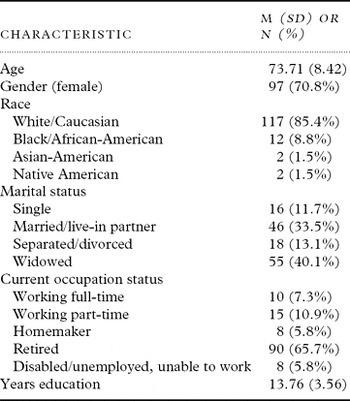
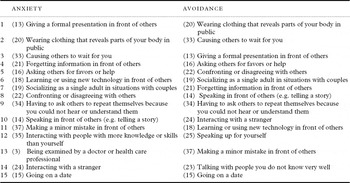
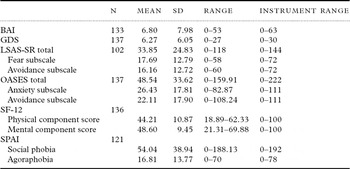
The age range for the sample (N = 137) is 60–94 years. Demographic characteristics are displayed in Table 1. OASES mean scores and standard deviations are as follows: OASES total score (M = 48.54, SD = 33.62), OASES anxiety subscale (M = 26.43, SD = 17.81), and OASES avoidance subscale (M = 22.11, SD = 17.90). Items that had the highest total scores were rank ordered and are presented in Table 2. All the items on the OASES were endorsed by participants. An examination of the skipped items on the OASES demonstrated that the five most frequently skipped items described situations that may not be relevant to all individuals, yet were frequently endorsed by some participants: going on a date, using medical treatment in public, attending a class (e.g. continuing education), using assisted devices in public, and driving while others are present.
Participant characteristics (N = 137)

Rank-ordered of items by mean response (N = 137)

Note: OASES item number is in parentheses.
Internal consistency of OASES
Internal consistency for the OASES total score and the two subscales was evaluated using Cronbach's α. The α coefficient for the combined scales was 0.97. The OASES anxiety subscale α coefficient was 0.94. The OASES avoidance subscale α coefficient was 0.95. The OASES anxiety and avoidance subscales were strongly correlated, r = 0.77, p < 0.001. Item-total correlation coefficients for the OASES anxiety subscale ranged from r = 0.31 to 0.75. The mean item-total correlation coefficient was 0.55. Item-total correlation coefficients for the OASES Avoidance subscale ranged from r = 0.33 to 0.74. The mean item-total correlation coefficient was 0.57.
Validity
Descriptive statistics for each questionnaire are presented in Table 3. Convergent and divergent validity were calculated with correlation analyses to evaluate the psychometric properties of the OASES.
Means and standard deviations for assessment measures

BAI = Beck Anxiety Inventory; GDS = Geriatric Depression Scale; LSAS-SR = Liebowitz Social Anxiety Scale-Self Report; OASES = Older Adult Social-Evaluative Situations Questionnaire; SF-12 = Short Form Health Survey; SPAI = Social Phobia and Anxiety Inventory.
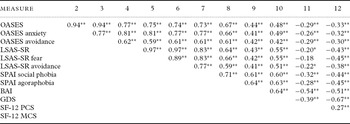
Pearson product-moment correlation analyses were conducted to examine the relation between the OASES and other measures of social anxiety (LSAS-SR and SPAI) and a measure of anxiety (BAI) as evidence of convergent validity. Results from these analyses are displayed in Table 4. As expected, medium to large correlations were found between the OASES and the LSAS-SR total score and SPAI social phobia subscale. A medium to large correlation was found between the OASES total score and the BAI. Pearson product-moment correlation analyses were conducted to examine the relation of the OASES subscales to the subscales of the other two social anxiety measures (LSAS-SR fear, LSAS-SR avoidance, and SPAI social phobia). These results are also displayed in Table 4. Medium to large correlations with the LSAS-SR total score, LSAS-SR subscales, SPAI social phobia subscale, and BAI were found.
Intercorrelations for measures

Note: N's for correlation analyses ranged from 98 to 137. **Indicates correlation is significant at the p < 0.01 level. *Indicates correlation is significant at the p < 0.05 level.
OASES = Older Adult Social-Evaluative Situations Questionnaire; LSAS-SR = Liebowitz Social Anxiety Scale-Self Report; SPAI = Social Phobia and Anxiety Inventory; BAI = Beck Anxiety Inventory; GDS = Geriatric Depression Scale; SF-12 PCS = Short Form Health Survey, Physical Component Summary; SF-12 MCS = Short Form Health Survey, Mental Component Summary.
Discriminant validity was examined by conducting Pearson product-moment correlation analyses on the OASES and measures of depression (GDS) and health (SF-12). Further evidence for discriminant validity was gathered by examining the relation between demographic variables and the OASES. A medium correlation was found between the OASES and the GDS. A small correlation between the OASES and the physical component score of the SF-12 and a medium correlation with the mental component score of the SF-12 were found. Results from these analyses are displayed in Table 4. Discriminant validity was further examined through Pearson product-moment correlation analyses conducted on OASES total scores and age and years of education. A small to medium correlation was found between age and OASES total score (r = 0.22, p = 0.01). The relation between years of education and OASES total score was small and non-significant (r = −0.17, p = 0.06).
Discussion
This paper describes the development and findings of a preliminary examination of the psychometric properties of the OASES, a measure of older adult social anxiety. The results provide evidence in support of the validity and reliability of the OASES. The OASES was developed to be sensitive to social stimuli that are relevant to older adults to fill the void for a content valid measure of older adult social anxiety (Ciliberti et al., Reference Ciliberti, Gould, Smith, Chorney and Edelstein2011). Content validity of the OASES is evidenced by the presence of social situations that were endorsed by participants and were unique to this measure such as wearing clothing that reveals parts of your body in public, forgetting information in front of others, and learning or using new technology in front of others. The OASES was found to have excellent internal consistency for the overall score and for each subscales (anxiety and avoidance). Convergent validity of the OASES total score was established through correlations with the LSAS-SR (total score), SPAI social phobia subscale, and BAI. Support for the convergent validity of the anxiety subscale of the OASES was established through correlations with the LSAS-SR fear and avoidance subscales. Evidence for the convergent validity of the OASES avoidance subscale is evidenced by correlations with the LSAS-SR fear subscale, LSAS-SR avoidance subscale, and the SPAI social phobia subscale. The present study provides preliminary evidence suggesting that the OASES may be a valid measure of both anxiety and avoidance of social situations in older adults.
Support for the discriminant validity of the OASES is provided by the medium-sized correlation between the OASES and GDS. Some shared variance between the OASES and the GDS was expected in light of the overlap in symptoms and comorbidity of depression and anxiety (Segal et al., Reference Segal, June, Payne, Coolidge and Yochim2010). This overlap is also consistent with contemporary conceptualizations of emotional disorders that suggest common higher order trait dimensions (e.g. negative affect; Brown et al., 1998). The relation between depression and anxiety is evidenced by correlations between scores on the Geriatric Anxiety Scale and the GDS (r = 0.78; Segal et al., Reference Segal, June, Payne, Coolidge and Yochim2010), and the BAI and the Beck Depression Inventory (r = 0.48; Beck and Steer, Reference Beck and Steer1990). This relation is consistent with what one would expect if adopting the multitrait-multimethod approach to construct validity advocated by Campbell and Fiske (Reference Campbell and Fiske1959), which suggests that assessment instruments measuring the same trait or using the same method of assessment should be more highly correlated with each other than with assessment instruments measuring a different trait or using a different method of assessment. Further evidence in support of the discriminant validity of the OASES is the small correlation between the OASES total score and the physical component score of the SF-12, and the medium-sized correlation between the OASES total score and the mental component score of the SF-12. One would expect a somewhat larger correlation between the OASES and the SF-12 mental component score than with the physical component, as the mental component score taps affect (e.g. feeling calm, feeling downhearted) and the physical component taps physical functioning (e.g. limitations in activities, difficulty climbing stairs). Finally, small correlations were found between the OASES score and years of education and age, which supports the discriminant validity of the OASES.
The present study has a few limitations. The sample was comprised largely of women. Though older women outnumber older men according to census figures, the relatively small percentage of men may limit the generalizability of the present findings to men. Similarly, the generalizability of the present findings may be limited by the relatively small percentage of non-white participants. As the current sample was comprised of community dwelling older adults, the findings may not generalize to a clinical sample. Another potential limitation of the study is the procedure used to elicit anxiety-arousing situations from participants in the initial phase of instrument development (see Ciliberti et al., 2011). One could argue that when the initially developed list of potentially arousing situations was sent to older adults with the opportunity to add to the list, the presentation of situations could have attenuated the input being solicited. Moreover, the existing items could have otherwise influenced the responses of the participants. Several participants were removed from the analyses because of missing data, which is a common problem with studies of older adults (Hardy et al., Reference Hardy, Allore and Studenski2009). In future evaluations, researchers could examine whether changing the OASES instructions to ask participants to answer items as to how they think they might feel in that situation may preclude the failure to respond to some items.
In spite of the foregoing limitations, the development of the OASES as a content valid measure of older adult social anxiety appears to have been successful in our limited sample. Evidence in support of its convergent validity was demonstrated by medium- to large-sized correlations with other measures of social anxiety (LSAS-SR and SPAI social phobia subscale), and of anxiety (BAI). Discriminant validity was demonstrated by small correlations with age, years of education, and the physical component subscale of the SF-12. The evidence of reliability is promising as demonstrated by excellent internal consistencies. The present study provides preliminary evidence of the psychometric properties of the OASES. The potential of the OASES as a research and clinical measure is perhaps most exciting, as the absence of a developmentally sensitive measure of older adult anxiety has in many ways hindered its study.
Much remains to be explored with the measurement of older adult social anxiety, not the least of which is the further psychometric examination of the OASES. An examination of the test–retest reliability of the instrument would be desirable as an index of temporal stability. More research on discriminant validity is needed. An examination of the OASES in clinical samples and diverse samples of older adults would augment the present findings. Further refinement may occur as the acceptability and utility of the instrument is considered through its use with a variety of populations in a variety of settings.
Conflict of interest
None.
Description of authors’ roles
C. E. Gould designed the study, helped collect data, conducted the statistical analyses, and wrote portions of the paper. L. A. Gerolimatos helped with data collection and assisted with writing of the paper. C. M. Ciliberti designed the study, helped collect data, and assisted with writing of the paper. B. A. Edelstein designed the study, supervised data collection, and assisted with writing of the paper. M. D. Smith designed the study and assisted with data collection.
Acknowledgments
The authors would like to thank Daniel Chorney, PhD. Ami Bryant, and Kizma Button for their contributions to this research study. These data were presented at the annual American Psychological Association Convention (2011). The first author is supported by the Office of Academic Affiliations, Special Fellowship Program in Advanced Geriatrics, Department of Veterans Affairs. Views expressed in this paper are those of the authors and not necessarily those of the Department of Veterans Affairs.