Introduction
Women's vulnerability for a first episode of major depressive disorder (MDD) during midlife is substantial. While the incidence of first lifetime-onset MDD during midlife is lower than in young adulthood, 15–25% of midlife women with no prior MDD experience their first episode of MDD over 7–8 years (Bijl et al. Reference Bijl, De Graff, Ravelli, Smit and Vollebergh2002; Bromberger et al. Reference Bromberger, Kravitz, Matthews, Youk, Brown and Feng2009), translating to approximately 2–3% annually. The National Comorbidity Study reported that among 35- to 54-year-old women with no prior MDD, 1.7–2.5% had a first-onset of MDD within a 12-month period (Kessler et al. Reference Kessler, McGonagle, Zhao, Nelson, Hughes, Eshleman, Wittchen and Kendler1994). Whether risk factors differ for first-onset or recurrent MDD during midlife is unclear. Identifying risk factors for first lifetime-onset MDD is important because, for women with a MDD history, past MDD is the risk factor we focus on. For midlife women without such a history, identifying other risk factors is particularly important as such knowledge may guide clinicians in their care and monitoring of these women by more focused depression screening and earlier identification of depression risk. Furthermore, such risk factor information is important to know as a first episode in midlife may initiate a cycle of recurrent depression when women are becoming more vulnerable to chronic illnesses associated with depression, such as hypertension and diabetes.
The majority of prospective epidemiological studies that have examined predictors of first lifetime-onset MDD have done so in the population overall (Bruce & Hoff, Reference Bruce and Hoff1994; Kendler et al. Reference Kendler, Thornton and Gardner2000; De Graaf et al. Reference De Graaf, Bijl, Ravelli, Smit and Vollebergh2002; Grant et al. Reference Grant, Goldstein, Chou, Huang, Stinson, Dawson, Saha, Smith, Pulay, Pickering, Ruan and Compton2009). For example, several large studies of adults without lifetime MDD found that first-onset MDD was predicted by poverty status and being homebound (Bruce & Hoff, Reference Bruce and Hoff1994); negative life events (Bromberger et al. Reference Bromberger, Kravitz, Matthews, Youk, Brown and Feng2009); high neuroticism and sleep problems (Kendler et al. Reference Kendler, Thornton and Gardner2000; De Graaf et al. Reference De Graaf, Bijl, Ravelli, Smit and Vollebergh2002), and a history of anxiety disorders (Breslau et al. Reference Breslau, Schultz and Peterson1995; Goodwin, Reference Goodwin2002; Wittchen et al. Reference Wittchen, Beesdo, Bittner and Goodwin2003). However, whether these risk factors are relevant specifically for midlife and older women cannot be determined from these studies.
In addition to data from the first 7 years of the Study of Women's Health Across the Nation (SWAN; Bromberger et al. Reference Bromberger, Kravitz, Matthews, Youk, Brown and Feng2009), only two published prospective epidemiological studies have examined risk factors for first-onset MDD among middle-aged individuals. In this age group, separation or divorce and having less than a high school education (Gallo et al. Reference Gallo, Royall and Anthony1993); and self-reported poor health predicted first-onset MDD (Chou et al. Reference Chou, Mackenzie, Liang and Sareen2011). These studies are limited by short follow-up (1–3 years) and a small number of potential risk factors that do not include proximal time-varying factors or menopause-related characteristics that may be particularly important for midlife. In the current study, we evaluate multiple time-varying and menopause-related characteristics as risk factors for first-onset and/or recurrent MDD.
Initial multivariable analyses examining the risk for first lifetime-onset MDD during the first 7 years of SWAN in the Pittsburgh SWAN cohort, aged 42–52 years at study entry, revealed that lifetime history of an anxiety disorder [hazard ratio (HR) 2.20, p = 0.02] and role limitations due to physical health (HR 1.88, p = 0.07) at baseline and a very stressful life event (HR 2.25, p = 0.04) prior to depression onset predicted a first-onset MDD, but neither menopausal status nor frequent vasomotor symptoms (VMS: hot flashes or night sweats) did (Bromberger et al. Reference Bromberger, Kravitz, Matthews, Youk, Brown and Feng2009). By contrast, in longitudinal analyses of all Mental Health Study (MHS) participants who were pre-menopausal at baseline, peri- and post-menopause status significantly increased the risk of a major depressive episode, the majority of which were recurrent episodes (Bromberger et al. Reference Bromberger, Kravitz, Chang, Cyranowski, Brown and Matthews2011). This suggests that the menopausal transition may be a more vulnerable time for recurrent than first-onset MDD.
In addition to risk factors for first-onset MDD described above, we will evaluate other known risk factors for MDD that may be particularly salient for first-onset MDD during midlife, including social relations, both size of social network and emotional and instrumental support (Brown & Moran, Reference Brown and Moran1994; Wade & Kendler, Reference Wade and Kendler2000) and health-related factors: physical illness, compromised functioning, and body size (body mass index; BMI) (Geerlings et al. Reference Geerlings, Beekman, Deeg and Van2000; Roberts et al. Reference Roberts, Deleger, Strawbridge and Kaplan2003). The current analyses examined predictors of both first lifetime-onset MDD and recurrent MDD during a 13-year follow-up. By contrast to previous reports (Freeman et al. Reference Freeman, Sammel, Lin and Nelson2006; Bromberger et al. Reference Bromberger, Kravitz, Matthews, Youk, Brown and Feng2009, Reference Bromberger, Kravitz, Chang, Cyranowski, Brown and Matthews2011), we were able to determine risk for MDD throughout the menopausal transition (MT) and post-menopause and in relation to health factors because nearly 100% of women were post-menopausal by the end of the study.
Specifically, we evaluated (1) whether lifetime psychiatric and health history or personality traits are risk factors for first lifetime-onset or recurrent MDD during midlife, (2) the contribution to first-onset or recurrent MDD by time-varying psychosocial and health-related factors, and (3) whether MT and post-menopause-associated factors (menopausal transition stage, VMS, reproductive hormones) increase the risk for first-onset or recurrent MDD. We examined each of these aims separately for women with and without lifetime MDD at study entry to identify similarities and differences in risk factors for the two groups.
Method
Participants and procedures
This study was conducted among participants at the Pittsburgh SWAN MHS site. SWAN is a multisite community-based prospective investigation of the menopausal transition and aging. The study design and sampling procedures have been described previously (Sowers et al. Reference Sowers, Crawford, Sternfeld, Morganstein, Gold, Greendale, Evans, Neer, Matthews, Sherman, Lo, Weiss, Kelsey, Lobo, Kelsey and Marcus2000). Each site recruited white women and a predetermined minority group. Eligibility criteria for SWAN included age 42−52 years, having an intact uterus, having had at least one menstrual period and no use of reproductive hormones in the previous 3 months, and for the Pittsburgh site, self-identifying as non-Hispanic white or black. Approximately 50% of those eligible to participate in SWAN in Pittsburgh entered the study. Pittsburgh SWAN study participants and those who were eligible but did not participate did not vary by race, marital status, parity, quality of life, social support or perceived stress.
Using random digit dialing and a voters’ registration list, 162 Black and 301 White women were enrolled at the SWAN Pittsburgh site. Written informed consent was obtained from participants in accordance with the University of Pittsburgh Institutional Review Board guidelines. Of the 463 women enrolled, 443 (95.7%) participated in the MHS, which began in 1996, concurrent with the SWAN parent study. There were no significant differences between the MHS participants and non-participants with respect to sociodemographic factors and Center for Epidemiologic Studies Depression (CES-D) scores ⩾16.
At study entry, approximately half the women were premenopausal and half were early peri-menopausal. Extensive data were collected at baseline and annually thereafter as part of the parent SWAN study, which tracks a variety of psychological, social and health parameters in women as they transition through menopause. Serum reproductive hormones were measured on days 2–5 of a menstrual cycle occurring within 60 days of the baseline visit and annually thereafter.
The Structured Clinical Interview for DSM-IV Axis I Disorders (SCID; Spitzer et al. Reference Spitzer, Williams, Gibbon and First1992) was conducted at SWAN MHS entry to obtain information on lifetime psychiatric history and then annually during a 13-year follow-up to establish the presence of current and interim psychiatric disorders occurring during the previous year. Eligibility for the current analyses required the completion of the baseline SCID and at least one follow-up SCID. A total of 425 participants are the subjects of this analysis.
Measures
Assessment of psychiatric disorders
Diagnoses of lifetime, annual and current major and minor depression and other psychiatric disorders were determined from interviews conducted by SCID-trained clinicians (Spitzer et al. Reference Spitzer, Williams, Gibbon and First1992) The SCID is a semi-structured psychiatric interview with adequate reliability that has been used with many different ethnic groups and extensive field-testing has demonstrated its suitability for research purposes (Williams et al. Reference Williams, Gibbon, First, Spitzer, Davies, Borus, Howes, Kane, Pope, Rounsaville and Wittchen1992). In this study we have shown very good reliability for the diagnosis of depressive and anxiety disorders (kappa = 0.81–0.82) (Bromberger et al. Reference Bromberger, Kravitz, Chang, Cyranowski, Brown and Matthews2011). Minor depression was defined as having at least two MDD symptoms (one of which was low mood or anhedonia) and impairment in functioning. Lifetime psychotropic medication use was determined from the baseline SCID interview.
Baseline and stable characteristics
Demographic factors
Educational attainment was dichotomized as at least a college degree or not. Marital status was defined as married/living as married v. unpartnered (i.e. never married, separated/divorced, widowed). Difficulty paying for basics was a two-level categorical variable (very or somewhat hard v. not very hard) indicating the presence/absence of financial strain.
Health history
Lifetime medical conditions were self-reported. Participants were asked if they had ever been told by a healthcare provider that they had any of 13 pre-specified medical conditions. Physical activity level was measured with a 19-item composite continuous measure (range 3–15) (Baecke et al. Reference Baecke, Burema and Frijters1982; Sternfeld et al. Reference Sternfeld, Ainsworth and Quesenberry1999) that assessed physical activity in four domains: occupation, household/caregiving, sports/exercise, and daily routine.
Psychosocial characteristics
Three personality traits known to be relatively stable and frequently associated with depression were assessed at baseline with response categories ranging from 0 (not at all like me) to 3 (a lot like me). Each scale was summed with high scores indicating more of the trait. Trait anxiety, characterized by chronic negative emotions including sadness, anxiety, and anger, was assessed with the 10-item modified version of the State-Trait Personality Inventory (Spielberger et al. Reference Spielberger, Gorsuch and Lushene1970; Spielberger & Reheiser, Reference Spielberger and Reheiser2009). Private self-consciousness, which measures the tendency to attend to internal thoughts and feelings, was assessed with the 10-item Self-Consciousness Scale – Revised (Scheier & Carver, Reference Scheier and Carver1985b ). Dispositional optimism, a cluster of constructs (perceived control, positive expectations, lack of helplessness) was assessed with the 6-item Life Orientation Test (Scheier & Carver, Reference Scheier and Carver1985a ).
Social network or integration was assessed by asking ‘About how many close friends and close relatives do you have, that is, people you feel at ease with and can talk to about what is on your mind?’ Based on the distribution within our sample, this construct was dichotomized as those with ⩾6 close friends/relatives (including household members) v. ⩽5.
Time-varying characteristics
For all longitudinal modeling, with the exception of concurrent menopausal status and reproductive hormone levels, time-lagged analyses were used such that time-varying variables at time T were used to predict the MDD onset at the subsequent annual visit (time T + 1). Lagged variables consisted of VMS, psychosocial characteristics, and health-related factors. Most of the time-varying variables were obtained annually (except where noted below), which allowed us to examine proximal risk factors for MDD.
Menopause-related characteristics
Similar to World Health Organization recommended classifications (WHO, 1996) menopausal status was based on menstrual bleeding patterns in the previous 12 months: (a) premenopausal – menstrual period in the past 3 months with no change in regularity); (b) MT (peri-menopausal): change in regularity, but some menstrual bleeding within the past 12 months; (c) post-menopausal: no menstrual period within the past 12 months.
Reproductive hormone levels
Serum samples were assayed for estradiol (E2), follicle-stimulating hormone (FSH), and testosterone (T) at the SWAN central laboratory using a double-antibody chemiluminescent immunoassay as previously described (Bromberger et al. Reference Bromberger, Schott, Kravitz, Sowers, Avis, Gold, Randolph and Matthews2010).
Frequent vasomotor symptoms
At each visit, women were asked how often they had experienced hot flashes and night sweats in the past 2 weeks (McKinlay & Jefferys, Reference McKinlay and Jefferys1974; Matthews et al. Reference Matthews, Wing, Kuller, Meilahn and Plantinga1994). We defined frequent VMS as those occurring at least 6 days in the past 2 weeks.
Psychological and social factors
Both depressive and anxious symptoms can represent risk factors for or a prodrome to subsequent MDD (Kravitz et al. Reference Kravitz, Schott, Joffe, Cyranowski and Bromberger2014). We included these to determine whether other characteristics had a role in MDD onset independent of earlier symptomatology. Depressive symptoms were assessed with the CES-D scale, a 20-item scale measuring frequency of depressive symptoms during the previous week (Radloff, Reference Radloff1977). Anxiety symptoms were assessed using a 4-item scale (Neugarten & Kraines, Reference Neugarten and Kraines1965) to rate the frequency [0 (none) to 4 (daily)] of anxiety-related symptoms (feeling tense or nervous, fearful for no reason, irritable or grouchy, and heart racing or pounding) over the previous 2 weeks.
Sleep problems were determined from self-reported number of nights of difficulty falling asleep, staying asleep or early morning awakening during each of the previous 2 weeks. A sleep problem was defined if at least one of the three sleep symptoms was reported at least three times a week (Kravitz et al. Reference Kravitz, Zhao, Bromberger, Gold, Hall, Matthews and Sowers2008).
Social support was a summed score of frequency of availability of four types of needed emotional and instrumental supports (Sherbourne & Stewart, Reference Sherbourne and Stewart1991). Stressful events were assessed annually with a checklist of 18 life events and then rated according to how upsetting they were (Bromberger et al. Reference Bromberger, Kravitz, Chang, Randolph, Avis, Gold and Matthews2013).
Health-related factors
Presence of 13 medical conditions in the previous year were queried annually. Because almost 80% had one or no conditions at the first follow-up visit, we categorized this variable as 2 or more v. none/1. BMI (kg/m2) was calculated from measured weight and height.
Bodily pain and role function (role limitations related to physical health or emotional problems) were assessed using subscales from the SF-36 (Ware & Sherbourne, Reference Ware and Sherbourne1992). Each scale was dichotomized using the 25th percentile of the sample as the cut point for impaired functioning as previously established (Rose et al. Reference Rose, Koshman, Spreng and Sheldon1999). These scales were not included in annual visits 4, 7, 9, and 11 because they did not change markedly over 1 year and to reduce study burden. Thus, for example, role function data from visit 3 were used to predict MDD at visit 5.
Statistical analysis
Standard descriptive statistics were used to characterize the study sample at baseline. Characteristics of women with and without lifetime MDD were compared via χ2 and Student's t tests as appropriate. Thereafter, stratified analyses were conducted to examine associations with onset of an episode of depression during follow-up separately in the two groups. Analytic sample size varied slightly (411–425) because of random missing data of particular characteristics. Reproductive hormones required natural logarithm transformation to reduce skewness. Analyses were run using SAS version 9.3 (SAS Institute Inc., USA). Two tailed p values < 0.05 were considered statistically significant for individual predictors. To minimize over-parameterization and collinearity, all variables were first examined in bivariate analyses in each of the lifetime MDD history groups. Characteristics associated with onset of MDD at the p < 0.15 level were further evaluated in separate Cox multivariable models organized by domains for each MDD group. Each of the five domains was comprised of variables that reflected similar characteristics, specifically: demographic and stable traits, lifetime health history; time-varying – health-related, psychosocial, and menopause-related characteristics. To balance inclusion and over-parameterization, characteristics associated with MDD onset at the p < 0.15 level in the separate domain models were then examined together in a single multivariable model for each lifetime MDD group. The final model used Cox multivariable analyses with backward selection to estimate the association of candidate baseline and time-varying factors with onset of an MDD episode during the study follow-up at the p < 0.10 level, to provide a conservative estimate of characteristics associated with onset MDD for each group.
Cox analyses allow women with individual missing visits or missing covariates to contribute data at all time points (up to 13 visits) at which their data are complete until an event or censoring is reached. A woman met criteria for MDD onset (‘case’) at the particular visit in which she was diagnosed with current or past year MDD. Only the first episode was counted as the outcome as after a woman was first diagnosed as a ‘case’ her data were dropped from the analysis. Women without an onset of MDD (‘non-cases’) contributed data until the end of the study or their last known visit (prior to being lost to follow-up). Menopausal status and reproductive hormone levels were taken from the concurrent visit. Lagged analyses were employed such that all other time-varying variables were taken from the visit prior to being deemed a case or non-case.
Results
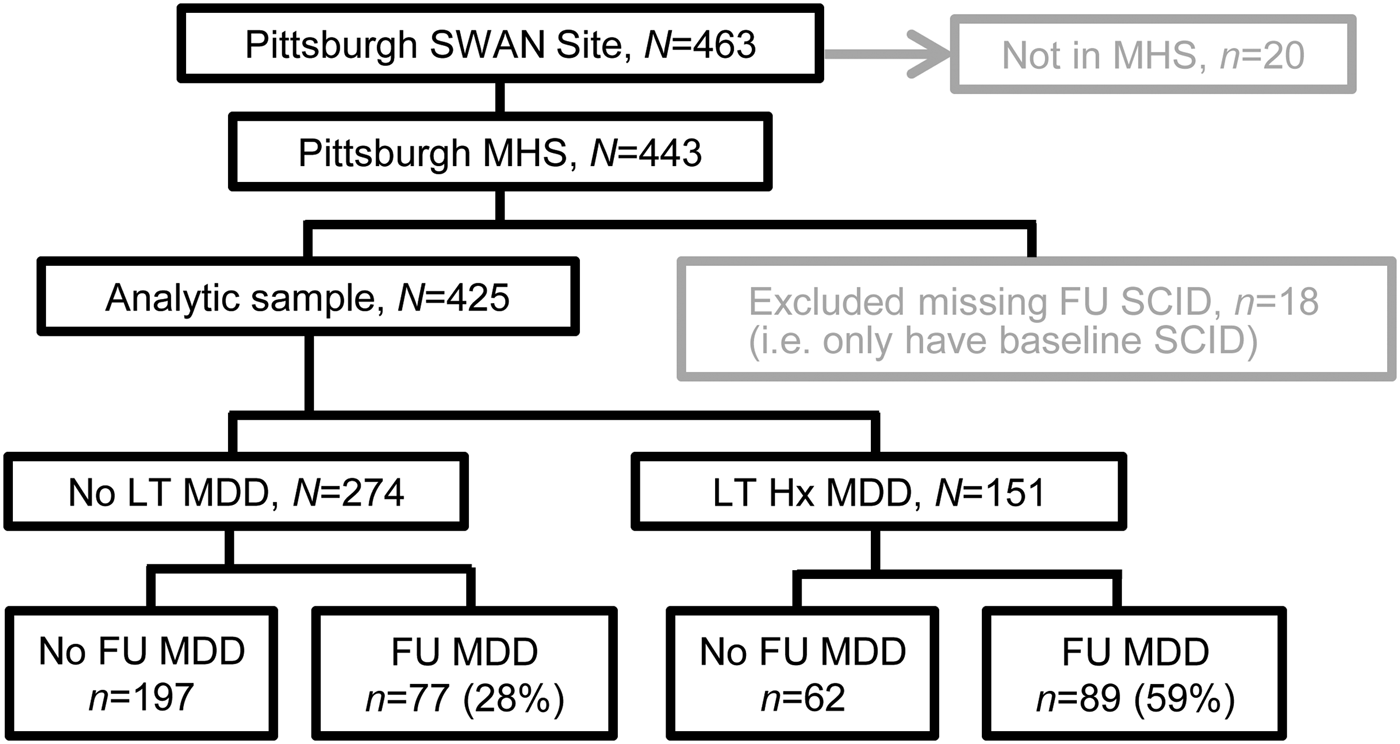
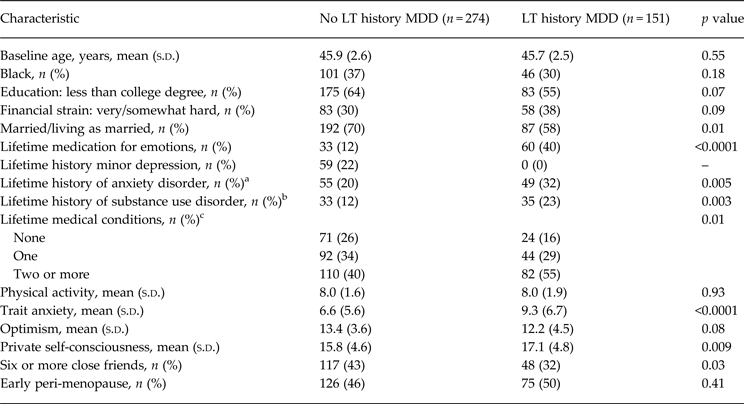
Of 443 women completing baseline SCID interviews, 425 (96%) had at least one follow-up assessment. Of these, 151 (36%) women had lifetime MDD at the time of the baseline visit and 274 (64%) did not. During follow-up, 28% (n = 77) of those without and 59% (n = 89) of those with lifetime MDD experienced at least one MDD episode (Fig. 1). Of the total 259 women without an MDD onset during SWAN, approximately 70% contributed data through visit 13. Among the total 425 in the analysis, on average, women completed 11 of 13 follow-up visits. Almost all women (98% without and 97% with a lifetime history of MDD) were post-menopausal by their last annual visit. Table 1 shows that compared to women without a history of MDD, those with a MDD history had a significantly higher prevalence of lifetime anxiety and substance use disorders, a greater number of medical conditions, higher trait anxiety and private self-consciousness, fewer than six close friends, a higher percentage that used psychotropic medications and a smaller percent that were married.
Sample for analyses of incident major depressive disorder (MDD) (follow-up 1-13 years) by lifetime history of MDD. FU, Follow-up, SWAN, Study of Women's Health Across the Nation; MHS, Mental Health Study; SCID, Structured Clinical Interview for DSM-IV Axis I Disorders; LT, lifetime.

Baseline characteristics of women with and without a lifetime history of MDD

LT, Lifetime; MDD, major depressive disorder; s.d., standard deviation.
a Lifetime history of anxiety disorder included panic, agoraphobia without panic, social phobia, specific phobia, obsessive-compulsive disorder, generalized anxiety disorder, anxiety disorder not otherwise specified.
b Lifetime history of substance disorder included alcohol and non-alcohol abuse or dependence.
c Lifetime medical conditions at baseline included ever having anemia, diabetes, high blood pressure, arthritis/osteoarthritis, thyroid disease, heart attack/angina, fibroids, cancer (other than skin cancer), migraines, hypercholesterolemia, osteoporosis, and stroke.
Bivariate analyses
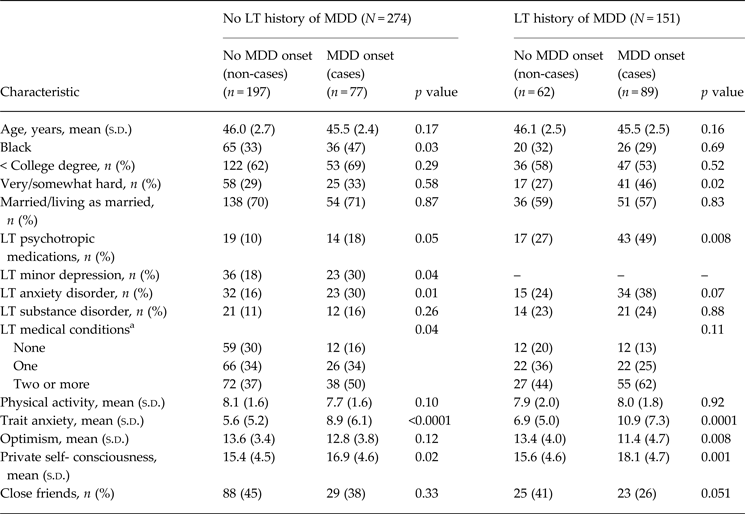
Table 2 shows that the baseline characteristics more prevalent (p < 0.15) in women with subsequent MDD episodes in both groups (with and without baseline lifetime MDD) included higher mean trait anxiety and mean private self-consciousness, lower mean optimism, and a higher percentage with lifetime anxiety disorder, two or more lifetime medical conditions and past use of psychotropic medication. Among women with no lifetime MDD, those who developed a first-onset MDD episode during follow-up were more likely to be black, have lower mean physical activity levels, and to have had prior minor depression than those who did not develop MDD. In contrast to women without lifetime MDD, characteristics predicting a recurrence of MDD during the follow-up period in women with lifetime MDD included financial strain and having fewer than six close friends/relatives.
Baseline/stable characteristics of women with and without incident MDD during follow-up assessments for women with and without lifetime history of major depression

LT, Lifetime; MDD, major depressive disorder; s.d., standard deviation.
a Lifetime medical conditions included ever having anemia, diabetes, high blood pressure, arthritis/osteoarthritis, thyroid disease, heart attack/angina, fibroids, cancer (other than skin cancer), migraines, hypercholesterolemia, osteoporosis, and stroke.
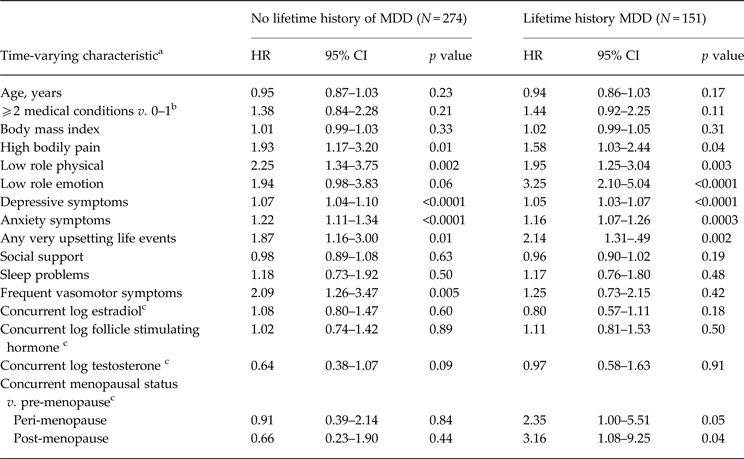
The individual Cox models (Table 3) for each predictor showed that the time-varying characteristics associated with a follow-up MDD episode (p < 0.15) were similar for those with and without lifetime MDD. Only frequent VMS and lower mean log testosterone level were associated with MDD developing during follow-up among women without lifetime MDD but not in those with lifetime MDD. By contrast, menopausal status and reporting two or more medical conditions were associated with a follow-up MDD episode developing among women with lifetime MDD but not among those without lifetime MDD.
Separate Cox models showing association with incident MDD during follow-up for women with and without lifetime history of MDD

CI, Confidence interval; HR, hazard ratio; MDD, major depressive disorder. Number of events (i.e. MDD onset/cases) varies for each model because of random missing characteristic data.
a Time-varying characteristics are lagged (i.e. from the visit prior to MDD onset) unless otherwise noted.
b Medical conditions included anemia, diabetes, high blood pressure, arthritis/osteoarthritis, thyroid disease, heart attack, angina, fibroids, cancer (other than skin cancer), migraines, hypercholesterolemia, osteoporosis, and stroke.
c Hormone values and menopause status are concurrent with MDD episode (case)/final visit (non-cases). The hormone and menopause status models are run without observations where menopausal status is ‘unknown’ (i.e. because of exogenous hormone therapy use) and ‘surgical’ (i.e. bilateral oophorectomy and/or hysterectomy).
Multivariable cox proportional hazards models
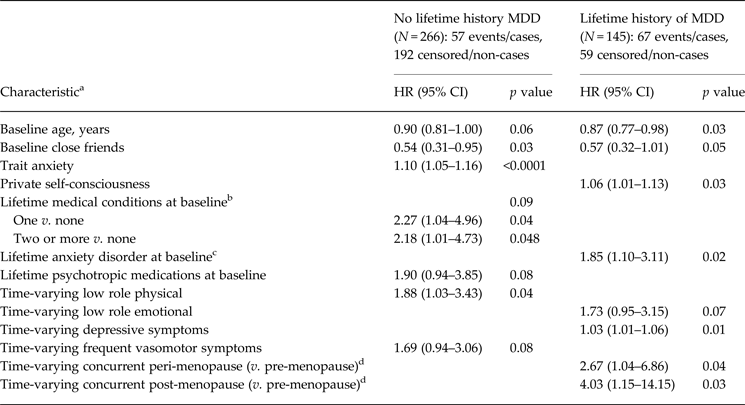
Women without a lifetime history of MDD (Table 4): The final backward selection analyses included candidate predictors from the domain multivariable analyses. Results showed that trait anxiety increased the risk for an MDD episode occurring during follow-up by 10% for every 1-point increase in the anxiety scale score, having at least one medical condition prior to study entry more than doubled the risk, and impaired role functioning because of physical health problems at the previous visit increased the risk by 88%. The highest prevalences of lifetime medical conditions for women with an MDD episode were anemia (45%), high blood pressure (25%), osteoarthritis (26%), fibroids (22%), and migraines (27%) with 31.8% of women having more than two conditions. Having at least six close friends reduced the risk of developing MDD by almost 50%. Younger age at study entry, lifetime psychotropic medication use, and frequent VMS during follow-up were each associated with risk of MDD at the level of a statistical trend (0.05 < p < 0.10), while neither menopausal status nor testosterone levels were risk factors in this subgroup.
Combined multivariate Cox models showing association with incident MDD during follow-up for women with and for women without lifetime history of MDD

CI, Confidence interval; HR, hazard ratio; MDD, major depressive disorder.
a Additional characteristics that were included in the models but removed because of selection criteria (i.e. association was not p < 0.10) were race, and time-varying anxiety symptoms and life events. Time-varying characteristics are lagged (i.e. from the visit prior to first onset/incident recurrent MDD) unless otherwise noted. [Characteristics not included in the models because of domain selection criteria (i.e. association was not p < 0.15 in individual domain models – see text) included baseline financial strain, optimism, minor depression, and total physical activity, and time-varying high body pain and two or more medical conditions. Additionally, concurrent log testosterone (p > 0.10) was not included in the final multivariate models missing hormone data reduced the overall number of events/cases by 17%.] Eight women with no lifetime history of MDD and six women with lifetime history of MDD, who were missing a baseline and/or stable characteristic, were dropped from their respective model. Note, cases with missing values in the time-dependent covariates (17 without lifetime MDD and 19 women with lifetime MDD, respectively) are not counted as event observations, but their data may still be used in the risk sets of other event times.
b Lifetime medical conditions at baseline included ever having anemia, diabetes, high blood pressure, arthritis/osteoarthritis, thyroid disease, heart attack, angina, fibroids, cancer (other than skin cancer), migraines, hypercholesterolemia, osteoporosis, and stroke.
c Lifetime anxiety disorder included panic disorder, agoraphobia without panic, social phobia, specific phobia, obsessive compulsive disorder, generalized anxiety disorder, and anxiety disorder not otherwise specified.
d Menopausal status is concurrent with MDD episode (case)/final visit (non-cases). Models are run without observations where menopausal status is ‘unknown’ (i.e. because of exogenous hormone therapy use) and ‘surgical’ (i.e. bilateral oophorectomy and/or hysterectomy).
Women with a lifetime history of MDD (Table 4): Having a history of an anxiety disorder increased the risk of a subsequent MDD episode by 85% and a tendency towards self- or internal-focused attention increased the risk by 6% for every 1-point increase in the scale score. Similarly, for every 1-unit increase in the depressive symptom score (CES-D) from the visit prior to MDD onset, the risk of an MDD episode increased by 3%. Being peri- or post-menopausal compared to pre-menopausal, more than doubled and quadrupled, respectively, the risk of a MDD episode, and reporting role limitations due to emotional concerns increased risk for MDD during follow-up at the level of a statistical trend (p = 0.07). Older age and having at least six close friends at study entry each reduced the risk of developing MDD during follow-up. Frequent VMS was not a risk factor for recurrence of MDD.
Discussion
In this 13-year prospective cohort study of midlife women with and without a history of MDD prior to enrollment, we observed that a significant proportion developed a MDD episode during follow-up and that risk factors varied according to prior depression history. Women without prior MDD were much less likely to experience an episode of MDD during follow-up than were those with prior MDD (28% v. 59%). While the two-fold difference in recurrent and first lifetime-onset of MDD is not surprising, the study results suggest that women who had lived nearly 50 years without experiencing MDD have different risk profiles for developing an episode during midlife than do those with a prior history of MDD.
Our findings indicate that having a chronic medical condition prior to midlife and perceived role limitations due to physical problems during the subsequent years independently predict a first-onset MDD during midlife, but not a recurrent episode. Noteworthy is the absence of an association between medical conditions reported during follow-up and risk for subsequent MDD, suggesting that a woman's perception of the effect of her physical health on her functioning at midlife may be a more salient risk factor for first-onset MDD than a medical condition that persists or one that develops during midlife more proximal to the MDD episode.
Risk factors for recurrence of MDD during midlife differed from those for first lifetime-onset of MDD. Consistent with literature supporting the contribution of psychosocial factors to depression (Nolen-Hoeksema, Reference Nolen-Hoeksema2000; Kessler, Reference Kessler2003), we observed traditional risk factors for depression recurrence in midlife; i.e. history of anxiety disorder, being more internally focused or ruminative, as well as having higher depression symptoms and perceiving role limitations due to emotional problems at the annual assessment preceding the onset of MDD recurrence. We also identified an important midlife-specific risk factor for depression recurrence (but not first-onset); being either peri- or post-menopausal increased the risk for a MDD episode relative to pre-menopause status. Annual serum reproductive hormone levels were not associated with MDD recurrence (or first-onset) across the transition, but are limited by being one cross-sectional measure per year in our study. Nevertheless, the absence of an association between hormone levels and depression is consistent with previous studies (Schmidt et al. Reference Schmidt, Murphy, Haq, Danaceau and St Clair2002).
This is the first study to prospectively evaluate the risk for MDD throughout the MT and post-menopause and results are consistent with earlier analyses of the first 7 and 10 years of SWAN data (Bromberger et al. Reference Bromberger, Kravitz, Matthews, Youk, Brown and Feng2009, Reference Bromberger, Kravitz, Chang, Cyranowski, Brown and Matthews2011, respectively). Two epidemiological studies examined risk for first-onset depression through early peri-menopause, but not the entire MT and post-menopause, and reported that the MT elevated risk for first-onset of a depressive disorder (Cohen et al. Reference Cohen, Soares, Vitonis, Otto and Harlow2006; Freeman et al. Reference Freeman, Sammel, Lin and Nelson2006). In addition to the limited follow-up, the two studies were limited methodologically in their assessment of major depression history or durng the study.
A few risk factors were shared by both groups. Having ⩾6 close friends at study entry was protective, reducing the risk of an episode by nearly half. Being older at study entry was also protective for both groups, although at a trend level for those without prior MDD. A predisposition for anxiety, either trait or disorder, appears to increase risk for a first-onset or recurrent episode of MDD during midlife, respectively.
Similar to our results, the National Epidemiologic Survey on Alcohol and Related Conditions (NESARC), a large population-based prospective study of adults, reported that risk factors for first-onset MDD at 3 years of follow-up included being younger than 50 years and having a lifetime history of an anxiety disorder (Grant et al. Reference Grant, Goldstein, Chou, Huang, Stinson, Dawson, Saha, Smith, Pulay, Pickering, Ruan and Compton2009; Chou et al. Reference Chou, Huang, Goldstein and Grant2013). In the subset of older women (age > 60 years) in the NESARC, poor self-rated health at baseline, but neither stressful life events nor number of medical conditions at baseline was associated with first lifetime-onset MDD over follow-up (Chou et al. Reference Chou, Mackenzie, Liang and Sareen2011). We followed our sample of women over a longer period of time than did NESARC and collected more health information prior to the onset of MDD, a methodological difference which may account in part for the strong finding for the relationship between number of medical conditions at baseline in our study, but not in NESARC.
The long follow-up period and frequency of assessments in our study are important strengths. This is the only study that assessed both lifetime exposures and prospectively measured proximal time-varying factors as risk factors for midlife onset of first lifetime MDD in women. Other strengths include the use of a standard psychiatric interview to diagnose lifetime psychiatric disorders and to determine between-visit MDD episodes and blacks comprised one-third of our sample. We also included menopause-related variables as well as traditional mental health variables.
Limitations include the possibility that although the ‘proximal’ experiences in the lagged analyses are from 1 year prior, some of these phenomena (e.g. VMS) may change frequently within a year. The self-report health data were not independently verified and could be inaccurate although such data are commonly used in epidemiological studies. Serum samples were collected annually which under-represents the variability of E2 and FSH and does not capture the dynamic nature of these hormones during the MT. Finally, the lifetime and annual SCID diagnoses are determined retrospectively, raising issues of reliability of recall. Past minor depression might have met MDD criteria in someone with better recall for the episode details which could result in misclassification of no lifetime MDD for those with lifetime minor depression reducing the between-group differences in risk factors. Women who were depressed at the time of interview may have been more likely to recall depression as studies have reported that current mood may influence recall of periods of similar mood. However, only 3.4% (n = 15) of all women (9.5% of the women with lifetime MDD) had current MDD at study entry. Nevertheless, although we used state-of-the-art methods (SCID) and carefully assessed lifetime symptoms and disorder in each woman, it is possible that misclassification occurred.
In summary, midlife women without prior MDD are at a lower risk for developing an episode of MDD during midlife than those with a prior history of MDD and the risk profile for first lifetime-onset differs from that of recurrent MDD. Specifically, health factors appear to be important risk factors for first-onset of MDD, whereas more traditional psychiatric illness histories and psychological symptoms are predominant risk factors for MDD recurrence. It is also notable that being peri- or post-menopausal confers risk for MDD recurrence, but not first lifetime-onset of MDD. Taken together, these findings suggest that midlife warrants attention as a period of vulnerability to MDD. The menopausal transition is a particular period of risk for those with a prior MDD history and health factors should be considered important risk factors for first lifetime-onset of MDD during midlife for those who have previously not been susceptible to major mood disturbance.
Acknowledgements
The Study of Women's Health Across the Nation (SWAN) has grant support from the National Institutes of Health (NIH), DHHS, through the National Institute on Aging (NIA), the National Institute of Nursing Research (NINR) and the NIH Office of Research on Women's Health (ORWH) (Grants U01NR004061; U01AG012505, U01AG012535, U01AG012531, U01AG012539, U01AG012546, U01AG012553, U01AG012554, U01AG012495). The SWAN Mental Health Study has grant support from the National Institute of Mental Health (R01MH59689). The content of this manuscript is solely the responsibility of the authors and does not necessarily represent the official views of the NIA, NINR, ORWH or the NIH. Clinical Centers: University of Michigan, Ann Arbor – Siobán Harlow, PI 2011–present, MaryFran Sowers, PI 1994-2011; Massachusetts General Hospital, Boston, MA – Joel Finkelstein, PI 1999–present; Robert Neer, PI 1994–1999; Rush University, Rush University Medical Center, Chicago, IL – Howard Kravitz, PI 2009–present; Lynda Powell, PI 1994–2009; University of California, Davis/Kaiser – Ellen Gold, PI; University of California, Los Angeles – Gail Greendale, PI; Albert Einstein College of Medicine, Bronx, NY – Carol Derby, PI 2011–present, Rachel Wildman, PI 2010–2011; Nanette Santoro, PI 2004–2010; University of Medicine and Dentistry – New Jersey Medical School, Newark – Gerson Weiss, PI 1994–2004; and the University of Pittsburgh, Pittsburgh, PA – Karen Matthews, PI. NIH Program Office: National Institute on Aging, Bethesda, MD – Winifred Rossi 2012–present; Sherry Sherman 1994–2012; Marcia Ory 1994–2001; National Institute of Nursing Research, Bethesda, MD – Program Officers. Central Laboratory: University of Michigan, Ann Arbor – Daniel McConnell (Central Ligand Assay Satellite Services). Coordinating Center: University of Pittsburgh, Pittsburgh, PA – Maria Mori Brooks, PI 2012–present; Kim Sutton-Tyrrell, PI 2001–2012; New England Research Institutes, Watertown, MA – Sonja McKinlay, PI 1995–2001. Steering Committee: Susan Johnson, Current Chair. Chris Gallagher, Former Chair. We thank the study staff at each site and all the women who participated in SWAN.
Declaration of Interest
Dr Joffe receives grant support from Cephalon/Teva and is a consultant/advisor for Noven and Merck. All other authors have no conflicts of interest.