Introduction
In line with much of the developed world, Ireland's population is aging (Foley and Freyne, Reference Foley and Freyne2005). A population increase rate for the over 65 years age group of 1.7% in 2006 jumped to 14.4% in 2011 (www.cso.ie, 2013). Data from the same year estimated that 47,000 people were living with dementia in Ireland. This figure is projected to treble in the coming three decades (Pierce and O'Shea, Reference Pierce and O'Shea2014). With increasing age well established as the most significant risk factor for the development of dementia, health services must anticipate the needs of this vulnerable group and plan for how we wish them to be met.
Data suggests that the diagnosis of dementia remains grossly inadequate (Joray et al., Reference Joray, Wietlisbach and Büla2004; Sampson et al., Reference Sampson, Blanchard, Jones, Tookman and King2009; Timmons et al., Reference Timmons2015). Early diagnosis affords opportunities to implement appropriate multi-disciplinary care and to access medications and support services. It allows patients and carers to plan for the future. Existing data is in agreement that outcomes for hospitalized dementia patients are consistently worse than for their cognitively intact counterparts (Zekry et al., Reference Zekry2009; Draper et al., Reference Draper, Karmel, Gibson, Peut and Anderson2011; Sampson et al., Reference Sampson, Leurent, Blanchard, Jones and King2013). A formal diagnosis increases the likelihood that patients will be routed toward specific care pathways which can benefit outcomes (Ellis et al., Reference Ellis, Whitehead, Robinson, O'Neill and Langhorne2011).
Mild cognitive impairment (MCI) represents a specific risk factor for the development of dementia with multi-domain deficits highly predictive of subsequent transition (Bickel et al., Reference Bickel, Mösch, Seigerschmidt, Siemen and Förstl2006). It is associated with cardiovascular disease, depression, and poorer general health status (Comijs et al., Reference Comijs, Dik, Deeg and Jonker2004; Van Den Kommer et al., Reference Van Den Kommer, Comijs, Aartsen, Huisman, Deeg and Beekman2013), factors which are associated with dementia in their own right. Despite these links, however, studies examining the prevalence, detection, and outcomes associated with MCI are sparse, indicating a gap in the literature around this cognitive syndrome.
In addition, hospital studies to date have tended to focus on patients admitted under acute medical services where high rates of dementia have been detected (Joray et al., Reference Joray, Wietlisbach and Büla2004; Sampson et al., Reference Sampson, Blanchard, Jones, Tookman and King2009; Zekry et al., Reference Zekry2009). Data on the prevalence of dementia and associated outcomes in the wider hospital setting, encompassing a broader range of specialties, are lacking. As people live longer, increasing numbers of older patients are accessing surgical, oncological, and other specialty services that would traditionally have cared for a younger cohort. Information on the “cognitive make-up” of the hospital-wide older population is crucial to plan for service provision, provide for staff education and support and ensure equitable access for patients to specialist care pathways.
The aims of this study were as follows: (i) to examine the prevalence of dementia, MCI, and normal cognition among adults aged over 65 years admitted to a tertiary referral general hospital via any route and under any specialty; (ii) to delineate the characteristics of the three cohorts; (iii) to investigate rates of detection; and (iv) to assess the outcomes of the three groups at 6 and 12 months.
Methods
Study design
This was a prospective, observational study of patients aged 65 years and older who were admitted to St. James's Hospital (SJH) in Dublin, Ireland. SJH is Ireland's largest hospital. It is a university-affiliated teaching hospital, tertiary referral center and national referral center for a number of medical and surgical specialties.
Patients
Over a consecutive two-week period in October 2014, all patients aged 65 years and older who were admitted to SJH via any route (emergency, elective, hospital transfer) under any speciality (broadly categorized as medical, surgical, geriatric, hematology/oncology/radiation-oncology) were approached by a member of the research team and invited to participate in the study. Patients were excluded if they were medically unstable, receiving palliative care, unable to communicate in English or suffering from profound sensory impairment. Patients who were admitted and discharged within 72 hours were excluded due to the constraints of a small research team and time necessitated to administer a thorough cognitive battery on a large number of patients. The local ethics committee provided ethical approval for the study protocol. Each patient or their carer was given verbal and written information about the study and given a minimum of 24 hours to consider whether they wished to participate. The contact details of the research team were made available for further information if required. Written informed consent was obtained prior to participation from each patient or their next of kin when the patient was deemed to lack decision-making capacity. Positive findings and novel diagnoses were clearly documented in the patients’ medical notes. The clinical services of the Old Age Psychiatry team were made available to any patient, carer, or treating team in the case of a query or concern regarding the findings.
Procedures and data collection
Patients were recruited and data collected by two Registrars and two Clinical Nurse Specialists in Old Age Psychiatry. All had undergone formal training in the use of the specific assessment tools prior to the study period and deemed competent and consistent by the supervising Consultant in Old Age Psychiatry. Members of the team were available to recruit and assess at weekends.
The Confusion Assessment Method (CAM) (Inouye et al., Reference Inouye, Van Dyck, Alessi, Balkin, Siegal and Horwitz1990) was used to screen for delirium. Objective information about baseline cognition and mental state was obtained from family, carers, and ward staff familiar with the patient to inform the CAM. Those who had a positive screen did not undergo further testing at that point. Findings were conveyed to the treating team and patients were re-assessed two weeks later. If they screened negatively for delirium at that point, the cognitive assessment proceeded.
Demographic information, reason for admission, medical history, and prior cognitive diagnoses were obtained from the patients, their carers, the electronic patient record (EPR), medical notes, discharge summaries, and GP and medical correspondence.
The cognitive assessment battery comprised the 6-item cognitive impairment test (6-CIT), the standardized Mini-Mental State Examination (sMMSE), and the Montreal Cognitive Assessment (MoCA). Scores for the sMMSE and MoCA were normed for age and level of education using the normative values from a representative sample of the older Irish population participating in the Irish Longitudinal Study on Ageing (TILDA) (Kenny et al., Reference Kenny, Coen, Frewen, Donoghue, Cronin and Savva2013). Scores that fell to below the tenth percentile for age and level of education were deemed to indicate a cognitive impairment.
The Functional Assessment Staging Tool (FAST) was used to assess level of functional ability with input from patients, their carers, and familiar hospital staff. Additional information was obtained from occupational therapy and public health nurse assessments and medical correspondence.
MCI was diagnosed using the Petersen Criteria which require objective evidence of cognitive impairment – in our case test scores below the tenth percentile for age and education – with largely intact functional abilities (Petersen, Reference Petersen2004).
A diagnosis of dementia was given if cognitive and functional impairment were both present and the DSM-IV criteria for dementia were otherwise met (APA, 1994). Patients were classified into three groups (Dementia, MCI, Normal) on the basis of their cognitive diagnosis.
In cases where scores between various tests were discrepant, an expert opinion was sought from the supervising consultant who made the decision based on a review of all the available information. Cases where a decision was not reached due to either a lack of information or incomplete assessment were excluded from data analysis.
All patients were screened for depression and anxiety, using the 4-Item Geriatric Depression Scale (GDS-4) and the short form of the Geriatric Anxiety Inventory (GAI-SF), respectively.
The burden of medical co-morbidity was calculated using the Charlson Co-Morbidity Index (CCI) with data obtained from the sources outlined above. To enhance consistency, the same doctor calculated the CCI for all study participants with randomly selected cases reviewed by the supervising consultant.
Smoking and alcohol consumption was assessed by self-report or collateral information when necessary. Weekly consumption of greater than 21 units for a male and 14 units for a female was considered to indicate harmful use.
Outcomes of interest were the total length of the index admission, the discharge destination of the patient, the number of readmissions in the 6 and 12 months post-discharge, and mortality at 12 months post-admission. The EPR and discharge summaries provided much of this information. Telephone calls to GPs and public death notifications on www.rip.ie facilitated 100% completion of outcome data. Patients who were deceased during the index admission were excluded from further outcome analysis.
Statistics
Differences between categorical variables were tested for using Pearson χ 2 tests. Continuous, non-parametric variables were examined using Mann–Whittney U Tests and Kruskal–Wallis Tests. Linear regression models were constructed to explore the relationship between cognitive status and the outcomes: length of stay and number of readmissions. Logistic regression models were used to examine the outcomes of discharge home and mortality. Cognitive status was treated as the independent variable in these analyses. Covariates included age and sex level of education, CCI, admitting team, living circumstances, smoking and alcohol history, psychiatric history, family history of dementia, and anxiety and depression scores. Bootstrap analyses were performed to ensure the robustness of the results. Data were analyzed using SPSS Statistics 22 for Windows. Statistical significance was determined using p < 0.05.
Results
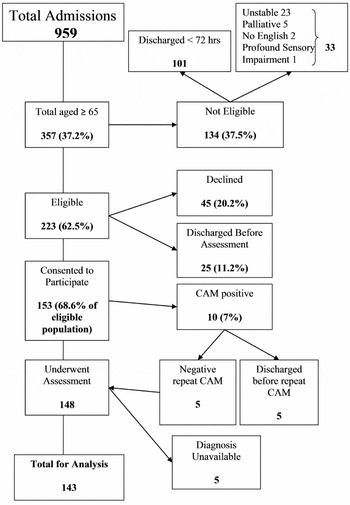
Figure 1 illustrates the study pathway. A total of 959 people were admitted over the two-week study period of whom 357 (37.2%) were aged 65 years or older. The most common reason for exclusion was patients being discharged within 72 hours of admission (75.3%). In addition, 23 (17.1%) were medically unstable, 5 (3.7%) were receiving palliative care, 2 (1.5%) were unable to communicate in English, and 1 (0.7%) had a profound speech and hearing impairment precluding assessment. Of the 223 patients who were eligible to participate, 45 (20.1%) declined and 25 (11.2%) were discharged before assessment. The remaining 153 patients who consented to participate represent 68.6% of the eligible study population.
Study pathway.

Ten (6.5%) patients screened positively for delirium and were re-screened two weeks later. Five screened negatively at that point and underwent the test battery. Five have been discharged in the intervening period. One-hundred-fourty-eight patients, therefore, were assessed in full. A diagnosis could not be reached for five patients and these were excluded from further analysis.
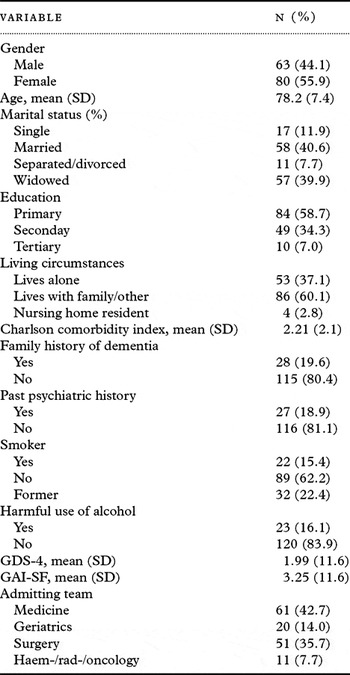
The cohort characteristics are summarized in Table 1. The mean age of the participants was 78.1 years (range 65–94). 47.6% of the group was aged 80 years or older. The majority were female (55.9%). Primary level education predominated and most lived with a spouse or family member. The mean burden of co-morbidity was an index of 2.21 (with an index of two predictive of 90% ten-year survival).
Characteristics of included patients

Cognitive impairment was present in 48% of the study population with 27.3% meeting the DSM-IV criteria for dementia and 21% meeting the criteria for MCI. Of those aged over 80 years, dementia prevalence rose to 41.2% and 14.7% for MCI. Only 41% of those with dementia and 10% of those with MCI had a previously documented cognitive impairment of any kind.
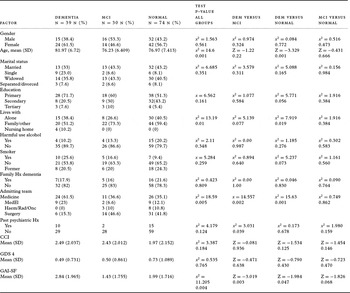
The characteristics of the three groups are outlined in Table 2. For the most part, the significant findings arose from differences between the dementia group and the normal group. Patients with dementia were older (p = 0.001) by five years than those with normal cognition. They were less likely to live alone and were more prevalent among medical admissions. Dementia patients were absent among the over 65 years receiving haem-/rad-/oncology care and were much less prevalent among those undergoing surgery. MCI patients, however, were present in each of these sub-specialties.
Characteristics of dementia, MCI, and normal groups

There was a trend to indicate that the more cognitively impaired groups had a lower level of formal education (primary education highest level achieved in 72% of dementia group vs. 60% of MCI group vs. 52% of the normal group) although the p-value fell to just above the cut-off for statistical significance for the dementia versus normal group (p = 0.056). Anxiety levels emerged as highly variable across the groups (p = 0.004) with mean anxiety screening scores highest among the dementia patients. By contrast, there was no difference when depression screening scores were compared.
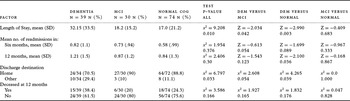
Outcomes at 6 and 12 months according to cognitive diagnosis are summarized in Table 3. Dementia was associated with longer hospital stays (p = 0.01). The mean length of hospital stay for dementia patients was 15.15 days longer than for the cognitively normal group (p = 0.003) and 13.95 days longer than for those with MCI (p = 0.042). There were no differences detected between the groups when comparing the number of readmissions to hospital in the six months following discharge. At 12 months, however, the dementia group had significantly more readmissions than the cognitively normal group (p = 0.036). Cognition impacted on discharge destination (p = 0.033) with 29.4% of dementia patients discharged to somewhere other than home in comparison to just 10% of MCI patients and 11.1% of the non-impaired group. Cognitive impairment did not impact on 12-month mortality across the groups.
Outcomes at 6 and 12 months

On multivariate analysis, the impact of cognition on outcomes remained significant for length of stay only with the strongest contribution to the model of all analyzed variables. Length of stay increased for those with dementia after adjustment with a mean stay 15.3 days (95% confidence intervals 1.9 to 18.8, p = 0.047) longer than for those with normal cognition. There was no significant association between cognitive status and other outcome variables on regression analyses.
Discussion
The key findings from this study are that cognitive impairment is pervasive among the elderly in the acute hospital, under-recognized by clinicians and associated with poorer outcomes. Our findings for prevalence and rates of detection of dementia are in line with the results of another Irish study that showed that 25% of patients aged over 70 years were found to have dementia, of whom only 35.6% had a prior dementia diagnosis (Timmons et al., Reference Timmons2015). When our findings are compared to similar international studies, our results place us somewhere in the middle of the spectrum. Travers et al. (Reference Travers, Byrne, Pachana, Klein and Gray2013) reported dementia rates of 20.7% among medical and surgical admissions in Queensland, Australia. 42% of medically admitted older patients in a London hospital had dementia, as reported by Sampson et al. (Reference Sampson, Blanchard, Jones, Tookman and King2009), of whom only 49% were previously diagnosed. This consistent discrepancy between the prevalence and recognition of dementia in clinical environments is striking. Clinician under-confidence, concerns about stigma, paternalism, fears around increased clinical responsibility, and potential barriers to discharge are some of the factors that may contribute to the status quo.
This is all the more concerning when we see the impact that a diagnosis of dementia has on patient outcomes. Our study showed that patients with dementia had a substantially longer length of hospital stay, an association that was strengthened on multivariate analysis. Longer hospital stays for patients with dementia have been noted in earlier studies, though the strength of the association is not always consistent in multivariate models (Sampson et al., Reference Sampson, Blanchard, Jones, Tookman and King2009; Zekry et al., Reference Zekry2009). It is difficult to determine what may drive this phenomenon. Intuitively, we must consider the lengthy process necessitated in Ireland to move a patient from an acute facility to a long-term care facility. However, on multivariate analysis, those with dementia were not more likely to go to institutional care. A potential explanation may be that these patients were awaiting the placement of additional supports at home before they could be safely discharged. Perhaps, they required lengthier rehabilitation periods because of their cognitive and functional deficits. They may have been more vulnerable to the development of secondary medical problems or more likely to become behaviorally disturbed in the unfamiliar hospital environment, all of which may have added to their length of stay.
We also showed, on univariate analysis, that patients with dementia were more likely to be readmitted to hospital than those with normal cognition in the year following discharge and less likely to be discharged home. Hospitalized elderly are at risk of loss of independence (Lafont et al., Reference Lafont, Gerard, Voisin, Pahor and Vellas2011), nosocomial infection (Hussain et al., Reference Hussain, Oppenheim, O'Neill, Trembath, Morris and Horan1996), falls (Healey et al., Reference Healey, Monro, Cockram, Adams and Heseltine2004), and delirium (Buurman et al., Reference Buurman2011).
These findings have significant implications for healthcare budgets. In 2015, Bail et al. demonstrated that the average cost of care per hospital episode is significantly more for patients with dementia than for those without. Additionally, patients with dementia were twice as likely to suffer complications during their hospital stay, which added substantially to the overall cost of their stay (Bail et al., Reference Bail, Goss, Draper, Berry, Karmel and Gibson2015). The identification of patients with dementia at an early point during a hospital admission affords an opportunity to implement enhanced discharge planning that is tailored to meet the specific needs of this group, thereby minimizing the risk of some of these adverse physical, social, and financial outcomes.
We did not demonstrate an association between dementia and mortality. This contrasts with Sampson et al.’s (Reference Sampson, Leurent, Blanchard, Jones and King2013) finding. The mean CCI of their patient cohort was 2.8, indicating a higher burden of co-morbidity than that of our population with a CCI of 2.1. We suspect that the lower co-morbidity index in our group reflects the broad inclusion criteria which allowed us to incorporate patients from the full range of hospital specialties into our sample. We also acknowledge the possibility that some participants who were deceased at follow-up may have gone undetected due to limitations of our follow-up methodology. Our findings, however, are consistent with two other studies that failed to find an association between dementia inpatients and interval mortality after adjustment (Joray et al., Reference Joray, Wietlisbach and Büla2004; Zekry et al., Reference Zekry2011).
Literature examining the prevalence of MCI in hospital populations is relatively scarce. Zekry et al.’s (Reference Zekry2009) prospective study reported a prevalence of 11% for MCI among an inpatient cohort with a mean age of 85 years. 14% of our over-80s met the criteria for MCI. This figure was higher (21%) for our overall population though still significantly less than the prevalence of 36.1% detected in a large multicenter study in Munich (Bickel et al., Reference Bickel, Mösch, Seigerschmidt, Siemen and Förstl2006). The decline in the prevalence of MCI with increasing age in our population coincides with an increase in dementia prevalence and may reflect the eventual transition of a proportion of patients from MCI to dementia. In accordance with our findings, MCI patients in Zekry et al.’s series behaved more like those with normal cognition when examining outcomes. We surmise that this may be due, in part, to the etiological heterogeneity of MCI patients. The scope of our study did not allow for more detailed classification of our MCI patients – or, indeed, more detailed classification of our dementia patients – for example, into amnestic versus non-amnestic groups, which may have allowed us to select those with a profile that was more suspicious for an underlying neurodegenerative process. Whether such a group is more vulnerable in terms of hospital outcomes remains unclear.
In contrast to findings from Timmons et al. (Reference Timmons2015), depressive symptoms did not emerge as differing significantly between our groups. Mean anxiety screening scores, however, differed significantly according to cognitive status, with the highest scores detected in those with dementia. When analyzed as a binary variable (positive/negative), 56.4% of patients with dementia screened positively for anxiety. This is consistent with the literature that has established anxiety symptoms as highly prevalent in dementia and associated with behavioral disturbance and increased cognitive impairment and disability (Ballard et al., Reference Ballard, Neill, O'Brien, McKeith, Ince and Perry2000; Ferretti et al., Reference Ferretti, McCurry, Logsdon, Gibbons and Teri2001). A hospital admission is a particularly disorientating and challenging experience for patients with dementia. Though our data does not allow us to draw conclusions as to the relative impact that this may have had on the participants’ cognitive screening scores, the high prevalence of positive screens among those with dementia serves to underline the need to be vigilant for potentially treatable anxiety syndromes in this group.
Our study has a number of strengths and weaknesses. Our sample was representative of the elderly population of a large Irish teaching hospital and encompassed patient groups and medical specialties that have not previously been included in studies of this nature. As a national referral center for a number of medical and surgical specialties, the breadth of national representation and socio-economic diversity of the hospital's patient population supports the generalizability of the study's findings. Cognitive screening scores were normed for age and highest educational attainment according to the normative values established for this population. This is a unique feature of our study which enhances the interpretation and validity of our scores. Our study is also unusual in that we sought and followed MCI patients in addition to those with dementia and normal cognition. Only one other study has employed this methodology, thus far, with results broadly comparable to ours (Zekry et al., Reference Zekry2011). Our study sample was small, however, confined to a single center and recruitment was carried out over a short time-frame. Almost one-third of potentially eligible patients were discharged within 72 hours of admission. An admission of more than 48 hours was necessary to participate in two other studies of this nature but the number that was excluded as a result was not reported (Sampson et al., Reference Sampson, Blanchard, Jones, Tookman and King2009; Travers et al., Reference Travers, Byrne, Pachana, Klein and Gray2013). Timmons et al. (Reference Timmons2015) did not apply such a criterion and demonstrated dementia rates reasonably similar to ours. However, when added to those we failed to capture prior to their discharge as well as those who declined to participate, we must acknowledge considerable potential selection bias. We must be cognizant, also, that anxiety, which was particularly prevalent among those with dementia, may have impacted negatively on affected participants’ performance on cognitive tests, with the potential for bias, therefore, in the interpretation of their scores. We are aware, also, that rates of delirium were notably low in our population. We suspect this may be due, in part, to the composition of our patient population, which included all those admitted electively for medical and surgical procedures, a cohort that is likely to be physically well. We included, also, patients who were transferred from other hospitals, having presumably already undergone a period of treatment, as well as patients admitted from home for respite or rehabilitation. Additionally, our study methodology prescribed that patients be admitted for a minimum of 72 hours before assessments began. Delirious patients may well have responded to treatment within this time. Nevertheless, we must acknowledge the possibility that delirious patients may have been included erroneously and misclassified as having a cognitive impairment.
Conclusions
Cognitive impairment is highly prevalent within the Irish general hospital population and cognitively impaired patients are encountered in all hospital specialties. MCI patients behave similarly to those with normal cognition in terms of outcomes. Dementia patients are older, more anxious, and vulnerable to poorer outcomes including longer hospital stays and the risks attendant upon this. Hospital admission should represent a key opportunity to identify those patients who may benefit from dementia-specific interventions to improve their care and quality of life. Instead, dementia remains grossly under-recognized in this setting and thousands of patients are admitted and discharged annually without their specific needs being identified and addressed. If we are to adequately address this short-coming, wide-spread clinical education, investment in resources, and a change in the culture of healthcare institutions and wider society will be essential.
Conflict of interest
None.
Description of authors’ roles
Dr C. Power – project lead, data collection, analysis and interpretation, lead author. Dr R. Duffy – statistical analysis and contribution to writing of paper. Ms H. Bates – research question, study design, data collection. Mr M. Healy – data collection. Ms P. Gleeson – data collection. Prof. B.A. Lawlor – study design, review of paper. Dr E. Greene – supervising consultant, research question, study design, quality control, review of paper.