Poverty is a social problem, according to UNESCO’s conceptual classification: 6310:08 (see http://www.et.bs.ehu.es/varios/unesco.htm). This social problem is currently considered by experts and leading international organizations one of the world's major problems.
In this situation, created, justified and maintained by individuals and groups within society, and, therefore, mainly psychosocial, psychology cannot remain as a neutral observer. Psychology cannot excuse its lack of intervention with the more or less objective criteria that poverty is reduced to political, legal, economic and/or cultural approaches. Furthermore, it cannot be assumed that, in terms of poverty, the social aspect is reduced to the study of the psychosocial consequences of poverty and not the psychosocial and sociostructural analysis of its processes and causes.
To date, and largely contradicting the above, the existing studies performed from a psychological perspective have only explored the psychological consequences of living in conditions of poverty; with no reference, therefore, to its causes or processes, and not considering poverty as it really is: a social problem, promoted, justified and maintained by the attitudes, interests, beliefs, values and behaviors of individuals and groups within society.
Regarding these approaches and justifications, a doctoral research study (Pérez, Reference Pérez2013) was performed with the following objectives: (a) to identify and define the main variables that are part of the concept, dimensions and causes of poverty; and (b) to design and contrast an explanatory model on the promotion, justification and maintenance of poverty. This research was conducted in four progressive and complementary studies: an Exploratory Study (after which a proposal for a Processual Explanatory Model of Poverty was designed); a Pilot Study and an Expert Judgment (by which the questionnaire measuring the different variables of the model was validated), and a Final Study where the hypotheses of the Model were contrasted. The present article reports the main approaches and results of the Final Study’s contrast of the Model’s hypotheses.
Therefore, the objective of this research is to design and validate an explanatory conceptual model of poverty that may help to achieve more accurate diagnoses and more effective, sustainable and dignified interventions.
In pursuing this goal, first, a thorough review of the conceptualization of poverty was performed: Biological Poverty (Booth, Reference Booth1892); Unsatisfied Basic Needs (Grant, Reference Grant1978; Holmes & Newnes, Reference Holmes and Newnes2004; Hunt, Reference Hunt1989; Stewart, Reference Stewart1985); Economic poverty (World Bank, 1990); and the Capabilities Approach (Sen, Reference Sen1985, Reference Sen, Nussbaum and Sen1993). And it was concluded that all of them are partial definitions of poverty, as each definition relates to some of its components but none define poverty in all its dimensions and magnitudes. For this reason, all definitions should be included within a valid conceptualization of Poverty; because, if used individually and separately, as is most common, all these definitions prove to be reductionist and invalid.
In addition, the classical definitions of Social Vulnerability (Bohle, Downing & Watts, Reference Bohle, Downing and Watts1994; Pérez de Armiño, Reference Pérez de Armiño1999) were revised. Both definitions are based on two main components: (a) high risk of crises and convulsions within the vulnerable population and (b) lack of resources and capabilities to prevent and/or solve the negative consequences of such crises and convulsions. It was noted that there is a high theoretical relationship between these two components and the definitions of poverty according to Unsatisfied Basic Needs and Capabilities Approach. This high theoretical relationship was later confirmed at a statistical level, when a high positive correlation (.75**) between Poverty and Social Vulnerability was found in the psychometric studies carried out in the early stages of this research. Moreover, they saturated within the same factor in the Exploratory Factor Analysis EFA performed. For all these reasons, in the final model proposed (see below, Figure 1), they were considered as two factors of a single common variable: Condition and Situation of Social Vulnerability and Poverty.
Processual Explanatory Model of Poverty (Pérez, Reference Pérez2013).

Secondly, according to the current definitions of poverty (UNDP, 2000, 2010), in which it is consensually recognized that poverty is not only a state but above all a multidimensional, human and social process, significance of psychosocial processes in the promotion, justification and maintenance of poverty was verified. That is, researching its causes, and not only, as hypothesized at the beginning of this study, its consequences. These psychosocial processes, directly related to social exclusion and poverty, have been extensively studied by social psychology.
Among these processes, the following can be mentioned: Moral Exclusion (Bierbrauer, Reference Bierbrauer, Baums, Hopt and Horn2000), Group Conflict (Sherif & Sherif, Reference Sherif and Sherif1953; Staub, Reference Staub1999), Moral Disengagement (Bandura, Reference Bandura1999), Pressures towards Uniformity (Sherif, Reference Sherif1936) and Social Conformity (Festinger, Reference Festinger1950), Social Comparison (Festinger, Reference Festinger1954), the Just World Theory (Lerner, Reference Lerner1980), Groupthink (Janis, Reference Janis1972, Reference Janis1982), Blatant and Subtle Prejudice (Pettigrew & Meertens, Reference Pettigrew and Meertens1995), Fundamental error and Ultimate attribution error (Heider, Reference Heider1958), Uncertain Social Identity (Jackson & Smith, Reference Jackson and Smith1999), exclusive and exclusionary aspects of social identity (De Lucas, Reference De Lucas and Blazquez1996), and the characteristics and symptoms of social exclusion (Opotow, Reference Opotow1990). All these processes, both individually and in combination, have their exclusive and exclusionary, discriminatory and dehumanizing (hereinafter EEDD) nature in common. Moreover, according to the present study’s approach, these EEDD processes would be the main predictors of the promotion, justification and maintenance of poverty. After identifying and justifying the variables, the hypothesis of the present research will be established precisely.
Subsequently, according to these EEDD processes, and considering that one of the basic features of social exclusion is that it occurs at different levels of abstraction (Abrams, Hogg, & Marques, Reference Abrams, Hogg, Marques, Abrams, Hogg and Marques2005), two possible predictors of the condition and situation of poverty were identified, which would later be defined as EEDD Psychosocial External Factors and EEDD Sociostructural External Factors. The “external” term, in the present research, refers to the attitudes and behaviors of the non-poor population in each situation and specific context of diagnosis and intervention. EEDD attitudes and behaviors with which the poor and impoverished can feel identified (Martín-Baro, Reference Martín-Baró1983, Reference Martín-Baró1989); may replicate them, in some cases, internally within their reference groups (opening a new EEDD Model complementary to the previous one), and may even feel them as normal and natural (Montero, Reference Montero2004).
Thirdly, and consistently with the current Human Rights approach (UNDP, 1997, 1998, 2000), the fundamental right to live a decent life as the normative reference for non-poverty was defined, and thus the Violation of Human Rights was negatively identified as the normative (or central) variable of the proposed Processual Explanatory Model of Poverty.
The Violation of Human Rights, as well as being the main consequence of the psychosocial and sociostructural processes of social exclusion (Shookner, Reference Shookner2002), generates social vulnerability and deep and serious biopsychosocial limitations and shortcomings (commonly defined as “poverty”), according to this present study’s predictions. All of the above-mentioned was included afterwards within the joint variable Condition and Situation of Social Vulnerability and Poverty.
After identifying and defining these variables, the possibility of defining a direct relationship between Social Exclusion Processes (EEDD External Psychosocial and Sociostructural Factors) and the Impoverishment Processes (Violation of Human Rights and Condition and Situation of Social Vulnerability and Poverty) was suggested. It was hypothesized, that, in fact, all these variables are intrinsically and directly connected, under the condition of the mediation of the Social Attribution of Responsibility for Poverty; that is, to whom and / or to what the causes and solutions to poverty attributed to.
The allocation of responsibility in poverty, or rather, according to our approach, the ideologies and processes justifying non-personal and / or group responsibility for social exclusion and poverty: the derivation and / or diffusion of responsibility (Opotow, Reference Opotow1990); internal attribution of responsibility to the poor themselves in their poverty (Brickman et al., Reference Brickman, Rabinowitz, Karuza, Coates, Cohn and Kidder1982); the psychologization (Morales, Reference Morales, Morales and cols1997), and / or victim blaming (Ryan, Reference Ryan1976), are not only an active part of the set of EEDD attitudes, values and behaviors that define the predictor variables of the Model, but also, according to our approach, would be one of the main mediating variables between social exclusion (social exclusion processes) and poverty (impoverishment processes). Indeed, parting from a limitation of human rights and social vulnerability and poverty; if the responsibility for this situation is attributed to external or uncontrollable factors (e.g. a violation, a disability, or being a victim of a terrorist attack), there is a tendency to assume co responsibility for this problem and to activate, as a state and as a society, different initiatives to solve the problem. However, if the responsibility for these situations is attributed to persons or groups affected by it (e.g., people’s addictions, corruption in poor countries, lack of effort and faith in God to succeed in life, etc.); there is a tendency to immediately justify the EEDD attitudes and actions of society and the state against those individuals and groups, with no responsibility being assumed for the causes of poverty, and no effective, sustainable or dignified solution being provided.
Finally, according to the existing literature and our previous research, it is considered that the poor and impoverished population can also facilitate and deepen their own social exclusion and poverty, through two complementary processes: (a) the assimilation, repetition, deepening and naturalization of attitudes, ideologies and processes that exclude and impoverish them (see for example, Martín-Baró, Reference Martín-Baró1983, and the concepts of habituation and naturalization in Montero, Reference Montero2004) and (b) the ease that the poor and impoverished population offers the individuals, groups and systems that violate their fundamental human rights and impoverish them, due to their own physical, psychological and social vulnerability: extreme weakness, learned helplessness, hopelessness, lack of social skills, external control locus, negative affect, trauma, fatalism, depression, etc. (See, for example, Acevedo, Reference Acevedo1996; Ardila, Reference Ardila and Whittaker1979; Estefanía & Tarazona, Reference Estefanía and Tarazona2003 or Jadue, Reference Jadue1996).
Based on all of the above, and to gradually approach the operational and statistical design of the model, the two main theoretical and explanatory concepts of our present research are explained: (a) a General Definition of Poverty that gathers and includes all psychosocial and sociostructural approaches presented above, and (b) the mediating effect of the Social Attribution of Responsibility for Poverty between the processes of social exclusion and impoverishment.
Whereas the possible mediating effect of the Social Attribution of Responsibility for Poverty has been discussed in the preceding paragraphs, we now offer the main components of our proposed General Definition of Poverty (see Pérez, Reference Pérez2013 for full definition):
-
- Ultimately, Poverty is a condition and situation of serious and profound biopsychosocial limitations and shortcomings.
-
- This Condition and Situation of Poverty occurs and deepens, permanently and progressively, due to a series of (personal and social) psychosocial processes of social exclusion, marginalization and violation of fundamental human rights (EEDD attitudes and processes).
-
- Attitudes and processes, the latter, are, in turn, protected, justified and maintained by a number of political, religious, economic and cultural ideologies and practices of an exclusive, exclusionary, dehumanizing and discriminatory nature.
-
- All these EEDD structures and processes, interactively and permanently, prevent people, families and poor and impoverished groups from achieving full enjoyment of their human rights in a sufficient and dignified manner, permanently and progressively limiting their access to development opportunities and denying their the ability to acquire and freely develop their skills.
-
- As a result of all this, social vulnerability of poor and impoverished people, families and groups is constant; this condemns them almost inexorably to become poorer each day and be increasingly excluded from any opportunities, abilities and rights.
-
- Social vulnerability and poverty can, in turn, be deepened and maintained by the attitudes and behaviors of very poor and impoverished people, both actively (replicating these processes internally in their reference groups on other third parties and groups) and passively (absorbing and justifying the “external” processes that exclude and impoverish them).
This General Definition of Poverty, along with the mediating effect of Social Attribution of Responsibility between the Social Exclusion and Impoverishment processes, includes the different variables of the Processual Explanatory Model of Poverty (hereinafter Model) which are presented below as the main theoretical and statistical hypothesis of this study.
Processual Explanatory Model of Poverty
Figure 1 shows the variables of the Model (see their specific definition below in Table 1), as well as the expected relationships and predictions (both direct and indirect effects), and their sign for all cases.
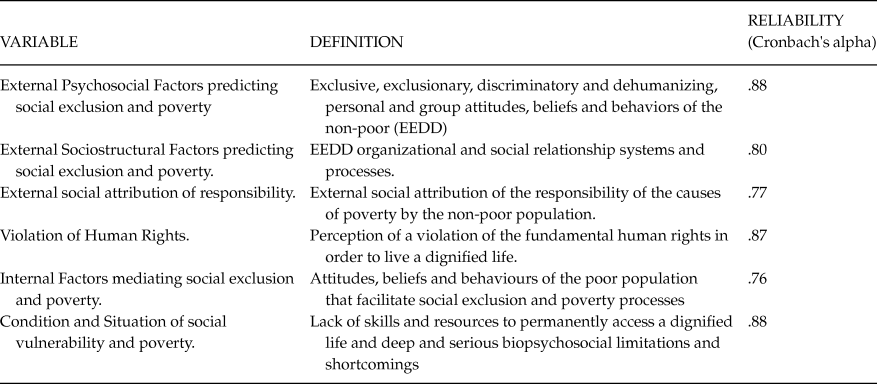
Theoretical definition of the Model’s variables and the reliability 1

1 Please refer to the Questionnaire in the Appendix 10 found in the following link: http://eprints.ucm.es/19915/1/T34309.pdf
All of which, predictions, mediations and signs, together with the fit assumptions for the Model, constitute the hypothesis of this research.
Method
Participants
A large, purposive and heterogeneous sample of 801 participants with the following characteristics was used in this study to analyze and test the hypotheses of the Model: 385 Nicaraguans (48.2%), 370 Spanish (46.2%), 30 from South America (3.7%) and 16 from the rest of Europe or the USA (2%). According to the International Standards of Poverty (UNDP, 2010), the participating Nicaraguans can be considered as the poor population and non-Nicaraguan subjects (Spanish people or foreign students in Spain) taking part in the study are considered as the non-poor population. Therefore, the sample is practically equivalent between poor populations (48.2%) and non-poor population (51.8%), which was essential in order to avoid the homogeneity biases found in previous studies (Pérez, Reference Pérez2013).
The possibility of including non-poor Nicaraguan and poor Spanish population was rejected for the following reasons: (a) First, due to the great difficulty in accessing the amount of participants needed, (b) because the sample was considered sufficiently broad and relevant to be used in the Model’s first confirmatory study Model and (c) because all the variables in this study were measured without making any specific reference to different types of poverty (much less at a national level), but considering poverty, at all times, as a human and global construct that relates to each person’s individual attitudes, perceptions and beliefs. We believe, therefore, that each subject in this study responded to the questionnaire items thinking not in the poverty of their country, or in any specific type of poverty but rather interconnecting and relating the different dimensions, experiences and mental representations of Poverty: both national and international and both abstract and concrete.
Continuing with the descriptive data, 36% of the total sample was male and 64% were female. We were unable to match genders within the sample due to the greater availability of the female Nicaraguans in the study; although it is important to consider that these percentages correspond to the estimates of the UN International Research and Training Institute for the Advancement of Women (UN-INSTRAW) that states that 70% of poor and impoverished population is female.
The mean age was 31.95 years, with a standard deviation of 11.5 years. A total of 88.7% of participants in this study were aged between 19 and 49 years.
Furthermore, the educational data (possibly higher due to the effect of social desirability) revealed the following percentages: (a) cannot read or write: 0.6%; (b) incomplete primary studies: 4.1%; (c) primary education: 3.9%; (d) secondary education: 13.1%; (e) high school or vocational training: 36.3%; (f) diploma: 10%; (g) degree: 22.7% and (h) postgraduate: 9.2%.
In relation to the Professional level data: (a) others (mostly students): 40.6%; (b) homemakers (this category was not included specifically in the questionnaire, but 28 people freely noted this in the “others” section): 3.5%; (c) unskilled worker in paid employment: 18%; (d) office employees: 11%; (e) self-employed: 8.1%; (f) non-management professionals: 9.2%; (g) area managers: 6%; (h) consultants: 2.2% and (i) management: 1.4%.
Instruments and Variables
The final questionnaire used to measure the variables of the Model was designed ad hoc in the previously mentioned research (Pérez, Reference Pérez2013) from an exploratory study, a pilot study and an expert judgment (see the complete Final Questionnaire in the Appendix 10 of the http://eprints.ucm.es/19915/1/T34309.pdf link)
The design and validation of the Questionnaire was carried out in different phases: (a) a database of 385 items was designed from the analysis and theoretical justifications presented and explained within the theoretical framework for each one of the variables of the Model, and from the main quantitative and qualitative results of the exploratory study; (b) analysis and subsequent selection by a group of academic and professional experts of the Initial Questionnaire items; (c) initial pilot application of the Questionnaire to a sample of 225 people (150 from Nicaragua and 75 from Spain); (d) Expert Judgment to review and improve the validity of the content and construct of the scales, as well as the adequacy, relationship and congruency of the items; and (e) a Final Questionnaire composed of 115 items was designed taking into account the results and conclusions of the above processes.
Subsequently, an exploratory factor analysis (EFA) was performed to identify the factors measured by the questionnaire and to test whether these factors coincide with the variables the Questionnaire intended to measure (Thompson, Reference Thompson2004). The factor extraction procedure used was Maximum Likelihood. Regarding the rotation criteria, the recommendations by Cliff (Reference Cliff1987); Fabrigar, Wegener, MacCallum & Strahan (Reference Fabrigar, Wegener, MacCallum and Strahan1999) and Pedhazur and Schmelkin (Reference Pedhazur and Schmelkin2001) were followed. Preferably, the oblique solution (Promax rotation with Kappa 4) was used. In relation to sample size, a sample of 801 subjects widely fulfills the conditions suggested by Gorsuch (Reference Gorsuch1983) where within the sample there should be at least five subjects per item, to ensure the stability, accuracy and reproducibility of the factors found.
In the EFA performed, six factors corresponding to the six variables of the model became clear and distinct. Table 1 shows the definition of the model variables and the reliability of the scales.
Next, some examples of items of each of the different factors found are offered for a better understanding of the variables being measured: (a) EEDD External Psychosocial Factors (e.g.: the poor are highly responsible for their situation of poverty, everything you set out to do in life can be achieved with effort and dedication); (b) EEDD External Sociostructural Factors (e.g.: the poor become poorer because the rich use all of society’s resources only for their own benefit; there are people and groups who believe that the solution to poverty can be a threat because it will involve losing their privileges); (c) External Social Attribution of Responsibility (e.g.: the poor are unable to overcome poverty because they are excluded from society’s benefits and opportunities); (d) perception of a Violation of human rights (e.g.: in my country, everybody can meet their basic needs and live with dignity); (e) Internal Factors mediating Social Exclusion and Poverty (e.g.: The poor cannot overcome poverty because they are so depressed and traumatized; the poor cannot think of a better future because everything they do to try to escape poverty is useless); (f) Social Vulnerability and Poverty (e.g.: the poor are poor because they don’t have a stable and secure job that allows them to live with dignity; the poor have very few resources and abilities to overcome difficulties and escape poverty).
Questionnaire Application Procedure
The non-poor sample from Spain were administered the questionnaire electronically or in person, and were offered broad but concrete deadlines to submit their reply. The poor and impoverished Nicaraguan sample were administered the questionnaire by pollsters, who had been previously trained in the procedures and techniques necessary to achieve the greatest accuracy and validity of responses and to prevent any fatigue effect.
Data Analysis
Data analyzes were performed using SPSS version 22 and AMOS program version 7. In the presentation of each of the results, we provide detailed and specific information about the analysis made in each case.
Results
Exploratory Graphical Analysis
Taking into account the importance of compliance with the parametric assumptions for multiple linear regression analyses and structural equations, especially the normality assumption (and multivariate normality) of the variables, an exploratory graphical analysis was performed first. According to the Kolmogorov-Smirnov (with the Lilliefors correction), the null hypothesis of normality was rejected for all our variables (p < .05); although, with Crombach´s Alpha: .01, the normality assumption for EEDD External Sociostructural Factors was accepted (p: .014 > .01). This statistic, with a large sample like the one in the present study, is very sensitive to small deviations from the norm. Therefore, the Q-Q normal and the Q-Q normal without trends charts for all the variables were analyzed. It was observed that the External Attribution of Responsibility and the Internal Factors mediating Social Exclusion and Poverty variables have near-normal results, as most of the observed values fall along the regression line, generally coinciding with the expected values. The variable that deviates furthest from the norm, with Asymmetry Indices of -10.62 and Kurtosis Indices of 5.27, is the (perceived) Violation of Human Rights variable. A possible explanation for this result may be the fact that the Violation of Human Rights variable has high rates of extreme scores, forcing to interpret the results related to this variable with caution.
Correlations and Descriptive analysis
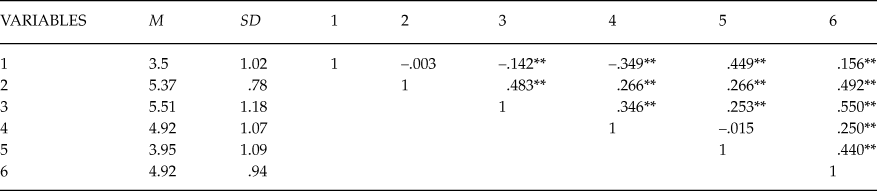
Table 2 shows the descriptive analysis and the correlation analysis results.
Main descriptive results and correlation analysis

Note: The measurement scale is from 1 to 7. **p < .01.
1.- EEDD External Psychosocial Factors predicting social exclusion and poverty.
2.- EEDD External Sociostructural Factors predicting social exclusion and poverty.
3.- External attribution of responsibility.
4.- Violation of human rights.
5.- Internal factors mediating poverty.
6.- Condition and Situation of social vulnerability and poverty.
The correlation analysis was intended to contrast the expected relationships according to the Model’s assumptions (Figure 1). All hypotheses were met (Table 2); with the exception of the expected negative relationship between EEDD External Psychosocial Factors and Social Vulnerability and Poverty. These variables yielded a positive relationship (.156**, p < .01) between them.
Multiple Regression Analysis
In the regression analysis performed to check to what extent the criterion variable, Condition and Situation of Social Vulnerability and Poverty, is explained by the linear combination of other predicting variables of the Model (hereinafter IIVV); firstly. all assumptions were contrasted with satisfactory results for all cases, with the only exception of the loss of the linear relationship of the Violation of Human Rights variable with Social Vulnerability and Poverty, when the effect of the other variables is controlled.
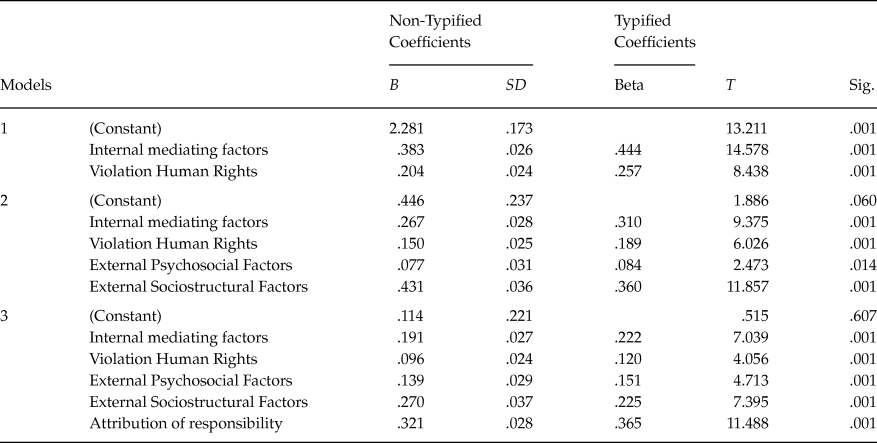
Subsequently, prior to verifying the Model, a linear regression analysis was performed hierarchically in blocks according to the different partial predictions (submodels) of the Model (Figure 1). The first block includes only the closest predicting variables to Social Vulnerability and Poverty, in particular: Violation of Human Rights and Internal Mediating Factors for Poverty. The second block includes the two main predicting variables in the Model (Figure 1): EEDD External Psychosocial Factors and EEDD External Sociostructural Factors. In the third and final block, the main mediating variable of the Model was added: Attribution of Responsibility in Poverty.
As can be observed in Tables 3 and 4, the percentage of variance explained by the criterion variable Condition and Situation of Social Vulnerability and Poverty in the first regression sub-model is 26%; 37% in the second, and 46% in the third due to the linear combination of all IIVV. All R² changes are significant (p < .001) and all the regression coefficients are statistically significant (p < .001).
Summary of the Multiple linear regression model analysis by blocks (a) and (b)

Note: a.- Dependent variable: Vulnerability/Poverty.
b.- Model 1 includes the Violation of Human Rights and Internal Factors mediating Poverty variables. Model 2 includes the previous variables and the EEDD External Psychosocial Factors and EEDD External Sociostructural Factors variables. Model 3 includes, apart from all of the previously mentioned variables, the main mediating variable of our Model: Social Attribution of Responsibility.
Typified and standardized regression coefficients (a)

Note: a. Dependent variable: Vulnerability/Poverty.
These results yield a first indication of the validity of the Model’s hypotheses (Figure 1), especially in relation to the criterion variable. However, to check the validity and significance of the expected predictions between the different predicting variables in the Model (the expected covariance structure) as well as the mediating effects of the Model and the Model’s fit to the data, a structural equations analysis was performed. Specifically, from the confirmatory strategy aimed at the theoretical exploration of the model chosen for this first study (Batista & Coenders, Reference Batista and Coenders2000), the equations model considered was a path-analysis structural model (Duncan, Reference Duncan1975).
The estimation method used was the Robust Maximum Likelihood (hereinafter MLrobust) with AMOS 7. The method of maximum likelihood, in general, is the most common method used in adjusting structural equation models because it yields consistent, efficient and unbiased estimates with large sample sizes, like the one in the present study, being able to facilitate the convergence of the estimates with the parameters even in the absence of normality (Bollen, Reference Bollen2014). The MLrobust used in this study, according to several authors, is the most statistically reliable estimate to evaluate models with covariance structures when the data does not meet the conditions of normality (Chou, Bentler, & Satorra, Reference Chou, Bentler and Satorra1991; Curran, West, & Finch, Reference Curran, West and Finch1996; Hu, Bentler, & Kano, Reference Hu, Bentler and Kano1992; Satorra, Reference Satorra1990; Satorra & Bentler, Reference Satorra and Bentler2010). This is the case of the present study, in which, regarding the Multivariate Normality, a Multivariate Kurtosis Index (c.r.) 13.96 was found.
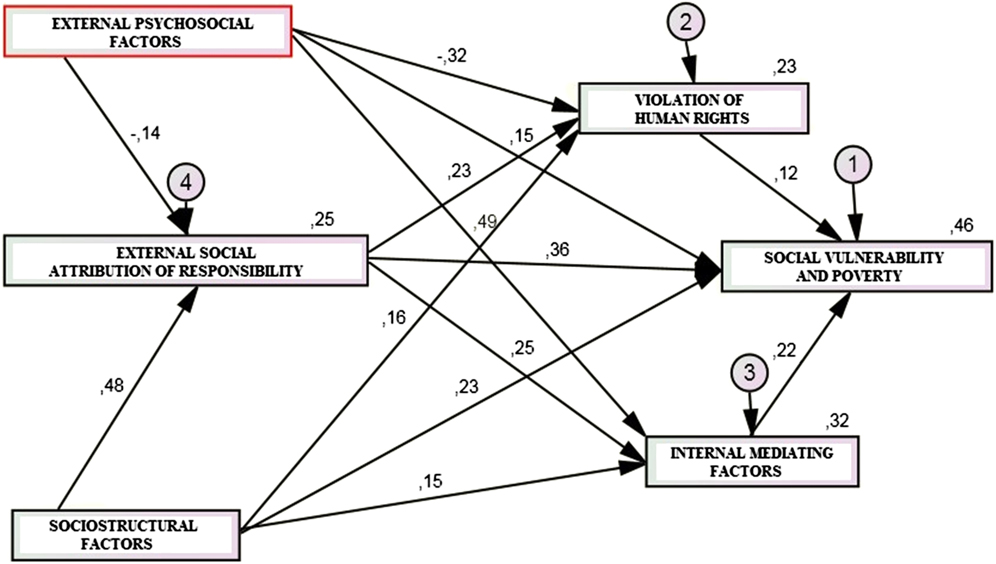
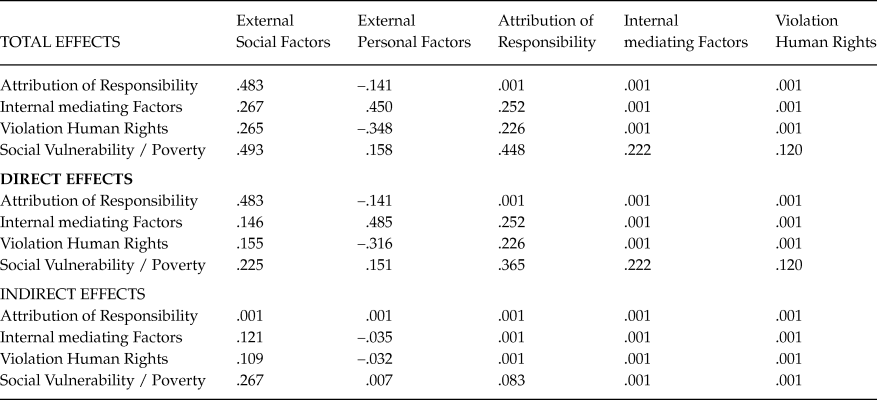
The results of the final adjusted model can be seen in Figure 2. As expected, according to the recommended indexes (χ² test, CFI, RMSEA and RMR); the model fit to the data is high, all the effects (direct and indirect) are significant and the explained variance of Social Vulnerability and Poverty is 46% (p < .001). Moreover, in this final adjusted model, the explained variance of the variables Violation of Human Rights and Internal Factors mediating Poverty by the Social Exclusion processes and by the External Attribution of Responsibility, was respectively 23% and 32%. Finally, it is important to consider the direct effects of EEDD External Psychosocial Factors (–.14, p < .001) and External Sociostructural Factors (.48, p < .001) on the External Attribution of Responsibility variable; each of which is different from the previous both in magnitude and in sign, although they coincide for both cases hypothesized in the Model (Figure 1).
Final adjusted Model.
Note: All effects were significant (p < .001). χ² = 1.3, df: 2 (p = .535). CFI: 1 RMSEA: .025 (LO90: 0 – HI90: .061). RMR: .008.

Furthermore, Table 5 offers the total, direct and indirect effects of structural equation analysis performed for a better interpretation of the results.
Totals, Direct and Indirect Effects

Discussion
The main conclusion that can be drawn from the results of this study is that, in the sample used, most of the Model’s assumptions were met (see Figure 1), and a good fit of the Model to the data was obtained (Figure 2).
As the majority of the hypotheses were verified, the same theoretical justifications that served to identify and define them will serve now to explain the significance of the effects found and the model’s fit to the data. These conceptualizations, relationships and predictions, very briefly, are as follows. Subsequently, their possible implications are presented.
The criterion variable of the Model, as explained in the identification of variables, consists of two highly interrelated main factors: Condition and Situation of Poverty and Social Vulnerability. Condition and Situation of Poverty, in turn, is formed by the different historical conceptualizations of poverty; which are, from least to greatest inclusiveness: (a) biological poverty (Booth, Reference Booth1892); (b) economic poverty (World Bank, 1990); (c) unsatisfied basic needs (Grant, Reference Grant1978; Hunt, Reference Hunt1989; Stewart, Reference Stewart1985; and Streeten, Reference Streeten1986); (d) human poverty (UNDP, 2000, 2001); and (e) our own definition of poverty as a violation of fundamental human rights (not being able to live a dignified life), which coincides with the UNDP’s conceptualization of poverty as the denial of basic human rights (1998, foreword IV). Social Vulnerability, in turn, has two components: (a) high risk of suffering from crises and convulsions, and (b) lack of resources and the necessary and sufficient abilities to prevent and / or solve the negative consequences of these crises and convulsions (Bohle et al., Reference Bohle, Downing and Watts1994; Pérez de Armiño, Reference Pérez de Armiño1999).
According to our approach, all these factors of social vulnerability and poverty are inseparable and, therefore, a valid definition of poverty (e.g.: the General Definition of Poverty that we have proposed) should include them all. Moreover, all these components should be used, without exception, in diagnosis and intervention, and in the control of effectiveness and quality of results.
On the other hand, the Condition and Situation of Social Vulnerability and Poverty, as the name suggests, refers to the descriptive consequences of poverty and the relative poverty conditions compared to non-poverty conditions; but it does not include the processes and causes that promote, justify and maintain these conditions and situations. These processes and causes are, according to our approach, mainly psychosocial and sociostructural (although they undoubtedly produce personal and group interests and privileges that complement and reinforce them), and can be identified and defined by the following variables: Internal Factors (of the poor population) Mediating Poverty; Violation of human rights; EEDD (Exclusive, exclusionary, discriminatory and dehumanizing) External Psychosocial Factors (of the non-poor population); EEDD External Sociostructural Factors and Social Attribution of Responsibility for Poverty. These constructs, in this present study, have jointly explained a high percentage of the variance of the Condition and Situation of Social Vulnerability and Poverty (46%), which seems to confirm our hypotheses and is one of the main results of this research.
Detailing the processes and causes of the criterion variable of the Model, the nearest predicting variables to the Condition and Situation of Social Vulnerability and Poverty are the Violation of Human Rights and the Internal Factors mediating Poverty. Therefore, as they are both so close, sometimes they can be considered as the only causes of the Condition and Situation. However, these variables, within our proposed model, in addition to their direct effect, also have a primary function as mediating variables between the processes of Social Exclusion (EEDD External Psychosocial Factors and External Sociostructural Factors) and the Social Vulnerability and Poverty.
The main predicting variables of Social Vulnerability and Poverty, as well as Violation of Human Rights and Internal Factors mediating Poverty are, therefore, the EEDD External Psychosocial Factors and the EEDD External Sociostructural Factors (Social Exclusion processes).
Between the EEDD External Psychosocial Factors and the EEDD External Sociostructural Factors there should be, in theory, a high positive relationship, as they are the same processes at different levels of abstraction (see Abrams et al., Reference Abrams, Hogg, Marques, Abrams, Hogg and Marques2005). However, in practice, especially due to the diffusion and derivation processes of responsibility (Opotow, Reference Opotow1990) and by the attribution of responsibility to the poor (fundamental attribution error, Heider, Reference Heider1958; psychologizing, Morales, Reference Morales, Morales and cols1997; moral model of Brickman et al., Reference Brickman, Rabinowitz, Karuza, Coates, Cohn and Kidder1982), the (linear) relationships between these two variables can be nonexistent (dissociative effect), as predicted in the Model, or even negative. In short, no one takes responsibility for the processes of Social Exclusion, and thus, they become chronic and worse. The limitation of Violation of Human Rights (the limitation of opportunities and abilities to live a dignified life) also worsens permanently and progressively, and, consequently, the Condition and Situation of Social Vulnerability and Poverty.
Finally, and in relation to the above, the Social Attribution of Responsibility for Poverty (to whom the causes of poverty are attributed to: the poor, the non-poor or to uncontrollable factors), is the main mediating variable between Social Processes of Exclusion and the Impoverishment Processes; as it the one used to justify the alleged lack of personal, group or social responsibility in the causes and consequences of social exclusion and poverty. This important mediating role of the Social Attribution of Responsibility could also mean, therefore, that, if applied in a positive way, it could have a strategic importance within any alternative model of social intervention that might arise from these approaches in the future. This would imply, in practice, applying the alternative principle of Social Co-responsibility in the effective, sustainable and dignified (guaranteeing the fundamental human rights) prevention and solution of Poverty to all phases of evaluation and social intervention.
Regarding the only hypothesis that was not met: the (expected) direct negative impact of EEDD External Psychosocial Factors on Social Vulnerability and Poverty, a hypothesis that is based on the fact that the personal and group EEDD attitudes, values, interests and behaviors include within their fundamental processes the denial of the negative consequences of their actions, it is important to make a couple of clarifications. The first is that while the result of the effect was positive (contrary to expectations), the magnitude of the effect was small. The second clarification is that the total effect of the EEDD External Psychosocial Factors on Social Vulnerability and Poverty is mediated by another two variables (Violation of Human Rights and External Attribution of Responsibility) over which it had a clear direct negative effect. According to these results, it appears that the EEDD External Psychosocial Factors variable has a significant negative effect on Social Vulnerability and Poverty, as expected (see, among others, Bandura, Reference Bandura1999; Bierbrauher, Reference Bierbrauer, Baums, Hopt and Horn2000; De Lucas, Reference De Lucas and Blazquez1996; Opotow, Reference Opotow1990; Ryan, Reference Ryan1976); but mediated by the denial of the Violation of Human Rights (the denial of social exclusion) and the denial of responsibility on behalf of the non-poor population in the conditions and situations of poverty of the poor population. The negative effects of the EEDD External Psychosocial Factors on Social Vulnerability and Poverty would thus be indirect; while the positive direct effect would be small. This would entail not denying poverty (something impossible) but perceiving it as less and more limited to what it actually is.
The main limitations of this study, as discussed in their respective sections, are as follows: (a) a wide and significant yet not representative sample (which will entail further studies of cross-validation); (b) failing to perform the structural equations analysis using a measurement model, which, according to the first findings of this study, will be carried out in future research; (c) the possible effect of Social Desirability on some of the answers, which was quite evident, for example, in the Studies variable; and (d) the potential problems of the lack of variability of the Violation of Human Rights variable, which may have partially affected the results and should be resolved in future studies.
The results of this study, if replicated in further research, would entail, among others, the following conceptual, methodological and applied implications: (a) the need for a broad and comprehensive definition of poverty (therefore, a scientifically, ethically and professionally valid definition) that should include in addition to its consequences, its processes and its causes; (b) the need to use such definition or model (either the one initially validated in this study or another similar one) to increase the validity of diagnostics and the effectiveness of interventions; (c) the need for everybody, poor and non-poor, to assume the social coresponsibility in the effective, sustainable and dignified prevention and solution to poverty; (d) to design and use social intervention models based on personal change (to solve the effects on poverty of the EEDD External Psychosocial Factors and the Internal Factors mediating Poverty) and on social transformation (in order to solve the effects on poverty of the EEDD External Sociostructural Factors and the Violation of Human Rights); (e) to conduct longitudinal interventions with scientific methodology (particularly epidemiological) and with high levels of social participation; and (f) the need for more suitable and valid research, reflection and action paradigms in the evaluation and social intervention of social exclusion and poverty issues, such as the Community Social Psychology (see, for example, Montero, Reference Montero2004).