Approximately 12.8% of infants are born prior to term (PT, <37 weeks gestation) and 8.3% are born low birth weight (LBW, <2500 g) in the United States each year (Hamilton, Martin, & Ventura, Reference Hamilton, Martin and Ventura2007). Younger and more medically fragile infants are surviving their Neonatal Intensive Care Unit (NICU) stays, with survivors exhibiting high rates of special needs, including developmental delays, learning disabilities, and behavior problems (e.g., Bhutta, Cleves, Casey, Cradock, & Anand, Reference Bhutta, Cleves, Casey, Cradock and Anand2002; Halsey, Collin, & Anderson, Reference Halsey, Collin and Anderson1996). Although many deficits in infants born PT or LBW (PT LBW) are hypothesized to reflect impaired self-regulatory capacities (Davis & Burns, Reference Davis and Burns2001), or the ability to exert internalized control over one's attention, behaviors, and emotions (Brownell & Kopp, Reference Brownell and Kopp2007; Kopp, Reference Kopp1982, Reference Kopp1989), research focusing on the development of self-regulation in PT LBW infants is limited.
Prematurity and LBW are primary causes of neonatal mortality and morbidity (Martin et al., Reference Martin, Hamilton, Sutton, Ventura, Menacker and Kirmeyer2006; Wilson-Costello, Friedman, Minich, Fanaroff, & Hack, Reference Wilson-Costello, Friedman, Minich, Fanaroff and Hack2005). As they grow older, PT LBW infants experience risk for developing cognitive, language, and motor delays and behavior problems. For example, Sajaniemi and colleagues (Reference Sajaniemi, Makela, Saolkorpi, von Wendt, Hamalainen and Hakamies-Blomqvist2001) found that at 4 years of age, 22% of the extremely LBW (<1000 g) infants in their study met criteria for impaired language function. Other studies have noted significant delays in language comprehension and development (Cusson, Reference Cusson2002; Luoma, Herrgard, Martikainen, & Ahonen, Reference Luoma, Herrgard, Martikainen and Ahonen1998) and elevated rates of motor delays (Roberts, Marlow, & Cooke, Reference Roberts, Marlow and Cooke1989) and motor impairments such as cerebral palsy (e.g., Vincer et al., Reference Vincer, Allen, Joseph, Stinson, Scott and Wood2006). Early studies documented long-term neurological difficulties in infants born preterm (e.g., Saint Anne Dargassies, Reference Saint Anne Dargassies1975), and more recent studies have highlighted dysregulation in their sleep–wake states (e.g., Feldman, Reference Feldman2006), affect (e.g., Hsu & Jeng, Reference Hsu and Jeng2008), and attention (e.g., Lawson & Ruff, Reference Lawson and Ruff2004), possibly contributing to their temperamental presentation and later challenges in self-regulatory capacities (Feldman, Reference Feldman2009). Furthermore, a meta-analysis by Bhutta and colleagues (Reference Bhutta, Cleves, Casey, Cradock and Anand2002) found links between preterm birth and increased risk for attention-deficit/hyperactivity disorder (ADHD) and other behavior problems at school age, in addition to lower cognitive scores. However, Bhutta et al. indicated that it is important to consider demographic risks and other familial factors, as these are often stronger predictors of child outcomes than perinatal risks as the child grows older. However, few studies have examined the complexity of developmental and familial processes that contribute to regulatory problems in PT LBW infants. In one of the few studies to examine predictors of self-regulation in children born preterm, Clark, Woodward, Horwood, and Moor (Reference Clark, Woodward, Horwood and Moor2008) found that children born earlier demonstrated less optimal self-regulation during parent–child interactions, cognitive assessments, and behavioral functioning at home compared to children born later. Feldman (Reference Feldman2009) examined emerging self-regulation in preterms, although she did not examine parenting contributions.
Models of developmental psychopathology are increasingly referring to the importance of children's capacities for self-regulation (Feldman, Greenbaum, & Yirmiya, Reference Feldman, Greenbaum and Yirmiya1999; Kochanska, Murray, & Coy, Reference Kochanska, Murray and Coy1997; Kochanska, Murray, & Harlan, Reference Kochanska, Murray and Harlan2000). Difficulty with attention regulation is associated with externalizing behaviors and academic problems (Eisenberg et al., Reference Eisenberg, Guthrie, Fabes, Reiser, Murphy and Homgren1997; Rothbart & Bates, Reference Rothbart, Bates, Eisenberg, Damon and Richard2006), whereas difficulty with regulation of negative emotions is associated with aggression and irritability (Rothbart & Bates, 1998). Overall, this literature suggests that self-regulatory capacities emerge early, are shaped by a child's disposition and experiences, and have implications for the development of competence and the design of preventive interventions. Calkins and Fox have argued that the period from infancy to toddlerhood is particularly important for the development of self-regulation (Calkins, Reference Calkins1994; Fox & Calkins, Reference Fox, Calkins, Rubin and Asendorpf1993). During this time, the infant's dispositional characteristics interact with the parenting context in the development of self-regulatory capacities (Beauchaine, Reference Beauchaine2001).
Kopp (Reference Kopp1982) proposed that self-regulation emerges by about 3 years of age, beginning with neurophysiological variables influencing mutual regulation, and mutual regulation subsequently influencing internalized self-control. According to Kopp's (Reference Kopp1982) model, mutual regulation occurs in the context of parent–infant interactions from approximately 3 months postterm. Sensitive and responsive interactions with parents help soothe infants and modulate their arousal. Infants' affective and social responses are regulated by the behaviors and responses of the parent, which can be seen during interactions that occur during face-to-face play, feeding, and other caregiving functions. Several studies have found that early maternal responsiveness predicts children's later ability to engage in self-regulated compliance (Martin, Reference Martin1981; Stayton, Hogan, & Ainsworth, Reference Stayton, Hogan and Ainsworth1971). Especially when infants are young, parents help regulate the infant's physiological state through feeding (e.g., timing onset of feeding and intake levels in response to infant signals). As infants take a more active role in their environment, parents continue to regulate infant responses, especially during play (e.g., initiating and maintaining the infant's interest, modulating the infant's affective responses, responding to the infant's signals).
By 9 to 12 months postterm, infants assume a more active, initiating role in dyadic interactions (e.g., Feldman, Greenbaum, Mayes, & Erlich, Reference Feldman, Greenbaum, Mayes and Erlich1997). At approximately the same time, infants enter the phase of emerging self-control as they grow increasingly capable of complying with commands, self-initiated monitoring of behaviors, and inhibiting behavior with the assistance of parental direction (Kopp, Reference Kopp1982). Moreover, temperament, which has been conceptualized as an expression of an infant's early self-regulatory disposition, increasingly influences the quality of parent–infant interactions during these social transformations. However, temperamentally difficult infants, especially those who have a history of medical fragility, may remain fairly dependent on parents to assist in the development of behavioral control. Calkins, Dedmon, Gill, Lomax, and Johnson (Reference Calkins, Dedmon, Gill, Lomax and Johnson2002) found that easily frustrated infants sought help from their mothers more than infants who were less easily frustrated and concluded that “these infants may have come to rely more on their caregivers because of their own limited regulatory abilities” (pp. 191–192). Feldman et al. (Reference Feldman, Greenbaum and Yirmiya1999) argued that pathways from mutual regulation to self-regulation can only be understood when infant temperament is considered. This may be especially true for PT LBW infants because of their medical fragility and neurobiological risks that may contribute to their temperament presentation. These infants may be easily influenced by parents' abilities to provide opportunities for mutual regulation via interactions, although negative parenting also can function as a vulnerability factor independent of temperament (e.g., Bowlby, Reference Bowlby1982).
Drawing on ecological theories (e.g., Bronfenbrenner & Ceci, Reference Bronfenbrenner and Ceci1994), Belsky (Reference Belsky1997) has argued that infant temperament affects child outcomes both directly via influence on the infant's self-regulatory capacities and interactively, by strengthening the nature of associations between parenting and children's development. The associations between parenting and child outcomes may be stronger among temperamentally difficult infants because they may be more susceptible to certain experiences and interactions (Belsky, Reference Belsky, Ellis and Bjorklund2005). Belsky and colleagues have presented evidence in a series of reports supporting this model (e.g., Belsky, Hsieh, & Crnic, Reference Belsky, Hsieh and Crnic1998; Park, Belsky, Putnam, & Crnic, Reference Park, Belsky, Putnam and Crnic1997; Pluess & Belsky, Reference Pluess and Belsky2010). Several research groups have found that difficult, easily distressed, uptight, highly reactive, or fearful infants are particularly susceptible to the effects of negative parenting, which can be considered the “dual risk” part of the model (e.g., Crockenberg, Leerkes, & Barrig-Jo, Reference Crockenberg, Leerkes and Barrig-Jo2008; Dopkins Stright, Gallagher, & Kelley, Reference Dopkins Stright, Cranley Gallagher and Kelley2008).
However, Belsky's model also suggests that temperamentally difficult infants may be more susceptible to positive care than other infants. For example, Feldman and colleagues (Reference Feldman, Greenbaum and Yirmiya1999) found that when highly negative infants experienced positive, synchronous interactions with their mothers, they displayed greater self-control when compared to infants characterized as less negative. In addition, Bakermans-Kranenburg, van IJzendoorn, Pijlman, Mesman, and Juffer (Reference Bakermans-Kranenburg, Van IJzendoorn, Pijlman, Mesman and Juffer2008) found that children were differentially susceptible to experimentally manipulated changes in parenting. In their sample, children who varied in a particular dopamine receptor, D4 (DRD4 7-repeat allele), were more susceptible to improvements in maternal discipline strategies with respect to externalizing behavior problems. Given that the DRD4 7-repeat allele has the potential for differential responses to both negative and positive influences, leaders in the field have highlighted it as a plasticity gene rather than a vulnerability gene (Belsky et al., Reference Belsky, Jonassaint, Pluess, Stanton, Brummet and Williams2009; Belsky & Pluess, Reference Belsky and Pluess2009). Studies of child care quality also support the positive side of the differential susceptibility model (Pluess & Belsky, Reference Pluess and Belsky2009, Reference Pluess and Belsky2010). For children high in negativity, high-quality child care predicted fewer behavior problems and teacher–child conflicts compared to children low in negativity.
Because the vast majority of this research has focused on children born healthy and full term, we do not know whether similar processes occur for children born PT LBW. On the basis of Belsky's differential susceptibility model, we speculated that PT LBW infants who exhibit temperamentally difficult characteristics must rely heavily on parents to assist with their regulatory functions, and thus, negative and positive parenting interactions may have differential effects on these vulnerable infants. Consistent with Belsky's recommendations regarding testing model specificity by examining alternative susceptibility factors, we also tested whether the differential susceptibility model was specific to early emotional reactivity (negativity) or whether the temperament characteristic of low sustained attention might also function as a susceptibility factor in PT LBW infants (Belsky, Bakermans-Kranenburg, & van IJzendoorn, Reference Belsky, Bakermans-Kranenburg and van IJzendoorn2007).
Among infants born PT LBW, it is unclear how varying degrees of prematurity and birth weight influence contextual susceptibility and developmental outcomes. Studies comparing extremely LBW (<1000 g) or very LBW (<1500 g) to infants born at term have documented elevated learning and behavioral problems (e.g., Bhutta et al., Reference Bhutta, Cleves, Casey, Cradock and Anand2002; Halsey et al., Reference Halsey, Collin and Anderson1996). However, comparisons within preterm samples do not consistently report elevated deficits in infants born younger and lighter or those who experience more medical risks. For example, in the domain of attention, studies consistently report deficits in infants born preterm compared to infants born at term. However, comparisons within preterm samples provide more mixed results, with inconsistent associations among gestational age, birth weight, and medical risks, depending on the attention outcome or the age of assessment (van de Weijer-Bergsma, Wijnroks, & Jongmans, Reference Van de Weijer-Bergsma, Wijnroks and Jongmans2008). The present sample includes infants with a wide range of birth weights and levels of prematurity; therefore, infant birth weight was explored as a correlate of susceptibility, not as a susceptibility factor.
The term effortful control has been used to describe the child's ability to suppress a dominant response to show a subdominant response (Rothbart & Bates, Reference Rothbart, Bates, Eisenberg, Damon and Richard2006). Components of effortful control include slowing down motor activity, delaying upon request, lowering one's voice, suppressing and initiating activity to signal, and effortful attention (Kochanska et al., Reference Kochanska, Murray and Harlan2000). Although it has been discussed as a key dimension of temperament (e.g., Rosario, Posner, & Rothbart, Reference Rosario, Posner and Rothbart2005), effortful control likely depends on a complex interaction of processes, including the child's level of symbolic or representational development, dispositional propensities, the caregiving environment, and contextual factors. The emotional reactivity components of temperament also depend on a complex interaction of processes in development. A growing body of research has examined antecedents of effortful control in samples consisting of healthy full-term children (e.g., Kochanska et al., Reference Kochanska, Murray and Harlan2000). Moreover, although researchers have examined parenting (e.g., Rothbaum & Weisz, Reference Rothbaum and Weisz1994) or children's dispositions (e.g., Eisenberg, Fabes, Guthrie, & Reiser, Reference Eisenberg, Fabes, Guthrie and Reiser2000) as predictors of self-regulatory capacities, only a handful of studies have investigated joint contributions of the parenting context and infant characteristics (Calkins & Fox, Reference Calkins and Fox2002). To date, no published studies have examined the joint contributions of temperament and parenting on developing self-regulation and effortful control in PT LBW infants. The present study helps fill this gap by examining differential susceptibility to parenting in a prospective longitudinal study that followed PT LBW infants from NICU discharge to 24 months postterm.
Study Hypotheses
We hypothesized that PT LBW infants would show less optimal effortful control and more behavior problems during the toddler period when they experienced a combination of more difficult temperament characteristics (e.g., proneness to distress) and less optimal parenting during infancy (e.g., interactions characterized by intrusiveness, hostility, or lack of sensitivity), controlling for infant birth weight and gender, multiple birth, family sociodemographic risks, maternal depression, and infant cognitive development. We also expected that PT LBW infants would show more optimal effortful control and fewer behavior problems when they experienced a combination of more difficult temperament and highly positive parenting during infancy. Finally, we tested whether the differential susceptibility model also applied to the temperament characteristic of low sustained attention in PT LBW infants. To test these hypotheses, we followed the five steps outlined by Belsky and colleagues (Reference Belsky, Bakermans-Kranenburg and van IJzendoorn2007) for stepwise testing of differential susceptibility:
1. Conduct a statistical test for genuine (cross-over) interaction.
2. Conduct a test of the independence of the susceptibility factor and the predictor.
3. Conduct a test of the association between the susceptibility factor and the outcome; if the association is nonzero, there is no support for differential susceptibility.
4. Compare the regression plot with prototypical graphical displays. In addition to differential susceptibility effects, graphs can also reflect an absence of susceptibility (parallel lines), contrastive effects (slopes for both groups differ but in opposite directions), or dual-risk effects (Belsky et al., Reference Belsky, Bakermans-Kranenburg and van IJzendoorn2007).
5. Conduct a test of the specificity of the model by replacing susceptibility factors or outcomes.
Method
Participants
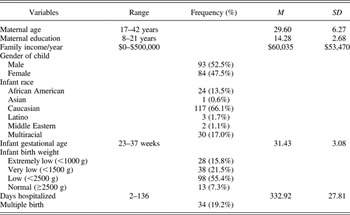
A total of 181 mothers and their infants were recruited from three NICUs in southeastern Wisconsin. A research nurse from each hospital invited families to participate in the study if they met the following criteria: (a) infants were born at ≤35 weeks gestation or weighed <2500 g at birth, (b) infants had no known congenital malformations or prenatal drug exposures, (c) mothers were at least 17 years of age, (c) mothers could read English, and (d) mothers self-identified as the child's primary caregiver. For multiple births, 1 infant was randomly selected to participate in the study. Because the hospitals would not allow us to be “first contact” for families and they only provided us with information about families who signed consent forms for the study, we were unable to calculate a participation rate. However, participant family characteristics paralleled the population of Wisconsin (Hamilton et al., Reference Hamilton, Martin and Ventura2007). From the original sample of 181 infants, 3 infants were later screened out of the study because review of NICU medical records revealed that they had significant findings on cranial ultrasound or magnetic resonance imaging (periventricular leukomalacia or Grade IV intraventricular hemorrhage) and, sadly, 1 infant died subsequent to NICU discharge. See Table 1 for a description of our sample at the time of hospital discharge.
Infants and their families were assessed at five time points: just prior to the infant's hospital discharge (Time 1) and again at 4 (Time 2), 9 (Time 3), 16 (Time 4), and 24 months (Time 5), corrected for prematurity. Time 2 data were not used in this report. Corrected age was calculated on the basis of the infant's due date and is commonly used for assessments of preterm infants' development (DiPietro & Allen, Reference DiPietro and Allen1991). At Time 5, 153 of the families continued to participate in the study, resulting in a 14% attrition rate between NICU discharge and 24 months. A multivariate analysis of variance was used to examine potential differences between families who continued in the study for 2 years and families lost to attrition. Results revealed no significant differences for infant gestational age, birth weight, 1- and 5-min Apgar scores, days hospitalized, a neonatal health risk index, number of children in the family, the father's age or education, family income, a sociodemographic risk index, or maternal depressive symptoms at Time 1. However, mothers lost to attrition were younger, F (1, 173) = 5.51, p < .05, had completed fewer years of education, F (1, 173) = 5.88, p < .05, were more likely to be single, χ2 (1) = 4.68, p < .05, and non-White, χ2 (1) = 5.57, p < .05, compared to mothers who completed the study. Our attrition is consistent with other longitudinal studies of high-risk infants (e.g., Miles, Holditch-Davis, Schwartz, & Scher, Reference Miles, Holditch-Davis, Schwartz and Scher2007). Because our analyses using 24-month data originate from a slightly more socioeconomically privileged group than our original sample, appropriate caution should be used when generalizing our findings.
Of the 153 infants who continued to participate in the study at Time 5, 76 (50%) infants were boys and 77 (50%) were girls. Infant birth weights ranged from 490 to 3328 g, with a mean of 1739 g (SD = 595), and infant gestational ages ranged from 23 to 37 weeks, with a mean of 31.5 weeks (SD = 3.13). On average, infants spent 33 days (SD = 28) in the NICU. At hospital discharge, mothers were an average of 30 years old (SD = 6.26) and had obtained an average of 14.5 years of education (SD = 2.70), and most mothers (n = 112, 73%) reported that they were married. The average household income was $63,135 (SD = $54,296), and the incomes of 30 (20%) families were below the federal poverty level. Most infants (n = 108; 71%) were White, 21 (14%) infants were biracial or multiracial, 19 (12%) infants were African American, 2 (1%) infants were Latino, 2 (1%) infants were Middle Eastern, and 1 (1%) infant was Asian. Most biracial and multiracial infants were African American and either White or Latino.
Sample demographic and neonatal characteristics at neonatal intensive care unit discharge (n = 177)

Procedure
Following institutional review board approval, a research nurse described the study to eligible families. Mothers who were interested in participating signed informed consent forms. A researcher met the mother at the NICU just prior to the infant's discharge to collect Time 1 data. Mothers completed self-administered questionnaires including a demographic form and a collaborating nurse completed the history of hospitalization form by reviewing the infant's medical records. The next visit included in this report was a home visit when infants were 9 months postterm and included maternal self-administered questionnaires, 15 min of videotaped mother–child play and the Laboratory Assessment of Temperament (LAB-TAB; Goldsmith & Rothbart, Reference Goldsmith and Rothbart1996). The home visit lasted approximately 1.5 hr and mothers were paid $40. When infants were 16 and 24 months postterm, families visited our laboratory playroom. At the 16-month visit, a researcher administered the Mental Scale of the Bayley Scales of Infant Development, Second Edition (Bayley, Reference Bayley1993), yielding a Mental Development Index (MDI). At the 24-month visit, children participated in free play with their mothers, a toy clean-up task and a series of effortful control tasks. Each of the laboratory visits lasted approximately 1.5 to 2 hr. Mothers were paid $60 at the 16-month visit and $80 at the 24-month visit. Children were given an age-appropriate book or toy at the end of each visit.
Measures
Infant temperament
To account for the strengths and weaknesses of parent-reported and observer-rated temperament measures (Rothbart & Bates, Reference Rothbart, Bates, Eisenberg, Damon and Richard2006), we utilized two approaches to assess infant temperament at 9 months (Time 3): observer assessment and parental report.
Observer assessment of infant temperament
Tasks from Goldsmith and Rothbart's (Reference Goldsmith and Rothbart1996) LAB-TAB were used to assess infant temperament. Although the LAB-TAB was designed for laboratory use, it can be used in the home as well (H. H. Goldsmith, personal communication, 2002). In this report, we focus on three tasks administered in the home: unpredictable mechanical dog, plastic barrier task, and colored block. Tasks were videotaped and coded in accordance with the LAB-TAB manual.
For the unpredictable mechanical dog task, we coded intensity of vocal distress and fear response in 10-s intervals. The plastic barrier task was coded in 10-s intervals for intensity of vocal distress, facial sadness, bodily sadness, and latency to anger. For the colored block task, we coded latency to first look away, duration of orienting to the toy, and duration of manipulating the toy. Each task was coded by three independent coders, and the κ values for each measure ranged from 0.89 to 0.92. To reduce these data, we conducted a principal components analysis with varimax rotation on these nine variables and found a two-component solution. We labeled the components distress (four items, α = 0.80) and attention (three items, α = 0.62). Items loaded on each component between .66 and .90, with no overlap of items, although two items (latency to anger and intensity of fear response) did not load on either component. The distress component showed a positive skew because of one extreme outlier, which was dropped. The attention component was normally distributed. The attention and distress components were negatively correlated, r (147) = −.17, p < .05.
Parent report of infant temperament
The Revised Infant Temperament Questionnaire (RITQ; Carey & McDevitt, Reference Carey and McDevitt1978) was used to assess maternal perceptions of infant temperament. The RITQ has 95 items that assess the nine dimensions of temperament outlined by Thomas and Chess (Reference Thomas and Chess1977): activity level, rhythmicity, approach/withdrawal, adaptiveness, intensity, mood, persistence, distractibility, and threshold for stimuli. The RITQ has been used with full-term and preterm infants (e.g., Langkamp, Kim, & Pascoe, Reference Langkamp, Kim and Pascoe1998) and shows adequate reliability and validity, although the nine dimensions are correlated with each other (e.g., Bohlin, Hagekull, & Lindhagen, Reference Bohlin, Hagekull and Lindhagen1981). In the present study, the items from the approach, activity, intensity, negative mood, and adaptability dimensions were combined (after reverse coding where appropriate) into an index of difficult temperament, following previous studies that used the original version of the RITQ (e.g., Bradley & Corwyn, Reference Bradley and Corwyn2008; Dopkins Stright et al., Reference Dopkins Stright, Cranley Gallagher and Kelley2008). Higher RITQ difficult scores indicated temperament profiles that reflected less approachability and adaptiveness, and more activity, intensity and negative mood. Scores were normally distributed and the Cronbach α value was 0.80.
Parenting interactions
Infant–mother play interactions at 9 months postterm (Time 3) were coded with the parenting variables of the Parent Child Early Relational Assessment (PCERA; Clark, Reference Clark1985). The PCERA is a coding system designed to assess the frequency, duration, and intensity of affect and behavioral characteristics of parents, infants, and dyads that occur during 5 min of face-to-face interactions. In the present study, we focused on the 29 parent variables. Each variable is coded on a scale ranging from 1 (negative relational quality) to 5 (positive relational quality).
Previous studies of the PCERA have reported an acceptable range of internal consistency (.75 to .96) and factorial validity (Clark, Reference Clark1999). In addition, the PCERA has been used with preterm infants (Pridham, Lin, & Brown, Reference Pridham, Lin and Brown2001) and discriminate validity between high-risk and well-functioning mothers has been demonstrated (Clark, Paulson, & Conlin, Reference Clark, Paulson, Conlin and Zeanah1993). Two correlated parent factors have been identified in a large sample of full-term infants (e.g., Clark, Hyde, Essex, & Klein, Reference Clark, Hyde, Essex and Klein1997; Else-Quest, Hyde, & Clark, Reference Else-Quest, Hyde and Clark2003), labeled as Positive Affective Involvement, Sensitivity, and Responsiveness and Negative Affect and Behavior. These two factors have been used in studies with preterms but without a confirmatory factor analysis (e.g., Pridham, Brown, Clark, Sondel, & Green, Reference Pridham, Brown, Clark, Sondel and Green2002). At least one study with full-term infants found a three-factor solution for the parent variables (Clark, Reference Clark1999; Positive Affect, Involvement, and Verbalizations; Negative Affect and Behavior; and Intrusiveness, Insensitivity, and Inconsistency).
We conducted a confirmatory factor analysis on the 29 parent variables to determine whether the two-factor solution fit our data. Results indicated a poor fit, χ2 (103) = 403.27, p < .05, comparative fit index = 0.95, root mean square error of approximation = 0.13. Thus, the parent items were subjected to an unweighted least squares exploratory factor analysis with a varimax rotation, resulting in a three-factor solution. We labeled the factors Positive Affect, Communication, and Connectedness (14 items, α = 0.95); Intrusiveness, Anxiety, and Insensitivity (8 items, α = 0.89); and Anger, Hostility, and Criticism (5 items, α = 0.93). Two items did not load on any factor (behavioral disturbance and hypomanic mood). The factors were correlated (r = .61–.83), consistent with previous research using PCERA factors. We retained all three factors instead of combining them because different aspects of positive and negative parenting may relate to different child outcomes (e.g., Clark et al., Reference Clark, Hyde, Essex and Klein1997). Items in the Positive Affect factor included quality of verbalizations, visual contact, warm kind tone of voice, and connectedness. Items in the Intrusive factor included negative physical contact, anxious mood, and intrusiveness, and items within the Anger factor included angry hostile tone of voice, negative affect, and parental displeasure, disapproval, or criticism. Higher scores on each of these factors reflected more positive parenting; thus for the Intrusive and Anger factors, lower scores represented more of these behaviors. Ten percent of the sample was independently coded by at least two trained research assistants. Interrater reliability ranged from 83% to 97% agreement across codes, with a mean of 88% agreement.
Toddler effortful control
We examined toddler effortful control at 24 months (Time 5) using a behavioral multitask battery described in Kochanska et al. (Reference Kochanska, Murray and Harlan2000). Four components of effortful control are reported here: ability to delay (snack delay), slowing motor activity (walk a line slowly), suppressing–initiating activity to signal (towers), and effortful attention (animal shapes). The snack delay task included four trials, with each successive trial having a longer delay time. The delay to touch the cup in seconds was coded for each trial and averaged across all four trails. The delay task was independently coded by two trained students, who attained 100% reliability when coding delay times within 1 s of the child's response. For the animal shapes task, the child's responses to imbedded animal cards were coded as refusal or pointing to incorrect animal (0), pointing to large rather than small animal (1), self-correction (2), and correctly pointing to small animal (3). In the walk-a-line task, we first asked the child to participate in a physically exhilarating activity (e.g., a game of chase) and then asked the child to walk a line slowly across two trials. We calculated the average number of seconds the child took to walk across the two trials. Finally, the towers task was coded as a function of the number of turns the child allowed the experimenter to take. Higher scores indicated more turn taking.
Correlations among effortful control tasks ranged from −.04 to .26. The only statistically significant correlations were between animal shapes and towers, r (148) = .26, p < .01, and snack delay and walk a line, r (134) = .18, p < .05. Although previous studies with full-term low-risk infants have combined these tasks into an index of self-regulation or global effortful control (e.g., Kochanska, Coy, & Murray, Reference Kochanska, Coy and Murray2001; Kochanska et al., Reference Kochanska, Murray and Harlan2000), this approach was not used in our sample because it would have resulted in low internal consistency for an effortful control composite. Thus, we examined children's performance on each effortful control task separately.
Note that 14 children (9%) could not complete the walk-a-line-slowly task because of motor delays or not being able to calm down after the “rev up” time. Thus, they were excluded from analyses focusing on motor slowing.
Toddler behavior problems
The problem list of the preschool form of the Child Behavior Checklist (CBCL; Achenbach & Rescorla, Reference Achenbach and Rescorla2000) was used to assess children's behaviors at 24 months postterm (Time 5). The CBCL is a widely used standardized behavior rating scale that is completed by an adult with whom the child lives. The preschool forms list 99 problem behaviors. Mothers rated each problem behavior on a 3-point scale, not true (0), somewhat or sometimes true (1), or very true or often true (2), in reference to the child's behaviors that occurred during the past 2 months. Responses were summed to obtain scores for internalizing and externalizing problems scales that were converted into T scores on the basis of normative data (Achenbach & Rescorla, Reference Achenbach and Rescorla2000). The CBCL has high internal consistency (Cronbach α = 0.78–0.97), and it has been used with PT LBW infants (e.g., Yu, Buka, McCormick, Fitzmaurice, & Indurkhya, Reference Yu, Buka, McCormick, Fitzmaurice and Indurkhya2006).
Cognitive development
Infant cognitive skills were used as a control variable and were assessed at 16 months postterm (Time 4) using the Bayley Mental Scale (Reference Bayley1993). This measure is a widely used, individually administered standardized assessment appropriate for children aged 1 to 42 months. Standard scores on the MDI have a mean of 100 and a standard deviation of 15. MDI scores in this sample ranged from 55 to 122 (M = 86.37, SD = 10.76).
Family sociodemographic risks
Mothers completed a demographic questionnaire while their infants were in the NICU (Time 1). On the basis of previous research (e.g., Burchinal, Roberts, Hooper, & Zeisel, Reference Burchinal, Roberts, Hooper and Zeisel2000; Sameroff, Bartko, Baldwin, Baldwin, & Seifer, Reference Sameroff, Bartko, Baldwin, Baldwin, Seifer, Lewis and Feiring1998), one point was given for each of the following risks: the family's income was below the federal poverty guidelines adjusted for family size, both parents were unemployed, the mother was single, the mother gave birth to the target child as a teen, the family had four or more dependent children in the home, the mother had less than a high school education, and the father had less than a high school education. This index could range from 0 to 7, with higher scores reflecting more sociodemographic risks. The Cronbach α value for the index was 0.75. We also assessed family sociodemographic risks at all other time points and found that scores were highly correlated.
Maternal depressive symptoms
The Center for Epidemiologic Studies Depression Scale (CES-D; Radloff, Reference Radloff1977) was used to assess maternal depressive symptoms at 9 months postterm (Time 3). The CES-D is a 20-item self-report questionnaire that asks respondents to rate their symptoms of depression on a 4-point scale ranging from rarely/none of the time (0) to most/all of the time (3) during the past week. Scores of 16 and above are considered in the clinical range. The CES-D discriminates between patients and nonpatients and has been used extensively in clinical and epidemiological research, including research focusing on mothers of young children (e.g., Lyons-Ruth, Zoll, Connell, & Grunebaum, Reference Lyons-Ruth, Zoll, Connell and Grunebaum1986). Internal consistency generally ranges from .85 to .90. The Cronbach α value for the CES-D in present study was 0.88. This was used as a control variable because of research linking maternal depression with maternal reports of infant difficult temperament (e.g., McGrath, Records, & Rice, Reference McGrath, Records and Rice2008).
Results
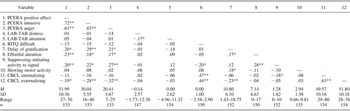
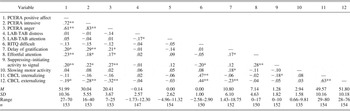
Screening of variable distributions revealed normal or near-normal distributions, with the exception of the LAB-TAB distress component that had one extreme outlier. This case was removed prior to analysis as described in the Measures Section. Other multiple regression assumptions (e.g., homoscedasticity, residuals uncorrelated with predictors), examined via residual analysis and plots, were not violated (Pedhazur & Schmelkin, Reference Pedhazur and Schmelkin1991). Table 2 presents means, standard deviations, and bivariate correlations for continuous variables. Because of missing data, sample sizes for analyses ranged from 115 to 130. Because infant birth weight and gestational age were highly correlated (r = .88, p < .001), we selected birth weight to use as a control in Step 1 of our analyses to avoid problems with multicollinearity.
Bivariate correlations and descriptive statistics for key variables
Note: PCERA, Parent Child Early Relational Assessment; LAB-TAB, Laboratory Assessment of Temperament; RITQ, Revised Infant Temperament Questionnaire; CBCL, Child Behavior Checklist.
*p < .05. **p < .01.
Tests for differential susceptibility
Following the steps outlined in Belsky et al. (Reference Belsky, Bakermans-Kranenburg and van IJzendoorn2007), first we conducted statistical tests for genuine (cross-over) interactions using hierarchical regression analyses, with a separate analysis conducted for each outcome and PCERA parenting factor combination. Because the LAB-TAB distress and the RITQ difficult components were uncorrelated, r (143) = −.05, p = .58, both variables were entered into regression equations simultaneously. In each analysis, we entered the controls in the first step (infant gender and birth weight, multiple birth, sociodemographic risk, 9-month maternal CES-D scores, and the child's 16-month Bayley MDI), the RITQ, LAB-TAB, and PCERA scores in the second step, and the Temperament × Parenting interactions in the third step.
To examine whether the susceptibility factor and predictor were independent (the second step of assessing the differential susceptibility model), we examined bivariate correlations between temperament components and PCERA factors (Table 2). None of the correlations were statistically significant, suggesting independence. We also examine correlations regarding associations between the susceptibility factor and the outcomes. The RITQ difficult score was associated with internalizing and externalizing behavior problems and initiating–suppressing activity to signal, indicating that differential susceptibility would not be possible in these models using maternal report of infant temperament. However, LAB-TAB distress and attention were not correlated with any outcome variables, and therefore differential susceptibility was not ruled out as a possibility for any outcomes using the observer-rated temperament variables.
When the interaction term was statistically significant, we also performed post hoc analyses to determine the nature of the continuous interaction term according to Aiken and West (Reference Aiken and West1991) and Cohen, Cohen, West, and Aiken (Reference Cohen, Cohen, West and Aiken2003). We ran simple regressions examining the parenting slopes at high and low levels (1 SD above and below the mean) of the temperament variables. Next, we compared the regression plots for significant interaction terms with the prototypical graphical displays in Belsky et al. (Reference Belsky, Bakermans-Kranenburg and van IJzendoorn2007) to determine whether they reflected differential susceptibility or other effects (e.g., dual risk). We performed the final step for testing the differential susceptibility model (testing for specificity) by replacing the LAB-TAB distress and RITQ difficult composites with the LAB-TAB attention variable.
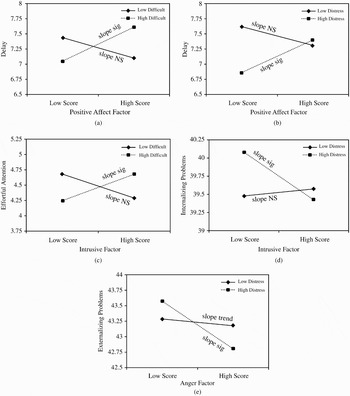
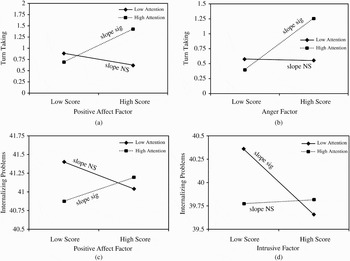
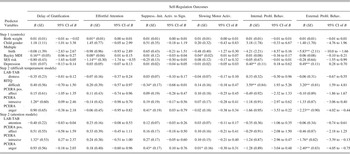
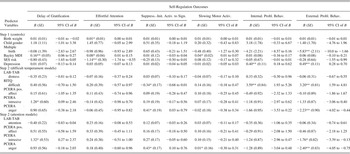
Results pertaining to interactions (i.e., moderator effects) are presented by susceptibility factors (i.e., difficult temperament as reflected in the RITQ difficult and LAB-TAB distress scales and the LAB-TAB attention component) across each toddler outcome. Toddler effortful control tasks (i.e., delay of gratification, effortful attention, slowing motor activity, and initiating–suppressing activity to signal) are presented first, followed by internalizing and externalizing behavior problems. Results pertaining to significant main effects are reported in Table 3. Figure 1 and Figure 2 are graphical displays of the significant interactions. (In cases in which the figure did not perfectly match a prototypical graphical display, we labeled both possible interpretations of the interaction effect.)
Significant interactions between parenting factors and indices of infant difficult temperament. (a) The contrastive effect or possible differential susceptibility effect, (b) the dual risk effect, (c) the contrastive effect or possible differential susceptibility effect, (d) the dual risk effect or possible differential susceptibility effect, and (e) the differential susceptibility effect.

Significant interactions between parenting factors and infant sustained attention. (a) The dual benefit effect, (b) the dual benefit effect or possible differential susceptibility effect, (c) the dual risk effect, and (d) the differential susceptibility effect.

Hierarchical linear regression models for toddler effortful control and behavior problems (controls and main effects)
Note: Step 3 significant interaction effects are illustrated in Figures 1 and 2. Standardized coefficients for significant Step 3 interactions are presented in the text. MDI, Mental Development Index; SES, socioeconomic status; LAB-TAB, Laboratory Assessment of Temperament; RITQ, Revised Infant Temperament Questionnaire; PCERA, Parent Child Early Relational Assessment.
*p < .05. **p < .01.
Difficult temperament as a susceptibility factor
Effortful control
For the delay of gratification component of effortful control, there were significant interactions for the RITQ Difficult × PCERA Positive Affect Scale (β = 0.23, p < .05) and the LAB-TAB Distress × PCERA Positive Affect Scale (β = 0.21, p < .05). Post hoc testing revealed that maternal positive affect significantly predicted toddler delay at high levels of infant difficult temperament (β = 0.38, p < .01), although maternal positive affect did not relate to 24-month delay at low levels of infant difficult temperament (β = −0.06, p = .66). Examination of Figure 1a indicates a contrastive effect. Post hoc tests also revealed that maternal positive affect was associated with 24-month delay at high levels of infant distress (β = 0.48, p < .01), whereas maternal positive affect was not related to delay at low levels of infant distress (β = 0.08, p = .51). Examination of Figure 1b indicates a dual risk effect.
For delay, there were no significant Difficult Temperament × Intrusive or Difficult Temperament × Angry Parenting interactions.
For the effortful attention outcome, the PCERA Positive Affect factor did not interact with infant difficult temperament. However, there was a significant RITQ Difficult × PCERA Intrusive interaction (β = 0.21, p < .05). Post hoc tests revealed that variations in intrusive, anxious parenting behaviors at 9 months related to effortful attention at 24 months when infants were rated as high in difficulty (β = 0.45, p < .01). However, at low levels of infant difficulty, intrusive parenting was unrelated to toddler effortful attention (β = −0.12, p = 38). Examination of Figure 1c suggests a contrastive effect. In addition, the PCERA Angry factor did not interact with infant difficult temperament for the effortful attention outcome.
We did not find statistically significant difficult Temperament × Parenting interactions for slowing motor activity and suppressing–initiating activity to signal.
Behavior problems
For internalizing behaviors, the LAB-TAB Distress × PCERA Positive Affect interaction was not significant. However, the LAB-TAB Distress × PCERA Intrusive Parenting interaction significantly predicted children's 24-month internalizing behaviors (β = −0.19, p < .05). Post hoc testing indicated that more intrusive, anxious parenting behaviors related to toddler internalizing behavior problems at high levels of infant distress (β = −0.34, p < .05), but not at low levels of infant distress (β = −0.07, p = .55). Inspection of Figure 1d suggests a dual-risk effect, possibly nearing a differential susceptibility effect. The LAB-TAB Distress × PCERA Angry interaction term was not a significant predictor of toddler internalizing behaviors, however.
Moreover, the LAB-TAB Distress × PCERA Positive Affect and the LAB-TAB Distress × PCERA Intrusive interaction terms did not significantly predict toddler externalizing behaviors. However, the LAB-TAB Distress × PCERA Angry interaction term significantly predicted children's 24-month externalizing behaviors (β = −0.17, p < .05). Post hoc testing indicated that at high levels of infant distress, variations in angry, critical parenting behaviors significantly related to toddler externalizing behavior problems (β = −0.57, p < .001), whereas at low levels of infant distress, there was only a trend-level association (β = −0.20, p = .07). Inspection of Figure 1e reveals a differential susceptibility effect for externalizing behaviors, with more easily distressed infants showing more behavior problems in the context of angry, critical parenting and fewer behavior problems than other children in the context of parenting that had an absence of angry, critical interactions.
Note that a total of 18 analyses were conducted to test difficult temperament as a susceptibility factor (with a total of six statistically significant interactions).
Low sustained attention as a susceptibility factor
Additional regression analyses were conducted to test the specificity of the differential susceptibility model. Thus, the LAB-TAB attention component was entered in the regression equations instead of the variables reflecting difficult temperament.
Effortful control
We did not find significant Attention × Parenting interactions for the delay, effortful attention, or slowing motor activity components of effortful control. Yet, there were significant LAB-TAB Attention × PCERA Positive Affect (β = 0.25, p < .01), and LAB-TAB Attention × PCERA Angry (β = 0.22, p < .01), interactions for the initiating–suppressing activity to signal outcome (turn taking). However, the LAB-TAB Attention × PCERA Intrusive interaction term was not significant for initiating–suppressing activity to signal. For the Attention × Positive Affect interaction, post hoc tests showed that variations in maternal positive affect and communication at 9 months significantly predicted 24-month turn taking when infants exhibited high sustained attention (β = 0.39, p < .01), but that maternal positive affect was unrelated to toddler turn taking for infants who exhibited low sustained attention (β = 0.05, p = .72). Inspection of Figure 2a suggests what we termed a “dual benefit” effect. That is, children who exhibited more sustained attention at 9 months and who also experienced more affectively positive play interactions were most likely to engage in high levels of turn taking. Post hoc tests also revealed that at high levels of infant attention, variations in angry, critical parenting were associated with toddler turn taking (β = 0.43, p < .01); however, at low levels of infant attention, angry parenting was not associated with 24-month turn taking (β = 0.14, p = .32). Figure 2b appeared to reflect a dual benefit effect.
Behavior problems
There were significant LAB-TAB Attention × PCERA Positive Affect (β = 0.17, p < .05), and LAB-TAB Attention × PCERA Intrusive (β = 0.19, p < .05) interactions for internalizing behaviors, although the Attention × Angry Parenting interaction was not significant. Post hoc tests revealed that at low levels of infant attention, variations in maternal positive affect (β = −0.26, p = .05), and intrusive parenting behaviors (β = −0.34, p < .05) were associated with toddler internalizing behaviors. However, at high levels of infant attention, maternal positive affect (β = 0.17, p = .25) and intrusive parenting behaviors (β = 0.07, p = .65) were not associated with internalizing problems. The Attention × Positive Affect interaction appears to be a dual risk effect (Figure 2c), whereas the Attention × Intrusive Parenting interaction appears to reflect a differential susceptibility effect (Figure 2d). For infants exhibiting low sustained attention, intrusive parenting was associated with more internalizing problems, whereas a lack of intrusive parenting was associated with fewer behavior problems compared to other children.
There were no significant Attention × Parenting interactions for externalizing behaviors.
Note that a total of 18 analyses were conducted to test infant attention as a susceptibility factor (with a total of four statistically significant interactions).
Discussion
Although infants born PT or LBW experience elevated risk for developmental psychopathology, including learning disabilities, behavior problems, and attention deficits, research is only beginning to elucidate developmental and familial process leading to these outcomes (e.g., Clark et al., Reference Clark, Woodward, Horwood and Moor2008). Although scholars have speculated that many of these problems may reflect impairments in self-regulatory processes (Davis & Burns, Reference Davis and Burns2001), few studies have focused on the development of self-regulation in high-risk infants (Feldman, Reference Feldman2009, is an exception). In our prospective longitudinal study of children born PT LBW, our most consistent findings involved interactions between parenting quality and infant temperament as predictors of toddler effortful control and behavior problems. The findings most often reflected differential susceptibility to parenting, dual risk effects, or contrastive effects, as discussed below.
Differential susceptibility effects
We identified several differential susceptibility effects for internalizing and externalizing behavior problems, but not effortful control. PT LBW infants who were more prone to distress and who experienced angry and critical parenting at 9 months exhibited the most externalizing behaviors at 24 months, whereas easily distressed infants who did not experience angry, critical parenting at 9 months exhibited the fewest externalizing problems. In addition, infants who were more prone to distress and who experienced intrusive, anxious parenting behaviors exhibited the most toddler internalizing behavior problems, whereas easily distressed infants who experienced few intrusive parenting behaviors exhibited the least internalizing problems. These relations did not hold for less distressed infants, however. Nevertheless, it is important to note that parenting remained a significant predictor in the final step of the model for externalizing problems, suggesting that the interaction did not completely explain children's outcomes in this sample of children born PT LBW.
In our tests focusing on the specificity of the differential susceptibility model, our findings also provided support for the incorporation of attention as a susceptibility factor in infancy. In our sample of infants born PT LBW, low sustained attention functioned as a susceptibility factor for the outcome of internalizing problems. Infants who were observed to exhibit low sustained attention at 9 months who experienced parenting characterized by intrusiveness, anxiety, and insensitivity exhibited the most internalizing problems at 24 months, whereas infants who showed low sustained attention at 9 months and who experienced nonintrusive parenting exhibited the fewest toddler internalizing problems. The development of internalizing behaviors in infants low in sustained attention appeared more affected by variations in maternal intrusiveness and sensitivity compared to highly attentive infants. Attention may be an important susceptibility factor to examine for PT LBW infants, especially given their propensity to develop attention-related disorders as they grow older (e.g., Bhutta et al., Reference Bhutta, Cleves, Casey, Cradock and Anand2002).
Most previous research has examined infant negativity (Belsky et al., Reference Belsky, Hsieh and Crnic1998; Blair, Reference Blair2002), emotional reactivity (Klein Velderman, Bakermans-Kranenburg, Juffer, & van IJzendoorn, Reference Klein Velderman, Bakermans-Kranenburg, Juffer and van IJzendoorn2006), and proneness to distress or fear (e.g., Kochanska, Reference Kochanska1991) as susceptibility factors. With a few notable exceptions (e.g., Belsky et al., Reference Belsky, Jonassaint, Pluess, Stanton, Brummet and Williams2009; Crockenberg & Leerkes, Reference Crockenberg and Leerkes2006), attention has not been assessed as a susceptibility factor. Previous studies of healthy infants have documented links between early attention problems and later behavior problems (e.g., Caspi, Henry, McGee, Moffitt, & Silva, Reference Caspi, Henry, McGee, Moffitt and Silva1995), but it is uncommon to assess how parenting may moderate this association via differential susceptibility. A notable exception, however, includes genetic studies focusing on the DRD4 7-repeat allele. This candidate gene has been linked with children's attention, and Gene × Environment interaction studies have illustrated differential susceptibility to experimentally manipulated changes in parenting (Belsky et al., Reference Belsky, Jonassaint, Pluess, Stanton, Brummet and Williams2009). Given these findings, future research should consider low sustained attention as a potential susceptibility factor, both at the genetic and behavioral levels, especially in high-risk infants.
Our findings are consistent with the idea that PT LBW infants with certain temperament characteristics may remain dependent on their parents to achieve interactional and behavioral regulation, even at 9 months postterm or later. These findings are also consistent with Calkins et al. (Reference Calkins, Dedmon, Gill, Lomax and Johnson2002), who reported that easily frustrated infants sought maternal assistance more than infants who were less easily frustrated, and with Belsky and colleagues (Reference Belsky, Hsieh and Crnic1998), who found that difficult infants were more vulnerable to the effects of negative parenting. Similarly, in a recent analysis of the NICHD early childcare data set, Dopkins Stright and colleagues (Reference Dopkins Stright, Cranley Gallagher and Kelley2008) found that full-term infants with difficult temperaments who experienced poor parenting quality were more susceptible to less optimal social adjustment in first grade. Further, Bakermans-Kranenburg and colleagues (Reference Bakermans-Kranenburg, Van IJzendoorn, Pijlman, Mesman and Juffer2008) found that children were differentially susceptible to positive parenting. In their study, an intervention designed to improve maternal sensitivity and maternal discipline had the greatest effect on children's externalizing behaviors when children were identified as having a particular allele of the dopamine receptor (DRD4 7 repeat). Taken together, these findings highlight the importance of parenting as a proximal process that exerts influence on an array of child outcomes, particularly for infants with certain temperament characteristics.
It is also important to note that we did not find strong differential susceptibility effects for toddler effortful control. Rather, the interactions tended to reflect dual risk, dual benefit, or contrastive effects, as we discuss below.
Dual-risk effects
In addition to the differential susceptibility effects for toddler behavior problems noted above, we also found dual-risk effects for the temperament dimensions of infant distress and low sustained attention combined with less optimal parenting for several effortful control outcomes. Toddlers born PT LBW exhibited shorter delay of gratification times when they exhibited more observed distress and they experienced low maternal positive affect and communication at 9 months. However, maternal positive affect during play at 9 months did not relate to toddler delay for infants observed to be low in distress. Moreover, when infants exhibited low sustained attention, low maternal positive affect was associated with more toddler internalizing behavior problems. However, at high levels of infant attention, maternal positive affect was not associated with internalizing problems.
These findings are consistent with research conducted by Crockenberg and colleagues (Reference Crockenberg, Leerkes and Barrig-Jo2008), who found that maternal behaviors moderated the association between infant negative reactivity and later externalizing behavior problems in a sample of full-term infants and their mothers. Specifically, infant distress to frustrating events (toy removal) predicted later aggressive behavior (externalizing problems) only when mothers actively encouraged their infants to attend to the frustrating event (Crockenberg et al., Reference Crockenberg, Leerkes and Barrig-Jo2008). It is possible that the strategies mothers used to encourage infant attention to the stressful event could be characterized as less optimal parenting behaviors, not unlike those observed in our sample.
Other significant moderator effects
We also identified two contrastive interactions predicting effortful control variables in our sample of PT LBW infants, both involving maternal reports of infant difficult temperament. When infants were rated by mothers as exhibiting difficult temperament characteristics, high levels of maternal positive affect significantly predicted longer toddler delay times, whereas low levels of maternal positive affect predicted shorter delay times. However, this association was not present for infants rated as having less difficult temperaments (although the regression coefficients were in the opposite direction of those for the more difficult infants, suggesting a contrastive effect; it is possible that these may be close to differential susceptibility effects, and this should be examined in future research with PT LBW samples). Moreover, intrusive, anxious parenting behaviors at 9 months related to less effortful attention at 24 months when infants were rated as high in difficulty, whereas nonintrusive parenting predicted more effortful attention for difficult infants. At low levels of infant difficulty, however, variations in intrusive parenting were unrelated to toddler effortful attention (again, the regression coefficients were in the opposite direction as those of the more difficult infants). Although results for these variables appear similar to differential susceptibility effects, it should be noted that the average outcomes for the high difficult/optimal parenting groups were similar to the low difficult/less optimal parenting groups, and the average outcomes for the high difficult/less optimal parenting groups were similar to the low difficult/optimal parenting groups.
The final type of significant interaction that we identified in our sample of PT LBW infants we labeled as a dual benefit effect. The combination of high sustained attention and more optimal parenting (more positive affect and lack of angry affect) was associated with high levels of 24-month turn taking. However, maternal positive affect and angry affect were unrelated to toddler turn taking for infants who exhibited low sustained attention. It is possible that effects such as this may reflect the operation of protective factors associated with resilience processes in high-risk infants. Although Belsky et al. (Reference Belsky, Bakermans-Kranenburg and van IJzendoorn2007) did not include a dual benefit effect in their graphical displays of possible moderator effects, we suggest that this may be the opposite of a dual risk effect, in that positive temperament characteristics and positive parenting operate to produce the most optimal effects. Further exploration of this type of effect will be important in future research with high-risk samples.
Alternative interpretation of interaction effects
One question that arises when examining Temperament × Parenting effects is how to interpret the meaning of statistically significant interactions. Because we used a theoretically driven approach, we analyzed significant interactions to test the differential susceptibility model, which specifies temperament as a moderator of the effects of parenting. Nevertheless, it is also possible to examine such interactions by conceptualizing parenting as the moderator variable, if this is consistent with one's theoretical model. In doing so, one would conduct post hoc tests to examine associations between temperament variables and outcomes under conditions of positive and negative parenting. For example, we could reinterpret our differential susceptibility effect for externalizing behavior problems as infant distress predicted toddler externalizing problems only when parenting was not angry or critical; that is, highly distressed infants who did not experience angry parenting developed fewer externalizing behaviors, whereas infants low in distress who did not experience angry parenting developed relatively more externalizing behaviors. Although this alternative means of examining interactions may shed light on the nature of the statistically significant interactions, it also highlights the importance of theory and a priori hypothesizing when conducting such analyses.
Main effects of parenting and contextual variables
We also found direct associations between early parenting quality and toddler effortful control and behavior problems. Toddlers whose mothers engaged in more anxious, intrusive, and insensitive interactions at 9 months exhibited shorter delay times at 24 months postterm compared to toddlers whose mothers did not engage in such interactions. In addition, infants who experienced hostile, critical, angry parenting at 9 months engaged in less toddler turn taking and exhibited more externalizing behavior problems at 24 months compared to infants who did not experience such parenting interactions. These findings underscore the importance of examining parent–child interactions as predictors of emerging self-regulation in PT LBW infants.
Results of our analyses also confirm the importance of early infant cognitive skills and the family context in relation to several self-regulation outcomes for toddlers born PT LBW. Toddlers with higher 16-month Bayley scores exhibited longer delay times, better effortful attention, and slower walk times than toddlers with lower cognitive scores. These findings support the idea that many self-regulatory skills require complex cognitive control, as suggested by temperament researchers (Posner & Rothbart, Reference Posner and Rothbart2000). In addition, higher birth weight infants and infants who experienced fewer sociodemographic risks performed better on the effortful attention task than lower birth weight infants and infants who experienced more socioeconomic status risks. Moreover, children whose mothers reported more depressive symptoms at 9 months postterm exhibited more parent-reported behavior problems at 24 months, and multiple birth was associated with fewer toddler behavior problems but was unrelated to effortful control.
Implications for theory, research, and intervention
Researchers who study emerging regulation in preterm infants should consider the complex interactions that occur among developmental and contextual processes over time, especially how hostile or anxious, intrusive parenting or low positive affect during play interactions may serve to exacerbate children's emotional reactivity or attentional difficulties. These difficulties may contribute to behavior problems and other undesirable outcomes in high-risk infants. It is also important to examine how sensitive parenting may function in a protective capacity for PT LBW infants. These transactions have important implications for children's developmental pathways, especially as they enter school.
In the present study, toddlers' performance on tasks assessing effortful control was not even, as correlations among tasks were relatively low, similar to Kochanska et al.'s (Reference Kochanska, Murray and Harlan2000) findings with full-term healthy infants at 22 months, for whom the average item-total correlation was .27 and the α value for the effortful control composite was 0.42. In our sample, some PT LBW children excelled at one or two areas (e.g., effortful attention and delay), but performed poorly in other areas (e.g., motor slowing). Moreover, each domain was predicted by different sets of variables and Temperament × Parenting interactions, suggesting different pathways to various toddler skill sets such as those involved in effortful attention or suppressing–initiating activity to signal in high-risk infants. Thus, our data suggest that effortful control may not a be a unitary construct at 24 months in children born PT LBW, similar to the conclusion of Li-Grining (Reference Li-Grining2007) in her study of low income preschoolers. Consistent with this conceptualization, Murray and Kochanska (Reference Murray and Kochanska2002) discuss effortful control as a multidimensional construct composed of a number of different abilities that become increasingly related over time (Kochanska et al., Reference Kochanska, Murray and Harlan2000, Reference Kochanska, Coy and Murray2001). In our study of toddlers born PT LBW, components of effortful control were not highly correlated with behavior problems, and these variables had different sets of predictors. Because of these issues, it would be inaccurate to refer to toddlers born PT LBW as globally “well-regulated” or “poorly regulated.” It would instead be more accurate to refer to the adaptiveness of specific toddler behaviors in each domain subsumed under the general category of effortful control.
These findings also suggest the importance of investigating interventions for children born PT LBW that focus on specific skill sets targeted to children's individual patterns of self-regulatory strengths and weaknesses, rather than providing more “generic” or “one size fits all” interventions (e.g., Infant Health and Development Program). Children's cognitive skills should be considered as well, as many of the effortful control tasks had a substantial relation to cognitive skills in this sample of high-risk infants. However, it is unclear whether some children showed delayed development of effortful control skills (i.e., early uneven skill development with increasing coherence among skills over time, similar to the trajectory of full-term healthy children; Kochanska et al., Reference Kochanska, Murray and Harlan2000) or whether PT LBW infants develop these skills on a different trajectory (i.e., uneven development of effortful control skills even later in development). We are continuing to follow the children in our sample to examine this issue empirically.
Although some of our findings are consistent with a dual risk interpretation (i.e., temperamental difficulty or low sustained attention combined with negative parenting) in the prediction of less optimal outcomes in PT LBW infants, our behavior problem findings can also be interpreted in a more positive light as suggested by differential susceptibility models. That is, temperamentally difficult infants or infants with low sustained attention who experienced highly positive parenting were less likely to exhibit problem behaviors compared to difficult infants who experienced negative parenting and compared to easier infants. Thus, interventions designed to improve parenting may have a more dramatic impact on resilience processes in PT LBW infants who display early challenging behaviors or variations in sustained attention. Consistent with this idea, Blair (Reference Blair2002) found that for LBW infants rated high in negative emotionality at 12 months, the Infant Health and Development Program intervention led to a lower incidence of behavior problems at age 3, even more than for infants rated low in negative emotionality. We suggest examining approaches that involve screening groups of PT LBW infants to identify those who are more easily distressed or who exhibit very low or high attention; then their families can be provided with interventions focused on helping maintain parental positive emotionality, sensitivity, and developmental support of these infants during interactions (e.g., van den Boom, Reference Van den Boom1994). Developmental screenings of NICU survivors that focus primarily or exclusively on children's early cognitive development, medical status, or degree of prematurity may fail to identify children who need support regarding their emerging self-regulatory behaviors. In addition, scholars should investigate whether effortful control and accompanying familial processes contribute to ADHD and other attention, learning, and behavioral problems as PT LBW children reach school age. Effortful control has been linked with attention regulation (e.g., Harris, Robinson, Chang, & Burns, Reference Harris, Robinson, Chang and Burns2007), symptoms of ADHD (e.g, Goldsmith, Lemery-Chalfant, Schmidt, Arneson, & Schmidt, Reference Goldsmith, Lemery-Chalfant, Schmidt, Arneson and Schmidt2007; Martel & Nigg, Reference Martel and Nigg2006), and academic achievement (e.g., Blair & Razza, Reference Blair and Razza2007), although only one study has linked preschool effortful control to concurrent symptoms of inattention and ADHD in children born preterm (Poehlmann et al., Reference Poehlmann, Schwichtenberg, Shah, Shlafer, Hahn and Maleck2010).
Limitations and Conclusion
The limitations of our study should be noted when interpreting or applying our findings. Although our attrition rate was relatively low, families that remained in the study were slightly more socioeconomically advantaged than ones who dropped out of the study or could not be located. Thus, appropriate caution should be used in generalizing our findings to more socioeconomically stressed families with PT LBW infants. Generalization of study findings should also be consistent within the specific parenting and infant temperament elements assessed. In particular, parenting interactions characterized by variations in positive affect, communication and sensitivity, intrusiveness/anxiety, and anger/criticism were assessed, not all parenting styles or elements. Likewise, only specific elements of toddler effortful control were assessed rather than global self-regulation.
Another limitation of the study is that there was little overlap between maternal reports of infant difficulty and distress as rated by observers using the LAB-TAB. Previous studies with low-risk infants have found small to modest associations between parental report and observer ratings of infant temperament (Rothbart & Bates, Reference Rothbart, Bates, Eisenberg, Damon and Richard2006). The lack of correspondence between temperament measures may have resulted from the high-risk nature of the sample, from measurement issues, or from measures tapping into different aspects of infant difficulty. Compared to the RITQ, the Infant Behavior Questionnaire (Rothbart, Reference Rothbart1981) may have been a more suitable measure for assessing maternal-reports of temperament. Items on the Infant Behavior Questionnaire are quite specific and may reduce bias in reporting. Previous research has also found that PT LBW infants' distress signals are more difficult for parents to read compared to full-term infants (Als, Reference Als and Tronick1982; Bakeman & Brown, Reference Bakeman and Brown1980; Eckerman, Oehler, Hannan, & Molitor, Reference Eckerman, Oehler, Hannan and Molitor1995). Mothers in our sample may have experienced difficulty rating their infants, ultimately reducing concordance between maternal reports and observational assessments of temperament. Alternatively, raters may not have observed certain low frequency behaviors that mothers experienced with their infants at home. It is also possible that the LAB-TAB tasks elicited different aspects of emotional reactivity (e.g., fear) compared to those assessed by the RITQ (e.g., frustration), which could be investigated in future research.
In addition, effortful control can be difficult to measure in toddlers, and this may present measurement challenges for researchers, possibly leading to error and contributing to the low correlations that we found among the effortful control tasks. Moreover, several measures relied on maternal report, and thus, shared method variance may have led to spurious positive findings (e.g., links between maternal reports of temperament and toddler behaviors), although this did not affect the differential susceptibility findings, as maternal report of temperament was ruled out as a possible susceptibility factor for behavior problems. However, our use of observer ratings of infant temperament and laboratory-based effortful control assessments were strengths of the study.
Despite these limitations, this investigation extended the differential susceptibility model to PT LBW infants; provided valuable information about the development of regulatory processes in a vulnerable population; and helped identify individual, dyadic, and contextual factors that may be targeted in future research to foster resilience processes in high-risk infants.