Introduction
In Southeast Asia, most rice production occurs in areas where the monthly average maximum temperature (T max) is high (>33 °C) during the reproductive or ripening phase (Wassmann et al., Reference Wassmann, Jagadish, Sumfleth, Pathak, Howell, Ismail, Serraj, Redona, Singh and Heuer2009), but the majority of rice genotypes show optimum growth under 28/22 °C day/night temperatures (Prasad et al., Reference Prasad, Boote and Allen2006a). Furthermore, the IPCC projects a mean annual temperature increase of 0.7–0.9 °C per decade in Southeast Asia (IPCC, 2014). Heat stress is defined as the rise in temperature beyond a critical threshold for a period of time that is sufficient to cause irreversible damage to plant growth and development (Wahid et al., Reference Wahid, Gelani, Ashraf and Foolad2007). Baker et al. (Reference Baker, Allen and Boote1992) reported that each 1 °C increase in the daytime temperature between 28 and 34 °C can reduce rice grain yields by 7–8%, while Peng et al. (Reference Peng, Huang, Sheehy, Laza, Visperas, Zhong, Centeno, Khush and Cassman2004) concluded that there was a 10% decrease in grain yield for each 1 °C increase in temperature.
The temperature of rice plants depends not only on the organ position, size, shape, surface area and hull morphology but also on the air temperature, air humidity, solar radiation and plant type (Sheehy et al., Reference Sheehy, Mitchell, Beerling, Tsukaguchi and Woodward1998; Yan et al., Reference Yan, Ding, Liu, Wang, Li, Ying and Wang2008, Reference Yan, Ding, Wang, Liu, Li, Muhammad and Wang2010). Fu et al. (Reference Fu, Feng, Zhang, Yang, Yang, Chen, Zhao, Zhang, Jin and Tao2016) reported a greater decrease in fertility and kernel weight in distal spikelets than proximal spikelets. The results of Zhang et al. (Reference Zhang, Fu, Yang, Yang, Zhao, Chen, Zhang, Jin and Tao2016) indicated that heat stress at 40 °C decreased spikelet fertility significantly, but caused little change in flag leaf photosynthesis during anthesis. At this air temperature, the panicle temperature was above 38 °C, while the flag leaves were only approximately 34 °C. In growth chamber experiments, heat tolerance at flowering is often tested over a short period at temperatures ranging from 37.5–38.0 °C (relative humidity (RH) of 60–70%) to generate a large contrast in spikelet fertility between susceptible and tolerant genotypes (Satake and Yoshida, Reference Satake and Yoshida1978; Mackill et al., Reference Mackill, Coffman and Rutger1982; Matsui et al., Reference Matsui, Omasa and Horie2001a; Matsui and Omasa, Reference Matsui and Omasa2002; Kobayasi et al., Reference Kobayasi, Matsui, Murata and Yamamoto2011; Shi et al., Reference Shi, Ishimaru, Gannaban, Oane and Jagadish2015).
Temperature has significant impacts in growth and development during both the vegetative and reproductive phases of rice growth (Welch et al., Reference Welch, Vincent, Auffhammer, Moya, Dobermann and Dawe2010). However, the reproductive stage is the most sensitive stage to heat stress, which is reflected by decreases in pollen viability and germination, anther indehiscence and a lack of pollen reaching the stigma. These effects can lead to floret sterility and yield losses (Matsui and Omasa, Reference Matsui and Omasa2002; Matsui et al., Reference Matsui, Kobayasi, Kagata and Horie2005; Cao et al., Reference Cao, Duan, Yang, Wang, Liu and Yang2009; Jagadish et al., Reference Jagadish, Muthurajan, Oane, Wheeler, Heuer, Bennett and Craufurd2010, Arshad et al., Reference Arshad, Farook, Ash, Jagadish, Prasad and Siddique2017). A previous growth chamber study showed that temperatures above 32–36 °C caused high spikelet sterility (Prasad et al., Reference Prasad, Boote and Allen2006a; Shah et al., Reference Shah, Huang, Cui, Nie, Shah, Chen and Wang2011). In addition, increasing both air temperature and relative humidity significantly increases spikelet sterility (Weerakoon et al., Reference Weerakoon, Maruyama and Ohba2008; Shah et al., Reference Shah, Huang, Cui, Nie, Shah, Chen and Wang2011). Thus, there is genotypic variation in spikelet sterility under heat stress (Satake and Yoshida, Reference Satake and Yoshida1978; Matsui et al., Reference Matsui, Omasa and Horie2001a; Prasad et al., Reference Prasad, Boote, Allen, Sheehy and Thomas2006b) that can be defined by different temperature thresholds (Matthews et al., Reference Matthews, Kropff, Bachelet, Van Laar, Matthews, Kropff, Bachelet and Van Laar1995; Nakagawa et al., Reference Nakagawa, Horie, Matsui, Mew, Brar, Peng, Dawe and Hardy2002). In addition, it has been suggested that indica species are more tolerant to higher temperatures than japonica species (Matsui et al., Reference Matsui, Omasa and Horie2000), although heat-tolerant genotypes have been found in both sub-species. The genotypes N22 (Yoshida et al., Reference Yoshida, Satake and Mackill1981; Prasad et al., Reference Prasad, Boote, Allen, Sheehy and Thomas2006b; Poli et al., Reference Poli, Basava, Panigrahy, Vinukonda, Dokula, Voleti, Desiraju and Neelamraju2013), M9962; Cheabu et al., Reference Cheabu, Panichawong, Rattanametta, Wasuri, Kasemsap, Arikit, Vanavichit and Malumpong2019) and Akitakomachi (Matsui et al., Reference Matsui, Omasa and Horie2001a) are the most tolerant genotypes found to date among the indica and japonica species, respectively.
Pollen development has been shown to be highly sensitive to elevated temperatures (Mesihovic et al., Reference Mesihovic, Iannacone, Firon and Fragkostefanakis2016). Moreover, heat stress during the flowering stage in rice can restrict the swelling of pollen grains (Matsui et al., Reference Matsui, Omasa and Horie2000). A decline in floral reproduction can occur after only a few hours of heat stress during anthesis due to embryo abortion (Matsui et al., Reference Matsui, Omasa and Horie2000; Cheabu et al., Reference Cheabu, Moung-Ngam, Arikit, Vanavichit and Malumpong2018). Under heat stress, deformed floral organs appear, along with a reduction in their number and size (Cao et al., Reference Cao, Duan, Yang, Wang, Liu and Yang2009). Anther characteristics (number of cell layers, length, and width) are linked to the fertility of pollen in japonica at 37.5/26 °C (day/night) during anthesis (Matsui and Omasa, Reference Matsui and Omasa2002). Under optimal conditions, the cell layers rupture for anther dehiscence to occur, but this process does not take place under heat stress (Endo et al., Reference Endo, Tsuchiya, Hamada, Kawamura, Yano, Ohshima, Higashitani, Watanabe and Kawagishi-Kobayashi2009). Thus, heat stress reduces pollen fertility due to delayed locule opening, which occurs since the locules are tightly closed as a result of the limited rupture of cell layers. However, the stomium (the region of the anther where dehiscence occurs) is associated more with fertility under heat stress than is anther size (Matsui and Omasa, Reference Matsui and Omasa2002).
In general, plants have evolved a mechanism to rapidly respond to heat stress in which heat stress proteins are synthesized, which function as molecular chaperones in repairing protein damage and maintaining homoeostasis to grow and propagate (Hartl and Hayer-Hartl, Reference Hartl and Hayer-Hartl2002). The central regulators of the expression of heat-responsive genes are heat stress transcription factors (Hsfs) (Wu, Reference Wu1995). During heat stress, Hsfs are the primary molecules responsible for relaying signals of cellular stress to the transcriptional apparatus and activating the expression of Hsp genes (Nover et al., Reference Nover, Bharti, Döring, Mishra, Ganguli and Scharf2001). Liu et al. (Reference Liu, Zou, Zhang, Zhou, Wang, Xiong, Chen and Chen2010) investigated 12 class A rice Hsfs and found that most OsHsfA genes responded quickly to heat stress, except for OsHsfA1a, A3, and A9, which were largely unaffected. Moreover, OsHsfA2a expression was highest among the Hsf genes in response to heat stress (Liu et al., Reference Liu, Zou, Zhang, Zhou, Wang, Xiong, Chen and Chen2010).
In previous studies, most relevant experiments involved treating plants with high temperatures for a short period (from 2 h to 15 days) at different stages of the reproductive phase (Matsui and Omasa, Reference Matsui and Omasa2002; Jagadish et al., Reference Jagadish, Craufurd and Wheeler2007; Cao et al., Reference Cao, Duan, Yang, Wang, Liu and Yang2009; Zhang et al., Reference Zhang, Chen, Zhang, Zheng and Liu2009; Liao et al., Reference Liao, Zhang, Shao, Zhong and Huang2011; Phan et al., Reference Phan, Ishibashi, Miyazaki, Tran, Okamura, Tanaka, Nakamura, Yuasa and Iwaya-Inoue2013; Das et al., Reference Das, Krishnan, Nayak and Ramakrishnan2014; Fu et al., Reference Fu, Feng, Zhang, Yang, Yang, Chen, Zhao, Zhang, Jin and Tao2016). However, only Weerakoon et al. (Reference Weerakoon, Maruyama and Ohba2008) used a high-temperature treatment from late booting (late R4) until maturity (R9), though the temperature was maintained at only 36 °C in the daytime. Thus, in the present study, the high-temperature treatment encompassed the reproductive phase (approximately 30 days) from early booting (early R2) to harvest (late R9) in a controlled greenhouse at an air temperature of approximately 40–42 °C for 6 h/day (10.00–16.00 h). During this period, the processes of heat tolerance or susceptibility from pollen development until grain filling could be investigated in the spikelets to clearly show the response of rice plants under heat stress. The new heat-tolerant lines M9962 and M7988, mutations from Jao Hom Nin (JHN) and susceptible line M7766 found in large mutant populations (Cheabu et al., Reference Cheabu, Panichawong, Rattanametta, Wasuri, Kasemsap, Arikit, Vanavichit and Malumpong2019), were used to investigate the factors contributing to seed set over long-term high temperatures during reproductive growth. In addition, the Sinlek (SL) variety, identified as susceptible to heat stress (Cheabu et al., Reference Cheabu, Moung-Ngam, Arikit, Vanavichit and Malumpong2018, Reference Cheabu, Panichawong, Rattanametta, Wasuri, Kasemsap, Arikit, Vanavichit and Malumpong2019), was used as a negative control. Moreover, the temperature of rice plants under heat stress was measured, and the seven class A OsHsf genes were analysed for their spatial expression and response patterns in the leaves and spikelets (R2) in both tolerant and susceptible genotypes.
Materials and methods
Plant materials
Heat-tolerant (M9962 and M7988) and heat-susceptible (M7766) fast-neutron-induced mutant rice lines along with JHN (wild type; purple grains) and SL (heat susceptible) were used in the current study. Pot (30 cm in height and 25 cm in diameter) experiments as part of a split-plot in completely randomized design with three replicates (five pots/treatment) were carried out at the Rice Science Centre at Kasetsart University, Nakhon Patom, Thailand, from February to May 2017. The main treatment applied was temperature stress being used with the high temperature (heated conditions; HC) being carried out by bringing pots into the greenhouse during the day and the control (natural conditions; NC) by leaving pots in the field. Each pot was filled with 8 kg of sieved sandy loam soil. The soil consisted of 5.50% organic matter, 3200 mg/kg total nitrogen, 110.66 mg/kg available phosphorus, 580 mg/kg exchangeable potassium, 1731.5 mg/kg exchangeable calcium and 109 mg/kg exchangeable magnesium with a pH of 7.22. Amounts of 0.5 and 0.6 g of urea were applied to each pot at mid-tillering (45 days) and panicle initiation (65 days), respectively. The other management activities followed a conventional high-yield cultivation approach. The rice seedlings (15 days after sowing) were transplanted into pots, with one seedling per pot. The reproductive stage of rice was determined according to the growth stage key of Counce et al. (Reference Counce, Keisling and Mitchell2000). Rice plants were maintained under normal conditions from the seedling stage (VE) until the booting stage (R2) (Jagadish et al., Reference Jagadish, Craufurd, Shi and Oane2013), and then 15 pots/genotype were treated under HC in a greenhouse until harvest (R9). The other 15 pots/genotype were grown under NC.
Greenhouse conditions
The greenhouse was maintained at high temperatures (40–45 °C) with a relative humidity of 50–60% and a light intensity of 900–1000 µmol/m2/s. The greenhouse temperature increased gradually from approximately 30 °C in the morning at 06.00 h to 40–45 °C at 10.00 h. The door and windows were opened whenever the indoor temperature was above 45 °C during the daytime, and the rice plants were treated with HC for six consecutive hours until 16.00 h, with gradual adjustments of the greenhouse temperature until it reached 28–29 °C at night (18.00 to 06.00 h) (Jagadish et al., Reference Jagadish, Craufurd and Wheeler2008). Fans in both the day and night compartments were used to circulate air continuously. The rice plants were subjected to these conditions from early booting (R2) to the late harvest stage (R9), which spanned approximately 30 days. The air temperature, water temperature, relative humidity and light intensity were recorded every 5 min using data loggers (WatchDog 1000 Series Micro Station, Spectrum Technologies, Inc., Aurora, IL, USA) at three positions in the 40-m long greenhouse (one at either end and one in the centre), while the carbon dioxide (CO2) concentration in the greenhouse, which was approximately 390 µmol/mol (Jagadish et al., Reference Jagadish, Craufurd and Wheeler2008), was monitored with a data logger (HUATO 653 series detector, Shenzhen, China).
The average temperature for the experiment from 10.00–16.00 h from R2 to R9 from April to May 2017 under HC was 41.18 °C, and the maximum temperature was 44.02 °C at 12.00 h; while the average temperature under NC (10.00–16.00 h) was 32.07 °C, and the maximum temperature was 34.45 °C at 14.30 h (Fig. 1(a)). The relative humidity levels of the NC and HC from 10.00 to 16.00 h were similar (50.07% RH under NC and 50.45% RH under HC) (Fig. 1(b)). The light intensity under NC (in the field) was higher than that under HC (in the greenhouse) from 10.00 to 16.00 h (1568.75 µmol/m2/s under NC and 893.50 µmol/m2/s under HC) (Fig. 1(c)).
Daily (a) air temperature, water temperature, (b) relative humidity and (c) light intensity under control and heat stress treatments. The experimental treatment consisted of high-temperature conditions from 9.00 to 16.00 h from early booting (R2) to late harvest (R9).

Thermal imaging of rice plants
The heat-tolerant line (M9962), heat-susceptible line (M7766) and JHN were used as representatives to monitor the temperature of the leaf blade, leaf sheath and panicle in both NC and HC every hour from 9.30 to 16.30 h for 5 days. Thermal images were taken with a thermal camera (FLIR i7, Wilsonville, Oregon, USA). The spectral range of the camera was 7.5–13 µm, and the detectable range was −40 to 250 °C. The camera was set up 0.5 m away from the rice plants. The data were analysed with QuickReport™ PC software (FLIR Systems Inc., Wilsonville, Oregon, USA). The temperature of each part of the plant was recorded from ten points for three plants/genotype.
Anther dehiscence
Anther dehiscence was determined using the method of Matsui et al. (Reference Matsui, Omasa and Horie2000). Five initially flowering florets (R4 stage) at the middle position of panicles were sampled from 8.00 to 9.00 h in the morning. Ten florets from two panicles/genotype were taken as one sample, with three replicates. Florets without glumes were placed in Petri dishes under constant conditions of 25 °C and a relative humidity of 70%. After 5 h of incubation, anthers with open apical and basal pores were recorded as dehisced, and the remaining grains were recorded as not dehisced, with the aid of a stereomicroscope (Leica model DM75, Heerbrugg, Switzerland). Anther dehiscence was calculated as the ratio of the number of dehisced anthers to the total number of anthers (dehisced + not dehisced) (Rang et al., Reference Rang, Jagadish, Zhou, Craufurd and Heuer2011).
Pollen viability
Pollen viability was determined using the method of Prasad et al. (Reference Prasad, Boote and Allen2006a). Ten spikelets at the R4 stage (flowering stage) from the first panicle of five plants/genotype were collected early in the morning before flowering. The anthers were opened with a needle, the pollen grains brushed immediately onto a glass slide and stained with 1% potassium iodide/iodine (KI/I2). The grains were observed and imaged under a light microscope (Leica model ICC50 HD, Heerbrugg, Switzerland). Pollen grains stained uniformly with a dark colour and with a round shape were considered viable. Pollen viability was estimated as the ratio of the number of stained pollen grains to the total number of pollen grains and expressed as a percentage.
Pollen germination
The percentage of pollen germination was determined via in vitro germination on culture media. The culture media were prepared in accordance with the methods of Song et al. (Reference Song, Lu and Chen2001), with minor modifications. The components of the culture media were 15 g of sucrose, 0.03 g of calcium nitrate and 0.01 g of boric acid dissolved in 100 ml of deionized water. Agar (0.06 g) was added to the solution, and 10 ml of the medium was poured into each Petri dish. The pollen at the R4 stage (flowering stage) from the different genotypes was brushed onto the media as soon as the florets opened in the morning. The pollen was incubated for 3 h in the dark. Pollen grains in which the pollen tube had elongated to a length longer than the diameter of the pollen grain were scored as germinated, while the pollen grains with no pollen tube or an elongation less than that were scored as non-germinated.
Spikelet fertility
At the flowering stage (R4), eight panicles per genotype were selected randomly and tagged. These spikelets were collected after maturing completely (R9) and the labelled spikelets from the rice plants under heat stress and under controlled conditions were sampled. Spikelet fertility was estimated as the ratio of the number of filled grains to the total number of reproductive sites (florets) and is shown as a percentage. The percentage of filled grains was used to identify the level of heat tolerance (IRRI, 2013) in accordance with the following scale: <11%, highly susceptible; 11–40%, susceptible; 41–60%, moderately tolerant; 61–80%, tolerant and >80%, highly tolerant.
Agronomic traits
Five rice plants from each genotype were harvested to determine: (1) plant height (cm), measured from the base of the stem to the tip of the flag leaf; (2) 1000-grain weight (g) and (3) grain yield per plant (g).
Semithin sections of anthers
Prior to sectioning, 15 florets from the middle of the panicle at the flowering stage (R4) were collected in the early morning (07.00 h), and the florets were dehydrated by a methanol–butanol series (Matsui et al., Reference Matsui, Omasa and Horie2001b). One anther from each floret was selected at random, after which it was infiltrated with and embedded in paraffin. The anthers were cut into semithin sections with a Leica RM2265 (Nussloch, Germany) rotary microtome. Six anthers were clearly observed, and the semithin section thickness was 2.5–3.0 µm. To increase the contrast of the histological slide images, the sections were stained with toluidine blue, which is a basic thiazine metachromatic dye with a high affinity for acidic tissue components. Coverslips were placed on microscope slides with neutral balsam. A Nikon Eclipse 80i microscope, a Nikon DS-Ri1 (Melville, USA) camera, and the NIS Elements BR program version 4.13.05 provided clear snapshots of the anthers. The scale bar in each image was set to 50 µm. The thickness of the epidermal layer and endothecium layer were measured at three points along the diagonal lines of the locule in each anther. The mean pollen diameter and locule diameter were calculated for each anther. These measurements were conducted in the middle parts of each anther and were determined digitally in micrometres (μm) using ImageJ software (Matsui et al., Reference Matsui, Omasa and Horie2001b).
HSF gene expression
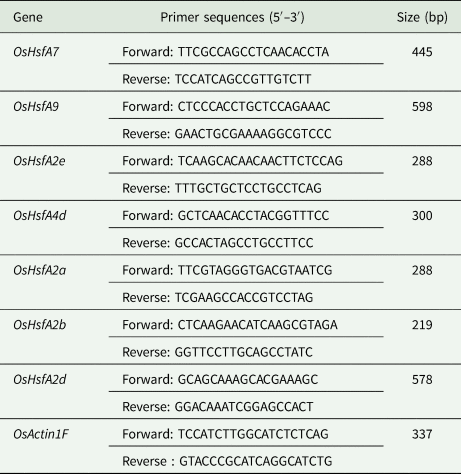
To understand the HSF gene expression changes in rice spikelets in response to heat stress, RNA was extracted from the spikelets and flag leaves of all genotypes (M9962, M7988, M7766 and JHN) of rice plants at the booting stage (R2) using the TRIzol reagent (Invitrogen, Carlsbad, CA, USA). cDNA was synthesized from the extracted RNA using RQ1 RNase-Free DNase (Promega, Madison, WI, USA). Real-time polymerase chain reaction (PCR) was performed using a KAPA SYBR Fast qPCR kit (KAPA Biosystems, Wilmington, NC, USA), with SYBR green as the fluorescent dye, according to the manufacturer's instructions. The reactions were run on a Bio-Rad iCycler iQ5 machine (Bio-Rad, Hercules, CA, USA). The thermal cycling conditions were as follows: initial denaturation at 94 °C for 2 min, followed by 40 cycles of denaturation at 94 °C for 20 s, annealing at a primer-specific temperature for 20 s, and extension at 72 °C for 20 s. Real-time PCR was followed by melting and plate reading. Actin I gene expression was used as an internal control for normalization. Three replications were performed for all reactions. The 2−ΔΔCt method (Livak and Schmittgen, Reference Livak and Schmittgen2001) was used to calculate relative gene expression. The primer sequences of the Actin I and HSF genes (OsHsfA7, OsHsfA9, OsHsfA2e, OsHsfA4d, OsHsfA2a, OsHsfA2b, OsHsfA2d, OsAP1) used are listed in Table 1. The specificity of the individual PCR amplifications was confirmed by using a heat-dissociation curve protocol following the final cycle of PCR.
The forward and reverse primers of seven OsHsf and OsActin1F genes used for real-time PCR

Statistical analysis
All the data were analysed using the R program version 3.6.1, 2017 (R Core Team, 2014) for statistical analysis to test the significance of the results for the natural and heat stress conditions. The means were separated using Duncan's test at P < 0.05. If there was no significant difference among the treatments for a given parameter, then the values from all of the experiments for that parameter were used to obtain the mean and standard error.
Results
Rice plant temperature
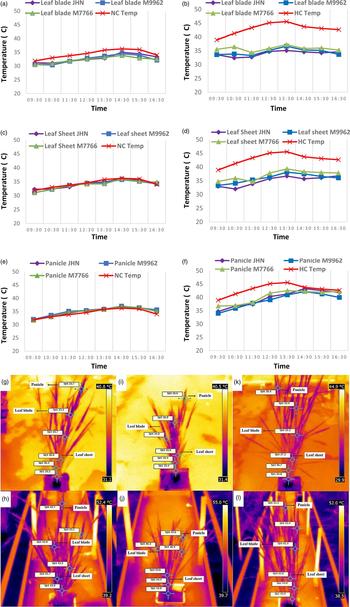
Average air temperature from the data logger in the current experiment between 09.30 and 16.30 h under NC and HC was 33.76 and 43.20 °C, respectively. The highest temperature (HT) under NC was 35.86 °C at 16.30 h, while the HT under HC was 45.56 °C at 13.30 h.
The temperature of M9962, M7766 and JHN rice plants under NC increased in the leaf blades, leaf sheaths and panicles with increasing air temperature (Figs 2(a, c and e)). The HT levels of the leaf blade, leaf sheath and panicle of the rice plants under NC were 34.44, 35.98 and 36.81 °C at 14.30 h (the air temperature was 36.25 °C). Panicles clearly showed the HT when compared with the other parts of the plant. In addition, the temperature of the panicles was slightly higher than the air temperature by 0.04 (09.30 h) to 1.22 °C (16.30 h) (Fig. 2(e)). However, the leaf blade temperature for the three genotypes was lower than the air temperature at all times under NC (Fig. 2(a)), and the leaf sheath temperature was slightly lower than the air temperature at 16.30 h (Fig. 2(c)). Thermal images of the rice plants at 14.30 h under NC are shown in Figs 2(g, i and k).
(Colour online) Temperature of the leaf blades, leaf sheaths and panicles of M9962, M7766 and JHN measured under NC (a, c, e) and HC (b, d, f). The thermal pictures of the M9962, M7766 and JHN rice plants were compared under NC (g, i, k) and HC (h, j, l).
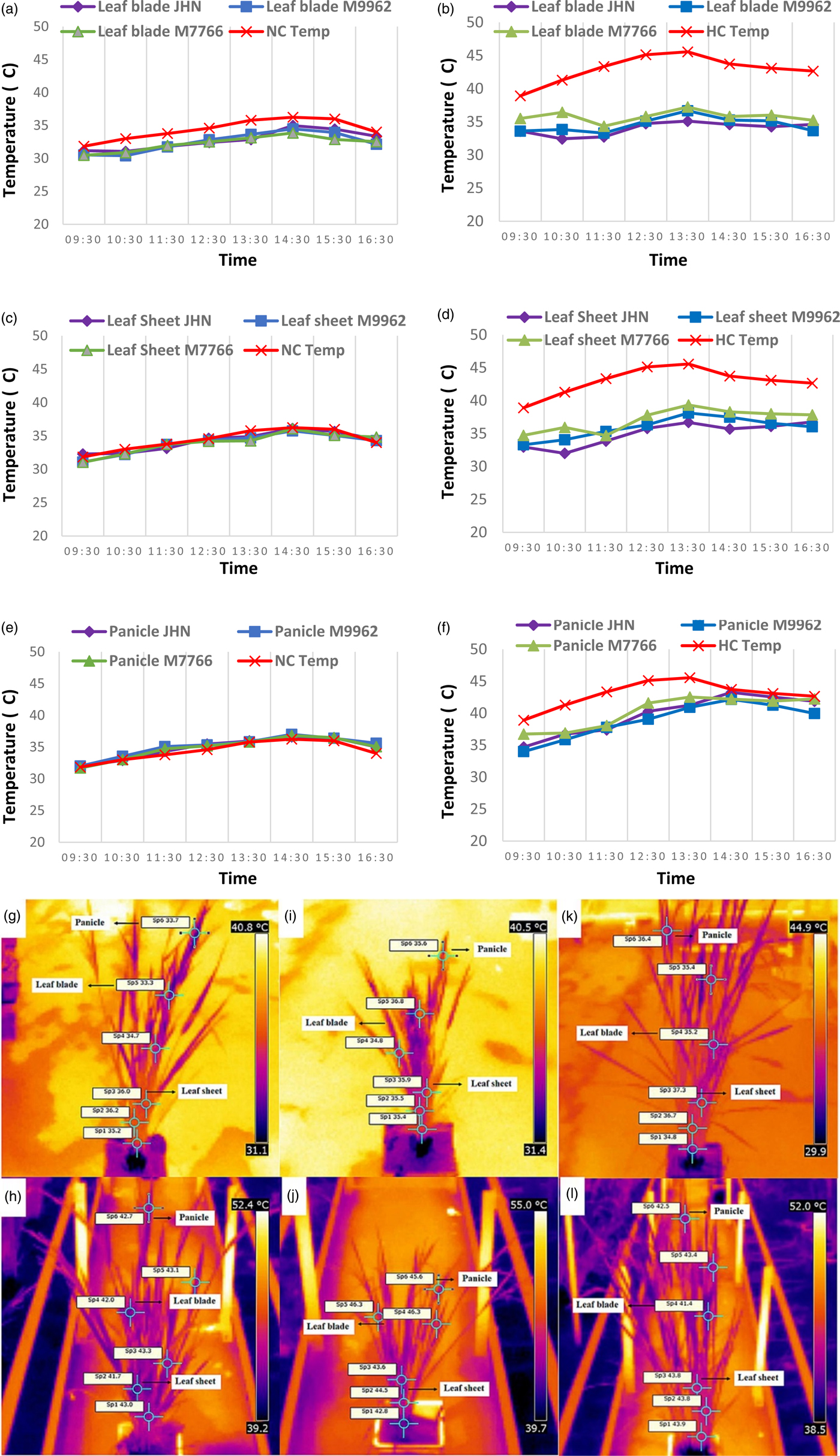
Under HC, the temperature pattern in the rice plant parts was the same as under NC (Figs 2(b, d and f)). However, the panicle temperature was no higher than the air temperature (Fig. 2(f)). When the air temperature increased to the HT at 13.30 h, the mean panicle temperature of the three genotypes was 41.57 °C, while the leaf sheath and leaf blade temperature were 38.05 and 36.33 °C, respectively. However, the average HT of the panicles was 42.55 °C at 14.30 h. Thermal images of the rice plants at 14.30 h under HC are shown in Figs 2(h, j and l). The current experiment clearly confirmed that the panicles had the HT when compared with the temperature of other plant parts under both NC and HC and that the panicle temperature may have directly affected anther dehiscence and pollen viability. However, the temperature of panicles between the tolerant and susceptible genotypes was not significantly different.
Spikelet and grain yield
Flowering period under heat stress
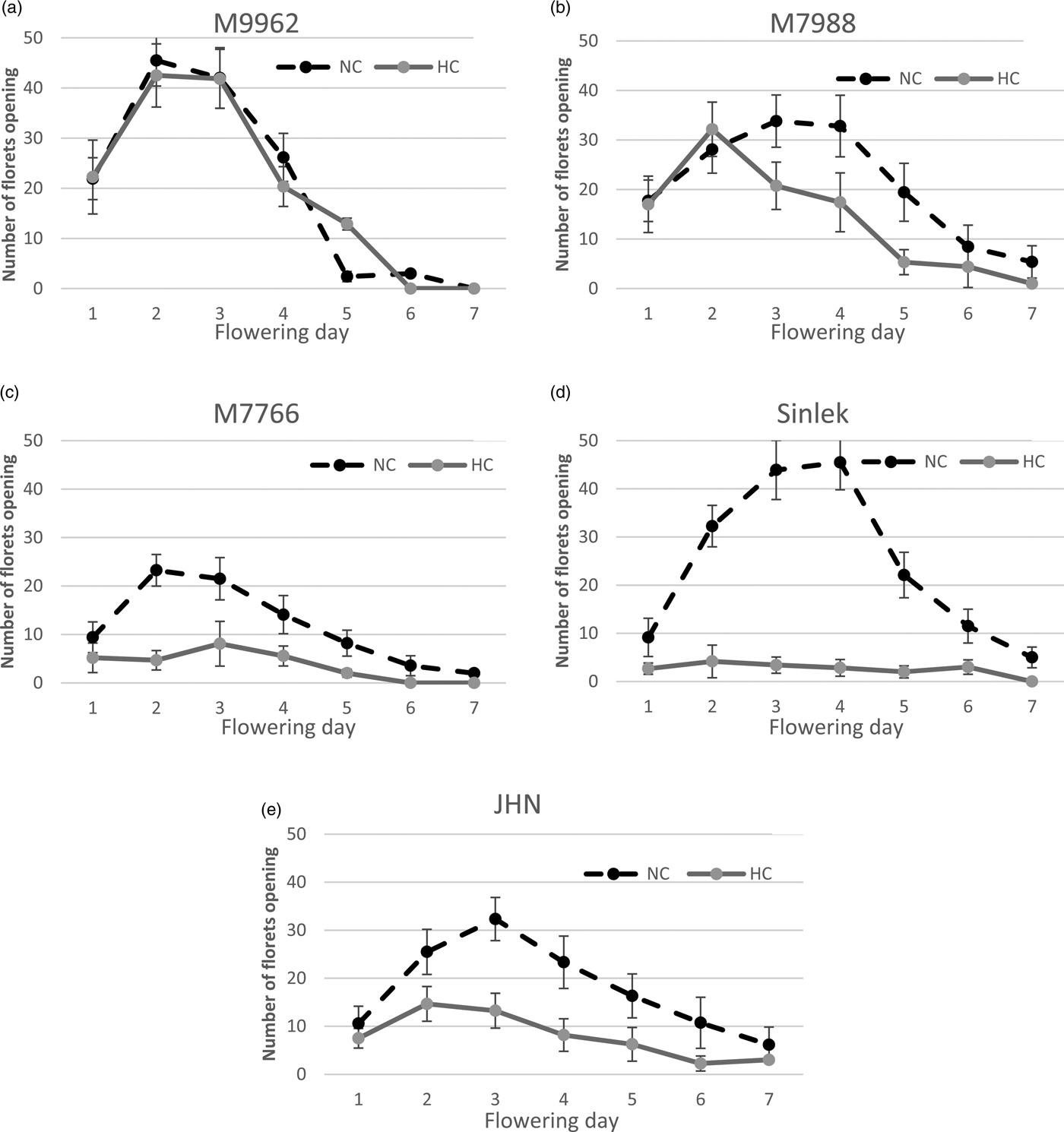
The flowering rate of the spikelets increased on the first day and peaked dramatically for all genotypes on the second and third days after treatment at high temperature (Figs 3(a–e)). The flowering spikelets of M9962 under HC showed the same pattern as did those under NC. Moreover, among all genotypes, M9962 had the highest number of flowering spikelets under HC (Fig. 3(a)). However, the flowering rate of M7988 under HC (tolerant genotype) was the same as that under NC, but the number of flowering spikelets of this genotype was less than that of M9962 (Fig. 3(b)). In addition, HC moderately affected the flowering rates of M7766 and JHN (Figs 3(c and d)), while it had a significant (P < 0.05) effect on heat-susceptible SL (Fig. 3(e)).
Effects of heat stress for 10 days during the flowering stage of M9962 (a), M7988 (b), M7766 (c), Sinlek (d) and JHN (e).

Anther dehiscence
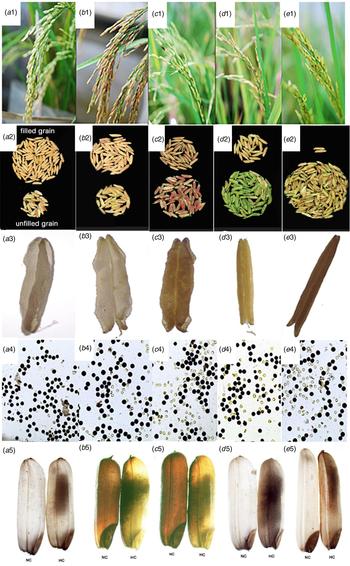
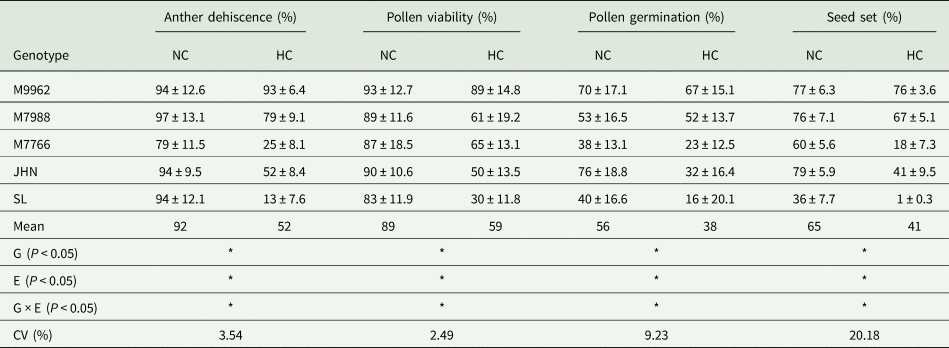
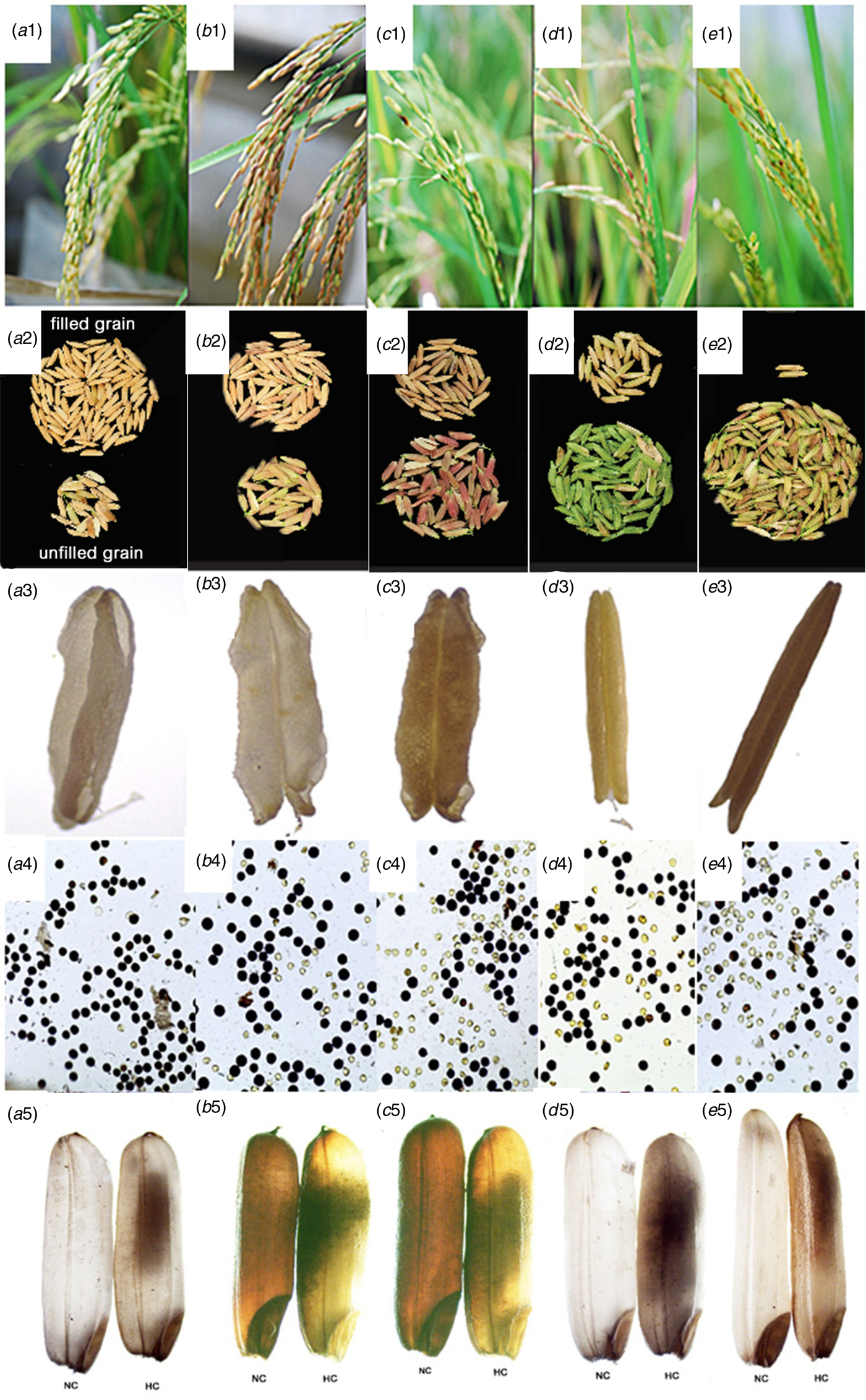
Heat stress severely affected anther dehiscence (P < 0.05) for JHN, M7766 and SL, which showed 51.6, 25.3 and 12.5% anther dehiscence under HC, compared with 94.2, 79.1 and 94.2%, respectively, under NC (Table 2). These genotypes showed a reduction in anther dehiscence under heat stress, especially SL, followed by M7766. The percentage of anther dehiscence of JHN under HC decreased from 94.2 to 51.6% compared with that under NC. However, the percentage of anther dehiscence of M7988 slightly decreased under HC from 96.9 to 79.0%, and M9962 still had a normal level of anther dehiscence under heat stress (94.4% under NC and 93.4% under HC). These results indicate that the pollen grains of M9962, M7988 and JHN could be released normally from anthers under heat stress (Figs 4(a-3, b-3 and c-3)). However, the anthers of M7766 and SL were still closed (Figs 4(d-3 and e-3)). Together, these results mean that pollen grains of M7766 and SL remained in the anthers under HC.
(Colour online) Seed set on the panicle, anther dehiscence, pollen viability, pollen germination, grain size and chalky grain of M9962 (a-1 to a-5), M7988 (b-1 to b-5), JHN (c-1 to c-5), M7766 (d-1 to d-5) and SK (e-1 to e-5) under heat stress.
Effects of heat stress on anther dehiscence, pollen viability, pollen germination and seed set of six genotypes compared with those under NC

Anther sections
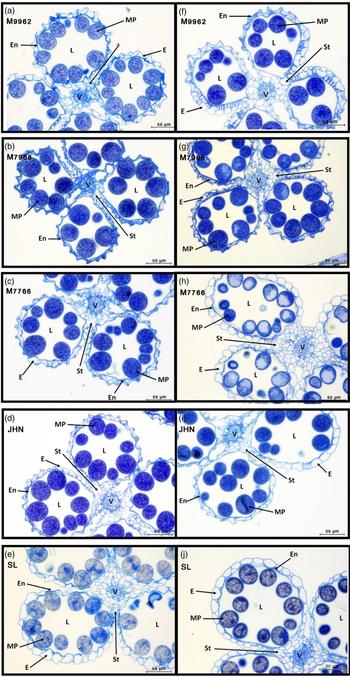
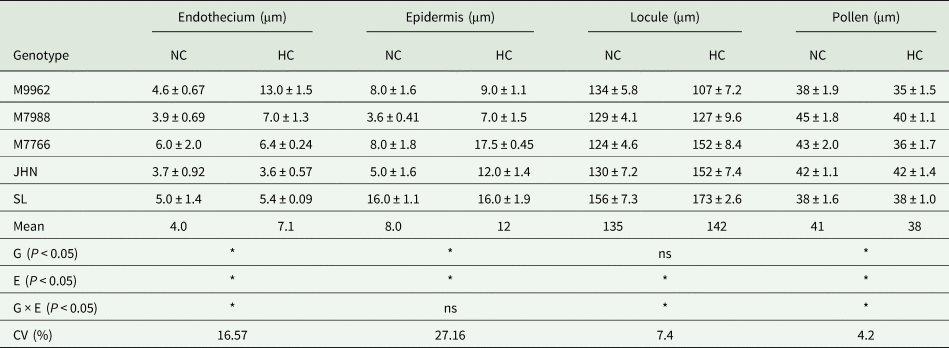
The anther cross-sections of M9962 (Figs 5(a and f)) were clearly different between NC and HC. The endothecium layer of M9962 (13 ± 1.5 µm) was the thickest when compared with that of the other genotypes under HC. On the other hand, the endothecium layers of all genotypes under NC were slightly different and ranged from 4 to 5.5 µm in thickness (Table 3; Figs 5(a–e)). In addition, in M9962, the epidermal layer was not significantly different between HC (9 ± 1.1 µm) and NC (8 ± 1.6 µm), while the epidermis of M7766, JHN and SL under HC was degraded slightly compared with that under NC (Table 3; Figs 5(h–j)). Compared with M7766, JHN and SL, the epidermal layers of M9962 and M7988 (tolerant lines) under HC were almost completely degraded (Figs 5(f–g)). In addition, the epidermal layer of SL under both HC and NC was not degraded and did not differ significantly between the two conditions (16 ± 1.9 and 16 ± 1.1 µm, respectively) (Table 3; Figs 5(e and j)). This phenomenon may help anther dehiscence in M9962 and M7988 under HC but disrupts anther dehiscence in susceptible lines (M7766, JHN and SL) under HC.
(Colour online) Comparison of the effects of heat stress on the last developmental stage of seven anther cell genotypes. The anthers under control conditions (a–e) and exposed to heat stress (f–j) are indicated. E, epidermis; En, endothecium; St, stomium; MP, mature pollen; L, anther locule; V, vascular bundle. Scale bar = 50 µm.

Dimensions of the endothecium layer, epidermal layer, locule diameter and pollen diameter of six genotypes under NC and HC

The anther size and the space inside the locules of M9962 under HC (107 ± 7.2 µm) were smaller than those under NC (134 ± 5.8 µm) (Table 3), which resulted in fewer pollen grains under HC; however, the pollen grains under HC were still viable (Table 2) and caused more pressure as the pollen grains swelled, which was in contrast to the other genotypes with a large space inside the locules (Table 3). In addition, the pollen grains under HC in all lines varied in size (Figs 5(f–j); Table 3). Moreover, for M7766 and SL, many vacuolated microspores appeared under HC (Figs 5(h and j)), which affected the pollen germination rate; these also varied in size.
Pollen viability and germination
Pollen viability had a differential response to heat stress among genotypes (P < 0.05) and between the two heat treatments (P < 0.05). The highest percentage of pollen viability under HC was found in M9962 (89.1%), which showed a slight reduction compared with that under NC (93.4%). In addition, M7988, M7766, JHN and SL had pollen viability percentages of 89.3, 86.9, 90.1 and 83.2%, respectively under NC (Table 2; Figs 4(a-4 to e-4)). The percentage of pollen viability in these genotypes under HC was decreased to 60.8, 64.7, 50.4 and 30.1%, respectively. Moreover, the pollen viability percentage of SL was the lowest under both NC and HC (Fig. 4(e-4)) due to the impact of heat stress. The percentage of pollen viability of SL under HC dramatically decreased from 83.2 to 30.1% compared with that under NC (Table 2). Staining pollen with KI/I2 indicated the formation of starch only in the pollen grains, thus indicating potentially viable pollen. However, this was no guarantee that viable pollen could germinate on the stigma, elongate a pollen tube and fertilize the egg cell.
The pollen germination rate decreased significantly (P < 0.05) in SL, M7766 and JHN under HC (Table 2) compared with that under NC. The rate in M9962 was slightly different between HC and NC. Furthermore, although the pollen germination rate of M7988 was significantly (P < 0.05) different between HC and NC, the difference was not large (51.9% under HC and 53.2% under NC). The reduction in pollen germination varied among the five genotypes. The highest percentage of pollen germination under NC was found in JHN, while under HC was found in M9962. Moreover, M9962 was slightly decreased when compared between NC (70.2%) and HC (66.9%). On the other hand, the pollen germination percentage of SL was dramatically decreased under HC (15.8%) when compared with that NC (40.0%) (Table 2).
Seed set
The seed set decreased significantly (P < 0.05) in most genotypes under HC compared with NC. However, the seed set in M9962 was not significantly different between HC (76.6%) and NC (75.6%) (Table 2). In addition, the seed set of M9962 under HC was significantly (P < 0.05) higher than that of the other genotypes. The seed set of M7988 was slightly lower, at 67.3%, under HC (76.3% under NC). SL exhibited the lowest seed set (1.0% seed set) under HC (Table 2; Figs 4(a-1 to e-1, a-2 to e-2)).
The percent seed set under HC varied from 1.0 to 75.6% (Table 2). The greatest negative effects of heat stress on seed set occurred in SL (35.9% under NC and 1.0% under HC) (Figs 4(e-1 to e-5)), followed by M7766 (59.6% under NC and 18.1% under HC) (Figs 4(d-1 to d-5)) and JHN (78.8% under NC and 40.9% under HC) (Figs 4(c-1 to c-5)). These genotypes could be classified as highly susceptible to heat stress. In contrast, only a slight decrease in seed set under HC was observed in M9962 (Figs 4(a-1 to a-5)), which indicated that this genotype was heat tolerant. In addition, the other genotype that was also classified as heat tolerant (IRRI, 2013) was M7988 (76.3% under NC and 67.3% under HC) (Figs 4(b-1 to b-5)).
Grain yield, seed weight and plant height
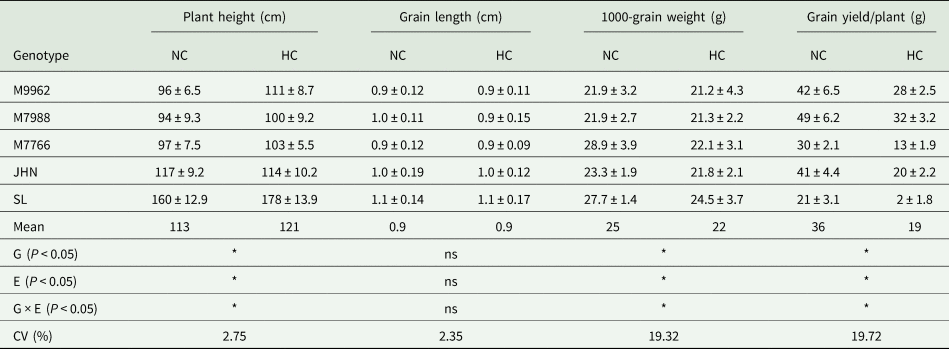
Seed weight under HC at harvest (R9) was significantly (P < 0.05) lower than that under NC in most genotypes. JHN showed no significant difference in grain weight between NC and HC. In contrast, M7766 showed a large reduction in grain weight under HC compared with NC. M9962 and M7988 showed significant (P < 0.05) differences in grain weight between HC and NC (Table 4). Remarkably, compared with the other genotypes, the susceptible SL genotype presented the highest grain weight but the lowest seed set under both NC and HC. However, the grain size of all genotypes between NC and HC was not significantly different but was slightly lower under HC than under NC (Table 4; Figs 4(a-5 to e-5)).
Effects of heat stress on plant height, grain length, 1000-grain weight and grain yield/plant of six genotypes compared with those under NC

Similar to the change patterns of the other traits, the grain yield per plant for all genotypes decreased significantly (P < 0.05) under HC. The highest yield under HC occurred for M7988, followed by M9962; however, SL showed the lowest yield under both NC and HC (Table 4). It is worth noting that a marked reduction in grain yield was attained as the seed set and grain weight were reduced under HC from the booting stage (R2) to harvest (R9); rice plants were particularly affected by heat stress before the fertilization process (R2–R4). Moreover, all genotypes showed chalky grain under HC, but the grains were still transparent under NC (Figs 4(a-5 to e-5)).
Surprisingly, the plant height of most genotypes was higher under HC than under NC. However, the heat stress treatment began after the vegetative stage and plant height might have been affected by the light intensity in the greenhouse. However, the plant height of JHN was not significantly different between NC and HC.
Expression profile of Hsf genes under heat stress
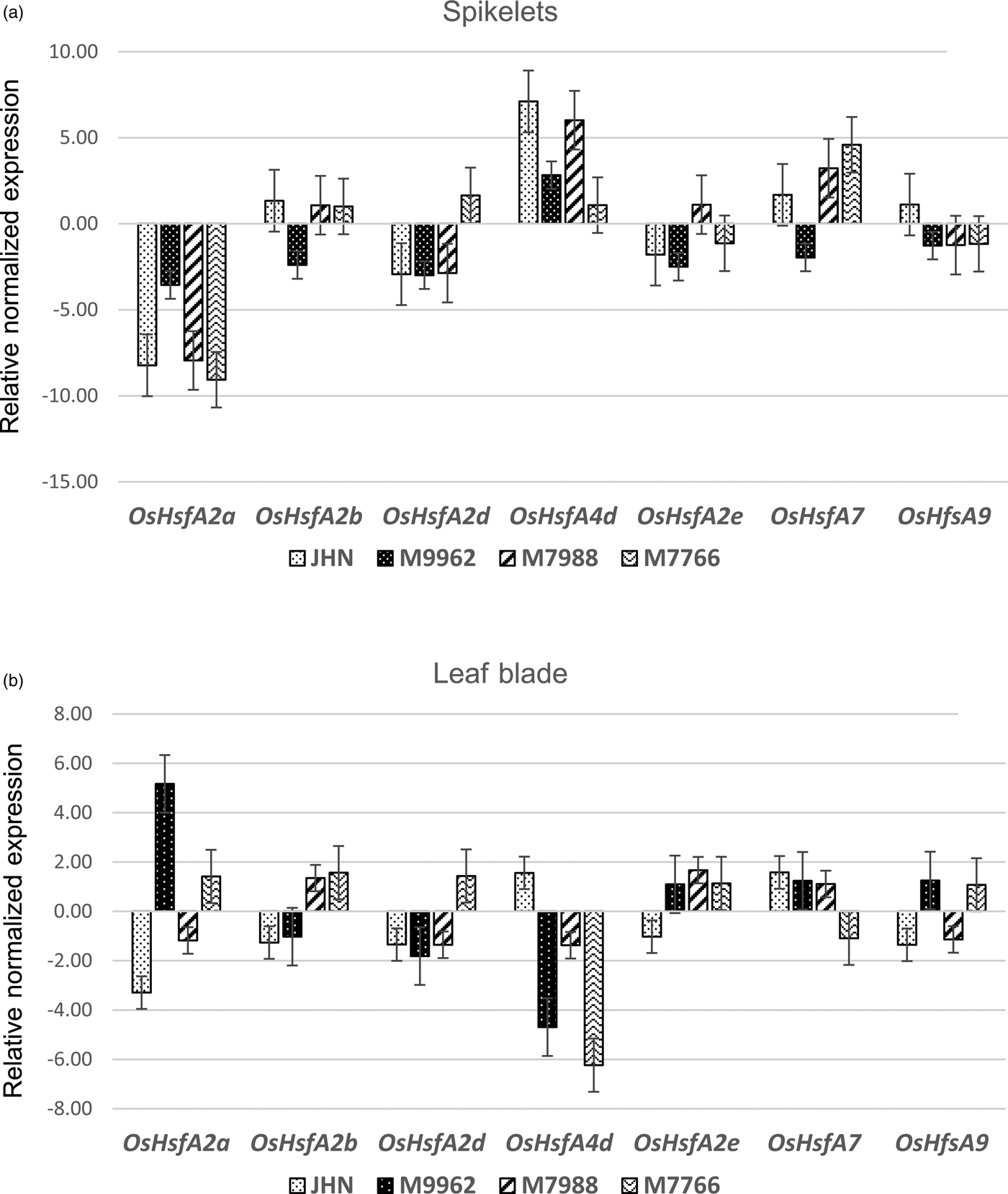
The expression of seven Hsf genes (excluding OsHsfA9) in the flag leaves and spikelets of heat-tolerant M9962 and M7988 and susceptible M7766 and JHN under HC at the R2 stage was different (P < 0.05) from that under NC (Figs 6(a and b)). The expression of OsHsfA2a in the spikelets was downregulated in all genotypes. The expression of this gene decreased slightly under HC in M9962 (−3.56-fold). However, the expression of OsHsfA2a decreased dramatically (−9.06 fold) under HC in M7766 (Fig. 6(a)). When considering the expression of OsHsfA2a in the flag leaves, the expression level in JHN decreased 3.29-fold, while that in M9962 increased 5.15-fold under HC (Fig. 6(b)).
Expression patterns of seven heat shock transcription factor genes from spikelet (a) and leaf blade (b) tissue (fold change).

The expression of HsfA2b, HsfA2d and OsHsfA2e was also downregulated in the spikelets of M9962. The expression of HsfA2 and OsHsfA2e was found to be unchanged, while the expression of HsfA2d was downregulated in the flag leaves of M9962. The expression of OsHsfA7 was downregulated in the spikelets of M9962, whereas in the spikelets of the other genotypes, it was upregulated (Fig. 6(a)), and its expression was not significantly different among the flag leaves of all genotypes (Fig. 6(b)). There was no change in the expression of OsHsfA9 in either the flag leaves or the spikelets in response to HC. These results showed differential expression of class A Hsf genes in response to HC of M9962, which contrasted with that of the susceptible genotypes. Notably, predominant expression of OsHsfA2a in the flag leaves in response to heat stress was found in M9962. These results suggest that the heat tolerance of M9962 was protected by the function of OsHsfA2a.
Discussion
The use of growth chambers or greenhouses is common in pollen heat tolerance studies. Growth chambers usually allow the precise control and uniform distribution of temperature (Barnabas et al., Reference Barnabas, Jager and Feher2008). In the current study, the high temperature and relative humidity in the greenhouse were uniform, with a high temperature of 41.2 °C for 6 h during the daytime, which was 9 °C higher than that of the NC. The relative humidity of the NC and HC was not different. However, the light intensity in the greenhouse was lower under HC than under NC due to the plastic sheet on the greenhouse. The light intensity in the greenhouse was the same as that in the experiment by Jagadish et al. (Reference Jagadish, Craufurd and Wheeler2007), who set the light intensity at 650 µmol/(l/m2/s) in a growth chamber.
The results of rice plant temperature under both NC and HC were in agreement with those of Ayeneh et al. (Reference Ayeneh, van Ginkel, Reynolds and Ammar2002) and Yan et al. (Reference Yan, Ding, Liu, Wang, Li, Ying and Wang2008), who reported that plant organs, including leaves, peduncles and spikes, may have different temperatures. Importantly, the panicles received more illumination than did the other parts due to the different positions of the plant parts within the canopy. Fu et al. (Reference Fu, Feng, Zhang, Yang, Yang, Chen, Zhao, Zhang, Jin and Tao2016) suggested that panicle type rather than canopy height mainly contributed to the temperature differences when there were no leaves. In the current study, the temperature of each part was not significantly different when compared between the tolerant and susceptible genotypes; however, Cao et al. (Reference Cao, Duan, Yang, Wang, Liu and Yang2009) reported that the leaf temperature of heat-tolerant genotypes was significantly lower than that of heat-sensitive genotypes under HC. Furthermore, the NC results showed that the panicle temperature was slightly higher than the air temperature, while the leaf blade temperature was lower than the air temperature. This finding was supported by the results of Pararajasingham and Hunt (Reference Pararajasingham and Hunt1991), who reported that the spikelet temperatures of wheat grown outdoors with an adequate water supply were 1.5 °C higher than the air temperature. In addition, Zhang et al. (Reference Zhang, Fu, Yang, Yang, Zhao, Chen, Zhang, Jin and Tao2016) reported that the transpiration rate of the leaf blade was higher than that of the panicle because the number of stomata in the leaf blade was higher than that of the spikelets of the panicle. This result indicates that the spikelet may reach daytime temperatures that are higher than the leaf temperature. However, the panicle temperature under HC was slightly lower than the air temperature but was higher than that under NC.
Generally, poor seed set results from the suppressive effects of high temperature just before or during anthesis in rice (Prasad et al., Reference Prasad, Boote and Allen2006a). Male stamens are more sensitive to high temperatures than are female pistils (Endo et al., Reference Endo, Tsuchiya, Hamada, Kawamura, Yano, Ohshima, Higashitani, Watanabe and Kawagishi-Kobayashi2009). However, Jagadish et al. (Reference Jagadish, Muthurajan, Oane, Wheeler, Heuer, Bennett and Craufurd2010) reported that male reproductive development and pre-fertilization development act as potential bottlenecks in the reproduction of plants during HC. Likewise, HC during or immediately after anthesis results in poor pollen germination and stunted pollen tube growth (Tang et al., Reference Tang, Zheng, Jin, Zhang, Huang and Chen2008). However, Cheabu et al. (Reference Cheabu, Panichawong, Rattanametta, Wasuri, Kasemsap, Arikit, Vanavichit and Malumpong2019) confirmed that M9962 was highly tolerant to HC at the reproductive stage, resulting in a high percentage of anther dehiscence, pollen viability and pollen germination.
When observing the spikelets under HC before flowering (early R4), it was confirmed that HC impacted the male organs significantly, especially those of the susceptible genotype, and induced spikelet sterility. These effects were mainly attributed to the inhibition of anther dehiscence (Matsui and Omasa, Reference Matsui and Omasa2002; Matsui et al., Reference Matsui, Kobayasi, Kagata and Horie2005), pollen viability and pollen germination (Song et al., Reference Song, Lu and Chen2001; Wassmann and Dobermann, Reference Wassmann and Dobermann2007). Matsui and Omasa (Reference Matsui and Omasa2002) reported that HC reduced pollen fertility due to delayed locule opening since the locules are tightly closed as a result of the inhibition of cell layer rupture. In addition, the decrease in pollen viability and germination under HC may be due to the reduced uptake of iron by pollen tubes or microspores (Jagadish et al., Reference Jagadish, Muthurajan, Oane, Wheeler, Heuer, Bennett and Craufurd2010). The negative impact of HC on the production of pollen is attributed to reduced meiocyte division and the poor development of microspores (Jagadish et al., Reference Jagadish, Craufurd and Wheeler2007; Cao et al., Reference Cao, Duan, Yang, Wang, Zhou and Yang2008). Thus, poor pollen development increases spikelet sterility (Jagadish et al., Reference Jagadish, Muthurajan, Oane, Wheeler, Heuer, Bennett and Craufurd2010). Prasad et al. (Reference Prasad, Boote and Allen2006a) reported that a temperature of approximately 5 °C above the ambient temperature can cause up to an 87% reduction in pollen production and a 25% decrease in pollen viability in sensitive genotypes. However, the current experiment showed more severely affected pollen viability than did that of Prasad et al. (Reference Prasad, Boote and Allen2006a) because the HC in the current experiment was set to 40–45 °C.
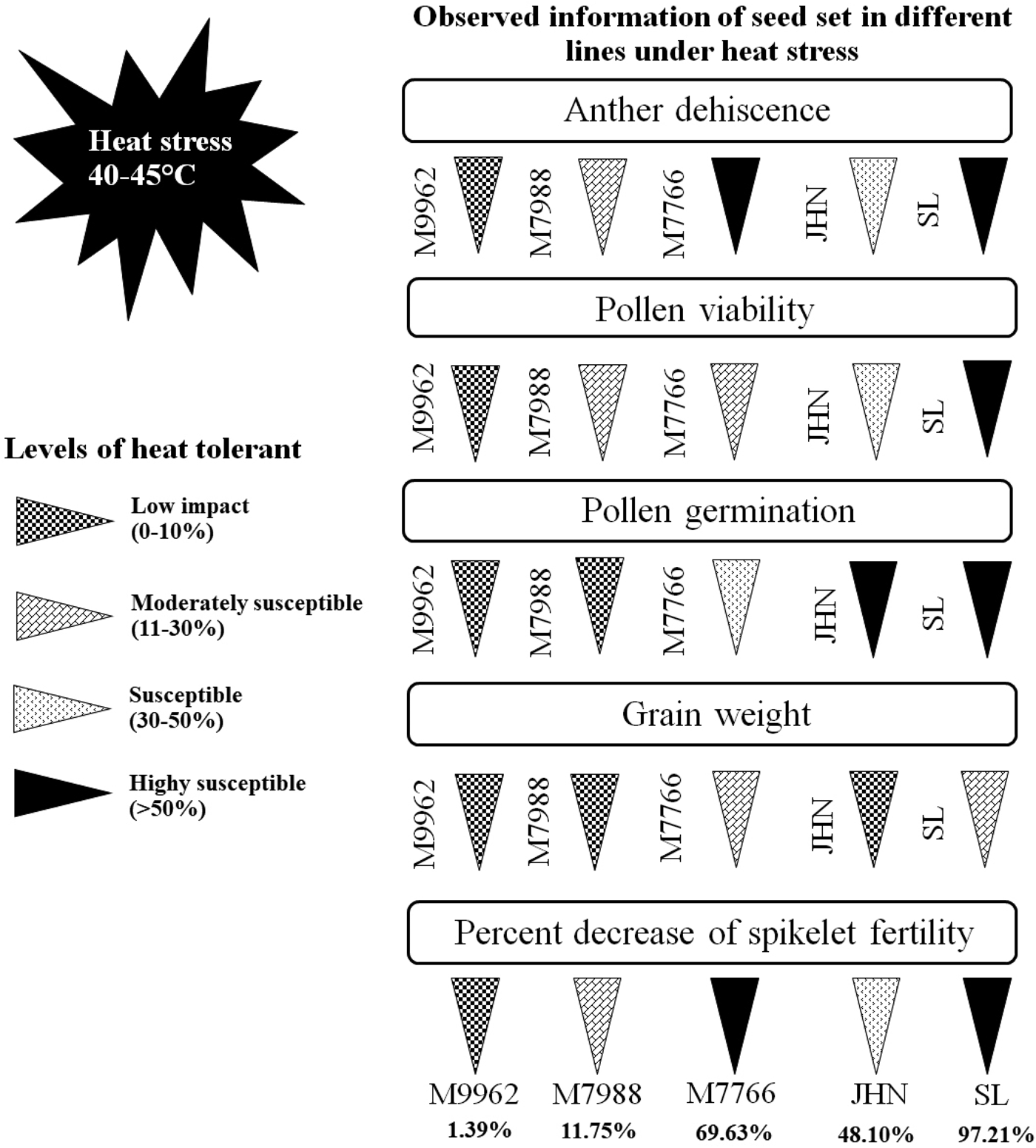
Surprisingly, the pollen viability of the susceptible genotypes M7766 and JHN under heat stress was not significantly different compared with that of the tolerant genotype M7988. Thus, it was interesting that heat stress had little effect on pollen viability in these susceptible genotypes, which was obviously different from previous results of many studies. This difference may suggest that the main factors affecting spikelet fertility in M7766 and JHN under HC were anther dehiscence and pollen germination rather than pollen viability. However, SL had the lowest level of pollen viability under both NC and HC. Das et al. (Reference Das, Krishnan, Nayak and Ramakrishnan2014) reported that each genotype showed various morphological, physiological and biochemical characteristics of pollen grains. These results clearly demonstrated that the response to HC may be different in each genotype (Fig. 7). However, the effects of HC on reduced fertilization in the susceptible genotype were consistent with the results in most studies, which show that HC dramatically reduces seed set. Therefore, the genotypic variation and mechanisms under HC can be focused on the fertilization process (Prasad et al., Reference Prasad, Boote, Allen, Sheehy and Thomas2006b; Jagadish et al., Reference Jagadish, Craufurd and Wheeler2008). Regression analysis showed strong relationships between spikelet fertility and the percentage of anther dehiscence, pollen viability and pollen germination, which were consistent with the results of Rang et al. (Reference Rang, Jagadish, Zhou, Craufurd and Heuer2011).
Observation of the fertilization process in each genotype, showing different patterns of tolerance and susceptibility under heat stress.

Anther dehiscence has been shown to be a highly regulated process that appears to be particularly sensitive to abiotic stress (Sakata and Higashitani, Reference Sakata and Higashitani2008; Jagadish et al., Reference Jagadish, Muthurajan, Oane, Wheeler, Heuer, Bennett and Craufurd2010). The tapetum plays an important role during the early microspore stage, providing the nutrients, carbohydrates, lipids and enzymes necessary for the synthesis of the outer pollen wall, and it degenerates soon after the microspore is released from the tetrad (Endo et al., Reference Endo, Tsuchiya, Hamada, Kawamura, Yano, Ohshima, Higashitani, Watanabe and Kawagishi-Kobayashi2009). Therefore, proper tapetal function and its timely degradation are crucial components of pollen development (Rieu et al., Reference Rieu, Twell and Firon2017). The growth of the outer layers of the anther walls, such as the epidermis, endothecium, septum and stomium, could be disturbed by HC and could cause anther indehiscence (Matsui and Omasa, Reference Matsui and Omasa2002). The endothecium thickening within this cell layer also plays a critical role in anther opening and pollen release. This process involves the expansion and subsequent deposition of ligno-cellulosic thickening in the endothecium cells and the breakdown of the septum in the anther walls combined with anther dehydration and pollen swelling, resulting in stomium breakdown and anther opening (Keijzer, Reference Keijzer1987; Wilson et al., Reference Wilson, Song, Taylor and Yang2011). Moreover, the endothecium plays a role in protecting pollen grains in the locules before anther opening (Pacini and Dolferus, Reference Pacini, Dolferus, Shanker and Shanker2016). There are also indications that secondary thickening in anther endothecia may be involved in localized stress-related transcriptional responses (Wilson et al., Reference Wilson, Song, Taylor and Yang2011). In addition, in the current study, the epidermis of M7766, SL and JHN was not degraded, and the anthers of these genotypes were non-dehiscent while, the epidermis of heat-tolerant M9962 was completely degraded and then anther dehiscence was normal.
Non-dehiscence of anthers has also been linked to a reduction in the swelling of pollen, which provides the force for anther opening (Matsui et al., Reference Matsui, Omasa and Horie2000). Matsui et al. (Reference Matsui, Omasa and Horie2001b) reported that the well-developed cavity of locules in tolerant lines (Nipponbare) under HC allows easy dehiscence of the anthers. Thus, in the current study, it may be that fewer non-viable pollen grains in the large locules of M7766, JHN and SL under HC caused less pressure as the pollen grains swelled, after which the anthers did not open.
High temperature can also occur during the period of seed development and can decrease the grain size of rice (Cao et al., Reference Cao, Duan, Yang, Wang, Zhou and Yang2008; Chaturvedi et al., Reference Chaturvedi, Bahuguna, Shah, Pal and Jagadish2017). The early stage of seed development is highly sensitive to temperature (Folsom et al., Reference Folsom, Begcy, Hao, Wang and Walia2014). In addition, the duration of the syncytial phase and the timing of cellularization are critical to response to temperature because they are correlated with the extent of nuclear proliferation and may influence grain filling and grain weight (Mizutani and Ohta, Reference Mizutani and Ohta2010). In the current experiment, the seed weight of all genotypes decreased under HC. Furthermore, high temperature is linked to various types of chalky rice grains (Wada et al., Reference Wada, Miyahara, Sonoda, Tsukaguchi, Miyazaki, Tsubone, Ando, Ebana, Yamamoto, Iwasawa, Umemoto, Kondo and Yano2015; Morita et al., Reference Morita, Wada and Matsue2016). The current experiment showed the same result as that of previous research in that every genotype presented chalky grains under high temperature.
The expression patterns of Hsf genes were investigated in the leaves and spikelets (R2). The expression of OsHsfA2a in the spikelets was dramatically decreased in all genotypes, especially in M7766, while in M9962, it was downregulated only slightly. Upregulated expression of this gene in the leaves was found only in M9962. These findings are in agreement with the results of Liu et al. (Reference Liu, Zou, Zhang, Zhou, Wang, Xiong, Chen and Chen2010), which showed that the expression of OsHsfA2a was strongly induced in the leaves of rice seedlings during heat stress. Thus, the product of this gene may play an important role in the heat defence of rice. Notably, the level of OsHsfA2a transcripts during heat stress was related to the seed set in both the tolerant and susceptible lines. In tomato, HsfA2 accumulated to a high level after plant exposure to prolonged heat stress (Scharf et al., Reference Scharf, Heider, Höhfeld, Lyck, Schmidt and Nover1998; Port et al., Reference Port, Tripp, Zielinski, Weber, Heerklotz, Winkelhaus, Bublak and Scharf2004). In contrast to tomato, which contains only one HsfA2, rice has an HsfA2 family composed of five different HsfA2s. Therefore, there might be a more complex heat shock regulation in rice than in tomato. In addition, the results suggested that the processes of M9962 during the reproductive stage could be related to the upregulated expression of OsHsfA2a in the leaves, which could activate other genes in the heat tolerance pathway. For OsHsfA2b, the expression pattern was slightly changed in the leaves and spikelets. Liu et al. (Reference Liu, Zou, Zhang, Zhou, Wang, Xiong, Chen and Chen2010) reported that this gene was expressed 45 min after treatment with high temperature and that it decreased at 1.5 h. The tissues in the current study were collected 1 day after treatment with high temperature. Thus, this gene was already transcribed, and its expression was inhibited by feedback control (Baniwal et al., Reference Baniwal, Bharti, Chan, Fauth, Ganguli, Kotak, Mishra, Nover, Port, Scharf, Tripp, Weber, Zielinski and von Koskull-Döring2004). Furthermore, HsfA2d, HsfA2e and OsHsfA7 showed the same results as did OsHsfA2b.
The expression of HsfA4d was upregulated under heat stress in the spikelets of all genotypes except M7766. It could be suggested that this gene is related to the heat stress response in spikelet tissue, as this gene showed a low level of expression under NC (Liu et al., Reference Liu, Zou, Zhang, Zhou, Wang, Xiong, Chen and Chen2010). When considering HsfA4d expression in the leaves, the current results showed that it was regulated by feedback control similar to that for OsHsfA2b. However, the expression of OsHsfA9 did not change under heat stress. This result was consistent with the results of Liu et al. (Reference Liu, Zou, Zhang, Zhou, Wang, Xiong, Chen and Chen2010), which showed that the expression of OsHsfA9 did not differ between HC and NC. Kotak et al. (Reference Kotak, Port, Ganguli, Bicker and Von Koskull-Döring2004) reported that AtHsfA9 was exclusively expressed in the late stage of seed development and not during the other stages of plant growth and that HaHsfA9 was specifically expressed during embryogenesis under normal conditions in sunflower (Almoguera et al., Reference Almoguera, Rojas, Diaz-Martin, Prieto-Dapena, Carranco and Jordano2002). These results indicated that HsfA9 might be involved in normal embryogenesis and/or seed development (Liu et al., Reference Liu, Zou, Zhang, Zhou, Wang, Xiong, Chen and Chen2010).
Conclusion
In summary, variations among genotypes showed that there are different processes for producing seed under heat stress. In the current study, M9962 was confirmed as a heat-tolerant genotype that had a high level of anther dehiscence and pollen viability and germination to produce seed set, while the other tolerant line (M7988) had a moderate level of anther dehiscence and pollen viability but had a high level of pollen germination. However, the processes within JHN, SL and M7766 were disrupted during some stages, which resulted in decreased seed set. In addition, the pollen viability in M7766 was slightly affected by heat stress, which differed from findings in previous studies. Thus, heat stress does not need to cause complete disruption at this step but can have a stronger effect at other steps, including anther dehiscence and/or pollen germination, during fertilization to affect seed set. Thus, the disruption of only one process is sufficient to reduce seed set dramatically. The expression levels of the seven Hsf genes (excluding OsHsfA9) in the flag leaves and spikelets of the heat-tolerant and heat-susceptible plants under heat stress conditions at the R2 stage were different from those under NC. In M9962, the expression of OsHsfA2a was highest among the genotypes during HC. Thus, M9962 and M7988 could be used as heat-tolerant germplasms in rice breeding programmes. Moreover, grain quality, especially grain weight and chalky grain, should be considered in breeding programmes.
Financial support
The authors acknowledge Agricultural Research Development Agency (Public Organization), Thailand for financing this study and the provision of this research.
Conflict of interest
None.
Ethical standards
Not applicable.