‘Do opposition coalitions increase the likelihood of democratization by elections in electoral authoritarian regimes?’ is the general question of this study. Authoritarian elections are characterized by their unlevel electoral playing fields, constructed to give the incumbent a clear advantage and reduce the degree of competition at the ballot box (Greene Reference Greene2007; Levitsky and Way Reference Levitsky and Way2010). Without electoral pressure to democratize, elections can be used as an institution to legitimize the political system and stabilize the status quo (Lust-Okar Reference Lust-Okar2006; Magaloni, Reference Magaloni2006). Several authors have therefore acknowledged opposition coordination to be a possible strategy for decreasing incumbent advantages and possibly achieve democratization by elections (Howard and Roessler Reference Howard and Roessler2006; Pripstein Posusney Reference Pripstein Posusney2002; Rakner and Svåsand, Reference Rakner and Svåsand2004).
Elections constitute a moment when political rules are under especially tense contestation (Schedler Reference Schedler2002a). Some elections are able to push the boundaries for democracy, while others stabilize the status quo or force incumbents to increase authoritarian control. In the Serbian 2000 election, the electorate managed to oust the regime and install a significantly more democratic successor. In Zimbabwe's 2002 election, on the other hand, a pressured Mugabe regime found itself forced to increase authoritarian coercion to get re-elected. How an election affects a country's degree of democracy will, in this article, be labelled the Democratic Electoral Outcome (DEO).Footnote 2 Serbia and Zimbabwe exhibit very divergent DEOs.
Both Serbia and Zimbabwe are cases with clearly coordinated opposition contesters. Although intuition suggests that the opposition's prospects for winning elections should intuitively be damaged by internal fractionalization, this does not necessarily imply that coordination is a general recipe for democratization by election. First, alternation does not necessarily lead to democratization. Second, opposition coordination might have little or even negative impact on democratization when elections do not lead to turnovers. Finally, it might be the case that opposition coordination is a reflection of authoritarian weakness rather than the real causal explanation for positive DEOs.
This article will investigate the process of democratization through elections and will critically assess the argument that opposition coordination causes positive DEOs. The study utilizes an original dataset of 251 authoritarian elections from the period 1973–2004. The results show that the assumption that coordination leads to democratization relies on remarkably feeble grounds. What can be understood as a democratizing effect of coalition building is more accurately described as an alternation effect, and this is partly an artefact of the coding procedures of leading democracy indices. The potential positive effect of opposition coordination also seems to be short lived. If we extend the timeframe for measuring the electoral effect, the importance of opposition coalitions vanishes. Moreover, evidence of potential endogeneity is presented which casts doubt on the causal explanatory power of opposition coordination for democratization through elections. The results suggest that opposition coordination is more common when the incumbent regime is weak. More specifically, when an incumbent's economic performance is poor, opposition parties are more likely to form coalitions. Taken together, these results indicate that opposition coordination is not a general recipe for democratization through elections.
Coalitions and democratization by elections
The world has seen a rapid increase in the number of electoral authoritarian regimes since the end of the Cold War. These regimes combine formal democratic rules with authoritarian governance and they use elections as their primary source of legitimization (Schedler Reference Schedler2002b). As counter-intuitive as it might sound, authoritarianism without election is nowadays a rare combination (for an illustration of the spread of the electoral authoritarian regime type see Hadenius and Teorell Reference Hadenius and Teorell2007). Although it has become common sense not to equate elections with democracy,Footnote 3 a number of authors have asked themselves whether elections could act as a promoter of democratization, even though the elections themselves were not democratic.
Empirical research has made this claim plausible (Lindberg Reference Lindberg2006; Teorell and Hadenius Reference Teorell and Hadenius2009). Countries with a longer electoral history tend to be more democratically developed than those with a shorter experience of arranging elections. How the process of democratization by elections should be perceived is, however, still a largely unsettled issue. Two divergent interpretations of this concept have been used in democratization research. In Lindberg's original work (Reference Lindberg2006) on this subject, the idea was promoted that elections should not only be considered an indicator of democracy but also an independent variable that promoted democratic practices. In this way, holding elections would give rise to longer-term beneficial effects, such as a more active citizenry, a more developed civil society and more institutionalized political parties. Elections can also be moments when internal and external actors can increase pressure for reform. In other contributions to the field, democratization by elections is understood as a more radical process. According to this view, elections sometimes become impossible for the incumbent regime to control and hence lead to drastic regime changes. This way of looking at democratization by election became especially attractive after the ‘colour’ revolutions in Eastern Europe and Central Asia (see Bunce and Wolchik Reference Bunce and Wolchik2010; Hale Reference Hale2005). Because of these instances, it became increasingly relevant to ask why some of these elections resulted in electoral turnovers, while others were comfortably held under control by the incumbent regime.
A clear member of the latter tradition is the work by Howard and Roessler (Reference Howard and Roessler2006). When investigating potential determinants for ‘liberalizing electoral outcomes’, Howard and Roessler found opposition coalitions to be the most prominent explanation for such changes. This is, of course, a highly interesting finding, but it is one in need of more systematic testing. This study will make an effort to deepen our understanding of how opposition coalitions affect electoral outcomes.
In the work by Przeworski et al. (Reference Przeworski, Alvarez, Cheibub and Limongi2000), alternation is seen as the defining feature that separates democracy from autocracy. However, as suggested by other authors, it is possible to change regime without changing regime type (Levitsky and Way Reference Levitsky and Way2010; Schedler Reference Schedler2002b). Democratization is here defined, along the lines of classic Dahlsian polyarchy, as a process of increased political competition and participation along with more effective enforcement of political liberties and civil rights (Dahl Reference Dahl1971). From this theoretical perspective it becomes clear that democratization does not by default follow alternation in power.
In Howard and Roessler's article (Reference Howard and Roessler2006), most of the presented mechanisms, connecting opposition coalitions with democratization, are related to an increased chance of opposition victory or, at least, decreased support for the incumbent when the opposition is coordinated. It does undoubtedly make intuitive sense that opposition parties with pooled administrative and economic resources and strategically coordinated electoral behaviours would increase their electoral capacity. It is, however, unclear whether coordination would also change the risk of electoral manipulation and repression by the incumbent regime. Quite the contrary: there have been theoretically convincing arguments suggesting that manipulation would be more common in cases where the incumbent is threatened by a strong opposition (Molina and Lehoucq Reference Molina and Lehoucq1999).
The question remains whether the effect of opposition coalition building is really one of general democratization or merely a consequence of an increased probability of opposition electoral success. This distinction is important for several reasons. First, our understanding of the effects of coalition building is limited if we do not know why it tends to produce democratically beneficial outcomes. If the aim is to increase our understanding of elections under authoritarianism, we should not aggregate concepts more than necessary. Rather than discussing several possible mechanisms by which coalitions could create democratization, it might be possible to narrow it down to one question: whether coalitions increase the probability for turnovers.Footnote 4
Second, recent experience has shown that opposition success should not be equated with democratization. In a number of divergent cases, such as Madagascar and Georgia, it has become clear that newly elected governments might be reluctant to abolish incumbent electoral advantages and increase electoral fairness (Kalandadze and Orenstein Reference Kalandadze and Orenstein2009). Alternation in power is not by definition democratization, but it should be considered a possible independent variable to longer-term democratization. Also, democratization through elections could be created without turnovers. If incumbent regimes feel pressured, from inside or outside, they might give in to such pressure and increase the fairness of elections. Eventually, such gradual liberalization might lead the way for alternation. However, alternation in these cases might be an effect of democratization rather than the cause.
Third, the outcome of elections in authoritarian regimes and the coding of leading indices of democracy are highly correlated in election years. Freedom House, for instance, includes electoral turnovers and opposition electoral support as two of the criteria for determining its political rights score.Footnote 5 If coalition building were primarily a consequence of alternation, we would have to observe longer-term effects to really claim that coordination is important for democratization.
Accordingly, to understand the effect of opposition coalition building for democratization by elections, we need to understand how and why potential effects of coordination occur and whether these effects are short lived or survive past the election year. Three hypotheses are derived on the basis of the above discussion.
H1a: Opposition coalitions increase the likelihood of opposition victories.
H1b: The presence of an opposition coalition does not impact democratization in election years if the opposition is not successful at the polls.
H1c: There is no effect of coalition-building on democratization beyond the actual election year.
Is the relationship endogenous?
In a study discussing the creation of opposition coalitions, van de Walle (Reference Van de Walle2006) argued that the relationship between opposition coordination and electoral outcomes might be considered somewhat endogenous. He claimed that elections in authoritarian regimes could be described as a tipping game. When clear signs of regime instability appear, leading government politicians start to defect and join the opposition. These new opposition politicians do so because they realize that their chances of retaining power and access to state resources are higher if they contest the election on an opposition ticket. A prerequisite for opposition success is, however, that the opposition is able to create a credible alternative to the incumbent. When faced with realistic prospects of an electoral victory, former ethnic or ideological rivals would usually find it more attractive to create such an alternative.
This is a vital objection to the theory about opposition coordination and democratization by election. If this is indeed the case, what has previously been described as a positive relationship between these two variables could be partially endogenous, especially if it is shown that the effect of coalition building is intimately related to the cases where the opposition actually wins elections. Moreover, if the newly elected coalition governments are really nothing more than old wine in new bottles, this also gives an indication as to what kind of democratization process could be expected after the electoral turnover.
Although van de Walle's theoretical argument (Reference Van de Walle2006) is a critical objection to the theory of opposition coordination, it still needs to be tested empirically. It is impossible to factor the real perceived prospect for an opposition victory into a regression analysis. What could be done, however, is to take into account structural circumstances that are likely to affect the potential for incumbent defeat.
The most powerful predictor for incumbent defeat would probably be incumbent economic performance. Hence, we believe that opposition coordination would be especially common if the incumbent's economic performance was poor. The theory about economic voting is one of the most prominent explanations for incumbent electoral success in the Western context (see Duch and Stevenson Reference Duch and Stevenson2008). A study by Collier and Hoeffler (Reference Collier and Hoeffler2009) showed that economic performance also harms the prospects of incumbent re-election in authoritarian regimes. Bad economic performance sparks dissatisfaction among the electorate and increases the support for the opposition parties (see, for example, Geddes Reference Geddes1999; Teorell Reference Teorell2010). It also negatively affects the government's ability to distribute patronage (Greene Reference Greene2007).
H2: Opposition coalitions are more likely to form prior to elections when the incumbent government's economic performance has been poor.
What is a pre-electoral opposition coalition?
Pre-electoral opposition coalitions can be organized in different ways. In some cases, the coalitions are highly formalized and integrated. In such cases, the opposition decides to issue a joint list under one common name. The opposition in Kenya in 2002, for instance, used this strategy. In this election, all parties ran under one common National Rainbow Coalition (NARC) list and also nominated one joint presidential candidate. In other cases, the opposition parties have retained their original party labels and have run separate campaigns, but with a declared intention to form a coalition government if they obtained a parliamentary majority. The VMRO-DPMNE Party and the Democratic Alternative (DA), for example, used this strategy in the Macedonian 1998 parliamentary election. These are two different strategies, but in this article both are considered to be versions of a pre-electoral coalition. Whether to run as a joint or separate list is probably to a large extent determined by institutional arrangements. However, as argued by Golder (Reference Golder2006), pre-electoral coalitions are not only formed to circumvent disproportional voting systems, but is also used as a signalling mechanism to voters. In authoritarian regimes, both types of coalition (joint and separate lists) should signal a stronger opposition against the government and a clear indication that opposition parties do not intend to be co-opted by the incumbent after the election (Wahman Reference Wahman2011). To make sure that this decision does not affect the results substantially, robustness tests will also be run, excluding the 13 cases in the sample where the opposition ran on a separate list coalition.
It is hard to find any shortcuts when it comes to an adequate operationalization of the coalition variable. Van de Walle (Reference Van de Walle2006) used the share of the vote received by the leading opposition candidate in a presidential election as a ‘proxy’. He argued that a high share of the vote for one single opposition candidate implies a large degree of opposition cohesion. This operationalization does have serious drawbacks because it could just as well imply opposition strength. Accordingly, there would be a substantial correlation between this variable and opposition victory. Therefore, there is no other option than to code this variable manually (Howard and Roessler (Reference Howard and Roessler2006) adopt the same solution).
The opposition coalition variable in the analysis is dichotomous. An opposition coalition is considered present when all major opposition parties are included in one common pre-electoral coalition. That is, they have declared that they have the intention of governing together after a contingent electoral victory or they explicitly support a single presidential candidate. If important elements of the opposition are not included in the coalition, the variable is coded as 0. Consequently, cases such as Gambia in 2001 are not coded as a coalition. In this instance, three parties had united behind the main opposition competitor, Ousainou Darboe of the United Democratic Party. However, there were also three other opposition candidates running against Mr Darboe. The most successful of these alternative candidates was Hammat Bah of the National Reconciliation Party, who secured almost 8 per cent of the vote (BBC News 2001). In this case, opposition disunity clearly remained an obstacle for the opposition's challenge. Similarly, cases with multiple coalitions are not coded as one having a coalition. In these cases, the type of coordination that is hypothesized to have an impact on the electoral outcome was not present.
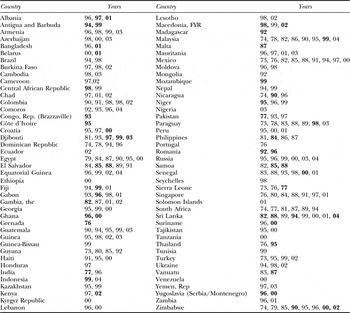
If the opposition is practically concentrated in one dominant party, this is also regarded as a coalition. An example of such a dominant party was the New Patriotic Party (NPP) in the Ghanaian elections of 1996 and 2000.Footnote 6 Information for the coding was taken from prominent secondary sources. Keesing's record of world events (various editions) and the Inter Parliamentary Union reports (various editions) were always consulted when available. If there were no explicit mention of coalitions in these sources, information was sought in Freedom House reports, scientific articles and articles from the press. A full list of elections and coding decisions is provided in Appendix 1.
Data and research design
The aim of this study is to keep the number of observations on as high a level as possible. Accordingly, there is no reason for restricting the population in time as long as there is accessible data. As will be explained later, the dependent variable of this study is dependent on Freedom House data; therefore it is not possible to go further back than 1973.Footnote 7 Because observations on many of the independent variables have decreased in the most recent years, the last observed year discussed is 2004.
Only authoritarian elections will be included in the population. There are different ways of identifying such regimes, but this article will use the classification from the work of Hadenius and Teorell (Reference Hadenius and Teorell2007) to identify this population. In their study, the authors utilized a category labelled ‘limited multiparty systems’ (LMS), which is equivalent to the concept of electoral authoritarianism. LMS codes all countries that, in a given year, have a government that has been elected in a popular and recurrent election where at least one real opposition candidate was allowed to participate, but where the democracy score is less than 7.5 on a 10-point (combined Freedom House and Polity) scale as an LMS state or, in this case, as ‘electoral authoritarian’.Footnote 8 This category is coherent with the definition of electoral authoritarianism used by Schedler (Reference Schedler2002b). Founding elections (that is, the country's first election under multipartyism) will also be excluded from the population. This, as Howard and Roessler (Reference Howard and Roessler2006) point out, is desirable because the outcome of these elections are seldom an effect of what happens in connection with the election but rather a consequence of power struggles that occurred in the process of setting up the electoral institutions.
The sample restriction outlined above leaves the study with a sample of 251 elections in 86 countries from 1973 to 2004. This is a significantly larger sample than all previous studies on this matter. The sample consists of 141 parliamentary and 110 presidential elections.
Democratic Electoral Outcome (DEO)
A combination of the two leading democracy indices, Freedom House and Polity IV, will be used to measure the Democratic Electoral outcome (DEO). The DEO is measured as the change in democracy surrounding the event of an election. Hence all movements in the scores are recognized. The variable can take on both negative and positive values, it is continuous and varies in size depending on how much the democracy scores change at a specific election.
Following Hadenius and Teorell (Reference Hadenius and Teorell2007), change in democracy will be measured with a combined inverted Polity and Freedom House civil liberties and political rights score. In this combined score, the two indices are transformed into a 0–10 scale (0 being the least and 10 the most democratic), and a mean score is then calculated for every country year. In this way, the dependent variable becomes continuous and can adopt negative as well as positive values.
The operationalization of the dependent variable in this study has many similarities with how Howard and Roessler (Reference Howard and Roessler2006) measure Liberalizing Electoral Outcomes (LEOs), but deviates from their operationalization in important ways in order to match the theoretical background and research aim of this article. A number of alternative tests will also be run to enable us to better understand the relationship between DEOs and electoral turnovers.
In Howard and Roessler's study on liberalizing electoral outcomes (Reference Howard and Roessler2006), the dependent variable is dichotomous. A LEO was noted in every election year where the Polity score increased by three points or more and the Freedom House political rights score increased by more than one point. This way of measuring the dependent variable is problematic for several reasons. Democratic indices, as already noted, especially the Freedom House political right index, are highly dependent on electoral outcomes and are likely to indicate significant improvements if the opposition is successful at the polls (Gastil Reference Gastil1990). Therefore, it is hard to capture effects other than pure alternation. There are also few good reasons not to measure changes in civil liberties. Changes in civil liberties should be just as interesting an indicator of democratization by elections and also more independent from the actual outcome. Since alternation is part of the Freedom House political rights score, it would also be interesting to measure democratic change only using the Polity scores. Therefore an additional test will be used to see whether the importance of opposition coordination decreases if we do not rely on the Freedom House index.
Furthermore, when only measuring change in the election year the electoral outcome affects the measurement even further. Democratization through elections might come as a consequence of opposition success at the polls, enabled by opposition coordination, but to support this argument we would have to see real democratic reforms after elections, not just a positive assessment of the prospects for future democratic development based on incumbent defeat. Therefore, the dependent variable will be measured with varying length on the measured timeframe. In addition to Howard and Roessler's one-year lag (Reference Howard and Roessler2006), the study will also use a two-year timeframe to measure the DEO as the change between the year after and the year before the election. It would, of course, be possible to use a longer timeframe, but the two-year frame constitutes a conservative test of hypothesis H1c (that the effect of coalitions fades beyond the election year).
Opposition Victories
The electoral outcome will be used as an alternative dependent variable. In parliamentary elections, an opposition victory is coded when the dominant party of the previous government is not included in the new government. By the same token, presidential elections where the winner is not the incumbent president or a representative from the party of the incumbent president are coded as opposition victories. Information guiding the coding is taken from prominent secondary sources such as the Keesing's record of world events (various editions) and the Inter-Parliamentary Union website (various editions).
Control Variables
Popular protests. In Howard and Roessler's study (Reference Howard and Roessler2006), popular protest was another variable, next to opposition coalitions, that gained significance in the statistical models. In this model, there will be three variables accounting for three types of popular protests: demonstrations, strikes and riots.Footnote 9 Numerous authors have stressed the importance of popular protests for electoral outcomes (for example, Geddes Reference Geddes1999; O'Donnell and Schmitter Reference O'Donnell and Schmitter1986). Protest movements often start out as a consequence of dissatisfaction with economic and social conditions, but they turn into more comprehensive movements that connect their discontent with more concretely defined goals of political and democratic change (Bratton and van de Walle Reference Bratton and van de Walle1997).
Institutional design. This is one of the more disputed aspects within the democratization literature, and it is also relevant in the study of authoritarian electoral outcomes. Birch (Reference Birch2007) argues for the importance of different electoral systems and also argues that majoritarian electoral systemsFootnote 10 are more likely to exhibit a higher degree of electoral misconduct because a smaller number of votes have to be changed to alter election results. By the same token, presidential systemsFootnote 11 have been connected with a lower chance of achieving electoral liberalizing outcomes. As in the majoritarian system, presidential systems are more prone to ‘winner-takes-all’ politics (Howard and Roessler Reference Howard and Roessler2006). No specific institutional design is clearly dominant in the sample. In regard to electoral systems, 59 per cent of the sample applies majoritarian voting rules. Similarly, most countries in the data are presidential (62 per cent).
It has been argued that a longer previous history of elections can increase the likelihood of democratization by elections. It takes time for institutions, civil society and the electorate to understand fully the institution of voting (Cox Reference Cox1997). Following Teorell and Hadenius (Reference Teorell and Hadenius2009), there will be a variable included in the regression accounting for the cumulative number of elections held since 1919 for the country in question.
Economic and social factors. The potentially harmful effect of high economic growth for the creation of opposition coalitions and democratic outcomes of elections has already been discussed in this article. A relatively high initial level of modernization could, on the contrary, increase the chances of political liberalization through elections. Bunce and Wolchik (Reference Bunce and Wolchik2010) argue that the different frequencies of electoral revolutions in post-communist Europe and Sub-Saharan Africa can be explained by differences in economic structures. The socioeconomic development will be measured by Teorell and Hadenius's modernization index (Reference Hadenius and Teorell2007), which accounts for several important socioeconomic aspects.Footnote 12
External factors. In an increasingly globalized world, some scholars have questioned whether the pressure from the economically superior West could have an effect on other countries’ domestic political systems. AidFootnote 13 and tradeFootnote 14 treaties are often amended with clauses in human rights and democratic governance. If the country does not meet limited democratic standards, or if it arranges obviously flawed elections, then such limitations could have a negative economic effect. It is accordingly possible to imagine that countries that are more dependent on trade or aid are less prone to electoral misconduct (Bunce and Wolchik Reference Bunce and Wolchik2010).
Leadership succession. A number of elections that led to remarkable democratic breakthroughs were held in the absence of a long-term authoritarian ruler. Indonesia after the ousting of Suharto or Ghana after Rawlings decided to step down are good examples of elections where the opposition was successful at the polls. They are also examples of instances where the opposition was unified to seize the opportunity to beat the incumbent regime (Cheeseman Reference Cheeseman2010). A dummy variable accounting for whether the incumbent chief executive was in the running will be introduced as a control variable.Footnote 15
Results
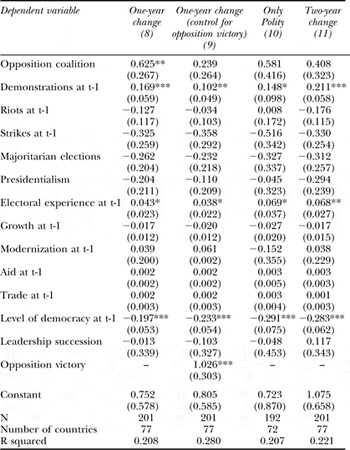
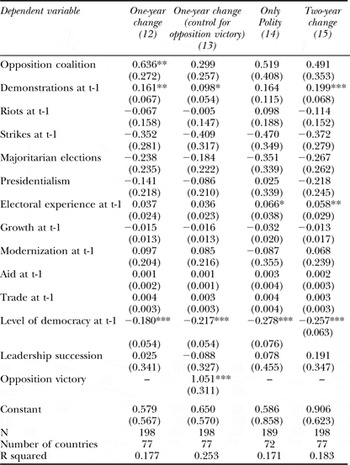
Below, a number of regression analyses will be displayed. In the OLS regressions, robust standard errors have been used and the logistic regressions utilize standard errors clustered by country. To account for possible multicollinearity, all models have also been run calculating the Variance Inflation Factor (VIF). No variable in any of the models received a VIF larger than 3.05, indicating that multicollineraity is not a serious concern in any of the models.Footnote 16 As the previous sections have argued, there are good theoretical reasons to treat those cases with separate list coalitions or dominant opposition parties as coalitions. To make sure that this coding decision has not affected the substantial results, two sets of robustness tests have been run: one set excluding all cases with dominant opposition parties and one set excluding all cases with separate list coalitions. There were no substantial differences between the results of these supplementary tests and the main regression models presented below, which suggests that the results are robust for altered operationalizations of the main independent variable.Footnote 17
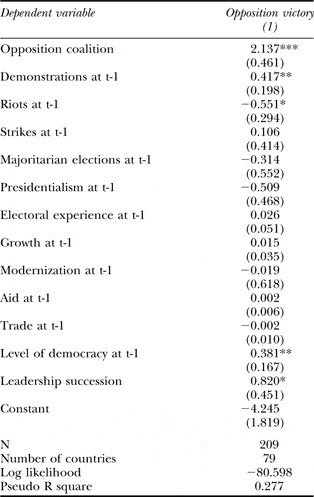
Table 1 shows a logistic regression with opposition victory as the dependent variable. According to the expectations stated in H1a, oppositional parties that formed a coalition are significantly more likely to win elections than those running separate campaigns. Although less significant, the occurrence of popular demonstrations also seems to affect the likelihood of an opposition victory. The predicted probability of an opposition victory is 29 per cent higher in elections where the opposition had formed a coalition, as opposed to those where a coalition was not formed.Footnote 18 Accordingly, there seems to be a clear relationship between opposition coordination and electoral outcome.
Logistic Regression on Opposition Victory

Notes: Entries are logistic coefficients; robust standard errors clustered by country are given within parentheses.
***p ≤ 0.01; **p ≤ 0.05; *p ≤ 0.10
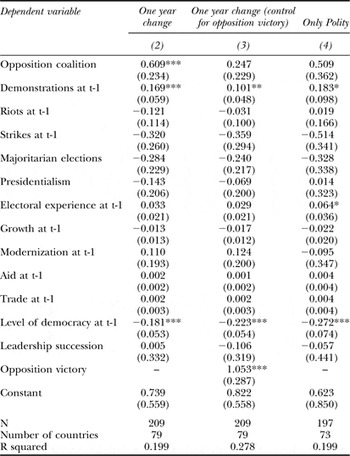
Despite the fact that the dependent variable is measured differently and that the sample is four times the size, the results in model 2 (Table 2) are very similar to those of Howard and Roessler (Reference Howard and Roessler2006). Opposition coalitions, together with popular protests, show clear significance for the DEO when measured as the difference in level of democracy between the year of the election and the year prior to the event. From model 1 (Table 1), we know that there is a relationship between the probability of incumbent defeat and opposition coalitions, model 3 (Table 2) suggests that this is the main explanation for the effect of coalitions on the DEO. In model 3, a dummy variable is introduced accounting for whether the election was won by the opposition to control for the potential importance of electoral outcomes. As this control variable is introduced, the significance of the coalition variable vanishes, while the variable measuring the occurrence of popular demonstrations remains significant. The difference between these two variables is interesting. Both showed a significant impact on the prospects for opposition victory. While popular demonstrations seem to affect the DEO through several different mechanisms, the impact of coalition building seems to be highly associated with the cases where the opposition did actually win the election. These results suggest that having an active citizenry has a more stable and longer-term effect on the prospects of democratization than the more agency-oriented coalition variable. Having easily mobilized citizens can increase the costs of oppression and improve the quality of elections, regardless of election outcomes. Opposition coordination at the elite level, however, seems to have little impact on the quality of elections.
OLS Regression on DEO

Notes: Entries are OLS coefficients, robust standard errors are given within parentheses.
***p ≤ 0.01; **p ≤ 0.05; *p ≤ 0.10
Model 4 (Table 2) further points to the problem of distinguishing democratization by election and electoral turnovers, when measuring democratization with standard indices. In model 3 the DEO is operationalized only using Polity scores.Footnote 19 In this way, the model is not dependent on the Freedom House democracy assessments that explicitly use alternation as part of the operationalization for democracy. When altering the operationalization of the DEO, the significance for opposition coalitions once again disappears. Polity has a somewhat smaller coverage (model 4 includes 12 cases fewer than model 2), but if we return to the original DEO operationalization and keep the sample constant, the coalition variable is still significant. Accordingly, the loss of significance when using the Polity DEO is not caused by the somewhat decreased sample in model 4.
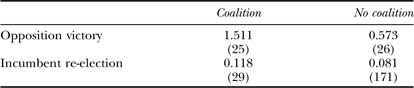
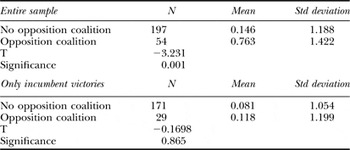
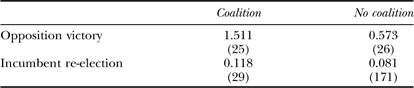
Table 3 displays a simple t-test of the DEO means for elections with and without coalitions. In looking at the entire population, there is a significant difference in the mean DEO between elections having a coalition and those with none. When excluding the cases with opposition victories, the significant difference disappears. Accordingly, there is no evidence suggesting that opposition coordination should be important regardless of electoral outcome. For instance, it does not seem likely that incumbent regimes would use less manipulation or harassment in these elections.Footnote 20 The mean DEO for countries in the sample with a turnover is 1.03, compared to 0.09 where there was an incumbent re-election. Consequently, there is a clear difference in the mean DEO between these two groups. However, as many as 56 out of the 200 elections with incumbent re-elections had a positive DEO. Among these, only seven had opposition coalitions.Footnote 21
T-test on Mean DEO in Elections With and Without Coalitions

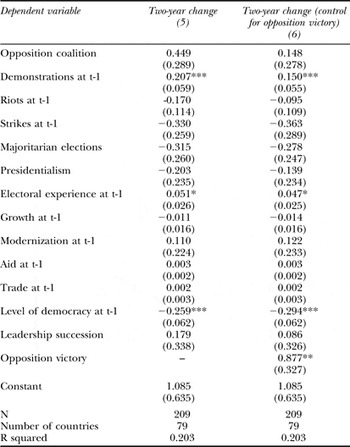
Table 4 (models 5 and 6) casts further doubt on the idea that opposition coordination should be the general recipe for democratization through elections. When the timeframe for measuring the DEO is extended to measure the year after the election (model 4), the significance of the coalition variable disappears. This result strengthens the idea that opposition coordination is highly associated with actual electoral outcome. In extending the measurement period, coordination does not seem to affect democratization. Newly elected opposition governments might not deliver the expected democratic reforms, and incumbent governments that ran successful re-election campaigns might not liberalize the regime as a consequence of the proven ability of the opposition to unite. Once again, the popular protests variable shows a completely different pattern and stays highly significant, regardless of the timeframe applied. An active citizenry mobilized in relation to elections also seems to have a lasting effect on democracy in the years after elections. In model 6 (Table 4) the dummy variable for opposition victory is introduced. The dummy variable remains significant, although with a smaller coefficient and at a lower confidence level. Hence the results show that the effect of opposition victories on democratization decreases when we extend the timeframe.
OLS Regression on DEO (Extended Timeframe)

Notes: Entries are OLS coefficients, robust standard errors are given within parentheses.
***p ≤ 0.01; **p ≤ 0.05; *p ≤ 0.10
In sum, the models above strengthen the proposition that the effect of opposition coalitions on the DEO is highly associated with an increased probability of opposition victories when the opposition is coordinated. Moreover, the models show that the beneficial effect of opposition coordination does not last when looking beyond the election year. These results would be especially troubling for the theory of opposition coordination and democratization if van de Walle's claim about endogeneity could be supported statistically. If an opposition victory is the factor that drives the importance of opposition coordination and opposition parties coordinate when they believe they could win elections, this would question the causal relationship, not only between opposition coordination and democratization, but also between opposition coordination and opposition electoral success.
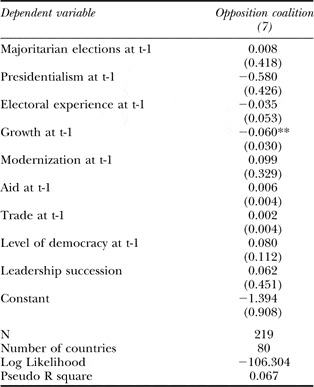
Table 5 provides some good support for the endogeneity claim when using the structural independent variables from the previous models. The only significant variable affecting the tendency to form coalitions seems to be the variable accounting for GDP growth. Interestingly, this variable seems to be more important than the variable accounting for a majoritarian voting system, a variable that, given the theory of interparty coalitions developed for the Western European context (Golder Reference Golder2006), would be expected to be enormously important for the creation of coalitions. Post-estimations of the logistic regression show that the predicted probability of having a coalition is 48 per cent lower when going from the lowest observed value of GDP growth to the highest. A standard deviation increase of GDP growth around the mean decreases the probability of having a coalition by 4.5 per cent.Footnote 22
Logistic Regression on Opposition Coalitions

Notes: Entries are logistic coefficients; robust standard errors clustered by country are given within parentheses.
***p ≤ 0.01; **p ≤ 0.05; *p ≤ 0.10
On the basis of this result, it might be surprising that the variable for GDP growth did not show significance in model 2. However, if the model is rerun excluding the variables for opposition coalitions and popular demonstrations, the variable does become highly significant.Footnote 23 It is obviously problematic to control variables further back in the causal chain for variables that are more proximate to the outcome of the dependent variable. This is not evidence enough to suggest that the relationship between opposition coordination and opposition electoral victories is completely endogenous. Although opposition parties put their differences aside when facing a realistic chance of electoral victory, they do so because they believe that this would increase their chances of getting elected. The results above do, however, show evidence that part of this relationship is endogenous and that opposition coordination is not independent of structural prerequisites.
There are a number of good illustrations in the data of how economic decline can contribute to a greater willingness of the opposition to coordinate. Two well-known examples are Indonesia in 1999 and the 2000 election in Serbia. In the case of Indonesia, General Suharto was forced out of power as a consequence of the Asian economic crisis and massive protests caused by economic hardship in 1998. The popularity of the incumbent Golkar Party was seriously damaged as an outcome of this situation. This made it reasonable for the opposition to believe in a victory, and the main opposition parties, PDI-P, PAN and PKB, created a unified coalition to contest the election (Suryadinata Reference Suryadinata2007). Similarly, Serbia's economy was in a serious state in the 2000 election after NATO bombings. It is widely believed that this economic decline was an important reason for the fall of Milošević and the decision of the opposition to join together before the election (Birch Reference Birch2002).
Conclusion
The aim of this article has been to critically assess the argument that opposition coordination generally leads to democratization by elections. It is possible to understand the process of democratization by elections in different ways. Here, it has been argued that incumbent defeat is not identical to democratization by election. Recent experiences from Africa and the colour revolutions of the post-communist context should have made scholars of democratization sceptical of the notion of ‘electoral revolutions’. Although elections can be effective in changing the leadership in electoral authoritarian regimes, real democratization is a more lengthy process. In the late 1990s, it became evident that the previous ‘transition paradigm’ equating democracy with elections was outdated. By now we should also have acknowledged that the ability of a system to produce alternation in power is not sufficient to transform a country into a democracy. As many recent cases have shown, opposition parties can continue the authoritarian policies of old regimes in order to reap the electoral benefits from being an incumbent government under electoral authoritarian institutions.
This understanding is important when deciding how to measure democratization by elections. Opposition coordination might increase the likelihood of opposition victories, but without electoral turnovers we should not expect opposition coordination to further the process of democratization. This result clarifies how opposition coordination might be linked to varying electoral outcomes. When looking beyond the actual election year, we see that the ability of the opposition to coordinate in elections has no significance for the longer-term democratization process.
Furthermore, we have to question why these coalitions are built in the first place. In this study, the first large-scale statistical evidence that suggests that opposition coordination is likely to be formed under structurally beneficial conditions has been shown. In sum, this article has shown clear evidence against the notion that opposition coordination should be a general recipe for democratization by elections.
There is a substantial need for more research about elections in authoritarian regimes and the incentives for opposition coalition building. There are important reasons for pursuing this research, and there are still important empirical and theoretical holes to be filled. We also need more research on the consequences of electoral turnovers. It is important to acknowledge that turnovers do not, in and of themselves, constitute a transition to democracy. More work is needed that examines turnovers as a possible independent variable for democratization.

Appendix 2: Robustness Test Excluding Dominant Opposition Parties
OLS Regressions Excluding Cases with Dominant Opposition Parties

OLS Regressions Excluding Cases with Non Joint-list Coalitions

Mean DEO Depending on Coalition and Election Result