This is the third in a series of papers in which I explore a social geography of Iron Age Southern Africa. In the first (Wilmsen Reference Wilmsen, von Benda-Beckmann and Griffiths2009a), I drew on Georg Simmel's (Reference Simmel1900) Philosophy of Value to consider the regulation of exchange in the region during that time. In the second (Wilmsen Reference Wilmsen, Humphris and Rehren2013), I adopted the concept of epistemic community articulated by Haas (Reference Haas1992) to examine the role of knowledge-based specialists in the translocation of metallurgy throughout the region. Here, I enter Early Iron Age (EIA) and Middle Iron Age (MIA) mythic space through the portal of historical pluralism opened up by recent historians of approximately contemporaneous Europe. Their insight that too often history is a kind of vertical line cast down from the present to the past is comparable with the approach I have taken to Southern African economic history (Wilmsen Reference Wilmsen1989) and directly applicable to the myths we are considering here. Paraphrasing Davies (Reference Davies2011), scholarly attention to each myth sustains its own totality and coherence precisely in the way it ignores the myths of its neighbours. Historical pluralism, in contrast, is predicated on a regard for the simultaneous existence at any given historical moment of all identifiable polities (with, in our case, associated myths), including those that no longer exist or for which we have only intangible evidence. To accomplish this, Snyder (Reference Snyder2011) proposes that instead of disparate vertical lines descending from isolated or insulated entities we think of history horizontally in order to extricate parallels among them. As is the case with most novel methodologies, this is not entirely new to archaeology. Nor to anthropology. Any contemplation of myths today must give at least a nod to Lévi-Strauss, even if negative, as with de Heusch (Reference de Heusch1971: 31, quoted in Willis Reference Willis and de Heusch1982: xi), who envisioned a hypothesis he called ‘structural history’: ‘This hypothesis … offers the advantage of an escape from the historical nominalism to which Lévi-Strauss sometimes seems tempted to condemn social anthropology.’ Although de Heusch emphasized that this idea of structural history ‘should be taken further’, he does not seem to have ever again mentioned it, as such, in print. He did, however, offer a prescription that resonates closely with that of historical pluralism (de Heusch Reference de Heusch1985: 23): ‘One must listen patiently to the ideological speeches … in the most diverse societies … one must ask oneself what is the symbolic coherence, which often appears incongruous; one must not fail to connect them with neighbouring rites.’ Yet in Southern Africa, with exceptions such as Huffman, his students and some of his critics (cited below), most investigations of a particular myth by anthropologists, archaeologists or historians still tend to follow the vertical line inscribed by that myth through its tellers. This has limited our ability to integrate the histories of the various myths and their associated sites.
Again, Lévi-Strauss (Reference Lévi-Strauss and Weight1981: 600–3) maintained that material objects ‘manipulated’ in ritual, indeed ritual itself, are ‘bastardisations of thought’ in that they undermine the aura of myth; this seems to say that material things of human value and human being itself are illicitly united in rites promoting social legitimacy. Not surprisingly, de Heusch (Reference de Heusch1985: 2) found this curious. Annette Weiner (Reference Weiner1992: 391) found it incomprehensible: ‘Given that material culture is such an intimate part of our ethnographic inquiry, why has it taken so long to move beyond traditional, normative theories?’ Particularly, for my purpose here, Weiner (Reference Weiner1992: 11) recognized that ‘cosmologies are active forces in social life that, in mediating systems of meaning, also entail material or verbal objectifications that actively become the agents or instruments of [continuity or] change’. As a consequence, it is clear that materials, revered natural objects as well as artefacts, become invested with meaning through social interaction and are capable of accumulating histories that embody the essence of social life. With these fundamentals in mind, we may turn to the myths and their materials.
FOUNDING MYTHS
In episodes of Kapembwa origin mythology found in Ulungu at the southern tip of Lake Tanganyika in Zambia, Willis (Reference Willis1999) detects the structure of Lungu social-political development and notes that this myth occurs in similar form over much of Central and adjacent Southern Africa. According to the myth, a primal pair descended spontaneously from a creative spirit and at first lived in darkness on opposite sides of an underground lake without any sense of self-awareness or awareness of each other. After emerging into the light, brother and sister met and produced a series of children who initially lived for centuries in a state of incest and promiscuity with their parents, lacking any form of custom or law. After the death of the primal pair, their daughter, Mwenya Mukulu, departed to found a new country, Ulungu, to the east. Mwenya was able to unseat the minor headman of the land that became Ulungu because she was ‘brilliant … with beads on her head and anklets’ (Willis Reference Willis1999: 50). En route to this land she encountered Kapembwa, a creator spirit who lived on a flat hilltop, Polombwe (Figure 1), and sent her first-born son, Musika, to investigate. Kapembwa arranged to marry Mwenya's daughter, Mangala, thus abolishing promiscuity and instituting social legitimacy, at the core of which in Africa is chieftainship. But Kapembwa had a first, spirit, wife before he married the younger, mortal, Mangala, whom he then preferred. One day this first wife failed to do what Kapembwa wanted, and after an altercation with Mangala ran away, never to return. She had, however, pulled off the crown of feathers given to Mangala by Kulungu and she tore it up, throwing the pieces into the bush as she ran. In compensation for this insult, Kapembwa ceded the lake fish to the Lungu people and persuaded his brother-in-law, Chisya, a spirit of Polombwe, to cause rain so that they could cultivate crops (Willis Reference Willis1999: 52). In another version of the myth, a parallel Mwenya manifestation called Mwenyami,Footnote 1 had a son, Mpulungu, who married his sister; this pair had three boys and three girls – ‘they all married each other … and that was the beginning of the Ulungu people’ (Willis Reference Willis1999: 59). This myth is the explanation ‘of intersibling marriage traditionally associated with chiefly families … it was policy that a chief marry a sister to produce a proper chief’ (Willis Reference Willis1999: 69).
A homologous set of myths concerns the Tsodilo Hills in north-western Botswana (Figure 1). There are four hills named in descending order of size: Male, Female, Child and North. These myths originated with the ‖Ani, a Khoisan-speaking people, but they are now also held by Žu|’õasi (hereafter Žu), also Khoisan-speaking, who replaced them around the beginning of the nineteenth century. The first myth says that in the beginning the Hills were people. Their origin was some 85 kilometres to the south-east on the edge of the Okavango Delta, where there is a large, deep hollow in the ground at the bottom of which is a spring; it is said that a snake lives in the spring. The water of this spring has medicine-power (Žu: n|ôm, ‖Ani: tsóò – medicine);Footnote 2 before drinking from it for the first time, a person from another place must be anointed with its water by someone associated with the spring, and failure to observe this injunction will cause the drinker to die. Biesele (Reference Bieselen.d.) records the Žu name, N!aha, for this place but gives no indication of its derivation or meaning.Footnote 3 Tsodilo, apparently as a primal pair, emerged from this spring-hollow and walked up the Xaudum molapo (Setswana: riverbed) to the present location of the Hills where the pair produced a child who became the third, Child, hill. The creator caused all this to happen, and because of this natal link to N!aha, first-time foreign drinkers of Tsodilo water must be anointed in the same way.Footnote 4 The Hills are thought to be inhabited by the spirits of ancestors – Khòe, Žu and Hambukushu – who ‘demand respect shown through careful washing procedures, devout submission, and asking permission’ to approach them; failure to follow these strictures can result in death (Campbell Reference Campbell, Campbell, Robbins and Taylor2010: 24). They are also the abode of rain, dwelling inside the Hills as smoke that emanates from the rocks to become rain clouds. Current Hambukushu residents at Tsodilo kill a black goat as an offering when praying to their female ancestors for rain: ‘I plead with you, for the rain has taken you to spouse’ (Campbell Reference Campbell, Campbell, Robbins and Taylor2010: 28). Several of the many paintings on the rocks of the Hills depict mythical animals similar to those interpreted as rain animals in South Africa (Lewis-Williams Reference Lewis-Williams1981: 34, 103–16) while others depict men in apparent ritual association with such animals; it is normally considered that these were painted by Khoisan-speakers.
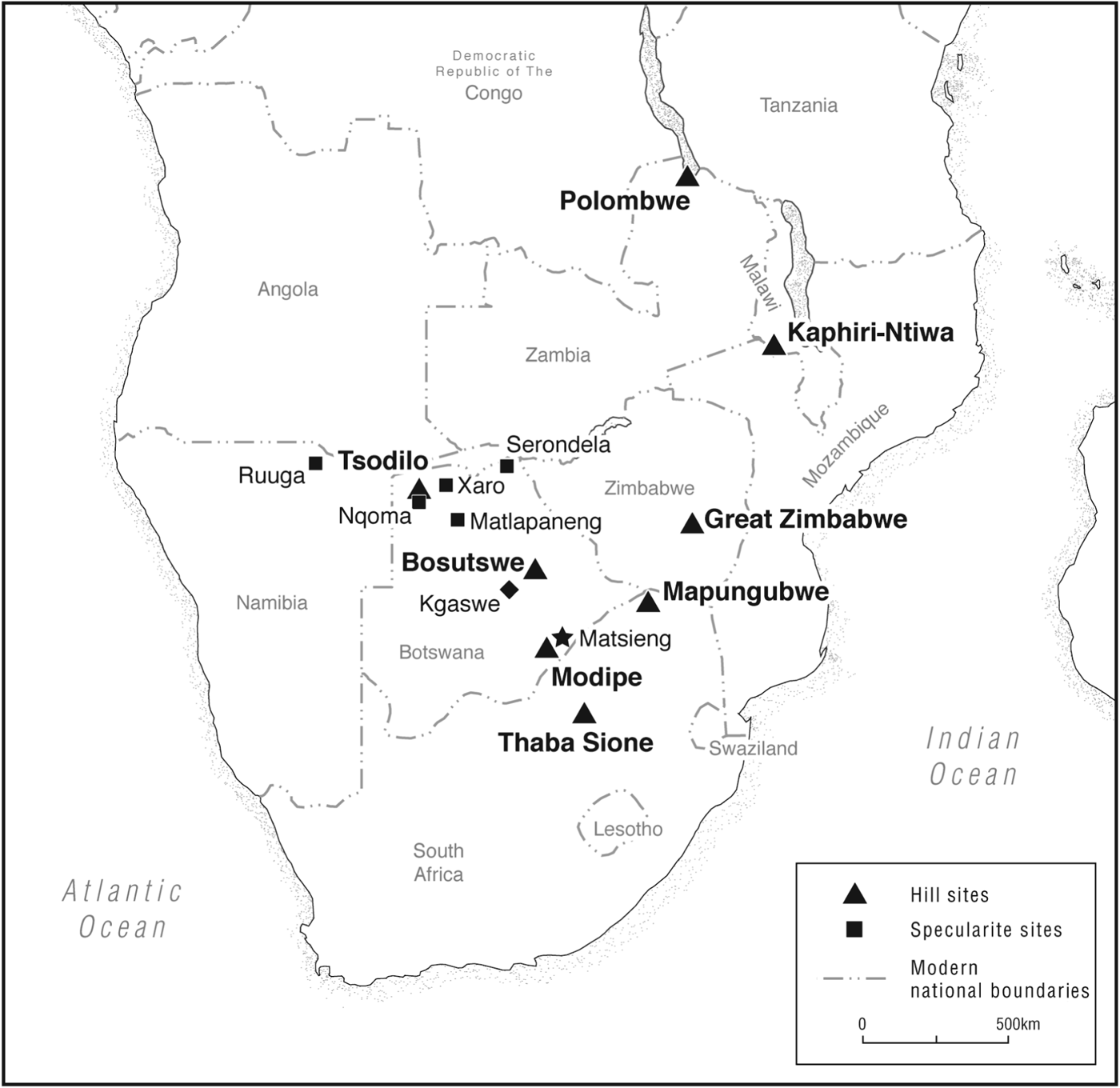
Map of Central and Southern Africa showing the places referred to in the text

Taylor (Reference Taylor2000: 3) recorded a second ‖Ani myth, which should be seen as a continuation of the first. This says that:
the large Male Hill had two wives, and they were next to him. However, he liked the young second wife better than the other – the Female Hill was the second wife. The first wife became jealous and ran away, past the other woman [the Child Hill] who was not married. She wanted to keep on running, but the others [Male and Female Hills] sent their servants to stop her, and she remained where she is today [the fourth, North, Hill], all alone.
In 1898, Passarge (Reference Passarge1904) recorded a ‖Ani name for the North Hill, Tsau 2Kam (ts'áo – bush + !gáàm – to throw away; thus, thrown into the bush). In the context of the myth, this could carry the meaning ‘thrown by herself/her pursuers into the bush to live alone/in exile’. Hambukushu, who arrived in the mid-nineteenth century and adopted the ‖Ani myths, name both the first wife who ran away and the North Hill, which she became, Thiwethambuku – the one who wants to live by herself. The scattering of rocks north of this fourth hill is called Gxaakhoesi (Žu: g¦¦àá – to be poor/indigent + khòe – people + si – plural; thus, poor people/chattel): that is, they are the servants sent to stop Thiwethambuku.
The first animals are said to have descended on Tsodilo by a rope from the sky; certain erosional grooves on a rock in a steep ravine on the side of the Female Hill are thought to be hoof marks where the first eland (Khoisan) or cattle (Bantu) slid on the then soft rocks of creation time. Tsodilo is also the place where God created the first human, as distinct from mythological beings; this person is said to have been male and was also put down on the Female Hill from the sky (Taylor and Campbell Reference Taylor, Campbell, Campbell, Robbins and Taylor2010: 29). It is not clear if this is meant to be an allusion to a mythical spontaneous genesis of original descendants; however, another myth centred on a rock, Ncugqoridao (‖Ani: n#'u – food +g!o – vagina + ri – conjunctive + dàò – path; thus, path to vagina food) at the foot of the Female Hill, recounts the origin of sexual reproduction by asexually conceived people, presumably sibling offspring of this first male. The rock is said to resemble three vaginas, hence the ‖Ani name. Campbell (personal communication), who recorded the myth, calls it Procreation Rock. The myth goes like this:
At the time when the earth was young, people were all youths; they did not grow old and were not born. One day, three girls went up the hill to collect water from a spring, Shamtsho (‖Ani: tshàá – water + tsóò – medicine; thus, medicine water).Footnote 5 On their way home they met three boys, who had been told by God to meet them. God told them that they must have sex so there would be life and death. They did not understand sex, so God shaped the rock and showed them what to do. The girls put the pots down and the three couples performed, thus the first children were born.
The temporality of life marked by birth and death in these myths introduces the concept of time, and the founding of a country introduces the concept of history into the cosmology of the region (Wilmsen Reference Wilmsen2009b).
The Chisumphi myth of northern Malawi Chewa has many of the same elements:
In the beginning there were Chiuta-God and the earth. Chiuta lived in the sky, and below him was the earth, waterless and without life … Then the sky opened and from it Chiuta-God, the first human pair and all the animals descended in a shower of rain. They alighted on a flat-topped hill by the name of Kaphiri-Ntiwa … After their descent the soft surface hardened and turned into rock. On this rock the imprints of their feet as well as the spoors of many animals can still be seen. (Schoffeleers Reference Schoffeleers2000: 10)
In an ancillary myth, man accidentally invented fire, which set the bush alight and drove Chiuta back to the sky from whence he pronounced that henceforth man must die and join him there. Schoffeleers (Reference Schoffeleers2000: 27, 56) records that, among southern Chewa Mang'anja, divine names for the supreme being include Mulungu as well as Chiuta, with Mulungu so closely identified with rain that the name is used for both God and rain and is associated with a primal spirit whose origin is at Kaphiri-Ntiwa. A sacred pool with an associated spirit snake features in both versions of the myth, as does a sacred plateau associated with creation and/or rain. Schoffeleers (Reference Schoffeleers1979: 152–3, 180), relying on Rangeley (Reference Rangeley1952) and Ntara (Reference Ntara1955), further relates these shrines to pre-Chewa hunter-gatherers known today by the generic name Kafula, arguing that there is ‘much evidence for a long-lasting symbiotic relationship’ between Kafula and the peoples Schoffeleers calls Proto-Chewa who adapted Kafula rituals into their own cosmology. Among the adaptations was adoption of the drum used in rain-calling ceremonies; these drums are said to have come from autochthonous pygmy or Bushman foragers, i.e. Kafula (Schoffeleers Reference Schoffeleers2000: 63). The Proto-Chewa Banda clan had a ritual relation to the land ‘particularly credited with the power of rain-calling’ (Schoffeleers Reference Schoffeleers1979: 149–50). In the fourteenth century, ‘they came to be ruled over by a group of royal invaders, the Phiri clan’ (Hamilton Reference Hamilton and Hamilton1955); Schoffeleers (Reference Schoffeleers1979: 155–6) notes that political expediency led these royals to adapt autochthonous rituals, including the re-allocation of Chisumphi shrine functions, and in time ‘the mystical union of the chief with his forebears came to be related primarily to the land for which he was responsible’ and the dynastic spirits became a class apart. A chief is able to influence his ancestral spirits (mzimu) on the basis of consanguinity and legitimate succession; these spirits are his mediators with God. The chief's main wife also became associated with the land and fertility, ‘stressing the male–female relationship thought to exist between the chief and his country’ (Schoffeleers Reference Schoffeleers2000: 40–3, 60–3).
Frobenius (Reference Frobenius1931) recorded a Shona myth homologous with the Lungu Kapembwa and Chewa Chisumphi myths. In this myth, Mwari as Musiki (Creator – God) formed the primal ancestor out of a hole in the ground or marsh and subsequently founded Shona in their present location. In this manifestation, Mwari piles up rocks to make mountains (Owemoyela Reference Owomoyela2002: 29), which accordingly are metaphorically associated in Shona ideology with high status and sacred leadership. In other versions of the myth (Owemoyela Reference Owomoyela2002), a primal ancestor, Mwari as Musika-vanhu (Origin of people), descended spontaneously from a creative spirit and was ultimately brought out of a hole or deep pool of water in the ground at the place of origin, Guruuswa. Mwari, as a disembodied spirit, then led Shona ancestors to their present homeland. Some traditions ‘mention the passing of certain hills’ during the journey (Beach Reference Beach1980: 57). In the latter account, Mwari is the founding precursor of Shona near the time of creation, but not the creator (Owomoyela Reference Owomoyela2002: 28). Mwari concerns himself especially with the provision of rain.
These myths reveal the structure of rights to possession found in many Central and interior Southern African communities and observed by Europeans in the eighteenth and nineteenth centuries, and to a degree still practised in some places today. In the Kapembwa and Tsodilo myths, a primal pair or person descends from the sky subsequently to emerge from an underground associated with water. In the various Mwari myths, a primal ancestor descended spontaneously from, or was formed by, a creative spirit and emerged from a deep hole connected with water. In the Chisumphi myths, a primal pair descend in a rain shower along with all animals. Willis's (Reference Wilmsen1999: 50) insight regarding Kapembwa applies equally to the others, in that the origin of this structure lies in an encounter some centuries ago between groups embodying two radically different forms of authority: one derived from descent from a deified ancestor, an authority legitimized by a supposedly unbroken line of descent through time; and one derived from a parahuman entity or spirit identified with the land or territory, an authority in and over space. Typically, the original encounter between these two forms of authority are remembered in local traditions as a meeting between incoming royals, bearers of the time-based ancestral lineage, and the already established priestly representatives of the territorial spirit. We thus see in these myths both the establishment of a proper social order with a legitimate leader at its apex and the association of that order with the land in which it exists. Some myths suggest that the encounter was between incoming Bantu-speakers bearing authority of lineage and autochthonous Khoisan-speakers bearing authority of land; this is the case with the Kapembwa and Chisumphi. These myths, then, may preserve in metaphorical form the actual incursion towards the end of the last millennium BC or in the early first millennium AD of Bantu-speaking peoples into what had until then been Khoisan-speakers' space.
In any case, the outcome has been a cluster of indigenous societies based on a complex and potentially unstable resolution of the inherent contradiction between the two concepts of authority and power: lineage and land (Ranger Reference Ranger1973; Werbner Reference Werbner1977; Schoffeleers Reference Schoffeleers1979; Willis Reference Willis1999). This resolved power is vested in a chief, who occupies a position of unique privilege and authority in the society over which he rules. As Schapera (Reference Schapera1938: 62) said of Tswana dikgosi (chiefs), they are ‘the symbol of tribal unity … at once, ruler, judge, maker and guardian of law, repository of wealth, priest and magician of the people’. In recorded time and in the ethnographic present, all assets of a polity – land, cattle, mineral wealth, sumptuary goods – were the property of its chief, who kept the conspicuous accoutrements of power for himself (or occasionally herself).
SPACE, TIME, GENDER
There is a broad geographical and deep temporal spread of myths in which the flat plateaux of hilltops are associated with elite leadership and supernatural power involves the control of rain. In mythic time there is Polombwe, seat of the spirit creator Kapembwa, and Kaphiri-Ntiwa, earthly home of the creator Chiuta/Mulungu. At the other end of the spectrum, in archaeological time, there is Great Zimbabwe, seat of fourteenth- and fifteenth-century Shona mambos, with Mapungubwe its immediate thirteenth-century antecedent (Huffman Reference Huffman, Leslie and Maggs2000). Bosutswe, the abode of a large but invisible rain-snake, has extensive occupations contemporary with both Great Zimbabwe and Mapungubwe, as well as earlier strata extending to the eighth century (Denbow and Miller Reference Denbow and Miller2007). These three sites are relatively near each other (see Figure 1). The fourth archaeological site, Nqoma, is 600 kilometres to the north-west on a plateau of the Female Tsodilo Hill, at the foot of which is the mythic rock Ncugqoridao. Nqoma is a stratified site with a complex history of occupation from the early centuries of the first millennium AD into the nineteenth century, but inhabited most intensively between the eighth and eleventh centuries (Wilmsen and Denbow Reference Wilmsen, Denbow, Campbell, Robbins and Taylor2009; Wilmsen Reference Wilmsen2011).
Parallels among the myths associated with these sites are clear: in the process of creation a primal pair or person in undifferentiated space and time passes through a series of liminal states, thereby bringing structure to the landscape and legitimacy to society. In the Kapembwa, Tsodilo, Chisumphi and Mwari myths, the origin of humans is drawn from mystically imbued water, while the Ncugqoridao myth links water from a paranormal source to the beginning of human procreation. The Mwari myth, like that of Kapembwa, explicitly associates this transformation with leadership, in the Shona case male, and with the power to generate rain, thus expressing authority derived from descent from a deified ancestor. The Mwari myth, however, unlike the others, does not unequivocally specify a female counterpart.Footnote 6 In this regard, it is significant that a praise poem combines both male and female attributes in the Mwari figure:Footnote 7
Leader in the way, Mwari of all the people, You are our father, you are our mother, Whose breast feeds the whole land. (Owomoyela Reference Owomoyela2002: 29)
Thus, it appears that Mwari is a melding of Mangala/Kapembwa-like figures, embodying simultaneously a parahuman spirit identified with territory, an authority in and over land, and a time-based ancestral authority of lineage. The portrayal of Mwari as both primal ancestor and disembodied spirit integrates this duality. Presumably this integration was enabled by and served to legitimate increased centralization of power by Shona elites. The duality was further institutionalized by Shona in the position of the senior sister of the king, representing the female side of the ruling lineage, who was responsible for the charms that protected her brother and allowed him to govern (Huffman Reference Huffman1985: 71, citing Theal Reference Theal1898–1903: 357). One element of this appears to have been royal sibling marriage, sanctified by a legend of incestuous relations between a founding ruler and his sister.
Huffman (Reference Huffman1996: 138, 143) draws on later Mwari myths in the Matopo Hills and Khami along with Venda myths derived from these to interpret symbolic and spatial structures at Great Zimbabwe, inter alia the king's senior sister's residence next to the king's enclosure and the sanctuary dedicated to the ancestral spirits.Footnote 8 Beach (Reference Beach1998: 48–9), however, notes that the hill was not a major Mwari centre in the eighteenth and nineteenth centuries and that recent oral traditions were obtained from people who settled there some 200 years after the builders of the stone structures for which the hill is famed had abandoned it. Indeed, ‘historically, the Mwari cult dates to the late 17th century established by the Rozvi Shona in the Matopos; the Rozvi mambo (king) was a medium of Mwari through the tribal ancestors' (Owomoyela Reference Owomoyela2002: 28). Fontein (Reference Fontein2006: 15), however, sees this as ‘bias for a particular time period in history … a primarily archaeological problem’ that ignores studies such as that by Matenga (Reference Matenga1998), who ‘shows that Great Zimbabwe did and does feature as an important sacred site in local “history-scapes”’. While Fontein is correct to criticize former myopic biases, it remains nonetheless primarily an archaeological problem. This is because, as Singh (Reference Singh2007: 66) cogently points out, ‘When one inherits, one sorts, one sifts, one reclaims, and in the process reactivates what one inherits.’ Fontein (Reference Fontein2006: 35–72) documents in detail how this takes place for Shona clans around Great Zimbabwe where ‘the past is a site of great contestation, as they jostle to justify their claims’ (Fontein Reference Fontein2006: 47). Beach (Reference Beach1980: 103), moreover, cites sixteenth- and seventeenth-century Portuguese sources that record that Shona turned to their ruler for rain ‘because of his access to a mudzimu [ancestor] spirit that could contact the high-god, that spirit was important because it was the spirit of a powerful former ruler’. These sources record that among some Shona there was ‘a high-god named Mulungu’ – not Mwari. Circumstances such as these caution us against reliance on any one particular reiteration of a myth (cf. Lane Reference Lane1994).
A close parsing of these mythic texts may unearth a deeper antiquity. To begin with, Beach (Reference Beach1980: 56) recognizes that ‘Shona historical traditions, however much they tend to differ in details, have a remarkably similar structure … used to illustrate or explain certain features of genealogy or rights to land.’ Willis (Reference Willis1999: 54), too, recorded variations of the Lungu myth and also notes that ‘all these stories from different chiefly courts and priesthoods offer varying perspectives on a single and all-pervasive sociocultural reality: the complementary opposition of royal [lineage] and spiritual [land] authority’. Schoffeleers (Reference Schoffeleers1979: 149–50) also noted two groups among Chewa ‘in terms of claims to secular and religious authority’. As Werner (Reference Werner and Schoffeleers1979: 91) notes, ‘It is clear on the basis of comparative ethnographic data that many Central African cults shared common symbols and ideas, despite large differences in organization. Plainly these cults drew upon common prototypes … influenced by the ideas of non-Bantu populations.’ It is this similarity of structure, not the use of any specific term such as Mwari or Kapembwa, that is significant. In this respect, recurrence of the name Mulungu for a supreme being or creator is noteworthy: Schoffeleers (Reference Schoffeleers2000: 56–7) notes that the Portuguese sources cited above found the name to be common in inland Lower Zambezia, as did Livingstone 300 years later (Schapera Reference Schapera1965). Recall also that Mwenya Mukulu's son, Musika, is the intermediary between people and spirits in the Kapembwa myth, while in some Mwari myths Musiki is the spirit ancestor of people (vanhu); these almost identical names cannot be fortuitous. Another set of terms has a wider scope: ‖Ani muẓimu (Vossen Reference Vossenn.d.: 42) is clearly a Bantu loanword cognate with Shona mudzimu and Chewa mzimu, all meaning ancestor, but the history of these terms in the context of the myths is not clear.
Current Žu and Hambukushu at Tsodilo do not appeal to myths to legitimate their residence at the Hills, but they do recognize that the Tsodilo and Ncugqoridao myths served that function for Khòe-speaking ‖Ani, who were there long before they arrived. Spontaneous origin of a polity and its people are explicit in the Lungu, Shona and Chewa myths and implied in the Tsodilo version; this origin occurred in association with water. Initial male–female introgression features in the Shona and Tsodilo versions, but not the Lungu or Chewa. Figurative incest, a form of auto-creation by an asexually generated pair, is seen as the means of initial population growth in all; this sanctions later sibling incest among Lungu and Shona royalty. All four myths tell of journeys from elsewhere to the present location of the tellers in which specific hills are features of cosmic encounters or re-creation; these hills are associated with ancestors able to control rain.
The myth in its Lungu, Shona and Chewa forms is Bantu, the Tsodilo–Ncugqoridao form is Khoisan (specifically ‖Anikhòe), underscoring Willis's observation of its wide geographical – and we may now add sociographical and temporal – spread in Central and Southern Africa. The remarkably similar structures Beach found among Shona variants of legitimizing myths now appear to be themselves transforms of a wider interior Central–Southern African mythic structure of which Lungu, Chewa and Tsodilo variants are other manifestations. Myths articulated in the past are, of course, intangible to us today; they become tangible only through evidence of their prior existence. The specificity of mythic elements is one form of such evidence; irrespective of persistence or non-persistence of particular names such as Ncugqoridao or Mwari, the persistence and broad geographical spread of these elements among speakers of several, related as well as unrelated, languages imply a considerable time depth. As Murimbika (Reference Murimbika2006: 9) has observed, ‘the more widespread a custom or belief, the higher the probability of its antiquity; some customs and beliefs would have been integral to rainmaking’ before the appearance of Iron Age economies, and ‘actual practices may vary because of context’. Schoeman (Reference Schoeman2006: 257) further proposes that ‘a key source of this spiritual power was its location in the centre of a San ritual landscape, marked by rock art’, quite possibly extending to the first millennium AD, as suggested by Tsodilo rock paintings. This mythic structure, rather than any specific myth, thus provides another perspective from which to read the archaeological record.
THE BRILLIANCE OF BEADS
More concrete evidence emerges when we materialize the myths. Remember that Mwenya Mukulu was able to unseat the headman of the land that became Ulungu because she was ‘brilliant with beads’; for her, beads were signifiers of status and power. The value embodied in those beads through the judgements of her social peers was great. This is an instance of Simmel's (Reference Simmel1900; [1907] Reference Simmel and Bottomore1978: 73) premise that value is not an inherent property of objects, but is a judgement made by subjects mediated by transcendent temporal, cultural and social caveats. Elsewhere (Wilmsen Reference Wilmsen, von Benda-Beckmann and Griffiths2009a), I elaborate on Simmel's premise and draw on Veblen (Reference Veblen1899), Weiner (Reference Weiner1985; Reference Weiner1992), Kopytoff (Reference Kopytoff and Appadurai1986) and Appadurai (Reference Appadurai and Appadurai1986), who note that objects may have oral histories (including myths) transmitted with their ownership and thus have a capacity to signal fairly complex social messages and a linkage to specified people (Wilmsen Reference Wilmsen, von Benda-Beckmann and Griffiths2009a: 179–80). Weiner (Reference Weiner1992: 11) notes further that ‘cosmologies are active forces in social life that, in mediating systems of meaning, also entail material or verbal objectifications that actively become the agents of [continuity or] change’. Thus, in EIA-MIA interior Southern Africa, glass beads along with ancillary objects are best viewed as accoutrements of political and/or ritual power. As such, they would be concentrated mainly in the hands of the holders of such power and in the places where such power is to be found. These premises taken together provide a structure for examining small, early sites such as Nqoma within the same analytical frame as large, late sites such as Great Zimbabwe.
Sometime in the mid-eighth century or slightly earlier, pale blue-grey glass beads appear at Nqoma imported from the East African coast, some 1,500 to 2,000 kilometres away, depending on direction. The chemistry of these beads is like that of Chibuene series beads found in abundance at the trading port, Chibuene, on the central Mozambique coast; Nqoma is the only other place where these beads have so far been identified (Wood Reference Wood2011; Wood et al. Reference Wood, Dussubieux and Robertshaw2012). Later, c.AD 800–850, Zhizo series beads, darker blue in colour and chemically distinct,Footnote 9 appeared at Nqoma, in much larger quantities; these beads were accompanied by marine shells, some species of which are confined to the Indian Ocean. For a brief time, from c. mid-eighth century to c. mid-eleventh century, Nqoma was the richest Southern African site of its day as regards metal jewellery (Miller Reference Miller1996), and before c. mid-tenth century the richest interior site for imported glass beads and marine shells.
Exports from the interior to the inter-ocean trade that were recorded in the early tenth century at the coast by the Arab traveller al-Masudi (died AD 956) include ivory, rhinoceros horn, tortoiseshell, leopard skins and gold (Freeman-Grenville Reference Freeman-Grenville1962). There is no gold at Tsodilo, but massive quantities of both platy quartz vein and granular micaceous specularite were mined there at this time; a series of radiocarbon ages indicates that mining, complete with tunnels and inclined shafts, was intensive during the period c.AD 750–1025 (Robbins et al. Reference Robbins, Murphy, Campbell and Brook1998; Wilmsen et al. Reference Wilmsen, Campbell, Robbins, Murphy, Humphris and Rehren2013). The large scale of production from Tsodilo mines at this time implies that specularite was traded or distributed beyond local populations (Kiehn et al. Reference Kiehn, Brook, Glascock, Dake, Robbins, Campbell and Murphy2007: 464); nodules of both varieties occur in EIA-MIA contexts at the sites Matlapaneng, Serondela, Xaro and Ruuga (Wilmsen et al. Reference Wilmsen, Campbell, Robbins, Murphy, Humphris and Rehren2013) (see Figure 1). This form of iron ore is prized as a cosmetic that imparts a silvery sparkle to a person's skin and hair as well as to clothing made of hides. Specularite is not recorded as being a commodity in the inter-ocean trade, but that from Tsodilo was no doubt coveted in the interior and was probably entirely, or almost entirely, consumed there; in any case, it would have moved with other goods along internal pathways. Evidence for direct communication along these pathways is established by integrating analyses of pottery design motifs with those of the mineral composition of potsherds compared with those in clays collected from diverse geological contexts in the region.Footnote 10 In this way, we have ascertained that pots made from Zambian Choma-Kalomo and Chobe-Zambezi clays were taken to Nqoma, 600 kilometres and 400 kilometres away (Wilmsen et al. Reference Wilmsen, Killick, Rosenstein, Thebe and Denbow2009); this traces the western end of the most likely route from the Indian Ocean by which Chibuene and Zhizo glass beads reached Tsodilo.
Zhizo beads ceased to be imported shortly after the mid-tenth century (Wood, personal communication, 2011) but are found at Nqoma until c. AD 1020 or 1030. Zhizo beads were replaced by Indo-Pacific glass beads in a variety of colours, which were mainly made in southern Asia; few of these reached Nqoma, and only one has been positively identified. Vastly larger quantities were imported into Southern Africa than before, but they were still concentrated at a few sites, first at eleventh- and twelfth-century K2 followed by thirteenth-century Mapungubwe, and then fourteenth- and fifteenth-century Great Zimbabwe, far to the east of Nqoma. Smaller but still significant numbers were found at other Shashe-Limpopo sites and also at Bosutswe. Adit mining for gold in eastern Botswana and western Zimbabwe, some for local consumption but most for export to the intra-ocean trade, peaked between 1250 and 1330 in response to European, Indian and Muslim demand for the minting of coins (Sutton Reference Sutton1997; Killick Reference Killick, Falconer and Redman2009). The consequent huge increase in local wealth was partly invested in the construction of towns with stone walling, first at Mapungubwe in about AD 1250 followed by Great Zimbabwe in about AD 1300, where Arabian and Chinese ceramics and Indian cotton cloth were now added to the list of known luxury imports.
BIRDS OF A FEATHER
A quarter century ago, Huffman (Reference Huffman1985) recognized that the carved soapstone birds at Great Zimbabwe were part of a larger symbolic structure designed to emphasize the link between a Shona deity and Zimbabwe royalty through their ancestors in order to legitimate their lineage authority, the basis of their sacred leadership (Huffman Reference Huffman1996: 190). In Shona cosmology, eagles, particularly the bateleur eagle (Shona: chapungu), travel between heaven and earth carrying messages linking the ancestors with God (Hall Reference Hall1905; Franklin Reference Franklin1933). Lightning is brought by the ‘bird of heaven’, also said to be an eagle, probably chapungu (Van der Merwe Reference Van der Merwe1957: 43; Matenga Reference Matenga2011: 132). Huffman (Reference Huffman1996: 134–6) notes further that ‘royal ancestor spirits are also mediators, free to soar like birds, and the spirits of former kings are said to travel between earth and heaven interceding with God on behalf of the people. Indeed, this intercessory role is one of the definitive features of [Shona] sacred leadership.’ Matenga (Reference Matenga2011: 131–43) confirms these aspects of Shona cosmology.
This appeal to birds as a legitimizing force has a wider circulation in Southern Africa and is also found in the Kapembwa myth. Mangala's crown of feathers, consecrated as a prestation from her kinsmen, was a material signifier of lineage authority; the name of the feather-crown, ‘ngala’, is the root of Mangala's name, hence binding the person and the object in metonymical unity. The destruction of the crown by her rival, unrelated, wife metaphorically challenged that authority (cf. Werner Reference Werner and Schoffeleers1979: 112). The challenge was transmogrified by Kapembwa into the basis of sustenance and the cause of rain, thus consolidating his spiritual authority over the land and the natural elements. Furthermore, the involvement of both Mangala and Kapembwa with the same materials further suggests an amalgamation or at least a mingling of the two forms of authority; it may be that the melding of female (Mangala) and male (Kapembwa) attributes in Mwari symbolizes a parallel amalgamation. While the Mwari myth has no direct content of this kind, it seems plausible that the soapstone Zimbabwe birds are figurative transmutations of that feather crown; like Mangala's feather crown, the birds were metonyms, signifiers of royal authority. Schoffeleers (Reference Schoffeleers2000: 52) says that among Chewa, too, ‘birds may be taken as symbols of men and spirits’ but he does not amplify this argument.
Birds are also a vital and vitalizing force in Tswana mythology and rainmaking. The LòwèFootnote 11 myth was first recorded by the missionary John Campbell in 1814 (Morton Reference Morton2011: 57–8). In this myth Matsieng, a creator and ancestor of all Batswana, lived below ground; at some point he heard birds singing above him, looked up, saw a hole with the sky above, and climbed out while the rocks were still soft. He then created the animals and went back into the hole from which subsequently emerged the Basarwa (‘Bushmen’) and Bakgalagadi peoples. Batswana secured possession of the newly created cattle and assumed overlordship over these other peoples who had followed. All these beings, human and animal, left footprints in the rock at a place with a deep hole near Mochudi in Kgatleng; the ‘footprints’ are actually engravings almost certainly made by Khoisan long before Batswana arrived to claim them as their own (Walker Reference Walker1997). As Morton remarks, the Lòwè myth is clearly a narrative expressing collective Tswana identity. It also proclaims authority of lineage for Batswana, the first to emerge, and of land through possession of cattle, the ownership of which requires possession of land. Since Tswana polities came to Kgatleng only in the fifteenth century, possibly slightly earlier, this is probably an instance of syncretic merging of pre-existing Tswana myths with autochthonous myths and localities. By adapting the episodes of Matsieng to the engraved attributes of the mythic place, incoming Batswana captured the political authority imbued within it. Similarly, Ouzman (Reference Ouzman1995: 56, 60) argues that at another Khoisan rock engraving site, Thaba Sione near Pretoria, ‘elements of shared meaning is indicated in the use [of] the engravings by Tswana-speakers to make rain’ and such ‘contemporary spiritual uses are used to justify and extend the political power of the chief’. As Werner (Reference Werner and Schoffeleers1979: 111) says of Bantu immigrants generally, ‘their own ancestral sanction [of] their right to be rulers … seems to have depended on their ability to incorporate existing spiritual authorities with their own ancestral spirits'. Matsieng is still a contact point to God where elders gather and sacrifice a black ox ‘to ask Matsieng to ask God to give the tribe rain’ (Thebe Reference Thebe2008).
Schapera (Reference Schapera1971: 49–51), focusing mainly on Bakgatla, lists the essential ingredients of a Kgatla rainmaker's tshitlho (medicinal ointment): ‘roots of some plants, a small frog, tladi feathers and “urine”,Footnote 12 and kgwadira claws'; bits of other things might be added if available, mainly crocodile skin and a miscarried child (preferably a twin). Tladi (Setswana: lightning) is a name given to the fish eagle (Haliaëtus vocifer), thus ‘lightning-bird’, so called because it is believed that lightning is ‘caused by the beating of the bird's wings' (Schapera Reference Schapera1971: 59). Kgwadira is the bateleur eagle (Terathopius ecaudatus): ‘it is a bird that lives in the sky, nobody knows where its nest is; it is itself a doctor … it deposits its dung on the surface of water’ (Schapera Reference Schapera1971: 61). Bits of these ingredients were ground to a powder, mixed with the fat of a black sheep and stored in a rain horn, formerly a rhino horn but now that of a gemsbok (a large antelope). When rain was to be called, some tshitlho was put into a potsherd and heated so that its smoke could be smelled by badimo (ancestors), ‘because the medicines belong to them’ (Schapera Reference Schapera1971: 52–4). The rainmaker then blew on a ‘lightning’ whistle made from the wing bone of a tladi or kgwadira eagleFootnote 13 to call the bird and then prayed to ‘the owners of the medicine’ – the ancestors (Schapera Reference Schapera1971: 52):
Shoulderers, shoulderers of chiefship, carry well the people of the crying horns, — rainmakers intercede for those of the crying horns, intercede for the chiefs; I am speaking, I speak about rain.
‘Shoulderers’ were the ancestors who shouldered – i.e. held up or provided legitimacy for – the chief, while fish and bateleur eagles were key agents in interceding with them for rain, through the smoke of their feathers mixed with other medicines. Thus, Tswana eagles are mythological analogues of Lungu feathers as agents for bringing about rain. We, of course, do not know from which bird species the feathers of Mangala's crown were taken, but as the crown was a signifier of authority we can be sure it was from a species endowed with power, such as a raptor. The Shona belief that the bateleur eagle carries messages from the ancestors and travels between heaven and earth as a mediator between God and the king (Huffman Reference Huffman1996: 134–5) is another manifestation of this widespread belief. The further Shona belief that lightning ‘is brought by the bird of heaven’ (Huffman Reference Huffman1996: 135) corresponds directly with the Tswana belief that the lightning-bird brings lightning. Two whistles (or flutes) made of birds' long bones were found in Lose (c.AD 1300–1600) and possibly Toutswe (c.AD 1000–1300) period contexts at the archaeological site, Bosutswe, in eastern Botswana (Denbow, personal communication, 2012). This suggests that such beliefs concerning birds have a long history.
Before the inroads of Christianity among Batswana in the latter half of the nineteenth century, ‘the chief [was] generally the principal rain maker’, as Livingstone wrote in 1853 (Schapera Reference Schapera1960: 242), and he was supposed to ensure that his heir was properly instructed in the art. By the time of Schapera's fieldwork (between 1929 and 1934), this had changed but still no one could practise rainmaking without the chief's permission. Among Bakgatla, the chief, as rainmaker, went up Modipe Hill, the home of a mythical rain-snake near the Kgatla central town, Mochudi, to collect the snake's dung and fat with which to add potency to his medicines: ‘when the land was full of troubles’ such as extreme drought or sickness, he ministered some of his rituals on the top of this hill (cf. Schoeman Reference Schoeman2006). Huffman (Reference Huffman2011: 66) shows that sixteenth- and seventeenth-century Tswana makers of Madikwe pottery resorted to the hill in times of prolonged drought to ‘pull down the rain’. A candidate rainmaker was tested on Modipe Hill: the ‘chief's doctors went with him … and told him to go [to a cave] up on the hill. If he lacked tshitlho, if he was frightened, the snake would kill him’ (Schapera Reference Schapera1971: 39). In Ulungu, a candidate chief rainmaker was similarly tested in a cave on Polombwe; if he was deemed incapable ‘he would not be able to re-emerge through the narrow entrance and would disappear’ (Willis Reference Willis1999: 63).
ACCOUTREMENTS OF PRESTIGE AND POWER
Whereas eighth- to eleventh-century Nqoma, with a population of perhaps fifty people, was a village, albeit the largest and most influential of its time and area, thirteenth-century Mapungubwe, with about 5,000 inhabitants, was a fully developed town. The much larger fourteenth- and fifteenth-century Great Zimbabwe is considered by some to have been a true city with possibly as many as 18,000 inhabitants (Huffman Reference Huffman1987; Reference Huffman1996). Despite their differences in physical size, population numbers and position in the landscape, all the sites mentioned share a number of quite specific characteristics. All are associated with flat plateaux of hilltops on which elites established exclusive residences. At Mapungubwe and Great Zimbabwe the vast majority of people were commoners who lived on the surrounding plains. The spatial distribution of subsidiary sites around Bosutswe suggests a similar pattern (Denbow Reference Denbow1983); and, although the necessary survey has not been conducted around Nqoma, the limitations of the hill make it certain that the same was true there (Wilmsen Reference Wilmsen2011).
All these hills have now, and have had for as long as memory recalls or records confirm, an association with supernatural power involving, inter alia, snakes and the control of rain. For example, Bosutswe means ‘The place toward which you must not point your finger’ – for if you do, the rain-snake will cause you to die. At Tsodilo, on the high, nearly vertical cliffs that form the western ramparts of the Nqoma plateau, there is a hole with an elliptically shaped mouth about 4 metres wide that extends back into the rock. Although this appears to be a natural cave, it was actually excavated in the process of mining specularite, seams of which are visible in the cavern walls. This hole is fed by a spring deep in the rocks and retains a substantial quantity of water year round, except in times of the most severe drought, and many believe a large mythological snake known as Dikongoro in Tshimbukushu protects its waters (Wilmsen Reference Wilmsen1999: 77). In keeping with this mythic status, Campbell (Reference Campbelln.d.) recorded the name Tshokxam (‖Ani: tsóò – medicine + kx'ám – mouth; thus, medicine mouth) for this hole. As noted above, Schapera (Reference Schapera1971: 35–42) records a myth about a very large snake that lived on Modipe Hill in Kgatleng that was called Kgwanyape: ‘on the top of the hill was a very big rock with a pool of water in it, and the snake lived in a cave facing the pool … this snake played a very important part of rainmaking and other ritual.’ The Proto-Chewa snake spirit, Tungu, was associated with the sacred pool on Kaphiri-Ntiwa and rain. Huffman (Reference Huffman1996: 90–1) notes that this cave–pool–snake symbolism is associated with ancestors and rainmaking at some hilltop dzimbahwe and has recognized such associations at Great Zimbabwe, where a cave, East Cave, contains a deposit of ironstone that ‘probably signified … the type of pool in a cave [linking] the mambo to Mwari and … the sacred nature of Zimbabwe leadership’ (Huffman Reference Huffman1996: 138).
All these sites (except Bosutswe, for which there are as yet no data, and Kaphiri-Ntiwa, which was not a residential site) share another feature of elite privilege: cattle slaughtered at them were overwhelmingly in prime age classes. These animals are the most desirable for food, and they are also those of reproductive age; thus, their removal from the herd represents a double charge against its maintenance – because not only is the butchered animal itself removed from the herd but also, in the case of cows, that animal's reproductive capacity plus that of its unrealized offspring are removed.Footnote 14 Such a charge can be borne only by someone in a position to deny others the same privilege so that the herd does not dwindle away. The contradiction is embedded in a Tswana praise poem (Schapera Reference Schapera1965: 115):
When we go across to the chief's place, he sends away the oxen with large hoofs, with hoofs that fill the servants' bowls, so that a servant may eat. Molefi [the chief] doesn't slaughter big oxen, he slaughters young ones and pregnant cows, he slaughters animals in calf, so that old men may eat the foetuses.
Huffman (Reference Huffman1996: 118–21) details Shona-Venda prescriptions for the distribution of parts of a slaughtered cow that he avers were in place in Great Zimbabwe times: choice parts go to elites; hooves and tail go to the herdsmen and servants. Clearly, this class discrepancy in access to categories of food is long established in the region (cf. Denbow and Thebe Reference Denbow and Thebe2006 for modern Tswana).
All these sites, except again Kaphiri-Ntiwa, have a final characteristic in common: the restricted areas of the plateaux on which elite quarters are situated made it impossible for the elites to be self-sufficient, either in food or in anything else. Indeed, the layout of the settlements left no space for growing crops or pasturing herds; the inhabitants were thus dependent for their subsistence on food produced on the plains below and had to ensure that supplies were available when needed. Clearly, then, these hilltops were not occupied for their production potential; rather, they offered association with cosmological forces and the authority which that alliance entails. This was as true of modest Nqoma as of Great Zimbabwe. The elite status of the people living on them was thereby made manifest, thus enhancing their control over the means of production and distribution of all goods and services available to the community. At smaller sites on the level plain, commoner servants had charge of herds and agricultural fields, worked the mines, and received few – usually none – of the exotic luxuries such as glass beads obtained in the inter-ocean exchange (Wilmsen Reference Wilmsen1989; Calabrese Reference Calabrese2005). These plains were home to relatively low numbers of people who also had little of the highly valued locally made iron and copper jewellery.
To conclude, it is unlikely that Zhizo beads and the many-coloured ones that followed were inexpensive trinkets to the Indian Ocean traders of the eighth to fifteenth century, as they were to their nineteenth-century European counterparts (Wilmsen Reference Wilmsen, Falola and Jennings2003). The long-distance movement of beads, marine shells and cloth entailed costs that made their possession in places in the far interior in itself a marker of sumptuary distinction regulated by the expense of their acquisition. Even if, as is likely, in the interior where our sites are located, trade was initially less formal, the basic cost of goods was set at the coastal interface where imports, such as glass beads, were first exchanged for exports, such as ivory and gold. Considered in this way, social processes at work in temporally distant Nqoma, Bosutswe, Mapungubwe and Great Zimbabwe are more clearly recognizable. At each place, some members of society were able to channel value through their own hands while creating ideological structures expressed as myths for keeping that value in the hands of their descendants, thereby rationalizing in their particular instances the incipient socio-economic stratification present in all societies.
Archaeological evidence coupled with Portuguese records reveal a comparable constitution in the fourteenth- and fifteenth-century Zimbabwe polity. The concentration of sumptuary goods (glass beads, marine shells, metal, jewellery) at thirteenth-century Mapungubwe and Bosutswe (as well as at their eleventh- and twelfth-century predecessor, K2) and between the eighth and eleventh century at Nqoma contrasted with the poverty in these goods at contemporary sites. This, taken together with evidence for the control of herds at Mapungubwe and Nqoma, allows us to infer a similar structure – although not the specifics of its construction – at all these locations. Huffman (Reference Huffman, Leslie and Maggs2000: 27) has noted that control of the supply of imports such as glass beads and cotton cloth, and of their redistribution, appears to have been a central mechanism in the development of complex society in Southern Africa. At Nqoma, with no gold and far from coastal trading entrepôts, specularite ceased to be mined in significant quantity before AD 1100, concomitant with the development at about this time of the major centres to the east that captured control of the coastal trade; this would have effectively truncated Nqoma's further development.
In addition, historical records are unanimous in noting that a chief did not himself go for goods; rather, they were brought to him by designated intermediaries. For Great Zimbabwe, oral accounts make it clear that a similar arrangement was the rule, and as Mapungubwe was its immediate predecessor we can safely deduce the same for that place. For Bosutswe and Nqoma, however, we must rely on archaeological evidence. A clay pot that contained 2,600 glass beads may provide a clue. This was found in one of seventeen houses at Kgaswe, which in all other respects is like other small, cattlepost/farmstead Toutswe period sites – notably in that no glass beads were present in the other sixteen houses or twenty-seven burials recovered from the site (Denbow Reference Denbow1986: 19–20). This is the only known hoard of its kindFootnote 15 – all other comparable masses of beads are from elite burials at Mapungubwe and Great Zimbabwe,Footnote 16 and later from the royal precincts in the capital towns Mgungundlovu (1828–39) and Ondini (1872–79) of the powerful Zulu chiefs Dingane and Cetshwayo (Van der Merwe et al. Reference Van der Merwe, Saitowitz, Thackeray, Hall and Poggenpoel1989: 101).Footnote 17 The fact that no glass beads, or any other kind of sumptuary goods, were found in Kgaswe burials, where they would be expected in at least higher status male internments inside the kraal, provides firm evidence that the beads were not destined for consumption at that place. We may, therefore, conjecture that Kgaswe was not the intended final destination of the beads found there, but that they were en route to a chief, probably at Bosutswe roughly 50 kilometres away, or, as Huffman (Reference Huffman, Leslie and Maggs2000: 20) suggests, they were a hidden hoard of illicit trade. This proposition is supported by analysis of pottery from the two sites, which reveals that some Toutswe-style pots at both Bosutswe and Kgaswe have similar mineral compositions (Wilmsen et al. Reference Wilmsen, Killick, Rosenstein, Thebe and Denbow2009); this suggests that links did exist, but more work needs to be done to confirm this. Kgaswe, then, may be seen as the seat of a minor local headman with ties to a chief, likely at Bosutswe, and responsibilities for overseeing the safe conduct of persons and things within his domain. Such a person would be authorized to handle sumptuary goods, but could not possess them for personal use.
FURTHER CONSIDERATIONS
Schoeman (Reference Schoeman2006: 254–6) suggests that, when in the eleventh century Leopard's Kopje people came into the Shashe-Limpopo region and settled first at and around K2 before establishing Mapungubwe in the thirteenth century, their choice of hills as rain places could have been informed not only by their own imaginings concerning caves and hills, but also ‘through incorporating meanings hunter-gatherers had configured on the landscape’ long before their arrival. As newcomers, they may have felt the need to access the spiritual power thought to be possessed by the owners of the land, as Batswana did at Matsieng. Schoeman's proposal is in keeping with a meeting between incoming bearers of an ancestral lineage and already established agents of a territorial spirit expressed in the myths I have examined. At Tsodilo it was not a matter of choice – the Hills are the only hills for more than 100 kilometres in any direction. But as we have seen, Tsodilo is imbued with Khoisan myths of creation and rain that are now – and surely were much earlier – shared by Bantu-speaking peoples, as well as abundant rock paintings, some of the most expressive of which are associated with shelters and caves.Footnote 18 Samutjau Mukate, the recently deceased Mbukushu kgosi (chief) at Tsodilo, denies that his ancestors painted images but nevertheless uses one in White Paintings Shelter ‘to access the ancestors who live inside the rocks’ (Campbell and Robbins Reference Campbell, Robbins, Campbell, Robbins and Taylor2010: 108–9). A ceremony performed before one of these images to heal a person possessed by the ancestors appears to admonish those ancestors not only for the condition of the person but also for insufficient provision of rain, seemingly associating the one with the other: ‘You, Hill/Living without any river/Your water dries up in the sand.’ This is a fine example of Murimbika's (Reference Murimbika2006: 194) observation that ‘the meaning of rainmaking is not limited to the knowledge of the process; it also relies on a consensus about the symbols associated with rainfall’.
To call on Singh (Reference Singh2007: 63) once more: ‘icons are mutable, multivalent, and open to political disputation and manipulation’. We cannot now know what the original myth, if there was a single beginning, looked like, nor can we know where it may have arisen, if there was a single source. It is more likely that the myths I have examined are outcomes of an amalgamation of elements from the repertoire of interacting peoples and that they were built up to accommodate the competing interests generated by their encounters. Throughout their history, the myths have mutated to their current versions, and these have been manipulated to serve political ends. But, as I have shown, they have also retained a common consensus across a broad geographical region encompassing several language groups. If we force our attention on only one version, we fail to notice commonalities. If, however, we rotate our gaze across a wider spectrum, commonalities – and, equally relevant, differences – come into focus and we may see deeper into the past.
ACKNOWLEDGEMENTS
I thank James Denbow, Anne Griffiths, David Killick, Tom Huffman and Phenyo Thebe for critical readings of various drafts of this paper, and Benjamin W. Smith who directed me to further study of Schoffeleers's work on Chewa cults.