Malaysia is a country in South East Asia comprising of thirteen states and three territories which practices parliamentary democracy. It is an upper middle-income country under the classification of the World Bank. Malaysia has a population of 32.4 million (2018 mid-year population) (with 70 percent living in urban areas); who enjoy a well developed dual-tiered system of healthcare services (Reference Safurah, Kamaliah and Khairiyah1;2). The system consists of a tax-funded and highly subsidized government led services, and a fast-growing private sector. The foundation of Malaysia's healthcare system is a geographically widespread public healthcare delivery system. This widespread access to healthcare services is achieved through a network of 2,871 Ministry of Health (MOH) clinics and 150 public (MOH and non-MOH) hospitals, distributed across the country, including in rural and remote areas. The MOH offers a comprehensive range of services, including health promotion, disease prevention, curative, and rehabilitative care delivered through clinics and hospitals, while special institutions provide long-term care (Reference Safurah, Kamaliah and Khairiyah1).
The private sector has evolved alongside the government-led health delivery system and grown tremendously over the years. As of 2014, private facilities had 6,978 clinics and 267 private hospitals. In contrast to public facilities, private facilities tend to be concentrated in urban areas; with 69 percent of outpatient clinics and 26 percent of acute hospital beds. The public sector provides approximately 82 percent inpatient and 38 percent ambulatory cares, as compared with approximately 18 percent inpatient and 62 percent ambulatory cares offers by the private sector (Reference Hussein3). Malaysia's dual-tiered healthcare system ensures a reasonable level of physical access to healthcare services for the majority of the population. Nonetheless, some gaps exist specially for more technologically advanced services and comprehensive primary care (Reference Atun, Berman and Hsiao4).
Malaysia's public healthcare system is financed mainly through general revenue and taxation collected by the federal government, while the private sector is funded principally through out-of-pocket (OOP) payments from patients and some private health insurance. Spending on health in Malaysia reached 4.55 percent of gross domestic product (GDP) with the majority from public spending, which is 51.47 percent of total health expenditure (THE) in 2015 (Reference Safurah, Kamaliah and Khairiyah1;5). Malaysian healthcare system has the strength in providing broad and meaningful protection from financial risks associated with high cost of healthcare.
Reflecting this strong financial protection, the incidences of catastrophic and impoverishing health expenditures in Malaysia are among the lowest of all middle income countries worldwide. Although OOP spending contributes 36 percent of health financing in Malaysia, all citizens have the option to seek highly subsidized healthcare in the public sector. Approximately 65 percent of Malaysians attend public sector facilities (Reference Quek6). As such, OOP spending does not translate into financial risk for the population using health services (Reference Atun, Berman and Hsiao4). Overall, the population enjoys high levels of financial risk protection and the use of public health care services is distributed equitably (Reference Chiu7). However, there is no formal or explicitly defined benefits package, nor is there a legally enforceable right to specific services for Malaysians.
In keeping with the MOH's policy to ensure that safe, effective, and cost-effective health technologies are being used in MOH facilities, health technology assessment (HTA), a field developed to support coverage or purchasing decisions for health technologies is established in August 1995. The main driver for the establishment of HTA in Malaysia was due to the increasing evidences on the need for a more effective mechanism in the selection and introduction of health technologies for the healthcare system. Additionally, there was a great demand in obtaining the best and latest sophisticated technologies from the public as well as the healthcare professionals due to the rapid economic growth in the early 1990s as reported by Sivalal (Reference Sivalal8). The aim of this study was to provide a comprehensive overview of the evolution of HTA in Malaysia over the past decade which might give some insights on developing a sustainable HTA program by other countries in this region.
Methods
We described the evolution of HTA program in Malaysia based on review of administrative data, publicly available information, and quantitative description of impact evaluation.
Evolution of HTA Program in Malaysia
Malaysian Health Technology Assessment Section (MaHTAS), is a central structure within Ministry of Health. It is funded by the federal government and has been given the mandate to develop HTA program to provide evidence-based information on the clinical and economic implications of new health technologies that have never been introduced in the MOH facilities, as well as existing health technologies on issues of safety, effectiveness or cost-effectiveness. The scope of HTA includes drugs, medical devices, medical/surgical procedures, health programs, organizational, and support system through which health care is provided. This was stipulated in a policy document signed by the Director General of Health in the year 2000.
The main function of the HTA program in Malaysia is to assist in the formulation of safe and effective policies on health technologies that are patient focused. It seeks to achieve best value, by providing inputs into purchasing decisions, initiation of services/programs, advertisement related to health, reimbursement, pricing and provide basis in the development of clinical practice guidelines (CPGs). Vision and mission are created to reflect the business culture of MaHTAS, which are crucial to the aspiration and success of its activities. MaHTAS aspires to be the center of excellence for informed decision making for better health care by means of: (i) producing transparent, relevant, and accessible HTAs, CPGs, and others; (ii) synthesized research evidence; (iii) fostering collaboration with local and international stakeholders; (iv) strengthening HTA capacity in Malaysia; and (v) empowering the consumer.
The HTA Unit has grown in size, resources, and functions since its inception in 1995. The number of staff has increased from a few in the early years (1995) to more than thirty personnel in 2018. MaHTAS became a member to the International Network of Agencies for Health Technology Assessment (INAHTA) and known as the MaHTAS internationally. Professor Guy John Maddern, Surgical Director of The Australian Safety and Efficacy Register of New Interventional Procedures-Surgical (ASERNIPS) evaluated the HTA program in 2009 and provided recommendations to further strengthening the program.
Following with, MaHTAS has diversified its products by producing Information Brief (rapid review) and improving quality of mini-HTA reports by having external review process. Before that, MaHTAS produces HTA and mini-HTA reports only. In addition, the usage and impact of HTA program are monitored and evaluated. Access to the products was enhanced through additional dissemination approaches including mobile application (MyMaHTAS) and linking to INAHTA database. Economic evidence has been known as one of the important component in HTA. Therefore, MaHTAS has started to strengthen its capacity in conducting economic evaluation since 2015. MaHTAS works closely with academicians and researchers within MOH and Ministry of Education in conducting economic evaluation. Technical advisory committees for economic evaluation of health technologies was formed with identified terms of reference and appointed members to provide direction and technical support of the activity.
Recently, MOH has suggested to have the cost-effectiveness threshold for health technologies at less than or equal to (≤) 1 GDP per capita. This threshold value will be used as a guide for the decision making pertaining to availability and accessibility of health technologies. Outcome of the economic evaluation will also facilitate decision making for price negotiation and reimbursement of health technologies. It will assist MOH to plan healthcare care budget in a more transparent and efficient way. The implementation of value-based medicine in the MOH was supported by several disciplines such as oncology in view of the escalating drug prices for oncology treatments; cardiology and nephrology.
Evaluation of the impact of HTA and mini-HTA reports has commenced since 2016 by using an evaluation form (developed according to INAHTA-Framework for reporting of impact) (Reference Hailey, Werko and Rosen9). MaHTAS collaborates well with many other HTA agencies, and is an active member in Health Technology Assessment international (HTAi), International Network for Agencies of HTA (INAHTA), HTAsiaLink, Guidelines-International-Network (G-I-N), International Society for Pharmacoeconomics and Outcome Research (ISPOR), and Euroscan International.
Horizon Scanning of Health Technologies
The rapid pace of health technology innovations and inadequacy in its evaluation before introduction into the market, can leads to complexity of treatment options and higher costs. Therefore, horizon scanning of emerging health technologies was introduced and officially set up as part of MaHTAS activities in 2014. Horizon scanning is a systematic identification of potential threats and opportunities, with emphasis on new and emerging health technologies that have potentials to impact on health, health services, and/or society. These technologies are still early in their life cycles and expected to be introduced into the market within 24 months. In priori, an exploratory survey was conducted in 2013, on the needs and expectation, for the setting up of horizon scanning in MOH; with a broad scope covering drugs, public health interventions, diagnostics, and devices. A manual was developed and pilot project was conducted from 2015 until 2016.
A technical advisory committee for horizon scanning of health technologies with identified specific terms of reference has been formed to provide direction and technical support of for the activity. New technologies identified through horizon scanning that require assessment will be prioritized for further evaluation. The priority was given to technologies for management of diseases with high burden in Malaysia and local innovations. The aim is to provide timely advice to allow appropriate implementation and/or adoption of health technologies, and to facilitate budgetary planning. The system will help in decision making on undertaking relevant primary and secondary researches. Emerging technologies identified with inadequate evidence will be monitored.
Clinical Practice Guidelines
In 2001, MaHTAS was mandated with additional scope to develop evidence-based CPGs. Implementation of CPG activities started in 2008 resulting from consultation with the World Health Organisation (WHO) (Reference Marshall10). These included development of Quick References, Training Module with Training of Core Trainers, Patient Information Leaflets, and launching of the CPGs to create awareness among wider target users. These CPGs will be updated in a minimum period of 4 years or sooner if new evidence becomes available (11). Usage of Quick Reference is monitored by using feedback forms. Evaluation on users’ awareness and adherence to selected CPGs such as the Dengue CPG (revised second edition) has also been conducted (Reference Ariff, Yahya and Zaki12).
Capacity Building
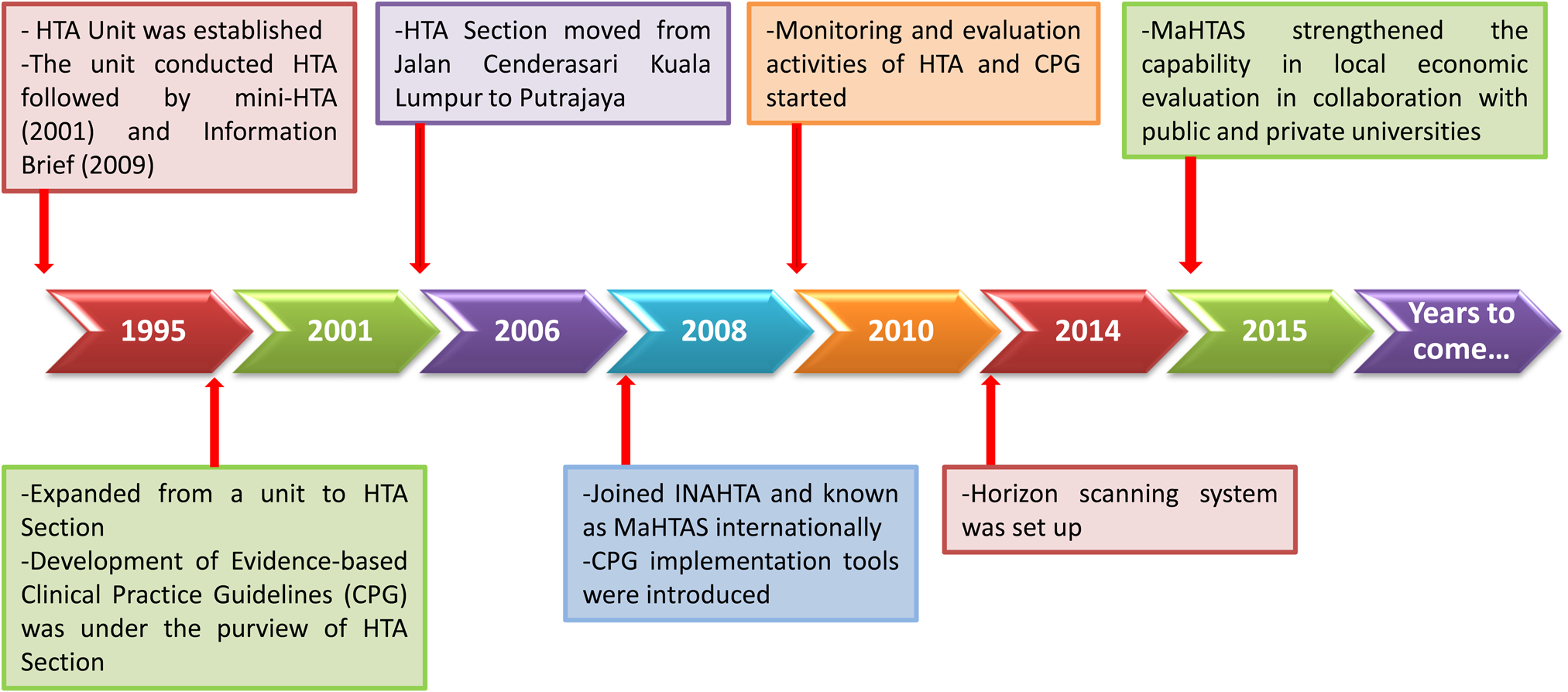
To carry out its role in advocating informed decision making, MaHTAS conducts awareness workshops, training on evidence informed decision making and relevant work processes for stakeholders, policy makers, and healthcare professionals. Additionally, MaHTAS is committed in the capacity building of its staff on areas such as evidence-based medicine (EBM), evidence retrieval and synthesis, systematic review, meta-analysis, and economic evaluation through overseas attachments, postgraduate studies, short courses, in-house, and on-the-job training. The evolution of HTA program in Malaysia is illustrated as in Figure 1.
Milestone of HTA program in Malaysia. CPG, clinical practice guidelines; HTA, health technology assessment; INAHTA, International Network of Agencies for Health Technology Assessment; MaHTAS, Malaysian Health Technology Assessment Section.

Results
Structure of HTA
MaHTAS is set up under the Medical Development Division, Ministry of Health Malaysia, which makes Malaysia the first country in Asia to establish a formal HTA program. The success of any HTA program is measured by the extent of inputs into policy formulation and decision making. The highest body that oversees the HTA programs is the Health Technology Assessment and Clinical Practice Guidelines Council chaired by the Director General of Health. It has representatives from the public, academic, and private sectors. Advisory committees (HTA, CPG, Horizon Scanning, and Economic Evaluation of Health Technologies) assist the Council with reviewing and providing technical inputs on matters relating to HTA and CPG program. MaHTAS works closely with various multidisciplinary experts and academicians who serve in these technical advisory committees.
HTA Work Processes
The work processes for HTA are: (i) request of HTA issues, (ii) prioritization of HTA issues, (iii) specification of assessment problem, (iv) retrieval of evidence, (v) critical appraisal of literature, (vi) grading of evidence, (vii) analysis and synthesis of evidence, (viii) formulation of findings and recommendation, (ix) peer reviews, (x) approval of HTA report, and (xi) dissemination and feedbacks to requestors. There is a slight variation in the work processes for mini-HTA report and Information Brief preparation.
Methods in conducting HTA, CPG, horizon scanning, and economic evaluations are constantly evolving with the advancement in science. Thus, it is pertinent to have a standardized method in conducting these activities to ensure consistency, replicability, and transparency. Hence, MaHTAS has developed several manuals for the above activities; Manual on Development and Implementation of Evidence-Based Clinical Practice Guidelines, Manual on Horizon Scanning of Health Technologies, and Manual on Economic Evaluation of Health Technologies (11;13–15). These manuals were developed jointly by working groups and expert committees highlighting the elements and contexts of each subject, as well as processes and methods to be used in the conduct of HTAs, CPGs, horizon scanning, and economic evaluation. These manuals were developed based on current best available evidence reflecting best practices at the time of development.
HTA Products
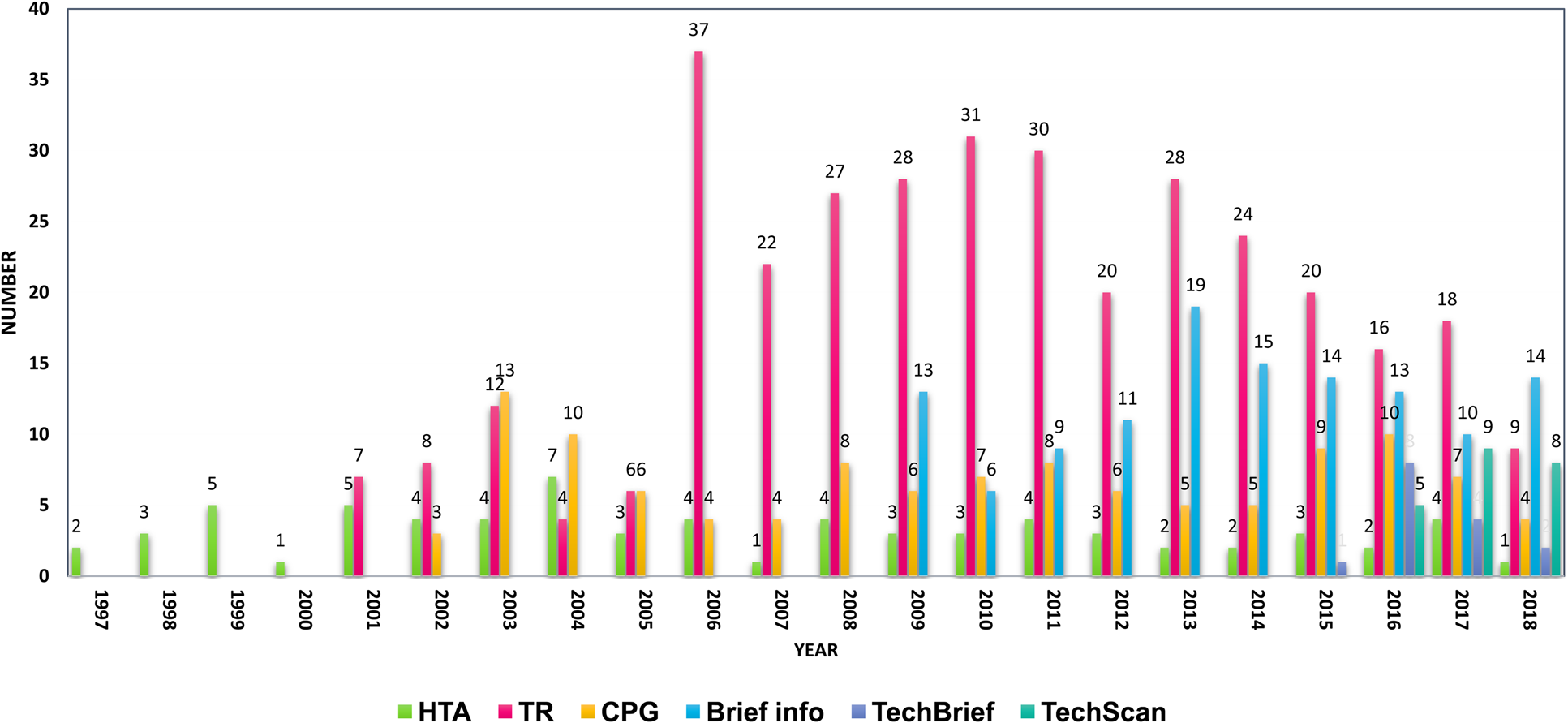
Since its establishment in 1995 up to June 2018, MaHTAS has produced seventy HTA reports, 347 mini-HTA reports (Technology Review) reports, 124 Information Briefs, thirty-seven Techbrief/Techscan, and 115 CPGs (Figure 2). These reports are accessible at the MOH Malaysia Web site, International Network for Health Technology Assessment (INAHTA) database, MaHTAS mobile app (myMaHTAS) for android and IOS application, Academy of Medicine Malaysia, and some Malaysian professional medical society Web sites (CPGs only). Extracts of these reports and news were highlighted in the biannual newsletter publications and in MaHTAS Facebook.
MaHTAS outputs by year. CPG, clinical practice guidelines; HTA, health technology assessment; MaHTAS, Malaysian Health Technology Assessment Section; TR, technology review.

The most common types of health technologies being assessed in HTA reports were program and procedures; while medical devices and procedures were the most assessed in mini-HTA reports (Supplementary Figures 1 and 2).
HTA and Decision-Making Process
This mechanism, which includes economics evaluation, will result in a recommendation on the use, including conditionality, or non-use of the technology. A positive recommendation does not automatically result in the inclusion of that a particular health technology in the benefits package even though cost-effectiveness has been considered in the assessment. Rather, it allows internal advocates to make a request for funding using the usual budgetary request mechanisms. If the budget request is for a “new” technology, that is, an addition to the historical line item budget, the request is referred to as a “dasar baru” or new policy, and may require approval by the cabinet (the highest body of the executive branch of the government). Funding may be partial, in which case implicit or explicit rationing mechanisms would be required, as the demand for such technologies exceeds the supply. On the other hand, a negative recommendation generally means that the health technology will be excluded from use in Malaysia's healthcare system. It may be possible for a new health technology to be included without going through HTA, such as for exceptional cases; however, it requires strong justification.
Based on the reports produced from 2004 to 2018, 38.0 percent of health technologies assessed were recommended for routine or selected use, 25.0 percent for further research or use in a research environment. More than a third (37.0 percent) of the health technologies assessed was not recommended for use mainly following lack of evidences on safety or effectiveness.
Impact/Influence of HTA
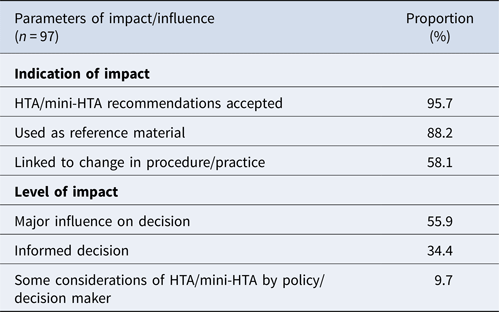
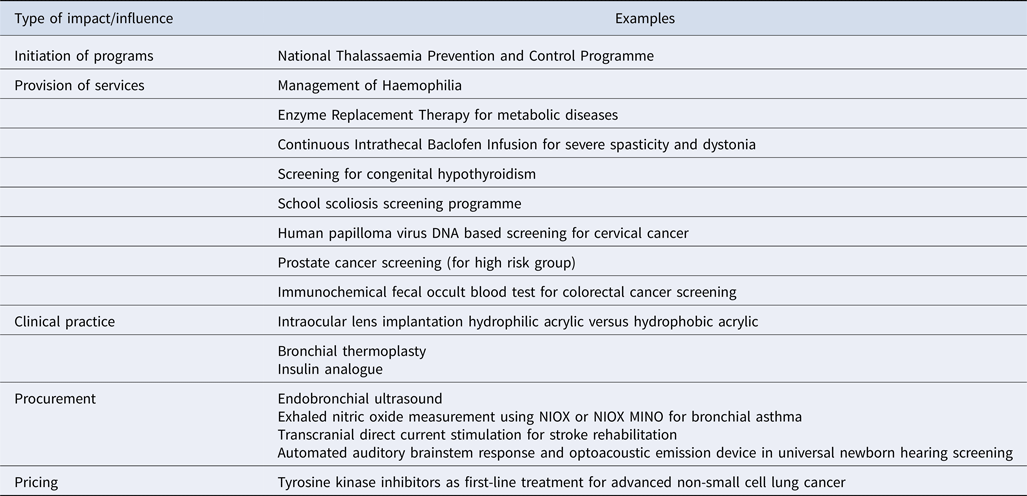
The impact/influence of these HTA reports was seen in various ways. A survey on the impact of HTA reports produced from 1997 to 2013 was conducted in December 2014 and January 2015. The impact/influence of the HTA reports was then evaluated biannually since 2016 using an evaluation form (developed according to INAHTA-Framework for reporting of impact). The forms are sent to the report requestors approximately six month after approval and dissemination of the reports. A report is considered to have an impact/influence if any indication is present; whereas level of impact on decision is classified at four levels of impact/influence accordingly, as in Supplementary Figure 3. Ninety-three HTA/mini-HTA reports (61 HTA reports from 1997 to 2016; and 32 mini-HTA reports from 2015 to 2016) were evaluated. All the reports have indication of impact/influence. The most common indications of impact/influence and the levels of impact/influence are illustrated in Table 1. The reports are mainly used for provision of services, initiation of programs, procurement and clinical practices as shown in Table 2 (16).
Indications and Level of Impact of HTA and Mini-HTA Reports in Malaysia

Impact of HTA and Mini-HTA Reports and Decision Making

Discussion
HTA was formalized in Malaysia in 1995 as a central structure within the MOH. Although the growth of HTA program in Malaysia is not as rapid as some other countries in Asia, it has expanded significantly in terms of personnel and activities in the past decade. Capacity has further enhanced over the years. HTA program is not legally binding in Malaysia; however, its existence has been sustained mainly with strong and continuous support from high level management. HTA plays an important role in policy/decision making for health technologies particularly for the MOH. HTA usage in the private sector needs to be explored further. The Malaysian Health Technology Assessment Section (MaHTAS) is in the midst of conducting an evaluation on the awareness, knowledge, and usage of HTA in the private sector.
Malaysia does not have an explicit benefits package, unlike countries with formalized health insurance system. Hence, the usage of HTA in terms of benefits package and reimbursement decisions is not optimized and can be improved further.
Exploring alternative financing mechanism for a sustainable healthcare delivery system reveals the dynamic of Malaysian healthcare system. The Government of Malaysia is currently planning for a more sustainable health financing system; therefore, it is envisaged that HTA will play an increasingly important role in determining the benefits package coverage.
The development of HTA activities in Malaysia can be perceived as unique since its establishment. The scope of assessments is broad and distinct from many other HTA agencies, which includes all health technologies; namely medical devices, procedures, programs, pharmaceuticals, as well as traditional and complementary medicine (T&CM). Assessing health technologies other than pharmaceuticals such as medical devices and T&CM is challenging following the scarcity of evidence, and evidence requirement may differ when different risk imposed, as well as language barrier. Moreover, the advent of disruptive technologies creates challenges in the assessment of such technologies.
In facing new challenges with finite resources, Malaysia is moving toward value-based medicine to ensure efficient allocation and usage of resources as well as improving quality of services in line with practices in other countries such as Sweden and England (Reference Gentry and Badrinath17;Reference Nilsson, Bååthe and Andersson18).
Although MaHTAS products are accessible through various channels, creating awareness among the public on ineffective health technologies is still one of the major challenges, what's more to empower them on informed decision making. Hence, communication with wider audience including the public will be enhanced with optimal use of social media.
Traditionally, HTA has been focusing on informing policy making at macro level (Reference Cicchetti, Marchetti and Dibidino19). Application of HTA logic and tools at an organizational level to support both managerial and clinical decision-making process could be ventured in future.
In conclusion, HTA program in Malaysia has evolved over the past decades. Its role in policy formulation and decision making of health technologies has become more significant over the years and is foreseen to be bigger in the future. As a trusted source of evidence, HTA in Malaysia will continue to strengthen the health system by advocating informed decision making and value-based medicine. As other countries in this region is trying to establish their own HTA processes and procedures, this review on the evolution of the HTA program in Malaysia might give some insights on developing a sustainable HTA program.
Supplementary Material
The supplementary material for this article can be found at https://doi.org/10.1017/S0266462319000023
Supplementary Figure 1: https://doi.org/10.1017/S0266462319000023
Supplementary Figure 2: https://doi.org/10.1017/S0266462319000023
Supplementary Figure 3: https://doi.org/10.1017/S0266462319000023
Conflicts of Interest
The authors have no conflicts of interest to disclose.