Introduction
Hormonal treatments, particularly eCG (equine chorionic gonadotrophin, formerly named PMSG, pregnant mare serum gonadotrophin), have been largely used in animal production. In ovine and caprine production, this molecule is routinely used to induce and synchronize estrus and ovulation and is consequently a prerequisite to insemination. However, the repeated use of eCG is generally followed by a decrease in fertility in some ewes and goats, a consequence of the apparition of plasmatic anti-eCG antibodies (Baril et al., Reference Baril, Remy, Vallet and Beckers1992; Bodin et al., 1995; Roy et al., Reference Roy, Maurel, Combarnous, Briois, Pobel and Deletang1995). Indeed, its proteinic and exogenic nature associated with its high molecular weight could reduce its efficiency in case of prolonged use in rabbit does also.
In rabbits, Canali et al. (1991) studied the immunogenic response to eCG on 20 nulliparous rabbit does receiving 40 IU of eCG, 48 h prior to artificial insemination (AI). After the 3rd injection, fertility showed a considerable decrease, during which the anti-eCG antibody rate increased from the 4th injection onward. Moreover, these authors evidenced that the immune response is related to the interval between treatments (r = −0.51). Even though the immune response was confirmed by Boiti et al. (Reference Boiti, Castellini, Canali, Zampini and Monaci1995) and Lebas et al. (Reference Lebas, Theau-Clément, Remy, Drion and Beckers1996), authors diverge in their opinion on the relationship that exists between immunogenic response to eCG, antibody production and productivity of the does. Indeed, at the end of the experiment after seven injections, Lebas et al. (Reference Lebas, Theau-Clément, Remy, Drion and Beckers1996) did not observe a clear relationship between anti-eCG antibodies and productivity. Bourdillon et al. (Reference Bourdillon, Chmitelin, Jarrin, Parez and Rouiller1992) did not observe any decrease in fertility after four treatments, whereas Rebollar et al. (Reference Rebollar, Milanès, Pereda, Millán, Cano, Esquifino, Villarroel, Silván and Lorenzo2006) evidenced an increase in fertility in lactating does only for the first four eCG injections on 4-day lactating does.
This article is the first one relating the study on the relationship between eCG dose and immune response in rabbits, which was necessary to better understand the relationship between the hormone and its use in does.
The aim of this experiment was to study the anti-eCG antibody production in relation to the number of injections and the injected dose (8 or 25 IU) and consequently the relationship between antibody production, receptivity and the reproductive performances of rabbit does inseminated every 35 days (intensive reproduction rhythm, rabbit does are 4-day lactating at AI).
Material and methods
The experimental approach has been described in more detail in a previous article (Theau-Clément et al., 2007). A total of 124 primiparous INRA 0067 does were inseminated every 35 days with Hyplus buck semen (Grimaud frères) during the 11 consecutive series. Consequently, the number of eCG injections were the same for all the does regardless of their production intensity. A doe was definitively assigned to a group. Does were eliminated only for sanitary reasons and were systematically replaced by young does (nulliparous) assigned to the group of the doe it replaced. Nulliparous does were never injected with eCG and were not considered in the analysis. No biostimulation was used in this experiment to induce receptivity in does. Free suckling was applied. The animals were housed in individual flat decks under a 16L : 8D constant lighting program and fed ad libitum with a commercial pellet diet containing 16.5% crude protein and 15.5% crude fiber. Water was provided ad libitum.
Experimental design
At the first kindling stage, the does were equally divided into three groups according to their lactation status (lactating or not), genealogy (sisters distributed in the different groups) and body weight 3 weeks before the first insemination. At 48 h before further inseminations, the does of the eCG-treated groups received a subcutaneous injection of 8 IU (group 8) or 25 IU (group 25) of eCG (Chronogest®, Intervet, France) in 1 ml of solvent. The does of the control group (group 0) did not receive any injection. Two days before insemination, blood samples (3 ml in the marginal vein of the ear) were systematically taken from all the does (immediately before eCG injection for groups 8 and 25). The plasma was centrifuged (20 min, 4000 rpm/min at 4°C) and frozen (−20°C).
Prior to insemination, sexual receptivity of the does was tested in the presence of a buck as described by the International Rabbit Reproduction Group (2005). Inseminations were performed using heterospermic pools diluted seven times in Dilap 2000. Ovulation was induced by the intramuscular injection of 0.8 μg of Buserelin acetate (Receptal®, Intervet, France). After the 11th insemination, the does were sacrificed 30 h or 14 days after insemination.
Antibody detection in plasma samples
The eCG antibodies were quantified using a Radio Immuno Assay described by Lebas et al. (Reference Lebas, Theau-Clément, Remy, Drion and Beckers1996). The purified eCG was radiolabeled using 125-Iodine (IMS-30; Amersham, Little Chalfont, UK) according to the enzymatic procedure of Thorell and Johansson (Reference Thorell and Johansson1971). The antibody levels were expressed as the percentage of 125I-eCG bound by 10 μl of plasma. The higher this percentage, the higher the antibody level.
Studied traits
The 125I-eCG binding rate, receptivity rate, fertility (number of kindling does/number of inseminated does), litter size at birth, litter size at weaning (28 days), and the litter mean weight and individual mean weight at 28 days were studied. For the 11th series, we considered that does having at least one segmented egg 30 h after AI, or one alive embryo 14 days after AI, were fertile, and their results were added to those of previous determinations of fertility (kindlings/AI).
The global productivity was measured by the number of weaned rabbits/AI.
Statistical analysis
The data were statistically analyzed using the SAS (1993) statistics library. The immunogenic response to eCG was studied by analysis of variance, taking into account the fixed effect of treatment (3 levels: control, 8 IU, and 25 IU), the experimental phase (2 levels: beginning, corresponding to the four first inseminations and the end, corresponding to the six following series) and the interaction. The choice of the two-phase distribution was made by taking into account the results described in the bibliography (Canali et al., 1991; Boiti et al., Reference Boiti, Castellini, Canali, Zampini and Monaci1995; Lebas et al., Reference Lebas, Theau-Clément, Remy, Drion and Beckers1996; Rebollar et al., Reference Rebollar, Milanès, Pereda, Millán, Cano, Esquifino, Villarroel, Silván and Lorenzo2006). A second analysis of variance was aimed to compare the reproductive performances of the two groups of does treated with eCG according to their immune response. The fixed effect of the eCG dose (2 levels: 8 and 25 IU) and the antibody level present at the moment of insemination (2 levels: low immune response, binding rate <6%; high immune response, binding rate ⩾6%), and their interaction were analyzed. The highest level of binding rate found in the control group (that never received eCG injection) was 5.7%. Consequently, it was considered that a binding rate ⩾6% reflected a detectable immune response. Receptivity rate and fertility were considered to be Bernoulli variables (range 0 to 1), and they were analyzed as traditional continuous variables.
Results
Evolution of anti-eCG antibodies in relation to the number of injections and eCG dose
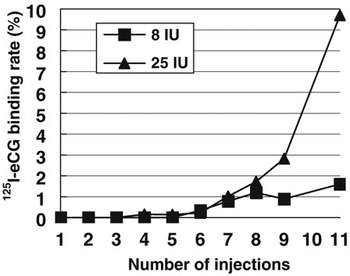
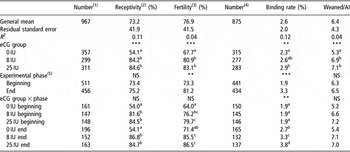
The eCG antibody remains at a basal level until the 6th injection. An increase was appreciable only in the samples taken just before the 7th injection (i.e. blood sampling 35 days after the 6th injection) and significant (P < 0.05) only for does receiving 25 IU and controlled before the 11th injection (Figure 1). Among the 43 treated does still present in the 11th series (8 IU: 20; 25 IU: 23), respectively, 15.0% and 39.1% of them developed an immune reaction (binding rate >6%, maximum value of the control). Compared with the control group, a significant improvement in receptivity (P < 0.001), fertility (P < 0.001) and consequently global productivity (P < 0.001) was observed after eCG injection (Table 1, the efficiency of eCG to increase productivity of rabbit does has been developed by Theau-Clément et al., 2007). No improvement of reproduction performances was obtained when eCG doses were increased from 8 to 25 IU. The introduction of two experimental phases (beginning, corresponding to the first four inseminations and the end, corresponding to the six following series) in the analysis of variance shows that sexual receptivity did not vary at the beginning or at the end of the experiment (73.4% and 75.2%). But fertility was significantly lower at the beginning of the experiment (73.3% v. 81.2%, P = 0.004). However, the binding rate was positively correlated to both eCG dose (2.3% to 2.6% and 2.9%, for groups 0, 8 and 25 IU, respectively, P = 0.005) and number of injections (1.9% v. 3.3%, respectively, for the first four injections and the following ones, P = 0.001). The significant interaction between the group and the phase (P = 0.005) was related to the higher antibody production at the end of the experiment (3.3% and 3.8% for groups 8 and 25, respectively). The global productivity of the females did not vary according to the phase (6.3 v. 6.5 weaned rabbits/AI, for the initial and the final phase, respectively).
Binding rate in relation with the number of injections and eCG (equine chorionic gonadotrophin) dose (difference with the control group).

Evolution of anti-eCG antibodies in relation to eCG dose and the number of injections

eCG = equine chorionic gonadotrophin; AI = artificial insemination.
Results of variance analysis (least-squares means).
(1) Number of artificial inseminations.
(2) Percentage of does taking a lordosis position in the presence of a buck.
(3) Number of kindling does/number of inseminated does.
(4) Number of blood samples.
(5) Experimental phase: beginning, corresponding to the four first inseminations and the end, corresponding to the six following series.
The calculated probability (P) is indicated as NS when P > 0.05, **when P < 0.01 and *** when P < 0.001.
Mean values in the same column with different superscripts differ significantly (P < 0.05).
A visible immune reaction was observed following the 6th injection. Consequently, the variance analysis was performed again by gathering the first six series and the last four ones. The percentage of receptive does did not vary significantly between the phases (74.0% v. 75.0%) when the fertility and binding rate were higher in the 2nd phase (73.9% v. 84.3%, P < 0.001; 2.2% v. 3.6%, P < 0.001). The productivity at weaning was higher in the 2nd phase (7.1 v. 6.2 weaned rabbits/AI). eCG injections as compared to the control improved regardless of the dose, similar to the 1st and 2nd phase of productivity (+31% weaned rabbits/AI in both cases).
Immune response and productivity
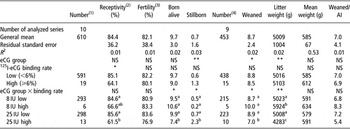
The antibody rate was considered as low when the binding rate was lower than 6% (higher limit of the binding rate of the control group). It was regarded as high in the opposite case. The relationship between the presence of eCG antibodies and the reproductive performances was studied after elimination of data of the control group and of the 11th series (rabbit does sacrificed during pregnancy). Only 15% and 39% of the does of groups 8 and 25, respectively, developed a visible immune reaction before the 11th injection. The data were analyzed again after introducing the presence of antibodies (low or high) into the statistical model. As previously demonstrated, an increase of eCG dose did not influence receptivity and fertility. However, females having low antibody levels were significantly more receptive than those that developed a severe immunity (85.1% v. 64.1%, P = 0.021, Table 2). However, no significant effect of the immune response on fertility was observed (82.2% and 80.1%, respectively, for a low or high binding rate). Even if the number of kits born alive did not differ significantly according to the eCG dose, the interaction between the two eCG groups and the level of antibodies in does treated with 25 IU of eCG and presenting an important immune reaction showed a significantly lower litter size at birth when compared with those treated with 8 IU (7.4 v. 10.6 born alive, P = 0.030). The mortality at kindling was also higher for these high-dose-treated females (2.3 v. 0.2 stillborn, P = 0.004) and consequently litter size and litter weight at weaning were lower (7.0 v. 10.0 weaned, P = 0.002 and 4283 v. 5924 g, P = 0.004). However, these does being slightly represented (n = 19), the global productivity estimated by the number of weaned rabbits/AI did not vary significantly according to the dose of eCG and according to the intensity of the immune response.
Relationship between anti-eCG antibody production and productivity of rabbit does productivity

eCG = equine chorionic gonadotrophin; AI = artificial insemination.
Results of variance analysis (least-squares means).
(1) Number of artificial inseminations.
(2) Percentage of does taking a lordosis position in the presence of a buck.
(3) Number of kindling does/number of inseminated does.
(4) Number of litters at weaning.
The calculated probability (P) is indicated as NS when P > 0.05, * when P < 0.05 and ** when P < 0.01.
Mean values in the same column with different superscripts differ significantly (P < 0.05).
Discussion
This experiment was the first to demonstrate that the level of anti-eCG antibodies is eCG dose dependent; however, the level of antibodies remains low (mean binding rate: 2.6% for 10 successive injections). Therefore, it can be assumed that the clear increase in the rate of formation of eCG antibodies observed by Canali et al. (1991) and Stradaioli et al. (1994) starting from the 4th injection is the consequence of the use of higher dose (40 IU). In the present experiment, the eCG antibodies were detectable only just before the 7th injection. Moreover, the significant percentage of does developing a detectable immunity was not confirmed: 55%, after seven treatments of 40 IU (Canali et al. 1991); and 80% after eight treatments of 40 IU (Stradaioli et al., 1994). Nevertheless, at a lower dose (20 IU) and injection of eCG at higher intervals (45 days) to 25 does, Boiti et al. (Reference Boiti, Castellini, Canali, Zampini and Monaci1995) evidenced 84% of hyperimmune does after seven treatments. Different experiments conducted for studying immunogenic response to eCG in rabbits showed varying results, which is attributed to several factors such as genetic effects, the reproductive rhythm related to the interval between eCG injections, the breeding system (single batch or several batches) and the physiological status of the does at the time of injection. But the immunogenic response to exogenous gonadotropins depends on other different factors such as the quality of the hormone prepared (solubility, contaminant proteins, etc.), the mode of injection (intramuscular or subcutaneous) and the volume of the injection. Indeed, in the present experiment, only 15% and 39% of the does receiving 8 or 25 IU, respectively, developed a significant immune reaction just before the 11th injection. Recently, Roy et al. (Reference Roy, Maurel, Combes, Vaiman, Cribiu, Lantier, Pobel, Delétang, Combarnous and Guillou1999) demonstrated that the negative effect of repeated eCG treatments on subsequent fertility in Alpine goats was due to a humoral immune response involving the major histocompatibility complex. Unfortunately, we could not find any study on genetic sensibility to eCG realized in the rabbit species. The reproduction rhythm needs to be considered in relation to the breeding system (single batch or several batches). For example, for two batches, no pregnant rabbit does detected by abdominal palpation are treated again and inseminated 21 days after the previous insemination, in which case the interval between injection and the number of injections during the career of the does varied considerably. The immune reaction against eCG can also depend on the physiological status of the does. In our study, females were injected on Day 4 of lactation, when milk production increases considerably. Changes in general metabolism and in hormone production could account for a temporary shorter half-life of eCG; therefore, the immune system is not simulated due to decreased levels of eCG. The quality of the hormone preparation might explain the difference between our results and other results published in the literature. In our study, the eCG in 1 ml of solvent was subcutaneously injected. It could be hypothesized that a subcutaneous injection of a large volume results in longer diffusion time; however, it is impossible to draw a conclusion since the injected volume is generally not specified by authors. Consequently, further studies are necessary to better understand the variability of eCG response in rabbits.
The disappearance of the favorable effect of eCG on fertility of does having received more than four or six injections was not observed here: indeed, the fertility was even higher at the end of the experiment, whereas no doe was reformed for criteria related to performances of reproduction. The relationship between the rate of binding of antibodies and the receptivity highlighted by the analysis has to be confirmed because the observations on hyperimmune females (binding rate ⩾6%) were related to the results of only 19 inseminations. Moreover, this effect was not reflected in case of fertility and prolificacy. At weaning, Lebas et al. (Reference Lebas, Theau-Clément, Remy, Drion and Beckers1996) obtained rabbits heavier for hyperimmune does (+71 g); the results of that experiment highlight a difference in the same way (+27 g) but non-significantly. As a consequence, global productivity is not related to the level of immune response.
The very weak share of the variability of performances explained by the model (R 2 between 0.04 and 0.11) confirms the minor influence of the presence of eCG antibodies on the reproductive performances of the does. This result is in contrast with the negative effects of repeated eCG injections in goats and sheep in order to synchronize estrus. The goat seems to be the most reactive with repeated administrations of gonadotrophins (Drion et al., Reference Drion, Remy, Houtain, Mc Namara, Baril, Heyman, Cognie, Theau-Clément, Leboeuf, Ectors, Segers and Beckers1998). Indeed, 36% of the females receiving one or two eCG treatments at the first insemination presented a sufficient immune response to compensate for the successful estrus induction treatment (Baril et al., Reference Baril, Remy, Vallet and Beckers1992). The immune reaction induces an increase in the frequency of late estrus, associated with a low fertility. In cases of extremely intensive use of eCG treatments, the immune reaction can even induce the absence of the following estrus (Drion et al., Reference Drion, Remy, Houtain, Mc Namara, Baril, Heyman, Cognie, Theau-Clément, Leboeuf, Ectors, Segers and Beckers1998). In case of ewes, repeated injections of eCG to an ewe make it gradually less receptive to the treatment (Clarke, Reference Clarke1973). One year later, residual antibodies were still present in larger quantities in older females because of their accumulation during successive treatments. These antibodies constitute a major element of resistance to the treatments in this species (Bodin et al., 1995). In rabbits, residual eCG antibodies can still exist 35 days after the previous injection, but even when accumulated during successive treatments (every 35 days), they do not considerably depress reproductive performances.
Conclusion
In conclusion, an 8 or 25 IU eCG injection 48 h before the insemination of rabbit does on the 4th day of lactation durably improves global productivity. An immune response was detected only after the 6th injection and further immune response was directly related to the injected dose but failed to depress the global productivity of the herd. Consequently, even though the response is dose dependent in rabbit does, the immune response to eCG injection seems to be marginal.
Moreover, under the experimental conditions described here, reproductive performances of hyperimmune does are not affected. Consequently, no relationship was evidenced between immune response and productivity even after 10 eCG treatments (8 or 25 IU), which encompasses the whole reproductive life of a rabbit doe in farms.
Acknowledgments
The authors are grateful to Jacqueline Bellereaud and all the technicians of ‘Elevage Alternatif et Santé des Monogastriques’ for their valuable collaboration, to Roger Duzert (SAGA) and his team for the supervision of the computerized data collection system, and to W. Brand-Williams for English revision of the manuscript.