

1 Introduction
Adjusting the structures of developed welfare states to population aging remains one of the key challenges of economic policy in many industrial countries. Notwithstanding these necessities, reform options such as a higher pension age are unpopular among the majority of voters albeit with substantial individual heterogeneity. Preceding studies have explored numerous important drivers of pension reform preferences. According to these insights, an individual's socio-economic characteristics such as gender, income, or age matter as does the degree of information on the extent of the system imbalances. So far, however, the literature has not looked into another potential source of reform resistance, which is related to an individual's (dis-)utility from work. Hence, this contribution argues that intrinsic motivation, which has received increasing attention on other fields of economic analysis, must not be overlooked in a comprehensive analysis of pension reform preferences. Pension reforms impose or reduce restrictions on aging citizens to offer their work at the labor market. Therefore, an individual's work motivation should have an impact on reform preferences. People with intrinsic work motivation will be less anxious about longer working years compared with people for whom work is a burden.
To specify the theoretical link between work motivation and pension reform preferences, we regard the optimization on pension age within the framework of an optimal job separation decision. In this context, retirement offers an outside option to the continuation of work and co-determines a reservation wage. If the older worker's job does not pay the reservation wage, the retirement option is more attractive. Intrinsic work motivation will, ceteris paribus, lower this reservation wage, whereas someone with a large disutility from work will demand a higher compensation for staying in employment. Therefore, a higher pension age should be a relatively attractive reform option for intrinsically motivated workers compared with the reform alternatives of cutting pensions or increasing contributions.
In the empirical part, this prediction is tested for data from the representative ALLBUS survey (‘Allgemeine Bevölkerungsumfrage der Sozialwissenschaften’: German General Social Survey) of the German population. This test adds to the scarce literature on the drivers of pension reform preferences (surveyed below) in at least two respects. First, it is innovative as to the inclusion of intrinsic motivation as a potential determinant of reform acceptance. As such, it also advances the intrinsic motivation literature, which, so far, is unrelated to the formation of policy preferences. Second, it does not look at pension reform in general but differentiates between three distinct reform options and their relative popularity: cutting pensions, increasing contributions, and lifting the pension age. The results strongly confirm that (lacking) intrinsic work motivation is a robust determinant for individual (resistance to and) support for a higher pension age. A reversed effect is observable with respect to the support for higher pension contributions: intrinsically motivated individuals are less than others willing to pay the price for early retirement through higher contributions.
Our results indicate that intrinsic motivation is relevant for certain economic policy preferences as well, a finding that enriches the literature on intrinsic motivation by one important application. Non-monetary work incentives appear to be not only important for individual productivity or an organization's efficiency but also for a country's institutional adaptability. The findings point to the fact that lacking intrinsic work motivation can be a relevant reform constraint.
The paper's structure is as follows: Section 2 briefly surveys the literature on both the drivers of pension reform preferences and the role of intrinsic motivation in economic contexts. Section 3 derives the theoretical expectations to which extent intrinsic work motivation should impact on different pension reform options. The data and empirical results are presented in Sections 4 and 5 followed by robustness checks and conclusions on the feasibility of pension reforms.
2 Literature survey
2.1 Pension reform preferences
The existing scarce literature on the drivers of pension reform preferences has successfully shed light on some important aspects. Individuals’ socio-economic characteristics help to explain variation: the young are more reform oriented than the old; males more than females; the rich more than the poor (Boeri et al., Reference Boeri, Börsch-Supan and Tabellini2001, Reference Boeri, Börsch-Supan and Tabellini2002). The division between the old and the young generation is a consequence of the different costs of parametric reforms depending on age. Much of this variation is obviously consistent with a self-interest view on the welfare state along the lines of Meltzer and Richard (Reference Meltzer and Richard1981) where voters judge welfare arrangements on the basis of their individual monetary net balance. Women (due to longer life expectation compared to men), the old (due to their more limited time horizon compared to the young) and the poor (due to the redistributive elements in pay-as-you-go (PAYG) systems and due to a higher unemployment risk compared to the rich) are relative winners of unadjusted PAYG systems. Consistently, all these groups show a relative low inclination to accept reforms, which cut back pensions or lift pension age. Scheubel et al. (Reference Scheubel, Schunk and Winter2009) expand the standard set of self-interest related determinants to the individually expected work ability at pension age and show that this expectation significantly drives the rejection of a higher retirement age.
A further insight from this empirical literature is that, beyond self-interest, information matters. Boeri et al. (Reference Boeri, Börsch-Supan and Tabellini2001, Reference Boeri, Börsch-Supan and Tabellini2002) show for a survey of European citizens that the respondents underestimate the costs of the system and have an unrealistic expectation of benefits. The better voters are informed, the more they support reforms, which would allow for a partial opting out of mandatory PAYG systems towards private funded schemes. For Italian survey data, Boeri and Tabellini (Reference Boeri and Tabellini2012) find that voters are vastly uninformed about the cost and functioning of the pension system and that the degree of information helps to predict an individual's readiness to accept reforms. However, even better information does not guarantee support for sustainability improving reforms. Generally, reforms that cut back the size of PAYG systems lack support, even among those who are informed about an imminent pension crisis (Boeri et al., Reference Boeri, Börsch-Supan and Tabellini2002).
In addition to self-interest and information related factors, the non-economic approaches stress that individual ideological views contribute to shape pension reform preferences. For example, Lynch and Myrskylä (Reference Lynch and Myrskylä2009) exploit Eurobarometer data to demonstrate that ideological proxies, such as general views on the welfare state or union membership, significantly influence individual positions on pension reforms. In a macro cross-national study, Schneider (Reference Schneider2009) confirms that trade union power reduces the likelihood of pension reforms. At the same time, the objective reform need, measured on the basis of projected pension spending increases, speeds up reform activity.
The existing literature is focused on the acceptance of pension reforms in general without paying particular attention to the drivers of relative popularity of different pension reform options. Yet, Boeri et al. (Reference Boeri, Börsch-Supan and Tabellini2002) present descriptive evidence for this relative attractiveness in their two country study. According to these results, a higher pension age is more attractive in Italy than in Germany with the reversed pattern for cutting pensions.
None of the existing approaches have, however, included an individual's utility or disutility from work. Thus, the picture remains incomplete.
2.2 Intrinsic motivation
The key contribution of the intrinsic motivation literature to economics is its widening of the perspective on incentives. Deci's definition is as follows: ‘one is said to be intrinsically motivated to perform an activity when one receives no apparent reward except the activity itself’ (Deci, Reference Deci1971: p. 105). Whereas, in particular in the context of principal–agent relationships, neoclassical economics has stressed the role of monetary or other extrinsic incentives, the intrinsic motivation literature corrects this unbalanced view.
One insight of the literature is that monetary incentives or punishments might even be counterproductive as these externally set constraints may crowd out intrinsic motivation (Bénabou and Tirole, Reference Bénabou and Tirole2003, Reference Bénabou and Tirole2006). The empirical evidence is manifold and ranges from experiments, where incentives crowd out reciprocity, over tax honesty, where fines may lead to lower tax morale, up to labor supply decisions, where the introduction of small monetary incentives for voluntary works may reduce supply or labor efficiency (Frey and Jegen, Reference Frey and Jegen2001; Frey, Reference Frey2008). The existence of this second type of motivation has become important for modern economics’ advice on optimum institutions. For instance, the conclusions relate to optimal organizational forms of modern companies with respect to an optimal balance of extrinsic and intrinsic motivation to solve social dilemmas (Osterloh et al., Reference Osterloh, Frost and Frey2002) or to the design of optimal knowledge transfer (Osterloh and Frey, Reference Osterloh and Frey2000).
Although the relevance of intrinsic motivation has been established in numerous contexts, there is one striking gap: so far, this concept has not been related to the formation of policy preferences. We aim at filling this gap in the context of pension reform preferences – a field particularly promising since it is about government interference with individual freedom of choice to end working life.Footnote 1
3 Theoretical expectations
Intuitively, there should be a link between pension reform preferences and intrinsic motivation. Somebody who obtains large intrinsic rewards from work should feel less threatened by the prospect of a later pension age compared to somebody working ‘just for the money’.
To analyze the impact of intrinsic work motivation on pension reform preferences in a more precise way, it is useful to look at the preferred retirement age in the context of an optimizing job separation decision.Footnote 2 The job separation literature assumes that it is optimal for both employers and employees that a worker leaves a firm whenever outside opportunities offer a more productive employment (Mortensen, Reference Mortensen1978). Certainly, when reflecting retirement, the outside option is of a different nature and does not relate to the productivity (and wage) which can be achieved with another employer. This reflection, nevertheless, relates to another type of outside option which offers a pension in combination with increased leisure consumption. The combined features of this outside option (including factors such as company pension plansFootnote 3, wealth, or non-labor income) determine an older worker's reservation wage. Only if labor income for a given age still exceeds the reservation wage associated with the pension outside option, an individual will prefer work over retirement.
Ceteris paribus, workers with a large disutility from work might have a higher reservation wage and a preference to retire earlier than those with moderate disutility or even positive utility from work. There is considerable evidence that individual retirement decisions are indeed heavily influenced by job satisfaction and working conditions (Blekesaune and Solem, Reference Blekesaune and Solem2005, and the survey therein) so that it appears promising to assume a similar link for the formation of preferences on pension reforms.Footnote 4
However, preference formation on pension reform options is more complex than an individual retirement decision. For the latter, it is merely the adjustment to the incentives of an exogenously given pension system. For the former, it is the reasoning on parameter changes which would serve the individual utility best over the (rest of one's) life cycle.
The challenge for a static PAYG pension system which is not adjusted to an increase in longevity is that, in the beginning of a representative insured's life cycle, his present value of received pensions, PVP, exceeds his present value of contributions, PVC, with the implicit individual pension debt, ID=PVP − PVC.Footnote 5 Thereby, the implicit individual pension debt of a representative individual in age group A depends on the following policy parameters: the retirement age R, the pension contributions C, and the annual pension payments P. Abstracting from growth, income heterogeneity and uncertainty, the individual pension debt is thus denoted by
 $$ID_{A} \equals PVP_{A} \minus PVC_{A} \equals \mathop{\sum}\limits_{i \equals R}^{\infty } {P\alpha _{Ai} \delta } ^{\lpar i \minus A\rpar } \minus \mathop{\sum}\limits_{i \equals A}^{R \minus \setnum{1}} {C\alpha _{Ai} \delta ^{\lpar i \minus A\rpar } } \comma $$
where αAi denotes the survival probability of age group A up to age i and δ is the economy's discount factor (see Börsch-Supan, Reference Börsch-Supan1992).
Increasing longevity pushes up the survival probabilities αAi and increases IDA. This especially holds true for the post-retirement age.Footnote 6 A reform that wants to restore sustainability would then have to cut back the sum of all age groups’ ID to zero. Basically, this adjustment can occur through any of the three policy parameters (or some of them in combination): increasing pension contributions C, cutting pensions P, or lifting retirement age R.Footnote 7
It is immediately obvious that an individual's age will affect his preference for one of the preferred reform options. A higher C imposes a cost early in the life cycle but not after retirement. Hence, the relative preference for higher contributions should increase with age approaching retirement age.Footnote 8 A preference for lower pensions should, on the contrary, decline with age approaching retirement. Although lower pensions (instead of higher contributions) are relatively attractive for the young with retirement far ahead, they are much less attractive for people close to or in retirement who do not benefit (substantially) from savings in contributions. A higher pension age that effectively cuts back PVP through a later start of pension payments is particularly unattractive for older workers facing retirement.Footnote 9 It is relatively attractive for younger workers and even more for pensioners, who are past the critical age to be affected.
These age effects have been identified before (see above 2.1) and we now concentrate on preference heterogeneity within one age group. For that purpose we regard the relative attraction of cutting P, raising C, or raising R for members of the identical age group A where any of these reforms would cut back IDA by the same amount ΔIDA.Footnote 10
Our key interest is now how individuals of the same age group and with identical discount factors might differ in their reform options because of differences in intrinsic work motivation. Here it is essential that an identical income effect within one age group (defined by ΔIDA) would translate differently into individual utility. For workers with a high disutility from labor, the higher retirement age will be particularly unattractive since it confronts them with a substantial loss in leisure. The assessment is different for those with only low disutility or even utility from work in the sense that they even would prefer unpaid work over sitting at home. For the latter, the longer working lifetime is no loss but utility-enhancing. A higher pension age in these cases may also alleviate a binding constraint, which, so far, has prevented them from working beyond the pension age before the reform. This reform would then simply expand the leeway for self-determination, which again reinforces the importance of intrinsic motivation. Since the latter is particularly powerful in the absence of external restrictions (Frey, Reference Frey1997b), the reform's impact thus intensifies. Taken together, there is the clear theoretical prediction that – holding all other factors like age or discount rate constant – a higher pension age should be a reform option which is relative attractive for those with low work disutility compared to those for whom any additional working day is a nuisance.Footnote 11
We would not expect that intrinsic motivation impacts equally positively on the acceptance of lower pension payments or higher pension contributions. Both reform proposals are not associated with any increase in self-determination. Even if intrinsically motivated workers do not work just for the money, they would not welcome new external interventions which cause resistance. It is a central insight of the intrinsic motivation literature that extrinsic incentives can crowd out intrinsic motivation. Extrinsic (typically monetary) incentives which are regarded as inadequate have a destructive effect on work motivation (Frey, Reference Frey1997a). For example, a cut of net income from active work due to higher pension contributions is likely to be regarded as a move toward an inadequate compensation for work efforts. Given the insights from the mentioned literature, one cannot expect that this move will be more acceptable for workers who enjoy their work compared to those with a larger disutility from working. A similar reasoning applies for cutting pensions. Intrinsically motivated workers could perceive this move as disrespect for their high efforts and react not in a less critical way than other workers.
Thus, the specific difference between workers with a high and low intrinsic work motivation concentrates on the assessment of a higher pension age. Although all three reform options (higher contributions, lower benefits, and longer working years) confront workers (of the same age group and with equal individual discount rates) with the same income effect, only the longer working years option increases the scope for self-determination and should be the favorite of people who enjoy their work. Hence, our subsequent empirical testing is based on the prediction that intrinsically motivated respondents should have one clear favorite among the reform options which is a higher pension age.
One qualification, however, could blur the clear prediction on the impact of intrinsic motivation on the reservation wage and reform preferences. It relates to the fact that a wage has to compensate for the disutility of work at the margin (Lazear and Oyer, Reference Lazear and Oyer2007): it might well be the case that a higher age worker still receives satisfaction from his work in general but would be glad to have a lower work load or less working hours. As a consequence, the wage has to compensate him for his effort at the margin. If they were free to choose, intrinsically motivated older workers would then stay in employment but possibly reduce their effort or working hours. Regularly, this freedom of choice does not exist so that an employee might not face a decision at the margin but has to reflect whether to stay in employment at all. Only an empirical test can show to which extent this problem invalidates the expectation that intrinsically motivated workers have lower reservation wages and, hence, are more open for late retirement.
Our conceptual framework also allows identifying further essential determinants which should impact on pension reform preferences. In principle, all factors that influence an older worker's reservation wage, such as wealth, health, or non-labor income, should matter and should, as far as available, be covered as control variables in an empirical approach.
4 The data
For our empirical test, we use data from the representative ALLBUS survey (Terwey et al., Reference Terwey, Bens, Baumann and Baltzer2007), which was first conducted in 1980 with subsequent waves every 2 years.Footnote 12 The survey is designed to be representative for the German population and offers data on the individual labor market status, socio-economic characteristics, and policy preferences. For our study, we make use of data collected from March to August 2006. In Germany, this period was characterized by a large public and parliamentary debate on the future of the pension system, which resulted in the decision to gradually increase the pension age with the relevant law taking effect in 2007.
This data base offers all necessary preconditions for testing for the impact of intrinsic motivation on pension reform preferences. Besides a rich coverage of socio-economic characteristics, it includes questions on the acceptance of the three basic pension reform options: a higher pension age, higher contributions to the PAYG system, and lower pension payments.Footnote 13 This specific type of question is particularly useful as it confronts respondents with different reform alternatives which are equally able to improve the sustainability of the PAYG system. Surveys which only ask for the acceptance or rejection of one reform option, such as a higher pension age, are confronted with the problem that results could rather reflect general reform willingness than the assessment of the specific reform option (Scheubel et al., Reference Scheubel, Schunk and Winter2009). With that ALLBUS question, this is less of a concern and we are able to measure the relative popularity of different reform options independent from the popularity of pension reforms in general.
The survey equally covers a set of questions which can be employed as indicators for the complex of intrinsic work motivation. The survey participants answer the question whether they would like to stay employed even without need for the money earned or whether they are willing to work harder to support the organization. The precise questions run as follows: our ‘like work’ dummy represents the support for the statement ‘I would like to work even without the need for the money’ and the ‘work for firm’ dummy marks individuals who declare ‘I am ready to work harder than I have to in order to contribute to my firm's/organization's success’. Both variables are empirically and conceptually distinct. Empirically, the low correlation (0.13) indicates that respondents perceive that both questions target at quite independent issues. Conceptually, the first proxy is clearly much closer to Deci's definition (section 2.2) of intrinsic motivation than the second because it is so explicit about working without monetary incentives. The second question is rather related to concepts of organizational commitment. Organizational commitment has different dimensions (Meyer and Allen, Reference Meyer and Allen1991) ranging from an affective attachment to an organization over perceived costs of leaving an organization up to normative obligations to remain with the organization. Our question is closest to the measurement of affective attachment which typically includes items like ours on the willingness to exert effort. In the empirical test we include this measure for a cross-check: from a theoretical point of view, we would expect the measure of intrinsic motivation to have a clearer impact on the pension age preference compared with the organizational commitment proxy. Hence, contrasting both measures’ results helps us to assess whether it is really the intrinsic work motivation and not some type of company-related affection, which drives the results for pension age preferences.
Both the pension reform preference and the questions on intrinsic motivation and organizational commitment have been fed into the ALLBUS survey in the context of the International Social Survey Program (ISSP).Footnote 14
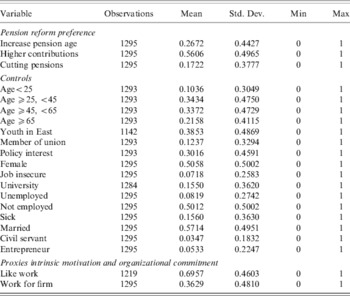
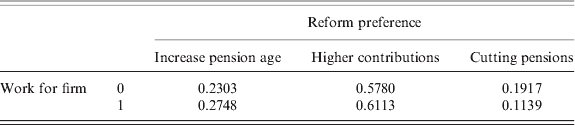
The descriptive statistics (Table 1) confirm the finding from other studies that a higher pension age is not a popular solution. If they had to accept one reform, the survey respondents would rather opt for higher contributions. The least popular reform is, however, cutting pensions. According to our intrinsic motivation proxies, around two thirds classify as intrinsically motivated in the sense that they do not work primarily for the money. About one third is ready to work hard for their firm to improve the company's success.
Descriptive statistics

5 Econometric testing
In a first step, we model the formation of reform preferences as an independent decision problem over acceptance or rejection of each single option under consideration. Hence, our dependent variable is binary (1 support for the specific reform option, 0 no support) and we apply a probit estimation procedure for each of the three policy options (‘increase pension age’, ‘higher contributions’, and ‘cutting pensions’). In the next step, we proceed to a multinomial logit modeling, which allows identifying the drivers of relative probabilities between the available reform options.
The inclusion of control variables is guided by our theoretical reasoning. The position in the life cycle should impact on policy preferences as explained above so that we include different age class dummies (<25, 25–44, and 45–64 years with the pensioner age class 65 and older as our point of reference). Furthermore, we account for individual characteristics which should affect the reservation wage required to opt for longer working years instead of retirement. Among these indicators, we include the fear of a job loss (job insecure), the employment status (unemployed and not employed),Footnote 15 and sickness. All these factors should push up the reservation wage for work in a higher age and, thus, render an early pension as highly desirable. Given the importance of information for pension reform acceptance (see the literature survey above), we include an information proxy based on self-assessment (respondent claims that he is interested in politics in general). The dummy for university education is an integrated proxy for different facets: the degree of information, job satisfaction, but also accumulated wealth – at least the latter two factors should lead to a lower reservation wage and a relatively favorable position on a higher pension age. We also add control variables which are normally used for modeling policy preferences, e.g., in the context of redistribution (youth in East, Alesina and Fuchs-Schündeln, Reference Alesina and Fuchs-Schündeln2007; union membership). Finally, we supplement standard socio-economic (gender, married) and employment related indicators (entrepreneur, civil servant).Footnote 16
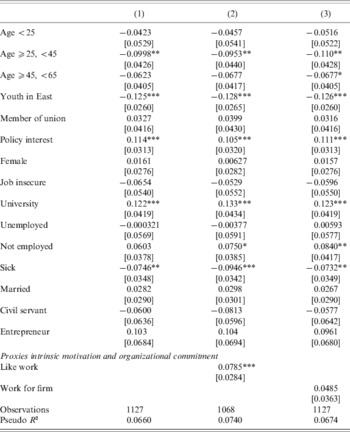
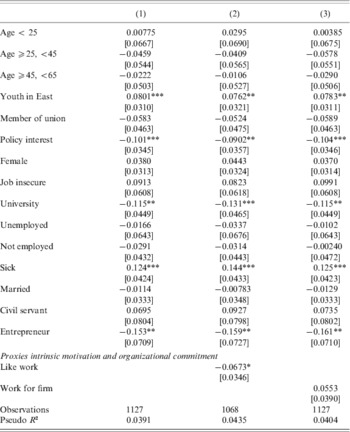
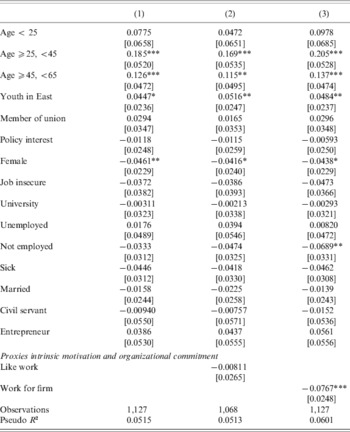
Tables 2–4 present the probit estimation results. For each of the policy options the baseline including the explained controls is estimated. We then add two specifications including the proposed intrinsic motivation indicator and its cross-check indicator on organizational commitment consecutively.
Probit estimation, dependent variable: increase of pension age preference

Marginal effects, standard errors in brackets.
*p < 0.1, **p < 0.05, ***p < 0.01.
Probit estimation, dependent variable: higher contribution preference

Marginal effects, standard errors in brackets.
*p < 0.1, **p < 0.05, ***p < 0.01.
Probit estimation, dependent variable: cutting pension preference

Marginal effects, standard errors in brackets.
*p < 0.1, **p < 0.05, ***p < 0.01.
With respect to the general controls, the included proxies confirm our expectation if they are significant: the active workers are less willing to accept higher pension ages compared to those who already receive pensions (the respondents aged 65 and above are the reference group, which is dropped in the regression). Conversely, the working age cohorts are more inclined to cut pension payments than today's pensioners. Interestingly, these effects appear to be stronger for the middle aged compared with the very young. Among the other controls, ‘youth in East’, ‘policy interest’, ‘university’, and ‘sick’ all prove to be significant in most specifications (apart from cutting pension estimations). The signs are as expected: the sick, those with youth in the East, without particular interest in politics or without university education are less ready to opt for a higher pension age, but prefer higher contributions instead. The self-employed differ significantly only with respect to the contribution preference where they reject higher contributions. Compared to men, women are more critical of cutting pensions.
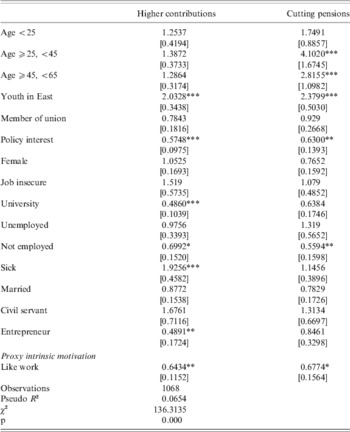
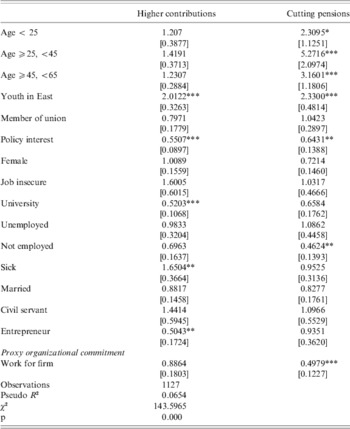
The augmentation of the baselines by our intrinsic work motivation and commitment proxies leads to significant but distinct results for the ‘like work’ and the ‘work for firm’ dummy. The impact of intrinsic motivation is as expected: respondents who would prefer work over leisure even without need for the money have a higher probability to support a higher pension age. They are also less likely to opt for higher contributions. The marginal effect allows quantifying the effect: the probability that a respondent opts for a higher pension age is 7.8% points higher if this person is intrinsically motivated. The proxy for organizational commitment ‘work for firm’, however, has a smaller impact (4.8 percentage points) on the pension age preference and fails to be significant at conventional levels. It only shows significance for the cutting pension preference where organizational commitment is associated with a stronger rejection of lower pension. These results confirm our theoretical prediction on the specific impact of intrinsic motivation (compared to concepts of company affection): indeed, it has a particularly marked impact on the pension age preference.
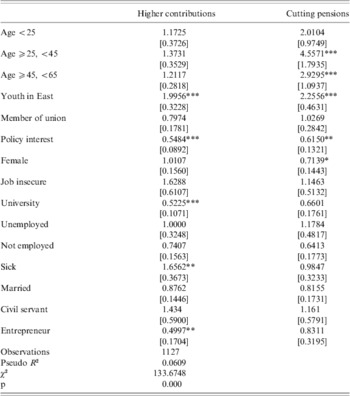
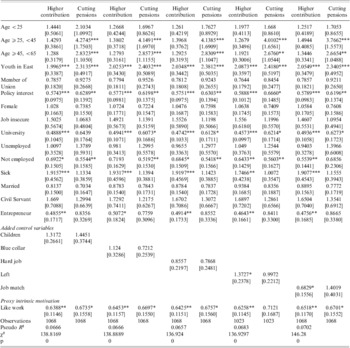
A limitation of the binary approach is that the resulting separate regressions for each of the three single reform options do not allow for the cross-equation links. This implies inefficient testing given that, by construction of the pension reform question in the ALLBUS survey, the answers are dependent. Hence, a multinomial logit is a more efficient estimation approach. This procedure allows estimating the impact of covariates on the relative probabilities of an individual choosing one of two options. Since the pension reform preference variable has three values, it implies the joint estimation of two equations. Tables 5, 6 and 8 present the results. The base outcome is the increase of pension age. The relative risk representation is chosen; i.e., the coefficients represent a covariate's impact on the relative probability that one of two reform options is preferred. The baseline is followed by specifications augmented by each of the motivation proxies consecutively.
Multinomial logit estimation – baseline

Base outcome: increase of pension age, relative risk exposition; standard errors in brackets.
*p < 0.1, **p < 0.05, ***p < 0.01.
Multinomial logit estimation – intrinsic motivation

Base outcome: increase of pension age, relative risk exposition; standard errors in brackets.
*p < 0.1, **p < 0.05, ***p < 0.01.
The results for the multinomial logit estimations show some differences to the probit results. Generally, a more critical screening is required since less control variables keep their significance. For instance, the gender variable loses its significance if the motivation dummies are included. The age effects are confirmed: active workers are much more likely to opt for lower pensions than for a higher pension age (factor 4.6 for the 25–44 age groups). An absent university education, a youth in the East and no particular interest in politics are robustly significant and foster a rejection of higher pension ages relative to the other solutions.
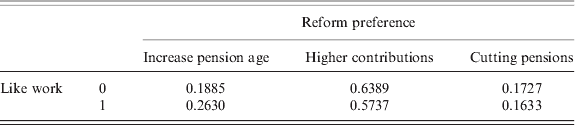
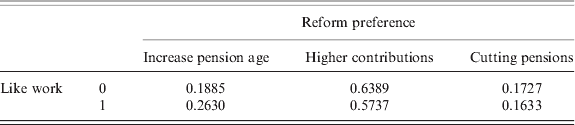
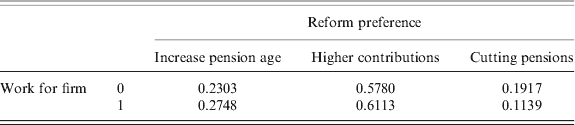
Both our indicator for intrinsic motivation and the indicator for organizational commitment survive the multinomial testing. As for the probit analysis, the ‘like work’ and the ‘work for firm’ proxies turn out to have a significant but distinct effect. The predicted probabilities in Tables 7 and 9 report the size of the effect. These predictions are calculated for average values of all other covariates and show the difference between probabilities for respondents who are and who are not intrinsically motivated. For those who would work even without the need for the money earned, the crucial difference is related to a higher probability of opting for higher pension age and a lower probability of opting for higher contributions. No marked difference exists for the cutting pension preference. For the organizational commitment motivation proxy ‘work for firm’, a particular marked difference exists for the cutting pension preference. Those who feel a large loyalty to their firm or organization are less likely to opt for lower pensions, whereas variation in organizational commitment is not associated with a large variation in the pension age preferences.
Predicted probabilities – intrinsic motivation
Multinomial logit estimation – organizational commitment

Base outcome: increase of pension age, relative risk exposition; standard errors in brackets.
*p < 0.1, **p < 0.05, ***p < 0.01.
Predicted probabilities – organizational commitment
6 Robustness
Our findings support the empirical relevance of the preceding theoretical reasoning: respondents with a high degree of intrinsic work motivation are more likely to opt for a postponement of the statutory retirement age. However, this result may equally reflect other links in the data structure. Although we already control for numerous important individual characteristics, missing variables could distort the regression. Thus, it cannot be excluded that intrinsic motivation is linked to a general individual inclination for reform. Furthermore, there is a straightforward alternative story, which could explain our key result: it could simply be the case that workers with a physically demanding job are both less intrinsically motivated, and naturally, less optimistic that they would be capable of continuing to work at a higher age (Scheubel et al., Reference Scheubel, Schunk and Winter2009). In this case, our result would reflect the impact of job characteristics related to physical stress. In the following, we check for the reliability of our results with respect to these possible objections and also provide several regression variants to check for the general robustness of our findings. In these robustness checks, we now concentrate on our intrinsic motivation proxy ‘like work’ (robustness checks for the organizational commitment proxy ‘work for firm’ did not leave to any substantial modifications of the above insights and are not reportedFootnote 17).
6.1 Physical job stress
With respect to physical job stress, some of our standard control variables already have a proxy characteristic in this regard, such as gender, the education variable (university), or the profession dummies (civil servant, entrepreneur). In addition, we experiment with the following more direct control variables: (1) A dummy ‘hard work’ which indicates that the respondent has to perform a physical straining job and (2) a dummy variable equal one if the respondent is a ‘blue collar’ worker. These additional controls should filter out intrinsic motivation as far as it is systematically linked to job characteristics. All robustness checks are performed for both the probit (not reported) and the multinomial regressions (reported). None of the included variables seem to have any significant impact on pension reform preferences in the multinomial logit regression, while the significant impact of intrinsic motivation persists in all regressions (see Table 10).
Multinominal–Logit: robustness checks, intrinsic motivation

Base outcome: increase of pension age, relative risk exposition; standard errors in brackets.
*p < 0.1, **p < 0.05, ***p < 0.01.
6.2 General reform inclination
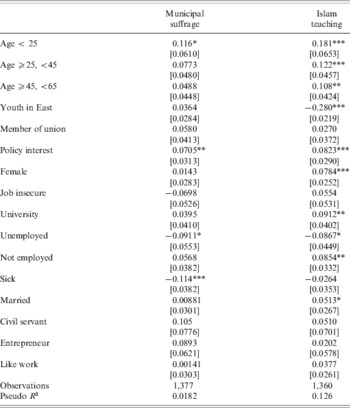
Our theoretical reasoning for the impact of intrinsic motivation is specific to reforms related to working time. If this reasoning is indeed responsible for the data structure, we would not expect a significant impact on reform issues unrelated to working times. Significant results for non-work related reform issues would be a hint that intrinsic motivation is just a proxy for some other type of important individual characteristic which is not covered by our controls. To check for this possibility, we apply a placebo regression. We estimate a similar specification as in Table 2, but now for reform issues without any obvious theoretical link to intrinsic work motivation. Two different reform options are chosen, which are completely unrelated to working conditions or working time: first, the approval to municipal suffrage for foreigners, and second, the compliance with the need for Islam-teaching at German schools. In none of the cases intrinsic motivation is among the significant determinants. This backs our confidence that our results on pension reform preferences are driven by the proposed causal chain and not just a general individual inclination to accept change.Footnote 18 The results of the regressions are presented in Table 11.
Probit estimation: placebo regression

Marginal effects, standard errors in brackets.
*p < 0.1, **p < 0.05, ***p < 0.01.
6.3 Ideology, children, and age
The debate on several reform proposals on the German public pension system was strongly affected by party and ideological considerations. To account for the possibility that an individual's choice for a certain reform option reflects his party preference or ideology, we control for the respondent's ideology by making use of a dummy variable indicating that he has classified himself as left-leaning. If, for instance, right-leaning individuals show a higher degree of intrinsic motivation and are also more in favor of longer working years, this would also explain our results. The inclusion does not change the substance of the results (these variants and the following ones are included in Table 10).
Having children might also affect a person's readiness to accept certain pension reforms as it might be less desirable to impose the burden of an unsustainable system on future generations. Thus, it is reasonable to expect that individual's with children might be, for instance, less in favor of higher contributions than those without children. We include a dummy variable whether there are children at all. Including this variable, however, does not change the results.
Age is an important determinant of preferences for different reform options of the pension system as it reflects individual self-interest. Therefore, we employ numerous specification changes with respect to the measurement of the age effect (results are not reported but available upon request). First, we change the age classification by introducing closer age groups (10-year intervals). Second, we control for a non-linear relationship by employing the respondent's age as well as its square and cube. The results remain unchanged, indicating a robust and significant age effect, i.e., younger individuals are more likely to accept pension cuts. The significant impact of intrinsic motivation on the reform preferences persists.
6.4 Job match
Finally, one might argue that our measures of intrinsic motivation may also capture other factors such as the job match quality. It is possible that individuals with a better match are more willing to continue to work simply because they are gaining rents from their present employment. Then, the significant relationship between intrinsic motivation and pension reform preferences would not indicate a causal effect but rather result from a better job match that increases both the general willingness to work and the preferences of a postponement of the statutory pension age. To address this concern, we proxy the quality of the respondent's job match by including a dummy variable equal to one if the respondent states that he can make use of his past work experience and/or job skills for his present job. The results presented in Table 10 indicate that individuals with a better job match are more likely to prefer an increase in the pension age than higher contributions. Including this variable, however, does not weaken the impact of intrinsic motivation on pension reform acceptance.
7 Conclusion
Our findings suggest that intrinsic work motivation is indeed a relevant driver of work-related reform processes – at least with respect to the formation of pension reform preferences. The empirical results confirm the predictions of our theoretical reasoning, which makes a clear case for the existence of such a link. Our intrinsic motivation proxy proves to be robustly significant in a series of econometric tests, in which we pay careful attention to an individual's physical job stress and apply numerous modifications to the included control variables. For a multitude of specifications, respondents who experience utility from their work beyond the money they earn are more willing to embark on reforms leading to a higher pension age.
This key result has implications both for the intrinsic motivation literature and our understanding of reform processes. So far, intrinsic motivation has been recognized to be important for the efficiency of firms and organizations. Our findings point beyond that insight toward the formation of policy preferences and the adaptability of modern welfare states and societies. A lack of non-monetary incentives will contribute to the blockade of reforms which require more work effort. Hence, a society for which work is perceived as a nuisance will have much larger problems to adjust to the necessities of demographic change compared to a society with high work ethics.
Although these insights can be helpful for a broader understanding of reform resistance in certain contexts, it is more difficult to derive conclusions of immediate policy relevance. A first difficulty is that a population's degree of intrinsic motivation is hardly verifiable. So it will not be possible to prescribe reform strategies for a country dependent on its population's level of intrinsic motivation. Furthermore, it is unclear to which extent policy really is able to influence this human trait, whether it is an exogenous feature or reactive to policy measures. There are some hints in the intrinsic motivation literature that this type of motivation is not purely exogenous. For example, it is known that extrinsic incentives can crowd out intrinsic motives so that a lot may depend on adequate payment systems (Ockenfels et al., Reference Ockenfels, Sliwka and Werner2010). However, these approaches are hardly under the government's direct control. Nevertheless, a modest conclusion from our results would be that reform strategists should be sensible for the possibility that a lack of intrinsic work motivation can be a relevant reform constraint.
Appendix
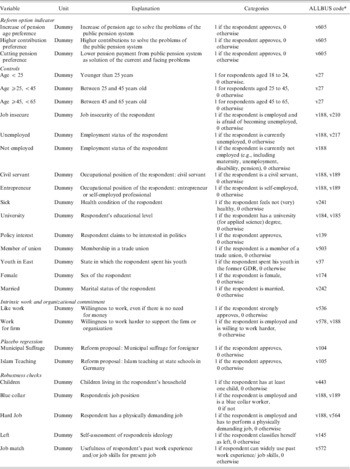
Variable definitions