Introduction
The reduction of intensification is a strategy for the implementation of sustainable agricultural systems. In orchards and vineyards, characterized by an intense use of pesticides, the reduction of sprays as well as the adoption of selective products and techniques like mating disruption, are the first steps to increase the ecological sustainability of Integrated Pest Management (IPM) system (Ioriatti et al., Reference Ioriatti, Bagnoli, Lucchi and Veronelli2004, Reference Ioriatti, Lucchi, Bagnoli, Koul, Cuperus and Elliot2008; Simon et al., Reference Simon, Bouvier, Debras and Sauphanor2010). Organic farming represents a further opportunity to reduce disturbance intensity. Habitat management can reduce or prevent pest density, by enhancing functional biodiversity and associated ecosystem services (Landis et al., Reference Landis, Wratten and Gurr2000; Gurr et al., Reference Gurr, Wratten and Altieri2004; Altieri et al., Reference Altieri, Nicholls, Wilson and Miles2010). These techniques, included also in ecological engineering, can be applied both in an IPM context and in organic farming. A number of different agro-ecological manipulations have been tested in vineyards from a large range of countries: most of them are largely focused on the management of plant diversity, including the use of cover crops, grass cover, ecological infrastructures, flowering plants, island habitats and hedgerows (Duso et al., Reference Duso, Torresan and Vettorazzo1993, Reference Duso, Fontana and Malagnini2004, Reference Duso, Pozzebon, Kreiter, Tixier, Candolfi, Bostanian, Vincent and Isaacs2012; Delucchi, Reference Delucchi, Prota and Pantaleoni1997; Viggiani, Reference Viggiani2003; Altieri et al., Reference Altieri, Nicholls, Ponti and York2005, Reference Altieri, Nicholls, Wilson and Miles2010; Gurr et al., Reference Gurr, Scarratt, Jacometti, Wratten, Vincent, Goettel and Lazarovits2007). The groundcover manipulation in vineyard is a factor that greatly influences ecosystem services (Altieri et al., Reference Altieri, Nicholls, Wilson and Miles2010). It is demonstrated that the proper management of a number of plants associated with vineyard may have a positive effect on the diversity and activity of beneficial arthropods. For example, in the mites-phytoseiids system, this effect is mediated by pollen availability on the vegetation (Duso et al., Reference Duso, Fontana and Malagnini2004, Reference Duso, Pozzebon, Kreiter, Tixier, Candolfi, Bostanian, Vincent and Isaacs2012). Surface mulches in vineyard can significantly affect the abundance of parasitoid Hymenoptera, spider and ground beetles; moreover, some canopy predators can increase after mulching (Thomson & Hoffman, Reference Thomson and Hoffmann2007). Concerning the complexity of trophic web, the average number of insect–flower interactions was higher in organic vineyards in comparison with conventional vineyards and natural site (Kehinde & Samways, Reference Kehinde and Samways2014). Besides these effects at habitat level, also woody vegetation at landscape scale can affect natural enemies, including several families of parasitoids (Thompson & Hoffman, Reference Thomson and Hoffmann2009; Thomson et al., Reference Thomson, McKenzie, Sharley, Nash, Tsitsilas and Hoffmann2010). The vineyard scenario is made complex by the phloem-feeding species that are involved in the transmission of plant pathogens, including the stolbur phytoplasma and flavescence dorèe (Alma, Reference Alma2004; Bosco et al., Reference Bosco, Marzachì and Alma2005; Weintraub & Beanland, Reference Weintraub and Beanland2006; Riolo et al., Reference Riolo, Landi, Nardi and Isidoro2007; Minuz et al., Reference Minuz, Isidoro, Casavecchia, Burgio and Riolo2013). In vineyard agro-ecosystems, the groundcover and surrounding vegetation can provide patches of suitable host plants for different leafhopper and planthopper vectors of plant pathogens, including Hyalesthes obsoletus Signoret (Cixiidae), which are not strictly linked to Vitis vinifera L., but mainly feed and live on wild herbaceous plants (Minuz et al., Reference Minuz, Isidoro, Casavecchia, Burgio and Riolo2013). For these reasons, habitat interventions need a careful evaluation that takes into account both the positive and the potential detrimental effects, resulting in a farm design which avoids or minimizes negative impacts. Indeed, pest species may also benefit from food sources and for this reason it is crucial to promote food plants, which selectively fulfil the needs of beneficial fauna without promoting pest species (Winkler et al., Reference Winkler, Wäckers, Valdivia, Larraz and van Lenteren2003). Plant selectivity may depend on plant characteristics and agronomy, including floral architecture, pollen/nectar quality, quantity and nectar flow (Winkler et al., Reference Winkler, Wäckers, Valdivia, Larraz and van Lenteren2003; Wratten et al., Reference Wratten, Lavandero, Scarratt and Vattala2003; Wäckers et al., Reference Wäckers, van Rijn and Bruin2005).
Habitat management in vineyard has mainly taken into account specific trophic systems, while interdisciplinary assessment of arthropod fauna has been scarcely considered. A full evaluation of ecological measures should be based on a holistic assessment of the complex guilds of vineyard. In particular, a distinction from shotgun vs. directed approaches has been evoked in using plant food, like flowering strips, in conservation biological control, including the concept of selective plant food (Wäckerset al., Reference Wäckers, van Rijn and Bruin2005), in order to combine ecological theory and practice under the assumption that ‘appropriate diversity helps’ (Gurr et al., Reference Gurr, Wratten, Tylianakis, Kean, Keller, Wäckers, Van Rijn and Bruin2005; Wäckers et al., Reference Wäckers, van Rijn and Bruin2005). A complete evaluation of the utility of flowering plants in a crop, including other ecological compensation areas, requires a deep investigation of the functional biodiversity but also an analysis of the potential detrimental effects.
A wide range of beneficial plants has been proposed as cover crops in different agro-ecosystems, vineyards included (e.g., Gurr et al., Reference Gurr, Wratten and Altieri2004; Altieri et al., Reference Altieri, Nicholls, Wilson and Miles2010; Lu et al., Reference Lu, Zhu, Gurr, Zheng, Read, Heong, Yang and Xu2014). The presence of flowering plants can enhance several ecological services: the provision of food source (as pollen or floral and extrafloral nectar) can be considered the main positive effect (Wäckers et al., Reference Wäckers, Romeis and van Rijn2007; Lundgren, Reference Lundgren2009; Lu et al., Reference Lu, Zhu, Gurr, Zheng, Read, Heong, Yang and Xu2014). The improvement of refuges and overwintering sites, the presence of alternative prey/hosts or the enhancement of corridors for beneficial insects movement can be considered as additional advantages (Altieri et al., Reference Altieri, Nicholls, Wilson and Miles2010). Positive and negative effects of specific flowering plants can be different; for example the nutritional value of pollen and nectar is largely effected by plant species (Lu et al., Reference Lu, Zhu, Gurr, Zheng, Read, Heong, Yang and Xu2014). In addition, the efficiency of the agro-ecological strategies is strongly influenced by geographic, climatic and economic factors (Delucchi, Reference Delucchi, Prota and Pantaleoni1997): each intervention cannot be merely exported from one context to another, but has to be contextualized in a particular region or area. For this reason the choice of optimal plants to be used as cover crops in vineyard should be considered a key decision, which requires adequate research on local scale.
The aim of the present research was to evaluate the potential positive and negative effects of different cover crops in a Northern Italy vineyard. The present field trial belongs to a regional project (funded by Emilia-Romagna region and CRPV) aimed at the application of sustainable agronomic techniques in organic vineyard. In particular, a part of this project was focused on the effect of ground management on the functional biodiversity associated with the control of the main arthropod pests infesting organic vineyard. The specific aim was to evaluate the aerial arthropod fauna of the vegetation, associated with different ground covers in the same vineyard. Another part of the same project was focused on the soil arthropod diversity, but the result of this monitoring will be shown in another paper. A survey of the hoverfly assemblage (Diptera Syrphidae) of the present organic farm, in comparison with that of an IPM vineyard has been carried out (Sommaggio & Burgio, Reference Sommaggio and Burgio2014). The cover plants were selected on the basis of the functional features, including the potential to increase ecosystem services (Gliessmann, Reference Gliessman1998; Wäckers et al., Reference Wäckers, van Rijn and Bruin2005; Altieri et al., Reference Altieri, Nicholls, Wilson and Miles2010). The arthropod fauna was studied using different sampling techniques in order to provide a broad framework of the main groups. Finally, an evaluation of the utility of each cover crop treatment was carried out, in order to suggest the best plant combination to be used in the ground management of vineyards in the area of investigation.
Materials and methods
Study site
The organic vineyard of the experiment was located in San Prospero, Modena province (Northern Italy) and planted in 1991; the varieties were Salamino and Sorbara, which are typical cultivars of the area. The wine training system was GDC (Geneva Double Curtain); SO4 was used as rootstock. The planting system was 4.40 × 2.20 m2. The soil was characterized by a medium dough-clayey structure, which is typical of the area investigated.
Climatic conditions
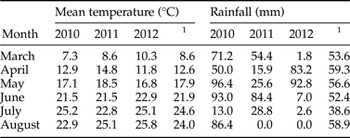
A summary of the mean temperatures and rainfall registered by ARPA (Agenzia Regionale Prevenzione Ambiente) Emilia-Romagna in the three sampling seasons at Albareto station (Modena) are reported in table 1.
Mean monthly temperature and mean rainfall from March to August (2010–2013).

1 Mean value of the period between 1969 and 2009.
Experimental planning
The experiment included the following six treatments: (1) Sweet Alyssum (Lobularia maritima (L.) Desv.); (2) Phacelia (Phacelia tanacetifolia Benth.); (3) Buckwheat (Fagopyrum esculentum Moench.); (4) Faba Bean (Vicia faba L.); (5) Vetch (Vicia villosa Roth) and Oat (Avena sativa L.), and (6) Control. The latter was characterized by the ordinary management of inter-row and in particular included minimum tillage in autumn and mowing in June. Control plot vegetation was characterized by the presence of Festuca, Poa and Lolium plants. Each treatment was sown in an area of 1600 square meters (m2), which was nested in four plots of 400 m2, generating a total of 24 plots. This design was replicated for 3 consecutive years (2009, 2010 and 2011). The experiment was planned using a ‘split-plot in time’, or ‘split-block design’ (Steele et al., Reference Steele, Torrie and Dickey1997). By this design, the experimental apparatus included the factors: ‘treatments’ (six levels), ‘plots’ (nested into treatments) and ‘years’ (three levels).
Arthropod sampling
The arthropods were sampled in each plot, which was considered the sampling unit of the experiment, using three different techniques: manual collection of grapevine leaves, sweeping net, and vacuum sampling. Entomological net and vacuum sampling were carried out on the cover crop stands, including the control. All the samplings were carried out on sunny days, in low wind condition, and in the morning between 10.00 am and 2.00 pm. Details of the sampling techniques are reported below.
Collection of leaves
Leaves were collected with the purpose of estimating phytoseiids (Acarina Phytoseiidae) density and the relative abundance of the species belonging to this taxon. Ten leaves were randomly collected in each plot, for a total of 40 leaves per treatment. The leaves were collected from grapevines in the middle of each plot; the inter-row at the margins of each plot was excluded. The leaves were collected from the middle of the shoots, usually from the third to the eighth leaf and were immediately analyzed in the laboratory under stereo-microscope to assess the density of different mite species. Eggs, young stages and adult stage were counted and referred to each leaf. The identification of the adults was carried out on sub-samples (50%) of the material collected. The phytoseiids were mounted on slides, in Hoyer's medium and identified under a phase contrast microscope. Field samplings were carried out every 2–3 weeks, from the beginning of June to the end of August, for a total of 7–8 samplings per year.
Sweeping net sampling
A sweeping net sampling was used in each plot, by means of 20 shots, which collected the insect attending flowers and vegetation of each sampling unit. An entomological net was chosen, instead of a classic sweeping net, in order to avoid damage to the vegetation. The entomological net was applied using the classic ‘sweeping’ technique, resulting in low impact insect collection. Sweeping collections were carried out only in the central part of each plot, in the middle of inter-row, excluding 3 m at margins of each plot. Insects collected were put into plastic bags and moved to laboratory for identification. Samplings in adjacent plots were performed with a time interval of at least 4 min. Sweeping net was carried out every 3 weeks, during the flowering period of the cover crops. A total of three/four samplings per year were performed from mid May to mid July.
Vacuum sampling
The vacuuming was carried out in each plot, using a hand-held vacuum suction device (Stihl BG75 leaf blower). The sampling included a total of 20 one-second suctions per plot, on the cover crops of the inter-rows. The suction was carried out in the central part of plot, but on cover plants not sampled with sweeping net. The insects were collected in a fine net applied on the top of the vacuum, put in plastic bags and moved to the laboratory for identification. Samplings in adjacent plots were performed with a time interval of at least 4 min. Vacuum sampling was carried out every 3 weeks, during the flowering period of the cover crops, from mid May to mid July. A total of three samplings per year were performed.
Data analysis
A nested design ANOVA was performed for each insect taxon sampled in the experiment, using a type III sum of square. For data analysis, the mean number of the arthropods collected from each plot in the different sampling dates was used. If ‘treatment’ factor revealed significant effects by nested ANOVA, Dunnett test (P < 0.05) was used to assess statistical differences in insect density among flowering plants against control. Concerning phytoseiid data, the yearly peak of density was statistically analyzed. Data were square root or log transformed if homoscedasticity, evaluated by Cochran and Levene tests, was violated.
The analysis of the frequency distribution of the phytoseiids mites found in the different cover crops was carried out by Chi-square analysis in a 2 × 6 contingency table (Zar, Reference Zar1984).
All statistical analyses were conducted using Statistica version 10 software (StatSoft™).
Results
Faunistic analysis
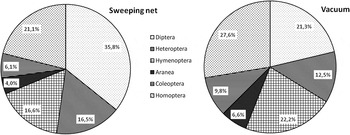
Monthly temperatures were strongly variable across the three seasons and in some cases they deviated from the mean values registered in the last 40 years (table 1). In 3 years, a total of 12,562 and 8.669 arthropods were collected using sweeping net and vacuum sampling, respectively. Sweeping net mostly collected taxa characterized by mobile stages (fig. 1). In sweeping net samples, Diptera represented 35.8% of the collected individuals, while their percentage was lower (21.3%) in vacuum samples (fig. 1). The main Diptera taxa collected by sweeping net were: Agromyzidae (54.8%), Chloropidae (12.1%), Dolichopodidae (7.9%), aphidophagous Syrphidae (7.3%) and Nematocera (3.8%). In vacuum samples, the more common Diptera taxa were: Agromyzidae (37.9%), Nematocera (27.5%), Chloropidae (9.2%), aphidophagous Syrphidae (3.1%) and Dolichopodidae (2.8%). Data analysis was performed only for Agromyzidae, as the most frequent taxon, and aphidophagous Syrphidae due to their importance in agroecosystems.
Relative abundances (%) of the arthropod orders collected by sweeping net and vacuum.

All Hymenoptera collected belong to Apocrita; parasitoids represented 72.3% of the specimens collected by sweeping net and 92.7% by vacuum sampling. Braconidae was the most common taxon representing 31.8% of the Hymenoptera collected by sweeping net, and 45.7% by vacuum. Within Braconidae, two subfamilies were well represented: Aphidiinae (accounting for 20.3% of Hymenoptera in sweeping net and 28.2% in vacuum sampling) and Alysiinae (5.4 and 10.8%, respectively). Aphidiinae subfamily includes parasitoids of aphids, while Alysiinae attack mainly Diptera. For this reason, these two subfamilies have been considered separately for further data analysis. Other Hymenoptera parasitoids which were sampled were: Chalcidoidea, which accounted for the 31.1% of Hymenoptera collected by sweeping net and 27.8% by vacuum sampling; and Ichneumonidae, which accounted respectively for 5.2 and 2.8%. Besides parasitic Hymenoptera, the other Hymenoptera belonged to Apoidea (accounting 27.7% of Hymenoptera collected by sweeping net and 7.1% by vacuum sampling). Most of the collected Apoidea belong to the Halictidae family; Lasioglossum glabriusculus (Morawitz) was the dominant species (66.0% of the Apoidea collected), followed by Lasioglossum malachurum (Kirby) (11.5%); about 7% of collected specimens belong to Apis mellifera Linnaeus.
All sampled Homoptera (representing 21.1% of the arthropod collected by sweeping net and 27.6% by vacuum sampling) are sap feeders and for this reason they were analyzed as a single taxon. Most of the Homoptera belong to two families: Cicadellidae (which represented 54.3% of Homoptera collected by sweeping net, and 61.6% collected by vacuum sampling) and Delphacidae (44.9 and 33.3%, respectively). Very few specimens of H. obsoletus (less than 2% of the Homoptera collected) were found in the present research, while no specimens of Scaphoideus titanus Ball were collected by the field samples.
Heteroptera included several families with different trophic habitus. The most common taxa found in the present research were: Miridae (which represented 75.7% of Heteroptera collected by sweeping net and 67.5% by vacuum sampling); Nabidae (11.4 and 14.8%, respectively) and Lygaeidae (9.1 and 12.8%, respectively). All collected Miridae were phytophagous and more than 80% belong to Lygus genus. No predator genera in the Miridae family have been collected in the present research.
Coleoptera accounted for 6.1% of the arthropod collected by sweeping net and 9.8% by vacuum sampling. The families collected were: Curculionidae, Coccinellidae and Chrysomelidae (Halticinae). Coccinellidae represented 30.9% of the Coleoptera collected by sweeping net and 19.5% by vacuum sampling and they were considered for further data analysis, due to their importance in agroecosystems as natural enemies of many pests.
Because of their importance in agroecosystems, Araneae data are presented, although the sampling techniques used in this research are not specific for this group. Araneae specimens belong mainly to Thomisidae and Therididae families but they were analyzed as a single taxon.
Concerning predator mites, Phytoseiidae was the only family of Acarina that was found on the vineyard leaf samples. Typhlodromus pyri Scheuten was the dominant species, reaching 85.7% of the total collected Phytoseiidae. Kampimodromus aberrans (Oudemans) was the second species for abundance (13.65%), followed by Paraseiulus soleiger (Ribaga) (0.32%) and Euseius finlandicus (Oudemans) (0.32%), whose relative abundance was very scarce. P. soleiger and E. finlandicus were not considered in the analysis due to their very low abundances (<1%).
Functional analysis of the effect of the flowering plants on insect taxa
Sweeping net and vacuum samplings
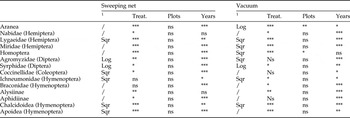
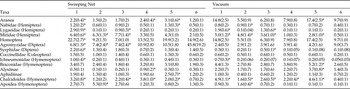
In table 3, the list of the taxa collected by sweeping net and vacuum sampling is provided, including the mean number of specimens collected of each group. Each ground cover treatment was characterized by different insect assemblages. Table 2 summarizes the results of the nested design analysis. Significant differences between years were found for almost all the taxa sampled with both methods, except for Nabidae and Alysiinae collected by sweeping net and for Homoptera by vacuum sampling (table 2). The plot variable did not show significant differences (P > 0.05), with the only exception of Homoptera collected by vacuum sampling.
Results of the nested design ANOVA (see materials and methods for details).

n.s.: P > 0.05; *: P < 0.05;**: P < 0.01; ***: P < 0.001.
1 Transformation used for ANOVA: Sqr, square root transformation; Log, logarithmic transformation.
Taxa collected by sweeping net and vacuum, in the different treatments.

Means of specimens collected and relate SE (between the brackets) are reported. Asterisks indicate significant differences vs. control, by Dunnett test (P < 0.05). Treatments: 1: Alyssum; 2: Phacelia; 3: Buckwheat; 4: FabaBean; 5: mix of Vetch and Oat; 6: control.
Regarding predators, aphidophagous Syrphidae were significantly attracted by Sweet Alyssum (sweeping-net) and Buckwheat (vacuum sampling). Coccinellidae populations collected by sweeping net did not reveal significant differences in comparison with control (table 3). Araneae collected by sweeping-net were more abundant on Faba Bean and ‘Vetch and Oat’ mix; vacuum sampling revealed higher populations on ‘Vetch and Oat’ mix in comparison with control. Many parasitoid taxa significantly responded to ground cover plants. In particular, Alyssum showed a significant attraction for Ichneumonidae in both sampling methods, while ‘Vetch and Oat’ mixture significantly attracted Braconidae and Alysiinae. Also, ‘Vetch and Oat’ showed higher populations of Aphidiinae collected by sweeping-net. Braconidae and Chalcidoidea populations collected by sweeping net, and Aphidiinae sampled by vacuum, did not show any difference in comparison with control (tables 1 and 2).
Phacelia treatment showed higher Apoidea populations in comparison with control (tables 1 and 2), confirming the well-known attraction of this plant for bees.
Some herbivore taxa were attracted by flowering plants. In particular, Alyssum and Buckwheat revealed higher populations of Lygeidae in both sampling methods (tables 1 and 2). Also Myridae were attracted by a number of flowering plants, including Alyssum, Phacelia, Buckwheat and ‘Vetch and Oat’ mixture. Homoptera populations did not show higher populations on flowering plots in comparison with control, with the exception of Alyssum, which revealed an attraction towards this insect taxon, although only in the case of sweeping-net sampling. Agromyzidae were more numerous in control than ground cover plant management, even if significant differences were detected against Alyssum, Phacelia and Buckwheat, by sweeping net sampling.
Collection of leaves
An analysis of the Phytoseiidae species distribution on the different treatments, obtained by pooling the individuals sampled in the plots of each treatment, revealed an interaction between species occurrence and cover crops (Chi-square test = 16.6, df = 5, P < 0.01). T. pyri was less abundant on ‘Vetch and Oat’ and control, in comparison with the other treatments. On the other hand, K. aberrans showed a lower relative abundance on Faba Bean in comparison with the other treatments.
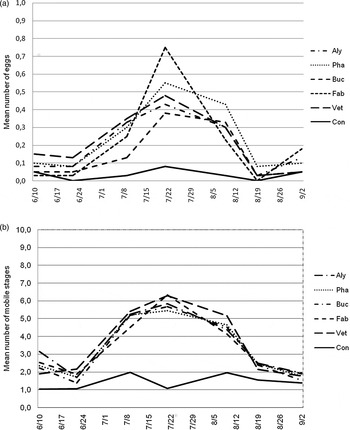
The statistical analysis of the phytoseiid eggs and mobile stages was carried out on the peaks of density and revealed significant differences among the treatments (P < 0.01). In particular, the density of eggs and mobile stages on vineyard foliage belonging to each ground cover plant treatment was significantly higher in comparison with control (tables 4 and 5). Phytoseiids populations showed maximum density in 2012 (5.1 ± 0.42 mobile stages per leaf) and a minimum in 2011 (3.55 ± 0.26 per leaf), revealing a significant difference among the years (table 4). The trends of the average egg and mobile stages populations in 2010 season are shown in fig. 2; the population peaks were detected on 9 July. Similar trends were found in the other years, with the exception of the occurrence of the population peaks, which were observed on May 19 2011 and May 10 2012.
Trend of the mean number of eggs (a) and mobile stages (b) of Phytoseiidae in 2010 season. The data are cumulative of all species (Typhlodromus pyri; Kampimodromus aberrans; Paraseiulus soleiger; Euseius finlandicus). Legend: Aly: Alyssum; Pha: Phacelia; Buc: Buckwheat; Fab: FabaBean; Vet: mix of Vetch and Oat; Con: control.

Results of the nested design ANOVA on Phytoseiidae.

Statistical analysis was performed on the peak of population density. Data were square root transformed. n.s.: P > 0.05; **: P < 0.01; ***: P < 0.001.
Mean peak density of Phytoseiidae egg and mobile stages (SE), in the different treatments.

Asterisks indicate significant differences vs. control, by Dunnett test (P < 0.05). Treatments: 1: Alyssum; 2: Phacelia; 3: Buckwheat; 4: FabaBean; 5: mix of Vetch and Oat; 6: control.
Discussion and conclusions
Our results demonstrate a low spatial variability of the arthropods among the plots, and a high variability of the populations among the years. Concerning the spatial variation, only Homoptera sampled by vacuum showed a significant difference among plots. This experiment confirms that arthropod plan sampling for agroecological studies requires a pluriannual approach, and a three season replication seems to be the minimum design for our geographic context. Indeed, strong fluctuations of the arthropod populations could produce biased interpretation of the results obtained in 1-year trials. The relatively low spatial variability of our sampling revealed that the area size and the sampling plan of the experiment seem to be sufficiently robust and reliable.
Ground cover management significantly affected insect fauna, including beneficial groups, which can provide ecosystem services in vineyard. Many beneficial groups were attracted by cover crops of the vineyard in comparison with control, showing an aggregative numerical response in the plots cultivated with flowering plants. Chalcidoidea were significantly attracted by all the ground cover plants, with the exception of Phacelia, and this attractiveness was confirmed by both sampling methods. Chalcidoidea comprises Mymaridae, whose species are egg parasitoids of many pests, including the leafhopper Empoasca vitis Goethe. Another important family within Chalcidoidea is represented by Encyrtidae, which includes Anagyrus spp., a parasitoid of Pseudococcidae (Homoptera) and in particular the mealybug Planococcus ficus (Signoret), a key pest of Italian vineyard. Anagyrus pseudococci (Girault) was released in Central Italy vineyards, proving to be a promising candidate for mealybug control (Varner et al., Reference Varner, Mattedi and Lucchi2015). Further studies could investigate the role of flowering plants in supporting mealybug parasitoids. Berndt et al. (Reference Berndt, Wratten and Scarratt2006) found that the presence of Buckwheat in vineyards increased the parasitism rate of several moths in New Zealand. It was also demonstrated that the use of Alyssum in Australian vineyards improved the egg parasitism rate of moth species (Begum et al., Reference Begum, Gurr, Wratten, Hedberg and Nicol2006). Also, surface mulches in Australian vineyards increased abundance of parasitoid Hymenoptera (Thomson & Hoffman, Reference Thomson and Hoffmann2007).
In our trial, Aphidiinae sub-family (Braconidae) was significantly attracted by ‘Vetch and Oat’. Aphidiinae taxon includes economically important aphid parasitoid species; although their role in vineyards pest control is marginal, they are considered important biological control agents in other crops (Starý, Reference Starý, Minks and Harrewijn1988; Völkl et al., Reference Völkl, Mackauer, Pell, Brodeur, van Emden and Harrington2007; Boivin et al., Reference Boivin, Hance and Brodeur2012). Laboratory trials demonstrated that Buckwheat, Phacelia, Alyssum and Coriander enhanced the fitness of the braconid Aphidius ervy Haliday (Araj et al., Reference Araj, Wratten, Lister and Buckley2006). Aside from food, flowering plants can provide alternative hosts for natural enemies (Barbosa, Reference Barbosa1998): ‘Vetch and Oat’ usually harbored a rich aphid fauna, which can support Aphidiinae populations. In our experiment, also Alysiinae showed higher populations in Faba Bean and ‘Vetch and Oat’ plots; it is remarkable that these leguminous plants are characterized by extra-floral nectars, which can increase the availability of nectar provision (Wäckers et al., Reference Wäckers, van Rijn and Bruin2005). Besides their important role as biological control agents, Braconidae sub-families have been employed as environmental bio-indicators in vineyards, showing potential in assessing the impact of vineyard management (Loni & Lucchi, Reference Loni and Lucchi2014).
In the present research, some flowering plants were attractive for predators. For example, Alyssum and Buckwheat attracted syrphids, while Faba Bean and ‘Vetch and Oat’ revealed an increase in spiders attending flowering plant canopy. Also Nabidae showed higher population in Alyssum, ‘Vetch and Oat’ and Phacelia plots. Nabidae species take part in the natural control of some pests of vineyard, but their role has been poorly investigated. Field studies demonstrated that many flowering plants increased syrphid abundance in crops like cereals or cabbage (Lovei et al., Reference Lovei, McDougall, Bramley, Hodgson and Wratten1992; Cowgill et al., Reference Cowgill, Wratten and Sotherton1993; White et al., Reference White, Wratten, Berry and Weigmann1995; Hickman & Wratten, Reference Hickman and Wratten1996; Carreck & Williams, Reference Carreck and Williams1997; Hogg et al., Reference Hogg, Bugg and Daane2011). Several studies showed the positive effect of flowering plants also on Coccinellidae (Nalepa et al., Reference Nalepa, Bambara and Burroughs1992; Pemberton & Vandenberg, Reference Pemberton and Vandenberg1993; Cottrell & Yeargan, Reference Cottrell and Yeargan1998; Freeman Long et al., Reference Freeman Long, Corbett, Lamb, Reberg-Horton, Chandler and Stimmann1998), while in our research the tested ground covers did not show any effect on these beetles.
Syrphids are not considered key biological control agents in vineyards; only the species Xanthandrus comtus (Harris) has been recorded in Italy as predator of Lobesia botrana (Denn. & Schiff.) (Belcari & Raspi, Reference Belcari and Raspi1989; Marchesini & DallaMontà, Reference Marchesini and Dalla Montà1994). Besides the potential role in biological control, syrphids proved to be effective functional bioindicators to compare vineyards with different managements (Sommaggio & Burgio, Reference Sommaggio and Burgio2014). Other studies demonstrate that ground cover in vineyard can affect predator abundance, including Hemiptera and Diptera (Thomson & Hoffmann, Reference Thomson and Hoffmann2007). Araneae (spiders) have been poorly investigated in experiments assessing the effects of flowering plants on functional biodiversity; pollen and nectar seem to have little importance for this taxon (e.g., Rebeck et al., Reference Rebek, Sadof and Hanks2005; Lu et al., Reference Lu, Zhu, Gurr, Zheng, Read, Heong, Yang and Xu2014) and the reasons for their increase in Faba Bean and ‘Vetch and Oat’ plots of our experiment are unknown. A realistic hypothesis could involve cascading effects determined by a greater number of preys attracted by this mix of cover crops. In Australian vineyard, surface mulches increased soil macro invertebrates abundance, including spiders (Thomson & Hoffmann, Reference Thomson and Hoffmann2007). Another study on Araneae fauna in vineyard focused on the influence of landscape and agriculture practices on species assemblages (e.g., Isaia et al., Reference Isaia, Bona and Badino2006); further studies should better investigate their role in conservation biological control of pests in vineyard.
An important result evinced in this research is that most of the cover crops tested did not increase Homoptera populations in comparison with control. Only Alyssum revealed relatively higher population of Homoptera in comparison with control, but must be pointed out that the species S. titanus was not sampled during our experiment. In addition, the plants tested in our experiment did not show any increase of H. obsoletus and for this reason selective grass cover using a mixture of these flowering plants could represent a habitat strategy characterized by the lack of negative effect.
Phytoseiidae mites showed a significant increase in all the vineyard plots with ground cover plants, in comparison with control. Our research is in line with other studies demonstrating the functional effect of vegetation surrounding the vineyard on these beneficial, which play a crucial role in spider mites control (Duso et al., Reference Duso, Fontana and Malagnini2004, Reference Duso, Pozzebon, Kreiter, Tixier, Candolfi, Bostanian, Vincent and Isaacs2012). The most abundant Phytoseiidae species in our investigation was T. pyri, followed by K. aberrans, two common taxa in Northern Italy vineyards (Marchesini, Reference Marchesini1989; Marchesini & Ivancich Gambaro, Reference Marchesini and Ivancich Gambaro1989). The increase of Phytoseiidae populations could be determined by pollen and nectar provided by the ground cover plants tested in this experiment; the cover management of selected plant species seems to be a proper method to maintain and promote conservation biological control of spider mites.
In conclusion, in our experiment Buckwheat, Sweet Alyssum, Faba Bean and ‘Vetch and Oat’ boosted the populations of many functional groups. Sweet Alyssum is not easily available on Italian market and is rather expensive; these features seem to make this flowering plant unsuitable for the ground cover management of Northern Italy vineyard. Buckwheat, Faba Bean and ‘Vetch and Oat’ could be used in mixture to ensure continuity in nectar and pollen provision; the presence of extra-floral nectars of the two tested legumes is considered a positive trait to implement ecosystem services in many crops (Wäckers et al., Reference Wäckers, van Rijn and Bruin2005), including vineyard.
The demonstration of the attractiveness of these plants for beneficial insects is one step in the ground cover management of the vineyard (Gurr & Wratten, Reference Gurr and Wratten2000). Laboratory studies have demonstrated the gain in the fitness of parasitoid species due to the nectar provided by most of these flowering plants (Wratten et al., Reference Wratten, Lavandero, Scarratt and Vattala2003; Wäckers et al., Reference Wäckers, van Rijn and Bruin2005; Araj et al., Reference Araj, Wratten, Lister and Buckley2006; Sigsgaard et al., Reference Sigsgaard, Betzer, Naulin, Eilenberg, Enkegaard and Kristensen2013). Besides these positive effects on parasitoid fitness, other studies demonstrated that flowering plants can display an attraction for parasitoid species (Belz et al., Reference Belz, Kölliker and Balmer2013). The attractiveness of Phacelia on bees (Apoidea) could be exploited to compensate the scarce pollination efficiency of some Italian varieties (i.e., Piccolit and Sorbara), but specific studies should be designed. Phacelia was introduced as trap crop in table vineyards of Southern Italy, where it contributed to the reduction of the damage caused by Frankliniella occidentalis (Pergande) (Moleas, Reference Moleas2003), a key-pest in Mediterranean areas. In addition, the lack of undesirable effects on pest fauna of the vineyard, as recorded in the present research, seems to suggest the utility of the mentioned cover crops in the vineyards.
The final step to evaluate the positive effects of a cover crop management in the vineyard should be focused on the quantification of the practical benefits of this management on pest dynamics and regulation, and the increase of the farmers’ profits (Wratten et al., Reference Wratten, Lavandero, Scarratt and Vattala2003). The lack of potential negative effects of the plants tested in this experiment, combined with an aggregative numerical response for many beneficials, seems to show a potential for their use in Northern Italy vineyards.
Acknowledgements
This research was founded by Emilia-Romagna Region and CRPV, within the ‘Organic Vineyard’ project. We would like to thank Steve Wratten (Lincoln University, New Zealand) for the critical comments on our manuscript. A special thanks to Enrico Tonucci and Cristina Viscardi who greatly supported the field samplings, and to the owner of ‘Acetaia del Cristo’ (Modena) vineyard.