Introduction
In recent decades, advancements in managing patients with tetralogy of Fallot have led to excellent primary outcomes.Reference Miller, Stephens and Goldstone1,Reference Karamlou, Silber and Lao2 However, approximately 35% of repaired tetralogy of Fallot patients develop clinically significant pulmonary valve regurgitation by 30 years of age,Reference Wu, Wang and Chiu3 resulting in an emerging adult CHD population requiring optimal care.Reference Miller, Stephens and Goldstone1,Reference Karamlou, Silber and Lao2 Concurrently, evolving transcatheter technologies have expanded the armamentarium of strategies in contemporary practice. Compared to traditional surgical pulmonary valve replacement, transcatheter pulmonary valve replacement has been associated with shorter hospital stays,Reference Ribeiro, Teixeira, Lopes, Costa, Pires and Gonçalves4–Reference O’Byrne, Gillespie, Shinohara, Dori, Rome and Glatz6 comparable perioperative costs,Reference Daily, Tang, Angtuaco, Bolin, Lang and Collins5–Reference Steinberg, Jones, Verrier, Stout, Krieger and Karamlou7 and reintervention rates,Reference Ribeiro, Teixeira, Lopes, Costa, Pires and Gonçalves4,Reference McElhinney, Zhang and Levi8,Reference Caughron, Kim and Kamioka9 yet higher incidences of endocarditis.Reference Ribeiro, Teixeira, Lopes, Costa, Pires and Gonçalves4,Reference Cekirdekci, Bugan, Onar and Cekirdekci10,Reference Haas, Bach and Vcasna11
Recent studies have used clinicalReference Andresen, Døhlen, Diep, Lindberg, Fosse and Andersen12 and administrativeReference Khanna, Hill and Pasquali13 data and single-Reference Sharma, Griffiths and Eckhauser14 and multi-centreReference Daily, Tang, Angtuaco, Bolin, Lang and Collins5 patient cohorts to evaluate the associated survival,Reference McElhinney, Zhang and Levi8 complications,Reference Ribeiro, Teixeira, Lopes, Costa, Pires and Gonçalves4 and healthcare costsReference O’Byrne, Gillespie, Shinohara, Dori, Rome and Glatz6 of each pulmonary valve replacement strategy. However, many of these studies are constrained by retrospective designs or short follow-ups, which do not appraise the long-term trajectory of repaired tetralogy of Fallot patients. Given each technique’s advantages and disadvantages, randomised controlled trials are necessary to determine the superior pulmonary valve replacement option. However, such studies would be challenging due to a small sample size, provider and patient preferences, and the financial and logistical constraints associated with decades of prolonged, uninterrupted follow-up.
Decision analysis is an underutilised yet powerful tool to integrate existing evidence into a systematic model to evaluate complex clinical scenarios. Markov model and Monte Carlo microsimulation-based decision analysis provide several distinct advantages. Monte Carlo analysis enables the simulation of a large patient cohort through a stochastic process using probabilistic ranges derived from real-world data. A Markov model can simulate the longitudinal process of patients moving between health states, where future states depend on the current state and previous decisions. Additionally, this modelling technique allows head-to-head comparison of strategies through cost-effectiveness values that encompass key factors in the decision-making processes, such as morbidity, mortality, cost, and quality of life, while providing a comprehensive assessment of experiences across institutions by incorporating ranges of reported literature findings.Reference Udeh15
The major merits of a decision analytic methodology lie in its ability to perform sensitivity and threshold analyses, which allow the simultaneous variation of multiple clinical factors to determine thresholds in literature-derived values that may have significant impacts on cost-effectiveness outcomes.Reference Udeh15 These clinical factors and thresholds may be used by clinicians to decide whether their own current practice yields a net benefit for patients. This key advantage was exemplified by Birkmeyer and colleagues,Reference Birkmeyer, Marrin and O’Connor16 when they used decision analysis to guide the prophylactic replacement for 85,000 patients who had received the faulty Björk-Shiley prosthetic valve. In their analysis, the authors weighed known operative risk against yearly fracture threshold risk, considering aortic versus mitral position, annulus size, gender, and age.
Many have employed decision analysis to guide decision-making in adult cardiology and adult cardiac surgery.Reference Cohen, Taira and Berezin17–Reference Hendriks, Tomini, Van Asselt, Crijns and Vrijhoef19 However, this methodology is rarely used in paediatric and CHD.Reference Hunter, Isaac, Frigiola, Blundell, Brown and Bull20,Reference Aleem, Karamlou, Benson and McCrindle21 Our team has used decision analysis to compare the Ross procedure with mechanical aortic valve replacement in young adults with aortic stenosisReference Sarnaik, Hoenig and Bakir22 and to compare management pathways for critically cyanotic neonates with tetralogy of Fallot.Reference Hoenig, Sarnaik, McCrindle, Welke, Mahboubi and Karamlou23 Such studies have underscored the method’s effectiveness in modelling patient outcomes and identifying critical clinical thresholds that could change management.
Given the limitations of direct comparative studies between transcatheter pulmonary valve replacement and surgical pulmonary valve replacement, decision analysis modelling was applied to this scenario to simulate a 5-year comparison. We first aimed to create a literature-based cost-effectiveness analysis comparing transcatheter pulmonary valve replacement versus surgical pulmonary valve replacement at baseline. We then conducted sensitivity and threshold analyses to understand whether variation in literature inputs would identify clinical thresholds favouring an alternative interventional approach.
Materials and methods
The present decision analysis modelled post-intervention outcomes, quality-adjusted life years, and healthcare costs of hypothetical 18-year-old patients with repaired tetralogy of Fallot and pulmonary valve regurgitation undergoing either transcatheter pulmonary valve replacement or surgical pulmonary valve replacement on the 5-year horizon.
Model construction
A Markov model decision tree with Monte Carlo simulations was constructed in the open-source modelling framework Amua.Reference Zward24 A hypothetical cohort of 10,000 18-year-olds with repaired tetralogy of Fallot was assigned to undergo either transcatheter pulmonary valve replacement or surgical pulmonary valve replacement, followed by 5 postoperative follow-up years (60 × 1-month cycles). A 5-year time frame was used to simulate mid-term outcomes based on the average follow-up time in studies that were selected as model inputs. Monthly cycles were chosen to allow for sufficient granularity given limited computational capability. The outputs were collated into quality-adjusted life years and healthcare costs associated with each pathway. These values were used to derive an incremental cost-effectiveness ratio to arbitrate between transcatheter pulmonary valve replacement and surgical pulmonary valve replacement. Supplemental Figure 1 shows simplified schematics of the model.
Four quadrant plot depicting a critical value of post-transcatheter pulmonary valve replacement endocarditis rate that switched the preferred strategy from transcatheter to surgical valve replacement. Dotted line indicates a willingness-to-pay threshold of 100,000 dollars per quality-adjusted-life-year. QALY = quality adjusted life year. SPVR = surgical pulmonary valve replacement. TPVR = transcatheter pulmonary valve replacement. USD = United States Dollars. WTP = willingness-to-pay.

Input parameters
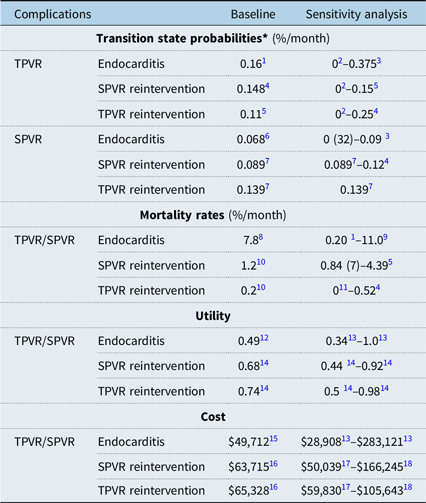
Postoperative transition probabilities and associated mortalities, utilities, and healthcare costs were derived from published peer-reviewed literature (Table 1). Literature was selected based on its representativeness of the current paradigm, as determined by expert review, with the rationale for each paper’s selection summarised in Supplemental Tables 2–5. Baseline mortality by age was accounted for using the 2020 Actuarial Life Table from the U.S. Social Security Administration.25 Utility was used as a metric for quality of life, where 1 represented a year of life in perfect health and 0 represented death.Reference Udeh15 Quality-adjusted life years were obtained by multiplying quality of life utility by the duration a hypothetical patient spent in the given health state. The lowest quality of life utility was used in the quality-adjusted life year calculation for patients who had more than one complication. Healthcare costs associated with each complication were adjusted for inflation to December 2022 United States Dollar using the U.S. Bureau of Labor Statistics Consumer Price Index.26 A willingness-to-pay threshold, defined by the theoretical amount the society would pay for an additional year of life in perfect health, was set to $100,000/quality-adjusted life year gained.
Markov model input parameters

* Transition state probabilities represent the likelihood that a hypothetical patient will develop a given complication and are used by the Markov process to determine how hypothetical patients move between health states.
SPVR = Surgical Pulmonary Valve Replacement; TPVR = Transcatheter Pulmonary Valve Replacement; $ = United States Dollars.
Inputs for baseline analysis were chosen considering representativeness to the hypothetical cohort, sample size, concurrent procedures, study design, percentage of repaired tetralogy of Fallot patients, and data availability. Studies that reported the minimum or maximum value for each input category were used to define probability ranges (Supplemental Tables 1–4). One-way deterministic sensitivity analyses and threshold analyses based on these ranges were used to determine important variables that could alter the cost-effectiveness relationship between strategies and strategy preference.
Simulation and analysis
The model was constructed, and an initial analysis was conducted in Amua. Further calibration and analyses were performed in R (Version 4.2.2, Vienna, Austria). Average values and 95% confidence intervals were calculated for all model outputs after 300 total iterations. The Incremental cost-effectiveness ratio was calculated by the ratio of the net costs of transcatheter pulmonary valve replacement to the net quality-adjusted life years gained relative to surgical pulmonary valve replacement and rounded. Quality-adjusted life years were discounted at a rate of 1.5%/year. A half-cycle correction was applied to adjust for events and transitions that occurred continuously rather than the discrete 30-day cycles used in the model.
Results
Baseline analysis
From baseline analysis, surgical pulmonary valve replacement demonstrated superior modelled survival relative to transcatheter pulmonary valve replacement, and such a trend persisted throughout the 5-year simulation (Supplemental Figure 2). The modelled 5-year mortality for transcatheter pulmonary valve replacement and surgical pulmonary valve replacement cohorts was 1.3% (95% CI, 1.1–1.5) and 0.8% (95% CI, 0.6–1.0), respectively. The modelled occurrence of endocarditis, surgical pulmonary valve replacement reintervention, and transcatheter pulmonary valve replacement reintervention was higher after transcatheter pulmonary valve replacement than after surgical pulmonary valve replacement from the onset of the late period to the completion of the simulation (Supplemental Table 5).
From modelling, the average postoperative quality of life utility was 3.16 and 3.12 quality-adjusted life years for surgical pulmonary valve replacement and transcatheter pulmonary valve replacement, respectively (Table 2). Additionally, the average modelled healthcare cost associated with surgical pulmonary valve replacement complications was lower than that of transcatheter pulmonary valve replacement complications ($10,767 versus $14,528). The calculated incremental cost-effectiveness ratio demonstrated that an additional quality-adjusted life year gained for a simulated patient would cost $88,743 more for transcatheter pulmonary valve replacement than surgical pulmonary valve replacement. From baseline analysis, surgical pulmonary valve replacement was determined as the more cost-effective strategy given its superior modelled lifetime quality of life utility and lower modelled healthcare cost.
Baseline analysis—mean costs, utility, and incremental cost-effectiveness ratio (ICER) with 95% confidence intervals

CI = Confidence Interval; ICER = Incremental Cost-Effectiveness Ratio; TPVR = Transcatheter Pulmonary Valve Replacement; SPVR = Surgical Pulmonary Valve Replacement; QALY = Quality Adjusted Life Year; USD = United States Dollars.
One-way sensitivity analysis
One-way sensitivity analyses of 15 transition probabilities identified 2 threshold values that would switch the preferred strategy from surgical pulmonary valve replacement to transcatheter pulmonary valve replacement: post-transcatheter pulmonary valve replacement endocarditis rate of 0%/month and post-transcatheter pulmonary valve replacement surgical reintervention rate of 0%/month (Figures 1 and 2, Table 3). Among the remaining transition probability ranges, surgical pulmonary valve replacement remained preferred to transcatheter pulmonary valve replacement with respect to both quality-adjusted life years and healthcare costs (Supplemental Table 6). Sensitivity analysis also identified that post-surgical pulmonary valve replacement endocarditis prevalence was the main driver for surgical pulmonary valve replacement benefits according to the calculated incremental cost-effectiveness ratio (Supplemental Figure 3). Supplemental Figures 4–7 illustrate transition probabilities with the strongest associations with surgical pulmonary valve replacement cost, surgical pulmonary valve replacement quality-adjusted life years, transcatheter pulmonary valve replacement cost, and transcatheter pulmonary valve replacement quality-adjusted life years, respectively.
Four quadrant plot depicting a critical value of post-transcatheter pulmonary valve replacement surgical reintervention rate that switched the preferred strategy from transcatheter to surgical valve replacement. Dotted line indicates a willingness-to-pay threshold of 100,000 dollars per quality-adjusted-life-year. QALY = quality adjusted life year; SPVR = surgical pulmonary valve replacement; TPVR = transcatheter pulmonary valve replacement; USD = United States Dollars; WTP = willingness-to-pay.

Sensitivity analysis—threshold values that switched the preferred strategy from TPVR to SPVR

ICER = Incremental Cost-Effectiveness Ratio; QALY = Quality Adjusted Life Year; USD = United States Dollars; TPVR = Transcatheter Pulmonary Valve Replacement; SPVR = Surgical Pulmonary Valve Replacement.
Discussion
While many have attempted to compare transcatheter pulmonary valve replacement and surgical pulmonary valve replacement outcomes using retrospective designs,Reference Steinberg, Jones, Verrier, Stout, Krieger and Karamlou7,Reference Andresen, Døhlen, Diep, Lindberg, Fosse and Andersen12,Reference Sharma, Griffiths and Eckhauser14,Reference Shahanavaz, Zahn and Levi27,Reference Vergales, Wanchek, Novicoff, Kron and Lim28 decision analysis modelling is unique in its ability to define a baseline preferred strategy with critical clinical thresholds that have the potential to change management. We present three key findings from modelling: (1) At baseline, surgical pulmonary valve replacement outperformed transcatheter pulmonary valve replacement in 5-year modelled survival, endocarditis occurrence, and reintervention rates and was the overall more cost-effective option. (2) From sensitivity analysis, if a centre’s post-transcatheter pulmonary valve replacement endocarditis rate were to be 0%/month, transcatheter pulmonary valve replacement would be the preferred strategy. (3) From sensitivity analysis, if a centre’s post-transcatheter pulmonary valve replacement surgical reintervention rate were to be 0%/month, transcatheter pulmonary valve replacement would again be the more cost-effective strategy.
Baseline analysis
Cost-effectiveness is a key tenet of value-based care, defined by the resources required to achieve a standardised improvement of a patient’s clinical outcome. While many studies have endorsed transcatheter pulmonary valve replacement as a viable (or even preferred) alternative to surgical pulmonary valve replacement based on perioperative benefits,Reference Ribeiro, Teixeira, Lopes, Costa, Pires and Gonçalves4,Reference Steinberg, Jones, Verrier, Stout, Krieger and Karamlou7,Reference Zhou, Xiong, Bai, Chu and Dong29–Reference Wadia, Lluri and Aboulhosn31 our study found surgical pulmonary valve replacement to be the preferred strategy for both quality-adjusted life years and cost following a 5-year simulation of major complications. Additionally, while existing cost analysis studies focus on perioperative procedural-related expenditures, such as medical supplies and clinical charges,Reference O’Byrne, Gillespie, Shinohara, Dori, Rome and Glatz6,Reference Steinberg, Jones, Verrier, Stout, Krieger and Karamlou7 our study provided novel insights by reporting a comparison of cumulative costs from complications beyond the initial hospital stay. However, it is important to note that, despite rigorous efforts to select representative literature for model input, baseline analysis outcomes are subject to biases from such manual selection. Therefore, quality verification with external literature, as well as sensitivity analysis using ranges of input data from literature, is critical to the success of a decision analysis.
Our estimates align with published studies excluded from modelling to allow for quality verification. Abdelghani and colleagues completed a systematic review and reported endocarditis rates ranging from 1.3% to 9.1% per year after transcatheter pulmonary valve replacement.Reference Abdelghani, Nassif and Blom32 At baseline, our study predicted a post-transcatheter pulmonary valve replacement endocarditis rate of 1.84% per year, near the lower bound of Abdelghani’s report. Houeijeh and colleagues reported a post-transcatheter pulmonary valve replacement reintervention rate of 10.7% at a median follow-up of 2.8 years.Reference Houeijeh, Batteux and Karsenty33 Compared to the closest time point in our study, a predicted post-transcatheter pulmonary valve replacement reintervention rate of 9.1% at a 3-year follow-up aligns with findings from Houeijeh and colleagues.
Sensitivity analysis: endocarditis
Just as Birkmeyer identified thresholds that were important in weighing the risks of a repeat aortic or mitral valve replacement versus Björk-Shiley valve failure,Reference Birkmeyer, Marrin and O’Connor16 this study identified influential variables and thresholds for strategy preference that would make transcatheter pulmonary valve replacement a more cost-effective strategy. Notably, per our analysis, as centres minimise endocarditis occurrences following transcatheter pulmonary valve replacement to 0%/month, they should opt for transcatheter pulmonary valve replacement over surgical pulmonary valve replacement. Our findings demonstrated that centre-specific transcatheter endocarditis rate should be weighted when deciding between transcatheter pulmonary valve replacement and surgical pulmonary valve replacement. Additionally, this decision should be made in concordance with strategies to reduce endocarditis, such as anticoagulation prophylacticsReference Cremer and Barzilai34 or peri-procedural antibiotics.Reference Chourdakis, Koniari, Hahalis, Kounis and Hauptmann35
Concerns over post-pulmonary valve replacement endocarditis have centred around bovine-jugular-based valves, particularly the Melody (Medtronic, Minneapolis, MN, USA) valve for transcatheter pulmonary valve replacement,Reference Haas, Bach and Vcasna11,Reference Cremer and Barzilai34 which may be due to increased asymmetry and surface roughness of bovine pericardial leaflets contributing to a higher risk of bacterial adherence and microthrombi formation.Reference Chourdakis, Koniari, Hahalis, Kounis and Hauptmann35,Reference Ghandour, Hammoud and Zia36 However, analysis of the impact of valve types on pulmonary valve replacement cost-effectiveness outcomes is beyond the scope of this study. With an ongoing shift of centre-based preferences from bovine towards non-bovine-based valves, future decision analytic models should aim to arbitrate between valve-based approaches as more data becomes available.
Sensitivity analysis: reinterventions
Our sensitivity analysis also identified that transcatheter pulmonary valve replacement would be the more cost-effective strategy if the post-transcatheter pulmonary valve replacement surgical reintervention rate were to be 0%/month. This finding suggests that efforts to reduce the need for a surgical redo, pulmonary valve replacement, may significantly enhance the mid-term cost-effectiveness outcomes of transcatheter pulmonary valve replacement. Additionally, centres with low post-transcatheter pulmonary valve replacement surgical reintervention rates may opt for initial transcatheter pulmonary valve replacements instead of surgical pulmonary valve replacements. As younger age and smaller annulus at transcatheter pulmonary valve replacement are associated with higher reintervention rates,Reference McElhinney, Zhang and Levi8 novel transcatheter pulmonary valve replacement strategies that allow for timely adjustment to accommodate patient growth in a noninvasive manner may enhance outcomes. For instance, the Autus valve,Reference Li, Sun and Russ37 designed to expand with a balloon as the patient’s native annulus grows, shows promise for such scenarios. Future decision analysis studies should aim to evaluate the long-term cost-effectiveness outcomes of those novel strategies compared with traditional pulmonary valve replacement approaches.
Clinical significance and strengths
A strong decision analytic model may be used to recapitulate a healthcare scenario into an economic evaluation and derive influential thresholds that might aid or switch centre choices. The baseline analysis predicted superior cost-effectiveness outcomes for surgical pulmonary valve replacement compared to transcatheter pulmonary valve replacement. Sensitivity analyses then identified key clinical factors that would switch the scenario to support transcatheter pulmonary valve replacement. Due to the complex relationship between volume, outcomes, and patient heterogeneity in the management of CHD, direct comparative studies are particularly challenging. In addition to providing insights into the comparative outcomes of transcatheter pulmonary valve replacement and surgical pulmonary valve replacement, future renditions may be used to establish additional benchmarks based on centre-specific outcomes to optimise patient care. Emerging biophysical modelling approaches,Reference Biglino, Capelli, Bruse, Bosi, Taylor and Schievano38,Reference Capelli, Sauvage and Giusti39 including computational fluid dynamics of transvalvular flow, ventricular mechanics, and electrophysiology propagation, may also be used to complement future decision analysis frameworks by providing mechanistic estimates that can be translated into event probabilities, thereby reducing parameter uncertainty and increasing model granularity.
Limitations
To establish a hypothetical cohort of repaired tetralogy of Fallot patients with clinically significant pulmonary valve regurgitation, several assumptions were necessary.
1. The model assumed a hypothetical cohort of patients equally suitable for either transcatheter pulmonary valve replacement or surgical pulmonary valve replacement and modelled them as binary options. In clinical practice, the choice between transcatheter pulmonary valve replacement and surgical pulmonary valve replacement may be influenced for an individual patient by provider expertise and patient anatomy. Specifically, patients with native or dilated right ventricular outflow tracts, larger pulmonary valve annulus sizes, and the presence of comorbidities that necessitate concomitant intervention may be better suited for surgical pulmonary valve replacement. Conversely, the presence of an existing bioprosthetic pulmonary valve or conduit may favour a valve-in-valve transcatheter approach. These baseline selection preferences may account for some of the differences in incidence of endocarditis and reintervention rates. Furthermore, it is important to recognise that patients with repaired tetralogy of Fallot and pulmonary valve dysfunction will often require a combination of surgical and transcatheter interventions over their lifetime to optimise long-term outcomes.
-
2. The present study did not address the impact of different pulmonary valve replacement approaches and concomitant procedures on right ventricular remodelling. A recent study by Ghandour and colleagues reported that concomitant tricuspid valve repair at the time of pulmonary valve replacement may be beneficial for right ventricular remodelling and recovery.Reference Ghandour, Hammoud and Zia36 Such an approach may be limited to surgical intervention. Yet, given the lack of quantitative measurements of the quality of life utility and cost of right ventricular remodelling, the incorporation of this factor into our model was not feasible.
-
3. The present model did not incorporate individual patient-level variables, such as pulmonary regurgitation fraction, right ventricular dilation, and right ventricular systolic function. Instead, the present study with modelled trajectories through the Markov chain represents a probabilistic simulation of outcomes at the cohort level using literature-derived transition state probabilities. Future work integrating patient-level inputs could enhance both the precision and the clinical applicability of decision analysis.
-
4. When multiple complications occurred for patients in this model, hypothetical patients retained the state reflecting the lower quality of life. This was necessary given the limited availability of objective quality of life data. For the individual patient, post-procedural morbidity is complex and not easily explained by a single quality of life multiplier. We assume that our model still describes the total outcomes in the aggregate hypothetical cohort.
Supplementary material
The supplementary material for this article can be found at https://doi.org/10.1017/S1047951125110755.
Acknowledgements
None.
Financial support
None.
Competing interests
The authors declare no conflict of interest relevant to this study.