The Utopia of Revolution in French Theory
In the twentieth century, radical French thought spread worldwide, in both the East and the West. Many Chinese scholars remain sharply interested in the aesthetics of leftist theorists such as Jean-Paul Sartre, Louis Althusser, Jacques Derrida, Michel Foucault, Roland Barthes, Julia Kristeva, Jacques Lacan, Jean-Luc Godard, Jacques Rancière, and Alain Badiou. These French discourses are characterised by original conceptions and a strongly critical consciousness of contemporary capitalist cultures as well as poetic creativity. However, they are not located within closed systems; rather, they were clearly stimulated by Chinese Marxism and its aesthetics, especially the theory of cultural revolution, the most important manifestation of Marxist aesthetics in modern China as presented by the Chinese Marxist Mao Zedong (Mao Tse-Tung, 1893–1976). In different degrees, the aforementioned French theorists belonged to groups involved with Maoism, and their discourses are creative adaptations of Mao’s theories.
Mao’s philosophy and aesthetics are a constitutive element of Althusser’s structuralist theory of materialist dialectics. Althusser frequently ranks Mao with Karl Marx, Friedrich Engels and Vladimir Lenin. He transforms the methodology of Marx’s thought into a structural analysis of contradiction and uses it to argue for the scientific interpretation of the arts. The key category in his theory is ‘overdetermination’:
This reflection of the conditions of existence of the contradiction within itself, this reflection of the structure articulated in dominance that constitutes the unity of the complex whole within each contradiction, this is the most profound characteristic of the Marxist dialectic, the one I have tried recently to encapsulate in the concept of ‘overdetermination’. (Althusser Reference Althusser and Brewster1969, 206)
This category is derived in part from Mao’s 1930s essay ‘On Contradiction’. As Althusser noted: ‘I can claim to have treated Mao Tse-tung’s 1937 text on contradiction as a description of the structures of the Marxist dialectic reflected in political practice’ (Althusser and Balibar Reference Althusser, Balibar and Brewster1970, 32). Althusser almost uncritically accepted Mao’s ideas about the universality, specificity, and unevenness of contradiction and gave concrete form to Marx’s notion of the imbalance between artistic, social, and economic development in Introduction to the Critique of Political Economy. Thus, Mao’s idea that ‘Nothing in this world develops absolutely evenly’ renews the Marxist interpretation of the development of artistic production. This idea differs from Czech Neo-Marxist Karel Kosik’s interpretation, based on the dialectics of the concrete and on an existentialist interpretation of the ‘complex structure’ of works of art (Kosik Reference Kosik1976, 78). Based on the ‘unevenness of complexity of structure’, Althusser and Mao agree in terms of the scientific analysis of the arts and go on to explore the revolutionary significance of culture, unifying the Marxist philosophy of dialectics, aesthetics, and revolutionary practice. Althusser consequently holds the works of the German playwright Bertolt Brecht in high regard because they demonstrate latent structures of time and space, absence and presence, and they reveal the real living conditions of the sub-proletariat in capitalist societies by breaking away from traditional forms. He maintains that the formal condition of ‘classical’ aesthetics is closely related to its material content, but ‘now Brecht can only break with these formal conditions because he has already broken with their material conditions’ (Althusser Reference Althusser and Brewster1969, 144). According to Althusser, Brecht’s departure from these conditions, by skilfully applying the alienation effect, attempts to produce a new consciousness in the spectator, ‘who starts where the performance ends, who only starts so as to complete it, but in life’ (Althusser Reference Althusser and Brewster1969, 151). Obviously, a theory of cultural revolution is an essential dimension of Althusser’s aesthetics.
It was through Althusser’s interpretation of Mao’s philosophy and aesthetics that Maoism gained popularity with radical thinkers in the 1960s. Inspired by a kind of ‘wishful thinking’ with respect to China, these thinkers engaged in a series of practical activities and theoretical constructions. According to Richard Wolin,
The virtue of Mao’s essay was that it acknowledged that ‘base’ and ‘superstructure’ didn’t always stand in a direct, causal relation. Instead, often they stood in contradiction to one another. In pursuing this tack, Althusser sought to expand the purview of Marxist theory so that it would be capable of engaging new cultural and intellectual challenges. (Wolin Reference Wolin2010, 62)
Mao’s discourse is a desirable object and fantastic utopia. There is no doubt that radical aesthetics were in fashion at the time, inspiring also other prominent theorists to develop rich and creative discourses. Etienne Balibar and Pierre Macherey (Reference Balibar, Macherey, Eagleton and Milne1996) offer an innovative understanding of literature in the essay ‘On Literature as an ideological form’ by introducing Mao’s 1942 Yan’an talks on literature and the arts. They cite Peking’s English version of Selected Readings from the Works of Mao Tse-Tung (A), published in 1971 by Foreign Language Press, and agree with Mao that ‘Works of literature, as ideological forms, are the product of the reflection in the human brain of the life of a given society’ (Mao Reference Mao1971, 250). For them, Mao’s definition means that literature is a production of ideological forms,
So the first implication of the category of reflection for Marxist theoreticians is to provide an index of reality of literature. It does not ‘fall from the heavens’, the product of mysterious ‘creation’, but is the product of social practice (rather, a particular social practice); it is not an ‘imaginary’ activity, although producing imaginary effects, but inescapably part of a material process, ‘the production of the reflection … of the life of a given society’. (Balibar and Macherey Reference Balibar, Macherey, Eagleton and Milne1996, 275–295)
Balibar and Macherey shift Mao’s theory of reflection from an epistemological perspective based on Lenin’s discourse to a structural analysis of the production of literature based on Althusser’s and Mao’s theory of the unevenness of contradiction and make new room for the development of a materialist theory of reflection.
Creative constructions are also found in the work of Jacques Rancière and Alain Badiou. These two theorists were prominent members of the Althusserian school in the 1960s and 1970s, read Mao’s ‘On practice’ and ‘On contradiction’, and integrated theories on cultural revolution into the realm of aesthetics and politics. In 1969, Rancière declared that ‘the task of revolutionaries […] is to oppose bourgeois ideologies with the proletarian ideology of Marxism-Leninism’ (Rancière Reference Rancière and Battista2011, 141). In his 1973 book, Althusser’s Lesson, there is much discussion of Mao’s theories and Maoism. ‘Mao’, ‘Maoism’, and ‘Maoist’ appear 64 times in this work. Rancière strongly emphasises the political features of literature and aesthetics. According to him, politics is a partition of the sensible, the visible, and the sayable:
The politics of literature thus means that literature as literature is involved in this partition of the visible and the sayable, in this intertwining of being, doing and saying that frames a polemical common world. (Rancière Reference Rancière2004, 10)
Similarly, Badiou wrote much on Mao’s theories. In Aijaz Ahmad’s view, ‘Badiou shared with Althusser a pronounced partiality in favour of Maoism’ (Ahmad Reference Ahmad2012, 43), and ‘Badiou’s political commitments to Marx, communism and even Maoism are tenacious and at times profound’ (Ahmad Reference Ahmad2012, 50). Some scholars even regard Badiou as a sectarian Maoist:
By introducing an ontological structure undergirding political activity, Badiou opens the door to the avant-garde figure, the militant who, in contrast to the masses, understands and can articulate the missing truth of a situation, in short, the Leninist or the Maoist. (Love and May Reference Love and May2008, 67)
Badiou’s key concept of ‘inaesthetics’ indicates a relationship between philosophy and art. It indicates that art is itself a producer of truths, rather than an object of philosophy. Badiou thus reinterprets the immanent identity and singularity of art. This is related to his concept of ‘Metapolitics’, which suggests that politics is not merely an object of philosophical reflection, but a producer of truth and affirmation of equality. This is a constitutive intertwining of aesthetics, philosophy and politics. In our view, the aesthetics of these thinkers should be categorised as radical political aesthetics. Regarding French Maoism in the 1960s, Wolin (Reference Wolin2010, xi) maintains that ‘Thus, one of the 1960s’ crucial legacies is the idea of cultural politics.’ Rancière and Badiou in a sense derive a militant aesthetic from the Chinese theory of cultural revolution as fantastic utopia. Thus, even though many differences exist between French scholars and Chinese Marxists, and even if the former later moved away from their earlier allegiance to Maoism and the Althusserian perspective, in the works of Badiou, Balibar and Rancière ‘there are certainly lingering influences of Maoism’ according to Nick Hewlett (Reference Hewlett2010, 66).
In 1977, Althusser, after reading essays such as ‘Literature and Revolution’ by the eminent Chinese writer Lu Xun (1881–1936), acknowledged the latter as a writer continuously fighting for the people, and hence as a revolutionary intellectual opposing modern capitalist domination (Lu Reference Lu1977). During this period, French scholars such as François Jullien and Michelle Loi viewed Lu Xun’s aesthetics of revolution in terms of Mao’s ideas and considered him a true Marxist, even though he never joined the Chinese Communist Party.
The Critical Reception of Chinese Marxism by Eastern European Neo-Marxists
If French thinkers came into contact with Chinese Marxist aesthetics in a modern capitalist context and from the perspective of culture’s revolutionary function, its reception in Eastern Europe took the guise of a process of socialist revolution and construction. Unlike French radicals who identified with Mao’s theory of cultural revolution, Neo-Marxist scholars, such as Leszek Kolakowski (Poland), Stefan Morawski (Poland), and Mihailo Marković (Yugoslavia), reflected upon Chinese Marxist discourse to develop a Marxist humanist aesthetics. They viewed Mao’s aesthetics critically and to some degree looked down on his theories, resulting in misunderstandings in spite of their common belief in a socialist pattern in culture.
As a Neo-Marxist philosopher in the 1960s and 1970s, Kolakowski attempted to situate Chinese Marxism within a global Marxist history, which led him to give it but little room. Thus, in his famous book, Main Currents of Marxism, he explores in detail the philosophy and aesthetics of Marx, Plekhanov, Lenin and Lukacs, whereas he discusses Chinese Marxism and its aesthetics only in the final chapter, ‘Development of Marxism since Stalin’s death’, under the subtitle ‘The peasant Marxism of Mao Tse-tung’. According to Kolakowski, Mao’s theories belong to a peasant discourse that is characteristic of Chinese culture:
Maoism in its final shape is a radical peasant Utopia in which Marxist phraseology is much in evidence but whose dominant values seem completely alien to Marxism. Not surprisingly, this Utopia owes little to European experience and ideas. Mao never left China except for two visits to Moscow when he was already head of the new state; as he himself declared, he knew next to nothing of any foreign language, and his knowledge of Marx was probably also fairly limited […] His two philosophical essays – ‘On practice’ and ‘On contradiction’ – are a popular and simplified exposition of what he had read in the works of Stalin and Lenin. (Kolakowski Reference Kolakowski and Falla2008, 495)
Kolakowski then shifts from philosophy to aesthetics and probes into the 1942 Yan’an talks on ‘art and literature’ and Mao’s ideas on the new democratic culture. He argues that the main points of the Yan’an address ‘are that art and literature are in the service of social classes; that all art is class-determined; that revolutionaries must practice forms of art that serve the cause of revolution and the masses; and that artists and writers must transform themselves spiritually so as to help the masses in their struggle. Art must not only be good artistically but also politically right’ (Kolakowski Reference Kolakowski and Falla2008, 499). He outlines Mao’s criticism of the so-called notion of ‘love of humanity’ because it is a slogan invented by the possessing class. With respect to a new democratic culture, Kolakowski maintains that Mao, in his 1940 article ‘On new democracy’, argued that the Chinese revolution was essentially a peasant revolution and that culture would develop under the leadership of the proletariat. As a result, Kolakowski wrongly implies that Chinese Marxist aesthetics is characteristic of a peasant utopia, and he too simply dismisses Mao’s theories as a ‘naïve repetition of Marxism-Leninism’, claiming that Mao’s originality lies in his revision of Lenin’s strategic precepts. Although he could access some ideas on Mao’s aesthetics, Kolakowski misunderstood and oversimplified them. Before putting forward the above interpretation, even he himself, being ignorant of the Chinese language and the country’s history, acknowledged the danger of his discussing Mao’s theories:
Those who, like the present writer, do not know Chinese and have only a scanty and superficial knowledge of China’s history and culture doubtless cannot grasp the full meaning of these texts, the various associations and allusions perceptible to a reader acquainted with Chinese thought. (Kolakowski Reference Kolakowski and Falla2008, 494)
Even worse, Kolakowski drew almost entirely on second-hand information from American sinologists who had studied Maoism.
Morawski, the most important Marxist aesthetician in Poland in the latter half of the twentieth century, touches upon Chinese aesthetics, mainly Mao’s Yan’an talks, in relation to the discussion of the vicissitudes of socialist realism in the 1960s. For him, the theory of socialist realism undergoes an institutionalisation and a corruption of theory in general. One obvious immanent factor is the conflict between the avant-garde tendencies of artists and the backwardness of their public: ‘There the masses were particularly backward and the artists, finally free to devote themselves unconditionally to the search for new forms, made rather rash use of their experimental practice’ (Morawski Reference Morawski1978,270).
This conflict is a permanent characteristic in the history of human society, but under socialist conditions its intensity heightens. Morawski argues that Lenin was aware of this conflict and defended the masses, and that Lunacharsky struggled with the same problem. Mao too made efforts to resolve this conflict, as Morawski notes:
This conflict was sharply etched in the speeches of Mao Tse-tung at the forum of artists and writers held at Yenan in May 1942. There he asserted that the only criterion to be kept in view is the culture of the workers, peasants, and soldiers, that is, that in interpreting life and truth in artistic language one must, above all, take account of the audience for which it is destined. Mao did distinguish two types of artistic recreation, one very easy and the other more difficult, but he declared that the duty of the Party is, above all, to popularize art and not to elevate it excessively. He thus openly favored utilitarianism (according to which the value of a work is to be measured above all in terms of the public response it finds) and resolutely set political above aesthetic criteria. (Morawski Reference Morawski1978, 271, emphasis in original)
Thus, Morawski emphatically expounds Mao’s aesthetic thought from the angle of aesthetics and discovers that Mao’s arguments are identical to the socialist realism of Lenin, Lunacharsky and Zhdanov. Although Morawski examines the problem of socialist realism, he pays the greatest attention to aesthetic issues, especially Mao’s resolution of the conflict between the arts and the public audience. In our view, Morawski’s understanding of Chinese Marxist aesthetics is more accurate and profound than Kolakowski’s. The former considers Mao’s aesthetics in terms of Soviet Marxist aesthetics and positions them within the same, or similar, situation(s), while simultaneously emphasizing Mao’s characteristics, whereas the latter positions Mao’s ideas in a peasant utopia and a cult of peasant culture. The differences in their interpretations are a result of their different academic resources. As mentioned above, Kolakowski drew almost entirely on second-hand studies, whereas Morawski read the 1956 Warsaw version of Mao’s writings, Duties of the Artists and Writers, and refers to Peking’s 1960 English version, Mao Tse-tung on Art and Literature. As someone interested in aesthetics worldwide, however, Morawski is concerned with Chinese Marxist aesthetics in a very limited way, and his interpretation is thus imprecise. Mao’s aesthetics emphasises the priority of a political criterion over an aesthetic one, but it does not neglect the artistic, and it also emphasises the perfect union of content and form; it recognises the audience as the masses, but at the same time demands the elevation of the masses’ aesthetic competence and literacy. Morawski’s analysis thus fails to recognise the originality and complexity of Chinese Marxist aesthetics.
As a well-known and leading member of the Yugoslav Praxis Group, Marković’s 1971 analysis of Mao’s aesthetics of cultural theory assumes a different significance. He positions Mao’s theory within the worldwide New Left’s theory of cultural revolution, especially within the western Marxist context. For Marković, the New Left places incomparably greater emphasis on the necessity for a new, more radical culture than did the Old Left: ‘The thesis that there can be no revolutionary movement without a new revolutionary culture is articulated most clearly and convincingly by Gramsci’ (Marković Reference Marković1974, 185). Marković then establishes Mao’s theory and practice in connection to Gramsci’s theory of cultural hegemony:
Mao focused the attention of the world on the problem of cultural revolution. He realized that China would lose its opportunity to build a socialist society, if it failed to shake off the ballast of the ancient feudal culture and to erect barriers against the culture of the Western consumer society, which began to infiltrate the first Chinese socialist state. (Marković Reference Marković1974, 185)
In our view, Marković’s analysis is penetrating and essentially faithful to Mao’s authentic thought. However, Marković turns dramatically to the difference between Mao’s theory and Gramsci’s. For him, Mao’s theory and practice can hardly be considered to measure up to the standards laid down by Gramsci: it is a means of ending a struggle between factions; it neither represents a truly dialectical negation of the old culture, nor does it attempt to elevate the lifestyle and modes of thinking to the level of human universality, instead replacing critical self-consciousness with a cult of the will. He continues:
Because of its general backwardness China was unable to overcome feudal and bourgeois culture dialectically, but could only attempt to remove it by force. It did not have the strength to expose itself to influences from the rest of the world, to judge and absorb all that reflected the greatest creative qualities in universally human culture. To quote Gramsci, it was unable to ‘raise it to the point reached by the most advanced human thought.’ The human consciousness developing under Chinese conditions could not become self-consciousness. (Marković Reference Marković1974, 185–186)
From this, Marković rightly notes the shortcomings of Mao’s cultural theory, but he wrongly understands its limits and remains blind to the universal significance of Chinese Marxist cultural theory to global Marxist theory. In fact, Chinese Marxist aesthetics contains its own subjectivity from the beginning. Always, it is self-conscious. It serves to build a new and independent society through social and cultural revolution. If French radicals over-praised Mao’s model of cultural revolution, Marković’s assessment is in contrast overly negative.
Similarly, Slavoj Žižek, a Neo- or Post-Marxist from Slovenia, pays critical attention to Mao’s Marxist philosophy and aesthetics and situates them within a history of Marxism, observing violent ruptures from Marx to Lenin and then to Mao. For him, Chinese Marxism is not merely a Chinese application of Marxist theory but a reinvention and transposition of the original, characteristic of Asian mysteriousness and strangeness. According to Žižek, there is poetic justice in the fact that the result of Mao’s Cultural Revolution is today’s unprecedented explosion of capitalist dynamism in China: ‘There is thus, beyond all cheap jibes and superficial analogies, a profound structural homology between Maoist permanent self-revolutionizing, the permanent struggle against the ossification of state structures, and the inherent dynamics of capitalism’ (Žižek Reference Žižek and Tse-tung2007, 26, emphasis in original). Žižek’s interpretation is original and passionate but frequently misunderstands Chinese Marxist philosophy and aesthetics. He neglects the specificity and universality of Chinese Marxist texts, and thus he cannot adequately grasp the insights of their alternative modernity.
We can conclude that, overall, these Neo-Marxists’ remarks on Chinese Marxist aesthetics are mainly critical. Ferenc Feher and Agnes Heller from Lukacs’ Budapest School rightly comment that ‘Western Maoism was almost the only intermezzo with participants who for a time deluded themselves with the dream of unifying Western and Eastern social aspirations in one movement’ (Feher and Heller Reference Feher and Heller1987, 26). The East European Left remained critical of cultural revolution: ‘East European hostility to Maoism was, of course, not necessarily the guarantee of a more penetrating insight than could be perceived in the case of Western analysts and their endorsement of the phenomenon’ (Feher and Heller Reference Feher and Heller1987, 27).
With orthodox Marxist aestheticians in Eastern Europe we find more positive attitudes toward Chinese Marxist aesthetics. Take, for example, Czechoslovakian president Antonin Zapotocky’s speech ‘The party must lead literature and arts’ at the All Czech Writers Conference in 1957, which paid tribute to Mao’s 1956 ‘Shuang Bai’ policy (the policy of letting a hundred flowers blossom and a hundred schools of thought contend). Zapotocky attempts to solve the crisis of literary society in his country stemmed from the 1956 Second Czech Writers Conference using Mao’s 1956 and 1957 speeches with respect to democracy and freedom. He makes good use of Mao’s theories to solve the most difficult problems regarding democracy and freedom in the aesthetic sphere. Mao’s speeches state that democracy and freedom are relative rather than absolute, depending on social history, and that they are for the people; he relates democracy to collectivity, and freedom to discipline. Accordingly, Zapotocky criticises the erroneous slogans that had appeared more recently, such as ‘creation and criticism are absolutely free’ or the ‘leading role of the arts’. He clarifies the misunderstanding of Mao’s theories on literature and the arts in Czech society as follows: Mao’s ‘Shuang Bai’ policy aims to unite all people of the nation, and to promote socialist reform and construction, democratic collectivity, the advancement of the Communist Party’s leadership, and the union of a socialist world and world peace (Zapotocky Reference Zapotocky1958, 448). For Zapotocky, Mao’s slogans imply the flowering of good and the exclusion of bad art. Although he notices the complexity of Mao’s theories, he basically identifies with Mao’s relation of freedom to discipline as a principle. Similarly, the famous East German writer and critic Anna Seghers also positively evaluated Mao’s 1942 talks. However, these positive remarks are certainly motivated by ideological considerations and do not constitute serious literary theories.
Sympathetic Interpretation by European Sinologists
European sinologists look at Chinese Marxist aesthetics from a wider and more objective perspective than the aforementioned scholars, who absorb or criticise it on philosophical and ideological grounds. These sinologists, who generally spent considerable time in China, translated Chinese traditional texts, and had a strong interest in ancient and modern Chinese culture, investigated the specificity and importance of Chinese Marxist aesthetics in a transcultural and worldwide context. We will mainly discuss the views of the Prague School of Sinology and those of the Dutch scholars Douwe Fokkema and Elrud Ibsch.
The Prague School of Sinology is well-known for the contributions of Jaroslav Průšek and Marián Gálik who approached modern Chinese literature with a structuralist methodology. They identify with the original creation and significance of Chinese Marxist aesthetics through careful investigation. In our view, they delve deeply into real Chinese contexts from traditional aesthetics such as Confucian, Daoist and Buddhist ideas to modern Chinese discourse. Most of them also have a broad understanding of western aesthetics. This combination allows them to more precisely understand the genesis of Chinese Marxist aesthetics.
Průšek lived in China from 1932 to 1934 and afterwards remained in contact with Chinese Marxist critic Lu Xun. He thought that some western sinologists misunderstood or knew little about new Chinese literary theory, and even less about Chinese Marxist aesthetics. He criticised the West’s mistaken opinions about Lu Xun’s Marxist literary aesthetics, which relate Lu Xun’s thought to Menshevism because he translated Plekhanov’s and Lunacharsky’s theories. Průšek argues that it is wrong to speak of Menshevism as communism or to regard Plekhanov and Lunacharsky as Mensheviks. He emphasises that Lu Xun read and translated their writings because he was familiar with the Bolsheviks’ literary theory and attempted to apply it to the Chinese revolution (Průšek Reference Průšek1987, 32). Thus, Průšek maintains a positive attitude toward Chinese Marxist aesthetics and recognises its significance. Consequently, he disagrees with the Chinese American scholar C.T. Hsia’s description of Chinese Marxist literary criticism in the latter’s well-known 1961 A History of Modern Chinese Fiction 1917–1957. In Průšek’s eyes, although Hsia attempts to counter Mao’s ideological control of literature with artistic criteria, his interpretation remains a mode of ideological critique, namely an anti-communist attitude embedded within his own ideological prejudices. Průšek notes that ‘C. T. Hsia does not see the absolutely urgent need to create a new literature and art for the broad masses’ (Průšek Reference Průšek1962, 370).
However, if Průšek’s concerns with Chinese Marxist aesthetics constitute only a small part of his Chinese literature research, for Slovak academic Gálik they form his main focus of attention. Gálik studied as a postgraduate at Peking University from 1958 to 1960 and kept in close touch with eminent Chinese writer and Marxist literary critic Mao Dun (1896–1981). From the 1960s on, Gálik took an interest in Chinese Marxist literary theory. In 1969, he published Mao Tun and Modern Chinese Literary Criticism, which discusses Mao Dun’s Marxist aesthetics. More importantly, in 1980 he completed The Genesis of Modern Chinese Literary Criticism (1917–1930). Gálik limits his research to the period from 1917, when the Chinese literary revolution surfaced, to 1930, when the League of Left-Wing Writers was founded. This allows him to explore the complicated genesis and structural evolution of Chinese Marxist aesthetics almost year by year. Gálik is the first scholar to touch upon, and to some degree exceed, the limited work on this topic by sinologists P. G. Pickowitz and B. S. McDougal in the 1970s. We observe four main points characterising his interpretation.
First, Gálik seriously analyses the genesis of Marxist aesthetics from the perspective of literary theory and conducts a chronological close reading of texts by Chinese theorists. In each case study, he emphasises the transformation from Chinese traditional discourses and modern western ideas to Marxist theory. He probes in detail into the work of typical Marxist literary theorists such as Guo Moruo (1892–1978), Chen Fangwu (1897–1984), Deng Zhongxia (1894–1933), Yun Daiying (1895–1931), Xiao Chunü (1891–1927), Jiang Guangci (1901–1931), Qian Xingcun (1900–1977), Mao Dun, Qu Qiubai (1899–1935), Lu Xun, Feng Naichao (1901–1983), and Li Chuli (1900–1994), of all of whom most western sinologists know little. According to Gálik, critic and poet Guo Moruo’s key theoretical points shift from ‘genius’ to ‘feeling’, then to ‘revolution’. His ‘gramophone’ concept, implying that art is a faithful record of social reality, actually contains an original construction on the basis of dialectical materialism, which pursues objectivity and liberation for the exploited masses. Guo Moruo’s understanding of the persistence of literature was renewed by his reading of Marx’s A Contribution to Critique of Political Economy.
Second, Gálik’s analysis is based on a new methodology of Marxist structuralism. He makes good use of Chinese Literary Mind in the Last Twenty Years, by Chinese literary scholar Li Huolin (Li Ho-lin), on the period from 1917 to 1937, when the Anti-Japanese War broke out; but he takes a very different direction, drawing mainly upon Prague School Structuralism, Piaget’s genetic structuralism, and Marx’s and Engels’ structural analysis. According to Gálik,
Both system and structure are variously defined in scientific literature. Two statements will serve us as guidelines in our subsequent study:
Firstly: a system consists of a set of elements and their relations.
Secondly: the set of relations within the system constitutes structure.
Here we start from Marx’s and Engels’ original apprehension of system and structure. (Gálik Reference Gálik1980, 4)
Gálik situates early Chinese Marxist aesthetics within a complicated structural system and grasps its key elements and their transformation during its development. For instance, sympathy and sociality are two elements in theorist Cheng Fangwu’s system-structural entity. Sympathy relates to Kant’s aesthetic sense, whereas sociality extends from objectivity, to revolution, to his 1928 categories or components, such as dialectical materialism, the dialectical materialist method, and negation of negation, which form the basis for his theory of total criticism. Similarly, three elements are found in Qu Qiubai’s aesthetics: ‘He judged literature within the triad formed by the following “momenta”: society, thought and the individual who creates literature’ (Gálik Reference Gálik1980, 219).
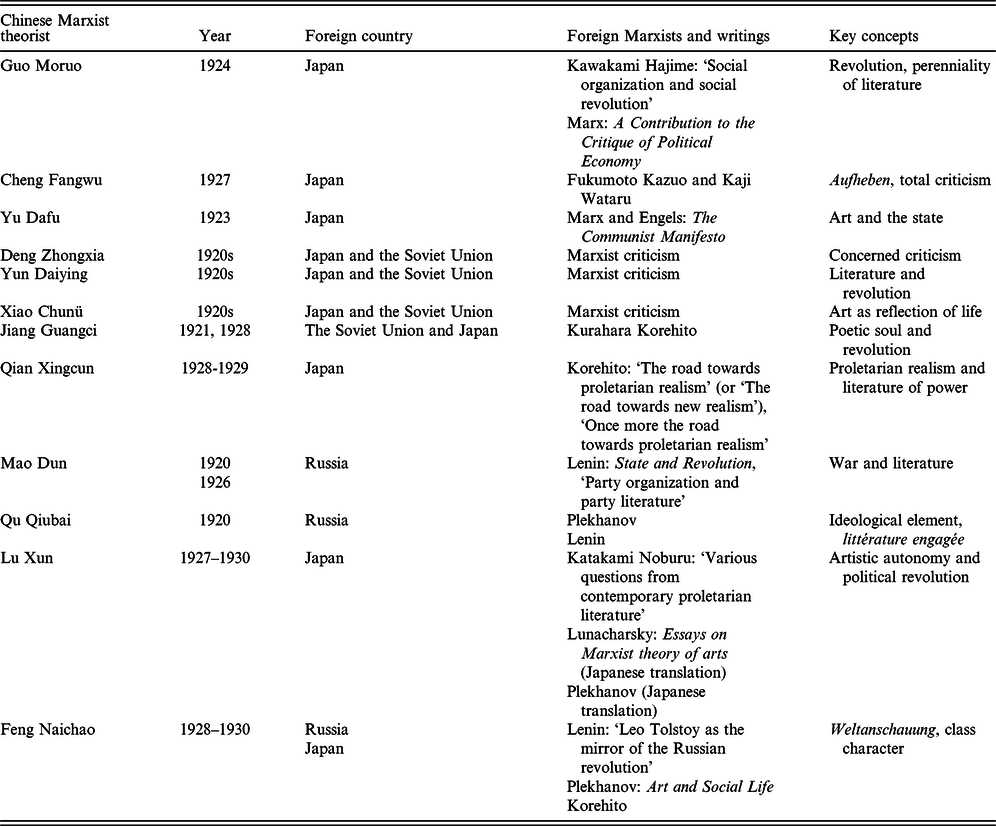
Third, Gálik pays great attention to the channels spreading foreign cultures to China in terms of Marxist aesthetics. The most important channel is mediation through Japanese Marxist academics. According to Gálik, two fundamental sources influence Chinese Marxist aesthetics: those in Russian and those in Japanese. Table 1, taken from his book, clearly illustrates that Chinese Marxist aesthetics derive primarily from the works of Russian Marxists such as Plekhanov, Lenin and Lunacharsky, and from Japanese Marxists such as Kawakami Hajime (1879–1947), Fukumoto Kazuo (1894–1983), Kaji Wataru (1903–1982, penname of Seguchi Mitsugi), Kurahara Korehito (1902–1991), and Katakami Noburu (1884–1928). On the basis of an extensive study of western sinologists’ writings in Chinese, Russian, Japanese and English on the genesis of Chinese Marxism, Gálik delves deeper into the Japanese influence than had ever before been done. His investigation shows that the Chinese acceptance of the Russian Marxists depends for the most part on Japanese Marxists’ translations and interpretations of their Russian counterparts. For example, Lu Xun’s Marxist aesthetics originate essentially from Katakami Noburu’s work ‘Various questions from contemporary proletarian literature’, and his translation of and research on Lunacharsky and Plekhanov also depend on their Japanese versions. Regarding Lu Xun’s acceptance of Lunacharsky, Gálik states that ‘on the basis of a Japanese translation by Nobori Shomu [1878–1958; penname of Naotaka Nobori], an eminent propagator of Russian and Soviet literature, Lu Hsün translated into Chinese and published another booklet entitled simply I-shu lun (On Art)’ (Gálik Reference Gálik1980, 275). We can see China’s reception of Marxist writings from Table 1 in more detail.
Chinese acceptance of foreign Marxist aesthetics.

Finally, Gálik understands Chinese Marxist aesthetics through the eyes of world literature, and thus notes its role in the system of world literary theory. Like Průšek, Gálik explores the traditional Chinese and western elements of Chinese Marxist aesthetics. He draws on Dionýz Ďurišin’s theory of comparative literature, or rather his methodology of intra-literary investigation in the framework of a national literature. Hence, he sees critic Guo Moruo’s aesthetics as a combination of elements from Kant, Walter Pater, Benedetto Croce, and Oscar Wilde, but also from traditional Chinese theorists, such as the traditional Chinese painting critic Xie He (479–502) and a number of Confucians. In Marxist Qu Qiubai’s discourse there is evidence of Buddhist consciousness, traditional Chinese critic Yuan Hongdao’s (1568–1610) concept of Yiqu (the aesthetic expression of an idea), and Tolstoy’s feelings of love. Lu Xun’s thought rests on Confucian ideas and Kant’s autonomy of aesthetics. Mao Dun shows influences from Nietzsche, Tolstoy, Romain Rolland, Maxim Gorky, and others, along with that of Xi Menbao, who lived more than 2000 years ago, and Books of Poetry, the first collection of Chinese poems. Gálik, then, approaches Chinese Marxist aesthetics from the perspective of both local Chinese and global literary theory and can clearly identify a sense of its real genesis, specificity, and universality.
In addition, Gálik reveals how most early Chinese theorists misread Marxism. Misreadings include both oversimplified and incorrect interpretations. Regarding the negation of negation, or Aufheben, he says:
In 1927, when Aufheben and the dialectical materialist method began to be written about, a certain distrust towards them was witnessed; of course, a distrust towards their Chinese interpretation. Lu Hsün mocked the ‘negation of negation’ the way Ch’eng Fang-wu understood it, although he, too, failed to understand it correctly. Later, in 1929, Mao Tun wrote about Ch’eng Fang-wu that ‘he learned only yesterday the ABC of dialectics.’ However, neither did Mao Tun grasp the dialectical method when he explained it as a dependence of human thought on social environment and economic conditions. (Gálik Reference Gálik1980, 100)
For us, however, a great deal of misreading is unavoidable and even necessary at the time of genesis. These texts creatively combine Marxist aesthetics and Chinese reality and culture, and gradually transform the literary notions inherited.
At almost the same time, in Western Europe, Fokkema and Ibsch published Theories of Literature in the Twentieth Century (Reference Fokkema and Ibsch1995 [1978]), which situates Chinese Marxist literary theory among global literary theories (Fu Reference Fu2015). Writing in the 1970s, for Fokkema and Ibsch, twentieth-century literary theory consists by and large of structuralism, Marxism, the aesthetics of reception, and semiotics. Marxist literary theories are discussed from a meta-theoretical point of view in four parts: (1) classic theory from Marx, Engels, and Lenin; (2) theory and practice after the October Revolution; (3) the Chinese reception of Marxist literary theories; and (4) Lukács and Neo-Marxist criticism. It is accurate to say that Fokkema and Ibsch associate Chinese Marxist aesthetics with the history of Marxist literary theories both orthodox and unorthodox, from Marx to critical theorists such as Benjamin, Adorno, Habermas, Fredric Jameson, and so on.
Fokkema and Ibsch reveal China’s special significance by means of comparison, as they show that Chinese Marxist literary theory, in contrast to Russian eclecticism, puts less emphasis on the assimilation of European literature and more on the Chinese way. They are concerned with Chinese Marxist aestheticians, such as Lu Xun, Qu Qiubai, Zhou Yang (1908–1989), and so on. They see Lu Xun’s ideas as a combination of the politics of revolution and artistic specificity. Mao’s aesthetics are derived from Qu Qiubai and Zhou Yang, which are inherited from Confucian ideas of literature. In Fokkema and Ibsch’s opinion, Mao’s primary concern is the subject matter, which may be separated from content in terms of Marxist literary theory: ‘a characteristic feature of Maoist literary theory is that subject-matter can very well be considered in isolation, separate from its formal expression’ (Fokkema and Ibsch Reference Fokkema and Ibsch1995 [1978], 111). Therefore, the class struggle and the Anti-Japanese War may serve as subject matter. Mao’s introduction to the Yan’an Talks gives the fullest attention to the themes of socialist revolution and construction and to more specific military campaigns; in the conclusion, his comments on the ‘theory of human nature’, ‘the love of humanity’, and so on further restrict the proper subject-matter. The talks go on to combine Mao’s literary theory with his political ideology, and, as a result, the lack of aesthetic quality does much harm to the literary field:
The exclusiveness of Maoist ideology and the infallibility of its wording prevent the Chinese writers from probing into the relation between sign and concept, or between word and reality. In fact all propaganda work in China, of which literature is often considered a part, is directed towards spreading the belief that words and concepts are one and that things do exist in reality if words only say so often enough. It is clear that the conception of poetry as a means to refine communication and to prevent language from being polluted is incompatible with the acceptance of the Maoist ideology. (Fokkema and Ibsch Reference Fokkema and Ibsch1995, 110)
Despite their misunderstanding of Marxist literary theory in the separation of content from form, Fokkema and Ibsch’s interpretation of the 1942 talks is valuable and significant. Fokkema insightfully observes the original significance of Chinese Marxist literary theory after 1949:
Critical of Occidentalism, which to them included imitation of the Russian tradition, the Chinese leaders wished to establish China’s own Marxist literary theory, one that allowed for romanticism as well as realism and called for immediate action to create a Communist society, first in words and then in reality. Literature and politics were combined in attempting to realize what in fact was and always remained a utopian goal. (Fokkema and Ibsch Reference Fokkema and Ibsch1995, 111)
However, Fokkema also notes a shortcoming of Chinese Marxist literary theory: Chinese left-wing critics negated the criteria of truth of Marxist criticism and European classic literature and attached themselves to the determinism of the economic base and Lenin’s party spirit.
Compared with the Prague School of Sinology, which was concerned with the genesis from 1917 to 1930, Fokkema draws more attention to Marxist aesthetics between 1942 and 1966. The American sinologist Paul Pickowicz concentrates on Chinese Marxist aesthetician Qu Qiubai in the 1923–1935 period, and the influence of ‘Chinese Marxist literary thought in the period from 1931–1935’ (Pickowicz Reference Pickowicz1981, xii) in comparison with the western tradition of Marxist literary thought. B.S. McDougal’s translation and research of the original Yan’an Talks relate to modern western literary theory and Marxist aesthetics in the 1980s. With these sinologists’ serious studies in the 1970s and early 1980s, the basic and authentic outlines of Chinese Marxist aesthetics gradually emerged in the West and entered the domain of world literature.
Chinese Marxist aesthetics, especially Mao’s aesthetics, are now fundamentally understood and in a sense accepted by some European sinologists. This process depends on the translation of Chinese texts into different western national languages. Chinese scholars translated some Chinese aesthetic texts into English, French, Spanish, and other languages from the 1950s to the 1980s; other texts were translated and published by European scholars.
Conclusion
Serious investigation of the process of its acceptance by European scholars reveals clearly that Chinese Marxist aesthetics has its place and voice in Europe, with a variety of understandings and misunderstandings. Three main kinds of creative reading or misreading occur in this process of cross-cultural interpretation: French scholars are passionate about gaining revolutionary courage from the Chinese theory of cultural revolution, and with it create an important radical discourse that has had a remarkable effect on global intellectuals since the 1960s; Eastern European Neo-Marxists remain critically involved with Chinese Marxism and consider it a peasant Marxist utopia, in contrast to the French fantasy; and European sinologists objectively reveal the genesis and specificity of Chinese Marxist literary theory and aesthetics. The first attitude is that of a utopia of revolution, the second of critical consideration, and the third of real recognition. Compared with studies of Chinese Marxist aesthetics in the US, which are for the most part characterised by an anti-communist position, European studies are more sympathetic, original, and pluralistic. They contain fruitful discoveries, along with some misreadings and variations. This indicates that Chinese ideas, to some degree, stimulate and promote the development of European radical aesthetics. If there were no such wind from the East, perhaps Europe would not have seen the rise of such a number of well-known theorists and critics, whose writings we continue to read to this day. Briefly, Chinese Marxist aesthetics is a part of the global Marxist discourse. It is a pity that most European scholars are restricted in their consideration of the Chinese discourse, and that very few understand its complicated but rich achievements. As Pickowicz diagnoses, western scholars’ understanding of Chinese ‘Marxist aesthetics remains rather fragmentary, yet no systematic discussion of fundamental Marxist ideas has appeared’ (Pickowicz Reference Pickowicz1980, 1).
About the Authors
Qilin Fu teaches literary theory and aesthetics at the College of Literature and Journalism, Sichuan University, and is the Chief Expert of the China Key Project of Philosophy and Social Science, ‘Bibliography and Research of Eastern European Marxist Aesthetics’ (15ZDB022). He has published A Study of Agnes Heller’s Thoughts on Aesthetic Modernity (2006), An Anthropological Interpretation of Aesthetic Ideology (2008), The Critique of Grand Narrative and the Construction of Pluralist Aesthetics: A Study of Reconstructing Aesthetics of Budapest School (2011), Eastern European Neo-Marxist Aesthetics (2016), A Study of Basic Issues of Eastern European Neo-Marxist Literary and Artistic Theory (2017), and a series of papers on Marxist literary theory and aesthetics in journals such as Thesis Eleven, Literary Review and Comparative Literature and Culture.
Shubo Gao is an Associate Professor teaching western literature at the College of Literature and Journalism, Sichuan University. He is the leader of the China Project of Philosophy and Social Science, ‘Research on Contemporary Western Marxism and World Literature’ (15CWW001). His scholarly interests include western literary theory, Marxist aesthetics, and semiotics. His recent publications include a book, Genre, Space and Literary History in the Perspective of Distant Reading: On Franco Moretti’s Literary Theory (2016), and some articles on Marxist literary theory.