What social and economic conditions foster successful transitions to democracy, or conversely, in what circumstances do democratic transitions fail? Social science theory has long held that these questions represent two sides of the same coin: The conditions supporting democracy are found lacking where nondemocratic politics succeeds. For example, civil society theorists tie democracy to a robust civil society, and, using the obverse argument, theorists of fascism cite links between a weak civil society and the rise of fascism. Parallels exist for the class and rational choice theories of democracy and fascism. Thus, the theoretical arguments employed to explain fascism have their analogues in theories of democracy. These three theories—class, civil society, and rational choice—may explain the rise of Italian Fascism, 1919–21, but a fuller understanding of the explanations requires a clear statement of the hypotheses and the construction of adequate measures.
Fascism emerged in many countries and in several forms, but the most intensive research has focused on Weimar Germany as the prime case of the implosion of democracy and the rise of fascism. “[S]cholars have long viewed the Weimar Republic and its collapse as a crucial theoretical testing ground. The disintegration of democracy in inter-war Germany is so central to our understanding of comparative politics and so critical for the history of modern Europe that we should at least be wary of any theory of political development that cannot explain it” (Berman 1997b, 406). By the same logic, however, we must test our understandings in a variety of national and historical settings; otherwise, we risk overgeneralizing from a single case.
ANALOGUES IN THEORIES OF FASCISM AND DEMOCRACY
Class Theories of Fascism and Democracy
Class interpretations emphasize that democracy and fascism result from different class alliances and that democracy emerged where a strong bourgeoisie opposed the landed interests and, to some degree, successfully coopted the working class. Fascism arose where a weak bourgeoisie aligned itself with the landed classes against the working class, with the rural sector remaining crucial in determining the outcome (Huber and Stephens 1999; Lipset 1960; Moore 1968). The “Red Menace” thesis, central to this analysis, stresses that fascism was a reaction of classes threatened by socialism (Linz 1976, 26, 28–29). Rural lower-class radicalism, in particular, provoked an alliance between the rural landlords and the urban bourgeoisie, and this reactive alliance explained fascism's initial appeals (Childers 1983; Elazar 1996; Luebbert 1991, 296ff.).
Civil Society Theories of Fascism and Democracy
Analysts from de Tocqueville ([1840] 2000, 486–87) to Putnam (2000) have stated that individuals well integrated into a robust civil society consisting of dense networks of secondary, voluntary associations develop the trust essential to democracy and are less “likely to be swayed by their worst impulses” (Putnam 2000, 289). The obverse thesis has long been a staple interpretation of fascism. If a robust civil society supports social trust and democracy, then a weak civil society facilitates distrust and fascism. Early formulations of this “mass society thesis” held that fascism drew its supporters from the socially marginal, alienated, isolated, or rootless, particularly the newly enfranchised and newly mobilized voters (Arendt 1961, 305; Bendix 1952; Kornhauser 1959). Initially, Burnham (1972) and, later, Bartolini and Mair (1990, 147–51, 175–81, 283) found that civic organizational density and electoral instability were inversely related during the interwar period. Critics challenged the supposed weakness of civil society in Weimar Germany, countering that a robust civil society divorced from political life might heighten mobilization but, coupled to low trust and political institutionalization, contributed to the collapse of democracy (Berman 1997b, 402).
Rational Choice Theories of Fascism and Democracy
Rational choice theories of democracy emphasize the voter's rational self-interests, with material interests comprising a significant component of rational voting. From Downs (1957, 36) to Dahl (1989, 180), the rational voter looms large in democratic theory. Whereas democracy and fascism were frequently contrasted as rational and irrational, more recently rational choice theorists have advanced notions of the “rational fascist” and the “rational autocrat” (Brustein 1991; Olson 1993). Olson (1993, 570) assumed that “democratic political leaders are just as self-interested as the stationary bandit and will use any expedient to obtain majority support. Observation of two-party democracies tells us that incumbents like to run on a ‘you-never-had-it-so good’ record.” Brustein (1996) incorporated rational choice to argue that fascism appealed to voters' “commonplace and rational factors—namely their material interests” (viii) and demonstrated that the Nazis gained support by offering voters “the best prospects for a better life” (181). Fascism succeeded by tailoring its appeals to the material interests of particular groups. The “rational fascist” challenged the association of rationality and support for democracy because fascist “supporters were no different from average citizens, who usually select a political party or candidate they believe will promote their interests,” with the implication that “evil as an outcome may have very logical origins and that evil is not always easily discerned—a chilling prospect” (Brustein 1996, xii).
Trust in Civil Society and Rational Choice Theories
Trust plays a central role in both civil society and rational choice theories, but its character differs in each. In civil society theory, trust approximates de Tocqueville's “Habits of the Heart” – an unconscious, deeply felt, unconditional, optimistic worldview that “the world is a benevolent place with good people, and that things are going to get better, and that you are master of your fate” (Uslaner 2002a, 6). Civic and political associations foster trust, and, in turn, trust encourages civic associations (de Tocqueville [1840] 2000, 491; Putnam 2000, 288–89). In rational choice theory, trust is strategic, conditional, and dependent on reciprocity. Civic and political associations foster trust through repeated reciprocity. The endurance of trust also differs. In civil society theory, trust is more deeply held, durable, and stable; in rational choice theory, trust is more conditional and subject to erosion when reciprocity fails (Uslaner 2002b, chap. 3).
The Context and Nature of Fascism
Although fascism was an immediate response to the economic crisis of the interwar period, its intellectual and organizational precursors emerged before and during World War I. In contrast to atomistic bourgeois liberalism and class-based socialism, fascism, under a new doctrine of “society as factory,” sought a harmonious, hierarchically integrated, functionally dependent, and efficient order (Maier 1987, 19–69). Fascism, however, encountered a congested political landscape. Following the war, nineteenth-century liberal and socialist rhetoric continued to dominate the “language of class anxiety,” preempting the ideological space and limiting entry points for newcomers. Moreover, not only was the ideological space occupied, but the existing parties claimed much of the political landscape as well. Yet the advantages of the “latecomer” ensured that fascism had few initial claimants and, hence, was freer to experiment with its language and appeals. Moreover, the same organizational density that underlay the existing political parties also limited their maneuverability (Linz 1980, 155–56).
Under these conditions, fascism defined its place by incorporating and synthesizing both new and existing political ideas, while claiming new organizational principles. Fascism's protean form generated a long-standing debate on its character. No single rigid definition predominates, but most agree that fascism embodied a unique mix of ideology, tactics, and organizational forms. Ideologically, fascism relied on extreme nationalism, secular idealism, and vitalism. It propagated a myth of national rejuvenation and rejected rationalism, materialism, and egalitarianism. Tactically, fascism emphasized the use of violence and rejected parliamentary democracy. Organizationally, it drew on organic and corporatist notions espousing ideals of harmony, hierarchy, and national efficiency (Bosworth 1998; Linz 1976, 12–13). Fascism's “anti” character, newness, and experimentation made it attractive to a variety of groups, consequently, its sources of support shifted across time.
Italy: Fascism and Democracy
Italian Fascism developed in a society characterized by deep social divisions and a long history of traditional patrimonial politics during a period of transition to mass democracy. Thus, the Italian experience (1919–22) is highly appropriate for examining an unsuccessful democratic transition, although it is less suitable to study democratic breakdown (Tarrow 1995, 210). In this sense, Italy shared conditions with other candidates for fascism–-Spain, Portugal, and Germany. Italian Fascism's early appearance, rapid success, and agrarian popular support mark its distinctive elements. In less than four years, the Fascists seized power and Fascism's electoral success in May 1921 aided its march to power. Thus, the keys to understanding the Fascist's success lie in the years between 1919 and 1921, a period marked by violence and labor unrest known as the “Biennio Rosso” (the Red Two Years).
The Italian case is less researched and understood than its German counterpart. Unlike Germany, the triumph of Italian Fascism depended on the conquest of the countryside, as Mussolini himself noted in 1919. Although the Nazis made inroads into rural areas, by 1925, Germany was a predominantly industrial economy. Also unlike Germany, where in 1925 about 30% of the economically active population engaged in agriculture, forestry, and fishing, in 1921 90% of the economically active population in Italy engaged in agriculture, forestry, and fishing, with 66% involved in land cultivation. Moreover, the Italian and German land tenure systems differed markedly. In Germany, 90% of the agricultural holdings were owner occupied, but in Italy, only 21% of the agricultural economically active population consisted of owner-occupiers, while 12% were sharecroppers, and 24% were landless wage laborers. In Germany, 62% of owner-occupied holdings were five to 100 hectares; the comparable figure for Italy was 16%. On the other hand, 82% of Italian owner-occupied holdings were less than five hectares, with 42% less than one hectare. In Italy, 0.4% of the holdings occupied 50% of the farmland. Thus, the rise of Italian Fascism depended heavily on the rural sector, and the key to understanding rural political behavior rests in the data drawn from several observation levels using strategies and techniques discussed below.
EXPLAINING FASCISM: RESEARCH STRATEGY AND METHODS OF ANALYSIS
The data analyzed here are ecological and nested or hierarchical, i.e., the data are available for different, but not the individual, levels of observation. Some variables are available only at the parliamentary electoral district level (N=54), while others exist at the administrative district level (N=214) and still others at the local or municipal level (N=6,110). To exploit these data, I use hierarchical linear modeling (HLM) (Bryk and Raudenbush 1992) within and across levels to capture those contextual variables most predictive of fascism1
Hierarchical linear modeling (HLM) avoids the drawbacks of the two most common methods applied to nested data. If the electoral districts' characteristics are assigned to the local municipalities, the assumption of independence of the municipalities is violated, and contextual effects of districts on the municipalities are ignored. If the municipalities are aggregated into the districts, the variance of the municipalities is discarded. HLM models capture all the information in the data by estimating both intercepts and slopes across and within districts. In addition, HLM can estimate contextual and cross-level effects.
and, in the second stage, ecological inference (EI) (
King 1997) to estimate individual electoral behavior in 1919 and 1921.
Concepts and Measures
The dependent variables are electoral support for prefascist and fascist parties leading up to the electoral breakthrough of Fascism in 1921. Thus, electoral dynamics among the contending political parties and shifts of support across levels, time, and parties rest at the center of the analysis.
In Italy, Fascist success meant triumphs in the rural sector (DeFelice 1966, 6ff.; Lyttelton 1987, 54–76). Four independent variables figure prominently. (1) Class theories emphasize the importance of land tenure as an indicator of property and class status. Rational choice interpretations also place importance on property but emphasize the maldistribution of land as a condition that the Fascists exploited in their rise to power. (2) Civil society theories stress the density of associational memberships as an indicator of the robustness of civil society. Typical indicators include measures of voluntary civic associations, e.g., trade unions, charitable associations, cooperative movements, and mutual benefit societies. (3) Class theories give particular emphasis to the 1919–21 agrarian strike activity, the “Biennio Rosso,” as a measure of rural lower-class mobilization. (4) Both class and civil society theories underline the importance of violence during this same period. For class interpretations, violence indicated the reaction of bourgeois society to the “Red Menace.” For both theories, violence served to destroy civil society and ensure the rise of Fascism.
Data and Data Treatment
Hierarchical or Nested Data Structure
Although the data are nested at three levels, two-level models generate the best-fitting HLM results. Fifty-four electoral districts constitute the Level Two units and the 6,110 local municipalities form the Level One units, with all units constant across time.2
The municipal units are “comuni,” local administrative centers that usually include several smaller villages, termed “frazioni.” Size may range from a few hundred to over a million inhabitants; Roma, Milano, and Napoli, for example, are comuni. Over time the boundaries of comuni change, as larger ones may be subdivided or smaller ones united to form new comuni. Because there is no way of knowing the profile of those areas affected by boundary changes, I aggregate any municipality into another municipality when any part of it is combined or subdivided. Because both prewar and 1921 census measures are necessary for the analysis, I exclude territories acquired by Italy after the war.
Level Two variables consist of three general categories: land tenure arrangements, rural strike activity, and violence. Land tenure and cultivator arrangements derive from the 1921 and 1930 census materials.
3 The census officials noted that the four principal types were not distinct categories. Particularly in the South, tenure patterns were hybrids. However, the census officials made every effort to classify tenure patterns by the dominant mode of production. In these and other variables only males are used, because they more closely approximate the enfranchised population.
were small proprietors who farmed their own land, usually relying on family labor, although some employed part-time or full-time labor.
Sharecroppers and
tenants labored under various in-kind rental arrangements, generally lived on the land they worked, and usually lived in a house supplied by the employer.
Renters were similar to croppers, but cash payments formed the basis for the use of land and the sale of produce.
Laborers worked for hourly or daily cash wages, occupied the least secure tenure, and constituted the lowest rung in the rural hierarchy. They were either contract laborers or day laborers. Contract laborers were “under contract to work for a specific employer whenever required, the employer being bound, in turn, to give them first chance of work” (Schmidt 1966, 11). With widespread unemployment, contract laborers had the promise of steady work but generally were paid a lower hourly wage than casual day laborers. At the very bottom of rural life were the day laborers, who formed the majority of agricultural wageworkers. In the Po Valley, day laborers outnumbered contract laborers by a ratio of 15:1. Day laborers generally were paid hourly or daily, or sometimes by piecework, and they accepted employment wherever available, often at great distances from their homes, and sometimes worked in nonagricultural activities.
Agrarian strike activity engaged 2.2% of the rural population in 1919 and 4.6% in 1920 during the “Biennio Rosso.” The variables are 1919 agrarian strike density and 1920 agrarian strike density. Several possible measures capture Fascist violence, but the most effective measure is the number of deaths and injuries in political clashes between January 1920 and May 1921, 1920–21 violence (Gentile 1989, 472–74).4
Violence figures prominently in several of the best-known analyses of Fascism (DeFelice 1966; Lyttelton 1987; Tasca 1966). I test several measures of violence including injuries and deaths in political clashes between January 1920 and May 1921, with data drawn from the Interior Ministry archives (Gentile 1989, 472–74), and Fascist–Socialist clashes between January 1 and May 8, 1921, also
from the Interior Ministry archives (DeFelice 1966, 36–39). A third measure consists of Fascist attacks on Socialist-affiliated organizations between January and May 1921, initially compiled by the Fascists themselves but later augmented by the Socialists (Tasca 1966, 120). Both injuries and deaths and Fascist–Socialist clashes measures exist by electoral district (N=54).
Level One (municipal) variables include rural organizational density in 1910 and electoral data for the parliamentary elections of 1919 and 1921. Rural organizations fall into two main types, trade unions and cooperatives. The latter included consumer and producer cooperatives, labor cooperatives, and rural savings banks, among others. Most trade unions and cooperatives were officially affiliated with the Socialist and Catholic parties. Others, however, were officially independent of any political party, although they generally supported the Socialists. Their organizational strength is measured by their membership densities: Socialist rural membership density, Catholic rural membership density, and unaffiliated rural trade union membership density. The rural trade union movement was deeply divided, but by 1910 the political and regional differences were clear. The Socialist and the unaffiliated trade unions and cooperatives dominated Central Italy, particularly the Po Valley, while the Catholic organizations were most successful in the North (Horowitz 1963, 78ff.; Roberts 1979, 53ff.).
Electoral data for 1919 and 1921 parliamentary elections at the municipal level are a product of field research in local archives. Electoral measures are votes for party blocs defined by Giusti (1921, 11–13) and Piretti (1995, 221, n18, 232ff.). According to these guidelines there were four voting blocs in the 1919 election: the center-right Constitutional bloc, the Center-Left bloc, the Catholic bloc, and the Socialists. In the 1921 election, there were the Fascists, the rightist National bloc, the Center-Left bloc, the Catholics, and the Left bloc (the Official Socialists, the Independent Socialists, and the Communists).
Incomplete Data Treatment
All data are complete for the level at which they appear in the models, with the exception of the electoral data. Here incomplete data average 20% across the electoral variables. I use the multiple imputation method (King et al. 2001) to estimate incomplete observations. A second data limitation is that in most districts in the May 1921 election, the Fascists ran in coalition with the National bloc. Although the Fascist vote within the National bloc was not reported separately, Brustein (1991) reconstructed the Fascist vote. With this as an indicator of likely Fascist vote, the multiple imputation method estimates the full data.5
Brustein (1991, 659) compiled the vote for the official Fascist candidates endorsed by Mussolini. He then “totaled the votes for each Fascist candidate from the preference votes (voti di preferenza) and from votes from the other lists (voti aggiunti riportati in altre liste) and divided that sum by the province's total preference vote and vote from other lists for all candidates.” Municipal Fascist vote is estimated by the multiple imputation method from the electoral district returns and municipal returns.
SUMMARY STATEMENT OF HYPOTHESES
These three theories offer differing hypotheses on Fascist support. The class theory holds that property holders and 1919 Centrist voters, reacting to the “Red Menace,” shifted to the Fascists. Because violence occupies a crucial explanatory role in the class theory, Fascist support should be greater and Left support less where violence was more intense. The civil society theory suggests that the Fascists attracted support among those at the social margins, such as those less integrated into networks of civic voluntary associations, the politically inexperienced, and the apathetic, e.g., newly enfranchised voters and previous nonvoters. The rational choice theory states that Fascist voters acted on their material interests in responding to the Fascist program. The Italian Fascist agrarian program offered numerous material appeals including land redistribution, higher wages, cooperative land leasing arrangements, credit, and marketing supports, among others. Those most responsive to such appeals would be those most economically disadvantaged, i.e., the landless rural laborers. Of course, the hypotheses are not mutually exclusive, e.g., if Fascism did appeal to the material interests of the landless, those who were members of civic voluntary organizations should be more immune. However, violence and intimidation might reduce this immunity. These and other subsidiary hypotheses are examined below.
CROSS-LEVEL EFFECTS AND CONTEXTUAL ANALYSIS
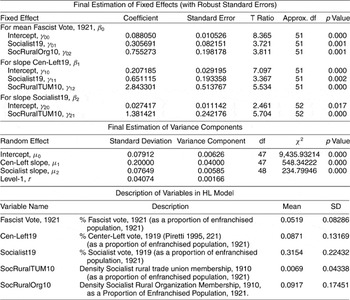
Estimates of cross-level effects between electoral districts and local measures identify the contextual effects giving rise to Fascism. The estimation process involves several steps: estimating the variance in Fascist vote at the local and district levels, selecting the strongest predictor variables of Fascist vote, testing regression models with means as outcomes, and testing a random coefficient model. The final model below estimates the intercepts and slopes as outcomes.6
An analysis of variance (ANOVA) model estimates that 87% of the variance of Fascist vote occurs across the electoral districts and 13% within the electoral districts, an expected result since Fascism was centered in selected districts. The estimated grand mean of the Fascist vote in 1921 is 0.088, with a standard error of 0.0160. The reliability coefficient of 0.997 indicates that the estimated mean is a highly reliable estimate of the true mean. Variables most predictive of Fascism are presented in Table 1. Given the standard histories of Italian Fascism, some variables are noticeably absent, particularly property arrangements, violence, and rural class mobilization. In the class interpretation of Fascism, these are central explanatory variables, so I return to these questions below.
The regression model with means as outcomes estimates the mean Fascist vote as a function of the electoral district variables found to be most significant in the step above. The results show highly significant associations between the mean Fascist vote and Socialist vote in 1919 and the mean Socialist rural organizational membership. This, of course, confirms the obvious, i.e., Fascism occurred in the presence of Socialist electoral and rural organizational density. The two variables account for 56% of the electoral district variance. The conditional intraclass correlation of 0.87 in the ANOVA model is reduced to 0.25 and measures the remaining degree of dependence among the observations having the same scores on these predictor variables. The conditional reliability coefficient of 0.993 indicates that the ability to discriminate among the electoral districts with the same scores on the predictor variables is very high.
The random-coefficient model estimates the regression equations within each electoral district, i.e., Fascist vote estimated as a function of the municipal variables centered about the electoral district means and proving significant in step 2 above. The results indicate that both municipal vote variables are significant predictors of Fascist vote. The coefficients are the average regression slope within the electoral district controlling for the other predictors. The 1919 Center-Left vote is the most significant and possesses the highest slope. Both the intercepts and the slopes are highly reliable, indicating that the data provide considerable power to examine the effect of the electoral district characteristics on the mean Fascist vote within the districts. This model accounts for 18% of the variance across the municipalities. Since in the previous model the district variables of 1919 Socialist vote and Socialist rural organizational membership density accounted for 56% of the district variance, the results confirm that the district variables are stronger predictors of Fascist vote than the municipal variables. The correlation of the intercepts and the slopes demonstrates a strong association between the mean Fascist vote and the slopes of the 1919 Center-Left vote (0.919) and 1919 Socialist vote (0.695) and confirms the importance of districts as a powerful context for analyzing Fascism.
Modeling Contextual Effects: Intercepts and Slopes as Outcomes
This model integrates the previous results and estimates the effects of the electoral district context on the local Fascist vote in 1921. The coefficients are the cross-level effects of the district predictors on local intercepts and slopes within the electoral districts. The model estimates contextual effects, permitting the disentanglement of local and compositional effects.
Table 1 presents the results in which the previous findings are confirmed. The mean Fascist vote across the electoral districts was 8.8%. The Fascist vote was significantly higher where the 1919 Socialist vote and rural organizational membership density were higher. The average slopes, γ10 and γ20, indicate that 1919 Center-Left voters, in districts where the 1919 Socialist vote and Socialist rural organizational density were higher, were more likely to vote Fascist. These results are entirely consistent with the class and “Red Menace” interpretation.
The new information in the model confirms the above interpretation and highlights the cross-level interactive effect of the district-level 1919 Socialist vote and Socialist rural organizational membership density on both the 1919 Center-Left vote and the 1919 Socialist vote. Both relationships are powerful and significant.7
The robust standard errors are consistent even when the HLM distributional assumptions are violated.
The results indicate that the municipalities more likely to vote Fascist were those located in districts where the 1919 Center-Left and Socialist vote was higher and where the Socialist rural organizational membership density was higher. In other words, there was an interactive effect between the district and the local dynamics.
The model also contains the contextual effects defined as the difference between the aggregate electoral district effects and the local effects. In the group-mean model above, the contextual effects are the differences between the across-electoral district and the within-electoral district effects. The most significant contextual effects for predicting Fascist vote are 1919 Socialist vote and organizational membership.
The model successfully accounts for 51% of the total variance, 56% of the electoral district variance, and 18% of the municipal variance in the 1921 Fascist vote. These results are consistent with the “Red Menace” thesis: 1919 Center-Left voters voted Fascist in 1921 in districts where the 1919 Socialist vote and rural organizations were stronger.
If the analysis ceased here, it would confirm one strain of the previous research, however, prior analyses were severely limited by a lack of electoral data at the local level and any measures of civil society. Hence the analyses exist only for electoral district or provincial level and cannot test the civil society theory. This study overcomes both these limitations. In addition, this research draws on newer techniques to approach the EI problem.8
Finally, although the results above confirm previous research, certain anomalies in these findings raise additional concerns. Although these results are consistent with the class theory, several variables central to that theory–-property holding arrangements, violence, and rural strike activity–-are poor predictors of Fascism. In addition, several variables crucial to the civil society theory–-Catholic vote and Catholic rural organizational density–-are not significant. Finally, conclusions based upon relatively few, large aggregate units raise concerns about the ecological fallacy. Although the municipal units employed here are ecological units, they are smaller, are more numerous, and display greater variance than the district units.
ECOLOGICAL INFERENCE MODELS
Identifying and Mitigating Bias
Ecological inference seeks valid inferences from aggregate data to individual behavior. Behavioral variance exists at both the contextual and the individual level. The HLM analysis offered above modeled the contextual variance of Fascism, while in this section, the parsing of these contextual effects generates inferences about individual behavior.
Endogeneity and Causality
Tarrow (1996) criticized the civil society interpretation (Putnam 1993) for ignoring reciprocal causality and endogeneity. Whereas Putnam (1993, chap. 5) argued for causality running from civil society to government performance, Tarrow (1996, 394) suggested an alternative model in which “the operative cause of regional political institutions in both North and South is neither cultural nor associational but political.” Tarrow's alternative hypothesis states that “nineteenth-century popular politics in north-central Italy are themselves the source of both civic community and positive political performance of its regional governments” (394). Tests for endogeneity show insignificant endogenous effects.9
Reciprocal causality takes several forms. Three questions must be addressed: Is the bias logically plausible? Is it empirically verifiable? and If so, can it be mitigated? Tarrow's alternative model suggested endogeneity between the Socialist vote and the Socialist organizations. Because these organizations had the explicit purpose of mobilizing electoral support for the party, reciprocal causality is plausible. Less plausible, but still possible, is aggregation on the dependent variable, i.e., Socialist sympathizers gravitated to districts where the Socialist vote was higher. Similar questions apply to other dependent variables. Several techniques can identify and then parse reciprocal causality; the most commonly used are two-stage least squares with instrumental variables (TSLS-IV) (Gerber 1998; Kenny and McBurnett 1994) and nonrecursive structural equation modeling with instrumental variables (SEM-IV). The SEM-IV technique has several advantages over the TSLS-IV method (Wong and Law 1999). One advantage is that it generates the reciprocal effects coefficients and measures their stability (Bentler and Freeman 1983). In the SEM technique, the IVs are exogenous variables used to identify the model properly. The SEM-IV models should meet the following conditions: The sample size is adequate (N > 200), disturbance terms are free to covary, moderate temporal stability exists, and instrumental variables have significant and equal effects on their respective endogenous variables.
I use the SEM-IV method to estimate and then parse several reciprocal effects. For example, of particular interest are the reciprocal effects of Socialist organizational membership density and Socialist vote, a test of the Tarrow alternative model. The coefficients of interest show that Socialist rural trade union membership density has a positive effect (standardized coefficient = 0.27) on 1919 Socialist vote, but the reciprocal effect of 1919 Socialist vote on Socialist trade union membership is insignificant (0.08). The interactive effect is highly stable at 0.020. The model is identified by specifying directed relationships from IV1, voter turnout in 1919, to 1919 Socialist vote (0.29) and IV2, non-Socialist trade union contract labor membership density, to Socialist trade union membership density (0.20). The covariance of the disturbance terms of the IVs is 0.02, and the covariance of the disturbance terms of the endogenous variables is −0.16. The residual error variances of the endogenous variables are 0.036 for 1919 Socialist vote and 0.010 for Socialist trade union membership density. Because the coefficients of the IVs to the endogenous variables and endogenous variable residual error variances differ from the desired conditions described above, I test for the significance of these differences. A comparison of two models, one in which the directed coefficients are free and one in which they are constrained to equality, shows no statistically significant difference. Thus, the model meets the necessary conditions and the results are robust. Similar models test for endogeneity for other variables. When endogeneity exists, the variables are reestimated as in the TSLS-IV technique.
The alternative model is rejected, however, even these small endogenous effects are parsed in the ecological inference models below.
Violence- and Intimidation-Induced Bias
The 1921 election occurred during the period of violence known as the “Biennio Rosso.” As a consequence, scholars have debated the impact of violence on electoral outcomes.10
Although the Catholics were a target of Fascist violence, the majority of the violence was committed against the Socialists. Figures on political deaths and injuries from January 1920 to May 31, 1921, show that 70% were Socialists, 18% Fascists, and 12% Catholics (Gentile 1989, 472–74). Scholars disagree on its significance. For some (DeFelice 1966, 35ff.; Gentile 1989, 202–8; Smith 1959, 345) violence was central to Fascist electoral success, but others (Lyttelton 1987, 67; Maier 1975, 327) are more qualified, noting that the Socialist vote held despite violence. Still others noted additional factors. Corner stated (1975, 144) that “to attribute so much to the actions of the squads would be to miss something.” He continues, “In fact the movement towards Fascism by the mass of the provincial population was far more articulated than is suggested by an explanation solely in terms of violence. Some people were beaten into submission, certainly, but many came to Fascism spontaneously and for varying reasons” (146). In Bologna, which had by far the highest levels of violence, Cardoza (1982, 342) concluded, “Fascist achievements were considerably more modest [compared to Ferrara]. Here six months of punitive expeditions did not succeed in substantially altering mass political loyalties.” In a review of the debate, Bernabei (1975, 151–53) concluded that promises of land redistribution were as important as violence for mobilizing 1921 Fascist electoral support.
Empirical tests of violence's systematic effects offer mixed evidence.
11 Szymanski (1973, 399) found a correlation of 0.45 between violence and Fascist vote at the regional level (N = 20). More recent studies (Elazar 2000, 317; Elazar and Lewin 1999, 197) suggest that, although significant, violence was not the decisive factor. These studies used DeFelice's (1966, 36–39) measures of violence.
Tests using HLM and structural equation models show no significant systematic effects of violence on the 1921 Fascist or Socialist vote at the electoral district or municipal level.
12 See footnote 4 for the measures of violence. The tests are as follows. (1) Test 1 examines correlation coefficients. The correlation between 1919 Socialist vote and 1921 Fascist vote at the electoral district level (N = 54) is 0.625; controlling for violence, the partial correlation is 0.618. The correlation between violence and Fascist vote is 0.133 and is not significant. (2) Test 2 reexamines the HLM results discussed above: Violence did not enter as a significant predictor of either slopes or intercepts in the relationship between 1919 Socialist vote and 1921 Fascist vote. (3) Test 3 tests an HLM model for the effect of violence on intercepts and slopes of 1921 Left vote predicted by 1919 Socialist vote. (4) Test 4 selects those 11 districts ranking above the grand mean on those variables most predictive of Fascism in Test 2–-1919 Socialist vote and Socialist rural organizational membership density. For these districts, HLM examines the effects of violence on the intercepts and slopes of Fascist vote for 11 districts and 570 municipalities. The resulting estimates are the effects of violence on the across-district mean Fascist vote and the within-district slopes between Fascist vote and 1919 Socialist vote, Socialist rural organizational density, Socialist rural trade union density, and unaffiliated trade union density controlling for the effects of the other variables. (5) Test 5 examines the effects of violence on the intercepts and slopes of 1921 Left vote predicted by 1919 Socialist vote and the other variables in Test 4. (6) Test 6 follows the logic of a quasi-experimental treatment design. The design matches two electoral districts on the key independent variables: 1919 Socialist vote, Socialist rural organizational density, Socialist rural trade union density, and unaffiliated trade union density. The matched districts differ on Fascist–Socialist Deaths and Injuries in 1919–21 by a factor of 2:1. Structural equation models alternatively free and impose equality constraints on the within-district directed relationships among the variables. The intercepts and covariances are permitted to vary across the districts. Both models employ 200 bootstrap samples. The resulting test statistics estimate if the differences in the constrained and unconstrained directed effects coefficients across the districts are significant. Retesting the models using the subcategories of rural trade union membership and alternative violence measures yields the same results.
The high-water mark for violence in 1920–21 followed the Socialist victories in the September–October 1920 administrative elections, however, the intensity of violence leading up to the May 1921 election (January 1, 1921, to April 7, 1921) was half that of the three months following the 1920 elections (
Gentile 1989, 472–74).
An alternative explanation holds that landlords isolated and intimidated their wage laborers, however, agricultural labor relations in this region fail to support this interpretation. The typical agricultural enterprise was a nonfamily, small to medium-sized, labor-intensive, capital-intensive farm raising highly commercial crops and employing wage labor.13
Forty-three percent of all enterprises employing wage labor were less than 20 hectares, and an additional 21% were 20 to 50 hectares. The density of wage laborers per hectare of cultivated land employing wage labor averaged 80 workers in the Po Valley and 29 workers per hectare in the remainder of Italy. This could mean that an enterprise of 50 hectares in the Po Valley had a potential labor force of 4,000 wage laborers–-far too large to house on the estate. Under conditions of persistently high unemployment and seasonal fluctuations in labor demand, employers took advantage of the resulting highly competitive, unskilled labor market to minimize labor costs through competitive labor markets or hiring halls. Later the Socialist organized the hiring halls, Chambers of Labor, upon which the Socialist unions founded their strength. In the Po Valley plain, day laborers made up 40% of heads of households in agriculture; 20% were owner-occupiers, 12% renters, 13% sharecroppers, and the remainder noncultivators (Istituto Centrale di Statistica 1935). Zamagni (1993, 198–99) estimates that in 1910–14 an agrarian day laborer had to work 280 days a year for subsistence, but the figure was usually 180–200 days and fell to 100–120 days in Bologna in some periods. Zangheri (1960, xi–xix) cites 90 days in Ferrara as typical. Seventy percent of all chemical fertilizers and 70% of all agricultural machinery in Italy in 1913 were employed in the Po Valley (Zamagni 1993, 61–68). Rice, hemp, sugar beets, and wheat constituted the main commercial crops and all were subject to high protective tariffs and subsidies (Ministero dell'agricoltura, industria e commercio 1914; Perdisa 1938; Pugliese 1926; Zattini 1922). The Po valley produced 50% of hemp, 25% of tomatoes, and 80% of sugar beets in 1911. Profits on sugar beets and hemp were four and 10 times that on wheat, respectively (Cardoza 1982, 128).
These “factories in the field” drew upon a vast, and chronically underemployed, wage labor force (a ratio of 80 wage laborers per hectare of commercially cultivated land typified the Po Valley). Overall, wage laborers made up 40% of the total economically active rural population, with casual day laborers outnumbering contract laborers by a ratio of 15:1. Typically, laborers lived in “agro-towns” along the roads outside the farms and met farm overseers at roadside “hiring halls” each day to bid for work. Gradually, the Socialists organized these hiring halls (termed Chambers of Labor), which became the foundation of Socialist trade unions in the countryside. Fascist violence aimed to destroy these organizations, but Fascist successes were uneven. In the province of Bologna, the Chambers remained intact until well after the 1921 election. If measures of overt violence and the nature of labor relations argue against the intimidation hypothesis, what about covert pressures? Measuring covert pressure is more difficult, but a more detailed examination of Fascism in Bologna provides helpful insights and follows the EI results.
Ecological Inference Results
Fascist support is best explained by 1919–21 voter transitions within Socialist-dominated districts. Because the two best predictors of the mean Fascist vote–-1919 Socialist vote and Socialist organizational membership density–-were centered on the grand mean in Table 1, I selected those districts above the grand mean for a more detailed examination of Fascist voting. This data subset consists of 11 electoral districts, 29 administrative districts, and 570 municipal units, and I used EI analysis to estimate the coefficients of individual behavior.14
The selected electoral districts/provinces from the region of Emilia-Romagna are Piacenza, Reggio nell'Emilia, Bologna, Modena, Ferrara, Ravenna, and Forli; and from the region of Lombardia, they include Cremona, Mantova, and Pavia, as well as Rovigo from the Vento region. Together these constitute most of the Po Valley's rich agricultural region and make up Putnam's (1993, 150) “most civic” region; this correspondence raised questions about the social capital theory and democracy (Tarrow 1996, 393; Wellhofer 1994, 335). I employ males only since they more closely approximate the enfranchised population. The exception is the 1927 employment data, for which gender is not available.
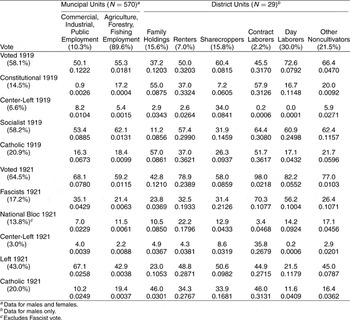
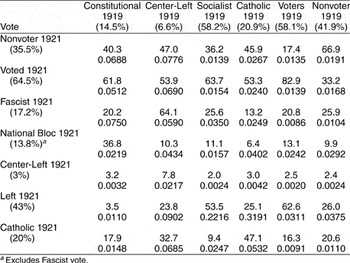
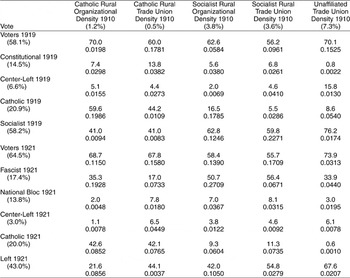
Districts supporting Fascism in 1921 differ substantially from the national average. Particularly in the rural sector, electoral turnout was higher, religious and class divisions were deeper, and voter transitions across the elections were larger. Table 2 presents individual behavior estimates for the administrative districts and municipalities. The Commercial and Industrial Census of 1927 provided information for the municipal units, but cultivation arrangements were available only for the district units in the 1921 Population Census. For Table 3 and Table 4 the estimates use the municipal units. Three statistics provide the information in each table. The figure below each row and column heading, in parentheses, is the observed mean value for that variable. For example, in Table 2 commercial, industrial, and public employees made up 10% of the labor force, and 58% of enfranchised voters voted in the 1919 election. Each cell in the table contains two figures. The upper figure is the estimate; the lower figure is the standard error. In Table 2 an estimated 50% of the enfranchised electorate employed in commercial, industrial, and public activities voted in 1919, with a standard error of 0.1222.
Table 2 clearly shows Fascism's agrarian base. An estimated 19% of the electorate employed in agriculture, forestry, and fishing voted Fascist, and, in contrast, only 3% of those in commercial, industrial, and public employment voted Fascist. In other words, 86% of the Fascist vote came from the rural sector, where the voter turnout was substantially higher than the nationwide average. Nationally, property holders had higher rates of turnout than landless rural laborers in both the1919 and the 1921 elections, but where Fascism was more successful the opposite occurred. Overall, 66% of family farmers and 40% of day laborers voted in 1919, but in areas of greater Fascist success 37% of family farmers and 73% of day laborers voted. Similarly, in 1921, turnout, particularly for the contract laborers and day laborers, was higher than the national average in areas supporting Fascism.
Additionally, both class and religious divisions were deeper in areas of higher Fascist voting. Family farmers and day laborers particularly demonstrated greater partisan voting. Family farmers divided almost equally between the Constitutional bloc and the Catholic parties, while day laborers allied themselves to the Socialists. However, in the 1921 election an estimated 70% of the contract laborers and 56% of the day laborers voted Fascist, consequently, support for the Left declined dramatically among these laborers. In 1919, 64% of contract laborers had voted Socialist, but in 1921 only 45% voted for the Left, and among day laborers Socialist support declined from 61% to 22%. Sharecroppers shifted from the Center-Left in 1919 (34%) to the Fascists in 1921 (31%; but note the high standard error), and only 9% of sharecroppers continued to vote for the Center-Left in 1921. Family farmers showed the smallest shift to Fascism. Meanwhile, the Catholic and the Left parties retained their support among renters and sharecroppers, and the Catholics retained most to their support among family farmers. These results strongly contradict the class theory of fascism.
Table 3 presents the voter transition matrix for the 1919–21 elections. The estimates indicate that 20% of Constitutional bloc voters, 64% of Center-Left voters, 26% of Socialist voters, 13% of Catholic voters, and 25% of nonvoters in 1919 shifted to the Fascists in 1921. Interpolating these figures, the distribution of the Fascist vote in 1921 can be compared to the 1919 electorate. The Constitutional bloc represented 10% of the 1919 electorate and 14% of the total 1921 Fascist vote. The figures for the other blocs are as follows: Center-Left, 6% and 5%; Socialists, 41% and 40%; Catholics, 15% and 6%; and nonvoters, 30% and 35%. Constitutional bloc voters and nonvoters in 1919 were overrepresented among Fascist voters, but Catholic voters were underrepresented. Most overrepresented were those who did not vote in 1919 but did vote in 1921. An estimated 10% of those who voted in 1919 voted Fascist in 1921, but 22% of those who did not vote in 1919 and did vote in 1921 voted Fascist. While the Fascists benefited most from the mobilization of previous nonvoters, the Left bloc benefited least. Overall, the Socialists retained 54% of their 1919 support and the Catholics 47%. These voter transitions are crucial to understanding the rise of Italian Fascism.
Table 4 presents the estimates for the vote of rural organizational members. The ability of these organizations to deliver votes to their party allies in 1919, particularly the Socialist organizations and unaffiliated rural trade unions, is dramatic. However, equally striking is the weakness of these same organizations to constrain the shift to the Fascists in 1921. In the 1919 election, an estimated 63% of all Socialist rural organization members and 60% of Socialist rural trade union members voted Socialist. In addition, an estimated 76% of the unaffiliated trade union members voted Socialist. For the Catholic rural organizational and trade union members, the results are more mixed. Although 60% of all Catholic rural organizational members voted Catholic, only 44% of Catholic rural trade union members voted Catholic. In each case, 41% voted Socialist. Thus, the Catholics were less successful than the Socialists in using organizations to mobilize partisan voting, and these results reflect a region variously designated anticlerical, “Red,” and de-Christianized.
However, in 1921 the situation is reversed. Catholic rural trade unions (78% of whose members were sharecroppers and tenants) were more successful in delivering the vote to the Catholic party than the Socialist unions were in delivering their members' votes to the Left. An estimated 17% of Catholic rural trade union members voted Fascist, but 56% of Socialist trade union members voted Fascist, as did almost half of all Socialist rural organizational members. Unaffiliated rural trade unions were more successful in mobilizing their members' votes for the Left (68%), but still 34% voted Fascist. Because the unaffiliated unions were also targets of Fascist violence for their Socialist support in 1919, the differences between the Socialist and unaffiliated estimates discount the effects of that violence and make it necessary to examine alternative hypotheses.
Because Fascist electoral support came disproportionately from landless wage laborers, the class interpretation of fascism is not supported. Although contract and day laborers made up 30% of the electorate, they constituted 46% of the total Fascist vote. An estimated 56% of all day laborers and 70% of contract laborers voted Fascist, with the differences between contract and day laborers examined below. Moreover, the class thesis that Fascist support came disproportionately from family farmers fails. Although the Fascists did gain support from family farmers, they constituted only 5% of the total Fascist vote, although they formed 16% of the electorate. Because these results so clearly contradict a central interpretation of Fascism, it is all the more important to test alternative hypotheses. Events in the Province of Bologna offer a more detailed perspective on the rise of Fascism.
Fascism in Bologna Province
Several factors make Bologna, the agricultural capital of the Po Valley, a good test case. Bolognese agriculture ranked among the most progressive and prosperous in Italy, and four commercial crops–-sugar, wheat, hemp, and rice–-generated the province's wealth. Although the province also had a long history of Socialist politics and trade unionism, the Fascists won 23% of the vote in the May 1921 election, and Mussolini himself won a parliamentary seat. In the months leading up to the election (January 1920 to May 1921), the province experienced the highest rate of political violence in the Po Valley; “[i]n the most important agricultural areas of the province, however, Fascist violence and agrarian pressures, unlike Ferrara, had not significantly weakened the allegiance of the mass of day laborers to the leagues by the summer of 1921 … ” (Cardoza 1982, 370). Nevertheless, an estimated 18% (standard error = 0.040) of 1919 Socialist voters, 33% (0.070) of Socialist unionized day laborers, and 25% (0.024) of all unionized day laborers voted Fascist in 1921. Because the shift of Socialist voters to Fascism cannot be attributed to overt violence, alternative explanations are required. Two possibilities are covert intimidation by land owners and the impact of the 1919–20 agricultural strikes.
Covert intimidation by definition remains unobservable, however, two plausible indirect, observable measures for the municipal units (N = 49) are reports of intimidation leading up to the May 1921 election and spread of Fascist nuclei across the province's municipalities from December 1920 to May–June 1921 (Cardoza 1982, 290–386, 318–19). The analysis assumes that the greater the presence of these two observed variables, the greater the likelihood of covert intimidation. This unobservable or latent variable extracts the common variance of the observed variables. Although the two indicators of intimidation load strongly (0.780 and 0.540) and significantly on the intimidation latent variable and a SEM with 200 bootstrap samples generates an excellent fit to the data (normed fit index = 0.936) with stable coefficients, the model shows no significant effect of intimidation on the Left vote or Fascist vote in 1921.
An alternative explanation may be found in Bologna's agricultural production modes and the destructiveness of the 1919–20 strikes. The province was divided into three agricultural zones, with the two highly commercial zones operated on a four-year crop rotation cycle (Robertson 1938; Zattini 1925, 72–73). The lower Po plain (consisting of nine municipalities) generated the highest value per hectare (698 lire), specialized in rice (45% of the cultivated area) and sugar beets (48%), and had 59% of the rural workforce employed as wage laborers. The upper Po plain (consisting of 10 municipalities) was less productive (585 lire), focused on wheat (20%) and hemp (24%), and had 31% of the rural workforce employed as wage laborers. The third agricultural zone, consisting of mountains and foothills, was the least productive (394 lire), possessed mixed agriculture, and had 36% of the workforce employed as wage laborers.
Politics, trade unionism, and Fascist diffusion also differed across the three zones. In 1919, the Socialists gained 79% of the vote in the rice and sugar zone, 78% in the wheat and hemp zone, and 62% in the mixed agricultural zone. Trade unionism also was concentrated in the two commercial zones. In the sugar and rice zone, 50% of the rural laborers were organized; in the wheat and hemp zone, 54%; and in the mixed agricultural zone, 16%. Fascist nuclei first sprouted in the mixed agricultural zone, later spread to the wheat and hemp zone, and appeared last in the sugar and rice zone. By May–June 1921, all of the municipalities in the sugar and rice zone had nuclei, but they existed in only 77% of the municipalities in the wheat and hemp zone and 50% of the municipalities in the mixed agricultural zone. Why did Fascist nuclei arrive later, but with broader penetration, in the more commercial and more unionized agricultural zones? The answer may be found in the destructiveness of the 1919–20 rural strikes. The strikes were particularly damaging in the sugar and rice zone, with 58% of the rice and 19% of the sugar crops destroyed (Cardoza 1982, 287; Perdisa 1938, 258). Lower, but substantial, losses occurred in the wheat and hemp zone, where wheat yields declined by 33% (Zattini 1920, 21). Overall unemployment in the province doubled from January–May 1920 to January–May 1921, with the higher rates in the commercial zones (Tremelloni 1923, 15).
The estimated voter transitions suggest a reaction against the Socialist-led strikes, their destructiveness, and the resulting unemployment. In municipalities in the rice and sugar zone, the estimate shows that 22% (0.043) of the 1919 Socialist voters voted Fascist and 59% (0.121) voted Left in 1921; in the wheat and hemp zone, 17% (.055) voted Fascist and 62% (0.145) voted Left. On the other hand, in the mixed crop zone, 14% (0.046) of 1919 Socialist voters voted Fascist and 75% (0.015) voted Left. Four conditions produced the shift of Socialist voters to Fascism: a higher density of wage laborers, a higher 1919 Socialist vote, a higher trade union membership density, and more destructive strikes in 1920.
EXPLAINING POPULAR SUPPORT FOR FASCISM
Popular support, particularly “working-class” support, for fascism has long been controversial because it goes to the core of the debate on the character and appeals of fascism. The major scholarly explanations of popular support for fascism include intimidation, tactical miscalculations by the Left, and material self-interest, the latter being the essence of the rational fascist thesis. The first of these explanations, overt violence and covert intimidation, received no support, but the second and third require additional scrutiny.
Political Tactics of the Left: A Trust Broken?
Did the increased militancy of the Left indirectly and unintentionally aid Italian Fascism? Did the leaders' militancy produce defections to Fascism? During this period in Italy, as in most all of Europe, the Socialists were divided among the Communists, the Maximalists, and the Official Socialists, foreshadowing the formation of the Communist Party in 1921.15
At the January 1921 Congress, the party split on the question of the Third International: 53% for the Communists, 31% for the Maximalists, and 16% for the Official
Socialists. The 1921 election took place in May 1921.
The war and the Russian Revolution inflamed the passions of those arguing for the “proletarianization” of rural workers, the collectivization of land, and the promotion of revolution. The 1919 Congress of
La Federazione nazionle dei lavoratori della terra (The National Federation of Land Laborers) in Bologna urged the abolition of rural working-class distinctions that hindered worker unity (
Zangheri 1960, lxxiv, 350). These debates heightened the tensions within the Socialist agrarian trade unions and culminated with the Socialist labor contracts of 1920 abolishing the distinctions between contract laborers and day laborers (
Cardoza 1982, 283ff.;
Corner 1975, 150–59;
Serpieri 1930, 305–6). Proletarianization meant loss of the contact laborers' right of first-hire and forced them into the same precarious status and poverty as day laborers. The 1920 labor pact, therefore, deepened the divisions within the Socialist agrarian unions (
Cardoza 1982, 366–67;
Corner 1974, 22–23). Meanwhile, the Catholic unions and the Fascists took up the cause of the contract workers (
Serpieri 1930, 314–19). The relative strength of contract and day laborers in the trade unions was also highly significant because both the Socialist and the unaffiliated agrarian unions organized workers by cultivator status, with separate organizations for contract laborers and day laborers. Overall 19% of day laborers were unionized, with 12% in Socialist and 7% in unaffiliated unions. Fifty-nine percent of contract laborers were unionized, with 45% in Socialist and 14% in unaffiliated unions. In both labor movements, day laborers made up the largest proportion of the membership, constituting 54% of the Socialist and 18% of the unaffiliated agrarian trade union membership, respectively. Day laborers constituted a significant 30% of all cultivators. Although the contract laborers constituted only about 2% of the cultivators, their numbers made up 14% of the Socialist and 3% of the unaffiliated agrarian trade union members, resulting in their influence in the agrarian unions far exceeding their numbers in the workforce. Hence, their transition to Fascism was highly significant.
Socialist contract laborers' sense of betrayal made them prime candidates for Fascism as shown by the estimates of the contract and day laborer trade union members' electoral behavior in 1919 and 1921 listed in Table 4 (also see Corner 1975, 159). The standard errors suggest some caution, but the estimates are strongly in the expected direction. Although all four groups voted Socialist in 1919, the Socialist unionized laborers defected to Fascism, while the unaffiliated trade union members did not. On the whole, contract laborers were overrepresented among Fascist rural voters by a ratio of 2.2:1 compared to their proportion in the potential electorate, while Socialist unionized contract laborers were overrepresented by a ratio of 1.1:1. Taken as a whole, day laborers were overrepresented in the Fascist vote by a ratio of 1.5:1 compared to their proportion in the potential electorate, while Socialist unionized day laborers were overrepresented by a ratio of 1.2:1.16
The ratios are the proportion in the electorate weighted by the likely turnout weighted by the probability of voting Fascist.
In contrast, unaffiliated unionized contract and day laborers, not subject to the 1920 Socialist labor pact, were underrepresented by ratios of 0.88:1 and 0.48:1, respectively.
The Socialists' heightened militancy, calls for proletarianization, and demands for land collectivization may account for these defections. In Bologna, where violence and intimidation show no effect on Fascist voting, Fascist support was higher where the 1920 strikes were more destructive. In Ferrara, a city at the center of both labor unrest and Fascist violence, the Socialist press, in April 1921, noted that “the present defections [of day laborers] are the work of those who came last to the proletarian organization because they are unhappy with the regime of social and working-class justice brought about through the labor exchanges” (Corner 1975, 159). In May 1921, a Socialist leader in Ferrara resigned in protest because the party failed to counter “the daily enthusiastic adhesion of large masses of labourers to the programme of fascio” (1975, 144). In June 1921, following the election, the same paper wrote that day laborers possessed “only partial class-consciousness, an inadequate preparation for sacrifice” in the struggle against Fascism (1975, 159–60).
Leaders on the Left expressed exasperation at these defections. In June 1921, Gramsci remarked, “ … In Emilia, in Polesine, in Veneto, many leagues of contadini [generally referring to peasants, but particularly contadini obbligati, contract laborers] have torn up the red flag and passed to Fascism” (Bernabei 1975, 123). Gramsci also noted that while violence played a part in Socialist defections, “it is not all exaggeration, it is not always a case of compulsion” (Corner 1975, 144). Togliatti attributed Fascist support to “a certain mass base in the countryside, particularly Emilia” (Bernabei 1975, 123). Although the defections of Socialist trade union members were significant, they can account for only a proportion of the total Fascist vote.
Prospects for a Better Life: A Rational Choice?
All the parties offered prospects for a better life. The Socialist vision rested on collectivized land promised to landless wage laborers (Serpieri 1930, 290–93), while the Catholic movement offered an alternative tailored to its own social base. Significantly, 78% of the Catholic rural cooperative movement and trade union members were sharecroppers and tenants in 1920 (Horowitz 1963, 124), and, with few exceptions, e.g., Cremona (Foot 1997), the Catholic trade unions had ignored the landless laborers. The Catholic party's electoral strategy was motivated by a desire to avoid alienating their supporters among small holders and sharecroppers, the Church's long-standing commitment to the sanctity of private property, and the Catholic view that economic differences must be reconciled within the harmonious hierarchy of society (Agocs 1988, 153–63; Caponi 1974, 46–55). These differing visions made attempts at a Catholic–Socialist rural trade union alliance very difficult, and Catholic union members acted as strike breakers against the Socialists in 1919 (Snowden 1989, 52).
The Fascists also promised a better life by proposing land redistribution to create private holdings. As early as the 1919 election, the Fascist program of the Piazza San Sepolcro advocated the eight-hour day for all workers. By late 1920, as the economic circumstances of the day laborers deteriorated, the Fascists launched their agrarian program.17
Sharecroppers, renters with fixed contracts, and small farmers fared better than laborers, whose situation deteriorated markedly (Serpieri 1930, 117–20, 144). Although nominal wages improved because of reductions in the working day, increased staffing requirements, and wage adjustments (Arcari 1936, 679–80), real wages of agricultural workers declined by 9% from 1919 to 1920 (Zamagni 1993, 238). In addition, take-home wages declined because of prolonged strikes and rising unemployment (Hobson 1925, 429; Serpieri 1930, 415). Serpieri (1930, 144) concluded that of all cultivator types in the Po Valley, laborers dependent only on wages, a phenomenon most characteristic of the Po Valley, suffered the most.
In January 1921, the Fascists began tailoring their appeals to the landless workers for the upcoming May 1921 election with such slogans as “To every peasant his land! To every peasant the entire fruit of his sacred work” (
Cardoza 1982, 326–27), and “The single most important idea of our farm workers is not the collective ownership of land, but the individual ownership of property” (
Corner 1974, 13).
Fascist strategies varied according to the land ownership patterns, the makeup of the labor force, and the political traditions of the region.18
The tactics included (1) the creation of producer, credit, and consumer cooperatives; (2) the intervention in strikes and the securing of more favorable terms than the Socialist or Catholic unions had offered, (3) the creation of alternative hiring halls to the Socialist Chambers of Labor, (4) the restitution of fines imposed by Socialist unions on members for breaking boycotts, and (5) the redistribution of land, among others. These tactics varied with the local conditions. Legislation of February 1918 and September 1919 permitted the requisitioning of underutilized land for use by cooperative movements. Socialist, Catholic, and later Fascist organizers sought to take advantage of the law. The cooperatives offered credit, insurance, and marketing assistance (Cardoza 1982, 337; Corner 1975, 159; Hobson 1926; Serpieri 1921). Adapting to local conditions, the Fascists settled strikes on more favorable terms than the Socialists or the Catholics proposed. For example, in June 1921 in Cremona, after a long and bitter strike, the Fascists opposed collective ownership of the land favored by the Catholic rural unions in opposition to the Catholic party's position (Foot 1997) and offered profit sharing (Serpieri 1930, 319–20). The agreement was popular because it gave the former contract laborers more secure access to land. In contrast, in Tuscany, where sharecropping was more prevalent, the Fascists sided with sharecroppers in some areas and with day laborers in others, sometimes shoring up tenant rights and at other times demanding land reform (Snowden 1989, 97ff.). In the Po Valley, where day laborers predominated, the Fascists created alternative hiring halls and syndicates, provided legal services, and offered more favorable wage agreements than the Socialists. In other areas, profit sharing contracts were advanced (Cardoza 1982, 337; Snowden 1989, 101). The Fascists also offered protection against fines imposed by Socialist unions (Cardoza 1982, 337–38). Actual redistribution of land appeared in several regions. In Ferrara by September 1921, the Fascists claimed to have redistributed 18,000 hectares, a little less than 10% of the productive surface of the province, and claimed to have resettled 4,000 families (Corner 1975, 157–58; also see Lyttelton 1987, 63, 460, n. 107). Similarly in Tuscany, prominent landlords on the Pisa plain, in the Chiana Valley, and in the Sienna region made land available to the Fascists for resettlement of landless workers (Snowden 1989, 97). In July 1921, the Fascists in Bologna also made land available for leasing (Cardoza 1982, 354). In Brescia, Turati, a native of Po Valley syndicalism, advocated land redistribution as well (Kelikian 1986, 140–41). The Fascists also capitalized on local political traditions. Particularly in the Po Valley, with a strong syndicalist tradition, major leaders of agrarian fascism passed through syndicalism–-Grandi, Bottai, Turati, Balbo, and Panunzio, among others (Roberts 1979, 182–212). Usually landlords cooperated with the Fascists in the joint effort to blunt Socialism, but in other cases pressure was also applied (Corner 1975, 157; Kelikian 1986, 144–53; Snowden 1989, 64–65). In at least one case, Santa Maria in Veneto, the Fascists seized and occupied the land in 1920 (Evans 1976, 36–41, 51–53). Most of the land distributions took place after the 1921 election and before the consolidation of the regime following the Matteotti Crisis. Most parcels were of poor quality and unable to support the new cultivators, who eventually sought reemployment as sharecroppers and laborers. Nevertheless, between 1921 and 1936 (years of censuses), the proportion of day laborers in agriculture declined from 39% to 14% of the agricultural economically active labor force (Corner 1979, 244).
Rational choice theory would predict Fascism's success in the most economically destitute regions and among the most desperate–-wage laborers in the Po Valley–-and
Table 2 shows this to be the case. An estimated 70% of contract laborers and 56% of day laborers voted Fascist, whereas 64% and 61% had voted Socialist in 1919 (but note the high standard errors). Among rural occupations, day laborers are overrepresented by 1.5:1 given their proportion in the likely electorate, but all other rural strata are underrepresented, especially family farmers, at a ratio of 0.34:1.
CONCLUSIONS
The questions raised at the start of this paper focused on the conditions fostering transitions to democracy or fascism. How do we account for these alternative outcomes? Class, civil society, and rational choice interpretations offer potential answers. This research strongly contradicts the class interpretation of fascism as an alliance of the urban bourgeoisie and rural landholders against the urban and rural working classes. Small property holders, supposedly the bulwark of fascism in the countryside, were underrepresented among Italian Fascist voters, while day laborers were overrepresented. Neither violence nor intimidation explains these results.
This research finds only mixed support for the civil society thesis. Newly mobilized voters have often been portrayed as among those most susceptible to extremism. Although 1919 nonvoters were overrepresented (1.3:1) among Fascist voters, 1919 Socialist voters were equally overrepresented (1.3:1). Did organizational membership stem the movement to Fascism? The evidence is mixed. Socialist trade union members were overrepresented among Fascist voters, but independent trade union members were underrepresented. The defection of Socialist trade unionists is best explained as a response to the party's militancy and its proletarianization strategy. This suggests a weakness in the civil society explanation. If civil society is predicated on trust fostered by civic organizations, trust appears to be more strategic than unconditional and, when broken, decays markedly.
Rational choice explanations emphasize both the material appeals of fascism and the strategic nature of trust. Fascist voters came disproportionately from the most impoverished segment of the rural population, who stood to gain the most materially from the Fascist agrarian program and whose trust was strained, if not broken. During the war, the government vowed agrarian reform to bolster sagging morale but failed to deliver.19
Following the defeat of the Italian forces at Caporetto in 1917, the government sought to motivate the peasant-soldiers with promises of land reform under the slogans “Fight for Italy and she is yours!” and “The land to the peasants!” Prime Minister Salandra declared, “After the victorious end of the War, Italy will perform a great deed of social justice. Italy will give land and everything that goes with it to the peasants, so every hero who has fought bravely in the trenches can become economically independent. That will be the Fatherland's reward to its brave sons” (Schmidt 1966, 27; also see Cardoza 1982, 246–47). The statement was widely distributed at the front. Commenting on the consequences of these promises, Gioletti, President of the Cabinet, in a speech at the meeting of the Senate, September 26, 1920, stated, “All parties vied with one another, just then, in giving promises, vague, indeterminate, and alluring. They promised land to the peasant and factories to the soldiers; promises that meant nothing to those who made them, while those who received them considered them their just deserts” (Por 1923, 37n).
After the war, Socialist militancy, prolonged and destructive strikes, and rising unemployment left many Socialist unionized laborers disenchanted and destitute by 1921.
20 In 1920, 44 strikes by day laborers occurred in the Po Valley, with the average strike involving 33% of the day laborers (Direzione Generale del Lavoro e della Providenza Sociale and Ministero dell'Economia Nazionale 1924, 295). As noted in the discussion of Bologna above, the strikes were extremely violent and devastated productive capacity. All major commercial crops suffered significant destruction. In addition, July 1920 witnessed the collapse of the international hemp market (Cardoza 1982, 288). From January–May 1920 to January–May 1921, unemployment increased by about 100% in Emilia, 200% in Lombardia, over 300% in Piemonte, and over 800% in Veneto (Tremelloni 1923, 15). Corner (1975, 159, n. 3) notes, “The decline [in the number of obbligati] before 1921 and the rise thereafter suggests there were possibly several thousand displaced obbligati eager to return to their former privileged position once it was clear that socialism had passed its peak.”
In addition, the Socialists abandoned their unionized contract laborers under the new labor contracts of 1920. Differing estimates for Socialist and unaffiliated union members support this interpretation.
The findings of this research are generally most consistent with the rational fascist interpretation. The civil society thesis receives support because under some conditions organizations restrained the shift of their members to fascism. These specific conditions, however, suggest that members' organizational loyalties were more strategic than unconscious “Habits of the Heart.” When individuals are disillusioned, the newcomer gains the advantage. Fascism was just such a newcomer, joining the political fray unfettered by a past and opportunistic about the future. While its support no doubt shifted over time, Italian Fascism initially found its popular base among the disillusioned and impoverished rural laborers in the Po Valley. Focused on a short time horizon, the Fascists had few reasons to weigh the future of the society and many reasons to become “roving bandits” on the road to becoming “rational autocrats.”
Here we have to note two things; first, that the people often, deceived by an illusive good, desire their own ruin, and, unless they are made sensible of the evil of the one and the benefit of the other by some one in whom they have confidence, they will expose the republic to infinite peril and damage. And if it happens that the people have no confidence in any one, as will be the case when they have been deceived before by events or men, then it will inevitability lead to the ruin of the state.
If we consider now what is easy and what is difficult to persuade a people to, we may make this distinction: either what you wish to persuade them to represents at first sight gain or loss, or seems brave or cowardly. And if you propose to them anything that upon its face seem profitable and courageous, though there really be a loss concealed under it that will involve the ruin of the republic, the multitude will ever be most easily persuaded to it. But if the measure proposed seems doubtful and likely to cause loss, then it will be difficult to persuade the people to it, even though the benefit and welfare of the republic were concealed under it. (Machiavelli [1531] 1950, 247–48)






Comments
No Comments have been published for this article.