Introduction
Neuralgic amyotrophy (also known as brachial plexus neuropathy, brachial plexus neuritis and Parsonage–Turner syndrome) is a rare polyneuropathy that classically affects the brachial plexus. It has been recognised as a diverse clinical syndrome that may present in a variety of manners and involve diverse peripheral nerves.Reference To and Traquina1 It is an inflammatory disease, and typically characterised by acute and severe shoulder pain, followed by paresis with muscle weakness and atrophy of the upper limb or shoulder girdle.Reference Holtbernd, Zehnhoff-Dinnesen, Duning, Kemmling and Ringelstein2 Neuralgic amyotrophy may also involve the phrenic nerve and more rarely the recurrent laryngeal nerve.Reference To and Traquina1
Neuralgic amyotrophy was first described by Parsonage and Turner in 1948.Reference Parsonage and Turner3 The incidence has been estimated at approximately 2–4 in 100 000 persons per year. It is observed between the third and sixth decades of life, and has a slight male preponderance.Reference Chen, Hu and Cheng4 Besides the idiopathic form, a hereditary autosomal dominant disorder caused by a mutation in the SEPT9 gene on chromosome 17q25 was recently described.Reference Kuhlenbäumer, Hannibal, Nelis, Schirmacher, Verpoorten and Meuleman5 The probability of neuralgic amyotrophy recurrence in the course of a lifetime is up to 25 per cent in the case of the idiopathic form and up to 75 per cent in the case of the hereditary form.Reference van Alfen6
In the majority of patients, the course of neuralgic amyotrophy is benign, with recovery of muscle function within a few months to two years. The differential diagnosis of neuralgic amyotrophy includes: cervical spinal disc herniation; vasculitic mononeuritis multiplex; and inflammatory, toxic, neoplastic or traumatic lesions of the brachial plexus and other peripheral nerves such as the recurrent laryngeal nerve. We report an unusual case of neuralgic amyotrophy presenting with vocal fold paralysis as the predominant symptom.
Case report
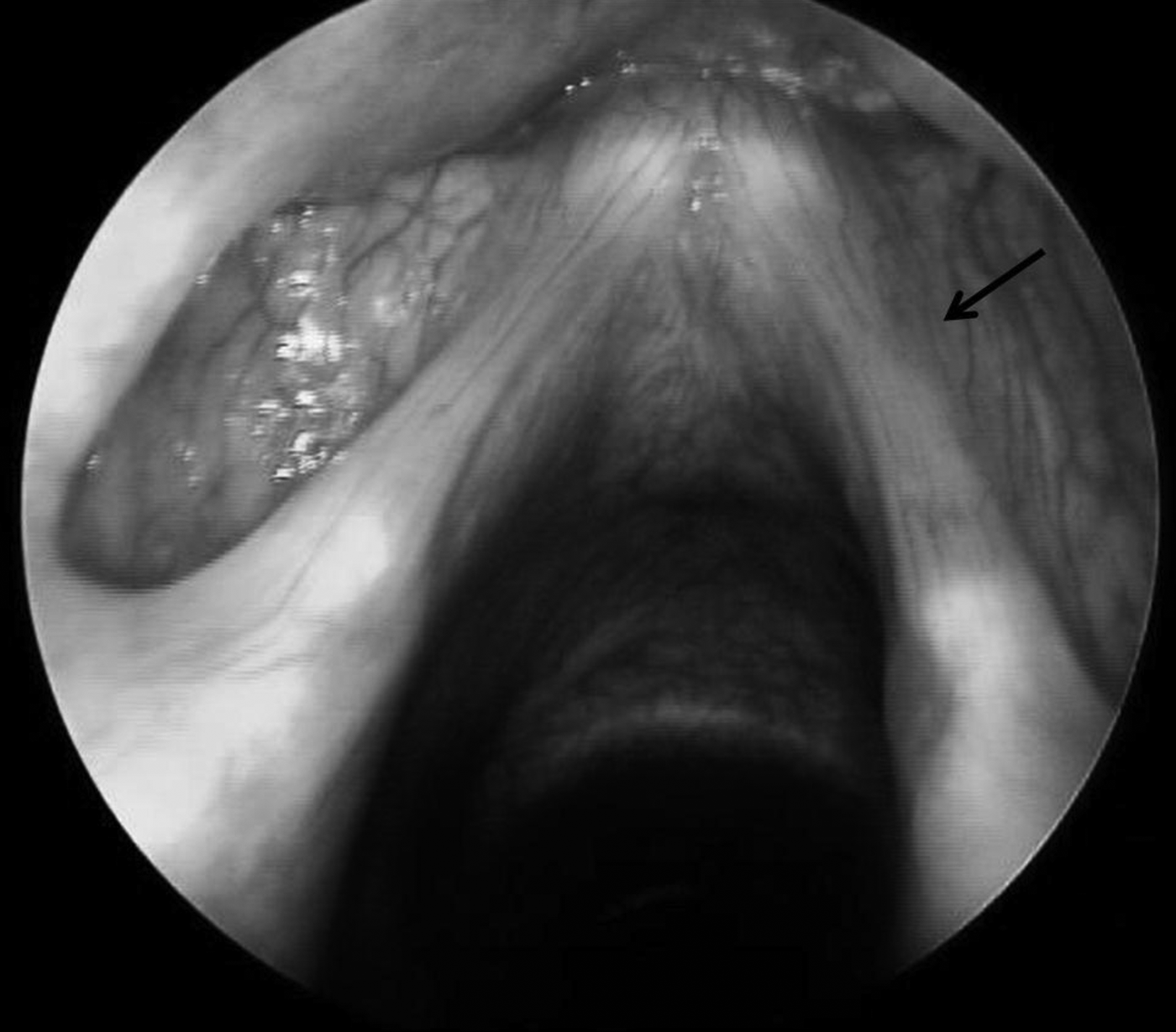
A 36-year-old male presented with hoarseness, which had developed within a week, without dysphagia. Eleven years previously, the first manifestation of the disorder was also characterised by the similar symptoms of hoarseness without dysphagia. These symptoms were present for one year and subsided following electro-physiotherapy. The current laryngoscopy findings of the second manifestation showed limited adduction of the right vocal fold without limited abduction, and discreet atrophy of the right vocal fold. Stroboscopy exposed an irregular and extended amplitude of the right vocal fold. The remaining ENT examination findings were normal.
Laryngeal electromyography (EMG) of the vocalis muscle and of the interarytenoid muscle revealed a neurogenic lesion. The cause of dysphonia was an adduction weakness of the right vocal fold, which was a manifestation of an incomplete injury of the right recurrent laryngeal nerve (Figure 1).
Laryngoscopic view showing discreet atrophy of the right vocal fold (arrow).

On neurological examination, a progressive weakness of the right shoulder and arm muscles was found. There were fasciculations of the right pectoral muscles, the triceps brachii dexter muscle and the biceps brachii dexter muscle. There was no sensory disturbance and no shoulder pain. Weakness and atrophy in the right deltoid muscle were also noted, along with atrophy only on exertion in the right triceps brachii muscle and the right abductor digiti minimi muscle.
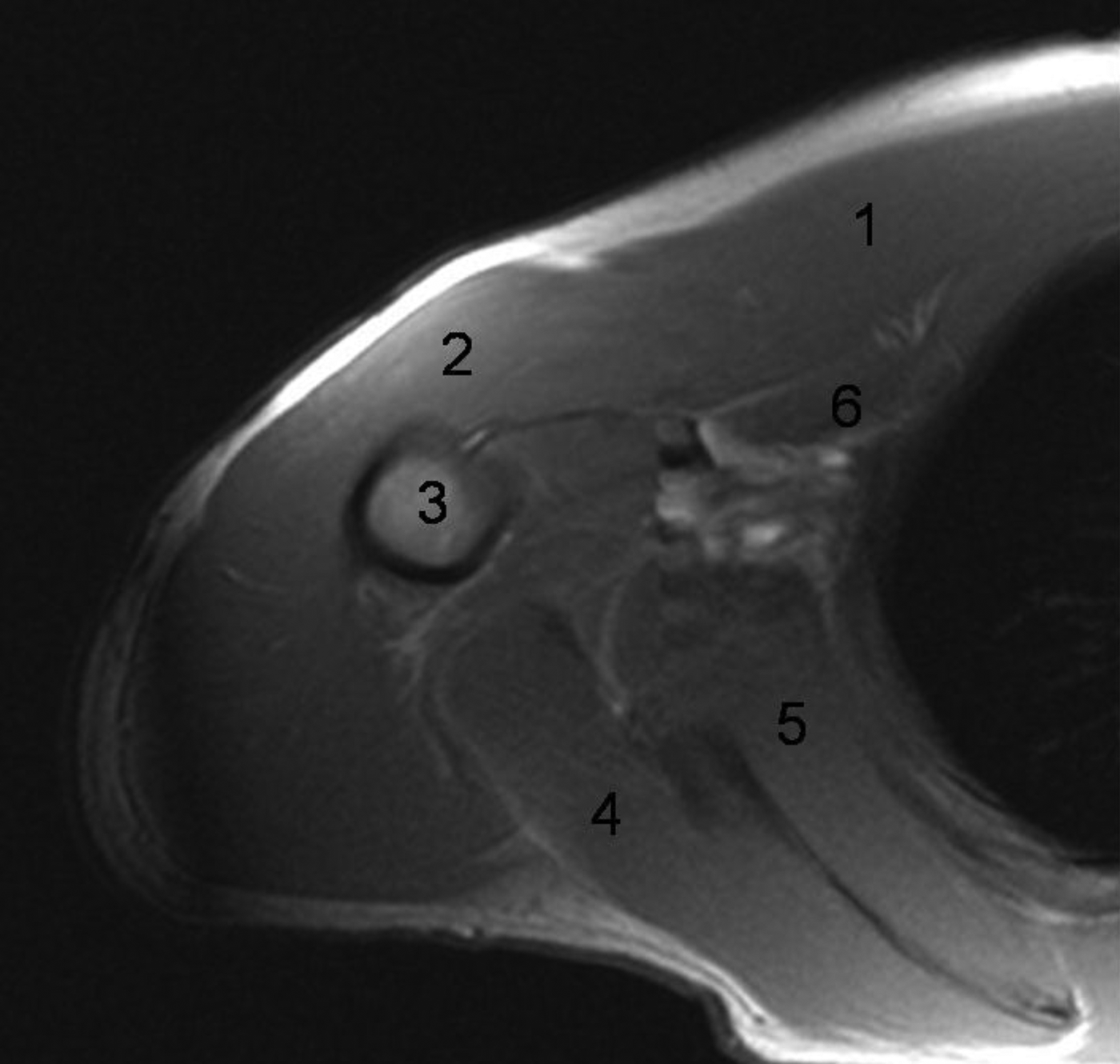
Needle electromyographic study of the triceps brachii dexter muscle and right deltoid muscle showed increased motor unit action potentials, which were signs of chronic denervation. Electroneurographic study of the right radialis nerve indicated a proximal impairment. Magnetic resonance imaging showed atrophy of the right deltoid muscle; however, the brachial plexus, shoulder and throat were normal, with no abnormal enhancement (Figure 2). On the basis of all findings, we diagnosed neuralgic amyotrophy.
Axial magnetic resonance imaging view showing right deltoid muscle atrophy.1 = pectoralis major muscle; 2 = deltoid muscle; 3 = humerus; 4 = infraspinatus muscle; 5 = subscapularis muscle; 6 = pectoralis minor muscle.
Initially, as conducted 11 years previously, electro-physiotherapy was performed to improve the hoarseness and weakness of the right shoulder and arm muscles. This time the treatment was without benefit. The patient subsequently underwent speech therapy in an attempt to treat the hoarseness; however, there was no improvement of the complaints. Therefore, after five months, microlaryngoscopy with augmentation of the right vocal fold using hyaluronic acid was performed. The effect of hyaluronic acid is transient. Progression of the underlying disease affecting the larynx declined slower than the effective period of hyaluronic acid lasted. The vocal fold reconstruction with hyaluronic acid was thus repeated twice, with three-month intervals. This resulted in overall satisfactory regression of the dysphonia. After the third injection, there was no further progression of the dysphonia.
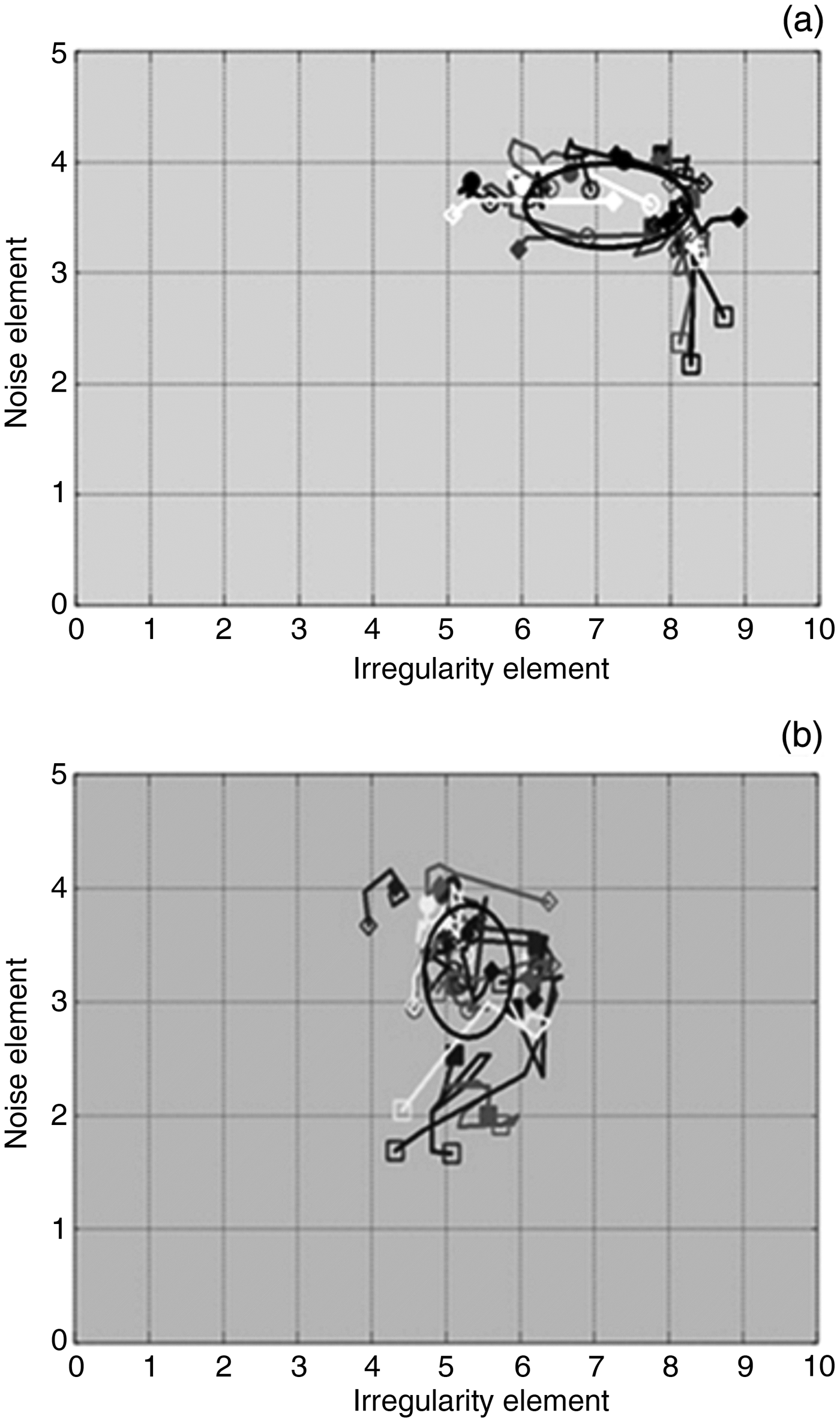
Therapeutic success was measured by performing a voice analysis (Figure 3). The dysphonia severity index was −2.09 before therapy but reached −0.13 after therapy, which was considered a satisfactory result. Six months after the last injection with hyaluronic acid, the dysphonia had considerably improved.
Voice analysis findings of the patient before (a) and after (b) the second vocal fold augmentation. Less limited voice dynamics and a broader vocal range were achieved after augmentation.
Discussion
Vocal fold paralysis is a rare feature of neuralgic amyotrophy. To our knowledge, less than 10 cases with such an association have been reported in the literature. These include: a 5-year-old child with bilateral laryngeal paresis due to neuralgic amyotrophy;Reference To and Traquina1 a 62-year-old man with left vocal fold and phrenic nerve paralysis, and a 5-year history of nasopharyngeal cancer;Reference Chen, Hu and Cheng4 and a 55-year-old man with bilateral phrenic nerve palsy, with concomitant laryngeal paresis.Reference Holtbernd, Zehnhoff-Dinnesen, Duning, Kemmling and Ringelstein2 Our patient suffered from partial paralysis of the right recurrent laryngeal nerve.
Viral and autoimmune theories have been proposed regarding the development of idiopathic neuralgic amyotrophy. Nevertheless, the aetiology and pathogenesis of neuralgic amyotrophy is as yet unknown.Reference To and Traquina1 However, the prognosis of vocal fold paralysis in cases of neuralgic amyotrophy is excellent; most patients recover from pain and weakness slowly over months to two or three years.
The typical clinical image of neuralgic amyotrophy is shoulder dysfunction and other consequences of peripheral nerve involvement in the neck region. Nevertheless, EMG is an important diagnostic tool. Electromyography measures the electric activity both in quiescent muscles (spontaneous activity) and arbitrarily contracted muscles (muscle action potentials). The use of EMG enables differentiation between myopathy and neuropathy, and discrimination among acute and chronic diseases. Therefore, EMG can confirm a chronic neurogenic lesion of affected nerves, which is typical of neuralgic amyotrophy. Electromyography is an easy to learn and quick to apply diagnostic method that should be utilised in the clinical routine.
• Neuralgic amyotrophy is a polyneuropathy that classically involves the brachial plexus
• An association with vocal fold paralysis is unusual
• For patients with neuralgic amyotrophy and laryngeal involvement, vocal fold augmentation with resorbable material is a more effective transient treatment than speech therapy alone
The present case shows that symptomatic treatment with speech therapy might be insufficient. Vocal fold augmentation is an additional option. Given the high probability of complete recovery in neuralgic amyotrophy cases, hyaluronic acid as augmentation material is recommended. It is resorbable and therefore has a temporary effect to bridge the functional deficit until full recovery of the recurrent nerve lesion occurs.
Neuralgic amyotrophy has a varied presentation and can affect cranial and peripheral nerves, including the recurrent laryngeal nerve. This diverse clinical entity may account for some of the idiopathic cases of vocal fold paralysis, and should be considered when other neurological manifestations are observed. Therefore, otorhinolaryngologists should be aware of the association between temporary recurrent nerve paresis and neuralgic amyotrophy. A careful history and neurological examination should be performed, and an EMG obtained. Treatment with resorbable hyaluronic acid could be supportive and more effective than speech therapy alone.