


Introduction
Being overweight or underweight in adulthood are important global health issues relating to cardio-vascular disease. In particular, having these conditions in the pre-pregnancy period is also associated with a risk of pregnancy complications, such as preterm birth, low birthweight, gestational diabetes mellitus (GDM), and hypertensive disorder of pregnancy (HDP). 1–Reference Sebire, Jolly, Harris, Regan and Robinson4 Thus, research on risk factors for being overweight or underweight among women is very important. Among these factors, the nutritional status during early life may be one of the most important factors, as suggested by the developmental origins of health and disease (DOHaD) theory, which posits that environmental influences during critical periods of development can impact the risk of being overweight or underweight in adulthood.
The original DOHaD theory focused on the fetal period; for instance, some reports have demonstrated excessive gestational weight gain during pregnancy which is considered as a proxy for fetal overnutrition that is significantly associated with “offspring overweight” in childhood, Reference Liu, Boghossian, Frongillo, Cai, Hazlett and Liu5,Reference Nguyen, Young and Khuong6 and others have shown a significant association between low birthweight (a proxy for fetal malnutrition) and being underweight in infancy. Reference Heidkamp, Piwoz and Gillespie7–Reference Vesel, Bellad and Manji9 The exposure period in recent studies has been expanded to “the first 1000 days (i.e., from conception through the second birthday).” Reference Beluska-Turkan, Korczak and Hartell10 As for nutrition during the neonatal and infancy periods, studies have reported that breastfeeding until 6 months decreased being overweight later in life. Reference Sata, Yamagishi and Sairenchi11–Reference Victora, Bahl and Barros13 However, to our best knowledge, there have been no studies of weight gain during early infancy (divided into 1, 3, and 6 months) associated with being overweight or underweight in adulthood among Japanese women. Individual studies on Japanese, Reference Akaboshi, Haraguchi, Mizumoto, Kitano and Kan14–Reference Nanri, Shirasawa, Ochiai, Ohtsu, Hoshino and Kokaze16 overweight or underweight in adulthood as outcomes, Reference Demerath, Reed and Choh17,Reference Odegaard, Choh, Nahhas, Towne, Czerwinski and Demerath18 and weight gain during the first several months as exposures Reference Akaboshi, Haraguchi, Mizumoto, Kitano and Kan14,Reference Odegaard, Choh, Nahhas, Towne, Czerwinski and Demerath18–Reference Hui, Schooling and Leung20 have been conducted. A well-designed study integrating these factors was required.
In Japan, the Maternal and Child Health Handbook (MCHH) is a nationally distributed booklet provided to all pregnant women. It records health data from the mother’s birth, infancy, and childhood to pregnancy to offspring’s birth, infancy, and childhood. Thus, MCHH data have been widely used for epidemiological studies considering environmental factors during the early stages of life as exposures. Reference Hosoya, Ogawa, Morisaki, Okamoto, Arata and Sago21 This study was conducted to assess associations of women’s birthweight and weight gain during their own infancy with the risk of being overweight or underweight as adults prior to pregnancy, using the MCHH.
Methods
Study setting and data source
This retrospective cohort study was conducted at the National Center for Child Health and Development (NCCHD) in Tokyo, Japan. Women were non-selectively approached during routine prenatal visits at the NCCHD between April 2017 and December 2021, depending on research staff availability. Although the recruitment was neither strictly consecutive nor randomized, most eligible women who were approached agreed to participate, and the risk of selection bias is considered minimal. Participants were asked to provide their own MCHH. The MCHH contains standardized health records routinely documented by healthcare providers throughout the perinatal and childhood periods. 22 During prenatal care, obstetricians or midwives document clinical details such as maternal weight, blood pressure, and urine test results. After birth, pediatricians or nurses record the infant’s growth (e.g., weight and height at 1, 3, and 6 months), feeding methods, and other developmental milestones. The handbook is retained by the family and regularly brought to medical checkups, making it a reliable and continuous source of health data from fetal to early childhood periods. In this study, trained research staff extracted relevant data directly from each participant’s MCHH, including their own birthweight, infant weight gain, and their mother’s pregnancy-related variables.
Eligibility and sample selection
The flow chart of study population selection is shown in Fig. 1. A total of 1501 women who agreed to participate and provide their own MCHH and questionnaire were eligible for this study. Of these, 60 women with missing data on pre-pregnant BMI, which is the primary outcome in the current study, were excluded. We performed multiple imputation to account for missing values in confounding variables. The primary analysis was subsequently conducted using the imputed dataset, including the remaining 1441 women. Among these, 35 with missing data on 1 month weight gain were excluded from an analysis of 1 month weight gain. Similarly, 70 and 336 were excluded from the analysis at 3 months and 6 months. Thus, the primary analysis was performed based on 1441 for birthweight, 1406 for 1 month weight gain, 1371 for 3 months weight gain, and 1105 for 6 months weight gain.
Flow chart showing the study population selection.

A sensitivity analysis using the complete-case dataset was also conducted in which 359 were additionally excluded because of missing any of the following data (Fig. 1): their mother’s pregnancy course including pre-pregnant BMI (n = 310), weight gain during pregnancy course (n = 315), HDP (n = 8), and gestational glycosuria (n = 38), or their current socio-economic status (n = 57) (there were some duplications).
Variables
Their own birthweight and infant weight gain from birth to 1/3/6 months were considered as the primary exposures of interest, as weaning food is generally started after 6 months. Birthweight was divided into the following five categories: ≤ 2499g, 2500 to 2999g, 3000 to 3499 g, 3500 to 3999 g, and ≥ 4000 g. As no general categorization was used, infant weight gain was divided into quintiles, as follows: (1) to 1 month: 365–810 g (Q1), 815–982 g (Q2), 982–1144 g (Q3), 1145–1320 g (Q4), and 1322–2770 g (Q5); (2) to 3 months: 1040–2680 g (Q1), 2682–3006 g (Q2), 3007–3330 g (Q3), 3331–3765 g (Q4), and 3766–5750 g (Q5); (3) to 6 months: 1540–3940 g (Q1), 3970–4352 g (Q2), 4355–4730 g (Q3), 4738–5228 g (Q4), and 5230–7700 g (Q5). The primary outcome of interest was pre-pregnant BMI at recruitment, which was extracted from the medical chart. Overweight and underweight were defined as pre-pregnant BMI ≥ 25 kg/m2 and<18.5 kg/m2, respectively.
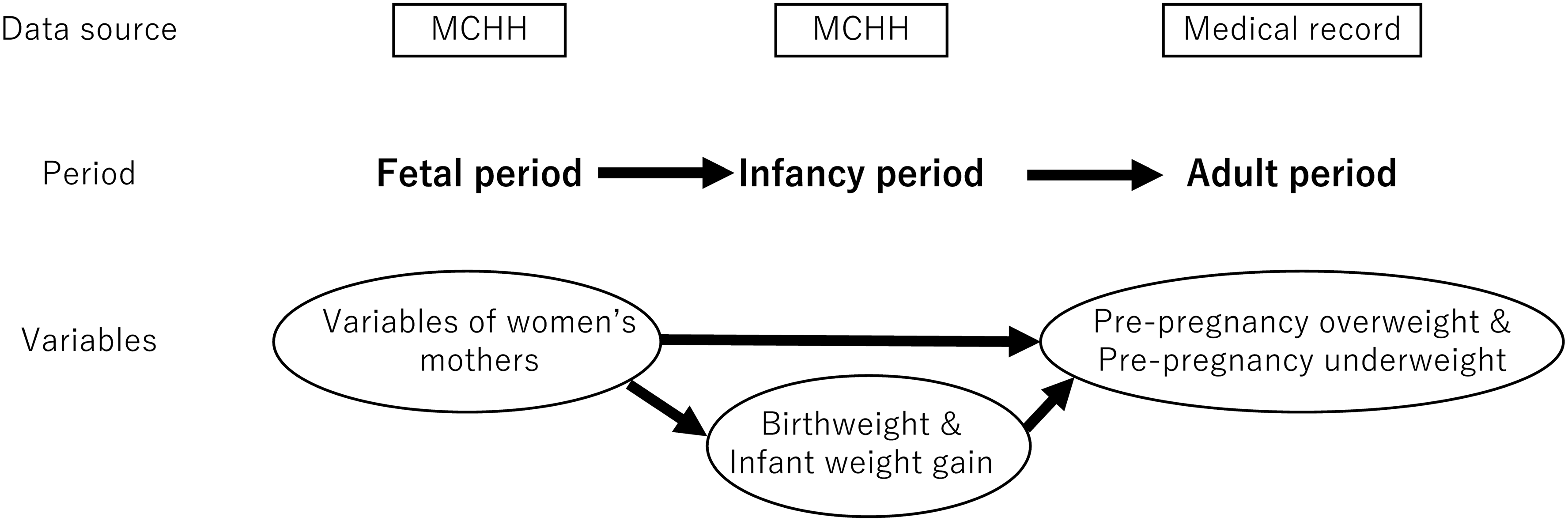
The following possible confounding variables were considered: physical status of the woman’s mother at her pregnancy including pre-pregnancy BMI and weight gain during pregnancy, pregnancy complications of the woman’s mother, including HDP and glycosuria, on each prenatal visit (considered as a proxy for GDM Reference Klein, Polidori, Twito and Jaffe23 ) as documented in the MCHH, and the woman’s current socio-economic status, such as educational status and household income (considered as a proxy for socio-economic status of the woman’s mother), and the woman’s age at the current pregnancy (considered as duration between exposure period and outcome period). The presumed temporal and causal relationships among the exposure, outcome, and potential confounding variables are illustrated as a directed acyclic graph in Fig. 2. Blood pressure and the urine dipstick test were typically assessed at every visit of the woman’s mother; HDP was defined as systolic blood pressure of ≥ 140 mmHg and/or diastolic blood pressure ≥ 90 mmHg; glycosuria was considered when a qualitative urine dipstick test yielded a finding of 1+ or above on at least one prenatal visit. Reference Klein, Polidori, Twito and Jaffe23 Educational levels were categorized into the following four levels according to the questionnaire responses: master’s graduate/university graduate, high school/professional training college graduate, junior high school graduate, and others. Household income was stated in the questionnaire in an open-ended format and categorized into the following three groups: < 6 million yen, 6–10 million yen, and >10 million yen. Feeding method when women were infants was categorized into three groups using the MCHH, namely, breastfeeding, formula feeding, and mixed feeding.
This directed acyclic graph outlines the hypothesized associations between birthweight and infant weight gain (exposures), pre-pregnancy BMI categories (outcomes), and potential confounding factors, including maternal characteristics during pregnancy, based on data from the maternal and child health handbook (MCHH) and medical records.

Statistical analysis
We conducted multiple imputations for missing values on confounding factors as a primary analysis. The pooled odds ratios (ORs) were based on models from 50 multiple imputations. First, we compared demographics of pregnant women and their mothers among the pre-pregnant BMI categories using the chi-squared test. Second, we estimated the association of the women’s own birthweight and weight gain from birth to 1/3/6 months with pre-pregnant BMI at their current pregnancy using a multivariable logistic regression analysis, considering women whose birthweights were 3000–3499 g and whose infancy weight gains to 1/3/6 months were categories of Q3 as references. As for each analysis, we excluded women with missing data on infant weight gain to 1 month when analyzing the association between 1 month weight gain and the current pre-pregnant BMI; the same was done for 3 months and 6 months in chronological order. Additionally, to assess the linear trends and further evaluate the robustness of our findings, we conducted supplementary analyses treating pre-pregnancy BMI as a continuous outcome. To confirm the robustness of the results from the imputed data, we analyzed based on complete dataset as a sensitivity analysis. Because feeding method was not adjusted in the primary analysis due to much missing data, we conducted another sensitivity analysis which also adjusted for feeding method (breastfeeding, formula feeding, mixed) to investigate whether the association in the primary analysis was confounded by this.
All statistical analyses were performed with the statistical software package Stata SE 18 (Stata Corp., College Station, TX, USA). Each result was presented as an odds ratio (OR) and a 95% confidence interval (95% CI). A P value of <0.05 was considered statistically significant, and all statistical tests were two-tailed.
Ethical standards
All patients gave their written informed consent at recruitment. The authors assert that all procedures contributing to this work comply with the ethical standards of the relevant national guidelines on human experimentation (Ethical Guidelines for Medical and Health Research Involving Human Subjects) and with the Helsinki Declaration of 1975, as revised in 2008, and was approved by the Institutional Review Board of the NCCHD in May 2019 (No. 197).
Results
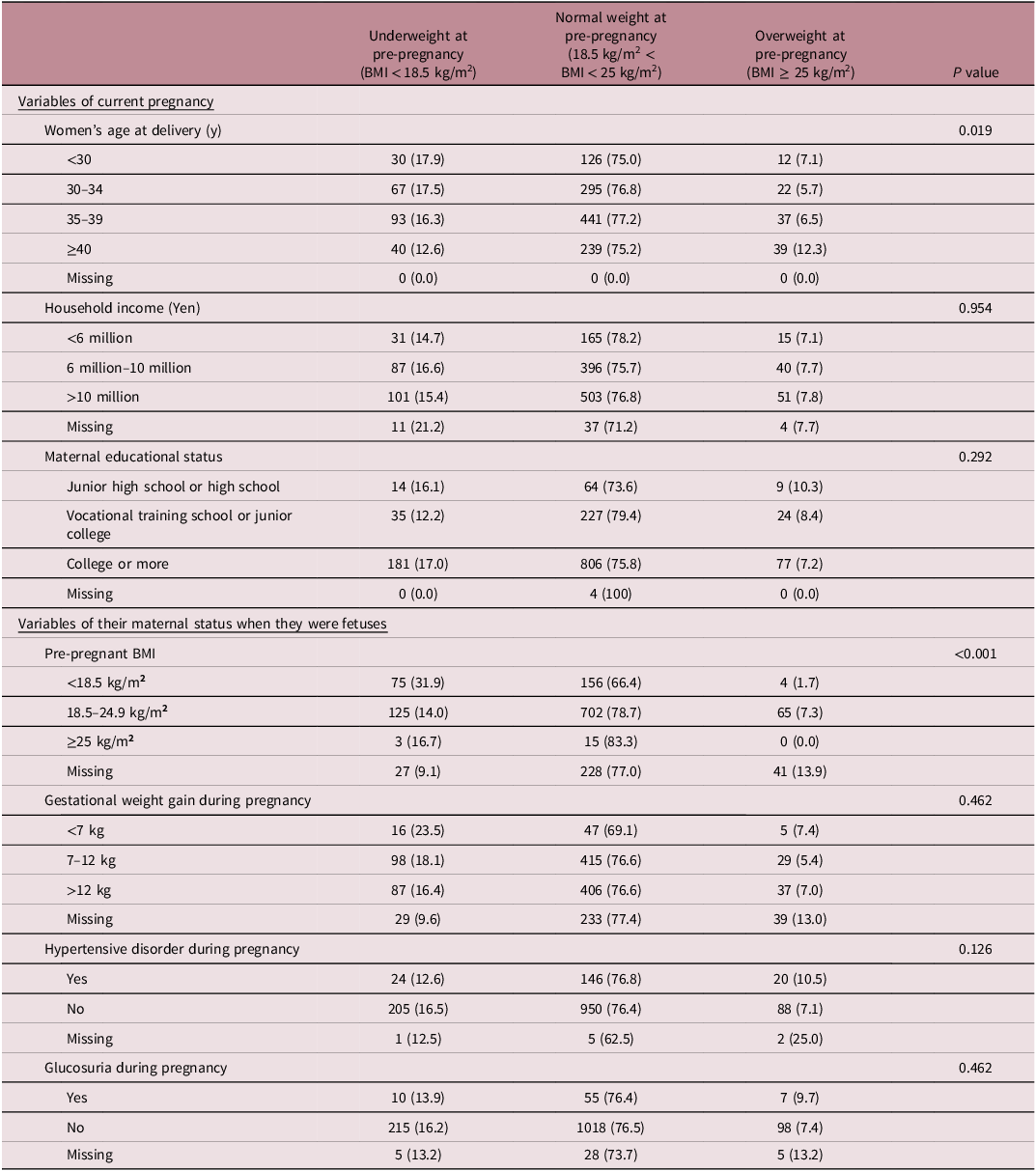
The demographic data stratified by pre-pregnant BMI categories are provided in Table 1. All factors except for women’s mothers’ pre-pregnant BMI (P < 0.001) were not statistically different between pregnant women’s pre-pregnant BMI categories.
Demographic variables of pregnant women and their mothers (n = 1441)

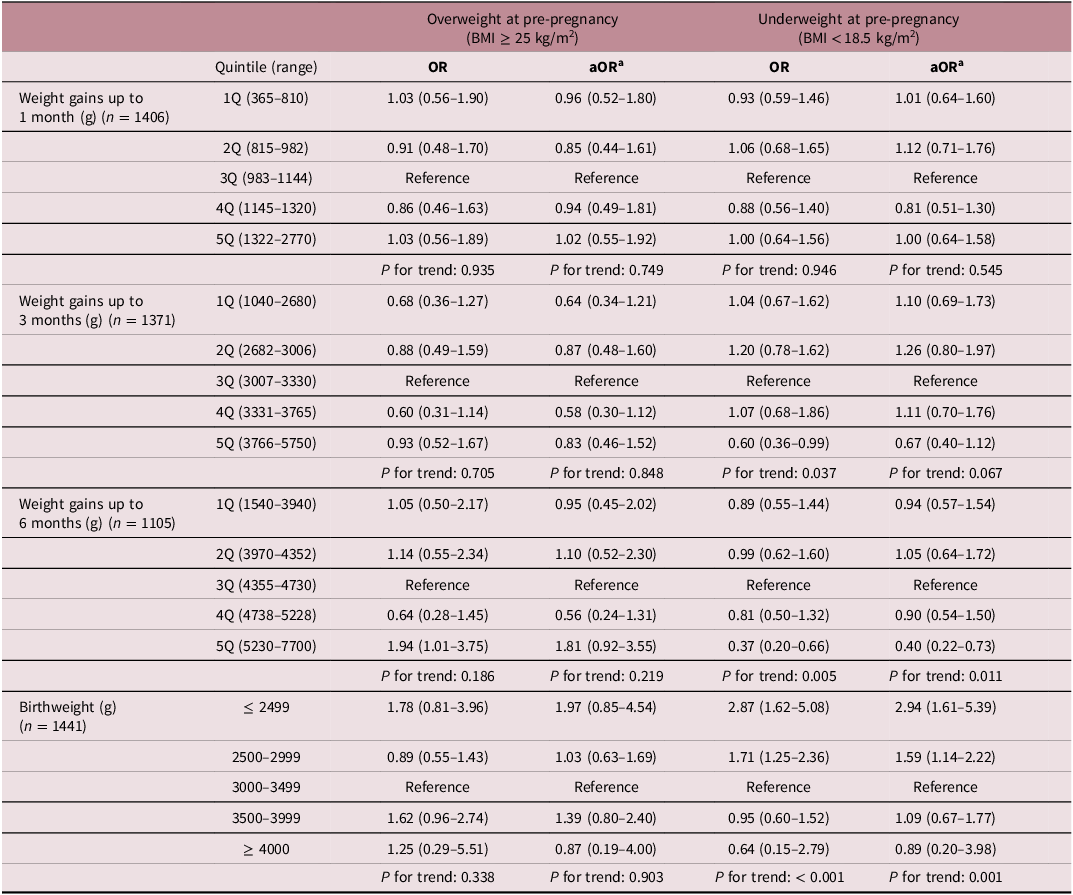
The association of the exposures of interest with pre-pregnant overweight or underweight is presented in Table 2. We found a protective effect stemming from the greater weight gain at 6 months, comparing Q5 with Q3 (aOR, 0.40; 95% CI, 0.22–0.73; and P value for trend, 0.011) against pre-pregnant underweight, as well as the risk of pre-pregnant underweight, was significantly higher among women born with lower birthweight (P for trend, 0.001). In contrast, a significant association was not observed between pre-pregnant underweight and weight gain up to 1 and 3 months. As for pre-pregnant overweight, none was significantly associated with the risk of pre-pregnant overweight. Those in the highest weight gain group (Q5) up to 6 months, higher prevalence of pre-pregnant overweight was observed (aOR, 1.81; 95% CI, 0.92–3.55) compared with those in the medium group (Q3), albeit statistically insignificant.
Association between weight gain during infancy period (1 month, 3 months, and 6 months) and BMI in later life at their pregnancy period, based upon imputed dataset, based upon complete dataset
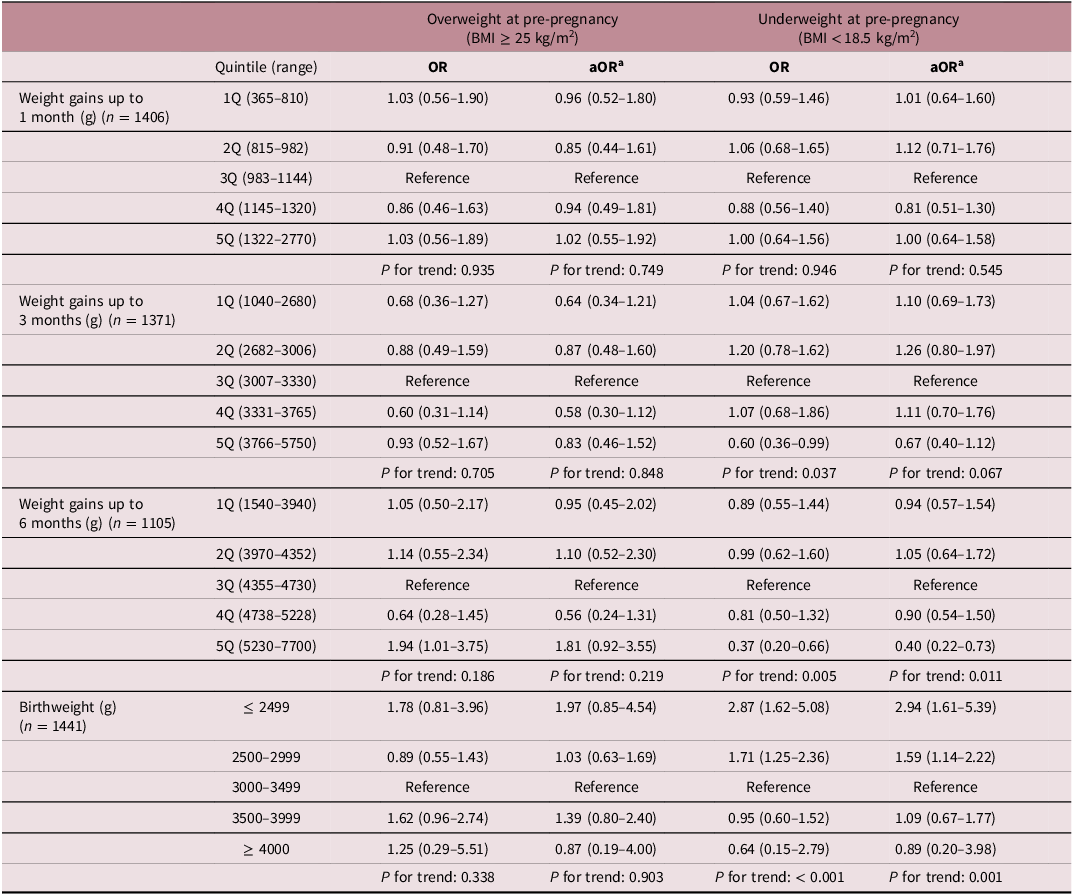
P for trend values were calculated by modeling the weight gain quintile variable as an ordinal variable to test for linear trend in association with the outcome.
aadjusted by women’s demographic variables, including age at pregnancy, their own birthweight and socio-economic status, including household income and education (proxy for their mother’s socio-economic status), and mother’s demographic variables during their pregnancy, including gestational glycosuria, hypertension during pregnancy, body mass index at pregnancy, and gestational weight gain during pregnancy for analysis on weight gain during infancy.
In addition, two sensitivity analyses showed similar results to the primary analyses. The analysis based on complete datasets showed that the risk of pre-pregnant underweight was higher among women with lower birthweight (P for trend, 0.012) and lower weight gain up to 6 months (P for trend, 0.005) (Supplemental Table 1). Although the primary analysis did not reach significance between weight gain to 3 months and underweight status (P = 0.067), another analysis modeling pre-pregnancy BMI as a continuous outcome showed a significant association in the sensitivity analysis (P = 0.011). Overall, the results were broadly consistent with those from the main analysis (Supplemental Table 2). The analysis additionally adjusting for feeding method demonstrated that the risk of pre-pregnant underweight was higher among those with lower weight gain up to 6 months (P for trend, 0.005) (Supplemental Table 3).
Discussion
The current study demonstrated that the greater weight gain up to 6 months was associated with lower risk for pre-pregnant underweight, without elevated risk for overweight. In contrast, weight gains up to 1 month and 3 months were not associated with pre-pregnant underweight, as well as weight gains up to 1, 3, and 6 months were not associated with overweight. To the best of our knowledge, this is the first study of the association of weight gain in early infancy and being overweight or underweight in adulthood among Japanese women.
Previous studies have demonstrated that rapid weight gain during the first 1–2 years of life is associated with an elevated risk of adult obesity. Reference Nanri, Shirasawa, Ochiai, Nomoto, Hoshino and Kokaze24,Reference Zheng, Hesketh and Vuillermin25 Additionally, DNA methylation relating to association between rapid weight gain during the first year of life and adolescent obesity has been identified. Reference Robinson, Brown and Antoun26 Conversely, significant association between lower weight gain in the first 2 years of life and lower BMI in adulthood was suggested. Reference Victora, Adair and Fall27 However, those studies focused limitedly on weight gain during the first 1–2 years; none have considered earlier periods (1, 3, 6 months) as exposures. Interestingly, the current study found early infancy (1–6 months) may have less of an impact on adult obesity, as well as greater weight gain up to 6 months in infancy was associated with lower risk for pre-pregnant underweight without elevated risk of overweight. This inconsistency suggests the effects of nutritional intake differ before and after 6 months. One possible explanation is that nutritional intake after 6 months may partially include complementary foods and relate to the preferences in the subsequent eating habits, and thus it may result in being overweight later in life. Conversely, nutrition before 6 months depending on breastfeeding or formula, which may not be related to the preferences in the subsequent eating habits, may not be associated with obesity later in life.
Furthermore, this study showed that the lower the birthweight, the more likely women were to be underweight in adulthood, in line with previous systematic reviews. Reference Selling, Carstensen, Finnström and Sydsjö28,Reference Tam, Wang and Luan29 Also, previous studies have demonstrated that both high and low birthweights are associated with an increased risk of obesity later in life as a “U-shaped curve.” Reference Tam, Wang and Luan29 In the current study, both <2500 and ≥ 4000 g birthweights were not significantly associated with obesity later in life; this may be due to small sample size. Reference Selling, Carstensen, Finnström and Sydsjö28 On the other hand, the current study demonstrated that those with lower birthweights tend to be underweight as adults, as in previous studies. Reference Selling, Carstensen, Finnström and Sydsjö28,Reference Klebanoff, Schulsinger, Mednick and Secher30
Our study had several strengths. First, the use of data from MCHHs, which are reliable and valuable sources, allowed for a high-quality epidemiological study with minimized recall bias. Second, the study focused on critical early life stages at 1, 3, and 6 months providing valuable insights that are scarce in global research. Nonetheless, this study had some limitations. First, the limited sample size might have led to insufficient statistical power, potentially affecting the interpretation of some results. In our supplemental analysis treating pre-pregnancy BMI as a continuous outcome, the association with weight gain up to 3 months reached statistical significance, whereas it was not statistically significant in the primary categorical analysis. This discrepancy may reflect differences in statistical power between modeling approaches rather than a true inconsistency. Moreover, although a statistically significant trend was observed in some comparisons, a clear dose-response relationship across quintiles was not evident. Therefore, these findings should be interpreted with caution. Although we do not believe that the observed associations are likely to be solely due to chance, the possibility of type I error cannot be entirely ruled out given the number of statistical tests performed. In the future, a study with a larger sample size is warranted to address this limitation. Second, some potential confounders, such as information about the initiation of breastfeeding and duration of breastfeeding, were not included in our database and could not be adjusted for in our analyses. Furthermore, available possible confounding factors during the fetal period (variables of women’s mothers) were limited. Although whether the weight gain during infancy was an exposure or an intermediate factor of true association was not able to be determined in the current study, we believe that understanding the relationship between infant weight gain, which is an easily accessible metric and an important predictor for health risk in the future, is a crucial insight. Third, although birthweight and gestational age were available, we could not classify participants into SGA/AGA/LGA categories, as parity — required to apply national standards Reference Itabashi, Kusuda, Tamura M.Hayashi, Takahashi and Goishi31 — was not consistently recorded in the dataset. Future studies that incorporate more complete perinatal data including parity would enable further analysis based on birth size classification. Finally, as the current study focused on pre-pregnant weight as a primary outcome of interest, whether the results can apply to the general, non-pregnant adult population, is unclear. As this generalization is crucial, further study is welcomed.
In conclusion, our study demonstrated that greater weight gains up to 6 months is associated with a decreased risk of “adult underweight,” but we did not find significant associations between postnatal weight gain and the risk of “adult overweight.”
Supplementary material
The supplementary material for this article can be found at https://doi.org/10.1017/S2040174425100202.
Data availability
Restrictions by the Ethics Committee at the NCCHD prohibit the authors from making the minimal data set publicly available. Data are available from the NCCHD for researchers who meet the criteria for access to confidential data. Requests for the data can be sent to ogawa-k@ncchd.go.jp.
Acknowledgements
We thank our research coordinator, Takako Tsuneizumi, for recruiting the participants and organizing the dataset.
Financial support
Kohei Ogawa was supported by a Grant-in-Aid for Scientific Research (C) from the Japan Society for the Promotion of Science (20K18181 and 23K08880). This work was partially supported by a Research Development Grant for Child Health and Development from the NCCHD (2019B-5 and 2024B-19).
Competing interests
The authors have no conflicts of interest to declare.
Ethical standards
The authors assert that all procedures contributing to this work comply with the ethical standards of the relevant national guidelines on human experimentation (Ethical Guidelines for Medical and Health Research Involving Human Subjects) and with the Helsinki Declaration of 1975, as revised in 2008, and has been approved by the Institutional Review Board of the National Center for Child Health and Development in May 2019 (No. 197).