This article is offered as a conversation between Krista McCracken (KM) and Skylee-Storm Hogan (SH) that centres on sketches and handicrafts created by students of the Shingwauk Indian Residential School. The Shingwauk Residential School operated in Sault Ste. Marie, Ontario from 1873 to 1970 during which time Indigenous students from all across Canada attended the School. Like all Residential Schools, the Shingwauk School was designed to take away the culture, language and identity of Indigenous children while assimilating them into Euro-Canadian culture.
Created by students at the Shingwauk Residential School, this artwork speaks to the colonial history of Residential Schools and the expression of Indigenous identity through art. The sketches were collected by Shingwauk staff member Ann E. Clarkson in a scrapbook in 1948. The handicrafts were made as part of woodworking classes and were often sold to generate money for the Residential School.
Today these sketches and handicrafts are stewarded by the Shingwauk Residential Schools Centre (SRSC) and their care is guided by the Survivors who attended the Shingwauk School. Since its establishment in the 1980s the SRSC has been driven by the needs of Survivors and has worked to be community centred in its approach to sharing archives, artwork, and the history of Residential Schools. Currently, these remarkable pieces of artwork are shared with survivors and community members through digital reproductions and on-site exhibitions.
As part of their employment at the SRSC, both Hogan and McCracken have worked to care for, display, and describe these sketches and handicrafts. Their conversation considers how the Shingwauk Survivor community has shaped approaches to stewarding this artwork and the opportunities it gives to show the resilience of Residential Schools students, their artistic talents, and the realities of artistic expression.
Sketches by Residential School students
KM: The first time I came across the scrapbook for student artwork was back in 2010, when I was starting to get a sense of what had already been accessioned in the Shingwauk archives. I remember being surprised to find this beautiful artwork amongst attendance records and other Residential Schools administrative files. Do you remember the first time you worked with the scrapbook of student artwork?
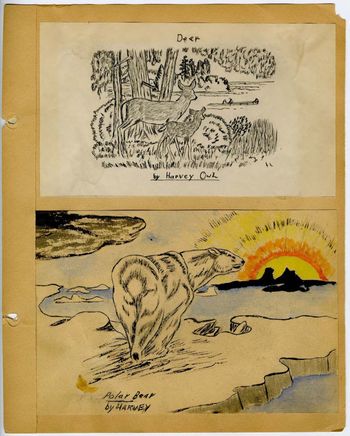
SH: I do! I was working my second year in the SRSC work-study position in 2015 when I was re-boxing materials and reorganizing their online descriptions. I remember being intrigued at the detail of the pieces that Harvey Owl created. Figure 1 shows two great examples of the shading work he did, they have so much life to them.
Sketches by Harvey Owl, part of the student artwork scrapbook kept by Shingwauk staff member Anne Clarkson. Sketchbook is currently cared for by the Shingwauk Residential Schools Centre.

KM: The artwork in this scrapbook is beautiful and varied. The scrapbook includes 56 pieces of artwork. Only three of these pieces were created by girls, with the remaining made by boys at Shingwauk. There are fifteen sketches by a Shingwauk student named Harvey Owl, whose sketches are of nature, sports, and local landscapes.
The curator in me wants to share these images. But I also want to be conscious of the conditions in which they were made: how did the teacher end up with the sketches? Were they made during a class or did the students draw them on their own while at Residential School? We don't know. What are your thoughts on sharing this artwork?
SH: I found myself asking why these would be in the possession of staff, or for what purpose they were created. I feel like they may have been art class assignments or done during a drawing period. When we put them on display in the SRSC exhibition space, I remember many Survivors as well as visitors commenting on how striking they were.
I eventually met Harvey's niece, Mary, while attending events in my undergraduate program; she was happy to see the pieces and wanted copies to show her family. Mary also asked about our process in the SRSC and the potential for the artwork to be put back in the care of the family. She was happy to hear that we work with Survivors, and take our cues from the community needs they identify. We were able to make digital copies for the Owl family at no cost, and let them know that we would make the originals available under the direction of the Survivor community we work with. The family ultimately decided to leave them in the care of the SRSC and the Survivor community.
KM: I'm extremely grateful for the guidance of the Children of Shingwauk Alumni Association, who are Survivors of the Shingwauk Residential School. Their good intentions around sharing the true history of Residential Schools and making space for Survivor voices has been really important for me when thinking about my role as someone who cares for this artwork. They have made it clear that they want this work shared and to be used as a way to speak about the Residential School experience. Taking that guidance in mind, what type of care should be taken when sharing this artwork?
SH: I think we need to take care with how we express the context in which these pieces were created. While we see clear talent and an abundance of color in Harvey's work, we need to understand the circumstances in which he, and the other students were living. It is important not to downplay the positive accounts of students who enjoyed these moments, but we also need to think about the cultural implications.
It is hard for us as descendants, and contemporary Indigenous peoples to realize that these artists would be ordinarily enriching the cultural and social identity of their people, instead of creating for the purposes of assimilation or profit-generation. It is also difficult for descendants and family members to see these things on display, if they have not started to work through their intergenerational traumas. It can be triggering when you are surprised by unexpectedly viewing the artworks of a family member created while they were in the Residential Schools System.
I often ask myself, while these pieces were collected by staff, how many others were sold off to the local non-Indigenous community to finance the system that took away their rights and cultural identity? This situation is similar to the handicraft sales that we know occurred at Shingwauk.
Shingwauk Handicrafts
KM: Do you think the same type of care applies to the handicrafts as the sketches? We know more about the context in which the handicrafts were made than we know for the sketches: we know that these handicrafts were made under the instruction of Harry Morrow, the woodworking teacher at Shingwauk, and were often sold to generate money for the Shingwauk School. But on the other hand, many of the sketches are signed and we are able to connect them to specific makers. Of the 62 handicrafts, however, only three have any notations that might represent the students who made them.
SH: I think unsigned, mass produced pieces can teach similar lessons to other assignments and educational materials we have seen in the Shingwauk collections. They show the mass scale of assimilation, the industrial educational practice, and the institutional nature of the Residential School. Similar in some respects to the mass-produced products of the prison system, the Residential Schools system came to rely on outside income that was generated by the labour of the students.
These handicrafts also serve to reinforce the Canadian pan-Indigenous identity. The handicrafts present stereotypical symbols of what Indigeneity has come to represent in the North American pop-culture context. These pieces spark conversation and ask hard questions: they can be art as an educational tool.
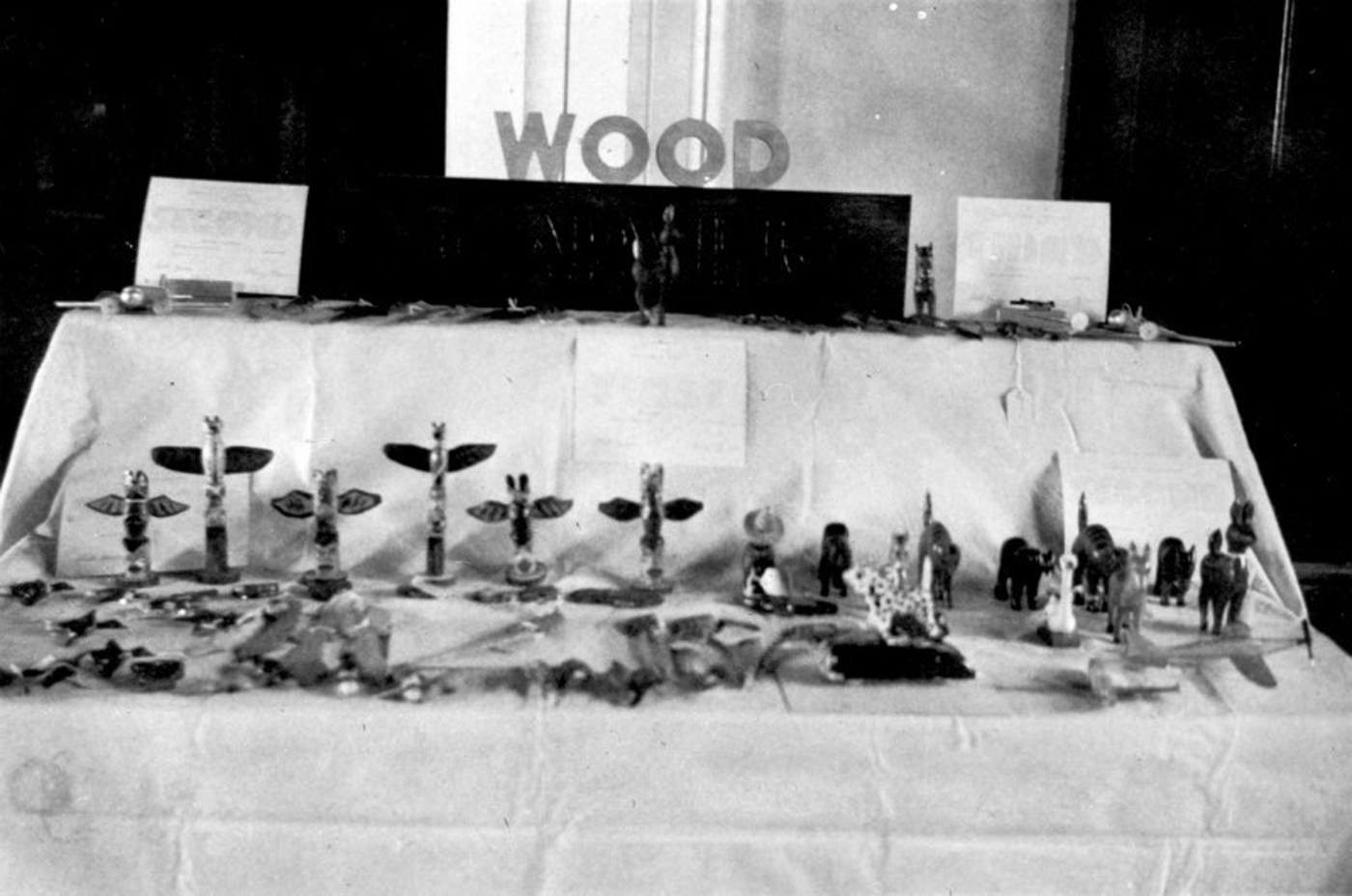
KM: I've really appreciated the conversations that these handicrafts have sparked around the commercialization of Indigenous art and the sale of pan-Indigenous identities. The small totem poles Figure 2 are particularly jarring, when you understand that they were made in a Residential School. How this artwork is displayed and described can really impact how people understand these handicrafts, providing a look at the relationship between colonialism and art-making.
Shingwauk student woodwork on display and for sale in the 1960s. Photograph from Rev. Canon Henry Morrow fonds, 2014-042/001

SH: Agreed, it is an interesting push and pull between still being able to practice traditional skills, and being forcibly taken away from their identity. But in terms of an educational exhibit or as a teaching tool on site tours, I think they can teach a lot to people about the Residential School's practice of mass-produced identity as assimilation. They also show different types of labour for profit.
We just need to make sure we balance the less traumatizing stories of creativity and expression with the experiences of colonial violence. We also need to make sure that we understand the context of the public with whom we are sharing this material; we need to ask ourselves what the lesson is and what the potential harms are to descendants. Taking direction from Survivors and taking care with context are, in my opinion, great best-practices.
KM: As with the sketches, I see these handicrafts as artwork that needs to be contextualized. Most of the remaining artifacts and photographs from Residential Schools are only snapshots of that experience. Just looking at this artwork without understanding the context in which it was made can result in unintentionally glossing over the harms of Residential Schools. Yes, the students may have been making art but they were also taken from their homes, not allowed to speak their language, and many suffered tremendous harm while at the schools. Context matters.
The sketches and handicrafts are part of a broader need to consider the ethics around the display of Indigenous artwork and material culture. For me, archivists and others working with Indigenous artwork should consider the principles of ownership, control, access, and possession before displaying Indigenous materials online or in-person. This means working with Indigenous communities to allow them to determine how materials are displayed, stored, and shared. This takes work and requires heritage and cultural organizations to do research, build relationships, and act with care. It might also mean revaluating provenance and the ethics behind how items entered a collection. Is there any advice you would give individuals who are working with Indigenous artwork or material culture in their collections?
SH: I completely agree, acting with care is important here. I would start by developing those community relationships that should always be there. That means even when there are not Indigenous cultural materials on display, organizations are reaching out to Indigenous folks in their areas. Building and maintaining these relationships requires a lot of learning and accountability on an organization's part and is something that looks closer to real reconciliation practice. My advice for the institution, gallery, or archive, that does not already have these relationships: is that they begin building them as soon as possible - not only with the local communities but also communities that have direct relationships to the collections themselves. If these collections have yet to be identified, paying an Indigenous researcher is a great place to start. I know that our industry is facing financial challenges but placing the burden of work on Indigenous communities perpetuates colonialism. If the supports are not in place for this content to be displayed meaningfully and correctly, then arrangements should be made to house and support that material elsewhere.
Many of the objects displayed in our museums and galleries were taken without consent. Consent is an issue that can be hard to tackle, especially in cases of Residential Schools. There is rarely the creator's name attached to the object. Or if the item was taken, purchased, or privately collected it can be hard to track down the original maker. It has been in my experience as a Mohawk researcher to reach out to those I have built relationships with, but settlers should start by doing some of the research work themselves.
In some cases, the item has been taken internationally. More needs to be done to reconnect the context with the proper people. This means accountability and talking about the institutional legacy of white supremacy and collecting. While it can be uncomfortable to address lack of consent, colonialism, racism, and violence in collections we need to move past those feelings and turn them into action. When efforts are made to research these collections, to build the right relationships, and collaborate in the display with adequate compensation, that is consent. Work done about us without us is perpetuating colonialism and removing agency from Indigenous cultural nationhood.
Conclusion
The sketches and handicrafts held by the SRSC are one example of artworks created by Residential Schools students in Canada. The ways in which these artworks are described, shared, and cared for can directly impact how they are interpreted and valued.
As curators and archivists, we need to be mindful of the ways in which we share these materials within their individual contexts. We need to consider how we can minimize further trauma to the Survivors and intergenerational Survivors. Whenever possible, this should be done by taking direction from Survivor communities and by fostering long-term meaningful relationships with Indigenous communities. Experiences within systems of colonialism are complex and varied, so interpretations of any artwork created within residential schools must reflect both the historical context of their creation and the present-day dynamics of Survivor communities.