Introduction
Globally, overweight and obesity are the major risk factors for growing incurable diseases, including hypertension, cancer, diabetes, and chronic respiratory diseases, which also contribute to deaths and disabilities (Fruh, Reference Fruh2017; Tianyi, Agbor, & Njamnshi, Reference Tianyi, Agbor and Njamnshi2018). Globally, approximately 4 million deaths and 120 million disabilities occur because of overweight and obesity (Global Burden of Disease [GBD] 2015, Obesity Collaborators, 2017). Worldwide the prevalence of overweight and obesity among women ranges between 29.8% and 38.0% (Ng et al., Reference Ng, Fleming, Robinson, Thomson, Graetz, Margono, Mullany, Biryukov, Abbafati, Abera and Gakidou2014). However, the prevalence of overweight and obesity is also rising rapidly in low- and lower-middle-income (LLMICs) countries along with their economic growth. Overweight and obesity affect all ages of people in low- and middle-income countries (LMICs) as well as their social and economic status (Morgen & Sørensen, Reference Morgen and Sørensen2014). Overweight and obesity, in particular, are important risk factors for the development of various non-communicable diseases (NCDs) in women, and they also cause more difficulties during pregnancy than women of normal weight (Gupta et al., Reference Gupta, Sajal, Hasan, Sutradhar, Haider and Sarker2019).
The burden of overweight and obesity is increasing in LMICs, and the global rise of overweight and obesity is initially influenced by socio-demographic, environmental, and genetic factors and sedentary lifestyles (Kassie et al., Reference Kassie, Abate and Kassaw2020). Globally, billions of dollars per year are lost due to overweight and obesity, which weakens the opportunities for economic growth by reducing productivity and life expectancy and increasing disability and health care spending (Kassie et al., Reference Kassie, Abate and Kassaw2020). The failure to invest in human wealth is connected with the rising prevalence of preventable morbidity and mortality for all ages (Bhurosy & Jeewon, Reference Bhurosy and Jeewon2014). This ultimately increases the economic burden to prevent the different overweight and obesity-related problems. However, energy expenditure is very low among women who often spend their leisure time watching television and using a mobile phone to play games and watch videos (Lepp et al., Reference Lepp, Barkley, Sanders, Rebold and Gates2013). This also increases their risk of accruing too much body weight. The invention of television and mobile phone, and subsequent commercialisation of the products globally, have changed the way we live and work.
Television and mobile phone use during bedtime reduces sleep duration (Dube et al., Reference Dube, Khan, Loehr, Chu and Veugelers2017), impacting physical weight (Felso et al., Reference Felső, Lohner, Hollódy, Erhardt and Molnár2017). The good health condition of women, particularly in their reproductive age, is a prerequisite for the healthy delivery of offspring. Recent studies have found that, even in poor and less-educated communities, women of reproductive age have been experiencing more adverse pregnancy outcomes and neonatal death because of their overweight and obesity (Haque et al. Reference Haque, Keramat, Rahman, Mustafa and Alam2021; Sutradhar et al., Reference Sutradhar, Akter, Hasan, Gupta, Joshi, Haider and Sarker2021).
Access to television and mobile phone and the time spent watching television and using the mobile phone has attracted numerous researchers across the globe. A systematic review of the literature found that bedtime use of portable devices was related to less night-time sleep and more day-time sleep habits, which is not healthy (Carter et al., Reference Carter, Rees, Hale, Bhattacharjee and Paradkar2016). Hale and Guan (Reference Hale and Guan2015) found that shortened duration of sleep time and delayed night-time sleep were associated with higher screen time among school-going children and adolescents. Li et al. (Reference Li, Zhang, Huang and Chen2017) also found that shorter sleeping time was associated with childhood obesity. Besides, a systematic review identified that physical activities decreased due to mobile phone use among college students (Lepp et al., Reference Lepp, Barkley and Karpinski2015). Watching television and access to a mobile phone during bedtime has decreased the sleep duration of Grade-V children in Alberta, Canada, by approximately 11 and 8 minutes, respectively, compared with those who do not have access to or use these technologies (Dube et al., Reference Dube, Khan, Loehr, Chu and Veugelers2017). Mobile phone use was associated with obesity among adults in the USA (Chrisman et al., Reference Chrisman, Chow, Daniel, Wu and Zhao2016). In a study focusing on Bangladesh, obesity, particularly among women who are not engaged in any formal employment, was found to be positively associated with the time spent watching television (Chowdhury et al., Reference Chowdhury, Adnan and Hassan2018). In India, television watching was also more associated with obesity among adult urban women than their rural counterparts (Gupta et al., Reference Gupta, Sajal, Hasan, Sutradhar, Haider and Sarker2019). Women of reproductive age who watched television every day had a higher chance of becoming overweight and obese than those who never watched television (Gupta et al., Reference Gupta, Sajal, Hasan, Sutradhar, Haider and Sarker2019; Das Gupta et al., Reference Das Gupta, Haider, Sutradhar, Hashan, Sajal, Hasan, Haider and Sarker2019).
Television and mobile phone are screen-based devices and are primarily practical technological development globally. A prior study found that screen-based media use affected sleep health, including time displacement, emotional stimulation and sleep physiology (LeBourgeois et al., Reference LeBourgeois, Hale, Chang, Akacem, Montgomery-Downs and Buxton2017). Screen time has a stronger correlation with the weight status of young Australians (Maher et al., Reference Maher, Olds, Eisenmann and Dollman2012). Higher Body Mass Index (BMI) among women was also influenced by access to television, as seen in Ghana (Tuoyire, Reference Tuoyire2018). In the Japanese context, mobile phone use and screen time on a mobile phone was recognised as risk factors for overweight among children (Wada et al., Reference Wada, Yamakawa, Konishi, Goto, Mizuta, Koda, Uji, Tamura, Nakamura, Tsuji and Nagai2019).
Women of their reproductive age often lead a sedentary lifestyle, increasing their risk of being overweight/obese. However, overweight and obesity in reproductive-aged women is a recognised and established cause of different health difficulties, including pre-eclampsia, eclampsia, hypertension and gestational diabetes mellitus (Kanguru et al., Reference Kanguru, McCaw-Binns, Bell, Yonger-Coleman, Wilks and Hussein2017; Kim et al., Reference Kim, England, Wilson, Bish, Satten and Dietz2010). Overweight and obesity also increase the probability of infertility and miscarriage (Sharma et al., Reference Sharma, Biedenharn, Fedor and Agarwal2013). The sedentary behaviour of a reproductive-aged woman is also an independent risk factor for infertility (Gupta et al., Reference Gupta, Sajal, Hasan, Sutradhar, Haider and Sarker2019). Comparatively, nonworking women have more time watching television and using a mobile telephone. Evidence about adolescents’ digital media uses between and among regions in low-middle-income countries (LMICs) exists (Banaji et al., Reference Banaji, Livingstone, Nandi and Stoilova2018). Similarly, another study reported that low economic status groups of people spent more time watching television than people from higher economic status groups (Yang-Huang et al., Reference Yang-Huang, van Grieken, Moll, Jaddoe, Wijtzes and Raat2017).
An intensive systematic review has revealed that individual and social activities influence obesity among women of reproductive age in LMICs (Trübswasser et al., Reference Trübswasser, Verstraeten, Salm, Holdsworth, Baye, Booth, Feskens, Gillespie and Talsma2021). Another study has found that internet use is becoming problematic among young people in selected LMICs (Fernandes et al., Reference Fernandes, Uzun, Aydin, Tan-Mansukhani, Vallejo, Saldaña-Gutierrez, Biswas and Essau2021). However, studies about internet use among women of reproductive age are hardly found. The context of LMIC concerning overweight and obesity in women of reproductive age has attracted many researchers (Trübswasser et al., Reference Trübswasser, Verstraeten, Salm, Holdsworth, Baye, Booth, Feskens, Gillespie and Talsma2021). The association among various factors, including mobile phone ownership and access to communication devices, are underexplored. Most of the studies examined the association between overweight and obesity with television watching (Gupta et al., Reference Gupta, Sajal, Hasan, Sutradhar, Haider and Sarker2019; Das Gupta et al., Reference Das Gupta, Haider, Sutradhar, Hashan, Sajal, Hasan, Haider and Sarker2019). However, the mobile phone is also a screened-based device like television, and the research on the association between overweight and obesity with mobile phone use is not well established. Therefore, the present study aimed to identify the association between overweight and obesity with television watching and mobile phone use of reproductive age women in low-and lower-middle-income countries (LLMICs). Thus, this study can contribute to the regional or country-specific promotional health policy with innovative strategies and programs to decrease the prevalence of overweight and obesity of reproductive age women in LLMICs.
Materials and methods
Data sources and procedures
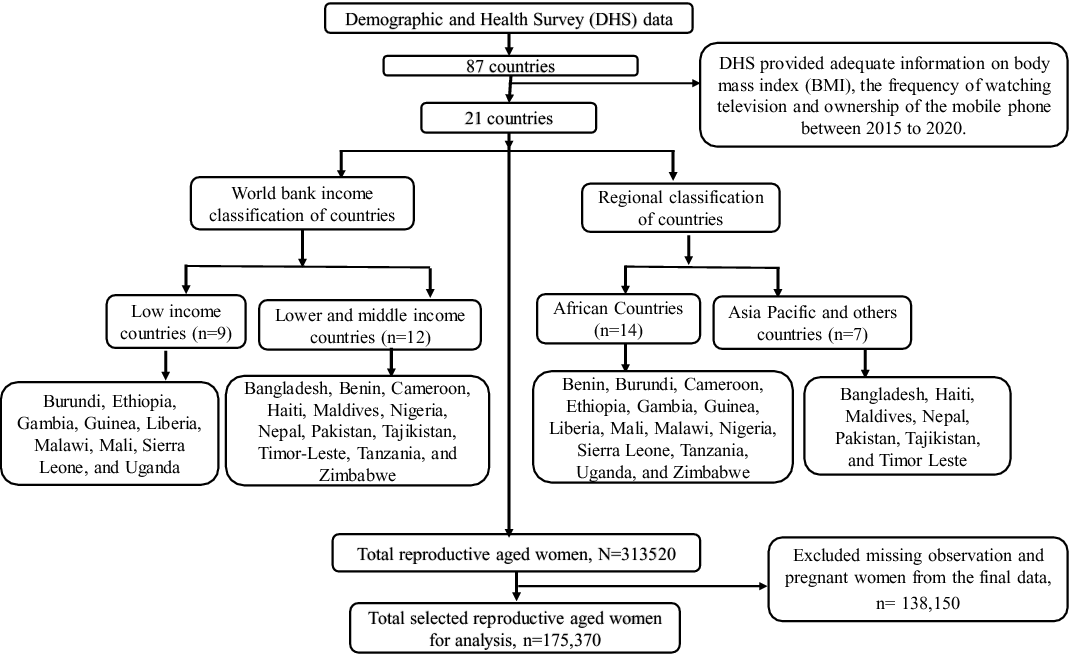
This study involved a cross-sectional analysis of data from the Demographic and Health Survey (DHS) of LLMICs. This study used pooled data of women from the individual recode files. Among 82 low (n=27) and lower-middle (n=55) income countries, 21 (low=9 and lower-middle=12) nationally representative cross-sectional datasets from the most recent DHS conducted after 2015 were used in this study. The selected 9 low-income countries are Burundi, Ethiopia, Gambia, Guinea, Liberia, Malawi, Mali, Sierra Leone and Uganda. The 12 lower-middle-income countries are Bangladesh, Benin, Cameroon, Haiti, Maldives, Nigeria, Nepal, Pakistan, Tajikistan, Timor-Leste, Tanzania and Zimbabwe. The following countries were also grouped by region: Africa region (Benin, Burundi, Cameroon, Ethiopia, Gambia, Guinea, Liberia, Mali, Malawi, Nigeria, Sierra Leone, Tanzania, Uganda and Zimbabwe) and the Asia Pacific and other regions (Bangladesh, Haiti, Maldives, Nepal, Pakistan, Tajikistan and Timor Leste). These countries were chosen because their DHS provided adequate information on body mass index (BMI), the frequency of watching television and ownership of the mobile phone. The detailed sample selection procedure is presented in Figure 1.
Detail sample selection procedure for analysis.

Although the DHS is a nationally representative household sample survey that collects data related to individuals’ health and social aspects (Corsi et al., Reference Corsi, Neuman, Finlay and Subramanian2012), in this analysis, data for women of the reproductive age (i.e. 15–49 years) were only included. In all 21 countries, the DHS survey followed the same standard procedures, and the survey data are available at http://www.dhsprogram.com. Detailed descriptions of DHS sampling procedures, questionnaire validation and data collection methods are published elsewhere (http://www.dhsprogram.com). A two-stage stratified sampling technique was used to select female respondents for the study. Enumeration areas (EAs) and households were randomly selected in the first and second stages, respectively. After adjustments for missing observations and pregnant women, 175,370 eligible women were selected for the final analysis.
Outcome variable
The main outcome variable, overweight or obesity, was calculated from the female respondents (BMI). The participants were divided into categories: normal or underweight (BMI <25.0 kg/m2) and overweight (BMI between 25.0 kg/m2 and <30.0 kg/m2) or obesity (BMI >=30.0 kg/m2). The ranges were defined based on the World Health Organisation (WHO) and National Institutes of Health BMI cut-off values (National Heart, Lung, Blood Institute, National Institute of Diabetes, Digestive and Kidney Diseases, 1998). The study outcome was reported as a binary variable with “overweight or obesity” coded as ‘1’ and ‘not overweight or obesity’ coded as ‘0’.
Key explanatory variables
The frequency of watching television and ownership of a mobile phone are major explanatory variables. The actual number of frequencies of viewing television was not available in DHS data. However, time spent viewing television was reported on a weekly measurement. The frequencies of viewing television were categorised by the DHS program as follows: (i) not at all, (ii) less than once a week, (iii) at least once a week and (iv) almost every day. However, ownership of a mobile phone was categorised as a binary response: (i) no and (ii) yes. All information was based on self-reported data from the survey participants.
Others explanatory variable
Seven other explanatory variables were considered as covariates based on their availability in the DHS dataset and the extensive literature review (Ferdausi et al., Reference Ferdausi, Al-Zubayer, Keramat and Ahammed2022; Chowdhury et al., Reference Chowdhury, Adnan and Hassan2018; Chrisman et al., Reference Chrisman, Chow, Daniel, Wu and Zhao2016; Dube et al., Reference Dube, Khan, Loehr, Chu and Veugelers2017; Gupta et al., Reference Gupta, Sajal, Hasan, Sutradhar, Haider and Sarker2019; Hale & Guan, Reference Hale and Guan2015; Lajunen et al., Reference Lajunen, Keski-Rahkonen, Pulkkinen, Rose, Rissanen and Kaprio2007). These variables were age (15–24, 25–34 and 35–49 years), place of residence (urban and rural), women’s education (no formal education, primary, secondary and higher), work status (no and yes), wealth index (poorest, poorer, middle, richer and richest), the number of household members (≤ 4 and > 4) and the number of children (0, 1–2, 3 and more).
Statistical analyses
First, frequency and percentage were determined to show the weighted prevalence of overweight or obesity in the selected LLMICs. We cross-tabulated the distribution of overweight or obesity across the key explanatory variables and other covariates and the estimated Pearson’s chi-square test of independence at a p-value of less than 0.05 to show significant factors. Furthermore, after adjusting the other covariates, a multivariate binary logistic regression analysis was conducted to examine the critical explanatory variables’ association with overweight or obesity. The binary logistic regression model had all the key explanatory variables and other covariates. The results were presented using adjusted odds ratios (AOR) at a 95% Confidence Interval (CI). To improve our findings’ generalisability, sample weight was used to correct for over and under-sampling, including the complex survey design. All the analyses were performed using R software.
Results
Background characteristics
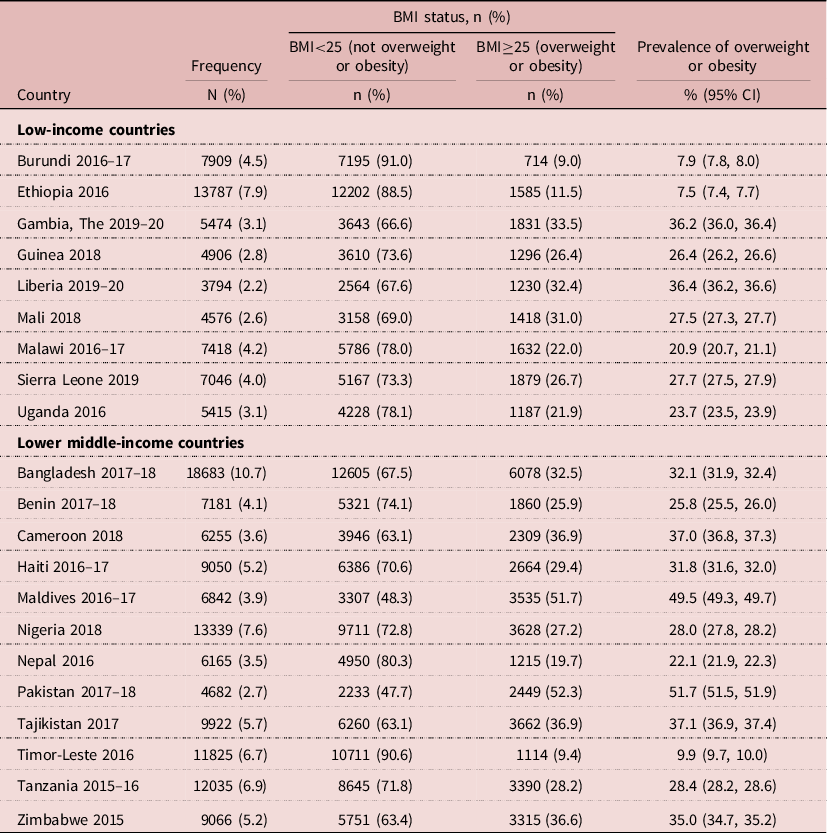
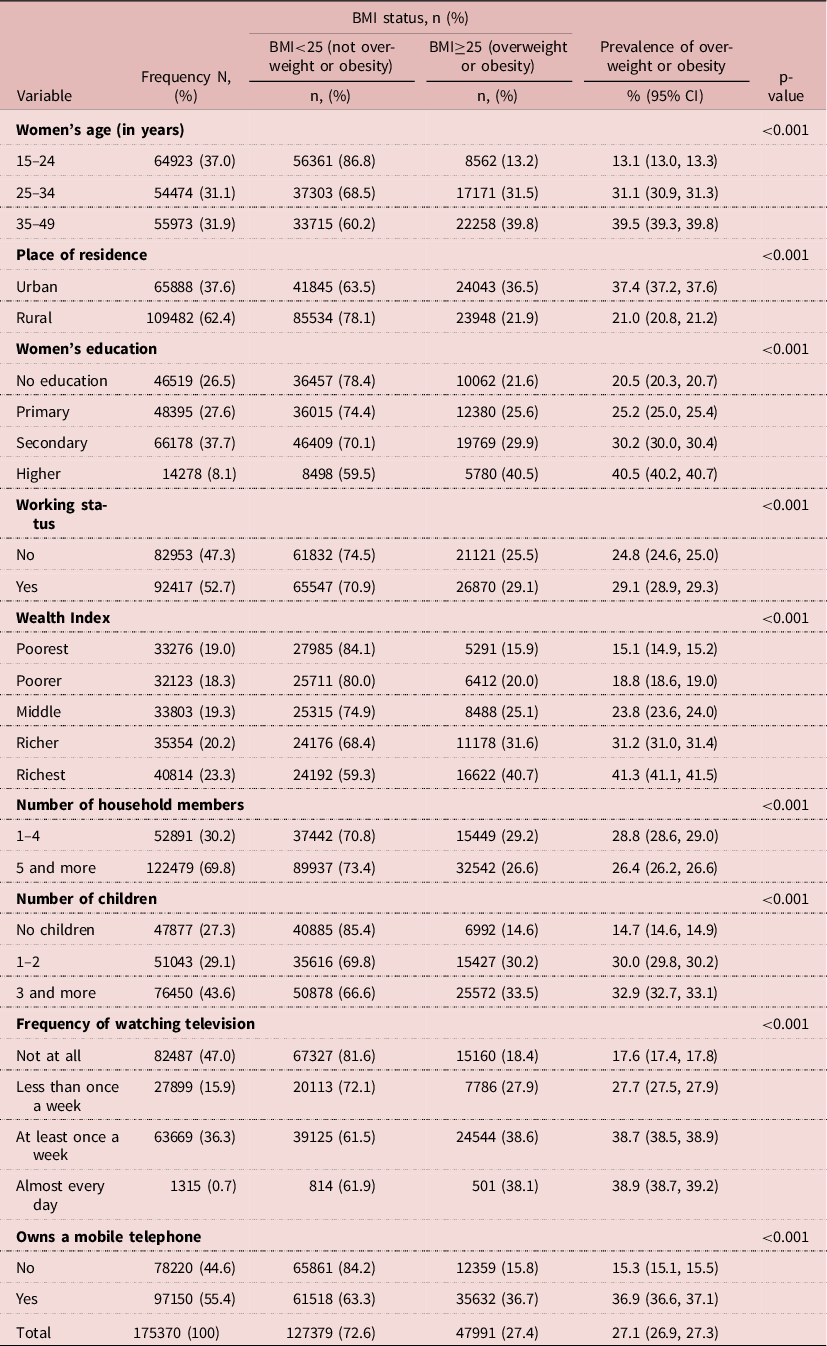
The women’s background characteristics and the prevalence of overweight or obesity were presented in Tables 1 and 2, respectively. Among the total women, the highest, 18,683 (10.7%), were from Bangladesh, and the lowest, 3794 (2.2%), were from Liberia. A total of 109,482 (62.4%) lived in rural areas, and 92,417 (52.7%) were involved in work. A total of 64,923 (37.0%) women were from the15–24 years age group, and 66,178 (37.7%) women had completed secondary education. However, 122,479 (69.8%) participants belonged to a family consisting of five or more members, and 76,450 (43.6%) had three or more children. Among the total women, 82,487 (47.0%) did not watch television, and 97,150 (55.4%) owned a mobile phone.
Prevalence of overweight or obesity in the sample population across the 21 low- and lower-middle-income countries

Prevalence of overweight or obesity in the sample population across the explanatory variables in 21 low- and lower-middle-income countries

Prevalence of overweight or obesity
The prevalence of overweight or obesity were varied among countries from 7.5% (95% CI: 7.4%–7.7%) in Ethiopia to 36.4% (95% CI: 36.2%–36.6%) in Liberia for low-income countries and 9.9% (95% CI: 9.7%–10.0%) in Timor-Leste to 51.7% (95% CI: 51.5%–51.9%) in Pakistan for lower-middle-income countries (Table 1). Overall, the prevalence of overweight or obesity was 27.1% (95% CI: 26.9–27.3%) among the LLMICs. The prevalence of overweight or obesity was higher among women in the 35–49 years age group (39.5%, 95% CI: 39.3–39.8%), in urban areas (37.4%, 95% CI: 37.2–37.6%), with higher education (40.5%, 95% CI: 40.2–40.7%) and within the richest household segment (41.3%, 95% CI: 41.1–41.5%). The prevalence of overweight or obesity among the women who watch television at least once a week and almost every day was 38.7% (95% CI: 38.5–38.9%) and 38.9% (95%CI: 38.7–39.2%), respectively. The prevalence of overweight or obesity was also higher among the women who owned a mobile phone (36.9%, 95% CI: 36.6–37.1%) (Table 2).
Association between the selected key variables
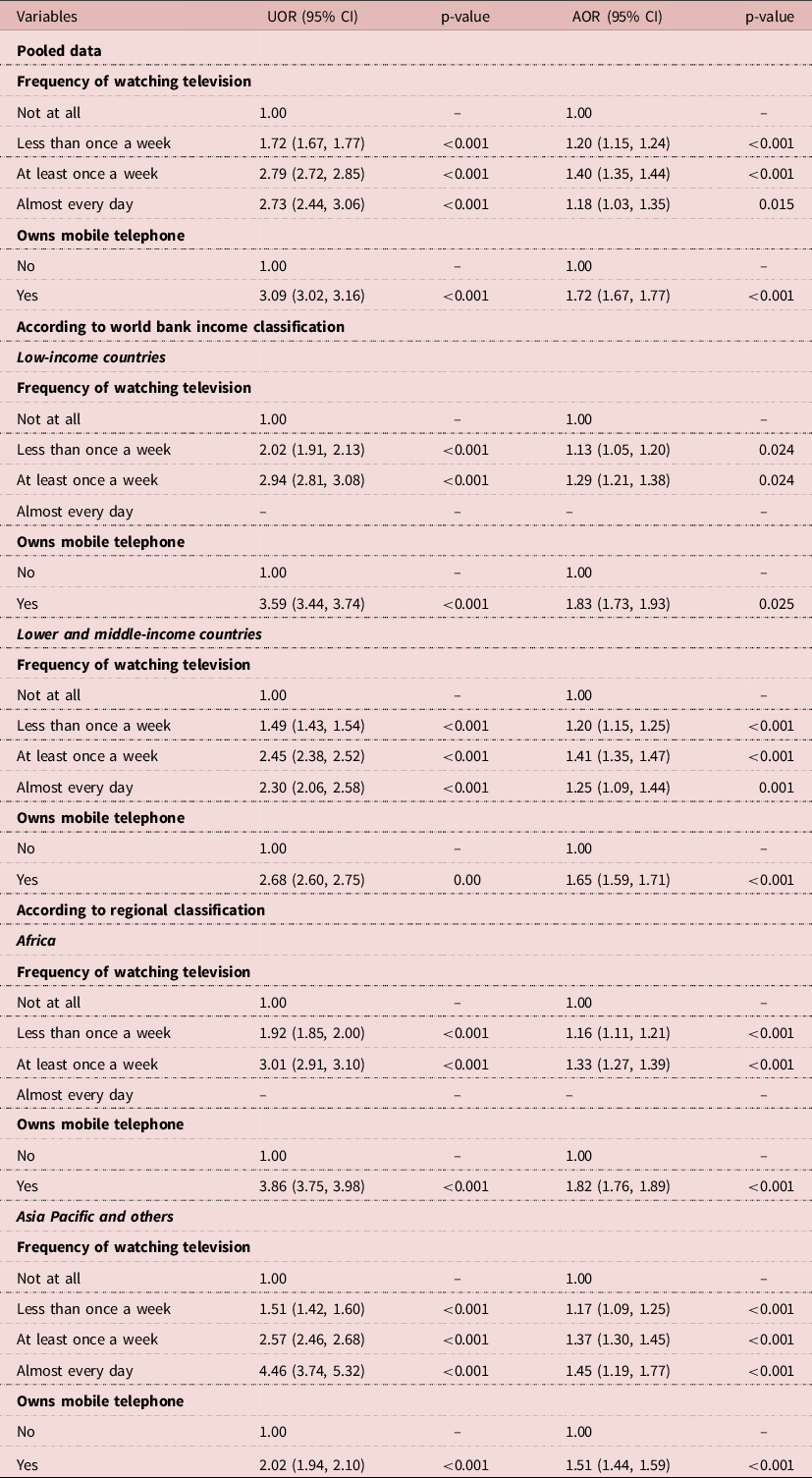
To measure the association between key variables, the crude and adjusted odds of being overweight or obese were presented in Table 3. The results were shown in three segments.
Association of frequency of viewing television and owning mobile with overweight/obesity among reproductive age women in 21 low and lower middle-income countries

Overall pooled analyses
The final model was adjusted for women’s age, residence, education, working status, wealth index, number of household members and the number of children. This study found that the frequency of watching television and owning a mobile phone was significantly associated with overweight or obesity. Overall, women who watched television less than once a week, at least once a week and almost every day were 1.20 (AOR=1.20, 95% CI: 1.15-1.24; p<0.001), 1.40 (AOR=1.40, 95% CI: 1.35-1.44; p<0.001) and 1.18 (AOR=1.18, 95% CI: 1.03-1.35; p=0.015) times, higher of being overweight or obese, respectively, than their counterparts who did not watch television. Conditional on all other factors, women who owned a mobile phone had the strongest association with overweight or obesity, with an odds ratio of 1.72 (AOR=1.72, 95% CI: 1.67–1.77; p<0.001).
Analyses according to the World Bank income classification of countries
Upon stratification by low income and lower-middle-income countries, overweight or obesity displayed a significant association with the frequency of watching television and owning a mobile phone in categories of countries. In low-income countries, women who watch television less than once a week and at least once a week were 1.13 (AOR=1.13, 95% CI: 1.05–1.20; p=0.024) and 1.29 (AOR=1.29, 95% CI: 1.21–1.38; p=0.024) times more likely to be overweight or obese compared with the women who did not watch television any time. Similarly, a significant positive association was reported for women who owned a mobile phone (AOR=1.83, 95% CI: 1.73-1.93; p=0.025). In lower-middle-income countries, women watching television less than once a week, at least once a week, and almost every day had 20% (AOR=1.20, 95% CI: 1.15–1.25; p<0.001), 41% (AOR=1.41, 95% CI: 1.35–1.47; p<0.001) and 25% (AOR=1.25, 95% CI: 1.09–1.44; p=0.001) increased odds of being overweight or obese, respectively, compared with women not watching television at all. However, a significant direct relationship was found between the women who owned a mobile phone and overweight or obese (AOR=1.65, 95% CI: 1.59–1.71; p<0.001).
Analyses according to the regional classification of countries
Regionally, overweight or obesity showed significant association with the frequency of watching television and owning a mobile phone in Africa, the Asia Pacific and other regions. In African countries, women who watch television less than once a week (AOR=1.16, 95% CI: 1.11–1.21; p<0.001) and at least once a week (AOR=1.33, 95% CI: 1.27–1.39; p<0.001) were also found more likely to experience overweight and obesity than those not watching television at all. Women with mobile phone ownership had a higher risk of being overweight or obese than those with no mobile phone (AOR=1.82, 95% CI: 1.76–1.89; p<0.001) in African nations. In the Asia Pacific and other countries, the risk of being overweight or obese was increased with the increased frequency of watching television (AOR=1.17, 95% CI: 1.09–1.25, p<0.001 for women watching television less than once a week; AOR=1.37, 95% CI: 1.30–1.45, p<0.001 for at least once a week; and AOR=1.45, 95% CI: 1.19–1.77, p<0.001 for almost every day). In addition, women who owned mobile phones had 1.51 times (AOR=1.51; 95% CI: 1.44–1.59; p<0.001) higher risk of being overweight or obese than their counterparts without a mobile phone.
Discussion
This study investigated the association between watching television and owning a mobile phone and the prevalence of being overweight and obese among women of reproductive age using pooled data from the DHS. The study displayed that the prevalence of overweight or obesity had a rising trend among reproductive-aged women with a higher frequency of watching television in LLMICs. In addition, the prevalence of overweight or obesity was also higher among the women who owned a mobile telephone. It highlighted that women who regularly watch television are more likely to be overweight and obese. Furthermore, mobile phone owners reported greater odds of being obese and overweight than their counterparts who had no ownership of mobile phones.
The study demonstrated that the prevalence of overweight or obesity among reproductive-age women in LLMICs was 27.1% (95% CI: 26.9-27.3%). However, according to the World Health Organization, approximately half or more than half of the population are overweight/obese in the United States (61.1%), Europe (54.8%), and Eastern Mediterranean (46.0%), whereas a significantly lower prevalence is observed in Africa (26.9%), South-East Asia (13.7%), and the Western Pacific (25.4%) (Yatsuya et al., Reference Yatsuya, Li, Hilawe, Ota, Wang, Chiang, Zhang, Uemura, Osako, Ozaki and Aoyama2014). In addition, the results of this study are much higher compared to the last three decades (Sutradhar et al., Reference Sutradhar, Akter, Hasan, Gupta, Joshi, Haider and Sarker2021). The rising prevalence of overweight or obesity among reproductive-aged women might be characterised by shifting nutritional habits and a sedentary lifestyle (Subedi et al., Reference Subedi, Marais and Newlands2015). Over past the three decades, the consumption of meat, plant, oil and sugar increased significantly (Subedi et al., Reference Subedi, Marais and Newlands2015). Even people are also consuming fast food and processed food more than ever before, possibly due to their easy availability in markets (Subedi et al., Reference Subedi, Marais and Newlands2015). In addition, many people do not perform regular physical activity as per WHO recommendations (Ministry of Health and Population [MOHP] et al., 2014). The possible reason behind the increased prevalence of overweight or obesity among reproductive-aged women is technological advancement and ease of access to devices such as television and cell phones. These devices are used to watch videos and play games. These activities mostly performed in a sitting, reclining, or lying posture with low energy expenditure are associated with overweight or obesity (Maher et al., Reference Maher, Olds, Eisenmann and Dollman2012).
The association of overweight or obesity with television viewing was coherent with different studies conducted in Myanmar (Das Gupta et al., Reference Das Gupta, Haider, Sutradhar, Hashan, Sajal, Hasan, Haider and Sarker2019), India (Gupta et al., Reference Gupta, Sajal, Hasan, Sutradhar, Haider and Sarker2019), Ghana (Tuoyire, Reference Tuoyire2018) and Bangladesh (Chowdhury et al., Reference Chowdhury, Adnan and Hassan2018). These studies reported that women who own a television were more likely to be either overweight or obese compared with women who did not have a television. Given that television commercials influence human behaviour, women may gain weight from watching television, limited daily exercise, unhealthy diets and high caloric food consumption (Tuoyire, Reference Tuoyire2018; Maher et al., Reference Maher, Olds, Eisenmann and Dollman2012).
Similarly, the respondents who own a mobile phone were reported to display a higher odds of being overweight or obese than women who do not own a mobile phone. A Finnish study investigating the prevalence of being overweight among twin adolescents with the association of mobile phone usage found a positive but weak correlation between the variables (Lajunen et al., Reference Lajunen, Keski-Rahkonen, Pulkkinen, Rose, Rissanen and Kaprio2007). The generalised study did not take a greater sample size of non-twin individuals and did not consider the mobile phone bills to monitor phone usage. However, a study conducted on a cohort of Japanese school attending children who use mobile phones had a higher risk of becoming overweight (Wada et al., Reference Wada, Yamakawa, Konishi, Goto, Mizuta, Koda, Uji, Tamura, Nakamura, Tsuji and Nagai2019), concurring with the results found in the present study. Another study on the characteristics between mobile phone usage and the behaviour of the Mexican-Americans also correlated mobile phone use with overweight or obesity in adults (Chrisman et al., Reference Chrisman, Chow, Daniel, Wu and Zhao2016). A probable explanation of such an alignment is that higher cell phone use frequency leads to more sedentary behaviour, reducing cardiovascular fitness among individuals. Such individuals impede their regularity of physical activity, causing obesity or being overweight (Lepp et al., Reference Lepp, Barkley and Karpinski2015). Furthermore, several studies concentrating primarily on children and adolescents have found that the recurrence of using electronic devices interrupts sleep duration (Carter et al., Reference Carter, Rees, Hale, Bhattacharjee and Paradkar2016; Dube et al., Reference Dube, Khan, Loehr, Chu and Veugelers2017; LeBourgeois et al., Reference LeBourgeois, Hale, Chang, Akacem, Montgomery-Downs and Buxton2017; Wada et al., Reference Wada, Yamakawa, Konishi, Goto, Mizuta, Koda, Uji, Tamura, Nakamura, Tsuji and Nagai2019). Other studies have shown that sleep deprivation is positively associated with overweight and obesity (Felső et al., Reference Felső, Lohner, Hollódy, Erhardt and Molnár2017; Li et al., Reference Li, Zhang, Huang and Chen2017), inferring that excessive mobile phone use can affect adult sleep cycles and affect weight in females.
Given the current economic circumstances, sedentary lifestyles and obesogenic food practices are becoming more preferential among individuals (Das Gupta et al., Reference Das Gupta, Haider, Sutradhar, Hashan, Sajal, Hasan, Haider and Sarker2019). Designing interventions that must lead to healthy nutritional practices contributing to individuals being overweight or obese. Women of their reproductive age may suffer from pregnancy complications due to being overweight and obese (Tennant et al., Reference Tennant, Rankin and Bell2011). For a more accurate result, further research can account for the exact number of hours spent watching television and the hours of screen time for individuals owning a mobile phone.
Policy and programme implications
Too much television watching and use of mobile telephone are significantly associated with being overweight or obese among reproductive-aged women. However, there is strong evidence that more television watching also raises the risk of weight-related chronic diseases such as diabetes, heart disease, and early death (Grøntved & Hu, Reference Grøntved and Hu2011). There is convincing evidence that watching television and using the mobile telephone displace the physical activity time, reduce healthy diets, give more scopes for unhealthy snacking during television watching and interfere with sleep, which influences adults to be overweight or obese (Strasburger, Reference Strasburger2011). Television watching and mobile phone usage are modifiable risk factors for overweight or obesity. Making television-free bedrooms and internet-free mobile can help to reduce the risk of being overweight or obese. Different educational programs about the destructive effect of more time watching television and using the mobile phone can play a vital role in controlling overweight or obesity problems (Gortmaker et al., Reference Gortmaker, Peterson, Wiecha, Sobol, Dixit, Fox and Laird1999). In addition, change in social behaviour, the habit of regular physical activity and raising awareness among the population, especially among children and women, may help prevent overweight or obesity and weight-related diseases (Gupta et al., Reference Gupta, Sajal, Hasan, Sutradhar, Haider and Sarker2019).
Strengths and limitations
The key strength of this study is the extensive pooled data from 21 LLMICs rather than focusing on one specific nation. Thus, the study can be more diverse, and the results to be more cohesive regarding different countries. Furthermore, this study has data from low and lower-middle-income countries to gauge the regional differences between the frequency of watching television and mobile phone ownership with women being overweight or obese. The large sample size, accountability for various regions and socioeconomic factors validate the positive association established with a low margin for error. To the best of our knowledge, this study is one of the first to establish a link between television viewing and mobile phone ownership and overweight or obesity in women of reproductive age.
These analyses are not without limitations. The cross-sectional aspect of the study can restrict the probability of drawing out a causal relationship between the association of watching television and mobile phone ownership with overweight or obesity of women of their reproductive age. The regularity of watching television was measured in weeks instead of hours or days, which may have generated less accurate information. In the multivariable analysis, diet plans, food habits, duration of or participation in any physical activity and hereditary factors were also not included (Das Gupta et al., Reference Das Gupta, Haider, Sutradhar, Hashan, Sajal, Hasan, Haider and Sarker2019). Additionally, this study aims to demonstrate a link between owning a mobile phone and being overweight or obese. The results do not provide further data on the frequency of screen time, which may have helped develop the time spent inactive while using mobile phones.
Conclusion
In conclusion, mobile phone usage and watching television were positively associated with women of their reproductive age being overweight or obese in 21 LLMICs. The prevalence of overweight and obesity can have adverse effects on human health, including increasing non-communicable diseases and premature death. Reduced usage of electronic devices such as television and cell phones may effectively prevent weight gain and the associated health hazards.
Acknowledgement
The data used in this study were obtained from the open-access dataset of DHS. We acknowledge DHS for providing us with this freely available data.
Funding
This research received no specific grant from any funding agency, commercial entity or not-for-profit organisation.
Conflict of interest
The authors have no conflicts of interest to declare.
Ethical approval
This study used a secondary dataset taken from the Demographic and Health Surveys (DHS) Program website (https://dhsprogram.com/data/). The ICF Institutional Review Board (IRB) reviewed and approved the standard DHS surveys data. Additionally, country-specific DHS survey protocols are reviewed by an IRB in the host country. ICF IRB certifies that the survey complies with the US Department of Health and Human Services regulations for the safety of human subjects, whereas the corresponding host country IRB confirms that the survey complies with the rules and standards of the country. In addition, the written form is used to take consent from the reproductive-aged women. So, no ethics approval is required for this dataset.