Introduction
Legumes play a significant role in the human diet by providing low-fat dietary protein, essential minerals, and dietary fibre. Hence, it is considered as poor man’s meat. It ensures global food and nutritional security across tropical and subtropical regions (Nitta et al., Reference Nitta, Daggupati, Tirumalasetty and Vattiprolu2024), especially in smallholder farming systems. Nonetheless, their productivity faces considerable challenges, among which insect pests are the most significant factor (Ba et al., Reference Ba, Huesing, Dabiré-Binso, Tamò, Pittendrigh and Murdock2019). One of the most devastating insect pests on edible legumes, viz., Indian bean (Lablab purpureus (L.) Sweet), field bean (Vicia faba L.), cowpea (Vigna unguiculata (L.) Walp), red gram (Cajanus cajan (L.) Millsp), green gram (Vigna radiata (L.) R. Wilczek), black gram (Vigna mungo (L.) Hepper), etc., is the legume pod borer or spotted pod borer, Maruca vitrata F. (Lepidoptera: Crambidae) (Rouf and Sardar, Reference Rouf and Sardar2011; Randhawa and Saini, Reference Randhawa and Saini2015; Krishna and Kumar, Reference Krishna and Kumar2022). It was first documented in Indonesia on beans (Leonard and Mills, Reference Leonard and Mills1931). Although M. vitrata originated in the Indo-Malaya region, it eventually distributed across the entire tropical regions of Asia, Africa, Australia, America, and the Pacific region (Srinivasan et al., Reference Srinivasan, Tamò and Malini2021). Regardless of the fact that the M. vitrata place of origin is the Indo-Malaysian region (Mahale et al., Reference Mahale, Chakravarty and Srivastava2022), it has several haplotype variations and cryptic species. At least 73 legume plant species serve as primary host plants for M. vitrata, leading to yield losses of up to 72%. (Dannon et al., Reference Dannon, Tamò, Agboton, van Huis and Dicke2012; Roy et al., Reference Roy, Chakraborty and Sarkar2017; Srinivasan et al., Reference Srinivasan, Tamò and Malini2021; Mahale et al., Reference Mahale, Chakravarty and Srivastava2022). Female moth lays eggs throughout the cropping season, but damage is majorly seen at two stages, viz., flowering as well as pod formation stages of the host plant (Rouf and Sardar, Reference Rouf and Sardar2011). Larva spins vegetative and reproductive parts (leaves, buds, flowers, and pods) by producing a silken web, and later it starts feeding on the reproductive parts of the respective host plant. It pupates within the silken web itself; therefore, the web protects both the larval and pupal stages from insecticides as well as from attacks by natural enemies (Sujayanand et al., Reference Sujayanand, Chandra, Pandey and Bhatt2021). This oligophagous insect pest is particularly difficult to control due to its broad host range, larval webbing behaviour, and ability to thrive across diverse agro-ecological zones (Sokame et al., Reference Sokame, Tounou, Datinon, Dannon, Agboton, Srinivasan, Pittendrigh and Tamò2015; Srinivasan et al., Reference Srinivasan, Tamò and Malini2021; Sujayanand et al., Reference Sujayanand, Chandra, Pandey and Bhatt2021).
Chemical control is one of the popular strategies for controlling M. vitrata infestations (Agunbiade et al., Reference Agunbiade, Coates, Datinon, Djouaka, Sun, Tamò and Pittendrigh2014; Sodedji et al., Reference Sodedji, Agbahoungba, Nguetta, Agoyi, Ayenan, Sossou, Mamadou, Assogbadjo and Kone2020). The majority of legume production systems have been found to use insecticides indiscriminately, as there are no resistant genotypes/varieties specific to M. vitrata (Srinivasan et al., Reference Srinivasan, Tamò and Malini2021; Mahale et al., Reference Mahale, Chakravarty and Srivastava2022). Chemical insecticides provide great control in the short run but have serious long-term consequences, such as subsequent field control failure and the development of insecticide-resistant populations of M. vitrata on legume plants (Sunitha et al., Reference Sunitha, Rao, Lakshmi, Saxena, Rao and Reddy2008). There are findings which imply that M. vitrata has already shown resistance to various classes of insecticides like organochlorine (endosulfan), organophosphates (chlorpyriphos and dimethoate), and synthetic pyrethroids (cypermethrin and lambda cyhalothrin) (Sreelakshmi et al., Reference Sreelakshmi, Paul, Antu, Sheela and George2015; Ashigar and Umar, Reference Ashigar and Umar2016; Srinivasan et al., Reference Srinivasan, Tamò and Malini2021), raising concerns over the long-term viability of current chemical control strategies. Overall past decades, several new-molecule insecticides, including indoxacarb, methoxyfenozide, chlorantraniliprole, flubendiamide, and cyantraniliprole, have been employed to protect agricultural production (Sreelakshmi et al., Reference Sreelakshmi, Paul, Antu, Sheela and George2015). Recently, it was observed that previously effective insecticides against M. vitrata in the country have become less effective, resulting in population outbreaks (Mahale et al., Reference Mahale, Chakravarty and Srivastava2022). M. vitrata has become a significant threat to both the economic and humanitarian well-being of emerging and low-income countries due to frequent insecticide applications, which have resulted in yield losses and increasing control challenges (Ba et al., Reference Ba, Huesing, Dabiré-Binso, Tamò, Pittendrigh and Murdock2019; Srinivasan et al., Reference Srinivasan, Tamò and Malini2021).
Usage of novel insecticides with high insecticidal toxicity, lower rate of dosage application, and low mammalian toxicity blends well with current integrated pest management (IPM) practices (Sunitha et al., Reference Sunitha, Rao, Lakshmi, Saxena, Rao and Reddy2008). Even though the choice of insecticides for M. vitrata management is as per the recommendations of regulatory bodies (Central Insecticides Board and Registration Committee), these label-claimed chemical insecticides must be periodically revalidated for effective insect pest management (Bhamare et al., Reference Bhamare, Wahekar, Bankar, Thakre, Hajare, Mahajan and More2021). In this regard, insecticide bioassays are an essential diagnostic tool to monitor the emergence of resistance and design region-specific IPM. Despite its importance, there is a significant information gap regarding spatial resistance variation, as most of the recent investigations included two/three pesticide classes and were restricted to small geographical areas. To address this issue, the present study evaluated selected novel insecticides with diverse modes of action against M. vitrata infesting a broad range of leguminous host plants. The susceptibility of five geographically distinct populations was evaluated to facilitate the development of region-specific insecticide resistance management techniques aimed at achieving sustainable insect pest control.
Materials and methods
Insects
Susceptible populations
An iso-female line of M. vitrata (National Accession number: NBAIR-IS-CRA-02), being maintained without exposure to any chemical insecticides and crossed more than 200 generations at ICAR- National Bureau of Agricultural Insect Resources (NBAIR), Bengaluru (12.97160° N, 77.54960° E), Karnataka, India, was used as a susceptible population (laboratory-susceptible (Lab-S)).
Field populations
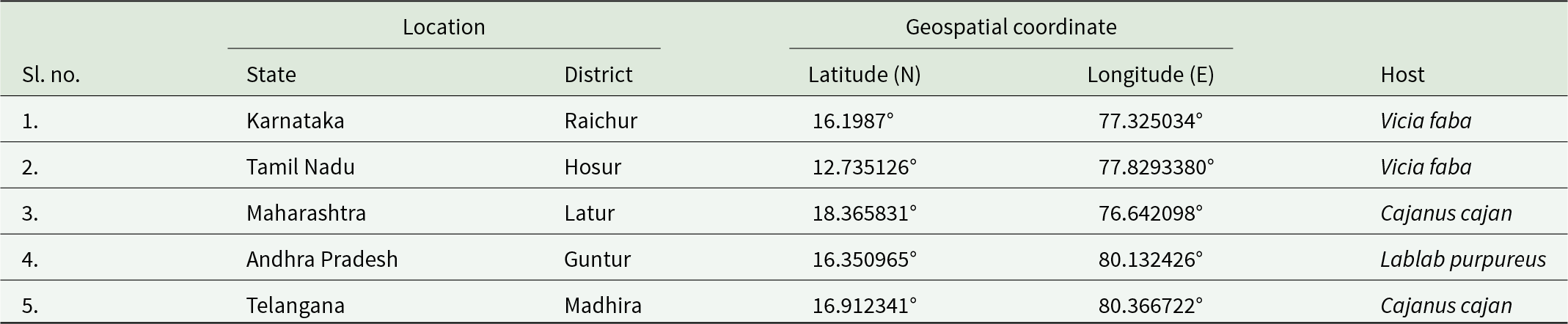
The field populations of M. vitrata larvae were collected from five different geographical locations, viz., Karnataka (Raichur) (16.1987° N, 77.325034º E), Tamil Nadu (Hosur) (12.735126° N, 77.8293380° E), Maharashtra (Latur) (18.365831° N, 76.642098° E), Andhra Pradesh (Guntur) (16.350965° N, 80.132426° E), and Telangana (Madhira) (16.912341° N, 80.366722° E) states of India (Table 1; Fig. S1), which were considered as F0 generation. All insects were maintained under laboratory conditions at 25 ± 1°C temperature, 70 ± 5% relative humidity and 12:12 (L:D) photoperiod on a semi-synthetic diet prepared as per Chethan et al. (Reference Chethan, Venkatesan, Mohan and Shivanna2021) and then uniformly reared. Late second instar larvae of the F1 generation were used for resistance monitoring studies.
Sample collection sites of Maruca vitrata

Table 1 Long description
The table lists five sample collection locations for Maruca vitrata in India, giving state, district, latitude, longitude, and the host plant recorded at each site. Sites are in Karnataka (Raichur), Tamil Nadu (Hosur), Maharashtra (Latur), Andhra Pradesh (Guntur), and Telangana (Madhira). Vicia faba is the host at Raichur and Hosur, while Cajanus cajan is the host at Latur and Madhira. Lablab purpureus is recorded only at Guntur. Coordinates span roughly from about 12.7 degrees north to about 18.4 degrees north in latitude, and from about 76.6 degrees east to about 80.4 degrees east in longitude, indicating coverage across the southern peninsula. The table reports presence at specific sites and does not indicate sampling effort, abundance, or whether hosts were surveyed consistently across locations.
Chemicals
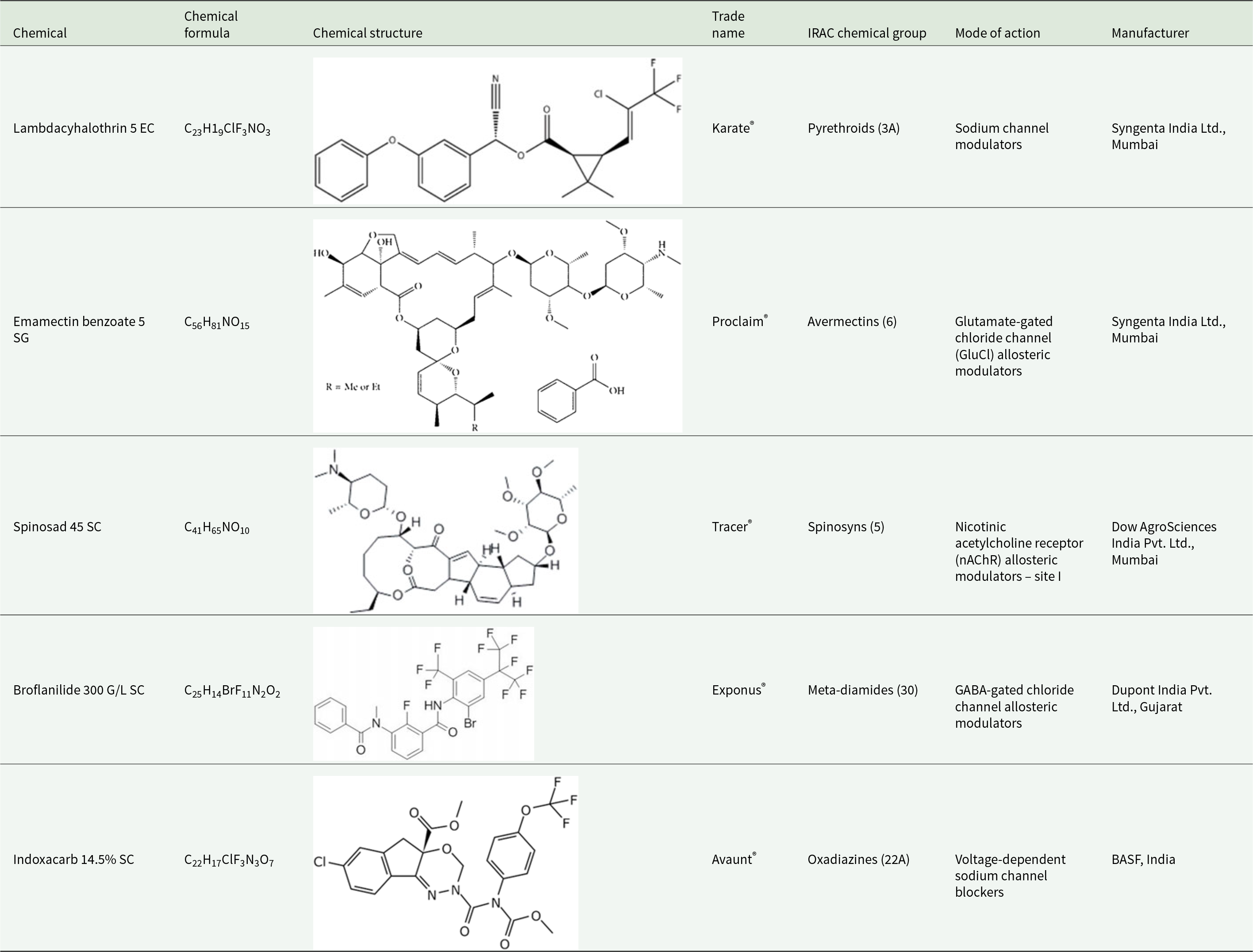
Commercially available new molecule insecticides, viz., lambdacyhalothrin 5 EC, emamectin benzoate 5 SG, spinosad 45 SC, broflanilide 300 G/L SC, and indoxacarb 14.5% SC, were used in this study (Table 2).
Details of insecticides used for insecticide resistance monitoring in Maruca vitrata

Table 2 Long description
The table lists five insecticides used for resistance monitoring in Maruca vitrata, giving each product’s chemical name, trade name, IRAC chemical group, mode of action, and manufacturer. The products cover five distinct IRAC groups: pyrethroids, avermectins, spinosyns, meta-diamides, and oxadiazines. Modes of action include sodium channel modulation or blocking, glutamate-gated chloride channel modulation, nicotinic acetylcholine receptor modulation, and GABA-gated chloride channel modulation. Syngenta India Ltd., Mumbai supplies two entries (Karate and Proclaim), while Dow AgroSciences India Pvt. Ltd., Mumbai, Dupont India Pvt. Ltd., Gujarat, and BASF, India each supply one. Chemical formulas are provided for all five insecticides, while the chemical structure column is blank in every row. The table supports comparing products by IRAC group and target site, but it does not include dose, efficacy, or resistance outcomes.
Dose–mortality bioassays
The diet overlay method (Chethan et al., Reference Chethan, Venkatesan, Mohan and Shivanna2021) was adopted for the insecticide resistance bioassay on late second instar M. vitrata larvae. Based on the dose-bracketing technique, five appropriate concentrations of each selected insecticide were prepared through serial dilution to achieve a larval mortality range between 5% and 95%, enabling accurate estimation of dose–response parameters. One mL of semi-synthetic diet was poured into the wells of each bioassay tray (C-D International, Pitman, NJ, USA) and allowed to dry for 1–2 h in a laminar airflow chamber. After drying, 50 μL of the insecticidal solution was uniformly applied to the diet surface in each well, followed by the transfer of a single late second instar larva, and the bioassay trays were sealed using self-adhesive pull-and-peel tabs (BIO-CV-16, Pitman, NJ, USA). An untreated diet was used as a control, and all the assays were replicated three times using 30 larvae per replicate. At 25 ± 1°C and 70 ± 5% relative humidity, 12:12 (L:D) photoperiod, the bioassay trays were kept for incubation. The mortality of larvae was assessed 48 h after treatment, and moribund larvae that did not respond to probing were considered dead.
Statistical analysis
Probit analysis was carried out to evaluate the dose–response mortality in all the selected M. vitrata populations (Finney, Reference Finney1971) by using Polo PC® 2.0 software (LeOra Software, 2003, Petulama, California, USA). Before analysis, Abbott’s formula was used to correct the larval mortality depending on the survivorship in control (Abbott, Reference Abbott1925). Values estimated included the median lethal concentrations (LC50) and model parameters (slope and intercepts). Goodness-of-fit statistics (χ2) were calculated for each population at p < 0.05. According to Robertson et al. (Reference Robertson, Jones, Olguin and Alberts2017), tests for the hypotheses of equality and parallelism were performed and lethal concentration ratios (LCRs) at LC50 (LCR50) and their 95% confidential limits were computed and the resistance ratio (RR) was calculated by using the formula, RR = (LC50 of field population)/(LC50 of susceptible population) (Tong et al., Reference Tong, Su, Zhou and Bai2013). The outcome of the RR was categorised as per Jiang et al. (Reference Jiang, Wu, Yang, Zhu and Gao2015). RR < 3.0 was considered as susceptible, RR = 3.1–5 was categorised as slightly susceptible, RR = 5.1–10.0 was classified as low resistance, RR = 10.1–40.0 was shown as moderate resistance, RR = 40.1–160.0 was considered as high resistance, and RR > 160.0 was demonstrated as very high resistance. The classified values were further used to design Choropleth-based Resistance risk mapping displaying M. vitrata RRs using Data wrapper software (https://www.datawrapper.de).
Further, to assess the potential cross-resistance and similarities in toxicity patterns among different insecticides, Pearson’s correlation coefficients were calculated based on the log LC₅₀ values obtained from dose–response bioassays conducted on five geographically distinct populations of M. vitrata. Significant correlations (p < 0.05) were indicated in the matrix and interpreted to infer potential cross-resistance or shared mechanisms of toxicity among insecticides. The remaining analysis and graphical depiction were done by using GraphPad Prism 8.0. software package (GraphPad software Inc., LLC, San Diego, CA, USA).
Results
Relative response of field-collected M. vitrata populations to different insecticides
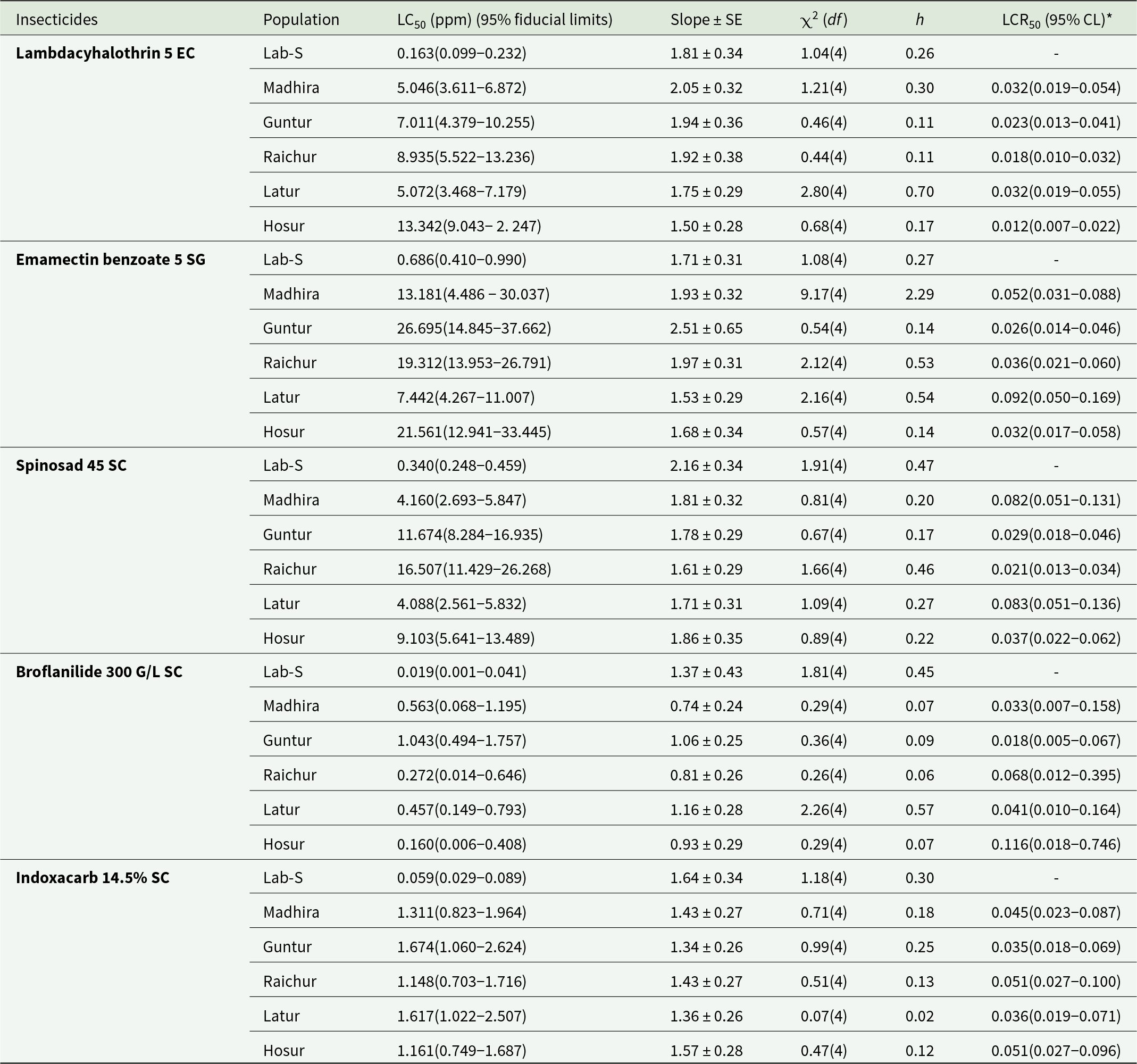
The Lab-S population of M. vitrata exhibited the highest sensitivity to all tested insecticides in the diet-overlay bioassay, with 50% lethal concentration (LC₅₀) values of 0.163 ppm for lambda-cyhalothrin 5 EC (χ2 = 1.04; df = 4; h = 0.26), 0.686 ppm for emamectin benzoate 5 SG (χ2 = 1.08; df = 4; h = 0.27), 0.340 ppm for spinosad 45 SC (χ2 = 1.91; df = 4; h = 0.47), 0.019 ppm for broflanilide 300 G/L SC (χ2 = 1.81; df = 4; h = 0.45), and 0.059 ppm for indoxacarb 14.5% SC (χ2 = 1.18; df = 4; h = 0.30). Resistance monitoring data for these five commonly used insecticides across five geographically distinct M. vitrata populations from South India are summarised in Table 3.
Response of legume pod borer Maruca vitrata field collected populations to commonly used insecticides in South India

Table 3 Long description
The table reports median lethal concentration values in parts per million for five insecticides tested against a laboratory susceptible strain and five field populations (Madhira, Guntur, Raichur, Latur, Hosur), along with dose response slope, model fit indicators, and lethal concentration ratios relative to the lab strain. Across all insecticides, every field population has a higher LC50 than the lab strain, indicating reduced susceptibility. The largest LC50 increases occur for emamectin benzoate, where Guntur is about 39 ppm versus about 0.69 ppm in the lab strain (about 39-fold), and for spinosad, where Raichur is about 16.5 ppm versus about 0.34 ppm (about 49-fold). Lambdacyhalothrin also shows strong shifts, with Hosur about 13.3 ppm versus about 0.16 ppm (about 82-fold). Indoxacarb shows smaller but consistent increases, with field LC50 values around 1.15 to 1.67 ppm compared with about 0.059 ppm in the lab strain (about 19 to 28-fold). Broflanilide has the lowest absolute LC50 values overall (lab about 0.019 ppm; field about 0.16 to 1.04 ppm), but still shows notable fold increases. Lethal concentration ratios are provided with confidence limits; interpret differences cautiously where confidence limits are wide, especially for broflanilide in some populations.
SE, standard error; χ2, Chi-square value; df, degrees of freedom; h, heterogeneity; LC50, median lethal concentration in ppm; LCR, lethal concentration ratios at LC50 and their 95% confidence level (CL) calculated according to Robertson et al. (Reference Robertson, Jones, Olguin and Alberts2017).
*LCR50 is significant (1 = 0.05) as the 95% CL does not include 1.0.
Lambda cyhalothrin
Toxicity assays of lambda-cyhalothrin against M. vitrata populations revealed LC₅₀ values ranging from 5.046 to 13.342 ppm. The population collected from Madhira exhibited the lowest LC₅₀ value (5.046 ppm; χ2 = 1.21; df = 4; heterogeneity factor (h = 0.30), whereas the Hosur population recorded the highest LC₅₀ value (13.342 ppm; χ2 = 0.68; df = 4; h = 0.17) (Table 3).
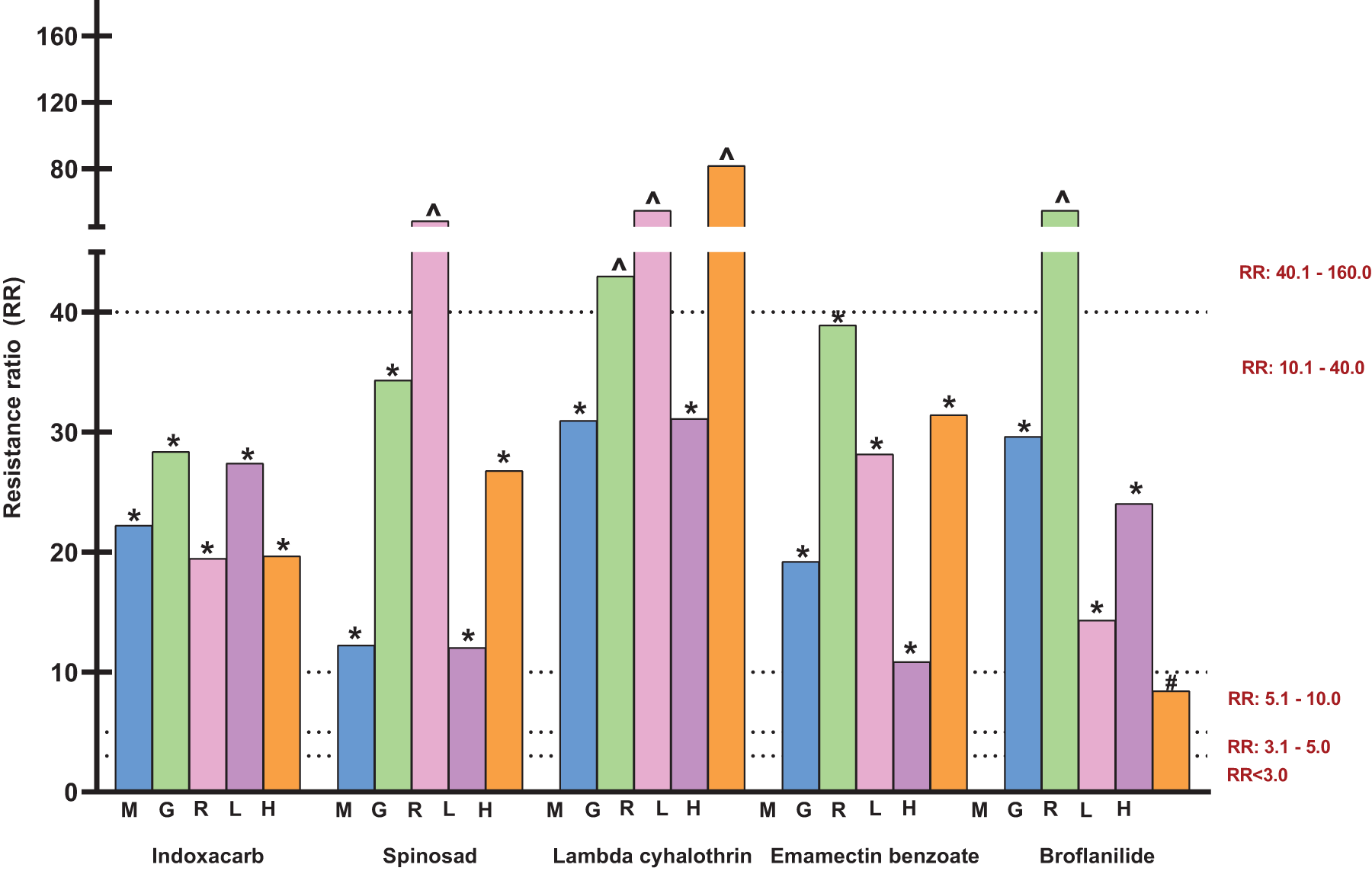
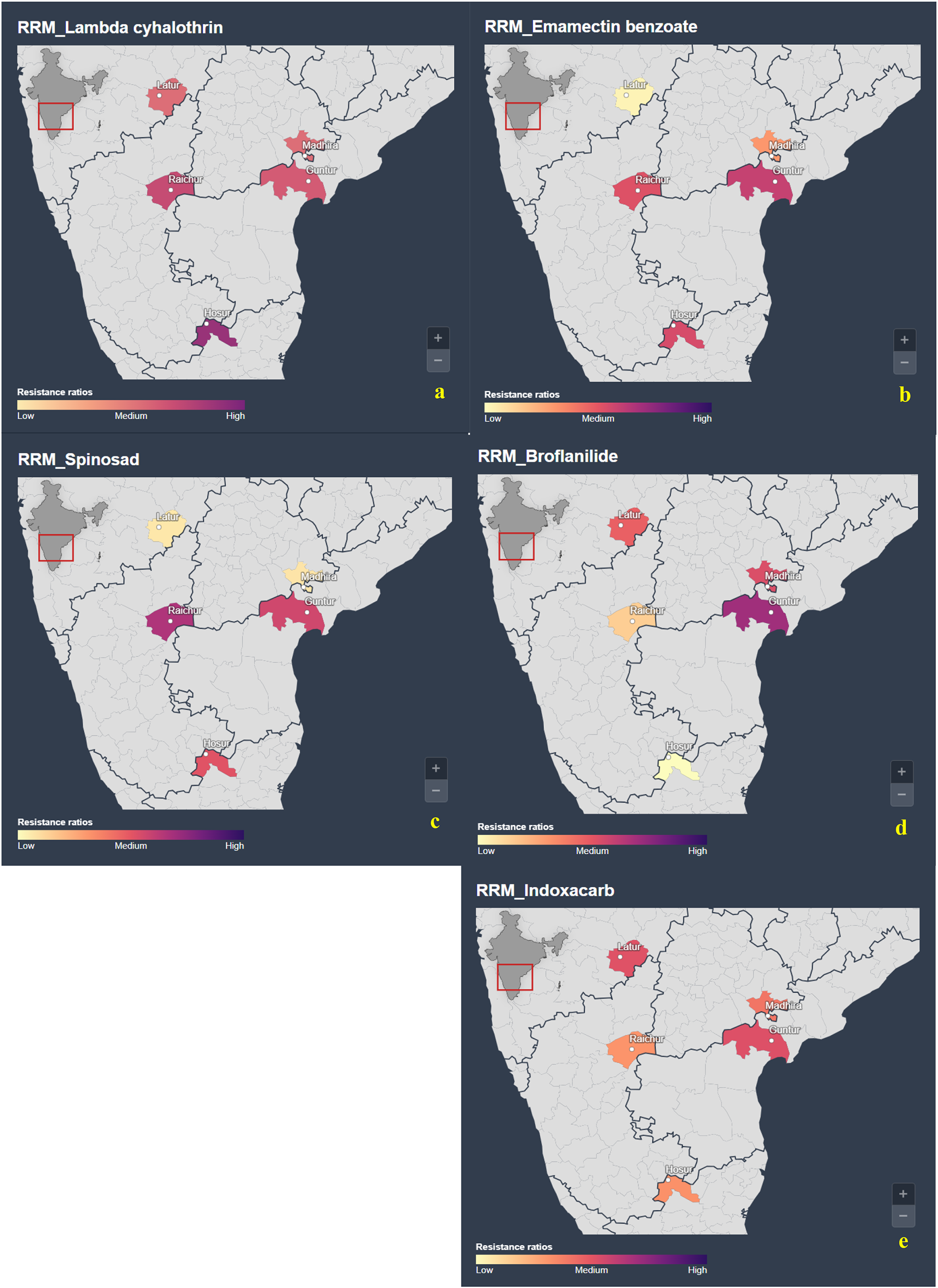
The maximum RR was found in the Hosur population (81.85-fold), followed by Raichur (54.82-fold), Guntur (43.01-fold), Latur (31.12-fold), and Madhira (30.96-fold) populations (Figs. 1 and 2a). The hypothesis test of equality of regression lines revealed a significant difference among the populations (χ2 = 227.0; df = 10; p < 0.05), indicating varying levels of resistance to lambda-cyhalothrin. However, the test for parallelism was non-significant (χ2 = 2.03; df = 5; p > 0.05), suggesting that the rate of increase in resistance was consistent across the populations.
Resistance levels in different field populations of Maruca vitrata to major insecticides that are commonly used for the management of M. vitrata.

Figure 1 Long description
A grouped bar graph with the vertical axis label Resistance ratio left parenthesis R R right parenthesis. The vertical axis shows labeled values 0, 10, 20, 30, 40, 80, 120 and 160. The horizontal axis shows five grouped categories labeled Indoxacarb, Spinosad, Lambda cyhalothrin, Emamectin benzoate and Broflanilide. Under each grouped category, the x axis tick labels are M, G, R, L and H. Indoxacarb group: M about 22, G about 29, R about 20, L about 28, H about 20. Spinosad group: M about 12, G about 35, R about 50, L about 12, H about 27. Lambda cyhalothrin group: M about 31, G about 45, R about 50, L about 31, H about 80. Emamectin benzoate group: M about 19, G about 39, R about 28, L about 11, H about 32. Broflanilide group: M about 30, G about 50, R about 15, L about 24, H about 9. Several bars have symbols above them, including asterisk, caret and hash. Dotted horizontal reference lines are shown across the plot. Text at the right side lists: R R colon 40.1 dash 160.0; R R colon 10.1 dash 40.0; R R colon 5.1 dash 10.0; R R colon 3.1 dash 5.0; R R less than 3.0.
Resistance risk mapping through Choropleth maps displaying Maruca vitrata resistance ratios (RR) to commonly used insecticides in different field populations of South India, i.e. (a) Lambda cyhalothrin, (b) Emamectin benzoate, (c) Spinosad, (d) Broflanilide, and (e) Indoxacarb. RR is classified as susceptible (RR < 3.0), slightly susceptible (RR = 3.1–5), low resistance (RR = 5.1–10.0), moderate resistance (RR = 10.1–40.0), high resistance (RR = 40.1–160.0), and very high resistance (RR > 160.0) as per Jiang et al. (Reference Jiang, Wu, Yang, Zhu and Gao2015). Darker colour intensity indicates increased resistance pressure.

Figure 2 Long description
Five maps display resistance ratios (RR) to insecticides in South India, with north at the top. Each map uses a color gradient to represent resistance levels, from 'Susceptible' (RR < 3.0) to 'Very High' (RR > 160.0). A) The map for Lambda cyhalothrin shows high resistance in Hosur and Raichur, with susceptible areas in the north. B) Emamectin benzoate map indicates high resistance in Guntur and Latur, with moderate resistance in surrounding regions. C) Spinosad map highlights high resistance in Madhira, with susceptible areas in the north and south. D) Broflanilide map shows high resistance in central regions, with moderate resistance in the north and south. E) Indoxacarb map presents high resistance in central areas, with moderate resistance in the north and south. Each map's legend categorizes resistance as susceptible, slightly susceptible, low, moderate, high and very high, with darker colors indicating increased resistance pressure.
Emamectin benzoate
The LC₅₀ values of emamectin benzoate for field-collected M. vitrata populations varied from 7.442 to 26.695 ppm, while the laboratory-reared susceptible strain (Lab-S) exhibited a significantly lower LC₅₀ value of 0.686 ppm (χ2 = 1.08; df = 4; h = 0.27) (Table 3). Among the collected field populations, the Guntur population displayed the highest LC₅₀ value (26.695 ppm; χ2 = 0.54; df = 4; h = 0.14), indicating the lowest susceptibility to emamectin benzoate. This was followed by the Hosur (21.561 ppm; χ2 = 0.57; df = 4; h = 0.14), Raichur (19.312 ppm; χ2 = 2.12; df = 4; h = 0.53), Madhira (13.181 ppm; χ2 = 9.17; df = 4; h = 2.29), and Latur (7.442 ppm; χ2 = 2.16; df = 4; h = 0.54) populations (Table 3).
RR relative to the Lab-S strain ranged from 10.85- to 38.91-fold (Figs. 1 and 2b), confirming the presence of elevated resistance levels in the field populations. Analysis of regression line characteristics revealed that the lines were neither parallel (χ2 = 194.0; df = 10; p < 0.05) nor equal (χ2 = 3.87; df = 5; p > 0.05), indicating significant heterogeneity in resistance levels and suggesting that resistance development occurred in a non-uniform manner across the sampled populations.
Spinosad
Spinosad exhibited high toxicity against populations of M. vitrata, with LC₅₀ values ranging from 4.088 to 16.507 ppm among field-collected populations, compared to an LC₅₀ of 0.340 ppm in the Las-S strain (χ2 = 1.91; df = 4; h = 0.47) (Table 3). The population of Latur showed the greatest susceptibility with the lowest LC₅₀ value (4.088 ppm; χ2 = 1.09; df = 4; h = 0.27), followed by Madhira (4.160 ppm; χ2 = 0.81; df = 4; h = 0.20), Hosur (9.103 ppm; χ2 = 0.89; df = 4; h = 0.22), Guntur (11.674 ppm; χ2 = 0.67; df = 4; h = 0.17), and Raichur (16.507 ppm; χ2 = 1.66; df = 4; h = 0.46).
RR relative to the susceptible strain ranged from 12.02- to 48.55-fold (Figs. 1 and 2c), indicating moderate to high resistance levels. The hypothesis test for regression line characteristics indicated that the lines were parallel (χ2 = 1.72; df = 5; p > 0.05), but not equal (χ2 = 187.0; df = 10; p < 0.05), suggesting significant differences in resistance levels among populations while maintaining a similar rate of resistance development.
Broflanilide
Toxicity assessment of broflanilide against M. vitrata populations revealed LC₅₀ values ranging from 0.160 to 1.043 ppm, in contrast to the Lab-S strain, which exhibited an LC₅₀ of 0.019 ppm (Table 3). The Guntur population showed the highest LC₅₀ value (1.043 ppm; χ2 = 0.36; df = 4; h = 0.09), indicating the lowest susceptibility to broflanilide, followed by Madhira (0.563 ppm; χ2 = 0.29; df = 4; h = 0.07), Latur (0.457 ppm; χ2 = 2.26; df = 4; h = 0.57), Raichur (0.272 ppm; χ2 = 0.26; df = 4; h = 0.06), and Hosur (0.160 ppm; χ2 = 0.29; df = 4; h = 0.07).
RR ranged from 8.42- to 54.89-fold (Figs. 1 and 2d), indicating variability from low to high resistance levels among the tested field populations. Statistical analysis of regression lines showed significant differences in resistance levels, as the hypothesis of equality was rejected (χ2 = 99.88; df = 10; p < 0.05), while the hypothesis of parallelism was accepted (χ2 = 2.94; df = 5; p > 0.05), suggesting similar resistance trends despite differences in absolute resistance levels across populations.
Indoxacarb
Toxicity data for indoxacarb indicated LC₅₀ values ranging from 1.148 to 1.674 ppm among the field populations of M. vitrata, compared to 0.059 ppm in the Lab-S strain (Table 3). The Guntur population exhibited the highest LC₅₀ value (1.674 ppm; χ2 = 0.99; df = 4; h = 0.25), followed by Latur (1.620 ppm; χ2 = 0.074; df = 4; h = 0.02), while the Raichur population showed the lowest LC₅₀ value among field samples (1.148 ppm; χ2 = 0.07; df = 4; h = 0.02).
RR ranged from 19.46- to 28.37-fold (Figs. 1 and 2e), indicating moderate levels of resistance across populations. The statistical analysis of the regression lines showed that the lines were parallel (χ2 = 0.78; df = 5; p > 0.05), implying consistent slopes among populations. However, the hypothesis of equality was rejected (χ2 = 29.58; df = 10; p < 0.05), indicating significant differences in the levels of susceptibility to indoxacarb among the tested populations.
Overall toxicity of five field populations of M. vitrata against insecticides
Among the insecticides evaluated, broflanilide consistently exhibited the lowest LC₅₀ values across all field-collected M. vitrata populations, indicating its superior toxicity and potential as an effective control agent. In contrast, emamectin benzoate demonstrated comparatively higher LC₅₀ values, notably in the Guntur and Hosur populations, suggesting reduced susceptibility and a potential shift in resistance development in these regions.
Estimation of cross-resistance among different insecticides
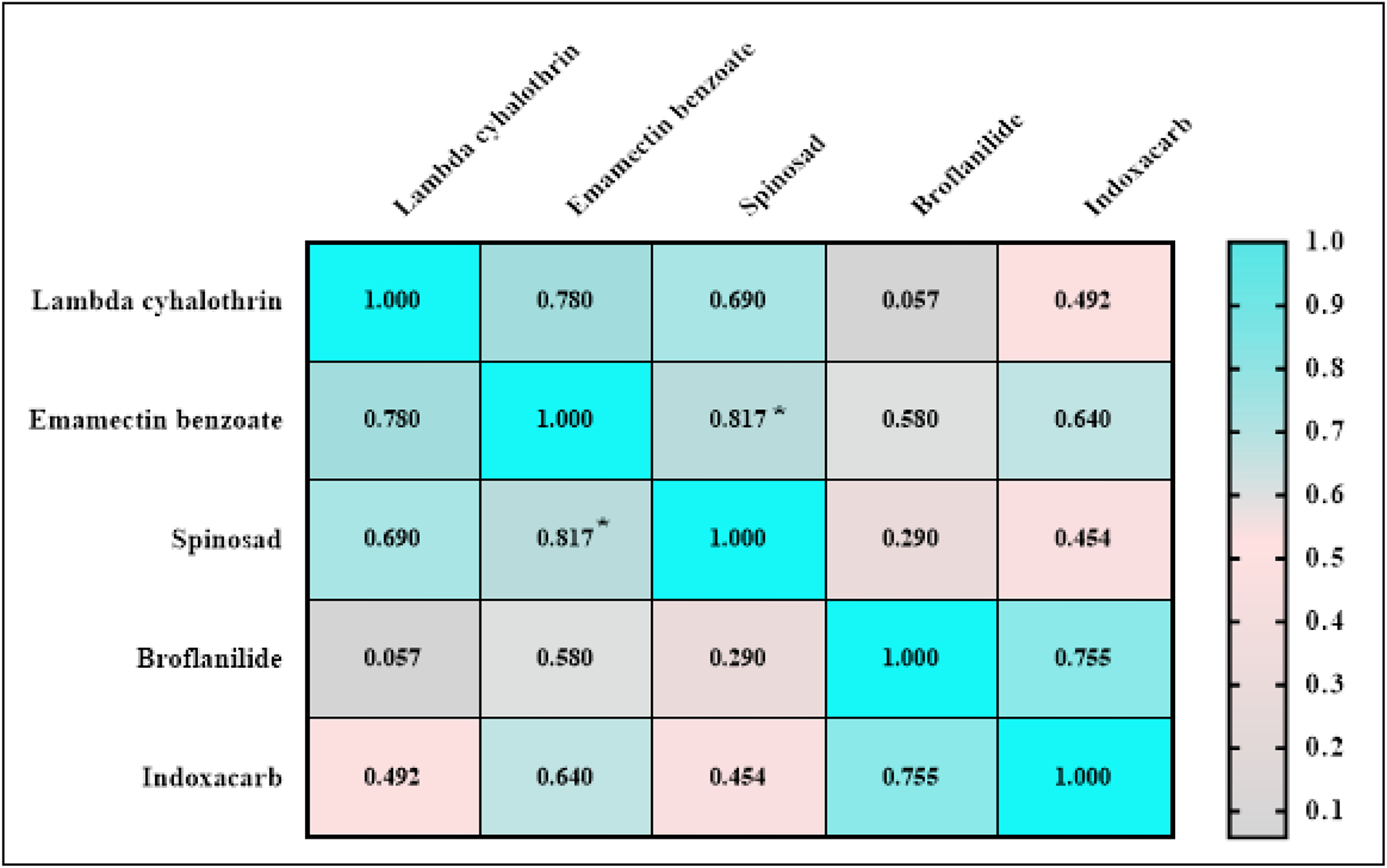
Pearson correlation analysis documented varying degrees of association among the toxicological responses of M. vitrata populations to the tested insecticides (Fig. 3). A significant positive correlation was observed between spinosad and emamectin benzoate (r = 0.817, p < 0.05), suggesting a potential similarity in their toxicity profiles or possible cross-resistance mechanisms. Further, moderate to high correlations (but not statistically significant) were found between lambdacyhalothrin and emamectin benzoate (r = 0.780, p = 0.06), and between the broflanilide and indoxacarb (r = 0.755, p = 0.08), indicating comparable responses of the insect across populations to these insecticide pairs. However, correlations between lambda-cyhalothrin and broflanilide (r = 0.057, p = 0.91) and between spinosad and broflanilide (r = 0.290, p = 0.58) were relatively low, suggesting distinct modes of action and minimum cross-resistance potential between these compounds.
Estimation of cross-resistance through pairwise correlation analysis using LC50 values of five commonly used insecticides for the management of Maruca vitrata.

Figure 3 Long description
A heat map displaying pairwise correlation values between five insecticides used for Maruca vitrata management. Row and column labels include Lambda cyhalothrin, Emamectin benzoate, Spinosad, Broflanilide and Indoxacarb. The color scale on the right indicates correlation strength, with darker shades representing higher correlations. Key correlations include Lambda cyhalothrin and Emamectin benzoate at 0.780, Emamectin benzoate and Spinosad at 0.817 with significance indicated by asterisks and Broflanilide and Indoxacarb at 0.755. Lower correlations are observed between Lambda cyhalothrin and Broflanilide at 0.057 and Spinosad and Broflanilide at 0.290. The diagonal values of 1.000 represent self-correlation and are omitted for brevity. The legend on the right provides a gradient from 0.1 to 1.0, denoting low to high correlation values. Significant correlations are marked with asterisks, indicating statistical significance.
Discussion
M. vitrata is distributed worldwide, and its population build-up is strongly favoured by factors such as a short life cycle and high reproductive potential. Consequently, frequent exposure to multiple applications of different insecticides exerts strong selection pressure on its populations (Ekesi et al., Reference Ekesi, Ogunlana and Dike1997; Zhu et al., Reference Zhu, Lavine, Neal, Lavine, Foss and Walsh2016). The development of resistance is mainly a consequence of past and current usage patterns of insecticides. Comparing resistance levels among different locations is essential for decision making in IPM practices (Ekesi, Reference Ekesi1999; Sreelakshmi et al., Reference Sreelakshmi, Paul, Antu, Sheela and George2015; Ba et al., Reference Ba, Huesing, Dabiré-Binso, Tamò, Pittendrigh and Murdock2019) and this study gives the first confirmed evidence related to broflanilide resistance in M. vitrata in India, highlighting the extent of insecticide resistance across five South Indian populations.
Emamectin benzoate is generally effective against a wide spectrum of lepidopteran pests (Stanley et al., Reference Stanley, Chandrasekaran and Regupathy2009). In the current study, resistance levels to emamectin benzoate in M. vitrata varied across populations, ranging from low in Latur to high in Guntur (Fig. 1), likely due to the prolonged and intensive usage of this insecticide. Similar trends of variable resistance have been reported in Leucinodes orbonalis, where populations exhibited low to high resistance levels (Kariyanna et al., Reference Kariyanna, Prabhuraj, Asokan, Agrawal, Gandhi Gracy, Jyoti, Venkatesan, Bheemanna, Kalmath, Diwan and Pampanna2020), and in Plutella xylostella, where increasing resistance has been observed (Tamilselvan et al., Reference Tamilselvan, Kennedy and Suganthi2021). Prior toxicological studies have confirmed the high efficacy of emamectin benzoate against lepidopteran pests (Firake and Panda, 2009; El-Sheikh, Reference El-Sheikh2015). Its mode of action involves disruption of neurotransmission, leading to neurotoxicity and developmental cardiotoxicity in the target insects (Lu et al., Reference Lu, Wang, Xu, Zhang, Tao, Li and Zhang2022). Kandil et al. (Reference Kandil, Fouad, El Hefny and Abdel-Mobdy2020) documented that exposure to emamectin benzoate significantly reduced γ-aminobutyric acid (GABA) levels in Spodoptera littoralis at LD₁₀, LD₂₅, and LD₅₀ doses. Furthermore, emamectin benzoate has been demonstrated to reduce cell viability, induce DNA damage, and activate apoptosis in Spodoptera frugiperda Sf-9 cells, ultimately impairing insect growth and survival (Wu et al., Reference Wu, Zhang, Yang, Zong, Huang and Tao2016). Despite its effectiveness, resistance to emamectin benzoate has been observed in several insect pests, including P. xylostella (Zhao et al., Reference Zhao, Collins, Li, Mau, Thompson, Hertlein, Andaloro, Boykin and Shelton2006) and Spodoptera exigua (Ishtiaq et al., Reference Ishtiaq, Razaq, Saleem, Anjum, Ane, Raza and Wright2014).
Further, M. vitrata exhibited moderate levels of resistance to lambda-cyhalothrin in Madhira and Latur populations, while higher resistance levels were observed in Guntur, Raichur, and Hosur populations (Fig. 1). Ekesi (Reference Ekesi1999) was the first to report low-level resistance to lambda-cyhalothrin in M. vitrata. In Kerala, Sreelakshmi et al. (Reference Sreelakshmi, Paul, Antu, Sheela and George2015) recorded RRs varying from 2.38- to 7.94-fold against lambda-cyhalothrin. Variable levels of resistance to this insecticide have also been observed in other lepidopteran pests, including Helicoverpa armigera (Wang et al., Reference Wang, Rui, Wang, Nahiyoon, Huang, Zhu, Ji, Yang, Yuan and Cui2021), Spodoptera litura (Sreelakshmi et al., Reference Sreelakshmi, Mathew, Umamaheswaran and Josephrajkumar2019), S. frugiperda (Guo et al., Reference Guo, Tang, Ma, Wu, He, Wan, Ma and Li2024), and Spodoptera cosmioides (Rocha et al., Reference Rocha, Martinez, Lima, Farder-Gomes, Cossolin, Afzal and Serrão2025). The increasing resistance levels may be attributed to the indiscriminate and repeated use of lambda-cyhalothrin, as well as the exposure of insect populations to sublethal doses resulting from insecticide degradation under field conditions (Desneux et al., Reference Desneux, Fauvergue, Dechaume-Moncharmont, Kerhoas, Ballanger and Kaiser2005; Li et al., Reference Li, Li, Wang, He, Tan and Yang2019). Therefore, continuous monitoring of resistance is very much essential, and particular attention should be given to the potential resurgence of M. vitrata following insecticide applications, especially considering the widespread use of lambda-cyhalothrin in its management.
Spinosad is noted for its great efficacy against a variety of insect pests, particularly within the Lepidopteran and Dipteran orders (Salgado et al., Reference Salgado, Sparks, Gilbert and Gill2010). In the current investigation, the toxicity data of spinosad against M. vitrata revealed moderate resistance levels in Madhira, Guntur, Latur, and Hosur, while a high resistance level was reported in the Raichur population, with RRs ranging from 12.24- to 48.55-fold (Fig. 1). Similar patterns have been documented in other lepidopteran pests, with low to extremely high levels of resistance noticed in Tuta absoluta (Grant et al., Reference Grant, Jacobson, Ilias, Berger, Vasakis, Bielza, Zimmer, Williamson, ffrench‐Constant, Vontas and Roditakis2019), S. litura (Saleem et al., Reference Saleem, Hussain, Ghouse, Abbas and Fisher2016), and S. frugiperda (Zhang, Reference Zhang2021). In contrast, low to moderate resistance has been documented in P. xylostella (Tamilselvan et al., Reference Tamilselvan, Kennedy and Suganthi2021) and S. exigua (Che et al., Reference Che, Shi, Wu and Yang2013). Interestingly, spinosad resistance has also been detected in the beneficial insects, such as the parasitoid Cotesia plutellae, under laboratory conditions (Liu et al., Reference Liu, Li, Liu, Feng and Tang2007), raising concerns about its impact on biological control agents. Although several laboratory studies have reported insect resistance to spinosad, the underlying mechanisms remain incompletely understood. Its unique mode of action may contribute to this complexity; spinosad is known to target nicotinic acetylcholine receptors (nAChRs) simultaneously with acetylcholine (Salgado et al., Reference Salgado, Sheets and Watson1998). The results of this study highlight that spinosad remains a potent insecticide for managing M. vitrata in most locations. However, in Raichur (Karnataka, India), where a high level of resistance was detected, its use should be minimised, and alternative insecticides with lower resistance levels should be considered to prevent further resistance build-up.
A novel meta-diamide insecticide, broflanilide, which shows a high level of toxicity against a broad range of crop pests in the insect orders, viz., Lepidoptera, Diptera, Coleoptera, Thysanoptera (Lees et al., Reference Lees, Ambrose, Williams, Morgan, Praulins, Ingham, Williams, Logan, Ismail and Malone2020), mites (Shen et al., Reference Shen, Li, Leviticus, Chang, Tang, Cui, Han and Zhao2021) and non-crop pests like cockroaches, termites, and ants (BASF, 2020). RRs for different M. vitrata populations generated against broflanilide vary from low resistance (8.42-fold) to high resistance (54.89-fold). Moderate resistance was found in H. armigera to broflanilide (Wang et al., Reference Wang, Shi, Tang, Liu, Hou, Jiang, Lu, Yang, Carrière and Wu2023). The chemical insecticide causes vomiting and strong excitement in insect pests (Katsuta et al., Reference Katsuta, Nomura, Wakita, Daido, Kobayashi, Kawahara and Banba2019). To date, no cross-resistance has been found with this insecticide, and it is reported to be an effective tool for managing insecticide resistance. However, broflanilide is anticipated to be widely used in many countries to manage the major lepidopteran pests, which will raise the possibility of resistance evolving. Therefore, species-specific baseline data of target insect pest susceptibility to broflanilide are needed for effective implementation of resistance monitoring programs (Rivero-Borja et al., Reference Rivero-Borja, Rodríguez-Maciel, Urzúa-Gutiérrez, Silva-Aguayo, Chandrasena, Felix-Bermudez and Storer2020). More in-depth research should be carried out based on laboratory results to provide good results for the use of broflanilide for M. vitrata management at the field level.
Indoxacarb, an oxadiazine insecticide, is known for its broad-spectrum efficacy against various Lepidopteran pests, as well as selective Coleopteran and Hemipteran species (Batista et al., Reference Batista, Plata-Rueda, Cunha, Zanuncio, Serrão and Martínez2025). In the current investigation, M. vitrata populations exhibited moderate levels of resistance to indoxacarb, with RRs ranging from 19.46- to 28.37-fold (Fig. 1). Similar moderate resistance levels have been previously reported in other major insect pests, including H. armigera (Bird, Reference Bird2017), P. xylostella (Zhang et al., Reference Zhang, Zhang, Shen, Li, Wan, You and Li2017), and Cydia pomonella (Yeşilırmak et al., Reference Yeşilırmak, Çevik and Ay2025). Indoxacarb acts as a pro-insecticide that is metabolically triggered within the insect midgut to its bioactive form, decarbomethoxylated JW062 (DCJW), primarily through esterase-mediated conversion. DCJW functions as a potent blocker of voltage-dependent sodium channels, thereby disrupting sodium ion flow and leading to neurotoxic symptoms and eventual insect mortality (Wing et al., Reference Wing, Schnee, Sacher and Connair1998; Ahmad and Gull, Reference Ahmad and Gull2017). The increased activity of cytochrome P450 monooxygenases has been linked to enhanced indoxacarb resistance in insects, as reported by Hafeez et al. (Reference Hafeez, Li, Ullah, Zhang, Zhang, Huang and Lu2022). Currently, indoxacarb is widely used across various cropping systems as a replacement for older chemical classes like organophosphates, carbamates, and pyrethroids. Nonetheless, its intensive and repeated application in the field has aided to the development of resistance in target insect populations (Chen et al., Reference Chen, Zhang, Wang, Li, Yin, Shen, Yan and Liu2024). These findings underscore the need for resistance monitoring and judicious use of indoxacarb within IPM programs.
Understanding cross-resistance among insecticides is crucial for designing effective resistance management tactics, particularly in the context of widely practised approaches such as insecticide rotation and sequential applications (Roush, Reference Roush1989). The present findings indicate a significant positive correlation in resistance between spinosad and emamectin benzoate, suggesting a potential cross-resistance between these two insecticides. This observation aligns with previous reports, such as Sayyed et al. (Reference Sayyed, Ahmad and Crickmore2008), who documented cross-resistance between indoxacarb and both emamectin benzoate and spinosad in S. litura populations selected for indoxacarb resistance. The presence of cross-resistance likely reflects shared or overlapping mechanisms of detoxification or target-site modifications that reduce insect susceptibility to multiple compounds. Conversely, the absence of significant cross-resistance among certain other insecticide combinations in this study suggests their compatibility for use in rotation or sequence-based strategies. Employing such non-cross-resistant insecticides in pest management programs can delay resistance development, reduce selection pressure, and prolong the efficacy of existing chemical tools. These results reinforce the need for informed selection of insecticides based on cross-resistance profiles, supporting the development of sustainable and region-specific IPM strategies for M. vitrata.
Conclusion
The increasing resistance of insects to different insecticides poses significant challenges in agricultural insect pest management. The present investigation is a collective effort that serves as a baseline for monitoring insecticide resistance and cross-resistance in M. vitrata. The results of this study indicate that M. vitrata field populations from five Indian states have developed varying levels of resistance to several insecticides, particularly lambda-cyhalothrin, emamectin benzoate, and spinosad. This highlights the urgent need to implement insecticide rotation and alternation strategies using compounds that exhibit lower resistance levels in the target populations. Furthermore, expanded surveillance of resistance patterns across additional regions in the affected countries is essential for developing region-specific pest management strategies. In-depth biochemical and molecular investigations into the mechanisms underlying insecticide resistance will further enhance our understanding and support the development of more effective resistance management frameworks. Such integrated approaches will be vital for ensuring the long-term sustainability and efficacy of insecticide-based control measures in the field.
Supplementary material
The supplementary material for this article can be found at https://doi.org/10.1017/S0007485326100856
Acknowledgements
The authors are grateful to the Indian Council of Agricultural Research (ICAR) for funding under the Consortium Research Platform (CRP) on Genomics project. The authors thank the Director, ICAR-National Bureau of Agricultural Insect Resources (NBAIR), Bengaluru, India, for the facilities provided. The authors are profusely thankful to University of Agricultural Sciences, Raichur.
Author contributions
C.R.C. carried out the experiment, performed data analysis, formal analysis and prepared the original draft. S.R.J. contributed to data analysis and review. S.N. edited and reviewed the manuscript. M.M. contributed to framing of the study, resource supply, data curation and draft corrections. All authors contributed to the study conception and design.
Financial support
Not applicable.
Data availability statement
All the data generated in the present investigation have been incorporated into the manuscript and are available from the first author upon request.
Competing interests
Authors declare that they have no known competing or financial conflict of interest.
Ethical approval
Not applicable.
Consent to publication
All authors have read the final version of the manuscript and agreed to publish.