

1 Introduction
A recurrent debate in the development economics literature concerns the possible deterioration in the real terms of trade for low-income countries. This hypothesis was formed simultaneously, but independently, by Prebisch (Reference Prebisch1950) and Singer (Reference Singer1950), who argued that the terms of trade for primary products had suffered a continuous and persistent deterioration, and that this was one of the key factors limiting the growth of the least developed economiesFootnote 1.
A review of the principal research in this field compiled by Nguyen (Reference Nguyen1981) and extended by Diakosavvas and Scandizzo (Reference Diakosavvas and Scandizzo1991) indicates that the debate remains open (see also Cuddington and Urzúa Reference Cuddington and Urzúa1989). The results obtained for the secular (continuous) trend of relative prices differ according to the period analysed, the definitions used and the estimation techniques used. In recent decades, some studies have improved the price series (e.g. Spraos Reference Spraos1980 and Grilli and Yang Reference Grilli and Yang1988), whereas others have focused on the use of more refined methodologies such as structural models (Sapsford Reference Sapsford1985). Diakosavvas and Scandizzo (Reference Diakosavvas and Scandizzo1991) and Ocampo and Parra (Reference Ocampo and Parra2003 and Reference Ocampo and Parra-Lancourt2010) have utilised time series methods together with structural break models (see also Lutz Reference Lutz1999a; Newbold et al. Reference Newbold, Pfaffenzeller and Rayner2005; Zanias Reference Zanias2005; Kellard and Wohar Reference Kellard and Wohar2006; Cuddington et al. Reference Cuddington, Ludema and Jayasuriya2007; Balagtas and Holt Reference Balagtas and Holt2009; Spatafora 2009), whereas a further group of scholars, including Hadass and Williamson (Reference Hadass and Williamson2003), has focused on the impact of the deterioration in the terms of trade on developing countries.
The literature reveals a remarkable lack of consensus, not only with regard to the verification of otherwise of the Prebisch–Singer hypothesis, but also with regard to the theoretical arguments that would explain a deterioration in the terms of trade. Some later studies, using more adequate price series, emphasise the existence of a long-term deterioration in the terms of trade for primary products in contrast to manufactures, but on the other hand question whether this was a secular or continuous trend. They suggest instead that it was concentrated in certain periods, particularly the interwar years and the 1980s, and therefore suffered a two-step fall (Ocampo and Parra Reference Ocampo and Parra2003 and Reference Ocampo and Parra-Lancourt2010).
According to Diakosavvas and Scandizzo (Reference Diakosavvas and Scandizzo1991) and Hadass and Williamson (Reference Hadass and Williamson2003), there is even less consensus with regard to the impact of the deterioration in the terms of trade on developing countries (i.e. the situation in which countries exporting primary products are left in terms of income and welfare). This means that even if the thesis of deterioration in primary product prices is correct, the far-reaching economic and technical changes occurring in the world economy and causing this variation in prices are difficult to measure by the simple quotient that expresses the real terms of trade relations.
Our objective is to contribute to this debate by analysing the evolution of the terms of trade for agricultural and food products in the second half of the last century. The study aims to answer one of the three principal questions on which the debate has centred: whether empirical records confirm the alleged secular decline in the terms-of-trade shock affecting primary producers, which has been called the «debate about the facts» (Hadass and Williamson Reference Hadass and Williamson2003, p. 630).
Our study period, the second half of the last century, is somewhat shorter than usual for this type of researchFootnote 2, but it has certain features that amply justify the choice. Firstly, it is evident that inter-industry trade based on exchanging agricultural products for manufactures, which predominated in the first wave of globalisation, tended to be replaced during the second by principally intra-industrial trade, in which the most important exchanges were between advanced countries (Krugman Reference Krugman1980; Helpman and Krugman Reference Helpman and Krugman1985). Secondly, although trade in agricultural products increased at an annual rate far above that of the first wave of globalisation, its weight in total world trade declined considerably. This loss of relative importance was due to both slower growth in the volume of agricultural trade and to a significant fall in the real prices of agricultural products and food (Serrano and Pinilla Reference Serrano and Pinilla2011b and Reference Serrano and Pinilla2011c).
Therefore, we attempt to establish the exact nature of this fall. In line with the literature referred to above, which emphasises that the behaviour of the terms of trade for primary products has varied significantly depending on the products and period in question, we perform a highly disaggregated analysis for the set of products of agricultural origin, with the aim of excluding non-agricultural raw materials. Many studies using the price indices constructed by Grilli and Yang (Reference Grilli and Yang1988) have approached the problem by including agricultural and raw material prices together, but we believe that these obey different logics. A recent analysis by Ocampo and Parra-Lancourt (Reference Ocampo and Parra-Lancourt2010) of a more heterogeneous group of primary products over a longer time period underlines that it was precisely agricultural products that displayed the most negative price behaviour in the long term, with a significant decline in the second half of the 20th century, whereas in the same period mineral prices remained stable or tended to increase. Our study is therefore partially distanced from the product group that was stricto sensu the original subject of the studies by Prebisch and Singer (the comparison of all primary products with manufactures), as it concentrates only on products of agricultural origin.
Given the historical importance of agricultural products in the exports of most developing countries, however, we believe that our study also makes a contribution in this area, as it focuses on the possible problems that such countries experience because of the poor performance of the real prices of products in which they are highly specialised. This was the case of many countries in Latin America, for example, whose exports were highly concentrated in agricultural products by 1950. The attempt to develop an import-substituting industrialisation strategy, justified in part by the deterioration in the continent's terms of trade and the economic development of the following decades, helped somewhat to reduce this specialisation; however, these products were still the principal export items of many countries at the end of the century (Bulmer-Thomas Reference Bulmer-Thomas1994).
We constructed sixty new series of price indices for specific agricultural products that were traded internationally between 1950 and 2000, to accurately represent all the groups comprising farm tradeFootnote 3. In addition, to obtain real prices, we deflated the agricultural price series by an index for international trade prices in order to include the important changes in the prices not only of manufactures but also of other goods, such as energy products, which strongly influenced the shocks occurring in the study period. In summary, we are specifically interested in the evolution of the real prices of agricultural and food products. We selected this option because we are especially interested in determining the behaviour of the prices of each group of products of agricultural origin, not in contrast to another product group, such as manufactures, but instead to the set of all the goods comprising international trade. This allows a more complete understanding of the impact of the evolution of export prices for developing countries, and especially for the least developed, as these do not import exclusively manufactures; for example, energy products make up a significant part of their imports. The significant rise in energy prices and their strategic character within the international economy provides further justification of our subject selection.
A second contribution of this study is the use of a new time series methodology that helps to fill the gaps left by some previous studies. Drawing on the work of Clemente et al. (Reference Clemente, Montañés and Reyes1998), we analyse the presence of two structural breaks in non-stationary series, and in addition establish endogenously in which years these took placeFootnote 4. We study when this deterioration occurred and its nature, analysing whether this occurred in specific periods or, by contrast, was gradual and continuous.
This set of analyses is aimed at characterising the different behaviour of the product groups that comprise international agricultural trade, determining in which of them the greatest deterioration occurred and proposing various hypotheses regarding their possible causes, both economic and institutional.
Following this introduction, section 2 explains the construction and long-term evolution of the series. Section 3 describes the econometric analysis and presents the principal results. The section 4 presents some conclusions, and also tentatively explores the case of Latin America.
2 Construction of the series and evolution of the real prices of agricultural and food products
In order to analyse the possible deterioration in real agricultural prices, we constructed nineteen price indices for the group of products that, according to the Standard International Trade Classification (SITC Revision 2), form part of agricultural and food trade. In addition, we prepared a general index of agricultural and food trade prices with the objective of analysing their aggregate evolution. To obtain these price indices, we calculated sixty price series for distinct products; these are the unitary value of world exports of each of them, on the basis of the trade figures compiled by the Food and Agriculture Organisation (FAO) of the United NationsFootnote 5 (see Appendix 1 for a description of the individual price series used and Appendix 2 for the series). The prices of the different products were aggregated to construct the price indices and weighted according to their share of world exports in each year.
In the first place, the selection of these prices instead of possible alternatives, such as the customary series of Grilli and Yang (Reference Grilli and Yang1988), permits greater coverage of the products that participated in agricultural trade. The representativeness of the aggregate series is far broader than that of similar studies. Thus, whereas the series used by Grilli and Yang (Reference Grilli and Yang1988), and subsequently reused in numerous studies by other authors, cover 49 per cent of all food products and 83 per cent of all non-food agricultural products in the period 1977-1979, our series represent 94 per cent of world trade in agricultural and food products in 1978Footnote 6. The homogeneity of our series also offers a certain advantage. We use the export unit values of agricultural products and food in the numerator, and the export unit values of world trade as a whole in the denominator, in order to deflate the nominal prices of the former. In the classic series of Grilli and Yang (Reference Grilli and Yang1988), the numerator to construct the nominal price index of commodities uses fourteen series from international market quotations, five from import unit values (cost, insurance and freight (CIF) prices from different countries for each series: the United States, the United Kingdom and Europe) and six from export unit values (free-on-board (FOB) prices from different countries for each series). The deflator used by Grilli and Yang is a trade-weighted index of the unit values of the exports of manufactures from the five major developed countries (France, Germany, Japan, the United Kingdom and the United States) to developing countries (Pfaffenzeller et al. Reference Pfaffenzeller, Newbold and Rayner2007). Moreover, as our series is composed of export prices, they are FOB, and thus prices are unaffected by international costs of transport and insurance or by the effects of the trade policies (quotas, tariffs, etc.) of the different countries.
The deflator used to calculate the real prices of agricultural and food products is the unit value index of total world trade, once more taking exports into account to avoid the above-mentioned problems (World Trade Organization 2003). This provides a wider vision than simple comparison with the evolution of the prices of manufactures, given that the structure of trade has changed substantially since the mid-20th century. The increased dependence on fuel, on raw materials for industry, on processed foods and on minerals has changed the structure of countries’ imports. In short, our series obtains real prices and, consequently, measures the evolution of the purchasing power of agricultural products forming part of international trade compared with all goods comprising such trade. Obviously, we cannot measure the evolution of real prices exclusively for developing countries, as our basket of goods includes «all» agricultural products and not only those exported by such countries. Logically, the terms of trade of these countries will depend on the composition of both their imports and their exportsFootnote 7.
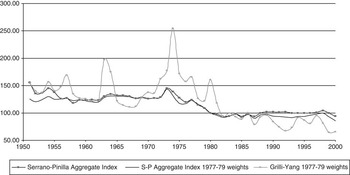
An initial view of the evolution of real agricultural and food product prices is given in Figure 1 (the Serrano–Pinilla (S–P) aggregate index). We also present two further indices constructed for comparative purposes. The first was prepared in the same way as our aggregate index, but this time weighting the prices of the distinct product groups by their relative importance in world trade in agricultural products and food in 1977-1979 (S–P aggregate index, 1977-1979 weights). The second comprises the eighteen products of agricultural origin included by Grilli and Yang (Reference Grilli and Yang1988) in their original study and to whose characteristics we have already referred, also weighted as previously (Grilli–Yang 1977-1979 weights). For the two new series, we used the same deflator as for the initial S–P aggregate index.
EVOLUTION OF THE REAL PRICES OF AGRICULTURAL AND FOOD PRODUCTS, 1951-2000
Source: Authors's elaboration on the basis of FAOSTAT (2004). The series used to construct the index Grill–Yang (1977) was kindly supplied by Stephen Pfaffenzeller.

This series of the real prices of agricultural and food products shows a gentle but persistent fall from 1951 until 1972. The 1970s were marked by the two oil price shocks of 1973 and 1979 and the deep worldwide economic crisis, producing notable turbulence in agricultural prices and a downward trend that persisted until the mid-1980s when prices tended to stabilise.
The comparison with the two additional series is intended to examine possible composition biases; the S–P Index is only an aggregate index. We make the first comparison with the series «S–P aggregate index, 1977-1979 weights», to observe the sensitivity of our index with respect to the weighting system employed. With the exception of the years 1951-1955, the result is that both series display extraordinarily similar behaviour, with a correlation coefficient of 0.94.
The second series compared is the index «Grilli–Yang 1977-1979 weights». In this case, the principal difference resides less in the trend and evolution of the two series and more in the enormous fluctuations the latter series display. This is logical if we remember that as the number of products is much smaller, eighteen compared to sixty, the Grilli–Yang index is affected far more deeply by the shocks of the 1970s and in general displays much lower stability. Whatever the type of weighting used, we believe that our indices reflect the real price evolution of agricultural and food products much more accuratelyFootnote 8.
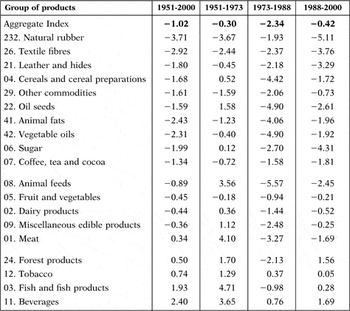
The evolution of our price series is also summarised in Table 1, which presents the annual rates of growth for the index of real prices of agricultural and food products and for its nineteen constituent groups (see column 1). Taken together, the reduction was substantial, as the real price of agricultural products fell at an annual rate of 1.02 per cent during the second half of the past centuryFootnote 9. The deterioration was very gentle in the first two decades, sharp in the period 1973-1988, when relative agricultural prices fell at an average annual accumulative rate of 2.34 per cent, and once again very slight in the final 15 years.
EVOLUTION OF REAL PRICES OF AGRICULTURAL AND FOOD PRODUCTS (CUMULATIVE AVERAGE ANNUAL RATES OF GROWTH)

Source: Authors’ elaboration, using the FAOSTAT (2004) database.
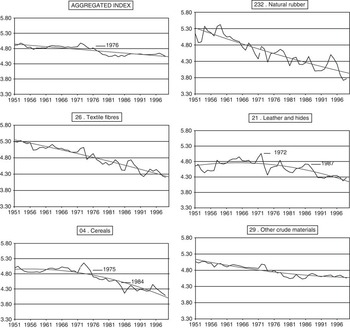
The behaviour of the different product groups was fairly heterogeneous. In general, less-processed products suffered a very substantial decrease in their real prices, far greater than that of the aggregate index. This is the case of raw materials and basic foods (SITC groups: 21. leather and hides, 22. oil seeds, 26. textile fibres, 29. other commodities and 04. cereals), the traditional tropical export products (06. Sugar, 07. coffee, tea and cocoa and 232. natural rubber) and other products (42. vegetable oils, 41. animal fats). By contrast, agricultural products and processed and high-value foods performed better (02. dairy products, 05. fruit and vegetables, 08. animal feeds and 09. miscellaneous edible products) or even suffered no deterioration (01. meat, 03. fish, 11. beverages, 12. tobacco and 24. cork and wood). Despite rising real prices in the long term, the latter (except tobacco and wood) were (like the remaining products) unable to avoid a sharp fall in the period 1973-1988, when the increase in oil prices produced a strong shock in international markets (see column 3 of Table 1).
3 Econometric analysis of real price trends for agricultural and food products
To determine whether there exist structural breaks or discontinuity in the series, and to examine changes in their trend that may determine the character of the shock, our objective now is to analyse the evolution of the real prices of the products comprising international agricultural trade in the period 1951-2000 using time series analysis.
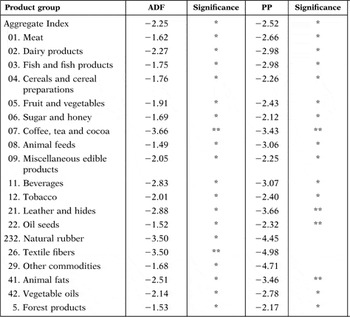
First, to establish whether structural shocks exist, we performed the conventional unit root tests on the real price series for aggregate agricultural trade between 1951 and 2000, and similarly for the nineteen product groups. Using the augmented Dickey–Fuller (ADF; Reference Dickey and Fuller1981) and Phillips–Perron tests (1988), we then examined whether a unit root is present and whether the different series are stationary. Column l of Table 2 gives the results of the ADF test. As may be observed, the null hypothesis of non-stationarity (the existence of a unit root) cannot be rejected either for the aggregate series or for the nineteen product groups.
UNIT ROOT TESTS FOR THE LOGARITHM OF THE REAL PRICE SERIES FOR TRADE IN AGRICULTURAL AND FOOD PRODUCTS

ADF: Augmented Dickey–Fuller test; PP: Philips Perron test.
Source: Authors’ estimates.
The functional form contrasted with lags is:

The null hypothesis is that the variable contains a unit root, and the alternative is that the variable was generated.
Values of the t statistic corresponding to the coefficient of the lagged variable Xt −1.
The critical values at 1%, 5% and 10% are −4.156, −3.504 and −3.181, respectively. (t-ratios are significant * at 1%, ** at 5% and *** at 10%.)
According to the Phillips–Perron test (column 3), this does not occur for three groups (232. natural rubber, 26. textile fibres and 29. other raw materials) that, following this criterion, do not display a unit root. Consequently, their trend adapts well to the Prebisch–Singer pattern of continuous deterioration in the terms of trade.
This result is easily explained if we remember that in these cases the chemical industry permitted partial substitution of these commodities by synthetic products as early as the 1950s). Natural fibres, such as cotton, were replaced by new materials such as nylon and polyester (Baffes Reference Baffes2005). The application of new technologies gave rise to competition between different products applied to the same use, as in the case of natural rubber and its substitutes. This caused demand for them to fall sharply and, consequently, severely affected their real prices.
Second, to establish the character of the discontinuities that exist in the majority of the groups, we have tested the hypothesis of structural change, that is to say, whether in reality the series are non-stationary or, in the long term, undergo changes in their level or trend. Following the proposal made by Perron and Vogelsang (Reference Perron and Vogelsang1992), we propose two tests of structural change in which the year of rupture is determined endogenously for the sixteen series and the aggregate series which, following both the Dickey–Fuller and Phillips–Perron criteria, we previously verified as displaying a unit root. The first of these we call the additive outlier model (AO), in which structural change is produced instantaneously; in other words, it is no more than a temporary event in the series. The second we have termed the innovational outlier model (IO), in which the change in the mean is gradual instead of instantaneous, affecting the trend of the series and, consequently, various periods. In addition, taking as base the work of Clemente et al. (Reference Clemente, Montañés and Reyes1998), we propose the same unit root tests for the case in which the series present two structural changes (AO2 and IO2).
The following equation represents the models to be tested in general form. The models include dummy variables in the trend (TDUit) and in the level (DUit), which take the values TDUit = (t−DUit) and DUit = 1, if t ≥ TBi and 0 otherwise, TBi being the moments of rupture. In the model, the breakpoints DTB1, DTB2 (ζ1, ζ2 are the shocks to the series) and the appropriate lag order k are unknown. The breakpoints are located by a two-dimensional grid search for the maximal (most negative) t-statistic for the unit-root hypothesis (α=1), while k is determined by a set of sequential F-tests.

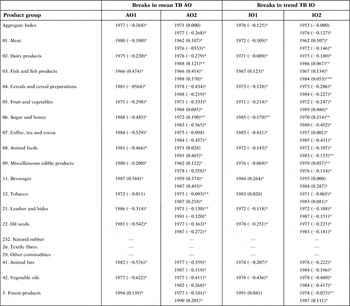
Several conclusions may be extracted from the results we present in Table 3. First, the aggregate series of the set of agricultural and food products, and similarly twelve of the sixteen groups examined (leather and hides, cereals, oil seeds, animal fats, vegetable oils, fruit, dairy products, tobacco, forest products, processed products, animal feed and meat), suffered a structural break of a permanent nature in and around the 1970s. Both the aggregate index and these twelve groups display a structural break in the level (AO2) around 1976 and in the trend (IO2) during the 1970s.
STRUCTURAL BREAKS FOR THE LOGARITHM OF THE REAL PRICE SERIES FOR TRADE IN AGRICULTURAL AND FOOD PRODUCTS

AO: additive outlier model; IO: innovational outlier model; TB: time breaks.
Note: Coefficients are given in brackets.
Sources: Authors’ estimations.
The AO incorporating structural changes requires a regression of the form:

where DTbmt = 1 for t = T bm + 1 and 0 otherwise, for m = 1,2. No intercept is necessary as  is mean 0. This regression is then estimated over feasible pairs of Tb 1 and Tb 2, searching for the minimal t-ratio for the hypothesis α = 1; that is, the strongest rejection of the unit root null hypothesis. The equivalent model for the IO (gradual change) expresses the shocks to the series (the effects of δ 1 and δ 2) as having the same autoregressive moving average (ARMA) representation as other shocks to the model, leading to the formulation:

where again an estimate of α significantly less than unity will provide evidence against the I(1) null hypothesis. In each of these models, the breakpoints Tb 1, Tb 2 and the appropriate lag order k are unknown. The breakpoints are located by a two-dimensional grid search for the maximal (most negative) t-statistic for the unit root hypothesis (α = 1), while k is determined by a set of sequential F-tests.
Critical values to test for the unit root are −4.94 for «IO» models and −5.57 for «AO» models (t-ratios are significant * at 1%, ** at 5% and *** at 10%; Clemente et al. (Reference Clemente, Montañés and Reyes1998): T = 100, P = 5).
Specifically, the aggregate index of the real prices of agricultural and food products presents a structural break in the level (AO2) in 1976 and in the trend (IO2) in 1977, which suggests that they suffered, with a lagged effect, the impact of the first oil crisis on the world economy in the 1970sFootnote 10.
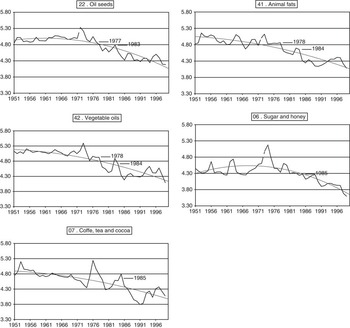
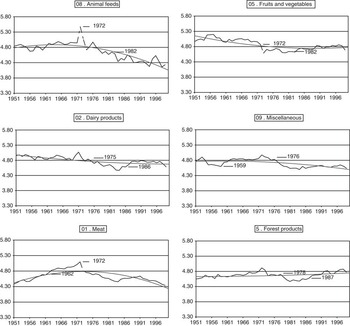
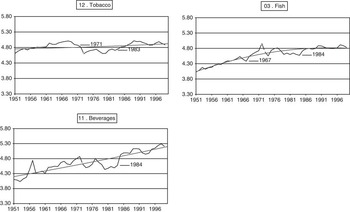
Consequently, the ruptures produced by that decade's economic crisis deeply affected almost all the product groups into which we have divided agricultural and food trade. As Figure 2 shows, in a significant number of cases, this meant that the stagnation or slight fall that their prices had experienced until then suffered an additional decrease to that undergone during the shocks, which produced a profound deterioration in real prices as a whole throughout the period (León and Soto Reference León and Soto1997).
EVOLUTION OF THE REAL PRICES OF AGRICULTURAL AND FOOD PRODUCTS: AGGREGATE INDEX AND GROUPS SHOWING GREATEST DETERIORATION

(Continued).

(Continued). EVOLUTION OF THE REAL PRICES OF AGRICULTURAL AND FOOD PRODUCTS: GROUPS OUTPERFORMING THE AGGREGATE INDEX

(Continued).

Second, of these twelve groups, ten (leather and hides, cereals, oil seeds, animal fats, vegetable oils, animal feeds, fruit and vegetables, dairy products, forest products and tobacco), in addition to two that had no previous experience of this type (sugar and honey and coffee, tea and cocoa), underwent a structural break with changes in both level and trend in the mid-1980s. Despite this common feature, however, their behaviour was notably heterogeneous from then on. We now attempt to explain the principal trends.
On the one hand, in the groups we classified in section 2 as performing poorly (leather and hides, cereals, oil seeds, animal fats, vegetable oils, coffee, tea and cocoa and sugar, which had in general seen real prices stagnate or fall slightly until the beginning of the 1970s), the shocks experienced involved not only one or two sharp falls, but also a subsequent trend of price decline. The cause of this deterioration may be explained in two ways: supply–demand imbalances (generated by the strong growth of production and stagnating demand) and trade in markets that were significantly distorted by interventionist policies. These imbalances were generated by a strong rate of production growth, which tended to exceed that of population and per capita food consumption as a consequence of the low income elasticity of this type of products or declining demand because of competition from new synthetic substitute products. In short, the interactions between technological progress, demand and public intervention were probably the principal causes of the deterioration in the real prices of agricultural and food products in the second half of the 20th century.
Productivity gains in the agriculture of the period were greater than those of preceding historical periods and those of other sectors. The technological advances that led to the green revolution and the mechanisation of agriculture explain this important growth. Between 1961 and 2000, according to our calculations based on figures from the FAOSTAT (2004) database, production grew extraordinarily in some product groups. Thus, it doubled for «cereals», «animal feeds», «sugar» and «coffee, tea and cocoa», tripled for «oil seeds», «fruit and vegetables», and even quadrupled in the case of «vegetable oils».
This formidable output growth, in contrast with the situation worldwide level until the interwar period, was based on a strong capitalisation of agriculture that drove productivity up sharply, normally above the rate of increase in the economy as a wholeFootnote 11. As Giovanni Federico (Reference Federico2005) has argued, highly intensive growth in agriculture from the second post-war period onwards replaced the more extensive growth that had predominated since the mid-19th century.
Another key variable was the evolution of consumption. In many of the groups, this tended to increase less than output. The majority of traded products had low income elasticity of demand, in contrast to consumer demand for manufactured goods and services (especially in the developed world). This contrast is essential to understanding international price evolution in a context of sharp growth in world incomeFootnote 12. It is also crucial in explaining the heterogeneous long-term behaviour of the evolution of real prices among product groups. The slow annual growth between 1961 and 2000 of per capita consumption for the groups of cereals (0.4 per cent), sugar (0.6 per cent) and coffee, tea and cocoa (0.14 per cent), with a market deterioration in their real prices contrasts with the strong growth in the consumption of fruit and vegetables (1.11 per cent) and meat (1.7 per cent), whose real prices performed betterFootnote 13.
Basic foods, such as cereals, sugar, oil seeds and vegetable oils and fats suffered a considerable decline in the rate of consumption growth from the 1970s onwards, since by then they were faced with mature markets and a deceleration in the rate of population growth, which until then had formed the basis for growth in demand. This may explain the new changes of level and trend in the mid-1980s for cereals and oil seeds (in Table 3, see the AO2 and IO2 breaks between 1984 and 1989). These products reached their maximum levels of consumption per capita in the 1970s and were progressively replaced by other, high-value foods (Rosegrant and Paisner Reference Rosegrant and Paisner2000; FAO 2002).
Furthermore, we must understand that the global production of these goods increased greatly, especially in the developed world, where subsidies and continuous protection caused serious problems of oversupply in the 1980s. Meanwhile, export subsidies shifted surpluses to other countries, depressing international prices (Lindert Reference Lindert1991; Tyres and Anderson Reference Tyres and Anderson1992; Diaz-Bonilla and Tin Reference Diaz-Bonilla and Tin2002; Askoy Reference Askoy2005).
For example, the Common Agricultural Policy of the European Union tended to stimulate cereal production for export. Subsidies, saturated markets and the exploitation of technological progress transformed its trade pattern from net importer to that of net exporter in the 1980s (Dyson Reference Dyson1996; Pinilla and Serrano Reference Pinilla and Serrano2009; Serrano and Pinilla Reference Serrano and Pinilla2011a). Between 1976 and 1987, the surpluses produced by such policies were placed on the international markets through export subsidies.
In other groups, something similar occurred with raw materials, which suffered a sharp deterioration in prices, although in later periods. For example, cane and beet sugar were increasingly replaced by sweeteners extracted from maize (isoglucose, glucose, dextrose) and even by artificial sweeteners (saccharine). Moreover, this sector was highly distorted by the policies of the high-income countries, in which farmers received up to twice the international market prices, thereby generating incentives to increase production (Tyres and Anderson Reference Tyres and Anderson1992)Footnote 14. As a result, prices were subjected to strong pressure from excess supply by high-income countries. Nevertheless, they managed for a long time to remain within the limits set by the International Sugar Agreement, 1954-1985 (Gilbert Reference Gilbert1996). Subsequently, in 1985, when these agreements and controls were suspended, relative prices suffered a deep shock (see Table 3, AO and IO in 1985).
Similarly, the group of coffee, tea and cocoa was affected by strong interventionism, had a highly concentrated and saturated consumption in the industrialised countries, experienced a significant increase in production through increases in productivity and the extension of cultivated land — both in traditional producers (Brazil) and new competitors (Vietnam) — and succeeded in maintaining its prices via the International Coffee Organization, which used production quotas to moderate and reduce price volatility (Gilbert Reference Gilbert1996). Following the abandonment of these practices in 1986, the fall in their real prices accelerated sharply (see Table 3, change in level and trend, AO1 and IO1 in 1985).
On the other hand, cattle feedstuffs, fruit and vegetables, dairy products and processed food evolved somewhat better, and behaved similarly until the 1970s, stagnating or falling slightly. However, their prices stabilised following the shocks or, in general, slowly recovered until the end of the century (see in Table 3 the IO and AO points of rupture around 1982-1987). This appears to be related to the increasing importance of dairy produce, fruit and vegetables and processed food, among other products, in diets worldwideFootnote 15. To the price behaviour of the latter certain products such as cattle feedstuffs, closely related to the expansion of the livestock sector, can be added.
The most dynamic behaviour was displayed by five groups (meat, forest products, tobacco, fish and beverages), which reveal positive long-term growth in their real prices. Whether they experienced two shocks with important falls in their prices, in the 1970s and 1980s (tobacco and wood) or the first on earlier dates (meat and fish) or only one in the 1980s (beverages), all (except meat) overcame the shocks and recommenced the trend to increasing prices experienced before the shocks. The final outcome was the most positive performance of all agricultural and food products. The groups «forest products» and «beverages» were two exceptions to this rapid output growth, and it is therefore unsurprising that their real prices increased continuously throughout the second half of the 20th century.
To sum up, it is reasonable to hypothesise that only those products that had higher income elasticity or greater difficulties in increasing output at a rate similar to that of the products that benefited most from the new technologies of the green revolution and mechanisation, and were difficult to replace by synthetic substitutes, finally experienced improvements in their terms of trade.
4 Conclusions
We conclude, from a long-term perspective, that the deterioration in the terms of trade for agricultural and food products was strong and clear in the second half of the last century. In addition, and from a comparative perspective, the product groups displayed fairly heterogeneous behaviour. In general, less processed products suffered a very heavy fall in their real prices, far in excess of that of the aggregate index. These products are the groups showing greatest deterioration, and they comprise raw materials and basic foods (SITC groups: 21. leather and hides, 22. oil seeds, 26. textile fibres, 29. other commodities and 04. cereals), traditionally exported tropical products (06. sugar, 07. coffee, tea and cocoa and 232. natural rubber) and vegetable oils and animal fats (SITC groups 42 and 41).
Nevertheless, the other question raised initially was whether this deterioration was continuous, as Prebisch and Singer suggest, or instead took place in steps, in response to the different shocks occurring in the international economy of the period. On this point, our results align themselves with recent studies, such as those by Ocampo and Parra (Reference Ocampo and Parra2003 and 2010 or Zanias (Reference Zanias2005)), as they indicate that there was no continuous and persistent deterioration in the terms of trade either as a whole or for the great majority of the agricultural and food product groups (with the exception of natural rubber, textile fibres and other raw materials). Rather, this deterioration occurred in stages. Specifically, from the 1970s onwards, when the international economy was struck by the energy and economic crisis, agricultural and food products as a whole, and most traded product groups experienced a structural break that caused a sharp fall in real prices.
From then onwards, the behaviour in the evolution of the different product groups was heterogeneous. Although in some groups this rupture was only a cyclical shock (Table 1 shows the recovery of the real prices of fruit and vegetables, dairy products and eggs, processed foods, fish and forest products, for example), for most (leather and hides, cereals, oil seeds, animal fats, vegetable oils, coffee, tea and cocoa and sugar) relative prices deteriorated sharply until the end of the century following a new structural break in the 1980s.
In short, these products underwent a marked deterioration in their terms of trade from the beginning of the 1970s until the end of the period, together with the three product groups that validated the Prebisch–Singer hypothesis for the entire period. From the long-term perspective, meanwhile, we have already termed this the «group with greatest degree of deterioration».
The objective of this study is not to analyse the price behaviour of this group for the countries most dependent on them for exports. Nevertheless, as a future research line, we are interested in analysing the impact this behaviour may have had in the case of Latin America, with two objectives. First, to determine whether this deterioration, affecting agricultural and food products in general, was similar in Latin America. Second, to establish which countries within this region were most deeply affected by the evolution of the real prices of its principal agricultural exports.
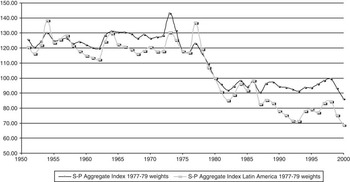
To answer the first question, we constructed a new index of real prices of agricultural and food products for the same period. In it, the weight used to aggregate the prices of the different product groups was the average of their weight in the agricultural and food exports of all Latin American countries in 1977-1979. Figure 3 shows that the series «S–P aggregate index, Latin America 1977-1979 weights» behaved very similarly to the world series until 1976, when the latter underwent a structural break and the former began a much sharper downward trend. For the period as a whole, the growth rates for the world series fell by an annual average of 0.77 per cent, whereas the figure for Latin America was 1.15 per cent. This difference is principally explained by the much greater fall in the Latin American series after 1976, when it began to fall at 2.2 per cent per year, compared with a worldwide annual decline of 1.3 per cent.
EVOLUTION OF THE REAL PRICES OF AGRICULTURAL AND FOOD PRODUCTS, LATIN AMERICA 1951-2000
Source: Authors’ elaboration on the basis of FAOSTAT (2004).

Why did the Latin American series behave worse than the world series? Principally, because the basket of exports of countries in the region had a much greater weight of products that from 1976 onwards were most affected by price deterioration (i.e. bulk and plantation products), and a relatively low weight of the most dynamic goods. In particular, there was a strong concentration of some of the product groups whose prices dropped furthest, especially coffee, tea and cocoa and sugar (Serrano and Pinilla Reference Serrano and Pinilla2008 and Reference Serrano and Pinilla2011b).
Lastly, we believe that it interesting to reflect upon the impact of the price falls in these product groups on Latin American countries. Logically, those countries with the greatest concentration of exports in the ten product groups whose real prices deteriorated most sharply saw the greatest decline in the purchasing power of their exports; consequently, their development possibilities were the most likely to have been adversely affected (León and Soto Reference León and Soto1995; Lutz Reference Lutz1999b; Blattman et al. Reference Blattman, Hwang and Williamson2007; Cuddington et al. Reference Cuddington, Ludema and Jayasuriya2007).
The Latin American countries that still concentrated over 40 per cent of the value of their exports in the ten product groups with the worst price behaviour in 1983-1989 were Nicaragua, El Salvador, the Dominican Republic, Cuba, Guatemala, Paraguay, Colombia and Argentina. All except the last two of these countries had a low level of per capita income.
A certain association can be observed between a high share of these products and a low rate of growth in their export value between 1973 and 2002 (Faostat 2004). Some countries, such as Nicaragua, the Dominican Republic and Cuba, even experienced an absolute decline in their exports, and although many economies tried to increase their production of exportable goods the environment for trade in such products was extremely unfavourable.
Appendix 1: Specific prices included in the International Agricultural and Food Trade Indices
The sixty series of unitary values of worldwide exports of the products used to construct the index, classified by product groups as per Standard International Trade Classification Revision 2.
01. Meat: bovine meat, pig meat, bacon-ham of pigs, meat sheep and poultry meat
02. Dairy products: butter, milk, cheese and curd and eggs
03. Fish and fish products
04. Cereals and cereal preparations: wheat, maize, rice, barley and oats
05. Fruit and vegetables: tomatoes, onions, potatoes, cassava, beans, peas, oranges, lemons and limes, grapefruit and pomelos, bananas and plantains and apples
06. Sugar and honey: sugar
07. Coffee, tea and cocoa: coffee, tea, cocoa beans and pepper
08. Animal feeds: feeding stuff and flour fish
09. Miscellaneous edible products
11. Beverages: wine
12. Tobacco: tobacco
21. Leather and hides
22. Oil seeds: soyabeans, copra, groundnuts and linseed
232. Natural rubber: rubber
26. Textile fibres: cotton lint, wool (greasy), sisal, flax fibre and jute
29. Other commodities
41. Animal fats
42. Vegetable oils: oil of soyabeans, oil of palm, oil of groundnuts, oil of coconuts, oil of cotton seeds, oil of linseed, oil of palm kernels and oil of sunflower seeds oil of soyabeans, oil of palm, oil of groundnuts, oil of coconuts, oil of cotton seeds, oil of linseed, oil of palm kernels and oil of sunflower seed
5. Forest products: sanwood, wood pulp, industrial roundwood