As the federal government’s principal litigators, US attorneys (USAs) occupy a central role in the justice system. Housed within the Department of Justice (DOJ), USAs serve at the pleasure of the president. However, despite possessing this removal authority, presidents have seemingly exercised it rarely in the middle of an administration (e.g., Scott Reference Scott2007). Given that history and a common suspicion that its actions represented dissatisfaction with USA behavior in a handful of specific, politically charged cases, the Bush administration’s dismissal of nine USAs in 2006 spawned significant controversy and investigation.Footnote 1 Critics alleged the removals resulted from improper considerations, while the administration proffered justifications stressing seemingly objective factors that reflected concerns about the performance of the individuals involved (Office of the Inspector General 2008, 325; Richman Reference Richman2009). Although the Office of the Inspector General (OIG) issued a report on the matter reflecting qualitative conclusions based largely on accounts from those involved, to our knowledge the OIG did not analyze any performance data on the USAs.
Here, we seek to test quantitatively the conventional notion that the firings were motivated by specific cases and idiosyncratic concerns (e.g., Moynihan and Roberts Reference Moynihan2010) against the possibility that they were consistent with a general, more extensive monitoring by DOJ principals of USAs—their agents across the country (Perry Reference Perry1998). Evidence of such monitoring would speak to ongoing debates about the centralization of decision-making in the DOJ (Herz and Devins Reference Herz2003, 1345–46; Spaulding Reference Spaulding2011), a process that is important on its own terms but is of particular significance to the work of USAs (Suthers Reference Suthers2008, 112–13; Richman Reference Richman2009). To be clear, in weighing the possibility that the administration’s behavior was consistent with the idea of more systematic monitoring, we do not mean to suggest that the dismissals were well executed by the administration or even politically defensible. As has been widely recognized, the firings themselves were carried out with the “reckless disregard of a choreographed train wreck” (Iglesias Reference Iglesias2008, 112; Suthers Reference Suthers2008; Ingle and Symons Reference Ingle2012). But we hardly think this forecloses the possibility that the administration’s underlying objectives may have been more coherent.
We begin by providing a brief overview of USAs, including aspects of their duties, the mechanics of their appointment, and their term length. We then reflect on the firings themselves and, in that discussion, provide relevant descriptions of the USAs involved. Next, we consider the applicability of principal-agent theory to this study. We describe the data, the measurement of key variables, and our modeling strategy before presenting the results. Those results show that several factors systematically affected the propensity of USAs to be targeted for dismissal, and we assess the implications of them. Then, in a supplementary examination, we look at the possibility that factors consistent with principal-agent theory may have been influential in other administrations. This subsidiary analysis suggests that the 2006 episode, while admittedly unique in many respects, is less aberrant than traditionally thought. Finally, we consider directions for additional research. Our findings speak to central questions of administration as they relate to law and courts. Who controls the federal government’s prosecutorial bureaucracy? What implications do trends related to centralization have for that oversight? Just how potent is the desire to avoid adverse selection—in essence, picking agents whose goals do not coincide with the principal’s—when it comes to choosing USAs?
A Brief Description of the History and Responsibilities of US Attorneys
The position of US attorney was established by the Judiciary Act of 1789, which provided each of the 13 original federal judicial districts an officer to prosecute violations of civil and criminal law and defend the United States in civil actions. Today, there are 93 such officers, each assigned to a federal judicial district.Footnote 2 The president nominates these individuals, and their 4-year term commences upon confirmation by the US Senate. Like lower court judges, they are subject to a blue-slip process that allows home-state senators to block their nominations. This selection process has been referred to as being “the greatest influence on how U.S. Attorneys perform their duties,” and, as such, scholars have noted the importance of avoiding adverse selection at this stage as a way to maximize control over these agents (Nelson and Ostrander Reference Nelson2016, 211). As political appointments, it is customary for USAs to submit their resignations upon a change in administration—although the incoming president may ask them to remain. Thus, while they garnered headlines, decisions of incoming presidents such as Clinton (Johnston Reference Johnston1993) and Trump (Savage and Haberman Reference Savage2017) to replace holdover USAs are qualitatively different from the events we examine here.
Aside from departures that coincide with a change in administration or the completion of a 4-year term, both the large number of USAs as well as their often-ambitious career goals can create periodic vacancies. In fact, between 1981 and 2006, at least 54 presidentially appointed USAs left office before the completion of their term—a plurality of those became federal judges, and a number of others embarked on lucrative private sector careers or campaigns for office (Scott Reference Scott2007). As a consequence, the procedure for appointing interim USAs carries significant potential implications. Between 1898 and 1986, these interim appointments were made by the respective federal district courts. In 1986, the attorney general gained authorization to make interim appointments, but those appointments were limited to 120 days. If a vacancy continued past the 120-day limit, the district court would then make an interim appointment.
That changed in 2006 when Congress reauthorized the USA Patriot Act. It removed the 120-day limit and eliminated the district court’s role in appointing interim USAs altogether, giving the attorney general plenary authority to make appointments that would remain in effect until the Senate’s confirmation of a “permanent” successor. This was the process in place when the dismissals considered in this study occurred, although discussions in the administration about replacing USAs had begun approximately a year before this statutory change (Nelson and Ostrander Reference Nelson2016).Footnote 3
USAs have historically operated with significant discretion—particularly when dealing with criminal matters, which comprise the bulk of their time and attention (Perry Reference Perry1998). As described by Richman (Reference Richman2009, 2090), “Federal criminal law … has long been characterized by extraordinarily broad substantive statutes and enforced by a relatively small bureaucracy that can pick and choose among possible targets.” Although USAs are also responsible for overseeing civil cases, they care most about crime (Perry Reference Perry1998, 139). Others (e.g., Eisenstein Reference Eisenstein1978; Glaeser, Kessler, and Piehl Reference Glaeser2000; Lochner Reference Lochner2002; Whitford Reference Whitford2002) similarly note that USAs possess significant discretion and should be expected to exercise it strategically.
Although prosecutors consider “winnability” in bringing cases, setting priorities with respect to categories of cases is primarily a political choice—not a legal one (Perry Reference Perry1998; Lochner Reference Lochner2002). And, to the extent that the association between USAs and the executive branch can be viewed as a principal-agent relationship, it is ultimately the USA’s responsibility to carry out the priorities of her political principal within legal bounds. Given this, centralization or oversight by the DOJ (“Main Justice”) is a focus of studies of USA decision-making. It is generally recognized that such oversight occurs to “impose policy decisions that may be driven by substantive concerns, a desire for uniformity, a desire to minimize abuses of discretion, or politics,” rather than because of “superior trial experience or judgment” (Green and Zacharias Reference Green2008, 202). In other words, although Main Justice may be uninterested in routine criminal matters, it does set the parameters of national policy (Iglesias Reference Iglesias2008, 162). Green and Zacharias (Reference Green2008, 200) conclude that centralization is most sensible when the DOJ emphasizes the importance of particular issues, and there is a wealth of evidence to suggest it has become increasingly willing to do so (e.g., Suthers Reference Suthers2008, 112–15; Richman Reference Richman2009; Ingle and Symons Reference Ingle2012).
Countering these centripetal forces is the notion that USAs must be responsive to conditions in their districts. “The entire institutional framework of federal prosecution is premised on the normative assumption that USAs should be and will be responsive to their local communities” (Apollonio, Lochner, and Heddens Reference Apollonio2013, 247). Richman (Reference Richman2009) identifies two pragmatic reasons why Congress should want to limit the centralization of authority in Main Justice. First, preserving the autonomy of local USAs limits the president’s agenda-setting ability. Second, Richman suggests that decentralization can give members personal leverage in their respective states or districts.
At the same time, USAs are subordinate to the attorney general’s authority, and there are ample reasons why they should be. There is an expectation of standardization in the nation’s basic law enforcement goals (Eisenstein Reference Eisenstein2007, 222). Such political responsiveness is a critical element of democratic accountability. The balance between centralization and decentralization has oscillated over time, by administration, and across case categories. The amount of centralization in Main Justice was especially strong during the George W. Bush administration (e.g., Driscoll Reference Driscoll2007) until the backlash that resulted from the attorney firings of 2006; this marked a contrast with the DOJ under Attorney General Reno during the 1990s (Richman Reference Richman2009). With the important exception of Eisenstein (Reference Eisenstein2007), scholars have generally concluded that the forces of centralization have grown in recent years (e.g., Lochner Reference Lochner2002). This conventional wisdom is consistent with broader trends toward centralization in the bureaucracy, which have occurred as the White House has sought ways to limit agency discretion (Wilson Reference Wilson1989, 264). As former USA John Suthers (Reference Suthers2008, 112) notes, “More and more of U.S. attorney discretion has become subject to the scrutiny of ‘Main Justice.’”
Politics, Accountability, or Impudence? The US Attorney Firings of 2006
The prospect of targeting a number of USAs for dismissal first gained traction in the weeks after President Bush’s 2004 reelection; the dismissals themselves would occur in several stages, but not until 2006. Seven of the nine were forced out on December 7, 2006, and resignations had been requested from two others earlier in the year, although accounts frequently treat the nine removals as a package (Office of the Inspector General 2008).Footnote 4 The firings were a drastic tactic: “Although the nine fired U.S. Attorneys had served more than four years, their firings were both unprecedented and counter to a long-standing and widespread consensus that they could expect to continue to serve until either they left voluntarily or resigned at the end of an administration” (Eisenstein Reference Eisenstein2007, 234).
It was only after Attorney General Alberto Gonzalez and White House Counselor Harriet Miers joined the administration that the proposal to dismiss a number of USAs, generally credited to the attorney general’s chief of staff Kyle Sampson, became the subject of meaningful discussion. In March 2005, Sampson produced an initial list of 14 USAs he recommended for removal. By December 2006, seven lists had been generated within the administration. At the time of the dismissals, 28 names had appeared on at least one of the lists.
In many of the nine dismissals, the OIG’s report determined that the administration’s proffered reasons for the firings—all of which were styled in relation to performance—were conflicting and inconsistent. The first USA directed to resign was Todd Graves of the Western District of Missouri; Michael Battle, director of the Executive Office for U.S. Attorneys, called Graves and instructed him to resign on January 24, 2006 (Office of the Inspector General 2008, 108). H. E. “Bud” Cummins of Arkansas’s Eastern District was asked to resign in June 2006. The seven remaining USAs were informed of their dismissals on December 7, 2006. In each case, the administration set forth alleged reasons for the firings that were unique to the individual at hand. For instance, Deputy Attorney General Paul McNulty described David Iglesias, the USA for New Mexico, as being “underperforming” and an “absentee landlord” who relied excessively on a subordinate to run his office. Despite numerous unanswered questions, the inspector general’s report concluded Iglesias’s removal was precipitated by complaints from Senator Pete Domenici and Representative Heather Wilson about Iglesias’s handling of investigations into voter fraud and public corruption. Indeed, Iglesias relayed conversations he had had with Wilson and Domenici, his former mentor, before a congressional subcommittee in 2007.Footnote 5 Iglesias in particular came to exemplify the idea that political considerations may have exerted improper influence in the firings.
The stated justifications for the removal of USA Daniel Bogden of Nevada centered on his purported resistance to the attorney general’s priorities—essentially the prioritization (or the lack thereof) of obscenity prosecutions. An alleged lack of energy and leadership in an office “where we have the right to expect excellence and aggressive prosecution in a number of priority areas” was also mentioned as a justification for his firing (Office of the Inspector General 2008, 202). Paul Charlton, the USA for Arizona, was allegedly removed for being “insubordinate as to the Department’s way of doing business” on the death penalty and the taping of interrogations (221). John McKay, headquartered in Seattle, was said by DOJ officials to have been removed for performance-related issues. More cynical observers felt the firing was rooted in McKay’s failure to prosecute alleged voter fraud in the 2004 Washington gubernatorial election, although the inspector general unearthed no direct evidence to substantiate that allegation.
The firing of Kevin Ryan as USA for the Northern District of California represents an instance in which both administration officials and the OIG were in agreement—Ryan had been removed in response to his office management. Significant concerns about his management had been reflected in two independently administered EARS (Evaluation and Review Staff) reviews that were “blistering”; according to the Los Angeles Times, Ryan was an administration loyalist, but his administrative and management failings were “well documented,” and he was added to the list because of them (Dolan Reference Dolan2007).
Margaret Chiara of Michigan’s Western District and the Southern District of California’s Carol Lam were the other USAs to be dismissed. The inspector general’s report concluded that Chiara had been fired for office management issues and noted that concern about her management style was long-standing and had, in fact, increased over time. Lam’s firing, by contrast, allegedly grew out of Main Justice’s dissatisfaction with her office’s prosecution of firearms and immigration cases. Some believed that Lam’s firing had been precipitated by her office’s investigation of former Republican congressman Randy “Duke” Cunningham on allegations of corruption, but the OIG report could not corroborate that supposition. Nevertheless, the inspector general faulted the DOJ for failing to examine Lam’s justifications for her comparatively low prosecution rates in firearms and immigration cases—namely, that her office emphasized the quality of such prosecution over quantity. Testifying before Congress, Principal Associate Deputy Attorney General William Moschella made clear that Main Justice was uninterested in any context or justification for Lam’s “low” numbers: “Quite frankly, her gun prosecution numbers are at the bottom of the list. She only beat out Guam and the Virgin Islands in that area” (Washington Post 2007). In her response, Lam lamented “the unfortunate bean-counting approach … that the Department came to employ.”Footnote 6
However, beneath this focus on the dismissed USAs lurks another question—to what extent did being targeted for dismissal result from issues at the heart of principal-agent theory: concerns about the selection of personnel and the monitoring of their performance? The initiative for removing the USAs seems to have come first from Harriet Miers, White House counsel, who wanted to dismiss all the USAs. Sampson and others believed this to be “unwise” and instead used Miers’s idea “as a way to replace some weak U.S. Attorneys” (Office of the Inspector General 2008, 21). To this end, the initial list was styled as an informal performance review and contained recommendations that USAs be retained, be removed, or had not distinguished themselves either positively or negatively. Sampson circulated a second list in January 2006 and a third in April, which he later stated had been compiled “based on my review of the evaluations of their offices conducted by EOUSA [Executive Office for United States Attorneys] and my interviews with officials in the Office of the Attorney General, Office of the Deputy Attorney General, and the Criminal Division” (28). The plan gained real traction in the fall of 2006, and four additional lists were disseminated between September and December. Sampson described the compilation of these lists as the product of “consensus” whereby he aggregated names and managed the process, although the OIG report disputed aspects of that account.
Principal-Agent Theory, Political Appointments, and Monitoring
We have suggested that the relationship between the DOJ and USAs fits that of principal and agent (see also Perry Reference Perry1998); although there is no single template capturing the wide range of such relationships (e.g., Waterman and Meier Reference Waterman1998; Gailmard Reference Gailmard2014), principal-agent theory has been recognized as a way to understand bureaucracies through the lens of rational choice (e.g., Moe Reference Moe1984; McCubbins, Noll, and Weingast Reference McCubbins1987; Wood and Waterman Reference Wood1994). Central to that theory are the concepts of moral hazard and adverse selection (Moe Reference Moe1984; Brehm and Gates Reference Brehm1997; Gailmard Reference Gailmard2009), both of which are based on assumptions about human nature and relate to the lack of full and complete information that principals inevitably face (Perrow Reference Perrow1986). Adverse selection refers to the risk inherent in choosing agents who are not in alignment with a principal’s goals, whereas moral hazard reflects the impossibility of observing an agent’s every action.
The most efficient way to ensure that principals and agents possess shared goals is for principals to appoint agents with care; this is of particular significance when political actors face agents with substantial levels of independence (e.g., Brehm and Gates Reference Brehm1997; Ennser-Jedenastik Reference Ennser-Jedenastik2016). It is difficult to overstate the importance of avoiding this problem, as political appointment has been described as the single most effective—although imperfect—mechanism for controlling the bureaucracy (Wood and Waterman Reference Wood1991, 801; Reference Wood1994; but see Lewis Reference Lewis2008). USAs are no exception here (Nelson and Ostranger Reference Nelson2016).
Several factors might make the selection of a USA relatively (un)favorable to the administration. Given the norm of senatorial deference, in states in which the Bush administration faced Republican senators, the administration might have been more reluctant to replace a USA when it would face the potential wrath of a copartisan.Footnote 7 In fact, the association between USAs and senators from their home states has been described as “deliberately indistinct” (Iglesias Reference Iglesias2008, 96). Conversely, where there was no relevant Republican senator, the administration would face no such constraint, and the USA would likely align more closely with the administration’s priorities. Even given some apparent congressional apathy with respect to the USAs at this time, same-party senators were reluctant to concede authority over valuable patronage (Richman Reference Richman2009, 2106). At the same time, the presence of same-party control is hardly dispositive here. For example, the effects of blue slips in the hands of opposition-party senators can be a significant constraint on an administration’s freedom of action. Furthermore, even where no same-party senator is present, other local political actors will typically play important roles.Footnote 8 Even so, with a constitutionally mandated voice in the confirmation process, senators are crucial actors, and we expect they will represent an important potential constraint on the executive.
Once installed, Main Justice must then monitor USA behavior in order to limit shirking. In his typology of bureaucratic agencies, Wilson (Reference Wilson1989, 167) describes “craft organizations” as those engaged in activities that, while processes are difficult to observe, yield results that are easy to evaluate. Like other agencies within the DOJ such as the Antitrust Division and the Federal Bureau of Investigation (Wilson Reference Wilson1989), USA offices closely approximate craft organizations. In such venues, metrics such as case filings or criminal statistics are straightforward to obtain and assess, even as many of the specific activities and procedures are hidden from view. This, in turn, fosters bureaucratic accountability to the principal’s goals by providing a heuristic tool for engaging in oversight of ultimate results.
We do not necessarily assert that the case statistics we employ here accurately reflect true notions of “effort,” “performance,” or “mismanagement.” But we do believe there is ample evidence to suggest that the Bush DOJ viewed them as such. In addition to the Moschella testimony described above, scholars (e.g., Eisenstein Reference Eisenstein2007, 252), a number of the fired USAs themselves (Driscoll Reference Driscoll2007; Iglesias Reference Iglesias2008), and even some USA colleagues who were retained (e.g., Suthers Reference Suthers2008) have noted the Bush DOJ’s “statistics happy” mentality. And, to underscore that point, scholars have adduced evidence that USAs sought to have their terrorism case statistics keep pace with the post-9/11 DOJ’s prioritization of the issue, in part by reclassifying cases such as identity theft under the “terrorism” heading (see Chesney Reference Chesney2007). In the appendix, we display and discuss subject-specific models testing the possibility that Main Justice’s oversight might have been focused on particular case categories.
Simply put, it is difficult if not impossible to monitor all actions undertaken by bureaucratic agents. A host of factors accentuate this concern in the relationship between Main Justice and USAs. For one, the physical distance between Washington and USA offices makes continuous oversight cumbersome. Beyond that, despite being responsible for their offices, USAs cannot make every decision—indeed, there are different degrees of centralization over the decisions of line attorneys in the district offices (Green and Zacharias Reference Green2008, 200–202). Since Congress gave assistant USAs civil service protections in 1988, these subordinates have grown increasingly careerist and more difficult for USAs to oversee (Lochner Reference Lochner2002; Suthers Reference Suthers2008, 112). In such an environment, a constant, police-patrol type of bureaucratic oversight (e.g., McCubbins and Schwartz Reference McCubbins1984) could be appealing to principals at Main Justice.
Data, Analytical Approach, and Expectations
Based on a large number of Freedom of Information Act requests to the DOJ, the data we use in this investigation come from the Transactional Record Access Clearinghouse (TRAC) at Syracuse University. These data include counts by district of the number of cases filed and completed, the number of convictions, the number of those convicted sent to prison, and the total prison term for all of those convicted and sentenced to prison. Our unit of analysis is a measure of the average for each of these categories in each district between fiscal year 2002 and fiscal year 2006 in each of the 89 districts.Footnote 9 Our dependent variable is whether a USA resigned in 2006 at the behest of the DOJ. The resignation variable is coded 1 if a USA resigned and 0 otherwise. Given the dichotomous nature of the dependent variable, we estimate logit models. Further, to account for heteroscedasticity, we estimate robust standard errors.
We have six key independent variables. Four of these capture different parts of the prosecutorial process, all of which are counts (in hundreds) that we conceive of as measures of effort. Case filings (prosecutions filed) is a measure that occurs at the earliest part of the process, and they arise in our data when an assistant USA files charges against a defendant. Case completions (prosecutions completed) follow filings and occur when closed either by conviction (typically plea bargain) or by failure to convict. Obviously, convictions measures the number of completed cases resulting in a conviction. The measure of the number of defendants sentenced to prison is a count of the number of defendants given a prison term because of conviction. We use these general measures of effort because they comport well with the notion, echoed multiple times in the OIG report and in later justifications from the administration, that the fired USAs did not manage their offices well.Footnote 10 Generally, then, we expect that higher numbers of case filings and the like will result in a decreased likelihood of resignation. There is some reason to expect that measures of effort from earlier in the prosecutorial process (filings and case completions) will be more predictive of resignation than will measures from later in the process (convictions and defendants sentenced to prison) because these earlier measures are less likely to be affected by other actors (see Wilson Reference Wilson1989) and might be viewed as more accurate indicators of USA effort by actors in Main Justice.
Aside from effort, our second major concern centers on USA selection. Normally, adverse selection refers to the danger that a principal is unable to select agents with preferences that match its own. Here, we have taken the stylized position that the president (and Main Justice) is the principal—stylized because in reality the USAs have multiple principals that include Congress, specific senators, and other district-specific actors. This traditional approach to adverse selection suggests that the administration should be more likely to seek resignations from agents that it was most constrained in selecting initially. Here, we measure this initial constraint on selection as a dummy variable equal to 1 if there was at least one Republican senator in a state at the time the USA was selected to serve and 0 otherwise (constrained appointment). This reflects the fact that, because norms of senatorial courtesy would be operative in such a situation, the administration’s preferences would be expected to accommodate those of its copartisan. Nevertheless, initial adverse selection may not be a powerful explanation for the decision to seek resignations because it ignores the fact that the administration, by December of 2006, had had at least 5 years, with the exception of Lam, for whom they had had only 4 years, to observe performance regardless of initial selection constraints.Footnote 11 Therefore, a savvy principal might be prospective rather than retrospective in thinking about selection. To capture this prospective position, we have created a variable coded 1 if no Republican senator is in place in 2006 (when the firing decisions were made) and 0 otherwise (unconstrained replacement). Because of how we have coded them, we expect both measures to have positive coefficients. In the case of an appointment constraint, the presence of a Republican senator reduces the freedom of the administration. In the case of unconstrained replacement, the absence of a Republican senator clears the path for the administration’s ideal candidates to ascend to the position. Further, comparatively, we expect that concerns related to prospective selection (unconstrained replacement) will be more powerful predictors of the USA firings than will retrospective measures, given other evidence of effort.
In addition to the variables of primary theoretical interest, we include a number of control variables to account for district-specific differences that might affect our measures of total effort output. First, we include a count of the number of referrals from investigative agencies that a district receives (referrals received, measured in thousands of cases)—higher levels of referrals should make filing more cases easier and so on. Second, districts that are more populous could potentially generate more cases for USAs (district population, measured in millions). Third, as a proxy for the size of a USA’s office we include a count of the number of court-related work hours in a district (court work hours, measured in thousands).Footnote 12 Court work hours represent the amount of time attorneys in a district spent in court or preparing for court. For instance, in fiscal year 2001, the majority of work hours were devoted to time actually arguing in court, while most of the additional hours were committed to witness preparation (Executive Office for United States Attorneys 2001). Office size obviously indicates the capacity of an office to produce case outputs, but there are additional theoretical reasons to include this measure. Eisenstein (Reference Eisenstein1978) focused on district size as a key explanation of the independence of USA offices. It may be, then, that larger offices are less amenable to policy directives—therefore, USAs in them are a better target for Main Justice. But, since Eisenstein wrote in the late 1970s, the number of assistant USAs has skyrocketed, and it is plausible that assistant USAs are allocated to many offices based, in part, on how amenable a particular USA is to administration policy.Footnote 13 There are diverging expectations about office size. If larger offices are more independent, they may be attractive candidates for reform. At the same time, if the administration has played favorites in allocating resources, then larger offices are those already preferred by Main Justice.
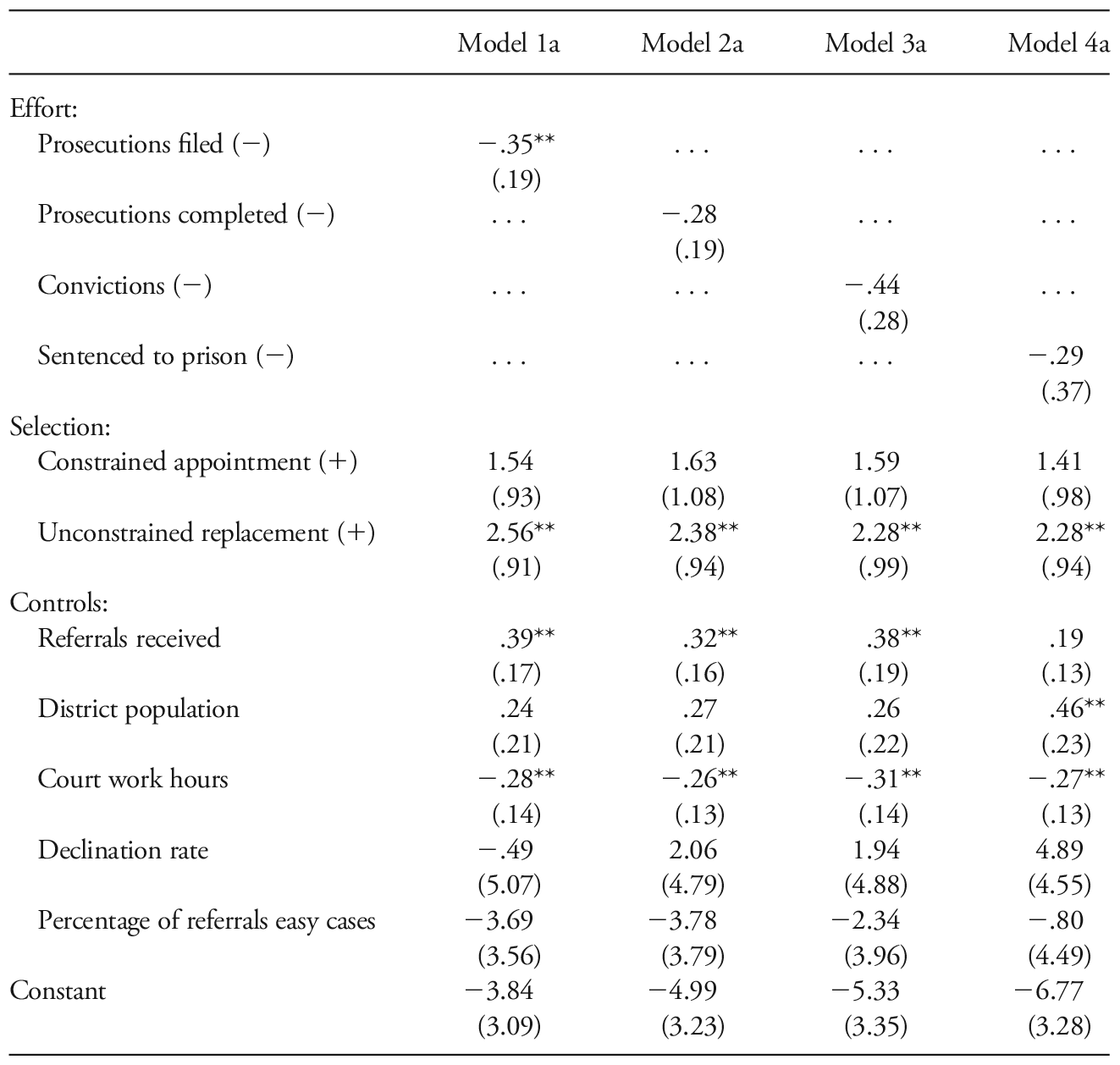
USAs in districts that bordered Mexico were obviously at higher risk for being fired than others. This is clear from the simplest descriptions of the firings that three of the nine dismissed were in border districts (Arizona, New Mexico, and the Southern District of California).Footnote 14 Therefore, it is important to account for the influence of bordering Mexico in the models. However, the introduction of a variable to denote the presence of a border district induces quasi-separation in the logit models that we present in table 2 (see, e.g., Zorn Reference Zorn2005). Thus, in the appendix, we present two approaches to help account for the absence of this variable and to ensure the robustness of the results that we present in the main text. First, we present a set of alternative models that exclude all border districts (table A1). Our results excluding border districts mirror those presented in table 2, with the noted exception that measures of effort after the filing of a case are no longer statistically significant. The models in table A1 use a penalized likelihood approach to account for the fact that the reduction in N from 89 to 84 induces quasi-separation in the models (Kosmidis and Firth Reference Kosmidis2009). Second, we use a penalized likelihood approach to “solve” the quasi-separation problem for models that include all districts and an indicator for whether a district is on the border. Table A3 contains results for these models. Here, too, our results are very similar to those presented in table 2. Therefore, we are confident that the need to exclude an indicator variable for border districts in the main models in table 2 does not affect our conclusions.
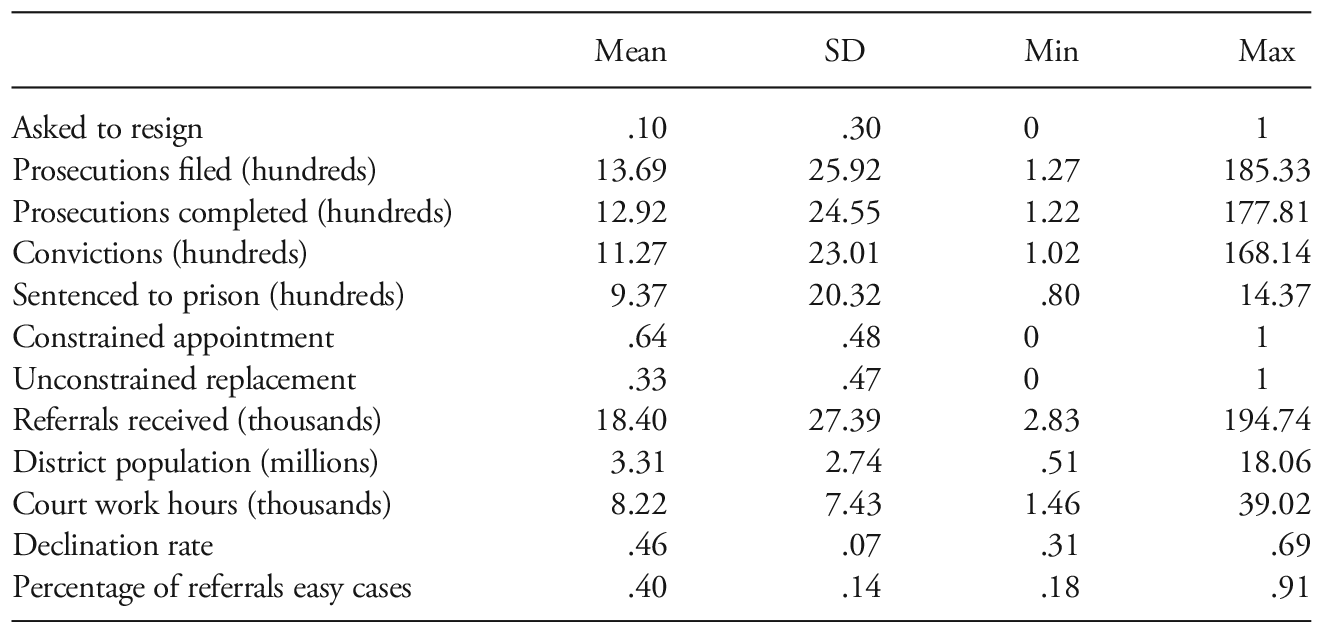
In addition, the case mix from district to district is likely to vary considerably. To help control for these variations, we include two control variables focused on the types of referrals USAs receive. First, we include a measure that tracks the average rate at which USAs decline cases referred to them by investigative agencies (declination rate). Second, we include a measure of the percentage of cases in each district that are what we call easy cases (percentage of referrals easy cases), measured as the percentage of total cases that are immigration, narcotics, or weapons cases.Footnote 15 Together, these variables help control for the flow of cases into a USA’s office. Table 1 displays descriptive statistics for the included variables.
Descriptive Statistics

Results
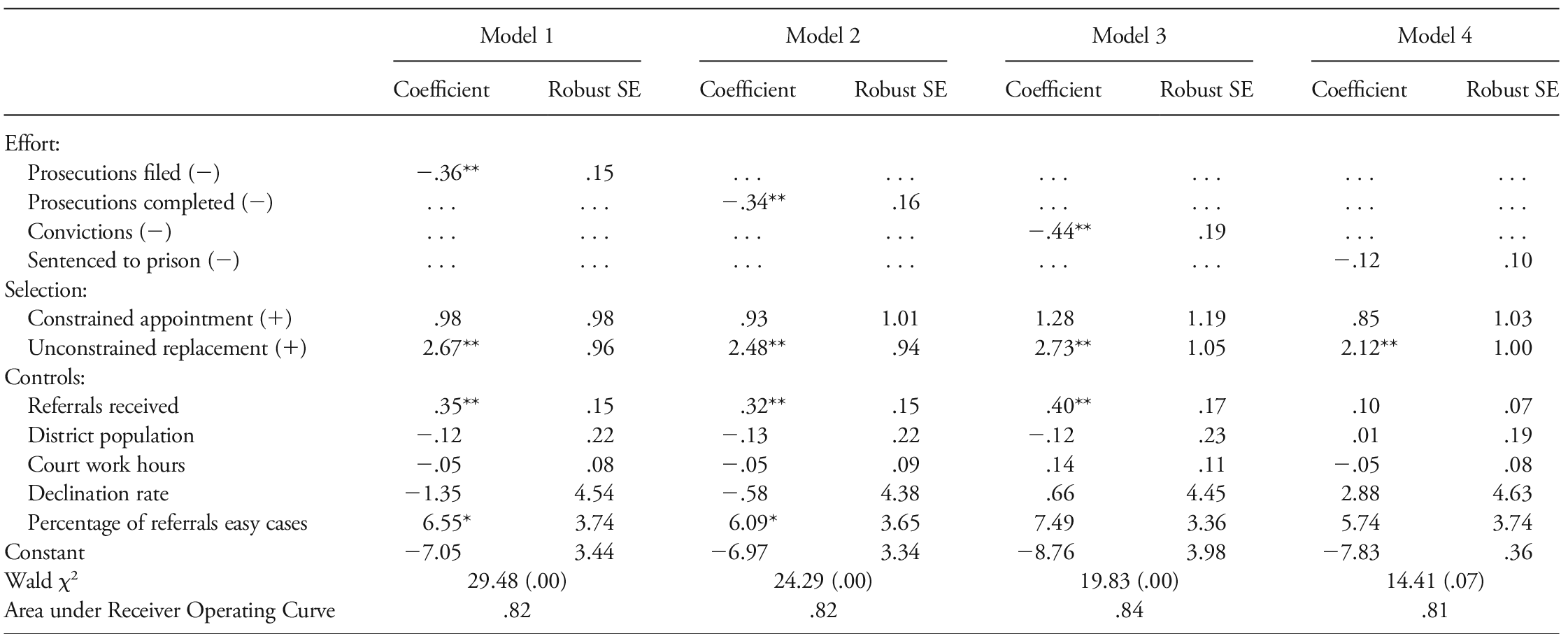
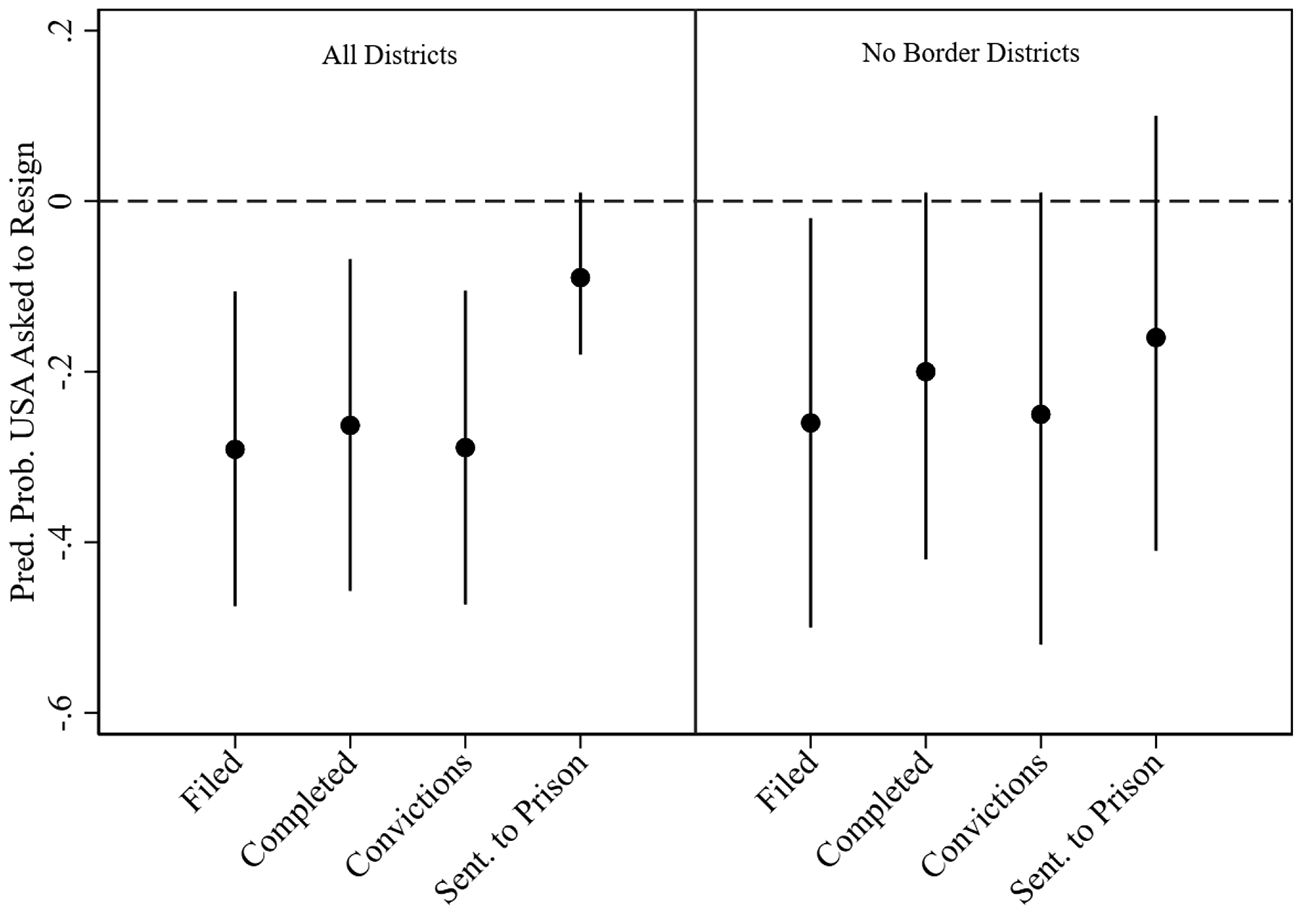
Across the life cycle of a case, we estimated a series of regressions to track the effects of monitoring and adverse selection on the decision to seek a resignation. In all, we have regression models for the number of cases filed, the number of cases completed, the number of convictions, and the number of those convicted sentenced to prison. Each model fits the data relatively well, with statistically significant Wald χ2 statistics and a high area under the Receiver Operating Curve (ROC) values. In general, models using effort early in the process (filings) are more predictive of firing, judging by the values of the area under the ROC measures. The amount of constraint imposed on the administration’s replacement decision (unconstrained replacement) is the single most important predictor in all models. Table 2 displays results for each of the models for all districts. Further, we summarize the critical results for our measures of effort at each stage in figure 1, including results from all districts (table 2) and nonborder districts (table A1). The left panel in figure 1 displays results across all districts for the effort variables, while the right panel displays the nonborder district results. The vertical lines represent 95% confidence intervals.
Logit Regression Results

Note.—The dependent variable is asked to resign. N = 89.
*. Significant at p < .10 (two-tailed).
**. Significant at p < .05 (two-tailed).
Change in probability of resignation with increasing effort, by stage

In figure 1, we map the effect of increasing case filings, completions, convictions, or prison sentences by shifting effort at each stage from the 10th percentile (low effort) to the 90th percentile (high effort) and show that such an increase significantly decreases the likelihood of being asked to resign by the Bush administration in 2006. Increasing the number of case filings from 276 cases (the 10th percentile) to 2,252 cases (the 90th percentile) decreases the probability of resignation by 29 [−48, −11] percentage points (95% confidence intervals are in brackets throughout). More concretely, a USA with an average of 276 cases filed per year would, holding all other variables at their means, face a 1 in 3 chance of being asked to resign in 2006, while a USA averaging 2,252 cases per year has closer to a 1 in 12 chance of being asked to resign.
The effect of increases in effort with respect to cases completed (26-percentage-point decrease [−46, −7]) and convictions (29-percentage-point decrease [−47, −11]) is similar to the effect for case filings. Increasing the number of defendants sentenced to prison results in a 9-percentage-point decrease [−18, 1] in the likelihood a USA is fired. Note that the results for the number of defendants sentenced to prison are not statistically significant, lending some support to the notion that performance measures from later in the process are less influential in the evaluation process. Further, the right panel of figure 1, presenting results from nonborder districts, suggests that only the results for case filings are robust. Excluding border districts, case completion, convictions, and prison sentences no longer have statistically significant effects. This lends further support to the notion that effort earlier in the prosecutorial process is more important for evaluations by the DOJ.
We also expected selection concerns to figure prominently in the decision-making of Main Justice in the firings. Our results are interesting not only because they support this interpretation but also because they highlight the fact that the administration appeared prospective and not retrospective in its concerns. Our variable measuring whether the initial appointment of the USA in question was constrained by the need to defer to a same-party senator is positive but never statistically significant. This suggests that the DOJ did not view initial selection constraints as relevant 4 years after the fact—a result that seems logical, given the presence of additional information on which to assess the USAs.
Conversely, there is strong evidence to indicate that the administration paid attention to whether, in naming a replacement USA, it would be subject to the constraints of senatorial courtesy. Our estimates for the unconstrained replacement dummy variable are consistently positive and statistically significant across models. In results averaging across the four stages, USAs who could be replaced without deference to a Republican senator were 19 [2, 36] percentage points more likely to be asked to resign. A USA in a district in which there was no Republican senator to consult was about six times as likely to be asked to resign (30% possibility) as one in a district with at least one Republican senator present (5% possibility). Note that the effect of replacement constraints is equal to a substantial increase in prosecutorial effort in case filings, suggesting that this factor was as important as case statistics in the administration’s decision-making.Footnote 16
Two of the control variables are significant in a number of models. First, the number of referrals a USA’s office receives correlates with the likelihood of dismissal, when controlling for effort. Put differently, if the number of cases referred to a USA is high but effort is relatively low, then the models suggest that this is a signal to the DOJ to look more closely at performance. Similarly, in two models in table 2, as the percentage of referrals that are easy cases increases, again controlling for effort, so too does the likelihood of dismissal. The logic here is likely similar to that for overall referral numbers—more of these easy-to-prosecute cases should result in more prosecutions.
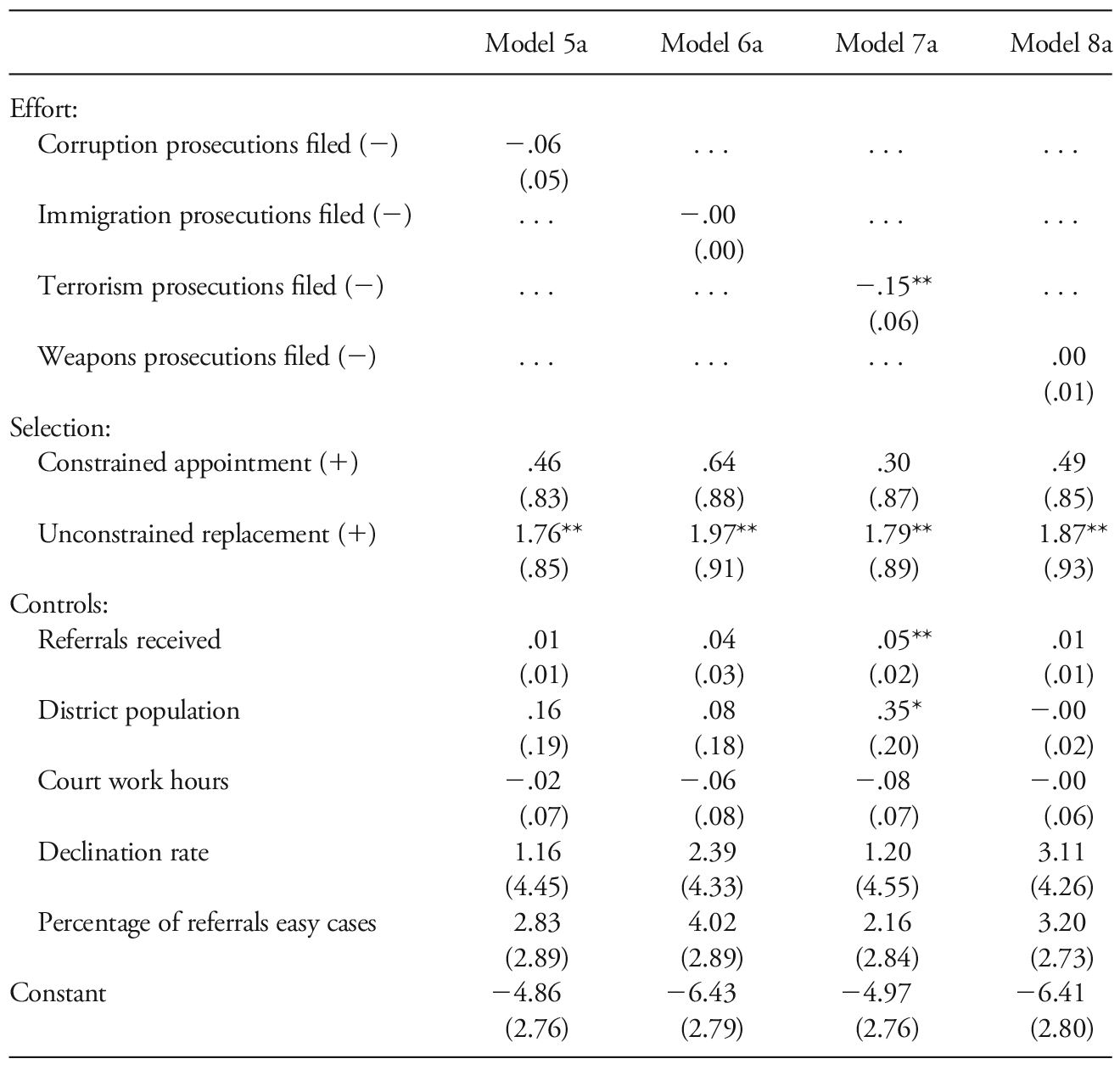
In addition to these models using measures of the overall level of effort at a given stage of the process, we also created subject-specific measures based on issue areas that the OIG report highlighted as important to the Bush administration. These include immigration and weapons cases from the justifications offered for the firing of Carol Lam, corruption prosecutions offered as justifications and speculation in the firing of David Iglesias (and possibly John McKay), and the terrorism cases long thought to be the central concern of the Bush-era DOJ (Suthers Reference Suthers2008; Richman Reference Richman2009). We estimated a series of regressions similar to those reported in table 2 (reported in table A2 in the appendix). In most of them, the subject-specific measures of effort are not significant. The one exception to this general trend is with respect to terrorism prosecutions. This is not surprising from the perspective of Main Justice, as we know that the Bush administration and the DOJ in particular obsessed about terrorism cases, to the extent of perhaps encouraging USA offices to lump more routine immigration and identity-theft cases into the category (Chesney Reference Chesney2007). Our results suggest that an increase in the number of terrorism prosecutions from 0 (the 10th percentile in the data) to 21 (the 90th percentile) reduced the likelihood of being asked to resign by 20 percentage points—an effect smaller than the increase in total prosecutions. Notably, our results for overall effort remain unchanged if we include terrorism filings in a model with total case filings, suggesting that effort in terrorism cases is not a substitute for measures of more general effort. There is no indication that there was a systematic evaluation of USA performance on corruption, immigration, or weapons prosecutions.
Discussion and Supplementary Analysis
We have found evidence to suggest that the Bush administration’s decision to fire nine USAs in 2006 was more systematic than most have previously thought. Specifically, our results are consistent with the idea that the administration used two criteria predicted to be important in principal-agent theories: avoiding adverse selection and monitoring effort. Notably, we also investigated whether there was anything systematic about the creation of the lists and found no evidence that there was.Footnote 17 Placement on a list was clearly not indicative of performance, nor was the potential of having to accommodate a Republican senator an influence in the construction of the lists. Given that there were multiple lists generated by numerous sources over multiple years, it is not surprising to us that the listing process appears unsystematic. Nonetheless, the far more consequential decision—which USAs to let go—seems to have been a potentially rational reaction to the difficulties of managing bureaucratic agents.
Those USAs ultimately fired were not necessarily performing inadequately, nor was it necessarily appropriate for the administration to fire them. Additionally, USAs are actors uniquely situated between national and local forces, and their behavior must respond to both. A level of nuance is needed in assessing USA behavior, because there can be dramatic differences in crime demographics and other characteristics across districts. This requires some level of flexibility and discussion with state and local officials (Suthers Reference Suthers2008, 113). But centralization and top-line monitoring are typically inimical to this sort of nuance. Therefore, we do not want our argument about the rationality of the administration’s behavior to be confused with a suggestion that it was normatively correct.
In addition, we investigated whether the DOJ appeared to treat various indicators of effort differently according to how directly USAs controlled the effort indicator monitored. To this end, we found that effort earlier in the prosecutorial process—particularly the decision to file a case—was a more potent predictor of the decision to fire a USA than was the later-stage indicator of the number of defendants sentenced to prison. Evidence in favor of filings being a particularly important indicator of effort also comes from the relative robustness of that measure to the exclusion of border districts in model 1a. We think this is important evidence of some sophistication in the way that Main Justice looked in on its agents. This evidence of monitoring couples nicely with the evidence suggesting that Main Justice was primarily concerned with the potential of adverse selection and not how it might have affected agent selection in the past. Given evidence of performance, it is logical that the administration would not heed past adverse-selection issues.
Our results are consistent with the exercise of rational behavior by the DOJ and the White House, but, as is generally the case with observational data, those results cannot definitively establish that such rationality actually guided the decision-making—that is, while we may be observing rational behavior, it is also possible that we have simply observed the appearance of rational behavior. At the same time, the clarity of our results and evidence suggesting that the process’s initial stages attempted to identify the “weakest” USAs (Office of the Inspector General 2008, 21) buttresses our confidence in these empirical results.
Although these results are important in their own right, we are also interested in whether similar considerations might have been operative in other administrations. This is a difficult question, because the firings in 2006 were unusually brazen and therefore unusually easy to observe. As explained earlier, all nine of the USAs removed in 2006 had served more than a full 4-year term. However, beyond the prominence they garnered, their departures were inconsistent with a clear norm: USAs in those circumstances would anticipate they could remain in place until the administration’s end if they desired to do so. To determine whether the twin concerns of naming a successor and effort monitoring—as predicted by our theory and evidenced in our results—may have also factored into attempts to control USAs in other administrations, we must first develop a plausible definition of when we observe a resignation that occurred under some pressure from the administration. This is not straightforward, so we wish to emphasize how tentative our conclusions on this front must remain. We proceed in two steps. First, we offer a definition for when a USA might have been asked to leave office, rather than leaving by choice. Then, using that definition, we analyze whether this group had characteristics as suggested by our theory.
Defining those USAs who may have left office before they wished to do so requires that we gather additional data on what a USA who left office did subsequently and on the timing of when USAs entered and exited office. We undertook this somewhat time-intensive endeavor for all USAs in the Clinton administration and the Obama administration. Focusing on these administrations offers us a number of advantages. First, both Clinton and Obama served two full terms, allowing us to make comparisons to the George W. Bush administration. Second, they are temporally proximate to the Bush administration. Third, they offer us the chance to see whether the theory we explain in the article is limited by partisanship.
We will use the term “potentially dismissed” to define those USAs who may have been asked to leave, rather than leaving on their own volition. We readily admit that we have no way of knowing their actual reason for leaving—indeed, this is the value of looking so closely at the 2006 firings—but we think it is useful to probe for any indications that other administrations may have had similar considerations in mind. The timing of a USA’s exit is crucial to our definition. From the complete list of USAs serving in the Clinton and Obama administrations, approximately 270 in total, we focus on those who leave office after having served at least 4 years but before normal politics suggests a resignation. A normal political resignation occurs near the end of the president’s 8-year term. So, we excluded from our list of potentially dismissed USAs those who left office the year before the relevant impending elections, so either after 1999 or after 2015, because those leaving so close to a known political transition were likely leaving because of partisan politics. This is a somewhat arbitrary cutoff, because it is possible that some USAs would like to stay on longer assuming a copartisan wins the elections in 2000 or 2016. So, for instance, a USA appointed to office in 1993 who then left office in 1998 would be on our list, but one appointed in 1994 who left in 1996 would not. This set of criteria allows us to make a tighter comparison to those USAs fired in 2006, all of whom served at least their initial 4-year terms. Were we to code the date of departure more leniently, our list would undoubtedly become overinclusive, causing a tripling in the number of USAs whose exits we deem to be potentially suspicious (and this strikes us as facially invalid).
From the list of USAs who left within our specified time frame, we then searched for information on what job the USA took after leaving office.Footnote 18 We did this by searching a host of secondary sources, including newspaper articles, obituaries, law-firm press releases, Wikipedia pages, and the like. We then kept on our list only those USAs who went into private practice.Footnote 19 This means we exclude from our potentially dismissed list those USAs who left office because of appointment to a federal office—either as a federal judge or to work in an executive agency. Such a subsequent appointment indicates anything but displeasure with the work of a USA. We also exclude a small number of USAs who leave to run for elective office (including as a state judge). This process leaves us with 22 USAs of interest across the two administrations. To reiterate, a number of the USAs on our list undoubtedly left by choice to earn more money in the private sector, and we cannot distinguish those who did so from those who left less willingly. The point is that our list is likely to contain those who left unwillingly, if any did so.
Comparing the USAs on our list of potential dismissals to the remaining group of USAs in both administrations might shed light on whether the difficulty of replacement and effort monitoring are factors that administrations other than that of George W. Bush considered. With respect to what we have called unconstrained replacement—the ability of the executive to replace a USA without having to consult a copartisan senator—there is some suggestive evidence that those on the potentially dismissed list were easier to replace than other USAs. We find that 35% of the USAs on the dismissal list could be replaced without consulting a senator, compared to 30% of the remaining USAs in each administration. The evidence for effort, measured in terms of prosecutions filed, is also suggestive. Here, we find that USAs on the dismissal list filed an average of 269 fewer cases per year than did other USAs in the Clinton administration (the difference is statistically significant at p = .02) and 999 fewer cases in the Obama administration (the difference is not quite statistically significant at p = .11).Footnote 20 In sum, both the replacement measure and the effort measure point in the same direction: those on our potentially dismissed list tend to be those that principal-agent theory suggests might be pressured to leave office. Although necessarily tentative, this suggests to us that, while the visibility of the Bush administration’s actions was indeed sui generis, the actual operation of them may not be.
Conclusion
In many ways, the 2006 firings punctuated a trend toward centralization in Main Justice during the Bush presidency (Eisenstein Reference Eisenstein2007), a trend in which the 9/11 attacks and the administration’s response to them played an integral role (e.g., Suthers Reference Suthers2008; Richman Reference Richman2009). Of course, the desire for centralization and the monitoring it necessitates typically take other, less drastic forms. Indeed, in the supplementary discussion above, we found some preliminary, if tentative, evidence that such considerations have been relevant in other circumstances. Further, this study has several implications for broader investigations of these topics in relation to USAs and Main Justice’s oversight of them. For one, it suggests national principals will be most likely to monitor markers of USA effort early in the prosecutorial process—especially at the filings and completion stages. We suspect the waxing of some issues (namely, immigration) and the waning of others (such as narcotics) as targets of national interest may be reflected in other aspects of USA behavior and its responsiveness to central actors and their priorities, as suggested by the Bush administration’s apparently close monitoring of terrorism filings. The availability of longitudinal data across time and administrations will facilitate such investigations, and we plan to undertake our share. Finally, as described above, we believe it is important to consider the possible relevance of nonnational factors in structuring USA behavior. We should study these local forces, both on their own terms and with an eye toward how they condition the attention of USAs to national priorities. Given their centrality in federal criminal justice policy, and the expanding federalization of crime, USAs are central actors in understanding how the state applies force against its own citizens. Our study examines one extreme episode in the attempt to exert political control over these actors, but much more work remains in explaining subtler and more regular forms of influence.
Appendix
Here we provide supporting evidence for a number of claims made in the article. First, we present evidence from the regressions that exclude border districts in table A1. As in the regression results presented in table 2, clear patterns of monitoring and adverse-selection concerns emerge. Note that the results from the models in table A1 are reported in figure 1 in the main text. The regressions in table A1 are penalized to account for the problem of quasi-separation caused by reducing the number of districts in the regressions from 89 to 84. Quasi-separation occurs when a variable is a perfect predictor for the outcome, causing issues with how the model generates coefficient estimates for that variable (Zorn Reference Zorn2005). To handle this problem, we turn to the recommendation of Kosmidis and Firth (Reference Kosmidis2009) to estimate models with penalized log likelihoods.
Logit Regression Results, No Border Districts, Penalized Likelihood

Note.—The dependent variable is asked to resign. Robust standard errors in parentheses. N = 84.
*. Significant at p < .10 (two-tailed).
**. Significant at p < .05 (two-tailed).
In addition, we estimated a series of regressions to account for the possibility that Main Justice cared more about effort in specific, highly salient areas of law rather than overall effort. We present results of regressions in specific areas of law in table A2. These measures also tend to induce quasi-separation, so we use a penalized likelihood approach here as well. Note that cases are sorted into issue areas by the coding assigned to the lead charge by the assistant USAs who initially process a case, according to TRAC. We focus on those issue areas that the firings highlighted: corruption, immigration, and weapons, as well as the central issue for the DOJ at this time, terrorism. As noted in the main text, we find some evidence that subject-specific performance was important in the decision-making process, as more terrorism prosecutions reduce the likelihood of being asked to resign. No other subject seems to have mattered for Main Justice. To be as concise as possible, we present results only from models using case filings because our results from later stages of the prosecutorial process are not substantially different from those we present here. We also use penalized regression for these subject-specific models to avoid problems caused by quasi-separation.
As noted in the main text, there is evidence that more terrorism prosecutions had a potentially prophylactic effect for USAs, reducing the probability of being asked to resign by 20 [−27, −15] percentage points (moving from the 10th percentile to the 90th percentile in the data). This evidence coincides with the emphasis that the Bush DOJ placed on terrorism after 9/11.
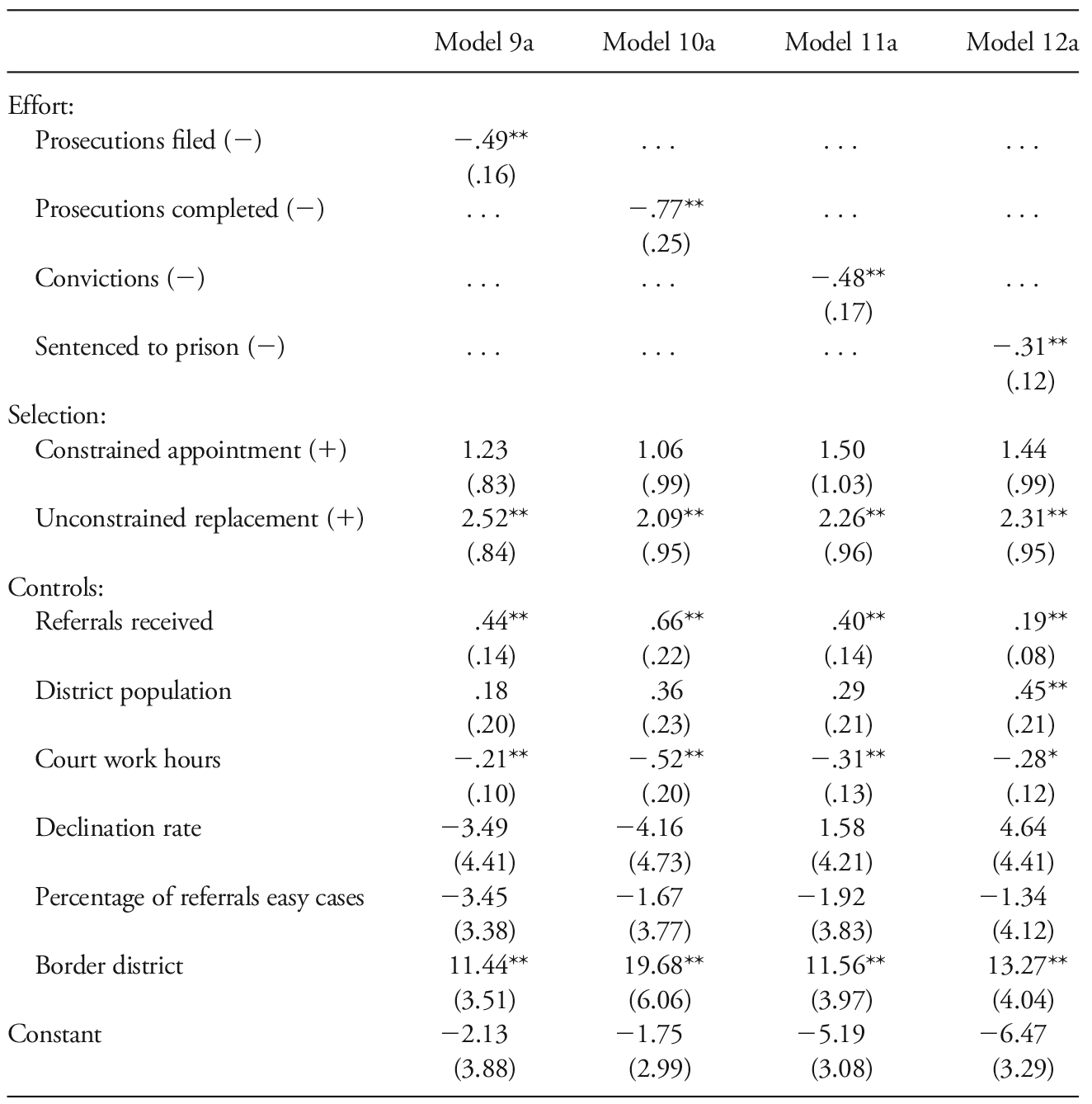
Finally, to check the robustness of the results we present in table 2, we reestimate the models but include the border district variable, accounting for quasi-separation using the penalized likelihood technique described above. Results are presented in table A3, with the only notable difference being that the effect of case completions is somewhat larger than in the model presented in table 2.
Subject-Specific Logit Regressions, Penalized Likelihood

Note.—The dependent variable is asked to resign. Robust standard errors in parentheses. N = 89.
*. Significant at p < .10 (two-tailed).
**. Significant at p < .05 (two-tailed).
Penalized Likelihood Including Border Districts

Note.—The dependent variable is asked to resign. Robust standard errors in parentheses. N = 89.
*. Significant at p < .10 (two-tailed).
**. Significant at p < .05 (two-tailed).