

I. Introduction
On November 12, 2025, President Trump signed legislation enacted as P.L. 119–37 (U.S. Congress, 2025), closing a regulatory “loophole” permitting the legal production and sale of intoxicating hemp-derived beverages under the federal definition of hemp established by the 2018 Farm Bill. Hemp is defined as any part of the plant species Cannabis sativa L. with a total delta-9 tetrahydrocannabinol (THC) concentration not exceeding 0.3% on a dry-weight basis (USDA Agricultural Marketing Service, 2021). As THC is the primary intoxicating compound, material exceeding this threshold is classified as marijuana, a controlled substance, rather than hemp under federal law.
The dry-weight standard has allowed finished products to contain intoxicating levels of THC, provided that the hemp-derived THC concentration remained below 0.3% relative to the product’s dry weight. This interpretation created a pathway for legally compliant, yet intoxicating, hemp-derived THC beverages often containing 2–10 mg of THC (Bowdring et al., Reference Bowdring, Mian, Young-Wolff and Prochaska2025). These products have grown in popularity (Staples, Reference Staples2024, Reference Staples2025), with U.S. sales approaching \$1 billion in 2024 (Whitney, Reference Whitney2025). P.L. 119–37 would effectively eliminate the hemp-derived THC beverage market, originally giving producers one year to comply with a 0.4 mg per-container limit on the combined total THC and other THC-like cannabinoids in final hemp-derived cannabinoid products (U.S. Congress, 2025).Footnote 1 The policy shift thus raises an important empirical question: What is the loss in consumer welfare stemming from the policy change?
II. Methods
In a recent publication, Staples et al. (Reference Staples, Kilders and Caputo2025) used a basket-based choice experiment (Caputo and Lusk, Reference Caputo and Lusk2022) with a national sample of U.S. adults to explore alcohol and cannabis preferences. Respondents were asked to envision spending a weekend night with friends and to select the alcohol and cannabis products they would expect to consume given that setting. Critically, the product assortment included THC beverages. Each respondent completed this choice exercise 10 times, with prices varying across the choice tasks based on real market prices.
Using a multivariate logistic model (Small and Rosen, Reference Small and Rosen1981; Gentzkow, Reference Gentzkow2007; Richards and Bonnet, Reference Richards, Bonnet, Cramer, Paudel and Schmitz2018), the previous study defined  $V_{nb}$ as the observable component of individual
 $n$’s utility from selecting bundle
 $b$ and estimated the marginal utility derived from each product as a function of main and interaction effects, price, and consumer demographics.
We leverage the utility estimates from Tables 3 and A4 in Staples et al. (Reference Staples, Kilders and Caputo2025) to compute the welfare effect of banning hemp-derived THC beverages. We do this by simulating the removal of every potential basket that contains the THC beverage, following procedures similar to those in Caputo and Lusk (Reference Caputo and Lusk2022) and Kilders et al. (Reference Kilders, Caputo and Lusk2024). Specifically, if  $B$ represents the universe of potential baskets that respondents could construct, and
 $B'$ is the subset of available options excluding hemp-derived THC beverages, then CV is given by (Small and Rosen, Reference Small and Rosen1981):
 \begin{equation}
CV = \frac{1}{\beta} \left( \ln \sum_{b=1}^{B'} e^{V_{nb}} - \ln \sum_{b=1}^{B} e^{V_{nb}} \right),
\end{equation}
where  $\beta \lt 0$ is the estimated price coefficient. By calculating the difference between the expected maximum utility obtainable in the constrained setting and in the full setting, and dividing by the estimated price coefficient, we obtain the monetary value required to restore individuals to their baseline utility level, given the choice context and sample demographics.
To incorporate parameter uncertainty and generate a confidence interval around the estimate, we use the coefficient estimates and corresponding variance-covariance matrix from Staples et al. (Reference Staples, Kilders and Caputo2025) to perform Krinsky-Robb simulation procedures (Krinsky and Robb, Reference Krinsky and Robb1986). Specifically, we generate 5,000 random draws from the joint distribution of the estimated coefficients and recalculate CV for each draw.
We then scale this estimate to an annualized population-level impact using simplifying assumptions about estimated annual market sales of hemp-derived THC beverages (Whitney, Reference Whitney2025) and their average price per six-pack based on prices used in Staples et al. (Reference Staples, Kilders and Caputo2025).
III. Results
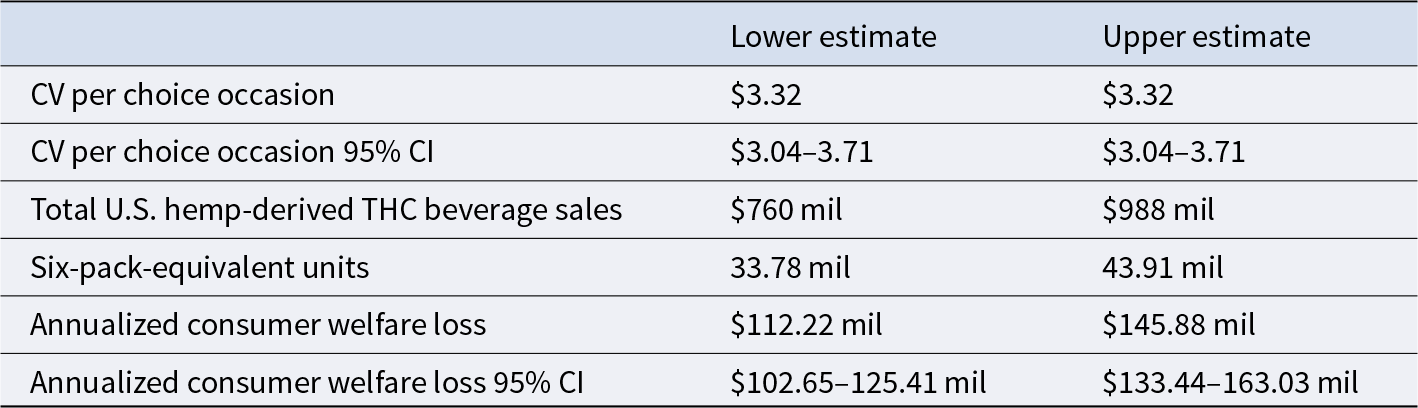
The CV calculation results in an estimated consumer welfare reduction of \$3.32 per person, per choice occasion (95% CI: \$3.04–\$3.71). While this estimate may appear modest, it translates into economically meaningful losses when annualized nationally. To illustrate, Whitney (Reference Whitney2025) estimates that the U.S. hemp-derived THC beverage market generated between \$760 and \$988 million in sales in 2024.Footnote 2
We then convert these sales estimates into six-pack-equivalent units using the average price per six-pack for THC beverages (\$22.50), as defined in Staples et al. (Reference Staples, Kilders and Caputo2025). Dividing the estimated beverage sales by the average price per six-pack yields between 33.8 and 43.9 million six-pack-equivalent units annually. We then multiply these quantities by the estimated CV per choice occasion to obtain scenario-based annual national welfare estimates.
This approach yields an annual national consumer welfare reduction ranging from \$112.2 million (95% CI: \$102.6–\$125.4 million) to \$145.9 million (95% CI: \$133.4–\$163.0 million), based on the lower- and upper-bound estimated market sales presented in Whitney (Reference Whitney2025). Table 1 summarizes the steps used to generate these estimates.Footnote 3
Summary of welfare and national scaling calculations

Table 1 Long description
Two columns compare a Lower Estimate and an Upper Estimate for CV per choice occasion, sales, purchasing occasions, and annualized consumer welfare loss. CV per choice occasion is \$3.32 in both columns. CV per choice occasion 95% CI is \$3.04 to 3.71 for both columns. Total U. S. hemp-derived THC beverage sales are \$760 mil for the Lower Estimate and \$988 mil for the Upper Estimate. Six-pack-equivalent units are 33.78 mil for the Lower Estimate and 43.91 mil for the Upper Estimate. Annualized consumer welfare loss 95% CI is \$102.65 to 125.41 mil for the Lower Estimate and \$133.44 to 163.03 mil for the Upper Estimate.
Notes: CV is calculated from the utility estimates reported in Staples et al. (Reference Staples, Kilders and Caputo2025) and reflects the welfare effect of removing the hemp-derived THC beverage alternative from the choice set. The 95% CIs for CV are based on Krinsky–Robb procedures with 5,000 draws from the joint distribution of the estimated utility parameters. Estimates are derived from Whitney (Reference Whitney2025), which reports total U.S. THC beverage sales between \$1.0 and \$1.3 billion, with 76% attributed to hemp-derived THC beverages. The lower and upper estimates reflect this range. Six-pack-equivalent units are calculated by dividing annual hemp-derived THC beverage sales by the \$22.50 experimental price of a six-pack of THC-infused beverages in Staples et al. (Reference Staples, Kilders and Caputo2025). Annual consumer welfare loss is calculated by multiplying CV per choice occasion by the estimated number of six-pack-equivalent units. The corresponding 95% CIs carry uncertainty in the estimated utility parameters through the national welfare calculations.
In communicating these results, it is important to emphasize that the welfare estimates are based on an experimental context in which respondents were asked to imagine spending a weekend night with friends. Preferences for hemp-derived THC beverages relative to other alcohol and cannabis options may differ across consumption settings, which could produce different coefficient estimates and, consequently, different CV estimates. The analysis implicitly assumes that the experimental setting provides a reasonable framework for generalizing preferences. While this represents a potential limitation, these estimates provide a useful benchmark for quantifying potential welfare reductions from removing hemp-derived THC beverages from the market. Accordingly, the results are best interpreted as a sales- and scenario-based approximation rather than a precise measure of market-wide consumer welfare loss.
IV. Discussion and conclusion
This short note communicates a non-trivial reduction in consumer welfare from removing hemp-derived THC beverages from the consumer choice set. These welfare calculations, which are grounded in recently published experimental research on consumers’ alcohol and cannabis preferences, only reflect the loss in consumer welfare from the policy change. They do not account for other potential market or social welfare effects and therefore should not be interpreted as a net welfare assessment, which would require considering supply chain welfare effects and possible public health impacts.
For example, the policy change could adversely impact hemp producers, as 54% of industrial floral hemp value was attributed to extracting essential oils in 2025 (U.S. Department of Agriculture, National Agricultural Statistics Service, 2026). At the same time, prior research identifies several potential health and social risks associated with different forms of edible cannabis, including adverse subjective and psychological effects (Froude et al., Reference Froude, Pangborn, Britz-McKibbin, MacKillop and Balodis2024), accidental underage consumption (White et al., Reference White, Van Tubbergen, Raymes, Contreras and Scallan Walter2020; Whitehill et al., Reference Whitehill, Dilley, Brooks-Russell, Terpak and Graves2021), and impaired driving (Zhao et al., Reference Zhao, Brands, Kaduri, Wickens, Hasan, Chen, Le Foll and Di Ciano2024). Restricting access could generate social benefits by mitigating these risks and their associated costs, though quantifying those benefits may be complicated by potential demand shifts toward alternative substances.
Given the economic significance of the industry and the severity of the impending policy change, some industry groups and lawmakers have advocated for greater regulatory flexibility. For instance, lawmakers introduced the Hemp Safety Enforcement Act (S. 4315) on April 16, 2026, which, if passed, would allow states to effectively opt out of the federal policy change (U.S. Congress, 2026b). Other proposals would preserve a legal market for hemp-derived THC beverages with well-defined federal regulatory and taxation frameworks. The Lawful Hemp Protection Act (H.R. 9830), for example, was introduced on July 22, 2026, proposing a comprehensive regulatory framework for hemp-derived cannabinoid products that includes a \$0.05-per-milligram excise tax on THC in beverages (U.S. Congress, 2026d). Similarly, the Beverage Regulatory Parity Act (H.R. 10079) introduced on August 10, 2026, outlined a plan to regulate qualifying hemp-derived beverages containing up to 5 mg of THC per serving and impose a \$0.08-per-milligram excise tax (U.S. Congress, 2026a). However, at the time of writing, the only official change is a 30-day delay in the application of the new per-container total THC restrictions relevant to hemp-derived THC beverages following the signing of the Continuing Appropriations and Extensions Act, 2027 (H.R. 6500) (U.S. Congress, 2026c). Thus, the restrictions closing the existing “loophole” are still set to take effect on December 11, 2026. While this may change given the fluid regulatory environment, these welfare estimates provide timely insight that should be considered alongside other market and social tradeoffs.
Data availability statement
Data will be made available upon request.
Acknowledgments
The authors thank the anonymous reviewer for comments and suggestions during the review process, which improved the overall quality of the research note.
Funding statement
Original data collection was partially funded by the North Central Region—Sustainable Agriculture Research and Education (NCR-SARE) Graduate Student Grant GNC21-337.
Competing interests
The authors report that they do not have conflicting interests relevant to this work.
Ethical standards
This study was approved by the lead author’s home institution at the time of data collection.

 Open access

