Autism was first described in the early 1940s by Leo Kanner and Hans Asperger (Refs Reference Kanner1, Reference Asperger2) who described children ‘whose condition differs so markedly and uniquely from anything reported so far, that each case merits a detailed consideration’. Current diagnosis of autism is based on impairments in reciprocal social interaction and communication, and restricted and stereotyped patterns of interests and activities. In addition, autism is often associated with mental retardation and epilepsy. It is a lifelong neurodevelopmental disorder, and, although one of the most heritable neuropsychiatric syndromes, has a highly variable phenotype.
The ‘autism spectrum’ comprises individuals who are high functioning and able to sustain a relatively ‘normal’ lifestyle through to those who are in need of constant care. Males are affected three to four times more commonly than females, and there is a strong relationship between mental handicap and sex ratio, with the lowest male to female ratio found in individuals with profound mental retardation. Autism spectrum disorders (ASDs) include childhood disintegrative disorder (CDD), pervasive development disorder – not otherwise specified (PDD-NOS), Asperger syndrome (AS) and Rett syndrome (RTT) (OMIM 312750). Although appropriate education strategies can make a significant difference to the lives of many affected individuals, there is as yet no widely effective preventative strategy or biological treatment, and ASDs are associated with considerable lifetime costs to the individuals, their families and society more broadly (Ref. Reference Jarbrink and Knapp3).
The reported prevalence of ASDs has increased over the past 20 years, with rates for childhood autism of 38.9 per 10 000, and 116.1 per 10 000 for all ASDs, from one study of 56 964 children in the South Thames region of the UK (Ref. Reference Baird4). This means that individuals on the autistic spectrum may represent up to 1% of the child population, with significant implications for education provision, and health and social care. The rise in reported ASD rates is probably due to increased awareness of the disorder and improved diagnosis. Two diagnostic instruments that have helped to standardise the identification of autism are the Autism Diagnostic Observation Schedule-Generic (ADOS-G; Ref. Reference Lord5) (an interactive interview that observes social and communicative behaviour in the individual) and the Autism Diagnostic Interview-Revised (ADI-R; Ref. Reference Lord, Rutter and Le6) (an interview carried out with the parent or primary carer). The symptoms of autism usually become apparent within the first 2–4 years of life and it has been shown that early intervention practices may be more effective in children with an ASD than in other developmental disorders (Ref. Reference Bryson, Rogers and Fombonne7), emphasising the importance of early diagnosis.
The causes of autism are still largely unknown but there is substantial evidence to support the involvement of genetic factors. Research suggests that microscopic cytogenetic abnormalities may contribute to autism in approximately 7% of cases (see http://projects.tcag.ca/autism/) and a small percentage of individuals that are behaviourally on the autistic spectrum are affected by another disorder of known genetic cause – most commonly tuberous sclerosis, fragile X syndrome, Down syndrome and neurofibromatosis type 1. Twin studies of idiopathic autism (autism of unknown cause) showed concordance rates between monozygotic twins of 36–96%, whereas dizygotic twins showed 0% concordance (Refs Reference Folstein and Rutter8, Reference Bailey9, Reference Steffenburg10). The concordance rate for milder, but conceptually related, social, communication and repetitive/restricted behavioural abnormalities that are features of the so-called ‘broader autistic phenotype’ (Ref. Reference Hurley11) was 92% in monozygotic twins and 10% in dizygotic twins. The prevalence of autism in siblings of autistic individuals is ∼2–6% (Ref. Reference Rutter12), considerably higher than the population prevalence. Statistical modelling implicated three to 15 genes in the idiopathic form of the disorder, supporting a polygenic mode of inheritance (Refs Reference Pickles13, Reference Risch14) and suggesting that no one gene or variant is either necessary or sufficient to express the phenotype.
Other factors, such as the environment or an individual's sex, are thought also to determine severity of autism. This theory agrees with the finding that features of the broader autistic phenotype are found particularly among male first-degree relatives of individuals with autism (Ref. Reference Bailey15). Certain nongenetic factors have also been reported to be the cause of autism in a very small number of cases. Prenatal insults, such as obstetric complications (Ref. Reference Juul-Dam, Townsend and Courchesne16), intrauterine exposure to the teratogenic drugs valproate (Ref. Reference Miyazaki, Narita and Narita17) and thalidomide (Ref. Reference Stromland18), and infections (Ref. Reference Patterson19) such as cytomegalovirus, have been proposed to increase susceptibility to autism in the unborn child. The association between autism and the MMR (measles–mumps–rubella) vaccine caused much controversy but has been disproved by a number of studies (Refs Reference Smeeth20, Reference Uchiyama, Kurosawa and Inaba21).
This review focuses on research strategies to identify the genetic factors involved in idiopathic autism. Challenges and future directions are highlighted in light of recent technology and current knowledge of the structure and variation of the human genome.
Linkage analysis
Traditionally, the first approach to identify susceptibility genes for complex disease has been to conduct a whole-genome linkage scan – the theory being that regions of the genome that are shared between affected relative pairs (ARPs) will have a higher probability of harbouring genes involved in the disorder in question. Many such studies have been carried out (Refs 22, 23, Reference Lamb24, Reference Barrett25, Reference Philippe26, Reference Buxbaum27, Reference Liu28, Reference Yonan29, Reference Buxbaum30, Reference Shao31, Reference Auranen32, Reference Cantor33, Reference Schellenberg34, Reference McCauley35; for review see Ref. Reference Bacchelli and Maestrini36) and nearly every chromosome has been implicated. However, although no regions have been consistently replicated, some loci have been identified by multiple studies, including chromosomes 2q, 7q and 17q.
Linkage to chromosome 7q was first identified by the International Molecular Genetic Study of Autism Consortium (IMGSAC) in 99 families in 1998 (Ref. 23). Buxbaum et al. identified linkage to chromosome 2q, which increased when limiting their sample to families with ‘phrase speech delay’ (Ref. Reference Buxbaum27). This linkage to phrase speech delay was also found by Shao et al. (Ref. Reference Shao37), and may indicate that a gene(s) involved in this aspect of the autistic phenotype maps to this region. The IMGSAC also identified linkage to chromosome 2q in 152 affected sibling pairs (ASPs) in the follow-up to their first genome screen, which increased when only sibling pairs fulfilling strict criteria were used (Ref. 22). These same regions have since been identified in independent samples, but attempts to refine these areas of linkage have not been successful. In support of the linkage findings, a meta-analysis by Badner and Gershon (Ref. Reference Badner and Gershon38) of the data from the IMGSAC (Ref. 23), the Stanford group (Ref. Reference Risch14), the PARIS (Paris Autism Research International Sibpair Study) group (Ref. Reference Philippe26) and the CLSA (Collaborative Linkage Study of Autism) (Ref. 39) showed significant linkage to chromosome 7q. Another meta-analysis, by Trikalinos et al. (Ref. Reference Trikalinos40), also found genome-wide significant linkage to chromosome 7q22-32, but linkage to 2q was not identified in these studies.
Sex-specific linkage
One of the strongest characteristics of autism is the gender bias of 4:1 affected males to females, which has led to studies of linkage in male-only or female-containing ASPs. The rationale for these studies is based on the premise that some of the major genetic risk factors for autism differ between males and females; therefore, families with affected females would be enriched for the female risk factors, whereas families with only male affected children would be enriched for the male risk factors. The Autism Genetic Resource Exchange (AGRE) found linkage to 17q11 in a genome scan of 345 families with a broad classification of autism (Ref. Reference Yonan29), with subsequent analysis generating more significant evidence for linkage in 148 male-only-affected families (Ref. Reference Stone41). A subsequent genome scan in an independent sample set of 91 families from the AGRE consortium gave further support to this linkage peak on 17q in male-only ASPs (Ref. Reference Cantor33). This linkage to 17q is particularly interesting as the serotonin transporter gene locus SLC6A4 underlies the peak of linkage. This gene has been implicated in autism, as levels of whole-blood serotonin are elevated in some affected individuals (Refs Reference Cook and Leventhal42, Reference Lam, Aman and Arnold43) and treatments based on reducing the level of blood serotonin can diminish certain autistic symptoms. In addition to chromosome 17, sex-limited linkage has been identified on chromosomes 7, 15 and 16 (Ref. Reference Lamb24). When 219 ASPs were analysed for sex-limited linkage on chromosomes 2, 7, 9, 15 and 16, principally male-only ASPs contributed to the linkage on chromosomes 7q and 16p, whereas the linkage on chromosome 15q originated from the female-containing ASPs. For chromosomes 2 and 9 all ASPs contributed to the linkage. This study also identified linkage dependent on the sex of the parent (see section ‘Epigenetics and imprinting’ below).
International collaborations
The lack of conclusive linkage results and the suggestion that sex-specific factors may be involved indicates that the genetic aetiology of idiopathic autism is likely to be more complex than previously supposed, with considerable heterogeneity within and between samples. Furthermore, different research groups might use different diagnostic inclusion criteria and methods of statistical analysis, and base their linkage study on different markers. The sample size of studies of the nature described above may also lack the power to identify the many genes of small effect that are now believed to contribute to autism susceptibility.
Autism researchers worldwide have recognised that by combining their samples they may be able to carry out genetic studies with sufficient power to detect effect sizes that are small yet biologically plausible. The Autism Genome Project (AGP) is one such consortium, involving approximately 50 research institutions; these jointly have access to approximately 1500 multiplex and 2000 simplex families from the USA, Canada and Europe, creating a multiplex sample size three times larger than any autism genetic study carried out previously. The AGP consortium aims to identify meaningful common and rare genetic variants, including submicroscopic copy number variations (CNVs) (see section ‘Structural genetic variation’ below) that increase susceptibility to ASDs.
For the first phase of the project, a whole-genome scan using the Affymetrix GeneChip® Human Mapping 10K Array (Ref. 44) and microsatellite markers was carried out. Suggestive linkage to 11p12-p13 was identified in all families. This evidence for linkage increased in the subset of female-containing families without affected individuals who carry CNVs. This region on chromosome 11p has shown only modest evidence for linkage in previous studies. Suggestive linkage to 15q23-q25.3 was also identified in the ‘broad’ diagnostic category after removing families with CNVs, and linkage increased to chromosomes 2q and 7q within the families of inferred European ancestry. As a caveat to these findings, research has demonstrated that increasing sample size in the presence of locus heterogeneity may, on average, decrease the linkage signal at a true susceptibility gene (Refs Reference Bartlett and Vieland45,Reference Vieland, Wang and Huang46).
Association studies and candidate-gene investigations
Over the past 15 years, linkage analysis has been the primary approach to search for genes underlying complex diseases such as autism, as described above. Linkage is a powerful method to detect rare high-risk disease alleles. However, complex diseases are more likely to be caused by a combination of rare alleles and common variants that confer only a very modest disease risk, for which association analysis has more power. Family-based association studies compare the frequency of transmitted versus nontransmitted parental alleles of polymorphic markers to affected individuals, whereas case–control association studies compare allele frequencies in affected individuals with unaffected controls to detect those that differ significantly between the two groups (Ref. Reference Carlson47). Using published data or bioinformatic resources such as the Human Genome Project, association analysis of candidate genes mapping to regions of linkage (positional candidates) or plausible biological candidates (for example, brain-expressed genes or those involved in serotonin production) has been carried out. Over 100 genes and many more variants have been investigated for association with autism. Here, we focus on three of these genes mapping to chromosomes 2q, 7q and 17q. These genes have been studied by several groups, and both positive and negative results have been reported, highlighting the limitations of this approach.
SLC25A12
The SLC25A12 [solute carrier family 25 (mitochondrial carrier, Aralar), member 12] gene maps to chromosome 2q31.1, under the region of linkage. The protein product of this gene is the calcium-dependent mitochondrial aspartate/glutamate carrier, which is localised in the mitochondrial inner membrane and expressed in the heart, brain and skeletal muscle (Ref. Reference Del and Satrustegui48). Two intragenic genetic variants showing excess transmission of the more common allele were identified in 411 families with one or more autistic individuals (Ref. Reference Ramoz49), and support for these alleles was found in an independent follow-up study in 158 Irish affected child–parent trios (Ref. Reference Segurado50). However, two further studies did not find association to these alleles in their respective family collections (Refs Reference Blasi51, Reference Rabionet52).
RELN
Another important candidate gene that has been the subject of many studies is RELN, which is present under the peak of linkage at 7q22. RELN codes for the protein reelin, a signalling molecule that has an essential role in the migration of neurons and radial glial cells and the development of neural connections. Persico et al. found an association between autism and a polymorphic GGC repeat located 5′ of the transcription initiation codon of the RELN gene in both family-based and case–control analyses, and hypothesised that longer triplet repeats may confer a higher risk of developing an autistic disorder (Ref. Reference Persico53). Another study supported these results (Ref. Reference Skaar54), but several other reports have not found association between autism and the trinucleotide repeat (Refs Reference Li55, Reference Bonora56, Reference Devlin57, Reference Krebs58, Reference Zhang59). Interestingly, recent data from a luciferase reporter gene assay showed that when RELN 5′ triplet repeats were increased in number the luciferase activity was reduced (Ref. Reference Persico, Levitt and Pimenta60), and research has shown that brain levels of the reelin protein and mRNA were significantly reduced in the superior frontal cortex and cerebellum in seven autistic individuals when compared with ten control samples matched for age, gender and postmortem interval (Ref. Reference Fatemi61). More comprehensive screening of RELN exons for genetic variants identified several novel missense variants in individuals with autism that were absent in a large control group, although these variants were present only at low frequency (Ref. Reference Bonora56).
SLC6A4
Whole-blood serotonin levels are elevated in some individuals with autism, as described above, suggesting that there may be reduced whole-blood serotonin uptake. Hence, the serotonin transporter gene SLC6A4 on chromosome 17q has been investigated as a candidate for autism. Many studies have concentrated on a deletion/insertion polymorphism of 44 bp in the promoter (HTTLPR) that affects expression of the protein. These results have been inconsistent, showing association of the short (Refs Reference Cook62, Reference McCauley63, Reference Conroy64, Reference Devlin65) or long allele (Refs Reference Klauck66, Reference Yirmiya67) of the HTTLPR and autism, and some studies have found no association (Refs Reference Maestrini68, Reference Persico69, Reference Ramoz70, Reference Zhong71). A recent study found association between the short allele and increased severity of nonverbal communication on the ADI-R, while the long allele was associated with increased severity of stereotyped and repetitive behaviours and aggression (Ref. Reference Brune72). This new finding may partially explain the difference in results found in previous studies, and indicates that using subcategories of the ADI-R to group samples may reduce heterogeneity within and between groups. A recent study by Sutcliffe et al. found that allelic heterogeneity and a combination of multiple, often rare, coding and noncoding variants at SLC6A4 increased risk of autism (Ref. Reference Sutcliffe73).
Insights from candidate-gene studies
Many factors may contribute to discrepancies in the results of complex-trait association studies. Genetic and phenotypic heterogeneity between samples due to ascertainment differences and suboptimal sampling, heterogeneity in exposure to environmental influences, disparity in sample sizes leading to false-positive or false-negative results because of differing power to detect real effects, and data over-interpretation have all been suggested as reasons for lack of replication (Ref. Reference Zondervan and Cardon74). Furthermore, research has suggested that the first published study likely represents an overestimate of the true effect size, due to ascertainment bias and an effect known as the ‘winner's curse’ (Refs Reference Trikalinos75, Reference Zollner and Pritchard76). Other factors, such as the genetic marker and predicted disease allele(s) frequency and the extent of linkage disequilibrium (LD) between the marker and unknown disease locus should also be taken into consideration when designing an association study. Many of the candidate-gene studies in autism to date have been inadequate as they have captured only a small fraction of the genetic variation, and functional knowledge of most genes is far from complete. Novel rare mutations have been recently identified in individuals with autism in the X-linked genes encoding neuroligins NLGN3 and NLGN4 (Ref. Reference Jamain77) and in the gene SHANK3 (SH3 and multiple ankyrin repeat domains 3) at chromosome 22q13.33 (Ref. Reference Durand78), supporting the existence of rare variants contributing to susceptibility in a minority of individuals with autism. Hence, the genes discussed above remain interesting candidates for autism susceptibility, even if possibly only for a small effect in a subset of cases.
Recent advances and future directions
Technological and bioinformatic developments
The completion of the Human Genome Project in 2003 (Ref. 79) and the efforts of the International HapMap Consortium (Ref. 80) have made more information available for the study of complex diseases and have been paramount in the recent evolution of genetic studies (Fig. 1). The International HapMap Consortium has genotyped 5.6 million single-nucleotide polymorphisms (SNPs), the most common form of variation spread throughout the human genome, in 269 DNA samples from four different ethnic populations. This research showed that haplotype diversity is limited and led to estimates that one SNP every 5–10 kb across the genome can capture all of the common variation in certain populations, because of genotypic redundancy between SNPs and the fact that one SNP can act as a proxy for another. In addition, over the past few years new microarray technology has come to the fore in the form of high-throughput SNP genotyping platforms that can generate hundreds of thousands of genotypes per person from a single hybridisation. Experiments that not so long ago would have taken years to perform now can be done in a matter of days, and these assays have proven to be robust despite fears that an increase in complexity would lead to a decrease in data quality (Ref. Reference Fan, Chee and Gunderson81). This technology has paved the way for whole-genome association studies, and recent research has confirmed the ability of this approach to identify variants for common complex diseases, given adequately powered samples (Refs Reference Todd82, 83). Hence, the capability to detect common genetic variants is now greater than ever before, and faster, more cost-effective technologies are continually evolving. In addition, development of bioinformatic tools now enables integration of information about the functional relationships between genes, allowing pathway analysis and prioritisation of associated variants based on gene category.
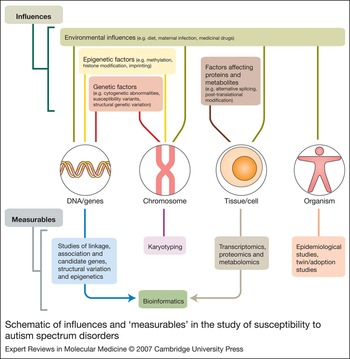
Schematic of influences and ‘measurables’ in the study of susceptibility to autism spectrum disorders. There is a complex interplay between genetic, epigenetic, cellular and environmental influences in the development of autism (upper part of figure). A range of techniques, targeting different levels of biological function, are being used to dissect the causes of autism (lower part of figure).

Structural genetic variation
Recent research has highlighted the importance of structural variation in our understanding of differences in genetic make-up within the human population. Structural variation includes deletions, insertions, inversions and duplications, and encompasses CNVs as well as more complex variants. These structural variants are ubiquitous and common in every genome, ranging from kilobases to megabases in size, and may comprise millions of nucleotides of heterogeneity that are likely to be important contributors to phenotypic diversity, evolution and disease susceptibility (Ref. Reference Feuk, Carson and Scherer84). Structural variation may affect gene expression directly by disrupting genes and altering gene dosage or indirectly through a position effect or unmasking of recessive mutations or functional SNPs on the remaining allele (Ref. Reference Eichler85). Conversely, variants occurring in intronic or intergenic regions may have little or no effect on gene expression.
The first-generation whole-genome maps of CNVs have been very recently published, including The Copy Number Variation Consortium investigation of CNVs in the individuals from the HapMap project (Ref. Reference Redon86). They found that 12% of the genome is made up of 1447 distinct CNV regions that encompass hundreds of genes and functional elements. CNVs contain more nucleotide content per genome than SNPs and more than half of the CNVs identified overlapped genes, indicating their potential impact on gene function. Gene ontology categories that were enriched within CNVs included cell adhesion, neurophysiological processes, sensory perception of smell and response to chemical stimuli. Putative oncogenes and tumour-suppressor genes were also associated with CNVs (Ref. Reference Wong87). These findings may be of significance in the search for autism-susceptibility genes, given the abnormal sensory hypersensitivity to sounds, taste, smell and touch in autistic individuals (Refs Reference Leekam88, Reference Rogers, Hepburn and Wehner89), and the co-morbid association of autism with tuberous sclerosis and neurofibromatosis, caused by mutations in tumour suppressor genes.
An unanticipated number of CNVs were identified in individuals with autism by the AGP in their genome-wide scan for linkage and CNVs (Ref. 44). These included a hemizygous deletion of coding exons of the neurexin 1 (NRXN1) gene on chromosome 2p16.3 in two affected siblings. Two SNPs within NRXN1 showed association under a dominant model with a modest level of significance (P < 0.05) in the complete sample of AGP families. Rare missense mutations in NRXN1 have been found in individuals with autism in another study (Ref. Reference Feng90). The neurexins interact with the neuroligins, and together they are important for glutamatergic synaptogenesis. Problems in glutamate function have been suggested to be a key factor in risk for autism, adding to the weight of this finding.
Sebat et al. (Ref. Reference Sebat91) recently carried out an investigation of CNVs in autism using comparative genomic hybridisation (CGH) microarray analysis in 118 singleton families, 47 multiplex families and 99 control families. They suggest that de novo CNVs are more frequent in individuals with ASDs than in unaffected individuals, and more common among female and sporadic cases of autism than in multiplex families. The authors interpret these findings as evidence for a causal role of de novo mutation in autism, although lack of strict diagnostic classification of some cases, nonindependence of cases and controls, and incomplete screening for karyotypic abnormalities suggest that these findings should be interpreted with caution.
Despite these advances in our understanding of the likely importance of structural genetic variation in susceptibility to common complex disease, resolution is still limited by technology, and methods to detect copy number differences are unable to detect variation arising as a result of balanced rearrangements.
Epigenetics and imprinting
Epigenetics, typically defined as the study of heritable changes in gene expression that are not due to changes in DNA sequence, includes histone modification, DNA methylation, disruption of higher-order chromosome structure and the expression of noncoding RNAs. The importance of epigenetics in development and disease susceptibility, as with structural variation, is becoming more apparent. The Human Epigenome Project (HEP) aims to identify genome-wide DNA methylation patterns in all major tissues and to examine differences in epigenomic organisation of the constituent cell types (Ref. Reference Eckhardt92). DNA methylation is one of the most stable types of epigenetic modification, occurring predominately within CpG dinucleotides and regulating gene expression through differential methylation of CpG islands at gene promoter sites. Epigenetic mechanisms play an important role in the developmental processes of the mammalian fetus, and epigenetic states may be evolutionarily conserved between mammals.
Imprinting is the differential expression of genetic material depending on its parental origin, and is believed to occur due to the selective inactivation of genes during gametogenesis by methylation. The 15q11-q13 region is involved in Angelman syndrome (AS) and Prader-Willi syndrome (PWS) – disorders associated with mental retardation that involve reciprocally imprinted genes. Both disorders occur due to a mixture of genetic and epigenetic effects that cause a deficiency of gene expression from the maternal chromosome 15q11-q13 in AS and the paternal chromosome 15q11-q13 in PWS, with the homologous chromosome unable to compensate due to genes in that region being imprinted. Maternal interstitial duplications of 15q11-q13 have been associated with autism, suggesting that modification of imprinting effects could be intrinsic to the aetiology of autism (Ref. Reference Cook93). This supports the finding of two discrete regions of linkage from the father and the mother at the locus on chromosome 7q, while only maternal sharing was found in the area of linkage on chromosome 9 (Ref. Reference Lamb24), suggesting that different heritable factors contributing to the autistic phenotype may be inherited from the mother and the father. Imbalanced genomic imprinting in the brain during development has also been suggested as a causative factor for autism (Ref. Reference Badcock and Crespi94). This theory proposes that paternally expressed genes have an increased influence on brain development in individuals with autism compared with maternal genes due to an imprinting abnormality. The ‘imprinted X liability threshold model’ supports this hypothesis and suggests that the higher number of males than females affected with autism is due to an imprinted protective locus expressed solely from the paternally derived X chromosome in females, which males are lacking (Ref. Reference Skuse95). Furthermore, mutations of the methyl-CpG-binding protein 2 (MeCP2) gene on the X chromosome, which encodes a protein that binds to methylated DNA sequences, causes the ASD Rett syndrome as a result of failure to properly recognise the epigenetic marks (Ref. Reference Amir96). The higher predominance of mutations of paternal origin in individuals affected with Rett syndrome (Refs Reference Girard97, Reference Trappe98) and the finding that the syndrome affects almost exclusively female offspring supports the importance of the parental origin of mutations.
It is important that these epigenetic studies are carried out in tissues, such as brain, at a developmental stage putatively relevant to autism, as epigenetic effects may otherwise fail to be detected.
Gene expression, proteomics and metabolomics
Large-scale gene expression studies or transcriptomics utilise microarray technology to view the level of fluorescence from hybridised mRNA transcripts to complementary sequences on a microarray chip. Inferences about under- or overexpression of protein product can then be made based on the intensity of hybridised mRNA signal. A recent study found that gene expression profiles in lymphoblastoid cells clearly distinguished individuals with autism from controls. Sixty-eight genes were dysregulated in autism, and individuals with autism could be separated into those with chromosome 15q11-q13 duplication or a fragile X mutation (Ref. Reference Nishimura99). These findings require confirmation in independent samples.
While the human genome is believed to contain about 25 000 genes, the human proteome – the entire set of proteins in the body (Ref. Reference Junaid and Pullarkat100) – is thought to contain one hundred times this number as a result of alternative splicing and post-transcriptional and post-translational modifications. The Human Proteome Organisation (HUPO) is an international collaboration that aims to identify all proteins and their function in the human body. Studies of this nature are being carried out on serum proteins from blood as well as other tissues such as the brain. Increasingly, metabolomic studies – the measurement of low molecular weight molecules that are a result of metabolic processes in a cell during a specific temporal or developmental state – are also being carried out.
Hence, there is a need to integrate transcriptomic, proteomic and metabolomic approaches to gain a clearer picture of what is occurring within the cells of individuals with autism for a particular tissue type and developmental stage. The choice of tissue used in these investigations is important as the most accessible tissues such as lymphoblastoid cells may not be representative of those more relevant to autism. Furthermore, mRNA expression levels may not directly correlate with the level of active translated product in the cell, as the mRNA may be rapidly degraded or not fully translated, and it is not yet clear how reliably measurements of gene expression in the periphery will act as surrogates for other regions such as the brain. The identification of genes, proteins or metabolic pathways that are differentially regulated in autism may indicate targets for developing rational preventative and treatment strategies and could enable identification of individuals for specialised treatments and more accurate and early diagnosis (Ref. Reference Corbett101). Characterising the core molecular mechanisms will be key to understanding the nature of the underlying neuropathophysiology in autism.
Endophenotypes
Endophenotypes (simpler intermediate traits of a complex disorder) have been used in an effort to interpret the relationship between genes and behavioural phenotype, based on the premise that their genetic basis is less complicated than that of the psychiatric diagnosis and they are therefore more tractable to genetic dissection than the disease state itself (Ref. Reference Flint and Munafo102). It has been proposed that the ‘triad of impairments’ of autism – social impairments, communication problems and rigid repetitive behaviours – is influenced by different genes (Ref. Reference Happe, Ronald and Plomin103), a view supported by the observation that individual traits of the triad of impairments are seen in a milder form in unaffected individuals. This suggests that use of samples of individuals unaffected for autism but meeting autism criteria for one area of the triad may be more effective than looking for genes for autism as a whole.
Physiological, anatomical or developmental endophenotypes – such as whole-blood serotonin levels, head circumference, or language impairment – have been investigated in autism. In addition to analysis of phrase speech delay as an endophenotype discussed in the linkage section above, increased linkage to chromosome 7q was reported when ‘age of phrase speech onset’ was used (Ref. Reference Alarcon104). Stronger evidence for linkage to a subset of families with obsessive compulsive behaviours has also been reported (Ref. Reference Buxbaum105). Macrocephaly is one of the most consistent findings in autism, found in approximately 20% of individuals, and subsets of individuals have been used to search for mutations linked to this phenotype: germline mutations have been found in the PTEN (phosphatase and tensin homologue, deleted on chromosome 10) tumour suppressor gene in three studies (Refs Reference Buxbaum106, Reference Butler107, Reference Herman108).
Despite the interest in endophenotypes, recent research concluded that the genetic effect sizes of loci contributing to endophenotypes are no larger than those for the cognate psychiatric illness, suggesting that the genetic architecture of endophenotypes is no simpler than that of the behavioural phenotype (Ref. Reference Flint and Munafo102). However, the ease and reliability of phenotyping may make endophenotypes more suitable for collecting the large samples needed for statistically reliable analysis of complex genetic traits. Future analyses of data using quantitative variables also may lead to more genetically informative traits.
Epidemiological studies
Epidemiological studies are critical to identify gene–environment interactions that may influence autistic behaviour, since twin research has shown that not all monozygotic twins are concordant for the autistic phenotype. The UK ALSPAC (Avon Longitudinal Study of Parents and Children) (http://www.alspac.bris.ac.uk) and TEDS (Twins and Early Development Study) (http://www.teds.ac.uk/) studies are two such investigations that include measures of autistic behaviour. The ALSPAC study was initiated to identify features in the physical and social environment that together with genetic inheritance influence health and development. They identified a cohort of approximately 15 000 pregnant women in the early 1990s and have followed them and their families from pregnancy until the present day. Environmental events that occur in the life of the mother and child such as infection, diet and prenatal injury are being related to autistic traits that occur in the general population such as obsessive behaviour, and lack of communication skills and empathy. TEDS is investigating how genes and the environment affect development by comparing identical and fraternal twins for autistic features that occur in the general population. The phenotypic data from these studies can then be related to genotypic data.
Concluding remarks
Linkage and association analyses have been the primary tools used to date in exploration of the causative genetic factors in idiopathic autism. Although linkage analysis has identified several regions of interest, and suggested that the genetic risk factors may differ between males and females and that different parental heritable factors may contribute to the autistic phenotype, the results so far have been inconclusive. Association studies have looked at many candidate genes and, despite inadequate power in many studies, several genes warrant further investigation. Advances in technology and bioinformatic resources now enable us to ask more appropriate questions methodologically. The recent publication of several whole-genome association studies and subsequent replication of these findings has confirmed the ability of this approach to identify common variants for complex diseases with heritabilities of the same magnitude as autism, given adequately powered sample sizes. The recent identification of unanticipated levels of structural genetic variation in individuals with autism suggests that the genetic aetiology of autism is likely to be much more complex than previously supposed, caused by a combination of rare and common variants, and involvement of karyotypic and submicroscopic structural variation, together with interaction of variants with each other and with the environment. Previous estimates of the number of genes involved are likely to be underestimates, while heritability may be overestimated, and there is a need for comprehensive new twin data and models that incorporate structural genetic variation. New horizons about the landscape of genetic variation and the aetiology of complex disease are opening windows for future investigations, requiring a comprehensive, interdisciplinary approach integrating genetic and functional studies with brain imaging, psychology, education, and treatment strategies. Large amounts of data are being generated, and the need to share and exchange information is of paramount importance and is being recognised as such. With the rapid evolution of genetic knowledge, the journey for researchers in autism holds excitement and promise to combat this debilitating disorder.
Acknowledgements and funding
The authors thank the families and clinicians who have contributed to the work on autism, and also the funding bodies – The Nancy Lurie Marks Family Foundation, The Simon's Foundation, The Medical Research Council and The Wellcome Trust – without whom this research would not be possible. We thank the anonymous reviewers for constructive comments on an earlier draft of this manuscript.