1. Introduction
Water scarcity is a shared concern around the world. With about 2,100 m3 of water per capita, China is among the 13 countries suffering most from water scarcity (Wong, Reference Wong2013). North China has less than one-quarter of the country's water endowment (Ministry of Water Resources of China, 2013). The lower levels of precipitation in North China are also much more seasonal than those in the south, with more than 70 per cent concentrated between June and September. North China, however, remains an important region, with about 35 per cent of the total population, 38 per cent of the nation's GDP and almost half of the grain production (NBSC, 2013). The increasing water scarcity is particularly challenging to the agricultural sector. The government has decided that agricultural use will not be given priority for any additional future allocations of water (China, Reference China2002). The share of agricultural water use in total water use has declined from more than 80 per cent in the 1970s to 63 per cent in 2013 (Ministry of Water Resources of China, 2013).
With surface water resources largely diminished, groundwater has become an important source for agricultural irrigation in North China. With the exception of rice, at least 70 per cent of the sown area of grains and other staple crops are irrigated by groundwater (Wang et al., Reference Wang, Rozelle, Blanke, Huang, Huang, Giordano and Villholth2007). The heavy reliance of irrigation on groundwater has led to rapid declines in water tables in parts of North China. The drops in groundwater tables are especially alarming in Hebei province which covers most of the Hai River Basin, which is one of the nine major river basins in China and which surrounds the nation's capital, Beijing (Qu et al., Reference Qu, Kuyvenhoven, Shi and Heerink2011). The dropping water levels have led to serious environmental consequences in the region, such as land subsidence, intrusion of saline water into freshwater aquifers and deterioration of ecosystems (e.g., Foster et al., Reference Foster, Garduno, Evans, Olson, Tian, Zhang and Han2004; Fan et al., Reference Fan, Huang and Zeng2006; Cai et al., Reference Cai, Ringler and You2008). How to maintain agricultural production in an environment of increasing water scarcities is the key challenge in agricultural water management.
Policy efforts and academic studies on groundwater management focus on what is happening within the irrigation sector. The solutions proposed include more efficient irrigation technologies (e.g., Blanke et al., Reference Blanke, Rozelle, Lohmar, Wang and Huang2007), water pricing (e.g., Lohmar et al., Reference Lohmar, Huang, Lei, Gao, Molle and Berkoff2008) and better groundwater governance (e.g., Huang, Reference Huang2014). The government has also responded to the water shortages by improving irrigation infrastructure and the capacity to monitor groundwater levels. Regardless of which policy instrument is used to battle the water shortages, its effectiveness will largely depend on the action of the decision makers over water use, i.e., the farm households. Few water studies have paid attention to the change in the environment in which agricultural production is taking place. In the past few decades, the most far-reaching change influencing rural households has been the massive migration of labor from rural to urban areas. In 2014, the number of total migrant workers was 273.95 million, about 35.46 per cent of the total labor force in rural China (NBSC, 2014). More recently, farmers remaining in the rural areas have also increased local off-farm work. Yang et al. (Reference Yang, Wang, Jin, Chen, Riedinger and Peng2016) found that rural households in nine provinces in China spent more time on local off-farm employment than on migration (29 per cent versus 6 per cent in 2008). Such change will surely affect how rural households respond to water policies. Since 2005, water resource bureaus in Hebei province have implemented pilot experiments in several counties that raised prices of irrigation water and provided subsidies to compensate for potential income losses (Hebei Provincial Government, 2014). In their assessment of these pilot reform projects, Wang et al. (Reference Wang, Huang, Huang and Rozelle2006) found that half of their sample villages that participated in the reform at the beginning had abandoned the reform in practice. The most cited reason was that participation in the reform was time-consuming. The increasing off-farm employment undoubtedly has increased the opportunity cost of rural households’ time spent on managing irrigation water.
The objective of this study is to better understand the impact of off-farm employment on groundwater irrigation in North China. This study makes at least three contributions to the empirical literature.
First, this study is among the very few that examine the relationships between off-farm employment and irrigation water use. The only other study we are aware of is that of Wachong Castro et al. (Reference Wachong, Heerink, Shi and Qu2010). The literature that examines the impact of China's off-farm employment (mainly migration) on agricultural production has focused on either output or non-water inputs in agricultural production, such as fertilizer and chemicals (e.g., Taylor et al., Reference Taylor, Rozelle and De Brauw2003; Li et al., Reference Li, Wang, Segarr and Nan2013). This study also adds to the literature that examines the relationship between agricultural productivity and industrial development (Foster and Rosenzweig, Reference Foster, Rosenzweig, Schultz and Strauss2007). This broader literature also finds the relationship may be positive or negative. For example, Foster and Rosenzweig (Reference Foster, Rosenzweig, Schultz and Strauss2007) show that the growth of agricultural productivity, measured by yield growth generated by High Yielding Varieties, lowered out-migration from rural India villages. Bustos et al. (Reference Bustos, Caprettini and Ponticelli2016) find that the adoption of genetically engineered soybean seeds, which saves labor, has boosted employment in the industrial sector in Brazil. Clemens et al. (Reference Clemens, Lewis and Postel2017) use induced technology change to explain why a labor policy that restricted the migration of Mexican workers has had little effects on wages or employment in the US domestic farm sector.
Second, this study examines two types of off-farm employment: migration and local off-farm employment. The literature that examines the impact of off-farm employment on agricultural production focuses mostly on migration. Only a few studies have considered local off-farm employment as well (e.g., Wachong Castro et al., Reference Wachong, Heerink, Shi and Qu2010; Yang et al., Reference Yang, Wang, Jin, Chen, Riedinger and Peng2016), probably because it is a more recent trend. Migration and local off-farm employment may exert different impacts on irrigation variables. Often migration generates a larger lost-labor effect since family members engaged in local off-farm work still live at home. Migration also reduces household food consumption and may dampen grain production as a result (Wachong Castro et al., Reference Wachong, Heerink, Shi and Qu2010; Li et al., Reference Li, Wang, Segarr and Nan2013).
Third, the study also makes a contribution to the literature on groundwater management. The conceptual framework of this study is similar to that of Wachong Castro et al. (Reference Wachong, Heerink, Shi and Qu2010), which examines surface water irrigation in a different part of China.Footnote 1 The focus of this study on groundwater may be more pertinent for several reasons. Firstly, individual farmers’ action can have larger impacts on groundwater use than on surface water use. Although China's National Water Law (China, Reference China2002) stipulates that all property rights over groundwater resources belong to the national government, villages that lie above the aquifers have the de facto rights to groundwater resources. Water rights are typically associated with the ownership of wells. With the rise of well ownership by individual farmers or a group of farmers, the management of groundwater has been shifted into the hands of farmers in many areas in North China (Wang et al., Reference Wang, Huang, Huang and Rozelle2006). In contrast, no individual farmer has the capacity to build a canal. Surface water is still managed at the village level. Secondly, a well-known result in the economics literature on groundwater is that the benefits from regulating groundwater are numerically insignificant (Gisser and Sanchez, Reference Gisser and Sanchez1980). Intuitively the reason is that even without regulation, as groundwater levels drop, farmers will reduce pumping rates in response to rising costs of groundwater. The difficulty of regulating millions of small farms increases the cost of regulation in China. If off-farm employment reduces groundwater use, this will further lend support to an approach that does not micromanage farmers’ water use.
2. Survey description
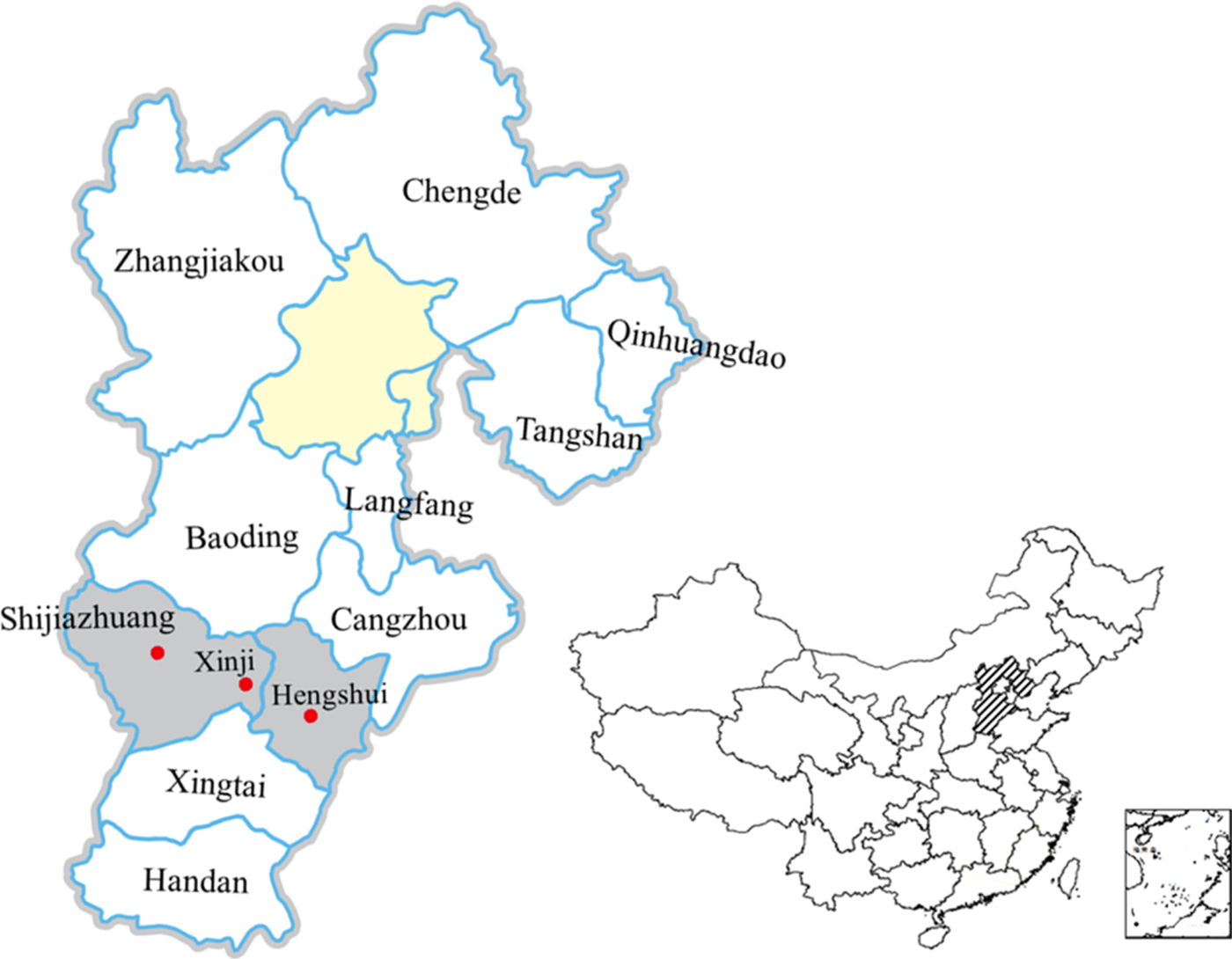
The data used in the empirical analysis were collected by the authors and collaborators in August 2015 in Hebei province in North China (figure 1). Hebei province has a temperate monsoon climate with an average annual precipitation of about 484.5 mm. Wheat and corn are the two major crops grown in the area. Wheat is particularly heavily irrigated since its growing season (October of previous year to June) does not overlap with the rainy season (June to October). In contrast, corn production relies much less on irrigation since the growing season of corn (June to October) largely falls within the rainy season.
Location of sample area and Hebei Province in China.
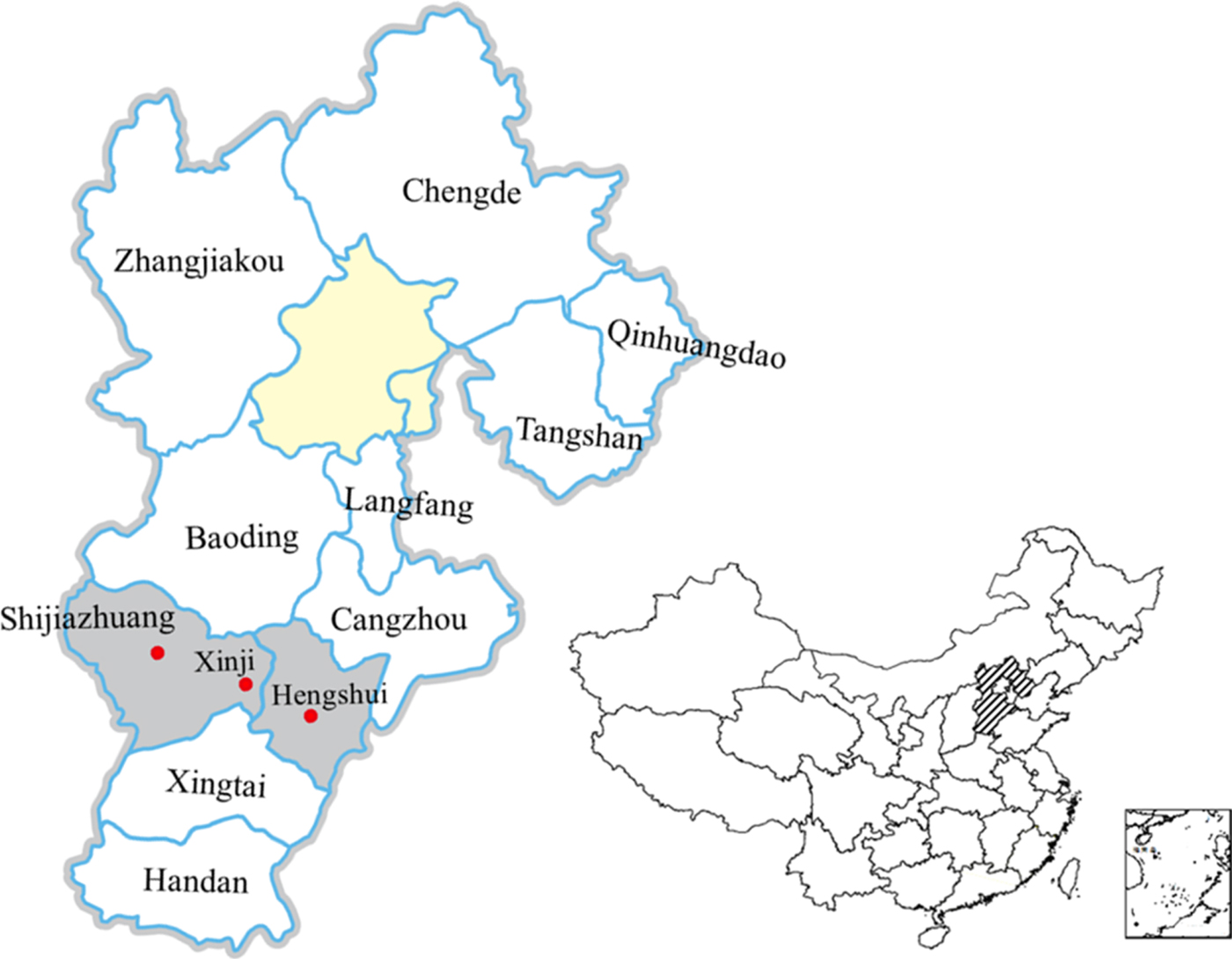
A stratified random sampling strategy was used to select counties with varying degrees of water scarcity in Shijin Irrigation District (ID), the largest ID in Hebei province. Counties were first sorted according to estimates of water resources available per capita and divided into three groups (the most water scarce, the least water scarce and the middle group). Then three counties were chosen randomly from each of the three groups. Three sample villages were randomly selected from a roster of all villages in each county. The random sampling method ensured each county and each village listed on the roster had an equal probability of being selected into the sample. Within each village, 10 households were randomly selected. In total, 27 villages and 270 farm households were surveyed. In each household, the decision maker regarding agricultural production activities who can answer detailed questions about off-farm employment activities was selected as the respondent. Due to missing data, 12 households were dropped. The final sample had 258 households. All 258 households used groundwater to irrigate either wheat or corn. Some households also used surface water: 27 households only used surface water to irrigate wheat (but used groundwater to irrigate corn) and 7 households used both groundwater and surface water to irrigate wheat or corn. Six households did not irrigate wheat or corn. Since surface water is paid on per unit of land area, the volume of surface water cannot be accurately calculated. The choice of using groundwater or surface water is largely exogenous in our analysis. Surface water in general is much cheaper than groundwater. Because of the price differences, farmers in rural China would almost invariantly prefer surface water if it were available. The availability of surface water depends on the presence of canals and available water supplies from the ID. Neither factor can be influenced by individual farmers.Footnote 2
3. Empirical specification
According to the conceptual framework constructed in online appendix 1 and a simple household utility maximization model given in online appendix 2, although various channels through which off-farm employment can affect water use are discussed in the conceptual framework section, it is difficult to tease out the effect of each individual channel due to both the complex nature of the relationships between off-farm employment and agricultural production, and data limitations. As a result, in the empirical analysis, we can only examine the total effect of off-farm employment on irrigation water use, irrigation investment and agricultural production. The following equation is estimated to examine the total effect of off-farm employment on irrigation water use:
 $$Y_{kiv} = \beta _{k0} + {\bf M}_{iv}{\bi \beta }_{k1} + \beta _{k2} p_{iv} + {\bf W}_{iv}{\bi \beta }_{k3} + {\bf L}_{iv}{\bi \beta }_{k4} + {\bf H}_{iv}{\bi \beta }_{k5} + \varepsilon _{kiv},$$
where Y kiv is the k th dependent variable of household i in village v. Three versions of equation (1) are estimated, each with a different dependent variable that measures irrigation water use: total number of hours wheat and corn were irrigated during the growing season; total amount of groundwater pumped out of wells to irrigate wheat and corn; and the total number of times wheat and corn were irrigated. The term ε kiv is the idiosyncratic error term.
The key variables of interest are contained in the vector M iv that measures off-farm employment activities. Our research distinguishes between two types of off-farm employment: migration and local off-farm employment. Household members are defined as migrants if they work outside of the township where they are registered and do not live at home. Household members who work off-farm part-time or full-time but still live at home are considered to be engaged in local off-farm employment. Usually these members suspend their off-farm work and work on-farm during the busy farming seasons such as planting or harvesting seasons. Specifically, M iv includes two variables: the share of family labor that has migrated and the share of family labor that works off-farm locally.
With irrigation water use as the dependent variable, equation (1) is essentially an input demand equation. As indicated by microeconomic theory, both input prices and output prices are determinants of input demand. Since crop prices do not vary much within a village, they are not included. Since groundwater is not regulated in rural China and there is no resource charge, the cost of groundwater is mostly the energy required to pump water (Huang et al., Reference Huang, Rozelle, Howitt, Wang and Huang2010). Therefore, the price of electricity used in agricultural irrigation, p iv , is highly correlated with the cost of water, given that we also control for the characteristics of wells and pumps. In our sample area, some respondents pump water out of their own wells while others purchase water from others that own wells (informal groundwater markets), or have water delivered from collectively-owned wells (Zhang et al., Reference Zhang, Wang, Huang and Rozelle2008). The price of electricity does vary within the village, since a service charge is often added to the electricity price when households purchase water on the informal groundwater markets. The cost of water is expected to have a negative effect on the amount of groundwater pumped. A set of well and pump characteristics is included in the vector W civ . Since conveyance loss increases with the average distance between plots and wells, farmers may apply more water to compensate for the seepage loss. If a well has lower water yield, it will take a longer time to irrigate a plot. Other factors such as the depth of wells, the diameter of the pump outlet pipes and the power of pump engines could also affect both the duration of the irrigation and the amount of water pumped.Footnote 3
Characteristics of land are controlled in the vector L iv . Farm size is measured by total household land holding. The number of plots a household has measures the degree of land fragmentation. The more fragmented the land is, the more difficult it is for a household to irrigate all the plots. The third variable measures soil quality, as rated by the respondent. Soil quality affects the level of water use.
A major econometric issue is the potential endogeneity of the variables that measure off-farm employment. This is because households are likely to make off-farm employment and production decisions simultaneously. The New Economics of Labor Market (NELM) (Stark and Bloom, Reference Stark and Bloom1985; Rozelle et al., Reference Rozelle, Taylor and De Brauw1999; Taylor et al., Reference Taylor, Rozelle and De Brauw2003) argues that households use migration as a strategy to overcome liquidity constraints and to finance consumption and investment at home. So the decision to allocate family labor to off-farm activities and decisions regarding other inputs including water are interrelated. Three steps have thus been taken to address the potential endogeneity issue.
First, a set of household characteristics are included in H iv . The demand for water is a function of prices of other inputs used in crop production. In the case when the price of agricultural labor is the shadow price of time, factors that influence the allocation of labor, such as the size of a household and its composition, would also affect demand for water through their effects on the shadow price of labor. Both the size of a household and its composition can affect a household's decision regarding off-farm employment (Zhao, Reference Zhao1999). For example, households with larger shares of children often face heavier economic burdens and limited amount of labor for farming and may turn to off-farm employment to boost income. These variables may also affect households’ irrigation decisions. Other things held constant, more children and/or elderly in the household could reduce irrigation water use because of the lack of labor. Age, gender and education are all typical factors that have been shown to affect farming productivity and off-farm employment (e.g., de Brauw and Rozelle, Reference de Brauw and Rozelle2008). Off-farm employment is often a risk-coping strategy for rural households who are exposed to shocks in agricultural production caused by factors such as weather (Giles, Reference Giles2006). Two dummy variables are used to gauge a household's risk attitude. The first dummy variable equals one if the respondent states that he/she prefers safe-albeit-low-returns technologies over risky-albeit-high-returns ones. The second dummy variable equals one if the respondent answered yes to the question ‘Do you often think about unexpected events that may happen in the future?’ The risk attitude of a household may also influence irrigation water use and investment. For example, a risk-averse farmer may apply excessive amounts of irrigation water to hedge against severe yield loss caused by potential droughts.
Second, the data allow us to use village fixed effects to control for any village level time invariant characteristics such as weather, policy environment and community-level off-farm employment network. Third, instrumental variable (IV) estimation is employed to address the potential endogeneity. Woodruff and Zenteno (Reference Woodruff and Zenteno2001) and McKenzie and Rapoport (Reference McKenzie and Rapoport2011) have used historic migration as an instrument to identify migration. Migration networks have also been shown to be among the most important determinant of migration (e.g., Taylor et al., Reference Taylor, Rozelle and De Brauw2003). During the survey, each respondent reported the number of relatives that migrated 10 years ago and the number of relatives that work off-farm locally. It is possible that the off-farm employment status of a relative may affect a household's irrigation water use or irrigation investment. For example, if a relative's household changed irrigation technology in response to migration, the respondent's irrigation technology may be affected through technology diffusion. For each respondent, we calculate the village-level average number of relatives who migrated 10 years ago. The average is calculated using the numbers reported by all other respondents in the same village except for the respondent. The village-level average number of relatives that work off-farm locally is calculated in the same way. Both variables could influence the off-farm employment status of a respondent's household through the community-level network. However, since the respondent is excluded in calculating the averages, there is no reason to believe either variable has any direct impact on the respondent's irrigation water use or irrigation investment. So both variables are suitable candidates for IVs. Results of the Durbin-Wu-Hausman test show that both variables are valid instruments.
The equation used to examine the impact of off-farm employment on irrigation-related investment is:
 $$I_{kiv} = \gamma _{k_0} + {\bf M}_{iv}{{\bf \gamma }_{k_1}} + \beta _{k_2}p_{iv} + {\bf L}_{iv}{{\bf \gamma}_{k_4}} + {\bf H}_{iv}{{\bf \gamma}_{k_5}} + \varepsilon _{kiv}$$
The first dependent variable in equation (2) is a dummy variable that equals one if a household has invested in wells. The second dependent variable is a dummy that equals one if a household used one or more water saving technologies. We examine three water-saving technologies: furrow irrigation, the use of underground pipe and/or lined canal to convey irrigation water for part or all of the distance between wells and fields. All three technologies could reduce the amount of water applied. Compared to basin irrigation that floods the entire field, furrow irrigation reduces seepage loss by reducing the flooded area. The major input in preparing land for furrow irrigation is labor needed to dig furrows before each irrigation season. It is not capital intensive and can be adopted by individual households. Underground pipe and/or lined canal can significantly reduce seepage loss along the conveyance channel. They only need to be installed once but they are expensive. Often they are adopted at the village level or by a group of households. It should be noted that the term water-saving is used in a loose sense in that these technologies reduce the amount of applied water but do not necessarily generate real water saving (reduction in consumptive water use or evapotranspiration) (Blanke et al., Reference Blanke, Rozelle, Lohmar, Wang and Huang2007). One limitation is that we could not separate out the use of each individual technology because during the survey the respondent was only asked whether the household used one or more of the three technologies. The third dependent variable measures the average number of furrows per unit of land. The number of furrows reflects the efforts households have made to reduce seepage loss. The optimal number of furrows depends on the size, shape and slope of the plot as well as the crop type. We have found during the survey that most households do not dig enough furrows because it is time consuming. So in the sample area, a larger number of furrows in general indicates more capacity to reduce seepage loss.Footnote 4
The specification of the right hand side of equation (2) is similar to that of equation (1) because the same set of factors may influence irrigation investment decisions. For example, households with more fragmented land may also be less likely to make investment such as sinking wells since they cannot enjoy economies of scale. Households may also be more willing to invest in land with better soil (Pender and Kerr, Reference Pender and Kerr1998). Well and pump characteristics are excluded since most households do not own wells or pumps. The price of electricity is also excluded in the regression for invested in well, since the relevant factor is the general level of electricity price in the village, which is captured by the village fixed effects.
Equation (2) is also used to examine the impact of off-farm employment on crop production. Since we examine both wheat and corn production, the total output value of wheat and corn production is used instead of crop yields. Total output value generated per unit of groundwater pumped is also used as a dependent variable. The third variable measures the share of total sown area allocated to wheat production. The last variable is a dummy variable that equals one if the household has fallowed some of its land.
Although some dependent variables are continuous and others are binary or categorical in nature, in the main specification, all regressions were run as a system of equations using Seemingly Unrelated Regressions (SUR). Both Three Stage Least Squares (3SLS) and Generalized Method of Moments (GMM) were used to implement the IV estimation. The results from 3SLS and GMM are similar. The 3SLS results are reported in tables 3–5 in section 4.
To check the robustness of the regression results, several alternative specifications were also run. In the basic specification, only the two key off-farm employment variables were included. Three other alternative specifications vary the control variables. The first alternative specification excludes the two dummy variables that measure a household's risk attitude. The second alternative specification excludes the two risk attitude variables and adds two variables: the number of a household's relatives living in the village and the number of a household's relatives who migrated in the past 10 years. The third alternative specification adds the two relative variables and also retains the two risk attitude variables. The estimation results of these alternative specifications are reported in tables A1–A3 in the online appendix. In online appendix table A4, alternative estimation methods are used for dependent variables that are binary or categorical in nature. Since number of irrigations is an ordinal and categorical variable, the method of ordered logit model was used. The conditional logit model is one of the very few nonlinear models that allow the incorporation of village fixed effects. It was used to estimate the equations for all binary dependent variables: invested in well, used one or more water saving technologies, and fallowed land. In regressions where the dependent variables are in log form (Log of Total groundwater, Log of Total irrigation hours, Log of Output value and Log of Output value per m3 of water), the log forms of total land holding, electricity price, depth of well, pump pipe diameter and engine power were used. When a dependent variable is in the original form, the original forms of these control variables were used. Variables that are measured in years and variables that are a proportion or a percent were used in original forms.
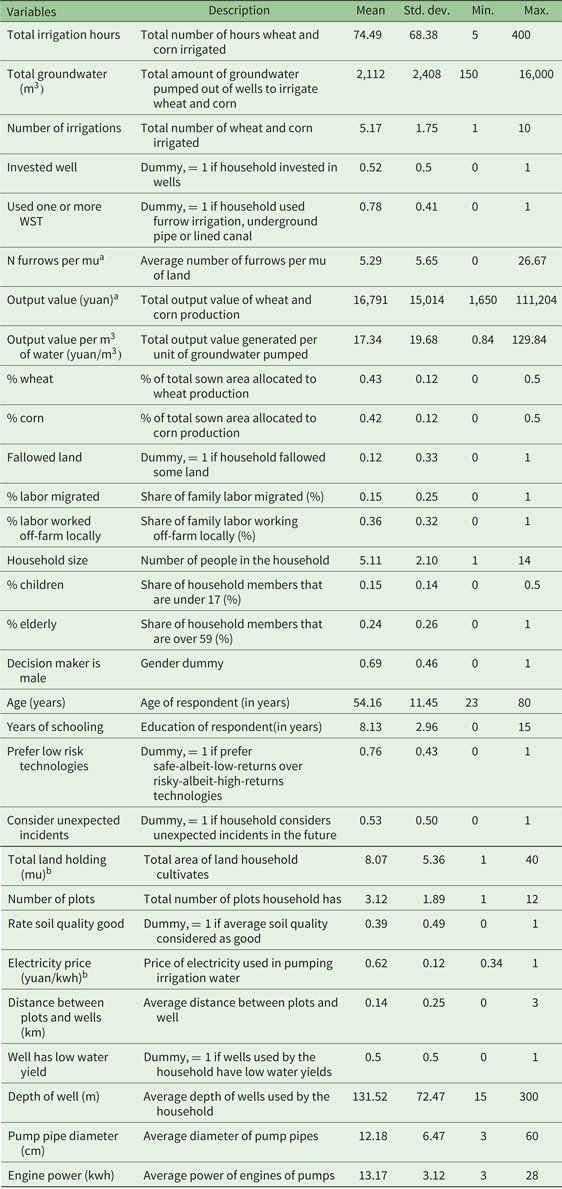
Table 1 presents the definition and summary statistics of each variable used in the analysis. In our sample areas, about 82 per cent of households have at least one member participating in off-farm employment. About 14 per cent participated only in local off-farm employment. About 20 per cent participated only in migration. The majority of the households, about 48 per cent, participated in both migration and local off-farm employment. Among the households that sent out migrants, 45 per cent of family laborers were migrant workers. Among the households with local off-farm employment, 52 per cent of family laborers were involved in local off-farm work. Averaged across all households (with or without off-farm employment), the share of migrant workers in family labor is 15 per cent and the share of labor working off-farm locally is 36 per cent. This is consistent with the recent trend that local off-farm employment has surpassed migration to become the dominant off-farm activity in rural China.
Variables description and summary statistics

a Yuan is the currency used in China. US$1 = 6.49 yuan using the exchange rate in the year 2015.
b Mu is the unit of land used in China. 1 mu = 1/15 hectare.
The average total share of children and elderly in the households is nearly 40 per cent, which is the typical structure of extended families in rural China. With large shares of children and elderly, as well as increasing share of off-farm labor, the share of agricultural labor in farm households is on the decline. The average age of farmers is 54.16, which is close to the level observed in the US and reflects the aging problem in the agricultural sectors. The risk attitudes of farm managers accord with the risk aversion and preservation of traditional farmers. About 76 per cent of respondents preferred low-risk technologies and 53 per cent often consider unexpected incidents in the future. On average, farmers pumped 74.5 hours in total, and pumped out 2,112 m3 groundwater to irrigate wheat and corn.Footnote 5 Meanwhile, the average depth of well reaches 131 meters in sample areas, underlining the scarcity of water in North China.
One shortcoming of this study is that we cannot analyze water use at the household level. Due to time and monetary constraints, the survey only collected information on water use for wheat and corn. Household-level irrigation water use could change if off-farm income enables households to shift away from grain production and invest in more profitable crops such as fruits and vegetables. Li et al. (Reference Li, Wang, Segarr and Nan2013) have found that remittances increased investment in orchard production in Northwest China. Since these crops are more water-intensive relative to grain crops, off-farm employment may work to increase total water use at the household level. There are reasons to believe that in our sample area, off-farm employment influences household-level total water use mostly through its effects on wheat and corn production. On average, 86 per cent of cultivated land is allocated to wheat between October of the previous year to June, then 85 per cent to corn from June to October. So wheat and corn production take almost 90 per cent of households’ land.
4. Results
This section reports the empirical findings on the total effect of off-farm employment on irrigation water use, irrigation investment and agricultural production. The findings on the second and third set of outcomes (irrigation investment and agricultural production) will also have implications for the main focus of the study, irrigation water use. First, a negative impact of off-farm employment on agricultural production has positive implications for the preservation of groundwater tables since it may be associated with lower levels of consumptive water use. Second, if agricultural production remains the same or increases, improvements in water productivity (output per unit of water used) could reduce its negative effect on groundwater resources. Third, the effects on water use of technologies adopted as a response to labor shortages or additional non-farm income may be ambiguous. In particular, those technologies that improve irrigation efficiency could increase water use (partly because the effective price of water is lowered) and bring unintended negative consequences for groundwater resources (Pfeiffer and Lin, Reference Pfeiffer and Lin2014).
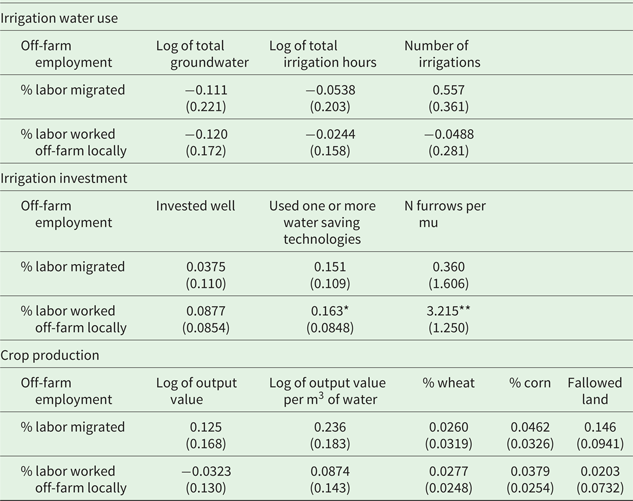
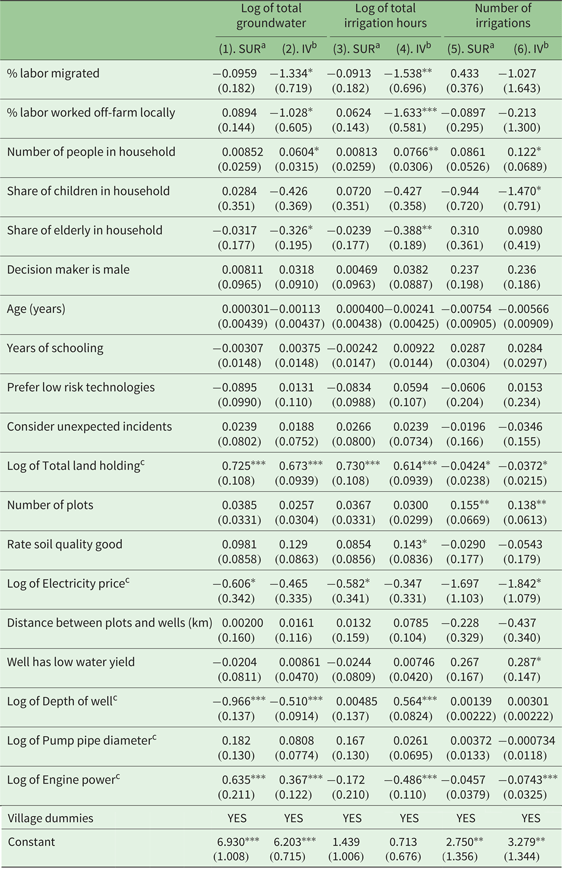
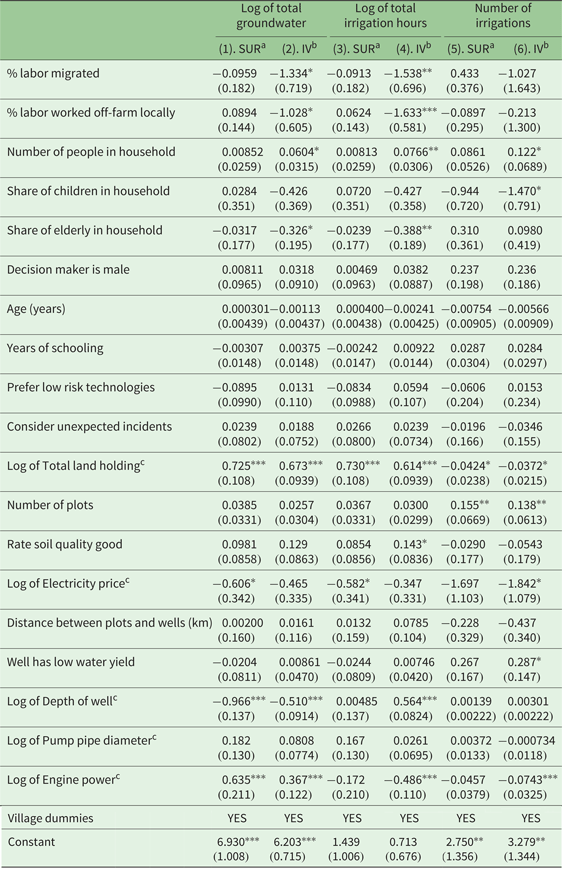
Results from the basic specification do not show a strong relationship between off-farm employment and irrigation water use (table 2). The estimated coefficients on the two variables, share of labor migrated and share of labor working off-farm locally, are negative in the regressions on total groundwater use and total hours pumped. However, none of the coefficients is statistically significant. When more control variables are added in the full specifications (table 3, columns 1 and 3), the signs of the coefficients on the share of labor working off-farm locally variables become positive. The coefficients, however, are still not statistically significant. The signs and levels of statistical significance of the coefficients on the two key variables are the same using either the full specifications in table 3 or the alternative specifications in table A1.
Basic specification, no other control variables added Seemingly Unrelated Regressions
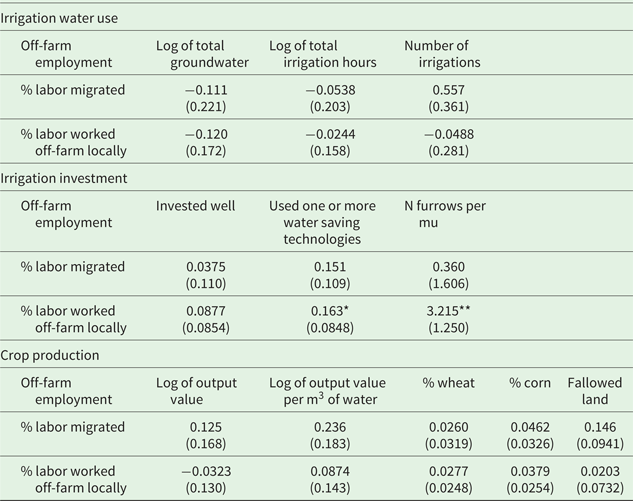
Notes: Standard errors in parentheses; *, ** denote significant at 10% and 5%, respectively.
Off-farm employment and irrigation water use, full specification
Notes: Standard errors in parentheses; *, **, *** significant at 10%, 5% and 1%, respectively.
a SUR: seemingly unrelated regressions.
b Instrumental variables for percentage labor migrated and percentage labor worked off-farm locally are the average number of relatives of other respondents in the village that migrated 10 years ago and the number of relatives in the village that work off-farm locally.
c The level form, not the log form, is used in columns (5) and (6) since the dependent variable is in its level form.
Results of the IV estimation, however, show that irrigation water use is likely to be negatively associated with migration and local off-farm employment (table 3, columns 2 and 4). The estimated coefficients on the share of labor migrated and share of labor working off-farm locally variables are both negative and statistically significant in the regressions on total irrigation hours and total amount of groundwater. Ceteris paribus, one percentage point increase in the share of family labor migrated reduces the total irrigation hours by about 1.54 per cent and total amount of groundwater pumped out of wells by 1.33 per cent. The estimated coefficients on the share of labor working off-farm locally are of similar magnitudes. Tests show that these two coefficients are not statistically different in either model. This set of results lends support to the lost-labor effect and the complementarity between labor and water as agricultural inputs.
Our result is stronger than the findings of Wachong Castro et al. (Reference Wachong, Heerink, Shi and Qu2010) that although the share of labor working locally is statistically significant, the estimated coefficient on migration has only borderline statistical significant at 10.8 per cent. The reason is that in the study of Wachong Castro et al. (Reference Wachong, Heerink, Shi and Qu2010), the main migration activity is cotton picking that takes place after the harvest season. In contrast, the main off-farm activities in our study area are jobs in the manufacturing, construction, and service industries, which are not related to farming. This means that even for households only engaged in local off-farm employment, the off-farm work will take labor away from farm during irrigation season.
The comparisons between the results of SUR and the IV estimations of the regressions on total groundwater used and total irrigation hours (table 3, column 1 versus column 2 and column 3 versus column 4) indicate that the coefficients on the off-farm employment variables may be upward biased when the SUR estimator is used. One possible explanation is omitted variable bias. The agricultural household model used in the conceptual framework section sheds some light on this. If demand for water is influenced by the shadow price of time, households’ preferences for time spent on leisure would affect demand for water. A stronger preference for leisure would increase the shadow price of time, which in turn may reduce water use. Ceteris paribus, a stronger preference for leisure would also reduce the amount of time a household would allocate to off-farm employment. A spurious positive relationship between off-farm employment and water use may arise due to their correlations with the preferences for leisure. Another omitted variable that may cause upward bias is past shocks that a household has experienced. Households may increase labor allocated to off-farm work as an ex post response to a past agricultural shock (Kochar, Reference Kochar1999) such as rainfall shocks (Giles, Reference Giles2006). Households may also apply more water as a response to such past shocks. Past shocks could not be controlled for, due to lack of information. Then the omission of the past shocks variable can lead to upward bias. The omission due to the lack of data of another variable in our analysis, well ownership, may also lead to bias. Well ownership is correlated with the price of water since households that purchase groundwater from other farmers often pay service charges. Then well ownership is likely to be correlated with some dependent variables such as the amount of groundwater used. It may also be correlated with off-farm employment since the latter may stimulate investment in wells. Therefore, omission of well ownership is likely to cause an upward bias.
The demographic composition of the households affects irrigation water use (table 3, columns 2 and 4). Larger households tend to irrigate for longer hours and use more groundwater. A possible explanation is that more people in the household means more labor can be allocated to irrigation. On the contrary, a higher share of elderly poses statistically significant negative impacts on both irrigation hours and the amount of groundwater, probably because it reduces the available farm labor and increases demand for elderly care. In addition, more elderly members means heavier economic burdens on the households and leads to lower disposable income (Wachong Castro et al., Reference Wachong, Heerink, Shi and Qu2010). Consequently, households may have reduced capacity to purchase productive inputs such as irrigation water. None of the characteristics of decision makers in the household (i.e., gender, age, education and risk attitude) has a statistically significant relationship with total irrigation hours or total groundwater pumped. A household's total land holding has a positive and statistically significant relationship with total irrigation hours. This is as expected since larger farms need more time to irrigate. Households tend to pump longer to irrigate plots with better soil quality. The coefficient on the price of electricity is negative but only statistically significant in the SUR estimation. Depths of wells and powers of pump engines do vary across households within the same village. Both variables do influence the length of pumping. Households using deeper wells tend to pump for a longer time. Households with more powerful pumps tend to pump for a shorter time. Both results are as expected.
None of the estimation results shows any impact of off-farm employment on the frequency of irrigation. In the regression on the number of irrigations, the estimated coefficient on the share of labor migrated is positive and that of the share of labor working off-farm locally is negative in the basic specification (table 2). Similar results are obtained using the full specification (table 3, column 5) or the alternative specifications (online appendix table A1, column 3) as well as when the ordered logit is used as the estimation method (online appendix table A4, columns 1 and 2). In the IV estimation, the estimated coefficient on the share of labor migrated becomes negative. None of the regressions on the number of irrigations generates statistically significant coefficients on either migration or local off-farm employment. This is probably because wheat production relies heavily on irrigation in the study area. Forgoing one irrigation will result in significant yield reductions (Liu et al., Reference Liu, Williams, Zehnder and Yang2007).
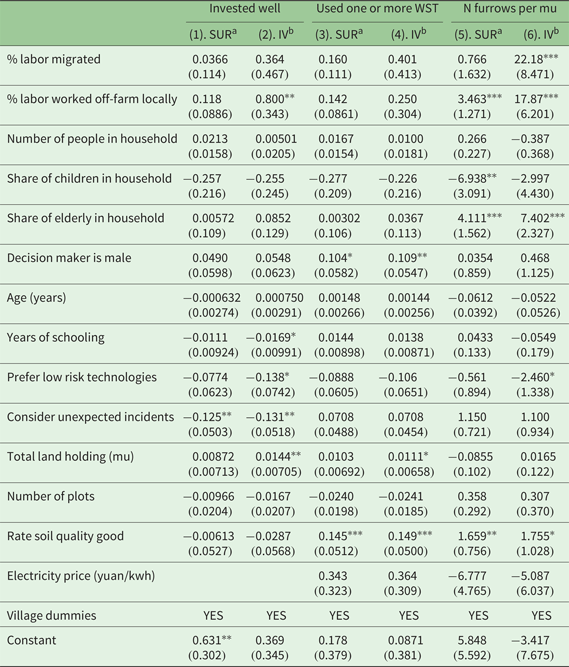
The estimation results also provide some evidence that off-farm employment may boost irrigation investment. In regressions on well investment, the estimated coefficients on the two off-farm employment variables are positive in the basic specification (table 2), the full specification (table 4, column 1) and alternative specifications (online appendix table A2, column 1). The coefficients remain positive when the conditional logit is used (online appendix table A4, columns 3 and 4). In the IV estimation, the coefficient on the share of labor working off-farm locally is also statistically significant (table 4, column 2). The IV estimation also shows that education reduces the likelihood of well investment. Households with larger land holding are more likely to invest in wells, which is consistent with the findings of Zhang et al. (Reference Zhang, Wang, Huang and Rozelle2008). Households that prefer low risk technologies or consider unexpected future incidents are less likely to invest in wells. This result may be specific to the context of the sample area where groundwater levels have declined significantly over the years and wells often run the risk of drying up.
There is also evidence that off-farm employment increases the use of water-saving technologies. In all regressions on whether households used one or more water saving technologies (table 2; table 4, columns 3 and 4; table A2, column 2; table A4, columns 5 and 6), the estimated coefficients on the two off-farm employment variables are positive. The results on the share of labor working off-farm locally are stronger. In the basic specification (table 2) and when the conditional logit model is used for estimation (table A4, columns 5–6), the coefficient on the share of labor working off-farm locally variable is statistically significant.
Off-farm employment and irrigation investment, full specification

Notes: Standard errors in parentheses; *, **, *** significant at 10%, 5% and 1%, respectively.
a SUR: seemingly unrelated regressions.
b The average number of relatives of other respondents in the village that migrated 10 years ago and the number of relatives other respondents in the village that work off-farm locally are used as the instrumental variables for percentage labor migrated and percentage labor worked off-farm locally.
The findings of positive correlation between off-farm employment and irrigation investment lend support to the income effect. This is different from the finding of de Brauw and Rozelle (Reference de Brauw and Rozelle2008) that migration had no effect on productive investment in the late 1990s. At least two explanations can be offered. First, de Brauw and Rozelle (Reference de Brauw and Rozelle2008) did not include local off-farm employment since it was less relevant during their study period. Our results show that the positive correlation is driven by local off-farm employment. Second, the returns to irrigation investment may have increased due to the role of irrigation in mitigating climate change impact (Taylor et al., Reference Taylor, Scanlon, Döll and Rodell2013).
One interesting finding is that a higher share of labor working off-farm locally increases the number of furrows per unit of land in the household. The estimated coefficient is statistically significant in all specifications. The impact of migration is positive but not statistically significant. This finding is unexpected because preparing land for furrow irrigation requires labor. This is also in contrast to the negative impacts off-farm employment has shown on the total hours of irrigation and the amount of groundwater pumped to irrigate wheat and corn (table 3). These seemingly contradictory findings, however, make sense when they are put together. A picture of how households adjust to the labor drainage associated with off-farm employment emerges. Although preparing land for furrow irrigation takes time, it is a one-time task. Once furrows are dug, in the rest of the irrigation season, because seepage losses are reduced with more furrows, less pumping is needed to achieve the same level of irrigation application rate in the field. Therefore, despite the initial labor requirement, furrow irrigation saves the total amount of irrigation labor needed for the whole irrigation season. This finding is consistent with a possible implication of the theory: households may reallocate labor among different irrigation-related activities and the effect of off-farm employment on the amount of water used depends on the nature of the allocation.
Factors that have been shown to influence the use of water-saving technologies are gender of decision makers, total land holding and soil quality (table 4, column 4). Water saving technologies are more easily extended to farms of larger scales and with better soil. A male farm manager is more likely to adopt water-saving technologies. These findings are in line with the results of previous studies (Just and Zilberman, Reference Just and Zilberman1983; Cremades et al., Reference Cremades, Wang and Morris2015). There is also some evidence that larger households and households with more elderly members and with better soil favor the use of furrows (column 6).
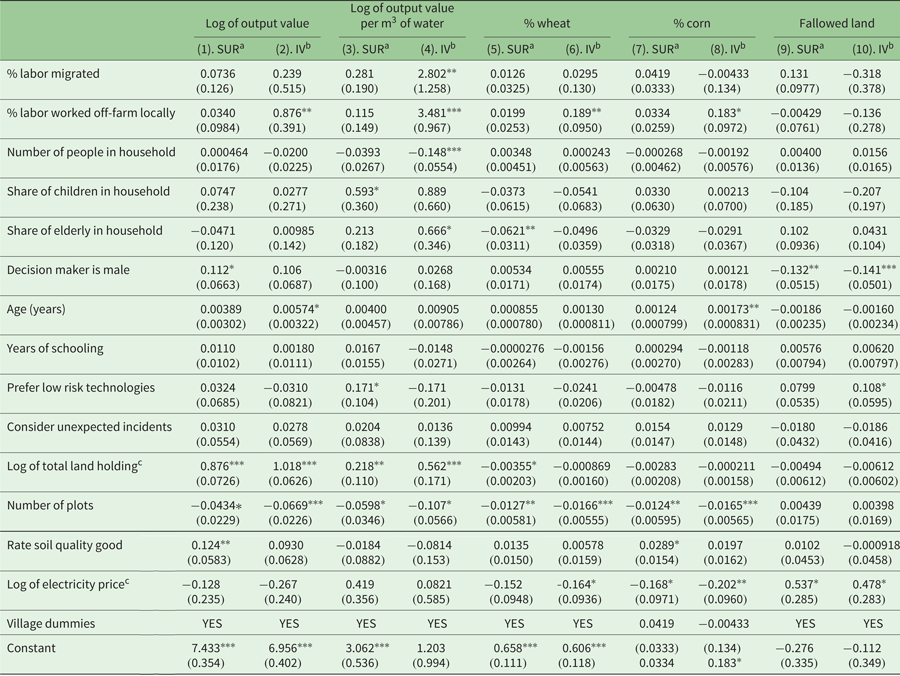
Although our results show that households with off-farm employment may reduce the amount of groundwater used to irrigate wheat and corn, crop production does not seem to be negatively affected. In the regressions on output value, the estimated coefficients on variables that measure off-farm employment are positive but not statistically significant (table 5, column 1; table A3, column 1). In the IV estimation, the coefficient on the share of labor working off-farm locally is positive and statistically significant (table 5, column 2). Furthermore, households with off-farm employment may enjoy higher levels of water productivity. The IV estimation results show that output value per unit of groundwater applied has statistically significant and positive relationships with both migration and local off-farm employment (table 5, column 4). This is consistent with the findings from tables 3 and 4 that, although off-farm employment reduces the length of pumping and the amount of groundwater pumped, the use of furrow irrigation, underground pipes and/or lined canals by households with off-farm employment tends to offset the negative impacts by reducing seepage losses. Overall, water productivity is boosted because less groundwater is pumped to achieve the same amount of output value.
Off-farm employment and crop production, full specification

Notes: Standard errors in parentheses; *, **, *** significant at 10%, 5% and 1%, respectively.
a SUR: seemingly unrelated regressions.
b The average number of relatives of other respondents in the village that migrated 10 years ago and the number of relatives other respondents in the village that work off-farm locally are used as the instrumental variables for percentage labor migrated and percentage labor worked off-farm locally.
c The level form, not the log form, of these variables in (5)–(8) are used in columns since the dependent variable is not in log form.
Off-farm employment does not seem to affect households’ decision to fallow land. The estimated coefficients on variables that measure off-farm employment are not statistically significant in any regression on fallowed land (table 5, columns 9 and 10; table A3, column 5; table A4, columns 7 and 8). There is some evidence that households with a higher share of labor working off-farm locally may allocate more land to wheat and corn (table 5, columns 6 and 8). One possible explanation is that households with off-farm employment are less likely to grow cash crops such as vegetables or fruits that require more irrigation.
Factors significantly influencing output value are the gender of the decision maker, size of land holding, number of plots and soil quality (table 5, column 1). Other things being equal, a household with a male decision maker may obtain higher yields. Similar results have been observed in African countries. Plots managed by the female are farmed much less intensively than those managed by men (Udry, Reference Udry1996). In South Nigeria, women produce 28 per cent less crop than men (Oseni et al., Reference Oseni, Corral, Goldstein and Winters2015). Fragmentation is another factor that negatively affects output value. As expected, households with larger land holding or which have better soil produce higher output value.
5. Conclusions
This study examines the relationship between irrigation and off-farm employment with a set of household-level data collected in Hebei Province in North China. Some of the estimation results show that off-farm employment reduces time spent on irrigation both in terms of total hours of irrigation and the amount of groundwater pumped to irrigate crops. Our estimation results also show that the negative effects of off-farm employment on irrigation water use have not resulted in losses of output value. In fact, water productivity, measured as output value produced per m3 of groundwater pumped, is higher among households with off-farm employment. These seemingly contradictory findings are explained by the increased use of water-saving technologies such as furrow irrigation, underground pipes and lined canals. These technologies reduce seepage losses during the conveyance of groundwater, as well as during irrigation of the fields. As a result, less groundwater needs to be pumped to achieve the same level of groundwater irrigation application rate in the field. In summary, our results provide some empirical evidence for the lost labor effect. Furthermore, households may respond to labor loss due to off-farm employment by reallocating labor among different irrigation activities.
There is some – but not strong – evidence for the income effect. Some of the estimation results show that higher off-farm employment may boost investment in wells as well as investment in capital intensive technologies such as underground pipes and lined canals. Our findings support the argument of Rozelle et al. (Reference Rozelle, Taylor and De Brauw1999) that a better functioning rural factor market can contribute to improving agricultural production and incomes.
Unlike Wachong Castro et al. (Reference Wachong, Heerink, Shi and Qu2010), our study does not offer strong support for the argument that off-farm employment leads to water savings. Although less groundwater is pumped for irrigation when households are engaged in off-farm employment, it is likely that consumptive water use remains the same since crop mix and crop output are largely the same. Therefore, off-farm employment does not seem to have generated real water savings.
Our findings suggest positive complementarities between industrial and agricultural policies. Given the trend of increasing off-farm employment and its likely negative association with groundwater pumping, a water management approach that tries to directly control farmers’ water use is not likely to be effective. One of the major policy implications arising from our findings is that households with off-farm employment are interested in using irrigation technologies that save labor. Therefore, the extension efforts of the government may be more fruitful in promoting water-saving technologies that also save labor. One such technology is sprinklers. The adoption rate is still quite low in China due to both the large capital requirement of the technology and the small farm size. Both constraints may be lifted with the changing landscape in rural China. Income from off-farm employment infuses more capital into the rural sector for investment. China's land tenure reform and other policies are all in favor of increasing farm sizes (Ma et al., Reference Ma, Heerink, Ierland, Lang and Shi2015). The government can facilitate the use of such technologies by providing more information, technical assistance and acting as the coordinator among households if needed. In addition, offering matching funds or subsidies will also make water-saving technologies more profitable investment opportunities for farmers’ capital.
Last but not least, it should be noted that except for the finding on the use of water-saving technologies and the use of furrows, most of our statistically significant findings come from the IV estimation. An argument can be made that the IVs used cannot adequately address the potential endogeneity of off-farm employment. The water use of a household may be correlated with water use of other households in the same village. This is particularly true in groundwater using areas where households may be pumping from the same aquifer. The off-farm employment decisions of households in the same village may also be correlated through such channels as the diffusion of off-farm employment information. As such, the IVs used may not be able to extract exogenous variations in the dependent variables to be used in estimation and thus our research findings do not necessarily imply causality. Future water research on this topic should make more efforts to collect information that can be used to construct IVs. For example, de Brauw and Giles (Reference de Brauw and Giles2012) explore the exogenous differences in the timing of national IDs distribution across rural villages in their IV estimation. Access to national IDs allows rural migrants to legally reside in cities and so would influence households’ off-farm employment. However, it is not likely that access to national IDs would affect water use.
Supplementary material
The supplementary material for this article can be found at https://doi.org/10.1017/S1355770X18000049