





Introduction
Trans and gender diverse (hereafter, trans) people are a heterogeneous group whose gender identity differs from, or is insufficiently represented by, their sex presumed at birth. Trans identities span a wide spectrum, including binary identities, such as trans women (women presumed male at birth) and trans men (men presumed female at birth), as well as non-binary identities. Trans people comprise a small but increasing proportion of the global population (around 0.3–4.5%) (Zhang et al., Reference Zhang, Goodman, Adams, Corneil, Hashemi, Kreukels, Motmans, Snyder and Coleman2020), likely reflecting greater societal visibility, knowledge, and acceptance (Coleman et al., Reference Coleman, Radix, Bouman, Brown, de Vries, Deutsch, Ettner, Fraser, Goodman, Green, Hancock, Johnson, Karasic, Knudson, Leibowitz, Meyer-Bahlburg, Monstrey, Motmans, Nahata and Arcelus2022). However, trans people remain a minoritized group that experiences substantial health and social disparities relative to cisgender people (Downing & Przedworski, Reference Downing and Przedworski2018; Fredriksen Goldsen, Romanelli, Hoy-Ellis, & Jung, Reference Fredriksen Goldsen, Romanelli, Hoy-Ellis and Jung2022; Rauh, Ménard, Roy, & Beall, Reference Rauh, Ménard, Roy and Beall2025).
Mental health inequities represent an important concern affecting trans people. Numerous studies report markedly elevated prevalence of certain mental disorders, suicidality, and non-suicidal self-injury (NSSI) compared with cisgender populations (Batchelder et al., Reference Batchelder, Stanton, Kirakosian, King, Grasso, Potter, Mayer and O’Cleirigh2021; Bouman et al., Reference Bouman, Claes, Brewin, Crawford, Millet, Fernandez-Aranda and Arcelus2017; Kidd et al., Reference Kidd, Tettamanti, Kaczmarkiewicz, Corbeil, Dworkin, Jackman, Hughes, Bockting and Meyer2023; Witcomb et al., Reference Witcomb, Bouman, Claes, Brewin, Crawford and Arcelus2018). These disparities are frequently interpreted within the framework of minority stress theory, which proposes that stigma, discrimination, and structural exclusion generate chronic stress that adversely affects mental health (Meyer, Reference Meyer2003).
Previous reviews of mental health outcomes in trans people have been conducted, but have been subject to a range of limitations, with many important gaps. These reviews were predominantly of low methodological quality, characterized by heterogeneous outcome definitions, limited coverage of mental disorders, and the inclusion of restricted or highly selected samples (e.g., armed services veterans, people living with HIV) and/or pediatric populations (Johnson, Bogdanova, Alexander, & Stokes, Reference Johnson, Bogdanova, Alexander and Stokes2025; Kohnepoushi et al., Reference Kohnepoushi, Nikouei, Cheraghi, Hasanabadi, Rahmani, Moradi, Moradi, Moradpour and Moradi2023; Marchi et al., Reference Marchi, Travascio, Uberti, De Micheli, Grenzi, Arcolin, Pingani, Ferrari and Galeazzi2023; Oliveira Teles et al., Reference Oliveira Teles, de Oliveira, de Mendonça Figueirêdo Coelho, Bezerra Pinheiro and Lannes Fernandes2026; Pinna et al., Reference Pinna, Paribello, Somaini, Corona, Ventriglio, Corrias, Frau, Murgia, El Kacemi, Galeazzi, Mirandola, Amaddeo, Crapanzano, Converti, Piras, Suprani, Manchia, Fiorillo and Carpiniello2022). There has also been limited disaggregation across specific trans identities (de Freitas, Léda-Rêgo, Bezerra-Filho, & Miranda-Scippa, Reference de Freitas, Léda-Rêgo, Bezerra-Filho and Miranda-Scippa2020; Lin et al., Reference Lin, Xie, Huang, Zhang, Wilson, Hou, Zhao, Wang, Pan, Liu, Han and Chen2021), inadequate synthesis of less commonly examined disorders, and a focus on trans youth populations (McArthur et al., Reference McArthur, Pesigan, Berg, Sin, Singh and McClurg2026). Consequently, important gaps remain, including the absence of robust pooled prevalence estimates for common mental disorders among trans adults, such as depression, and minimal examination of potential sources of heterogeneity in prevalence estimates, including geographic region, sociodemographic characteristics, and study design features (e.g., methods of ascertaining mental disorders).
Addressing these gaps is essential for generating more comprehensive and interpretable global prevalence estimates of mental disorders, suicidality, and NSSI among trans adults. Accordingly, this study aims to update and extend previous reviews by: (1) generating pooled global prevalence estimates of mental disorders (including mood, anxiety, trauma-related, eating, and psychotic disorders), suicidality (including suicidal ideation and suicide attempts), and NSSI; (2) examining prevalence both across the overall trans population and specific trans identity groups; and (3) examining variation in prevalence estimates according to key study-level and sociodemographic characteristics.
Methods
Design and registration
We conducted a systematic review and meta-analysis to estimate the pooled prevalence of mental disorders, suicidality, and NSSI among trans people. The protocol was prospectively registered with PROSPERO (CRD42023428569). The review was reported in accordance with PRISMA (Moher et al., Reference Moher, Shamseer, Clarke, Ghersi, Liberati, Petticrew, Shekelle, Stewart and Whitlock2015) and GATHER (Stevens et al., Reference Stevens, Alkema, Black, Boerma, Collins, Ezzati, Grove, Hogan, Hogan, Horton, Lawn, Marušić, Mathers, Murray, Rudan, Salomon, Simpson, Vos and Welch2016) guidelines (Supplementary Appendix A).
Search strategy
We searched MEDLINE, Embase, and PsycINFO on December 4, 2023, for peer-reviewed studies reporting prevalence of mental health outcomes in trans populations. The search was updated on April 7, 2026. Eligible studies were published between January 1, 1990, and April 7, 2026. The start date was selected to maximize the comprehensiveness of the evidence base, as the volume of eligible literature over time could not be anticipated a priori. Most included studies were published within the past decade, consistent with the more recent expansion of research on mental health among trans populations. This search formed part of a broader strategy that also included neurodevelopmental disorders and substance use outcomes. Substance use findings are reported separately, and neurodevelopmental conditions were excluded due to the availability of recent reviews (Bouzy, Brunelle, Cohen, & Condat, Reference Bouzy, Brunelle, Cohen and Condat2023; Kallitsounaki & Williams, Reference Kallitsounaki and Williams2023). Reference lists of relevant systematic reviews and meta-analyses were hand-searched to identify additional studies. Where necessary, study authors were contacted to clarify reporting details. The search strategy was developed in consultation with an information specialist, and full search terms are provided in Supplementary Appendix B.
Eligibility criteria
Inclusion criteria
We included quantitative studies of any design, including theses, dissertations, and conference abstracts. Studies were eligible if they included trans participants of any gender identity, whether self-identified or identified by others, and reported prevalence of mental disorders, suicidality, or NSSI.
Mental disorders were assessed using screening instruments with validated general population cut-offs or clinical diagnoses based on Diagnostic and Statistical Manual of Mental Disorders (DSM) or International Classification of Diseases (ICD) criteria, including structured diagnostic interviews. Disorders examined included depression, anxiety, bipolar disorder, generalized anxiety disorder (GAD), panic disorder, social anxiety disorder (SAD), obsessive-compulsive disorder (OCD), post-traumatic stress disorder (PTSD), eating disorders, and psychotic disorders. All screening and diagnostic tools included are listed in Supplementary Appendix C. Suicidality and NSSI outcomes included suicidal ideation, suicide attempts, and NSSI, by self-report or clinical assessment. Both current and lifetime prevalence estimates were included.
Participants recruited from gender-affirming care clinics were included. Although such samples represent a subset of trans people who are able to access gender-affirming care, these clinics often constitute a primary or sole point of contact for trans populations in some settings and may provide the only available data for certain countries. Their inclusion also enables comparison with community-based samples. There were no restrictions on country or language, and non-English studies were translated using Google Translate.
Exclusion criteria
We excluded studies with fewer than 40 trans participants to minimize the influence of small sample sizes with extreme prevalence values on pooled estimates (Munn et al., Reference Munn, Moola, Lisy, Riitano and Tufanaru2015). Restricted or highly selected subpopulations (e.g., people living with HIV, sex workers, students, veterans, etc.) were excluded. Studies were also excluded if participants identifying as intersex, cross-dressers, or drag performers comprised ≥10% of the sample and could not be removed from the analytic sample.
Studies predominantly sampling children or adolescents (age < 16 years), or those with narrowly defined adult age ranges (≤5 years, e.g. 18–22 years), were excluded. Retrospective chart reviews were also excluded unless the diagnostic process was clearly described, standardized, and missing data were < 10%. Administrative database studies were excluded due to under-ascertainment of trans identity (Kronk et al., Reference Kronk, Everhart, Ashley, Thompson, Schall, Goetz, Hiatt, Derrick, Queen, Ram, Guthman, Danforth, Lett, Potter, Sun, Marshall and Karnoski2022) and mental health diagnoses (Davis, Sudlow, & Hotopf, Reference Davis, Sudlow and Hotopf2016). Detailed inclusion and exclusion criteria are presented in Supplementary Appendix D.
Study selection
Search results were deduplicated in EndNote 20 and imported into Covidence (Veritas Health Innovation). Two trained reviewers independently screened titles and abstracts and then assessed full texts for eligibility. Disagreements at either stage were resolved by a third reviewer or by consensus with at least one other reviewer.
Data extraction
Data were extracted into REDCap by one reviewer and independently verified. Discrepancies were resolved through arbitration with a third reviewer. Extracted data included study characteristics, participant demographics, mental health outcomes, and risk-of-bias indicators (Supplementary Appendix E).
Data extraction was stratified by gender identity (trans women, trans men, non-binary), mental disorder assessment method (screening instrument versus clinical diagnosis), and timeframe (current versus lifetime). Participants were classified as non-binary where explicitly reported or where study authors described participants using identities outside the gender binary (e.g., genderqueer, genderfluid, agender, etc.). Current prevalence followed instrument-specific timeframes, except for suicidality and NSSI, which were defined as past-12-month outcomes and stratified into past 1–4 weeks, 2–6 months, and 6–12 months for subgroup analysis.
Where multiple publications reported overlapping samples, duplicate data were excluded, and the publication providing the most comprehensive reporting of the sample and relevant outcomes was retained. For studies reporting prevalence using both screening instruments and clinical diagnosis, both estimates were retained only for subgroup comparisons of assessment method; clinical diagnoses were prioritized for all other analyses. A summary of the included studies is presented in Supplementary Appendix G.
Risk of bias
Two reviewers independently assessed risk of bias using the RoB-PrevMH tool (Tonia et al., Reference Tonia, Buitrago-Garcia, Peter, Mesa-Vieira, Li, Furukawa, Cipriani, Leucht, Low and Salanti2023), designed for prevalence studies of mental disorders. Disagreements were resolved through discussion with a third reviewer. Studies were classified as: (1) high risk if any domain was rated high risk; (2) low risk if all domains were rated low risk; and (3) unclear risk if at least one domain was rated unclear, but none were rated high risk. Risk of bias assessment for individual studies is summarized in Supplementary Appendix G.5. Formal tests for funnel plot asymmetry were not performed because they have limited validity for meta-analyses of prevalence using transformed proportions, particularly with substantial between-study heterogeneity (Barker et al., Reference Barker, Migliavaca, Stein, Colpani, Falavigna, Aromataris and Munn2021).
Statistical analysis
Random-effects meta-analyses were conducted in Stata (version 18.5) using DerSimonian–Laird estimation with Freeman–Tukey double-arcsine transformation. Current and lifetime prevalence estimates were pooled separately for each mental health outcome, with 95% confidence intervals (CIs) and I 2 statistics reported to quantify heterogeneity. Sensitivity analyses were conducted using binomial-normal generalized linear mixed models (GLMMs) with a logit link. Between-study variance (τ 2) and 95% prediction intervals were estimated from the GLMMs where appropriate. Further methodological details are provided in Supplementary Appendix F (Extended Methods).
Subgroup analyses and meta-regression
Subgroup analyses were performed by gender identity, recruitment setting (community versus clinic), mental disorder assessment method (screening instrument versus clinical diagnosis), suicidality and NSSI timeframe, Global Burden of Disease (GBD) region, and risk of bias category. Subgroup-specific pooled prevalence estimates with 95% CIs were generated, and Cochran’s Q test was used to assess between-group differences. Subgroup analyses were restricted to categories with at least two contributing studies (k ≥ 2). Meta-regression analyses examined continuous or proportional study-level predictors, including publication year, sample size, age, and selected sociodemographic characteristics (unstable housing, regional/rural location, unemployment, high school education or less, partnered, sexual minority, non-white ethnicity). Statistical significance was defined as p < 0.05. Subgroup and meta-regression analyses were restricted to the most frequently reported outcomes.
General population comparator estimates
Comparator prevalence estimates for each mental disorder in the general population were obtained primarily from the Institute of Health Metrics and Evaluation GBD results database (2023) (Global Burden of Disease Collaborative Network, 2023) and the World Health Organization (WHO) World Mental Health Surveys (Supplementary Appendix Table B.5). For disorders not covered by these sources, a targeted Medline search (Supplementary Appendix Table B.6) was conducted to identify reviews with methodologically robust general population estimates. These estimates are indirect comparators and are provided for descriptive context rather than as direct or matched estimates of relative risk.
Role of the funding source
The funders of the study had no role in study design, data collection, data analysis, data interpretation, or writing of the report.
Results
Study selection and characteristics
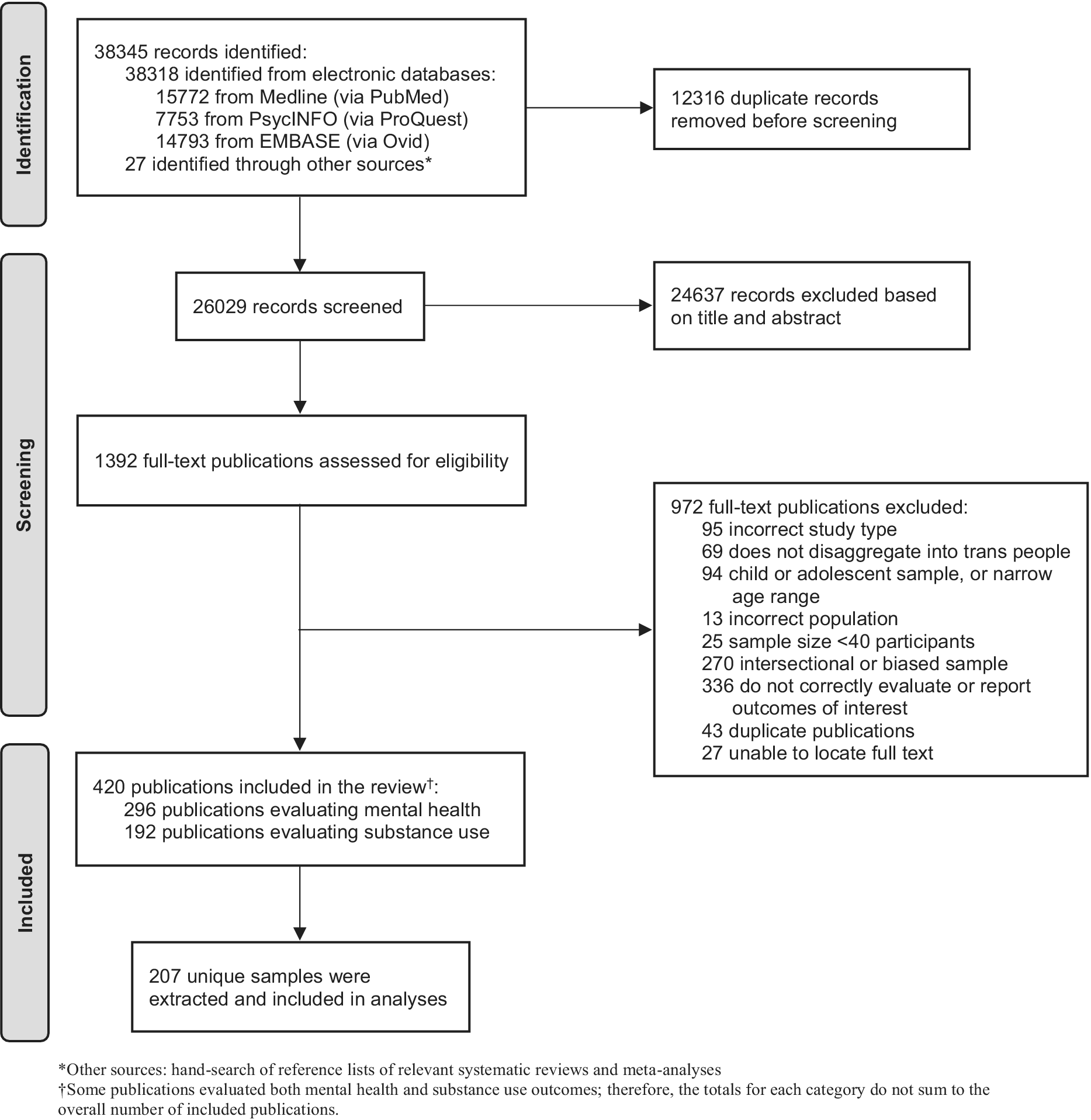
Our searches identified 38,345 records, of which 296 publications met inclusion criteria, corresponding to 207 unique studies and 134,071 trans participants contributing to one or more pooled prevalence estimates (Supplementary Appendix Table H.1). The study selection process is summarized in the PRISMA flow diagram (Figure 1). By gender identity, the dataset included 168 unique samples of trans women (n = 44,820), 147 samples of trans men (n = 28,422), and 92 samples of non-binary people (n = 24,382). Studies originated from 52 countries, predominantly from high-income settings, particularly the United States (k = 64). Geographic representation was limited, with three or fewer studies from Sub-Saharan Africa and the Caribbean, and none from Central Asia or the Pacific islands. The majority of participants were recruited from community-based samples (k = 165; n = 115,822), with a smaller proportion from clinic-based settings (k = 42; n = 18,249).
PRISMA flowchart of included studies.
aOther sources: hand-search of reference lists of relevant systematic reviews and meta-analyses.
bSome publications evaluated both mental health and substance use outcomes; therefore, the totals for each category do not sum to the overall number of included publications.

Figure 1. Long description
The flowchart is organized into four vertical phases labeled on the left: Identification, Screening, and Included.
1. Identification Phase:
- Top-left box: 38345 records identified, including 38318 from electronic databases (15772 from Medline via PubMed, 7753 from PsycINFO via ProQuest, 14793 from EMBASE via Ovid) and 27 from other sources.
- An arrow points right to a box: 12316 duplicate records removed before screening.
2. Screening Phase:
- Central box: 26029 records screened.
- An arrow points right to a box: 24637 records excluded based on title and abstract.
- Central box below: 1392 full-text publications assessed for eligibility.
- An arrow points right to a large exclusion box listing 972 full-text publications excluded for various reasons: 95 incorrect study type, 69 does not disaggregate into trans people, 94 child or adolescent sample or narrow age range, 13 incorrect population, 25 sample size less than 40 participants, 270 intersectional or biased sample, 336 do not correctly evaluate or report outcomes of interest, 43 duplicate publications, and 27 unable to locate full text.
3. Included Phase:
- Central box: 420 publications included in the review, consisting of 296 evaluating mental health and 192 evaluating substance use.
- Final central box at the bottom: 207 unique samples were extracted and included in analyses.
Most studies evaluated current mental disorders (k = 121; n = 61,259) or lifetime suicidality and NSSI (k = 94; n = 64,884) (Supplementary Appendix Table H.1). The most commonly evaluated current mental disorders among all trans participants were depression (k = 102; N = 56,035), non-specific anxiety (k = 30; N = 6,811), GAD (k = 27; N = 23,382), PTSD (k = 23; N = 5,443), and eating disorders (k = 15; N = 2,936).
Prevalence estimates
Table 1 summarizes pooled prevalence estimates for current and lifetime mental disorders, suicidality, and NSSI, stratified by gender identity. For mental disorders, overall pooled estimates combined studies using symptom screening instruments and clinical diagnostic methods, with clinical diagnoses prioritized where both were reported for the same sample. Screening-based estimates represent the proportion exceeding instrument-specific thresholds and should not be interpreted as confirmed clinical diagnoses. Therefore, overall estimates integrate heterogeneous ascertainment methods, with ascertainment-specific estimates presented separately in Supplementary Appendix Table H.2.
Prevalence estimates of current and lifetime mental disorders, suicidality, and non-suicidal self-injury according to gender identity

Table 1. Long description
The table is divided into two main sections: Mental disorders and Suicidality and non-suicidal self-injury. Each disorder lists current and lifetime prevalence estimates with 95% C I and I super 2 percentages across four groups: Total trans people, Trans women, Trans men, and Non-binary people.
Key data points include:
* Depression (Current): Total trans people 40.1%, Trans women 35.5%, Trans men 27.6%, Non-binary people 50.2% (p-value 0.0062).
* Anxiety (Current): Total trans people 29.8%, Trans women 30.1%, Trans men 22.9%, Non-binary people 44.8% (p-value 0.037).
* Generalized anxiety disorder (Current): Total trans people 26.8%, Trans women 14.0%, Trans men 15.2%, Non-binary people 43.4% (p-value 0.0008).
* Post-traumatic stress disorder (Current): Total trans people 23.6%, Trans women 13.8%, Trans men 4.9%.
* Suicidal ideation (Past 12-month): Total trans people 43.1%, Trans women 34.4%, Trans men 34.9%, Non-binary people 52.2% (p-value 0.011).
* Suicidal ideation (Lifetime): Total trans people 63.5%, Trans women 56.5%, Trans men 69.1%, Non-binary people 75.3% (p-value 0.030).
* Suicide attempt (Lifetime): Total trans people 32.1%, Trans women 30.4%, Trans men 34.0%, Non-binary people 31.7%.
* Non-suicidal self-injury (Lifetime): Total trans people 50.3%, Trans women 34.2%, Trans men 44.7%, Non-binary people 60.4%.
Sub-group analysis by gender shows statistically significant differences (p < 0.05) for current depression, non-specific anxiety, generalized anxiety disorder, eating disorders, and both 12-month and lifetime suicidal ideation.
a Prevalence estimates of mental disorders were derived from clinical diagnosis and/or screening instruments unless otherwise indicated: clinical diagnosis only. Disaggregation of prevalence estimates by assessment method is provided in the Supplementary material (Supplementary Appendix Table H.2).
b Excluded from subgroup analysis (k < 2 studies).
* Statistically significant (p < 0.05)
Current mental disorders
Among all trans participants, the prevalence estimate for current depression was 40.1% (95% CI 35.6–44.8; k = 102), non-specific anxiety 29.8% (20.3–40.2; k = 30), GAD 26.8% (16.6–38.4; k = 27), PTSD 23.6% (14.9–33.5; k = 23), and eating disorders 12.9% (5.4–22.7; k = 15) (Table 1). There were significant differences in prevalence by gender identity for depression (p = 0.0062), non-specific anxiety (p = 0.037), and GAD (p = 0.0008). The highest pooled prevalence estimates were observed among non-binary people, with depression at 50.2% (38.9–61.4; k = 13), non-specific anxiety at 44.8% (35.4–54.4; k = 2), and GAD at 43.4% (31.7–55.4; k = 5).
The prevalence estimate among all trans participants for bipolar disorder was 2.2% (0.6–4.6; k = 9), panic disorder 1.8% (0.8–3.1; k = 7), SAD 5.5% (0.9–13.2; k = 8), OCD 2.9% (1.2–5.2; k = 8), and psychotic disorders 0.5% (0.1–1.2; k = 7). None of these disorders were reported in studies that provided disaggregated estimates for non-binary participants. There were no significant differences in prevalence estimates between trans women and trans men for these disorders.
Lifetime mental disorders
Among all trans participants, lifetime prevalence estimates were highest for depression at 33.5% (17.0–52.4; k = 9), followed by non-specific anxiety at 17.9% (6.8–32.5; k = 6), GAD at 7.0% (4.3–10.1; k = 2), eating disorders at 2.6% (1.1–4.8; k = 3), and psychotic disorders at 1.3% (0.2–2.9; k = 3). No studies reported lifetime prevalence of mental disorders in non-binary participants. Data were insufficient to assess prevalence differences by gender identity for most outcomes, and depression prevalence did not differ between trans women and trans men (p = 0.11).
Past-12-month and lifetime suicidality and non-suicidal self-injury
Among all trans participants, past-12-month prevalence estimates were 43.1% (38.9–47.3; k = 54) for suicidal ideation, 9.3% (7.7–11.0; k = 30) for suicide attempts, and 26.1% (20.4–32.2; k = 14) for NSSI. Lifetime prevalence estimates were substantially higher, with suicidal ideation at 63.5% (58.5–68.4; k = 50), suicide attempts at 32.1% (29.7–34.5; k = 82), and NSSI at 50.3% (42.2–58.5; k = 29). There were significant differences in prevalence by gender identity for past-12-month and lifetime suicidal ideation (p = 0.011 and p = 0.030, respectively), with the highest pooled prevalence estimates observed among non-binary participants.
Sensitivity analysis
Sensitivity analyses using binomial-normal GLMMs produced prevalence estimates broadly consistent with those from the primary DerSimonian–Laird analyses (Supplementary Appendix Table H.6). GLMM estimates were generally slightly higher, with most estimates differing by less than 3 percentage points and overlapping 95% CIs.
Subgroup analysis
It was possible to examine potential reasons for variation in estimates among studies of trans people generally, for the five most studied current mental disorders (depression, non-specific anxiety, GAD, PTSD, and eating disorders), and for past-12-month and lifetime suicidality and NSSI. These findings are presented in Tables 2 and 3, respectively. Some subgroup categories were based on few contributing studies, and these estimates should therefore be interpreted as indicative rather than definitive.
Subgroup analysis of select current mental disorders among all trans and gender diverse people

Table 2. Long description
The table presents prevalence estimates with 95% C I and I super 2 values for five mental health conditions.
* Recruitment setting: Community settings show significantly higher prevalence than clinic settings across all disorders. For example, depression is 47.8% in community vs 18.6% in clinics.
* Assessment of mental disorders: Screening instruments consistently yield higher prevalence estimates than clinical diagnostic tools. Depression screening shows 45.0% compared to 11.9% via clinical tools.
* Screening instruments: Various tools are listed. For depression, C E S minus D shows 57.7% while P H Q shows 43.9%. For anxiety, O A S I S shows 68.3% and P R O M I S shows 69.5%.
* Clinical diagnostic tools: S C I D, D S M, and M I N I are compared. For P T S D, D S M criteria show 33.7% prevalence while S C I D shows 5.6%.
* Geographic region: Prevalence varies widely. North America shows high rates for depression (47.1%) and G A D (51.2%). South Asia shows the highest non-specific anxiety at 88.3%. Western Europe generally shows lower rates, such as 1.7% for P T S D and 1.3% for eating disorders.
* Risk of bias: High risk studies generally report higher prevalence than low risk studies. For depression, high risk studies report 45.8% vs 37.2% in low risk studies.
Statistical significance (p < 0.05) is noted for most subgroup comparisons across all five disorder categories.
a Statistically significant (p < 0.05)
b Two studies reported depression prevalence using both screening instruments and clinical diagnosis; both sets of results were included in the subgroup analysis comparing assessment methods for mental disorders.
c Excluded from subgroup analysis (k < 2 studies)
Ins. = screening instrument.
Subgroup analysis of suicidality and self-injury among all trans and gender diverse people

Table 3. Long description
The table is organized into six main outcome columns: Suicidal ideation past-12-month, Suicidal ideation lifetime, Suicide attempt past-12-month, Suicide attempt lifetime, Non-suicidal self-injury past-12-month, and Non-suicidal self-injury lifetime. Each outcome includes three metrics: k (Total N), Prevalence estimate (95% C I), and I super 2.
Key findings by subgroup:
* Recruitment setting: Community settings show higher prevalence for past-12-month ideation (45.5%) compared to clinics (20.1%). Lifetime ideation is high in both (64.3% community, 59.9% clinic).
* Timeframe: Past 6 to 12 months ideation prevalence is 45.8%, while past 1 to 4 weeks is 35.7%.
* Geographic region: Lifetime suicidal ideation is highest in Australasia (88.7%) and lowest in East and Southeast Asia (45.3%). Lifetime suicide attempts range from 18.0% in East and Southeast Asia to 49.4% in Eastern Europe. Non-suicidal self-injury lifetime prevalence is highest in Latin America (74.6%) and Australasia (73.7%).
* Risk of bias: High-risk studies reported a 46.0% prevalence for past-12-month ideation, while low-risk studies reported 43.2%.
Statistical significance (p-values) and Cochran’s Q values are provided at the end of each subgroup section to indicate variance between categories. Many comparisons, particularly geographic region and recruitment setting, show high statistical significance (p < 0.0001).
a One study reported suicidal ideation prevalence during the past 4 weeks and also during the past 12 months; both sets of results were included in the subgroup analysis comparing timeframes for current suicidal ideation.
b *Excluded from subgroup analysis (k < 2 studies).
Statistically significant (p < 0.05).
Screening instruments versus clinical diagnosis
Pooled prevalence estimates were consistently higher when mental disorders were identified using screening instruments compared with clinical diagnosis. For example, current depression prevalence was 45.0% (40.6–49.6; k = 89) using screening tools versus 11.9% (3.1–25.1; k = 15) via clinical diagnosis (p < 0.0001), with similar patterns observed for non-specific anxiety (39.2% vs 11.0%, p < 0.0001), GAD (45.6% vs 6.0%, p < 0.0001), PTSD (47.2% vs 9.0%, p < 0.0001), and eating disorders (27.8% vs 1.6%, p < 0.0001).
Community versus clinic samples
Pooled prevalence estimates were also higher in community-based samples than in clinic-based samples, paralleling differences observed by assessment method. Community samples showed elevated prevalence of current depression (47.8% vs 18.6%, p < 0.0001), non-specific anxiety (44.1% vs 18.4%, p = 0.0099), GAD (42.1% vs 4.2%, p < 0.0001), PTSD (37.3% vs 4.6%, p < 0.0001), and eating disorders (32.5% vs 3.7%, p < 0.0001). Suicidality and self-injury were significantly higher in community samples for past-12-month suicidal ideation (45.5% vs 20.1%, p < 0.0001), lifetime suicide attempts (33.6% vs 25.8%, p = 0.021), past-12-month NSSI (30.1% vs 6.5%, p < 0.0001), and lifetime NSSI (61.0% vs 26.9%, p < 0.0001).
Differences between screening instruments
Pooled prevalence estimates for current depression and non-specific anxiety differed significantly according to the screening instrument used (p < 0.0001 for depression, p = 0.016 for non-specific anxiety). For current depression, studies using the Center for Epidemiologic Studies Depression Scale (CES-D) had the highest pooled prevalence estimate at 57.7% (51.6–63.7; k = 36), whereas those using the Hospital Anxiety and Depression Scale (HADS) had the lowest estimate at 16.2% (7.8–27.1; k = 3). For non-specific anxiety, the highest pooled estimate was observed in the single study using the Patient-Reported Outcomes Measurement Information System (PROMIS) at 69.5% (66.0–72.8; k = 1), while the lowest estimate was observed for the Beck Anxiety Inventory at 18.2% (7.3–32.6; k = 3). No significant differences were detected between screening instruments for PTSD (p = 0.70) or eating disorders (p = 0.34).
Geographic region
Prevalence estimates varied significantly across GBD regions for all current mental disorders, and for past-12-month and lifetime suicidality and NSSI outcomes included in the subgroup analyses (all p < 0.05). Patterns were heterogeneous, with no single region consistently showing the highest prevalence across outcomes.
Risk of bias
Most estimates for mental disorders (including depression, non-specific anxiety, GAD, PTSD, and eating disorders), as well as suicidality and self-injury outcomes, were judged to be at uncertain or high risk of bias. Subgroup analyses indicated significant differences in prevalence estimates by risk-of-bias category for depression (p = 0.023), non-specific anxiety (p = 0.028), GAD (p = 0.017), and NSSI, both current (p < 0.0001) and lifetime (p < 0.0001).
Meta-regression analysis
Exploratory meta-regression analyses were conducted for current depression and non-specific anxiety, past-12-month suicidal ideation, and lifetime suicidal ideation, suicide attempts, and NSSI (Table 4). Studies with higher proportions of participants identifying as a sexual minority identity reported slightly higher prevalence of current depression (β = 0.003, p = 0.04) and lifetime suicidal ideation (β = 0.004, p = 0.007), suicide attempts (β = 0.002, p = 0.02), and NSSI (β = 0.006, p < 0.001). Additionally, studies with a greater representation of non-white participants showed marginally lower prevalence of past-12-month suicidal ideation (β = −0.005, p = 0.001), and lifetime suicidal ideation (β = −0.006, p < 0.001) and suicide attempts (β = −0.002, p = 0.006).
Meta-regression analysis of select mental disorders, suicidality, and non-suicidal self-injury among all trans and gender diverse people

Table 4. Long description
The table presents meta-regression results for six outcomes: Current depression, Current anxiety, Lifetime suicidal ideation, Lifetime suicide attempt, Lifetime non-suicidal self-injury, and Past-12-month suicidal ideation.
Key findings by row characteristic:
* Study start year: Shows significant positive coefficients for Current depression (p = 0.04), Current anxiety (p = 0.01), and Lifetime non-suicidal self-injury (p = 0.002).
* Log sample size: No statistically significant associations across any outcomes.
* Age (mean or median): No statistically significant associations.
* Unstable housing: Shows a significant negative coefficient for Lifetime non-suicidal self-injury (p < 0.001).
* Regional/rural location: No statistically significant associations.
* Unemployment: No statistically significant associations.
* High school education or less: No statistically significant associations.
* Partnered: Shows a significant negative coefficient for Current anxiety (p = 0.003).
* Sexual minority: Shows significant positive coefficients for Current depression (p = 0.04), Lifetime suicidal ideation (p = 0.007), Lifetime suicide attempt (p = 0.02), and Lifetime non-suicidal self-injury (p < 0.001).
* Non-white ethnicity: Shows significant negative coefficients for Lifetime suicidal ideation (p < 0.001), Lifetime suicide attempt (p = 0.006), and Past-12-month suicidal ideation (p = 0.001).
Statistical significance is defined as p < 0.05. The variable k represents the number of studies included in each specific regression model.
* Binary variables were coded such that the reference category represented absence of the characteristic (e.g., community-based setting, stable housing, urban residence, employment, education beyond high school, non–sexual minority status, and Caucasian ethnicity).
Statistically significant (p < 0.05). I: insufficient number of studies.
Comparison with general population estimates
When restricted to clinical diagnoses, the pooled prevalence estimates of several current mental disorders in trans people remained substantially higher than in the general population (Table 5 and Figure 2). As these comparisons draw on separate general population data sources rather than matched comparison groups within the included studies, the differences reported here should be interpreted as descriptive and indirect, rather than estimates of relative risk. The corresponding prevalence estimates were approximately fivefold higher for eating disorders (1.6% vs 0.3%) and PTSD (9.0% vs 1.9%), threefold higher for depression (11.9% vs 3.7%) and GAD (6.0% vs 1.8%), and twofold higher for non-specific anxiety (11.0% vs 6.0%). Larger differences were observed for suicidality outcomes, with pooled prevalence estimates 21-fold, sevenfold, 26-fold, and 12-fold higher than the corresponding general population estimates for past-12-month suicidal ideation (43.1% vs 2.1%), lifetime suicidal ideation (63.5% vs 9.2%), past-12-month suicide attempts (9.3% vs 0.4%), and lifetime suicide attempts (32.1% vs 2.7%), respectively. However, wide confidence intervals around several pooled estimates indicate uncertainty. In contrast, prevalence estimates for clinically diagnosed OCD (3.4% vs 3.0%), and psychotic disorders (0.4% vs 0.5%) were broadly comparable.
Prevalence of clinically diagnosed mental disorders a, suicidality, and non-suicidal self-injury in trans and gender diverse people and the general population, by gender identity

Table 5. Long description
The table lists 16 categories of mental health conditions and behaviors. For each category, it provides the number of studies k, prevalence estimates with 95% C I, and I super 2 values.
Key data points include:
* Depression (current): Trans people total 11.9% vs. General population 3.7%.
* Any anxiety (current): Trans people total 11.0% vs. General population 6.0%.
* Post-traumatic stress disorder (current): Trans people total 9.0% vs. General population 1.9%.
* Suicidal ideation (past 12-month): Trans people total 43.1% vs. General population 2.0 to 2.1%. Non-binary people show the highest prevalence at 52.2%.
* Suicidal ideation (lifetime): Trans people total 63.5% vs. General population 9.2%. Non-binary people show 75.3%.
* Suicide attempt (past 12-month): Trans people total 9.3% vs. General population 0.3 to 0.4%.
* Suicide attempt (lifetime): Trans people total 32.1% vs. General population 2.7%.
* Non-suicidal self-injury (lifetime): Trans people total 50.3% vs. General population 5.5%. Non-binary people show 60.4%.
Other conditions listed with lower prevalence include Bipolar disorder, Generalized anxiety disorder, Panic disorder, Social anxiety disorder, Obsessive-compulsive disorder, Eating disorders, and Psychotic disorders. In almost all categories, trans and gender diverse populations show significantly higher prevalence estimates than the general population comparators.
No eligible general population comparator studies reporting past 12-month non-suicidal self-injury were identified.
95% confidence intervals were not reported for some general population estimates.
a Only prevalence estimates derived from clinical diagnosis of mental disorders were included to ensure comparability with general population estimates; estimates based on screening instruments were not included.
b Institute for Health Metrics and Evaluation (IHME) Global Burden of Disease Collaborative Network (2023).
j Swannell et al. (Reference Swannell, Martin, Page, Hasking and John2014).
Forest plots comparing prevalence of current clinically diagnosed mental disorders and past-12-month suicidality and non-suicidal self-injury in trans and gender diverse people versus the general population.

Figure 2. Long description
The forest plot uses a horizontal X-axis labeled Prevalence percentage ranging from 0 to 80. A legend at the top identifies blue dots as General population and magenta dots as T G D.
From top to bottom, the categories show:
* Depression: T G D at approximately 12 percent, General population at 4 percent.
* Bipolar: T G D at 2 percent, General population at 0.5 percent.
* Anxiety non-specific: T G D at 11 percent, General population at 6 percent.
* Generalised anxiety disorder: T G D at 6 percent, General population at 2 percent.
* Panic disorder: T G D at 2 percent, General population at 1 percent.
* Social anxiety disorder: T G D at 5.5 percent, General population at 2.5 percent.
* Obsessive-compulsive disorder: T G D at 3 percent, General population at 3 percent.
* Post-traumatic stress disorder: T G D at 9 percent, General population at 2 percent.
* Eating disorders: T G D at 1.5 percent, General population at 0.5 percent.
* Psychotic disorders: T G D at 0.5 percent, General population at 0.5 percent.
* Suicidal ideation past-12-months: T G D at 43 percent, General population at 2 percent.
* Suicidal ideation lifetime: T G D at 64 percent, General population at 9 percent.
* Suicide attempt past-12-months: T G D at 9 percent, General population at 0.5 percent.
* Suicide attempt lifetime: T G D at 32 percent, General population at 3 percent.
* Non-suicidal self-injury past-12-months: T G D at 26 percent, General population data point not visible.
* Non-suicidal self-injury lifetime: T G D at 50 percent, General population at 5.5 percent.
Horizontal error bars indicate confidence intervals, which are significantly wider for the T G D group, particularly in the suicidality and self-injury categories.
Discussion
This review synthesized data from 207 unique studies comprising more than 134,000 participants across 52 countries. It provides the most comprehensive estimates of mental health outcomes in trans adults to date. Current depression, non-specific anxiety, GAD, PTSD, and eating disorders were highly prevalent, as were past-12-month and lifetime suicidality and NSSI. Prevalence varied by gender identity, with higher estimates more frequently observed among non-binary participants, although data were limited. Significant heterogeneity was identified according to assessment method, recruitment settings, and geographic region, with substantially higher prevalence reported in studies using screening instruments and in community-based samples. There was also significant heterogeneity among screening instruments used to assess depression and anxiety. Exploratory meta-regression analyses identified small but significant increases in current depression, lifetime suicidality, and lifetime NSSI in studies with a greater representation of sexual minority participants. In contrast, studies with a greater representation of non-white participants showed slightly lower prevalence of suicidality.
Elevated prevalence and differential patterns of mental health outcomes
Pooled prevalence estimates were generally higher than general population comparator estimates, with the largest differences observed for suicidality and NSSI, although these comparisons were indirect. Although the development of these outcomes is multifactorial, social and structural determinants are likely important contributors to these disparities (Tebbe & Budge, Reference Tebbe and Budge2022). The observed patterns may reflect the influence of psychosocial stressors and traumatic experiences on outcomes that are particularly sensitive to social stress and affective dysregulation (Chan & Lam, Reference Chan and Lam2026). In contrast, OCD and psychotic disorders had prevalence estimates comparable to those reported in the general population, which may reflect the comparatively greater contribution of neurobiological factors to their etiology (Dean & Murray, Reference Dean and Murray2005; Grant & Chamberlain, Reference Grant and Chamberlain2020; Rawani, Chan, Dursun, & Baker, Reference Rawani, Chan, Dursun and Baker2024).
The geographic distribution of the underlying evidence is an additional consideration. Although general population comparator sources incorporate data from multiple regions, the included trans studies were concentrated in high-income countries, particularly the United States and Western Europe. This geographic mismatch may influence the magnitude of the observed differences, but whether it leads to an over- or underestimation of disparities cannot be determined from the available data.
Trans people experience disproportionate exposure to psychosocial stress compared with cisgender people (Evje, Fluit, & von Soest, Reference Evje, Fluit and von Soest2026), and minority stress theory offers a framework for understanding these disparities (Meyer, Reference Meyer2003). Repeated exposure to distal stressors (including stigma, discrimination, harassment, and violence), together with proximal stressors (such as internalized transphobia, identity concealment, and expectations of rejection), may contribute to persistent psychological distress and psychiatric morbidity (Hendricks & Testa, Reference Hendricks and Testa2012). These stressors can also occur within healthcare settings, where discrimination, limited provider knowledge, and anticipated stigma may contribute to delaying or avoiding care (Kattari, Bakko, Hecht, & Kattari, Reference Kattari, Bakko, Hecht and Kattari2020; Kcomt, Gorey, Barrett, & McCabe, Reference Kcomt, Gorey, Barrett and McCabe2020). Broader structural barriers, including restricted access to gender-affirming healthcare, legal recognition, and safe social transition, may add to these experiences (White Hughto, Reisner, & Pachankis, Reference White Hughto, Reisner and Pachankis2015). This burden may be further compounded by greater exposure to adverse life events, including sexual and intimate partner violence (Closson et al., Reference Closson, Boyce, Johns, Inwards-Breland, Thomas and Raj2024; Peitzmeier et al., Reference Peitzmeier, Malik, Kattari, Marrow, Stephenson, Agénor and Reisner2020), as well as higher rates of comorbid mental disorders (Pinna et al., Reference Pinna, Paribello, Somaini, Corona, Ventriglio, Corrias, Frau, Murgia, El Kacemi, Galeazzi, Mirandola, Amaddeo, Crapanzano, Converti, Piras, Suprani, Manchia, Fiorillo and Carpiniello2022), substance use (Cotaina et al., Reference Cotaina, Peraire, Bosca, Echeverria, Benito and Haro2022), and chronic medical conditions (A. I. Scheim et al., Reference Scheim, Rich, Zubizarreta, Malik, Baker, Restar, van der Merwe, Wang, Beebe, Ridgeway, Baral, Poteat and Reisner2024). Consistent with this, prior reviews have linked greater exposure to minority stressors with higher prevalence of depression, suicidality, and NSSI (Pellicane & Ciesla, Reference Pellicane and Ciesla2022; Vigny-Pau, Pang, Alkhenaini, & Abramovich, Reference Vigny-Pau, Pang, Alkhenaini and Abramovich2021), whereas access to gender-affirming care and social affirmation appears to be associated with better mental health outcomes (Hughto, Gunn, Rood, & Pantalone, Reference Hughto, Gunn, Rood and Pantalone2020; Scheim et al., Reference Scheim, Restar, Zubizarreta, Lucas, Cole, Everhart, Baker and Rodriguez2025; Swan et al., Reference Swan, Phillips, Sanders, Mullens, Debattista and Brömdal2023; van Leerdam, Zajac, & Cheung, Reference van Leerdam, Zajac and Cheung2023). These findings suggest that reducing mental health disparities among trans people will require improving access to gender-affirming care, reducing barriers to mental healthcare, and addressing the broader social and structural conditions that contribute to minority stress.
Sources of heterogeneity in prevalence estimates
Gender identity
Although prevalence was consistently elevated for many outcomes, considerable heterogeneity was observed across gender identities, mental disorder assessment methods, recruitment settings, and geographic regions. Differences by gender identity were particularly pronounced. Studies of non-binary participants generally reported higher prevalence of current depression, non-specific anxiety, and GAD, as well as past-year and lifetime suicidal ideation, although the available data were limited. This pattern may reflect heightened minority stress arising from social invisibility and identity invalidation within social, legal, and healthcare systems, relative to binary trans people (Johnson, et al. Reference Johnson, LeBlanc, Dolezal, Singh and Bockting2024). However, these differences may also reflect variation between contributing studies in assessment methods, countries, or recruitment approaches. Barriers to affirmation may further contribute, as many clinical and legal pathways are structured around binary models that inadequately accommodate non-binary identities (Rosati et al., Reference Rosati, Lorusso, Pistella, Anzani, Di Giannantonio, Mirabella and Baiocco2025). These findings suggest that non-binary people may represent a group with comparatively elevated mental health needs, although the limited number of contributing studies for some outcomes warrants cautious interpretation. Further research is needed to clarify whether these differences reflect distinct patterns of risk and to inform appropriate approaches to assessment and support.
Assessment method and recruitment setting
Assessment method and recruitment setting also contributed substantially to between-study heterogeneity. Prevalence estimates for mental disorders were significantly higher in studies using screening instruments and in community-based samples. Screening instruments are designed to maximize sensitivity, but may inadvertently capture subthreshold symptoms, non-specific distress, or transient stress responses, potentially inflating prevalence estimates (Borgogna, Brenner, & McDermott, Reference Borgogna, Brenner and McDermott2021; Levis et al., Reference Levis, Yan, He, Sun, Benedetti and Thombs2019). Without careful interpretation, such estimates may overstate the burden of mental disorders and risk reinforcing deficit-oriented narratives regarding trans mental health. Conversely, clinically diagnosed prevalence was consistently lower, which may reflect greater diagnostic specificity, but also could relate to under-ascertainment arising from contextual and selection effects (Bradford, et al., Reference Bradford, Meyer, Khan, Giardina and Singh2024). In clinical settings, individuals with more severe psychiatric illness may be less likely to be referred for, or accepted into, gender-affirming care (MacKinnon et al., Reference MacKinnon, Grace, Ng, Sicchia and Ross2020), and participants may under-report symptoms because of concerns about stigma, diagnostic labelling, or refusal of treatment (Puckett et al., Reference Puckett, Cleary, Rossman, Newcomb and Mustanski2018; Snow, Cerel, Loeffler, & Flaherty, Reference Snow, Cerel, Loeffler and Flaherty2019).
Community-based studies also reported higher prevalence of suicidality and NSSI, despite both community and clinic samples relying on self-reported measures. This suggests that differences in measurement alone are unlikely to explain the observed variation. Greater willingness to disclose sensitive experiences in anonymous surveys (Hallford et al., Reference Hallford, Rusanov, Winestone, Kaplan, Fuller-Tyszkiewicz and Melvin2023), concerns about disclosure in clinical settings because of fears of stigmatization or restricted access to gender-affirming care (MacKinnon et al., Reference MacKinnon, Grace, Ng, Sicchia and Ross2020), and differences in participant selection are all plausible contributors. Non-affirming clinical encounters and gatekeeping practices may also influence disclosure patterns, potentially contributing to lower prevalence estimates in clinic-based studies. Improving trust and safety within clinical settings may therefore be important for accurate assessment of mental health needs among trans people.
Screening instruments
Differences between screening instruments also contributed to heterogeneity, with significant variation observed among instruments used to assess depression and anxiety. Aside from the Patient Health Questionnaire-9 (PHQ-9), these instruments have not been formally validated in trans populations (Supplementary Appendix C) (Xu et al., Reference Xu, Chang, Wang, Xu, Yu, Chen, Wang, Liu, Liu, Wang and Cai2023), and their ability to capture the intended constructs may therefore differ across scales. Some instruments may be more sensitive to general psychological distress, stress responses, or feelings of gender dysphoria than to syndromic depressive or anxiety disorders, potentially leading to higher prevalence estimates. These limitations are not unique to trans research but represent broader challenges inherent to using symptom-based screening instruments, which may detect distress rather than discrete psychiatric disorders (Leon et al., Reference Leon, Portera, Olfson, Weissman, Kathol, Farber, Sheehan and Pleil1997). Further evaluation of screening instruments in trans populations would improve interpretation of prevalence estimates and comparability across studies.
Geographic regions
Pronounced differences were also observed across geographic regions. These variations may relate to broader social and structural contexts in which trans people live, including differences in cultural acceptance, legal protections, and access to gender-affirming care (Williamson, Reference Williamson2024). Regional differences in mental health stigma, help-seeking behavior, and availability of services may also influence both mental health outcomes and access to support (Wainberg et al., Reference Wainberg, Scorza, Shultz, Helpman, Mootz, Johnson, Neria, Bradford, Oquendo and Arbuckle2017). Other contextual factors, such as economic inequality, exposure to trauma or conflict, and differences in recruitment and study design, are also likely to contribute to the observed heterogeneity.
Meta-regression of study-level and sociodemographic factors
Meta-regression analyses further identified higher prevalence of current depression, lifetime suicidality, and lifetime NSSI in studies with greater representation of sexual minority participants. This pattern is consistent with the potential cumulative effects of minority stress related to both gender identity and sexuality (Blosnich, Reference Blosnich2018). In contrast, studies with higher proportions of non-White participants reported slightly lower prevalence estimates for suicidality. Differences in disclosure, cultural expression of distress, and experiences of healthcare access and structural inequity may influence how suicidal thoughts are reported across ethnic groups (Bommersbach, Rosenheck, & Rhee, Reference Bommersbach, Rosenheck and Rhee2023). Given the exploratory nature of these univariable, study-level analyses, the findings should be interpreted cautiously, as differences attributed to sexual-minority composition or non-White representation may partly reflect correlated study-level characteristics, such as country, recruitment setting, or assessment method. However, they highlight the importance of considering intersecting experiences of minority stress and cultural context in suicide prevention and mental health care.
Limitations of the primary literature
Consistent with findings from a recent umbrella review (Hainey et al., Reference Hainey, Connolly, Thomson, Smalley, Campbell, Wells, Connelly, Delles, Mitchell and Katikireddi2025), the primary literature on mental health among trans populations has several important methodological limitations. Measurement limitations were common, reflecting substantial variation in the identification of trans participants, assessment of mental disorders, and timeframes used to define “current” symptoms. Many studies included small samples, combined diverse gender identities into a single trans category, or focused exclusively on trans women, limiting the ability to examine differences across gender identities. Sampling limitations were also common, with most studies using cross-sectional convenience or snowball recruitment (Supplementary Appendix Table G.1), and lacking cisgender comparison groups. The evidence base also remains geographically and demographically constrained. Most studies were conducted in North America and Western Europe, with participants predominantly drawn from high-income countries and White populations. Given these geographic, demographic, and sampling limitations, the pooled estimates should not be interpreted as population-representative estimates of the global trans population.
Strengths and limitations
This review has several strengths. We applied stringent eligibility criteria, excluding studies involving highly selected or restricted subpopulations that were unlikely to provide estimates relevant to the broader trans population. Studies that may have incorrectly ascertained trans people or inaccurately measured mental health outcomes were also excluded, such as self-reported mental disorders, very small samples, and administrative datasets. Administrative data, in particular, often under-report both the proportion of trans people (Kronk et al., Reference Kronk, Everhart, Ashley, Thompson, Schall, Goetz, Hiatt, Derrick, Queen, Ram, Guthman, Danforth, Lett, Potter, Sun, Marshall and Karnoski2022) and prevalence of mental disorders (Davis et al., Reference Davis, Sudlow and Hotopf2016). Subgroup analyses systematically explored heterogeneity by assessment method, recruitment setting, and geographic region. We provide pooled prevalence estimates for depression, anxiety, and several less frequently synthesized mental disorders, and report estimates disaggregated by gender identity, including non-binary people. Finally, we also explored study-level and sociodemographic factors using meta-regression.
Several limitations should be considered when interpreting these findings. We included studies from gender-affirming care clinics, which represent a subset of trans people with access to care. However, these clinics may constitute the primary or only data source in many countries and enabled comparison with community samples. We pooled prevalence estimates across screening instruments despite differences in their psychometric properties and the limited validation of most measures in trans populations. Although analyses were stratified by assessment method, pooled estimates inevitably reflect the predominance of screening studies, which may overestimate mental disorder prevalence relative to clinical diagnosis (Negeri et al., Reference Negeri, Levis, Sun, He, Krishnan, Wu, Bhandari, Neupane, Brehaut, Benedetti and Thombs2021). Evidence remained limited for several mental disorders, gender identities, geographic regions, and screening instruments, so some subgroup estimates should be interpreted cautiously. We also did not examine differences by sex presumed at birth among non-binary participants. Although such disaggregation may be invalidating or reinforce binary frameworks, it may influence observed patterns and warrants further investigation.
Conclusion
This systematic review and meta-analysis provides the most comprehensive synthesis to date of mental health outcomes among trans adults. Depression, anxiety, trauma-related disorders, eating disorders, suicidality, and NSSI were highly prevalent, with pooled prevalence estimates generally higher than indirect estimates from general population sources, particularly for suicidal ideation, suicide attempts, and NSSI. These findings indicate a marked burden of mental health difficulties among trans people. Prevalence varied across gender identities, with studies of non-binary participants generally reporting higher estimates for several mental health outcomes, including depression, anxiety, and suicidal ideation, although available data were limited. Estimates also varied according to assessment method, recruitment setting, and geographic region, indicating significant heterogeneity within the evidence base. While these differences require cautious interpretation, the consistency of elevated mental health burden across outcomes supports the need for approaches that reduce barriers to mental healthcare and create clinical environments that facilitate disclosure and engagement with care. Addressing broader social and structural conditions contributing to minority stress, alongside further evaluation of screening instruments in trans populations, will also be important for improving mental health assessment and interpretation of prevalence estimates.
Supplementary material
The supplementary material for this article can be found at http://doi.org/10.1017/S0033291726106254.
Data availability statement
Researchers wishing to undertake additional analyses of the data are invited to contact the corresponding author (emily.symes@unsw.edu.au).
Acknowledgements
We thank Arabella Matthews, Hermince Brickmar, Grace Carter, Catharine Reid, Emily Cooke, Miranda Hendry, Christopher Manning, and Tiana Charlton for their assistance with screening and/or data extraction. We also thank Farren Esman for her assistance with data handling and developing code for REDCap and RStudio.
Author contributions
Conceptualization: E.S., T.S. Jr, R.S., L.D.; Data curation: E.S., T.S. Jr, L.D.; Data extraction: T.S. Jr, R.S.; Formal analysis: E.S., L.D.; Formal analysis support: T.S. Jr; Investigation: E.S., T.S. Jr, R.S., M.L., S.T., P.L., L.D.; Methodology: E.S., T.S. Jr, L.D.; Project administration: E.S.; Screening: T.S. Jr, R.S.; Supervision: L.D.; Validation: E.S., T.S. Jr, M.L., S.T., P.L., L.D.; Visualization: E.S., T.S. Jr, L.D.; Writing – Original draft: E.S.; Writing – Reviewing and Editing: T.S. Jr., R.S., M.L., S.T., P.L., L.D. Each author certifies that their contribution to this work meets the standards of the International Committee of Medical Journal Editors.
Funding statement
The National Drug and Alcohol Research Centre (NDARC) is supported by funding from the Australian Government Department of Health under the Drug and Alcohol Programme. The views expressed here do not necessarily represent the position of the Australian Government. Louisa Degenhardt is supported by a NHMRC Investigator Grant (grant number APP2016825). Emily Symes receives research support from ACON Health Ltd. Australian Government Department of Health, Disability and Ageing ACON Health Limited Australian National Health and Medical Research Council.
Competing interests
We declare no competing interests.
Constraints on publishing
none.


 Open access

