1 Introduction and preliminaries
This work forms part of the study of the cardinal characteristics of the continuum related to the ideals of null-additive and meager-additive subsets of
 $2^{\omega }$
, with particular focus on the uniformity number of these ideals. The study of these cardinals has been ongoing for some time. Some of the first results were achieved by Pawlikowski [Reference Pawlikowski31], who studied these cardinal characteristics under the name of transitive additivity. Later, Bartoszyński and Judah [Reference Bartoszyński and Judah1, Theorem 2.2] and Shelah [Reference Shelah34] formulated very practical characterizations of the null-additive and meager-additive ideals, and provided combinatorial characterizations of their uniformity numbers (see Theorems 1.10 and 1.11).
The goal of this work is to prove new results about the combinatorics of the null-additive and meager-additive ideals, mostly concerning their uniformity numbers. We also consider the additivity of the strong measure zero ideal and prove several consistency results, strengthening those from Pawlikowski [Reference Pawlikowski31].
Before plunging into details, we review some basic notation:
Notation 1.1.
-
(1) Given a formula
 $\phi $
,
$\forall ^\infty \, n<\omega \colon \phi $
means that all but finitely many natural numbers satisfy
$\phi $
;
$\exists ^\infty \, n<\omega \colon \phi $
means that infinitely many natural numbers satisfy
$\phi $
.
-
(2) Denote by
$\mathcal {N}$
and
$\mathcal {M}$
the
$\sigma $
-ideals of Lebesgue null sets and of meager sets in
$2^{\omega }$
, respectively, and let
$\mathcal {E}$
be the
$\sigma $
-ideal generated by the closed measure zero subsets of
$2^{\omega }$
. It is well-known that
$\mathcal {E}\subseteq \mathcal {N}\cap \mathcal {M}$
. Even more, it was proved that
$\mathcal {E}$
is a proper subideal of
$\mathcal {N}\cap \mathcal {M}$
(see [Reference Bartoszyński and Judah2, Lemma 2.6.1]). -
(3)
$\mathfrak {c}:=2^{\aleph _0}$
.


Let
 $\mathcal {I}$
be an ideal of subsets of X such that
 $\{x\}\in \mathcal {I}$
for all
 $x\in X$
. Throughout this paper, we demand that all ideals satisfy this latter requirement. We introduce the following four cardinal characteristics associated with
 $\mathcal {I}$
:
 $$ \begin{align*} \mathrm{add}(\mathcal{I})&=\min\left\{|\mathcal{J}| \;\middle|\; \mathcal{J}\subseteq\mathcal{I},\,\bigcup\mathcal{J}\notin\mathcal{I}\right\},\\ \mathrm{cov}(\mathcal{I})&=\min\left\{|\mathcal{J}| \;\middle|\; \mathcal{J}\subseteq\mathcal{I},\,\bigcup\mathcal{J}=X\right\},\\ \mathrm{non}(\mathcal{I})&=\min\{|A| \mid\, A\subseteq X,\,A\notin\mathcal{I}\},\ \textrm{and}\\ \mathrm{cof}(\mathcal{I})&=\min\{|\mathcal{J}| \mid\, \mathcal{J}\subseteq\mathcal{I},\ \forall\, A\in\mathcal{I}\ \exists\, B\in \mathcal{J}\colon A\subseteq B\}. \end{align*} $$
These cardinals are referred to as the additivity, covering, uniformity, and cofinality of
 $\mathcal {I}$
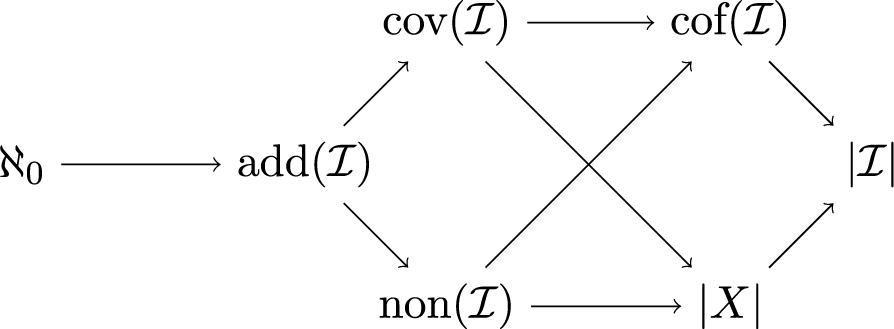
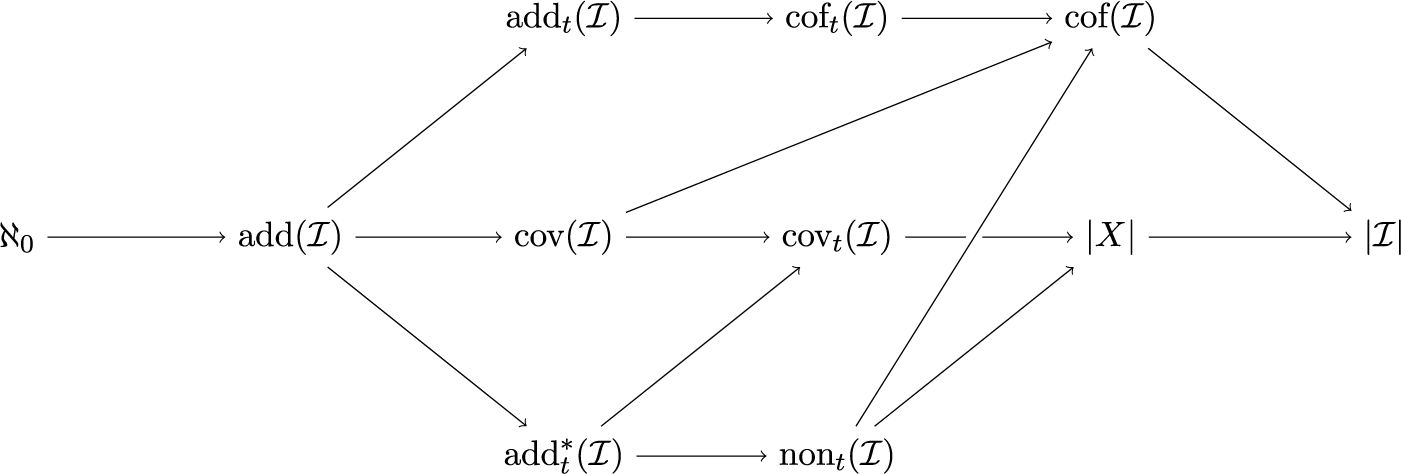
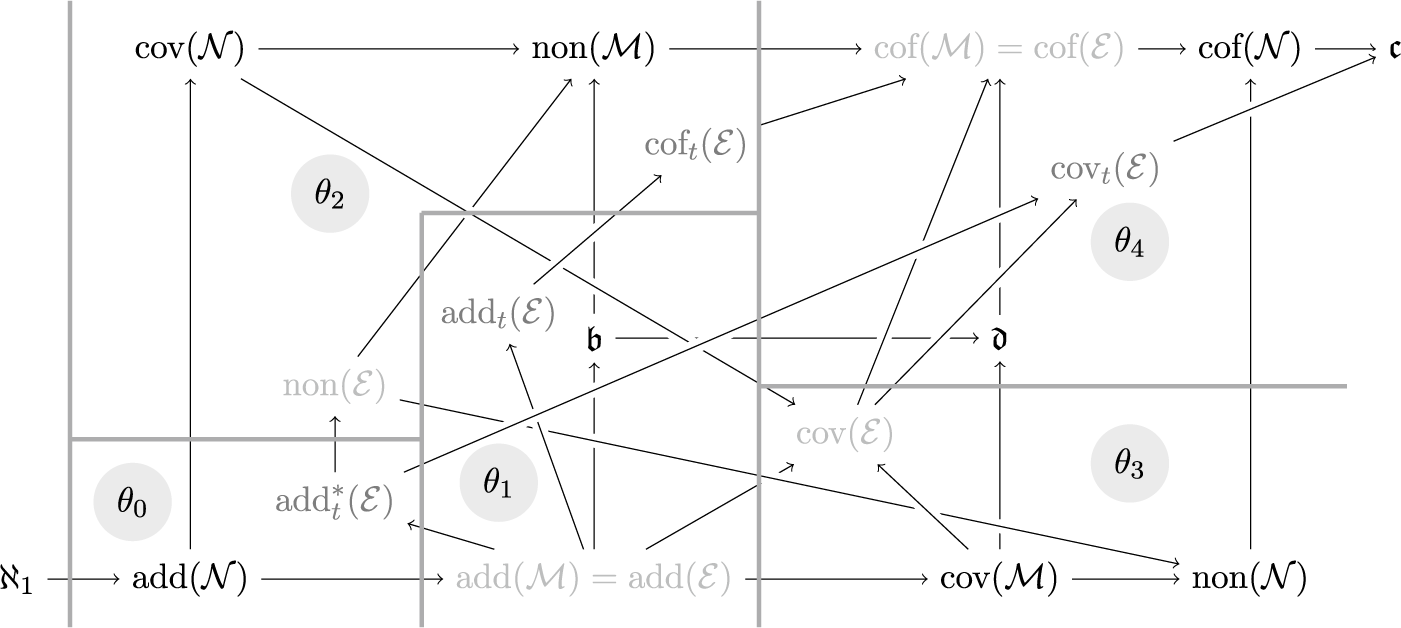
, respectively. The relationship between the cardinals defined above is illustrated in Figure 1.
Diagram of the cardinal characteristics associated with
 $\mathcal {I}$
. An arrow
 $\mathfrak x\rightarrow \mathfrak y$
means that (provably in ZFC)
 $\mathfrak x\le \mathfrak y$
.

Throughout this paper, we consider the Cantor space
 $2^{\omega }$
as a topological group with the standard modulo
 $2$
coordinatewise addition. We say that an ideal
 $\mathcal {I}\subseteq \mathcal {P}(2^{\omega })$
is translation invariant if
 $A+x\in \mathcal {I}$
for each
 $A\in \mathcal {I}$
and
 $x\in 2^{\omega }$
.
Definition 1.2. Let
 $\mathcal {I}\subseteq \mathcal {P}(2^{\omega })$
be an ideal. A set
 $X\subseteq 2^{\omega }$
is termed
 $\mathcal {I}$
-additive if, for every
 $A\in \mathcal {I}$
,
 $A+X\in \mathcal {I}$
. Denote by
 $\mathcal {IA}$
the collection of the
 $\mathcal {I}$
-additive subsets of
 $2^{\omega }$
. Notice that
 $\mathcal {IA}$
is a (
 $\sigma $
-)ideal and
 $\mathcal {IA}\subseteq \mathcal {I}$
when
 $\mathcal {I}$
is a translation invariant (
 $\sigma $
-)ideal.Footnote
1
We have an easy observation:
Lemma 1.3. For any translation invariant ideal
 $\mathcal {I}$
on
 $2^{\omega }$
, we have:
-
(1)
$\mathrm {add}(\mathcal {I})\leq \mathrm {add}(\mathcal {IA})$
. -
(2)
$\mathrm {cov}(\mathcal {I})\leq \mathrm {cov}(\mathcal {IA})$
and
$\mathrm {non}(\mathcal {IA})\leq \mathrm {non}(\mathcal {I})$
.


Proof.
-
(1) Let
$\{X_\alpha \mid \, \alpha <\kappa \}\subseteq \mathcal {IA}$
with
$\kappa <\mathrm {add}(\mathcal {I})$
. We show that
$\bigcup _{\alpha <\kappa }X_\alpha \in \mathcal {IA}$
. Let
$B\in \mathcal {I}$
. Then
$X_\alpha +B\in \mathcal {I}$
. Observe that Since
$$\begin{align*}\bigg(\bigcup_{\alpha<\kappa}X_\alpha\bigg)+B=\bigcup_{\alpha<\kappa}(X_\alpha+B).\end{align*}$$
$\kappa <\mathrm {add}(\mathcal {I})$
,
$\bigcup _{\alpha <\kappa }(X_\alpha +B)\in \mathcal {I}$
. Therefore,
$\bigcup _{\alpha <\kappa }X_\alpha \in \mathcal {IA}$
.
-
(2) Clear because
$\mathcal {IA}\subseteq \mathcal {I}$
.


The cardinal
 $\mathrm {non}(\mathcal {IA})$
has been studied in [Reference Kraszewski26, Reference Pawlikowski31] under the different name transitive additivity of
 $\mathcal {I}$
:Footnote
2
 $$\begin{align*}\mathrm{add}_t^{*}(\mathcal{I})=\min\{|X| \mid\, X\subseteq2^{\omega}\text{ and }\exists A\in\mathcal{I}\colon A+X\notin\mathcal{I}\}.\end{align*}$$
It is clear from the definition that
 $\mathrm {non}(\mathcal {IA})=\mathrm {add}_t^{*}(\mathcal {I})$
.
The ideal
 $\mathcal {IA}$
has received a lot of attention when
 $\mathcal {I}$
is either
 $\mathcal {M}$
or
 $\mathcal {N}$
. Pawlikowski [Reference Pawlikowski31] characterized
 $\mathrm {add}^{*}_t(\mathcal {N})$
(i.e.,
 $\mathrm {non}(\mathcal {N}\!\mathcal {A})$
) employing slaloms.
Definition 1.4. Given a sequence of non-empty sets
 $b = \langle b(n) \mid \, n\in \omega \rangle $
and
 $h\colon \omega \to \omega $
, define
 $$ \begin{align*} \prod b &:= \prod_{n\in\omega}b(n),\ \textrm{and} \\ \mathcal{S}(b,h) &:= \prod_{n\in\omega} [b(n)]^{\leq h(n)}. \end{align*} $$
For two functions
 $x\in \prod b$
and
 $\varphi \in \mathcal {S}(b,h)$
write
 $$\begin{align*}x\,\in^{*}\varphi\ \textrm{iff}\ \forall^\infty n\in\omega:x(n)\in \varphi(n).\end{align*}$$
We set
 $$\begin{align*}\mathfrak{b}^{\mathrm{Lc}}_{b,h}:=\min\left\{|F| \;\middle|\; F\subseteq \prod b \text{ and } \neg\exists \varphi \in \mathcal{S}(b,h)\,\forall x \in F\colon x\in^{*} \varphi\right\},\end{align*}$$
and set
 $\mathrm {minLc}:=\min \{\mathfrak {b}^{\mathrm {Lc}}_{b,\mathrm {id}_\omega } \mid \, b\in \omega ^{\omega }\}$
. Here,
 $\mathrm {id}_\omega $
denotes the identity function on
 $\omega $
.
Theorem 1.5 [Reference Pawlikowski31, Lemma 2.2]
 $\mathrm {non}(\mathcal {N}\!\mathcal {A})=\mathrm {minLc}$
.
Another characterization of
 $\mathrm {minLc}$
is the following.
Lemma 1.6 [Reference Cardona and Mejía15, Lemma 3.8]
 $\mathrm {minLc}=\min \{\mathfrak {b}^{\mathrm {Lc}}_{b,h} \mid \, b\in \omega ^{\omega }\}$
when h goes to infinity.
Hence, we can infer the following:
Corollary 1.7.
 $\mathrm {non}(\mathcal {N}\!\mathcal {A})=\min \{\mathfrak {b}^{\mathrm {Lc}}_{b,h} \mid \, b\in \omega ^{\omega }\}$
when h goes to infinity.
Yet another characterization of
 $\mathrm {add}(\mathcal {N})$
and
 $\mathrm {add}(\mathcal {M})$
in terms of the uniformity of the null-additive and meager-additive ideals was accomplished by Pawlikowski. Here,
 $\mathfrak {b}$
denotes the bounding number, which is defined in Example 2.6.
Theorem 1.8 [Reference Pawlikowski31, Lemma 2.3]
-
(1)
$\mathrm {add}(\mathcal {N})=\min \{\mathfrak {b},\mathrm {non}(\mathcal {N}\!\mathcal {A})\}$
. -
(2)
$\mathrm {add}(\mathcal {M})=\min \{\mathfrak {b},\mathrm {non}(\mathcal {MA})\}$
.


As a consequence of the previous, we immediately have the following:
Corollary 1.9. If
 $\mathrm {non}(\mathcal {IA}) \leq \mathfrak {b}$
, then
 $\mathrm {add}(\mathcal {I})=\mathrm {add}(\mathcal {IA})=\mathrm {non}(\mathcal {IA})$
, when
 $\mathcal {I}$
is
 $\mathcal {N}$
or
 $\mathcal {M}$
.
On the other hand, Bartoszyński and Judah [Reference Bartoszyński and Judah1] and Shelah [Reference Shelah34] provided important combinatorial characterizations of the null-additive and meager-additive sets, which are stated below. Shelah used them to prove that every null-additive set is meager-additive, that is,
 $\mathcal {N}\!\mathcal {A}\subseteq \mathcal {MA}$
.
Denote by
 $\mathbb {I}$
the set of partitions of
 $\omega $
into finite non-empty intervals.
Theorem 1.10. Let
 $X\subseteq 2^{\omega }$
.
-
(1) [Reference Shelah34, Theorem 13]
$X\in \mathcal {N}\!\mathcal {A}$
iff for all
$I=\langle I_n \mid \, n\in \omega \rangle \in \mathbb {I}$
there is some
$\varphi \in \prod _{n\in \omega }\mathcal {P}(2^{I_n})$
such that
$\forall n\in \omega \colon |\varphi (n)|\leq n$
and
$X\subseteq H_\varphi $
, where
$$\begin{align*}H_\varphi:=\{x\in2^{\omega} \mid\, \forall^{\infty} n\in \omega\colon x{\upharpoonright}I_n\in \varphi(n)\}. \end{align*}$$
-
(2) [Reference Bartoszyński and Judah1, Theorem 2.2]
$X\in \mathcal {MA}$
iff for all
$I\in \mathbb {I}$
there are
$J\in \mathbb {I}$
and
$y\in 2^{\omega }$
such that
$$\begin{align*}\forall x\in X\, \forall^\infty n<\omega\, \exists k<\omega\colon I_k\subseteq J_n\ \text{and}\ x{\upharpoonright}I_k=y{\upharpoonright}I_k.\end{align*}$$
Moreover, Shelah [Reference Shelah34, Theorem 18] proved that J can be found coarser than I, i.e., every member of J is the union of members of
$I.$


Bartoszyński and Judah provided a characterization of the uniformity of the meager-additive ideal:
Theorem 1.11 [Reference Bartoszyński and Judah1, Theorem 2.2], see also [Reference Bartoszyński and Judah2, Theorem 2.7.14]
The cardinal
 $\mathrm {non}(\mathcal {MA})$
is the largest cardinal
 $\kappa $
such that, for every bounded family
 $F\subseteq \omega ^{\omega }$
of size
 ${<}\kappa $
,

In [Reference Zindulka37], Zindulka used combinatorial properties of meager-additive sets described by Shelah and Pawlikowski to characterize meager-additive sets in
 $2^{\omega }$
in a way that nicely parallels the definition of strong measure zero sets. This led him to establish that
 $\mathcal {EA}=\mathcal {MA}$
. Therefore the following:
Corollary 1.12.
 $\mathrm {non}(\mathcal {MA})=\mathrm {non}(\mathcal {EA})$
. As a consequence,
 $\mathrm {non}(\mathcal {MA})\leq \mathrm {non}(\mathcal {E})$
.
In the present paper, we use the previously mentioned combinatorial properties of null and meager-additive sets described by Bartoszyński, Judah, Shelah, and Pawlikowski, to prove our main results. First, we show that the hypothesis
 $\mathrm {non}(\mathcal {N}\!\mathcal {A}) \leq \mathfrak {b}$
is not required in Corollary 1.9 (for the null-additive ideal) to show that:
Theorem A. In
 $\mathrm {ZFC}$
we have that
 $\mathrm {add}(\mathcal {N}\!\mathcal {A})=\mathrm {non}(\mathcal {N}\!\mathcal {A})$
.
This is one of the main results of the paper. It is unclear whether ZFC proves
 $\mathrm {add}(\mathcal {MA}) = \mathrm {non}(\mathcal {MA})$
.
Another result of Pawlikowski concerns the relationship between
 $\mathrm {add}_t(\mathcal {N})$
and
 $\mathrm {add}(\mathcal {SN})$
, where
 $\mathcal {SN}$
denotes the
 $\sigma $
-ideal of the strong measure zero sets (see Definition 2.29). Namely, he states
 $\mathrm {add}_t(\mathcal {N})\leq \mathrm {add}(\mathcal {SN})$
, but this proof does not appear anywhere. We offer our own proof of this inequality in Section 2. Concretely, we prove the following:
Theorem 1.13 [Reference Pawlikowski31]
 $\mathrm {minLc}\leq \mathrm {add}(\mathcal {SN})$
.
As a noteworthy consequence, we get the following:
Corollary 1.14.
 $\mathrm {non}(\mathcal {N}\!\mathcal {A})\leq \mathrm {add}(\mathcal {SN})$
.
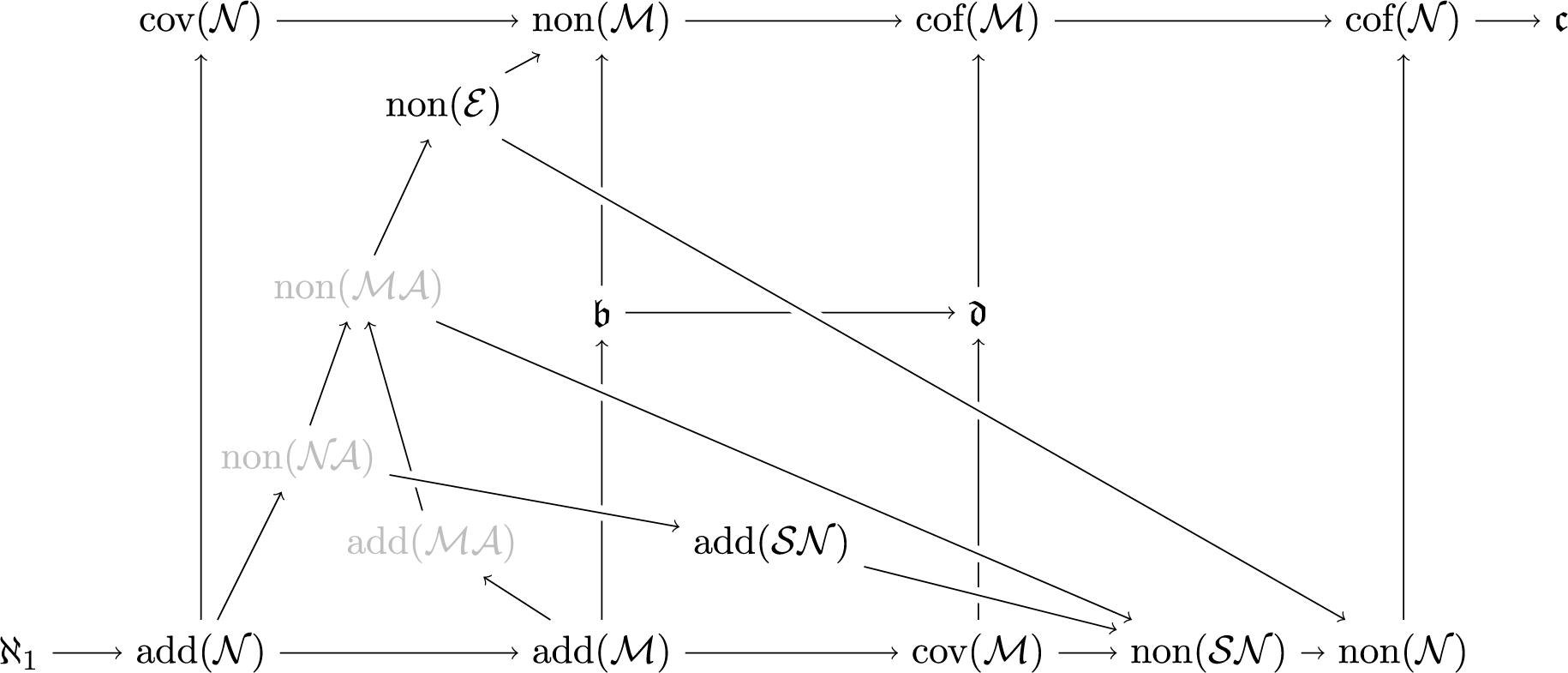
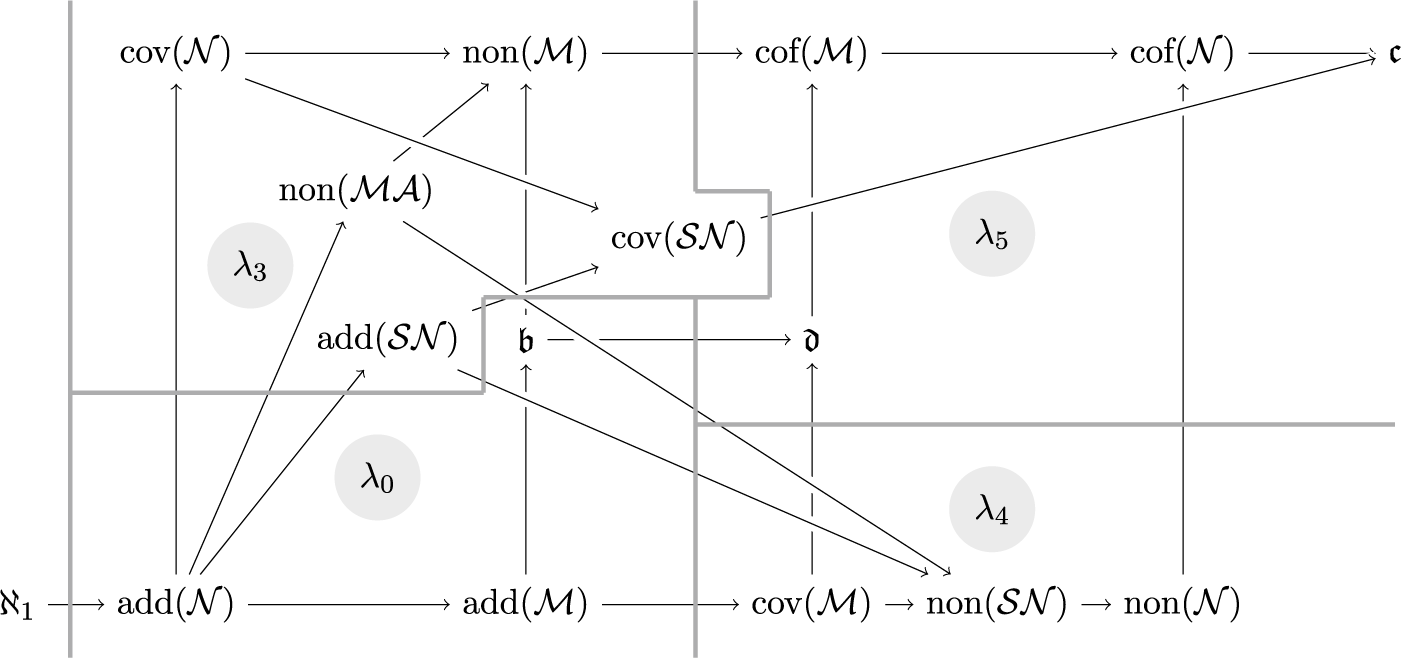
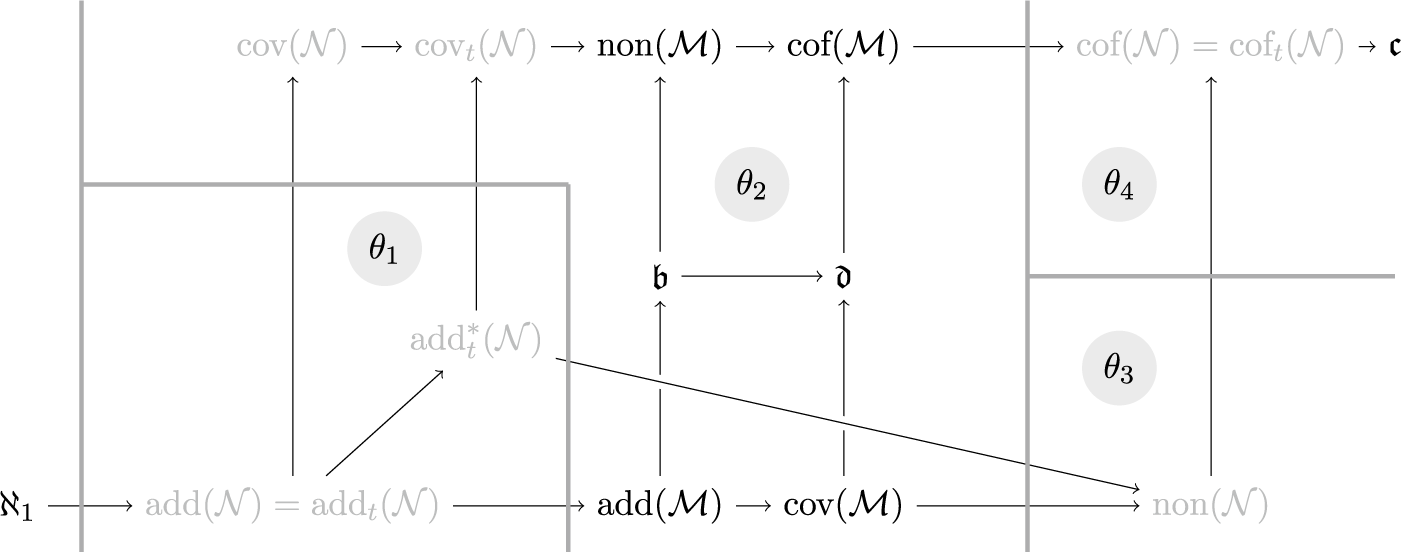
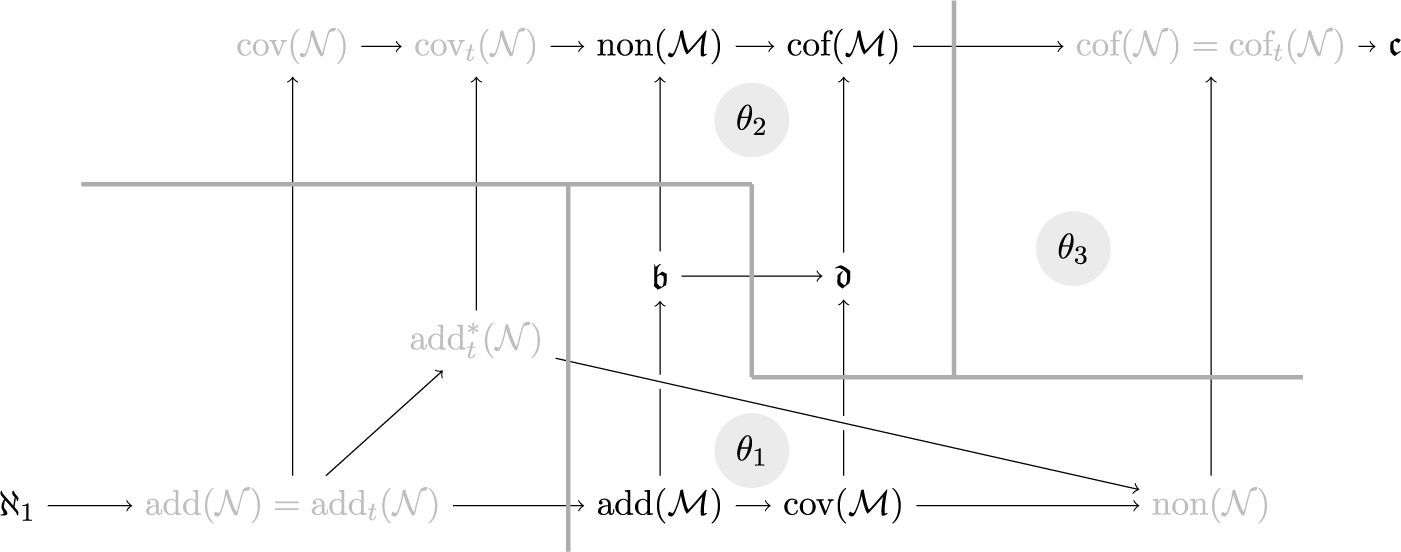
Figure 2 summarizes the inequalities among some cardinal characteristics associated with
 $\mathcal {E}$
,
 $\mathcal {MA}$
,
 $\mathcal {N}\!\mathcal {A}$
, and
 $\mathcal {SN}$
, with the cardinals in Cichoń’s diagram. Notice that
 $\mathrm {non}(\mathcal {MA}) \leq \mathrm {non}(\mathcal {SN})$
follows from
 $\mathcal {MA}\subseteq \mathcal {SN}$
(by Galvin’s, Mycielski’s, and Solovay’s [Reference Galvin, Mycielski and Solovay21] characterization of strong measure zero sets), and that
 $\mathrm {add}(\mathcal {M}) \leq \mathrm {non}(\mathcal {E})$
is a consequence of
 $\mathrm {add}(\mathcal {E}) = \mathrm {add}(\mathcal {M})$
[Reference Bartoszyński and Shelah4].
Cichoń’s diagram with some cardinal characteristics associated with
 $\mathcal {E}$
,
 $\mathcal {MA}$
,
 $\mathcal {SN}$
, and
 $\mathcal {N}\!\mathcal {A}$
.

Many cardinal characteristics can be described using a relational system, as reviewed in Section 2. For any relational system
 $\mathbf {R}$
, their bounding and dominating numbers are denoted by
 $\mathfrak {b}(\mathbf {R})$
and
 $\mathfrak {d}(\mathbf {R})$
, respectively.
Equation \faPagelines has inspired us to develop a new (Polish) relational system
 $\mathbf {R}_b$
, parametrized by
 $b\in \omega ^{\omega }$
, which can be used to reformulate Theorem 1.11 as
 $$\begin{align*}\mathrm{non}(\mathcal{MA})=\min\{\mathfrak{b}(\mathbf{R}_b) \mid\, b\in\omega^{\omega}\}.\end{align*}$$
This relational system will play an important role in this work, also for our consistency results. First, we prove (in Section 2) the following connections between their associated cardinal characteristics and some other classical characteristics.
Theorem B.
-
(1)
$\displaystyle \sup _{b\in D}\mathfrak {d}(\mathbf {R}_b) \leq \mathrm {cov}(\mathcal {MA}) \leq \mathfrak {d}\left (\prod _{b\in D}\mathbf {R}_b\right )$
for any dominating family
$D\subseteq \omega ^{\omega }$
. -
(2) For all
$b\in \omega ^{\omega }$
,
$\mathfrak {d}(\mathbf {R}_b) \leq \mathrm {cof}(\mathcal {M})$
. -
(3) Let
$b\in \omega ^{\omega }$
. If
$\displaystyle \sum _{k<\omega }\frac {1}{b(k)}<\infty $
, then
$\mathfrak {b}(\mathbf {R}_b) \leq \mathrm {non}(\mathcal {E})$
and
$\mathrm {cov}(\mathcal {E})\leq \mathfrak {d}(\mathbf {R}_b)$
.


In [Reference Cardona, Mejía and Rivera-Madrid19], it was established that
 $\mathrm {cof}(\mathcal {N})=\aleph _1$
and
 $\mathrm {cov}(\mathcal {SN})=\mathfrak {c}=\aleph _2$
hold in Sacks’ model. There,
 $\mathrm {cov}(\mathcal {MA})=\aleph _2$
because
 $\mathrm {cov}(\mathcal {SN}) \leq \mathrm {cov}(\mathcal {MA}) \leq \mathrm {cov}(\mathcal {N}\!\mathcal {A})$
(remember that
 $\mathcal {N}\!\mathcal {A} \subseteq \mathcal {MA}\subseteq \mathcal {SN}$
). By Theorem B, we obtain that
 $\sup _{b\in \omega ^{\omega }}\mathfrak {d}(\mathbf {R}_b) =\aleph _1$
in Sacks’ model, which yields the consistency of
 $\sup _{b\in \omega ^{\omega }}\mathfrak {d}(\mathbf {R}_b)<\mathrm {cov}(\mathcal {MA})$
. In addition, it follows that no classical cardinal characteristic of the continuum (different from
 $\mathfrak {c}$
) is an upper bound of
 $\mathrm {cov}(\mathcal {MA})$
. Because of the latter, we ask whether is it consistent with ZFC that
 $\mathrm {cov}(\mathcal {MA})<\mathfrak {c}$
, or even
 $\mathrm {cov}(\mathcal {N}\!\mathcal {A})<\mathfrak {c}$
. The upper bound of
 $\mathrm {cov}(\mathcal {MA})$
from Theorem B is used in Section 4 to show that this holds for
 $\mathcal {MA}$
, but the case for
 $\mathcal {N}\!\mathcal {A}$
remains open.
Theorem C (Theorem 4.2)
Let
 $\theta <\nu \leq \lambda $
be uncountable cardinals such that
 $\theta ^{<\theta }=\theta $
,
 $\nu ^{\theta } = \nu $
and
 $\lambda ^{\aleph _0} = \lambda $
. Then there is a poset, preserving cofinalities, forcing
 $$\begin{align*}\mathrm{cov}(\mathcal{N}) = \aleph_1 \leq \mathrm{add}(\mathcal{M}) = \mathrm{cof}(\mathcal{M}) = \theta \leq \mathrm{cov}(\mathcal{MA})\leq \nu \leq \mathrm{non}(\mathcal{N}) =\mathfrak{c} =\lambda. \end{align*}$$
In particular, it is consistent with
 $\mathrm {ZFC}$
that
 $\mathrm {cov}(\mathcal {MA}) < \mathrm {non}(\mathcal {N})$
.
Concerning more consistency results, Pawlikowski [Reference Pawlikowski31, Theorem 2.4] constructed a FS (finite support) iteration of ccc posets to obtain a model where
 $$\begin{align*}\mathrm{add}(\mathcal{N})=\mathrm{add}(\mathcal{M})=\mathfrak{b}=\aleph_1<\mathrm{non}(\mathcal{N}\!\mathcal{A})=\mathrm{non}(\mathcal{MA})=\mathfrak{c}=\aleph_2. \end{align*}$$
On the other hand, in [Reference Cardona and Mejía15, Theorem 5.15] we constructed a model where
 $$\begin{align*}\mathrm{add}(\mathcal{N})=\mathrm{add}(\mathcal{M})=\mathfrak{b}=\mu\leq\mathrm{minLc}=\mathrm{non}(\mathcal{M})=\mathrm{cov}(\mathcal{M})=\nu\leq\mathfrak{d}=\mathfrak{c}=\lambda \end{align*}$$
for arbitrary regular cardinals
 $\mu \leq \nu $
and a cardinal
 $\lambda \geq \nu $
such that
 $\lambda =\lambda ^{<\mu }$
.Footnote
3
Hence, by Theorem 1.5 and Lemma 1.3(2),
 $$ \begin{align} \mathfrak{b}=\mu \leq \mathrm{non}(\mathcal{N}\!\mathcal{A})=\mathrm{non}(\mathcal{MA})=\nu \end{align} $$
holds in this model. Consequently, it is consistent that
 $\mathfrak {b}<\mathrm {add}(\mathcal {N}\!\mathcal {A})=\mathrm {non}(\mathcal {N}\!\mathcal {A})$
by Theorem A. On the other hand,
 $\aleph _1=\mathfrak {b}=\mathrm {non}(\mathcal {MA})<\mathrm {cov}(\mathcal {N})=\aleph _2$
holds in the model obtained by a FS iteration of length
 $\aleph _2$
of random forcing (see, e.g., [Reference Cardona13, Theorem 5.4]) because
 $\mathrm {non}(\mathcal {MA})=\mathrm {non}(\mathcal {EA})\leq \mathrm {non}(\mathcal {E})$
by Corollary 1.12.
Motivated by (\faFilePdfO), we could ask:
Problem 1.15. Are each of the following statements consistent with
 $\mathrm {ZFC}$
?
-
(a)
$\mathfrak {b}<\mathrm {non}(\mathcal {N}\!\mathcal {A})<\mathrm {non}(\mathcal {MA})$
. -
(b)
$\mathrm {non}(\mathcal {N}\!\mathcal {A})<\mathrm {non}(\mathcal {MA})<\mathfrak {b}$
. -
(c)
$\mathrm {non}(\mathcal {N}\!\mathcal {A})<\mathfrak {b}<\mathrm {non}(\mathcal {MA})$
.


Concerning Problem 1.15(a),(b), it is known that “
 $\mathrm {non}(\mathcal {N})=\aleph _1$
and
 $\mathrm {cov}(\mathcal {N})=\mathfrak {b}=\aleph _2=\mathfrak {c}$
” is consistent with ZFC (see, e.g., [Reference Bartoszyński and Judah2, Model 7.6.7]), which implies
 $\mathrm {non}(\mathcal {N}\!\mathcal {A})=\mathrm {non}(\mathcal {MA})=\aleph _1<\mathfrak {b}$
. On the other hand, a model for
 $\mathrm {non}(\mathcal {N}\!\mathcal {A})=\aleph _1<\mathrm {non}(\mathcal {MA})=\mathfrak {b}=\mathfrak {c}=\aleph _2$
is obtained by adding
 $\aleph _2$
-many dominating reals by using a FS iteration of length
 $\aleph _2$
of Hechler forcing
 $\mathbb {D}$
(see Definition 4.1(2)) because
 $\mathrm {add}(\mathcal {M})=\min \{\mathfrak {b},\mathrm {non}(\mathcal {MA})\}$
by Theorem 1.8 and
 $\mathrm {non}(\mathcal {N}\!\mathcal {A})=\aleph _1$
by [Reference Cardona and Mejía15, Lemma 4.24].
We give a positive answer to Problem 1.15(c), which is the main result of this work. By separating even more cardinal characteristics of the continuum, we prove the following:
Theorem D (Theorem 4.8)
Let
 $\lambda _0\leq \lambda _1\leq \lambda _2\leq \lambda _3\leq \lambda _4$
be uncountable regular cardinals, and
 $\lambda _5$
a cardinal such that
 $\lambda _5\geq \lambda _4$
and
 $\mathrm {cof}([\lambda _5]^{<\lambda _i})=\lambda _5 = \lambda _5^{\aleph _0}$
for
 $i\leq 2$
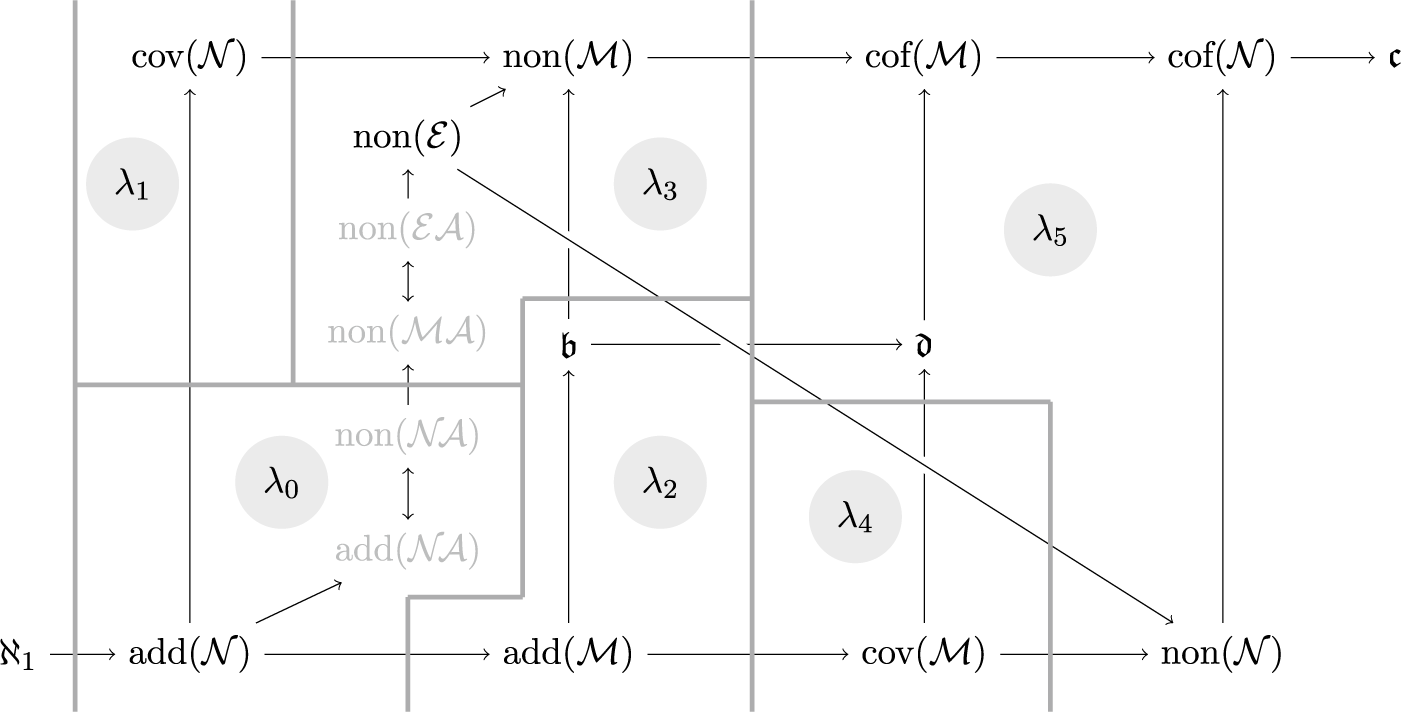
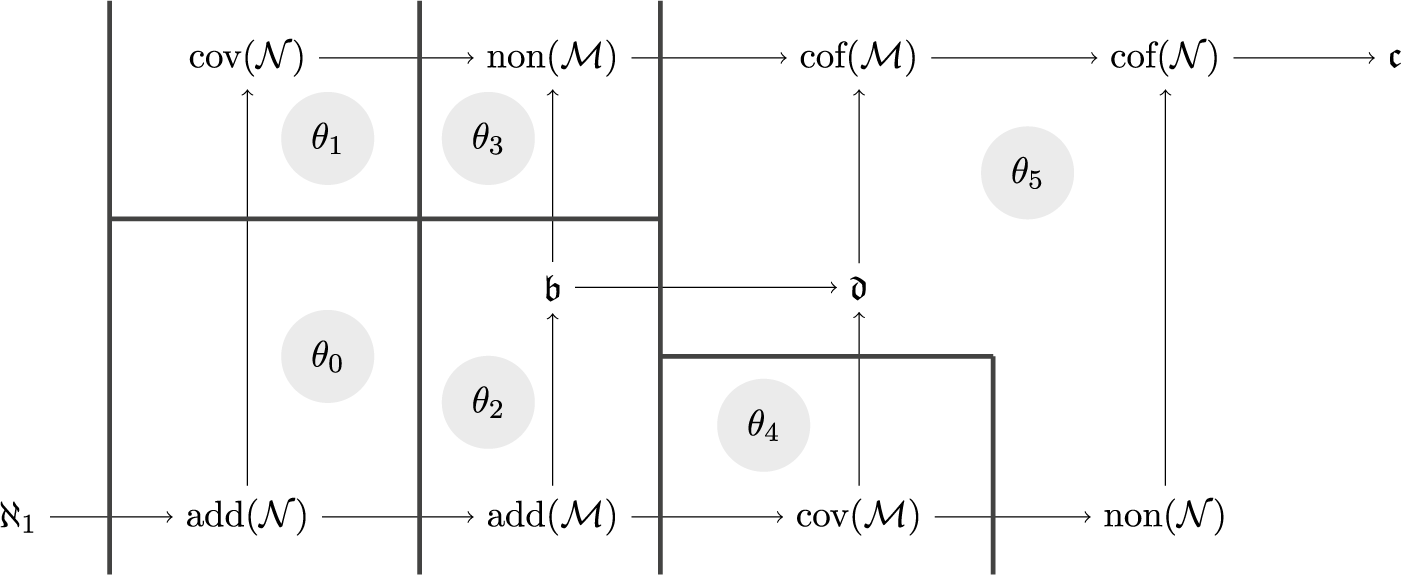
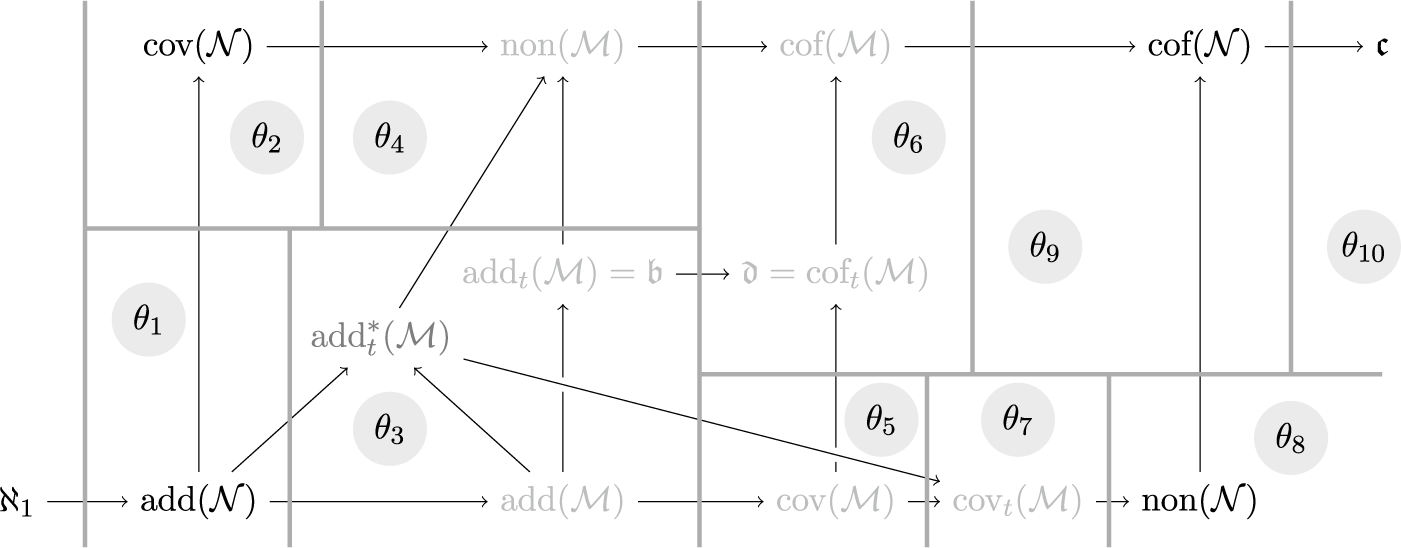
. Then there is a ccc poset forcing Figure 3.
Constellation forced in Theorem D.

We describe the method to approach Theorem D. Goldstern, Mejía, and Shelah [Reference Goldstern, Mejía and Shelah23] discovered a way to construct sequences of ultrafilters along a FS iteration to control that restrictions of the eventually different real forcing do not add dominating reals, a technique that was used to force the consistency of the constellation of Figure 4. The latter was used and improved in [Reference Brendle, Cardona and Mejía9] to force seven values in Cichon’s diagram with the left side separated (see Figure 5). The latter method consists of building ultrafilters along a matrix iteration, which is known as an ultrafilter extendable matrix iteration (uf-extendable matrix iteration, see Definition 4.6). Recently, in [Reference Cardona13] this method was used to force that the four cardinal characteristics associated with
 $\mathcal {E}$
can be pairwise different, and in [Reference Brendle, Cardona and Mejía10] to force Cichoń’s maximum (
 $10$
different values in Cichoń’s diagram, the maximum possible) along with pairwise different values for the cardinal characteristics associated with
 $\mathcal {SN}$
.
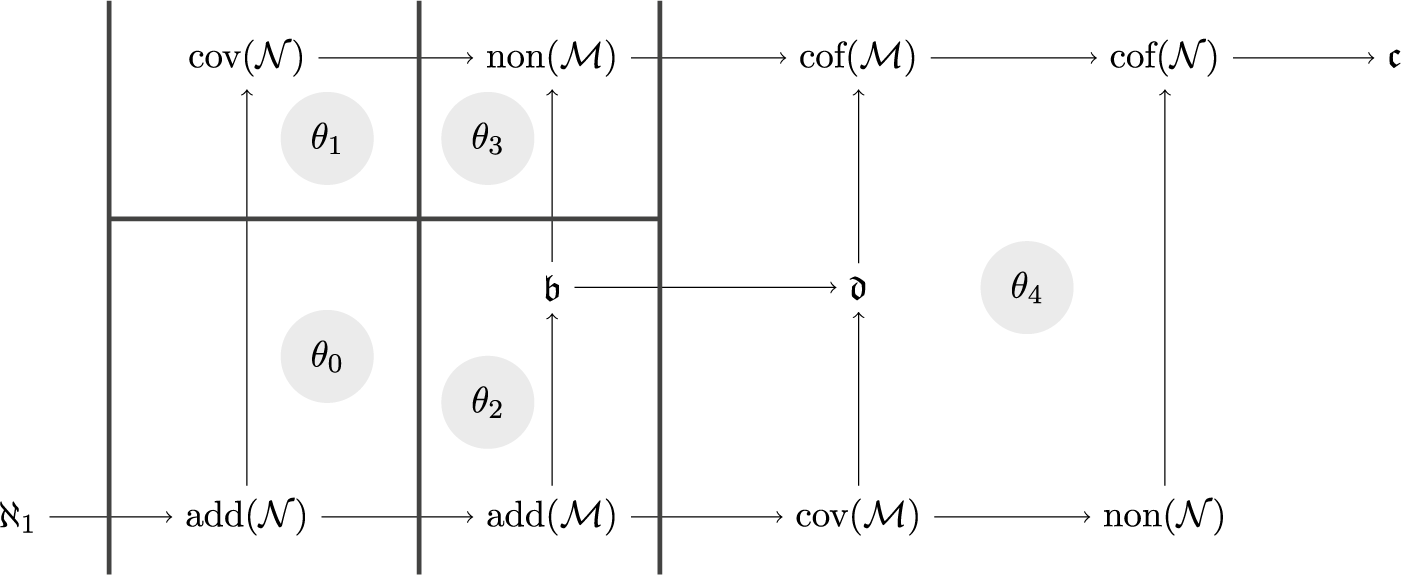
Separating the cardinal characteristics on the left side of Cichoń’s diagram. This constellation was forced in [Reference Goldstern, Mejía and Shelah23, Main Theorem 6.1] where
 $\aleph _1\leq \theta _0\leq \theta _1 \leq \theta _2 \leq \theta _3=\theta _3^{\aleph _0}$
are regular and
 $\theta _4$
is a cardinal such that
 $\theta _3 < \theta _4=\theta _4^{<\theta _3}$
.

Seven values in Cichoń’s diagram. This constellation was forced in [Reference Brendle, Cardona and Mejía9, Theorem 5.3] where
 $\aleph _1\leq \theta _0\leq \theta _1 \leq \theta _2 \leq \theta _3\leq \theta _4$
are regular cardinals and
 $\theta _5$
is a cardinal such that
 $\theta _4\leq \theta _5=\theta _5^{{<}\theta _2}$
.

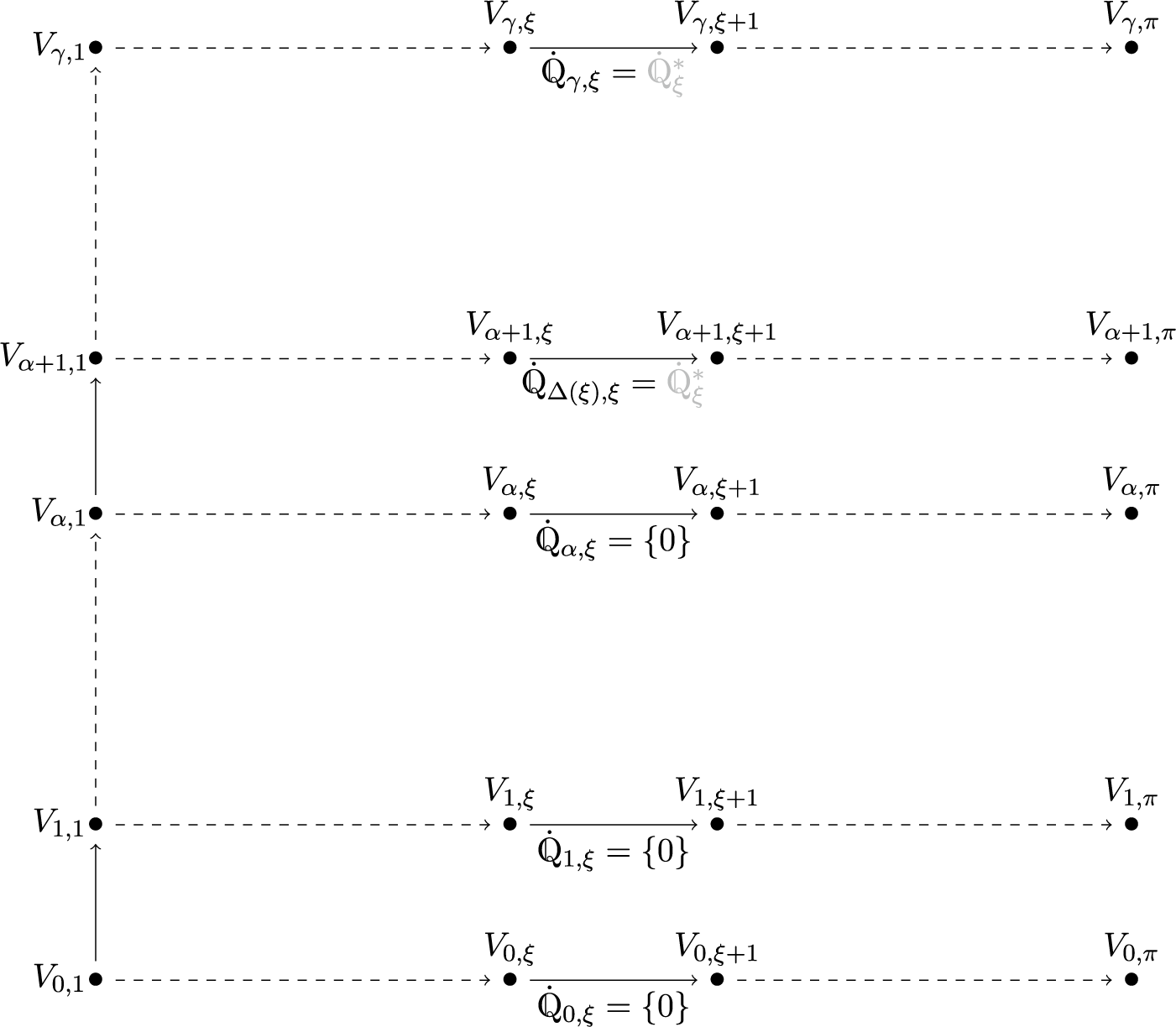
The proof of Theorem D is settled by the construction of a
 ${<}\lambda _3$
-uf-extendable matrix iteration. Details are provided in Section 4.
Though it is well-known the consistency with ZFC of each of
 $\mathrm {add}(\mathcal {N})=\mathfrak {b}<\mathrm {add}(\mathcal {SN})$
and
 $\mathrm {add}(\mathcal {N})<\mathfrak {b}=\mathrm {add}(\mathcal {SN})$
(see [Reference Bartoszyński and Judah2, Section 8.4B]), it is not known any model where the values of
 $\mathrm {add}(\mathcal {N})$
,
 $\mathfrak {b}$
, and
 $\mathrm {add}(\mathcal {SN})$
are pairwise different. Intending to solve the latter, we introduce a
 $\sigma $
-linked poset that increases
 $\mathrm {add}(\mathcal {SN})$
and does not add dominating reals, which is used to prove our next main result:
Theorem E (Theorem 4.9)
Let
 $\lambda _0\leq \lambda _3\leq \lambda _4$
be uncountable regular cardinals, and
 $\lambda _5$
a cardinal such that
 $\lambda _5\geq \lambda _4$
and
 $\mathrm {cof}([\lambda _5]^{<\lambda _0})=\lambda _5 = \lambda _5^{\aleph _0}$
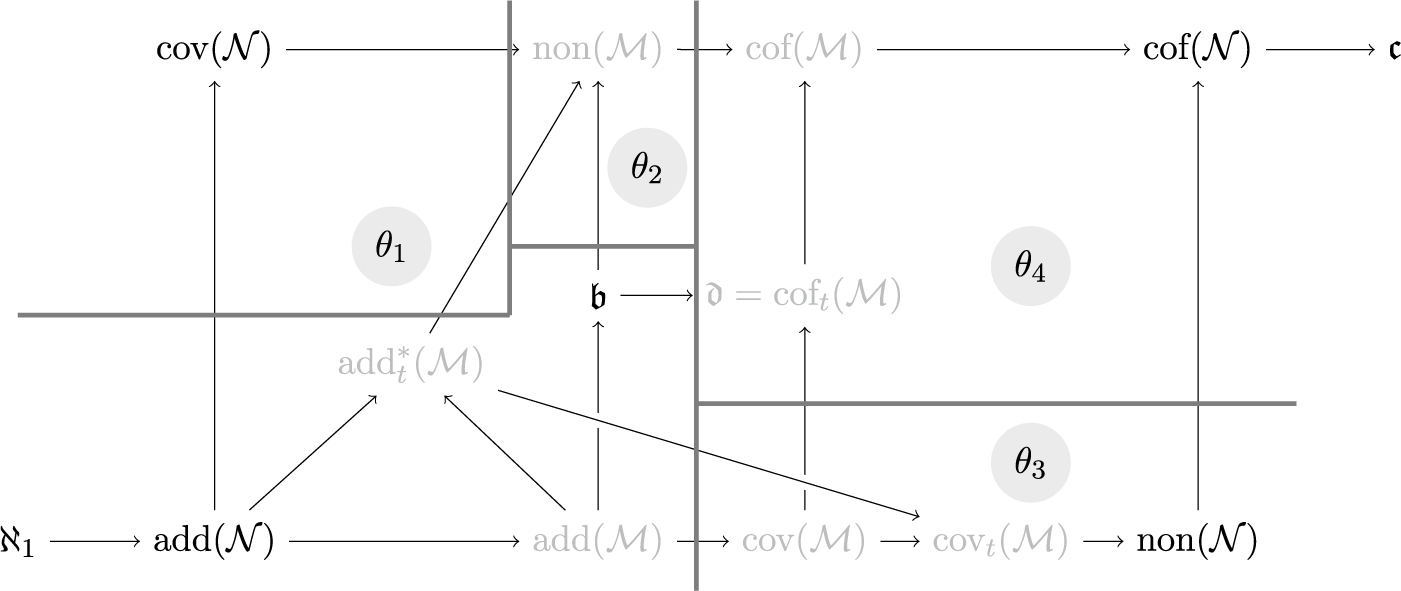
. Then there is some ccc poset forcing Figure 6.
Constellation forced in Theorem E.

At the end of Section 4, we shall show the previous theorem by using uf-extendable matrix iterations.
2 ZFC results
We employ the combinatorial properties of the null-additive and meager-additive sets referred to in Section 1 to prove Theorem A, and to extract a relational system
 $\mathbf {R}_b$
(Definition 2.9), parametrized with
 $b\in (\omega +1)^{\omega }$
, present in the characterization of
 $\mathrm {non}(\mathcal {MA})$
from Theorem 1.11, which will be useful to prove consistency results. In addition, we present connections of
 $\mathbf {R}_b$
with measure and category, and provide our proof of Theorem 1.13.
Recall that
 $\mathbb {I}$
denotes the set of partitions of
 $\omega $
into finite non-empty intervals. We use the following strengthening of Theorem 1.10(1).
Theorem 2.1. Let
 $h\in \omega ^{\omega }$
be a function diverging to infinity. For
 $X\subseteq 2^{\omega }$
,
 $X\in \mathcal {N}\!\mathcal {A}$
iff the statement below holds.
-
For all
$I \in \mathbb {I}$
there is some
$\varphi \in \prod _{n\in \omega }\mathcal {P}(2^{I_n})$
such that
$\forall n\in \omega \colon |\varphi (n)|\leq h(n)$
and
$X\subseteq H_\varphi $
.
 For all


Proof. See [Reference Bartoszyński and Judah1, Theorem 3.2] and [Reference Bartoszyński and Judah2, Theorem 2.7.18], but we provide an argument in connection with Theorem 1.10(1) (which is this theorem for
 $h = \mathrm {id}_\omega $
). It is enough to show that, for any
 $h,h'\in \omega ^{\omega }$
, if h diverges to infinity, then
 implies
 . We use an argument similar to [Reference Cardona and Mejía17, Theorem 3.16]. Fix
 $I\in \mathbb {I}$
. Pick an increasing function
 $g\in \omega ^{\omega }$
with
 $g(0)=0$
such that, for
 $0<k<\omega $
,
 $h(n)\geq h'(k)$
for all
 $n\geq g(k)$
. Refine I to
 $I'\in \mathbb {I}$
such that
 $I^{\prime }_k:=\bigcup \{I_n \mid \, g(k)\leq n <g(k+1)\}$
. So, by
 , there is some
 $\varphi '\in \prod _{k\in \omega }\mathcal {P}(2^{I^{\prime }_k})$
such that
 $|\varphi '(k)|\leq h'(k)$
for all
 $k<\omega $
, and
 $X\subseteq H_{\varphi '}$
. Set
 $$\begin{align*}\varphi(n):= \begin{cases} \{s\!\!\upharpoonright\!\! I_n \mid\, s\in\varphi'(k)\} & \text{if } g(k)\leq n<g(k+1) \text{ for some (unique) } k\geq 1,\\ \emptyset & \text{if } n<g(1). \end{cases}\end{align*}$$
It is clear that
 $\varphi \in \prod _{n\in \omega }\mathcal {P}(2^{I_n})$
and
 $|\varphi (n)| = 0 \leq h(n)$
whenever
 $n<g(1)$
; in the case that n is as in the first case above,
 $|\varphi (n)|\leq |\varphi '(k)| \leq h'(k)\leq h(n)$
. Moreover,
 $X\subseteq H_{\varphi '}\subseteq H_\varphi $
, which finishes the proof.
Proof of Theorem A
It just suffices to prove that
 $\mathrm {non}(\mathcal {N}\!\mathcal {A})\leq \mathrm {add}(\mathcal {N}\!\mathcal {A})$
. Suppose that
 $\{X_\alpha \mid \, \alpha <\kappa \}\subseteq \mathcal {N}\!\mathcal {A}$
and
 $\kappa <\mathrm {non}(\mathcal {N}\!\mathcal {A})$
. We prove that
 $\bigcup _{\alpha <\kappa }X_\alpha \in \mathcal {N}\!\mathcal {A}$
. Let
 $I\in \mathbb {I}$
. Then by using Theorem 1.10(1), for each
 $\alpha <\kappa $
choose
 $\varphi ^I_\alpha \in \mathcal {S}(2^{I},\mathrm {id}_\omega )$
such that
 $X_\alpha \subseteq H_{\varphi ^I_\alpha }$
. Let
 $b^I:=\langle [2^{I_n}]^{\leq n} \mid \, n\in \omega \rangle $
. Since
 $\langle \varphi ^I_\alpha \mid \, \alpha <\kappa \rangle \subseteq \prod b^I$
, by applying Theorem 1.5 there is some
 $\psi ^I\in \mathcal {S}(b^I,\mathrm {id}_\omega )$
such that
 $\forall \alpha <\kappa \colon \varphi ^I_\alpha \in ^{*}\psi ^I$
. Set
 $\varphi ^I\in \mathcal {S}(2^{I},\mathrm {id}_\omega ^2)$
by
 $\varphi ^I(n):=\bigcup \psi ^I(n)$
. As a result, we get that
 $\forall \alpha <\kappa \,\forall ^\infty n\colon \varphi ^I_\alpha (n) \subseteq \varphi ^I(n)$
. This implies that
 $\bigcup _{\alpha <\kappa }X_\alpha \subseteq H_{\varphi ^I}.$
Thus,
 $\bigcup _{\alpha <\kappa }X_\alpha \in \mathcal {N}\!\mathcal {A}$
by Theorem 2.1 (applied to
 $h(n):= n^2$
).
We now recall the combinatorial description of the meager ideal from Bartoszyński, Just, and Scheepers [Reference Bartoszyński, Just and Scheepers3], which was originally introduced by Talagrand [Reference Talagrand35]. First, we establish some preliminary results. Instead of dealing with all meager sets, we only need to consider suitable cofinal families.
Definition 2.2. Let
 $I\in \mathbb {I}$
and let
 $x\in 2^{\omega }$
. Define
 $$\begin{align*}B_{x,I}:=\{y\in2^{\omega} \mid\, \forall^\infty n\in\omega\colon y{\upharpoonright}I_n\neq x{\upharpoonright}I_n\}.\end{align*}$$
For
 $n\in \omega $
, define
 $$\begin{align*}B_{x,I}^n:=\{y\in2^{\omega} \mid\, \forall m\geq n\colon x{\upharpoonright}I_m\neq y{\upharpoonright}I_m\}.\end{align*}$$
Then
 $B_{x,I}^m\subseteq B_{x,I}^n$
whenever
 $m < n <\omega $
. Thus,
 $B_{x,I}=\bigcup _{n\in \omega }B_{x,I}^n$
.
Denote by
 $B_{I}$
the set
 $B_{0,I}=\{y\in 2^{\omega } \mid \, \forall ^\infty n\in \omega \colon y{\upharpoonright }I_n\neq 0)\}$
.
A pair
 $(x,I)\in 2^{\omega }\times \mathbb {I}$
is known as a chopped real, and these are used to produce a cofinal family of meager sets. It is clear that
 $B_{x,I}$
is a meager subset of
 $2^{\omega }$
(see, e.g., [Reference Blass5]).
Theorem 2.3 (Talagrand [Reference Talagrand35], see, e.g., [Reference Bartoszyński, Just and Scheepers3, Proposition 13])
For every meager set
 $F\subseteq 2^{\omega }$
and
 $I\in \mathbb {I}$
there are
 $x\in 2^{\omega }$
and
 $I'\in \mathbb {I}$
such that
 $F\subseteq B_{I',x}$
and each
 $I^{\prime }_n$
is the union of finitely many
 $I_k$
’s.
Lemma 2.4 [Reference Bartoszyński, Just and Scheepers3, Proposition 9]
For
 $x, y\in 2^{\omega }$
and for
 $I, J\in \mathbb {I}$
, the following statements are equivalent:
-
(1)
$B_{I,x}\subseteq B_{J,y}$
. -
(2)
$\forall ^\infty n<\omega \,\exists k<\omega \colon I_k\subseteq J_n$
and
$x{\upharpoonright }I_k=y{\upharpoonright }I_k$
.


We now review some basic notation about relational systems. A relational system is a triple
 $\mathbf {R}=\langle X, Y, \sqsubset \rangle $
where
 $\sqsubset $
is a relation and X and Y are non-empty sets. Such a relational system has two cardinal characteristics associated with it:
 $$ \begin{align*} \mathfrak{b}(\mathbf{R})&:=\min\{|F| \mid\, F\subseteq X\ \text{and }\neg\exists y\in Y\, \forall x\in F\colon x \sqsubset y\},\\
\mathfrak{d}(\mathbf{R})&:=\min\{|D| \mid\, D\subseteq Y\ \text{and }\forall x\in X\, \exists y\in D\colon x \sqsubset y\}. \end{align*} $$
We also define the dual
 $\mathbf {R}^\perp := \langle Y,X,\sqsubset ^\perp \rangle $
where
 $y \sqsubset ^\perp x$
means
 $x \not \sqsubset y$
. Note that
 $\mathfrak {b}(\mathbf {R}^\perp ) = \mathfrak {d}(\mathbf {R})$
and
 $\mathfrak {d}(\mathbf {R}^\perp ) = \mathfrak {b}(\mathbf {R})$
.
Given another relational system
 $\mathbf {R}'=\langle X',Y',R'\rangle $
, say that a pair
 $(\Psi _-,\Psi _+)\colon \mathbf {R}\to \mathbf {R}'$
is a Tukey connection from
 $\mathbf {R}$
into
 $\mathbf {R}'$
if
 $\Psi _-\colon X\to X'$
and
 $\Psi _+\colon Y'\to Y$
are functions such that
 $\forall \, x\in X\ \forall \, y'\in Y'\colon \Psi _-(x) \sqsubset ' y' \Rightarrow x \sqsubset \Psi _+(y')$
. Say that
 $\mathbf {R}$
is Tukey below
 $\mathbf {R}'$
, denoted by
 $\mathbf {R}\preceq _{\mathrm {T}}\mathbf {R}'$
, if there is a Tukey connection from
 $\mathbf {R}$
to
 $\mathbf {R}'$
. Say that
 $\mathbf {R}$
is Tukey equivalent to
 $\mathbf {R}'$
, denoted by
 $\mathbf {R}\cong _{\mathrm {T}}\mathbf {R}'$
, if
 $\mathbf {R}\preceq _{\mathrm {T}}\mathbf {R}'$
and
 $\mathbf {R}'\preceq _{\mathrm {T}}\mathbf {R}$
. It is well-known that
 $\mathbf {R}\preceq _{\mathrm {T}}\mathbf {R}'$
implies
 $\mathfrak {b}(\mathbf {R}')\leq \mathfrak {b}(\mathbf {R})$
and
 $\mathfrak {d}(\mathbf {R})\leq \mathfrak {d}(\mathbf {R}')$
. Hence,
 $\mathbf {R}\cong _{\mathrm {T}}\mathbf {R}'$
implies
 $\mathfrak {b}(\mathbf {R}')=\mathfrak {b}(\mathbf {R})$
and
 $\mathfrak {d}(\mathbf {R})=\mathfrak {d}(\mathbf {R}')$
.
Example 2.5. It is well-known that, for any ideal
 $\mathcal {I}$
on X, via the relational system
 $\mathbf {C}_{\mathcal {I}}:=\langle X,\mathcal {I},\in \rangle $
,
 $\mathfrak {b}(\mathbf {C}_{\mathcal {I}})=\mathrm {non}(\mathcal {I})$
and
 $\mathfrak {d}(\mathbf {C}_{\mathcal {I}})=\mathrm {cov}(\mathcal {I})$
.
Example 2.6. Note that
 $\leq ^{*}$
is a directed preorder on
 $\omega ^{\omega }$
, where
 $x\leq ^{*} y$
means
 $\forall ^\infty n<\omega \colon x(n)\leq y(n)$
. We think of
 $\omega ^{\omega }$
as the relational system with the relation
 $\leq ^{*}$
. Then
 $\mathfrak {b}:=\mathfrak {b}(\omega ^{\omega })$
and
 $\mathfrak {d}:=\mathfrak {d}(\omega ^{\omega })$
are the well known bounding number and dominating number, respectively.
Example 2.7. Define the following relation on
 $\mathbb {I}$
:
 $$\begin{align*}I \sqsubseteq J \text{ iff } \forall^\infty n<\omega\, \exists m<\omega\colon I_m\subseteq J_n. \end{align*}$$
Note that
 $\sqsubseteq $
is a directed preorder on
 $\mathbb {I}$
, so we think of
 $\mathbb {I}$
as the relational system with the relation
 $\sqsubseteq $
. In Blass [Reference Blass5], it is proved that
 $\mathbb {I} \cong _{\mathrm {T}} \omega ^{\omega }$
. Hence,
 $\mathfrak {b}=\mathfrak {b}(\mathbb {I})$
and
 $\mathfrak {d}=\mathfrak {d}(\mathbb {I})$
.
Example 2.8. The cardinals in Definition 1.4 can be defined by the relational system
 $\mathbf {Lc}(b,h):=\langle \prod b,\mathcal {S}(b,h),\in ^{*}\rangle $
, i.e.,
 $\mathfrak {b}(\mathbf {Lc}(b,h))=\mathfrak {b}^{\mathrm {Lc}}_{b,h}$
and
 $\mathfrak {d}(\mathbf {Lc}(b,h)) := \mathfrak {d}^{\mathrm {Lc}}_{b,h}$
.
We now introduce the relational systems involved in the characterization of
 $\mathrm {non}(\mathcal {MA})$
in Theorem 1.11.
Definition 2.9. Fix
 $b\in (\omega +1)^{\omega }$
.
-
(1) For
$I\in \mathbb {I}$
,
$f, h\in \omega ^{\omega }$
, define
$$\begin{align*}f \sqsubset^{\bullet} (I,h)\ \textrm{iff}\ \forall^\infty n\in\omega\,\exists k\in I_n\colon f(k)=h(k).\end{align*}$$
-
(2) Define the relational system
$\mathbf {R}_b:=\langle \prod b,\mathbb {I}\times \prod b,\sqsubset ^{\bullet }\rangle $
. When
$b(n)=\omega $
for all
$n<\omega $
, we denote this relational system by
$\mathbf {R}_\omega $
.


In the context of
 $\mathbf {R}_b$
, we will always consider that
 $b(n)>0$
for all n, even if we just write “
 $b\in (\omega +1)^{\omega }$
” (or
 $b\in \omega ^{\omega }$
).Footnote
4
Remark 2.10. Notice that, for fixed
 $(I,h)\in \mathbb {I}\times \prod b$
,
 $\{f\in \prod b \mid \, f\sqsubset ^{\bullet } (I,h)\}$
is meager whenever
 $b\geq ^{*} 2$
, so
 $\mathbf {C}_{\mathcal {M}}\preceq _{\mathrm {T}}\mathbf {R}_b$
, which implies
 $\mathfrak {b}(\mathbf {R}_b)\leq \mathrm {non}(\mathcal {M})$
and
 $\mathrm {cov}(\mathcal {M})\leq \mathfrak {d}(\mathbf {R}_b)$
. On the other hand, if
 $b\ngeq ^{*}2$
then we can find some
 $(I,h)\in \mathbb {I}\times \prod b$
such that
 $f\sqsubset ^{\bullet } (I,h)$
for all
 $f\in \prod b$
, so
 $\mathfrak {d}(\mathbf {R}_b) = 1$
and
 $\mathfrak {b}(\mathbf {R}_b)$
is undefined.
Fact 2.11. For
 $b\in (\omega +1)^{\omega }$
,
 $\mathbf {R}_b\cong _{\mathrm {T}}\langle \prod b,\mathbb {I}\times \omega ^{\omega },\sqsubset ^{\bullet }\rangle $
. As a consequence, if
 $b'\in (\omega +1)^{\omega }$
and
 $b\leq ^{*} b'$
, then
 $\mathbf {R}_b\preceq _{\mathrm {T}}\mathbf {R}_{b'}$
. In particular,
 $\mathfrak {b}(\mathbf {R}_{b'}) \leq \mathfrak {b}(\mathbf {R}_b)$
and
 $\mathfrak {d}(\mathbf {R}_b)\leq \mathfrak {d}(\mathbf {R}_{b'})$
.
We now aim to prove the following reformulation of Theorem 1.11:
Theorem 2.12 [Reference Bartoszyński and Judah1, Theorem 2.2]
 $\mathrm {non}(\mathcal {MA})=\min \{\mathfrak {b}(\mathbf {R}_b) \mid \, b\in \omega ^{\omega }\}$
.
We follow the proof of the cited reference under our notation using
 $\mathbf {R}_b$
. The following lemma establishes one of the inequalities.
Lemma 2.13. Let
 $b\in \omega ^{\omega }$
. Then
 $\mathbf {R}_{b}\preceq _{\mathrm {T}} \mathbf {C}_{\mathcal {MA}}$
. In particular,
 $$\begin{align*}\mathrm{non}(\mathcal{MA})\leq\min\{\mathfrak{b}(\mathbf{R}_b) \mid\, b\in\omega^{\omega}\} \text{ and } \sup\{\mathfrak{d}(\mathbf{R}_b) \mid\, b\in\omega^{\omega}\}\leq\mathrm{cov}(\mathcal{MA}).\end{align*}$$
Proof. Given
 $b\in \omega ^{\omega }$
, thanks to Fact 2.11 we may assume that there is some
 $I^b\in \mathbb {I}$
such that
 $b(n)=2^{|I_n^b|}$
. Then, we can identify numbers
 ${<}b(n)$
with
 $0$
-
 $1$
sequences of length
 $|I_n^b|$
. We have to find maps
 $\Psi _-\colon \prod b\to 2^{\omega }$
and
 $\Psi _+\colon \mathcal {MA}\to \mathbb {I}\times \prod b$
such that, for any
 $ f\in \prod b$
and for any
 $X\in \mathcal {MA}$
,
 $\Psi _-(f)\in X$
implies
 $f\sqsubset ^{\bullet } \Psi _+(X)$
.
For
 $f\in \prod b$
define
 $x_f^{I^b}\in 2^{\omega }$
by
 $$\begin{align*}x_f^{I^b}={\underbrace{f(0)}_{\text{length }|I_0^b|}}^{\frown} \cdots\cdots{}^{\frown}{\underbrace{f(n)}_{\text{length } |I_n^b|}}^{\frown}\cdots,\end{align*}$$
so put
 $\Psi _-(f):= x^{I^b}_{f}$
.
For
 $X\in \mathcal {MA}$
,
 $X+B_{I^b}\in \mathcal {M}$
. Note that
 $$\begin{align*}X+B_{I^b}=\bigcup_{x\in X}B_{x,I^b}.\end{align*}$$
Then, by Theorem 2.3, there are
 $y\in 2^{\omega }$
and
 $J\in \mathbb {I}$
such that
 $$\begin{align*}\bigcup_{x\in X}B_{x,I^b}\subseteq B_{y, J}.\end{align*}$$
Let
 $h\in \prod b$
such that
 $y=x_{h}^{I^b}$
(recall that
 $b(n)=2^{|I^b_n|}$
), so put
 $\Psi _+(X):=(J',h)$
where
 $$\begin{align*}k\in J^{\prime}_n \text{ iff } \min J_n<\max I^b_k \leq \max J_n.\end{align*}$$
It remains to prove that, for any
 $ f\in \prod b$
and for any
 $X\in \mathcal {MA}$
,
 $\Psi _-(f)\in X$
implies
 $ f\sqsubset ^{\bullet }\Psi _+(X)$
. Suppose that
 $x_{f}^{I_b}\in X$
and
 $\Psi _+(X) = (J',h)$
. Then
 $B_{x_{f}^{I_b},I^b}\subseteq B_{x_{h}^{I^b},J}$
. Hence, by using Lemma 2.4,
 $$\begin{align*}\forall^\infty n\,\exists k\colon I_k^b\subseteq J_n\text{ and }x_f^{I^b}{\upharpoonright}I_k^b=x_{h}^{I^b}{\upharpoonright}I_k^b.\end{align*}$$
Since
 $I^b_k\subseteq J_n$
implies
 $k\in J^{\prime }_n$
, the equation above implies that
 $f\sqsubset ^{\bullet }(J',h)$
.
To prove the converse inequality of Theorem 2.12, we employ products of relational systems.
Definition 2.14. Let
 $\overline {\mathbf {R}} = \langle \mathbf {R}_i \mid \, i\in K\rangle $
be a sequence of relational systems
 $\mathbf {R}_i = \langle X_i,Y_i,\sqsubset _i\rangle $
. Define
 $\prod \overline {\mathbf {R}} = \prod _{i\in K} \mathbf {R}_i:=\left \langle \prod _{i\in K}X_i, \prod _{i\in K}Y_i, \sqsubset ^\times \right \rangle $
where
 $x \sqsubset ^\times y$
iff
 $x_i\sqsubset _i y_i$
for all
 $i\in K$
.
For two relational systems
 $\mathbf {R}$
and
 $\mathbf {R}'$
, write
 $\mathbf {R}\times \mathbf {R}'$
to denote their product, and when
 $\mathbf {R}_i = \mathbf {R}$
for all
 $i\in K$
, we write
 $\mathbf {R}^K := \prod \overline {\mathbf {R}}$
.
Fact 2.15 [Reference Cardona and Mejía18]
Let
 $\overline {\mathbf {R}}$
be as in Definition 2.14. Then
 $\sup _{i\in K}\mathfrak {d}(\mathbf {R}_i)\leq \mathfrak {d}(\prod \overline {\mathbf {R}})\leq \prod _{i\in K}\mathfrak {d}(\mathbf {R}_i)$
and
 $\mathfrak {b}(\prod \overline {\mathbf {R}})=\min _{i\in K}\mathfrak {b}(\mathbf {R}_i)$
.
In the following result, not only do we complete the proof of Theorem 2.12, but we find an upper bound of
 $\mathrm {cov}(\mathcal {MA})$
that will be useful to show the consistency with ZFC of
 $\mathrm {cov}(\mathcal {MA})<\mathrm {non}(\mathcal {N})$
in Section 4.
Lemma 2.16. For any dominating family
 $D\subseteq \omega ^{\omega }$
,
 $\mathbf {C}_{\mathcal {MA}}\preceq _{\mathrm {T}} \prod _{b\in D}\mathbf {R}_b$
. In particular,
 $\min _{b\in D}\mathfrak {b}(\mathbf {R}_b) \leq \mathrm {non}(\mathcal {MA})$
and
 $\mathrm {cov}(\mathcal {MA})\leq \mathfrak {d}\left (\prod _{b\in D}\mathbf {R}_b\right )$
.
Proof. Without loss of generality, we may assume that there is some
 $\mathbb {I}$
-dominating family
 $D_0$
, i.e.,
 $\forall I\in \mathbb {I}\, \exists J\in D_0\colon I\sqsubseteq J$
, such that for each
 $b\in D$
there is some
 $I\in D_0$
such that
 $b = 2^I$
, i.e.,
 $b(n) = 2^{I_n}$
for all
 $n<\omega $
.
Define
 $\Psi _-\colon 2^{\omega }\to \prod _{I\in D_0} 2^I$
by
 $\Psi _-(x)(I):=\langle x\!\!\upharpoonright \!\! I_n \mid \, n<\omega \rangle $
. And define
 $\Psi _+\colon \prod _{I\in D_0}\mathbb {I}\times 2^I\to \mathcal {MA}$
such that, for
 $z=\langle (J^I,z^I) \mid \, I\in \mathbb {I}\rangle $
,
 $$\begin{align*}\Psi_+(z) := \{x\in 2^{\omega} \mid\, \forall I\in D_0\, \forall^\infty n<\omega\, \exists k\in J^I_k\colon x\!\!\upharpoonright\!\! I_k = z^I(k)\}.\end{align*}$$
For each
 $I\in D_0$
let
 $I^{\prime }_n:=\bigcup _{k\in J^I_n}I_k$
and
 $y^I\in 2^{\omega }$
the concatenation of all the
 $z^I(k)\in 2^{I_k}$
for
 $k<\omega $
, i.e.,
 $y^I\!\!\upharpoonright \!\! I_k = z^I(k)$
. Then
 $I':=\langle I^{\prime }_n \mid \, n<\omega \rangle \in \mathbb {I}$
,
 $I\sqsubseteq I'$
and
 $$\begin{align*}\forall x \in \Psi_+(z)\, \forall^\infty n<\omega\, \exists k<\omega\colon I_k\subseteq I^{\prime}_n \text{ and }x\!\!\upharpoonright\!\! I_k = y^I\!\!\upharpoonright\!\! I_k.\end{align*}$$
Therefore, by Theorem 1.10,
 $\Psi _+(z)\in \mathcal {MA}$
.
It is clear that
 $(\Psi _-,\Psi _+)$
is the required Tukey connection.
As we mentioned in Section 1,
 $\mathrm {cof}(\mathcal {N})=\aleph _1$
and
 $\mathrm {cov}(\mathcal {SN})=\mathfrak {c}=\aleph _2$
holds in Sacks model (see [Reference Cardona, Mejía and Rivera-Madrid19, Theorem 4.7]). There,
 $\mathrm {cov}(\mathcal {MA})=\aleph _2$
because
 $\mathrm {cov}(\mathcal {SN}) \leq \mathrm {cov}(\mathcal {MA}) \leq \mathrm {cov}(\mathcal {N}\!\mathcal {A})$
.
We now focus on proving that
 $\sup \{\mathfrak {d}(\mathbf {R}_b) \mid \, b\in \omega ^{\omega }\} \leq \mathrm {cof}(\mathcal {M})$
. Therefore,
 $\sup \{\mathfrak {d}(\mathbf {R}_b) \mid \, b\in \omega ^{\omega }\} =\aleph _1$
in Sacks model, so we cannot dualize Theorem 2.12, i.e.,
 $\mathrm {ZFC}$
(if consistent) cannot prove that
 $\mathrm {cov}(\mathcal {MA})$
equals
 $\sup \{\mathfrak {d}(\mathbf {R}_b) \mid \, b\in \omega ^{\omega }\}$
. Another consequence is that no classical cardinal characteristics of the continuum (different from
 $\mathfrak {c}$
) is an upper bound of
 $\mathrm {cov}(\mathcal {MA} )$
.
We use the composition of relational systems to prove our claim.
Definition 2.17 [Reference Blass5, Section 4]
Let
 $\mathbf {R}_e=\langle X_e,Y_e,\sqsubset _e\rangle $
be a relational system for
 $e\in \{0,1\}$
. The composition of
 $\mathbf {R}_0$
with
 $\mathbf {R}_1$
is defined by
 $(\mathbf {R}_0;\mathbf {R}_1):=\langle X_0\times X_1^{Y_0}, Y_0\times Y_1, \sqsubset _* \rangle $
where
 $$\begin{align*}(x,f)\sqsubset_*(y,b)\text{ iff }x \sqsubset_0 y\text{ and }f(y) \sqsubset_1 b.\end{align*}$$
Fact 2.18. Let
 $\mathbf {R}_i$
be a relational system for
 $i<3$
. If
 $\mathbf {R}_0\preceq _{\mathrm {T}}\mathbf {R}_1$
, then
 $\mathbf {R}_0\preceq _{\mathrm {T}} \mathbf {R}_1\times \mathbf {R}_2 \preceq _{\mathrm {T}} (\mathbf {R}_1;\mathbf {R}_2)$
and
 $\mathbf {R}_1\times \mathbf {R}_2 \cong _{\mathrm {T}} \mathbf {R}_2\times \mathbf {R}_1$
.
The following theorem describes the effect of the composition on cardinal characteristics.
Theorem 2.19 [Reference Blass5, Theorem 4.10]
Let
 $\mathbf {R}_e$
be a relational system for
 $e\in \{0,1\}$
. Then
 $\mathfrak {b}(\mathbf {R}_0;\mathbf {R}_1) =\min \{\mathfrak {b}(\mathbf {R}_0),\mathfrak {b}(\mathbf {R}_1)\}$
and
 $\mathfrak {d}(\mathbf {R}_0;\mathbf {R}_1)=\mathfrak {d}(\mathbf {R}_0)\cdot \mathfrak {d}(\mathbf {R}_1)$
.
We introduce the following relational system for combinatorial purposes.
Definition 2.20. Let
 $b:=\langle b(n) \mid \, n<\omega \rangle $
be a sequence of non-empty sets. Define the relational system
 $\mathbf {Ed}_b:=\langle \prod b,\prod b,\neq ^\infty \rangle $
where
 $x=^\infty y$
means
 $x(n)=y(n)$
for infinitely many n. The relation
 $x\neq ^\infty y$
means that x and y are eventually different. Denote
 $\mathfrak {b}^{\mathrm {aLc}}_{b,1}:=\mathfrak {b}(\mathbf {Ed}_b)$
and
 $\mathfrak {d}^{\mathrm {aLc}}_{b,1}:=\mathfrak {d}(\mathbf {Ed}_b)$
. When
 $b(n)=\omega $
for all
 $n<\omega $
, denote the relational system by
 $\mathbf {Ed}$
and its associated cardinal characteristics by
 $\mathfrak {b}^{\mathrm {aLc}}_{\omega ,1}$
and
 $\mathfrak {d}^{\mathrm {aLc}}_{\omega ,1}$
.
Recall the following characterization of the cardinal characteristics associated with
 $\mathcal {M}$
. It is well-known that
 $\mathfrak {b}^{\mathrm {aLc}}_{\omega ,1}=\mathrm {non}(\mathcal {M})$
and
 $\mathfrak {d}^{\mathrm {aLc}}_{\omega ,1}=\mathrm {cov}(\mathcal {M})$
(Bartoszyński and Miller, see, e.g., [Reference Cardona and Mejía17, Theorem 5.1]). The one for
 $\mathrm {add}(\mathcal {M})$
below is due to Miller [Reference Miller30].
Theorem 2.21. [Reference Cardona and Mejía15, Section 3.3]
 $$\begin{align*}\mathrm{add}(\mathcal{M}) = \min(\{\mathfrak{b}\}\cup\{\mathfrak{d}^{\mathrm{aLc}}_{b,1} \mid b\in \omega^{\omega}\}) \text{ and } \mathrm{cof}(\mathcal{M}) = \sup(\{\mathfrak{d}\}\cup\{\mathfrak{b}^{\mathrm{aLc}}_{b,1} \mid b\in \omega^{\omega}\})\end{align*}$$
Therefore, to settle our claim, it suffices to prove the following:
Theorem 2.22. For
 $b\in (\omega +1)^{\omega }$
,
 $\mathbf {Ed}_b^\perp \preceq _{\mathrm {T}}\mathbf {R}_b\preceq _{\mathrm {T}} (\mathbf {Ed}_b^\perp ;\mathbb {I})$
. In particular,
 $\mathfrak {b}^{\mathrm {aLc}}_{b,1}\leq \mathfrak {d}(\mathbf {R}_b)\leq \max \{\mathfrak {b}^{\mathrm {aLc}}_{b,1},\mathfrak {d}\}$
and
 $\min \{\mathfrak {d}^{\mathrm {aLc}}_{b,1},\mathfrak {b}\}\leq \mathfrak {b}(\mathbf {R}_b)\leq \mathfrak {d}^{\mathrm {aLc}}_{b,1}$
.
Proof. The Tukey-inequality
 $\mathbf {Ed}_b^\perp \preceq _{\mathrm {T}}\mathbf {R}_b$
is immediate from the definitions, so we focus on the second one. Define
 $\Psi _-\colon \prod b \to \prod b \times \mathbb {I}^{\prod b}$
by
 $\Psi _-(x):= (x,F_x)$
where, for
 $y\in \prod b$
, if
 $y =^\infty x$
then
 $F_x(y):= I^y_x \in \mathbb {I}$
is chosen such that
 $\forall k<\omega \, \exists i\in I^y_{x,k}\colon y(i) = x(i)$
; otherwise,
 $F_x(y)$
can be anything (in
 $\mathbb {I}$
).
Define
 $\Psi _+\colon \prod b\times \mathbb {I}\to \mathbb {I}\times \prod b$
by
 $\Psi _+(y,J) = (J,y)$
. We check that
 $(\Psi _-,\Psi _+)$
is a Tukey connection. Assume that
 $x,y\in \prod b$
,
 $J\in \mathbb {I}$
and that
 $\Psi _-(x)\sqsubset _* (y,J)$
, i.e.,
 $x =^\infty y$
and
 $I^y_x \sqsubseteq J$
. Since each
 $I^y_{x,k}$
contains a point where x and y coincide,
 $I^y_x \sqsubseteq J$
implies that, for all but finitely many
 $n<\omega $
,
 $J_n$
contains a point where x and y coincide, which means that
 $x\sqsubset ^{\bullet } (J,y) = \Psi _+(y,J)$
.
Corollary 2.23. For all
 $b\in (\omega +1)^{\omega }$
,
 $\mathrm {add}(\mathcal {M})\leq \mathfrak {b}(\mathbf {R}_b)$
and
 $\mathfrak {d}(\mathbf {R}_b) \leq \mathrm {cof}(\mathcal {M})$
.
Note that
 $\mathrm {add}(\mathcal {M}) \leq \min \{\mathfrak {b}(\mathbf {R}_b) \mid \, b\in \omega ^{\omega }\}$
already follows from Lemma 1.3 and Theorem 2.12.
Remark 2.24. For
 $b\in \omega ^{\omega }$
,
 $\mathfrak {b}^{\mathrm {aLc}}_{b,1}\leq \mathrm {non}(\mathcal {M})$
and
 $\mathrm {cov}(\mathcal {M})\leq \mathfrak {d}^{\mathrm {aLc}}_{b,1}$
. On the other hand, after a FS (finite support) iteration of uncountable cofinality length of ccc non-trivial posets,
 $\mathrm {non}(\mathcal {M}) \leq \mathrm {cov}(\mathcal {M})$
, which implies by Theorem 2.22 that
 $\mathfrak {b} \leq \mathfrak {b}(\mathbf {R}_b)$
and
 $\mathfrak {d}(\mathbf {R}_b)\leq \mathfrak {d}$
. Hence, the consistency of
 $\mathfrak {b}(\mathbf {R}_b)<\mathfrak {b}$
(and
 $\mathfrak {d}<\mathfrak {d}(\mathbf {R}_b)$
) cannot be obtained by FS iterations. The same applies to
 $\mathrm {non}(\mathcal {MA}) <\mathfrak {b}$
.
Concerning
 $\mathbf {R}_\omega $
, Theorem 2.22 indicates that
 $\mathrm {non}(\mathcal {M}) \leq \mathfrak {d}(\mathbf {R}_\omega )\leq $
 $\max \{\mathrm {non}(\mathcal {M}),\mathfrak {d}\} = \mathrm {cof}(\mathcal {M})$
and
 $\mathrm {add}(\mathcal {M})=\min \{\mathrm {cov}(\mathcal {M}),\mathfrak {b}\}\leq \mathfrak {b}(\mathbf {R}_\omega )\leq \mathrm {cov}(\mathcal {M})$
. But more can be concluded.
Lemma 2.25.
 $\omega ^{\omega }\preceq _{\mathrm {T}}\mathbf {R}_\omega $
.
Proof. Let
 $\Psi _-\colon \omega ^{\omega }\to \omega ^{\omega }$
that sends
 $x\in \omega ^{\omega }$
to some increasing
 $x'\in \omega ^{\omega }$
above x (everywhere). Define
 $\Psi _+\colon \mathbb {I}\times \omega ^{\omega }\to \omega ^{\omega }$
such that, for
 $(I,h)\in \mathbb {I}\times \omega ^{\omega }$
,
 $\Psi _+(I,h)$
is the map in
 $\omega ^{\omega }$
that sends each point in the interval
 $I_n$
to
 $\max _{k\in I_{n+1}}h(k)$
. Then
 $(\Psi _-,\Psi _+)$
is a Tukey connection: if
 $x\in \omega ^{\omega }$
,
 $(I,h)\in \mathbb {I}\times \omega ^{\omega }$
and
 $x'\sqsubset ^\bullet (I,h)$
, i.e.,
 $\exists \, k_n\in I_n\colon x'(k_n)=h(k_n)$
for all but finitely many
 $n<\omega $
, then
 $x(j)\leq x'(j) < x'(k_{n+1}) \leq \max _{k\in I_{n+1}}h(k)$
for all
 $j\in I_n$
, i.e.,
 $x\leq ^{*} \Psi _+(I,h)$
.
Theorem 2.26 [Reference Bartoszyński and Judah2, Theorem 2.2.12]
 $\mathfrak {b}(\mathbf {R}_\omega ) = \mathrm {add}(\mathcal {M})$
, and
 $\mathfrak {d}(\mathbf {R}_\omega )=\mathrm {cof}(\mathcal {M})$
.
We also present further connections between
 $\mathbf {R}_b$
and measure zero.
Lemma 2.27. Let
 $b\in \omega ^{\omega }$
. If
 $\sum _{k<\omega }\frac {1}{b(k)}<\infty $
then
 $\mathbf {C}_{\mathcal {E}} \preceq _{\mathrm {T}} \mathbf {R}_b$
. In particular,
 $\mathfrak {b}(\mathbf {R}_b) \leq \mathrm {non}(\mathcal {E})$
and
 $\mathrm {cov}(\mathcal {E})\leq \mathfrak {d}(\mathbf {R}_b)$
.
Proof. For
 $0<m<\omega $
, consider the uniform measure
 $\mu _m$
on m, which assigns measure
 $\frac {1}{m}$
to each singleton. Consider the measure
 $\mathbf {Lb}_b$
on (the completion of) the Borel
 $\sigma $
-algebra of
 $\prod b$
obtained as the product measure of the uniform measures of each
 $b(i)$
. We can define
 $\mathcal {E}(\prod b)$
on
 $\prod b$
similarly, and thanks to the map
 $$\begin{align*}x\in \prod b \mapsto \sum_{n<\omega}\frac{x(i)}{\prod_{k\leq n}b(k)},\end{align*}$$
we have that
 $\mathcal {E}(\prod b)\cong _{\mathrm {T}} \mathcal {E}$
and
 $\mathbf {C}_{\mathcal {E}(\prod b)}\cong _{\mathrm {T}} \mathbf {C}_{\mathcal {E}}$
, see details in [Reference Gavalová and Mejía22, Section 7.1 (arXiv version)].Footnote
5
So, for this proof, we can work with
 $\mathcal {E} = \mathcal {E}(\prod b)$
.
Let
 $F\colon \prod b\to \prod b$
the identity function. For
 $(J,h)\in \mathbb {I}\times \prod b$
, define
 $$\begin{align*}G(J,h) := \left\{x\in \prod b \;\middle|\; x \sqsubset^{\bullet} (J,h)\right\}.\end{align*}$$
It is enough to show that
 $G(J,h)\in \mathcal {E}$
to conclude that
 $(F,G)$
is the desired Tukey connection. It is clear that
 $G(J,h)$
is an
 $F_\sigma $
-set, since
 $$\begin{align*}G(J,h) = \bigcup_{m<\omega}\bigcap_{n\geq m}\bigcup_{k\in J_n}A^{h(k)}_k, \text{ where }A^{\ell}_k := \left\{x\in \prod b \;\middle|\; x(k) = \ell\right\} \text{ for }\ell<b(k),\end{align*}$$
and each
 $A^\ell _k$
is clopen. Since
 $\mathbf {Lb}_b(A^\ell _k) = \frac {1}{b(k)}$
, we obtain
 $$\begin{align*}\mathbf{Lb}_b(G(J,h))) \leq \lim_{m\to \infty}\prod_{n\geq m}\sum_{k\in J_n}\frac{1}{b(k)}.\end{align*}$$
This limit above is
 $0$
because
 $\sum _{k<\omega }\frac {1}{b(k)}<\infty $
.
Remark 2.28. In the case
 $\sum _{k<\omega }\frac {1}{b(k)} = \infty $
, it is possible to find a
 $J\in \mathbb {I}$
such that
 $\mathbf {Lb}_b(G(J,h)) = 1$
for all
 $h\in \prod b$
. Indeed,
 $$\begin{align*}\prod b\smallsetminus G(J,h) = \bigcap_{m<\omega}\bigcup_{n\geq m}\bigcap_{k\in J_n}\left(\prod b\smallsetminus A^{h(k)}_k\right),\end{align*}$$
so
 $$\begin{align*}\mathbf{Lb}_b\left(\prod b\smallsetminus G(J,h)\right) \leq \lim_{m\to\infty}\sum_{n\geq m}\prod_{k\in J_n}\left(1 - \frac{1}{b(k)}\right) \leq \lim_{m\to\infty}\sum_{n\geq m} e^{-\sum_{k\in J_n}\frac{1}{b(k)}}.\end{align*}$$
Then, it is enough to find a
 $J\in \mathbb {I}$
such that
 $\sum _{k\in J_n}\frac {1}{b(k)} \geq n$
for all
 $n<\omega $
.
The previous lemma and Theorem 2.12 imply that
 $\mathrm {non}(\mathcal {MA})\leq \mathrm {non}(\mathcal {E})$
and
 $\mathrm {cov}(\mathcal {E})\leq \mathrm {cov}(\mathcal {MA})$
. Note that this also follows from Zindulka’s result
 $\mathcal {EA} = \mathcal {MA}$
.
We conclude this section by showing Pawlikowski’s claim
 $\mathrm {minLc} \leq \mathrm {add}(\mathcal {SN})$
(Theorem 1.13).
We begin with some notation:
-
• For
$s\in 2^{<\omega }$
, denote
$[s]:=\{x\in 2^{\omega } \mid \, s\subseteq x\}$
. -
• For
$\sigma \in (2^{<\omega })^{\omega }$
, define
$\mathrm {ht}_\sigma \colon \omega \to \omega $
by
$\mathrm {ht}_\sigma (n):=|\sigma (n)|$
for all
$n<\omega $
, which we call the height of
$\sigma $
. Also, define
$$\begin{align*}[\sigma]_\infty:=\{x\in 2^{\omega} \mid\, \exists^\infty n\colon \sigma(n)\subseteq x\}. \end{align*}$$


Definition 2.29. A set
 $X\subseteq 2^{\omega }$
has strong measure zero if
 $$\begin{align*}\forall f\in\omega^{\omega}\, \exists \sigma\in(2^{<\omega})^{\omega}\colon f\leq \mathrm{ht}_\sigma \text{ and }X\subseteq\bigcup_{i<\omega}[\sigma(i)].\end{align*}$$
Denote by
 $\mathcal {SN}$
the collection of strong measure zero subsets of
 $2^{\omega }$
.
The following characterization of
 $\mathcal {SN}$
is quite practical.
Lemma 2.30. Let
 $X\subseteq 2^{\omega }$
and let
 $D\subseteq \omega ^{\omega }$
be a dominating family. Then
 $X\subseteq 2^{\omega }$
has strong measure zero in
 $2^{\omega }$
iff
 $$\begin{align*}\forall f\in D\, \exists\sigma\in (2^{<\omega})^{\omega}\colon \mathrm{ht}_\sigma=f\ \text{and}\ X\subseteq[\sigma]_\infty.\end{align*}$$
Proof of Theorem 1.13
We show that, for any fixed
 $h\in \omega ^{\omega }$
diverging to infinity and any dominating family
 $D\subseteq \omega ^{\omega }$
,
 $\mathcal {SN} \preceq _{\mathrm {T}} \prod _{b\in D}\mathbf {Lc}(b,h)$
, so we also have
 $\mathrm {cof}(\mathcal {SN})\leq \mathfrak {d}\left (\prod _{b\in D}\mathbf {Lc}(b,h)\right )$
.Footnote
6
Let
 $b_-(n):=\lfloor \log _2 b(n) \rfloor $
and fix an injection
 $s^n\colon 2^{b_-(n)}\to b(n)$
with left inverse
 $t^n$
. First define
 $\Psi _-\colon \mathcal {SN}\to \prod _{b\in D}\prod b$
. Let
 $X\in \mathcal {SN}$
. For
 $b\in D$
, by Lemma 2.30 pick
 $\sigma ^b_{X}\in (2^{<\omega })^{\omega }$
such that
 $\mathrm {ht}_{\sigma ^b_X}=b_-$
and
 $X\subseteq [\sigma ^b_X]_\infty $
, and set
 $\Psi _-(X):=\langle \langle s^n(\sigma ^b_X(n)) \mid \, n<\omega \rangle \mid \, b\in D\rangle $
.
Now define
 $\Psi _+\colon \prod _{b\in D} \mathcal {S}(b,h)\to \mathcal {SN}$
. Partition
 $\omega $
into intervals
 $I_n$
of length
 $h(n)$
. Let
 $\bar \varphi = \langle \varphi ^b \mid \, b\in D\rangle \in \prod _{b\in D} \mathcal {S}(b,h)$
. For each
 $b\in D$
pick
 $\psi ^b\in \mathcal {S}(b,h)$
such that
 $\varphi ^b(n) \subseteq \psi ^b(n) = \{\ell ^b_i \mid \, i\in I_n\}$
(i.e.,
 $|\psi ^b(n)|=h(n)$
) for all
 $n<\omega $
. Set
 $\tau ^b:=\langle t^n(\ell ^b_i) \mid \, i<\omega \rangle $
and
 $\Psi _+(\bar \varphi ):=\bigcap _{b\in D}[\tau ^b]_\infty $
. We get that
 $\{\mathrm {ht}_{\tau ^b} \mid \, b\in D\}$
forms a dominating family, so
 $\Psi _+(\bar \varphi )\in \mathcal {SN}$
. Indeed, for
 $x\in \omega ^{\omega }$
, define
 $x'(n):= 2^{\max _{i\in I_n}x(i)}$
, so
 $x'\leq ^{*} b$
for some
 $b\in D$
, i.e.,
 $\max _{i\in I_n}x(i) \leq b_-(n)$
for all but finitely many n, thus
 $x(i) \leq b_-(n) = \mathrm {ht}_{\tau ^b}(i)$
for
 $i\in I_n$
.
The pair
 $(\Psi _-,\Psi _+)$
is a Tukey-connection. For
 $X\in \mathcal {SN}$
and
 $\bar \varphi \in \prod _{b\in D}\mathbf {Lc}(b,h)$
, assume
 $\Psi _-(X)\sqsubset ^\times \bar \varphi $
, i.e., for all
 $b\in D$
, for all but finitely many
 $n<\omega $
,
 $s^n(\sigma ^b_X(n)) \in \varphi ^b(n)$
, which means that
 $s^n(\sigma ^b_X(n))=\ell ^b_{i_n}$
for some
 $i_n\in I_n$
. This implies
 $\sigma ^b_X(n)=t^n(\ell ^b_{i_n})=\tau ^b(i_n)$
. Therefore,
 $X\subseteq [\sigma ^b_X]_\infty \subseteq [\tau ^b]_\infty $
for any
 $b\in D$
, so
 $X\subseteq \Psi _+(\bar \varphi )$
.
3 Preservation and uf-linkedness
For the reader’s convenience, we first recall the preservation properties that were developed for FS iterations of ccc posets by Judah and Shelah [Reference Judah and Shelah24] and Brendle [Reference Brendle7], which were generalized in [Reference Cardona and Mejía15, Section 4]. We also review some recent tools from [Reference Brendle, Cardona and Mejía10, Reference Cardona and Mejía18] to control the cardinal characteristics associated with
 $\mathcal {SN}$
in forcing iterations, and the notion of ultrafilter limits for forcing notions from [Reference Brendle, Cardona and Mejía9, Reference Goldstern, Mejía and Shelah23]. These properties will be applied in the proof of our consistency results in Section 4. Furthermore, we introduce forcing notions to increase
 $\mathfrak {b}(\mathbf {R}_b)$
and
 $\mathrm {add}(\mathcal {SN})$
, which have ultrafilter limits.
Definition 3.1. Let
 $\mathbf {R}=\langle X,Y,\sqsubset \rangle $
be a relational system and let
 $\theta $
be a cardinal.
-
(1) For a set M,
-
(i) An object
$y\in Y$
is
$\mathbf {R}$
-dominating over M if
$x\sqsubset y$
for all
$x\in X\cap M$
. -
(ii) An object
$x\in X$
is
$\mathbf {R}$
-unbounded over M if it
$\mathbf {R}^\perp $
-dominating over M, that is,
$x\not \sqsubset y$
for all
$y\in Y\cap M$
.
-
-
(2) A family
$\{x_i \mid \, i\in I\}\subseteq X$
is strongly
$\theta $
-
$\mathbf {R}$
-unbounded if
$|I|\geq \theta $
and, for any
$y\in Y$
,
$|\{i\in I \mid \, x_i\sqsubset y\}|<\theta $
.


The existence of strongly unbounded families is equivalent to a Tukey connection.
Lemma 3.2 [Reference Cardona and Mejía16, Lemma 1.16]
Let
 $\mathbf {R}=\langle X,Y,\sqsubset \rangle $
be a relational system,
 $\theta $
be an infinite cardinal, and I be a set of size
 ${\geq }\theta $
.
-
(a)
$\mathbf {C}_{[I]^{<\theta }}\preceq _{\mathrm {T}} \mathbf {R}$
iff there exists a strongly
$\theta $
-
$\mathbf {R}$
-unbounded family
$\{x_i \mid \, i\in I\}$
. -
(b)
$\mathfrak {b}(\mathbf {R})\geq \theta $
iff
$\mathbf {R}\preceq _{\mathrm {T}} \mathbf {C}_{[X]^{<\theta }}$
.


We look at the following type of well-defined relational systems.
Definition 3.3. Say that
 $\mathbf {R}=\langle X,Y,\sqsubset \rangle $
is a Polish relational system (Prs) if
-
(1) X is a Perfect Polish space,
-
(2) Y is a non-empty analytic subspace of some Polish Z, and
-
(3)
$\sqsubset =\bigcup _{n<\omega }\sqsubset _{n}$
where
$\langle {\sqsubset _{n}} \mid \, n\in \omega \rangle $
is some increasing sequence of closed subsets of
$X\times Z$
such that, for any
$n<\omega $
and for any
$y\in Y$
,
$({\sqsubset _{n}})^{y}=\{x\in X \mid \, x\sqsubset _{n}y \}$
is closed nowhere dense.


Remark 3.4. By Definition 3.3(3),
 $\langle X,\mathcal {M}(X),\in \rangle $
is Tukey below
 $\mathbf {R}$
where
 $\mathcal {M}(X)$
denotes the
 $\sigma $
-ideal of meager subsets of X. Therefore,
 $\mathfrak {b}(\mathbf {R})\leq \mathrm {non}(\mathcal {M})$
and
 $\mathrm {cov}(\mathcal {M})\leq \mathfrak {d}(\mathbf {R})$
.
For the rest of this section, fix a Prs
 $\mathbf {R}=\langle X,Y,\sqsubset \rangle $
and an infinite cardinal
 $\theta $
.
Definition 3.5 (Judah and Shelah [Reference Judah and Shelah24], Brendle [Reference Brendle7])
A poset
 $\mathbb {P}$
is
 $\theta $
-
 $\mathbf {R}$
-good if, for any
 $\mathbb {P}$
-name
 $\dot {h}$
for a member of Y, there is a non-empty set
 $H\subseteq Y$
(in the ground model) of size
 ${<}\theta $
such that, for any
 $x\in X$
, if x is
 $\mathbf {R}$
-unbounded over H then
 $\Vdash x\not \sqsubset \dot {h}$
.
We say that
 $\mathbb {P}$
is
 $\mathbf {R}$
-good if it is
 $\aleph _1$
-
 $\mathbf {R}$
-good.
The previous is a standard property associated with preserving
 $\mathfrak {b}(\mathbf {R})$
small and
 $\mathfrak {d}(\mathbf {R})$
large after forcing extensions.
Remark 3.6. Notice that
 $\theta <\theta _0$
implies that any
 $\theta $
-
 $\mathbf {R}$
-good poset is
 $\theta _0$
-
 $\mathbf {R}$
-good. Also, if
 $\mathbb {P} \lessdot \mathbb {Q}$
and
 $\mathbb {Q}$
is
 $\theta $
-
 $\mathbf {R}$
-good, then
 $\mathbb {P}$
is
 $\theta $
-
 $\mathbf {R}$
-good.
Lemma 3.7 [Reference Cardona and Mejía15, Lemma 2.7]
Assume that
 $\theta $
is a regular cardinal. Then any poset of size
 ${<}\theta $
is
 $\theta $
-
 $\mathbf {R}$
-good. In particular, Cohen forcing
 $\mathbb {C}$
is
 $\mathbf {R}$
-good.
We now present the instances of Prs and the corresponding good posets that we use in our applications.
Example 3.8.
-
(1) Define
$\Omega _n:=\{a\in [2^{<\omega }]^{<\aleph _0} \mid \, \mathbf {Lb}(\bigcup _{s\in a}[s])\leq 2^{-n}\}$
(endowed with the discrete topology) and put
$\Omega :=\prod _{n<\omega }\Omega _n$
with the product topology, which is a perfect Polish space. For every
$x\in \Omega $
denote which is clearly a Borel null set in
$$\begin{align*}N_{x}:=\bigcap_{n<\omega}\bigcup_{m\geq n}\bigcup_{s\in x(m)}[s],\end{align*}$$
$2^{\omega }$
.
Define the Prs
$\mathbf {Cn}:=\langle \Omega , 2^{\omega }, \sqsubset ^{\mathrm {n}}\rangle $
where
$x\sqsubset ^{\mathrm {n}} z$
iff
$z\notin N_{x}$
. Recall that any null set in
$2^{\omega }$
is a subset of
$N_{x}$
for some
$x\in \Omega $
, so
$\mathbf {Cn}$
and
$\mathbf {C}_{\mathcal {N}}^\perp $
are Tukey–Galois equivalent. Hence,
$\mathfrak {b}(\mathbf {Cn})=\mathrm {cov}(\mathcal {N})$
and
$\mathfrak {d}(\mathbf {Cn})=\mathrm {non}(\mathcal {N})$
.Any
$\mu $
-centered poset is
$\mu ^+$
-
$\mathbf {Cn}$
-good [Reference Brendle7]. In particular,
$\sigma $
-centered posets are
$\mathbf {Cn}$
-good. -
(2) The relational system
$\mathbf {Ed}_b$
is Polish when
$b=\langle b(n) \mid \, n<\omega \rangle $
is a sequence of non-empty countable sets such that
$|b(n)|\geq 2$
for infinitely many n. Consider
$\mathbf {Ed}:=\langle \omega ^{\omega },\omega ^{\omega },\neq ^\infty \rangle $
. By [Reference Bartoszyński and Judah2, Theorems 2.4.1 and 2.4.7] (see also [Reference Cardona and Mejía17, Theorem 5.3]),
$\mathfrak {b}(\mathbf {Ed})=\mathrm {non}(\mathcal {M})$
and
$\mathfrak {d}(\mathbf {Ed})=\mathrm {cov}(\mathcal {M})$
. -
(3) The relational system
$\omega ^{\omega } = \langle \omega ^{\omega },\omega ^{\omega },\leq ^{*}\rangle $
is Polish. Any
$\mu $
-
$\mathrm {Fr}$
-linked poset (see Definition 3.17) is
$\mu ^+$
-
$\omega ^{\omega }$
-good (see Theorem 3.18). -
(4) For each
$k<\omega $
, let
$\mathrm {id}^k:\omega \to \omega $
such that
$\mathrm {id}^k(i)=i^k$
for all
$i<\omega $
and
$\mathcal {H}:=\left \{\mathrm {id}^{k+1} \;\middle |\; k<\omega \right \}$
. Let
$\mathbf {Lc}^{*}:=\langle \omega ^{\omega }, \mathcal {S}(\omega , \mathcal {H}), \in ^{*}\rangle $
be the Polish relational system where and recall that
$$\begin{align*}\mathcal{S}(\omega, \mathcal{H}):=\{\varphi\colon \omega\to[\omega]^{<\aleph_0} \mid\, \exists{h\in\mathcal{H}}\, \forall{i<\omega}\colon|\varphi(i)|\leq h(i)\},\end{align*}$$
$x\in ^{*}\varphi $
iff
$\forall ^\infty n\colon x(n)\in \varphi (n)$
. As a consequence of [Reference Bartoszyński and Judah2, Theorem 2.3.9] (see also [Reference Cardona and Mejía17, Theorem 4.2]),
$\mathfrak {b}(\mathbf {Lc}^{*})=\mathrm {add}(\mathcal {N})$
and
$\mathfrak {d}(\mathbf {Lc}^{*})=\mathrm {cof}(\mathcal {N})$
.
Any
$\mu $
-centered poset is
$\mu ^+$
-
$\mathbf {Lc}^{*}$
-good (see [Reference Brendle7, Reference Judah and Shelah24]) so, in particular,
$\sigma $
-centered posets are
$\mathbf {Lc}^{*}$
-good. Besides, Kamburelis [Reference Kamburelis25] showed that any Boolean algebra with a strictly positive finitely additive measure is
$\mathbf {Lc}^{*}$
-good (in particular, any subalgebra of random forcing). -
(5) For
$b\in \omega ^{\omega }$
,
$\mathbf {R}_b$
is a Polish relational system when
$b\geq ^{*}2$
(cf. Remark 2.10). -
(6) Let
$\mathbf {M} := \langle 2^{\omega },\mathbb {I}\times 2^{\omega }, \sqsubset ^{\mathrm {m}} \rangle $
where
$$\begin{align*}x \sqsubset^{\mathrm{m}} (I,y) \text{ iff }\forall^\infty n\colon x\!\!\upharpoonright\!\! I_n \neq y\!\!\upharpoonright\!\! I_n.\end{align*}$$
This is a Polish relational system and
$\mathbf {M}\cong _{\mathrm {T}} \mathbf {C}_{\mathcal {M}}$
(by Theorem 2.3).Note that, whenever M is a transitive model of
$\mathrm {ZFC}$
,
$c\in 2^{\omega }$
is a Cohen real over M iff c is
$\mathbf {M}$
-unbounded over M. -
(7) In [Reference Brendle, Cardona and Mejía10, Section 5], we present a Polish relation system
$\mathbf {R}^f_{\mathcal {G}}$
, parametrized by a countable set
$\{f\}\cup \mathcal {G}$
of increasing functions in
$\omega ^{\omega }$
, which is useful to control
$\mathrm {add}(\mathcal {SN})$
and
$\mathrm {cof}(\mathcal {SN})$
in FS iterations (see Theorem 3.11). We do not need to review the definition of this relational system, but it is enough to indicate that any (poset forcing equivalent to a) Boolean algebra with a strictly positive finitely additive measure, and any
$\sigma $
-centered poset, are
$\mathbf {R}^f_{\mathcal {G}}$
-good ([Reference Brendle, Cardona and Mejía10, Theorem 5.8 and Corollary 5.9], cf. (4)).


We now turn to FS (finite support) iterations. To fix some notation, for two posets
 $\mathbb {P}$
and
 $\mathbb {Q}$
, we write
 when
 $\mathbb {P}$
is a complete suborder of
 $\mathbb {Q}$
, i.e., the inclusion map from
 $\mathbb {P}$
into
 $\mathbb {Q}$
is a complete embedding.
Definition 3.9 (Direct limit)
We say that
 $\langle \mathbb {P}_i:\, i\in S\rangle $
is a directed system of posets if S is a directed preorder and, for any
 $j\in S$
,
 $\mathbb {P}_j$
is a poset and
 for all
 $i\leq _S j$
.
For such a system, we define its direct limit
 $\operatorname {\mathrm {limdir}}_{i\in S}\mathbb {P}_i:=\bigcup _{i\in S}\mathbb {P}_i$
ordered by
 $$\begin{align*}q\leq p\ {\Leftrightarrow }\ \exists\, i\in S\colon p,q\in\mathbb{P}_i\text{ and }q\leq_{\mathbb{P}_i} p.\end{align*}$$
Good posets are preserved along FS iterations as follows.
Theorem 3.10 [Reference Brendle, Cardona and Mejía10, Section 4]
Let
 $\langle \mathbb {P}_\xi ,\dot {\mathbb {Q}}_\xi \mid \, \xi <\pi \rangle $
be a FS iteration such that, for
 $\xi <\pi $
,
 $\mathbb {P}_\xi $
forces that
 $\dot {\mathbb {Q}}_\xi $
is a non-trivial
 $\theta $
-cc
 $\theta $
-
 $\mathbf {R}$
-good poset. Let
 $\{\gamma _\alpha \mid \, \alpha <\delta \}$
be an increasing enumeration of
 $0$
and all limit ordinals smaller than
 $\pi $
(note that
 $\gamma _\alpha =\omega \alpha $
), and for
 $\alpha <\delta $
let
 $\dot c_\alpha $
be a
 $\mathbb {P}_{\gamma _{\alpha +1}}$
-name of a Cohen real in X over
 $V_{\gamma _\alpha }$
.
Then
 $\mathbb {P}_\pi $
is
 $\theta $
-
 $\mathbf {R}$
-good. Moreover, if
 $\pi \geq \theta $
then
 $\mathbf {C}_{[\pi ]^{<\theta }}\preceq _{\mathrm {T}}\mathbf {R}$
,
 $\mathfrak {b}(\mathbf {R})\leq \theta $
and
 $|\pi |\leq \mathfrak {d}(\mathbf {R})$
.
We even have nice theorems for
 $\mathcal {SN}$
.
Theorem 3.11 [Reference Brendle, Cardona and Mejía10, Theorem 5.10]
Let
 $\theta _0\leq \theta $
be uncountable regular cardinals,
 $\lambda =\lambda ^{<\theta _0}$
a cardinal and let
 $\pi =\lambda \delta $
(ordinal product) for some ordinal
 $0<\delta <\lambda ^+$
. Assume
 $\theta \leq \lambda $
and
 $\mathrm {cf}(\pi )\geq \theta _0$
. If
 $\mathbb {P}$
is a FS iteration of length
 $\pi $
of non-trivial
 $\theta _0$
-cc
 $\theta $
-
 $\mathbf {R}^f_{\mathcal {G}}$
-good posets of size
 ${\leq }\lambda $
, then
 $\mathbb {P}$
forces
 $\mathbf {C}_{[\lambda ]^{<\theta }}\preceq _{\mathrm {T}}\mathcal {SN}$
, in particular,
 $\mathrm {add}(\mathcal {SN})\leq \theta $
and
 $\lambda \leq \mathrm {cof}(\mathcal {SN})$
.
We now present two preservation results for the covering of
 $\mathcal {SN}$
, originally introduced by Pawlikowski [Reference Pawlikowski32] and generalized and improved in [Reference Cardona and Mejía18]. Here, we use the notion of the segment cofinality of an ordinal
 $\pi $
:
 $$\begin{align*}\operatorname{\mathrm{scf}}(\pi):=\min\{|c| \mid\, c\subseteq \pi \text{ is a non-empty final segment of }\pi\}.\end{align*}$$
Theorem 3.12 [Reference Pawlikowski32], [Reference Cardona and Mejía18, Theorem 5.4(c)]
Let
 $\langle \mathbb {P}_\xi \mid \, \xi \leq \pi \rangle $
be a
 -increasing sequence of posets such that
 $\mathbb {P}_\pi = \operatorname {\mathrm {limdir}}_{\xi <\pi }\mathbb {P}_\xi $
. Assume that
 $\mathrm {cf}(\pi )>\omega $
,
 $\mathbb {P}_\pi $
has the
 $\mathrm {cf}(\pi )$
-cc and
 $\mathbb {P}_{\xi +1}$
adds a Cohen real over the
 $\mathbb {P}_\xi $
-generic extension for all
 $\xi <\pi $
. Then
 $\pi \preceq _{\mathrm {T}} \mathbf {C}_{\mathcal {SN}}^\perp $
, in particular
 $\mathrm {cov}(\mathcal {SN}) \leq \mathrm {cf}(\pi ) \leq \mathrm {non}(\mathcal {SN})$
.
Theorem 3.13 [Reference Pawlikowski32], [Reference Cardona and Mejía18, Corollary 5.9]
Assume that
 $\theta \geq \aleph _1$
is regular. Let
 $\mathbb {P}_\pi =\langle \mathbb {P}_\xi ,\dot {\mathbb {Q}}_\xi \mid \, \xi <\pi \rangle $
be a FS iteration of non-trivial precaliber
 $\theta $
posets such that
 $\mathrm {cf}(\pi )>\omega $
and
 $\mathbb {P}_\pi $
has
 $\mathrm {cf}(\pi )$
-cc, and let
 $\lambda :=\operatorname {\mathrm {scf}}(\pi )$
. Then
 $\mathbb {P}_\pi $
forces
 $\mathbf {C}_{[\lambda ]^{<\theta }}\preceq _{\mathrm {T}}\mathbf {C}_{\mathcal {SN}}^{\perp }$
. In particular, whenever
 $\operatorname {\mathrm {scf}}(\pi )\geq \theta $
,
 $\mathbb {P}_\pi $
forces
 $\mathrm {cov}(\mathcal {SN})\leq \theta $
and
 $\operatorname {\mathrm {scf}}(\pi )\leq \mathrm {non}(\mathcal {SN})$
.
To force a lower bound of
 $\mathfrak {b}(\mathbf {R})$
, we use the following:
Theorem 3.14 [Reference Cardona and Mejía16, Theorem 2.12]
Let
 $\mathbf {R}=\langle X,Y,\sqsubset \rangle $
be a Polish relational system,
 $\theta $
an uncountable regular cardinal, and let
 $\mathbb {P}_\pi =\langle \mathbb {P}_\xi ,\dot {\mathbb {Q}}_\xi \mid \, \xi <\pi \rangle $
be a FS iteration of
 $\theta $
-cc posets with
 $\mathrm {cf}(\pi )\geq \theta $
. Assume that, for all
 $\xi <\pi $
and any
 $A\in [X]^{<\theta }\cap V_\xi $
, there is some
 $\eta \geq \xi $
such that
 $\dot {\mathbb {Q}}_\eta $
adds an
 $\mathbf {R}$
-dominating real over A. Then
 $\mathbb {P}_\pi $
forces
 $\theta \leq \mathfrak {b}(\mathbf {R})$
, i.e.,
 $\mathbf {R}\preceq _{\mathrm {T}}\mathbf {C}_{[X]^{<\theta }}$
.
Lemma 3.15 [Reference Cardona and Mejía15, Lemma 4.5]
Assume that
 $\theta $
has uncountable cofinality. Let
 $\langle \mathbb {P}_{\alpha } \mid \, \alpha <\theta \rangle $
be a
 -increasing sequence of
 $\mathrm {cf}(\theta )$
-cc posets such that
 $\mathbb {P}_\theta =\operatorname {\mathrm {limdir}}_{\alpha <\theta }\mathbb {P}_{\alpha }$
. If
 $\mathbb {P}_{\alpha +1}$
adds a Cohen real
 $\dot {c}_\alpha \in X$
over
 $V^{\mathbb {P}_\alpha }$
for any
 $\alpha <\theta $
, then
 $\mathbb {P}_{\theta }$
forces that
 $\{\dot {c}_\alpha \mid \, \alpha <\theta \}$
is a strongly
 $\theta $
-
 $\mathbf {R}$
-unbounded family, i.e.,
 $\theta \preceq _{\mathrm {T}} \mathbf {R}$
.
From now on, we restrict our attention to the notion of ultrafilter-limits introduced in [Reference Goldstern, Mejía and Shelah23], and to the notion of filter-linkedness by the second author [Reference Mejía29]. More about the latter can be found in [Reference Brendle, Cardona and Mejía9, Section 3].
Given a poset
 $\mathbb {P}$
, the
 $\mathbb {P}$
-name
 $\dot {G}$
usually denotes the canonical name of the
 $\mathbb {P}$
-generic set. If
 $\bar {p}=\langle p_n \mid \, n<\omega \rangle $
is a sequence in
 $\mathbb {P}$
, denote by
 $\dot {W}_{\mathbb {P}}(\bar {p})$
the
 $\mathbb {P}$
-name of
 $\{n<\omega \mid \, p_n\in \dot {G}\}$
. When the forcing is understood from the context, we just write
 $\dot {W}(\bar {p})$
.
Definition 3.16. Let
 $\mathbb {P}$
be a poset,
 $D\subseteq \mathcal {P}(\omega )$
a non-principal ultrafilter, and
 $\mu $
an infinite cardinal.
-
(1) A set
$Q\subseteq \mathbb {P}$
has D-limits if there is a function
$\lim ^{D}\colon Q^{\omega }\to \mathbb {P}$
and a
$\mathbb {P}$
-name
$\dot D'$
of an ultrafilter extending D such that, for any
$\bar q = \langle q_i \mid \, i<\omega \rangle \in Q^{\omega }$
,
$$\begin{align*}{\lim}^{D}\, \bar q \Vdash \dot{W}(\bar{q})\in \dot D'. \end{align*}$$
-
(2) A set
$Q\subseteq \mathbb {P}$
has uf-limits if it has D-limits for any ultrafilter D. -
(3) The poset
$\mathbb {P}$
is
$\mu $
-D-
$\lim $
-linked if
$\mathbb {P} = \bigcup _{\alpha <\mu }Q_\alpha $
where each
$Q_\alpha $
has D-limits. We say that
$\mathbb {P}$
is uniformly
$\mu $
-D-
$\lim $
-linked if, additionally, the
$\mathbb {P}$
-name
$\dot D'$
from (1) only depends on D (and not on
$Q_\alpha $
, although we have different limits for each
$Q_\alpha $
). -
(4) The poset
$\mathbb {P}$
is
$\mu $
-uf-
$\lim $
-linked if
$\mathbb {P} = \bigcup _{\alpha <\mu }Q_\alpha $
where each
$Q_\alpha $
has uf-limits. We say that
$\mathbb {P}$
is uniformly
$\mu $
-uf-
$\lim $
-linked if, additionally, for any ultrafilter D on
$\omega $
, the
$\mathbb {P}$
-name
$\dot D'$
from (1) only depends on D.


For not adding dominating reals, we have the following weaker notion.
Definition 3.17 [Reference Mejía29]
Let
 $\mathbb {P}$
be a poset and F a filter on
 $\omega $
. A set
 $Q\subseteq \mathbb {P}$
is F-linked if, for any
 $\bar p=\langle p_n \mid \, n<\omega \rangle \in Q^{\omega }$
, there is some
 $q\in \mathbb {P}$
forcing that
 $F\cup \{\dot {W}(\bar p)\}$
generates a filter on
 $\omega $
. We say that Q is uf-linked (ultrafilter-linked) if it is F-linked for any filter F on
 $\omega $
containing the Frechet filter
 $\mathrm {Fr}:=\{\omega \smallsetminus a \mid \, a\in [\omega ]^{<\aleph _0}\}$
.
For an infinite cardinal
 $\mu $
,
 $\mathbb {P}$
is
 $\mu $
-F-linked if
 $\mathbb {P} = \bigcup _{\alpha <\mu }Q_\alpha $
for some F-linked
 $Q_\alpha $
(
 $\alpha <\mu $
). When these
 $Q_\alpha $
are uf-linked, we say that
 $\mathbb {P}$
is
 $\mu $
-uf-linked.
For instance, random forcing is
 $\sigma $
-uf-linked [Reference Mejía29], but it may not be
 $\sigma $
-uf-
 $\lim $
-linked (cf. [Reference Brendle, Cardona and Mejía9, Remark 3.10]). It is clear that any uf-
 $\lim $
-linked set
 $Q\subseteq \mathbb {P}$
is uf-linked, which implies
 $\mathrm {Fr}$
-linked.
Theorem 3.18 [Reference Mejía29]
Any
 $\mu $
-
 $\mathrm {Fr}$
-linked poset is
 $\mu ^+$
-
 $\omega ^{\omega }$
-good.
Example 3.19. The following are the instances of
 $\mu $
-uf-lim-linked posets that we use in our applications.
-
(1) Any poset of size
$\mu $
is uniformly
$\mu $
-uf-lim-linked (because singletons are uf-lim-linked). In particular, Cohen forcing is uniformly
$\sigma $
-uf-lim-linked. -
(2) [Reference Brendle, Cardona and Mejía9, Reference Goldstern, Mejía and Shelah23] The standard eventually different real forcing is uniformly
$\sigma $
-uf-lim-linked.


We now introduce a forcing notion
 $\mathbb {P}_b$
that increases
 $\mathfrak {b}(\mathbf {R}_b)$
(see Definition 2.9) and prove that
 $\mathbb {P}_b$
is uniformly
 $\sigma $
-uf-
 $\lim $
-linked.
Definition 3.20. Given
 $b\in \omega ^{\omega }$
, the poset
 $\mathbb {P}_b$
is defined as follows: A condition
 $p=(s,t,F)\in \mathbb {P}_b$
if it fulfills the following:
-
•
$s\in \omega ^{<\omega }$
is increasing with
$s(0)>0$
(when
$|s|>0$
), -
•
$t\in \mathrm {seq}_{<\omega }(b):=\bigcup _{n<\omega }\prod _{i<n}b(i)$
, and -
•
$F\in [\prod b]^{<\aleph _0}$
.


We order
 $\mathbb {P}_b$
by setting
 $(s',t',F')\leq (s,t,F)$
iff
 $s\subseteq s'$
,
 $t\subseteq t'$
,
 $F\subseteq F'$
and,
 $$\begin{align*}\forall f\in F\,\forall n \in|s'|\smallsetminus|s|\, \exists k\in[s'(n-1),s'(n))\colon f(k)=t'(k). \ (\text{Here } s'(-1):=0.)\end{align*}$$
The poset
 $\mathbb {P}_b$
is
 $\sigma $
-centered, since for
 $s\in \omega ^{<\omega }$
increasing, and for
 $t\in \mathrm {seq}_{<\omega }(b)$
, the set
 $$\begin{align*}P_{s,t}:=\{(s',t',F)\in\mathbb{P}_b \mid\, s'=s\ \textrm{and}\ t'=t\}\end{align*}$$
is centered and
 $\bigcup _{s\in \omega ^{<\omega },\, t\in \mathrm {seq}_{<\omega }(b)}P_{s,t}=\mathbb {P}_b$
.
Let G be a
 $\mathbb {P}_b$
-generic filter over V. In
 $V[G]$
, define
 $$\begin{align*}r_{\mathrm{gen}}:=\bigcup\{s \mid\, \exists t,F\colon (s,t,F) \in G\} \text{ and } h_{\mathrm{gen}}:=\bigcup\{t \mid\, \exists s,F\colon (s,t,F) \in G\}.\end{align*}$$
Then
 $(r_{\mathrm {gen}},h_{\mathrm {gen}})\in \omega ^{\omega }\times \prod b$
and, for every
 $f\in \prod b\cap V$
, and for all but finitely many
 $n\in \omega $
there is some
 $k\in [r_{\mathrm {gen}}(n),r_{\mathrm {gen}}(n+1)]$
such that
 $f(k)=h_{\mathrm {gen}}(k)$
. We can identify the generic real with
 $(J_{\mathrm {gen}},h_{\mathrm {gen}})\in \mathbb {I}\times \prod b$
where
 $J_{\mathrm {gen},n} :=[r_{\mathrm {gen}}(n-1), r_{\mathrm {gen}}(n))$
, which satisfies that, for every
 $f\in \prod b\cap V$
,
 $f \sqsubset ^{\bullet } (J_{\mathrm {gen}},h_{\mathrm {gen}})$
.
We will show that the sets
 $$\begin{align*}P_{s,t,m}:=P_b(s,t,m)=\{(s',t',F)\in\mathbb{P}_b \mid\, s'=s,\ t'=t \text{ and }|F|\leq m\}\end{align*}$$
for
 $s\in \omega ^{<\omega }$
,
 $t\in \mathrm {seq}_{<\omega }(b)$
and
 $m<\omega $
, witness that
 $\mathbb {P}_b$
is uniformly
 $\sigma $
-uf-
 $\lim $
-linked. For an ultrafilter D on
 $\omega $
, and
 $\bar {p}=\langle p_n \mid \, n\in \omega \rangle \in P_{s,t,m}$
, we show how to define
 $\lim ^D\bar p$
. Let
 $p_n=(s,t,F_n) \in P_{s,t,m}$
. Considering the lexicographic order
 $\lhd $
of
 $\prod b$
, and let
 $\{x_{n,k} \mid \, k<m_n\}$
be a
 $\lhd $
-increasing enumeration of
 $F_n$
where
 $m_n \leq m$
. Next find an unique
 $m_*\leq m$
such that
 $A:=\{n\in \omega \mid \, m_n=m_*\}\in D$
. For each
 $k<m_*$
, define
 $x_k:=\lim _n^D x_{n,k}$
in
 $\prod b$
where
 $x_k(i)$
is the unique member of
 $b(i)$
such that
 $\{n\in A \mid \, x_{n,k}(i) = x_k(i)\} \in D$
(this coincides with the topological D-limit). Therefore, we can think of
 $F:=\{x_k \mid \, k<m_*\}$
as the D-limit of
 $\langle F_n \mid \, n<\omega \rangle $
, so we define
 $\lim ^D \bar p:=(s,t,F)$
. Note that
 $\lim ^D \bar p \in P_{s,t,m}$
.
Theorem 3.21. The poset
 $\mathbb {P}_b$
is uniformly
 $\sigma $
-uf-
 $\lim $
-linked: For any ultrafilter D on
 $\omega $
, there is a
 $\mathbb {P}_b$
-name of an ultrafilter
 $\dot D'$
on
 $\omega $
extending D such that, for any
 $s\in \omega ^{<\omega }$
,
 $t\in \mathrm {seq}_{<\omega }(b)$
,
 $m<\omega $
and
 $\bar p\in P_{s,t,m}^{\omega }$
,
 $\lim ^D \bar p \Vdash \dot W(\bar p)\in \dot D'$
.
To prove the former theorem, it suffices to show the following:
Claim 3.22. Assume
 $M<\omega $
,
 $\{(s_k,t_k,m_k) \mid \, k<M\}\subseteq \omega ^{<\omega }\times \mathrm {seq}_{<\omega }(b)\times \omega $
,
 $\{\bar {p}^k \mid \, k<M\}$
such that each
 $\bar {p}^k=\langle p_{k,n} \mid \, n<\omega \rangle $
is a sequence in
 $P_{s_k,t_k,m_k}$
,
 $q_k$
is the D-limit of
 $\bar {p}^k$
for each
 $k<M$
, and
 $q\in \mathbb {P}_b$
is stronger than every
 $q_k$
. Then, for any
 $a\in D$
, there are
 $n\in a$
and
 $q'\leq q$
stronger than
 $p_{k,n}$
for all
 $k<M$
(i.e.,
 $q'$
forces
 $a\cap \bigcap _{k<M}\dot {W}(\bar {p}^k)\neq \emptyset $
).
Proof. Write
 $p_{k,n}=(s_k,t_k,F_{k,n})$
,
 $q_k=(s_k,t_k,F_{k})$
where each
 $F_k = \{x^k_j \mid \, j<m_{*,k}\}$
is the D-limit of
 $F_{k,n} = \{x^{k,n}_j \mid \, j<m_{*,k}\}$
(increasing
 $\lhd $
-enumeration) with
 $m_{*,k}\leq m_k$
. Assume that
 $q = (s,t,F)\leq q_k$
in
 $\mathbb {P}_b$
for all
 $k<M$
. Let
 $$ \begin{align*} U_k & :=\big\{\langle x_j \mid\, j<m_{*,k}\rangle \mid\, \\ &\forall j<m_{*,k}\, \forall \ell\in|s|\smallsetminus|s_k|\, \exists m\in[s(\ell-1),s(\ell))\colon x_j(m)=t(m)\big\}, \end{align*} $$
which is an open neighborhood of
 $\langle x^k_j \mid \, j<m_{*,k}\rangle $
in
 $(\prod b)^{m_{*,k}}$
. Then
 $$\begin{align*}b_k & := \big\{n<\omega \mid\, \\ & \forall j<m_{*,k}\, \forall \ell\in|s|\smallsetminus|s_k|\, \exists m\in[s(\ell-1),s(\ell))\colon x_{j}^{k,n}(m)=t(m) \big\}\in D.\end{align*}$$
Hence,
 $a\cap \bigcap _{k<M}b_k\neq \emptyset $
, so choose
 $n\in a\cap \bigcap _{k<M}b_k$
and put
 $q'=(s,t,F')$
where
 $F':=F\cup \bigcup _{k<M}F_{k,n}$
. This is a condition in
 $\mathbb {P}_b$
because
 $|F'|\leq |F|+\sum _{k<M}m_{*,k}$
. Furthermore,
 $q'$
is stronger than q and
 $p_{n,k}$
for any
 $k<M$
.
Now we define a forcing to increase the additivity of the strong measure zero ideal. This is a weakening of a forcing of Yorioka [Reference Yorioka36].
Definition 3.23. Let f be an increasing function in
 $\omega ^{\omega }$
. Define
 $\mathbb {Q}_{f}$
as the poset whose conditions are triples
 $(\sigma , N, F)$
such that
 $\sigma \in (2^{<\omega })^{<\omega }$
,
 $N<\omega $
and
 $F\subseteq (2^{<\omega })^{\omega }$
, satisfying the following requirements:
-
•
$|\sigma (i)| = f(i)$
for all
$i<|\sigma |$
, -
•
$|F|\leq N$
and
$|\sigma |\leq N^2$
, and -
•
$\forall \tau \in F\, \forall n<\omega \colon |\tau (n)| = f((n+1)^2)$
.


We order
 $\mathbb {Q}_{f}$
by
 $(\sigma ', N', F')\leq (\sigma , N, F)$
iff
 $\sigma \subseteq \sigma '$
,
 $N\leq N'$
,
 $F\subseteq F'$
and
 $$\begin{align*}\forall\tau\in F\, \forall i\in N'\smallsetminus N\, \exists n<|\sigma'|\colon \sigma'(n)\subseteq\tau(i).\end{align*}$$
Lemma 3.24. Let
 $f\in \omega ^{\omega }$
be increasing.
-
(1) For
$n<\omega $
, the set
$\{(\sigma , N, F)\in \mathbb {Q}_{f} \mid \, n<N\}$
is dense. Even more, if
$(\sigma ,N,F)\in \mathbb {Q}_{f}$
and
$N'\geq N$
in
$\omega $
, then there is some
$\sigma '$
such that
$(\sigma ',N',F)\leq (\sigma ,N,F)$
in
$\mathbb {Q}_{f}$
. -
(2) For
$\tau \in (2^{<\omega })^{\omega }$
, if
$\forall i<\omega \colon |\tau (i)| = f((i+1)^2)$
, then the set
$\{(\sigma , N, F)\in \mathbb {Q}_{f} \mid \, \tau \in F\}$
is dense. -
(3) For
$n<\omega $
, the set
$\{(\sigma , N, F)\in \mathbb {Q}_{f} \mid \, n<|\sigma |\}$
is dense.


Proof. We show (1) (the other properties follow immediately from this). Let
 $(\sigma ,N,F)\in \mathbb {Q}_{f}$
and
 $N'\geq N$
in
 $\omega $
. We need to extend
 $\sigma $
to
 $\sigma '$
to ensure that, for any
 $i\in N'\smallsetminus N$
and
 $\tau \in F$
,
 $\tau (i)$
extends some
 $\sigma '(n)$
. For this purpose, we aim for
 $|\sigma '| = |\sigma | + |F|(N'-N)$
. Enumerate
 $F=\{\tau _i \mid \, i<|F|\}$
. For
 $d<N'-N$
and
 $i<|F|$
, we have
 $$\begin{align*}f(|\sigma|+d |F|+i) &\leq f(N^2 + d N + i)<f(N(N+d+1)) < f((N+d+1)^2) \\ &= |\tau_i(N+d)|,\end{align*}$$
so it is enough to define
 $\sigma '(|\sigma |+d |F|+i):= \tau _i(N+d)\!\!\upharpoonright \!\! f(|\sigma |+d |F|+i)$
.
The poset
 $\mathbb {Q}_{f}$
is ccc, even
 $\sigma $
-k-linked for any
 $k<\omega $
, since the set
 $$\begin{align*}Q^k_{\sigma,N}:=\{(\sigma',N',F)\in\mathbb{Q}_{f} \mid\, \sigma'=\sigma,\ N'=N \text{ and }k|F|\leq N\}\end{align*}$$
is k-linked and
 $\bigcup _{\sigma \in (2^{<\omega })^{\omega }, N<\omega } Q^k_{\sigma ,N}$
is dense in
 $\mathbb {Q}_{f}$
by Lemma 3.24(1).
Let G be a
 $\mathbb {Q}_{f}$
-generic filter over V. In
 $V[G]$
, define
 $$\begin{align*}\sigma_{\mathrm{gen}}:=\bigcup\{\sigma \mid\, \exists (N, F)\colon (\sigma, N, F) \in G\}.\end{align*}$$
Then
 $\sigma _{\mathrm {gen}}\in (2^{<\omega })^{\omega }$
,
 $\mathrm {ht}_{\sigma _{\mathrm {gen}}} = f$
and, for every
 $\tau \in (2^{<\omega })^{\omega }\cap V$
, if
 $|\tau (i)|\geq f((i+1)^2)$
for all but finitely many
 $i<\omega $
, then
 $[\tau ]_\infty \subseteq \bigcup _{n<\omega }[\dot \sigma _{\mathrm {gen}}(n)]$
.
We aim to show that
 $\mathbb {Q}_{f}$
is uniformly
 $\sigma $
-uf-
 $\lim $
-linked, witnessed by
 $$\begin{align*}Q_{\sigma, N}:=Q_{f}(\sigma, N)=\{(\tau, N', F)\in \mathbb{Q}_{f} \mid\, \tau=\sigma,\ N=N'\}\end{align*}$$
for
 $\sigma \in (2^{<\omega })^{<\omega }$
and
 $N<\omega $
.Footnote
7
Let D be an ultrafilter on
 $\omega $
, and
 $\bar {p}=\langle p_n \mid \, n\in \omega \rangle $
be a sequence in
 $Q_{\sigma , N}$
with
 $p_n = (\sigma ,N,F_n)$
. Since
 $|F_{n}|\leq N$
, we can find
 $a_0\in D$
and
 $N_0<\omega $
such that
 $F_{n}=\{\tau _{n,k} \mid \, k\in N_0\}$
(increasing enumeration using the lexicographic order of
 $(2^{<\omega })^{\omega }$
with respect to some canonical well-order of
 $2^{<\omega }$
) for all
 $n\in a_0$
. For each
 $k<N_0$
, define
 $\tau _k=\lim _n^D \tau _{n,k}$
by
 $$\begin{align*}\tau_k(i)=s\ \textrm{iff}\ \{n\in a_0 \mid\, \tau_{n,k}(i)=s\}\in D,\end{align*}$$
which matches the topological D-limit in
 $\prod _{i<\omega }2^{f(i+1)^2}$
. Then, the D-limit of
 $F_n$
can be defined as
 $F:=\{\tau _k \mid \, k<N_0\}$
and
 $\lim ^D \bar p := (\sigma ,N,F)$
. It is clear that this limit is in
 $Q_{\sigma ,N}$
.
Theorem 3.25. The poset
 $\mathbb {Q}_f$
is uniformly
 $\sigma $
-uf-
 $\lim $
-linked: If D is an ultrafilter on
 $\omega $
, then there is a
 $\mathbb {Q}_{f}$
-name of an ultrafilter
 $\dot D'$
on
 $\omega $
extending D such that, for any
 $\sigma \in (2^{<\omega })^{\omega }$
,
 $N<\omega $
and
 $\bar p\in Q_{\sigma ,N}^{\omega }$
,
 $\lim ^D \bar p \Vdash W(\bar p)\in \dot D'$
.
Just as in Theorem 3.21, to prove the foregoing theorem, it suffices to see the following:
Claim 3.26. Assume
 $M<\omega $
,
 $\{(\sigma _k,N_k) \mid \, k<M\}\subseteq (2^{<\omega })^{<\omega }\times \omega $
,
 $\{\bar {p}^k \mid \, k<M\}$
such that each
 $\bar {p}^k=\langle p_{k,n} \mid \, n<\omega \rangle $
is a sequence in
 $Q_{\sigma _k,N_k}$
,
 $q_k$
is the D-limit of
 $\bar {p}^k$
for each
 $k<M$
, and
 $q\in \mathbb {Q}_{f}$
is stronger than every
 $q_k$
. If
 $a\in D$
then there are some
 $n\in a$
and
 $q'\leq q$
stronger than
 $p_{k,n}$
for all
 $k<M$
.
Proof. Write the forcing conditions as
 $p_{k,n}=(\sigma _k,N_k, F_{k,n})$
where
 $F_{k,n}=\{\tau _i^{k,n} \mid \, i<N_0^k\}$
(increasing enumeration) with
 $N_0^k\leq N_k$
, for all
 $n\in a$
(wlog), and let
 $q_k=(\sigma _k,N_k,F_{k})$
be such that each
 $F_k=\{\tau ^k_i \mid \, i<N_0^k\}$
is the D-limit of
 $\langle F_{k,n} \mid \, n<\omega \rangle $
, that is,
 $\tau _i^k=\lim _n^D \tau _i^{k,n}$
for
 $i< N_0^k$
.
Assume that
 $q=(\sigma ,N,F) \leq q_k$
for all
 $k<M$
. By strengthening q if necessary, we assume that
 $|F|+\sum _{k<M}N_k\leq N$
. Then
 $$\begin{align*}\forall i<N_0^k\, \forall j\in N\smallsetminus N_k\,\exists \ell<|\sigma|\colon\sigma(\ell)\subseteq\tau_i^k(j),\end{align*}$$
so
 $b_k:=\{n<\omega \mid \, \forall i<N_0^k\,\forall j\in N\smallsetminus N_k\,\exists \ell <|\sigma |:\sigma (\ell )\subseteq \tau _i^{k,n}(j)\}\in D$
. Hence
 $a\cap \bigcap _{k<M}b_k$
is not empty. Choose an n in that set and put
 $q':=(\sigma ,N,F')$
where
 $F':=F\cup \bigcup _{k<M} F_{n,k}$
. This is a condition in
 $\mathbb {Q}_{f}$
because
 $|F'|\leq |F|+\sum _{k<M}N_k \leq N$
. Thus
 $q'$
is stronger than q and
 $p_{n,k}$
for
 $k<M$
.
4 Consistency results
In this section, we prove our main consistency results about the cardinal characteristics associated with
 $\mathcal {N}\!\mathcal {A}$
and
 $\mathcal {MA}$
. Concretely, we prove Theorems C–E.
We start with a review of some other posets we will use in the proof of our consistency results.
Definition 4.1. Define the following forcing notions:
-
(1) Localization forcing is the poset defined by
$\mathbb {LOC}:=\{(n,\varphi )\in \omega \times \mathcal {S}(\omega ,\mathrm {id}_\omega ) \mid \, \exists m<\omega \,\forall i<\omega \colon |\varphi (i)|\leq m\}$
ordered by
$(n',\varphi ')\leq (n,\varphi )$
iff
$n\leq n'$
,
$\varphi '\!\!\upharpoonright \!\! n = \varphi \!\!\upharpoonright \!\! n$
and
$\varphi (i)\subseteq \varphi '(i)$
for every
$i<\omega $
. This forcing is used to increase
$\mathrm {add}(\mathcal {N})$
. Recall that
$\mathbb {LOC}$
is
$\sigma $
-linked, hence ccc. -
(2) Hechler forcing is defined by
$\mathbb {D}=\omega ^{<\omega }\times \omega ^{\omega }$
, ordered by
$(t,g)\leq (s,f)$
if
$s\subseteq t$
,
$f\leq g$
and
$f(i)\leq t(i)$
for all
$i\in |t|\smallsetminus |s|$
. This forcing is used to increase
$\mathfrak {b}$
. Recall that
$\mathbb {D}$
is
$\sigma $
-centered. -
(3) For an infinite cardinal
$\theta $
,
$\mathrm {Fn}_{<\theta }(A,B)$
denotes the poset of partial functions from A into B of size
${<}\theta $
, ordered by
$\supseteq $
. -
(4)
$\mathbb {C}_\lambda :=\mathrm {Fn}_{<\aleph _0}(\lambda \times \omega ,2)$
is the poset adding
$\lambda $
-many Cohen reals, and denote random forcing by
$\mathbb {B}$
.


We now begin proving our main consistent results. In particular, we establish Theorem C:
Theorem 4.2. Let
 $\theta <\nu \leq \lambda $
be uncountable cardinals such that
 $\theta ^{<\theta }=\theta $
,
 $\nu ^{\theta } = \nu $
and
 $\lambda ^{\aleph _0} = \lambda $
. Then there is a poset, preserving cofinalities, forcing
 $$\begin{align*}\mathrm{cov}(\mathcal{N}) = \aleph_1 \leq \mathrm{add}(\mathcal{M}) = \mathrm{cof}(\mathcal{M}) = \theta \leq \mathrm{cov}(\mathcal{MA})\leq \nu \leq \mathrm{non}(\mathcal{N}) =\mathfrak{c} =\lambda. \end{align*}$$
In particular, it is consistent with
 $\mathrm {ZFC}$
that
 $\mathrm {cov}(\mathcal {MA}) < \mathrm {non}(\mathcal {N})$
.
Proof. First force with
 $\mathrm {Fn}_{<\theta }(\nu ,\theta )$
to obtain
 $\mathfrak {d}_\theta = 2^\theta = \nu $
in its generic extension, where
 $\mathfrak {d}_\theta := \mathfrak {d}(\langle \theta ,\theta ,\leq \rangle ^\theta )$
(as a relational system), which coincides with the canonical dominating number of
 $\theta ^\theta $
. Notice that cardinalities (and cofinalities) are preserved, as well as the cardinal arithmetic hypothesis.
Afterwards, perform a FS iteration
 $\mathbb {P} = \langle \mathbb {P}_\xi ,\dot {\mathbb {Q}}_\xi \mid \, \xi <\lambda \theta \rangle $
where
 $\mathbb {Q}_\xi $
is a
 $\mathbb {P}_\xi $
-name of
 $\mathbb {D}\ast \mathbb {P}_{\dot d_\xi }$
where
 $\dot d_\xi $
is the name of the dominating real over
 $V_\xi := V^{\mathbb {P}_\xi }$
added by
 $\mathbb {D}$
. The iterands of this iteration are
 $\mathbf {Cn}$
-good (see Example 3.8(1)), so
 $\mathbb {P}$
forces
 $\mathbf {C}_{[\lambda ]^{<\aleph _1}} \preceq _{\mathrm {T}} \mathbf {Cn}$
by Theorem 3.10. On the other hand,
 $\mathbb {P}$
forces
 $\mathfrak {c}=\lambda $
, so it follows that
 $\mathrm {cov}(\mathcal {N}) = \aleph _1$
and
 $\mathrm {non}(\mathcal {N}) = \mathfrak {c}$
. On the other hand, by the cofinaly-many Cohen and dominating reals
 $\langle \dot d_{\lambda \rho } \mid \, \rho <\theta \rangle $
added along the iteration, since
 $\mathrm {cf}(\lambda \theta )=\theta $
, we obtain
 $\mathfrak {b} = \mathrm {non}(\mathcal {M}) = \mathrm {cov}(\mathcal {M}) = \mathfrak {d} = \theta $
. which implies
 $\mathrm {add}(\mathcal {M}) = \mathrm {cof}(\mathcal {M})=\theta $
. Even more, we obtain
 $\omega ^{\omega } \cong _{\mathrm {T}} \mathbf {C}_{\mathcal {M}} \cong _{\mathrm {T}} \theta $
.
In the final generic extension
 $V_{\lambda \theta }$
, it is clear that
 $D:=\{d_{\lambda \rho } \mid \, \rho <\theta \}$
is
 $\leq ^{*}$
-increasing and dominating in
 $\omega ^{\omega }$
. Denote
 $d^{\prime }_\rho := d_{\lambda \rho }$
for
 $\rho <\theta $
. We show that
 $\mathbf {R}_{d^{\prime }_\rho } \cong _{\mathrm {T}} \theta $
. On the one hand,
 $\theta \cong _{\mathrm {T}} \mathbf {C}_{\mathcal {M}} \preceq _{\mathrm {T}} \mathbf {R}_{d^{\prime }_\rho }$
. For the converse, define
 $F\colon \prod d^{\prime }_\rho \to \theta $
such that, for
 $x\in \prod d^{\prime }_\rho $
,
 $F(x)$
is some ordinal
 $\eta>\rho $
such that
 $x\in V_{\lambda \eta }$
; and define
 $F'\colon \theta \to \mathbb {I}\times \omega ^{\omega }$
such that
 $F'(\varrho )$
is the
 $\mathbb {P}_{d^{\prime }_\varrho }$
-generic real added by
 $\mathbb {Q}_{\lambda \varrho }$
when
 $\varrho \geq \rho $
, otherwise
 $F'(\varrho ):= F'(\rho )$
. It is clear that
 $(F,F')$
is the desired Tukey connection.
Since
 $\mathbb {P}$
is ccc, the equality
 $\mathfrak {d}_\theta = \nu $
is preserved (see, e.g., [Reference Cardona and Mejía18, Lemma 6.6]). Now, by Lemma 2.16,
 $$\begin{align*}\mathbf{C}_{\mathcal{MA}} \preceq_{\mathrm{T}} \prod_{b\in D}\mathbf{R}_b \cong_{\mathrm{T}} \langle\theta,\leq \rangle^\theta,\end{align*}$$
so
 $\mathrm {cov}(\mathcal {MA}) \leq \mathfrak {d}_\theta = \nu $
.
We use the matrix iterations with ultrafilters method from [Reference Brendle, Cardona and Mejía9], which we examine below, to force many simultaneous values in Cichoń’s diagram.
Definition 4.3 [Reference Brendle, Cardona and Mejía9, Definition 2.10]
A simple matrix iteration of ccc posets (see Figure 7) is composed of the following objects:
-
(I) ordinals
$\gamma $
(height) and
$\pi $
(length); -
(II) a function
$\Delta \colon \pi \to \gamma $
; -
(III) a sequence of posets
$\langle \mathbb {P}_{\alpha ,\xi } \mid \, \alpha \leq \gamma ,\ \xi \leq \pi \rangle $
where
$\mathbb {P}_{\alpha ,0}$
is the trivial poset for any
$\alpha \leq \gamma $
; -
(IV) for each
$\xi <\pi $
,
$\dot {\mathbb {Q}}^{*}_\xi $
is a
$\mathbb {P}_{\Delta (\xi ),\xi }$
-name of a poset such that
$\mathbb {P}_{\gamma ,\,\xi }$
forces it to be ccc; -
(V)
$\mathbb {P}_{\alpha ,\xi +1}=\mathbb {P}_{\alpha ,\,\xi }\ast \dot {\mathbb {Q}}_{\alpha ,\xi }$
, where
$$\begin{align*}\dot{\mathbb{Q}}_{\alpha,\xi}:= \begin{cases} \dot{\mathbb{Q}}^{*}_\xi & \textrm{if } \alpha\geq\Delta(\xi),\\ \{0\} & \textrm{otherwise;} \end{cases}\end{align*}$$
-
(VI) for
$\xi $
limit,
$\mathbb {P}_{\alpha ,\xi }:=\operatorname {\mathrm {limdir}}_{\eta <\xi }\mathbb {P}_{\alpha ,\eta }$
.


A simple matrix iteration.

It is known that
 $\alpha \leq \beta \leq \gamma $
and
 $\xi \leq \eta \leq \pi $
imply
 , see, e.g., [Reference Blass and Shelah6] and [Reference Cardona and Mejía15, Corollary 4.31]. If G is
 $\mathbb {P}_{\gamma ,\pi }$
-generic over V, we denote
 $V_{\alpha ,\xi }= [G\cap \mathbb {P}_{\alpha ,\xi }]$
for all
 $\alpha \leq \gamma $
and
 $\xi \leq \pi $
.
Lemma 4.4 [Reference Brendle and Fischer11, Lemma 5], see also [Reference Mejía29, Corollary 2.6]
Assume that
 $\mathbb {P}_{\gamma , \pi }$
is a simple matrix iteration as in Definition 4.3 with
 $\mathrm {cf}(\gamma )>\omega $
. Then, for any
 $\xi \leq \pi $
,
-
(a)
$\mathbb {P}_{\gamma ,\xi }$
is the direct limit of
$\langle \mathbb {P}_{\alpha ,\xi } \mid \, \alpha <\gamma \rangle $
, and -
(b) if
$\eta <\mathrm {cf}(\gamma )$
and
$\dot {f}$
is a
$\mathbb {P}_{\gamma ,\xi }$
-name of a function from
$\eta $
into
$\bigcup _{\alpha <\gamma }V_{\alpha ,\xi }$
then
$\dot {f}$
is forced to be equal to a
$\mathbb {P}_{\alpha ,\xi }$
-name for some
$\alpha <\gamma $
. In particular, the reals in
$V_{\gamma ,\xi }$
are precisely the reals in
$\bigcup _{\alpha <\gamma }V_{\alpha ,\xi }$
.


Using a Polish relational system that is Tukey-equivalent with
 $\mathbf {C}_{\mathcal {M}}$
(see Example 3.8(6)) we have the following result.
Theorem 4.5 [Reference Cardona and Mejía15, Theorem 5.4]
Let
 $\mathbb {P}_{\gamma , \pi }$
be a simple matrix iteration as in Definition 4.3. Assume that, for any
 $\alpha <\gamma $
, there is some
 $\xi _\alpha <\pi $
such that
 $\mathbb {P}_{\alpha +1,\xi _\alpha }$
adds a Cohen real
 $\dot {c}_\alpha \in X$
over
 $V_{\alpha ,\xi _\alpha }$
. Then, for any
 $\alpha <\gamma $
,
 $\mathbb {P}_{\alpha +1,\pi }$
forces that
 $\dot {c}_{\alpha }$
is Cohen over
 $V_{\alpha ,\pi }$
.
In addition, if
 $\mathrm {cf}(\gamma )>\omega _1$
and
 $f\colon \mathrm {cf}(\gamma )\to \gamma $
is increasing and cofinal, then
 $\mathbb {P}_{\gamma ,\pi }$
forces that
 $\{\dot {c}_{f(\zeta )} \mid \, \zeta <\mathrm {cf}(\gamma )\}$
is a strongly
 $\mathrm {cf}(\gamma )$
-
 $\mathbf {C}_{\mathcal {M}}$
-unbounded family. In particular,
 $\mathbb {P}_{\gamma ,\pi }$
forces
 $\gamma \preceq _{\mathrm {T}} \mathbf {C}_{\mathcal {M}}$
and
 $\mathrm {non}(\mathcal {M})\leq \mathrm {cf}(\gamma )\leq \mathrm {cov}(\mathcal {M})$
.
Definition 4.6 [Reference Brendle, Cardona and Mejía9, Definition 4.2]
Let
 $\theta \geq \aleph _1$
and let
 $\mathbb {P}_{\gamma , \pi }$
be a simple matrix iteration as in Definition 4.3. Say that
 $\mathbb {P}_{\gamma , \pi }$
is a
 ${<}\theta $
-uf-extendable matrix iteration if for each
 $\xi <\pi $
,
 $\mathbb {P}_{\Delta (\xi ),\xi }$
forces that
 $\dot {\mathbb {Q}}_\xi $
is a
 $\theta _\xi $
-uf-linked poset for some cardinal
 $\theta _\xi <\theta $
(decided in the ground model).
The next result shows the effect of uf-extendable matrix iterations on
 $\langle \omega ^{\omega },\leq ^{*}\rangle $
.
Theorem 4.7 [Reference Brendle, Cardona and Mejía9, Theorem 4.4]
Assume that
 $\theta \leq \mu $
are uncountable cardinals with
 $\theta $
regular. Let
 $\mathbb {P}_{\gamma ,\pi }$
be a
 ${<}\theta $
-uf-extendable matrix iteration as in Definition 4.6 such that
-
(i)
$\gamma \geq \mu $
and
$\pi \geq \mu $
, -
(ii) for each
$\alpha <\mu $
,
$\Delta (\alpha )=\alpha +1$
and
$\dot {\mathbb {Q}}^{*}_\alpha $
is Cohen forcing, and -
(iii)
$\dot c_\alpha $
is a
$\mathbb {P}_{\alpha +1,\alpha +1}$
-name of the Cohen real in
$\omega ^{\omega }$
added by
$\dot {\mathbb {Q}}^{*}_\alpha $
.


Then
 $\mathbb {P}_{\alpha ,\pi }$
forces that
 $\{\dot c_\alpha \mid \, \alpha <\mu \}$
is strongly
 $\theta $
-
 $\omega ^{\omega }$
-unbounded, in particular,
 $\mathbf {C}_{[\mu ]^{<\theta }}\preceq _{\mathrm {T}} \omega ^{\omega }$
.Footnote
8
Now, we have developed enough machinery to prove Theorems D and E. Here, we denote the relational systems (some introduced in Example 3.8)
 $\mathbf {R}_0:=\mathbf {Lc}^{*}$
,
 $\mathbf {R}_1:=\mathbf {Cn}$
, and
 $\mathbf {R}_2:=\omega ^{\omega }$
.
Theorem 4.8. Let
 $\lambda _0\leq \lambda _1\leq \lambda _2\leq \lambda _3\leq \lambda _4$
be uncountable regular cardinals, and
 $\lambda _5$
a cardinal such that
 $\lambda _5\geq \lambda _4$
and
 $\mathrm {cof}([\lambda _5]^{<\lambda _i})=\lambda _5 = \lambda _5^{\aleph _0}$
for
 $i\leq 2$
. Then there is a ccc poset forcing:
-
(1)
$\mathfrak {c}=\lambda _5$
; -
(2)
$\mathbf {R}_i\cong _{\mathrm {T}}\mathbf {C}_{[\lambda _5]^{<{\lambda _i}}}$
for
$0\leq i\leq 2$
; -
(3)
$\mathbf {C}_{[\lambda _5]^{<\lambda _0}} \preceq _{\mathrm {T}} \mathcal {SN}$
and
$\mathbf {C}_{\mathcal {SN}}^\perp \cong _{\mathrm {T}} \mathbf {C}_{[\lambda _5]^{<\lambda _1}}$
; -
(4)
$\lambda _3\preceq _{\mathrm {T}}\mathbf {C}_{\mathcal {M}}$
and
$\lambda _4\preceq _{\mathrm {T}} \mathbf {C}_{\mathcal {M}}$
; and -
(5)
$\mathbf {R}_b\preceq _{\mathrm {T}}\lambda _4\times \lambda _3$
for each
$b\in \omega ^{\omega }$
.


In particular, it is forced that:
 $$ \begin{align*} \mathrm{add}(\mathcal{N}) & =\mathrm{non}(\mathcal{N}\!\mathcal{A})=\mathrm{add}(\mathcal{SN})=\lambda_0 \\ &\leq\mathrm{cov}(\mathcal{N})=\mathrm{cov}(\mathcal{SN})=\lambda_1\leq\mathrm{add}(\mathcal{M})=\mathfrak{b}=\lambda_2\\ &\leq\mathrm{non}(\mathcal{MA})=\mathrm{non}(\mathcal{M})=\lambda_3\leq\mathrm{cov}(\mathcal{M})=\sup\{\mathfrak{d}(\mathbf{R}_b) \mid\, b\in\omega^{\omega}\} = \lambda_4\\ &\leq\mathfrak{d}=\mathrm{non}(\mathcal{SN}) = \mathrm{non}(\mathcal{N})=\mathfrak{c}=\lambda_5. \end{align*} $$
Proof. For each
 $\rho <\lambda _4\lambda _3$
denote
 $\lambda _\rho :=\lambda _4+\lambda _5\rho $
. Fix a bijection
 $g=(g_0, g_1,g_2):\lambda _5\to \{0, 1,2\}\times \lambda _4\times \lambda _5$
and a function
 $t\colon \lambda _4\lambda _3\to \lambda _4$
such that, for any
 $\alpha <\lambda _4$
,
 is cofinal in
 $\lambda _4\lambda _3$
.
We are going to build a ccc poset of the form
 $\mathbb {C}_{\lambda _5}\ast \mathbb {P}$
where
 $\mathbb {P}$
is constructed as follows:
Let
 $V_{0,0}:=V^{\mathbb {C}_{\lambda _5}}$
. We construct
 $\mathbb {P}:=\mathbb {P}_{\gamma ,\,\pi }$
from a
 ${<}\lambda _2$
-uf-extendable matrix iteration with
 $\gamma =\lambda _4$
and
 $\pi =\lambda _4+\lambda _5\lambda _4\lambda _3$
, starting with:
-
(C1)
$\Delta (\alpha ):=\alpha +1$
and
$\dot {\mathbb {Q}}^{*}_{\alpha }=\mathbb {C}_{\alpha }$
for
$\alpha \leq \lambda _4$
.


Let us define the matrix iteration at each
 $\xi =\lambda _\rho +\varepsilon $
for
 $\rho <\lambda _4\lambda _3$
and
 $\varepsilon <\lambda _5$
as follows. Denote
 $$ \begin{align*} \mathbb{Q}^+_0 & := \mathbb{LOC}, & \mathbb{Q}^+_1 &:= \mathbb{B}, & \mathbb{Q}^+_2 &:=\mathbb{D},\\ X_0 & := \omega^{\omega}, & X_1 & := \Omega, & X_2 & := \omega^{\omega}. \end{align*} $$
For
 $j<3$
,
 $\rho <\lambda _4\lambda _3$
and
 $\alpha <\lambda _4$
, choose
-
(Ej) a collection
$\{\dot {\mathbb {Q}}_{j,\alpha ,\zeta }^\rho \mid \, \zeta <\lambda _5\}$
of nice
$\mathbb {P}_{\alpha ,\lambda _\rho }$
-names for posets of the form
$(\mathbb {Q}^+_j)^N$
for some transitive model N of ZFC with
$|N|<\lambda _{j}$
such that, for any
$\mathbb {P}_{\alpha ,\lambda _\rho }$
-name
$\dot F$
of a subset of
$X_j$
of size
${<}\lambda _{j}$
, there is some
$\zeta <\lambda _5$
such that, in
$V_{\alpha ,\lambda _\rho }$
,
$\dot {\mathbb {Q}}^\rho _{j,\alpha ,\zeta } = (\mathbb {Q}^+_j)^N$
for some N containing
$\dot F$
,Footnote
9
and


-
(E
${}^\rho $
) an enumeration
$\{\dot {b}_{\zeta }^\rho \mid \, \zeta <\lambda _5\}$
of all the nice
$\mathbb {P}_{t(\rho ),\lambda _\rho }$
-names for all the members of
$(\omega \smallsetminus \{0\})^{\omega }$
,


and set:
-
(C2) if
$\xi =\lambda _\rho +2\varepsilon $
for some
$\varepsilon <\lambda _5$
, put
$\Delta (\xi ):=t(\rho )$
and
$\dot {\mathbb {Q}}^{*}_{\xi }=\mathbb {P}_{\dot b^\rho _{\varepsilon }}^{V_{\Delta (\xi ),\xi }}$
; and -
(C3) if
$\xi =\lambda _\rho +2\varepsilon +1$
for some
$\varepsilon <\lambda _5$
, put
$\Delta (\xi ):=g_1(\varepsilon )$
and
$\dot {\mathbb {Q}}^{*}_{\xi }=\dot {\mathbb {Q}}^{\rho }_{g(\varepsilon )}$
.


According to Definition 4.3, the above settles the construction of
 $\mathbb {P}$
as a
 ${<}\lambda _2$
-uf-extendable matrix iteration by Example 3.19 and Theorem 3.21. First, observe that
 $\mathbb {P}$
is ccc. It is also clear that
 $\mathbb {P}$
forces
 $\mathfrak {c} = \lambda _5$
by the assumption
 $\lambda _5 = \lambda _5^{\aleph _0}$
. We now prove that
 $\mathbb {P}$
forces what we want:
-
(
$\boxplus _{1}$
)
$\mathbb {P}$
forces
$\mathbf {R}_0\cong _{\mathrm {T}}\mathbf {C}_{[\lambda _5]^{<{\lambda _0}}}$
:
$\mathbf {C}_{[\lambda _5]^{<{\lambda _0}}}\preceq _{\mathrm {T}}\mathbf {R}_0$
is forced by Theorem 3.10 because, for each
$\xi <\pi $
,
$\mathbb {P}_{\gamma , \xi }$
forces that
$\dot {\mathbb {Q}}_{\gamma , \xi }$
is
$\lambda _0$
-
$\mathbf {R}_0$
-good. Indeed, the case
$\xi =\lambda _\rho +2\varepsilon $
for some
$\rho <\lambda _4\lambda _3$
and
$\varepsilon <\lambda _5$
follows by Example 3.8(4); when
$\xi =\lambda _\rho +2\varepsilon +1$
for some
$\rho <\lambda _4\lambda _3$
and
$\varepsilon <\lambda _5$
, we distinguish three subcases: the subcase
$g_0(\varepsilon )=0$
is clear by Lemma 3.7; the subcases
$g_0(\varepsilon )=1$
and
$g_0(\varepsilon )=2$
follow by Example 3.8(4).On the other hand, let
$\dot A$
be a
$\mathbb {P}$
-name for a subset of
$\omega ^{\omega }$
of size
${<}\lambda _0$
. By employing Lemma 4.4 we can find
$\alpha <\lambda _4$
and
$\rho <\lambda _4\lambda _3$
such that
$\dot A$
is
$\mathbb {P}_{\alpha ,\lambda _\rho }$
-name. By (E0), we can find a
$\zeta <\theta _6$
and a
$\mathbb {P}_{\alpha ,\lambda _\rho }$
-name
$\dot N$
of a transitive model of ZFC of size
${<}\lambda _0$
such that
$\mathbb {P}_{\alpha ,\lambda _\rho }$
forces that
$\dot N$
contains
$\dot A$
as a subset and
$\mathbb {LOC}^{\dot N}=\dot {\mathbb {Q}}_{0,\alpha ,\zeta }^\rho $
, so the generic slalom added by
$\dot {\mathbb {Q}}^{*}_{\xi }=\dot {\mathbb {Q}}_{g(\varepsilon )}^\rho $
localizes all the reals in
$\dot A$
where
$\varepsilon :=g^{-1}(0,\alpha ,\zeta )$
and
$\xi =\lambda _\rho +2\varepsilon +1$
. Hence, by utilizing Theorem 3.14,
$\mathbb {P}$
forces that
$\mathbf {R}_0\preceq _{\mathrm {T}}\mathbf {C}_{[\lambda _5]^{<{\lambda _0}}}$
because
$|\omega ^{\omega }|=|\pi |=\lambda _5$
. -
(
$\boxplus _{2}$
)
$\mathbb {P}$
forces that
$\mathbf {R}_i\cong _{\mathrm {T}}\mathbf {C}_{[\lambda _5]^{<{\lambda _i}}}$
for
$i\in \{1,2\}$
: For
$i=1$
, since
$\mathbb {P}$
can be obtained by the FS iteration
$\langle \mathbb {P}_{\lambda _4,\xi },\dot {\mathbb {Q}}_{\lambda _4,\xi } \mid \, \xi <\pi \rangle $
and all its iterands are
$\lambda _1$
-
$\mathbf {R}_1$
-good (see Example 3.8(1)),
$\mathbb {P}$
forces
$\mathbf {C}_{[\lambda _5]^{<{\lambda _1}}}\preceq _{\mathrm {T}} \mathbf {R}_1$
by applying Theorem 3.10; and for
$i=2$
, since the matrix iteration is
${<}\lambda _2$
-uf-extendable, by Theorem 4.7,
$\mathbb {P}$
forces
$\mathbf {C}_{[\lambda _5]^{<{\lambda _2}}}\preceq _{\mathrm {T}}\mathbf {R}_2$
.On the other hand,
$\mathbb {P}$
forces that
$\mathbf {R}_i\preceq _{\mathrm {T}}\mathbf {C}_{[\lambda _5]^{<{\lambda _i}}}$
for
$i\in \{1,2\}$
by a similar argument as in (
$\boxplus _{1}$
) (using (Ej) for
$j\in \{1,2\}$
). -
(
$\boxplus _{3}$
)
$\mathbb {P}$
forces that
$\mathbf {C}_{[\lambda _5]^{<\lambda _0}}\preceq _{\mathrm {T}} \mathcal {SN}$
: Immediate from Theorem 3.11 because all iterands are
$\lambda _0$
-
$\mathbf {R}^f_{\mathcal {G}}$
-good (see Example 3.8(7)). -
(
$\boxplus _{4}$
)
$\mathbb {P}$
forces that
$\mathbf {C}_{\mathcal {SN}}^\perp \cong _{\mathrm {T}} \mathbf {C}_{[\lambda _5]^{<\lambda _1}}$
: Since
$\mathbb {P}$
is obtained by a FS iteration of precaliber
$\lambda _1$
posets, by Theorem 3.13
$\mathbb {P}$
forces
$\mathbf {C}_{[\lambda _5]^{<{\lambda _1}}}\preceq _{\mathrm {T}}\mathbf {C}_{\mathcal {SN}}^\perp $
, and in this way
$\mathbf {C}_{[\lambda _5]^{<{\lambda _1}}}\cong _{\mathrm {T}}\mathbf {C}_{\mathcal {SN}}^\perp $
because
$\mathbf {C}^\perp _{\mathcal {SN}}\preceq _{\mathrm {T}}\mathbf {C}^\perp _{\mathcal {N}}$
(in ZFC). -
(
$\boxplus _{5}$
)
$\mathbb {P}$
forces that
$\lambda _3\preceq _{\mathrm {T}}\mathbf {C}_{\mathcal {M}}$
and
$\lambda _4\preceq _{\mathrm {T}}\mathbf {C}_{\mathcal {M}}$
: Since
$\mathrm {cf}(\pi )=\lambda _3$
, the first one follow by applying Lemma 3.15 whereas the latter follow by Theorem 4.5. -
(
$\boxplus _{6}$
)
$\mathbb {P}$
forces that
$ \mathbf {R}_b\preceq _{\mathrm {T}}\lambda _4\times \lambda _3$
for each
$b\in \omega ^{\omega }$
: Since
$\lambda _4\lambda _3 \cong _{\mathrm {T}} \lambda _3$
it suffices to prove that, in
$V_{\gamma ,\pi }$
, there are maps
$\Psi _-\colon \prod b\to \lambda _4\times \lambda _4\lambda _3$
and
$\Psi _+\colon \lambda _4\times \lambda _4\lambda _3\to \mathbb {I}\times \prod b$
such that, for any
$x\in \prod b$
and any
$(\alpha ,\rho )\in \lambda _4\times \lambda _4\lambda _3$
, if
$\Psi _-(x)\leq (\alpha ,\rho )$
, then
$x\sqsubset \Psi _+(\alpha ,\rho )$
. To this end, denote by
$( J_{\xi }, h_{\xi })$
the
$\mathbf {R}_b$
-dominating real over
$V_{t(\rho ),\xi }$
added by
$\dot {\mathbb {Q}}_{t(\rho ),\xi }$
when
$\xi =\lambda _\rho +2\varepsilon $
for some
$\rho <\lambda _4\lambda _3$
and
$\varepsilon <\lambda _5$
.By Lemma 4.4, there exists an
$\alpha _{ b}<\lambda _4$
such that
$b \in V_{\alpha _{ b},\pi }$
. Moreover, since
$\pi $
has cofinality
$\lambda _3$
, we can find
$\rho _{ b}<\lambda _4\lambda _3$
such that
$ b\in V_{\alpha _{ b},\lambda _{\rho _{ b}}}$
. Now, for
$x\in \prod b\cap V_{\lambda _4,\pi }$
, we can find
$\alpha _b\leq \alpha _x<\lambda _4$
and
$\rho _b\leq \rho _x<\lambda _4\lambda _3$
such that
$x\in V_{\alpha _x,\lambda _{\rho _x}}$
, so put
$\Psi _-(x):=(\alpha _x,\rho _x)$
.For
$(\alpha ,\rho )\in \lambda _4\times \lambda _4\lambda _3$
, find some
$\rho '\geq \rho $
in
$\lambda _4\lambda _3$
such that
$t(\rho ')=\alpha $
. When
$(\alpha ,\rho )\geq (\alpha _b,\rho _b)$
, since
$b\in V_{\alpha ,\lambda _{\rho '}}$
, by (E
${}^\rho $
) there is an
$\varepsilon <\lambda _5$
such that
$ b=b_{\varepsilon }^{\rho '}$
, so define
$\Psi _+(\alpha ,\rho ):=(J_{\xi }, h_{\xi })$
where
$\xi =\lambda _{\rho '}+2\varepsilon $
; otherwise,
$\Psi _+(\alpha ,\rho )$
can be anything. It is clear that
$(\Psi _-,\Psi _+)$
is the required Tukey connection. -
(
$\boxplus _{7}$
)
$\mathbb {P}$
forces
$\mathrm {add}(\mathcal {SN}) = \mathrm {non}(\mathcal {N}\!\mathcal {A})=\lambda _0$
: Since
$\mathrm {add}(\mathcal {N}) \leq \mathrm {non}(\mathcal {N}\!\mathcal {A}) \leq \mathrm {add}(\mathcal {SN})$
, it is enough to show that
$\mathbb {P}$
forces
$\mathrm {add}(\mathcal {SN})\leq \lambda _0$
. But this is immediate from (
$\boxplus _{3}$
). -
(
$\boxplus _{8}$
)
$\mathbb {P}$
forces
$\mathrm {non}(\mathcal {MA}) = \lambda _3$
and
$\sup \{\mathfrak {d}(\mathbf {R}_b) \mid \, b\in \omega ^{\omega }\} = \lambda _4$
: By (
$\boxplus _{5}$
) and (
$\boxplus _{6}$
), since
$\mathbf {C}_{\mathcal {M}} \preceq _{\mathrm {T}} \mathbf {R}_b$
whenever
$b\geq ^{*}2$
,
$\mathfrak {b}(\mathbf {R}_b) = \lambda _3$
and
$\mathfrak {d}(\mathbf {R}_b) = \lambda _4$
. Hence,
$\mathrm {non}(\mathcal {MA}) = \lambda _3$
by Theorem 2.12.


This finishes the proof of the theorem.
We now proceed to show Theorem E.
Theorem 4.9. Under the same hypothesis as in Theorem 4.8, there is a ccc poset forcing:
-
(1)
$\mathfrak {c}=\lambda _5$
; -
(2)
$\mathbf {Lc}^{*}\cong _{\mathrm {T}} \omega ^{\omega } \cong _{\mathrm {T}} \mathbf {C}_{[\lambda _5]^{<{\lambda _0}}}$
; -
(3)
$\lambda _3\preceq _{\mathrm {T}}\mathbf {C}_{\mathcal {M}}$
and
$\lambda _4\preceq _{\mathrm {T}} \mathbf {C}_{\mathcal {M}}$
; -
(4)
$\lambda _3\preceq _{\mathrm {T}}\mathbf {C}^\perp _{\mathcal {SN}}$
and
$\lambda _4\preceq _{\mathrm {T}} \mathbf {C}^\perp _{\mathcal {SN}}$
; -
(5)
$\mathbf {R}_b\preceq _{\mathrm {T}} \lambda _4\times \lambda _3$
for all
$b\in \omega ^{\omega }$
; -
(6)
$\mathcal {SN} \preceq _{\mathrm {T}} (\lambda _4\times \lambda _3)^{\lambda _5}$
; and -
(7)
$\mathbf {C}^\perp _{\mathcal {N}} \preceq _{\mathrm {T}} \lambda _4\times \lambda _3$
.


In particular, it is forced that:
 $$ \begin{align*} \mathrm{add}(\mathcal{N}) & =\mathfrak{b}=\lambda_0\leq \mathrm{add}(\mathcal{SN})= \mathrm{cov}(\mathcal{SN})= \mathrm{non}(\mathcal{MA})= \mathrm{cov}(\mathcal{N}) = \mathrm{non}(\mathcal{M})=\lambda_3\\ & \leq \mathrm{cov}(\mathcal{M})=\sup_{b\in \omega^{\omega}}\mathfrak{d}(\mathbf{R}_b) = \mathrm{non}(\mathcal{SN}) = \mathrm{non}(\mathcal{N}) = \lambda_4\leq\mathfrak{d}=\mathfrak{c}=\lambda_5. \end{align*} $$
Proof. We proceed as in Theorem 4.8. Set
 $\lambda _\rho $
(
 $\rho <\lambda _4\lambda _3$
) and t as in there, and fix a bijection
 $g\colon \lambda _5 \to \lambda _4\times \lambda _5$
. First add
 $\lambda _5$
-many Cohen reals, and afterwards construct a
 ${<}\lambda _0$
-uf-extendable matrix iteration
 $\mathbb {P} = \mathbb {P}_{\gamma ,\pi }$
with
 $\gamma = \lambda _4$
and
 $\pi = \lambda _4 + \lambda _5\lambda _4\lambda _3$
, defining the first
 $\lambda _4$
-many steps as in (C1).
For
 $\rho <\lambda _4\lambda _3$
and
 $\alpha <\lambda _4$
, choose
-
(F0) a collection
$\{\dot {\mathbb {Q}}_{\alpha ,\zeta }^\rho \mid \, \zeta <\lambda _5\}$
of nice
$\mathbb {P}_{\alpha ,\lambda _\rho }$
-names for posets of the form
$\mathbb {LOC}^N$
for some transitive model N of ZFC with
$|N|<\lambda _{0}$
such that, for any
$\mathbb {P}_{\alpha ,\lambda _\rho }$
-name
$\dot F$
of a subset of
$\omega ^{\omega }$
of size
${<}\lambda _{0}$
, there is some
$\zeta <\lambda _5$
such that, in
$V_{\alpha ,\lambda _\rho }$
,
$\dot {\mathbb {Q}}^\rho _{\alpha ,\zeta } = \mathbb {LOC}^N$
for some N containing
$\dot F$
, and


-
(F
${}^\rho $
) enumerations
$\{\dot {b}_{\zeta }^\rho \mid \, \zeta <\lambda _5\}$
and
$\{\dot {f}_{\zeta }^\rho \mid \, \zeta <\lambda _5\}$
of all the nice
$\mathbb {P}_{t(\rho ),\lambda _\rho }$
-names for all the members of
$(\omega \smallsetminus \{0\})^{\omega }$
, and for all the increasing functions in
$\omega ^{\omega }$
, respectively,


and set:
-
(C2) if
$\xi =\lambda _\rho +4\varepsilon $
for some
$\varepsilon <\lambda _5$
, put
$\Delta (\xi ):=t(\rho )$
and
$\dot {\mathbb {Q}}^{*}_{\xi }=\mathbb {P}_{\dot b^\rho _{\varepsilon }}^{V_{\Delta (\xi ),\xi }}$
; -
(C3) if
$\xi =\lambda _\rho +4\varepsilon +1$
for some
$\varepsilon <\lambda _5$
, put
$\Delta (\xi ):=t(\rho )$
and
$\dot {\mathbb {Q}}^{*}_{\xi }=\mathbb {Q}_{\dot f^\rho _{\varepsilon }}^{V_{\Delta (\xi ),\xi }}$
; -
(C4) if
$\xi =\lambda _\rho +4\varepsilon +2$
for some
$\varepsilon <\lambda _5$
, put
$\Delta (\xi ):=t(\rho )$
and
$\dot {\mathbb {Q}}^{*}_{\xi }=\mathbb {B}^{V_{\Delta (\xi ),\xi }}$
; and -
(C5) if
$\xi =\lambda _\rho +4\varepsilon +3$
for some
$\varepsilon <\lambda _5$
, put
$\Delta (\xi ):=g_1(\varepsilon )$
and
$\dot {\mathbb {Q}}^{*}_{\xi }=\dot {\mathbb {Q}}^{\rho }_{g(\varepsilon )}$
.


The construction is indeed a
 ${<}\lambda _0$
-uf-extendable iteration. We prove the claims related to
 $\mathcal {SN}$
, as the rest can be proved as in Theorem 4.8.
(4)
 $\mathbb {P}$
forces
 $\lambda _3\preceq _{\mathrm {T}}\mathbf {C}^\perp _{\mathcal {SN}}$
and
 $\lambda _4\preceq _{\mathrm {T}} \mathbf {C}^\perp _{\mathcal {SN}}$
: Immediately by Theorem 3.12 applied to
 $\langle \mathbb {P}_{\lambda _4,\xi } \mid \, \xi \leq \pi \rangle $
and
 $\langle \mathbb {P}_{\alpha ,\pi } \mid \, \alpha \leq \lambda _4\rangle $
, respectively.
(6) Work in
 $V_{\gamma ,\pi }$
. Let
 $D\subseteq \omega ^{\omega }$
be the set of all increasing functions. For each
 $f\in D$
let
 $f'\in \omega ^{\omega }$
be defined by
 $f'(i) := f((i+1)^2)$
. Since
 $\lambda _4\lambda _3\cong _{\mathrm {T}} \lambda _3$
, we construct a Tukey connection
 $\Phi _-\colon \mathcal {SN}\to (\lambda _4\times \lambda _4\lambda _3)^D$
,
 $\Phi _+\colon (\lambda _4\times \lambda _4\lambda _3)^D \to \mathcal {SN}$
.
For
 $A\in \mathcal {SN}$
, we can find
 $\langle \tau ^A_f\mid \, f\in D\rangle \subseteq (2^{<\omega })^{\omega }$
such that
 $\mathrm {ht}_{\tau ^A_f} = f'$
and
 $A\subseteq \bigcap _{f\in D}[\tau ^A_f]_\infty $
. By Lemma 4.4, for each
 $f\in D$
find
 $(\alpha ^A_f,\rho ^A_f)\in \lambda _4\times \lambda _4\lambda _3$
such that
 $f,\tau ^A_f\in V_{\alpha ^A_f,\lambda _{\rho ^A_f}}$
. So set
 $\Phi _-(A):= \langle (\alpha ^A_f,\rho ^A_f) \mid \, f\in D\rangle $
.
Whenever
 $\xi = \lambda _\rho + 4\varepsilon +1$
for some
 $\rho <\lambda _4\lambda _3$
and
 $\varepsilon <\lambda _5$
, let
 $\sigma ^{*}_{\xi } \in 2^{f^\rho _\varepsilon }$
be the
 $\mathbb {Q}_{f^\rho _\varepsilon }$
-generic real over
 $V_{\Delta (\xi ),\xi }$
added in
 $V_{\Delta (\xi ),\xi +1}$
. Let
 $z=\langle (\beta _f,\varrho _f) \mid \, f\in D\rangle $
in
 $(\lambda _4\times \lambda _4\lambda _3)^D$
. For each
 $f\in D$
, find
 $\varrho ^{\prime }_f\geq \varrho _f$
in
 $\lambda _4\lambda _3$
such that
 ${t(\varrho ^{\prime }_f) = \beta _f}$
. When
 $f\in V_{\beta _f,\lambda _{\varrho ^{\prime }_f}}$
, find
 $\varepsilon _f<\lambda _5$
such that
 $f = f^{\varrho ^{\prime }_f}_{\varepsilon _f}$
, and let
 $\sigma _f := \sigma ^{*}_{\xi _f}$
where
 ${\xi _f:= \lambda _{\varrho ^{\prime }_f}+3\varepsilon _f+1}$
, otherwise let
 $\sigma _f$
be anything in
 $2^f$
. Set
 $\Phi _+(z) := \bigcap _{f\in D}\bigcup _{n<\omega }[\sigma _f(n)]$
, which is clearly in
 $\mathcal {SN}$
.
It remains to show, by using the notation above, that
 $\Phi _-(A)\leq z$
implies
 $A\subseteq \Phi _+(z)$
. If
 $\Phi _-(A)\leq z$
, i.e.,
 $\alpha ^A_f\leq \beta _f$
and
 $\rho ^A_f\leq \varrho _f$
for all
 $f\in D$
, then
 $f,\tau ^A_f\in V_{\beta _f,\varrho ^{\prime }_f}$
, so
 $\sigma _f = \sigma ^{*}_{\xi _f}$
and
 $[\tau ^A_f]_\infty \subseteq \bigcup _{n<\omega }[\sigma _f(n)]$
. Therefore,
 $A\subseteq \Phi _+(z)$
.
Remark 4.10. Under further assumptions in the ground model, we could force some value to
 $\mathrm {cof}(\mathcal {SN})$
by using techniques from [Reference Cardona and Mejía18] as in [Reference Brendle, Cardona and Mejía10, Section 6].
5 Open problems
We were able to determine in Theorem A that
 $\mathrm {add}(\mathcal {N}\!\mathcal {A})= \mathrm {non}(\mathcal {N}\!\mathcal {A})$
, but the case of
 $\mathcal {MA}$
is unknown.
Problem 5.1. Does
 $\mathrm {ZFC}$
prove
 $\mathrm {add}(\mathcal {MA}) = \mathrm {non}(\mathcal {MA})$
?
Recall that
 $\mathrm {add}(\mathcal {MA}) = \mathrm {non}(\mathcal {MA})$
follows from
 $\mathrm {non}(\mathcal {MA}) \leq \mathfrak {b}$
(see Corollary 1.9). In the case
 $\mathfrak {b}<\mathrm {non}(\mathcal {MA})$
, we obtain by Theorem 1.8 that
 $\mathfrak {b}=\mathrm {add}(\mathcal {M}) \leq \mathrm {add}(\mathcal {MA}) \leq \mathrm {non}(\mathcal {MA})$
.
Another possible equality is considered in the following.
Problem 5.2. Does
 $\mathrm {ZFC}$
prove
 $\mathrm {add}(\mathcal {MA}) = \mathrm {add}(\mathcal {M})$
?
Both problems cannot have positive answers simultaneously because it is consistent with ZFC that
 $\mathfrak {b} < \mathrm {non}(\mathcal {MA})$
, which follows from Theorem 4.8.
Notice that
 $\mathrm {add}(\mathcal {MA}) = \mathrm {add}(\mathcal {M})$
is equivalent to
 $\mathrm {add}(\mathcal {MA})\leq \mathfrak {b}$
by Theorem 1.8. So, in contrast, we may ask the following:
Problem 5.3. Is it consistent with
 $\mathrm {ZFC}$
that
 $\mathfrak {b}<\mathrm {add}(\mathcal {MA})$
?
Since
 $\mathrm {add}(\mathcal {N}\!\mathcal {A}) = \mathrm {non}(\mathcal {N}\!\mathcal {A})$
, we know the consistency of
 $\mathfrak {b}<\mathrm {add}(\mathcal {N}\!\mathcal {A})$
with ZFC (see (\faFilePdfO) in Section 1).
In Section 2 we mentioned that
 $\mathrm {cov}(\mathcal {SN})=\mathrm {cov}(\mathcal {MA}) = \mathrm {cov}(\mathcal {N}\!\mathcal {A})=\mathfrak {c}$
in Sacks model, so these covering numbers do not have “reasonable” upper bounds in ZFC other than
 $\mathfrak {c}$
. The consistency of
 $\mathrm {cov}(\mathcal {SN})<\mathrm {add}(\mathcal {M})$
with ZFC is known [Reference Pawlikowski32], and we proved the consistency of
 $\mathrm {cov}(\mathcal {MA}) < \mathrm {non}(\mathcal {N})$
in Theorem 4.2. However, we do not know the answer to the following.
Problem 5.4. Is it consistent with
 $\mathrm {ZFC}$
that
 $\mathrm {cov}(\mathcal {N}\!\mathcal {A}) < \mathfrak {c}$
?
We now discuss about the cofinality numbers. Yorioka and the authors have investigated the cofinality of
 $\mathcal {SN}$
. Yorioka [Reference Yorioka36] proved that it is consistent with ZFC that
 $\mathrm {cof}(\mathcal {SN})<\mathfrak {c}$
. Building in his work, we [Reference Cardona12, Reference Cardona and Mejía18] have obtained nice lower and upper bounds for
 $ \mathrm {cof}(\mathcal {SN})$
, which led us to considerably improve Yorioka’s results. As to the cofinality of
 $\mathcal {N}\!\mathcal {A}$
and
 $\mathcal {MA}$
, we do not know anything about their behavior. For instance, we may ask the following:
Problem 5.5. Does
 $\mathrm {ZFC}$
prove some inequality among
 $\mathrm {cof}(\mathcal {N}\!\mathcal {A})$
,
 $\mathrm {cof}(\mathcal {MA})$
,
 $\mathrm {cof}(\mathcal {SN})$
and
 $\mathfrak {c}$
?
Notice that
 $\mathcal {MA}$
does not have a Borel base because
 $\mathcal {MA}\subseteq \mathcal {SN}$
, and no perfect subset of
 $2^{\omega }$
is in
 $\mathcal {SN}$
. The same applies to
 $\mathcal {N}\!\mathcal {A}$
.
In this work, we have solved Problem 1.15(c), i.e., the consistency of
 $\mathrm {non}(\mathcal {N}\!\mathcal {A}) < \mathfrak {b} < \mathrm {non}(\mathcal {MA})$
with ZFC, but the answer to the remaining questions are unknown: Are each of the following statements consistent with ZFC?
-
(a)
$\mathfrak {b}<\mathrm {non}(\mathcal {N}\!\mathcal {A})<\mathrm {non}(\mathcal {MA})$
. -
(b)
$\mathrm {non}(\mathcal {N}\!\mathcal {A})<\mathrm {non}(\mathcal {MA})<\mathfrak {b}$
.


We know that
 $$\begin{align*}\mathrm{add}(\mathcal{M})\leq\mathrm{non}(\mathcal{MA})\leq \mathrm{non}(\mathcal{E}) \leq \min\{\mathrm{non}(\mathcal{M}), \mathrm{non}(\mathcal{N})\}.\end{align*}$$
Therefore, any FS iterations of ccc posets (with length of uncountable cofinality) forces that
 $\mathfrak {b}\leq \mathrm {non}(\mathcal {MA})\leq \mathrm {non}(\mathcal {E})$
because any such iterations forces that
 $\mathrm {non}(\mathcal {M})\leq \mathrm {cov}(\mathcal {M})$
. So we can conclude that FS iterations do not work to solve (b). Hence, alternative methods are required.
One of our original intentions to introduce the poset
 $\mathbb {Q}_f$
from Definition 3.23, which works to increase
 $\mathrm {add}(\mathcal {SN})$
, was to solve the following.
Problem 5.6 [Reference Brendle, Cardona and Mejía10, Question 8.1]
Are each of the following statements consistent with
 $\mathrm {ZFC}$
?
-
(1)
$\mathrm {add}(\mathcal {N}) < \mathrm {add}(\mathcal {SN}) < \mathfrak {b}$
. -
(2)
$\mathrm {add}(\mathcal {N}) < \mathfrak {b} < \mathrm {add}(\mathcal {SN})$
.


Since
 $\mathrm {minLc} \leq \mathrm {add}(\mathcal {SN})$
and
 $\mathrm {add}(\mathcal {N}) = \min \{\mathfrak {b},\mathrm {minLc}\}$
(see Theorems 1.5 and 1.8), a necessary condition of the above is that
 $\mathrm {add}(\mathcal {N}) = \mathrm {minLc}$
. It is unclear to us why
 $\mathbb {Q}_f$
should not increase
 $\mathrm {minLc}$
. On the other hand, the bounding number
 $\mathfrak {b}$
is not a problem because
 $\mathbb {Q}_f$
is uniformly
 $\sigma $
-uf-
 $\lim $
-linked, so it can be controlled.
The second author [Reference Mejía28] has constructed a forcing model where the four cardinal characteristics associated with
 $\mathcal {N}$
are pairwise different, the first author [Reference Cardona13] has produced a similar model for
 $\mathcal {E}$
, and the first model for
 $\mathcal {M}$
(without using large cardinals) appears in [Reference Brendle, Cardona and Mejía9]. In this context, we ask the following:
Problem 5.7. Are the following statements consistent?
-
(1)
$\mathrm {non}(\mathcal {N}\!\mathcal {A})<\mathrm {cov}(\mathcal {N}\!\mathcal {A})<\mathrm {cof}(\mathcal {N}\!\mathcal {A})$
. -
(2)
$\mathrm {add}(\mathcal {MA})<\mathrm {cov}(\mathcal {MA})<\mathrm {non}(\mathcal {MA})<\mathrm {cof}(\mathcal {MA})$
. -
(3)
$\mathrm {add}(\mathcal {MA})<\mathrm {non}(\mathcal {MA})<\mathrm {cov}(\mathcal {MA})<\mathrm {cof}(\mathcal {MA})$
.


Although we only considered one transitive additivity of a translation invariant ideal
 $\mathcal {I}$
on
 $2^{\omega }$
to show its relationship with the uniformity of
 $\mathcal {IA}$
, there are more transitive versions of the cardinal characteristics associated with
 $\mathcal {I}$
as below.Footnote
10
For
 $A,B\subseteq 2^{\omega }$
, write
 $A\subseteq _+ B$
when
 $A\subseteq y+ B$
for some
 $y\in 2^{\omega }$
.
 $$ \begin{align*} \text{Transitive additivity of } \mathcal{I}: && \mathrm{add}_t(\mathcal{I}) & :=\mathfrak{b}(\mathcal{I},\mathcal{I},\subseteq_+),\\ \text{Transitive covering of } \mathcal{I}: && \mathrm{cov}_t(\mathcal{I}) & :=\min\{|X| \mid\, X\subseteq2^{\omega} \\ &&&\quad \text{ and }\exists A\in\mathcal{I}\colon A+X=2^{\omega}\},\\ \text{Transitive uniformity of } \mathcal{I}: && \mathrm{non}_t(\mathcal{I}) & := \mathrm{non}(\mathcal{I}),\\ \text{Transitive cofinality of } \mathcal{I}: && \mathrm{cof}_t(\mathcal{J}) & := \mathfrak{d}(\mathcal{I},\mathcal{I},\subseteq_+). \end{align*} $$
Let us notice that
 $\mathrm {add}^{*}_t(\mathcal {J})$
and
 $\mathrm {cof}_t(\mathcal {J})$
, as well as
 $\mathrm {cov}_t(\mathcal {J})$
and
 $\mathrm {non}_t(\mathcal {J})$
, are not dual pairs of cardinal characteristics.
Figure 8 illustrates the relationship between the transitive cardinal characteristics and the cardinal characteristics associated with
 $\mathcal {I}$
. See details in [Reference Kraszewski26].
Hasse diagram of inequalities of the transitive cardinal characteristics associated with a translation invariant ideal
 $\mathcal {I}$
on
 $2^{\omega }$
.

The transitive covering number was the first transitive cardinal that was studied. It appeared implicitly in 1938 in the famous Rothberger Theorem [Reference Rothberger33], which states that
 $\mathrm {cov}_t(\mathcal {N})\leq \mathrm {non}(\mathcal {M})$
and
 $\mathrm {cov}_t(\mathcal {M})\leq \mathrm {non}(\mathcal {N})$
. Later, Pawlikowski in [Reference Pawlikowski31] accomplished a complete description of the transitive additivity and cofinality of the null and the meager ideal. He proved in ZFC the following statements.
Theorem 5.8 [Reference Pawlikowski31]
-
(a)
$\mathrm {cof}_t(\mathcal {M})=\mathfrak {d}$
and
$\mathrm {add}_t(\mathcal {M})=\mathfrak {b}$
. -
(b)
$\mathrm {cof}_t(\mathcal {N})=\mathrm {cof}(\mathcal {N})$
and
$\mathrm {add}_t(\mathcal {N})=\mathrm {add}(\mathcal {N})$
. -
(c)
$\mathrm {add}(\mathcal {N})=\min \{\mathfrak {b},\mathrm {add}_t^{*}(\mathcal {N})\}$
and
$\mathrm {add}(\mathcal {M})=\min \{\mathfrak {b},\mathrm {add}_t^{*}(\mathcal {M})\}$
.


Recall that
 $\mathrm {add}_t^{*}(\mathcal {N})\leq \mathrm {add}_t^{*}(\mathcal {M})$
follows from
 $\mathcal {N}\!\mathcal {A}\subseteq \mathcal {MA}$
. In addition, it is proved in [Reference Bartoszyński and Judah2, Theorem 2.7.14] that
 $\mathrm {cov}_t(\mathcal {M}) = \min \{\mathfrak {d}(\mathbf {Ed}_b) \mid \, b\in \omega ^{\omega }\}$
. In fact,
 $\mathrm {cov}_t(\mathcal {M}) = \mathrm {non}(\mathcal {SN})$
(by Galvin’s, Mycielski’s, and Solovay’s characterization of
 $\mathcal {SN}$
) and
 $\mathrm {cov}_t(\mathcal {N}) = \mathrm {non}(\mathcal {SM})$
, where
 $\mathcal {SM}$
denotes the collection of strong meager subsets of
 $2^{\omega }$
.
On the other hand, Kraszewski [Reference Kraszewski27] studied the transitive cardinals of the
 $\sigma $
-ideal
 $\mathcal {S}_2$
, the least nontrivial productive
 $\sigma $
-ideal of subsets of the Cantor space
 $2^{\omega }$
. Concretely, he proved that
 $\mathrm {add}_t^{*}(\mathcal {S}_2)=\mathrm {non}(\mathcal {S}_2)=\mathfrak {s}_\omega $
(the last equality was proven by Cichón and Kraszewski [Reference Cichoń and Kraszewski20] where
 $\mathfrak {s}_\omega $
is a variation of the splitting number),
 $\mathrm {add}_t(\mathcal {S}_2) = \aleph _1$
and
 $\mathrm {cof}_t(\mathcal {S}_2)=\mathrm {cov}_t(\mathcal {S}_2)=\mathfrak {c}$
.
From the rest of this section, we say that the cardinal characteristics in Figure 8, except
 $|X|$
,
 $|\mathcal {I}|$
and
 $\aleph _0$
, are the
 $8$
cardinal characteristics associated with
 $\mathcal {I}$
. We could ask the following:
Problem 5.9. For each of the ideals
 $\mathcal {M}$
,
 $\mathcal {N}$
and
 $\mathcal {E}$
: Is it consistent with
 $\mathrm {ZFC}$
that their associated cardinal characteristics are pairwise different?
Separation of the cardinals associated with
 $\mathcal {N}$
where
 $\aleph _1\leq \theta _1\leq \theta _2\leq \theta _3$
are regular cardinals and
 $\theta _4\geq \theta _3$
is a cardinal such that
 $\theta _4^{<\theta _1}=\theta _4$
. This constellation was forced in [Reference Mejía28, Theorem 13].

Separation of the cardinals associated with
 $\mathcal {N}$
with a different order where
 $\aleph _1\leq \theta _1\leq \theta _2\leq \theta _3$
are regular cardinals. This constellation is forced in [Reference Brendle8, Corollary 30].

We may have repetitions in some cases, e.g.,
 $\mathrm {add}_t(\mathcal {N}) = \mathrm {add}(\mathcal {N})$
and
 $\mathrm {cof}_t(\mathcal {N}) = \mathrm {cof}(\mathcal {N})$
, and also dependence, like
 $\mathrm {add}(\mathcal {M}) = \min \{\mathrm {add}_t(\mathcal {M}),\mathrm {cov}_t(\mathcal {M})\}$
. More generally,
 $\mathrm {add}(\mathcal {I}) = \min \{\mathrm {add}_t(\mathcal {I}),\mathrm {add}^{*}_t(\mathcal {I})\}$
(see [Reference Kraszewski26]).
Regarding
 $\mathcal {N}$
, the constellation of Figure 9 holds in the second author’s matrix iteration construction from [Reference Mejía28, Theorem 13]. On the other hand, Brendle [Reference Brendle8] developed a sophisticated technique, called Shattered iterations, to obtain a model of ZFC satisfying the constellation of Figure 10.
Cichoń’s maximum with
 $\mathrm {cov}_t(\mathcal {M})$
where for
 $i\leq 9$
,
 $\theta _i$
is an uncountable regular cardinal such that
 $\theta _i\leq \theta _j$
for any
 $i\leq j$
, and
 $\theta _{10}\geq \theta _9$
is a cardinal such that
 $\theta _{10}=\theta _{10}^{\aleph _0}$
. This constellation was proved in [Reference Brendle, Cardona and Mejía10, Theorem 7.1]. The value of
 $\mathrm {add}_t^{*}(\mathcal {M})$
is unclear.

A constellation of the transitive cardinals associated with
 $\mathcal {M}$
(Open question).

So far, shattered iterations have been used only once to deal with models in which many cardinal characteristics in Cichoń’s diagram assume simultaneously distinct values with the order
 $\mathrm {cov}(\mathcal {M})<\mathrm {non}(\mathcal {M})$
, so this approach may help to solve several instances of Problem 5.9.
Concerning
 $\mathcal {M}$
, the constellation of Figure 11 holds in the forcing model from [Reference Brendle, Cardona and Mejía10, Theorem 7.1], but there the value of
 $\mathrm {add}_t^{*}(\mathcal {M})$
is unclear. It is even a challenge to separate
 $\mathrm {add}_t^{*}(\mathcal {M})$
from
 $\mathrm {non}(\mathcal {M})$
.
Problem 5.10. Is the constellation in Figure 12 consistent with
 $\mathrm {ZFC}$
?
Lastly, regarding
 $\mathcal {E}$
, in Section 1, we mentioned that
 $\aleph _1=\mathfrak {b}=\mathrm {non}(\mathcal {EA})<\mathrm {cov}(\mathcal {N})=\aleph _2$
holds in the model obtained by a FS iteration of length
 $\aleph _2$
of random forcing. There,
 $\aleph _1=\mathrm {add}_t^{*}(\mathcal {E})=\mathrm {non}_t(\mathcal {E})<\mathrm {cov}_t(\mathcal {E})=\mathrm {cof}_t(\mathcal {E})=\aleph _2$
also holds. On the other hand, the constellation of Figure 13 is forced in the first author’s matrix iteration with ultrafilters from [Reference Cardona13, Theorem 5.4], but the values of
 $\mathrm {add}_t^{*}(\mathcal {E})$
,
 $\mathrm {add}_t(\mathcal {E})$
,
 $\mathrm {cov}_t(\mathcal {E}),$
and
 $\mathrm {cof}_t(\mathcal {E})$
are unclear. As yet it is not known how to separate more than three transitive cardinals associated with
 $\mathcal {E}$
.
Separation of the cardinals associated with
 $\mathcal {E}$
where
 $\theta _0\leq \theta _1\leq \theta _2\leq \theta _3$
are uncountable regular cardinals, and
 $\theta _4$
is a cardinal such that
 $\theta _3\leq \theta _4=\theta _4^{{<}\theta _1}$
, as forced in [Reference Cardona13, Theorem 5.6]. The values of
 $\mathrm {add}^{*}_t(\mathcal {E})$
,
 $\mathrm {add}_t(\mathcal {E})$
,
 $\mathrm {cov}_t(\mathcal {E})$
and
 $\mathrm {cof}_t(\mathcal {E})$
are unclear.

Funding statement
This work is supported by the Slovak Research and Development Agency under Contract No. APVV-20-0045 and by Pavol Jozef Šafárik University at a postdoctoral position (first author), the Grants-in-Aid for Scientific Research (C) 23K03198, Japan Society for the Promotion of Science (second author), and by the Grant No. IN202204, Dirección de Tecnología e Investigación and Oficina de Internacionalización, Institución Universitaria Pascual Bravo (all authors).