Introduction
A multi-level interaction between genetic and neurobiological vulnerabilities, exposure to early life adversity and chronic stress, and psychotic symptoms has been proposed in vulnerability-stress models (Zubin & Spring, Reference Zubin and Spring1977; Nuechterlein & Dawson, Reference Nuechterlein and Dawson1984). There is now growing evidence for the relationship between stress and psychosis (Walker & Diforio, Reference Walker and Diforio1997; Tessner et al. Reference Tessner, Mittal and Walker2011): adverse exposures such as major life events (Wiles et al. Reference Wiles, Zammit, Bebbington, Singleton, Meltzer and Lewis2006; van Os et al. Reference van Os, Kenis and Rutten2010) or even mundane ‘daily hassles’ (Myin-Germeys et al. Reference Myin-Germeys, van Os, Schwartz, Stone and Delespaul2001; Myin-Germeys & van Os, Reference Myin-Germeys and van Os2007) increase the likelihood of developing psychosis, including in those already at varying forms of risk (Bechdolf et al. Reference Bechdolf, Thompson, Nelson, Cotton, Simmons, Amminger, Leicester, Francey, McNab, Krstev, Sidis, McGorry and Yung2010; Wicks et al. Reference Wicks, Hjern and Dalman2010; Shah et al. Reference Shah, Eack, Montrose, Tandon, Miewald, Prasad and Keshavan2012; Addington et al. Reference Addington, Stowkowy, Cadenhead, Cornblatt, McGlashan, Perkins, Seidman, Tsuang, Walker, Woods and Cannon2013; Dvir et al. Reference Dvir, Denietolis and Frazier2013). More recently, studies have begun to provide direct evidence regarding the effect of psychosocial stress on the dopaminergic system, widely considered the ‘final common pathway’ in psychosis (Wand et al. Reference Wand, Oswald, McCaul, Wong, Johnson, Zhou, Kuwabara and Kumar2007; Mizrahi et al. Reference Mizrahi, Addington, Rusjan, Suridjan, Ng, Boileau, Pruessner, Remington, Houle and Wilson2012). Together, these reports strongly suggest that stress is ‘a common mechanism by which a plethora of risk factors for psychosis confer their vulnerability, thereby providing a unifying theory for several areas of research’ (Palmier-Claus et al. Reference Palmier-Claus, Dunn and Lewis2012).
A key neural underpinning of physical or psychosocial stress is the hypothalamic-pituitary-adrenal (HPA) axis, believed to play a major role in schizophrenia and related psychoses (Walker et al. Reference Walker, Mittal and Tessner2008). The HPA axis is a network of positive and negative feedback regulating hypothalamic secretion of corticotropin-releasing hormone, anterior pituitary secretion of adrenocorticotropic hormone, and adrenal secretion of cortisol, a stress hormone whose effects manifest throughout the body including in brain function. Dynamic changes in the structural and functional features of the HPA pathway are believed to occur in response to internal and external stimuli and demands, whether adaptive or pathological (Pariante, Reference Pariante2008). Neuroanatomical and biological markers potentially associated with HPA dysregulation and stress response have therefore been the subject of much investigation, including cortisol (Bradley & Dinan, Reference Bradley and Dinan2010; Borges et al. Reference Borges, Gayer-Anderson and Mondelli2013) and the hippocampus (Geuze et al. Reference Geuze, Vermetten and Bremner2005; Steen et al. Reference Steen, Mull, McClure, Hamer and Lieberman2006). Note that this effect may well be bidirectional: while excess cortisol is well-known to precipitate psychotic symptoms in clinical settings (Dubovsky et al. Reference Dubovsky, Arvikar, Stern and Axelrod2012), others have noted that subjective stress associated with sub-threshold, emerging or full-blown psychotic symptoms may also activate the HPA axis and thereby induce cortisol release (Walker et al. Reference Walker, Trotman, Pearce, Addington, Cadenhead, Cornblatt, Heinssen, Mathalon, Perkins, Seidman, Tsuang, Cannon, McGlashan and Woods2013).
The pituitary gland is a dynamic neuroendocrine organ which plays an important role in development. It regulates thyroid, adrenal, reproductive and other functions through secretion of a number of hormones in feedback loops. In adolescence, for example, the shift in hormonal balance is triggered by surges in sex, growth and thyroid hormones that begin a rapid process of maturation and development (Nussey & Whitehead, Reference Nussey and Whitehead2001). The pituitary is associated with both traits (e.g. gender) and mental health states (e.g. development of psychiatric disorders) (Krishnan et al. Reference Krishnan, Doraiswamy, Lurie, Figiel, Husain, Boyko, Ellinwood and Nemeroff1991; Beresford et al. Reference Beresford, Arciniegas, Rojas, Sheeder, Teale, Aasal, Sandberg and Reite1999; Thomas & De Bellis, Reference Thomas and De Bellis2004; MacMaster et al. Reference MacMaster, Keshavan, Mirza, Carrey, Upadhyaya, El-Sheikh, Buhagiar, Taormina, Boyd, Lynch, Rose, Ivey, Moore and Rosenberg2007b ). Severe or psychotic depression is linked with increased pituitary volume (PV), and a positive correlation has been found between PV and post-dexamethasone cortisol levels (Axelson et al. Reference Axelson, Doraiswamy, Boyko, Rodrigo Escalona, McDonald, Ritchie, Patterson, Ellinwood, Nemeroff and Krishnan1992). Even though such findings have been inconsistent, they have contributed to suggestions that the HPA axis may be hyperactivated in the early phases of psychotic illness (Shah & Malla, Reference Shah and Malla2015).
Intriguingly, studies measuring PV in individuals at risk for or at various stages of psychosis have also documented a great deal of longitudinal variability. With some exceptions (e.g. Klomp et al. Reference Klomp, Koolschijn, Hulshoff Pol, Kahn and Van Haren2011), patients with established schizophrenia appear to have lower PVs than controls (Pariante et al. Reference Pariante, Vassilopoulou, Velakoulis, Phillips, Soulsby, Wood, Brewer, Smith, Dazzan, Yung, Zervas, Christodoulou, Murray, McGorry and Pantelis2004; Upadhyaya et al. Reference Upadhyaya, El-Sheikh, MacMaster, Diwadkar and Keshavan2007; Pariante, Reference Pariante2008; Bradley & Dinan, Reference Bradley and Dinan2010; Borges et al. Reference Borges, Gayer-Anderson and Mondelli2013; Nordholm et al. Reference Nordholm, Krogh, Mondelli, Dazzan, Pariante and Nordentoft2013; Romo-Nava et al. Reference Romo-Nava, Hoogenboom, Pelavin, Alvarado, Bobrow, Macmaster, Keshavan, McCarley and Shenton2013); it has been postulated, although not confirmed, that there may be an inverse relationship between PV and duration of untreated psychosis (Tournikioti et al. Reference Tournikioti, Tansella, Perlini, Rambaldelli, Cerini, Versace, Andreone, Dusi, Balestrieri, Malagò, Gasparini and Brambilla2007). Consistent with the notion of a common vulnerability across the psychosis continuum, smaller PVs are also seen in antipsychotic-naive patients with longstanding schizotypal personality disorder (Romo-Nava et al. Reference Romo-Nava, Hoogenboom, Pelavin, Alvarado, Bobrow, Macmaster, Keshavan, McCarley and Shenton2013). Although antipsychotic medications are a potentially confounding factor that can raise PV regardless of diagnosis (Pariante et al. Reference Pariante, Vassilopoulou, Velakoulis, Phillips, Soulsby, Wood, Brewer, Smith, Dazzan, Yung, Zervas, Christodoulou, Murray, McGorry and Pantelis2004; MacMaster et al. Reference MacMaster, El-Sheikh, Upadhyaya, Nutche, Rosenberg and Keshavan2007a ; Takahashi et al. Reference Takahashi, Suzuki, Velakoulis, Lorenzetti, Soulsby, Zhou, Nakamura, Seto, Kurachi and Pantelis2009; Nordholm et al. Reference Nordholm, Krogh, Mondelli, Dazzan, Pariante and Nordentoft2013), strong support for reduced PV in chronic psychosis was found in a unique study of neuroleptic-naive patients 2 years following the onset of illness (Upadhyaya et al. Reference Upadhyaya, El-Sheikh, MacMaster, Diwadkar and Keshavan2007). Cumulatively, this line of research suggests that ‘exhaustion’ of the potential for HPA axis activation as measured by reduced PV may be the functional end-point of a long duration of illness.
In contrast to its reduction in established schizophrenia, however, PV is thought to be similar in size or slightly enlarged during the early course of psychosis, most consistently in the period of first-episode psychosis (FEP) (Pariante et al. Reference Pariante, Dazzan, Danese, Morgan, Brudaglio, Morgan, Fearon, Orr, Hutchinson, Pantelis, Velakoulis, Jones, LEFF and Murray2005; MacMaster et al. Reference MacMaster, El-Sheikh, Upadhyaya, Nutche, Rosenberg and Keshavan2007a ; Nicolo et al. Reference Nicolo, Berger, Garner, Velakoulis, Markulev, Kerr, McGorry, Proffitt, McConchie, Pantelis and Wood2010; Nordholm et al. Reference Nordholm, Krogh, Mondelli, Dazzan, Pariante and Nordentoft2013). Evidence of dynamic fluctuations in PV over time have drawn increasing attention to the months and years leading up to the FEP. In one study, all FEP and clinical high-risk (CHR) subjects had elevated PV (Takahashi et al. Reference Takahashi, Nakamura, Nishiyama, Furuichi, Ikeda, Kido, Nakamura, Kawasaki, Noguchi, Seto and Suzuki2013). In other reports, PV was elevated in CHR subjects who later converted (Garner et al. Reference Garner, Berger, Nicolo, Mackinnon, Wood, Pariante, Dazzan, Proffitt, Markulev, Kerr, McConchie, Phillips, Pantelis and McGorry2009; Büschlen et al. Reference Büschlen, Berger, Borgwardt, Aston, Gschwandtner, Pflueger, Kuster, Radü, Stieglitz and Riecher-Rössler2011), compared to non-converters (Garner et al. Reference Garner, Pariante, Wood, Velakoulis, Phillips, Soulsby, Brewer, Smith, Dazzan, Berger, Yung, van den Buuse, Murray, McGorry and Pantelis2005). The clinical importance of the HPA axis for treatment of psychosis is underlined by the suggestion that lower PV at onset of psychosis predicts increased early response to antipsychotic treatment (Garner et al. Reference Garner, Berger, Nicolo, Mackinnon, Wood, Pariante, Dazzan, Proffitt, Markulev, Kerr, McConchie, Phillips, Pantelis and McGorry2009), and that reductions in PV in those receiving antipsychotics may be dose-dependent (Nicolo et al. Reference Nicolo, Berger, Garner, Velakoulis, Markulev, Kerr, McGorry, Proffitt, McConchie, Pantelis and Wood2010).
However, given the linkage between HPA dysregulation, symptoms and distress, and the longitudinal trajectory to psychosis, it may be difficult to disentangle how stress and psychotic symptoms influence one another, as well as the extent to which particular symptom domains are related to measures of the HPA axis. In order to determine the influence of state- and/or trait-level factors on stress response pathways and proneness to psychosis, for example, it would be of great value to assess HPA-related biomarkers and early symptoms prospectively and in an integrative fashion. The latter (early and emerging ‘schizotypal’ or ‘schizotypy’ symptoms) are considered to be a trait-level feature linked to neurodevelopmental vulnerability to psychosis (Kwapil et al. Reference Kwapil, Barrantes-Vidal and Silvia2008), and have been associated with subsequent conversion to psychosis in familial high risk (FHR) populations – both independently (Tandon et al. Reference Tandon, Montrose, Shah, Rajarethinam, Diwadkar and Keshavan2012) and as mediators of early life risk factors that also influence conversion (Shah et al. Reference Shah, Eack, Montrose, Tandon, Miewald, Prasad and Keshavan2012).
At present, little is known about PV in young at-risk individuals prior to their seeking help. PV has been studied in unaffected first-degree adult relatives of probands with psychotic disorders, but these studies have had inconsistent results (Mondelli et al. Reference Mondelli, Dazzan, Gabilondo, Tournikioti, Walshe, Marshall, Schulze, Murray, McDonald and Pariante2008; Habets et al. Reference Habets, Collip, Myin-Germeys, Gronenschild, van Bronswijk, Hofman, Lataster, Lardinois, Nicolson, van Os and Marcelis2011). Furthermore, since adolescence is considered a time of increased stress sensitization and developmental changes in the HPA axis (Walker et al. Reference Walker, Sabuwalla and Huot2004), PV in middle-aged subjects who have not developed psychosis is unlikely to be representative of PV during the high-risk period of adolescence and young adulthood.
We therefore sought to characterize PV in a group of non-help-seeking FHR adolescents and young adults at FHR who have been extensively examined as part of a longitudinal dataset that includes neurobiological, psychological, and socioenvironmental data (Gilbert et al. Reference Gilbert, Montrose, Sahni, Diwadkar and Keshavan2003; Keshavan et al. Reference Keshavan, Diwadkar, Montrose, Stanley and Pettegrew2004, Reference Keshavan, Diwadkar, Montrose, Rajarethinam and Sweeney2005, Reference Keshavan, Montrose, Rajarethinam, Diwadkar, Prasad and Sweeney2008; Eack et al. Reference Eack, Prasad, Montrose, Goradia, Dworakowski, Miewald and Keshavan2008; Bhojraj et al. Reference Bhojraj, Francis, Montrose and Keshavan2011; Shah et al. Reference Shah, Eack, Montrose, Tandon, Miewald, Prasad and Keshavan2012). As recently noted by Nordholm et al. (Reference Nordholm, Krogh, Mondelli, Dazzan, Pariante and Nordentoft2013), such investigations in non-help-seeking FHR populations will minimize the potential confounding role of late prodromal symptoms or antipsychotic medications. Our aim was to prospectively examine the relationships between early PV alterations and developing psychopathology (general psychiatric disorders, emerging symptoms, and psychosis itself) in young individuals at FHR in order to determine whether PV changes precede or co-evolve with clinical trajectories. We hypothesized that in FHR populations, trait schizotypy (especially positive schizotypy features such as perceptual aberration and magical ideation) (Tandon et al. Reference Tandon, Montrose, Shah, Rajarethinam, Diwadkar and Keshavan2012) would be associated with factors influencing psychosis risk (high-risk status and PV), rather than presence or absence of any baseline Axis I diagnosis. We also hypothesized that baseline PV would be significantly enlarged in the FHR group, particularly for those who eventually transitioned to psychosis. This is the first study to prospectively assess PV and its linkage with emerging clinical symptoms in unaffected adolescents and young adults at FHR for schizophrenia.
Materials and method
Participants
Eighty-seven subjects were recruited for the study. Of this group, four individuals were excluded from analysis due to missing Chapman's schizotypy scores, and an additional five subjects were excluded due to poor quality magnetic resonance (MR) images. Our final sample therefore included 78 participants: 40 healthy controls (HCs) (14 males, 26 females) and 38 individuals (18 males, 20 females) at FHR for schizophrenia in an area including and surrounding Pittsburgh, PA, USA. All subjects were first-degree relatives (either offspring or siblings) of an individual diagnosed with schizophrenia or schizoaffective disorder based on the Structural Clinical Interview for DSM-IV (SCID; First et al. Reference First, Spitzer, Gibbon and Williams2002) or Schedule for Affective Disorders and Schizophrenia – Child Version (K-SADS) instruments (Ambrosini et al. Reference Ambrosini, Metz, Prabucki and Lee1989). Controls were recruited from the same neighborhood communities where the first-degree relatives were recruited by paper advertisements. Although the age range for study inclusion was 8–25 years, participants’ ages at baseline ranged from 10 to 24 years (mean 16.6 years). Overall sample characteristics have been further described in previous reports (Keshavan et al. Reference Keshavan, Diwadkar, Montrose, Rajarethinam and Sweeney2005, Reference Keshavan, Montrose, Rajarethinam, Diwadkar, Prasad and Sweeney2008).
Procedures
Relatives were recruited by approaching patients or by advertisements at local inpatient psychiatry units or outpatient clinics. Exclusion criteria included DSM-IV mental retardation, lifetime evidence of a psychotic disorder, lifetime exposure to antipsychotic or antidepressant medication, current or recent (within the previous month) substance use disorder, or significant neurological or unstable medical conditions. Written informed consent was obtained from subjects or their parents/guardians prior to enrollment. The study was approved by the University of Pittsburgh Medical Center's Institutional Review Board.
On initial evaluation, neuroimaging, clinical, historical, and demographic data collection were performed. DSM-IV-TR psychopathology was assessed at baseline using the SCID (First et al. Reference First, Spitzer, Gibbon and Williams2002) or K-SADS (Ambrosini et al. Reference Ambrosini, Metz, Prabucki and Lee1989) instruments, depending on age. Baseline psychotic-spectrum experiences were evaluated using Chapman and colleagues’ positive schizotypy subscales (Perceptual Aberration and Magical Ideation) (Chapman et al. Reference Chapman, Chapman and Raulin1978; Eckblad et al. Reference Eckblad, Chapman, Chapman and Mishlove1982; Eckblad & Chapman, Reference Eckblad and Chapman1983). Subsequent follow-up visits were attempted annually for at least 1 year and up to 3 years, in order to evaluate for emergence of new or worsening DSM-IV-TR psychopathology using the SCID or K-SADS.
Image acquisition and pituitary tracing
Baseline MR structural images were collected on all subjects using the 1.5-T Signa whole body scanner (GE Medical Systems, USA) at the MR Research Center of the University of Pittsburgh Medical Center. MR parameters were: 124 × 1.5-mm coronal slices; SPGR sequence with TR = 25 ms, TE = 5 ms, flip angle = 40°, matrix = 256 × 192.
FreeSurfer v. 5.1 (Martinos Center for Biomedical Imaging, Massachusetts General Hospital, USA; http://surfer.nmr.mgh.harvard.edu/) was utilized to extract whole brain volumetric measurements. All images underwent rigorous data quality control. Initially, images were converted to NIFTI format and checked for scanner artifacts by trained raters. If images passed this pre-check, a first-level auto-reconstruction was performed in FreeSurfer v. 5.1. Scans were reoriented using a Talairach transformation in order to create a consistent alignment between images and to further increase accuracy while tracing. Images were checked for remaining dura or sinus that could interfere with accurate segmentation. When non-brain tissue was found, images were edited manually by trained raters. All raters had inter-rater reliabilities (intra-class r) above 95%. When deemed sufficiently clean for segmentation by an independent rater, whole brain volume measures were extracted after a final image processing step in FreeSurfer.
Images reoriented in FreeSurfer were analyzed using the 3DSlicer program (Surgical Planning Laboratory, Brigham and Women's Hospital, USA; http://www.slicer.org/) for the location and measurements of the pituitary. Following the methodology defined by Sassi et al. (Reference Sassi, Nicoletti, Brambilla, Harenski, Mallinger, Frank, Kupfer, Keshavan and Soares2001), the pituitary was traced excluding the infundibular stalk, but including the bright posterior pituitary. The typically distinct borders of the anterior and posterior pituitary were also traced: diaphragma sellae, superiorly; the sphenoid sinus, inferiorly; and the canvernous sinuses, bilaterally (Pariante et al. Reference Pariante, Vassilopoulou, Velakoulis, Phillips, Soulsby, Wood, Brewer, Smith, Dazzan, Yung, Zervas, Christodoulou, Murray, McGorry and Pantelis2004). Tracing was performed in the coronal view, and each pituitary was also examined in the sagittal view for marking and increased accuracy (Fig. 1). Volume was determined by calculating the voxels in all relevant slices (in mm3).
Pituitary gland in sagittal, axial and coronal magnetic resonance images. The typically distinct borders of the anterior and posterior pituitary were traced, excluding the infundibular stalk but including the posterior pituitary.

All tracing was completed by one rater who was aware that approximately half of the subjects were at FHR for psychosis, but was blind as to subjects’ baseline group or diagnostic outcome. Reliability testing was first completed by comparing PVs measured on ten brains randomly selected from the sample; both inter-rater (E.R.H.–N.T.) and intra-rater (E.R.H.–E.R.H.) reliability were excellent (intra-class r = 0.98 in both cases).
Statistical analyses
All statistical analyses were conducted using RStudio v. 0.96.122 (2012; RStudio Inc., USA). Two-tailed statistical significance level was set at p < 0.05.
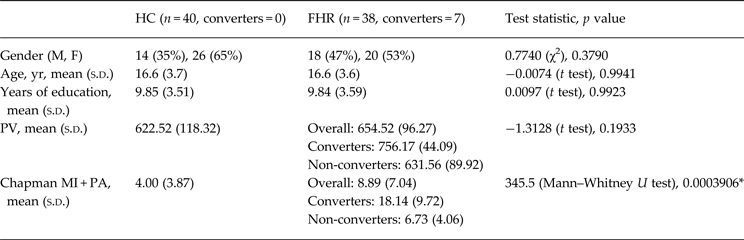
First, descriptive statistics were compiled for both HCs and FHR subjects at baseline. We evaluated whether sex, age or educational attainment were confounding factors (Table 1) using χ2, t tests or Mann–Whitney U tests as appropriate.
Demographic characteristics of the sample

HC, Healthy controls; FHR, familial high risk; MI + PA, Magical Ideation + Perceptual Aberration.
Data are presented as mean (s.d.) except where noted.
* Indicates a significant between-group difference.
Second, we explored relationships between schizotypy and other measures (group status, presence of initial DSM-IV-TR Axis I diagnosis, PV). Our hypotheses that trait schizotypy relates to psychosis risk factors (FHR group) but not presence of any Axis I diagnosis was assessed using a Mann–Whitney U test, while our hypothesis that schizotypy is associated with PV was tested by Spearman's rank correlation coefficient for PV with Chapman's schizotypy scores for Magical Ideation and Perceptual Aberration.
Third, for our hypotheses regarding group differences in PV, the overall FHR group was compared to controls at baseline, and was then divided along multiple dimensions: FHR subjects with v. without initial DSM-IV-TR diagnosis; FHR subjects who did v. did not develop new or worsening psychopathology over the course of the study; and FHR subjects who eventually converted v. did not convert to psychosis. For these analyses, group PVs were compared using ANCOVAs controlling for age, gender, and intracranial volume.
Results
Descriptive analyses
The study sample consisted of 38 high-risk relatives (mean age 16.6 years ± 3.6; 18 males) and 40 HCs (mean age 16.6 ± 3.7; 14 males). Of the 38 high-risk relatives, seven (18%; four females, three males) converted to psychosis during follow-up (with diagnoses of schizoaffective disorder, schizophrenia, schizophreniform disorder, and psychosis NOS). As described in previous reports, final non-psychotic diagnoses among the overall sample included attentional mood, conduct, anxiety and eating disorders, along with multiple individuals who developed no significant psychopathology (Eack et al. Reference Eack, Prasad, Montrose, Goradia, Dworakowski, Miewald and Keshavan2008; Shah et al. Reference Shah, Eack, Montrose, Tandon, Miewald, Prasad and Keshavan2012; Tandon et al. Reference Tandon, Montrose, Shah, Rajarethinam, Diwadkar and Keshavan2012).
For the overall sample, females had significantly larger PV when controlling for intracranial volume (F = 10.872, p = 0.00153). None of the potential confounding variables including age, sex or educational status differed between FHR and control groups (Table 1).
Baseline PV in FHR
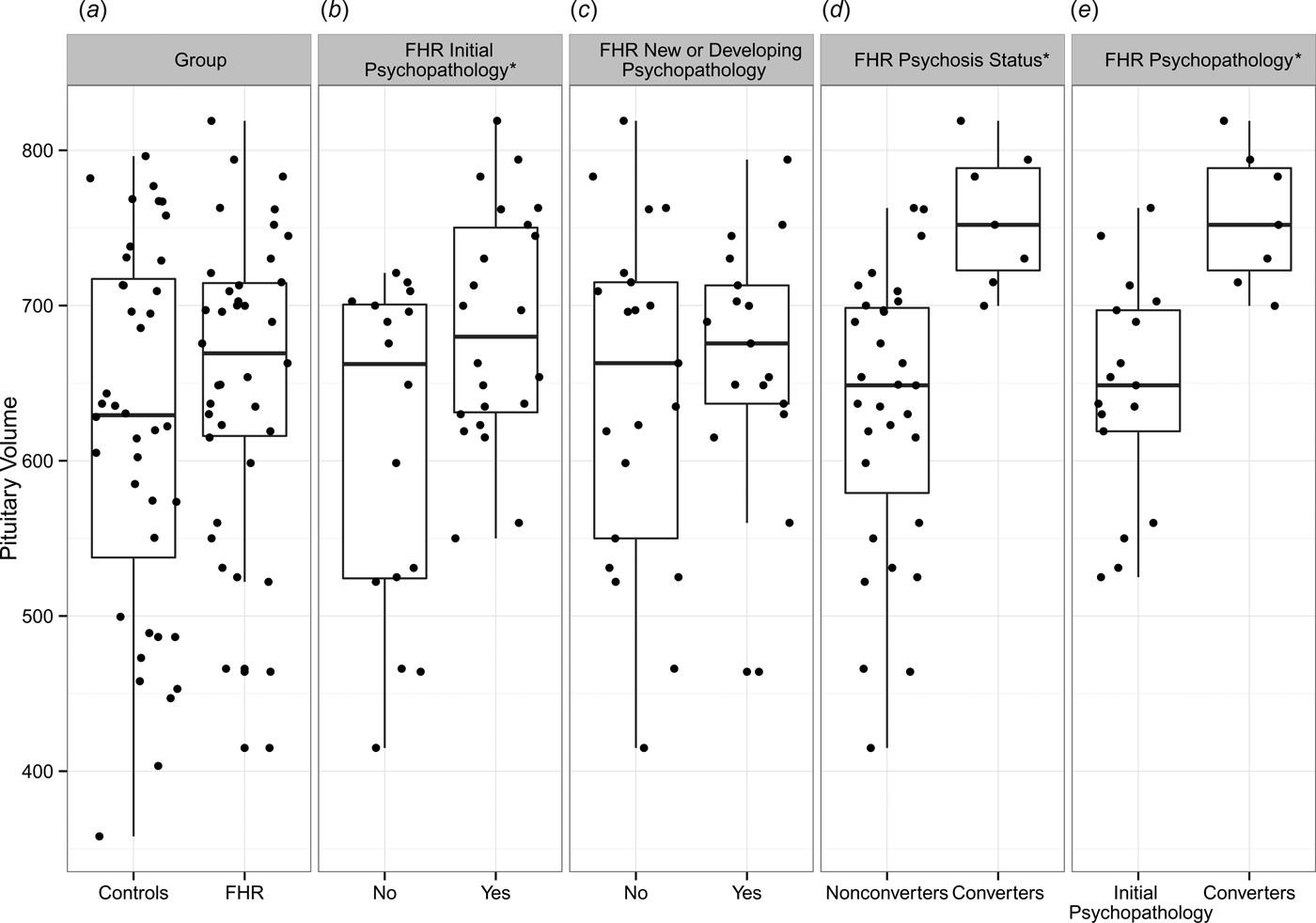
There was no significant difference in baseline PV between high-risk individuals and HCs after controlling for age, sex and intracranial volume (Fig. 2a ).
Baseline measures of pituitary volume in (a) healthy controls v. individuals at familial high risk (FHR) for schizophrenia; (b) FHR subjects with v. without initial Axis I psychopathology; (c) FHR subjects who do v. do not go on to develop new or worsening Axis I psychopathology; (d) FHR subjects who develop psychosis v. those who do not; (e) FHR subjects who later convert to psychosis v. non-converters with initial Axis I psychopathology. Asterisks (*) refer to differences with statistical significance, p < 0.05.

Schizotypy, high-risk status and PV
The FHR group had significantly higher schizotypy scores for Magical Ideation and Perceptual Aberration than did controls (Table 1; W = 345.5, p = 0.0003906). There were no differences in schizotypy scores between FHR subjects with and without baseline DSM-IV-TR Axis I disorders (W = 200, p = 0.2844).
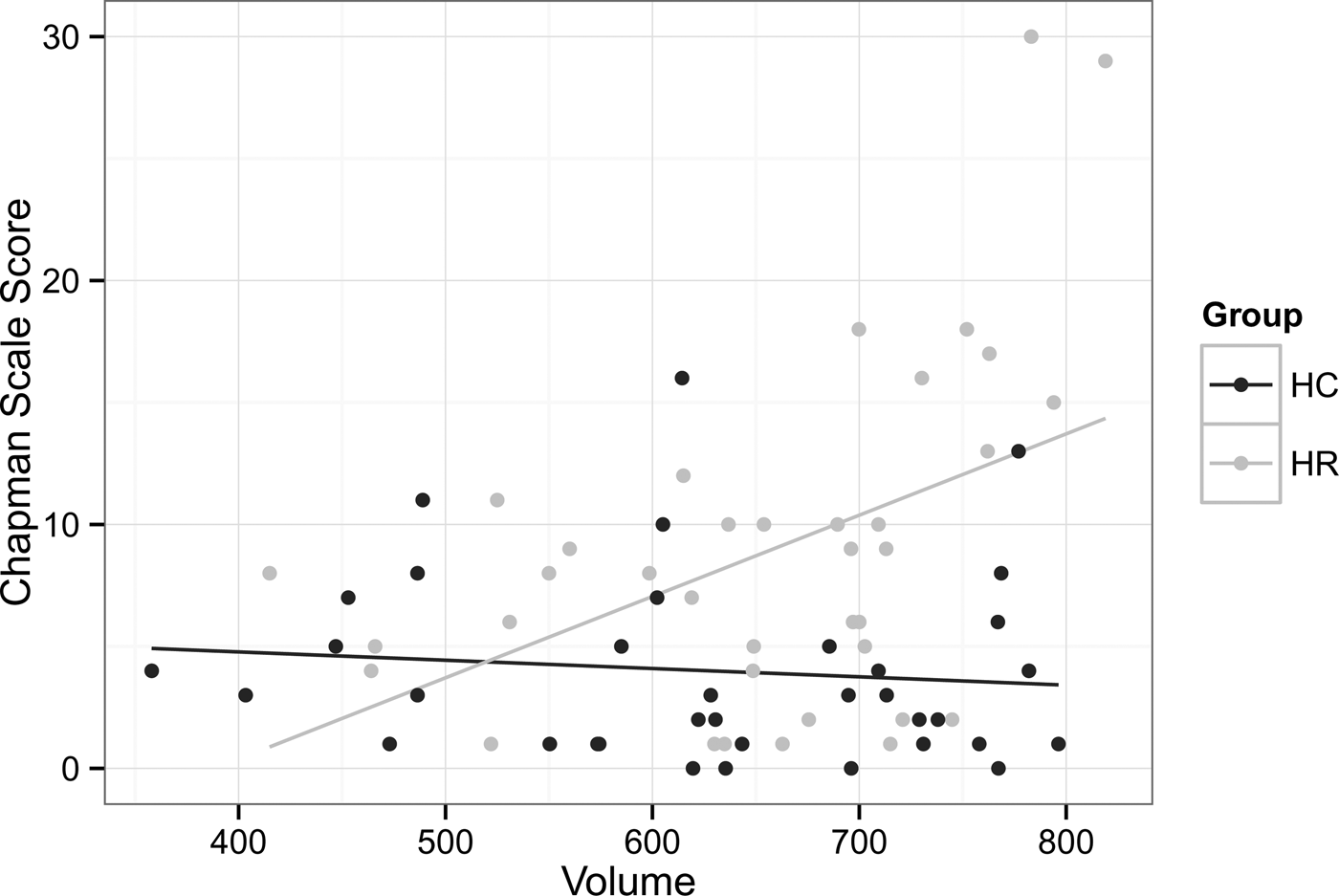
Within FHR subjects, PV was significantly correlated with Chapman's schizotypy scores for Magical Ideation + Perceptual Aberration (ρ = 0.41, p = 0.011). A significant group × PV interaction was also found on the CHAPMIPAS scale (p < 0.02) Fig. 3).
Relationship between pituitary volume and Chapman's schizotypy (Magical Ideation + Perceptual Aberration) scores. HC, Healthy controls; HR, high risk.

PV and clinical psychopathology
Of the seven future converters, five (71%) had initial (baseline) non-psychotic DSM-IV psychopathology and two (29%) had none; of 31 non-converters, 17 (55%) had baseline DSM-IV psychopathology while 14 (45%) did not. PV among a subgroup of FHR subjects with any initial Axis I diagnosis was significantly larger than HCs (p = 0.004), and trended larger than for FHR subjects with no initial psychopathology (p = 0.07). There was no difference between HCs and FHR subjects without initial psychopathology (Fig. 2b ).
There were no differences in baseline PV between HCs and FHR subjects who did or did not develop new or more serious Axis I diagnoses over the course of the study (Fig. 2c ). Of the 31 non-converters, 12 (39%) developed new or worsening Axis I psychopathology while 19 (61%) did not.
PV and emerging psychosis
Among FHR subjects, those who later transitioned to psychosis (FHR converters) had significantly larger baseline PVs compared to subjects that did not transition (FHR non-converters) (p = 0.0007), and compared with HCs (p = 0.003) (Fig. 2d ).
PV, baseline psychopathology, and future psychosis
Baseline PV in those later transitioning to psychosis (FHR converters) was significantly higher than in FHR subjects with any initial Axis I diagnosis (p = 0.002) (Fig. 2e ).
Discussion
This study examined the relationship between PV and clinical trajectory at baseline and over time in non-psychotic adolescents and young adults at FHR for schizophrenia. We found that PV within the FHR group was correlated with emerging positive sub-clinical symptomatology (‘schizotypy’) of magical ideation and perceptual aberrations. There was a significant group × PV interaction with these schizotypy measures, which was not confounded by Axis I diagnosis. Baseline PV was no different between the overall FHR group and HCs, and similarly displayed no enlargement in those destined to develop any new or worsening Axis I diagnosis. Importantly, however, PV was significantly higher in the FHR sample that carried any baseline Axis I diagnosis, and higher still in the group that went on to convert to psychosis.
Subjects in our study were younger than in CHR and FEP populations (Pariante et al. Reference Pariante, Vassilopoulou, Velakoulis, Phillips, Soulsby, Wood, Brewer, Smith, Dazzan, Yung, Zervas, Christodoulou, Murray, McGorry and Pantelis2004; Garner et al. Reference Garner, Pariante, Wood, Velakoulis, Phillips, Soulsby, Brewer, Smith, Dazzan, Berger, Yung, van den Buuse, Murray, McGorry and Pantelis2005), suggesting that they occupy an earlier point along the trajectory to psychosis and revealing important associations between PV and current as well as future psychopathology. As with previous reports in CHR populations (Garner et al. Reference Garner, Pariante, Wood, Velakoulis, Phillips, Soulsby, Brewer, Smith, Dazzan, Berger, Yung, van den Buuse, Murray, McGorry and Pantelis2005, Reference Garner, Berger, Nicolo, Mackinnon, Wood, Pariante, Dazzan, Proffitt, Markulev, Kerr, McConchie, Phillips, Pantelis and McGorry2009; Büschlen et al. Reference Büschlen, Berger, Borgwardt, Aston, Gschwandtner, Pflueger, Kuster, Radü, Stieglitz and Riecher-Rössler2011), baseline PV in our study is elevated in FHR subjects destined to convert to psychosis, although not in future non-converters (Fig. 2d ). Intriguingly, PV was associated with neither FHR group membership per se (Fig. 2a ), nor the future development of a new or worsening Axis I disorder (Fig. 2c ). Those with initial (baseline) Axis I psychopathology have trending higher PVs compared to those without, suggesting a potential association between PV and concurrent clinical state (Fig. 2b ). The observation that PV is higher still in future converters to psychosis is of clinical and translational significance, since it argues that PV may have utility in differentiating future converters to psychosis from even those with baseline Axis I psychopathology (Fig. 2e ).
Taken together, these initial findings suggest that in contrast to pituitary reductions seen in chronic schizophrenia (Upadhyaya et al. Reference Upadhyaya, El-Sheikh, MacMaster, Diwadkar and Keshavan2007), early pituitary hyperplasia is an important trait-level indicator of vulnerability to future psychosis even within an already high-risk group. While in need of replication, they imply that while some increase in PV in FHR subjects is shared between future psychosis and initial (baseline) Axis I general psychopathology, additional PV enlargement in FHR subjects may be specific to psychosis and is not confounded by the presence of Axis I disorders. This supports the notion that a potential premorbid vulnerability to psychosis may exist prior to illness onset among a minority of FHR subjects – one which is partially shared with some but not all emerging psychiatric conditions (MacMaster & Kusumakar, Reference MacMaster and Kusumakar2004; Thomas & De Bellis, Reference Thomas and De Bellis2004; MacMaster et al. Reference MacMaster, Russell, Mirza, Keshavan, Banerjee, Bhandari, Boyd, Lynch, Rose, Ivey, Moore and Rosenberg2006, Reference MacMaster, Leslie, Rosenberg and Kusumakar2008), but in which ultimate diagnostic trajectory may nonetheless be distinguished.
These findings are consistent with the notion that increased stress-vulnerability to psychosis may lead to HPA overactivity and pituitary hyperplasia (Bardeleben von & Holsboer, Reference Bardeleben von and Holsboer1988; Shah & Malla, Reference Shah and Malla2015), and with evidence that HPA axis hyperactivity is more prominent in psychotic than in non-psychotic depression (Contreras et al. Reference Contreras, Menchon, Urretavizcaya, Navarro, Vallejo and Parker2007). Abnormal PV may also be related to altered neurodevelopment (such as atypical pruning) in high-risk subjects or those with longstanding Axis I disorder (Diwadkar et al. Reference Diwadkar, Montrose, Dworakowski, Sweeney and Keshavan2006), or could be secondary to other neural changes such as damage to the hypothalamus with resulting loss of the subcortical gray matter extending from hypothalamus to pituitary. Interestingly, metabolic stress has also been shown to cause heightened dopaminergic and HPA axis activity in patients with schizophrenia, their unaffected siblings and controls (Brunelin et al. Reference Brunelin, d'Amato, van Os, Cochet, Suaud Chagny and Saoud2008). The correlation seen between PV and sub-clinical positive schizotypy within FHR subjects (Fig. 3) raises the possibility that different dimensions of psychotic symptoms may be variably associated with HPA axis changes (i.e. sub-threshold positive symptoms may influence PV enlargement), that HPA dysregulation has a variable effect on different dimensions of psychotic symptomatology (i.e. pituitary alterations more strongly influence positive rather than negative schizotypy), or some combination of the above. Finally, analyses such as these demonstrate how the comparison of future converters to psychosis with those with non-psychotic Axis I diagnoses may be a more discerning and informative test than comparison with ‘squeaky-clean’ HCs (Kapur, Reference Kapur2011).
Because PV and Chapman's schizotypy data were not consistently available at follow-up, the convergence or dissociation of these clinical and neuroimaging findings over time cannot be followed up in the current study. However, our initial conclusions are of interest in light of observations made by Walker et al. (Reference Walker, Brennan, Esterberg, Brasfield, Pearce and Compton2010), who carefully describe reports of heightened cortisol preceding psychotic episodes and identify important questions of causality. Since FHR subjects are theoretically at an earlier point along the trajectory to psychosis than CHR subjects, our baseline correlation between PV and Chapman's positive schizotypy in FHR suggests that sub-threshold psychotic symptoms co-evolve with at least some aspects of the HPA axis. Parallel and more fine-grained assessments of cortisol, PV and other markers of vulnerability, stress, and clinical symptomatology will be required to determine the degree to which each variable predicts others over time.
In addition to within-group effects, group membership may itself confer divergent effects on PV. Although this and some earlier studies have found baseline PV to be similar between high-risk subjects and controls (Garner et al. Reference Garner, Pariante, Wood, Velakoulis, Phillips, Soulsby, Brewer, Smith, Dazzan, Berger, Yung, van den Buuse, Murray, McGorry and Pantelis2005, Reference Garner, Berger, Nicolo, Mackinnon, Wood, Pariante, Dazzan, Proffitt, Markulev, Kerr, McConchie, Phillips, Pantelis and McGorry2009; Büschlen et al. Reference Büschlen, Berger, Borgwardt, Aston, Gschwandtner, Pflueger, Kuster, Radü, Stieglitz and Riecher-Rössler2011), we found significant group differences in correlations between PV and schizotypy. This raises the possibility that evaluating baseline PV alone obscures important processes (such as existing Axis I psychopathology) that differentially influence the relationship between PV and sub-threshold psychotic symptomatology. It lends support to the notion that trait- and state-level factors do not act in isolation, but rather interact in a complex fashion to contribute to HPA axis dysregulation along the trajectory to psychosis.
Our study is limited by its modest sample size, questions regarding generalizability beyond FHR samples, and the fact that PV is a single ‘snapshot’ of one HPA structure rather than a measure of HPA function. For example, PV alone cannot account for subjective stress, neuroendocrine response to stress challenges, or other HPA structures such as the hypothalamus or adrenal gland. While potential confounders such as age and gender were controlled for in our analyses, neither pubertal status (Ramanathan et al. Reference Ramanathan, Miewald, Montrose and Keshavan2015) clinical state nor functioning were accounted for here; the latter is relevant as some impairment in FHR subjects could in fact meet CHR criteria. Furthermore, Chapman's schizotypy scales have not been conclusively validated in the younger age range of our sample. They were utilized as the study was designed and initiated before instruments such as the Community Assessment of Psychotic Experiences were available (Konings et al. Reference Konings, Bak, Hanssen, van Os and Krabbendam2006); these newer scales may provide improved insight into sub-threshold symptoms in at-risk as well as general populations. Given the roughly annual assessment of subjects, the length of time between the evaluation and development of Axis I disorders (including psychosis) was difficult to determine, as was the potential relationship between PV and time-to-transition in converters.
As the analysis was conducted on 1.5 T images, higher-resolution imaging in combination with newer segmentation and estimation techniques (Wong et al. Reference Wong, Pipitone, Park, Dickie, Leonard, Perron, Pike, Richer, Veillette, Chakravarty, Pausova and Paus2014) may yield greater accuracy and reliability. Technically, others have described difficulties in separating anterior and posterior portions of the pituitary using common tracing methods, although (as noted; see Garner et al. Reference Garner, Pariante, Wood, Velakoulis, Phillips, Soulsby, Brewer, Smith, Dazzan, Berger, Yung, van den Buuse, Murray, McGorry and Pantelis2005) the anterior pituitary (the site of corticotropin-secreting cells relevant to HPA activity) occupies the majority of PV. Furthermore, as noted earlier, there is a lack of complete consensus regarding PV elevation in high-risk and early-course psychoses (Tournikioti et al. Reference Tournikioti, Tansella, Perlini, Rambaldelli, Cerini, Versace, Andreone, Dusi, Balestrieri, Malagò, Gasparini and Brambilla2007; Takahashi et al. Reference Takahashi, Suzuki, Velakoulis, Lorenzetti, Soulsby, Zhou, Nakamura, Seto, Kurachi and Pantelis2009; Nicolo et al. Reference Nicolo, Berger, Garner, Velakoulis, Markulev, Kerr, McGorry, Proffitt, McConchie, Pantelis and Wood2010; Klomp et al. Reference Klomp, Koolschijn, Hulshoff Pol, Kahn and Van Haren2011; Gruner et al. Reference Gruner, Christian, Robinson, Sevy, Gunduz-Bruce, Napolitano, Bilder and Szeszko2012; Shah & Malla, Reference Shah and Malla2015) which may be due to within-category heterogeneity, the diverse cohorts being examined across studies, the confounding effects of medications or dosages, or other factors.
In this regard, significant strengths of our study relate to the relative homogeneity of this FHR subject population (given their shared risk factor), the careful matching of groups for age and gender, and the relatively early stage of subjects along the trajectory to psychosis (prior to the point of CHR or first episode) (Keshavan et al. Reference Keshavan, DeLisi and Seidman2011). Our prospective measurement of PV reduces the likelihood of baseline experiences of distressing near-threshold-level psychotic symptoms that might otherwise contribute to pituitary enlargement and thereby confound the analysis (Pariante, Reference Pariante2008). Studying FHR populations also addresses a key concern articulated by many groups, since antipsychotic exposure can be ruled out as a confounding influence on PV (Nordholm et al. Reference Nordholm, Krogh, Mondelli, Dazzan, Pariante and Nordentoft2013; Walker et al. Reference Walker, Trotman, Pearce, Addington, Cadenhead, Cornblatt, Heinssen, Mathalon, Perkins, Seidman, Tsuang, Cannon, McGlashan and Woods2013). For the reasons mentioned above, prospective longitudinal studies of young at-risk populations offer a valuable opportunity to begin to disentangle these important issues.
While it is widely recognized that abnormal but endogenous trajectories can play a major role in brain development and neurodevelopmental processes, trajectories may also be modified by the stressful impact of psychotic symptoms and/or heightened reactivity to distressing events (Bramon & Murray, Reference Bramon and Murray2001). Understanding the relationships between psychobiological markers of stress-vulnerability and clinical trajectories is a critical step towards indexing risk and improving diagnostic and treatment capacities regarding psychosis as well as other developmental outcomes (Addington & Heinssen, Reference Addington and Heinssen2012; Carrión et al. Reference Carrión, McLaughlin, Goldberg, Auther, Olsen, Olvet, Correll and Cornblatt2013; Shah et al. Reference Shah, Tandon and Keshavan2013). In particular, the intimate link between stress and psychosis points to the potential utility of developing techniques for stress reduction and resilience that could benefit prevention and early intervention strategies.
Overall, our results contribute important knowledge to the dynamic and fluctuating course of PV. They suggest that while there are no stark group-level differences for baseline PV alone, PV and emerging sub-threshold psychotic symptoms are closely linked in the early period of psychosis risk in vulnerable individuals, and both group- and state-level processes interact to influence PV in FHR subjects. They also offer hope that baseline PV will assist in the prediction of future psychosis in relatives at FHR, even among those with initial Axis I psychopathology. The possibility that HPA axis hyperactivation in early course psychosis might contribute to increased PV needs to be confirmed by parallel neuroendocrine and imaging studies, and may point to potential targets for early intervention.
Acknowledgements
M.S.K. has received grant support from GSK and Sunovion. This work was supported by a Dupont-Warren Research Fellowship, Harvard Medical School (J.L.S.); National Institutes of Mental Health MH01180 and MH64023 (M.S.K.); and a NARSAD Independent Investigator Award (M.S.K.).