Introduction
Inorganic carbonates play a very important role when meteor matter is considered in an astrobiological context. For example, but far from exhaustively, they provide a chemical pathway into the long debate in progress since 1984 about possible biogenic activity on Mars, when Allan Hills 84001 (ALH84001) meteorite was found in Antarctica. In 1996, it was determined that ALH84001is an igneous orthopyroxenite consisting of coarse-grained orthopyroxene [(Mg,Fe)SiO3] and minor maskelynite (NaAlSi3O8), olivine [(Mg,Fe)SiO4], chromite (FeCr2O4), pyrite (FeS2) and apatite [Ca3(PO4)2] (McKay et al. Reference McKay, Gibson, Thomas-Keprta, Vali, Romanek, Clemett, Chillier, Maechling and Zare1996). This meteorite, the oldest Martian one ever found (Reference SchirberSchirber), solidified from a melt about 4.51 Gyr ago, while carbonate discs inside this structure are believed to be formed about 600 Myr later (during the so-called Noachian Age) due to hydrothermal processes in pre-existing fracture within the groundmass (Thomas-Keprta et al. Reference Thomas-Keprta, Gibson, McKay, Gibson and Wentworth2009). ALH84001 has generated great enthusiasm in the scientific community due to the presence of magnetite (Fe3O4) nanocrystals embedded in the carbonate matrix (see Fig. 1). This iron-based nanophase resembles those produced by magnetotactic bacteria on Earth, while inorganic formation processes at high temperature have been found to be unlike after experimental tests (McKay et al. Reference McKay, Thomas-Keprta, Clemett, Gibson, Spencer and Wentworth2009). The physicochemical properties of these crystals actually suggest that bacterial origin cannot be excluded (McKay et al. Reference McKay, Friedmann, Frankel and Bazylinski2003). These structures feature a definite size range and width/length ratio, chemical purity and crystallographic perfection (Friedmann et al. Reference Friedmann, Wierzchos, Ascaso and Winklhofer2001). Moreover, the presence of chain structures, elongation of crystals in the [111] crystallographic direction and the existence of unusual truncated hexaoctahedral geometry, at the same time, have been considered as evidence for the biological origin of magnetite bodies into ALH84001 meteorite (Bazylinski Reference Chase2003). A plausible scheme actually links nanobacteria with carbonate discs: the decomposed remains of magnetobacteria would have penetrated fissures of the rock dragged by carbonates-rich fluids. Afterwards, evaporation of the liquid enhanced the deposition of carbonate globules, at whose borders magnetite crystals and chain fragments sedimented, probably through the mechanism of ring deposition of particles dispersed in liquid drops (Friedmann et al. Reference Friedmann, Wierzchos, Ascaso and Winklhofer2001). According to McKay et al. (Reference Chase2003), ~25% of magnetite crystals embedded in the carbonates globules are likely biologically produced, while the remaining ~75% may be originated by inorganic processes.
Sketch of the typical morphology of carbonates discs on ALH84001 surface. They include an easily identified gold coloured carbonate core and a black–white–black rim. Black rims, ~5–10 µm thick, are composed of nanophase magnetite embedded in a magnesium carbonate matrix, with inclusions of sideritic carbonate. White rims, ~10–15 µm thick, are composed of almost pure MgCO3, with calcium and nanophase magnetite impurities. The entire system is surrounded by an iron and silicate matrix (grey coloured in the sketch). (Drawing by the authors, based on Thomas-Keprta et al. Reference Thomas-Keprta, Gibson, McKay, Gibson and Wentworth2009).

The meteorite, ejected from Mars surface 16 Myr ago, spent 11 000 years on Antarctica ice sheet (Gibson et al. Reference Gibson, McKay, Thomas-Keprta, Wentworth, Westall, Steele, Romanek, Bell and Toporski2001), so it is necessary to distinguish between Martian origin materials and terrestrial contaminations. A kinetic model proposed by Kopp & Humayun (Reference Kopp and Humayun2003) suggests actually that the carbonate generation has occurred under relative low partial pressure of carbon dioxide (CO2). On the other hand, detailed isotope studies established that the carbonates were formed on Mars, as well as the magnetite nanophase, which further analyses indicated as allochtonous compared with bulk carbonates (McKay et al. Reference McKay, Friedmann, Frankel and Bazylinski2003).
Although the specific case is still much debated, these studies have revived the interest in the panspermia theory, which hypothesizes that life was brought on Earth from other planets. Life forms, or at least life templates such as cell components, might have survived entering Earth atmosphere and spread out from sedimentary inclusions in meteorite materials. Foucher et al. (Reference Foucher, Westall, Brandstätter, Demets, Parnell, Cockell, Edwards, Bény and Brack2010) studied this problem from a heat conduction point of view. In their experiment they found that carbonaceous microfossils can survive atmospheric entry on Earth, but the living microorganisms were carbonized by flame leakage to the back of the rock sample. Using an analytical model to estimate the temperature reached by the sample, they state that, even without flame leakage, the living organisms probably need to be protected by at least 5 cm of rock, in order to be shielded from the intense heat of entry. However, such studies need to include chemical effects such as matrix decomposition and outgassing, which can reduce the thermal load on the matrix.
The aim of this work is to determine whether life forms might have survived entering Earth atmosphere, from an inorganic chemistry point of view. From this perspective, thermochemical properties and decomposition rates of an exposed carbonate matrix need to be known under real entry trajectory conditions.
The state of the art for entry scenario evaluations includes different models that take into account the variation of several parameters, such as time, quota, speed and temperature. Typical results of such models (Fentzke & Janches Reference Fentzke and Janches2008; Longo Reference Longo2012) can be quoted. A meteor entering Earth atmosphere takes several seconds to reach the surface, measuring time from 100 km quota. Nevertheless, it is during the peak heating regime that lasts about 2 s, that thermal stress of the surface is severe, leading to high equilibration temperatures (determined by the balance of friction power versus radiation and ablation losses). Physical models can be improved with chemical studies, taking into account the evaporation rate of the material at high temperature. The physical basis of this phenomenon is the friction generated by the molecules lying in the Earth atmosphere. Therefore the transit of the meteor through Earth atmosphere causes a dramatic increase of thermal flux on the surface, so the material undergoes decomposition when it reaches high temperatures. Moreover, previous models have been formulated for ferrous and silicate matrixes: there is no accurate model that well fits to a carbonate surface.
The most important peculiarity of carbonates, which differentiate them from silicates in this context, is their facile thermal decomposition into metal oxide and gaseous CO2. This reaction is facilitated by the small radius of the Mg2+ and O2− ions, compared with relatively bulky CO3 2−.
This decomposition needs to be characterized using a quantitative approach. In this paper, the use of Lagmuir law provides a starting point, from which kinetic and thermochemical considerations can be elaborated.
This is a promising direction of research, also in the light of recent laboratory studies where thermal stresses comparable with entry conditions are artificially produced on real meteoritic matter using high-power lasers (De Giacomo et al. Reference De Giacomo, Dell'Aglio, De Pascale, Longo and Capitelli2007; Dell'Aglio et al. Reference Dell'Aglio, De Giacomo, Gaudiuso, De Pascale, Senesi and Longo2010, Reference Dell'Aglio, De Giacomo, Gaudiuso, De Pascale and Longo2014).
Test case and calculation method
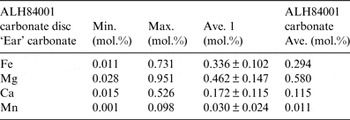
In view of the importance of carbonate inclusions in ALH84001, reviewed above, it is appropriate to consider these as a case of study, paying special attention to the so called ‘Ear’ carbonate, which features a gold coloured centre surrounded by a black–white–black rim, with an annular structure and a thin disc shape (Thomas-Keprta et al. Reference Thomas-Keprta, Gibson, McKay, Gibson and Wentworth2009) (see Fig. 1). Each disc has composition (Fe x Mg y Ca z Mn1−x−y−z )CO3, where x + y + z ≤ 1, and is made up of three concentric annular zones, with different cationic proportions, especially between the inner and outer core, separated by three thin rims. Magnetite nanocrystals are embedded in these carbonates, and they are more abundant within the rim and the carbonate discs. In Table 1, adapted from Thomas-Keprta et al. (Reference Thomas-Keprta, Gibson, McKay, Gibson and Wentworth2009), the average composition of the whole carbonate is presented.
ALH84001 average composition. The fifth column shows how Mg2+ is the most abundant cation in the carbonate disc. (summary of Table 3 from Thomas-Keprta et al. Reference Thomas-Keprta, Gibson, McKay, Gibson and Wentworth2009)

The table shows that the most abundant cation in the matrix is magnesium. As a first step, a pure magnesite (MgCO3) composition will be therefore analysed in the study.
The most appropriate quantity to describe the matrix decomposition is the number of evaporating molecules per surface unit per time unit J and it is given by the Langmuir law (Loeb Reference Loeb2004):
 $$J = \displaystyle{{{{\rm \#} _{{\rm evaporating}\;{\rm molecules}}}} \over {{{\rm m}^{2}}{{\rm s}}}} = \displaystyle{1 \over 4}{v_{{\rm Th}}}\displaystyle{{1.01 \times {{10}^5}p{\rm C}{{\rm O}_2}} \over {kT}},$$
where v Th is the thermal average speed of degassed components given by
 $${v_{{\rm Th}}} = \sqrt {\displaystyle{{8RT} \over {\pi M}}}. $$
R is the ideal gas constant (R = 8.314 K−1 mol−1), T is the meteor surface temperature, M is the molar mass of the component (only CO2 in this case, so M = 44.01 × 10⁻³ kg mol−1),
 ${p_{{\rm C}{{\rm O}_2}}}$
is the partial pressure of the CO2 (in atmospheres) and k is the Boltzmann constant (k = 1.38 × 10⁻²³ J K−1), 1.01 × 10⁵ is the numerical value of 1 atmosphere pressure when expressed in Pascal. The only missing parameter is
 ${p_{{\rm C}{{\rm O}_2}}}$
, which is easily calculated with the usual thermodynamic relation (Atkins & De Paula Reference Atkins and De Paula2002):
 $${\,p_{{\rm C}{{\rm O}_2}}} = {{\rm e}^{ - \Delta G/RT}}.$$
ΔG, the Gibbs free energy, is defined as
 $$\Delta G(T) = \Delta H(T) - T\Delta S(T),$$
where ΔH and ΔS are enthalpy and entropy variations in a mole of reaction. In the present case, the reaction proposed is the thermal decomposition with vacuum degassing of magnesium carbonate:
 $${\rm MgC}{{\rm O}_{3(s)}}\buildrel {\Delta} \over \longrightarrow {\rm Mg}{{\rm O}_{(s)}} + {\rm C}{{\rm O}_{2(g)}}$$
ΔH at temperature T can be obtained using the Kirchhoff equation (Atkins & De Paula Reference Atkins and De Paula2002):
 $$\Delta H(T) = \Delta H({T_0}) + \int_{{T_0}}^T {\Delta {C_p}{\rm d}T}. $$
ΔH(T 0) can be calculated with the equation:
 $$\Delta H({T_0}) = \sum\limits_{i = 1}^n {{b_i}\Delta {H_i}{{({T_0})}_p}} - \sum\limits_{\,j = 1}^m {{a_j}\Delta {H_j}{{({T_0})}_r}}, $$
where i and j indicate the number of products p and reactants r in the reaction, while b and a are stoichiometric coefficients of products and reactants, respectively. In this case:
 $$\eqalign{\Delta H({T_0}) &= \Delta {H_f}({T_0},{\rm C}{{\rm O}_2}) + \Delta {H_f}({T_0},{\rm MgO}) \cr & \quad- \Delta {H_f}({T_0},{\rm MgC}{{\rm O}_3}),} $$
ΔC p can be determined using equations analogous to equation (7) which in the specific case turns into:
 $$\Delta {C_p} = {C_p}({\rm C}{{\rm O}_2}) + {C_p}({\rm MgO}) - {C_p}({\rm MgC}{{\rm O}_3}).$$
The decomposition entropy ΔS as a function of temperature T can be obtained using the corresponding Kirchhoff equation in the form:
 $$\Delta S(T) = \Delta S({T_0}) + \int_{{T_0}}^T {\displaystyle{{\Delta {C_p}} \over T}{\rm d}T}. $$
ΔS(T 0) can be determined using equations analogous to equation (7):
 $$\Delta S({T_0}) = \Delta S({T_0},{\rm C}{{\rm O}_2}) + \Delta S({T_0},{\rm MgO}) - \Delta S({T_0},{\rm MgC}{{\rm O}_3}).$$
The expressions of heat capacity, enthalpy and entropy, depending on temperature, are given by Shomate fits (Chase, Reference Chase1998), which have the same form for each compound in the chemical reaction considered:
 $${C_p}(T) = A + Bt + C{t^2} + D{t^3} + \displaystyle{E \over {{t^2}}}[{\rm J}\;{\rm mo}{{\rm l}^{ - 1}}\;{{\rm K}^{ - 1}}],$$
 $$S(T) = A\ln (t) + Bt + C\displaystyle{{{t^2}} \over 2} + D\displaystyle{{{t^3}} \over 3} - \displaystyle{E \over {2{t^2}}} + G\;[{\rm J}\;{\rm mo}{{\rm l}^{ - 1}}\;{{\rm K}^{ - 1}}],$$
 $$\eqalign{H(T) &= H(298.15\;K) + At + B\displaystyle{{{t^2}} \over 2} \cr & \quad + C\displaystyle{{{t^3}} \over 3} + D\displaystyle{{{t^4}} \over 4} - \displaystyle{E \over t} + F - H\;[{\rm kJ}\;{\rm mo}{{\rm l}^{ - 1}}],} $$
where all capital letters are constants whose value depends on the temperature range; t = T(K)/1000 and T is the temperature.
Results and discussion
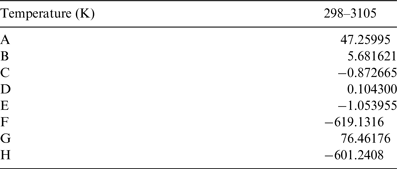
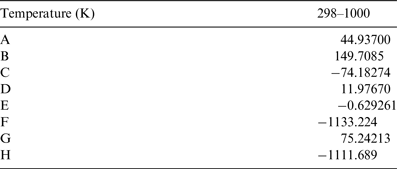
The value of the quantities, whose equations have been already shown in the previous section, are presented here, at T = 298 K. The values of all constants are shown in Tables 2–5.
CO2 constant values used in Shomate equations to determine heat capacity, entropy and enthalpy variations in function of temperature

MgO constant values used in Shomate equations to determine heat capacity, entropy and enthalpy variations in function of temperature

MgCO3 constant values used in Shomate equations to determine heat capacity, entropy and enthalpy variations in function of temperature

Standard formation enthalpy of each compound involved in the considered reaction, at a temperature of 298 K

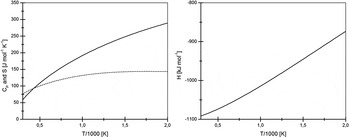
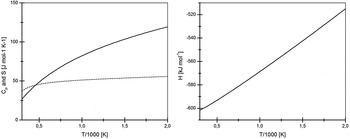
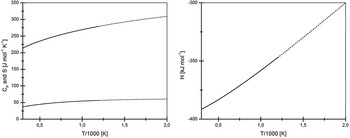
Figures 2–4 show the variation of all thermodynamic magnitudes already mentioned in a temperature range of 298–2000 K.
MgCO3 heat capacity (left plot, dashed line) entropy (left plot, full line) and formation enthalpy (right plot) as function of temperature.

MgO heat capacity, entropy and formation enthalpy as function of temperature.

CO2 heat capacity (left plot, lower curve), entropy (left plot, upper curve) and formation enthalpy (right plot) as function of temperature. Solid and dashed lines have been used to underline the use of two different data sets, as reported in Table 2.

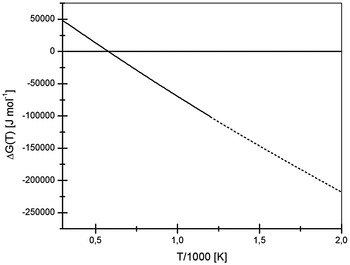
From these data, it is possible to calculate ΔG(T) (Fig. 5).
Gibbs free energy variation in the decomposition process. Solid and dashed lines have been used to underline the use of two different data sets, as reported in Table 2.

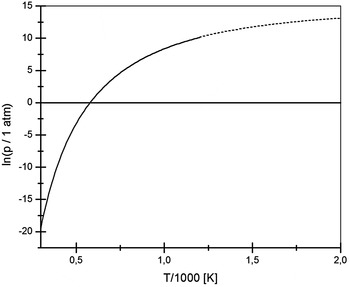
The equilibrium CO2 partial pressure is obtained using equation (2) (Fig. 6).
CO2 partial pressure in function of temperature. Solid and dashed lines have been used to underline the use of two different data sets, as reported in Table 2.

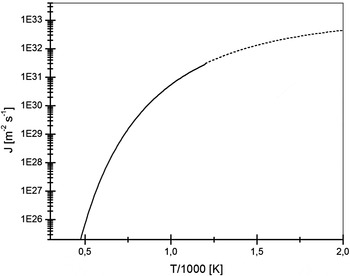
Finally, the ablation speed is calculated: it is expressed as the number of evaporating molecules per surface unit per time unit (equation (1)). The corresponding plot, that shows how the number of evaporating molecules changes with temperature variation, is presented in Fig. 7. It can be noted that the expression provided for the decomposition rate does not require further fitting, being based on a sequence of simpler formulas; therefore it can be included in any realistic entry model using the meteor surface temperature T as single variable (and of course data from tables here).
Decomposition rate expressed as the number of evaporating molecules per unit surface and time. Solid and dashed lines have been used to underline the use of two different data sets, as reported in Table 2.

Results in Fig. 7 show that J(T) increases exceedingly fast with T after a temperature of about 480 K. In order to estimate the thickness L of the layer affected by decomposition, it is possible to use a simplified model for the final state, after atmospheric passage, where a layer of MgO covers a bulk of pristine carbonate. Using such a model, the kinetic estimate of the layer thickness is given by the integration along trajectory of dL/dt = (μ/ρN A)J, where μ is the molar mass of MgCO3 (μ = 84.31 g mol−1), ρ is its density (ρ = 2.95 g cm−3) and N A is the Avogadro number (N A = 6.023 × 10²³ mol−1). This quantity reaches very high values even at moderate temperatures. For example, dL/dt is estimated, using the present model, as 5.7 mm s−1 at 500 K and 45.7 mm s−1 at 550 K. These high values suggest that a complete model must include the energetic cost of producing the MgO layer and the power dissipated by the process in establishing the surface temperature of a carbonate layer. Future studies should include this thermal protection of an exposed matrix resulting from surface decomposition. The power per unit surface dissipated is in fact given by JΔH/N A and again reaches very high values. For example, maintaining a stable temperature of just 500 K over pristine MgCO3 in vacuum requires 19.5 MW m−2 of thermal energy to compensate the decomposition cooling. For comparison, silicates offer significant decomposition cooling only at temperatures much above 1200 K (Öpik Reference Öpik2004). This heat loss term is not accounted in previous temperature calculations and can strongly mitigate the thermal damage of the carbonate matrix. In alternative, a purely thermochemical estimate of L can be provided assuming the same simplified MgO/MgCO3 layered structure as above and using energy balance and it is given by L = Qμ/(ΔHρ) where Q is the total thermal load on the exposed matrix, given in turn by the time integral of the power load W. Of course, further considerations require modelling the entry process to provide values of Q. The energy that can be dissipated by decomposition of a superficial layer is however impressive: using the last formula, it is found that the decomposition of 1 mm layer of MgCO3 dissipates about 3.4 MJ m−2 of thermal energy. Although limestone, e.g. CaCO3 may actually offer some protection to life forms based on the same principle, its vacuum decomposition becomes significant only at higher temperatures (~800 K).
Entry trajectory and shielding conditions of the matrix can radically modify the evaluation of a panspermia model with assistance of biological materials included into carbonates. The main limits of the present formulation are the neglect of the finite diffusion rate of CO2 and the use of very simplified chemical model for the carbonate matrix. The main perspective is to explore peculiar entry scenarios, like those with very low entry speed and entry angles, and those with mechanical fragmentation of the body at high altitude, which exposes fresh layers to just a small fraction of the entry thermal load. These scenarios can be evaluated in the future using concepts and formulas from the present paper as part of an atmosphere entry models for carbonates.
Conclusions
This work sets the basis for a criterion to evaluate the astrobiological significance of a carbonate matrix, inspired by ALH84001 globules, entering a planetary atmosphere in a panspermia scenario. The present authors suggest that high-temperature properties of carbonatic matrixes need to be investigated as a necessary preliminary step. In this context, a review of the composition data of these minerals leads to suggest pure MgCO3 as a suitable test case. This mineral is much more labile than bulk constituents of meteors due to facile decomposition into MgO and CO2. Based on kinetic theory and thermochemical considerations, the decomposition rate is estimated. It is suggested that magnesium-rich carbonatic materials, actually similar to those found in ALH84001 globules, offer much better protection to possible embedded prebiotic matter towards thermal stresses than silicates and still significant better than limestone, which was considered in previous works. Suitable formulas and results are provided for future studies. For further applications, the calculations should be improved to account for CO2 diffusion in the layer as well as the presence of iron and calcium cations, which are the next most important components after those considered here.