Religiosity is considered as a term which cannot be easily defined (Hackney & Sanders, Reference Hackney and Sanders2003) and measured (Allen & Lo, Reference Allen and Lo2010). However it is considered as combination of organized belief system, feelings, rituals and practices that are associated with specific religion (Ho & Ho, Reference Ho and Ho2007; Zullig, Ward, & Horn, Reference Zullig, Ward and Horn2006). Previous researches focused on the global level of religiosity and did not pay attention to the factors of religiosity (Mahoney, Pargament, Swank, & Tarakeshwar, Reference Mahoney, Pargament, Swank and Tarakeshwar2001).
Currently it is said that religiosity involves behavioral, emotional and cognitive aspects (Hackney & Sanders, Reference Hackney and Sanders2003); therefore different measures of religiosity focus on different factors of religiosity. However; commonly included factors are denominational identification, frequency of participation in religious activities, level of religion‘s meaningfulness to the life of an individual, and the extent of the individual‘s affiliation with members of religious groups (Allen & Lo, Reference Allen and Lo2010).
Islam is one of the largest religions of the world with almost 1.1 billion believers (Encyclopedia Britannica Online, 2007). It is obligatory for Muslims to have belief and practice the defined five pillars of Islam. Available literature reflects the scarcity of tools to measure practice and belief among Muslims. Most of the researches regarding religiosity have been conducted on Christians, therefore majority of available tools measure the religiosity of people having Christian faith. However, most of the researches used adapted version of Intrinsic/Extrinsic measurement scale (Gorsuch & McPherson, Reference Gorsuch and McPherson1989), Sahin-Francis Scale (Sahin & Francis, Reference Sahin and Francis2002) and the Muslim Attitude towards Religiosity Scale (Wilde & Joseph, Reference Wilde and Joseph1997), to measure the religiosity among Muslims (Francis, Sahin, & Al-Failakawi, Reference Francis, Sahin and Al-Failakawi2008; Khan, Watson, & Habib, Reference Khan, Watson and Habib2005; Pace, Reference Pace2014).
Previously the research on association between health and religion was widely considered as “illegitimate”, therefore researchers often put aside the religious variables in their studies (Miller & Thoresen, Reference Miller and Thoresen2003). After 1990s researchers started taking interest in the area of health and religion and they tried to explore the effect of religion on psychological well-being of its believers (Tarakeshwar, Pargament, & Mahoney, Reference Tarakeshwar, Pargament and Mahoney2003). Relatively few empirical studies have been carried out among Muslims, and very few have examined the role of Islam with respect to physical and psychological well-being. Moreover, most of these empirical studies have been comparative in nature, and do not focus exclusively on Muslims (Raiya, Reference Raiya2008). Therefore most of the measures were developed to assess the attitude of people towards religion rather than actual Islamic religious oriented actions and dogmatic belief system is given less importance. Muslims are required to have belief and to practice in basic pillars of Islam but none of the already existed measures briefly and precisely measured Islamic religious practice and belief. Keeping in view the limitations associated with already existing scales SMPBS (AlMarri, Oei, & Al-Adawi, Reference AlMarri, Oei and Al-Adawi2009) was developed. This measure was developed specifically for Muslim population as most of the available scales are developed for people of Christian faith or for people of different religious faith which cannot be suitable measure to measure religiosity in Muslim even in translated form. Basic aim of the researchers to develop SMPBS was to develop a brief measure of Muslim religiosity to measure the level of belief and practice among alcoholics.
SMPBS was originally developed for diverse population of Muslims living in Oman, Arab, Malaysia and Indonesia. This scale comprised of nine items measuring practice (4 items) and belief (5 items). Response format of the practice subscale is five point Likert scale ranging from 1 = ‘‘I never do this’’ to 5 = ‘‘I always do this’’ and response format of belief subscale range from 1 = strongly disagree to 5 = strongly agree.
Initially thirteen items were selected from item pool and most of the items were drawn directly from the verses of Quran, reflecting basic pillars of Islam. After running exploratory factor analysis two factor structure with nine items was retained. After EFA, Confirmatory factor analysis was carried out to validate the factor structure of SMPBS. The 9-item, two-factor solution showed a good fit to the data. Reliability coefficient of the scale is .83 and it is found as a valid and promising measure of Muslim religiosity. Empirical evidence shows that SMPBS is a psychometrically sound measure that can be used for quick and accurate measurement of religiosity (AlMarri et al., Reference AlMarri, Oei and Al-Adawi2009). Recently SMPBS has been used to measure its relationship with paranormal belief and anxiety among different age groups (Tahir, Reference Tahir2015). Result of the study revealed that paranormal belief and anxiety is negatively correlated with religious practice and belief. Study conducted by Tahir (Reference Tahir2015) provided another evidence for the validity and reliability of SMPBS.
According to AlMarri et al. (Reference AlMarri, Oei and Al-Adawi2009) validity of the SMPBS was enhanced by the results depicting that participants who scored higher on SMPBS were more likely to be lifelong alcohol abstainers. Though SMPBS was originally developed for alcoholic population but it was proved that it can be applied on non alcoholic population. SMPBS measure is available in Arabic and English language. In order to use SMPBS in Pakistan, it was translated into national Urdu language.
The research on religion and health in Pakistan is growing rapidly but well-designed and theoretically grounded studies are relatively rare. One factor that may be holding back the study of religion and health is lack of a comprehensive, brief, non-offensive, low-burden measure of religiosity in the Urdu, official language of Pakistan that may be easily included in large cross-sectional and longitudinal studies. There is dire need of any valid, reliable and brief measure of religiosity in the Urdu language in order to explore the associated areas of religiosity in the life of Pakistani people. Keeping in view the dearth of valid and reliable indigenous scale of religiosity, the current study was planned to translate and validate the SMPBS (AlMarri et al., Reference AlMarri, Oei and Al-Adawi2009).
In order to meet the objectives, current study comprised of four phases. Phase 1 aimed at translation of the scale, Phase II comprised of confirmatory factor analysis and determination of psychometric properties, Phase III aimed at cross language validation while phase IV provided convergent and divergent validation of the SMPBS.
Phase I: Translation of Short Muslim Practice and Belief Scale (SMPBS)
Before starting the translation process, the authors (AlMarri et al., Reference AlMarri, Oei and Al-Adawi2009) of the scales were requested to grant permission to translate it into Urdu Language. The authors of the scale kindly accorded their consent to translate the scale into Urdu language. The translation procedure was divided into four steps which are stated in detail below.
Forward Translation
In the first step the Scale was translated from English to Urdu according to the standardized translation procedure (Brislin, Reference Brislin1976). Three bilingual experts (assistant professor of psychology from psychology department, University of Sargodha) were approached. All bilingual experts were having proficiency in both languages, familiarity with both cultures and had experience in Psychological test development. They were asked to take care about the technical equivalence of the language such as grammar, tense, question length, acceptable level of abstraction, and their relationship to the socio-cultural context. By following this process, at the end, there were three independent Urdu translated versions of SMPBS.
Evaluation of translated Items by Committee
To get the best fitting translation items, three independent forward versions were reconciled by comparing them in order to assess the theoretical uniformity of items by using committee approach. This committee comprised of two assistant professors of psychology department and one assistant professor of linguistics from University of Sargodha. Each and every item was critically analyzed with reference to their context, grammar and wording by the experts and they selected one translation, which fulfills the best meaning of each item. Finally the forward translation was reconciled consisted of the best fitting translation of the items and each item was selected by the consensus of all experts.
Backward translation
In the third step finalized Urdu version of the scale was translated back into English by two bilingual experts independently. This step was performed in present study to ensure that Urdu translated version was correct, valid, reliable without linguistic biases and conceptually equivalent to original scale. At the end of this step there were two independent English translations of Urdu version of the scale.
Evaluation of back translated items by Committee of Experts
A group of experts comprising one lecturer and two assistant professors of psychology department, University of Sargodha, critically assessed back-translated items. Finally there was a consensus among all the experts regarding accuracy of translation.
Phase II: Determination of Psychometric Properties and confirmatory factor analysis of Urdu SMPBS
The data was analyzed in terms of factorial validity, alpha reliability, correlations, and item-total correlations by using AMOS 20 and Statistical Package for Social Sciences (SPSS).
Sample
The sample of the study was comprised of 500 participants with age range 20 to 70 years (M = 36.5, SD = 10.1). Men and women were given equal representation in the sample (n = 250). Data was collected from public sector university students, different professionals, businessmen and housewives. Participants belonged to diverse socioeconomic status.
Procedure
Convenient sampling strategy was used to approach the participants of the study. In order to collect the data 550 participants were personally contacted. They were briefed regarding the purpose of the study and instructions were provided to them relevant to response format and completion of scales. All queries regarding scale completion were solved and then participants were requested to answer honestly and they were ensured that the confidentiality and privacy of their information will be maintained. There was no time limit for the completion of scales. Five hundred and twenty participants returned the scales while 500 scales found complete in all regards therefore 500 scales were appropriate for further data analysis. At the end participants were apprised for their kind cooperation and help.
Confirmatory Factor Analysis
In order to confirm the measurement model and factor structure of (SMPBS), CFA was carried out. In the current study various indices and criteria were checked to explain the best model fit (CFI, GFI, and RMSEA).
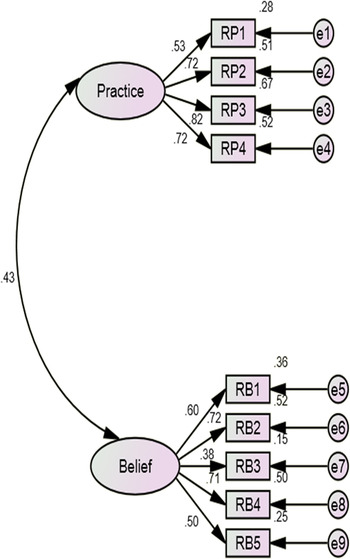
The Table 1 and Figure 1 shows the results of model fit indices and factor loadings of CFA for translated Brief Practice and belief Scale for Muslims. Based upon the initial criteria for model fit i.e., item loading > .35 the original model with two factor structure (practice & belief) was examined through confirmatory factor analysis and the two factor structure showed a good fit to the data with chi square 55.96 (df = 26), CFI =.96, GFI = .97, and RMSEA = .04. The final model contains two factors with 4 items in practice subscale and 5 items in belief subscale. The factor loadings of the items ranged from .38 to .82.
Model fit indices of CFA for Brief Muslim Practice and Belief Scale (N = 500)

Measurement Model of Urdu Translated Short Muslim Practice and Belief Scale.

In order to compare the model fit of the two factor structure of SMPBS with other possible competing model, CFA was carried out on data to check the model fit indices of one factor solution of the test. On the basis of theoretical grounds only possible alternative structure of scale was single factor. Results of CFA provided strong evidence against the one factor solution, having bad fit to the data with chi square 368.30 (df = 27, p > .05), CFI = .70, GFI = .82, and RMSEA = .15.
Results provided strong evidence for validation of two factor structure of Urdu Translated SMPBS by proving that it is the only possible and best factor structure.
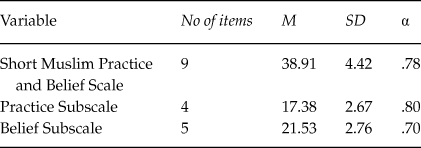
In order to find out reliability of Urdu translated scale alpha reliability analysis was carried out. Table 2 depicts that SMPBS and its subscales are highly reliable.
Descriptive and Psychometric Properties of Scale of Present Study (N = 500)

Phase III Cross Language Validity
In the third phase of current study cross language validation of the Urdu translated version of Short Muslim religiosity scale was undertaken. This process involved a comparison of Urdu translated version with original English version of scale. This procedure helped in the assessment of quality of Urdu translated version in order to determine its empirical equivalence with original version.
Sample
Sample consisted of 60 participants with minimum age 20 (range 20–35, M = 25.3, SD = 5.3) were taken. Sample was categorized into the four conditions by forming their four groups, each group comprising of 15 participants in test and retest phase. Their education level varies between undergraduate to postgraduate level. Participants belonging to different socioeconomic class were recruited.
Procedure
This phase of the study was intended to examine the validation of translated versions of scales which were administrated twice to the four groups (15 participants in each other) of participants in Urdu-Urdu, English-English, English-Urdu and Urdu-English sequence .
The tests were administrated on participants in two conditions. In a first trial two groups were given Urdu versions and two were given English versions of both scales. After 7 days, second trial was taken and the same four groups comprised of 60 participants (15 participants in each group) were given the test again but in this trial two groups were given same language version but other two groups were given opposite language version of the test. The aim of this procedure was to find out the discrepancy or equivalence between Urdu and English versions of scales. Such distributions were made to control the learning effect that may take place due to testing of original and translated versions. This empirical equivalence was assessed by finding the correlations of test and retest phase of seven days.
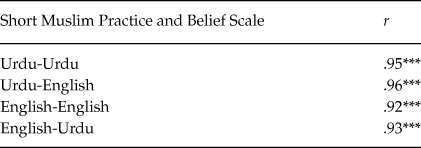
Table 3 indicates that the correlations between all test-retest phases of SMPBS administration. It indicates that all test-retest phases for these scales are significantly correlated with each other and their correlation coefficients ranged from .92 to .96. Overall results in Table 6 showed that Urdu translation of SMPBS is empirically equivalent to its English version.
Correlations between Urdu and English Versions of Short Muslim Practice and Belief Scale (N = 60)

*** p < .001
Phase IV Convergent and Discriminant Validation of Urdu Translated SMPBS
Phase IV was aimed at assessing the convergent and divergent validity of Urdu Translated SMPBS. It was hypothesized that Positive correlation between Urdu Translated SMPBS and Religiosity Belief and Practice Scale (Amjad, Reference Amjad2007) will provide evidence for convergent validity. Moreover Negative correlation of Urdu Translated SMPBS with Depression Subscale of DASS-42 (Farooqi & Habib, Reference Farooqi and Habib2010) will confirm the divergent validity of scale.
Sample
The convenient sample consisted of 200 participants was recruited from Sargodha city (100 male & 100 female) ranging in age from 20 to 65 (M = 30.98, SD = 16.87). Minimum education level was intermediate and maximum was post-graduation.
Instruments
- Short Muslim Practice and Belief Scale (SMPBS) (AlMarr et al., Reference AlMarri, Oei and Al-Adawi2009 ).
SMPBS comprised of nine items measuring practice (4 items) and belief (5 items). Response format of the scale is five point Likert scale. The maximum possible score on the scale is 45 and minimum possible score is 9. Reliability coefficient of the scale is .83 and it is found as a valid and promising measure of Muslim religiosity.
- Religiosity Belief and Practice Scale ( Amjad, Reference Amjad2007 ).
Religiosity belief and practice scale is 20 item scale developed by Amjad (Reference Amjad2007). It measures two factors of religiosity; practice and belief. Response format of the scale is five point Likert scale from 1 = strongly disagree to 5 = strongly agree. Ten items measure practice and ten measures belief. Reported reliability coefficient of the scale is .80.
- Depression Subscale of DASS-42 ( Farooqi & Habib, Reference Farooqi and Habib2010 ).
Urdu version of anxiety subscale of DASS by Farooq and Habib (Reference Farooqi and Habib2010) was used to measure the depression level among participants. DASS comprised of 42 items was designed to check the severity of symptoms related to Depression (14 items), Anxiety (14 items) and stress (14 items). Its response format consists of 4 point rating scale ranging from (0-never, 1-rarely, 2-mostly, and 3-always). The scale was constructed by Lovibond and Lovibond (Reference Lovibond and Lovibond1995) and translated in Urdu language by Farooqi and Habib (Reference Farooqi and Habib2010). The original scale internal consistency of the DASS subscales range from 91 to .97 whereas internal consistency of the translated version of DASS-42 ranges from .94 to .97.
Procedure
All the scales required for the validation of SMPBS (SMPBS) were distributed among the participants of the study. After taking informed consent and ensuring the confidentiality of information, 250 participants were given guidelines to read all the given instructions and fill all the questionnaires completely and carefully. Two hundred and thirty participants returned questionnaires and finally 200 questionnaires were complete in all regards and analysis was carried out on data of 200 participants.
Results
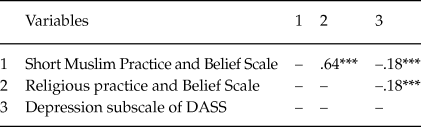
Correlation among SMPBS, Religious practice and Belief Scale, and Depression subscale of DASS was computed to provide convergent and discriminant validity evidence for the SMPBS. Table 4 provides the evidence of convergent validity as it indicates that SMPBS is significant positive correlate of Religious practice and Belief Scale (r = .64, p < .001). Table also depicts the evidence of discriminant validity of the scale as it is revealed that there is a significant negative correlation of Depression subscale of DASS with SMPBS (r = –.18, p < .001), and Religious practice and Belief Scale (r = –.18, p < .001) reflecting that higher the level of religiosity, lower will be the level of depression among Muslims. These results provide evidence for convergent and Discriminant validity of Urdu translated SMPBS.
Intercorrelations among Study Scales (N = 200)

*** p < .001
Discussion
Religiosity is a very important construct in the field of Psychology but unfortunately most of the scales have been developed for religiosity among the people other than believers of Islam. In Pakistan there is no measure of religiosity, with psychometrically strong factor structure and which is truly based upon Quran and Ahadis, therefore current study attempted to translate SMPBS for Pakistani population. Keeping in view the need of researchers, SMPBS was developed to provide a brief, easy to administer, reliable and valid tool of Muslim (AlMarri et al., Reference AlMarri, Oei and Al-Adawi2009). Being brief measure of religiosity it can be widely applied on different type of Muslim populations. Limitation of self reported measures is problem in response rate especially while dealing with patients or old age people. However SMPBS revealed valid and reliable results in studies conducted on sample of elderly people, alcoholics, non alcoholics, anxious and non clinical people as well (AlMarri et al., Reference AlMarri, Oei and Al-Adawi2009; Ghayas & Batool, Reference Ghayas and Batool2015; Tahir, Reference Tahir2015).
The SMPBS published in 2009 and diverse sample size recruited for construction and validation of the scale was one of the strengths of the study. Researchers took the sample from various regions of Middle East and Asia in order to give representation of Muslims living in diverse areas. As most of the items of the scale were taken from Quran and remaining were based upon consensus of Islamic scholars therefore multiple group comparative results of study yielded evidence for validation of scale. Its translations in other languages are ongoing and its reliability and validity has been examined in many studies (Ghayas & Batool, Reference Ghayas and Batool2015; Tahir, Reference Tahir2015).
The current study was aimed at translation of SMPBS into Urdu, so that it would be applicable on majority of Pakistani Muslims. Forward Backward Translation Techniques (Brislin, Reference Brislin1976) was used for this purpose. This scale comprised 2 subscales namely Practice and Belief Scale. Reliability analysis revealed that scale and its subscales (Urdu translation) are reliable and compatible with the original scale reliability. Reliability analysis suggested that items of the original scale measuring practice and belief also reflect practice and belief of Pakistani population. Confirmatory analysis was carried out ensure the factor structure of the scale and model fit to the data obtained from Pakistani population. CFA revealed an excellent model fit to the data and demonstrated exactly the same two factor structure as generated through EFA and CFA on original data. In the current study possibility of one factor structure was also assessed but CFA did not revealed good fit to the data. These results are in line with the original work done on this scale as AlMarri et al. (Reference AlMarri, Oei and Al-Adawi2009) also reported that model fit indices obtained by single factor structure was not lying within the acceptable range so only two factor structure is possible for this scale.
Cross language validation also revealed excellent validity indices. Further evidence was collected to ensure construct validity of translated SMPBS. The scores of translated SMPBS were correlated with Religiosity Belief and Practice Scale (Amjad, Reference Amjad2007) in order to ensure its convergent validity. Results demonstrated that both the scores on both the scales are highly correlated with each other providing convergent validity of the scale. Furthermore SMPBS was found to be significant negative correlate of Depression Subscale of DASS-42 (Farooq & Habib, Reference Farooqi and Habib2010) and these results provided evidence for Discriminant validity of the scale. These results are in line with existing literature claiming the effect of religiosity in decreasing the level of depression (Newport, Agerwall, & Witters, Reference Newport, Agrawal and Witters2010; Sage, Reference Sage2011). It seems logical that those who are more religious tend to have low level of depression as religiosity works as a buffering and protective factor against depression by providing comfort and relief in the difficult life situations which might lead towards psychiatric symptoms if person is not religious (Brauser, Reference Brauser2012; Karimallahi & Aghamohammadi, Reference Karimallahi and Aghamohammadi2001; Koenig, Reference Koenig2007).
The adaptation and validation of the scale will help to design research in various fields with reference to religiosity among Pakistanis (e.g., it will provide an opportunity to assess the role of religion in mental health, life satisfaction, and marital relationship). Additionally being a short measure it will help in measuring religiosity among those groups who do not respond to lengthy measures. Translation of this scale is positive addition to the social science discipline as the field of religiosity can easily and quickly be measured by this scale and this will lead towards exploration of new horizon regarding the religiosity and social and personal life of individuals whose first language is Urdu.
Participants of the current study represented non-clinical population only and it would be better to use both clinical and non clinical population.
To determine better factor structure and more sound psychometric properties of SMPBS for Pakistani sample, a more generalizable group of respondents taken from different provinces of Pakistan must be recruited for factor analysis to establish better construct validity of the scale.
Participants from different sects were not given equal representation in the sample. For future researches it is recommended to apply on large sample having equal representation from major sects existing in Pakistan.