As of July 2020, over 13 million cases of coronavirus disease 2019 (COVID-19) have been reported worldwide with over 500,000 deaths. 1 Aside from the cost of the disease itself on those infected, there have been other far-ranging negative effects, including widespread job loss, damage to small businesses, and great strain on health-care systems. Reference Nicola, Alsafi and Sohrabi2 Virologists, epidemiologists, and other public health experts have reiterated the intensity of this crisis and even assert that COVID-19 is here to stay in the world population. Reference Asadi, Bouvier and Wexler3 Despite multiple vaccines for COVID-19 having been approved 4 for distribution and administration in countries worldwide, transmission remains concerningly high in several countries. Reference Bowman and Reeves5,Reference Pandey and Nazmi6
The need for a rapid and reliable diagnostic system to identify cases is still present even over a year since the start of the pandemic. Many communities continue to struggle to contain disease spread and potentially suffer casualties that could have been avoided if testing procedures with these characteristics could be implemented. Over the course of the COVID-19 pandemic, it will be increasingly important to have quick, readily available testing for isolation of those infected with COVID-19. Reference Tanne7 Since the onset of the COVID-19 pandemic, there has been rapid development in diagnostic capabilities to detect the presence of severe acute respiratory syndrome coronavirus 2 (SARS-CoV-2; the virus that causes COVID-19) in people. Reference Carter, Garner and Smoot8 These techniques include serological and immunological tests that evaluate the presence of coronavirus antibodies as well as reverse transcriptase-polymerase chain reaction (RT-PCR), which detects viral RNA. Other nucleic acid-based detection techniques have also been introduced, including isothermal amplification assays, hybridization microarray assays, amplicon-based metagenomic sequencing, and cutting-edge clustered regularly interspaced short palindromic repeats (CRISPR). Reference Carter, Garner and Smoot8 Despite these developments, most of these methods are expensive and time-consuming. The necessity for ultra-rapid, on-the-spot, equipment-light testing is clear, Reference Tang, Schmitz and Persing9 and developments have been made to attain a diagnostic method with these criteria. Reference Hoffman, Nissen and Krambrich10,Reference Nguyen, Duong Bang and Wolff11
While more rapid tests, such as saliva and lateral flow antigen tests, have been developed, they do come with their own drawbacks. Saliva testing is less invasive than traditional RT-PCR methods, Reference Service12 but it may be difficult for those with low saliva production (such as young children) to produce the necessary sample size. 13 Antigen testing using lateral flow technology has the benefit of not requiring a laboratory, running water, or electricity, and can deliver results in 15-30 min. Reference Wise14 Despite these advantages, both saliva testing and rapid antigen testing have been found to be less accurate than traditional PCR testing as they tend to be worse at detecting early cases with lower viral loads.
Artificial intelligence (AI) techniques such as cough “bark” analysis are another option paving the way for rapid, on-the-spot COVID-19 detection. Massachusetts Institute of Technology researchers have built up a database of people’s coughing sounds and have been using it to identify asymptomatic COVID-19 infections by analyzing the slight differences in cough sounds. Reference Laguarta, Hueto and Subirana15 This research team proposes that there is no such thing as being truly asymptomatic, and that all infections produce tiny physiological changes, with some being imperceptible to human senses. Coughing is one such marker, as the human ear can only register so much nuance between coughs, whereas an AI system such as the one proposed can apparently identify asymptomatic COVID-19 patients with 100% accuracy. Reference Laguarta, Hueto and Subirana15
This study proposes that using AI techniques in breath analysis to identify compounds present in exhaled breath has the potential for rapid, portable, and noninvasive COVID-19 diagnosis.
Background
Breath analysis, or breathomics, is an area of research that quantifies the volatile organic compounds (VOCs) present in exhaled breath to understand how these compounds might be related to diseases and other biological mechanisms. Reference Kuo, Tan and Wang16 The use of AI in breathomics to diagnose respiratory illness, cancer, and diabetes has been well-documented. Reference Bos, Weda and Wang17–Reference Behera, Joshi and Anil Vishnu19 Previous research has indicated that certain diseases can be identified through VOCs, such as with acute respiratory distress syndrome (ARDS), lung cancer, and diabetes. Reference Bos, Weda and Wang17–Reference Behera, Joshi and Anil Vishnu19 Research has also demonstrated that exhaled breath analysis can be used in the early diagnosis of gastric cancer, Reference Durán-Acevedo, Jaimes-Mogollón and Gualdrón-Guerrero20 with a more recent study demonstrating the effectiveness of deep learning-based neural networks in both early diagnosis of gastric cancer and classification between early and advanced stages. Reference Aslam, Xue and Chen21 Additionally, breath analysis has been used to differentiate between the similar symptom profiles of chronic obstructive pulmonary disease and asthma. Reference Fens, Zwinderman and van der Schee22 It would follow that COVID-19 may present with its own unique pattern of VOCs that could then be identified by means of breath analysis.
The first step in breath analysis is breath sampling (obtaining a sample of breath from a participant), which can be done by means of multiple approaches. One approach for breath sampling uses either solid phase microextraction (SPME) or needle-trap devices (NTD). Reference Ghosh, Singh and Grandy23 SPME technology was introduced as a solvent-free method of preconcentration for breath analysis. However, this technology has drawbacks in that it is fragile, has a limited absorption capacity, and is expensive. An alternative technology to SPME is NTD technology, which is more sensitive, easy-to-use, and has enhanced chemical profiling. Reference Ghosh, Singh and Grandy23 It stands to reason that NTD technology could potentially be used to sample for COVID-19 given its noninvasive nature, simplicity, and sensitivity.
Once samples have been collected, the next step in breath analysis involves using different techniques to analyze the chemical makeup of said samples. Typically, mass spectrometry and other spectroscopic techniques are used; however, these methods are relatively expensive when compared with chemical sensors. Reference Broza, Vishinkin and Barash24–Reference Hashoul and Haick26 There are 2 approaches used in the design of chemical sensors to analyze breath. The first approach involves the creation of a nano-material that can specifically bind to a single VOC in breath. This is often lengthy and troublesome due to the complexity of creating nano-materials that are sensitive to particular VOCs. This approach calculates the probability that a quantifiable compound could be a biomarker of disease. This approach is expensive, nonportable, requires skilled scientists to operate the equipment, and is not suitable for large-scale screening. Reference Hashoul and Haick26
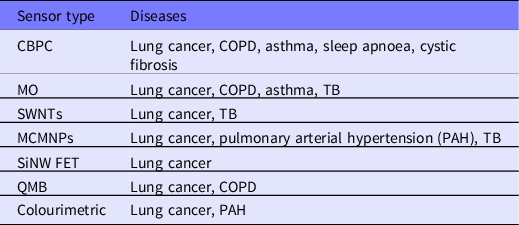
The second approach to chemical sensors uses an array of sensors that are each reactive to a different range of VOCs. Reference Broza and Haick27,Reference Nakhleh, Amal and Jeries28 The pattern of activation of these sensors can be analyzed to identify compounds within a breath sample. VOC patterns in exhaled breath can be matched to the pattern of activation characteristic of a given respiratory illness. These arrays operate in a variety of ways, the most common method is by means of chemiresistors. Reference Vishinkin and Haick29 These have their resistivity changed relative to the build-up of VOCs on an organic layer or experience steric changes in the sensing layer that affects the charge transfer. Incorporating an array of cross-reactive/semi-selective sensors combined with pattern recognition software (machine learning and/or AI), this system is similar to the human sense of smell. Reference Behera, Joshi and Anil Vishnu30 This approach has successfully been used to detect patterns of VOCs and create a “breathprint” for a specific disease (such as has been done for lung cancer and diabetes). This approach does not aim to recognize each specific VOC, it aims to identify the general pattern for the disease and, thus, would be an ideal approach for exploring patterns for COVID-19. Exhaled breath contains more than 3000 VOCs, and these VOCs can be correlated with internal biochemical processes in the body to associate them with a particular disease and can then be detected with a specific type of sensor material (see Table 1).
Different sensor types corresponding to their use in detection of select diseases Reference Fens, Zwinderman and van der Schee22

Abbreviations: CBPC, carbon black polymer composite; COPD, chronic obstructive pulmonary disease; MCMNPs, monolayer-capped metal-coated nanoparticles; MO, metal oxide; QMB, quartz microbalance; SiNW FET, silicon nanowire field effect transistors; SWNTs, single-walled carbon nanotubes; TB, tuberculosis.
After interfacing with a breathalyzer device used to detect COVID-19, the breath data submitted by the patient should be sent to a private Internet or cellular network’s database to safely store and process the result, similar to remote alcohol monitoring systems. Reference Koffarnus, Bickel and Kablinger31,Reference Lee32 Ideally, a patient would be notified privately shortly after submitting their sample; however, due to the logistics of testing in a mass setting, a patient’s result may need to be sent by means of a more secure route. Reference Masood, Wang and Daud33 The result could potentially be given in a secure physical package or sent to a patient’s email or phone by means of text-message. There are a variety of ways results can be delivered to patients but they should always take into account issues relating to privacy and patient autonomy, especially considering the added risks presented by public testing sites. Reference Masood, Wang and Daud33
Technology using “breathprints” such as e-noses have the potential to be used in the COVID-19 crisis. The e-noses provide the opportunity to gather breath samples and provide analysis in 1 device. Reference Fens, Van der Schee and Brinkman25 Using chemical sensors, most likely the array approach due to their broad specificity, e-noses can also directly sample from an individual. This introduces the potential to produce on-the-spot results. Similar to the breathalyzers used to detect alcohol, which come in many forms (including infrared spectroscopy and semiconductor analysis), e-noses allow for sampling to be paired with on-the-spot analysis to provide quick results for COVID-19 patients.
Discussion
Breath analysis has been used in multiple different contexts, such as for the detection of drug use and identification of potential disease. Reference Bos, Weda and Wang17 As such, it is natural to ask whether such an approach could be used for the detection of COVID-19. A similar concept has been proposed previously by Khoubnasabjafari et al., Reference Khoubnasabjafari, Jouyban-Gharamaleki and Ghanbari34 who wrote about the possibility that exhaled breath concentrate (EBC) could serve as a specimen for lab analysis by means of RT-PCR. More recently, Exhalation Technology, a company out of the United Kingdom, has announced results from a clinical trial of their point-of-care rapid diagnostic test for COVID-19. Reference Mason35 Their test, dubbed the CoronaCheck, detects the presence of COVID-19 by means of EBC using electrochemical sensors, providing results in under 5 minutes. Initial results from their clinical trial have indicated that the test is highly sensitive and specific, and while the test has yet to achieve regulatory approval, it demonstrates that the rapid detection of COVID-19 using exhaled breath concentrate is possible. Furthermore, researchers have begun performing studies using the sensors in smartphones to analyze breath samples for COVID-19. Reference Maghded, Ghafoor and Sadiq36
One of the benefits of using breath analysis over other traditional methods for detecting COVID-19 is that it is a noninvasive method. Breath analysis techniques simply require that you breathe onto a particular device as opposed to being pricked such as in blood samples or swabbed as with nose swabs. This could make it simpler for individuals to participate in testing as any anxiety and pain associated with invasive methods can be avoided. The second benefit that they provide over traditional testing kits is that they require less training to administer. They do not require a trained professional as with a nasal swab or a blood sample, only the changing of a disposable mouthpiece or sample container. Reference Krisher, Riley and Mehta37 On a wide scale, this can make it easier for staff and volunteers to operate said testing equipment, and to operate them in environments outside of a typical testing clinic. Ultimately, the test procedure being training free makes test administration all the more feasible to be implemented in a streamlined manner on a wide scale. The third advantage is that they use reusable and portable technology. Breath analysis sampling technology is typically small, compact, and durable. Reference Krisher, Riley and Mehta37 This contrasts with other testing methods that often contain multiple components, are fragile, and disposable.
While breathalyzer technology has many potential benefits in large-scale applications, such as pandemic responses, there exists some challenges associated with their implementation. While breath analysis devices that can both sample and perform analysis tend to be cheaper than the lab equipment needed to analyze nose swabs, blood testing, and breath samples, their use would necessitate multiple devices at one site resulting in a large upfront cost. This may end up being more expensive upfront than individual testing kits being sent to labs for analysis. As such, any solution involving breath analysis would likely include the collection of breath samples with analysis being done elsewhere as the large upfront cost may prove unfeasible given the current situation. Additionally, that patient data needs to be handled in a robust and secure private network means that there is an even larger upfront cost to create that network or use a pre-existing one. Reference Lee32,Reference Masood, Wang and Daud33 Furthermore, as breath analysis techniques such as the e-nose are generally reusable, they would not create ongoing revenue for the companies that manufacture them. This could create difficulty when trying to get investment into a wide platform for these technologies as it is less profitable than other methods of diagnosis.
Other challenges of using breath analysis for the detection of COVID-19 and pandemic responses in general would be that there is currently a need for standardization in breath analysis products, a problem that is not made any easier when attempting to fast-track solutions. Reference Das and Pal38,Reference Wallace and Pleil39 One example of this issue is the fact that different types of breath analysis use different techniques for identifying VOCs, each of which have different aims. Mass spectrometry breaks down the components of a mixture of gases, while e-noses only analyze the overall pattern or “print” of a breath sample. This could lead to discrepancies between tests conducted using these methods. Additionally, the varying collection methods from polymer bags to steel canisters require particular methods to analyze the samples correctly, adding another layer of complexity to breath analysis sampling. Reference Wallace and Pleil39 Together, all these standardization problems serve as a barrier to implementing breathalyzers as a testing method for COVID-19 and future biological crises.
COVID-19 variants may also pose a problem in the widespread implementation of breathalyzers to detect COVID-19. While a VOC pattern for COVID-19 may or may not be identified, it is safe to assume that variants of COVID-19 (such as the delta variant) may possess a different VOC profile. Reference Kuo, Tan and Wang16 If this is true then this would hinder the ability of breathalyzers to detect COVID-19 as a characteristic VOC pattern for the variant would have to be identified and AI systems would have to be re-trained to identify the pattern in exhaled breath. Reference Laguarta, Hueto and Subirana15 This may even result in the sensors of the breathalyzer having to be adjusted to be more flexible in their detection range of VOCs. Reference Kuo, Tan and Wang16,Reference Broza and Haick27,Reference Nakhleh, Amal and Jeries28 As this is a time consuming process, it would significantly influence the performance of breathalyzers in a pandemic such as this. However, it is also possible that, despite the genetic variance between strains, the eventual VOC pattern in exhaled breath may not be affected, similar to how some vaccines remain effective despite different variants emerging. Reference Conti, Caraffa and Gallenga40
Other issues associated with breath analysis are related to the detection of VOCs. Reference Das and Pal38 Breath from the human airway mainly comes from the upper esophagus as opposed to from the alveolar space in the lungs, so VOCs originating from lung tissue are dilute in exhaled breath. Reference Das and Pal38 In addition, poor oral hygiene serves as a possible route for contamination of VOCs as well as ambient air quality such that sampling from different environments affects sample profiles. This would provide a large roadblock in wide-scale implementation as these environmental standards for sample containment and sampling may not always be maintained. It is also very challenging to detect target VOCs among thousands of others.
Conclusions
As the COVID-19 pandemic progresses, the need for rapid, equipment-light, reliable testing methods continues to be high. Breath analysis techniques offer potential to fill these needs, and in fact, there are currently devices awaiting approval that make use of exhaled breath concentrate and breath analysis for diagnosis of COVID-19. Apart from the difficulties inherent in determining whether there are characteristic VOCs present in the exhaled breath of COVID-19 patients that can be used for diagnosis by means of breath analysis, the use of this technology in COVID-19 diagnosis would require infrastructure that is not currently in place. Despite the challenges discussed in this study, it is worth investing in systems that would allow for the standardization of breath analysis techniques on a broad scale, as they could prove instrumental in providing rapid diagnosis of COVID-19, better enabling the management of disease outbreaks in communities and ultimately, better prepare health systems to respond to similar crises in the future.
Acknowledgment
This research received no specific grant from any funding agency in the public, commercial, or not-for-profit sectors.
Conflict(s) of interest
None; Audacia Bioscience does not perform COVID-19 testing by means of breath analysis.