There has been much discussion on the use of particles (also referred to as ‘discourse particles’ or ‘pragmatic particles’) as a key feature of Singapore English. Wong (Reference Wong2004) has pointed out that particles are essential in the Singapore speech community, and in order to pass as a functional member of the speech community a speaker needs to have a proficient knowledge of the meanings and functions of particles in spoken (and increasingly in texted) discourse. There is no doubt that the use of particles in Singapore Colloquial English is prevalent in the language use of speakers in Singapore, as attested by the numerous studies conducted on the topic since the 1970s (including Tongue, Reference Tongue1974; Richards & Tay, Reference Richards, Tay and Smith1981; Kwan–Terry, Reference Kwan–Terry1978; Platt & Weber, Reference Platt and Weber1980; Platt, Weber & Ho, Reference Platt, Weber and Ho1983; Platt & Ho, Reference Platt and Ho1989; Gupta, Reference Gupta1992; Wong, Reference Wong2004, Reference Wong2005; Wee, Reference Wee2002, Reference Wee2003, Reference Wee and Lim2004, Reference Wee2010; Liemgruber, Reference Leimgruber2016; Botha, Reference Botha2018). Despite the fact that particles have been studied extensively, very few studies have investigated which particular particles can be considered prototypical in Singapore English in general, as well as more specifically in the vernacular speech of Singaporeans. Not only that, there appears still to be a lot we do not know about the functions and uses of many of these particles, specifically in the vernacular speech of Singaporeans.
Although this study focuses on the vernacular language of speakers in the social networks of Singapore university students, and the conclusions may not be readily applied to the Singapore community as a whole, the patterns of language use that are presented in the findings here are certainly worth considering due to the frequency of the patterns that are presented in this article. In a recent study (Botha, Reference Botha2018) I proposed that that the particles ah, lah and eh are potential contenders for a generalized Singapore English ‘feature pool’ (Mufwene, Reference Mufwene2001). In this article, I aim to present a description of the functions (both semantic and social) of the particle leh in Singapore English, and to argue that this particle is increasingly becoming a feature of the vernacular speech of Singaporeans in general. As few studies have attempted to correlate the use of leh with relevant social variables, this article, by contrast, investigates various social variables that co-occur with the use of this particle. This article also provides findings of extended uses of this particle.
The article begins with a brief background to the sociolinguistic context of the study, before reviewing relevant studies of the particle leh in the Singapore context. Next, I introduce the research methods for this research project, which are aimed at analyzing naturalistic language data drawn from the language use of Singaporean students in their respective social networks. After the findings for the study are presented the article is concluded with a discussion and conclusion, where the findings of the study are set against the research questions for the project, which may be stipulated as follows: (i) to identify the frequency patterns of the use of leh in the social networks of students, with reference to various social variables such as modality, gender, and the ethnicity of the speakers; (ii) to identify the functions of leh in the spoken discourse of the speakers; and (iii) to indicate the frequency of the functions of leh in the social networks.
leh in Singapore English
For those readers unfamiliar with the language situation in Singapore, it is worth pointing out that in the country there are four official languages and one national language, with English, Malay, Mandarin and Tamil the official languages, and Malay the national language. In Singapore, around 74% of the population are ethnic Chinese, 13% are Malay and 9% are Indian, with some 35% of the population reportedly using Mandarin as a usual home language, and almost 37% use English (Department of Statistics Singapore, 2016). In this current study reported on here, the participants were selected based on the ethnic profile of Singapore in order to ensure that the data is more generally representative of the (‘official’) Singapore ethnic situation. Many studies of English in Singapore (or Singapore English) have argued that there are two varieties of Singapore English, that is, Singapore Standardised English (or SSE), which resembles Standardised British English (Cavallaro, Ng & Seilhamer Reference Cavallaro, Ng and Seilhamer2014), and Singapore Colloquial English (SCE). Features of SSE have been discussed in Wee (Reference Wee and Lim2004), while SCE features have been discussed in terms of lexical productivity (Low & Brown, Reference Low and Brown2005; Leimgruber, Reference Leimgruber2011), substrate-influenced syntax (Bao & Wee, Reference Bao and Wee1999); use of pragmatic and discourse particles (Lim, Reference Lim2004; Wee, Reference Wee and Lim2004; Botha, Reference Botha2018), and phonology (Lim, Reference Lim2004; Deterding, Reference Deterding2005). As such, this article focuses on a specific feature of SCE.
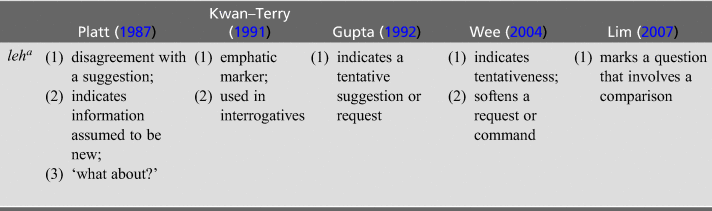
The particle leh in Singapore Colloquial English has received some discussion over the past three decades. Lim (Reference Lim2007: 461) has argued that this particle has a Cantonese origin and notes that a similar particle le 55 (with a ‘high level’ tone marking) exists that is used to form a question, has a comparative function, and that it means ‘what about?’. In Singapore English, Lim (Reference Lim2007: 461) argues that leh serves to ‘mark a question that involves a comparison’. For Lim, the substrate influence(s) on this particle should not be ignored when considering the functional meaning of this (as well as other Singapore English particles). Gupta (Reference Gupta1992) has proposed what she refers to as a ‘scale of assertiveness’, where she situates leh somewhere near the middle of her scale, where the particle can be used to express some degree of assertiveness, and that it indicates a tentative suggestion or request. Wee (Reference Wee and Lim2004) has also suggested that this particle is a marker of tentativeness, as well as used to soften a request or command in Singapore English. Earlier, Platt (Reference Platt, Steele and Threadgold1987) has suggested that this particle indicates a disagreement with a suggestion, conveys information that is assumed to be new, and that it can also mean ‘what about?’; while Kwan–Terry (Reference Kwan–Terry and Kwan–Terry1991) has suggested that leh is used as an emphatic marker (such as in declaratives or imperatives) and used in interrogatives. Table 1 below indicates a summary of the functional uses of leh in the literature on particles in Colloquial Singapore English.
Summary of the functional uses of leh in the literature

a Note that different spellings of leh are used by some of these authors, with Platt (Reference Platt, Steele and Threadgold1987) using le 22 and le 55, and Kwan–Terry (Reference Kwan–Terry and Kwan–Terry1991) using le 33 and le 55.
In terms of the frequency of use of leh in SCE, some studies have attempted to order the place of Singapore English particles in terms of how often they are used in discourse. Smakman and Wagenaar (Reference Smakman and Wagenaar2013) placed leh at number six in their list of eight investigated particles in terms of frequency of use, similar to Ler (Reference Ler and Fischer2006) which placed this particle at number eight of her list of ten particles in Singapore English. In a previous study of the frequency and distribution of particles in the vernacular speech of students in their social networks, Botha (Reference Botha2018) places leh at number five of the 16 particles investigated. It needs to be noted that the frequency and distribution of these particles often depends on the type of language data that is used for analysis, which reveals that not all SCE particles in such studies are always included in the range of particles that are investigated (for example, those particles of a so-called Malay origin [such as sia and seh] and datasets may often be skewed in terms of ethnicity towards a far greater number of words by a certain ethnic group in the data [as in Smakman & Wagenaar, Reference Smakman and Wagenaar2013]). In the next section I proceed to describe the research methods for investigating the description of leh.
Researching leh in the vernacular speech of students
The social network research approach that was used for this study has already been described in previous publications which investigated particles in the vernacular speech of Singapore students (Botha, Reference Bothain press). This approach has also been developed from my earlier research on language in social networks (Botha, Reference Botha2012, Reference Botha2017; Botha & Barnes, Reference Botha and Barnes2013, Reference Botha and Barnes2015), which focused on the vernacular speech of speakers in South China, and the reader is directed to these references for details regarding the methods that were employed for this current study. However, for the sake of clarity, the approach used for this present study presented is briefly summarised below.
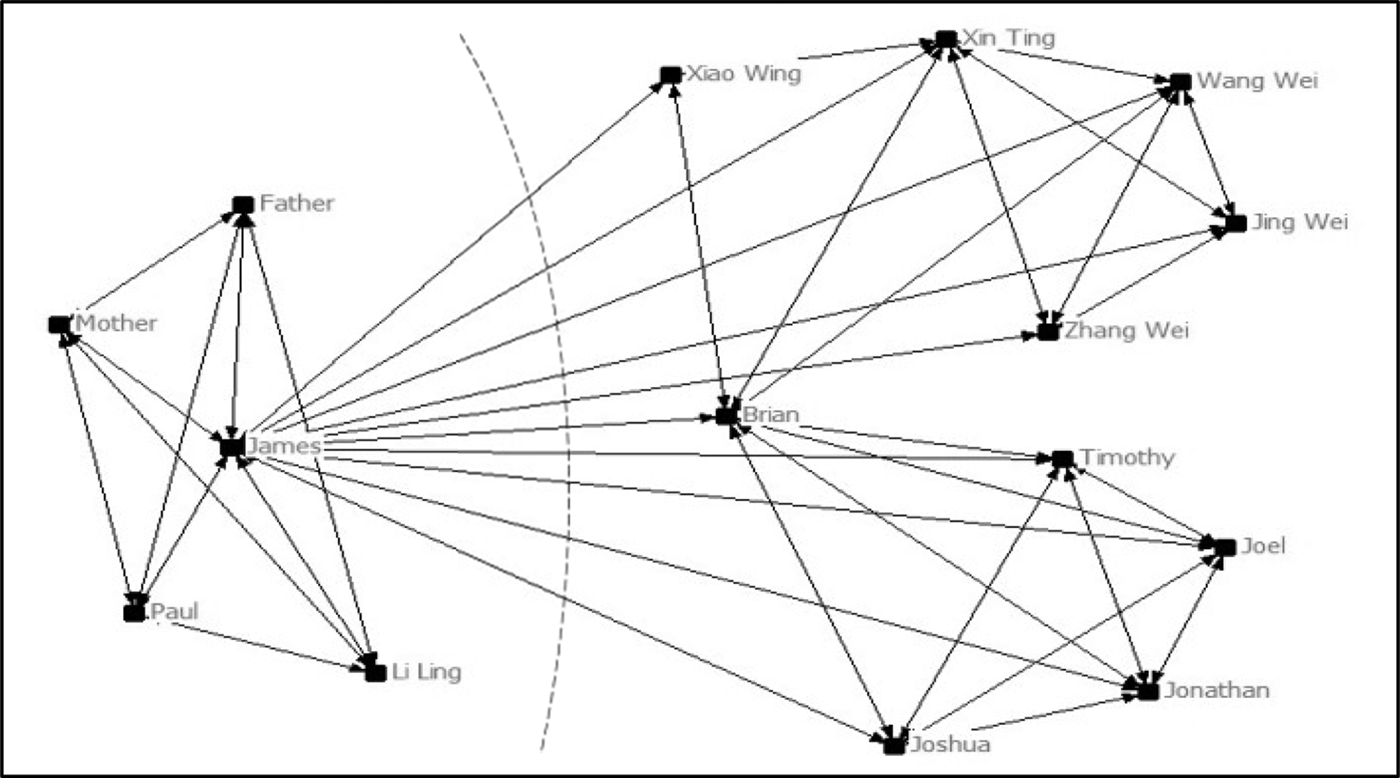
Three ethnic Chinese students, two ethnic Malay students, and one ethnic Indian student participated in the research. Each of these participants acted as the main subject (or ‘ego’) of their individual social networks. The first stage of the study involved establishing the connections (or ‘ties’) that each student had with people that they were in regular contact with. In Figure 1, a visual representation is shown of one of the social networks that were investigated for this study. From this figure it can be seen that there is a distinction made between the first- and second-order network zones in the social networks of the student, where members in the first-order zone all know one another and are in regular contact with one another. In the second-order zone not all the members know one another except the ego of the network, but these members are all in regular contact with the main subject. Interestingly, this study reveals that with the six social networks that were investigated for this study, nearly all the members of each social network are of the same ethnicity as the main subject of the study, especially in the first-order zones, where all the members are of the same ethnicity as that of the main subject.
Visual representation of one of the Chinese social networks, showing the first- and second-order network (adapted from Botha, Reference Botha2018)

During the next stage of the study, all the participants (that is, social network members of each network) were informed that their conversations with the main subject would at times be recorded, and that they would be made aware of when each recording would be conducted. All the participants were later anonymized in the reporting of results related to this study. The main subject of each network would meet members of their social networks in relaxed social settings and proceeded to record their conversations. These recorded conversations and discussions were on average around 20 minutes in length. The recordings were then transcribed using an adapted version of Du Bois’ (Reference Du Bois1991) transcription method in order to facilitate data analysis. Text messages of and between subjects in their social networks were also collected, consisting of a dataset of some 300,000 texted words, but the spoken discourse was the main focus of the study that is reported in this article. In addition, self-report data on the language use and language backgrounds of the subjects were also collected by means of a short language survey, which was used for obtaining basic demographic data of all the participants. Just over 70,000 words were recorded in the spoken conversations.
A total of 57 subjects took part in the project. The sample characteristics were recorded through the language survey and reveal that 71.9% of the participants were between the ages of 19 and 24, and 28.1% were aged 25 or older. As for the gender of the subjects, 49.1% males and 50.9% females were represented in the study. And in terms of ethnicity, 63.2% of the participants in the sample were Chinese, 22.8% were Malay, 10.5% were Indian, and a further 3.5% were of ‘other’ ethnicities. The sample for this study is to some extent representative of the ethnic makeup of Singapore society when compared to figures for ethnicity in the city-state as a whole (Department of Statistics Singapore, 2016), despite a slight overrepresentation of Malay subjects, and a slight underrepresentation of Chinese subjects.
The use of leh in the social networks
The frequency of leh in the networks
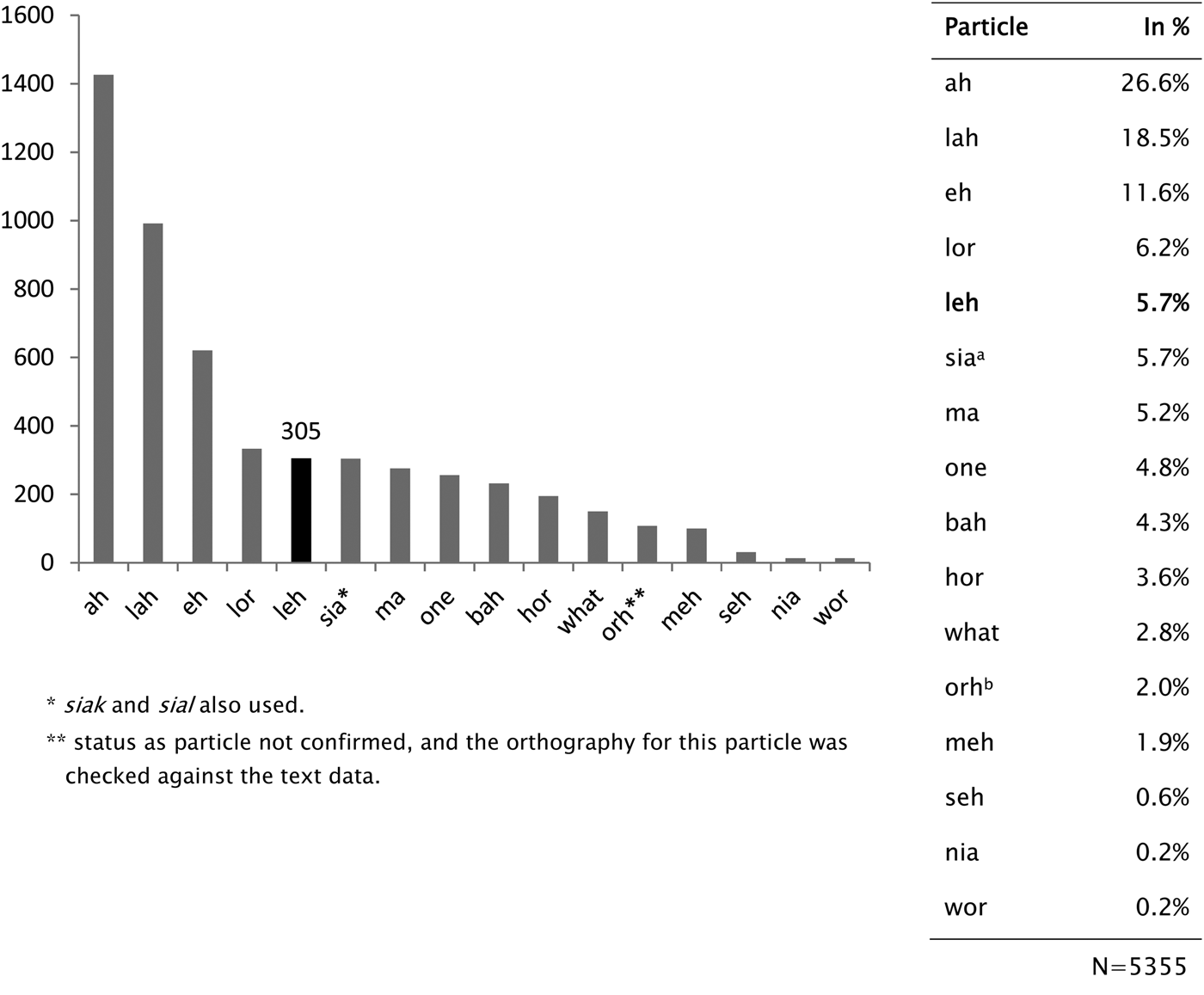
In this part of the article I proceed to present the findings of my results on the social contexts to the use of leh. The results here are discussed with reference to the research aims that were introduced above, where the first aim concerns the frequency patterns of the use of leh in the social networks of students, with reference to various social variables such as modality, gender, and the ethnicity of the speakers. As can be seen from Figure 2, the overall number of these selected particles is 5,355 (or some 1.5% of the total number of words and utterances in the spoken data). From these results, it is clear that certain particles are used much more frequently than others, with ah, lah and eh occurring considerably more frequently than the other particles. These results indicate that leh is the fifth most used particle in the data, occurring 305 times overall, with 176 (6.9%) occurrences in the spoken data.
Overall frequency distribution of leh, compared with other particles in the social networks (adapted from Botha, Reference Botha2018)

The frequency patterns reveal that there is very little difference in terms of modality (or medium of communication) and gender. The biggest difference was shown to occur with the ethnicity variable, where, of the 176 occurrences in the spoken data, the particle appeared 170 times in the Chinese networks (or 96.6%), five times in the Malay networks (2.8%), and only once in the Indian network (0.6%). These results indicate that ethnicity is an important variable in the use of leh, with Chinese speakers predominantly using this particle. However, the occurrence of this particle in the spoken data in the Malay and Indian networks indicates that this particle is now perhaps being appropriated by some Malay and Indian speakers.
The functions of leh in the spoken discourse of the speakers
The findings also reveal that there are a number of additional functions to the use of leh, compared to those functions that have been identified in the literature (as summarized in Table 1 above). Besides the functions summarized in Table 1, additional functions were also identified and these are summarized as follows.
Softening
There are a number of ways in which leh is used to soften an utterance (besides the previously identified function of softening a request or command identified in Wee, Reference Wee and Lim2004). The following additional softening functions were identified in the recorded data.
Softening a disagreement
Leh was found to be frequently used to soften disagreements between speakers. An example of how this is done is shown in Extract 1, with the use of ‘Technically wrong leh’, where A disagrees with an idea that was raised and discussed by C. Here leh is used to soften the disagreement and make the disagreement less emphatic.
Extract 1
A: Okay that's fine.. that's fine because you also do it.. ni3 hen3 huai4 @ then.. then he'll like ask he'll question how watertight wo3 men2 de argument is right.. would it make sense anot and all that then come to his turn to present ah.. ta1 de.. @.. idea.. gen1 ben3 don't make sense.
Okay that's fine.. that's fine because you also do it.. you are terrible @ then.. then he'll like ask he'll question how watertight our argument is right.. would it make sense or not and all that then when it comes to his turn to present.. his.. @.. idea.. simply doesn't make sense.
B: This is.
A: Technically wrong leh.. we see already like.. what the hell is he saying like.. he go and use a a small chip to go and charge a.. of of 2 volts to charge a 4-volt battery I think wo3 you3 gen1 ni3 jiang3 guo4.. you can't use 2-volt charger to volt.
Technically wrong leh.. when we watched (his presentation we wondered) like.. what the hell is he saying like.. he used a small chip of 2 volts to charge a 4 -volt battery I think I told you this before.. you can't use a 2 -volt charger to volt.
Another example of how leh was used to soften a disagreement is shown in Extract 2, where it can be seen that A disagrees with B, about a friend someone being better (fine/healed). The softening of this disagreement is initiated with ‘Mm zai’ (Don't know), but is softened with leh in order to keep the social bonds between A and B.
Extract 2
G: I1 hor3 hor3 leh. @ Mm zai @
Teochew, She was fine though. @ Don't know @
H: [Mm zai i1 hor3 hor3 leh.] ki3 guai3
Teochew, Don't know, she was fine leh. Weird.
Softening a question
The use of leh was also found to soften questions in some of the interchanges, and an example of this is shown in Extract 3. Here the question ‘wei4 shen3 me bu4 hui4 zuo4 leh?’ (Why doesn't he know how to do it?) is softened with the particle leh, and could also be used in a similar way as with the question particle ne, in Mandarin Chinese, which is often used to soften questions.
Extract 3
Z: Ah.. bu4 shi4 wo3 jiang3 homework.
Ah.. that's not what I call homework.
X: ta1 homework assignment la?
Is it his homework assignment?
C: wei4 shen3 me bu4 hui4 zuo4 leh?
Why doesn't (he) know how to do it leh?
Softening an opinion
In Extract 4, and example is given of how leh is used to soften an opinion, which was found to be somewhat frequent in the use of this particle. In this instance, B states that it is her opinion that it is a bad idea to let ‘him’ buy a pair of sunglasses. The use of leh here is to indicate a softening of the opinion that it is a bad idea to get another person to buy a pair of sunglasses for her.
Extract 4
A: Later you boom boom boom then throw at someone. @ Later you throw at someone
B: [@] [No] then in the in.. Under the light hor…(7) Their shades are nice.. Kay later I shall bring him here. @… But like very bad leh.. get him to buy. Ai4 ya3 (Cantonese expression of displeasure) don't want la don't want la..
then in the in.. Under the light…(7) Their shades are nice.. ’kay later I shall bring him here. @… But like very bad leh.. get him to buy. Ai4 ya3 let's not make him do it..
Softening a protest
Examples where leh was used to soften a protest were also observed in the data, as can be seen in Extract 5, with the expression ‘Tired leh’, where C is softening her protest of being tired with the use of the particle.
Extract 5
C: Don't know leh…(6) Go home first thing I do is kun3 [Hokkien, meaning sleep] sia.. I do is kun3. Cannot take it sia.. Tired leh!
Don't know leh…(6) The first thing I do when I reach home is to sleep… I do is sleep. I cannot take it already.. Tired leh!
G: @ that's what you always say. School.. work.. no work.. also kun3.
@ that's what you always say. School.. work.. no work.. also sleep.
Tentative reminder
The particle was also used as a tentative reminder in some instances, as can be seen in Extract 6. In this extract leh is used to indicate a tentative reminder to AM that there is still some ‘mushroom potage’ left.
Extract 6
AM: you3 banana milk.
There's banana milk.
B: hai2 you3 ni3.. hai2 you3 ni3 de mushroom potage leh.
There's still your.. there's still your mushroom potage leh.
AM: Yeah sia.
Yeah sia.
To signal helplessness
In Extract 7, an example is shown of how leh is used to signal helplessness. Helplessness here refers to the feeling that nothing can be done or said about a particular thing or situation, and in this extract leh is used to signal that she is uncertain about going.
Extract 7
M: Orh = .. so confirm going already ah?
Okay = .. so it's confirmed that you're going?
B: Don't know leh.
Don't know leh.
F: Ai4 ya3.. don't keep on = pressure la he also don't know one la = .
Ai4 ya3.. don't keep pressuring him he doesn't know either anyway.
To ask for support
Finally, instances were also observed where leh was used when asking for support (as in, to support an opinion), as can be seen in Extract 8. In this extract, the particle is used to request for agreement/approval from the listener, where B tells A that he will request his brother to bring his calculator to him instead of B returning home to retrieve it himself. B attempts to address the inconvenience that he might cause his brother by using leh in his justification ‘it's better than me going home and taking it’ to seek A's support of his decision, which we can see in A's response ‘yeah’.. It's B saying ‘this idea is not that bad, please support me by agreeing with what I've decided’
Extract 8
B: [I I] I ask my brother to bring it.. as in.. if he's going to school.. I meet him somewhere nearby.
I asked my brother to bring it.. as in.. if he's going to school.. I'll meet him somewhere nearby.
A: He's in which poly again?
Which poly(technic) is he in again?
B: SP… it's okay ah = it's better than me going home and take taking it leh.
SP… it's okay ah = it's better than me going home and taking it leh.
A: Yeah… Yeah…
The frequency distribution of the functions
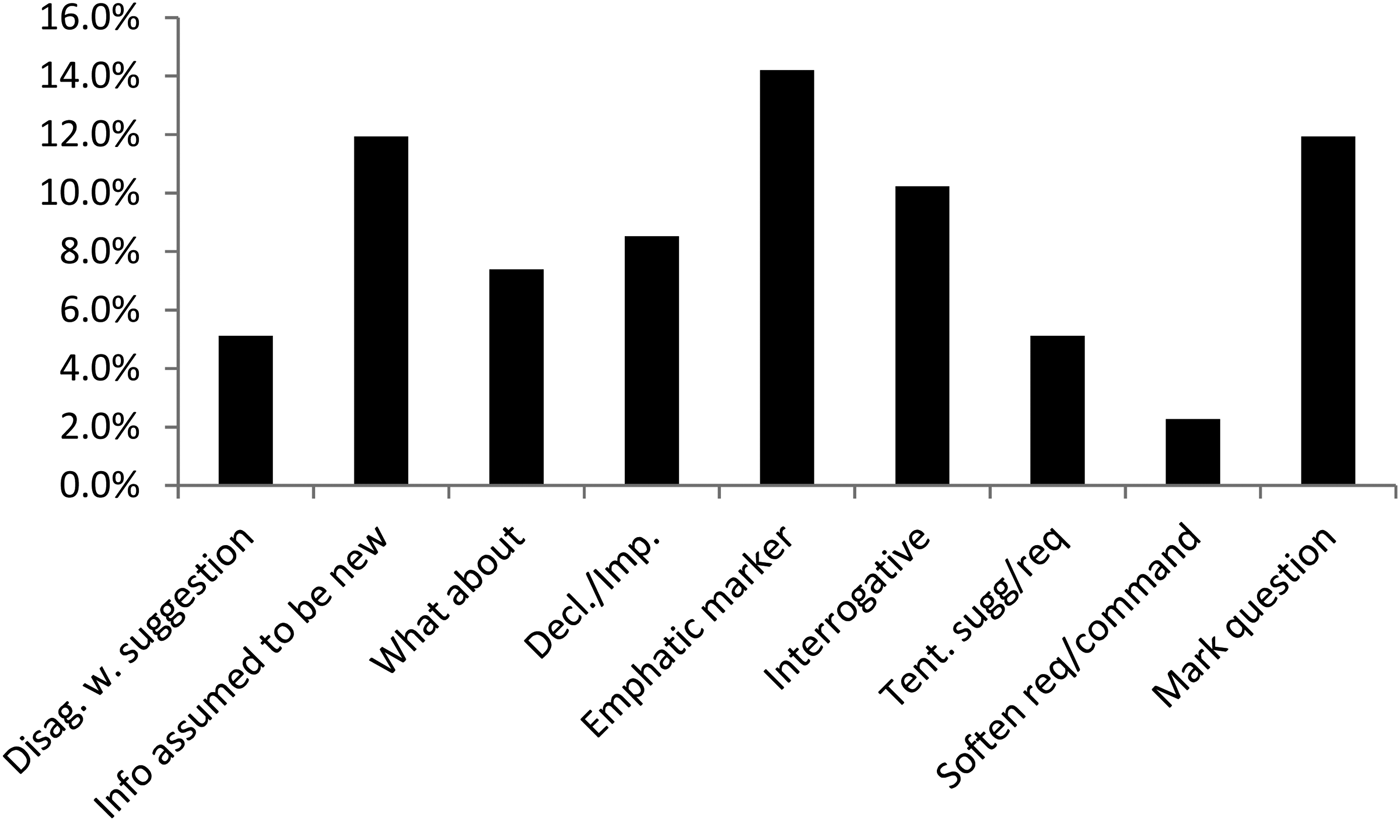
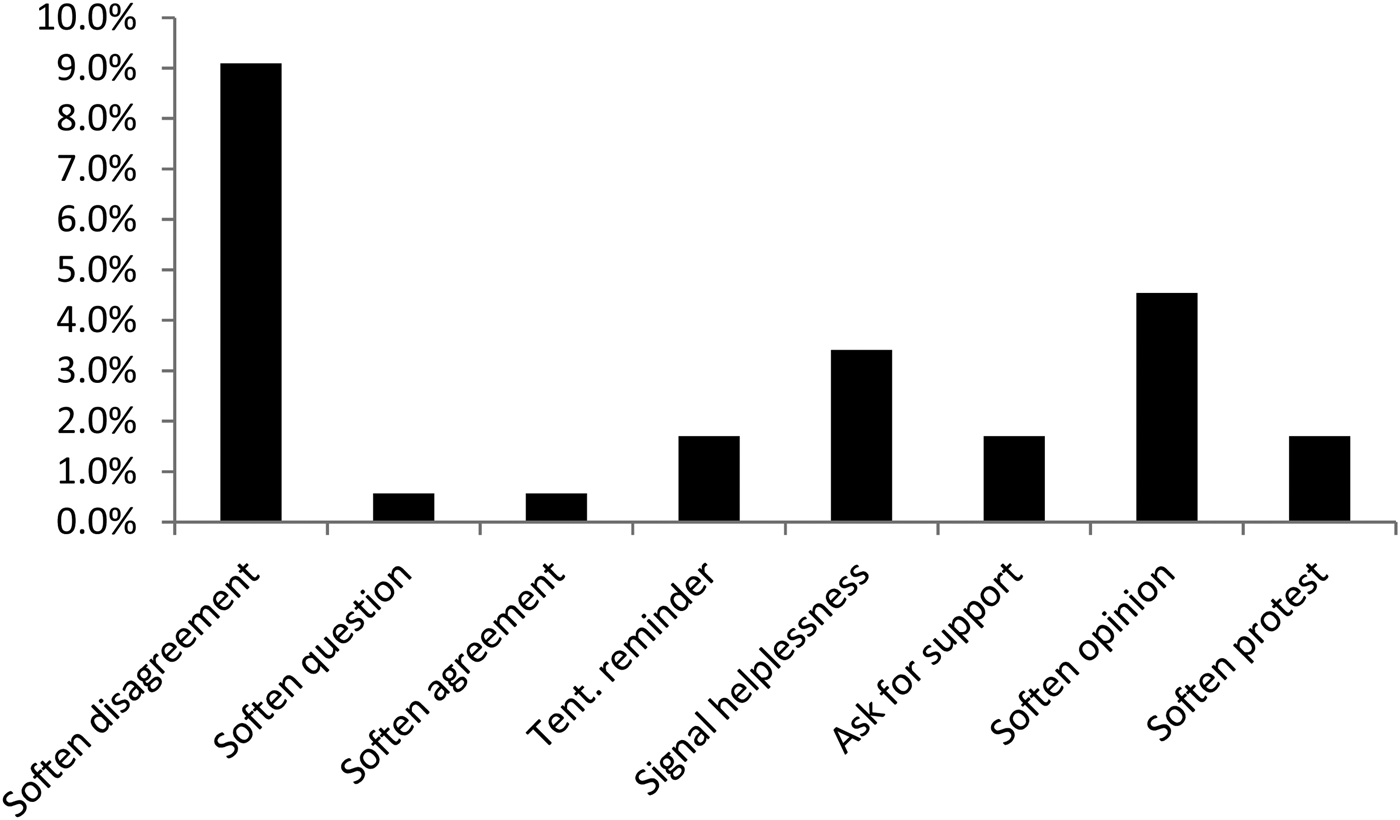
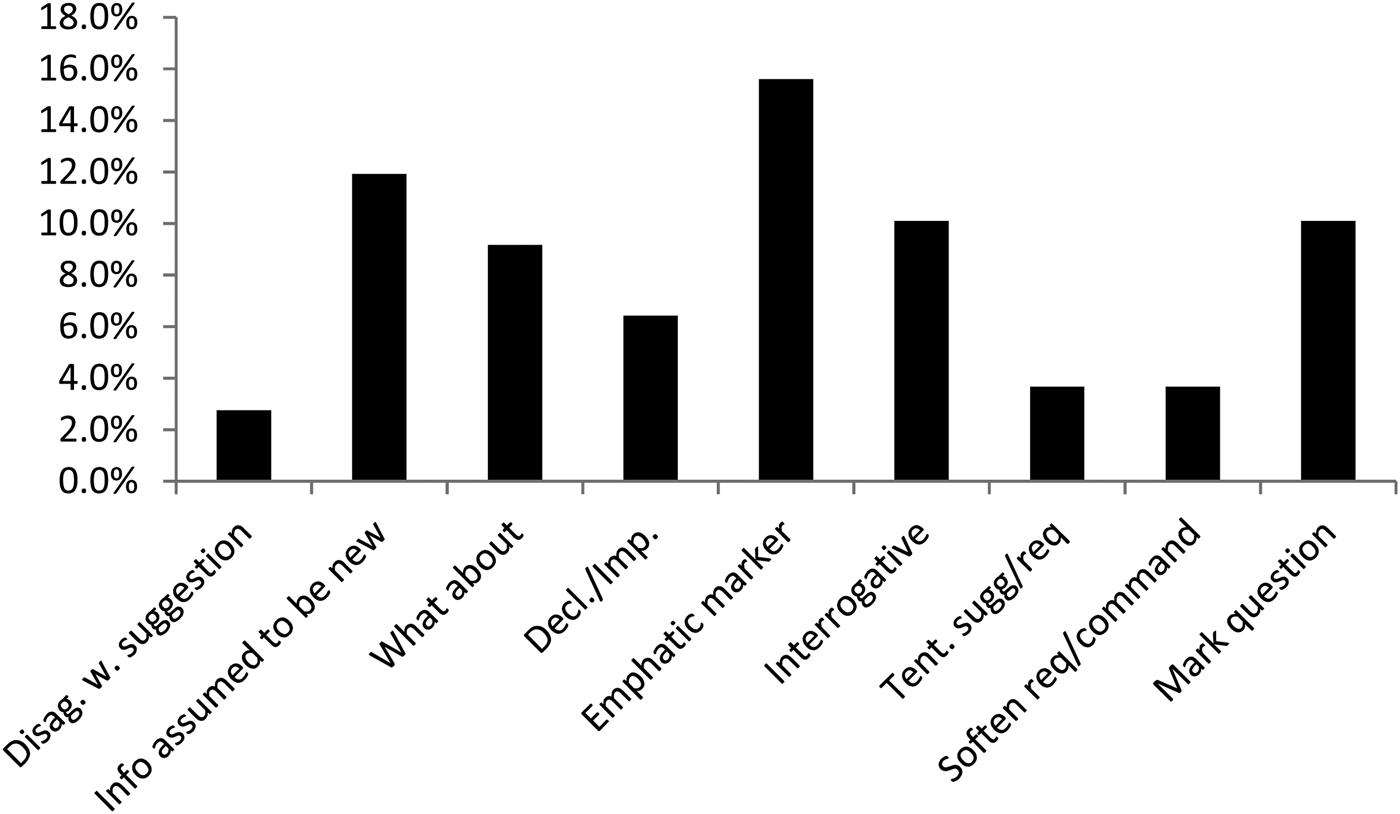
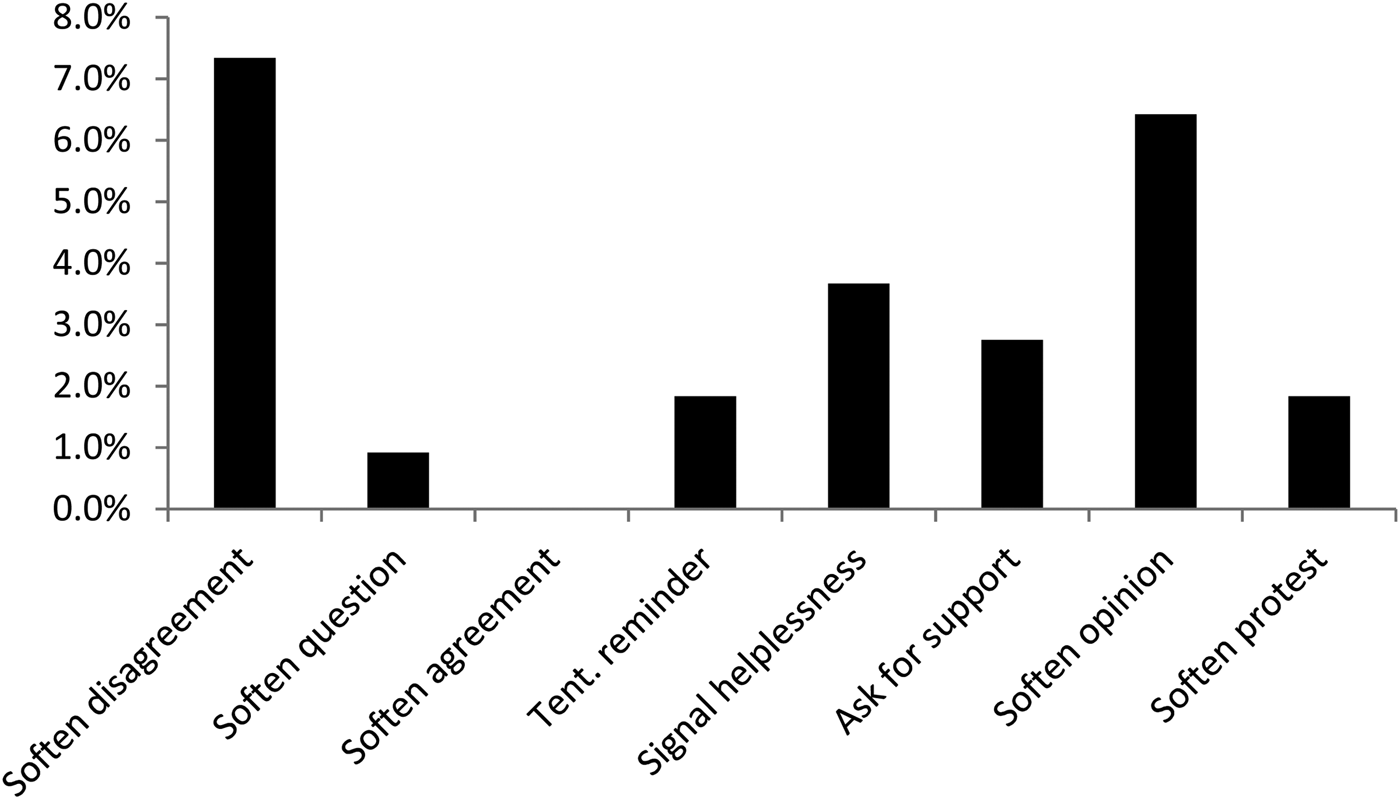
The data was also analyzed to determine the frequency distributions of the identified functions of leh. The results of this analysis are presented in Figures 3 to 6, showing (1) the function patterns for leh in the data according to the previously identified functions identified in the literature; (2) the functions for leh according the additional functions identified in this current study; (3) the distribution of the previously identified functions in the English only exchanges; and (4) the distribution of the additional functions of leh in the English only exchanges. This analysis of the data is motivated to indicate the spread and use of leh in the vernacular language use of speakers in the social networks, and also to compare the variations in the use of leh, according to the main language used in an interchange, with the view to establish the extent to which the functions exist in Singapore Colloquial English.
The frequency distribution of the functions of leh in the data, based on the functions in previous literature

The frequency distribution of the additional functions of leh in the data

The distribution of the previously-identified functions of leh in English utterances

The distribution of the additionally-identified functions of leh in English utterances

From Figure 3 it can be seen that the overall most frequent use of leh in the previously identified functions in the literature were as an ‘emphatic marker’ (14.2% of overall usage), when used to indicate when ‘information was assumed to be new’ (11.9%), to ‘mark a question’ (11.9%), to mark an ‘interrogative’ (10.2%), and as a ‘declarative/imperative’ (8.5%). The least frequent use of leh was used to ‘soften a request/command’ (2.3%).
The functions for leh according the additional functions identified in this current study are shown in Figure 4. Here it can be seen that the most frequent use of the particle is identified with the ‘softening a disagreement’ (9.1%), to ‘soften an opinion’ (4.5%), and to ‘signal helplessness’ (3.4%). The least frequent use was identified with ‘softening a question’ and ‘softening an agreement’ (0.6%).
In order to capture variation in the use of leh in the expressions where only English was used, or more specifically, where the particle was attached to an English expression, the results in Figure 5 indicate the distribution of the previously identified functions in such expressions. It can be seen in the figure, and similar to the results shown in Figure 3, the most frequent use in this context is as an ‘emphatic marker’ (15.6%), to indicate ‘information assumed to be new’ (11.9%), as an ‘interrogative’ (10.1%), to ‘mark a question’ (10.1%), and to mean ‘what about’ (9.2%).
Finally, Figure 6 shows the distribution of the additional functions of leh in the English only exchanges, where the most frequent uses are identified with ‘softening a disagreement’ (7.3%), to ‘softening an opinion’ (6.4%), and to ‘signal helplessness’ (3.7%). Less frequent use was identified with ‘softening a question’ (0.9%), and no instances of ‘softening an agreement’ were found in the English exchanges.
Conclusion
There are often a number of factors involved in determining the evolution of a feature in an English variety, and predictions about which features are selected from a so-called feature pool (Mufwene, Reference Mufwene2001) and how they affect the evolutionary trajectory of a language or language variety have often been challenging. Particles are a useful way in which we can see how the meanings or meaning potential of a feature are distributed across a range of contexts in a speech community, and by focusing on a particular particle one can identify its use, and how its use varies according to specific social situations and contexts. Another immediate observation from the data (as well as extracts above), is that the particle occurs often in contexts where code-switching and mixing occurs. However, by focusing on one of the lesser-studied particles in Singapore vernacular speech of speakers in their respective social networks, it can be seen that although the speakers in the ethnic Chinese social networks use this particle most frequently, this particle is also identified in the vernacular speech of Malay and Indian speakers. This possibly suggests that this particle is being appropriated by the Malay and Indian community and suggests an increasing use of this particle among these speakers. This also potentially suggests that the leh particle could be a contender as a general feature of Singapore Colloquial English, where its use is not restricted to the Chinese speech community, which is similar to the cases of lah, ah and eh (as discussed in Botha, Reference Botha2018). Gender did not seem to be an important indicator as to how this particle was used between men and women.
Another finding in this study concerns the identification of more detailed social functions of the use of the leh particle, as well as how frequently these functions occur when the particle was used with English utterances. The frequency distributions of these functions are valuable in that they can offer a clearer picture as to how frequently these functions occur in the vernacular speech of Singaporeans, and potentially which functions are likely to be used in Singapore English more generally. This is an area where future studies could compare the frequency distributions described in this article with studies of such functions in formal Singapore English (or even in inter-ethnic communications in Singapore).
As with all studies this current study has a few limitations that future studies on particles in Singapore English need to consider. First, only a few social networks were investigated in this study, and the findings cannot be generalized to the Singapore speech community as a whole. This is unfortunately due to the nature of detailed ethnographic studies such as in this current study presented here. The findings are also only reported of speakers in the social networks of university students, which admittedly represent only a rather elite fraction of Singapore society. Finally, a range of other social factors have still not been investigated, and these include the proficiency of speakers in their so-called mother tongues (Mandarin, Malay, Tamil) as well as the interethnic uses of leh which might reveal how shared meanings and understandings of the various social functions of this particle occur more broadly in Singapore English, in both formal as well as informal speech patterns.
Despite these limitations, it is the hope that this current study makes a valuable contribution to research on Singapore Colloquial English by providing an empirically-based account of how a particular particle is used with reference to specific social and contextual features, as well as how speakers’ affiliation to their ethnic group is an important variable with regards to how specific linguistic features are used in the vernacular speech of Singaporeans. Finally, this study also reveals additional social functions of leh that have not been previously detailed, as well as the frequency and distribution of those functions that have been previously identified in the literature.
 WERNER BOTHA is Assistant Professor at Nanyang Technological University in Singapore. His research interests include the use of English in Asian higher education, world Englishes, multilingualism, and language variation, with particular reference to the Asian region. Recent publications include research articles on the spread and use of English in China's higher education and on sociolinguistic variation in Cantonese. Email: wbotha@ntu.edu.sg