Introduction
Magnetoresistive (MR) read headsReference Maat, Marley, Xu, Awschalom and Nitta1 have been used in HDDs since 1990. IBM commercialized the first anisotropic magnetoresistive (AMR) head in 1991 and subsequently launched the first giant magnetoresistive (GMR) spin valve head in 1997. The introduction of AMR and GMR heads enabled significant recording areal density growth of 60–100% per year for almost a decade. To further advance recording density, the tunneling magnetoresistive (TMR) head was introduced by Seagate in 2004. The transition from AMR to GMR to TMR reader facilitated an area density boost from 2–3 Gbpsi to 200 Gbpsi to today’s 1 Tbpsi, along with recording scheme migration from longitudinal to perpendicular recording in 2006.
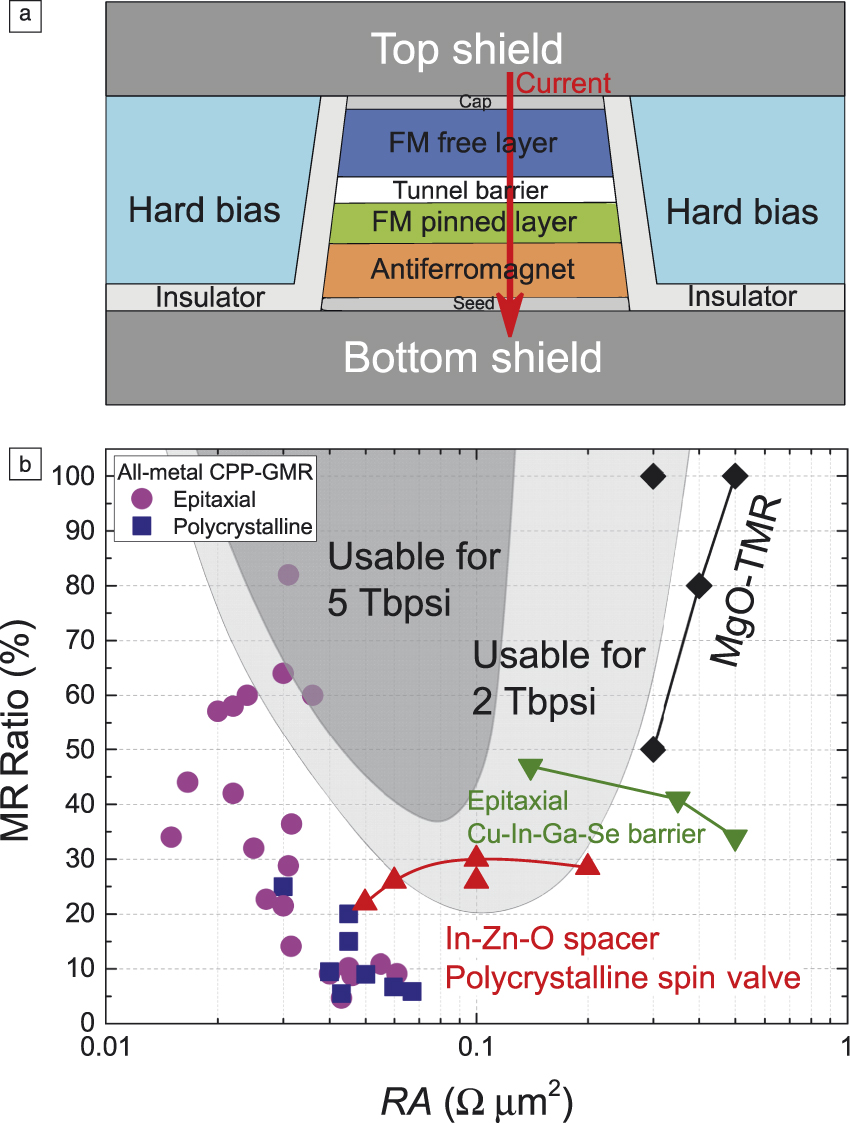
The MR read head structure principally consists of a ferromagnet/nonmagnet/ferromagnet (FM/NM/FM) trilayer MR sensor, a magnetic stabilization layer (antiferromagnetic pinning layer), and magnetic shielding layers (Figure 1a).
(a) Magnetoresistive (MR) read sensor with current-perpendicular-to-plane (CPP) configurations for hard-disk drives (HDDs). (b) MR ratio and resistance-area (RA) range requirements for the read sensor for 2 Tbpsi and 5 Tbpsi calculated by Takagishi et al.Reference Takagishi, Yamada, Iwasaki, Fuke and Hashimoto3 It should be noted that MgO-based tunneling magnetoresistance (TMR) substantially degrades with decreasing RA Reference Nagamine, Maehara, Tsunekawa, Djayaprawira, Watanabe, Yuasa and Ando13 and alternate materials are required. All-metal current-perpendicular-to-plane giant magnetoresistive (CPP-GMR) data using Heusler alloys with RA ≲ 0.05 Ω μm2 are plotted.Reference Valet and Fert19–Reference Sakuraba, Ueda, Miura, Sato, Bosu, Saito, Shirai, Konno and Takanashi23,Reference Goripati, Furubayashi, Takahashi and Hono25–Reference Carey, Maat, Chandrashekariaih, Katine, Chen, York and Childress29,Reference Read, Nakatani, Smith, Choi, York, Brinkman and Childress31–Reference Choi, Nakatani, Read, Carey, Stewart and Childress33 Recent experimental data from CPP-GMR using Heusler alloys and with conductive oxide (In-Zn-O) spacer layersReference Nakatani, Mihajlović, Read, Choi and Childress34,Reference Nakatani, Li, Sakuraba, Furubayashi and Hono35 and semiconductor Cu-In-Ga-Se barrierReference Mukaiyama, Kasai, Takahashi, Kondou, Otani, Mitani and Hono44 are included in the figure together with recent results for low-RA MgO-based TMR.Reference Kitada, Nakamura, Tanaka, Furukawa and Hatano17

Now that the areal density of perpendicular recording is approaching its limit of ∼1 Tbpsi, a transition to a new recording method is required. The initial goal will be 2 Tbpsi within several years, and thereafter in the range of 5 Tbpsi in a decade or so.2 The size of the read sensor (width and thickness) has to be smaller than 20 nm for 2 Tbpsi and smaller than 13.5 nm for 5 Tbpsi because the sensor size determines the spatial resolution of magnetic field sensing.Reference Takagishi, Yamada, Iwasaki, Fuke and Hashimoto3 The sensor width is defined by lithography and the sensor thickness corresponds to the shield-to-shield spacing (Figure 1a). Reduction of the sensor size will lead to an increase in the resistance of the sensor and a decrease in the volume of magnetic layers, which give rise to increases in thermal electric noise (Johnson noise and shot noise) and in thermal magnetic noise, respectively.Reference Smith and Arnett4 Hence, the signal-to-noise ratio (SNR) of the sensor is degraded as the sensor size is shrunk. New read sensors for next-generation high-density recording must exhibit sufficiently large voltage output (>10 mV) with a substantially low resistance-area (RA) product using thin total sensor thickness (shield-to-shield spacing) for low noise, high speed and high spatial resolution reading operations.
Figure 1b shows the usable RA and MR ratio estimated for read sensors for 2 Tbpsi areal density calculated using standard signal and noise scaling projections by Takagishi et al.Reference Takagishi, Yamada, Iwasaki, Fuke and Hashimoto3 A MR ratio larger than 20% is required at RA = 0.1 Ω μm2, while the required MR ratio increases rapidly as the RA value of the sensor decreases or increases from 0.1 Ω μm2. The increasing MR ratio requirement for the low RA range is due to increasing spin transfer torque noise. The higher MR ratio required for RA > 0.1 Ω μm2 is due to the thermal electric noise in this regime. Therefore, an RA of 0.1 Ω μm2 is considered to be the optimal RA value for the read sensors above >2 Tbpsi. For 5 Tbpsi, even lower RA and higher MR ratios are required.
In this article, we review industrial and academic efforts to develop read sensors applicable to higher recording densities (>2 Tbpsi). After a brief review of the development of today’s MgO-based TMR sensors, more recent research on current-perpendicular-to-plane giant magnetoresistive (CPP-GMR) sensors with very low RA values is reviewed for potential read sensors for next-generation HDDs. The last part describes the emerging lateral spin-valve (LSV) sensors that utilize spin injection and its diffusion phenomena as a potential future reader technology.
Tunnel MR sensors
Current TMR readers utilize an MgO(001) crystalline tunnel barrier. In 2001, Butler and Mathon independently proposed a large TMR ratio from a Fe(001)/MgO(001)/Fe(001) epitaxial magnetic tunnel junction (MTJ).Reference Butler, Zhang, Schulthess and MacLaren5,Reference Mathon and Umerski6 In this configuration, electrons with certain band asymmetry (Δ1 band) can coherently tunnel through a crystalline MgO barrier, which acts as a spin filter allowing only majority-spin (up-spin) electrons to tunnel (i.e., spin polarization P∼1) of tunnel electrons. Since TMR ratio is expected to follow Julliere’s equation,Reference Julliere7 TMR ratio = 2P 1P 2/(1-P 1P 2), where P 1 and P 2 are the spin polarizations of each magnetic electrode of MTJ, large TMR enhancement is expected when P approaches 1 by the spin filtering effect through the Fe–MgO interfaces. With this coherent tunneling mechanism, the effective barrier height can also be smaller than the case of noncoherent tunneling, which makes a TMR sensor with low resistance and high MR ratio possible. Yuasa et al. demonstrated, in 2004, a 180% MR ratio with a fully epitaxial MBE-grown single-crystalline Fe(001)/MgO(001)/Fe(001) MTJ based on this theoretical prediction.Reference Yuasa, Nagahama, Fukushima, Suzuki and Ando8 Parkin et al.Reference Parkin, Kaiser, Panchula, Rice, Hughes, Samant and Yang9 demonstrated an MR ratio of 220% with fully integrated polycrystalline TMR stack of CoFe/MgO/CoFe. This result motivated many researchers in industry and academia to further pursue the potential of MgO-based TMR to meet process and design requirements for read sensors.
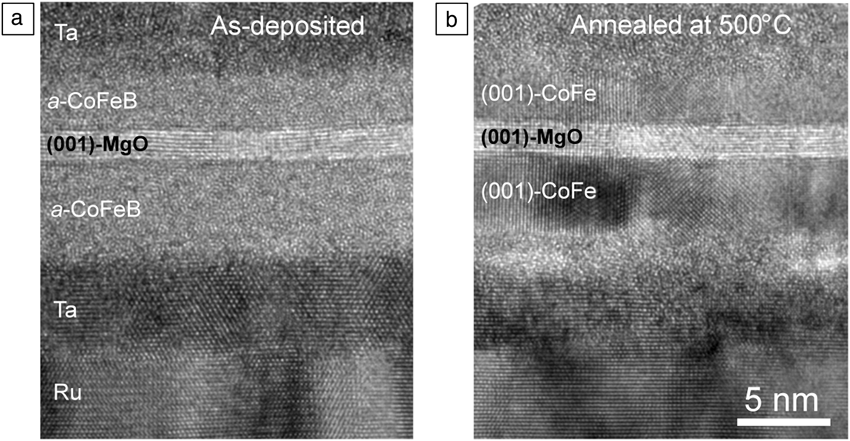
Djayaprawira et al.Reference Djayaprawira, Tsunekawa, Nagai, Maehara, Yamagata, Watanabe, Yuasa, Suzuki and Ando10,Reference Djayaprawira and Yuasa11 reported, in 2005, an even higher TMR ratio of 230% with a CoFeB/MgO/CoFeB MTJ. The significance of this work was not only the high MR ratio, but also that it was a fully integrated film directly produced from sensor deposition sputtering tool. Instead of a single crystalline or polycrystalline ferromagnetic layer, amorphous (a)-CoFeB was used to promote strong (001) MgO texture in the as-deposited state; post annealing transforms a-CoFeB layer from amorphous to a (001)-textured polycrystalline CoFe layer, templated from the (001)MgO layer, giving rise to the orientation relationship (001)[100]CoFe//(001)[110]MgO in each grain as shown in Figure 2.Reference Kodzuka, Ohkubo, Hono, Ikeda, Gan and Ohno12 In 2006, the same group reported that the MgO layer can be thinned down to the 0.4 Ω μm2 range while maintaining an MR of around 50%.Reference Nagamine, Maehara, Tsunekawa, Djayaprawira, Watanabe, Yuasa and Ando13 This RA range was desired for read head application.
Cross-sectional transmission electron microscope images of polycrystalline CoFeB/MgO/CoFeB pseudo spin valves (a) for as-deposited film and (b) after annealing at 500°C.Reference Kodzuka, Ohkubo, Hono, Ikeda, Gan and Ohno12

The MR ratio of the MgO-based TMR sensor depends on barrier formation, annealing temperature, electrode material, and stacking structure. Of these, the CoFeB electrode material is the most important in today’s MgO-based MTJ. Ikeda et al. in 2008 reported an MgO-based MTJ with an MR ratio of 600% at room temperature with an annealing temperature of 525°C in a simplified pseudo spin-valve structure.Reference Ikeda, Hayakawa, Ashizawa, Lee, Miura, Hasegawa, Tsunoda, Matsukura and Ohno14 The MR ratio largely depends on the material for a capping layer deposited on the MTJ stack, and Ta is now commonly used as a cap for the CoFeB/MgO/CoFeB trilayer structure (Figure 2). The role of Ta is to scavenge B from the crystallized CoFe layers when a-CoFeB is crystallized, keeping the MgO–CoFe interface free from B segregation.Reference Karthik, Takahashi, Ohkubo, Hono, Ikeda and Ohno15 The MR ratio increases with CoFeB thickness up to 4–5 nm; the Co fraction is also important in determining the optimal range for the MR ratio.Reference Lee, Hayakawa, Ikeda, Matsukura and Ohno16 Due to improved growth methods of MgO, the best CoFeB/MgO/CoFeB MTJ gives an MR ratio of 100% for the RA value of 0.3 Ω μm2,Reference Kitada, Nakamura, Tanaka, Furukawa and Hatano17 which is considered to be suitable for the MgO-based TMR sensor up to 2 Tbpsi recording density.
CPP-GMR sensors
In order to realize read sensors for recording density higher than 2 Tbpsi, further reduction of RA is needed. For this reason, CPP-GMR with an all-metallic multilayer with a typical RA of ∼0.05 Ω μm2 has been considered as a promising candidate for read sensor application of ultrahigh density HDDs.Reference Childress, Carey, Maat, Smith, Fontana, Druist, Carey, Katine, Robertson, Boone, Alex, Moore and Tsang18 The typical layer structure of a CPP-GMR spin valve is similar to that of CPP-TMR, the only difference being the nonmagnetic spacer layer. In other words, instead of using MgO as the insulating nonmagnetic (NM) layer in the FM/NM/FM stack, a metallic NM material was used as the spacer (Figure 1a). The MR effect is caused by spin-dependent scattering of conduction electrons in FM layers and at FM–NM interfaces.Reference Valet and Fert19 By using FMs with high-spin polarizations, a large CPP-GMR effect will be obtained. For example, some Co-based Heusler alloys with chemical formula Co2YZ (Y = Mn and Fe; Z = Al, Si, Ga, Ge) and L21 structure are predicted to be half-metals, where the down-spin electrons have a bandgap at the Fermi level, but the up-spin electrons have a continuous metallic band. Therefore, a half-metallic FM is the ideal material for CPP-GMR. In addition, matching the up-spin band at FM/NM interfaces is considered to be critical for large CPP-GMR values.
CPP-GMR devices using Heusler alloys with large MR outputs
A number of studies have demonstrated large CPP-GMR effects using single-crystalline Heusler alloy films epitaxially grown on MgO (001) substrates, such as Co2MnSi,Reference Iwase, Sakuraba, Bosu, Saito, Mitani and Takanashi20 Co2Fe(Al0.5Si0.5),Reference Nakatani, Furubayashi, Kasai, Sukegawa, Takahashi, Mitani and Hono21 Co2Fe(Ga0.5Ge0.5) (CFGG),Reference Takahashi, Srinivasan, Varaprasad, Rajanikanth, Hase, Nakatani, Kasai, Furubayashi and Hono22 and Co2(Fe0.4Mn0.6)Si.Reference Sakuraba, Ueda, Miura, Sato, Bosu, Saito, Shirai, Konno and Takanashi23 Ag is used for the spacer layer because of its good band matching with FM Heusler alloys,Reference Miura, Futatsukawa, Nakajima, Abe and Shirai24 thus a large CPP-GMR effect is realized. The epitaxial multilayers can be annealed at high temperatures (≥500°C), which enables a high degree of chemical order in the Heusler alloy films. For example, a CFGG/Ag/CFGG device showed a large CPP-GMR ratio of 41% at RT and 129% at 10 K.Reference Takahashi, Srinivasan, Varaprasad, Rajanikanth, Hase, Nakatani, Kasai, Furubayashi and Hono22 The bulk spin polarization (β) of the CFGG films (0.9 at 10 K) deduced from experimental results demonstrated the half-metallicity of the L21-ordered CFGG film at low temperatures;Reference Goripati, Furubayashi, Takahashi and Hono25 however, the interfacial spin polarization (γ) remained 0.84. This indicates that the CPP-GMR output can be further enhanced by improving the band matching between the Heusler alloy and the spacer.
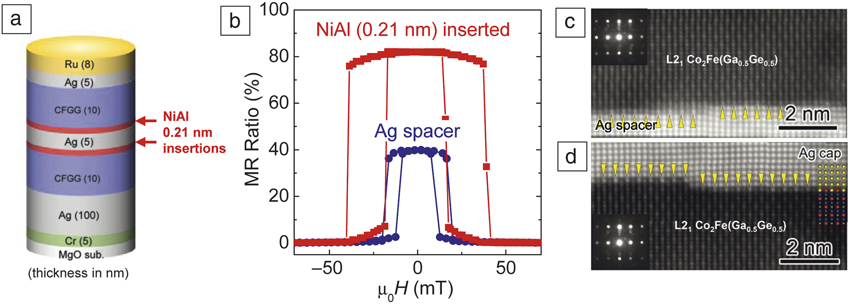
Recently, B2-ordered NiAl was considered to have better band matching with FM Heusler alloys; however, the short spin-diffusion length of NiAl ∼8 nm was a problem for realizing large MR. Jung et al. overcame this issue by inserting a thin NiAl (0.21 nm) layer between CFGG and Ag (i.e., a CFGG(10 nm)/NiAl(0.21 nm)/Ag(5 nm)/NiAl(0.21 nm)/CFGG(5 nm) device),Reference Jung, Sakuraba, Sasaki, Miura and Hono26 and observed an MR ratio of 82% at RT (Figure 3). The MR ratio increases to 285% at 10 K. This experiment indicated enhanced interfacial spin-dependent scattering due to better band matching at the CFGG/NiAl interface. A similar approach for increasing the contribution of interfacial spin-dependent scattering by a new spacer material was made using L12-AgMg alloy as the spacer in combination with Co2(Fe0.4Mn0.6)Si Heusler alloy layers.Reference Narisawa, Kubota and Takanashi27,Reference Kubota, Ina, Tsujikawa, Morikawa, Narisawa, Wen, Shirai and Takanashi28
(a) Schematic of the stacking structure of Co2Fe(Ga0.5Ge0.5)/NiAl/Ag/NiAl/Co2Fe(Ga0.5Ge0.5) current-perpendicular-to-plane giant magnetoresistive and (b) its magnetoresistive curves at room temperature. (c–d) High-angle annular dark-field images showing two Co2Fe(Ga0.5Ge0.5)(CFGG)/NiAl/Ag interfaces.Reference Jung, Sakuraba, Sasaki, Miura and Hono26

Although the fully epitaxial CPP-GMR pseudo spin valves demonstrate large MR outputs, the single-crystal structure cannot be integrated in practical spin-valve read sensors. The annealing temperature applicable in the current read sensor fabrication process is at most 350°C, much lower than that used for single-crystal CPP-GMR devices for fundamental research. Carey et al. obtained a ∼10% MR ratio using polycrystalline Co2MnGe (CMG)/Cu/CMG-based spin-valve sensors,Reference Carey, Maat, Chandrashekariaih, Katine, Chen, York and Childress29 which is much larger than that obtained using conventional CoFe/Cu/CoFe spin valves (MR ratio ∼5%). The B2 ordered structure of CMG is obtained by a relatively low annealing temperature of 245°C to the lowest melting point of CMG (T m = 1346 K)Reference Cheng, Nadgorny, Bussmann, Carpenter, Das, Trotter, Raphael and Harris30 among the Co2MnZ and Co2FeZ Heusler alloys and a high driving force of chemical ordering, because in bulk material, the L21-ordered CMG is stable up to the T m. Further improvements of MR ratio in polycrystalline spin-valve sensors up to 18% have been reported using Co2(Mn0.6Fe0.4)Ge (CMFG) Heusler alloy FM layers and a AgSn spacer layer.Reference Read, Nakatani, Smith, Choi, York, Brinkman and Childress31–Reference Choi, Nakatani, Read, Carey, Stewart and Childress33 The CMG and CMFG films are only B2-ordered, whereas the epitaxial devices demonstrating large MR ratios use L21-ordered Heusler alloy films. For further improvement of MR ratio using polycrystalline spin-valves, alloy composition and fabrication processes which enable the L21 ordering in polycrystalline Heusler alloy films are required.
CPP-GMR spin valves with NM metal/conductive-oxide hybrid spacer
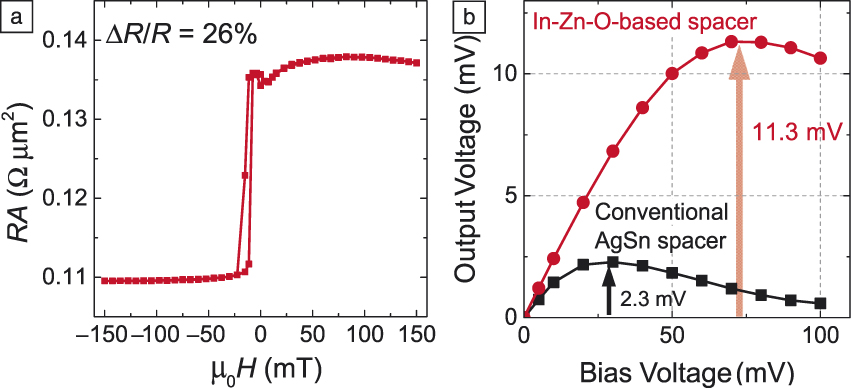
The all-metallic CPP-GMR devices using Heusler alloy FM layers and a Ag (alloy) spacer layer show significantly improved MR ratios compared to conventional CoFe/Cu devices. However, the RA value of ∼0.03 to 0.05 Ω μm2 (Figure 1b) is lower than the optimal RA value of ∼0.1 Ω μm2 for 2 Tbpsi.Reference Takagishi, Yamada, Iwasaki, Fuke and Hashimoto3 Nakatani et al. employed In-Zn-O (IZO), an amorphous transparent conductive oxide, as a spacer layer and demonstrated an MR ratio of up to 26% for RA ∼ 0.1 Ω μm2 and a large output voltage as shown in Figure 4 in order to optimize the RA value of CPP-GMR devices.Reference Nakatani, Mihajlović, Read, Choi and Childress34 Recently, an MR ratio up to 30% for RA = 0.1 Ω μm2 was reported using a AgSn/IZO spacer.Reference Nakatani, Li, Sakuraba, Furubayashi and Hono35 Similar hybrid spacers with a combination of metal and semiconducting oxide have been reported for the Cu/ZnO/Zn trilayerReference Shimazawa, Tsuchiya, Mizuno, Hara, Chou, Miyauchi, Machita, Ayukawa, Ichiki and Noguchi36 and for Cu/AlMgO.Reference Iwasaki, Hashimoto, Shirotori, Takagishi and Kasai37
(a) Magnetoresistive curve of the spin valve with the Ag/IZO/Zn conductive oxide-based spacer layer, and (b) output voltage versus bias voltage for the spin valve in comparison with the sensor with all-metallic AgSn spacer. A five times larger output voltage is obtained with the IZO-based spacer compared to the AgSn spacer.Reference Nakatani, Mihajlović, Read, Choi and Childress34 Note: RA, resistance-area.

Interestingly, for the IZO-based spacer, a Ag (0.4 nm)/IZO (1.7 nm)/Zn (0.8 nm) trilayer structure resulted in the best RA and MR ratio performance compared to the IZO single-layer spacer. Without the thin Ag layer below IZO, RA increases significantly and the MR ratio decreases. A recent transmission electron microscopy study revealed that the Ag concentration in IZO is inhomogeneous,Reference Nakatani, Sasaki, Li, Sakuraba, Furubayashi and Hono38 which may cause nonuniform electric current distribution within the spacer layer, which is known as “current-confined-path spacer.”Reference Fukuzawa, Yuasa, Hashimoto, Koi, Iwasaki, Takagishi, Tanaka and Sahashi39 An MR ratio of 30% for RA = 0.1 Ω μm2 satisfies the RA and MR values required for 2 Tbpsi.Reference Takagishi, Yamada, Iwasaki, Fuke and Hashimoto3 However, the sensor total thickness (currently ∼30 nm) has to be reduced to meet the 20-nm requirement. In addition, the robustness necessary for mass production of readers requires further improvement of MR output.
Lateral spin-valve sensors
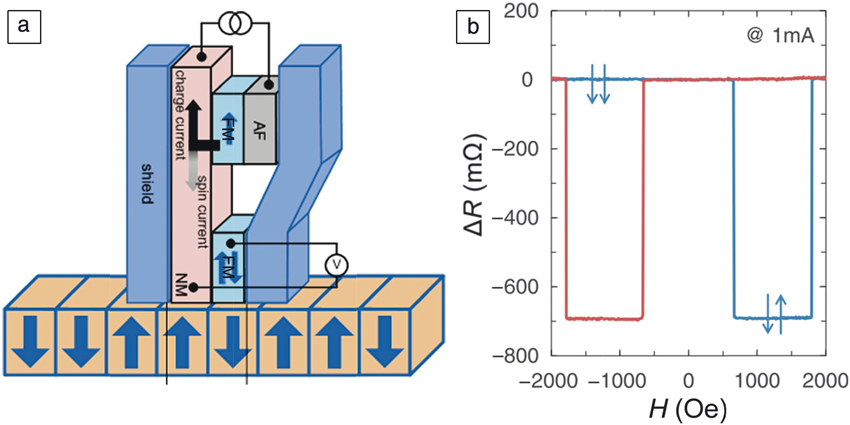
For areal recording densities above 2 Tbpsi, as mentioned in the Introduction section, the shield-to-shield spacing, which corresponds to the total sensor thickness, has to be below 20 nm to avoid signal interference by adjacent recording bits, which is challenging for the spin-valve structure with a lot of thin-film layers (Figure 1a). Jedema et al. first reported a lateral spin valve (LSV) in 2001.Reference Jedema, Filip and van Wees40,Reference Jedema, Heersche, Filip, Baselmans and van Wees41 This has been proposed as an alternative sensor structure. The schematic illustration of a LSV read sensor is shown in Figure 5a.Reference Takahashi, Kasai, Hirayama, Mitani and Hono42 Unlike conventional spin valves, the spin-injection part (pinned layer) and field-sensing part (free layer) are separated by a laterally extended NM channel such as Cu. Spins are injected into the channel and diffuse toward the free layer. The voltage depends on the magnetization direction of the free layer relative to that of the pinned layer. Because of the simple structure of the field-sensing part composed of only a NM channel and a free layer, the shield-to-shield spacing can be reduced to the total thickness of the two layers. To increase the voltage output of the LSV, utilization of a highly spin-polarized Heusler alloy is effective. Takahashi et al. reported a large resistance change of ΔR =17.3 mΩ at RT using a Co2Fe(Ga0.5Ge0.5)/Cu LSV.Reference Takahashi, Kasai, Hirayama, Mitani and Hono42 Jedema et al. reported the first LSV using NiFe/Cu, which exhibited ΔR of only 0.4 mΩ at RT.Reference Jedema, Filip and van Wees40 By reducing the spacing between the pinned layer and the free layer, the output of the LSV can be enhanced. Shirotori et al.Reference Shirotori, Hashimoto, Takagishi, Kamiguchi and Iwasaki43 demonstrated a giant ΔR = 700 mΩ and a large voltage output of 1.2 mV when the spacing between the pinned layer and the free layer was reduced to 40 nm (Figure 5b). For these experiments, a polycrystalline Co2(Fe0.4Mn0.6)Si Heusler alloy and a Cu NM channel were used. LSV is considered to be promising for read sensors if significant signal increases with low noise can be demonstrated with near 20-nm read widths and 20-nm shield-to-shield spacing.
(a) Schematic structure of the read sensor using the lateral spin valve.Reference Takahashi, Kasai, Hirayama, Mitani and Hono42,Reference Shirotori, Hashimoto, Takagishi, Kamiguchi and Iwasaki43 Note: NM, nonmagnet; FM, ferromagnet; AF, antiferromagnet. (b) Large spin accumulation effect (ΔR = 700 mΩ) in the lateral spin valve with a Co2(Fe0.4Mn0.6)Si Heusler alloy and a Cu NM channel.Reference Shirotori, Hashimoto, Takagishi, Kamiguchi and Iwasaki43

Summary
TMR devices with MgO tunnel barriers are expected to meet the short- and middle-term needs of read sensor technology due to the good extendibility of reducing RA (currently ∼0.3 Ω μm2). However, once HAMR is successfully integrated into HDDs and the areal recording density reaches 2 Tbpsi, CPP-GMR devices could be utilized due to their intrinsically low RA and low noise sensor performance. Practical spin-valve sensors incorporating Heusler alloys and the emerging conductive oxide-based spacer demonstrate a 30% MR ratio at RA = 0.1 Ω μm2, showing potential for the read sensors for HDDs with areal density higher than 2 Tbpsi. High spin polarization Heusler alloys have been proven to be effective to enhance the output of LSV sensors, with which read sensors with ultrahigh bit resolution might be realized in the future. For realizing of readers for ultrahigh density HDDs, further development of high spin polarization FM materials and their fabrication processes is critical.
Acknowledgments
T.M. and K.H. thank IDEMA-ASTC for their long-standing support to our research on Heusler alloy CPP-GMR for advanced readers.

Tomoya Nakatani has been a senior researcher at the National Institute for Materials Science (NIMS), Japan, since 2016. He received his PhD degree in materials science from the University of Tsukuba, Japan, in 2011. After completing postdoctoral research at NIMS, he joined HGST (currently Western Digital Corporation), San Jose Research Center, as a principal research engineer in 2012, where he developed current-perpendicular-to-plane giant magnetoresistance read sensors for hard disk drive applications. His current research focuses on the development of thin-film materials for magnetoresistive sensors. Nakatani can be reached by phone at +81-298592694 or by email at nakatani.tomoya@nims.go.jp.

Zheng Gao is a global director in the Recording Head Development Group of Western Digital. She received her BS degree in materials science and metallurgy from Central South University of Science and Engineering in China, a MS degree in mathematics from Marshall University, and a MS degree in materials science and engineering from The Ohio State University in 1997. She then joined Seagate Technology, working on recording sensor development for anisotropic magnetoresistance, giant magnetoresistive, and tunneling magnetoresistance readers, and later joined the Core Memory Development Group working on spin transfer torque-based memory devices. Her research interests include magnetic sensors, recording head reader/writer fabrications, magnetic random-access memory, spin torque oscillator, as well as thin-film materials for microelectronic applications. Gao can be reached by email at zheng.gao@wdc.com.

Kazuhiro Hono is a National Institute for Materials Science (NIMS) Fellow and director of the Research Center for Magnetic and Spintronic Materials at NIMS, Japan. He is also a professor in materials science and engineering at the University of Tsukuba, Japan. He received his BS and MS degrees in materials science from Tohoku University, Japan, and his PhD degree in materials science and engineering from The Pennsylvania State University in 1988. After completing postdoctoral research at Carnegie Mellon University, and as a research associate at the Institute for Materials Research, Tohoku University, he moved to NIMS as a staff scientist in 1995. His research interests include microstructure–property relationships of metallic materials, in particular, magnetic and spintronic materials and their devices. Hono can be reached by email at kazuhiro.hono@nims.go.jp.