

Multidisciplinary work, where members of a range of professions contribute knowledge and skills in a team effort to benefit the service user, is viewed as the cornerstone for collaboration, clinical judgment and decision-making in many education, health, and social care contexts. Multidisciplinary collaboration is demanded by the United Nations Convention for the Rights of Persons with Disabilities (United Nations, 2007) and adopted by, for example, the National Institute for Clinical Excellence (NICE, 2013b) guidelines for the management of autism in children and young people, with the expectation that the ‘whole is greater than the sum of its parts’ (Bond & Eldridge, Reference Bond and Eldridge2012, p. 403).
Multidisciplinary teams commonly consist of educational, medical, allied health, and social care professionals. Specialisations are important because it is humanly impossible for one person to be fully trained in all necessary competences. Within each discipline there are further specialisations; for example, educators usually specialise in primary, secondary, special, or lifelong education. In medicine, practitioners can specialise in surgery, general practice, anaesthetics, cardiology, or orthopaedics. Similar differentiations occur in other professions; for example, social workers may specialise in family and childcare, elder care, criminal justice, or mental health; while nurses may specialise in critical care, midwifery, health visiting, or psychiatric nursing. Together, they represent specific areas of expertise, with the aim that those in need of services benefit from a comprehensive understanding that combines knowledge areas and extends beyond rigid professional boundaries.
Although a multidisciplinary approach seems entirely reasonable, even common sense, virtually all interventions that are established as effective in the treatment of autism and other neurodevelopmental disorders, are based on the application of behaviour analysis, that is, Applied Behaviour Analysis (ABA; National Autism Centre [NAC], 2009). As well as improving overall quality of life, and academic and social skills, numerous cost-benefit analyses show the fiscal advantages of behaviour analysis–based interventions, especially but not exclusively, when applied early in life (e.g., Chasson, Harris, & Neely, Reference Chasson, Harris and Neely2007; Jacobson, Mulick, & Green, Reference Jacobson, Mulick and Green1998; Motiwala, Gupta, Lilly, Ungar, & Coyte, Reference Motiwala, Gupta, Lilly, Ungar and Coyte2006). Not surprisingly, ABA-based interventions are widely endorsed in the United States and Canada (see, e.g., Hilton, Reference Hilton2012; Surgeon General, 1999), and are covered by public and private health care systems (Associated Press, 2014). Board Certified Behavior Analysts (BCBA) are the key professionals to supervise these programs, and in some cases funding is denied if a BCBA is not in charge of the service user's program.
In other parts of the world, people not trained in the discipline of behaviour analysis frequently caricature ABA as a ‘one size fits all’ model, without reference to the science on which it is based (Howlin, Reference Howlin2013; Maginnis, Reference Maginnis2008). Subsequently, ABA-based interventions have been rejected in favour of eclecticism in autism treatment (e.g., Howlin, Reference Howlin2010; Jordan, Reference Jordan, Lewis and Norwich2005). Eclecticism, however, remains an ill-defined terra incognita, especially due to the potential for conceptual and methodological incompatibilities and the sheer impossibility of all-embracing staff training (Dillenburger, Reference Dillenburger2011). Odom, Hume, Boyd, and Stabel (Reference Odom, Hume, Boyd and Stabel2012) also critiqued eclecticism because of a severe ‘lack of clarity as to the actual components of the treatment conditions [that] makes replication of intervention procedures highly improbable’ (p. 282). In fact, there is evidence of comparative ineffectiveness of eclectic interventions when compared with ABA-based interventions (Howard, Sparkman, Cohen, Green, & Stanislaw, Reference Heward, Heron, Neef, Peterson, Sainato, Cartledge and Dardig2005). Not surprisingly, eclecticism has become a highly contentious and controversial concept, especially with regard to autism spectrum disorders (ASD) interventions (Freeman, Reference Freeman2003).
Without a common conceptual foundation there is a danger that multidisciplinarity regresses into mere eclecticism, or what Howley (Reference Howley, Cumine, Dunlop and Stevenson2009) called a ‘haphazard “pick and mix” which fails both the child and the practitioner’ (p. vii). Rhoten (Reference Rhoten2003) cautions that ‘while there is a general acceptance of interdisciplinary collaboration as both a worthy and authentic component of “new” science and scientific research in theory, the idea remains largely misunderstood, misconstrued, and mismeasured in practice’ (p. 1). This can have many undesired side effects, such as being labour intensive, ineffective, and expensive; causing controversy, competition, and the potential for annulling treatment effects; lacking coherent theoretical foundations; or engendering professional jealousy, none of which benefits the service users. Consequently, Ernsperger (Reference Ernsperger2002) warns: ‘Caution must be given for selecting an eclectic approach in order to prevent a “hodgepodge” of instructional methods with no clear understanding of the specific techniques and components’ (p. 60).
To confuse matters further, the recent availability of funding in the United States for ABA-based interventions for ASD has led to the assertion from a range of professionals, especially psychologists, that they are trained in behavioural principles and, ergo, competent in the delivery of ABA-based interventions (Crowder & Nordal, Reference Crowder and Nordal2013). In order to prevent misrepresentation of ABA competence, State licensure laws identify BCBAs as appropriately qualified professionals, although unfortunately, these regulations are not yet available in most other parts of the world.
In this article we bring together a multidisciplinary group of experts in their respective fields; most of us are also BCBAs. We address the question of how to square the circle between the importance of multidisciplinary input, disciplinary boundaries, competence in ABA, and consistency in terms of intervention strategies. We discuss how true multidisciplinarity can be achieved without resort to eclecticism for the sake of it. We show how this can be done, by adopting the common understanding of human behaviour afforded by behaviour analysis (Cooper, Heron, & Heward, Reference Cooper, Heron and Heward2007). We illustrate this with an example of a project based on holistic, multidisciplinary teamwork in the area of autism interventions.
Autism Spectrum Disorder
With regards to Autism Spectrum Disorder (ASD) there are no medical markers and the diagnosis is based on behavioural observations and caregiver reports of social/communication deficits, restricted interests and repetitive behaviours. Severity of ASD is assessed on three levels depending on service needs, that is: Level 1: Requiring Support; Level 2: Requiring Substantial Support; Level 3: Requiring Very Substantial Support (DSM-5; American Psychiatric Association, 2013).
While it is possible to diagnose before the second birthday, typically children are diagnosed at about 3 years of age, although often the diagnosis comes much later. Presently, internationally accepted prevalence estimates are based on the U.S. figures of 1:88, although school-aged populations and boys show a much higher prevalence rate of 1:54 (Centres for Disease Control and Prevention, 2013). In Northern Ireland, recent figures for school-aged children are 1:56 (Department of Health, Social Services, and Public Safety, 2013). These figures confirm predictions that adult prevalence rates are likely to rise considerably in the future.
A diagnosis is reached after a number of assessments and observations using standardised measures, such as the Autism Diagnostic Observation Schedule (ADOS; Lord et al., Reference Lord, Rutter, Goode, Heemsbergen, Jordan, Mawhood and Schopler1989) and the Autism Diagnostic Interview, Revised (ADI-R; Lord et al., Reference Lord, Rutter and LeCouteur1994). Most diagnostic teams consist of a paediatrician, a clinical or educational psychologist, and a speech and language therapist or occupational therapist (Thyer & Kropf, Reference Thyer and Kropf1995). Commonly, there has to be full agreement between all professionals; that is, a unanimous decision is necessary for an ASD diagnosis to be confirmed.
When the diagnosis of ASD is confirmed in very young children, the decision as to what kind of intervention should be undertaken is initially left up to parents. When the child reaches compulsory school age, a multidisciplinary team may become involved in designing Special Educational Needs (SEN) Statements and Individual Education Plans (IEP). During the transition to adult services, again a multidisciplinary team is tasked to advise on the best way ahead.
Like most other diagnoses, support and services for individuals with ASD and their families can benefit from input from many areas of expertise. Unlike many other diagnoses, however, there often is limited agreement between professionals as to what constitutes the best way forward after diagnosis. One of the main reasons of this incongruity is that while multi- or interdisciplinary collaboration makes sense on paper, when it comes to the practicalities of working together, there is generally very little common ground. The caseworker, who is tasked with leading the team, needs to ensure that everyone is not simply ‘doing their own thing’. The danger is that rather than using a common conceptual basis for their work, different professionals recommend different discipline-specific interventions in an eclectic mix. Of course, this problem does not only arise in autism interventions (McDaniel & Dillenburger, Reference McDaniel and Dillenburger2014), especially if some such interventions are provided at great expense to parents, using proprietary models with costly treatment manuals or training programs (e.g., The Option Institute, 2014). Indeed, many interventions are promoted without any scientifically credible evidence of effectiveness and are pseudoscientific in their orientation (Offit, Reference Offit2010; Thyer & Pignotti, Reference Thyer and Pignotti2010), creating a very confusing treatment landscape for parents, other caregivers, and policy-makers (Dillenburger, McKerr, & Jordan, Reference Dillenburger, McKerr and Jordan2014).
As mentioned earlier, out of this landscape has come the maxim that ‘one size does not fit all’ and an eclectic approach to treatment is recommended as necessary or better, not because it possesses the best scientific evidence for effectiveness, but because it seems the only way out of the dilemmas arising from differing perspectives held by different professionals (Odom et al., Reference Odom, Hume, Boyd and Stabel2012). This state of affairs exists despite the evidence pointing out that an eclectic approach is not very effective compared to interventions derived from ABA (e.g., Howard et al., Reference Howard, Sparkman, Cohen, Green and Stanislaw2005).
Applied Behaviour Analysis
Behaviour analysis is the science of behaviour, where behaviour is defined as the interaction of a biological organism (in this case, a person) with their environment. In other words, behaviour is anything an organism does that is either publicly discernible, such as gross and fine motor movements, or privately observable, such as cognitions, emotions, or attitudes (Cooper et al., Reference Cooper, Heron and Heward2007).
The interface between biology and the environmental contingencies to which the person is exposed is assessed with respect to their learning history, their present circumstances, and their cultural context. By employing ‘the scientific method’ to delineate behavioural principles, explanations for behaviour are sought through an analysis of environmental contingencies. Mentalistic interpretations are avoided in favour of an analysis of functional relations between the organism and the environment (Keenan, Reference Keenan, Dillenburger, O’Reilly and Keenan1997; Keenan & Dillenburger, Reference Keenan and Dillenburger2012), with the result that, as Fryling (Reference Fryling2013) put it, ‘behavior is almost always much more than the world considers it to be’ (p. 48).
From this perspective, the understanding of how behaviour evolves across the lifespan of an individual has led to effective, individually tailored, truly child/person-centred interventions. These interventions rely on data-based decisions with respect to how environmental contingencies interact with the individual and the functions that these interactions serve. Behavioural data are collected and interventions tested by using within/intra-subject research designs, to allow for immediate discontinuation of ineffective procedures (Johnston & Pennypacker, Reference Johnston and Pennypacker2008). The procedures are adjusted if outcome data indicate a need for adjustment. When applied in this way, behaviour analysis is not limited to certain target behaviours; in fact, pretty much any behaviour can be targeted through the scientific analysis of behaviour (Dillenburger & Keenan, Reference Dillenburger and Keenan2009). The key word, of course, is analysis!
Applied behaviour analysis (ABA) is widely recommended as the scientific basis for effective interventions in autism (NAC; 2009). For example, the Surgeon General of the United States endorsed behaviour analysis in his Mental Health Report as long ago as 1999: ‘Over 30 years of research demonstrate the efficacy of applied behavioral methods in reducing inappropriate behavior and in increasing communication, learning, and appropriate social behavior’ (p. 164).
The Ontario Ministry of Education Policy/Program Memorandum (PPM-140, 2007) established a policy framework to: ‘support incorporation of ABA methods into school boards’ practices [and recognized that] . . . [t]he use of ABA instructional approaches may also be effective for students with other special education needs’ (p. 1).
Since then, more recent endorsement have come from many others, including the U.S. Office of Personnel Management, which manages benefits for all federal government employees. They specified that treatment of autism that is based on behaviour analysis merits insurance coverage for federal employees. Their review panel determined that: ‘based on ample scientific and empirical evidence, ABA therapy qualifies as a medical treatment, rather than purely educational’ (Bahsoun, Reference Bahsoun2012, p. 1).
Interventions based on ABA are now covered by health insurance in most states in the United States and, increasingly, licensure laws ensure that BCBAs plan, manage, and supervise implementation.
In sharp contrast to North America, in the rest of the world, ABA-based interventions are commonly sidelined as a ‘one size fits all’ approach (Dillenburger & Keenan, Reference Dillenburger and Keenan2009). The main reason for this sad state of affairs lies in a common category error (Ryle, Reference Ryle1949) that is made in relation to ABA. Rather than being understood as a distinct discipline (Cooper et al., Reference Cooper, Heron and Heward2007), ABA is often considered one of many interventions in autism. Category errors are made when concepts that belong to one category are wrongly used as if they belong to another — for example, when kitchen, living room, bathroom, bedroom and house are all considered on the same level. In this case, ‘house’ belongs to a different, broader category than the others; that is, ‘house’ belongs to an overarching category (Chiesa, Reference Chiesa, Keenan, Henderson, Kerr and Dillenburger2006; Dillenburger & Keenan, Reference Dillenburger and Keenan2009). The same mistake is made when people talk about Early Intensive Behavioural Intervention (EIBI), Lovaas Programme, Verbal Behaviour (VB), Picture Exchange Communication System (PECS), Pivotal Response Training, and ABA, as if they were all intervention methods per se. In this instance, ABA belongs to a different, broader category from which a great variety of procedures, including those mentioned, are developed. The most reliable way to ensure that category mistakes are avoided is by providing accurate definitions and appropriate training of professionals.
ABA is correctly defined as: ‘the science in which the principles of the analysis of behavior are applied systematically to improve socially significant behavior, and in which experimentation is used to identify the variables responsible for change in behavior’ (Cooper et al., Reference Cooper, Heron and Heward2007, p. 20).
Multidisciplinary Professionals
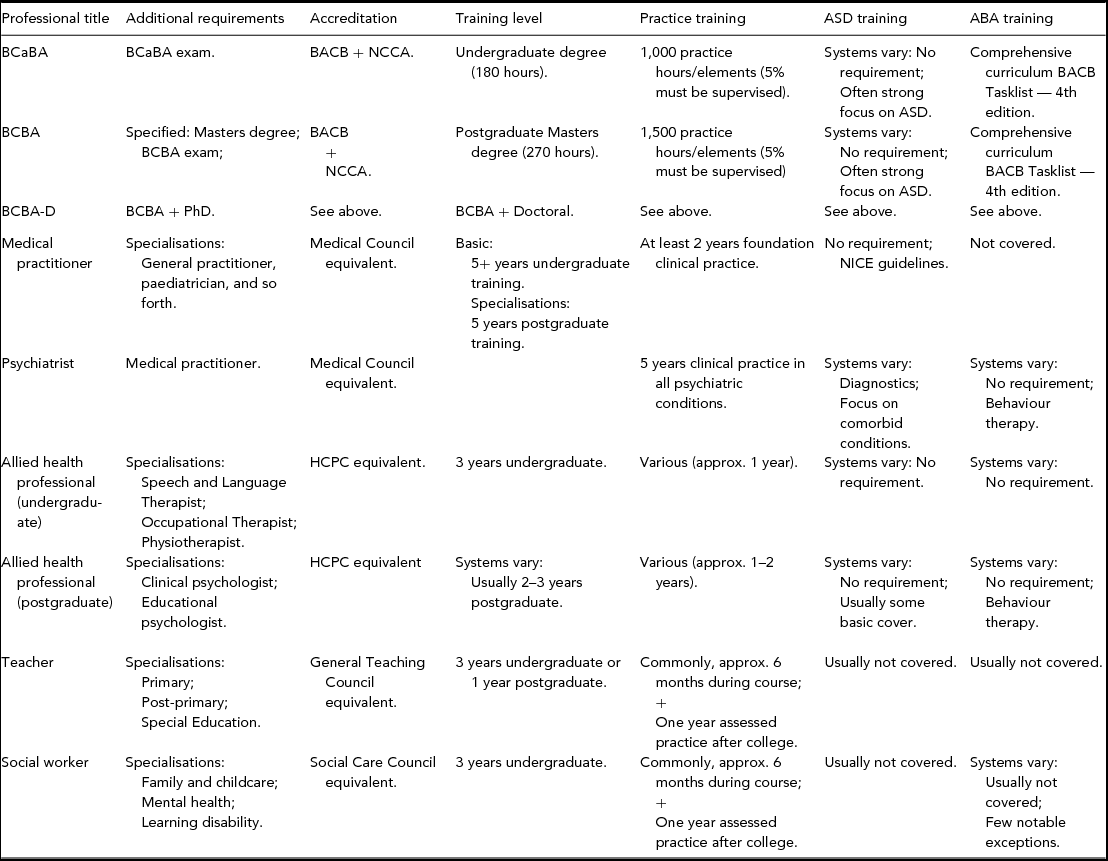
In order to understand how the science of behaviour analysis can enhance collaboration across different professional disciplines that share a common focus (i.e., improving the quality of life of their target population), it is important first to understand training requirements across relevant professions (Table 1).
Training Requirements for Key Professionals in ASD

Note: ABA = Applied Behaviour Analysis; ASD = autism spectrum disorders; BACB = Behavior Analyst Certification Board; BCaBA = Board Certified assistant Behaviour Analyst; BCBA-D = Board Certified Behavior Analyst — Doctoral; HCPC = Health Care Professional Council; NCCA = National Commission for Certifying Agencies; NICE = National Institute for Clinical Excellence.
Behaviour Analysts
The professional title Board Certified Behavior Analyst (BCBA®) is based on Master's level training (BCBA-D is based on doctoral level training) that is approved by the Behavior Analyst Certification Board (BACB, 2014) and recognised by the National Commission for Certifying Agencies (NCCA) in Washington, DC in the United States. The BCBA qualification is recognised internationally and promoted by organisations such as the European Association for Behaviour Analysis (http://europeanaba.org) and the Association for Professional Behavior Analysts (www.apbahome.net).
Medical and Allied Health Disciplines
For most parents of children with ASD, the general practitioner (GP) or physician is the first port of call. Parents who go to their GP for advice about autism often expect to be given medication to alleviate the symptoms, despite the fact that the Maine Review (Maine Department of Health and Human Services and the Maine Department of Education, 2009) considered pharmacological interventions for ASD as harmful. Most GPs will have received little or no training regarding ASD in their basic training, although online post-qualifying courses exist for those who want to learn about ASD (NICE, 2013a). With regard to research training, they will be mainly familiarised with intergroup comparison methods, such as randomised controlled trials (RCT), and thus have little knowledge of the research methodologies used in ABA (Dounavi & Dillenburger, Reference Dounavi and Dillenburger2013; Keenan & Dillenburger, Reference Dillenburger2011).
To guide the practice of health professionals, the NICE published:
1. Clinical guidelines for autism recognition, referral and diagnosis of children and young people (NICE, 2011);
2. Clinical guidelines for recognition, referral, diagnosis and management of adults on the autism spectrum (NICE, 2012); and
3. Clinical guidelines on autism: Management of autism in children and young people (NICE, 2013a).
It goes beyond the expectations of GPs to have read these reports or be fluent in their implementation, and most health providers have designated teams whose responsibility it is to deal specifically with ASD-related issues, although the training for ASD coordinators or teams is usually not specified (Dillenburger, Reference Dillenburger2012; Friman & Jones, Reference Friman and Jones2005; Keenan et al., Reference Keenan, Gallagher, Dillenburger, Byrne, Booth, Martin and Douvani2013; Maglione et al., Reference Maglione, Gans, Das, Timbie and Kasari2012).
Input by allied health professionals (AHP), such as clinical and educational/school psychologists, speech and language therapists/pathologists, physiotherapists, and occupational therapists (Health and Care Professions Council, 2012) is provided routinely by relevant health services. The work of AHPs focuses on physical, mental, or developmental issues relevant to health, daily living, and work skills. AHP training generally includes very little specific training in ASD and almost never any training in ABA (British Psychological Society, 2013). Some specific ASD-related intervention methodologies have been developed by AHPs, such as Sensory Integration Therapy (occupational therapists) or More than Words (speech and language therapists). There is little rigorous research evidencing the effectiveness of these procedures, and some have been shown to be counterproductive (Lang et al., Reference Lang, O’Reilly, Healy, Rispoli, Lydon, Streusand and Giesbers2013).
Education Disciplines
Teachers and other educationalists are the key professionals when the child starts school, but generally have had no training in ASD or ABA (Table 1); at best, they may have received a one-off lecture during initial teacher training. Hart and Malian (Reference Hart and Malian2013) pointed out that although it is highly probable that teachers will encounter students with ASD in their classrooms ‘consistent with the findings from the state analysis [. . .] and of the National Research Council [NRC], most teacher graduates receive minimal to no preparation in evidence-based practices for students diagnosed with ASD’ (p. 3).
Even educational/school psychologists have little or no training in ASD or ABA (American Psychological Association, 2009; Australian Psychological Society, 2013; Bahsoun, Reference Bahsoun2012; Heward, et al., Reference Heward, Heron, Neef, Peterson, Sainato, Cartledge and Dardig2005; Nuñez, Reference Nuñez2011; Oxford Educational Assessment Centre, 2011; Queens University, 2013). Notwithstanding, the British Psychological Society (2013) asserts that ‘the rigorous scientific training provided by psychology degrees enables graduates to become skilled in evaluating evidence and in making evidence-based decisions in a range of areas of their everyday lives’ (p. 9).
Social Care Disciplines
Social workers generally carry out needs assessments and refer service users to services that aim to meet their needs. Few social workers provide direct intervention services. In most social work courses, the term ‘autism’ is mentioned briefly, but there are no in-depth courses. Generally, social workers have received no training in ABA, although in a small number of exceptional colleges in the United States, social workers can obtain training in behaviour analysis. This is not the case in social work training in Europe.
A Common Foundation
Multidisciplinary teams generally have the common aim to improve the quality of life trajectory of individuals and their families, and the disciplines described here represent a wealth of knowledge on a range of important target behaviours. As mentioned above, behaviour analysis offers the knowledge base of how to arrange contingencies to achieve these targets. A lack of knowledge of ABA across a multidisciplinary team can lead to a number of problems in the development and application of effective, evidence-based interventions: ‘Science is a systematic approach for seeking and organising knowledge about the natural world. In applied behavior analysis, this means socially important behaviors’ (Cooper et al., Reference Cooper, Heron and Heward2007, p. 25).
In order to illustrate a way of adopting a consistent scientific basis that underpins interdisciplinary teamwork, the case study of a real project aiming to improve the life of children with ASD is described next.
Project A was an intensive care program for children with ASD, based at a university and comprised of multidisciplinary faculty; that is, psychiatrists, clinical psychologists, social workers, students, community services, and parents of children with ASD. Everyone in the team undertook basic training in behaviour analysis through an online training platform that included user-friendly videos and animations (Simple Steps,12013). The platform was developed by a European team of behaviour analysts (four BCBA-Ds and two BCBAs) together with service users and is available in a range of European languages (Keenan et al., Reference Keenan, Gallagher, Dillenburger, Byrne, Booth, Martin and Douvani2013; Science and the Treatment of Autism [STAMPP], 2013). The team of Project A was involved in the further development of the online resource and translations that were culturally sensitive to their local contexts.
Project A was able to offer a coherent approach to the treatment of ASD, as the various professionals worked closely together with students and parents to deliver individually tailored intervention programs. Project A was distinct in that it took a joined-up approach to the individual subject expertise of each member of a multidisciplinary team through common understanding of behaviour analysis. The behaviour analytic focus on building functional behaviours and developing necessary life skills broadened each of the single-disciplinary perspectives decisively and, at the same time, the focus on continuous data taking (i.e., single system designs) set new scientific standards of excellence.
Children entered Project A after having completed statutory diagnostic procedures. The parents’ point of view was an important source of information. Following a thorough interview with the parents, Project A staff observed the children in their home and pre-school/kindergarten settings and performed assessments, such as the completion of the Psychoeducational Profile (PEP, 2013). In therapy, the core areas of child development that were addressed included joint attention, basic imitation, language and communication skills, motor skills, independence competences, and pre-school activities. Intervention procedures were based on functional assessment and analysis and were transparent to all. Data were taken on behaviour change before, during and after the intervention, and procedures were adapted as necessary to ensure target behaviours were achieved as efficiently as possible.
The target behaviour of imitation skills serves as a good example. Given the pivotal importance of imitation skills for further development and learning, generalisation of these skills is key. In a multidisciplinary team that is based on consensus among professionals who have adopted the science of behaviour analysis as theoretical basis (or conceptual framework), a program to target generalised imitation would include a behaviour analyst who teaches gross motor imitation of body parts, a speech and language therapist who teaches oral-motor imitation, an occupational therapist who teaches how to wash face or hands, a teacher who facilitates the child imitating some aspects of other pupil's behaviours at school, and importantly, parents who encourage the use of imitation skills at home.
Including parents in the intervention makes a decisive difference between an ABA-based and the traditional psychiatric and psychotherapeutic approaches that are still used widely in many parts of the world, where ‘patients’ are treated in individual sessions. In Project A, the joined training of all key people guaranteed that professionals and parents had a common understanding and a common language, thus achieving a high level of consistency across therapy, school, and home settings, with remarkable improvements in the quality of life for the child and the family.
Conclusion
We briefly outlined the rationale behind multidisciplinary work and the potential problems of multidisplinarity and eclecticism. We described the training background of the key disciplines involved in working with individuals with ASD. We found that ASD and ABA were frequently not an essential part of the training curriculum in these professions, but that an internationally recognised qualification in behaviour analysis exists. We argued that the scientific discipline of behaviour analysis provides a ‘common ground’ for multidisciplinary working and that this is particularly useful for the cooperation and collaboration between the health and social care and the educational systems.
We outlined that the scientific method that underpins ABA includes the careful and precise definition of the subject matter, a knowledge base that stems from basic and applied science, and a focus on individually tailored, person/child centred, continuously evaluated intervention procedures that allow multidisciplinary teams to work as ‘one’. Does that mean ABA can be considered as ‘one size fits all’? Normally, this term is used in a pejorative sense, especially when it comes to such a heterogeneous diagnosis as ASD, but when the ‘one’ being referred to is a well-researched and clearly defined science, then the ‘one’ means consistency, agreement, transparency, and sensible collaboration.
The United States and Canada have explicit guidance in support of interventions that are based on the application of the scientific methods derived from behaviour analysis:
The purpose of this memorandum is to provide direction to school boards to support their use of applied behaviour analysis (ABA) as an effective instructional approach in the education of many students with autism spectrum disorders (ASD). This memorandum establishes a policy framework to support incorporation of ABA methods into school boards’ practices. The use of ABA instructional approaches may also be effective for students with other special educational needs.’ (Memorandum No. 140, Ontario Ministry of Education, 2007, p. 1)
In other places official advice varies considerably. Across Europe, for example, there is relatively little training in ABA, and sometimes government departments still debate whether ASD services are the responsibility of educational, health, or social care departments. Evidently, the crux of this debate revolves around who should be responsible for funding the necessary services.
Of course, even with clear guidance it is not always smooth sailing for service users or providers, and difficulties in obtaining services or claiming health benefits remain. However, at least there is now some level of clarity as to what is considered best practice. Recent reports identified that when early intensive behaviour analytic interventions are offered, families and individuals with ASD are beginning to reap the fruits. Fein et al. (Reference Fein, Barton, Eigsti, Kelley, Naigles and Tyson2013), for example, reported that significant numbers of children diagnosed with autism are now achieving optimal outcomes, meaning that their quality of life has improved to the extent that they require no specific support and, in some cases, may even no longer meet the criteria that led to their ASD diagnosis. These outcomes are statistically significantly linked to early intensive behaviour analytic interventions (Orinstein et al., Reference Orinstein, Helt, Troyb, Tyson, Barton, Eigsti, Naigles and Fein2014).
ABA is a science of behaviour, which, when applied to autism, empowers parents with the skills to harness principles of behaviour for bringing out the best in their children. Results produced when ABA is implemented correctly are quite remarkable and that is why parents persist despite the hard work involved. Sometimes the changes in the children who benefit from ABA are so extensive that they cause all sorts of problems for the establishment not familiar with ABA. For example, bureaucratic boundaries between education and health authorities are rendered meaningless when significant improvements in a child's overall health and well-being are brought about by educational procedures. If everyone cares, then these bureaucratic boundaries need to be dismantled so that resources are marshalled in an efficient and cost effective way. (Keenan, Henderson, Kerr, & Dillenburger, Reference Keenan, Henderson, Kerr and Dillenburger2006, p. 48)
We have argued here that professionals who are trained in the scientific method of behaviour analysis have a common ground to develop truly inclusive collaborative evidence-based multidisciplinary work that brings out the best for individuals with ASD.
We propose that individuals who are recipients or potential recipients of treatment designed to change their behaviour have the right to a therapeutic environment, services whose overriding goal is personal welfare, treatment by a competent behaviour analyst, programs that teach functional skills, behavioural assessment and ongoing evaluation, and the most effective treatment procedures available. (van Houten et al., Reference Van Houten, Axelrod, Bailey, Favell, Foxx, Wata and Lovaas1988, p. 381)
Ultimately, individualisation in autism intervention is not the same as ‘eclecticism’ or multidisciplinarity. Truly individualised, child-centred, evidence-based interventions are carried out in close collaboration between relevant professionals where treatment decisions are determined by the behavioural data they produce.
Financial Support
This research received no specific grant from any funding agency, commercial or not-for-profit sectors.
Conflict of Interest
None.
Ethical Standards
The authors assert that all procedures contributing to this work comply with the ethical standards of the relevant national and institutional committees on human experimentation and with the Helsinki Declaration of 1975, as revised in 2008.
Endnote
Some of the authors of this paper contributed to the development of Simple Steps supported by European Commission Funding. None of the authors have any financial interest in Simple Steps.