Introduction
Mechanical means are some of the most common methods used to control weeds in crops as they can be applied at different times of the cropping cycle: in pre-planting during the seedbed preparation to stimulate weed seed germination, as in the case of the false seedbed technique, and after crop emergence to eliminate the weeds (Bond, Reference Bond and Naylor2007; Meissle et al., Reference Meissle, Mouron, Musa, Bigler, Pons, Vasileiadis, Otto, Antichi, Kiss, Pálinkás, Dorner, Van Der Weide, Groten, Czembor, Adamczyk, Thibord, Melander, Nielsen, Poulsen, Zimmermann, Verschwele and Oldenburg2009). Mechanical control methods can be adopted, in combination with herbicides, in integrated weed management programs. In Europe, Integrated Weed Management (IWM) is considered part of the Integrated Pest Management (IPM) and its application has become mandatory in all European Union Member States following the adoption of the Sustainable Use of Pesticides Directive (2009/128/EC) of the European Commission (Moss, Reference Moss2010). In this view, herbicide use can be reduced and partially replaced by alternative control methods. In maize, for example, herbicide use can be lowered to 60% when integrated with mechanical tillage in a rotational cropping system (Pimentel et al., Reference Pimentel, McLaughlin, Zepp, Lakitan, Kraus, Kleinman, Vancini, Roach, Graap, Keeton and Selig1991). In sustainable agriculture, the use of mechanical weed control has a great importance as it presents less risks of harming the environment, it may prevent the selection of herbicide-resistant populations in weeds and it is safer for the operators (Abdin et al., Reference Abdin, Zhou, Cloutier, Coulman, Faris and Smith2000; Upadhyaya and Blackshaw, Reference Upadhyaya, Blackshaw, Upadhyaya and Blackshaw2007). In organic cropping systems weeds are one of the major issues that need to be addressed appropriately in order to get a satisfying crop performance (Bàrberi, Reference Bàrberi2002; Upadhyaya and Blackshaw, Reference Upadhyaya, Blackshaw, Upadhyaya and Blackshaw2007). In such cultivation systems, specific regulations limit the range of weed control techniques available to preventive methods (e.g. crop rotation, false seed bed) and direct physical and mechanical methods (i.e. flame weeding, spring tine harrowing) (Vidotto et al., Reference Vidotto, Tesio, Patracchini, Boni and Ferrero2007). Even in this type of agriculture mechanical means are the most commonly adopted methods for weed control (Armengot et al., Reference Armengot, José-María, Chamorro and Sans2013; Melander, Reference Melander2014).
Direct mechanical means, harrowing, in particular, applied in established crops act mainly by weed seedling burial and uprooting (Cloutier et al., Reference Cloutier, Van Der Weide, Peruzzi, Leblanc, Upadhaya and Blackshaw2007). Both factors are responsible for weed control even though the prevalent mechanism has yet to be determined (Cirujeda et al., Reference Cirujeda, Melander, Rasmussen and Rasmussen2003). In fact, some previous studies found that burial was the principal factor, while other studies showed that uprooting is fundamental for the final control of the weeds, especially at the first growth stages (Fogelberg and Gustavsson, Reference Fogelberg and Gustavsson1998; Kurstjens and Kropff, Reference Kurstjens and Kropff2001). The efficacy of mechanical means used to control weeds is strictly dependent on many factors that are not always easily manageable by the farmers. Unfavourable weather and soil conditions at the moment of the tillage may delay cultivations, affecting weed control (Duerinckx et al., Reference Duerinckx, Mouazen, Anthonis and Ramon2005). Wet soil conditions due to prolonged rains may lead to a fast weed growth and poor weed control because grown-up weeds are not well controlled by mechanical means. On the contrary, crusty or hard clayey soils occasionally need a proper mechanical tillage in order to break the crust and loose the clumps prior to the weed control operations (Kouwenhoven, Reference Kouwenhoven1997). Weed stage can also affect the effectiveness of the mechanical means; in general, their application results in a better weed control at the earliest weed growth stages, while the crop should be at a later stage (Kouwenhoven, Reference Kouwenhoven1997). The best weed growth stage to perform cultivations also depends on the mechanical means chosen and the machinery adjustment set by the operators (Van der Weide et al., Reference Van der Weide, Bleeker, Achten, Lotz, Fogelberg and Melander2008).
The effects of the uncontrollable factors, namely soil and weather conditions and weed stage, could be managed through regulations of the operative technique such as the number of passages and the working speed. Cultivation frequency and forward speed are strictly related to weed density and weed species compositions (Laguë and Khelifi, Reference Laguë and Khelifi2001).
Weed harrowing, hoeing and ridging are some of the most common mechanical means adopted in row-planted crops for weeding. Harrowing and hoeing are effective between crop rows but not in the intra-rows; for this reason, other practices such as ridging could help in controlling intra-row infestations (Cirujeda et al., Reference Cirujeda, Melander, Rasmussen and Rasmussen2003).
Mechanical interventions may result in poor selectivity causing significant crop injuries when treating the whole crop both in broadcast and row-planted crops. In general, the more effective the mechanical weed control, the less selective for the crop (Rasmussen et al., Reference Rasmussen, Bibby and Schou2008). For example, high driving speed, deep penetration of the working tools and thick tines are the best setting for efficient weed control in contrast to low working speed, thin tines and their vertical orientation which can assure crop selectivity (Duerinckx et al., Reference Duerinckx, Mouazen, Anthonis and Ramon2005). As a consequence, cultivation techniques need to be balanced in order to get a satisfying weed control and crop selectivity. Crop damage can be caused by the direct contact with working implements, or indirectly by soil covering, which both may result in yield reduction.
Maize is one of the crops for which mechanical weed control is commonly applied even in combination with herbicides. Italy is one of the largest European maize producers with about 995,000 hectares (Istituto Nazionale di Statistica (ISTAT), 2016). Moreover, Italy has also the largest area of organic maize production in Europe, with more than 1% of the overall Italian maize area (Ceddia and Cerezo, Reference Ceddia and Cerezo2008), in which mechanical means are predominantly adopted.
Maize can tolerate early weed infestations for the firsts 2–6 weeks after planting without significant yield losses; however, this range of tolerance and the possible damage can vary according to weed density, weed species, time of weed and maize emergence and the environmental conditions (Cloutier et al., Reference Cloutier, Van Der Weide, Peruzzi, Leblanc, Upadhaya and Blackshaw2007).
The objective of the present study was to assess weed control efficacy and the possible crop injuries caused by mechanical interventions (harrowing, hoeing and ridging) in traditional flint Italian varieties of maize during two cropping seasons (2013–2014).
Materials and methods
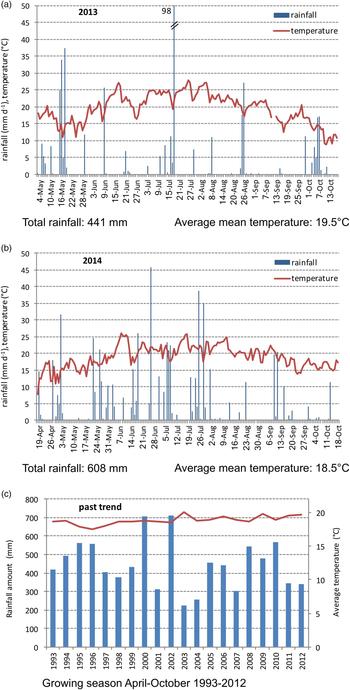
The study was carried out at the experimental station of the Dipartimento di Scienze Agrarie, Forestali e Alimentari of the University of Turin, during two cropping seasons (2013–2014). The experimental station is located in northwest Italy in an area traditionally cultivated with maize, characterized by sandy-loam soil. Climatic conditions (average temperature and rainfall of the site) during the maize growing cycle of 2013 and 2014 and the past trends are given in Figure 1. The total amount of rainfall over the cropping seasons were 441.0 mm and 607.8 mm in 2013 and 2014, respectively. Average temperatures of the same period were 19.5°C in 2013 and 18.5°C in 2014. Weather data were obtained from the meteorological station located in the experimental site.
Average daily temperature and total rainfall over the maize growing cycle of 2013, 2014 and of the years 1993–2012.

The following five traditional flint Italian varieties of maize for human consumption were considered in the study: Marano, Ottofile, Pignoletto, Nostrano and the hybrid Maranello.
These varieties were chosen among those most commonly cultivated in North Italy before the introduction of hybrids. These varieties were also considered interesting in organic agriculture on the basis of a previous experiment conducted in Piemonte (Spagnolo et al., Reference Spagnolo, Pinna, Gamba, Zaccara, Possetto and Valoti2005). The seeds of the varieties were provided by the Bergamo Section of the CREA-Cerealicoltura e Colture Industriali (CREA-CI) (Italy), which maintains a collection of the Italian varieties of maize.
The experimental field was mouldboard ploughed during the autumn before each year to a depth of 25 cm and harrowed about a month before seeding to prepare the seedbed. The day preceding maize sowing, the plot was again harrowed to eliminate all the newly emerged weeds. Maize seeds were sown in two different fields on May 4 and April 19 in 2013, and 2014, respectively, using a two-row trailed Gaspardo planter (model SP510, Pordenone, Italy). Spacing between the rows was 75 cm and 21 cm between the seeds, with an initial density of 6.3 plants m−2.
During the cropping seasons, maize irrigation was carried out once per year, at stem elongation (end of June), giving about 70–80 mm for the whole plot.
Maize fertilization was provided each year with Urea (150 kg ha−1) before ridging.
Mechanical interventions
Direct weed control treatments were performed at the crop post-emergence stage and named:
• STH: spring tine harrowing at different growth stages followed by inter-row hoeing and hoe ridging;
• MWR: manual weed removal with hand-hoe all season long to exclude competition from weeds;
• STH + MWR: as treatment STH but supplemented with manual removal;
• CHK: untreated.
The number of passes with mechanical means in the STH and STH + MWR plots varied each year in order to simulate a real situation in which farmers varied the number of treatments to obtain a good weed control in relation to the climatic conditions and the field infestation. In particular, in 2013 two interventions with a spring tine harrow at 17 and 26 days after sowing (DAS), corresponding to 2–3 and 4–5 leaf stage respectively, were carried out and in 2014 three interventions were performed at 20, 26 and 35 DAS. Subsequently, every year a passage with a hoeing-ridging machine (at 9–10 leaf stage, about 40 DAS) was performed in the STH and STH + MWR treatments.
Weed harrowing was carried out with a 2.5-m wide spring tine harrow with 48 elastic tines; driving speed was maintained from 5 to 7 km h−1 and the tine angle was reduced and adjusted on the basis of visual assessments of the crop soil cover to provide an appropriate treatment.
In 2013, MWR was carried out four times during the growing season, while in 2014 six interventions were necessary to eliminate the weeds because of the higher infestation.
Experimental design
The experiment was arranged in a randomized complete block design with three replications. Plots were 6 m (8 maize rows) wide by 10 m long, for a total of 60 plots, resulting from 20 different combinations of maize varieties (5) and weed control treatments (4). In the 2 years, the experiment was carried out in two similar fields close to each other, in order to avoid carryover weed infestations.
Weed assessments
Weed data in terms of weed specie composition, density and cover were collected about a week after each mechanical intervention in the STH and CHK plots. In particular, weeds were counted in a squared frame of 0.5 × 0.5 m2 randomly placed between crop rows, including both interrow and intrarow areas. No weed counting was carried out on MWR and STH + MWR plots because they were maintained weed-free all season long.
Weed diversity indices were also calculated for STH and CHK plots at the last weed assessment, after all the mechanical intervention, separately for each year, in order to assess if weed species richness (number of species), diversity and dominance changed as a consequence of the mechanical treatments. In particular, dominance index of Simpson (D) was determined as follows:
 $$D = \sum {\left[ {\displaystyle{{\,pi} \over N}}\right]}^2 $$
and Shannon diversity index (H′) was calculated as follows:
 $$H^{\prime} = \sum \left( { - \displaystyle{{\,pi} \over N}} \right)\ln \left( {\displaystyle{{\,pi} \over N}} \right)$$
where pi is the density of the ith species, N is the total weed density of all the species (Clements et al., Reference Clements, Weise and Swanton1994).
Crop assessments
The possible crop damages caused by mechanical weeding were estimated by determining several maize growth and yield parameters. Maize plant height, number of leaves and plant density were determined within few days after each mechanical weeding. In both years, a total of four assessments were performed. In 2013, both the third and fourth assessment were carried out after the last mechanical weeding.
At maturity, maize yield and other yield-related traits (1000-seed weight, hectolitre weight, grain moisture) were determined by hand harvesting an area of about 15 m2 for each plot (two adjacent central maize rows, each 10 m long). Afterwards, the remaining area of the plots was combined.
Statistical analyses
The effect of the maize variety, the year, the weed management and their interactions on weed density were assessed using the GLM Analysis of Variance procedure of the statistical package SPSS (version 23) (data not shown). As the effect of the year was significant, data were analyzed separately per year. The efficacy of each STH treatment in each year was evaluated by comparing weed density between CHK and STH trough another ANOVA analysis (P ≤ 0.05).
For each crop parameter, an ANOVA analysis to test the effect of the maize variety, the year, the weed management and their interactions was performed (data not shown). The effect of the year was also significant for crop parameters and thus data were analyzed separately per year. Another ANOVA analysis and post-hoc tests were performed to compare the values recorded at the same assessment: plant height, number of leaves, and plant density between maize varieties, separately per year. Moreover, the same analyses were carried out to compare the crop values among treatments at each assessment and for each variety. Yield and yield-related traits were compared to find out differences among the treatments within a variety, differences among varieties averaging the weed management and differences among the treatments averaging for the varieties.
Results and discussion
Weed assessments
The ANOVA analysis conducted on weed density showed a significant effect of the year and of the weed management while no differences among varieties were found; the interactions among the main factors were also non-significant (data not shown). As the analysis found no effect of the variety on the efficacy of the mechanical weeding, weed densities were averaged among varieties (Table 1).
Weed density, weed reduction of STH over CHK and weed cover (%) at each weed assessment after mechanical treatments followed by the ANOVA results of the effect of the main factors (variety and weed management) and their interactions on weed density

1 Values sharing the same letter are not significantly different according to ANOVA (P ≤ 0.05). Letters indicate the comparison on weed density values between CHK and STH separately for each assessment and year.
V, variety; WM, weed management; ns, non-significant.
Significance: ***P < 0.001.
Initial weed infestation in 2013 and 2014 differed, being higher in 2014 (304 plants m−2) compared with 2013 (163 plants m−2) (Table 1). These different weed densities between the 2 years could be attributed to the diversity of the two fields in which the study was carried out and to the different weather conditions between 2013 and 2014 (Fig. 1). Weed density was higher in 2014 probably because rainfalls, which were more frequent and abundant compared to 2013, may have induced flushes of weed seedlings (Roberts, Reference Roberts1984); these could also explain the always higher weed density recorded in the CHK plots in 2014. Indeed, the growing season 2014 could be considered as one of the most rainy over the last 20 years, as shown in Figure 1, recording a total rainfall amount of 607.8 mm.
Plots that underwent mechanical treatments always showed a significant lower weed density compared with the CHK plots. Higher efficacy of the first two STH interventions was recorded in 2013 with values of weed reduction exceeding 50% between STH and CHK plots, while weed density was reduced by only about 30% in 2014. The higher efficacy recorded in 2013 may be due both to a lower initial weed density and weeds being at early growth stage as demonstrated by the lower values of weed cover over the soil surface. This was already established by previous studies in which the highest efficacy obtained by mechanical means, in particular by harrowing, occurred when weeds were at early growth stages (e.g. cotyledon stage) (Lundkvist, Reference Lundkvist2009; Kolb and Gallandt, Reference Kolb and Gallandt2012). The lower weed density at the moment of the treatment is another factor contributing to the efficacy of the mechanical treatment, as demonstrated by Kouwenhoven (Reference Kouwenhoven1997). Moreover, the prevalence of certain weed species, their density and their growth stage, has been demonstrated by the previous study to affect the efficacy of weed harrowing (Kurstjens and Kropff, Reference Kurstjens and Kropff2001).
At the third STH treatment a higher weed reduction was instead recorded in 2014 even though the weed density remained higher than in 2013. In 2014, a total of four STH treatments (3 passes with spring-tine harrow + 1 pass with hoeing-ridging machine) have been necessary to obtain the same weed density level (about 50 plants m−2) of that recorded in 2013, when a total of three STH treatments were performed (2 passes with spring-tine harrow + 1 pass with hoeing-ridging machine). However, the final percentage of soil covered by weeds in 2014 was lower than that of the previous year, demonstrating that a further mechanical treatment could also help maintaining weeds at the initial growth stages. Repeated harrowing has been reported to better control weeds in spring barley and in winter wheat even though increasing the number of passages caused a decrease in crop yield (Melander et al., Reference Melander, Rasmussen and Bàrberi2005; Ulber et al., Reference Ulber, Steinmann, Klimek and Isselstein2009). Thus, the appropriate number of harrowing passages should be able to maximize weed control without damaging or reducing the crop yield. In both years, the efficacy of mechanical weeding was only partial as the final weed density was of about 50 plants m−2; this partial effectiveness could lead to yield reduction in the short term, but could also worsen the infestation level in the long term as non-controlled weeds may reach maturity and set seeds, contributing to soil seed bank enrichment (José-María and Sans, Reference José-María and Sans2011; Armengot et al., Reference Armengot, José-María, Chamorro and Sans2013).
In both years, the most prevalent weed was Chenopodium album both in CHK and STH treatments (Fig. 2). In 2013, the weed species present in the two considered treatments were basically the same and with a similar abundance; only, Panicum dichotomiflorum and C. album were slightly less represented in STH, while Solanum nigrum and Echinochloa crus-galli were more present. In 2014, as in the previous year, the recorded species were similar in CHK and STH, with again S. nigrum and E. crus-galli having higher densities in STH. These two species were the most abundant in STH treatments in both years probably because were those less controlled by mechanical treatments.
Most represented weed species and Simpson and Shannon indices at the final weed assessment (7 days after the third and fourth treatments in 2013 and 2014, respectively) in CHK and STH plots (percentage over total number of weeds found).

Comparing the 2 years, the infestation slightly changed likely because the trials were hosted in two adjacent but different fields. This difference might lead to the hypothesis of a different soil seed bank composition between the fields. Moreover, different climatic conditions between the 2 years, lower rainfalls and higher temperatures in 2013 versus higher rainfalls and lower temperatures in 2014, may have favored the emergence of different weed species. In particular, in 2013 Portulaca oleracea represented almost 30% of all the weed individuals while in 2014 it counted for <1%.
In general, the most represented weed species in these fields, C. album and E. crus-galli, were those commonly observed in Italian maize fields as reported in a previous survey (Vidotto et al., Reference Vidotto, Fogliatto, Milan and Ferrero2016). Weed species found in the treatments CHK and STH, showed a similar presence; this was also confirmed by the two diversity indices, Simpson and Shannon, which showed a similar weed species dominance and diversity (Fig. 2). In particular, Simpson indices were similar between both CHK and STH and years with values of about 0.35, indicating an absence of dominance of few species. Similar Shannon indices were recorded for CHK and STH plots with values of about 1.34 in 2013 and 1.4 in 2014 (Fig. 2), suggesting a similar weed diversity between treatments and years.
According to these results, it is possible to partially confirm what already observed in a previous study, which found that harrowing did not cause a change in species dominance and richness and thus maintained the weed diversity (Armengot et al., Reference Armengot, José-María, Chamorro and Sans2013).
The compared treatments slightly differed in terms of species richness with CHK plots showing always higher number of species compared with STH; in particular, 17 species were counted in CHK and 11 in STH plots in 2013 (data not shown). In 2014, a total of 11 species were observed in CHK and seven species in STH plots. Thus, in general, STH treatment slightly reduced weed species richness probably because of the different sensitivity to mechanical weeding among species (Fogelberg and Gustavsson, Reference Fogelberg and Gustavsson1998). The species richness found in STH and CHK plots, as well as the Shannon diversity indices, fall within the range of that observed in a previous study carried out in maize fields in Northern Italy, in which the species richness varied from 5, in plots sprayed with herbicides both in pre-and post-emergence and hoed, to 16 species, in plots sprayed with herbicides in post-emergence only and also hoed (Vasileiadis et al., Reference Vasileiadis, Otto, van Dijk, Urek, Leskovšek, Verschwele, Furlan and Sattin2015).
Crop assessments
Plant height
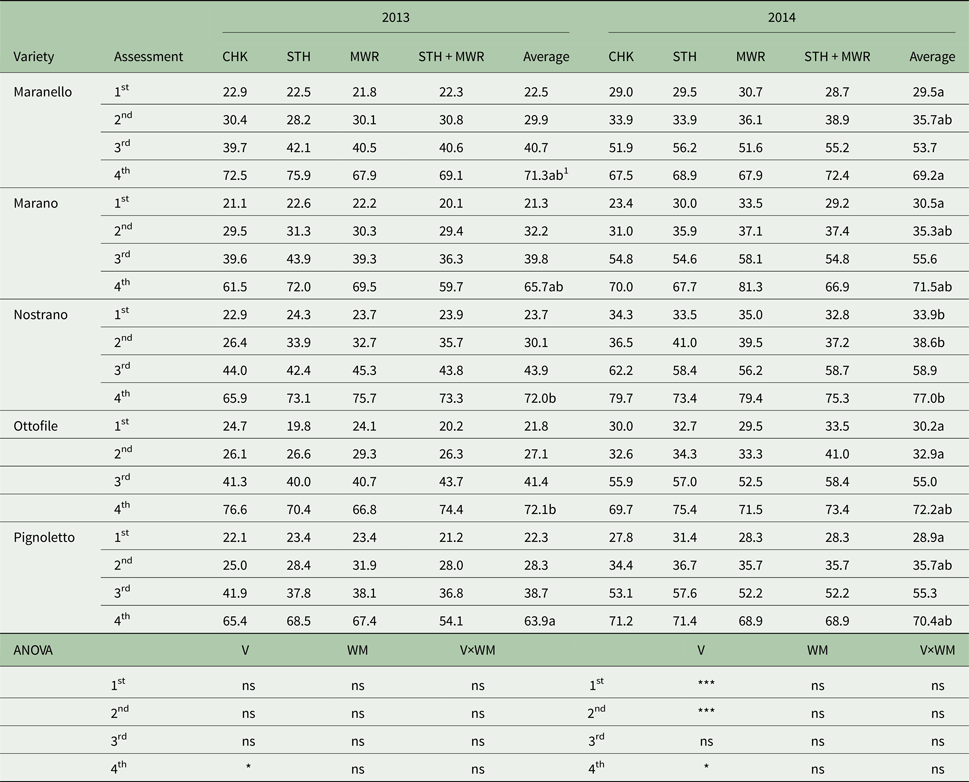
In both years, ANOVA results indicated that the effect of the applied mechanical treatments was not significant (Table 2). In 2013, a significant effect of the variety on plant height (averaging among treatments) was detected only at the final assessment, while in 2014 differences among varieties were always found with the exception of the third assessment (Table 2). In particular, Nostrano was the tallest variety in both years, with values higher than 70 cm after the last mechanical weeding. The shortest varieties were Pignoletto in 2013 and Maranello, the hybrid variety, in 2014. Taller plants are usually more susceptible to damage by mechanical treatments; this has been demonstrated in different crop species, such as barley (Rasmussen et al., Reference Rasmussen, Kurtzmann and Jensen2004). Thus, among the studied varieties, Nostrano could be the most affected one due to its tallness. Weed and crop traits measures are usually carried out to assess the efficacy of the mechanical methods of weed control and the susceptibility of the crop, respectively; plant height could be one of the crop traits that could be considered (Kurstjens et al., Reference Kurstjens, Kropff and Perdok2004; Vanhala et al., Reference Vanhala, Kurstjens, Ascard, Bertram, Cloutier, Mead, Raffaelli and Rasmussen2004). Moreover, maize height has been demonstrated to be positively correlated with yield (Sowinski et al., Reference Sowinski, Kristensen and Hermansen2002).
Plant height of the maize cultivars in the different treatments in 2013 and 2014 followed by the ANOVA results of the effect of the main factors (variety and weed management) and their interactions on plant height

1 Values sharing the same letter are not significantly different according to REGWF test (P ≤ 0.05). Letters indicate the comparison among maize varieties separately for each assessment and separately for each year and the comparison among treatments within the same assessment for each variety, separately for each year. When no letters are shown, the values are not significantly different.
V, variety; WM, weed management; ns, non-significant.
Significance: *P < 0.05; ***P < 0.001.
Number of leaves
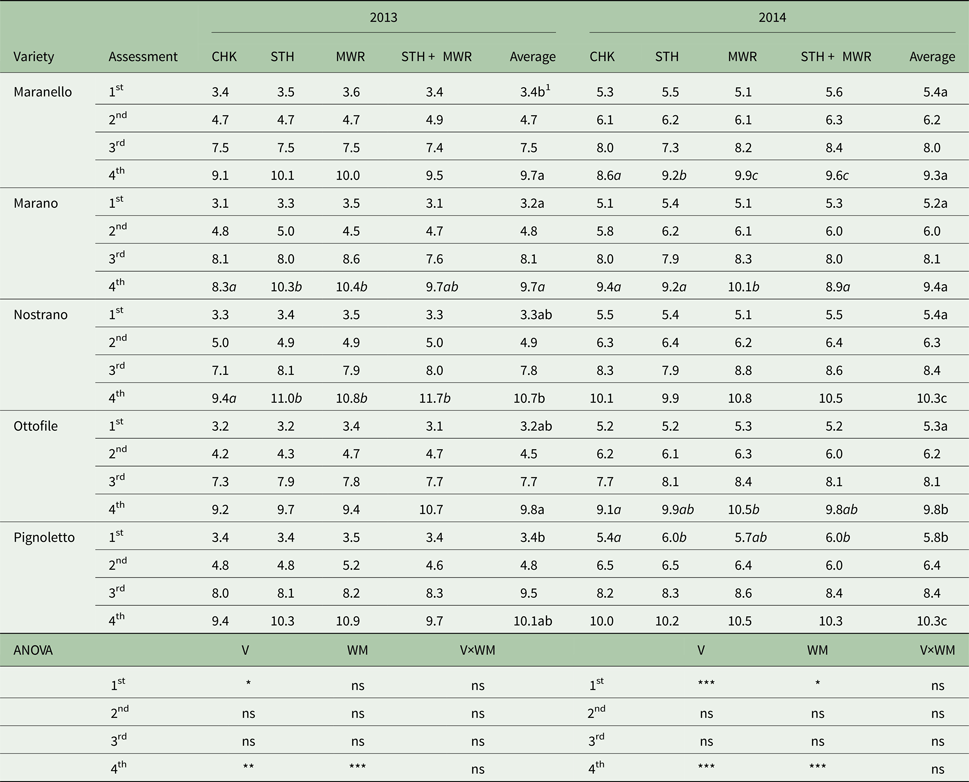
The comparison among the mechanical treatments for all the varieties, with the only exception of Pignoletto, showed significant differences only at the final assessment in which the untreated check had always a lower number of leaves (Table 3). Generally, the applied mechanical treatments had a similar effect on the number of leaves across varieties; however, for Marano, in particular in 2014, STH treatment showed the same number of leaves of that recorded for CHK and STH + MWR suggesting a partial negative effect caused by the mechanical treatments. Maranello in 2014 also showed a lower number of leaves in STH compared with MWR and STH + MWR but this was probably due to the scarce efficacy of the weeding treatment. Considering the number of leaves per plant in each variety, averaging among treatments, Maranello and Marano showed the lowest values, while Nostrano and Pignoletto the highest, in particular at the first and fourth assessment.
Number of leaves per plant of the maize cultivars in the different treatments in 2013 and 2014 followed by the ANOVA results of the effect of the main factors (variety and weed management) and their interactions on number of leaves

1 Values sharing the same letter are not significantly different according to REGWF test (P ≤ 0.05). Roman letters indicate the comparison among maize varieties separately for each assessment and separately for each year. Italic letters indicate the comparison among treatments within the same assessment for each variety, separately for each year. When no letters are shown, the values are not significantly different.
V, variety; WM, weed management; ns, non-significant.
Significance: *P < 0.05; **P < 0.01; ***P < 0.001.
Leaf number is a varietal characteristic but can also indicate, as in this experiment, the growth stage reached by the maize varieties. Mechanical weeding can cause injuries to maize by delaying the growth or by damaging the leaves which both may result in a lower number of leaves. Previous studies have found that harrowing performed on maize at the two-leaf stage can cause injury if the driving speed exceeds 3–4 km h−1 (Van der Weide et al., Reference Van der Weide, Bleeker, Achten, Lotz, Fogelberg and Melander2008). The higher driving speed used in this experiment (about 7 km h−1) could be the reason for the lower number of leaves found in Marano. Moreover, the incomplete weed control obtained with the mechanical treatments can further contribute to lower the leaf number. In addition, Hall et al. (Reference Hall, Swanton and Anderson1992) showed that the longevity of maize lower leaves was reduced by the competition with weeds for light and nutrient, resulting in a high number of senescent leaves.
Maize density
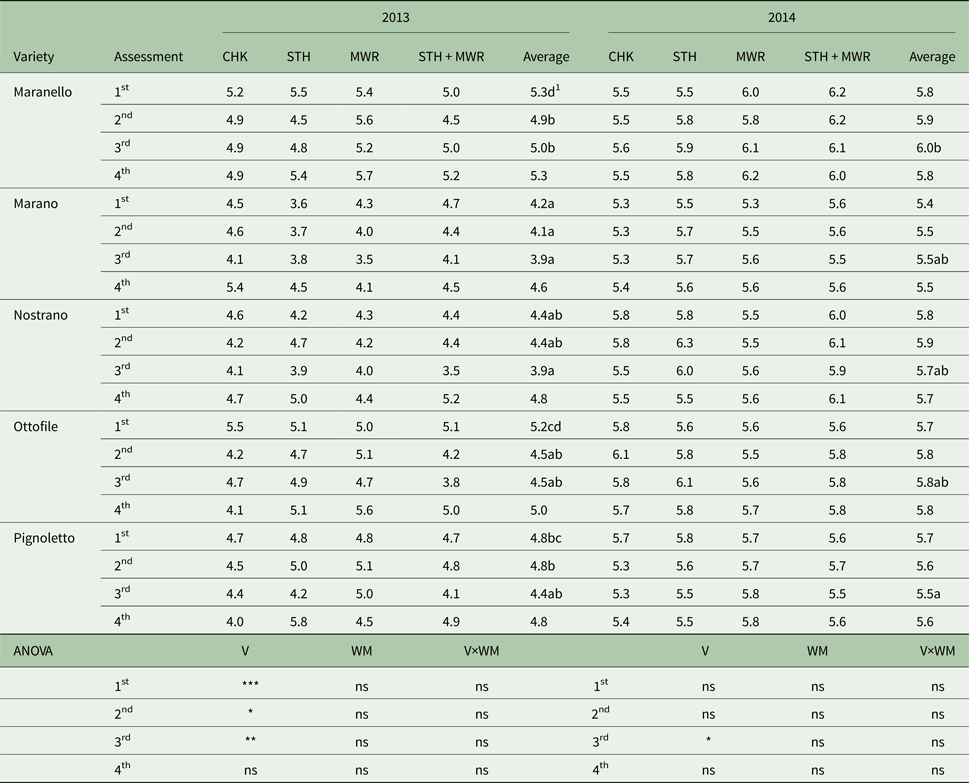
In both years, no differences in plant density were found among the treatments, while the only significant differences were those among varieties, averaging among treatments (Table 4).
Maize density (number of plants m−2) of the maize cultivars in the different treatments in 2013 and 2014 followed by the ANOVA results of the effect of the main factors (variety and weed management) and their interactions on maize density

1 Values sharing the same letter are not significantly different according to REGWF test (P ≤ 0.05). Letters indicate the comparison among maize varieties separately for each assessment and separately for each year and the comparison among treatments within the same assessment for each variety, separately for each year. When no letters are shown, the values are not significantly different.
V, variety; WM, weed management; ns, non-significant.
Significance: *P < 0.05; **P < 0.01; ***P < 0.001.
In 2013, the hybrid variety Maranello showed a higher plant density, followed by Ottofile. In the same year, Marano and Nostrano had a lower density than the other varieties in two assessments. However, in 2014 the density was generally higher for all the varieties, and differences were only found at the third assessment, with again Maranello having the highest density and Pignoletto the lowest. These differences were however not significant in the last assessments.
Maize density was used as an indicator of the selectivity of the mechanical weeding as plant uprooting can occur during the treatment (Kurstjens et al., Reference Kurstjens, Perdok and Goense2000; Pannacci and Tei, Reference Pannacci and Tei2014). Maize harrowing demonstrated in this study to be selective as no damages occurred to the plants, confirming what found in previous studies for summer annual crops (Pannacci and Tei, Reference Pannacci and Tei2014). Maize density in this study averaged from 4 to 6 plants m−2; high plant density has been demonstrated, for maize and other crops, to favor crop selectivity of the mechanical means as close plants on the rows may move away the tines avoiding crop injuries (Melander et al., Reference Melander, Rasmussen and Bàrberi2005). Moreover, high plant density is able to limit the weed biomass (Sanyal et al., Reference Sanyal, Bhowmik, Anderson and Shrestha2008); a study found that the increase of maize density from 4 to 10 plants m−2 permitted a weed biomass reduction higher than 50% (Tollenaar et al., Reference Tollenaar, Dibo, Aguilara, Weise and Swanton1994). In our study, Maranello which was the variety that had the highest plant density was also the one less infested and thus probably the most competitive.
Maize yield
In both years, for all the tested varieties the untreated check showed significant lower yields compared with the mechanical treatments, with values ranging from 0.3 t ha−1 for Nostrano in 2013 to 4 t ha−1 for Maranello in 2014 (Fig. 3).
Yield, 1000-seed weight, hectolitre weight and grain moisture at harvest in 2013 and 2014. Values sharing the same letter are not significantly different according to REGWF test (P ≤ 0.05). Lower case letters indicate comparison among treatments, while italics letters refer to comparison among varieties, averaging per treatments. Capital letters showed comparison among treatment within a variety and separately for each year. Yield, 1000-seed weight and hectolitre weight are standardized to 14% grain moisture.

In general, STH showed intermediate yield values among CHK and the other two treatments, MWR and MWR + STH. Marano was the least productive variety while Maranello, being hybrid, the most productive one as the yield ranged from 0.3 t ha−1 for Marano CHK to 10.4 t ha−1 for Maranello MWR + STH. This study highlighted that besides the hybrid variety Maranello, Pignoletto showed the highest yield, which peaked at about 6 t ha−1. This result was in agreement with a previous study conducted in Italy on old vitreous maize varieties cultivated organically, in which Pignoletto demonstrated to be the most productive one, the most rapid to grow, with high competitive ability towards weeds and thus the old maize variety most suitable to grown organically (Spagnolo et al., Reference Spagnolo, Pinna, Gamba, Zaccara, Possetto and Valoti2005).
As for the majority of the tested varieties, mechanical treatments and manual weed removal did not show significant yield differences, it was possible to observe that the mechanical treatments did not cause significant yield losses due to plant damages. In particular, this was more detectable for two varieties, Nostrano and Ottofile. In fact, Nostrano at both years and Ottofile in 2014 showed similar yields between MWR + STH and MWR and thus the presence of some damages caused by STH can be excluded; in addition, STH yield was significantly lower than MWR + STH indicating that the lower productivity was probably due to an incomplete weed control of the mechanical means and not to a plant damage. This conclusion was also drawn by previous studies in which lower crop yields were obtained in fields with mechanical weed control, compared with chemical control, mainly because of the poor weed control as no or very few damages occurred after the weeding operations (Mulder and Doll, Reference Mulder and Doll1993; Gilbert et al., Reference Gilbert, Vanasse and Angers2009). Moreover, yield reductions can also be caused by other factors as enhanced leaf disease that can result from a higher availability of nitrogen as a consequence of an enhanced nitrogen mineralization following mechanical weeding (Steinmann, Reference Steinmann2002).
Other yield-related traits
1000 seed weight
In our study, Marano was the variety that in both years recorded the lowest 1000 seed weight, with an average of 200 g (Fig. 3). The highest values were instead recorded for Maranello and Ottofile, with weight that exceeded 300 g. With exception of Marannello in both years, Marano in 2013 and Ottofile in 2013, no significant differences were found among treatments, even though higher values of 1000 seed weight were usually found in MWR and MWR + STH treatments. In general, CHK had similar or lower 1000 weight values than the other treatments. Significantly lower grain weights were observed in CHK for Maranello (in both years) and Ottofile (in 2013 only), as in the previous study conducted on maize in Brazil, in which lower grain weights were obtained in non-weeded plots (Silva et al., Reference Silva, Mesquita, Antônio and Silva2010). In the same study, no differences were found between mechanical treated plots neither with a different moment of treatment nor with increasing number of weeding operations (Silva et al., Reference Silva, Mesquita, Antônio and Silva2010).
Hectolitre weight
In both years, Nostrano and Marano showed the highest hectolitre weight with about 70 kg hl−1, while Maranello and Ottofile had the lowest values. Regarding the effect of mechanical weeding on the hectolitre weight, no big differences were detected among the treatments. Only Pignoletto showed differences among the treatments in both years, however with opposite results; in particular, in 2013 the CHK had significant higher hectolitre weight, while in 2014 CHK was the lowest with MWR and MWR + STH reaching the highest values. Hectolitre weight, as well as 1000 seed weight, is one of the measures of maize quality and it is correlated with good milling performance (Tolera et al., Reference Tolera, Sundstøl and Said1998; Engelbrecht, Reference Engelbrecht2008); in our study, Marano was the least productive variety and showed the highest hectolitre weight, while Maranello was the most productive but presented a low hectolitre weight. It should be noted that these two varieties showed an opposite trend regarding 1000 seed weight. Controversial results are reported in the literature about the presence or absence of correlation between 1000 seed weight and hectolitre weight; however, despite the fact that some correlation may exist, these two quality indices are not alternative to estimate yield quality (Engelbrecht, Reference Engelbrecht2008).
Maize grain moisture
In 2013, moisture values at harvest were generally high and ranged from about 17% up to more than 25%, while in 2014 the moisture was lower with values averaging about 12–14% and thus near to the conservation moisture.
In 2013, averaging between varieties, no influence of the applied treatments was found, while in 2014 CHK showed the highest moisture values. In agreement with our results, a previous study conducted on maize showed that the mechanical treatment (rotary-hoeing) did not affect the grain moisture content (Begna et al., Reference Begna, Hamilton, Dwyer, Stewart, Cloutier, Liu and Smith2001). The higher moisture content recorded in CHK in 2013 can be attributed to the weed presence as weed seeds can have been harvested with the grains and can have raised the maize moisture (Lyon et al., Reference Lyon, Blackshaw, Gill and Carver2009). Marano in both years showed low moisture at harvest, while Maranello the highest, followed by Pignoletto (Fig. 3). Within varieties, no big differences among the treatments were found; in particular, in 2013 Maranello showed a lower moisture for CHK, while in 2014 Ottofile recorded the highest moisture in CHK. It has been demonstrated that in maize a high grain moisture content causes a decrease in hectolitre weight because humid kernels are bigger and a low number of kernels fits in the container used for the measure of the hectolitre weight (Engelbrecht, Reference Engelbrecht2008). This was also confirmed in our study in which Marano, that had a low moisture content, showed a high hectolitre weight, or by Maranello but with an opposite trend.
Conclusions
In this study, mechanical weeding significantly lowered weed density even though the efficacy of weed control was not sufficient to avoid yield losses. Higher weed control was obtained with weeds at early growth stages and with a repeated number of harrowing. In fact, in 2014 when weed infestation was higher compared with the previous year, a further passage of harrowing permitted to obtain the same infestation level of 2013, with the advantage of having weeds at early growth stages. The weed species composition was that typically observed in other spring crops and the mechanical interventions slightly reduced species richness. Moreover, mechanical weeding had similar effects on weed density among maize varieties as shown by the statistical analysis.
Regarding the effect on maize plants, mechanical weeding did not cause significant injury in terms of plant height or density; however, for some varieties, i.e. Marano and Maranello, mechanical treatments caused a delay in the crop cycle as shown by the lower number of leaves in STH compared with MWR at the last assessment.
Neither yield nor yield-related traits were affected by mechanical weeding. Maize yield in STH was intermediate between that obtained in untreated and in MWR, and this result has to be attributed to the incomplete weed control as no damages were observed on the crop. Regarding the tested varieties, the study confirmed the superiority of the hybrid Maranello being the most productive, while among the traditional varieties Pignoletto showed the highest yield. Marano showed the lowest yield but with good quality as demonstrated by the high hectolitre weight and the low grain moisture. Besides the hybrid Maranello, the variety most suitable to grown organically was Pignoletto, not only for the high yield but also because it was shorter than the other varieties and thus less exposed to mechanical damages and with a crop cycle that was not affected by weeding as shown by the higher number of leaves.
The results of this study confirmed that mechanical weeding can be an applicable practice to control weeds both in organic and in conventional farming as an integrative means to limit weed infestation without causing crop injuries, even though alone is not able to control the weeds effectively. Even though in organic farming, maize can be sold at higher price, usually 30% more than the conventional one, this cannot compensate the yield losses caused by the incomplete weed control obtained with the sole use of mechanical weeding (Piazza, Reference Piazza2004). Further studies are necessary to determine which mechanical operations and adjustments are the most effective in controlling weeds in different cropping conditions.
Acknowledgement
The authors want to thank Mario Gilardi, Mauro Gilli and Gabriele Gariglio for helping in the field works. The research was partially funded by Regione Piemonte grant No. 08000541915 (project ENVIFLOUR). The paper is equally attributable to the authors.