During the late 1800s state governments in America began to regulate the food industry. Over the course of roughly two decades the food and dairy trade became one of the more heavily regulated segments of the United States economy. State legislatures began to enact pure food and pure dairy laws in the early 1880s. By 1900 nearly every state had passed some kind of pure food or pure dairy legislation that made it illegal to sell “adulterated” food products. What explains this expansion of regulatory activity?1
For an analysis of food regulation in the Britain during the late nineteenth and early twentieth centuries see Phillips and French, “Adulteration,” and French and Phillips, Cheated Not Poisoned.
One hypothesis is that state pure food laws were enacted to enhance the market power of manufacturers and distributors of traditional food products. Technological developments in food manufacturing and processing during the late 1800s gave rise to new and cheaper products, such as oleomargarine, glucose, and dressed beef, that threatened to undermine the market power of more traditional food products. Could it be that pure food laws that outlawed the “adulteration” (cheapening through the addition of impurities) of food products were introduced to protect traditional food producers from these new substitutes?
Another hypothesis is that pure food laws were enacted to help make a market for certain food products.2
According to Dupré, “Regulating the Québec Dairy Industry,” the market-making benefits of regulation were also invoked in support of dairy regulation in early-twentieth-century Québec. Dupré, however, argues that reputation mechanisms were responsible for solving the lemons problem in the Québec dairy industry.
Specialization and technological change in food production made it difficult for consumers to judge product quality and created opportunities for cost-reducing deception by firms. Reputation mechanisms may not have been effective in dealing with this asymmetric information problem because advances in science made it possible for firms to adulterate their goods in ways that were not easily perceived by consumers. Regulation of product labels may therefore have arisen as a solution to this “lemons” problem regarding product ingredients because regulators had a comparative advantage over consumers in detecting food and dairy adulteration.
Examining city-level prices of various food items between 1890 and 1903, I find little evidence that pure food laws affected food prices in ways that were beneficial to traditional food producers. Hence, the price data do not generally support the market-power hypothesis. On the other hand, an analysis of the effect of pure food laws on food consumption, as well as of the political economy of the pure food movement, suggests that pure food regulations were desired to increase consumer confidence in product quality and that one benefit of regulation may have been its positive impact on consumer perceptions about quality. Specifically, I find that consumption of commonly adulterated foods was higher in states with pure food laws and that proxies for the importance of consumer groups are closely correlated with cross-state variation in state pure food and pure dairy laws. These results are consistent with the hypothesis that pure food regulation reduced information costs about the quality of certain food products.3
The asymmetric information problem regarding other dimensions of food quality (for instance, nutritional value) may not have been addressed by these regulations. Hence, the emphasis of this article is strictly on the market-making role of regulation that improved the quality of information about product ingredients. Because it is possible that regulation that helps make a market for certain food items may also harm consumers (because other relevant information about quality is still not provided), I do not claim that these regulations protected consumers or improved overall welfare.
This article builds on the existing literature in three ways. First, my study is among the first to examine the pure food and dairy laws that were enacted by state legislatures in the late 1800s.4
An important exception is Okun, Fair Play.
Existing work by economic historians has focused exclusively on specific food regulations (for instance, state and federal restrictions on oleomargarine) or the 1891
Meat Inspection Act.
5 Dupré, “If It's Yellow”; and Libecap, “Rise.”
Second, I bring more data to bear on this topic than other authors. Scholarship in this area tends to be mostly narrative. Third, I recognize that competing hypotheses about regulation are often observationally equivalent, which makes it difficult to conduct a specific econometric test that cleanly distinguishes one hypothesis from another. Although I do not jointly test the two hypotheses in a single econometric framework, I accumulate an ensemble of quantitative and qualitative evidence that is generally more supportive of one hypothesis than the other.
THE MARKET FOR FOOD AND DAIRY IN THE LATE 1800s
The late 1800s was a period of rapid organizational and institutional change in the American economy. New technologies and declining transportation costs gave rise to multiunit firms that realized large economies of scale and scope.6
Additionally, the emergence of a national transportation network widened the size of the market and increased the gains from specialization. The result was regional specialization and urbanization.
7 Kim, “Economic Integration” and “Urban Development.”
As a consequence, the separation between the production and consumption of many goods, including food and dairy products, increased tremendously. In the early 1800s, the vast majority of the population lived in rural areas, close to the production of food. However, as the century progressed, the population gravitated to the cities, and the share of the population directly engaged in the production of foodstuffs declined. Consumers therefore became increasingly reliant on impersonal market exchange for their food.
Technological advances changed the types and varieties of foods that were available. Improvements in refrigeration, combined with the development of the railroad, facilitated the growth of the midwestern meat packers and the “dressed beef” industry.8
Yeager, Competition, chapter 3.
Advances in chemistry enabled the French chemist Mège-Mouries to develop oleomargarine, the first viable butter substitute, in 1869. Within a few years, oleomargarine was produced and consumed widely in the United States.
9 Wood, Strategic Uses, pp. 154–64; and Young, Pure Food, pp. 71–72.
The development of chemical preservatives and improvements in canning technology spurred the growth of the canning industry, making fruits, vegetables, and meats available throughout the year.
10 Although these changes increased the range of products available, they also increased uncertainty about product quality, because consumers now knew less about where their food was from and what was added to it. Thus, consumer anxieties about quality—specifically, about food adulteration—were increasingly common.
11 Wood, Strategic Uses, chapter 3; and Goodwin, Pure Food, Drink and Drug Crusaders, chapter 2.
These developments also created new sets of winners and losers in the food and dairy industry. The growth of the large meat packers in the mid-1800s undermined the dominant position of local slaughterhouses in supplying meat to city consumers.12
The introduction of oleomargarine in the 1870s posed a competitive threat to butter producers, because oleomargarine was significantly cheaper than butter.
13 Additionally, the rise of national food manufacturing firms such as H. J. Heinz, Armour, and the National Biscuit Company eroded the competitive position enjoyed by smaller regional and local firms.
14 McCurdy, “American Law”; and Wood, “Strategic Use.”
Hence, the changes that occurred in this market tilted the competitive playing field in favor of new products and new firms.
State regulation of the food and dairy industry began against this historical backdrop. Between 1880 and 1900 nearly every state in America introduced some sort of law regulating the food and dairy industry. With the declared objective of protecting consumers from fraud and illness, state legislatures enacted laws to ensure the “purity” of food and dairy products. These laws required firms to label their products in particular ways and gave state officials the authority to examine samples of food and dairy products and to punish manufacturers and distributors who “adulterated” their wares. What prompted this expansion of state regulation?
DID PURE FOOD REGULATIONS PROTECT TRADITIONAL FOOD PRODUCERS?
Economists often argue that regulation is enacted to advance specific producer interests. Certain producers may desire regulation because of its potential to deliver competitive advantages. For instance, by limiting the number of firms in an industry or by reducing the availability of substitutes, regulation may raise the profits of incumbent firms. Indeed, because incumbents face lower collective action costs than either consumers or competing firms, the market for regulation is often skewed in their favor. Rent seeking on the part of incumbents may therefore give rise to regulation that enhances the market power of incumbent producers.15
Stigler, “Theory”; and Peltzman, “Toward a More General Theory.”
In the late 1800s businessmen were certainly not above using the coercive power of government to tilt the competitive playing field in their favor. Producers of food items who found their market shares eroded by the entry of new substitutes were apparently quite willing to lobby for regulation that harmed competing products.16
In her discussion of food-industry trade wars in the late 1800s, Wood, Strategic Uses, pp. 152–53, writes: “Highmindedness aside, the basic strategy of the trade war was simple: Trick your opponents, unnerve them, get them to make mistakes, steal their clientele, and if all else fails, get the government to tax them out of business or have their products declared adulterated or misbranded.”
At the national level, much scholarship emphasizes the role of large firms in shaping federal food regulation to suit their needs.
17 See, for instance, Kolko, Triumph of Conservatism, pp. 98–110; and Wood, “Strategic Use.”
At the state level, however, the evidence suggests that it was generally smaller local firms that produced traditional food items who desired regulation. Charles McCurdy, for instance, argues that local meat packers pushed for state meat inspection in order to disadvantage the large Chicago packinghouses, and Ruth Dupré finds that small dairy producers who wanted to limit the availability of oleomargarine supported margarine regulations. State governments were responsive to these smaller scale producers because they represented important local or regional political constituencies.
18 McCurdy, “American Law,” pp. 643–48; and Dupré, “If It's Yellow.” In a similar vein, recent scholarship has argued that state antitrust laws were enacted in response to pressure from smaller scale, local producers. See Boudreaux, DiLorenzo, and Parker, “Antitrust.”
Could a desire on the part of small traditional food producers to preserve their market power furnish an explanation for pure food and dairy regulation?
If pure food and dairy regulations protected producers of traditional food items, then regulation should affect the prices of traditional food products. Specifically, I posit that if pure food regulations reduced the availability of new substitutes, pure food regulations should have either increased the prices of traditional food products, reduced the rate at which they were falling, or reduced their variability, other things held constant.19
A stronger test would also involve examining the effect of regulation on the prices of new substitute products. Unfortunately, data limitations force me to restrict the analysis to prices of traditional food items. The lack of information on the prices of new products is not altogether surprising because data tend to be collected only for products that have existed for some time.
The prices of these products should rise if pure food regulations increased the market power of traditional food producers; they should fall less quickly or become more stable if pure food regulations helped these producers preserve their market power. Hence, it may be possible to detect whether pure food regulations advantaged traditional food producers by examining how regulation affected the prices of traditional food items.
Testing this hypothesis is difficult because evidence in its favor may also be consistent with the alternative hypothesis. If regulation increased traditional food prices, should one infer that regulation enriched producers of these items at the expense of efficiency, or that regulation helped consumers distinguish low- from high-quality products? Observational equivalence makes it difficult to test the market-power hypothesis against the alternative hypothesis. Nevertheless, I believe that an examination of price data provides some information about the relevance of the market-power story. For if prices were unaffected by regulation, it would be hard to argue that regulation benefited traditional food producers. Without evidence that regulation benefited these producers, the plausibility of the market-power hypothesis is in question.
Enforcement of State Pure Food Regulations
In order for regulation to affect prices, pure food and dairy laws would have had to have been enforced. Enforcement of these laws evidently varied widely across states. In several states, the regulations outlawed the sale of adulterated products, but no agency was entrusted with the authority to enforce the law. Typical among such statutes was the pure food law of Arizona which made “[t]he adulteration or dilution, for sale as pure, of food, drink, or drug, or the sale as pure of such adulterated or diluted articles … a misdemeanor” but did not specify an agency to enforce the law or establish penalties for violation.20
US Senate, Adulteration of Food Products, p. 155.
In states such as Arizona, enforcement was very weak. Hence, according to the authors of a Senate report on state pure food laws: “[I]n a considerable number of states, especially in the South and West, [enforcement] provisions are very brief.”
21 In other states, agencies were established to enforce pure food and dairy laws. In these states, a budget was provided for the enforcement agency, the regulations furnished particular guidelines for the taking and inspection of food samples, and fines or prison terms could be imposed on dealers and manufacturers who violated the regulations. In Massachusetts, for instance, enforcement of food and dairy laws was placed within the State Board of Health and the State Dairy Commissioner respectively. Both the Board of Health and the Dairy Commissioner employed inspectors, chemists, and public health officials who collected and analyzed food and dairy samples on a regular basis. Violators of these laws could be brought to court and fines of up to $500 could be imposed on manufacturers found guilty of adulteration.22
In Minnesota, a Dairy and Food Commissioner was established to enforce the state's pure food and dairy laws. The commissioner was given a budget of $15,000 for enforcement and had the authority to appoint inspectors and chemists to collect and analyze food samples. Violators of the Minnesota law could be punished by a fine not exceeding $500, a prison sentence not exceeding one year, or both.
23 According to the Senate report cited earlier the laws enacted in states with enforcement agencies, which represented about half of the states, “contain[ed] also definite provisions regarding their enforcement, which are seldom found in the briefer laws,” and were therefore “much more elaborate and effective.”
24 Although it is difficult to get a systematic impression of the degree to which pure food and dairy laws were enforced in the various states, the evidence indicates that enforcement was reasonably vigilant in those states with food and dairy laws that specified an agency to enforce its regulations and essentially nonexistent in those states that did not. In those states where no enforcement agency was established, the laws were “dead letters.” In states with enforcement agencies, however, the authorities attempted to induce compliance with pure food and dairy laws in three ways.25
Goodwin, Pure Food, pp. 68–70. See also Law, Specialization, pp. 19–23.
One was to directly prosecute offenders in court and to punish manufacturers and dealers with fines or prison terms. Another strategy was to shame manufacturers and dealers by publishing the results of agency investigations in the press and in monthly bulletins that listed the names, addresses, and violations of offenders. The third strategy was to use “moral suasion” to induce food manufacturers and distributors to alter the nature of their products.
Thus, although the degree of enforcement varied across states, enforcement was unquestionably more vigilant in those states where an enforcement agency was present. Hence, for the empirical portions of this article, I identify the existence of regulation by the presence of a pure food or pure dairy law that specified an enforcement agency. Any state that failed to specify an enforcement agency is treated as equivalent to those states that did not enact a pure food or dairy law.
Testing the Market-Power Hypothesis: Evidence from Retail Prices
Perhaps the most systematic way to test the market-power hypothesis is to exploit cross-state and temporal variation in state food and dairy regulations to determine the effect of these laws on the prices of traditional food and dairy items. Panel data on retail prices of specific food and dairy items are available on an annual basis from 1890 to 1903. During the 1890s, the Bureau of Labor began to collect data on retail prices in various cities in order to estimate the cost of living in various cities in the United States.26
U.S. Bureau of Labor, Eighteenth Annual Report.
By matching this data with information about the years in which state food and dairy laws were enacted, I can analyze the effect of these regulations on prices, the rate of price change, and the variance of prices.
In its survey, the Bureau of Labor collected city-level retail prices for a variety of food and dairy items, ranging from specific cuts of meat to sugar. For certain products, the survey included as many as 32 different states, and in some states, over 20 different cities were surveyed. It is fortunate that this survey of retail food prices was collected from 1890 to 1903, for it was during these years that most states in the sample enacted pure food and dairy laws.
I focus on the prices of six products: butter, cheese, milk, sugar, molasses, and vinegar. I chose to examine these particular items because they include traditional food items whose market shares were potentially threatened by new products, and because state laws often set specific standards for these products. Oleomargarine, for instance, posed a significant competitive threat to butter; developments in the technology of canning and preservation made evaporated and condensed milk viable substitutes for fresh milk; and the introduction of glucose threatened to undermine the dominant position enjoyed by producers of traditional sweeteners such as sugar and molasses. State dairy regulations enacted during this period often included specific standards mandating the minimum fat content and proper labeling of butter, milk, and cheese. Additionally, state pure food statutes frequently included minimum acidity standards for vinegar and glucose prohibitions for sugar and molasses. Hence state food and dairy inspectors would certainly have targeted these products.
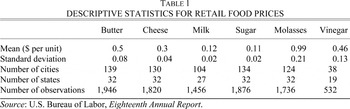
Table 1 displays descriptive statistics for each price series, along with information about the total number of cities and states included in the sample. For butter, 139 cities were included, representing 32 different states, and yielding a total of 1,946 observations. For vinegar, the survey included 38 cities in 19 different states, generating 532 observations in total. Hence, the data should permit broad generalizations regarding the effect of regulation on these particular prices.
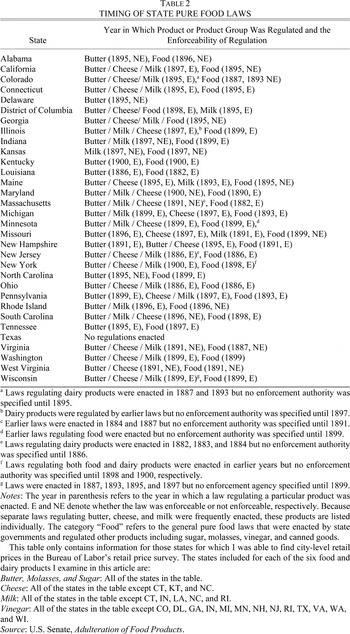
Table 2 presents information about the timing of the pure food and dairy regulations that were enacted in the states included in the Bureau of Labor retail price survey. The data were gathered from a US Senate report that included a digest of state pure food laws.27
U.S. Senate, Adulteration of Food Products.
As shown in the table, specific regulations for butter, cheese, and milk were enacted in nearly every state in the sample. General pure food laws regulating other products (sugar, molasses, vinegar) were also enacted in almost every state included in the sample. Whereas most of these regulations were introduced in the 1890s, some states enacted pure food and dairy regulations in the 1880s.
Table 2 also indicates whether a state's food regulations specified a particular enforcement agency. Inspection of the table reveals that there was considerable variation across states on this score. Hence, cross-state variation in both the timing and enforceability of state food regulations will be used to estimate the effect of regulation on the prices of various food items.
To determine the effect of regulation on prices, I estimated the following fixed-effect model for the prices of each of the six food and dairy products:
Pjkt is the real price of the product in city j in state k in year t, m is an intercept, Sk is a state fixed effect, Yt is a year fixed effect, ejkt is an error term, and Rkt is a binary variable that equals one for all years t in which enforceable regulation regarding the product is in effect in state k and zero otherwise.
28 A weakness of using a single binary variable to measure regulation is that does not allow the effect of regulation to vary over time. To address this problem I also estimated the model using year-specific binary variables to represent the first, second, third, and subsequent years in which regulation was in place in a given state. Qualitatively similar results were obtained using year-specific regulation variables. See Law, Specialization, pp. 25–29, 59–60.
Real prices were obtained by deflating the nominal prices in the survey by the wholesale price index. State fixed effects were included to control for factors that vary across states, and year fixed effects control for changes in technology and other time-dependent shocks. The parameter of interest in this regression is
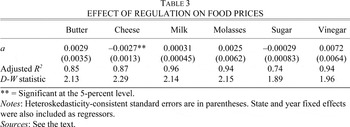
a which measures the effect of regulation. If
a is less than or insignificantly different from zero, I can reject the market-power hypothesis. A negative (zero) coefficient estimate for
a implies that prices declined (remained unchanged) as a result of regulation, which is inconsistent with the hypothesis that regulation, by reducing the availability of substitutes, allowed firms to increase prices.
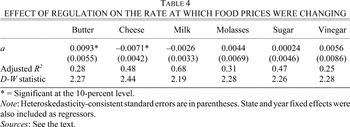
To test the hypothesis that regulation kept prices from falling at a faster rate, I estimated another set of fixed effect regressions for each of the six food items. These regressions are identical to equation 1 except that the dependent variable is the growth rate of prices. If regulation prevented prices from declining at a faster rate, then a should be positive: the marginal effect of regulation is to reduce the rate at which prices were falling. A negative or zero a implies that the rate at which prices were changing either declined or was unaffected by regulation, which is inconsistent with the view that regulation enabled traditional food producers to preserve their market power and keep prices from declining.
Table 3 displays least square estimates of a for equation 1 when the dependent variable is the real price of a particular food or dairy item. In each regression, the coefficient a is either insignificantly different from zero or negative and significant. Hence, regulation did not allow producers of these goods to raise prices. Table 4 shows coefficient estimates for a when the dependent variable is the annual growth rate of each price. The coefficient on the regulation dummy variable is negative and statistically significant for cheese, positive and significant for butter, and insignificantly different from zero for the remaining products: regulation favorably affected the growth rate of butter prices, but not the prices of other products. Thus, whereas state regulation may have helped preserve the market power of butter producers (in that it may have favorably affected the rate at which butter prices were changing), it did not enhance the market power of the other products examined.
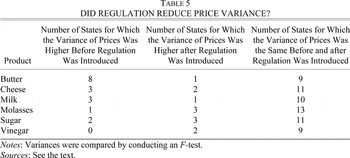
Another way to test the market power hypothesis is to examine the effect of regulation on the variance of prices. If regulation enhanced the market power of traditional products by making it harder for new substitutes to enter the market, then one observable implication may be a decline in price variability. To test this hypothesis, I calculated the variance of prices in each state before and after regulation was introduced and then conducted an F-test to determine whether the difference in the pre- and post-regulation price variance was statistically significant. Table 5 reports the results of this exercise. Although the variance of butter prices declined in several states after the introduction of regulation, for most products and in most states included in the sample, the variance of prices was unaffected by pure food or dairy regulation.
Summary of the Evidence
The evidence suggests that pure food and dairy regulations did not allow producers of many traditional food products to raise their prices, slow the rates of price decline, or reduce price volatility. For one commodity—butter—pure dairy laws may have affected prices in a way that was favorable to producers. This is not altogether surprising because recent scholarship indicates that butter interests were an important constituency in favor of laws that restricted the availability of oleomargarine.29
What is perhaps novel is the precise way that butter producers benefited from pure dairy legislation: real butter prices did not increase, but the rate at which butter prices were declining was reduced by regulation. Moreover, in several states, butter prices became less volatile following regulation. Hence, butter producers may have benefited from pure food legislation, but not in the most obvious manner. The fact that these advantages were not conferred on the producers of the other products examined, however, suggests that pure food and dairy regulations did not
generally enhance the market power of traditional food producers.
30 The skeptical observer may argue that the evidence presented so far is consistent with the possibility that the regulations were generally not enforced. Although it is difficult to challenge this claim directly, I believe that two factors militate against it. One is the historical evidence that suggests that enforcement agencies in several states were quite vigilant in their enforcement efforts. Another is the fact that, for the one product (butter) where regulation favorably affected the growth rate of prices, the regulation dummy variable is only statistically significant when the variable indicates the presence of a pure dairy law that specified an enforcement agency. However, when the dummy variable merely indicates the presence of a pure dairy law, enforceable or otherwise, the coefficient falls and is no longer significant at conventional levels. This suggests that it was the presence of an enforcement agency that made it possible for regulation to affect market outcomes and that pure food and dairy regulations that specified an enforcement agency may not have been merely window-dressing. See Law, Specialization, pp. 31–32.
STATE REGULATION AND THE PROBLEM OF FOOD ADULTERATION
One of the risks that must be overcome when individuals specialize and engage in impersonal exchange is greater uncertainty about the quality of products purchased from others. Specialization may increase the gains from trade, but it also increases information costs because one's ignorance about the goods and services produced by others increases as one becomes more specialized.31
Wallis and North, “Measuring the Transaction Sector.”
The average consumer in the late nineteenth century may have been wealthier than his early nineteenth century counterpart, but as a result of specialization in food production, he also possessed a smaller information set regarding the attributes of the food items he consumed. Because individuals knew less about where their food was from, how it was produced, and what was added to it, they became increasingly suspicious about quality.
32 This sentiment was expressed in 1885 by Ellen Richards, one of the major figures in the home economics movement, who wrote in Food Materials and Their Adulteration: “We buy everything, and have no idea of the processes by which articles are produced, and have no means of knowing beforehand what the quality may be. Relatively we are in a state of barbarous innocence, as compared with our grandmothers, about the common articles of daily use.” Quoted in Strasser, Satisfaction, p. 255.
These suspicions were not unwarranted. According to George Akerlof, asymmetric information about product quality can result in low quality goods dominating the market.33
Akerlof, “Market for ‘Lemons’.”
In the context of the food industry, this “lemons” problem manifested itself in the adulteration and false representation of food products. Precisely because consumers were ignorant about how their food was produced, firms had an incentive to adulterate their goods as this would allow them to earn higher profits. Hence, concerns about food adulteration were frequently expressed in political discussions during this period.
34 Goodwin, Pure Food, Drink and Drug Crudaders, pp. 41–58; and Young, Pure Food, pp. 31–51.
The Adulteration Issue
Historical evidence indicates that adulteration was a very profitable strategy for the manufacturers and distributors of many food items. Milk was occasionally cheapened by the addition of water, and the cream was sometimes removed without notifying the customer because it could be sold elsewhere for higher prices.35
U.S. Senate, Investigation, p. 13.
Stories about wholesalers and retailers substituting oleomargarine for butter were common. The incentive to do this was substantial, because butter sold for 25 cents per pound whereas oleomargarine sold for 18 cents per pound.
36 Cheese was frequently cheapened by the substitution of low-priced fats for milk fat, and inexpensive cottonseed and coconut oils were often added to lard.
37 Producers of maple syrup, one of the most expensive food items at the time, adulterated their products in extremely devious ways.
38 Technological advances often enabled firms to alter their products in ways that reduced costs but were difficult to detect. For instance, the development of glucose in the early 1800s allowed honey, molasses, and maple syrup producers to cheapen their products and make a given amount “go farther.” In testimony to Congress in 1899, George York, editor of the American Bee Journal claimed: “liquid honey is the kind most commonly adulterated; not that adulteration is particularly harmful, but more in the nature of a deception and fraud upon the public. They [the dealers] adulterate mainly with glucose, which is a very much cheaper article than pure honey … We find that nearly all the wholesale grocers in this city, and in other cities, adulterate it.”39
Improvements in chemistry and bacteriology also contributed to the development of new preservatives such as borax, benzoic acid, and salicylates that allowed manufacturers to mask food deterioration and lower costs.
40 Goodwin, Pure Food, Drink and Drug Crusaders, p. 48.
Technological change thus gave rise to new forms of food adulteration that were imperceptible to consumers.
A report prepared by the Agriculture Department surveyed the findings of several studies conducted by state and federal agencies on the extent of food adulteration between 1880 and 1900.41
U.S. Senate, Adulteration of Articles of Food. Similar findings were reported by Jesse Battershall, a chemist who conducted some of the earliest studies of food adulteration in the United States. See Battershall, Food Adulteration.
Over 20 studies found that milk was watered down or skimmed without warning. Eight studies discovered butter to be adulterated with oleomargarine. Fifteen studies found that cottonseed oil was extensively used to adulterate lard. Several state agencies found glucose and preservatives in canned goods, jams, and jellies. Tea and coffee were often found to contain contaminants such as burnt shells and dirt. The evidence presented in this report therefore suggests that food adulteration was quite widespread.
Why Reputation Mechanisms Could Not Solve the Food Adulteration Problem
Reputation mechanisms often provide firms with an incentive not to cheat on quality. If goods are purchased repeatedly, and if consumers can determine product quality ex post, then consumers can punish firms that cheat on quality by taking their business elsewhere. Benjamin Klein and Keith Leffler demonstrate that firms will not have an incentive to cheat on quality if the present value of expected profits from repeat sales exceeds any temporary increase in profits due to shirking on product quality.42
Klein and Leffler, “Role.”
Why then was food adulteration relatively common?
In order for reputation mechanisms to ensure that the right level of quality is delivered, two conditions must be met. First, consumers must be able to determine the identity of the producer. If consumers cannot tell which products were produced by which firm, punishment of quality cheating is impossible, for there can be no value in punishment if one does not know whom to punish. Second, consumers must be able to accurately judge product quality ex post. If it is difficult for consumers to detect whether they have been cheated, then cheating may occur in equilibrium because consumers will not know whether or not to punish.43
Darby and Karni, “Free Competition”; and McCluskey, “Game Theoretic Approach.”
Product branding solved the first problem. Branding allowed manufacturers and distributors to distinguish their own products from their competitors. Indeed, the late 1800s witnessed a proliferation of brand name food items.44
Strasser, Satisfaction; and Kim, “Markets.”
Hence, as branding became more common, consumers were able to distinguish among the products of different firms. However, because technological developments made it possible for firms to adulterate their products in virtually imperceptible ways, the second problem—detecting quality cheating—became more acute. Without the ability to detect subtle adulteration
ex post, consumers could not punish firms for failing to supply unadulterated items. Even producers of brand-name items had an incentive to engage illicitly in subtle forms of adulteration, for subtle adulteration allowed a firm to reduce costs in ways that would not trigger a loss of reputation. Thus, while reputation mechanisms might eliminate the more obvious types of food adulteration, they could not deal effectively with the problem of subtle adulteration.
Some consumers were evidently aware that subtle forms of adulteration occurred and they preferred to either pay less for subtly adulterated foods or to avoid eating them entirely. Correctly or otherwise, these consumers believed that adulteration, even if undetectable, was fraudulent, and that certain types of adulteration, particularly those involving chemical preservatives, could lead to illness or even death.45
It was widely believed by consumers that glucose was unfit as food, that alum-based baking powders were poisonous, and that chemical preservatives such as borax could lead to long-term health problems. See Young, Pure Food, chapters 3 and 4; and Wood, Strategic Uses, chapter 3.
Stories about food adulteration therefore fueled doubts about the purity of all food and dairy products, whether packaged and branded or sold in bulk.
46 According to Goodwin, Pure Food, p. 42, a study conducted by the Massachusetts Board of Health and the New York Medical Society in the 1890s found that food adulteration, “… extended to almost every item of food on the American dinner table … Samples from well known reputable brands, as well as those more obscure, revealed blatant misrepresentation and dangerous adulteration in every segment of the food, drink, and drug industries” (italics added).
Unable to determine which products were subtly adulterated, consumers rationally discounted their demands for all products where subtle adulteration was likely.
Detection of subtle food adulteration required an understanding of analytical chemistry and access to a well-equipped laboratory. Although consumers did not have these tools, state officials did. In particular, chemists employed in state agricultural experiment stations and other laboratory-based agencies had the capacity to determine whether glucose had been added to honey, or if chemical preservatives such as borax or benzoic acid were present in canned vegetables. Because the “proof of the pudding” was not in the eating, but instead in the inspection of food samples in a laboratory, government scientists, rather than consumers, had a comparative advantage in detecting adulteration.47
This rationale for regulation was expressed by a member of the 49th Congress (1885), who made the following argument:
In ordinary cases the consumer may be left to his own intelligence to protect himself against impositions. By the exercise of a reasonable degree of caution, he can protect himself from frauds in under-weight and in under-measure. If he can not detect a paper-soled shoe on inspection he detects it in the wearing of it, and in one way or another he can impose a penalty upon the fraudulent vendor. As a general rule the doctrine of laissez faire can be applied. Not so with many of the adulterations of food. Scientific inspection is needed to detect the fraud, and scientific inspection is beyond the reach of the ordinary consumer. In such cases the Government should intervene.
See
Congressional Record, 49th Congress, 1st Session, pp. 5040–41.
Given this comparative advantage, reformers looked to government regulation of product quality as the most viable solution to this problem.
48 Young, Pure Food, chapter 3.
State Regulation as a Solution to the Adulteration Problem
Although the pure food and dairy statutes enacted by state governments varied considerably, these laws shared one common feature. In the majority of states, these laws required manufacturers and distributors to indicate on product labels whether impurities or mixtures were added to their products, and state officials from agricultural experiment stations, boards of health, and food and dairy commissions were granted the authority to examine food samples to determine the accuracy of these labels. The requirement that mixtures and impurities be disclosed on labels was present for those products that were singled out in state food and dairy regulations. In those states that specifically mentioned honey and maple syrup in their pure food laws, producers and distributors were required to indicate the presence of glucose. Dairy producers who skimmed the fat off their milk, cheese, and butter were required to indicate this on their labels. Producers of canned goods who added water to their items were required to disclose that their products were “soaked.” Finally, manufacturers of imitation cider vinegars were required to indicate on their product labels that their vinegars were indeed imitations.49
U.S. Senate, Adulteration of Food Products, pp. 137–43.
State regulation of product labels may therefore have helped solve the lemons problem in the market for food and dairy products because now consumers would know which products were subtly adulterated.
Indeed, the emphasis that these laws placed on product labeling suggests that they were designed to enhance the market for “pure” food items without foreclosing the market for cheaper food products. Nearly every pure food statute enacted between 1880 and 1900 defined adulteration as the addition of impurities without indication on product labels. Producers could continue to add chemicals, glucose, and other items to their foods as long as their product labels disclosed the presence of these food adulterants.50
According to the authors of the Senate digest of state pure food laws, over one half of the states had enacted detailed pure food laws that “provide for certain exceptions from their definition [of adulteration]. Thus, it is commonly declared that mixtures or compounds known as ordinary articles of food shall not be adulterated if they are labeled so distinctly so as to show their character and if they contain no injurious substances.” In those states with less detailed pure food laws, the regulations generally permitted the sale of foods to which mixtures or impurities were added provided that the “purchaser is informed of their character and they are properly labeled.” Ibid., p. 138.
If pure food laws were enacted with the exclusive goal of enhancing the market power of producers of traditional items, then presumably these laws would simply have banned adulteration entirely. Undoubtedly producers of pure food items would have preferred an outright ban because it would have enhanced consumer confidence in the quality of their items
and eliminated competition from the lower end of the market, but this is not how the regulations were written. Hence, the content of most state pure food laws is not consistent with the pure market-power hypothesis.
Did State Regulation Reduce Information Costs? Evidence from Food Consumption Data
Did state pure food laws actually solve the food adulteration problem by reducing information costs about product quality? The simplest way to test this hypothesis is to examine how regulation affected the consumption of goods that were commonly adulterated. If pure food laws solved the adulteration problem by forcing firms to provide credible information about product quality on product labels, then, other things being equal, consumption of potentially adulterated items should have been higher in states with pure food legislation.51
A better way to test the impact of pure food regulation on food consumption would be to examine the impact of regulation in a panel setting. Unfortunately, the absence of state-level panel data on food consumption forces me to restrict attention to cross-sectional variation in a single year.
A potential problem with this test is that it may be observationally equivalent to the market power hypothesis, specifically for traditional food items whose market share was threatened by new substitutes. If, by reducing the availability of substitutes, pure food laws shifted demand away from new products, then the demand for traditional food products should rise and consumption of traditional food items should increase. Hence, for traditional food items, it may not be possible to distinguish the lemons hypothesis from the market-power hypotheses. It therefore makes sense to also examine the effect of pure food laws on the consumption of products for which there were no obvious new substitutes, but for which there was an adulteration problem. If the consumption of these products increased as a result of regulation, then I have evidence that is consistent with the lemons hypothesis but not with the market-power hypotheses.
In 1903 the Bureau of Labor surveyed households in 33 states on their consumption of various food items.52
Bureau of Labor, Eighteenth Annual Report.
Although the Bureau did not publish the individual returns from this survey, for each state it published data on average food consumption, average number of persons in each household, and average household income, disaggregated by national origin of the head of the household. Hence, by comparing per capita household consumption of various food items across states, it may be possible to estimate the effect of pure food and dairy regulations on food consumption choices. Because only households of American origin were included in all 33 states, I restricted my attention to the data pertaining to these households.
The survey included several items, ranging from quarts of milk to pounds of tea consumed by each household. Of the various items in the survey, I focus on seven: butter, cheese, milk, molasses, sugar, tea, and coffee. I chose to focus on these items for two reasons. First, each of these products was adulterated in various ways. Second, these products include traditional food items whose market power may have been threatened by new substitutes (each of the dairy items, as well as molasses and sugar), as well as products for which there were no obvious new substitutes (tea and coffee). It makes sense to examine both types of products because the lemons and market power hypotheses are observationally equivalent for the traditional food items, but not observationally equivalent for tea and coffee.
State pure food laws varied significantly from state to state. The effect of pure food regulation on consumption should not be the same in states with different laws, considering that state laws varied in terms of enforceability. Because not all state pure food laws were equally enforced, I can use cross-state variation in enforceability to estimate the effect that pure food regulations had on food consumption. As before, the particular margin of enforceability I exploit is whether a state's pure food or dairy law specified an enforcement agency.
To determine how regulation affected food consumption, I estimated for each commodity the following ordinary least squares regression equation
Ci is consumption per household member of a particular food item in state i; ENFi is a binary variable that equals one if state i had an enforceable pure food (pure dairy) law in 1903 and zero otherwise; Yi is the income per household member in state i; and X is a vector of region dummy variables. Income per household member was included to control for the fact that consumption of many food items will increase with income, ceteris paribus, and regional dummy variables were included to sweep out regional factors that influenced consumption choices.
53 Because food consumption affects one's ability to work and earn income, income per capita may be endogenous. Unfortunately, the available data do not allow me to instrument for income. I do not believe that this is a very serious source of bias, however, because the evidence indicates that food adulteration was not generally harmful to health. See Wood, Strategic Uses, pp. 73–83. If adulterated food was not generally harmful to health, then the effect on individuals' ability to work was probably negligible.
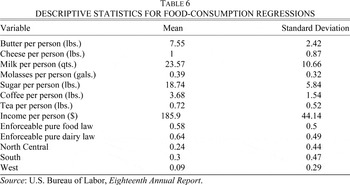
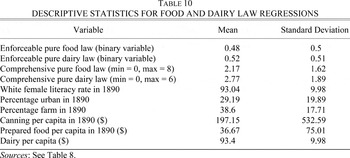
Descriptive statistics for each of these variables are shown in
Table 6.
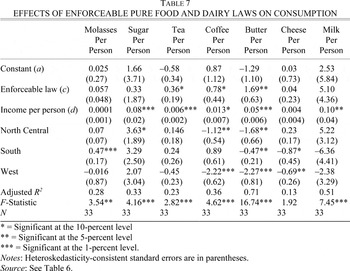
Table 7 displays coefficient estimates for the food-consumption regressions. For three products (butter, tea, and coffee), the coefficient on the enforceable pure food or pure dairy dummy variable, c, is positive and statistically significant. For the remaining four products (cheese, milk, molasses, and sugar), c is positive but not significant. The fact that butter consumption was higher in states with enforceable pure dairy regulations is consistent with both the lemons hypothesis and the market-power hypotheses because, as noted earlier, butter consumption might have increased either because consumers were more confident about quality or because the regulations reduced the availability of a substitute (oleomargarine). However, the fact that tea and coffee consumption was higher in states with enforceable pure food laws is only consistent with the lemons hypothesis, because there were no obvious new substitutes for these items, but both were commonly adulterated. Although this finding does not prove that state regulation solved the lemons problem more generally, it is consistent with the possibility that pure food and dairy laws reduced information costs for some goods.
THE POLITICAL ECONOMY OF PURE FOOD AND DAIRY REGULATION
An examination of the political economy of the pure food movement may also provide evidence supporting the view that regulation was enacted to help reduce information costs about food quality. If producers of traditional food and dairy items were the only interest group lobbying in favor of regulation, then the market power hypothesis seems plausible. On the other hand, if consumer as well as producer groups were important constituencies in favor of pure food regulation, then the lemons hypothesis seems more plausible.
The historical evidence suggests that some producers as well as some consumers actively lobbied for pure food and pure dairy regulation. Producer groups were divided in their support for state pure food regulation. Manufacturers and distributors who specialized in producing higher quality items supported pure food regulation because they realized that regulation would help them distinguish their items from their competitors. For instance, in 1879, the National Board of Trade, under the leadership of Francis Thurber, a New York City food manufacturer, sponsored a contest for a model pure food statute and promoted the prizewinning law across the country. Versions of this law were eventually enacted in New York, Massachusetts, and New Jersey. On the other hand, producers of lower quality food items often opposed regulation because they feared that it might be enforced in a manner that foreclosed markets for their products or that it would increase production costs and reduce their profits. Some large national firms involved in interstate trade also resisted state regulation because compliance with widely varying state regulations was potentially costly.54
Young, Pure Food, chapter 3; and Wood, Strategic Uses, chapter 4.
Mobilized consumer groups such as the Women's Christian Temperance Union (WCTU), the General Federation of Women's Clubs (GFWC), leaders of the home economics movement, and public health officials also demanded state regulation of food and dairy products. In fact, women's groups were among the most active consumer advocates in favor of pure food regulation. Isabel Churchill, a women's club member from Denver, Colorado, wrote: “[T]he quality of food stuff should be a question of paramount interest to every Housewife. It therefore behooves [women] to thoroughly awake to the need … for pure food legislation.”55
Goodwin, Pure Food, Drink and Drug Crusaders, p. 137.
Members of these groups were aware of the problem of food adulteration; they believed that adulteration and misbranding were forms of fraud, and they desired regulation to help them distinguish pure from impure food and dairy items.
56 Ibid., chapters 2 and 3; and Wood, Strategic Uses, chapter 3.
To the extent that organized consumer interest in favor of pure food and dairy legislation can be approximated by either the urbanization rate or the white female literacy rate, it may be possible to demonstrate empirically that consumers were a critical constituency in favor of pure food and dairy regulation. Urbanization is a reasonable proxy for consumer interests because urban consumers were among the more vocal supporters of pure food regulation. Because they were more likely to read or hear stories about food adulteration through newspapers or in magazines, and because these individuals were dependent upon market-supplied food items, urban consumers supported the pure food cause.57
Goodwin, Pure Food, Drink and Drug Crusaders, pp. 52–61.
The white female literacy rate may, however, be a better proxy for consumer interests for two reasons. First, membership in pro–pure food regulation consumer groups such as the WCTU or the GFWC was concentrated among literate white women. Second, unlike the urbanization rate, the white female literacy rate is less likely to be correlated with manufacturing interests. Hence, if consumers were an important proregulation constituency, then cross-state variation in state pure food and dairy legislation should vary systematically with either the white female literacy rate or the urbanization rate. Specifically, I hypothesize that states with higher white female literacy rates or higher urbanization rates would have been more likely to enact enforceable pure food and dairy legislation; enact more comprehensive pure food and dairy regulations; and introduce a food or dairy enforcement agency sooner.
Other interest groups also influenced the characteristics of state pure food and dairy regulation. Manufacturers and distributors of higher quality products desired pure food legislation to help distinguish their items from lower quality (adulterated) items. On the other hand, manufacturers of lower quality items opposed regulation because of its potential to increase production costs. Hence, proxies for food manufacturing interests need to be included in the analysis. Agricultural interests may have also influenced the characteristics of state pure food laws, because agricultural groups perceived themselves as beneficiaries of pure food legislation, perhaps because they produced “traditional” or “pure” foodstuffs. Finally, dairy interests need to be included in the analysis of pure dairy laws, because dairy producers stood to gain from legislation that mandated minimum standards for products like fresh milk, butter, and cheese—either because these standards established entry barriers or because they helped to assure consumers that their products were unadulterated.
Pure Food Regressions
To test the hypothesis that consumers were an important constituency in favor of pure food legislation, I regressed measures of the enforceability, comprehensiveness, and timing of each state's pure food law on a constant term, the percentage of the population that lived on farms in 1890, the per capita value added of canned food produced in the state in 1890, the per capita value added of prepared food produced in the state in 1890, and either the white female literacy rate in 1890 or the urbanization rate in 1890. The enforceability of each state's pure food law is measured by a binary variable that indicates whether a state's pure food law specified an enforcement agency. The comprehensiveness of each state's law is measured by an index that is defined as the total number of different products specifically mentioned in each state's pure food law. Timing is measured by the year in which a state introduced a food or dairy enforcement agency. The white female literacy rate or the urbanization rate is included as a proxy for consumer interests. The percentage of the population that lived on farms controls for agricultural interests. The per capita value added of canned foods and prepared foods is included to control for manufacturing interests that may have desired or opposed pure food legislation. Canned foods and prepared foods include products such as vinegars, sauces, condiments, and canned fruits and vegetables that were easily adulterated by manufacturers and distributors by the addition of chemical preservatives and other adulterants. Some producers of these products may have stood to gain from regulations that helped assure consumers that product labels were accurate.58
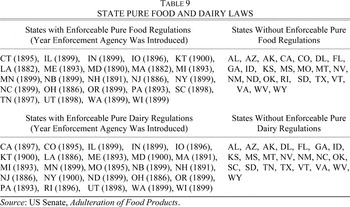
If food regulations helped make a market for these items, the value of canned and prepared food per capita could be endogenous. I do not believe this is a very serious problem, however, because I use the per capita value of canned and prepared foods in 1890 to proxy for food manufacturing interests, and this was prior to the introduction of enforceable food regulations in most states (see Table 9). Similar results were obtained when the value of canned and prepared foods in 1880 was used instead.
Others may have opposed regulation because they used adulterants and did not want regulation that would increase their production costs. Unfortunately, data limitations make it difficult for me to distinguish high from low quality food manufacturers. Hence, the predicted sign of the coefficients on these manufacturing variables is ambiguous, because it will measure the net effect of food manufacturers in lobbying for and against pure food regulation.
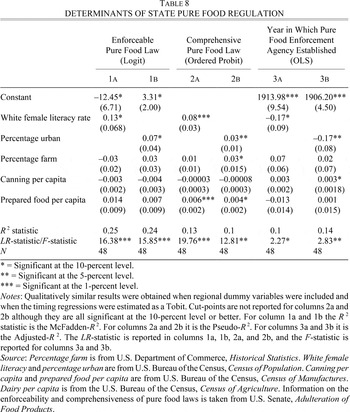
Coefficient estimates for the pure food law regressions are displayed in Table 8. The per capita value of canned food and prepared food are not statistically significant determinants of the enforceability or timing of state pure food laws, but the coefficient on prepared food per capita is positive and significant in the regression on the comprehensiveness of state laws; hence, there is some evidence, albeit mixed, that food manufacturers were in favor of regulation, perhaps because it helped assure consumers that their products were not adulterated.59
The ambiguous affect of the manufacturing interest variables is attributable to the fact that manufacturers were divided in their support for pure food regulation, depending on whether they were high or low quality producers, but the crude nature of the manufacturing interest variables does not allow me to distinguish high from low quality manufacturers.
In each of the regressions, the coefficient on the consumer interest variable is statistically significant and has the correct sign. States with higher white female literacy were more likely to enact an enforceable and more comprehensive food law. Additionally, states with higher white female literacy rates introduced some kind of pure food enforcement agency sooner. Analogous results were obtained when the urbanization rate was used to proxy for consumer interests. To the extent that these variables correctly approximate the influence of consumer groups, the regression results suggest that consumer interests helped determine the characteristics of state pure food regulation. Information on state pure food and dairy laws as well as descriptive statistics for each of the regression variables are displayed in
Tables 9 and
10.
Pure Dairy Regressions
To test the hypothesis that consumer interests played an important role in affecting the characteristics of pure dairy legislation, I regressed measures of the enforceability, comprehensiveness, and timing of pure dairy legislation on a constant term, either the white female literacy rate in 1890 or the urbanization rate in 1890, the per capita value of dairy (butter, cheese, and milk) production in 1890, and the per capita value of oleomargarine production. The measures of the enforceability, comprehensiveness, and timing of each state's pure dairy legislation are constructed in the same way as those for state pure food laws. As before, either the white female literacy rate or the urbanization rate is included to control for consumer interests. The per capita value of dairy production controls for dairy interests, and the per capita production of oleomargarine controls for oleomargarine interests, who generally opposed pure dairy regulations.60
I do not believe that these variables are endogenous because I use the value of dairy production in 1890 to measure the influence of dairy producers, which was before most states enacted enforceable pure dairy laws (see Table 9). Similar results were obtained when I used the value of dairy production in 1880 as a proxy for dairy interests.
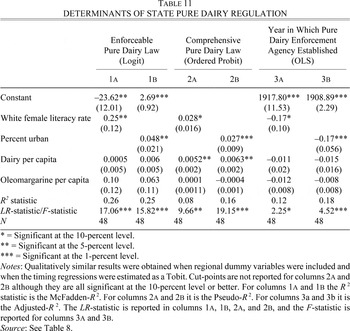
Table 11 shows coefficient estimates from the pure dairy law regressions. In each regression, the coefficient on the white female literacy variable is significant and has the correct sign. When the urbanization rate is used instead, the results are qualitatively similar. The per capita production of dairy products has a positive and significant impact on the comprehensiveness of dairy laws, but does not have a significant impact on either enforceability or timing. Hence, these regressions suggest that consumers also played an important role in influencing the characteristics of state pure dairy regulation.
CONCLUSIONS
In this article I argue that state regulation of the food and dairy industry arose in late-nineteenth-century America as a solution to an asymmetric information problem. Reputation mechanisms could not easily guarantee the delivery of pure food and dairy items because technological advances made it possible for firms to adulterate their products in ways that consumers could not easily perceive. State regulation of product labels had the potential to solve this lemons problem because regulators from science-based agencies possessed the technology to systematically detect food adulteration. This benefited manufacturers and distributors who specialized in selling pure food items, as well as certain consumer groups who wanted to avoid paying a premium for adulterated goods.
Although the evidence presented in this article suggests that state food and dairy regulations were enacted to solve a lemons problem, it would be premature to conclude that state regulation actually achieved this objective. While I do find that consumption of a few products was higher in states with enforceable pure food laws, this evidence does not prove that the lemons problem was solved more generally. In the absence of more systematic information on the enforcement of state pure food and dairy laws, it is not possible to draw stronger conclusions about the ultimate effect of these regulations. Future work should aim to analyze more fully how regulatory enforcement affected the performance of these markets.
This article is a revised version of one of the chapters from my unpublished Ph.D. dissertation. I am deeply grateful to Sukkoo Kim, my dissertation chair, for his guidance and supervision. I would also like to thank Price Fishback, Gary Libecap, Mindy Marks, Gary Miller, James Morley, Douglass North, John Nye, and two anonymous referees for extensive comments. Earlier versions of this article were presented at the 2001 Canadian Economics Association Meetings, the 2002 Cliometrics Society Meetings, and department seminars at Washington University and the University of Vermont.