Relative clauses are subordinate clauses that modify noun phrases (Andrews, Reference Andrews2007) and are introduced with the operators “who,” “which,” or “that.” Relative clauses are an interesting domain of investigation for a number of reasons. A large body of literature shows a robust asymmetry in the comprehension of subject relatives compared to object relatives (“the girl that pushes the cow” vs “the cow that the girl pushes”). Seminal work from Brown (Reference Brown1972) has shown that children understand subject relatives more accurately than object relatives. This result holds across the acquisition of a number of head-initial languages such as English (McDaniel et al., Reference McDaniel, McKee and Bernstein1998), Hebrew (Friedmann, Belletti, & Rizzi, Reference Friedmann, Belletti and Rizzi2009; Haendler & Adani, Reference Haendler and Adani2018), Italian (Adani, Reference Adani2011; Belletti & Contemori, Reference Belletti and Contemori2009; Contemori & Belletti, Reference Contemori and Belletti2014), Cypriot Greek (Theodorou & Grohmann, Reference Theodorou and Grohmann2012), Spanish (Betancort et al., Reference Betancort, Carreiras and Sturt2009), and German (Adani, Stegenwallner-Schütz et al., Reference Adani, Stegenwallner-Schütz, Haendler and Zukowski2016; Adani et al., Reference Adani, Stegenwallner-Schütz and Niesel2017). The data on head-final languages are more controversial, however, sometimes showing a subject-object asymmetry, as in Chinese (Hu et al., Reference Hu, Gavarró, Vernice and Guasti2016), and sometimes the opposite pattern, as in Basque (Gutierrez-Mangado, Reference Gutierrez-Mangado2011). An extensive review recently published by Lau and Tanaka (Reference Lau and Tanaka2021) attempts to assess whether the subject advantage in relative clauses should be considered a language universal or not. The authors show that there is a clear tendency towards a subject advantage across a wide variety of languages, and studies demonstrating a subject advantage are by far the most common. However, a few studies display the opposite pattern, and several studies fail to find a significant difference between subject and object relatives altogether. Of importance to the current study, we should notice that in Slavic languages the asymmetry was observed in only three out of five studies (Lau & Tanaka, Reference Lau and Tanaka2021). To our knowledge, there are no studies assessing this asymmetry in Czech (the languages tested are Russian, Polish, and Serbo-Croatian).
In languages in which the asymmetry is observed, several studies show that it can be reduced, meaning that object relatives can be easier to process under certain circumstances (Garraffa & Grillo, Reference Garraffa and Grillo2008; Grillo, Reference Grillo2008; Villata et al., Reference Villata, Rizzi and Franck2016). One of the ways of varying the complexity of object relatives is by varying the degree of similarity of the noun phrases involved in the action, particularly in terms of grammatical features. Friedmann et al. (Reference Friedmann, Belletti and Rizzi2009) put forward this idea and showed that the structural similarity of the noun phrases involved in the action modulates accuracy: When the noun phrases involved are structurally different (i.e., they differ in terms of grammatical features), performance improves.
Building upon this, Adani et al. (Reference Adani, Forgiarini, Guasti and Van Der Lely2014) investigated the comprehension of subject and object relatives in typically developing (TD) English-speaking children and in children with language impairment while varying the number of the noun phrases involved in the action: The noun phrases could either be in the same number (both plural or both singular) or they could differ in number (one singular and one plural). The authors found that both TD children and children from the clinical group showed effects of sentence type (object relatives vs subject relatives) and number (match vs mismatch), whereby sentences including noun phrases with a number mismatch were more accurate. A similar result was obtained by Contemori and Marinis (Reference Contemori and Marinis2014) using eye-tracking, where children were found to display a facilitation effect for sentences with mismatch in number in terms of accuracy (but the effect was not found when comparing looking times).
Number is a grammatical feature expressed in English with the inflectional morpheme /s/ and its allomorphs. The grammatical nature of number is demonstrated by its role in dependency relations. In fact, number is one of the traits that a noun provides for the agreement with the verb to occur, as in the examples “The boy eats” vs “The boys eat.”.
A verb inflected in the third person singular requires a singular noun, while a verb inflected in the third person plural requires a plural noun. While the methods used in this study do not assess agreement directly, the role of grammatical features associated with number may be at the foundation of this reported number effect. As mentioned, previous work has shown an effect of facilitation for trials with mismatch in number in monolingual children with and without language impairment (Adani et al., Reference Adani, Van der Lely, Forgiarini and Guasti2010; Adani et al., Reference Adani, Forgiarini, Guasti and Van Der Lely2014; Contemori & Marinis, Reference Contemori and Marinis2014). The explanation for this pattern may lie in the morphosyntactic features carried by number: In sentences with mismatch in number, the morphosyntactic features reduce the syntactic complexity and simplify the assignment of theta roles (the participant roles associated with a predicate). In relative clauses, a mismatch in number facilitates the parsing of both the embedded and the embedding clauses. Take, for instance, the following sentence:
-
1) The cats that the dog loves are sitting on the ground
When nouns mismatch in number, only one of these nouns can be the subject of the related verb, and this reduces the interference effects generated by the noun in the embedded clause: In this example, only “the cats” can be the subject of the verb “are sitting,” and only “the dog” can be the subject of the verb “loves.” In object relatives like the one presented here, the configuration is particularly interesting. Despite being closer to the main verb than its actual subject, the embedded noun does not agree with the main verb, and thus, during parsing, listeners can discard its potentially misleading role: In this example, while “dog” is linearly closer to “are sitting” than “the cats,” the agreement constraints help to discard it as a potential subject for the main verb. A study on French (Bentea & Durrleman, Reference Bentea, Durrleman, Lamendola and Scott2017) addressed the question of whether these effects are related to featural mismatch between the NPs, or whether the cue is related to verbal morphology (or both). In French, verbal morphology is sometimes phonologically ambiguous, meaning that mismatch between NPs is only recognizable from the phonetic realization of nouns. In this study, the authors showed that mismatch facilitation is observed in both sentences with and without explicit verbal morphology. As the authors explain, this finding is consistent with a “pure-feature based” view: In children, processing is facilitated when NPs differ in features, regardless of whether this mismatch surfaces on the verb as well. However, they also showed that this effect emerges in older French children in comparison to studies that have investigated Italian and English children (two languages previously tested with this methodology), and this may be related precisely to the ambiguity of French verbs. Recent work from the same authors additionally shows that lexical restriction is not necessary to alleviate parsing load (Bentea & Durrleman, Reference Bentea, Durrleman, Dionne and Vidal Covas2021). Mismatch effects are also observed when children are presented with sentences in which one NP position is occupied by a pronoun and the other by a lexically restricted NP, and these two items differ in number (one is singular and the other is plural). This is, again, consistent with a featural explanation of number mismatch effects.
The patterns described so far apply to monolingual children, but a few studies have addressed the comprehension of relative clauses in bilinguals as well. In a recent study of Mandarin-English bilingual children, Tsoi et al. (Reference Tsoi, Yang, Chan and Kidd2019) showed that these children favor subject relatives over object relatives, to an extent that is even higher than the one observed in age-matched monolingual Mandarin children. In another study of Mandarin-Italian bilinguals, Hu and Guasti (Reference Hu and Guasti2017) showed that bilinguals are more accurate with subject relatives in both their dominant and non-dominant language. In addition, the study showed that while bilingual children are overall less accurate compared to monolingual children, the two groups display the exact same pattern of responses, with subject relatives being more accurate than object relatives. Moreover, in a study of Turkish-English bilingual children, Özge (Reference Özge2010) showed that the asymmetry between subject and object relatives is present from a very early stage of acquisition (5 years of age).
Some studies show that the L1 can affect the parsing of relative clauses in the L2. In a study of Cantonese-English bilingual children, Kidd et al. (Reference Kidd, Chan and Chiu2015) showed that while Cantonese monolinguals do not display a subject advantage, children that speak English in addition to Cantonese show an advantage for subject relatives, possibly as an effect of English over Cantonese: In English, the subject advantage is quite robust, and it may be the case that English-Cantonese bilinguals extend this advantage to their second language. Another study by Öwerdieck et al. (Reference Öwerdieck, Hamann, Ibrahim, Dionne and Vidal Covas2021) investigated Arabic-German bilinguals in their comprehension and production of German relative clauses (and measured them at two times, with an interval of 12 months). In the elicitation task, both groups showed an asymmetry between subject and object relatives, and both adopted avoidance strategies when object relatives were elicited. Interestingly, bilinguals did not recur to passives as much as monolinguals, especially at the time of first assessment. As the authors’ stress, this is likely to be an effect of the L1 over the L2, since spoken Arabic does not use passives.
To our knowledge, no study has investigated bilingual children in terms of their comprehension of relative clauses that contained NPs both matching and mismatching in number.
This phenomenon is particularly interesting if one considers how relative clauses are formed in Czech. In (2), we report the Czech translation of (1), together with a word-by-word explanation (it is worth noticing that Czech does not have articles):
-
2) Kočky, které pes miluje, sedí na zemi
Cats nom-F-pl whom acc-F-pl dog nom-M-sg loves pres-3-sg sit pres-3-pl on ground
The crucial aspect to consider is the morphological richness of all elements of this sentence, which is expressed in the bound morphemes (in bold). The noun “cats” is inflected for plural, feminine, and nominative case (expressed by -y); the complementizer “who” is inflected for plural, feminine, and accusative case (expressed by -é); the noun “dog” is inflected for masculine, singular, and nominative case (in this case, it is not expressed by a bound morpheme as this is the unmarked form); the verb “loves” is inflected for singular third person and present tense (expressed by -uje); and the verb “sit” is inflected for plural, feminine, and present tense (expressed by -í). This level of inflectional richness puts the processing of relative clauses in Czech in evident contrast with the processing of relative clauses in English, where theta role assignment takes place in the context of a much poorer inflectional morphology. As we will discuss later, this difference may contribute to explaining some of the patterns observed in our sample of bilingual children.
The role of exposure
During language acquisition, different structures are shown to be more or less dependent on exposure in order to be mastered. As Tsimpli (Reference Tsimpli2014) suggests, grammatical structures may be divided into early and late phenomena. As Tsimpli (Reference Tsimpli2014, p. 283) puts it: “Early phenomena are core, parametric and narrowly syntactic, in contrast to late and very late phenomena, which involve syntax-external or even language-external resources too.” As Cilibrasi & Tsimpli, Reference Cilibrasi and Tsimpli2020b, p. 141) explain, “this distinction roughly reflects age of acquisition in monolingual children and refers to the fact that certain aspects of language are acquired quickly and proficiently, while others require a large amount of time and remain difficult for many years”. For example, if we look at English, there is virtually no evidence of children inverting the position of determiners and nouns, saying something like “cat the,” while there is plenty of evidence of children omitting bound morphemes for many years during development, saying something like “she run.” In English, the acquisition of the order of determiners and nouns can thus be seen as an early phenomenon, while the acquisition of bound morphology and subject-verb agreement is a late phenomenon (Cilibrasi & Tsimpli, Reference Cilibrasi and Tsimpli2020b). Tsimpli (Reference Tsimpli2014) showed that for late phenomena, the amount of exposure is a good predictor of performance, while for early phenomena, little amounts of exposure may be sufficient to achieve proficiency, so performance would be less dependent on exposure in early phenomena.
An example of an early phenomenon is head-complement directionality (e.g., the order of verbs and the associated object). Monolingual children are shown to respect the head-complement distribution in their utterances very early on. Studies in bilingual acquisition show that skills of this kind are mastered quite early by bilinguals as well. For instance, a study by Möhring and Meisel (Reference Möhring, Meisel and Müller2003) showed that German-French bilinguals were able to produce correct word orders in both languages very early, approximately from the age of 2 (Poeppel & Wexler, Reference Poeppel and Wexler1993), even if the order of heads and complements differs in German and French. Although in each language bilingual children receive an amount of exposure that is not comparable to that of monolingual children, head directionality does not seem to be a problem for them. In contrast, the amount of exposure is one of the main predictors in the acquisition of grammatical gender, for instance, which is only mastered between 4 and 6 years of age (in monolinguals), depending on the language (Blom et al., Reference Blom, Polisenska and Weerman2008; Tsimpli, Reference Tsimpli2003). A study by Unsworth et al. (Reference Unsworth, Argyri, Cornips, Hulk, Sorace and Tsimpli2014) examining Greek-Dutch bilinguals not only confirmed the late nature of the acquisition of grammatical gender but also showed that the amount of exposure has larger predictive power than the age of onset for the acquisition of this skill.
When looking at structures according to this division in early and late phenomena, where do relative clauses stand? Tsimpli (Reference Tsimpli2014) cautioned that certain phenomena do not appear to be clearly early or late. Relative clauses belong to this group, according to the author. Relative clauses may be considered an early or late phenomenon depending on the kind of relatives we are referring to, since different kinds of relatives entail significantly different kinds of processing. This means that exposure may have a positive role in the acquisition of the more complex types of relatives and a negligible role in the acquisition of simpler types of relatives.
A study by Scheidnes and Redmond (Reference Scheidnes, Redmond, Brown and Dailey2019) directly addressed the role of exposure in predicting performance with relative clauses in a group of bilinguals. In this study, English-French bilinguals with limited exposure to French were assessed in their comprehension of subject and object relatives in both English and French. Results showed that performance was comparable in the two languages, with children either performing above or below chance in both languages. This finding is taken to indicate an effect of the L1 over the L2: When children master the computational steps necessary to parse a relative clause in their L1, they are able to extend these steps to the L2. Importantly, the study demonstrates that low exposure to the L2 may still correspond to good performance with relative clauses, if these are mastered in the L1.
A final concept that we will discuss concerns the notion of exposure itself. Recent work suggests that continuous approaches to use and exposure in the L2 are the most promising in capturing performance of bilingual children. In a large-scale study, Ostadghafour and Bialystok (Reference Ostadghafour and Bialystok2021) showed that a continuous measure of language experience predicts performance in linguistic tasks that require inhibition. As the authors explain, this type of finding indicates an advantage in the use of continuous measures of bilingualism, instead of the use of more classic divisions in bilingual versus monolingual groups. This approach is endorsed in the current article, where exposure is measured and treated as a continuous variable.
Types of relative clauses in the current study
In our study, two within-subject factors, each with two levels, were manipulated, yielding a 2 × 2 design. These factors are as follows: 1) type – object and subject relatives, and 2) number – match and mismatch (for a summary of the design, see Table 2 in the methods section). When looking at the first factor, type, there is considerable longitudinal evidence suggesting that subject relatives and object relatives are acquired at different stages of development, with subject relatives being mastered before object relatives and with a consistent tendency of children to transform object relatives into subject relatives where possible (Adani et al., Reference Adani, Stegenwallner-Schütz, Haendler and Zukowski2016; Belletti & Contemori, Reference Belletti and Contemori2009). Due to the fact that object relatives are acquired later than subject relatives, we may expect exposure to play a bigger role in the acquisition of object relatives compared to subject relatives (implying that object relatives are a late phenomenon, and subject relatives are somewhere in between early and late phenomena). However, this is only assuming that there is any interaction between exposure and type.
A similar reflection may be relevant for number, although the timing of acquisition of relative clauses with NPs that match or mismatch in number has not been tested systematically. Related to this, however, in a cross-sectional study on German, Stegenwallner-Schütz & Adani (Reference Stegenwallner-Schütz and Adani2017) investigated the comprehension of Object-Verb-Subject (OVS) declarative sentences with number match and number mismatch in different groups of 3- to 10-year-old monolingual German-speaking children. The results show a clear facilitation of number mismatch in 5- to 6-year-olds. For younger children, even OVS disambiguated by number mismatch remained below chance level, while for 7-year-olds (and older), OVS with number match are already much more accurate, and, therefore, there is no significant difference with OVS with number mismatch. A facilitation in OVS sentences with mismatching verb arguments was also recently reported for German-speaking children with SLI (Stegenwallner-Schütz & Adani, Reference Stegenwallner-Schütz and Adani2021).
It is thus unclear how (or if) the effects of number will interact with exposure, given the dearth of longitudinal research on these kinds of sentences. Interesting data come again from German, where it was shown that object relatives with number mismatch are actually rarer than object relatives with match in the input (Adani et al., Reference Adani, Stegenwallner-Schütz and Niesel2017). One reasonable expectation is that exposure will positively affect sentences that indeed only occur more frequently in the input, thus those with NPs matching in number. Apart from its relationship with exposure, the role of number in the parsing of our stimuli may surface as an interaction between number and type (mismatch should play a larger role in object relatives, where the assignment of theta roles is more problematic) or as a main effect (mismatch sentences may be simpler to process independently of clause type). In other words, the following two outcomes are possible: 1) The effect of type could be larger in match sentences, where the grammatical features of number have reduced facilitatory effects, and the complexity associated with object relatives is at its peak; and 2) the role of type and number may be independent, which is consistent with previous work that has shown the frequent presence of a main effect of number, with mismatch sentences being more accurate (Adani et al., Reference Adani, Van der Lely, Forgiarini and Guasti2010; Adani et al., Reference Adani, Forgiarini, Guasti and Van Der Lely2014; Contemori & Marinis, Reference Contemori and Marinis2014).
Hypotheses
We predict that bilingual children will replicate patterns previously observed in the monolingual population, that is, they will perform more accurately on subject relatives (as opposed to object relatives) and on mismatch sentences, independently of sentence type. Additionally, we expect exposure to (partially) predict performance, with higher exposure corresponding to higher performance, at least for the match sentences.
Methods
Participants
A total of 38 Czech-English bilingual children (Mage = 10 years and 5 months, SD = 9.3 months) from three schools in the Prague metropolitan area took part in the study. One subject was excluded from the analysis because their responses were random, and they showed no engagement in the task. All schools involved are international schools where English is the main language of instruction. None of the children had a diagnosis of language and/or developmental impairments.
Materials and procedure
The study received ethical approval from both the Ethics Committee of the University of Cambridge and the Charles University Ethics Committee. All parents completed a questionnaire that allowed the calculation of children’s exposure to the L1 and the L2.
Amount of exposure
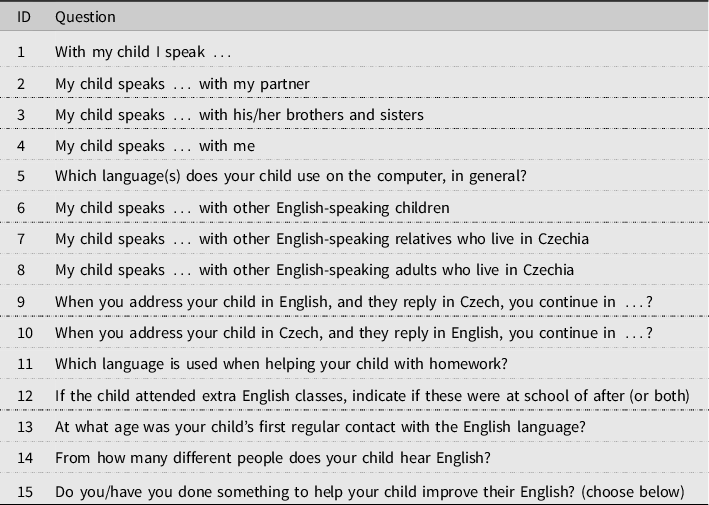
The questionnaire we used to calculate the amount of exposure to English was developed by Andreou et al. (Reference Andreou, Knopp, Bongartz and Tsimpli2015) and has been used in a number of studies (e.g., Bongartz & Torregrossa, Reference Bongartz and Torregrossa2017; Dosi & Papadopoulou, Reference Dosi and Papadopoulou2019; Peristeri et al., Reference Peristeri, Baldimtsi, Andreou and Tsimpli2020). The questionnaire, completed by parents, contains 54 questions aimed at assessing various parameters of exposure: Exposure before literacy (in both languages), exposure to spoken and written languages after the child has learned to read, exposure at home (internal), and exposure at school and after school (external to the home environment). The questionnaire additionally measures various metadata and biographical information regarding the parents and the child. For this study, we are interested in the role of exposure to English (since children were tested in English), so 15 questions referring to English exposure were selected (see Table 1). The total exposure score corresponded to the sum of all questions.
Questions selected to calculate English exposure

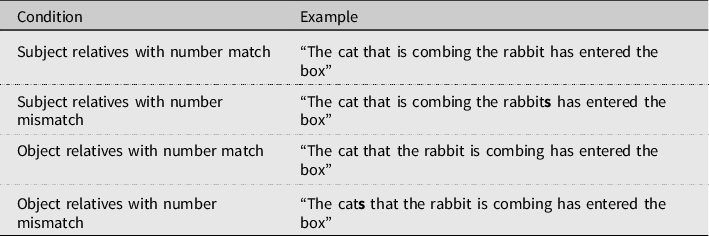
The four conditions with example sentences

From the questions presented in Table 1, three different kinds of response options were used and scores are calculated as follows:
Items 1–8
These questions were answered by choosing one option from a 5-point Likert scale regarding the amount of exposure in each language: 0) Czech only, 1) more Czech than English, 2) both languages equally often, 3) more English than Czech, and 4) English only.
Items 9–12
These questions were answered by choosing one option from binary choice: 0) Czech or 1) English.
Items 13–15
These questions were answered by choosing one option between alternatives that were created ad-hoc in each case. For example, question 14 could be answered as follows: “teachers”, “classmates”, “relatives”, “family friends”, “friends” (one point was assigned to each, more than one answer could be chosen). Question 13 assessed the age of onset of English. Possible responses to this question were as follows: “from birth,” between “1 and 3,” between “4 and 6,” and “after 6.” These corresponded to scores “3,” “2,” “1,” and “0” in the coding of the exposure measure. The average score for this question is 2.13 (SD = 0.8), indicating that most children had an age of onset of English exposure between 1 and 3 years of age. For details about all possible answers to the multiple-choice questions, see Appendix A.
During the testing session, children were first assessed using a series of background tests, namely the Children’s Test of Nonword Repetition, measuring phonological working memory (Gathercole & Baddeley, Reference Gathercole and Baddeley1996) and the Raven’s Colored Progressive Matrices, measuring non-verbal intelligence (Raven, Reference Raven1998). Second, our main experimental task, developed by Adani et al. (Reference Adani, Forgiarini, Guasti and Van Der Lely2014), was used to assess the comprehension of relative clauses. In this task, children are aurally presented with center-embedded subject relatives and object relatives. There are four possible conditions regarding the interaction between type and number, as reported in Table 2.
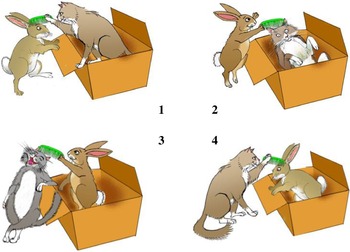
Once presented with the trial sentence, children were asked to choose from one of four pictures. For example, following the trial sentence: “The cat that the rabbit is combing has entered the box”, children were presented with four pictures seen in Figure 1 and were asked to select the picture that corresponded to the sentence. Only two pictures correctly represent the theta roles expressed in the trial sentence (the rabbit is combing the cat, pictures 2 and 3), while the other two pictures have inverted theta roles and therefore do not correctly represent the theta roles expressed in the sentence (pictures 1 and 4). Moreover, only one of the pictures with the appropriate theta roles correctly represents the relationship between the verb phrase of the main clause and its subject (the cat entering the box, picture 2). The correct picture selection from each trial thus requires two steps: 1) The appropriate identification of the theta roles and 2) the connection of the verb phrase of the main clause to the sentence subject.
Set of Visual Stimuli Paired with the Sentence: “The cat that the rabbit is combing has entered the box”.

The experiment consisted of five practice trials (in which participants received feedback) followed by 48 main trials (12 per condition) in total, presented using the shuffle extension of PowerPoint. Audio for each sentence was previously recorded by a native British English speaker. The children were asked to point to the picture that they found most appropriate to match the sentence, and the experimenter noted their answers on a pre-prepared record sheet. An index on the top of the slide informed the experimenter as to which trial was presented.
Data analyses
Accuracy was analyzed through mixed-effects logistic regression models (MELR) with the glmer function of the lme4 R package (Bates et al., Reference Bates, Mächler, Bolker and Walker2014). Since by default R assigns one value of each categorical variable to the intercept, and since this makes the reading of the interactions complex, we releveled the categorical variables (type and match) using the function sliding contrast (from the MASS library). Levels were assigned with the following values: +, subject relatives; −, object relatives; +, mismatch; −, match. MELR accounted for random and fixed effects, with participant and item as the random factors, type, number, and the centered value of exposure (see Schielzeth, Reference Schielzeth2010), for the rationale of centering continuous variables) as fixed factors. The final model was selected using a parsimonious approach (Bates et al., Reference Bates, Kliegl, Vasishth and Baayen2015). Based on the research questions, the full fixed structure of the model contained a three-way interaction (type × number × exposure). First, keeping the maximal fixed structure we detected the optimal random structure. The best random structure was found using data-driven model comparison by running an anova() command between all models converging from the combination of intercepts and the slopes of type and number (see Appendix B). The best random structure was revealed to be (type|participant) + (1|item). Second, we attempted to reduce the fixed structure. The model with the full three-way interaction was compared to a model with two-way interactions and main effects using the anova() command but since this led to a significant change, we kept the model with the full 3-way interaction. In this way, the final full model was the following:
 $$\eqalign{Full\,model \lt \!\!\!- glmer(acc\sim type*number*exposure + \left( {type|participant} \right) + \left( {1|item} \right)}$$
Results
Descriptive statistics (means and standard deviations) for amount of exposure and background tasks are presented in Table 3, while descriptive statistics for accuracy (for each crossed condition in the main experimental task) are presented in Table 4.
Means and standard deviations of all measures assessed

Note. Only children under the age of 10 are included for the calculation of the centile for phonological working memory because this is the limit of the norms of the CNRep test.
Descriptive statistics for accuracy in the four conditions of the task

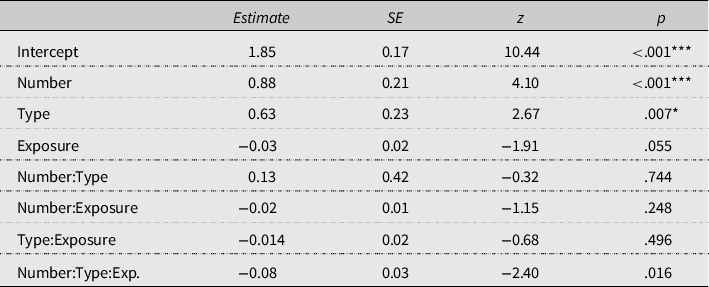
Our full model showed a main effect of type, where children were more accurate with subject relatives compared to object relatives, and a main effect of number, where children were more accurate in mismatch sentences than in match sentences (see Table 5). In addition, there was also a significant three-way interaction between number, type, and exposure. None of the other effects were significant.
Fixed effects of the full model

The asterisk indicates a significant result.
To explore the nature of the three-way interaction, the dataset was divided into two subsets: Subject relatives and object relatives (for a similar procedure with the same task, see Cilibrasi et al. (Reference Cilibrasi, Adani and Tsimpli2019), where the authors obtained a three-way interaction between number, type, and a continuous measure of reading skills, and created subsets of the same kind). The choice of using type (rather than number) as the dividing variable is theoretically motivated: This study adds to previous studies in that it measures the effects related to the number variable. If we opted for splitting the dataset according to this variable, we would have lost the ability to assess its effect.
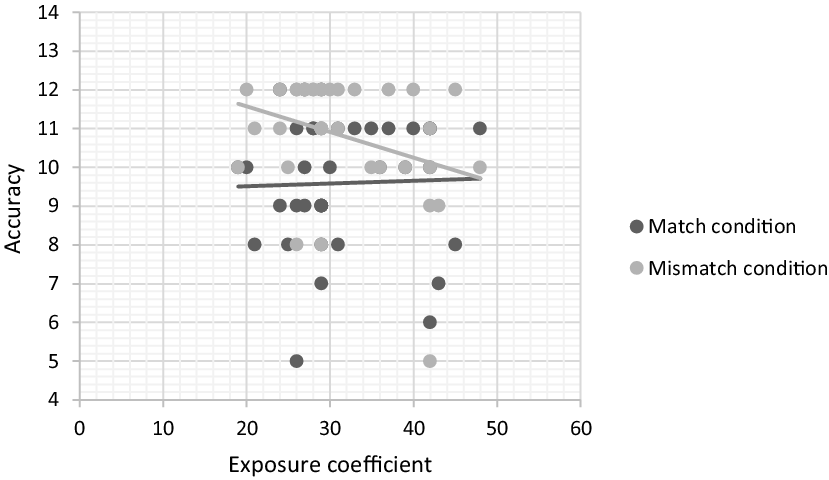
A model containing number and exposure (and their interaction) was run on both subsets. In the object relative subset, we found a significant main effect of number (z = 3.45, p < .001). In the subject relative subset, we observed a main effect of number (z = 2.52, p = .01) and a significant interaction between number and exposure (z = −2.33, p = .01). Following the interaction between number and exposure, two post hoc tests from the phia library (De Rosario-Martinez, Reference De Rosario-Martinez2015), both with Bonferroni correction, were run: one with “fixed” number and one “across” number (in both cases exposure was the slope). The first post hoc analysis shows that exposure is a significant predictor in mismatch sentences (χ 2 = 5.29, p = .04), but not in match sentences (χ² = 0.01, p ≈ 1). The second post hoc shows that the exposure slope is significantly different across different values of number (χ² = 5.44, p = .01). The sign of the estimate, negative in the first post hoc, indicates that in the mismatch subject relative clauses higher levels of exposure correspond to lower levels of performance, a pattern which was not attested in match subject relative clauses. The interaction is represented in Figure 2. As it may be seen, while the trending line for match sentences appears flat, the trending line for mismatch sentences shows that higher levels of exposure lead to poorer scores in accuracy.
Scatter Plot of Exposure-Accuracy Across Match and Mismatch Conditions (in the subject relative subset).

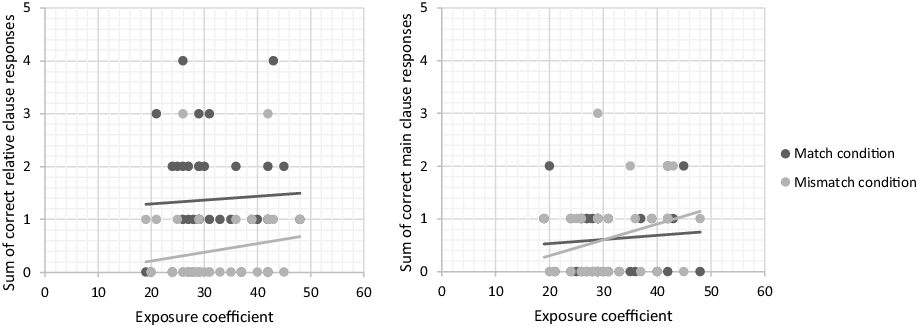
As a final step, we further explored this significant interaction with a qualitative analysis of the type of non-target responses in subject relative clauses and how they are modulated in the match vs mismatch conditions and in relation to the exposure coefficient. The response “correct relative clause” refers to the answer in which the thematic roles within the relative clause are interpreted correctly. The response “correct main clause” refers to the answer in which the thematic roles within the main clause are interpreted correctly but the ones within the relative clause are not. This bundle of data is illustrated in Figure 3. As the figure shows, number of errors increase more steeply in the mismatch subset, particularly when it comes to errors in which theta roles are wrongly assigned, but the main clause is correctly interpreted.
Scatter Plots Exposure-Non-Target Response Type Across Match and Mismatch Conditions (in the subject relative subset).

First, it should be noted that non-target answers in which neither the theta roles nor the main clauses were appropriately assigned were extremely rare. In the entire subset, there are only six mistakes of this kind. For simplicity, we decided not to represent them in the figure. The other two possible kinds of non-target responses are instead related to main clause assignment (meaning that theta roles are assigned correctly, but the main clause is not interpreted correctly) or in theta role assignment (meaning that the main clause is interpreted correctly, but the theta roles are inverted). Figure 3 shows that the increase of both types of non-target responses as a function of exposure tends to be steeper in the mismatch conditions, rather than in the match ones. This result is consistent with the outcome of the 2-way (number by exposure) interaction reported in the main analysis. This trend is stronger for the sentences with correct main clauses (and wrong theta role assignment). For additional qualitative charts on the answers provided, including charts on the object relative subset, see Appendix C.
Discussion
In this study, we investigated the role of exposure in the comprehension of relative clauses in Czech-English bilingual children. Exposure is certainly one of the main predictors of L2 acquisition, but several scholars (e.g., Paradis et al., Reference Paradis, Tremblay and Crago2008; Tsimpli, Reference Tsimpli2014; Unsworth, Reference Unsworth, Nicoladis and Montanari2016) have suggested that its role may vary depending on the type of structure investigated. Relative clauses, with their inherent variability due to several manipulations that can be performed on their structure, offer an interesting ground of investigation.
This study deals with the effects of relative clause type (subject vs object extracted relatives), number marking (specifically in terms of match and mismatch between the two verb arguments), and exposure on the comprehension of relative clauses in bilingual children and provides both expected and unexpected findings. First, the results show that the asymmetry between subject and object relatives commonly reported in the literature is also observed in Czech-English bilinguals, with subject relatives being more accurate than object relatives. Second, the results show that mismatch in number has a facilitatory effect over match in number, again consistent with previous studies. Finally, the results also displayed an unexpected finding: In subject relatives with number mismatch, a higher level of exposure predicts poorer performance. We will now discuss the three findings.
The main effect of type (i.e., the asymmetry between subject and object relatives) is in line with many existing findings in the psycholinguistic literature and is extended here to a new population, Czech-English bilingual children: Subject relatives were comprehended overall more accurately than object relatives. This is in line with extensive cross-linguistic and cross-population evidence, since the same result was observed in children with and without disorders (Adani et al., Reference Adani, Forgiarini, Guasti and Van Der Lely2014), speaking different languages (English: McDaniel et al., Reference McDaniel, McKee and Bernstein1998; German: Adani et al., Reference Adani, Stegenwallner-Schütz, Haendler and Zukowski2016; Adani et al., Reference Adani, Stegenwallner-Schütz and Niesel2017; Hebrew: Friedmann et al., Reference Friedmann, Belletti and Rizzi2009; Italian: Belletti & Contemori, Reference Belletti and Contemori2009; Contemori & Belletti, Reference Contemori and Belletti2014; Cypriot Greek: Theodorou & Grohmann, Reference Theodorou and Grohmann2012; Spanish: Betancort et al., Reference Betancort, Carreiras and Sturt2009; Chinese: Hu et al., Reference Hu, Gavarró, Vernice and Guasti2016), and in several groups of bilingual children (Hu & Guasti, Reference Hu and Guasti2017; Özge, Reference Özge2010; Tsoi et al., Reference Tsoi, Yang, Chan and Kidd2019).
The main effect of number supports findings that were previously reported for monolingual children with and without language impairment and is extended here to bilingual children: Sentences in which NPs mismatch in number were comprehended overall more accurately than sentences in which NPs match in number. This pattern was reported for the first time by Adani et al. (Reference Adani, Van der Lely, Forgiarini and Guasti2010) in monolingual Italian children and was then replicated in English monolingual children (Contemori & Marinis, Reference Contemori and Marinis2014) as well as in English children with language impairment (Adani et al., Reference Adani, Forgiarini, Guasti and Van Der Lely2014). The higher accuracy of mismatch conditions (e.g., sg-pl) compared to matching ones (e.g., sg-sg) is explained in terms of sensitivity to the internal structure of the NP, meaning that the cost associated with the assignment of theta roles and processing load are reduced where NPs differ in grammatical features such as number. Interestingly, this finding was not shown to hold in L2 learners of English (Xia et al., Reference Xia, White and Guzzo2020), making our finding on bilingual children particularly noteworthy. The participants tested in Xia et al. (Reference Xia, White and Guzzo2020) were native speakers of Mandarin, a language with a very poor inflectional system. If the facilitatory effect of number mismatch is to be attributed to theta role disambiguation related to agreement, it is to be expected that this effect will be visible only for speakers that do have a high sensitivity to inflections. In this sense, our finding with Czech-English bilinguals may be related to the inflectional richness of Czech and the consequently expected sensitivity to inflectional morphemes in children that (also) speak Czech. Similarly, the finding of Xia et al. (Reference Xia, White and Guzzo2020) is also expected: Due to the lack of bound morphemes in Mandarin, Mandarin learners of English may not be so sensitive to agreement features and may thus fail to use number mismatch as a cue to theta role assignment. Our study and the study of Xia et al. (Reference Xia, White and Guzzo2020) are not the first to show an effect of the L1 over the processing of relative clauses in the L2. As mentioned in the introduction, Kidd et al. (Reference Kidd, Chan and Chiu2015) showed that English-Cantonese bilinguals display a subject advantage while processing relative clauses in Cantonese, while Cantonese monolinguals do not, and this is described as an effect of the L1 English over the L2 Cantonese. Similarly, Öwerdieck et al. (Reference Öwerdieck, Hamann, Ibrahim, Dionne and Vidal Covas2021) showed that, in elicitation tasks, Arabic-German bilinguals display avoidance strategies that are affected by their L1 (particularly, they rarely use passives, contrary to German monolinguals, because passives are not used in spoken Arabic). Our results fit well with these results in suggesting an effect of L1 over L2.
It is interesting to compare our results to the results obtained by Adani et al. (Reference Adani, Forgiarini, Guasti and Van Der Lely2014), who originally performed this task on monolingual English children, with and without SLI. It appears that results obtained in this sample are overall comparable to those obtained in that study. Adani et al.’s (Reference Adani, Forgiarini, Guasti and Van Der Lely2014) study contained three samples: Children with SLI (mean age 12;11), TD grammatically matched children (mean age 6;09), and TD lexically matched children (mean age 8;01). Patterns among these three groups were similar (all displayed main effects of number match and type of clause), and performance between the two TD groups was not significantly different. Similarly, as in Adani et al. (Reference Adani, Forgiarini, Guasti and Van Der Lely2014), we observe a main effect of sentence type and a main effect of number. In terms of age, our sample, with a mean age of 10;05, stands virtually in the middle between the SLI group and vocabulary matched group in Adani et al. (Reference Adani, Forgiarini, Guasti and Van Der Lely2014). Since the children we tested do not have any language difficulties, it is expected that they would outperform the SLI children (which they did) and perform similarly to slightly younger monolingual children (which they did).
Apart from number surfacing as a main effect (replicating Adani et al. in a bilingual sample), the number effect was also shown to interact with exposure in the subject relatives subset, meaning that exposure had a different role in match vs mismatch sentences. The post hocs showed that while exposure was not a significant predictor of performance in match sentences, it was significant in mismatch sentences. In short, higher exposure was associated with lower accuracy in subject relatives with number mismatch.
The fact that we found a relationship between higher exposure and poorer performance in this type of sentence was a surprising result. Such a finding seems at first glance problematic, as it contradicts a simple axiom in child language acquisition research, which is that more exposure corresponds to better performance. Such a claim is pervasive and is found in articles from rather different theoretical paradigms (see e.g., Ambridge et al., 2015; Paradis et al., Reference Paradis, Tremblay and Crago2008; Tsimpli, Reference Tsimpli2014; Unsworth et al., Reference Unsworth, Argyri, Cornips, Hulk, Sorace and Tsimpli2014, to mention a few). However, in a fine-grained analysis of the role of exposure, Tsimpli (Reference Tsimpli2014) stated that (only) the so-called late phenomena are strictly dependent on the amount of exposure the child receives in L2. Our prediction, following this line of argumentation, was that proficiency in some structures would have been predicted by the amount of exposure, in the sense that higher levels of exposure would have corresponded to better performance on late structures (the most complex kinds of relative clauses). Contrary to this expectation, our results show that higher levels of exposure corresponded to poorer performance, in the subset that, from the parsing point of view, should be the less challenging (subject relatives with number mismatch). How can we reconcile this finding with the robust evidence that exposure is a main predictor of L2 acquisition?
The explanation for our finding may lie in the experimental methods we used, and particularly in the materials chosen. Our experiment uses center-embedded relative clauses with full NPs. These types of sentences, though grammatical, are very rare in the input. This may be particularly true for subject relatives with number mismatch.
First, according to a large corpus study of English conducted by Roland et al. (Reference Roland, Dick and Elman2007), in spoken language, object relatives are more frequent than subject relatives. This result is due to the frequent occurrence of one kind of object relative in spoken language, the one with the following structure: [Inanimate-NP + (that) + pronoun + V]. Relative clauses with two full animate NPs (the ones we used), instead, are extremely rare in both spoken and written corpora. Consistently with these findings, Kidd et al. (Reference Kidd, Brandt, Lieven and Tomasello2007) showed that when children produce object relatives, these tend to have either a pronominal relative clause subject or an inanimate head noun, and very rarely do they contain two full noun phrases. Second, a study of the frequency of match and mismatch relative clauses with full NPs conducted by Adani et al. (Reference Adani, Stegenwallner-Schütz and Niesel2017) on German shows that object relative clauses with NPs matching in number tend to be more frequent than the ones where the NPs mismatch. Assuming this distributional asymmetry not to be a language-specific phenomenon, this pattern could explain why more exposure corresponded to poorer performance with subject relatives with full NPs that mismatch in number. Exposure, an overarching notion that does not distinguish between different kinds of structures, may not help in learning structures that are not present in the input or that are extremely rare, such as subject relatives with full NPs that mismatch in number. The qualitative analysis we performed is consistent with this claim. When observing the nature of the errors committed by children in mismatch sentences in the subject relatives subset, it appears that an increase in exposure corresponded to an increase in theta role assignment errors, and not so much to errors in the parsing of the main clause: In other words, high exposure children experienced difficulties specifically with the comprehension of these unusual relatives, but not necessarily with the comprehension of complex sentences.
When looking at the impact of input frequency from this point of view, our finding does not appear so surprising. The input children receive does not train them particularly well in the resolution of relative clauses with full NPs, and even less so, in subject relatives where the two full NPs are mismatching in number, which are yet less frequent than the matching ones. Children that receive an extensive amount of exposure in English may be even more puzzled when presented with these kinds of sentences, since this is not something that they are normally dealing with. A similar interpretation is provided in Belletti and Guasti (Reference Belletti and Guasti2015), who obtained another surprising result with a very different sample. In their study, non-proficient adult learners of Italian were shown to display better performance with object relatives than proficient learners. Proficiency with a language may indicate a gradual reliance on what is more frequent in the language and a less “structure-driven” approach, and thus, more proficient speakers may be less keen on the use of unusual structures. In Belletti and Guasti (Reference Belletti and Guasti2015), low proficiency participants were shown to prefer object relatives (i.e., the cat that the dog washes) over passive subject relatives (i.e., the cat that is washed by the dog) in an elicitation task. This behavior contrasts with what is observed in native speakers of Italian and in proficient L2 learners. Belletti and Guasti (Reference Belletti and Guasti2015) suggest that when inflectional morphology is not fully developed, participants may paradoxically resort to a choice that is dispreferred by natives, like an object relative, if this is simpler from the inflectional point of view. This leads to the use of infrequent structures by non-proficient speakers. Something similar may be happening in our study, where a decrease in exposure to certain structures does not lead to a decrease in performance. It should be stressed that the current result is overall consistent with the result of Scheidnes and Redmond (Reference Scheidnes, Redmond, Brown and Dailey2019), who showed that English-French bilinguals can attain high proficiency with L2 relative clauses even when exposure to these structures is limited. When looking at the whole dataset, it appears that exposure did not have a strong role in predicting performance in our sample: Only accuracy in subject relative clauses with number mismatch was predicted by exposure (thus, 25% of the dataset), and accuracy with all other kinds of relative clauses was not.
In conclusion, our study showed that the amount of exposure to L2 can modulate the comprehension of relative clauses, but only in some specific cases. Particularly, we observed that amount of exposure to L2 interacts with the effect of match in number and with type. In subject relatives with number mismatch, we observe an effect of exposure, with performance slowly decreasing with an increase in exposure. For all other kinds of relative clauses, we do not find an effect of exposure. In addition to this new finding, our study extends classic findings to a new population: Our results show in fact that Czech-English bilingual children display asymmetries between subject and object relatives (they are more accurate with subject relatives) and between match and mismatch sentences (they are more accurate with mismatch sentences), consistent with previous studies on monolingual samples.
Supplementary material
To view supplementary material for this article, please visit https://doi.org/10.1017/S0142716422000078
Acknowledgments
We would like to thank Alžběta Brabcová for her contribution to the data collection and Maria Teresa Guasti for comments to a previous version of this manuscript. We would like to thank the De Vincenzi Foundation for their support during the first stage of this project and the Charles University Primus Programme for their support during the second stage of this project.
Competing interests declaration
Elaine Schmidt is an employee of Cambridge Assessment within Cambridge University Press and Assessment, all necessary steps were taken during the acceptance process to ensure this did not prejudice the review and final decision in any way.
Ethics declaration
Research involving Human Participants: This study does involve human participants. This study was carried out in accordance with the recommendations of our University Ethics Committee with written informed consent from all parents. All participants gave written informed consent in accordance with the Declaration of Helsinki. The protocol was approved by our University Ethics Committee.