1. Introduction
Mantle eclogites represent a minor component (<5 %) of the lithospheric mantle beneath cratons that is dominated by peridotitic material (e.g. Jacob, Reference Jacob2004). However, mantle eclogites provide unique insights into lithospheric processes given that they are thought to represent fragments of subducted oceanic crustal material. All of the rocks within the cratonic mantle can be brought to the Earth’s surface (and hence can be sampled) as xenoliths entrained in volcanic rocks and as inclusions in diamonds. The most ancient mantle eclogites and eclogitic inclusions in diamonds yield late Archaean ages (3.0–2.5 Ga; Pearson et al. Reference Pearson, Snyder, Shirey, Taylor, Carlson and Sobolev1995; Jacob & Foley, Reference Jacob and Foley1999; Shirey et al. Reference Shirey, Carlson, Richardson, Menzies, Gurney, Pearson, Harris and Wiechert2001; Jacob et al. Reference Jacob, Bizimis and Salters2005; Shirey & Richardson, Reference Shirey and Richardson2011; Aulbach et al. Reference Aulbach, Heaman, Jacob and Viljoen2019 a). However, the crustal (orogenic) eclogites that crop out within orogenic belts and are thought to represent primary evidence for plate tectonics do not yield ages older than early Proterozoic (≤2.09 Ga; e.g. Boniface et al. Reference Boniface, Schenk and Appel2012; François et al. Reference François, Debaille, Paquette, Baudet and Javaux2018; Loose & Schenk, Reference Loose and Schenk2018). This means that mantle eclogite xenoliths can provide further insights into the secular evolution of the subcontinental mantle, oceanic crustal material (i.e. oceanic gabbros and basalts) and tectonic processes, at least since Archaean time.
Mantle eclogites yield a broad range of equilibration pressures that correspond to depths within the subcratonic mantle lithosphere (e.g. Schulze, Reference Schulze1989; Kamber & Collerson, Reference Kamber and Collerson2000; Jacob, Reference Jacob2004). However, these eclogites also commonly host diamonds, indicating that they must have equilibrated at minimum pressures of 4 GPa (i.e. >120 km depth at typical cratonic conductive geotherms; e.g. Schulze, Reference Schulze1989; Jacob, Reference Jacob2004). Thermometric calculations for the majority of mantle eclogites yield equilibration temperatures of >800 °C (e.g. fig. 3 in Jacob, Reference Jacob2004). Residence of mantle eclogites under these elevated pressure and temperature (P–T) conditions for millions of years or longer, alongside the possibility of multiple metasomatic events, and the eventual influence of kimberlitic magmas could easily have perturbed the radiogenic isotope systems (e.g. Sm–Nd, Rb–Sr, Pb–Pb) of the rock-forming minerals of the eclogites, making dating of these rocks difficult (Jacob, Reference Jacob2004; Schmidberger et al. Reference Schmidberger, Heaman, Simonetti, Creaser and Cookenboo2005; Heaman et al. Reference Heaman, Creaser, Cookenboo and Chacko2006; Shu et al. Reference Shu, Brey, Gerdes and Hoefer2014; Aulbach et al. Reference Aulbach, Heaman, Jacob and Viljoen2019 a). Bulk rock isotope analysis of mantle eclogite generally yields no reliable dates (e.g. Shu et al. Reference Shu, Brey, Gerdes and Hoefer2014), and ages obtained from Lu–Hf dating of rock-forming minerals such as garnet and clinopyroxene (e.g. Shu et al. Reference Shu, Brey, Gerdes and Hoefer2014) and from Re–Os dating of accessory sulfides (e.g. Aulbach et al. Reference Aulbach, Creaser, Pearson, Simonetti, Heaman, Griffin and Stachel2009) are often difficult to link with particular geological events. However, precise dating of these rocks is vital for determining the origin of mantle eclogites and to link them with subcontinental lithospheric evolution (e.g. Usui et al. Reference Usui, Nakamura, Kobayashi, Maruyama and Helmstaedt2003; Shchukina et al. Reference Shchukina, Agashev and Zedgenizov2018; Aulbach et al. Reference Aulbach, Heaman, Jacob and Viljoen2019 a). Zircon is a promising mineral for dating mantle eclogites as it has high refractory properties (Cherniak et al. Reference Cherniak, Hanchar and Watson1997; Whitehouse & Platt, Reference Whitehouse and Platt2003) and a U–Pb system with a relatively high closure temperature (>900 °C; Lee et al. Reference Lee, Williams and Ellis1997), and has been proven a robust geochemical tracer (Cherniak et al. Reference Cherniak, Hanchar and Watson1997; Li et al. Reference Li, Li, Liu and Tang2011). Zircon grains can record several episodes of growth (i.e. zoning) that reflect the evolution of their host rocks, which is especially typical for zircons within metamorphic and metasomatic rocks. Each of these zones can easily retain the original geochemical and some other signatures that are indicative of the conditions during the growth of that individual zone. This is true even if the U–Pb system in the zircon has been disturbed, meaning that a precise age cannot be obtained for that particular zone (e.g. Rubatto, Reference Rubatto2017). However, zircon is not commonly found within mantle eclogite xenoliths, in contrast to the abundant zircon grains that have been identified within orogenic eclogites (Skublov et al. Reference Skublov, Berezin and Berezhnaya2012 a; Rubatto, Reference Rubatto2017). Only a few kimberlites and kimberlite-like rocks that host zircon-bearing mantle eclogites have been identified to date, namely the Calcutteroo kimberlites of the Australian Craton (Chen et al. Reference Chen, O’Reilly, Kinny and Griffin1994), the Jericho kimberlites of the Slave Craton (Heaman et al. Reference Heaman, Creaser and Cookenboo2002, Reference Heaman, Creaser, Cookenboo and Chacko2006; Schmidberger et al. Reference Schmidberger, Heaman, Simonetti, Creaser and Cookenboo2005), kimberlite-like pipes of the Colorado Plateau (Usui et al. Reference Usui, Kobayashi and Nakamura2002, Reference Usui, Nakamura, Kobayashi, Maruyama and Helmstaedt2003; Smith et al. Reference Smith, Connelly, Manser, Moser, Housh, McDowell and Mack2004), the Lovedale and Lace kimberlites of the Kaapvaal Craton (Schmitz et al. Reference Schmitz, Shirey and Carlson2003), the V. Grib pipe of the Arkhangelsk kimberlite province (Skublov et al. Reference Skublov, Shchukina, Guseva, Mal’kovets and Golovin2011, Reference Skublov, Nikitina, Marin, Levskii and Guseva2012 b; Shchukina et al. Reference Shchukina, Agashev, Golovin and Pokhilenko2015, Reference Shchukina, Agashev and Zedgenizov2018) and the Catoca and Cat-115 kimberlite pipes of the Kasai Craton (Nikitina et al. Reference Nikitina, Marin, Skublov, Korolev, Saltykova, Zinchenko and Chissupa2012, Reference Nikitina, Korolev, Zinchenko and Felix2014).
An understanding of the characteristic signatures of zircons in mantle eclogites is vital for meaningful interpretation of the ages obtained. Therefore, we use existing zircon data from these eclogites and other rocks to constrain the types of zircon that might occur in xenoliths of mantle eclogite.
2. Available zircon-bearing mantle eclogite data, associated opportunities and current barriers
Linking ages obtained during zircon U–Pb dating with specific geological events is essential, especially for those grains that record several episodes of growth (e.g. zircon grains with metamorphic rims and inherited magmatic cores). This can be achieved using zircon characteristics such as internal textures, and trace-element and further isotope compositions. Considerable quantities of data on these characteristics have been collected to date, all of which have been used to determine the origins and evolution of host rocks and/or to reconstruct and describe geological processes and settings (e.g. Belousova et al. Reference Belousova, Griffin, O’Reilly and Fisher2002; Corfu et al. Reference Corfu, Hanchar, Hoskin and Kinny2003; Rubatto, Reference Rubatto2017). Zircon origins and growth conditions can be determined using variations in Th/U ratios, trace-element concentrations, and O and Hf isotope compositions alongside cathodoluminescence (CL) imaging, which allows the identification of internal zircon textures (e.g. Rubatto, Reference Rubatto2017). However, only limited analysis has been undertaken on zircons from mantle eclogites, which presents the main barrier for the present study. To date, incomplete zircon data for only 16 mantle eclogites from five localities have been reported in peer-reviewed scientific publications (Table 1). This limited dataset is further constrained by the fact that Th/U ratios, CL images, trace-element concentrations and Hf isotope data are only available for ten, five, four and two of these eclogite xenoliths, respectively, with no O isotope analyses undertaken on any zircon from mantle eclogites to date.
Available data for zircons from mantle eclogite xenoliths from kimberlites and kimberlite-like rocks

R – reported; NR – not reported; * – an appropriate backscattered electron image has been reported for one xenolith (Usui et al. Reference Usui, Nakamura, Kobayashi, Maruyama and Helmstaedt2003).
Sampling and laboratory-based sample preparation can lead to the contamination of geological samples by xenogenic material (e.g. Dobrzhinetskaya et al. Reference Dobrzhinetskaya, Wirth and Green2014; Litasov et al. Reference Litasov, Kagi, Voropaev, Hirata, Ohfuji, Ishibashi, Makino, Bekker, Sevastyanov, Afanasiev and Pokhilenko2019). The rare nature of zircon within mantle eclogites indicates that the addition of contaminant zircon grains during laboratory-based mineral separation is likely. This type of contamination is especially plausible if (1) zircon grains are isolated from mantle eclogites within laboratories that routinely process zircon-rich rocks, and (2) zircon grains are not identified in thin-sections of the same mantle eclogite sample. This study, therefore, focuses on mantle eclogite suites that contain visible zircons in thin-sections. These suites of zircon-bearing mantle eclogites contain 13 xenoliths, and include eclogites of the Colorado Plateau, the Jericho eclogites of the Slave Craton and the V. Grib eclogites of the Arkhangelsk province (Table 1).
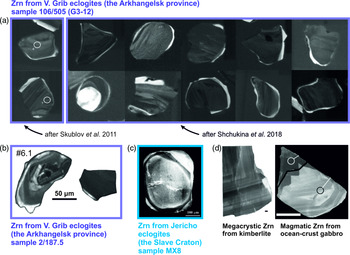
The mantle eclogites from kimberlite-like rocks of the Colorado Plateau, and the Jericho and V. Grib kimberlites contain zircon grains that record more than one episode of crystal growth as evidenced by (1) complex internal textures present in the zircons, and (2) the scattered nature of the U–Pb ages obtained from these zircon grains. Some of the zircons from these eclogites have sharp boundaries between relict cores and more recent overgrowths (i.e. rims) that are visible in CL and backscattered electron images (Fig. 1a–c; fig. 3B in Usui et al. Reference Usui, Nakamura, Kobayashi, Maruyama and Helmstaedt2003). The distribution of U–Pb ages obtained for zircons within a single mantle xenolith can span >500 Ma and provides evidence of multiple episodes of zircon growth (Schmidberger et al. Reference Schmidberger, Heaman, Simonetti, Creaser and Cookenboo2005; Heaman et al. Reference Heaman, Creaser, Cookenboo and Chacko2006; Shchukina et al. Reference Shchukina, Agashev and Zedgenizov2018). The presence of several episodes of zircon growth within mantle eclogites, combined with the limited range of incomplete data available to date for these zircons, mean it is not possible to determine characteristics specific to zircon that grows during the formation of the hosting mantle eclogites. However, combining existing data on the characteristics of zircon from different rocks that enable the identification of geological processes and settings with concepts relating to the origins of mantle eclogites can provide insights into the types of zircon that can be present in mantle eclogite xenoliths, and those that cannot. This study summarizes the characteristics of zircon types that may be found within zircon-bearing mantle eclogites and, therefore, provides a firm basis for future research. We also use these characteristics to determine the nature of zircon grains from the Kasai Craton eclogite xenoliths; these xenoliths were selected because they represent the only mantle eclogite samples in which zircon has not been identified in thin-sections that provide sufficient zircon data for such analysis (Table 1).
Cathodoluminescence images for mantle eclogite-hosted, magmatic oceanic gabbro-hosted and kimberlitic zircons. (a) Zircon grains from mantle eclogite xenolith sample 106/505 (G3-12) from the V. Grib kimberlites, Arkhangelsk province (modified after Skublov et al. Reference Skublov, Shchukina, Guseva, Mal’kovets and Golovin2011 and Shchukina et al. Reference Shchukina, Agashev and Zedgenizov2018; note that this sample is labelled as 106/505 and G3-12 in the first and second publications on this eclogite, respectively). The zircon grains are ~100–150 μm long, and the images are reprinted by permission from Springer Nature under licences (i) 4826260699731: Springer Nature, Geochemistry International, vol. 49, fig. 1, p. 416, Geochemical characteristics of zircons from xenoliths in the V. Grib Kimberlite Pipe, Archangelsk Diamondiferous Province, Skublov et al., Copyright (2011); and (ii) 4826261215178: Springer Nature, Mineralogy and Petrology, vol. 112, fig. S3-a, ESM 3, Origin of zircon-bearing mantle eclogites entrained in the V. Grib kimberlite (Arkhangelsk region, NW Russia): evidence from mineral geochemistry and the U–Pb and Lu–Hf isotope compositions of zircon, Shchukina et al., Copyright (2018). (b) Zircon grains within mantle eclogite 2/187.5 from the V. Grib kimberlite (modified after Skublov et al. Reference Skublov, Nikitina, Marin, Levskii and Guseva2012b). Reprinted by permission from Springer Nature under licence 4826260895721: Springer Nature, Doklady Earth Sciences, vol. 444, fig. 1, p. 596, U–Pb age and geochemistry of zircons from xenoliths of the V. Grib kimberlitic pipe, Arkhangelsk diamond province, Skublov et al., Copyright (2012). (c) Zircon within the MX8 mantle eclogite from the Jericho kimberlite of the Slave Craton (modified after Heaman et al. Reference Heaman, Creaser, Cookenboo and Chacko2006). Reprinted by permission from Oxford University Press under licence 4850101300985: Heaman et al. (Reference Heaman, Creaser, Cookenboo and Chacko2006), Multi-stage modification of the northern Slave mantle lithosphere: evidence from zircon- and diamond-bearing eclogite xenoliths entrained in Jericho Kimberlite, Canada, Journal of Petrology, vol. 47, fig. 2c, p. 826. (d) Oscillatory zoning within kimberlitic zircon (modified after Corfu et al. Reference Corfu, Hanchar, Hoskin and Kinny2003) and oscillatory-sector zoning within magmatic zircon from an oceanic gabbro (modified after Cavosie et al. Reference Cavosie, Kita and Valley2009). Reprinted with the permission of the Mineralogical Society of America as follows: (i) from Corfu et al. (Reference Corfu, Hanchar, Hoskin and Kinny2003), Atlas of Zircon Textures, Reviews in Mineralogy and Geochemistry, vol. 53, fig. 4, p. 477; (ii) from Cavosie et al. (Reference Cavosie, Kita and Valley2009), Primitive oxygen-isotope ratio recorded in magmatic zircon from the Mid-Atlantic Ridge, American Mineralogist, vol. 94, fig. 2, p. 928.

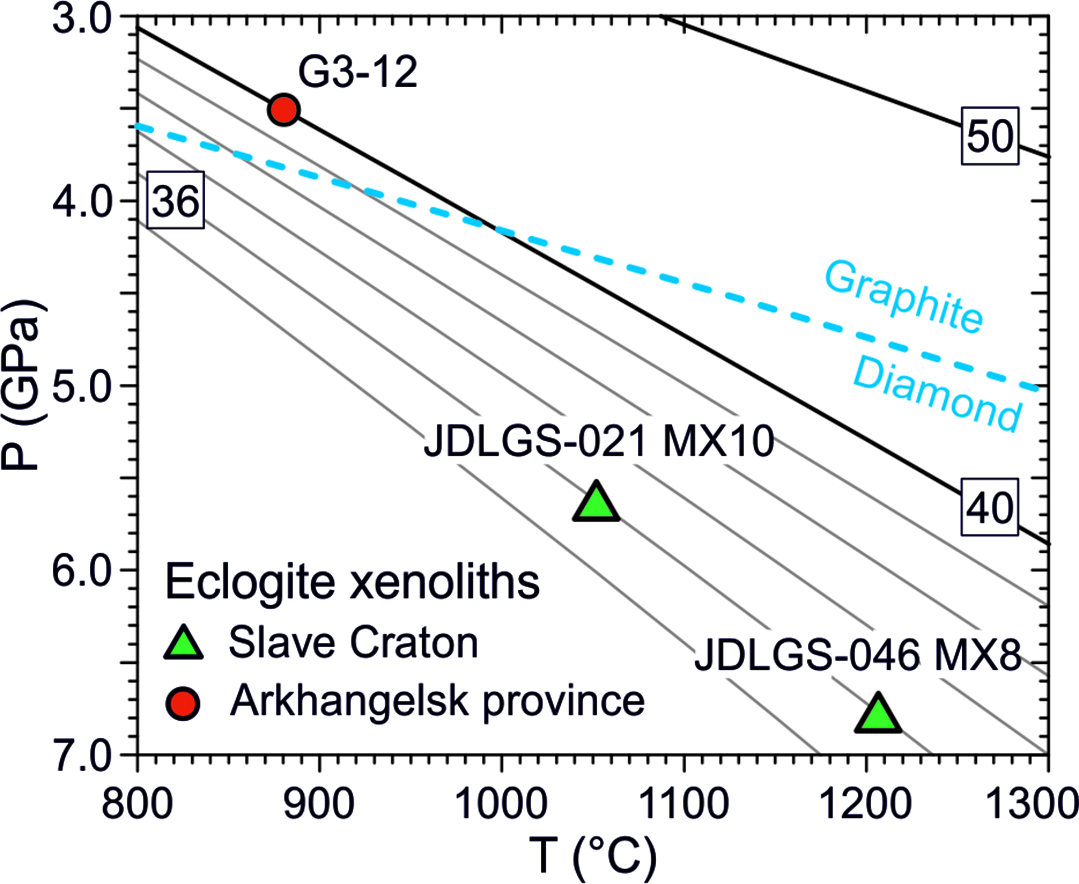
The Colorado Plateau eclogites likely formed at c. 80 Ma (see discussion in Usui et al. Reference Usui, Nakamura and Helmstaedt2006) and represent atypical mantle eclogites as they contain lawsonite or pseudomorphs after primary lawsonite. The petrography of these eclogites and the mineral assemblages present in these samples are similar to those found in low-temperature orogenic eclogites (Usui et al. Reference Usui, Nakamura, Kobayashi, Maruyama and Helmstaedt2003, Reference Usui, Nakamura and Helmstaedt2006) that formed during cold subduction, a process that commonly occurred during Phanerozoic and late Neoproterozoic times (Tsujimori et al. Reference Tsujimori, Sisson, Liou, Harlow and Sorensen2006; Tsujimori & Ernst, Reference Tsujimori and Ernst2014). In comparison, U–Pb zircon dating of the Jericho and V. Grib eclogites yielded ages up to 2.0–1.8 Ga (Schmidberger et al. Reference Schmidberger, Heaman, Simonetti, Creaser and Cookenboo2005; Heaman et al. Reference Heaman, Creaser, Cookenboo and Chacko2006; Shchukina et al. Reference Shchukina, Agashev and Zedgenizov2018). These eclogites have a garnet + clinopyroxene + zircon ± rutile ± kyanite ± ilmenite mineral assemblage (Heaman et al. Reference Heaman, Creaser, Cookenboo and Chacko2006; Shchukina et al. Reference Shchukina, Agashev and Zedgenizov2018) that (barring zircon) is typical for many mantle eclogites (Jacob, Reference Jacob2004). Determining the P–T conditions for the Jericho and V. Grib eclogites indicates that they formed within both the graphite and diamond stability fields (880–1210 °C, 3.5–6.8 GPa; Fig. 2; online Supplementary Material Table S1). The presence of garnet with elevated Na concentrations within some of the zircon-bearing Jericho eclogites also indicates the residence of these rocks within the diamond stability field (Heaman et al. Reference Heaman, Creaser and Cookenboo2002). The only factor that links the Colorado Plateau, Jericho and V. Grib eclogites is a proposed subducted oceanic crustal origin (Usui et al. Reference Usui, Nakamura, Kobayashi, Maruyama and Helmstaedt2003; Heaman et al. Reference Heaman, Creaser and Cookenboo2002; Shchukina et al. Reference Shchukina, Agashev and Zedgenizov2018). However, compared with zircon-free mantle eclogites, each of these zircon-bearing eclogites can have a unique petrological or geochemical signature (e.g. whole-rock compositions of the Jericho eclogites are highly enriched in high-field-strength elements; Heaman et al. Reference Heaman, Creaser and Cookenboo2002, Reference Heaman, Creaser, Cookenboo and Chacko2006) that is not shared by any other zircon-bearing eclogite, which indicates that these unique signatures are not critical for this review.
P–T diagram for zircon-bearing eclogite xenoliths from kimberlites of the Slave Craton and the Arkhangelsk province, where P–T parameters are only calculated for xenoliths if zircon grains were observed in thin-section. Mineral chemical compositions used for P–T calculations are after Shchukina et al. (Reference Shchukina, Agashev and Zedgenizov2018) and Heaman et al. (Reference Heaman, Creaser, Cookenboo and Chacko2006) and are given in online Supplementary Material Table S1. Numbers in boxes indicate the heat flow of the corresponding geothermal gradients, and the dashed line indicates the graphite–diamond phase boundary (Day, Reference Day2012). P–T conditions were estimated using garnet–clinopyroxene geothermometry (Nakamura, Reference Nakamura2009) in combination with 40 and 36 mW/m2 model conductive geotherms for the Arkhangelsk province (Hasterok & Chapman, Reference Hasterok and Chapman2011) and the Slave Craton (Kopylova et al. Reference Kopylova, Russell and Cookenboo1999), respectively.

3. Origins of mantle eclogites and associated zircon
The majority of mantle eclogites are thought to represent metamorphosed mafic rocks that formed from subducted oceanic crustal material and associated residues (e.g. Jacob et al. Reference Jacob, Jagoutz, Lowry, Mattey and Kudrjavtseva1994; Jacob, Reference Jacob2004; Aulbach & Jacob, Reference Aulbach and Jacob2016). This hypothesis is generally accepted (e.g. Korolev et al. Reference Korolev, Melnik, Li and Skublov2018 and references therein) and has been supplemented by the identification of additional eclogite formation processes. These include the reworking of primary subduction-related eclogites during mantle metasomatism (Smart et al. Reference Smart, Heaman, Chacko, Simonetti, Kopylova, Mah and Daniels2009; Huang et al. Reference Huang, Griffin, Gréau, Pearson, O’Reilly, Cliff and Martin2014; Aulbach et al. Reference Aulbach, Höfer and Gerdes2019b ) and the ultrahigh-pressure (UHP) metamorphism of picritic cumulates that originally formed at lower pressures (1–2 GPa; Jacob, Reference Jacob2004). A significant amount of research supports the subduction-related hypothesis for the origin of mantle eclogite (Jacob, Reference Jacob2004), including the identification of Colorado Plateau eclogite xenoliths that were derived from a slab that is currently being subducted (Helmstaedt & Doig Reference Helmstaedt and Doig1975; Usui et al. Reference Usui, Nakamura, Kobayashi, Maruyama and Helmstaedt2003). However, the other hypothesis, which indicates that mantle eclogites represent UHP cumulates formed from primary mantle-derived melts, is still being discussed and cannot, therefore, be discounted entirely (e.g. Griffin & O’Reilly, Reference Griffin and O’Reilly2007).
The origin and evolution of subduction-related mantle eclogites (SM eclogites) have the following stages (see review in Korolev et al. Reference Korolev, Melnik, Li and Skublov2018): (1) formation of an oceanic crust protolith (i.e. basalts and gabbros), (2) hydrothermal alteration of the oceanic crust by seawater, (3) subduction-related metamorphism, partial melting and metasomatism, (4) long-term residence in the lithospheric mantle with possible mantle metasomatism, (5) interaction with kimberlitic melt during ascent and emplacement, and (6) alteration within the hosting kimberlites after emplacement. In comparison, mantle eclogites that originate from mantle-derived melts (MDM eclogites) have different evolutionary histories (Korolev et al. Reference Korolev, Melnik, Li and Skublov2018) involving (1) partial melting of mantle peridotites and melt migration, and (2) eclogite formation by crystallization from this melt at mantle pressures, followed by the same evolutionary stages as 4–6 for the SM eclogites.
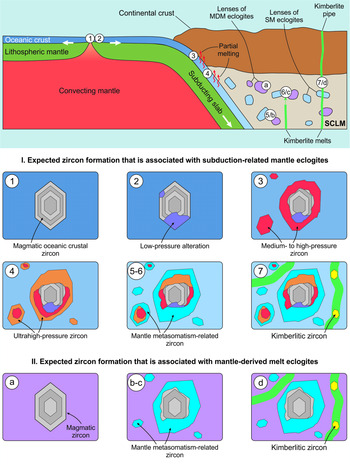
The likely origin and evolution of mantle eclogites suggest that zircon within mantle eclogites can be (1) magmatic, (2) metamorphic and (3) kimberlitic. For the purposes of this study, zircon that formed during either metasomatic reworking or hydrothermal alteration of mantle eclogites and their protoliths is also considered metamorphic. Hypothetical zircon origins associated with mantle eclogites are illustrated in Figure 3.
Schematic diagram illustrating zircon formation that is associated with the origin and evolution of mantle eclogites. (1–7) Stages for subduction-related mantle (SM) eclogites and their oceanic crustal protoliths. (a–d) Stages for mantle-derived melt (MDM) eclogites. All these stages are simplified and modified after Korolev et al. (Reference Korolev, Melnik, Li and Skublov2018). (1) Formation of oceanic basalts and gabbros from mantle-derived melts and the crystallization of associated magmatic zircon. (2) Low-pressure seafloor hydrothermal alteration of the oceanic crust and associated partial recrystallization of magmatic zircon. (3) Medium- to high-pressure zircon growth related to metamorphism and/or metasomatism at crustal depths during subduction. (4) Ultrahigh-pressure zircon growth related to metamorphism and/or metasomatism at mantle depths during subduction. (5, 6) Long-term residence of SM eclogites in the subcratonic lithospheric mantle (SCLM) with possible mantle metasomatism and associated zircon growth. Mantle metasomatism can be linked (6) and/or not linked (5) with kimberlitic magmas. (7) Incorporation of kimberlitic zircon within xenoliths of SM eclogites during ascent within the hosting kimberlites. (a) Crystallization of eclogites from mantle-derived melts at mantle pressures and possible crystallization of associated magmatic zircon. Further stages b–d for the MDM eclogites are equivalent to stages 5–7 for the SM eclogites. Possible zircon origins for stages 1–4 are inferred from natural examples (see text for details). Hypothetical zircon origins for stages 5–7 and a–d are assumed from the likely origin and subsequent evolution of mantle eclogites (Section 3).

Magmatic zircon in MDM eclogites might form during crystallization of melt at mantle depths, whereas magmatic zircon within SM eclogites is inherited from subducted oceanic basalts and gabbros. The latter process has been inferred from orogenic high-pressure (HP) and UHP rocks, including (a) the Dora–Maria whiteschists within the Western Alps that preserve relict granitic zircon, despite the fact that the protoliths of these rocks were metasomatically altered and underwent UHP metamorphism (Gauthiez-Putallaz et al. Reference Gauthiez-Putallaz, Rubatto and Hermann2016); and (b) the Monviso orogenic eclogites (Western Alps), which contain inherited magmatic zircon derived from their oceanic gabbro protoliths, despite these eclogites having undergone HP metamorphism and extensive metasomatism within a subduction channel environment (Rubatto & Angiboust, Reference Rubatto and Angiboust2015).
Metamorphic zircon may form in mantle eclogites and their protoliths as a result of (1) the low-pressure (LP) hydrothermal alteration of a mafic protolith in a mid-ocean ridge setting (i.e. the recrystallization of magmatic zircon; Spandler et al. Reference Spandler, Hermann and Rubatto2004; Grimes et al. Reference Grimes, John, Cheadle, Mazdab, Wooden, Swapp and Schwartz2009); (2) the metamorphism and metasomatic alteration of subducting oceanic crustal material at crustal and mantle depths (Heaman et al. Reference Heaman, Creaser and Cookenboo2002; Schmidberger et al. Reference Schmidberger, Heaman, Simonetti, Creaser and Cookenboo2005; Page et al. Reference Page, Essene, Mukasa and Valley2014; Rubatto & Angiboust, Reference Rubatto and Angiboust2015; Shchukina et al. Reference Shchukina, Agashev and Zedgenizov2018; Aulbach et al. Reference Aulbach, Massuyeau, Garber, Gerdes, Heaman and Viljoen2020), leading to possible growth of medium- to UHP zircon; (3) thermal events and associated mantle metasomatism during long-term residence in the cratonic mantle (Heaman et al. Reference Heaman, Creaser, Cookenboo and Chacko2006); and (4) metamorphism or metasomatism associated with kimberlite magmatism (Usui et al. Reference Usui, Nakamura, Kobayashi, Maruyama and Helmstaedt2003). A combination of some or all of these events can lead to multiple periods of zircon growth, as well as various degrees of alteration, resorption, overgrowth and recrystallization of earlier-formed zircon within individual eclogite samples (stages 2–6 and b, c in Fig. 3).
Kimberlitic magmas interact directly with mantle xenoliths during magma ascent, occasionally leading to infiltration and injection of kimberlitic magma into the xenoliths. This in turn indicates that kimberlitic zircon might be incorporated within mantle eclogite xenoliths during this process (stages 7 and d in Fig. 3).
The textural relationship between accessory zircon and rock-forming minerals can provide information on the origin of the former. Zircon inclusions in garnet and clinopyroxene have been identified within mantle eclogites (Usui et al. Reference Usui, Nakamura, Kobayashi, Maruyama and Helmstaedt2003; Schmidberger et al. Reference Schmidberger, Heaman, Simonetti, Creaser and Cookenboo2005; Heaman et al. Reference Heaman, Creaser, Cookenboo and Chacko2006; Shchukina et al. Reference Shchukina, Agashev and Zedgenizov2018), which indicates that either all these minerals formed at the same time or the zircon pre-dates the garnet and clinopyroxene. Interstitial zircon grains provide no clear textural evidence of their origin, meaning that these grains can be inherited, can be related to eclogite formation and can be secondary. Xenogenic kimberlitic zircon may be added to mantle eclogites, which indicates these zircon grains will be either interstitial or hosted by veins that cross-cut the xenoliths.
4. Internal textures and trace-element compositions of zircon within mantle eclogites
Metamorphic and magmatic zircon can generally be distinguished by variations in internal textures and geochemical signatures, although distinguishing metamorphic zircons of particular origins may be complicated (see review in Rubatto, Reference Rubatto2017). This suggests that it is possible to discriminate between metamorphic and magmatic zircon within mantle eclogite xenoliths, rather than to identify the specific origin of metamorphic zircons.
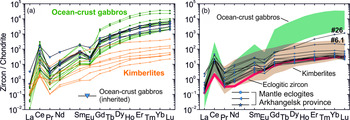
Magmatic zircons from rocks of different geological settings typically have oscillatory and/or sector zoning that is visible during CL imaging (Fig. 1d), and have Th/U ratios of >0.1. These characteristics also apply to magmatic zircons from mafic oceanic crustal rocks and to kimberlitic zircons (Belousova et al. Reference Belousova, Griffin, O’Reilly and Fisher2002; Corfu et al. Reference Corfu, Hanchar, Hoskin and Kinny2003; Zartman & Richardson, Reference Zartman and Richardson2005; Cavosie et al. Reference Cavosie, Kita and Valley2009; Grimes et al. Reference Grimes, John, Cheadle, Mazdab, Wooden, Swapp and Schwartz2009). Relics of magmatic zircons from oceanic gabbro protoliths can potentially be inherited by SM eclogites, and would have chondrite-normalized rare earth element (REEN) patterns (Fig. 4a) that are similar to the majority of other magmatic zircons of different origins. These patterns have a steep increase from the light REEs (LREEs, La–Nd) to the heavy REEs (HREEs, Gd–Lu), with positive Ce and negative Eu anomalies (Belousova et al. Reference Belousova, Griffin, O’Reilly and Fisher2002; Hoskin & Schaltegger, Reference Hoskin and Schaltegger2003). Relics of magmatic zircon grains preserving all of the characteristics described above have been identified previously within HP and UHP orogenic rocks (e.g. Rubatto & Hermann, Reference Rubatto and Hermann2003; Gauthiez-Putallaz et al. Reference Gauthiez-Putallaz, Rubatto and Hermann2016), including eclogites (or former eclogites) with oceanic crustal protoliths (Fig. 4a). Kimberlitic zircons, in contrast, have relatively flat HREEN patterns, are free of Eu anomalies (Fig. 4a) and contain lower total REE concentrations (maximum of ~650 ppm, typically <60 ppm; Belousova et al. Reference Belousova, Griffin, O’Reilly and Fisher2002; Page et al. Reference Page, Fu, Kita, Fournelle, Spicuzza, Schulze, Viljoen, Basei and Valley2007). Kimberlitic zircon has low U concentrations (<90 ppm; Valley et al. Reference Valley, Kinny, Schulze and Spicuzza1998; Belousova et al. Reference Belousova, Griffin, O’Reilly and Fisher2002; Sun et al. Reference Sun, Tappe, Kostrovitsky, Liu, Skuzovatov and Wu2018), which is distinct from most magmatic crustal zircons (Belousova et al. Reference Belousova, Griffin, O’Reilly and Fisher2002). The geochemical characteristics of magmatic zircons within MDM eclogites remain unknown, as no unambiguous MDM eclogite samples have been identified to date (e.g. Jacob, Reference Jacob2004).
REEN patterns for mantle eclogite-hosted, oceanic gabbro-hosted and kimberlitic zircons. (a) REEN patterns for representative zircons from oceanic crustal gabbros (magmatic zircon; Cavosie et al. Reference Cavosie, Kita and Valley2009; Grimes et al. Reference Grimes, John, Cheadle, Mazdab, Wooden, Swapp and Schwartz2009) and kimberlites (Belousova et al. Reference Belousova, Griffin, O’Reilly and Fisher2002; Page et al. Reference Page, Fu, Kita, Fournelle, Spicuzza, Schulze, Viljoen, Basei and Valley2007) along with representative REEN patterns for inherited relict magmatic oceanic crustal gabbro zircons now hosted within orogenic metamorphic rocks (Rubatto & Hermann, Reference Rubatto and Hermann2003; Rubatto & Scambelluri, Reference Rubatto and Scambelluri2003; Spandler et al. Reference Spandler, Hermann and Rubatto2004); note that the REEN patterns of the relict zircon grains match the field defined by zircon from oceanic gabbros. (b) REEN patterns of zircon grains from the V. Grib mantle eclogites (Skublov et al. Reference Skublov, Shchukina, Guseva, Mal’kovets and Golovin2011, Reference Skublov, Nikitina, Marin, Levskii and Guseva2012b; Shchukina et al. Reference Shchukina, Agashev and Zedgenizov2018) compared to REEN patterns for metamorphic (‘eclogitic’) zircons from orogenic eclogites (Skublov et al. Reference Skublov, Berezin and Berezhnaya2012a), magmatic zircons from oceanic gabbros and kimberlitic zircons. The REE data used in this figure are given in online Supplementary Material Table S2, and all REE concentrations are normalized to the CI chondrite composition of McDonough & Sun (Reference McDonough and Sun1995).

Lithium concentrations can potentially be used to discriminate between magmatic zircons that formed in oceanic and continental crustal environments (Ushikubo et al. Reference Ushikubo, Kita, Cavosie, Wilde, Rudnick and Valley2008; Bouvier et al. Reference Bouvier, Ushikubo, Kita, Cavosie, Kozdon and Valley2012). Magmatic zircon grains within rocks derived from the Mid-Atlantic Ridge, including oceanic crustal gabbros, have low Li concentrations (<<0.1 ppm, n = 39; Ushikubo et al. Reference Ushikubo, Kita, Cavosie, Wilde, Rudnick and Valley2008; Grimes et al. Reference Grimes, Ushikubo, John and Valley2011), whereas magmatic zircons formed in continental crustal settings typically contain 1–100 ppm Li, although concentrations outside this range may also be possible (Ushikubo et al. Reference Ushikubo, Kita, Cavosie, Wilde, Rudnick and Valley2008; Barth & Wooden, Reference Barth and Wooden2010; Bowman et al. Reference Bowman, Moser, Valley, Wooden, Kita and Mazdab2011; Li et al. Reference Li, Li, Liu and Tang2011; Bouvier et al. Reference Bouvier, Ushikubo, Kita, Cavosie, Kozdon and Valley2012). In addition, the diffusion of Li in zircon is slow enough to preserve primary Li concentrations, even under high-grade metamorphic conditions and during anatexis (see Bouvier et al. Reference Bouvier, Ushikubo, Kita, Cavosie, Kozdon and Valley2012). This suggests that the low concentrations of Li (<<1 ppm) found in magmatic zircons that formed in oceanic crustal environments can be retained during subduction processes and eclogite formation.
Metamorphic zircon domains (e.g. metamorphic rim) and grains typically have weaker zoning visible in CL images (e.g. homogeneous, weak oscillatory, irregular, cloudy or mosaic zoning), Th/U ratios that are generally <0.1 and lower total REE concentrations relative to those found within magmatic zircons (Corfu et al. Reference Corfu, Hanchar, Hoskin and Kinny2003; Hoskin & Schaltegger, Reference Hoskin and Schaltegger2003; Rubatto, Reference Rubatto2017). However, these characteristics do not apply to all metamorphic zircons, with these differences potentially related to the origin of SM eclogites. For instance, oscillatory zoning has been identified within HP zircon that formed as a result of hydrothermal fluid-related processes, as is the case for orogenic eclogites with oceanic crustal protoliths. However, even these zoned metamorphic zircons have Th/U ratios of ≤0.1 (Rubatto & Hermann, Reference Rubatto and Hermann2003; Page et al. Reference Page, Essene, Mukasa and Valley2014). (U)HP metamorphic zircons can also have high Th/U ratios (see review in Rubatto, Reference Rubatto2017). Zircon domains that formed as a result of seafloor hydrothermal alteration of magmatic zircon at low pressures (stage 2 in Fig. 3) have high Th/U ratios (>0.1) and usually have REEN patterns that resemble those of unaltered magmatic zircon (Spandler et al. Reference Spandler, Hermann and Rubatto2004; Grimes et al. Reference Grimes, John, Cheadle, Mazdab, Wooden, Swapp and Schwartz2009). Zircon grains within oceanic gabbros sometimes have relatively weak magmatic zoning, and large parts of these grains appear texturally homogeneous (Fig. 1d; fig. 2 in Cavosie et al. Reference Cavosie, Kita and Valley2009), which potentially causes problems relating to the identification of relics of these zircon grains within mantle eclogites. All of these exceptions need to be considered carefully when determining the origins of zircon within mantle eclogites.
Zircon grains in the Colorado Plateau, Jericho and V. Grib eclogites vary in size from <20 μm (Usui et al. Reference Usui, Nakamura, Kobayashi, Maruyama and Helmstaedt2003) up to 2 mm (Schmidberger et al. Reference Schmidberger, Heaman, Simonetti, Creaser and Cookenboo2005), and range in shape from anhedral to rounded (Fig. 1a–c). In addition, zircon grains from the Jericho and V. Grib eclogites have core–rim textures with cores that generally appear darker during CL imaging. The brighter and darker domains of these zircons have relatively homogeneous and patchy/mosaic zoning, respectively. This weak zoning contrasts with the regular zoning expected for magmatic and kimberlitic zircons (Fig. 1d), and suggests these zircons have a metamorphic origin. The core of zircon grain no. 6.1 from a V. Grib eclogite (Fig. 1b) has oscillatory-like zoning, suggesting it is magmatic (Skublov et al. Reference Skublov, Nikitina, Marin, Levskii and Guseva2012 b). However, this is not the case as it has a REEN pattern (Fig. 4b) that is consistent with the majority of the other metamorphic zircons within the V. Grib eclogites.
All but one of the zircon grains from the V. Grib eclogites have flat HREEN patterns (LuN/GdN = 1–3) and are HREE depleted (8–229 times chondrite) relative to magmatic zircon within oceanic gabbros (Fig. 4b; online Supplementary Material Table S2). These characteristics are indicative of metamorphic zircon that formed in equilibrium with garnet that sequestered HREEs (Rubatto, Reference Rubatto2017). Only one zircon grain from the V. Grib eclogites (no. 26 in Fig. 4b) is relatively enriched in the HREEs (up to 1142 times chondrite) and has a steeply inclined REEN pattern (LuN/GdN = 19), which suggests this zircon has a distinct origin. However, this remains uncertain as this zircon has no associated CL image or reported U–Pb data. All of the zircon grains from the V. Grib eclogites have negative Eu anomalies (Eu/Eu* = 0.24–0.65). The presence of a negative Eu anomaly in metamorphic zircons from mafic rocks is indicative of the formation of zircon together with plagioclase that preferentially sequesters Eu or is indicative of the presence of a significant bulk rock Eu anomaly (Rubatto, Reference Rubatto2017). The fact that the bulk composition of the V. Grib eclogites is free of any significant Eu anomaly (Eu/Eu* = 0.8; Shchukina et al. Reference Shchukina, Agashev, Golovin and Pokhilenko2015, Reference Shchukina, Agashev and Zedgenizov2018) suggests that these zircons formed as a result of subduction-related metamorphism under crustal conditions where garnet and plagioclase are both stable (e.g. amphibolite-facies conditions). In addition, the REEN patterns of these zircon grains are inconsistent with those expected for eclogitic zircon within HP orogenic rocks. The latter are characterized by flat HREEN patterns and are free of Eu anomalies (Fig. 4b), which reflects the presence of garnet and the absence of plagioclase within orogenic eclogites (Rubatto, Reference Rubatto2002, Reference Rubatto2017; Skublov et al. Reference Skublov, Berezin and Berezhnaya2012 a). The zircon within the V. Grib eclogites cannot have formed during the generation of an eclogite-facies assemblage at crustal or mantle depths, given the lack of plagioclase in both cases. It has been concluded previously that the V. Grib eclogite zircon could have formed just before, but in association with, the formation of these eclogites (Shchukina et al. Reference Shchukina, Agashev and Zedgenizov2018). Our interpretation suggests that the zircon should have formed prior to the eclogite-facies conditions at crustal depths (e.g. amphibolite-facies subduction-related metamorphism), which improves upon the previous conclusion.
Metamorphic zircons within HP rocks that formed at sub-solidus (i.e. ‘cold’) temperatures, including orogenic eclogites, have Th/U values that are generally <0.1, but vary between 0.001 and 0.6 (Rubatto, Reference Rubatto2017). Zircon grains from the Jericho eclogites have Th/U ratios of 0.05–0.37 (n = 19; Heaman et al. Reference Heaman, Creaser, Cookenboo and Chacko2006) that are indistinguishable from the zircons found within ‘cold’ orogenic eclogites. These zircon grains also contain low concentrations of U (9–62 ppm; Heaman et al. Reference Heaman, Creaser, Cookenboo and Chacko2006) that is consistent with the U concentrations of metamorphic zircons within a wide range of orogenic eclogites (Skublov et al. Reference Skublov, Berezin and Berezhnaya2012 a). The zircon grains within the V. Grib eclogites have higher Th/U ratios (0.26–0.99; online Supplementary Material Table S2). The low Th/U ratios (<0.1) of metamorphic zircons generally reflect the partitioning of Th between zircon and Th-rich phases such as monazite and allanite; however, the latter two minerals (1) might not have formed during metamorphism as a result of the bulk composition of the rock, or (2) can also be removed during melting under ultrahigh temperature conditions (UHT, >900 °C; Rubatto, Reference Rubatto2017). Ti-in-zircon thermometry yielded temperatures of 707–769 °C for the formation of the V. Grib eclogite zircon (Skublov et al. Reference Skublov, Shchukina, Guseva, Mal’kovets and Golovin2011, Reference Skublov, Nikitina, Marin, Levskii and Guseva2012 b; Shchukina et al. Reference Shchukina, Agashev and Zedgenizov2018). This temperature range indicates that the high Th/U ratios of zircon grains from the V. Grib eclogites reflect the specific bulk composition of these rocks, rather than zircon growth under UHT conditions. These temperatures also suggest that the zircon grains formed before garnet–clinopyroxene equilibration within the V. Grib eclogites at higher temperatures and mantle depths (880 °C; Fig. 2; online Supplementary Material Table S1).
5. Expected range of O isotope compositions for mantle eclogite-hosted zircon
The O isotope composition of zircon within mantle eclogites can be constrained using O isotope data for mantle-derived rocks and orogenic eclogites. Mantle and primary mantle-derived materials have uniform O isotope compositions. For example, garnet within mantle peridotites has δ18O values of 5.42 ± 0.5 ‰ (Wang et al. Reference Wang, Bucholz, Skinner, Shimizu and Eiler2011), whereas fresh modern mid-ocean ridge basalts have δ18O values of 5.25–5.85 ‰ (Harmon & Hoefs, Reference Harmon and Hoefs1995; Eiler, Reference Eiler2001; Cooper et al. Reference Cooper, Eiler, Sims and Langmuir2009). Kimberlitic (i.e. mantle) zircon yields an average δ18O value of 5.3 ± 0.6 ‰ (2SD; Valley et al. Reference Valley, Kinny, Schulze and Spicuzza1998), which is indistinguishable from the O isotope composition of magmatic zircon from different rocks (including gabbros) within the oceanic crust (5.3 ± 0.8 ‰, 2SD; Cavosie et al. Reference Cavosie, Kita and Valley2009; 5.2 ± 0.5 ‰, 2SD; Grimes et al. Reference Grimes, Ushikubo, John and Valley2011). This suggests that magmatic zircon within SM eclogites and, probably, within MDM eclogites is likely to have mantle-like O isotope signatures within a narrow range of 4.5–6.1 ‰. The initial mantle-like δ18O values for relics of the magmatic zircon within SM eclogites are likely to be preserved during the sub-solidus alteration of the oceanic crust (Cavosie et al. Reference Cavosie, Kita and Valley2009), as well as during metamorphism and metasomatic reworking within subduction zone environments (Rubatto & Angiboust, Reference Rubatto and Angiboust2015).
Hydrothermal alteration by seawater can shift the primary mantle-like bulk O isotope composition of the oceanic crust considerably, yielding a range of δ18O values between 0 and 15 ‰, depending on temperature (references in Korolev et al. Reference Korolev, Melnik, Li and Skublov2018). This means that zircon that forms during closed-system metamorphism within a subduction zone environment will inherit this bulk O isotope composition, as is the case for zircon within orogenic eclogites with oceanic crustal protoliths (Page et al. Reference Page, Essene, Mukasa and Valley2014; Rubatto & Angiboust, Reference Rubatto and Angiboust2015). Within subduction channel environments, an influx of external fluids can cause the metasomatism of subducting oceanic crustal material, and zircon that forms during this process inherits the O isotope compositions of the associated fluids (Page et al. Reference Page, Essene, Mukasa and Valley2014; Rubatto & Angiboust, Reference Rubatto and Angiboust2015). These external fluids contrast with the uniform O isotope composition of the mantle materials, in that these fluids can be isotopically lighter or heavier, depending on the nature of a given fluid-derived source (i.e. isotopically lighter serpentinized or heavier sedimentary rocks) within the mantle wedge (Errico et al. Reference Errico, Barnes, Strickland and Valley2013; Rubatto & Angiboust, Reference Rubatto and Angiboust2015). This means that metamorphic or metasomatic subduction-related zircons within mantle eclogites are likely to have variable (likely between 0 and 15 ‰) O isotope compositions compared with magmatic zircons that have mantle-like (4.5–6.1 ‰) O isotope compositions. A comparison of the δ18O values of coexisting zircon and garnet within mantle eclogites could address the issue of the relative origins of these minerals, given that the O isotopic equilibrium between them in orogenic eclogites is a robust indication that they formed simultaneously (Page et al. Reference Page, Essene, Mukasa and Valley2014; Rubatto & Angiboust, Reference Rubatto and Angiboust2015).
6. Identification of zircon associated with mantle eclogites
6.a. An algorithm for identification of these zircons
As discussed in Sections 2–4 above, the zircon grains in the Jericho and V. Grib eclogites represent very few specific examples of zircon growth. Therefore, these zircons cannot be considered representative examples of the metamorphic zircon expected to be present in all types of mantle eclogites. It is also likely that metamorphic zircons within mantle eclogites undergo multiple episodes of growth during the formation and evolution of these rocks. This means that the lack of available data for these metamorphic zircons, combined with their highly variable O isotope compositions (discussed in Section 5 above), highlights the absence of a reliable framework for the identification of specific metamorphic zircons associated with mantle eclogites. However, magmatic zircons within oceanic gabbros and kimberlites have well-investigated and particular zoning patterns, Th/U ratios, and trace-element and O isotope characteristics that can be used for identification purposes. This enabled the construction of an algorithm (Fig. 5) that allows the identification of inherited oceanic crust-derived and xenogenic kimberlitic zircons that may be present in mantle eclogite xenoliths. This algorithm can also be used for the identification of metamorphic zircons (albeit of unknown origin and unknown relation to mantle eclogite samples) and magmatic zircon contaminants added to samples during laboratory-based mineral separation processes. This application is especially useful for testing zircon grains isolated from mantle eclogite xenoliths that contain no zircons in their thin-sections. Although magmatic zircons within MDM eclogites should theoretically have magmatic (i.e. oscillatory and/or sector) zoning that is visible in CL images, in addition to Th/U ratios of >0.1 and mantle-like δ18O compositions, the characteristics of these magmatic zircons remain unknown, which means that they cannot be assessed using our algorithm. Recrystallized domains of oceanic magmatic zircons that formed as a result of LP hydrothermal alteration (stage 2 in Fig. 3) cannot be correctly assessed using this approach, owing to the geochemical affinity with the magmatic zircon (discussed in Section 4 above). However, these altered domains have distinctive chaotic or perturbed zoning in CL images and contain multiple pores and Th- and Y-rich inclusions (Spandler et al. Reference Spandler, Hermann and Rubatto2004; Grimes et al. Reference Grimes, John, Cheadle, Mazdab, Wooden, Swapp and Schwartz2009), which could be indicative of their origin in combination with the geochemical characteristics.
Flowchart for an algorithm for the identification of kimberlitic and inherited ocean-crust magmatic zircon within mantle eclogite xenoliths. This algorithm allows the discrimination of these zircons from (i) magmatic zircon contaminants that can be introduced to mantle eclogite samples during laboratory-based mineral separation, and (ii) metamorphic zircon. However, this algorithm does not consider magmatic zircon of MDM eclogites and zircon that originated from low-pressure alteration of ocean-crust magmatic zircon. *1 – The metamorphic zircon represents different ‘metamorphic’ origins (including metasomatic) and does not provide information on its relationship with mantle eclogite samples (i.e. ‘metamorphic’ zircon of most origins is meant here, including laboratory-induced metamorphic zircon contaminants). *2 – ‘Magmatic’ REEN patterns that increase rapidly from the LREEs to the HREEs, with positive Ce and negative Eu anomalies, are generally indicative of magmatic zircon (Belousova et al. Reference Belousova, Griffin, O’Reilly and Fisher2002; Hoskin & Schaltegger, Reference Hoskin and Schaltegger2003), including magmatic zircons that form within oceanic gabbros (Fig. 4a). *3 – Kimberlitic zircon has flat HREEN patterns, positive Ce (but no Eu) anomalies and overall depleted REE concentrations relative to magmatic oceanic crust-derived zircon (Fig. 4a); the range of δ18O (2SD) is after Valley et al. (Reference Valley, Kinny, Schulze and Spicuzza1998). Note that HP (eclogitic) zircon has low U and REE concentrations (Skublov et al. Reference Skublov, Berezin and Berezhnaya2012a) and can have REEN patterns that overlap those of kimberlitic zircon (Fig. 4b). In cases when this HP zircon has Th/U >0.1, it, therefore, can be mistaken for those kimberlitic zircons whose primary zoning has been erased. In this case, the kimberlitic zircon can be identified by the U–Pb age it yields that should be equal to the emplacement age of the hosting kimberlite pipe in most cases (Page et al. Reference Page, Fu, Kita, Fournelle, Spicuzza, Schulze, Viljoen, Basei and Valley2007). *4 – ‘Other REE pattern’ refers to magmatic zircons that have different REEN patterns from those of kimberlitic and typical magmatic zircons. These zircons are exemplified by zircon grains from syenites that have REEN patterns that increase rapidly from the LREEs to the HREEs, and have positive Ce but no Eu anomalies (Belousova et al. Reference Belousova, Griffin, O’Reilly and Fisher2002), and by zircon 5.1 in Figure 6b.

We suggest that inherited magmatic zircons derived from oceanic crust are likely to be present either as relics (e.g. magmatic cores overgrown by metamorphic rims) or as zircon grains with evidence of alteration, as is the case in some HP orogenic rocks (e.g. fig. 1a, b, e in Rubatto & Hermann, Reference Rubatto and Hermann2007). This parameter was not included in our algorithm; however, the algorithm does account for some other possible challenges: (1) despite the fact that kimberlitic zircons generally have oscillatory zoning that is visible in CL images (Page et al. Reference Page, Fu, Kita, Fournelle, Spicuzza, Schulze, Viljoen, Basei and Valley2007), this primary zoning can be erased during later processes in some grains (Corfu et al. Reference Corfu, Hanchar, Hoskin and Kinny2003); and (2) zoning in either magmatic zircon relics or fragments can be relatively weak (e.g. the homogeneous darker sectors of the oceanic crust-derived zircon shown in Fig. 1d).
The algorithm suggests that the V. Grib eclogite zircon grains have metamorphic origins in that they have Th/U values >0.1, contain only weak zoning visible during CL imaging and have REEN patterns that do not match those of typical magmatic zircons that formed in different environments (for REEN patterns in typical magmatic zircons, see Belousova et al. Reference Belousova, Griffin, O’Reilly and Fisher2002; Hoskin & Schaltegger, Reference Hoskin and Schaltegger2003). The Jericho eclogite zircon grains that have Th/U values <0.1 are also classified as metamorphic by our algorithm, whereas those with Th/U values >0.1 cannot be assessed using this approach, owing to the lack of other necessary data (e.g. no REE compositions are available to date).
6.b. Case study of zircon from the Kasai mantle eclogites
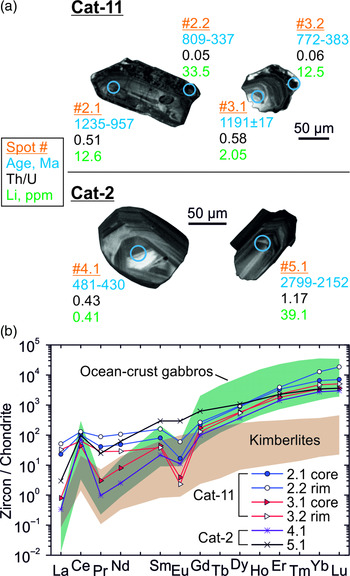
Zircon grains isolated from the Kasai eclogite xenoliths represent a good case study for testing the effectiveness of the algorithm developed during this study as (1) no zircon grains have been identified in thin-sections of these xenoliths, and (2) CL imaging, Th/U values and trace-element data have been reported previously for zircon grains isolated from these xenoliths (Nikitina et al. Reference Nikitina, Marin, Skublov, Korolev, Saltykova, Zinchenko and Chissupa2012, Reference Nikitina, Korolev, Zinchenko and Felix2014). Importantly, these eclogites are also thought to have formed as a result of the subduction of oceanic crust or by the recrystallization of SM eclogites within the mantle (Nikitina et al. Reference Nikitina, Korolev, Zinchenko and Felix2014, Reference Nikitina, Bogomolov, Krymsky, Belyatsky, Korolev and Zinchenko2017; Korolev et al. Reference Korolev, Nikitina, Melnik and Zinchenko2017; N. M. Korolev et al. Reference Korolev, Nikitina, Goncharov, Dubinina, Melnik, Müller, Chen and Zinchenkosubmitted). The O isotope compositions of the Kasai eclogite zircon grains cannot be considered as no data have been reported.
Four zircon grains were separated from two Kasai eclogite xenoliths. These zircon grains yield U–Pb ages that range between 2799 and 430 Ma (Fig. 6a), all of which are older than the timing of emplacement of the hosting kimberlites (118 ± 1 Ma; Robles-Cruz et al. Reference Robles-Cruz, Escayola, Jackson, Galí, Pervov, Watangua, Gonçalves and Melgarejo2012) and are thought to record different stages of the evolution of the Kasai eclogites within the upper lithospheric mantle (Nikitina et al. Reference Nikitina, Marin, Skublov, Korolev, Saltykova, Zinchenko and Chissupa2012, Reference Nikitina, Korolev, Zinchenko and Felix2014, Reference Nikitina, Bogomolov, Krymsky, Belyatsky, Korolev and Zinchenko2017).
(a) Cathodoluminescence images of zircon grains from low-Mg (Cat-11) and high-Mg (Cat-2) mantle eclogite xenoliths from kimberlites of the Kasai Craton (modified after Nikitina et al. Reference Nikitina, Marin, Skublov, Korolev, Saltykova, Zinchenko and Chissupa2012). Images of these grains are reprinted by permission from Springer Nature under licence 4826261015582: Springer Nature, Doklady Earth Sciences, vol. 445, fig. 1, p. 841, U–Pb age and geochemistry of zircon from mantle xenoliths of the Katoka and Kat-115 kimberlitic pipes (Republic of Angola), Nikitina et al., Copyright (2012). Ages (Ma ± 1σ for concordant analyses, 207Pb–206Pb and 206Pb–238U ages (Ma) for discordant analyses), Th/U ratios, Li concentrations and analysis numbers are from Nikitina et al. (Reference Nikitina, Marin, Skublov, Korolev, Saltykova, Zinchenko and Chissupa2012, Reference Nikitina, Korolev, Zinchenko and Felix2014), and are indicated by different colours. The diameter of the blue circles is ~20 μm, and each circle indicates the approximate location of the U–Pb and trace-element ion microprobe analyses of these zircon grains. (b) REEN patterns of zircons from the Cat-11 and Cat-2 mantle eclogites compared to zircon REEN patterns for oceanic gabbros and kimberlites (Fig. 4a). REE concentrations are normalized to the CI chondrite composition of McDonough & Sun (Reference McDonough and Sun1995), and the trace-element data used in (a) and (b) are given in online Supplementary Material Table S2.

Two zircon grains from low-Mg mantle eclogite sample Cat-11 have similar internal textures (Fig. 6a) where cores with oscillatory zoning are overgrown by weak, patchy-zoned rims. Classifying these zircon grains with our algorithm suggests that the weak, patchy zoning of both rims, coupled with their low Th/U values (0.05–0.06), is indicative of a metamorphic origin. The cores have magmatic-like REEN patterns that are similar to those present in zircon from the oceanic crust (Fig. 6b), as well as oscillatory zoning that is visible during CL imaging, and Th/U values >0.1, all of which are indicative of a magmatic origin. However, these cores also have high Li contents (2–13 ppm) that are indicative of formation in a continental crustal setting. This suggests that both of the zircon grains isolated from mantle eclogite sample Cat-11 are contaminants that were most likely introduced during laboratory-based mineral separation.
The two zircon grains from high-Mg mantle eclogite sample Cat-2 are magmatic, indicated by their Th/U values of >0.1 and distinct oscillatory zoning visible during CL imaging (Fig. 6a), as well as REEN patterns that are distinct from those of kimberlitic zircon (Fig. 6b). Zircon grain 5.1 has a weaker Eu anomaly than that expected for oceanic crust-derived zircons (Eu/Eu* = 0.69 and 0.03–0.45, respectively; online Supplementary Material Table S2), and is relatively enriched in the REEs from Pr to Gd (Fig. 6b). This REE composition differs from typical magmatic patterns and is related to the ‘other REE pattern’ classification within our algorithm (Fig. 5). This indicates that zircon 5.1 is most likely another laboratory-introduced contaminant. The high Li content (39 ppm) of this zircon grain is also indicative of a contaminant origin. Zircon grain 4.1 has a REEN pattern that is similar to that expected for typical magmatic zircon and contains a low concentration of Li (0.4 ppm), suggesting it might have formed in an oceanic crustal setting and could have been inherited subsequently by the eclogite. However, this grain represents a fragment of zircon that has distinct magmatic zoning visible during CL imaging and records no textural evidence of alteration. Preservation of grains of inherited oceanic crustal zircon that have no overgrown rims or other textural records of metamorphic alteration (e.g. partial resorption, recrystallization along fractures) is highly unlikely, considering the evolutionary history of mantle eclogites and previous examples of inherited magmatic zircon grains or magmatic zircon relics within (U)HP orogenic rocks (e.g. Rubatto & Hermann, Reference Rubatto and Hermann2007; Gauthiez-Putallaz et al. Reference Gauthiez-Putallaz, Rubatto and Hermann2016). Therefore, it is likely that zircon grain 4.1 also represents a laboratory-introduced contaminant.
7. Suggestions for future research
We suggest that two main reasons may lead to the scarcity of zircon within mantle eclogites in contrast with zircon-rich orogenic eclogites: (1) it is unlikely that individual samples of mantle eclogites would contain accessory zircon, because these kimberlite-hosted mantle-derived xenoliths are relatively small in size (typically <100 mm); (2) the majority of mantle eclogites underwent higher rates of partial melting that, therefore, makes it more possible for accessory zircon to be removed from these rocks during this process. However, mantle eclogites of all types may theoretically contain accessory zircons related to one or several origins (Fig. 3). To make progress with the proper identification of zircon-bearing mantle eclogites, and with the linking of the U–Pb ages of the zircons they contain with particular geological events, it will be useful to:
-
(a) search for zircon grains within thin-sections only. This approach enables the avoidance of possible contamination of mantle eclogite samples during laboratory-based mineral separation. It also should be considered that, as an accessory mineral, zircon may not be observed in every single thin-section. Therefore, an investigation of several thin-sections of each mantle eclogite xenolith should increase the probability of finding zircons.
-
(b) fully characterize zircon from mantle eclogites to utilize its outstanding potential to date and identify processes that affected these rocks and their precursors. Th/U ratios, trace-element concentrations (at least REE, Y, Hf, U, Th and Li), O and Hf isotope compositions, internal zircon textures (CL imaging) and textural relationships with other minerals are the most critical characteristics of mantle eclogite-derived zircons in addition to the U–Pb ages they yield.
-
(c) compare the δ18O values of coexisting zircon and garnet within mantle eclogites. This approach could be a robust proxy for the identification of the relative origins of these minerals as it has been demonstrated for orogenic eclogites (Page et al. Reference Page, Essene, Mukasa and Valley2014; Rubatto & Angiboust, Reference Rubatto and Angiboust2015).
8. Conclusions
-
(1) The supposed origins and evolutionary histories of mantle eclogites suggest that xenoliths of these rocks can contain several types of zircon: (a) magmatic zircon within MDM eclogites that formed during melt crystallization, (b) magmatic zircon within SM eclogites that was inherited from mafic rocks that formed within oceanic crustal settings, (c) metamorphic zircon (including metasomatic), and (d) xenogenic kimberlitic zircon. Zircon types (c) and (d) can occur within all types of mantle eclogites.
-
(2) The specific characteristics of magmatic zircon within MDM eclogites and metamorphic zircon within all mantle eclogites remain unknown. However, the magmatic zircon derived from mafic rocks formed in oceanic crustal environments and kimberlitic zircon have distinctive trace-element and O isotope compositions. Kimberlitic and magmatic oceanic crust-derived zircons generally have oscillatory and/or sector zoning that is visible in CL images, Th/U values >0.1 and mantle-like δ18O values that range generally between 4.5 and 6.1 ‰. These oceanic crust-derived zircons have ‘magmatic’ REEN patterns that increase rapidly from the LREEs to HREEs with positive Ce and negative Eu anomalies. They are also depleted in Li (<<1 ppm). Kimberlitic zircons have flat HREEN patterns, are free of Eu anomalies, are depleted in U (<90 ppm) and typically contain <60 ppm (maximum of ~650 ppm) REEs. These data allow the construction of an algorithm for the identification of inherited magmatic zircons derived from oceanic crust and xenogenic kimberlitic zircons within mantle eclogite xenoliths (Fig. 5). This algorithm can also be used to identify metamorphic zircons, albeit without specifying their origins and relation to mantle eclogites (including laboratory-based metamorphic zircon contaminants), and magmatic zircon contaminants that have been introduced to mantle eclogite samples during laboratory-based mineral separation, but does not consider the magmatic zircon of MDM eclogites.
-
(3) The algorithm has been applied to mantle eclogite xenoliths from kimberlites of the Kasai Craton, as these eclogites have a primary subduction-related origin and contain zircon grains that have not been identified within thin-sections (Nikitina et al. Reference Nikitina, Marin, Skublov, Korolev, Saltykova, Zinchenko and Chissupa2012, Reference Nikitina, Korolev, Zinchenko and Felix2014). This analysis indicates that at least three of the four zircon grains isolated from these xenoliths most likely represent contaminants that were introduced to these mantle eclogite samples during laboratory-based mineral separation.
Supplementary material
To view supplementary material for this article, please visit https://doi.org/10.1017/S0016756820001387
Acknowledgements
We thank Jin-Xiang Huang for constructive comments that helped to improve the manuscript, and Alexey G. Goncharov for discussions on an earlier version of the manuscript. We are thankful to Sonja Aulbach and an anonymous referee for their very constructive comments and criticisms. This study was funded by the National Key R&D Program of China (grant 2016YFE0203000); the National Natural Science Foundation of China (grant 41811530083); and the Russian Foundation of Basic Research (RFBR), research projects No. 18-55-53022 and 16-35-60092 mol_a_dk. This study was conducted under state contract No. 0153-2019-0002 of the Institute of Precambrian Geology and Geochronology of the Russian Academy of Sciences. A.E. Melnik acknowledges the awarding of a postdoctoral fellowship under the President’s International Fellowship Initiative (PIFI) of the Chinese Academy of Sciences (grant 2019PC0100). We acknowledge the permission from Springer Nature, Oxford University Press and the Mineralogical Society of America to reproduce images herein (details are given in the captions for Figures 1 and 6).