

In late November 2001, after the United States invasion of Afghanistan, hundreds of surrendering Taliban fighters were sent to the Qala-e-Jangi prison complex near Mazari Sharif. Among the surrendering Taliban forces were Afghan Arabs who instigated a prison riot by detonating grenades they had concealed in their clothing, attacking Northern Alliance guards and seizing weapons. The prison uprising was brought to an end after a three-day battle that included heavy air support from United States AC-130 gunships and Black Hawk helicopters. One American soldier was killed and nine were injured along with about 50 Northern Alliance soldiers. Between 200 and 400 Taliban prisoners were killed during the prison uprising. Two American prisoners, Yaser Esam Hamdi and John Walker Lindh, were among the Taliban survivors.
Hamdi was named in the media as the “accidental citizen” or the “second American Taliban”. By the Bush administration he was described as an “illegal enemy combatant”, and detained for almost three years without being charged with any crime. He was initially detained at Camp X-Ray at the United States naval base in Guantanamo Bay, Cuba, and was later transferred to military jails in Virginia and South Carolina after it became known that he was a US citizen. In June 2004, the United States Supreme Court rejected the government’s attempts to detain Hamdi indefinitely without trial. On September 23, 2004, the US Justice Department released Hamdi to Saudi Arabia without charge on the condition that he renounce his US citizenship.
This case raises many legal aspects for study, including the separation of powers among different government branches, the detention of noncombatant Americans, and the legality of Hamdi’s “voluntary” renunciation of citizenship. Throughout this article, I locate the historical foundations, and the sociological and symbolic meanings, of cases such as the one presented above. Why do states take away citizenship from their subjects? Is it a punishment? When do states expatriate their citizens and on the basis of what justification? Should loyalty be judged according to one’s birthplace or actions? The policies of revoking citizenship will be the lens through which I examine, describe and analyze the complex relationships between citizenship, immigration and war.
The common thread in most of the recent studies on citizenship is that immigration and naturalization processes are articulated in relation to the conception of citizenship and nationhood in any particular country (for example: Brubaker Reference Brubaker1992; Joppke Reference Joppke1999; Joppke and Roshenhek Reference Joppke and Roshenhek2001; Smith Reference Smith1997). That is, the regulations responsible for the entrance into and inclusion of new members in the national community are dependent on the understanding of who should belong to the national “we” and who should not. In this research study, I examine the converse of these laws – those measures that deal with excluding people from membership in the community or loss of citizenship.
This analytical move, shifting the focus of the academic study of citizenship from inclusionary to exclusionary practices, is more than an empirical innovation. From a theoretical perspective, scholars of citizenship have traditionally discussed two issues. On the one hand, many have asked who is allowed to join each state and become a full citizen. On the other hand, scholars have questioned what rights and responsibilities are associated with the legal status of citizenship. I suggest that there is another element of citizenship that we should analyse. That is, we should investigate the meaning of the tie between the individual and the state, the social and cultural assumptions behind it, and the social order that citizenship represents. Can citizenship be transferred, removed, divided or be multiple?
Until now, the issue of revocation of citizenship has been predominantly dealt with from a legal perspective.Footnote 1 Most academic articles describe and assess revocation laws or the specific cases where these laws were applied. That is, legal experts investigated the relationship between those rules or court decisions and other legal instruments: Bills, Acts, constitutional amendments, international treaties or other judicial cases. In this research I intend to place the revocation of citizenship within a sociological framework. That is to say, I shall not only compare these pieces of legislation with other judicial acts, but rather situate the notion of expatriation within in its social, political, economic, and historical contexts. There are two main advantages to looking beyond the exact terminology of the various laws. First, by not limiting ourselves to the language of legal proceedings, we can locate the meaning originally invested in these laws rather than their contemporary interpretations. Second, by relating the analysis of the loss of citizenship to existing sociological theory on citizenship, I can review ongoing academic debates on the “nature” of citizenship itself from a fresh perspective.
The problem of citizenship
Citizenship is usually defined (with some variations) as “both a set of practices and a bundle of rights that define an individual’s membership in a polity” (Isin and Wood Reference Isin and Wood1999, p. 4). However, defining citizenship as an analytical concept is a challenging task for two reasons. First, this definition is highly contested and has competing, if not contradictory, meanings (Smith Reference Smith, Boyer, Cardinal and Headon2004). Its conceptualizations range from a purely legal/bureaucratic term, to an indicator of status, a form of identity, a normative desideratum, or a set of practices. Second, this institution is constantly changing and will probably continue to change in the future (Turner Reference Turner1990). Citizenship in its varying forms is contingent on historical struggles and has been contested by various political organizations – regarding both the access to it and the type of privileges/obligation it entails.
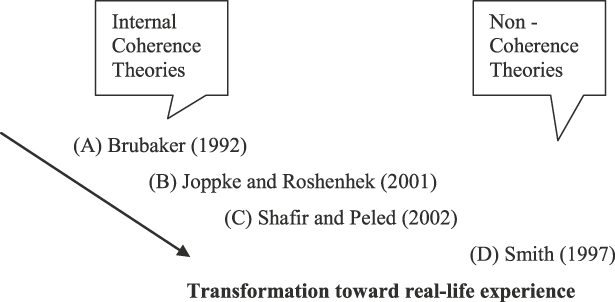
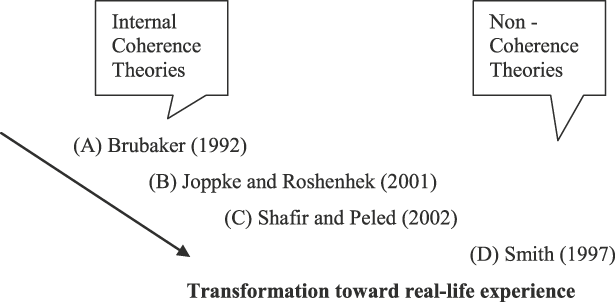
Let me begin by highlighting and comparing the two main – and contradictory – views of the notion of citizenship. On one side of the theoretical spectrum there are scholars who argue that citizenship is a constant and coherent value that describes both rights and obli-gations associated with belonging to a particular political entity (usually, a nation-state). The major opposing theory argues that citizenship is neither coherent nor consistent. The rights and obligations associated with it can have opposing (and sometimes conflicting) rationales, motives or justifications, even when proposed by the same individuals. I claim that all writings on citizenship can be categorized into the above-mentioned analytical classificationFootnote 2.
According to Brubaker (Reference Brubaker1992), the difference between Germany and France lies in their conception of citizenship. While France employs a model of territorial inclusion and assimilative citizenship (jus soli), Germany applies a model of nationhood based on ethnic exclusion (jus sanguinis). The former gives priority to the protection of individual rights within the territory of the state, while the latter emphasizes ethnic origin as the criterion for equal citizenship or naturalization. Brubaker invokes a cultural explanation of citizenship, which attributes a Volk-centered nationhood to Germany and civic-centered citizenship in France. He argues that these idioms are not purely primordial but are the consequence of particular historical circumstances of state-building. While Brubaker’s conception of citizenship and nationhood is theoretically contingent on historical circumstances, in reality it is deeply rooted in national self-perception (which is reinforced by its institutionalization in immigration policies) and thus is unlikely to change. Joppke and Roshenhek (Reference Joppke and Roshenhek2001) criticized the shortcomings of the implicit primordialist account in Brubaker’s position from 1992, a position which he later retracts. They particularly note “the assumption of a ‘straight line’ between reified and fixed identities and policies, which leaves out the fundamental role of conflict and contingency, that is, politics and history, as intervening variables” (p. 5).
The former standpoint is shared by many in the academic community and in the general public. The broad generalization of citizenship practices and national culture can be very useful in locating overarching characteristics of large societies. The simplification of the notion of citizenship as consisting of a single and coherent value system is usually a necessity for both comprehending and explaining national trends. Accordingly, many scholars identify a nation-state with a particular coherent citizenship. This includes both descriptive and normative work. The researchers who ascribe a single kind of citizenship to the different nations include: Conover, Crewe, and Searing (Reference Conover, Crewe and Searing1991), Miller (Reference Miller2000), Noiriel (Reference Noiriel1996), Ong (Reference Ong1999), Shklar (Reference Shklar1991) and Walzer (Reference Walzer1992). Many others argue that if a single coherent citizenship is not established, a conception of citizenship should be constructed for each specific state. Examples of these scholars include: Benhabib (Reference Benhabib2004), Dagger (Reference Dagger1997), Janoski (Reference Janoski1998), and Kymlicka (Reference Kymlicka1995).
Brubaker’s unitary approach is challenged by Rogers Smith who claims that the various citizenship principles are not coherent or consistent. In other words, at any given time, citizenship is a mix of multiple civic ideas. Smith (Reference Smith1997) explores the United States’ conception of citizenship by examining all federal statutes and all Federal, Circuit and Supreme Court decisions from the nation’s origins (1798) to the progressive era (1912). On the basis of a detailed scrutiny of United States citizenship, Smith argues that three conceptions of citizenship can (and usually do) exist together in the same polity. Liberalism, “ascriptive inegalitarianism” (supports the superiority of the origins of current rulers) and republicanismFootnote 3 can be expressed simultaneously “in logically inconsistent but politically effective combinations” (Smith Reference Smith1997, p. 470). In Tocqueville’s analysis of the American Revolution, this scholar of United States politics described it as an essentially liberal democratic society, especially since it appeared remarkably egalitarian in comparison to the class hierarchies in Europe. Even if some inconsistencies could be pointed out, such as the attitudes towards slavery, these are depicted as temporary exceptions likely to dissipate in time, particularly through universal liberal citizenship laws. However, careful analysis of court rulings on important citizenship issues covering three centuries of American history shows that, for over 80 percent of its history, the United States laws declared most of the world’s population ineligible for full American citizenship solely because of their race, origins or gender. In the same manner, for at least two-thirds of its history, the majority of the domestic population in the United States was also ineligible for such political status. Smith (Reference Smith1997) suggests replacing the Tocquevillian tradition with a view of America as having overlapping and multiple traditions that pay appropriate attention to oppression and inequality within the United States.
Smith’s theory is not the only criticism of Brubaker’s path-breaking study. Theories of citizenship have been constantly revised to better correspond to the empirical reality of real-life situations. Citizenship might be coherently defined, but only as the outcome of the political struggle between permanent interest groups (each possessing different conceptions of citizenship) (Brubaker Reference Brubaker1996; Mann Reference Mann1987; Shafir and Peled Reference Shafir and Peled2002). Nevertheless, the above-mentioned theories still accept the underlying principle that citizenship is a coherent and stable world view (at least for particular groups within the state).
Following Brubaker’s (Reference Brubaker1992) initial work on citizenship, many scholars chose to explore the procedure of naturalization as a focal point where the “nature” of citizenship and nationhood is brought into sharp focus. “Admission and exclusion are at the core of communal independence. They suggest the deepest meaning of self-determination” (Walzer Reference Walzer1983, p. 62). Determining who becomes a member is the state’s way of shaping and defining the national community. Thus, granting citizenship is a powerful tool in maintaining the state’s sovereignty, especially in times when it confronts substantial external pressures (such as transnational migration) that undermine its independence and self-determination. However, concentrating only on the inclusion mechanism can be misleading. On the one hand, politicians choose agreed standpoints and “avoid ‘compromising’ stances, which would mean being of the same mind as the occupants of opposite positions in the space of the political field” (Bourdieu and Thompson Reference Bourdieu and Thompson1991, p. 179). The centrality of immigration policies, and the vast public attention they draw, forces politicians to distinguish themselves by using definite and opposing political philosophies. Hence, focusing on incorporation regimes may misleadingly allow the incorrect conclusion to be drawn that all policies are coherent and stable. On the other hand, looking only at inclusion does not take into account Walzer’s (Reference Walzer1983) assertion that both admission and exclusion are at the core of communal independence. The question of whether citizenship is a coherent and consistent worldview for each state or for particular groups within it, or whether citizenship is composed of various and contingent standpoints, cannot be satisfactorily answered by looking only at incorporation mechanisms. I argue that my investigation of expatriation laws in the United States can complement current research and help resolve the theoretical debates on citizenship.
The loss of citizenship
Stripping away citizenship and all the rights it entails is usually associated with despotic and totalitarian regimes. The imagery of mass expulsion of once integral members of the community is associated with such events as civil war, ethnic cleansing, the Holocaust or other oppressive historical events. It is not surprising to hear that this practice was used in the past by South Africa’s apartheid regime (Dugard Reference Dugard1980), Germany during both World Wars (Arendt Reference Arendt1973), Stalinist Russia (Torpey Reference Torpey2000), pre-1789 France (Kingston Reference Kingston2005) and in the Roman Empire (Mathisen Reference Mathisen2006). Although related, these practices are not just a product of undemocratic events or extreme situations; they are standard clauses within the legal systems of most democratic states.
The practice of termination of citizenship can be described in various ways. The loss of citizenship can be both a demand of the nation-state and of individuals. Several terms are used to describe loss of citizenship: expatriation, denationalization, denaturalization, renunciation and revocation of citizenship. The different terminology used to express the loss of citizenship usually tries to depict a particular feature of the loss of citizenship (or the citizen himself). However, there is often an overlap and transposition of the concepts. Hence, in order to avoid omitting any aspects of expatriation, I will consider the full spectrum of terms of expatriation as cases of loss of citizenship.
Historically there have been four grounds for expatriation: regulating allegiance, civil order, ascriptive homogeneity, and renunciation. An overarching trait of the revocation of citizenship is derived from the plain need of the government to make certain demands of the citizen (for example: military service, taxes or particular public behavior) or to punish crimes, presumed disloyalty to the regime, or other deviant behavior. First, expatriation is one of the possible legislative methods to ensure the exclusive allegiance of the citizen to the state. A second reason for expatriation is the need to maintain civil order. From this standpoint, revocation of citizenship is grounded in concepts of public order and is intended to prevent bureaucratic inconsistency. Accordingly, governments create measures to expatriate citizens as a method of maintaining an orderly and efficient bureaucratic administration and registration of their subjects. Although this reason for the revocation of citizenship – assigning a tough penalty for what might be a minor crime – seems the most outrageous, it is one of the most common practices of expatriation. Deceitful or incorrect application for citizenship is one of the most common grounds for stripping away citizenship and it is customary practice in most states of the world (United States 2001). Third, many countries, not only totalitarian regimes, adopt measures to ensure that the population will be composed (at least symbolically) of people from a particular national, ethnic or racial background. That is, revocation of citizenship aims to exclude specific groups from the national space. Lastly, many people decide, of their own volition, to abandon their citizenship. However, the perception of the voluntary renunciation of citizenship as an unrestrained or free social action should be questioned.
Biological subjects and alienable citizens
“But as men, for the atteyning of peace, and conservation of themselves, have made an Artificial Man, which we call a Common-wealth; so also have they made Artificial Chains.” Thomas Hobbes ([1651] Reference Hobbes and Tuck1996), Leviathan, Book 1, Chapter 21, p. 147.
The above quotation from Thomas Hobbes signifies the beginning of the transformation toward modern political membership. Hobbes’ writings illustrate the beginning of Anglo-American liberal thought. He freed the individual to make subjective judgments as to the validity of institutions (Heineman Reference Heineman1994), marking the shift from the perception of membership as biological to membership as a social construction. In the past, political membership was seen as a biological condition. Being born into a particular community determined one’s natural identity. Therefore, persons who acquired allegiance to a new ruler were considered to be “naturalized”, a concept which is still used today although its underlying import is usually rejected (Smith Reference Smith1997). Thus, it is common to understand persons in pre-democratic political arrangements as subjects rather than free citizens.
I am fully aware that the distinction between subject and citizen is not unequivocal, both historically and analytically. In his Social Contract, Rousseau ([1762] Reference Rousseau and Gourevitch1997) distinguished between citizens, as self-governing people and subjects as people bound by the laws of the state. However, even after the US Declaration of Independence, the two terms were used interchangeably while in France’s Ancien Régime the term “citizens” was used to refer to the subjects of the king (Koessler Reference Koessler1946). Analytically, it has to be argued that the conceptual division between subjects and citizens is questionable, as citizenship is a modern technique of constituting, regulating and governing subjects (Cruikshank Reference Cruikshank1999). Nevertheless, in this paper I am utilizing this distinction to illustrate the different conceptions of allegiance between the individual and state.
This analytical distinction distinguishes between people who are assigned their allegiance by birth, regardless of their color, parentage or race. Thus, it is “not alienable: it could not be renounced, abandoned or confiscated” (Irving Reference Irving, Boyer, Cardinal and Headon2004, p. 9). Since one of the debates concerning citizenship relates to the identity of the persons within it, one can describe the history of modern citizenship as the changing relationship between membership and biology. Before the emergence of the nation-state as the dominant political arrangement in the nineteenth century, people were officially bound to each other by a hierarchical, overlapping, religious and dynastic system. “Legally, people were peasants, gentlemen, barons, burghers, laity, or clerics first, and Englishmen, Belgians, or Germans second or third if, at all” (Smith Reference Smith1997, p. 42). Within national identity, we can observe a process of separation between national identity and biology, which began with the political philosophy of the Enlightenment, crystallized in the French Revolution and the American declaration of independence, deepened throughout the nineteen and twentieth centuries, and continues thus even today.Footnote 4 Nevertheless, this development is not linear, equal or inevitable. It was introduced in different contexts in each country, was materialized differently or even retracted in some cases, while several countries still grant citizenship only according to ethnic descent. For most inhabitants of the world, citizenship is still a biological disposition. Most citizens are born into this status and will never abandon it or acquire another. Even those who do change their allegiance and emigrate to another country will do so in relation to a biological trait – family reunification or ethnic homogenization. Most people who have multiple nationalities acquired them by birth. Thus, by asserting that there is a process of separation between national identity and biology, I do not mean to claim that citizenship is in any way divorced from biology. However, there is a growing understanding that citizenship can be attained or lost by individual choice, regardless of biological qualities.
The French and the American Revolutions, each in its own way, gave the basic form to modern citizenship that entailed a dismissal of the natural subjection of people to a particular authoritarian rule. Modern citizenship was based on the rejection of rule by hereditary monarchical and aristocratic families in favor of a broader community of political equals (Smith Reference Smith, Isin and Turner2002). The French revolution crystallized the modern institutions of both the nation-state and the development of citizenship. The four aspects of the revolution – the bourgeois revolution, the democratic revolution, the national revolution and the bureaucratic revolution – established the predominance of national citizenship that has determined most of men’s (and later women’s) obligations and rights until the present day (Brubaker Reference Brubaker1989b). The constitution adopted in France in 1791 legally established the term “citizenship” for individuals eligible to call themselves French. In the next decade, the attitudes toward “foreigners” in France were constantly changing, in tandem with the change of political rule. The 1889 Naturalization Law codified, for the first time, nationality laws according the jus soli principle, which governs French immigration policies until today; namely, that children born in France would become French citizens (on reaching adulthood) (Noiriel Reference Noiriel1996). Therefore, citizenship was still determined biologically, but now it was determined by birthplace (in French territory) rather than by descent.
The US case
The United States may be the best case study of the policy of revocation of citizenship, especially during the period between the end of the 19th century and the mid 20th century. During the time frame of my analysis, and despite the efforts to restrict and control the flow and composition of incoming migration (Bernard Reference Bernard and Jacobson1998), the United States was at one of its peaks as a global immigration destination (see figure 4 and Gabaccia Reference Gabaccia2002). The study of the revocation of citizenship in the United States during a period in which immigration was most influential on American politics is most apposite. During that time, the idea of revoking citizenship should have evoked strong responses and have had great symbolical importance as it conflicted with one of America’s main legitimizing principles. Moreover, as it is totalitarian regimes that tend to denationalize their opposition and have few legal barriers against this action, the constitutional-democratic political institutions in the United States should have positioned it as the least likely state to strip away citizenship.Footnote 5 Hence, by studying the revocation of citizenship in the American context, I can clarify and test accepted hypotheses and generate new theoretical propositions regarding the relation between citizens and the state (Rueschemeyer Reference Rueschemeyer, Mahoney and Rueschemeyer2003).
Changes in citizenship theory
This figure depicts the analytical progression of theories of citizenship rather than the actual history of the coherence controversy.
The Wade-Davis Bill
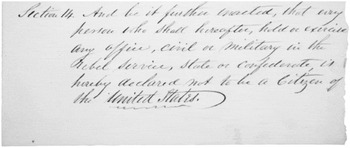
Handwritten copy of Wade-Davis Bill as originally submitted 1846; Records of Legislative Proceedings; Records of the United States House of Representatives 1789-1946; Record Group 233; National Archives.
The original draft of section 14 of the Wade-Davis Bill revokes citizenship from all participants, civil or military, in the rebellion against the United States. When the bill was presented to the Congress, this section was played down so that only the leaders of the Confederate rebellion (above the grade of colonel) would be punished.

Authority type and expatriation

Immigration and provisions of expatriation
Source of immigration data: Department of Homeland Security, Office of Immigration Statistics, 2003 Yearbook of Immigration Statistics (September 2004).

The independence of the United States formalized a novel approach regarding the relationship between citizenship and bloodline. In the British Common Law tradition, legal and political status was associated with the notion of prescribed perpetual allegiance, rather than an idea of citizenship as consensual membership. Allegiances were conceived as natural vertical ties between individual subjects and the king, like parent to child (Schuck and Smith Reference Schuck and Smith1985), and were indissoluble even with the subject’s consent. Voluntary renunciation of British subject status was an inconceivable concept (Hoerner Reference Hoerner1958). These ties knit together the British Empire, not the British nation. Thus, “There was no specific citizenship status for the colonies, for Britain itself, or even for the independent Commonwealth countries” (Brubaker Reference Brubaker and Brubaker1989a, p. 10).
The American concept of citizenship on the other hand reflects the continuous tradition of immigration both in its formation and myths. Thus, the British colonists’ growing displeasure with British rule reflected not only economic and political frustrations, as presented in the well-known slogan – « no taxation without representation » – but also grievances regarding the autonomous identity of the settlers (Smith Reference Smith1997). The American War of Independence was fueled by sharp criticisms of the British concept of unchangeable allegiance – an impossible option for the “New World” settlers – and the adoption of naturalization (or voluntary adhesion to the state) as the principle on which American citizenship was based. Nevertheless, until the American Civil War, it was still pondered whether a person could expatriate himself – that is, relinquish his/her allegiance from being American. In the same manner it was questionable whether a person could “really” cut his allegiance to his country of origin.
“If a Soveraign Banish his Subject; during the Banishment, he is not Subject.” Thomas Hobbes ([1651] Reference Hobbes and Tuck1996), Leviathan, Book 1, Chapter 21, p. 154.
As the perception of citizenship was disconnected from the assumption of unconditional allegiance, the opposite was also conceivable – the state’s option to terminate the political status of the citizens for lack of allegiance. Thus, belonging to any political community was conditional upon the actions of the individual. Expatriation or banishment would lead to the discontinuing of the mutual obligations and responsibilities between the state and the subject.
I trace and compare the deliberations on this issue since it was first raised during the American Civil War up to the end of the 1950s when Congress began to question this policy. Analyzing debates in the two houses of Congress has important implications for understanding policies and public opinion (Burstein Reference Burstein1985; Sheckels Reference Sheckels2000). The purpose of this paper is not to survey the legislative history of United States expatriation law – already addressed by Aleinikoff, Martin, and Motomura (Reference Aleinikoff, Martin and Motomura2003) and Weissbrodt and Danielson (Reference Weissbrodt and Danielson2005) – but to chart the patterned difference between the official language of the law and the socio-cultural context in which expatriation laws were legislated in the United States. While I present the reader with the complete list of bills introduced regarding the loss of citizenship, I will concentrate on laws that present fundamental changes from the then-existing policies.
Although never implemented, the suggestion of revoking American citizenship as a punishment was proposed during the American Civil War. On July 2, 1864 Senator Wade and Representative Davis introduced a Reconstruction Bill (HR, 244). Congress was concerned that President Lincoln’s “10 percent plan” for re-incorporating Southern states back into the Union was too weak. While Lincoln was willing to embrace any Confederate state in which 10 percent of its voters swore loyalty to the United States, the Wade-Davis Bill demanded extreme measures from these former rebellious states – such as a loyalty oath by 50 percent of the white males, abolition of slavery (but not suffrage for the new freedmen), appointment of provisional military governors in the seceded states, disqualification of Confederate officials from voting or holding office, and the revocation of citizenship from the leaders of the rebellion. Although the Bill was passed by Congress, these regulations were viewed by many as degrading and thus unrealistic. Eventually, President Lincoln pocket-vetoedFootnote 6 this bill as he believed it weakened the efforts to win the war and secure emancipation (in particular, the bill would have compelled him to repudiate the new government of Louisiana) (Foner Reference Foner1988; Williams Reference Williams2005). The debates around this bill dealt with Southern reconstruction and did not include any discussion on the theoretical or actual implications of expatriation practices.
The revocation of citizenship was first introduced during the American Civil War (1861-1865). The 38th Congress (1864-1865), for the first time in United States history, decided to revoke citizenship from American citizens. The overwhelming amount of desertion in the Confederacy, and even more in the Northern regiments, had significant implications for the social cohesion of both armies (and played an important role in the ultimate failure of the South). In contrast to the horrendous penalties meted out to Confederate deserters (Lonn Reference Lonn1998), the North tried to delineate a tough but “humane” form of punishment. Section 21 (copied from Bill 175 passed by the Senate) of the Enrollment Act (HR 678), inflicted a penalty of citizenship rights revocation for future deserters and current deserters who did not return to their post within 60 days. This section was introduced as part of a bill that provided authority to call for and regulate additional manpower for the national forces. Most of the debates concerning this bill dealt with the relative power of Congress over American citizens, rather than the meaning of this citizenship (or its revocation). When Congressman Rogers (D-NJ) opposed the proposed bill, he was not concerned about the changing value of citizenship. Rather, he feared the bill imposed an unnecessary burden on the citizens of the US. Others, like Congressman Chanler (D-NY), argued that this proposed law would increase the tyrannical powers of presidents. Congressmen Wilson (R-IA), JC Allen (D-IL) and Johnson (D-PA), opposed the bill arguing that it inflicted punishment without due process. It was argued that there would be no tribunal that decided upon this punishment, and that taking away citizenship from current deserters inflicted a retroactive punishment (that is, it proposed inflicting punishment on deserters who deserted before the passage of the law). Nevertheless, the legislation was passed and became effective on March 3, 1865. The objections to the revocation of citizenship were connected to the mechanism of the penal system or as part of protestation against the Civil War itself. Thus, it is clear that the revocation of citizenship was meant to be a penal response which had nothing to do with the general comprehension of citizenship.
Two years later, the provision that revoked the citizenship of deserters was amended. Bill 108 suggested that enlisted volunteers to the United States who had “faithfully” served until the surrender of Lee and Johnston in April 19, 1865 and had then left their ranks without authority, assuming that they had fulfilled their contract with the government, would not forfeit their citizenship as deserters. As during the original bill (HR 678), the opposition to this argument was divorced from any general perception of American nationality. It was feared that the amendment would present an opportunity for thousands of “real” deserters to avoid punishment; that soldiers who had remained in their ranks would be outraged; and that this would impose a greater burden on the taxpayers. In 1912, the provision that revoked citizenship from deserters was further relaxed. At the direction of the Committee on Naval Affairs, Congressman Padgett (TN) suggested amending the law that stripped citizenship from deserters so that it applied only during times of war (HR 17483). The debates did not question the meanings or implications of losing citizenship, but considered only whether it was the appropriate judicial punishment for a particular crime.
“The Obligation of Subject to the soveraign, is understood to last as long, and no longer, than the power lasteth, by which he is able to protect them.” Thomas Hobbes ([1651] Reference Hobbes and Tuck1996), Leviathan, Book 1, Chapter 21, p. 153.
Only with the Fourteenth Amendment and the Expatriation Act of 1868, could a citizen officially choose to follow the Hobbesian assertion that allegiance could be transferred (Ryan Reference Ryan and Sorell1996) and accordingly renounce his American citizenship. However, once the idea of citizenship was completely divorced from birthplace, the nation-state was able to demand the reverse. In other words it had the power to revoke citizenship from persons that did not deserve (from the congressional point of view) to be members of the polity any more. Both decisions determined that citizenship is a basic right for any American citizen but with opposing rationales. On the one hand, the Fourteenth Amendment declared that United States citizenship is a constitutional right which is granted automatically at birth on American soil. On the other hand, the Expatriation Act of 1868 declared the right of all to change their allegiance (Matteo Reference Matteo1997). The latter law, reflects more than any other law the contractual principle behind the liberal ethos of the United States, i.e., that the relationship between the American individual and the state is contractual and thus could be terminated at any point by the will of the citizen. While the right of expatriation may appear natural and trivial today, this was not always the case. In the past, and in some countries even today, the state strictly defended its gates from any attempt to shirk civil or military obligations by running away.
However, the legislation that has been produced since the Expatriation Act of 1868 reflects the beginning of a different attitude regarding the perceived relationship between the citizen and the state. The Expatriation Act of 1907, which was legislated in response to anxiety regarding high levels of immigration (Bredbenner Reference Bredbenner1998), was the first statute to specify acts of expatriation. The actions in this statute (HR 24122) which are cause for expatriation include: an oath of allegiance to a foreign government; naturalization by a foreign government; establishing residence abroad by a naturalized citizen for two years in his native country; or a woman’s marriage to a foreigner (even if she continues to reside in the United States). Moreover, and this provision would have important implications during the Second World War, “no American citizen shall be allowed to expatriate himself when this country is at war”.
This 1907 Act was the major Progressive Era federal law affecting women’s citizenship. Fearing that alien men married American women simply to get a foothold in the US, this law designated marriages between American women and foreign citizens as acts of voluntary expatriation. Therefore the 1907 Expatriation Act was sometimes termed the Gigolo Act. This Act was a tremendous setback for women’s struggle for full citizenship rights, as it implied that women derived their status as citizens from their American husbands rather than from their own individuality. Thus, this law received much criticism from major women’s political organizations at that time which were struggling to secure voting privileges for their gender, and the 1907 Act was repealed in 1922 (Bredbenner Reference Bredbenner1998).
“And whereas some have attributed the Dominion to the Men onely, as being of the more excellent Sex; they misreckon it. For there is not always that difference of strength, or prudence between the man and the woman.” Thomas Hobbes ([1651] Reference Hobbes and Tuck1996), Leviathan, Book 1, Chapter 20, p. 139.
Similar to domination of the commonwealth, Hobbes saw woman’s oppression as contractual rather than biological.Footnote 7 Nevertheless, patriarch-based citizenship ended only when the Gigolo Act was repealed 271 years after Hobbes’ statements. Considering the tremendous effect this section had on women’s suffrage in America, and in contrast to the Naturalization Act of 1906Footnote 8, the 1907 Act was only debated publicly in Congress for a short time. The New York representative, James Breck Perkins (R), who was the main advocate for the Gigolo Act convinced those objecting to the bill that the section on women was already law and that the new legislation only conferred on women the right to regain their American citizenship after the termination of a marriage. Congressman Perkins incorrectly assumed that just as a foreign woman receives her husband’s American citizenship upon marriage (according to the Nationality Act of 1855), the American woman receives her husband’s foreign citizenship upon marriage. In her analysis of the Expatriation Act of 1907, Nicolosi (Reference Nicolosi2001) convincingly argued that “in addition to helping to adjust foreign policy, codified derivative citizenship provided an additional function for the state: a penalty for American women who married foreign men [...] especially racially ineligible [for citizenship] foreigners” (p. 8). This Act was also passed in the Senate without any debate except for a few technical corrections to the text of the bill.
On April 25, 1933 the Committee on Immigration was designated by President Franklin D. Roosevelt to review US nationality laws, recommend revisions, and codify one comprehensive nationality law. After seven years of work the committee introduced HR 6680 (named the “codification of the nationality laws of the United States” or the “Nationality Act of 1940”) in the House of Representatives. The bill itself was passed unanimously by the committee and was endorsed by the Departments of State, Justice and Labor, War and Navy; the President; the Attorney General and the American Bar Association. Consistent with such wide-ranging approval of the bill, with the fact that it was presented as simply a codification of existing immigration laws, and with the collective dedication to complying with the war efforts during the Second World War, it was not surprising that there was not much debate on the law. Although Bill 6680 contained 98 pages, followed by a report of 164 pages, it was almost not contested or amended on the floor (except for a few technical changes in the wording of the law). Most congressmen who participated in the discussion on the Nationality Law used their time to congratulate and praise the hard work of constructing a unified law regarding immigration and naturalization.
However, the Nationality Act of 1940 did include new policies and extended considerably the list of acts that were interpreted as causes for expatriation. For the first time, this list included actions that did not involve the assumption of a new nationality. According to this legislation, a native-born or a naturalized citizen would lose his American citizenship by entering or serving a foreign military; taking foreign employment under certain circumstances; voting in a foreign election; formally renouncing citizenship; being convicted of any act of treason, bearing arms against the US or attempting to overthrow the government by force; or deserting during wartime. In addition naturalized citizens would lose their citizenship if they resided in another country for five years (or three years in their native country). The motive for such legislation by a liberal administration could be explained by the war effort and the concern that German-Americans might have dual loyalty (Boudin Reference Boudin1960). In a similar vein to previous legislation, the Act of September 27, 1944 established that remaining outside the US for the purpose of avoiding military service would be considered grounds for loss of citizenship.
An amendment to the Nationality Act of 1940 might be the best example for the two points I made earlier – that looking only at the language of the law predisposes the scholar to overlook the original meaning of the law and its significance, and that there is often a difference between the grounds and reasons for expatriation. The act of July 1, 1944 (HR 4103) removed the restriction on renunciation of American citizenship within the borders of the United States (or any of its outlying possessions) in time of war. The appearance of this amendment simply as a bureaucratic correction, caused legal scholars who surveyed expatriation laws to ignore its existence (for instance: Aleinikoff Reference Aleinikoff1986) or to underestimate its importance (see Weissbrodt and Danielson Reference Weissbrodt and Danielson2005). Nevertheless, close analysis of the debates on this amendment reveal one of the darkest hours in American history. Following this legislation, 5,589 American citizens of Japanese descent renounced their citizenship. Since they were incarcerated in concentration camps without any hearing or trial following decades of social discrimination, this act can hardly be considered voluntary (Collins Reference Collins1985; Grodzins Reference Grodzins1955). The generality of the law was intended to obscure the specific aim of its legislators – to find and establish a measure that would enable the American government to expatriate and deport as many native-born American citizens of Japanese descent as possible without interference by the United States Supreme Court. This resolution was passed unanimously in the Immigration and Nationalization Committee and by a vast majority in the House (111 ayes v. 33 noes).Footnote 9
Many of the objections to the law, mainly by the representatives from California (where most Japanese-Americans resided), were complaints that the law was not drastic enough and would therefore not attain its original racist intention. Accordingly, Congressmen Johnson (R-CA) suggested amending the bill in order to denationalize more Japanese-Americans. This suggested modification raised criticism from some Congressmen, who sympathized with the objection to the revision, but feared that it would have unintended consequences for other segments of the American people. In the words of Congressman Harless (D-AZ): “Mr. Speaker, we have approximately 25,000 Japanese interned in our state, and no one could be more interested in this legislation than I, because we are very much concerned that some of these people may be left there to mingle with our people when this war has been completed [...] but let us not be so stupid as to pass legislation which may be declared unconstitutional.” This line of reasoning, which was repeated several times during the debate by various Congressmen from both parties, illustrates nicely why this legislation had a racist undertone in addition to republican anxiety due to the ongoing war. First, many Congressmen who initially distinguished between loyal and disloyal Japanese dropped the use of this distinction as the debate heated up and desired to get rid of all Japanese-Americans. Second, some congressmen expressed the need to deal with the “Japanese question” that interferes with American life, economy and values even after the end of the war (Congressman Rolph, R-CA, Johnson R-CA). Third, while many Congressmen wanted to legislate an even harsher law against America’s Japanese population, the foremost objection was that it might be ruled unconstitutional (rather than the fear that it was essentially unconstitutional or morally wrong) (Congressman Eberharter, D-PA; Dickstein, D-NY; Allen, D-LA). Lastly, the discussion centered mainly on the disloyal Japanese rather than American citizens of German or Italian descent (Congressman Hallek, R-IN; Rees, R-KS).
The next act of legislation regarding the loss of citizenship took place during the “second red scare” or the McCarthy Era in the United States. The Immigration and Nationality Act of 1952 brought together into a single statute all legislation in these two fields. Although most of its provisions had been enacted in previous legislation, it did introduce novel segments of the law that strengthened and tightened the requirements for citizenship and its loss (Anonymous 1964). This act ended the blanket exclusion of immigrants based on race, only to replace it with the “rigid immigration quota system based on national origins and racial categories” (Campi Reference Campi2004). The Immigration and Nationality Act of 1952 extended the possible grounds for expatriation to include foreign government employment if it required a declaration of allegiance. In addition, this law allowed the government to deport immigrants or naturalized citizens engaged in subversive, especially allegedly Communist, activities.
The Expatriation Act of 1954 provided that nationality was to be lost upon criminal conviction for the violation of the Smith ActFootnote 10 (1940) which, although it predated McCarthyism, was enlisted to prosecute Communist Party supporters and leaders. In contrast to the Immigration and Nationality Act of 1952, this time the threat of expatriation and deportation was not limited to immigrants and naturalized citizens but applied to native-born Americans as well. President Dwight D. Eisenhower’s State of the Union address (January 7, 1954) included a specific request that Congress enact a law that would revoke American citizenship from Communists. Following his speech, several bills containing additional grounds for expatriation were introduced in the Committee on the Judiciary. On July 21, 1954, HR 7130, which proposed stripping citizenship from Americans who commit any act of treason according to sections 2383, 2384 and 2385 (the Smith Act) of Title 18 (Crimes and Criminal Procedure) in the United States Code, was introduced in the House. The motion to suspend the rulesFootnote 11 on the deliberation of this bill encountered no objections (except from Congressman Feighan (D-OH) who complained that his proposed bill 7265 which expanded even further the list of crimes punishable by the loss of citizenship was not endorsed by the Judiciary Committee), and after a few speeches by congressmen, the Expatriation Act of 1954 was passed with the necessary two-thirds majority vote. The vast bipartisan support stemmed from the fact that the idea for the bill was suggested by the president and that it was concerned with the United States’ greatest fear at that time – Communism. In the Senate, the same bill received one objection. Senator McCarran (D-NV) argued forcefully against the bill by stating that “Depriving a felon of his civil rights is, of course, an accepted thing; but depriving a felon of his citizenship, which means his basic nationality, is an entirely different matter” which should not be done easily. Moreover, he argued that this bill would not be fighting Communism effectively and was clearly unconstitutional. Nevertheless, his actual amendment was essentially technical (inserting the word “willfully” into the provision) and thus was accepted with no counterargument by either the Senate or the House. Although many of the grounds for expatriation have been withdrawn over the years, stripping away citizenship for crimes of treason is still valid law.
My analysis ends with the Expatriation Act of 1954. The main reason is that, since the passage of this law, the United States Congress has not initiated new Acts with additional grounds for expatriation. Moreover, as the years passed, the United States Supreme Court overturned many of the previous grounds for the revocation of citizenship as unconstitutional.Footnote 12 Following the Courts, Congress repealed the provisions that revoked citizenship for draft evasion (1976), desertion (1978), voting in a foreign country (1978), the 1952 addition to the subversion principle (1982) and residence abroad (1994).
During the second half of the twentieth century, the perception of expatriation as a policy changed dramatically. This transformation can be attributed largely to initiatives of the judicial branch. Since 1958, judges had started to question the legality of forced expatriation with respect to the constitution. On the appeal in Trop v. Dulles, Footnote 13 a five-to-four decision of the US Supreme Court concluded that the stripping of American citizenship as a punishment was unconstitutional in terms of the Eighth Amendment’s prohibition on inflicting “cruel and unusual punishment” on American citizens. The current judicial claim is that expatriation must be limited to a voluntary act of the individual. In this ruling Chief Justice Earl Warren argued that:
“It is a form of punishment more primitive than torture, for it destroys for the individual the political existence that was centuries in the development [...] This punishment is offensive to the cardinal principles for which the constitution stands. It subjects the individual to a fate of ever-increasing fear and distress [...] Citizenship is not a license that expires upon misbehavior. The duties of citizenship are numerous, and the discharge of many of these obligations is essential to the security and wellbeing of the Nation [...] But citizenship is not lost every time a duty of citizenship is shirked. And the deprivation of citizenship is not a weapon that the government may use to express its displeasure at a citizen’s conduct, however reprehensible that conduct may be. As long as a person does not voluntarily renounce or abandon his citizenship [...] I believe his fundamental right of citizenship is secure”.
In Afroyim v. Rusk (1967)Footnote 14 the US Supreme Court held that Congress lacked the power of involuntary expatriation and that the most the United States government could do was to formally recognize an individual’s voluntary renunciation of his/her American citizenship. In Vance vs. Terrazas (1980),Footnote 15 the Supreme Court held that in order to take away citizenship the government should prove that the expatriating act was undertaken with the intent to relinquish United States citizenship. It is the citizen’s intent, not only his or her disloyal or questionable act, which should be the benchmark for any expatriation decision.
Today, even as several grounds for expatriation were declared unconstitutional, there are seven acts on the books that are grounds for the loss of citizenship – except for section 5 (renunciation of American nationality in a foreign state) all originally meant to penalize felonious Americans. Sections 1 and 2 (obtaining naturalization and swearing an oath of allegiance to a foreign state) were both enacted in the 1907 Expatriation Act. Although the underlying tone of this legislation addressed the prevention of problems of dual nationality or allegiance, the statute clearly authorized the denationalization of United States citizens who had no desire to lose their American nationality (Aleinikoff Reference Aleinikoff1986). Sections 3 and 4 (serving in the army or employment by the government of a foreign state) were initiated during the Second World War in the Nationality Act of 1940. Although some Congressmen explicitly said this was not a punishment, this statue included a penalty for actions that did not involve the assumption of a new nationality. Section 6 (renouncing American citizenship in the territory of the United States during war) was clearly established in 1944 to allow the racial expatriation of Japanese-Americans who were held in relocation camps throughout the United States. Section 7 (committing any act of treason) was legislated in the 1954 Expatriation Act, referring to the prosecution of Communists and their sympathizers during the Cold War.
Citizenship and expatriation
The two sides of the citizenship coherence debate disagree about whether citizenship is a coherent and stable concept, or a mixture of indistinct policies and ideological positions. A possible method to test the applicability of each theory is to format for each counterargument a contrary expected outcome. In accordance with Brubaker’s (Reference Brubaker1992) perception of citizenship we would expect that the United States would have stable, consistent liberal or ethnic laws of expatriation. Alternatively, as suggested by Smith (Reference Smith1997), we should see an irregular mixture of republican, liberal and ethnic expatriation laws.
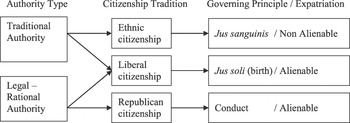
For this analytical exercise I categorised the loss of citizenship laws according to the three accepted traditions of citizenship. Some of the provisions are easily categorized. Revocation of citizenship for subversive political stance, desertion from the army during wartime, serving in a foreign army, departing the United States to avoid the draft, and bearing arms against the United States is clearly a punitive measure for diverging from the nationalist republican common goals. Revoking citizenship from naturalized immigrants who acquired their status illegally or by fraud is obviously a liberal measure expressing disapproval of a breach of the voluntary contract between the individual and the state. Stripping away citizenship for intermarriage between American women and foreigners or forcing Japanese-Americans to renounce their citizenship can be classified as ethnic-based law. However, the same practice of renunciation, grounded in the Fourteenth Amendment of the United States Constitution, usually illustrates the liberal character of the American polity.
Unequivocally categorizing the various acts into the three citizenship types may be impossible for several reasons. First, some of the revocation laws can have different interpretations. In most cases the language of the law is different both from the terms of the Congressional debates and the actual implementation of the laws. Second, this categorization is politically controversial. So, even the cases which I claimed to be straightforwardly distinguishable can be read differently. In addition, some of the revocation laws cannot be classified easily as liberal, ethnic or republican. The loss of citizenship following acts such as accepting foreign public office, voting in a foreign election, establishing residence abroad, naturalization in a foreign country, or taking an oath of allegiance to another state has more to do with the myth of exclusive national loyalty and the state’s effort to limit dual nationality, than any of the citizenship traditions. Thus, American expatriation laws do not correspond to any pattern of citizenship according to republican, liberal or ethnic standpoints – neither at any particular moment, nor over time or changes in the administration’s political identity.
In composing expatriation laws, the United States combined republican, liberal and ethnic elements in their deliberations without having any one of the three as a governing principle for Congress’s debates on this issue. In most cases, the need to solve a particular quandary laid the groundwork for stripping away citizenship rather than an ideological predisposition (who should be an American, what is the relation between the individual and the state, can citizenship be taken away). It seems that the appearance of allegiance has played a greater role in the creation of expatriation laws than coherent viewpoints. Rogers Smith (Reference Smith1997) described American citizenship regulation in a similar way: « American citizenship laws have always emerged as none too coherent compromises among the distinct mixes of civic conceptions advanced by the more powerful actors in different eras » (p. 6). Smith argues that this combination is constructed as a means to gain popularity and political endorsement without any constant underlying guiding principle. Indeed, expatriation laws do not follow any strict republican, liberal or ethnic principle but consistently react to the visible manifestation of massive disloyalty (which had variant delineations at different times).
Traditional membership in a polity was perceived as a biological trait which could not be altered. Once allegiance was designated alienable, both the individual and the state could terminate their mutual social contract. The modern state faces a problem that previous political systems were exempt from – how to resolve the issue of loyalty. In this paper I have shown how the three traditions of citizenship express analytical distinctions rather than real-life divisions, each representing a distinct method of deciding upon allegiance. Following Weber’s (Reference Weber1978) analysis of the changes in types of authority, ethnic (jus sanguinis or ascriptive) citizenship continued basing allegiance on traditional authority, making blood-line the main determinant of loyalty. However, there were two additional rational methods to determine allegiance. Liberal (jus soli) citizenship made birth within the territory of the state the basis for affiliation. Republican citizenship made the citizen’s actions the benchmark for determining loyalty. Moreover, once allegiance can be transferred, immigrants become the group most likely to be suspected of lacking loyalty to their new state. Thus, it is understandable that citizenship was usually associated with immigration policies. Scholars studying citizenship tended to neglect exclusionary practices and accordingly misrecognized a relative advantage of traditional citizenship over more rational practices – namely, that the ethnic majority is protected from expatriation. The British common law focus on allegiance persisted in the United States. Nevertheless, the understanding of permanent allegiance was transformed into a mixture of mechanisms that evaluate loyalty. Consequently, the appearance of disloyalty could lead to the revocation of American citizenship.
Academic literature covering debates in Congress as well as media reports tended to assume that the debates emulated the conventional division between Republicans and Democrats, majority v. minority, and that they are therefore inconsequential (Sheckels Reference Sheckels2000). According to this bipolar paradigm, the debates on expatriation laws would reflect the constructed division between the two parties. However, Senators and Representatives from both sides of the political divide have advocated the need to revoke citizenship from certain people at certain periods with no overt distinction between them in this regard. It is true that the administration was usually able to impose its viewpoint on the entire Congress. However, this happened under both liberal and conservative presidents. Moreover, most bills were introduced in Congress after they were unanimously adopted by both Republicans and Democrats in the relevant committees.
The Rationale for Expatriation Policies
Scholars of citizenship studies have usually equated the ideas of citizenship and immigration policies. Consequently, citizenship laws have tended to have some constant association with immigration patterns. From this standpoint, the introduction of new expatriation laws should correspond to changes in the number of people entering the United States. However, Figure 4 shows that even if one can locate a relationship between immigration and expatriation, as a positive relation until the 1920s or a negative association from the 1950s until today, it is evident that the relationship between the two variables is not constant.
If any pattern can be found, it is not in an overarching philosophy of political membership or party politics, but is associated with periods of armed conflict and (real or imagined) threat to the country. The introduction of most bills occurred in response to events that generated fear for the existence of the United States as an independent state. That is, while the substance of expatriation laws is purely political, the introduction of these laws follows periods of armed conflict. The first expatriation laws were introduced during the American Civil War in response to the rising numbers of deserters from the Union army. The Nationality Laws of 1940 were a response to the growing military requirements of the Second World War. The amendment of 1944 dealt with the treatment of Japanese purportedly disloyal to war efforts. In the same manner the Immigration and Nationality Act of 1952 and the Expatriation Act of 1954 were initiated in reaction to fears arising from the Cold War. Hence, I argue that revocation of citizenship is not a random policy that is introduced for election purposes but is contingent upon military conflicts. Citizenship as a social construction has more to do with the actual needs of the state than with a general coherent and stable ideological perception.
As the empirical data suggest, the response to the threat to the American polity was not necessarily republican. During congressional debates on expatriation during times of war, all three traditions of citizenship were invoked simultaneously. While some of the reaction is clearly an attempt to recruit patriotic or nationalistic sentiments, ethnic and liberal reactions to war were also introduced. Armed conflict is associated with the emergence of revocation laws, but we cannot predict how the enemy would be envisaged. At times, the opponent is set apart on ethnic grounds (such as the Japanese-Americans during the Second World War). In other cases the opponent is defined in republican terms (such as deserters or Americans serving the army of another state). Moreover, every so often, the rivals are those who defy the economic structure of the United States (such as Communists or American citizens working in other countries). The evidence complements two insights suggested by Carl Schmitt. First, even in democratic states the rules apply discriminatory policies as a “state of exception”, which verify their sovereignty and allow for governing outside the boundary of the law (Schmitt Reference Schmitt1985). Second, politicians use times of war as an opportunity to define the polity itself. “Political thought and political instinct prove themselves theoretically and practically in the ability to distinguish friends and enemy. The high points of politics are simultaneously the moments in which the enemy is, in concrete clarity, recognized as the enemy” (Schmitt Reference Schmitt1996 67). It appears that politicians are constantly trying to define American nationality by identifying the ultimate adversary.
Nevertheless, war is not the only factor that causes variation in expatriation policy. In 1906 it was decided to take away citizenship from naturalized citizens who received this status illegally or by fraud. The following year Congress added several other grounds for expatriation for native-born citizens as well. These statutes were not connected to any threat of war against the United States. Surprisingly, during the First World War, Congress did not enact any new bills regarding the expatriation of citizens. Although armed conflicts have resurfaced, the United States Congress has not legislated any new grounds for taking away American citizenship since 1954. On the contrary, during the Vietnam War several of the existing grounds for expatriation were overturned by the Court and repealed by Congress.
The conception of citizenship as an overarching and coherent principle of a country is adopted by most scholars who specialize in citizenship and even more by the general social scientific literature. This paper showed that this perception is not present in the Congressional debates regarding the revocation of citizenship or the legislation of such bills. This discrepancy reinforces Bourdieu’s argument against uncritically adopting categories of practice as categories of analysis. In our present discourse, citizenship is both a practical term that laymen use to describe a person’s national affiliation and an analytical concept that describes the relationship between the individual and the state. However, while the common understanding of citizenship is as a coherent worldview, scholars should not assume that it is necessarily so. Following Brubaker (Reference Brubaker1996) who was assessing nationalism, we should not make the practical conception of citizenship central to the theory of citizenship. “Reification is a social process, not only an intellectual practice” (p. 15).
Historically, 1954 was the last time new grounds for expatriation were enacted. Moreover, the United States Supreme Court has concluded that expatriation is dependent on intent. Nevertheless, such legislation has been considered since and might be developed in the future. For example, the Domestic Security Enhancement Act, informally known as Patriot Act II (a bill drafted by the Justice Department in 2003 which was leaked and never reached Congress) included a provision that would strip citizenship from anyone who materially supported (even indirectly) activities of organizations that the executive branch deemed “terrorist”. Today, such activities are grounds only for criminal prosecution, not for the loss of citizenship (Mariner Reference Mariner2004). It is clear that expatriation is still associated both with punishment and armed conflict.
This paper compares expatriation laws across time in a particular nation-state. However, it would be highly productive to compare similar laws across geographical space as well. That is, it would be worthwhile to evaluate whether the compartmentalized and irregular characteristics of the loss of citizenship also obtain under different regimes of citizenship. Are expatriation policies unique to the United States? Do other countries also combine citizenship traditions when discussing its revocation? While expanding the analysis to other countries, one should compare states with differential regimes of citizenship or ideals regarding citizenship. For example, we could compare predominantly ethnic regimes with more liberal states, or countries that embrace immigration in contrast to countries that would like to limit incoming immigrants. Other possibilities for research on the subject of expatriation would be to expand our understanding of the relations between military conflict and expatriation or gender and citizenship, changes in citizenship policies, countries with different citizenship policies and concepts, or to evaluate the complementary policy of preventing someone from renouncing his citizenship or removing himself from his own political community. Moreover, a complementary study would question even further our analytical category of citizenship and look at the revocation of citizenship rights, without the official declaratory act of expatriation. Do layers of citizenship also mean layers of exclusion? Do other forms of inequality in citizenship rights also follow the suggested patterns?