Introduction
Swallowing is a vital function. It relies on the voluntary and reflex movements of the anterior tongue (involved in the oral preparatory phase and in the voluntary oral phase of swallowing) and the tongue base (the driving force for the pharyngeal phase of swallowing).Reference Logemann and Bailey1 The preservation or rehabilitation of swallowing is a major concern in the multimodality treatment of advanced carcinoma of the upper aerodigestive tract; the aim is to optimise local control while maintaining a satisfactory quality of life. Surgical resection of all or part of the tongue can lead to swallowing impairment.
The principal goal of tongue reconstruction is thus to re-establish the functions of speech, mastication and swallowing. Healing by secondary intention, primary closure, local flaps or the technique of tongue set-back may be used in cases of limited tissue resection. In cases involving larger tissue loss, pectoralis major and latissimus dorsi pedicle flaps have been used for over 20 years.Reference Hamlet, Jones, Patterson, Michou and Cislo2, Reference McConnel, Pauloski, Logemann, Rademaker, Colangelo and Shedd3 Microvascular tissue transfer has been regularly employed since the 1990s. The advantages of microvascular reconstruction of the tongue are: freedom of flap placement without tethering; the possibility of bone reconstruction; and the possibility to model and design the desired form.Reference Urken, Moscoso, Lawson and Biller4 Many types of free flaps have been described for tongue reconstruction, including the radial forearm flap (fascio-cutaneous or composite),Reference Urken, Moscoso, Lawson and Biller4, Reference Salibian, Allison, Armstrong, Krugman, Strelzow and Kelly5 the latissimus dorsi flap,Reference Urken, Buchbinder, Weinberg, Vickery, Sheiner and Parker6 the abdominis rectus myo-cutaneous flap,Reference Kiyokawa, Tai, Inoue, Yanagara, Mori and Nakashima7, Reference Yamamoto, Sugihara, Furuta and Fukuda8 the iliac crest free flapReference Curtis, Plesh, Miller, Curtis, Sharma and Schweitzer9 and the fibular flap.Reference Curtis, Plesh, Miller, Curtis, Sharma and Schweitzer9 It is currently recognised that immediate reconstruction at the time of tumour resection optimises functional results.Reference Salibian, Allison, Strezow, Krugman, Rappaport and McMicken10
The objective of the present study was to determine, in a group of patients who had undergone free-flap tongue reconstruction and radiation therapy, the relationships between swallowing-related quality of life, aspiration and the extent of tongue resection.
Patients and methods
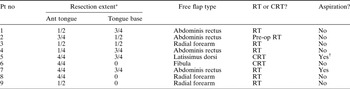
Twelve treated patients seen consecutively for out-patient clinic follow up over a four-week period were evaluated. Nine of these patients – seven men and two women of average age 51 years (range 39–66 years) – had been treated at least one and a half years previously and were retained for this study. These patients had been treated for tumour (T)4a, node (N)0 (n = 4), N1 (n = 3) or Nx (n = 2), M0Reference Sobin and Wittekind11 carcinoma of the mobile tongue and/or tongue base, by glossectomy, free-flap reconstruction, and either radiation therapy or chemoradiation (Table I). Seven patients had squamous cell carcinoma, one had adenoid cystic carcinoma and one had high grade mucoepidermoid carcinoma.
Extent of oral tongue and tongue base resection, and type of free-flap reconstruction

* See text for explanation of resection fractions. †Gastrostomy. Pt no = patient number; RT = post-operative radiation therapy; CRT = post-operative chemoradiation therapy; Ant = anterior; Pre-op = before salvage surgery
Our evaluation was performed an average of 43 months (range 18–83 months, median 35 months) after treatment, the end of treatment being taken as the last day of radiation or chemoradiation therapy (or the last day of post-operative hospitalisation for patients undergoing salvage surgery).
Table I shows the patients' resection classifications, according to the system of Urken et al.,Reference Urken, Moscoso, Lawson and Biller4 and the types of free flap employed for reconstruction. Resection of ‘one-quarter’ implied resection of up to one-quarter of the anterior tongue or tongue base, ‘one-half’ resection of between one-quarter and one-half, ‘three-quarters’ resection of between one-half and three-quarters, and ‘four-quarters’ total or subtotal resection exceeding three-quarters of the volume of the anterior tongue or tongue base. Only one patient required associated osseous reconstruction. Primary reconstruction was performed in all cases.
All patients had received radiation therapy or chemoradiation, post-operatively in eight cases and pre-operatively in the case of one patient who had undergone salvage surgery.
Informed consent for participation in the current study was obtained from all patients. In the clinic, patients completed the European Organization for Research and Treatment of Cancer Head and Neck-35 questionnaire,Reference Aaronson, Ahmedzai, Bergman, Bullinger, Cull and Duez12 the performance status scale questionnaireReference D'Antonio, Zimmerman, Cella and Long13 and the hospital anxiety–depression scale questionnaire.Reference Freidman, Samuelian, Lancrenon, Even and Chiarelli14 Aspiration was evaluated by fibre-optic laryngoscopy, according to the method described by Bastian et al., using a purée mixed with methylene blue.Reference Bastian15 Aspiration was noted to be present or absent, being defined as the passage of blue purée beyond the vocal folds.
Correlations between the swallowing-related quality of life domain scores, the extent of surgery and the presence of aspiration were evaluated, using non-parametric statistical analysis with significance set at p < 0.05.
Results
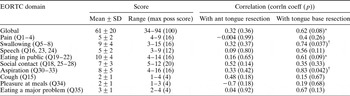
The global and domain scores for the European Organization for Research and Treatment of Cancer Head and Neck-35 questionnaire and the performance status scale questionnaire are shown in Tables II and III. No correlation was observed between patients' scores for these questionnaires and their ages (Spearman's correlation, p = 0.14 and 0.81, respectively). No significant difference in either questionnaire score was observed according to patients' sex (Mann–Whitney test, p = 0.79 and 0.77, respectively). The European Organization for Research and Treatment of Cancer Head and Neck-35 questionnaire global score was highly correlated with the global performance status scale questionnaire score (correlation coefficient = −0.89, p = 0.048).
EORTC H&N35 quality of life questionnaire scores and correlation with extent of anterior tongue or tongue base resection

Note that the maximum obtainable score was 100 (representing ‘best’ quality of life). Non-parametric Spearman's correlation coefficient (corrln coeff) and p values were calculated for anterior tongue resection and tongue base resection: * = statistical trend; † = statistical significance (p < 0.05). EORTC H&N35 = European Organization for Research and Treatment of Cancer Head and Neck-35; SD = standard deviation; max poss = maximum possible; ant = anterior; Q = questionnaire question number
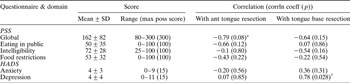
Scores for performance status scale and hospital anxiety–depression scale questionnaires, and correlations with extent of anterior tongue or tongue base resection

Note that the maximum obtainable score was 100 (representing the ‘best’ quality of life for the performance status scale (PSS) questionnaire, or the highest level of anxiety or depression for the hospital anxiety–depression scale (HADS) questionnaire). Non-parametric Spearman's correlation coefficient (corrln coeff) and p values were calculated for anterior tongue resection and tongue base resection: * = statistical trend; † = statistical significance (p < 0.05). SD = standard deviation; max poss = maximum possible; ant = anterior
Patients' scores for the swallowing domain (questions five to eight) and the aspiration domain (questions 30 to 33) of the European Organization for Research and Treatment of Cancer Head and Neck-35 questionnaire were significantly correlated with the extent of their tongue base resection (p = 0.037 and 0.042, respectively; Table II). A trend towards such a correlation was noted regarding scores for the ‘eating in public’ domain (questions 19 to 22, p = 0.09). Such a trend was also noted regarding the global European Organization for Research and Treatment of Cancer Head and Neck-35 questionnaire score (p = 0.08).
One patient had a depression score above 10 (actual score = 11), which is diagnostic for depression.Reference Freidman, Samuelian, Lancrenon, Even and Chiarelli14 However, in the whole group, no correlation was observed between anxiety and the extent of anterior tongue or tongue base resection, or between depression and the extent of anterior tongue resection (Table III). However, the depression score was significantly correlated with the extent of tongue base resection (p = 0.028, Table III) and also with the swallowing domain scores for the European Organization for Research and Treatment of Cancer Head and Neck-35 questionnaire (p = 0.023). A trend towards such a correlation was noted for the eating in public and the aspiration domain scores (p = 0.07 and p = 0.06, respectively).
Two patients had laryngoscopic evidence of aspiration, one of whom required exclusively enteral feeding. No statistical relationship between the extent of anterior tongue or tongue base resection and the presence of aspiration was found (Mann–Whitney test, p = 0.14 for both comparisons). However, the presence of clinical aspiration was significantly related to patients' scores for the swallowing and aspiration domains of the European Organization for Research and Treatment of Cancer Head and Neck-35 questionnaire (Mann–Whitney test, p = 0.04 and 0.05, respectively).
Patients' reconstruction flap type was not correlated to their scores for the swallowing, aspiration or eating in public domains of the European Organization for Research and Treatment of Cancer Head and Neck-35 questionnaire (Kruskall–Wallis test, p = 0.49, p = 0.41 and p = 0.13, respectively). A trend towards correlation was noted between the performance status scale questionnaire global scores and the extent of patients' anterior tongue resections (p = 0.08; Table III). No other correlations were noted for the performance status scale questionnaire global score or individual domains.
Discussion
Free-flap reconstruction allows wider tumour resection and adaptation of the flap to the defect, in order to minimise tethering of the remaining structures. Previous studies have shown that the tumour stage and the extent of resection significantly affect functional results.Reference McConnel, Logemann, Rademaker, Pauloski, Baker and Lewin16, Reference Colangelo, Logemann, Pauloski, Pelzer and Rademaker17 Controversy still exists regarding the functional advantage of free-flap reconstruction, as compared with regional pedicle flaps or primary closure. McConnel et al. found that primary closure resulted in better speech and swallowing than did regional or free-flap reconstruction, comparing equivalent tumour sites and resection volumes.Reference McConnel, Pauloski, Logemann, Rademaker, Colangelo and Shedd3 Others have found that free-flap reconstruction enables improved functional outcome.Reference Urken, Buchbinder, Weinberg, Vickery, Sheiner and Parker6, Reference Curtis, Plesh, Miller, Curtis, Sharma and Schweitzer9 It is still not clear if free-flap reconstruction improves quality of life, and, if so, for which patients.
Our findings imply that, despite the use of free-flap reconstruction, more extensive surgery is still linked to dysphagia and poorer aspiration-related quality of life. This would seem intuitively predictable, considering the effect of the inertia of the free flap, and the fact that the quality of swallowing depends on the strength, volume and mobility of the remaining tongue base; however, to our knowledge, such a correlation has not previously been statistically demonstrated. A variety of free flaps were employed in our patient group, as no study has shown an advantage of any one type of flap over another for tongue reconstruction; furthermore, the type of free flap employed did not seem to influence our results.
Tongue reconstruction aims to find a compromise between flap volume and flap pliability and mobility. Unfortunately, our small and heterogeneous cohort did not allow us to address the effect of flap volume on quality of life. Clinical and radiological factors will be compared in future studies.
Our three patients with radial forearm flaps underwent surgical reinnervation with the lingual nerve, but flap sensitivity was not assessed in our study. Motor reinnervation was not performed in the muscle flaps. Although recovery of sensation would intuitively appear to be a likely factor in swallowing recovery, an improvement in quality of life as a result of sensate tongue reconstruction, versus non-sensate tongue reconstruction, has not to our knowledge been previously documented. Motor recovery of the flap muscle has never been reported in cases of tongue reconstruction. Reinnervation of the muscle could help to preserve muscle tonus and volume, especially after radiation therapy, which tends to reduce the muscle volume; however, determination of the effect of muscle reinnervation will require further study.
Four of our nine patients had undergone subtotal or total resection of the oral tongue (category ‘4/4’ in Table I). The skewing of our patient population toward large resections may explain why we did not find a correlation between oral tongue resection extent and swallowing domain scores (Table II), and why speech and intelligibility domain scores were also not significantly correlated with the extent of oral tongue resection. The small number of patients in our group, and the small number of patients with aspiration, may explain why no relationship was observed between clinically apparent aspiration and the extent of tongue resection, even though aspiration was significantly related to scores for the swallowing- and aspiration-related quality of life domains.
Radiation therapy and chemoradiation impair swallowing, with a decrease in contact between the tongue base and the pharyngeal wall, a reduction in laryngeal elevation and vestibular closure, and a reduction in pharyngeal contraction and bolus propulsion.Reference Kotz, Costello, Li and Posner18 However, Rademaker et al. Reference Rademaker, Vonesh, Logemann, Pauloski, Liu and Lazarus19 have shown that diet improves after treatment over a 12-month period, and that most patients recover a pre-treatment level of oral intake, although results vary according to the tumour site and stage. All of our patients had received radiation therapy or chemoradiation at least 18 months earlier, so the effect of radiation or chemoradiation would not seem to be a distinguishing factor in swallowing-related quality of life. Furthermore, we evaluated only the domains related to eating and speaking, and eliminated other domains which seem to be more affected by radiation therapy than by surgery (i.e. problems with mouth opening and teeth, dry mouth, sticky saliva, and taste and smell).
• Following tongue resection, patients' swallowing function has been shown to be related to tumour stage and resection volume
• Free-flap reconstruction is used for treatment of tongue cancer; it allows wide resection and functional rehabilitation, adapts the reconstruction to the defect, and avoids tethering scars
• This study of patients with stage IV tumours found that, despite free-flap reconstruction, swallowing- and aspiration-related quality of life was still related to the extent of tongue base resection
Many other factors are involved in eating, social contacts and pleasure at mealtimes, such as coping mechanisms, family support and patient expectations.Reference Wagner, Coleman, Weisberger, Righi, Radpour and McGarvey20, Reference Ruhl, Gleich and Gluckman21 Swallowing may be a problem, but it has been suggested that many patients adapt their expectations to their handicap (one type of coping mechanism), and that this may actually improve their perceived quality of life.Reference Wagner, Coleman, Weisberger, Righi, Radpour and McGarvey20, Reference Ruhl, Gleich and Gluckman21 This may explain why there was no correlation between the extent of resection and the other domains studied. Global scores for the performance status scale questionnaire were highly correlated with those for the European Organization for Research and Treatment of Cancer Head and Neck-35 questionnaire. However, the questions of the latter questionnaire appeared to be more detailed, which may explain the correlation observed between the extent of tongue base resection and the latter questionnaire's scores for swallowing and aspiration, while such correlation was absent for the relevant domains of the former questionnaire. Perceived swallowing-related quality of life, as measured with quality of life questionnaires, may not adequately reflect the degree of objective, functional rehabilitation obtained with free-flap reconstruction, due to a lack of specificity and sensitivity in this particular patient group, and to the many psychological and social confounding factors involved.
Conclusions
Our study shows that the volume of resection is a major factor in swallowing- and aspiration-related quality of life, following tongue resection and free-flap reconstruction. Free-flap reconstruction does not seem to palliate the detrimental effect of the loss of functional tongue base on swallowing-related quality of life.