Greek yoghurt is thicker and creamier and surpasses regular yoghurt in terms of protein richness, flavour, texture and taste. These favourable factors have increased the market value of Greek yoghurt. Greek yoghurt attains this unique combination by incorporating straining at the end of the production process, resulting in concentration of total solids, mainly proteins and fat. Composition of Greek yoghurt varies, containing usually 23–25 g/100 g total solids and 8–11 g/100 g fat with 1·4–2·8 g/100 g acidity (Abu-Jdayil et al. Reference Abu-Jdayil, Jumah and Shaker2002). Elevated solids contribute directly to remarkable increment in viscous body, while improving creaminess, and moderating acidic flavour (Tamime & Robinson, Reference Tamime and Robinson1999). However, straining generates acid whey with high lactic acid, which can cause serious environmental problems unless properly disposed of (Jelen, Reference Jelen and Fuquay2011; Chandrapala et al. Reference Chandrapala, Duke, Gray, Weeks, Palmer and Vasiljevic2015, Reference Chandrapala, Duke, Gray, Weeks, Palmer and Vasiljevic2016a). Commercially, production of four pounds of Greek yoghurt creates approximately three pounds of acid whey (Zuber, Reference Zuber2012). Additional processing is required to allow for proper disposal of this whey stream. Production of Greek yoghurt has tripled over the last five years and industries have been struggling to find solutions for the generated 1·6 billion litres of acid whey per year (Chandrapala et al. Reference Chandrapala, Duke, Gray, Weeks, Palmer and Vasiljevic2015, Reference Chandrapala, Chen, Kezia, Bowman, Vasiljevic and Kentish2016b). Therefore, strategies to reduce the acid whey production are emphasised by the dairy industry.
Initial milk composition and fermentation process are two major factors governing compositional and structural attributes of Greek yoghurt and increased market value despite the need for downstream processing caused by acid whey issue. Addition of milk solids non-fat like milk protein concentrate powder or skimmed milk powder to the initial milk base increases the total solid level in the final product. These additions also affect the nutritional value and yoghurt structure development, especially improving texture, viscosity and mouthfeel (Tamime & Robinson, Reference Tamime and Robinson1999). However, increasing total solids to greater than 22 g/100 g by addition of skim milk powder hinders the lactic acid bacteria (LAB) growth due to the development of higher osmotic pressure in yoghurt base (Tamime & Robinson, Reference Tamime and Robinson1999). The performance of starter culture is affected by numerous factors including milk composition, bacterial strain, amount of inoculum, incubation temperature and time, and milk cooling time (Mahdian & Tehrani, Reference Mahdian and Tehrani2007; Bong & Moraru, Reference Bong and Moraru2014).
Minimising generation of acid whey during Greek yoghurt processing has never been a primary goal, especially not by manipulating initial total solid content of a yoghurt mix. Therefore, the main objective of the present study was to establish effects of adjusting initial total solids content on the volume of generated acid whey and resulting chemical and physical properties of Greek yoghurt manufactured by a traditional method. Laboratory manufactured products were compared at the end to three commercially available Greek yoghurt products to establish a benchmark in terms of composition and structure.
Materials and methods
Materials
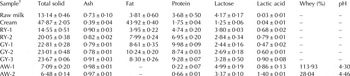
Raw milk, cream, milk protein concentrate (MPC) and skim milk powders (SMP) were obtained from Murray Goulburn (Laverton, Victoria, Australia). In order to depict seasonal variations of raw milk composition, two batches of raw milk were obtained in a time frame of three months. Their average composition is presented in Table 1. A commercially available starter culture (FD-DVS YC-380), which is a blend of non-exopolysaccharide (EPS) producing pure Streptococcus thermophilus (St. thermophilus) and Lactobacillus delbrueckii subsp. bulgaricus (Lb. bulgaricus) strains were obtained from Chr. Hansen (Bayswater, Victoria, Australia). The culture was stored in a freezer at −80 °C until being used. The culture was diluted by adding 50 units of freeze dried culture to 500 ml of sterile milk as per manufacturer's guidelines.
Proximate composition of raw milk, cream and Greek yoghurt samples at different processing stages with the corresponding acid whey

† Samples are named as follows:
RY-1 and RY-2 are the fermented yoghurt mix prior to the concentration step made with 15 and 20 g/100 g initial milk total solid, respectively
GY-1 and GY-2 are the Greek yoghurt concentrated from RY-1 and RY-2, respectively
AW-1 and AW-2 are the acid whey expelled during the concentration step during GY-1 and GY-2 manufacturing, respectively
GY-3 is the Greek yoghurt made with 23 g/100 g initial milk TS level
Values are means of at least 4 independent observations (n ≥ 4); the results are presented as means ± standard deviation (sd)
Preparation of milk samples
A yoghurt mix with 15 g/100 g total solids (TS) was prepared by adding calculated amounts of SMP to raw milk and was used as the control. A yoghurt mix with 20 or 23 g/100 g TS was prepared by adding calculated amounts of cream and MPC to raw milk using the Pearsons Square method (Tamime & Robinson, Reference Tamime and Robinson1999). Fat standardisation was carried out to maintain 8 g/100 g fat level.
Production of Greek yoghurt
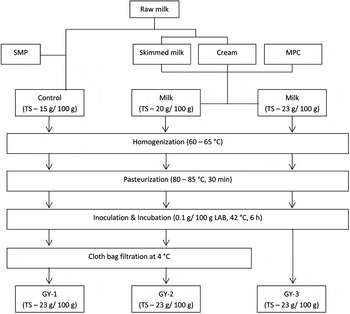
Greek yoghurt samples were standardized to 23 g/100 g TS by concentrating fermented yoghurt mix containing 15 g/100 g TS or 20 g/100 g TS. Yoghurt mix containing 23 g/100 g TS was treated and fermented without the straining step as described in Fig. 1. All milk samples were homogenized using a homogeniser (110Y – Microfluidics, Newton, Massachusetts, USA) at 60–65 °C, followed by a batch pasteurisation using a water bath at 85 °C for 30 min (Lucey, Reference Lucey2004) and subsequently cooled down to 42 °C. The mix was then inoculated with 0·1 g/100 g of active starter culture and incubated at 42 °C until a pH value of 4·6 was reached. All batches were chilled to 4 °C followed with straining of the fermented bases containing 15 g/100 g TS and 20 g/100 g TS using the cloth bag method to 23 g/100 g TS level.
Experimental design and coding employed in manufacturing Greek yoghurt samples.

Culture performance
The culture performance was monitored hourly during the 6 h fermentation period. The following parameters were assessed: culture concentration, pH, titratable acidity and bacterial proteolytic activity.
Pour plate counting method (Donkor et al. Reference Donkor, Henriksson, Singh, Vasiljevic and Shah2007) was used to enumerate culture bacteria (Lb. bulgaricus, St. thermophilus). MRS agar with anaerobic incubation at 42 °C for 48 h and M17 agar with aerobic incubation at 37 °C for 48 h were used for culturing of Lb bulgaricus and St. thermophilus, respectively.
Change of pH was monitored with a pH metre (WTW inoLab 720, Germany). Titratable acidity was established using a 0·1 mol/l NaOH solution (AOAC, Reference Horowitz2000c, 947·05) using phenolphthalein as an indicator.
Bacterial proteolytic activity during growth was measured using the O-phthaldialdehyde (OPA) method as described previously (Donkor et al. Reference Donkor, Henriksson, Singh, Vasiljevic and Shah2007). The absorbance was measured using an UV spectrophotometer (Libra S12 – Biochrom Ltd, Cambridge, England) at 340 nm. The yoghurt mix before inoculation was used as the control. The relative degree of proteolysis was determined as the difference between the free amino groups in fermented milk to that of the control.
Chemical composition of raw materials and yoghurt samples
Total solid, ash and lactose contents were measured as described previously (Chandrapala et al. Reference Chandrapala, Duke, Gray, Weeks, Palmer and Vasiljevic2015, Reference Chandrapala, Duke, Gray, Weeks, Palmer and Vasiljevic2016a).
The fat content was quantified using the Rose.Gottlieb method (AOAC, Reference Horowitz2000b, 905·02). The weight of the extracted fat was taken and represented as a percentage to the dry matter basis.
Total nitrogen content of all samples was determined using the Kjeldhal method (AOAC, Reference Horowitz2000a, 991·20). Total protein contents were calculated by multiplying the total nitrogen content by the conversion factor of 6·38.
Concentration of lactic acid was determined using the same HPLC fitted with Aminex HPX 87H, 300 × 7·8 mm ion exchange column (Biorad Instruments, Gladesville, NSW, Australia) (Chandrapala et al. Reference Chandrapala, Duke, Gray, Weeks, Palmer and Vasiljevic2015) maintained at 65 °C. A degassed 0·01 mol/l H2SO4 solution was used as the mobile phase. The flow rate, injection volume and wavelength were selected as 0·6 ml/min, 20 µl and 220 nm respectively.
Physical properties of Greek yoghurt
Physical attributes of the concentrated yoghurts were evaluated after whey drainage. All Greek yoghurt samples were stirred using a hand mixer for 2 min and allowed to equilibrate for 10 min under room temperature. They were then stored overnight at 4 °C. This approach was applied to ensure that processing history of the gel was erased and the new structure was established clearly affected by the final yoghurt gel composition (Purwandari et al. Reference Purwandari, Shah and Vasiljevic2007).
Textural attributes of 50 g of homogenized Greek yoghurt samples were established using a large-strain approach in a penetration mode by a TA XT Plus Texture analyzer (Stable Micro Systems Ltd., Surrey, UK) fitted with 5 kg load cell and a 20 mm diameter stainless steel cylindrical probe (model no: P/20). Double compression test (TPA) was performed for Greek yoghurt samples taken out from cold storage once their temperature reached 5 °C to identify gel firmness, cohesiveness and adhesiveness. Speed of the probe and penetration depth was pre-set as 0·5 mm/s and 15 mm, respectively (Ozer et al. Reference Ozer, Robinson, Grandison and Bell1997).
Viscoelastic and flow properties were measured using a cone (CP50-1, 1°, 50 mm) and plate (P-PTD200/56) geometry attached to a MCR 301 Rheometer (Anton Paar GmbH, Graz, Austria) similarly at 5 °C. Prior to testing, samples were stirred using a constant shear rate of 500 1/s for 30 s to diminish structural differences among samples during processing conditions (Purwandari et al. Reference Purwandari, Shah and Vasiljevic2007). Samples were then allowed to equilibrate for 10 min to rebuild yoghurt structure dependant on the composition of sample. Afterwards, a dynamic frequency sweep between 0·1–100 Hz at a constant shear strain of 0·5% was first performed to obtain G′ and Gʺ. Dynamic rheology as a function of shear rate in the range between 0·1 and 100 1/s (upward and downward sweeps) was performed over 20 min to measure variations in viscosity against shear rate.
Gel syneresis was determined as the amount of whey expelled from Greek yoghurt samples using a centrifugation technique as described by Zisu et al. (Reference Zisu, Lee, Chandrapala, Bhaskaracharya, Palmer, Kentish and Ashokkumar2011). Here, a 10 ml sample of yoghurt was centrifuged at 1449 × g for 20 min and the repelled whey content was collected. Gel syneresis was expressed as the ratio of weight of whey to the initial Greek yoghurt weight.
 $${\rm Syneresis}\;{\rm (\% ) =} \displaystyle{{{\rm Weight}\;{\rm of}\;{\rm repelled}\;{\rm whey}\;{\rm (g)}} \over {{\rm Initial}\;{\rm yoghurt}\;{\rm weight}\;({\rm g})}}{\rm \times 100\%} $$
Statistical analysis
All experiments were replicated two times independently in a randomized split plot block design with two sub-samplings to provide at least 4 independent observations (n ≥ 4). Total solid content served as the main variable with the replication as blocks. The data was analysed using a GLM procedure of the statistical analysis system (SAS, 1996) with the statistical level of significance pre-set at 0·05 (P < 0·05).
Results and discussion
Fermentation process
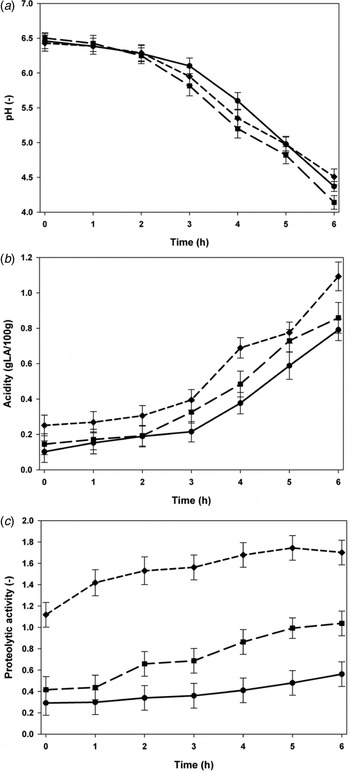
Required chemical and structural attributes of Greek yoghurt are heavily dependent on the nature of the fermentation process and thus the performance of starter culture bacteria. The primary goal of an efficient fermentation process in yoghurt manufacturing is to reduce the pH of milk below isoelectric point of casein (4·6) to facilitate protein aggregation in the shortest possible time. Therefore, pH profile of milk during fermentation is important in understanding the culture performance on yoghurt gel development (Fig. 2A). All samples followed the typical pH reduction profile with a slow and linear pH decrease at the beginning. The target pH of 4·6 was achieved fairly uniformly after 5 h 33 min, 5 h 16 min and 5 h 45 min for 15, 20 and 23 g/100 g TS levels, respectively, highlighting negligible impact of TS levels on the time of fermentation. Notably the ultimate pH of the yoghurt base containing 23 g/100 g TS has taken longer than the other two samples likely attributed to the buffering capacity of milk (Ozer et al. Reference Ozer, Robinson, Grandison and Bell1998) due to colloidal calcium phosphate dissolution at acidic pH (Peng et al. Reference Peng, Serra, Horne and Lucey2009).
Starter culture performance as depicted by proteolytic activity (A), acidity (B) and pH change (C) during fermentation of a yoghurt mix standardized to 15% ( ), 20% (
 ) or 23% (
 ) total solids by addition of skim milk powder (SMP) or milk protein concentrate (MPC). Values are means of at least 4 independent observations (n ≥ 4); the error bars represent ± standard deviation (sd).

The key mechanism that governs pH reduction in milk is lactose conversion into lactic acid by the starter cultures to fulfil their energy requirement (Vasiljevic & Shah, Reference Vasiljevic, Shah, Chandan, Kilara and Shah2008). Thus the amount of acid production gives a better indication of effective fermentation than pH reduction as it is governed by the buffering capacity of milk. The rate of acid generation increased with elevation of TS levels (Fig. 2B) and is consistent with Table 1, where the sample containing 23 g/100 g TS contained the highest LA content of 0·9 g/100 g in comparison to other TS levels (0·68 and 0·79 g/100 g). Indicatively the lactose metabolism of the starter culture bacteria was directly linked to increase in the TS level and likely attributed to the presence of free amino acids and smaller peptides in the medium (Fig. 2C) as their content was at least three times higher than that in other two samples at the start of fermentation.
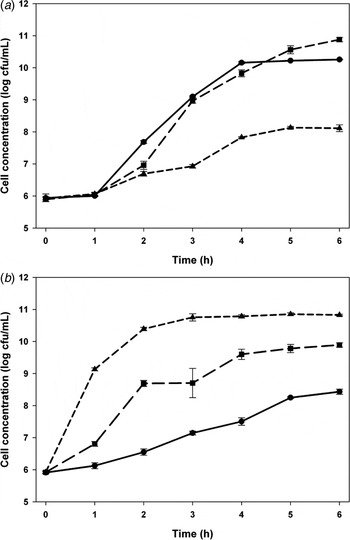
This was obviously linked to the growth of individual strains (St. thermophilus and Lb. bulgaricus, Fig. 3A, B, respectively). Both strains reached fairly high concentrations, almost a log cycle higher than is usually reported for yoghurt (Vasiljevic & Shah, Reference Vasiljevic, Shah, Chandan, Kilara and Shah2008). However, the supplementation was achieved by a protein rich product – MPC, which contained elevated amounts of amino acids and peptides (Fig. 2A). Both strains are highly fastidious organisms requiring numerous nutrients for their growth (Vasiljevic & Jelen, Reference Vasiljevic and Jelen2001), which could have been provided by supplementation instead of usually observed symbiotic growth. Interestingly, longer lag phase and hindered growth rate of St. thermophilus was noted when the TS level increased from 15 to 23 g/100 g TS (Fig. 3A), similar to a previous report (Mahdian & Tehrani, Reference Mahdian and Tehrani2007). This growth retardation was attributed to increased osmotic pressure in milk base due to higher concentration of TS, especially lactose and minerals (Tamime & Robinson, Reference Tamime and Robinson1999). However, it is not clear whether this could be one of the reasons for growth hindrance of St. thermophiles, as MPC mainly contains proteins with a small quantity of minerals, or was also due to metabolic activity of Lb. bulgaricus which has shown a completely different behaviour compared to St. thermophilus (Fig. 3B). With increasing TS level, the growth rate of Lb. bulgaricus has increased with concomitant shortening of its lag phase. Especially, Lb. bulgaricus in milk base with 23 g/100 g TS started their log phase at the beginning of fermentation which contained the highest free amino acid content (Fig. 2C). Presence of free amino acids and peptides in milk serum is important for starter bacteria to fulfil their essential nitrogen requirements (Bong & Moraru, Reference Bong and Moraru2014). Usually St. thermophilus initially releases shorter peptides and amino acids required by Lb. bulgaricus during yoghurt manufacturing (Vasiljevic & Shah, Reference Vasiljevic, Shah, Chandan, Kilara and Shah2008). In other complex media this requirement may be met by supplementation in the form of yeast extract, whey proteins or even skim milk powder (Vasiljevic & Jelen, Reference Vasiljevic and Jelen2001). Both strains appear dependent on the conditions of the environment and usually reach 108–109 cfu/ml during fermentation of yoghurt base (Vasiljevic & Shah, Reference Vasiljevic, Shah, Chandan, Kilara and Shah2008). However, cell concentrations in the current study may be attributed to presence of free and available amino acids (Fig. 2C) and enhanced buffering capacity (Fig. 2A) as it allowed more appropriate conditions for the strain adaptation.
Starter culture growth involving (A) Streptococcus thermophilus and (B) Lactobacillus delbrueckii subsp. bulgaricus during fermentation of a yoghurt mix standardized to 15% ( ), 20% (
 ) or 23% (
 ) total solids by addition of skim milk powder (SMP) or milk protein concentrate (MPC). Values are means of at least 4 independent observations (n ≥ 4); the error bars represent ± standard deviation (sd).

Properties of acid whey
Previous findings are important for process optimisation to gain efficient fermentation during Greek yoghurt production. In addition, study of the generated acid whey quantity and quality is vital as it is the primary goal of the present study. During the present study (Table 1) Greek yoghurt produced with 23 g/100 g initial milk TS level (referred to as GY-3) did not generate acid whey during the production as whey drainage stage was omitted. From a viewpoint based on quantity of acid whey releases, GY-3 would be considered the best option as no acid whey is generated. On the other hand, GY-1 and GY-2 release acid whey as drainage was incorporated as the step required to increase final yoghurt dry matter content up to 23 g/100 g TS. As expected, GY-1 released the highest amount of acid whey (113·93 g/100 g) compared to GY-2 (28·04 g/100 g) simply owing it to a different initial solid content. Acid whey generation during commercial production of four pounds of Greek yoghurt results in approximately three pounds of acid whey (Zuber, Reference Zuber2012). This is equivalent to an acid whey to Greek yogurt ratio of 75 g/100 g. Therefore, raising the initial total solid content of the yogurt mix as in case of GY-2 results in a significantly lower amount of acid whey during the production process compared to GY-1 as well as industrially reported values. This consequently leads to lower requirements for downstream processing. Lactic acid content is a major factor, which determines the properties of acid whey. It also appears as an obstacle for lactose recovery during acid whey processing as it acts as an inhibitor of lactose crystallisation (Wijayasinghe et al. Reference Wijayasinghe, Vasiljevic and Chandrapala2015; Chandrapala et al. Reference Chandrapala, Duke, Gray, Weeks, Palmer and Vasiljevic2016a, Reference Chandrapala, Chen, Kezia, Bowman, Vasiljevic and Kentishb). In GY-1 production, about 70 g/100 g of lactic acid contained in the intermediate regular yoghurt (RY-1) passed into the whey stream. On the other hand, only about 40 g/100 g of lactic acid accumulated in acid whey during GY-2 manufacturing due to the minimal whey drainage. Since the lactic acid appears largely dissolved in the serum phase of yoghurt at fermentation, the amount of lactic acid accumulated in acid whey is proportional to the whey drainage. GY-2 required a lower amount of cloth bag whey drainage to reach the desired total solid level, compared to GY-1. The lower amount of lactic acid observed in acid whey repelled while making GY-2 can be attributed to this phenomenon.
Properties of Greek yoghurt
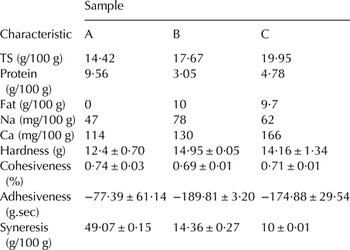
Chemical composition of Greek yoghurt and expelled acid whey rely mainly on the extent of the concentration step applied during manufacturing. The GY-3 was higher in lactose, lactic acid and ash compared to two other Greek yoghurt samples (Table 1), which can clearly be attributed to the omission of the concentration step. On the other hand, GY-1 and GY-2 composition differed substantially from their corresponding fermented yogurt mixes (referred to as RY-1 and RY-2, respectively). The straining step increased the protein content by retaining almost all of the proteins while allowing passage of lactose into the whey stream (Table 1). At the same time, fat was concentrated along with the proteins, likely due to even distribution throughout the protein gel resulting from the homogenisation step, which in turn may increase the creamy mouthfeel in the final product (Ozer & Robinson, Reference Ozer and Robinson1999). To compare the final products against an appropriate benchmark, three commercially available products were assessed for their chemical and physical properties which are given in Table 3. Apparently the total solid and especially the protein content of these products were substantially lower than those manufactured in our study. The results clearly demonstrate compositional and textural differences of the commercially marketed products and absence of standardized manufacturing to meet consumer expectations. Our samples contained elevated levels of milk solids and proteins but similar fat levels to some of these commercial products. These substantial compositional differences impacted on hardness, adhesiveness and syneresis (Tables 1–3).
Textural properties and syneresis of Greek yoghurt samples prepared from the yoghurt mix containing 15 (GY-1), 20 (GY-2) or 23 g/100 g (GY-3) initial total solids

Values are means of at least 4 independent observations (n ≥ 4); the results are presented as means ± standard deviation (sd)
Proximate composition, textural properties and syneresis of three commercially available Greek yoghurt samples

Values are means of at least 4 independent observations (n ≥ 4); the results are presented as means ± standard deviation (sd)
Impact of initial solid content on structural properties of Greek yoghurt
The structural properties of yoghurt gel are important parameters governing the consumers’ preferences. Increasing initial TS content alone is not enough to achieve appropriate structural properties (Table 2). The concentration step appears a key step increasing the hardness by 28and 33·6% for GY-1 and GY-2 samples, respectively, as compared to GY-3 (14·9%). Also, the hardness of these concentrated samples was double that of the commercial products (Table 3).
The greatest hardness was noted for GY-2 which can be attributed to the role of MPC. The casein network is the backbone of the yoghurt gel, influencing the perceived hardness in a concentration dependent manner (Bong & Moraru, Reference Bong and Moraru2014). The concentration step apparently reinforces it, bringing casein aggregates closer by removing whey and enhancing non-covalent bonds. The role of water (whey) appears obvious in GY-3; although it contained highest levels of TS, the formed gel exhibited a remarkably lower hardness value. Since the gel was disintegrated by stirring as one of the required processing steps, the initial gel structure never regained its original properties which resulted in very low measured hardness (Table 2). Removal of whey during GY-1 or GY-2 at straining decreases the pore size of the yoghurt gel while increasing the gel strength (Bong & Moraru, Reference Bong and Moraru2014). Furthermore, the whey removal leads to lower free water content and consequently lower syneresis. GY-2 had the lowest syneresis (Table 2) compared to other two manufactured samples, within a range of the commercial products (Table 3). When the casein to whey protein ratio is lowered, the consistency of cross links among protein gel network is increased. This reduces the movement of free water by reducing the pore size in the gel network (Puvanenthiran et al. Reference Puvanenthiran, Williams and Augustin2002). GY-2 also showed the highest degree of acidification during the fermentation (Fig. 2B). This would allow for a stronger casein gel at fermentation minimising movement of free water. Furthermore, higher ratio of protein (especially casein) and fat content as in GY-2 increases the hydrophilic nature in the yoghurt gel structure, maximising the water binding ability (Lucey et al. Reference Lucey, Munro and Singh1998). The greater water holding capacity indicates the strong micro structure of yoghurt gel, capable of holding a bulk amount of water (Abu-Jdayil et al. Reference Abu-Jdayil, Jumah and Shaker2002).
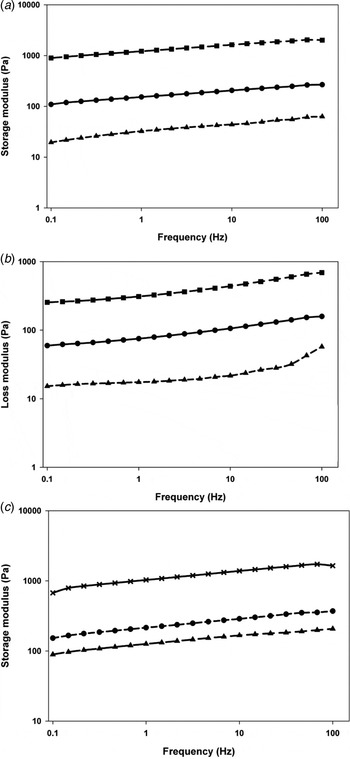
The microstructure of yoghurt is reflected by the rheological properties of yoghurt gel, mainly its storage (G′) and loss moduli (G″). During the study, all samples exhibited a greater storage than loss modulus throughout the frequency range (Fig. 4A, B), depicting and confirming their solid like behaviour (Ozer et al. Reference Ozer, Robinson, Grandison and Bell1997). GY-2 has exhibited a greater storage modulus compared to the other two manufactured samples and the commercially available Greek yoghurt (Fig. 4A–C), indicating a stronger gel strength. This may be due to the incorporation of MPC and the draining of whey enhancing the casein concentration and ultimately strength of casein network due to greater non-covalent interactions. Furthermore, the cloth bag draining has apparently allowed enough time for establishment of a strong gel matrix (Ozer et al. Reference Ozer, Stenning, Grandison and Robinson1999). Removal of whey is far more important than the casein content to achieve the required viscoelastic behaviour (Bong & Moraru, Reference Bong and Moraru2014). Our results supported this observation as the greatest MPC supplementation (GY-3) resulting in required protein content exhibited lowest G′ compared to both GY-1 and GY-2 due to absence of the straining step.
Viscoelastic properties of Greek yogurt represented as (A) storage modulus - G’ and (B) loss modulus – G’ produced by fermentation at 42 °C for 6 h of a yoghurt mix standardized to 15% ( ), 20% (
 ) or 23% (
 ) total solids by addition of milk protein concentrate (MPC) in comparison to storage modulus (G’) of some available commercial Greek yoghurt samples (C) due to confidentiality identified as yoghurt A (
 ), yoghurt B (
 ) and yoghurt C (
 ).Values are means of at least 4 independent observations (n ≥ 4).

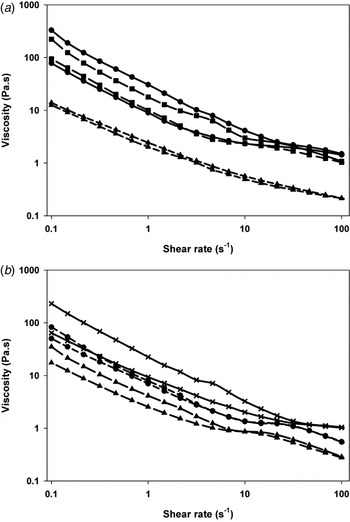
Apart from the viscoelastic nature, flow behaviour of Greek yoghurt is important for establishing an efficient industrial scale production especially pumping, filling or stirring. Shear thinning (pseudoplastic) behaviour is more dominant for yoghurt with increasing shear rate (Abu-Jdayil et al. Reference Abu-Jdayil, Jumah and Shaker2002). During the experiment, all Greek yoghurt samples exhibited typical non Newtonian flow behaviour, with immediate and greater reduction of viscosity under increasing shear rates (Fig. 5A) due to break down of gel network and further reduction of particle size (Bong & Moraru, Reference Bong and Moraru2014). However, GY-3 sample had a lower apparent viscosity than GY-1 or GY-2 over the examined shear rate range. Although GY-3 sample contained elevated casein content, the created casein network likely contained larger pores and thus weaker non-covalent interactions between the strands of the network due to greater distances (Purwandari et al. Reference Purwandari, Shah and Vasiljevic2007). Draining whey from the samples also increased casein to whey protein ratio lowering the viscous nature of the yoghurt gel (Sauer et al. Reference Sauer, Doehner and Moraru2012). Shortening intra- and intermolecular distances as in GY-1 and GY-2 samples augmented weak interactions, enabling greater absorption of an applied force by flexing without breaking the intra-particle cross-links. This leads to greater gel strength and a higher retained force (Purwandari et al. Reference Purwandari, Shah and Vasiljevic2007). Interestingly the manufactured samples had comparable flow behaviour to the commercial Greek yoghurt (Fig. 5B), which means that the proposed process manipulation may lead to similar products but with far less whey release.
Flow behavior of Greek yogurt samples (A) produced by fermentation at 42 °C for 6 h of a yoghurt mix standardized to 15% ( ), 20% (
 ) or 23% (
 ) total solids by addition of milk protein concentrate (MPC) in comparison to flow properties of some available commercial Greek yoghurt samples (B) due to confidentiality identified as yoghurt A (
 ), yoghurt B (
 ) and yoghurt C (
 ). Values are means of at least 4 independent observations (n ≥ 4).

Conclusion
The study has shown that it is possible to manufacture Greek yoghurt by manipulating the initial TS levels of the yoghurt base up to 23 g/ 100 g with milk protein concentrate. Increasing initial milk TS from 15 to 23 g/ 100 g positively affected performance of the starter culture, although the growth of St. thermophilus appeared compromised by developed osmotic pressure due to solubilisation of colloidal calcium phosphate from the casein micelle and likely lactic acid production due to enhanced embolic activity of Lb. bulgaricus. All three novel Greek yoghurt samples exhibited structural properties comparable with commercially available Greek yoghurt, matching the ranges of chemical composition. GY-2 sample appeared superior in many parameters with the highest gel strength due to a combined effect of draining and elevated protein content and minimised syneresis. Most importantly, this production led to substantially lower acid whey generation due to low drainage requirement without comprising yoghurt quality. This novel processing approach may assist in minimising acid whey generation and thus downstream processing issues associated with acid whey processing issue and promote sustainable Greek yoghurt production.