

Introduction
Rhinoceroses were an important component of North American mammal faunas from the late middle Eocene through the Miocene. They occurred in abundance and in high diversity, occupying several ecological niches and habitats (Prothero, Reference Prothero2005). A significant hindrance to understanding of the early biogeography of North America rhinocerotids is the group’s poor sampling outside the High Plains and eastern Rocky Mountain regions, from which the overwhelming majority of fossils come prior to the late Oligocene and Miocene when rhinocerotid fauna become common across the continent. This limited geographic sampling is particularly true of the early to mid-Oligocene, with more than 90% of rhinocerotid localities in the Whitneyan North American Land Mammal “Age” (NALMA) occurring in the White River Badlands of South Dakota (Prothero, Reference Prothero2005).
We describe two new rhinocerotid specimens from the early to mid-Oligocene Cougar Cliffs Member of the Steamboat Formation of the northeastern Warner Mountains in California. Although rhinocerotids are a notable component of Oligocene deposits in the nearby John Day Formation of Oregon, the presence of a rhinocerotid from outside of the High Plains during this period is nevertheless significant. The Steamboat Formation is well known for preserving a rich assemblage of fossil plants (Myers Reference Myers1998, Reference Myers2006), but this is the first report of mammalian fossils from the area, almost certainly pertaining to the same taxon and likely to the same horizon. Thus, the Steamboat Formation holds the potential for yielding other Oligocene terrestrial vertebrates, once such fossils are searched for systematically.
Location and stratigraphy
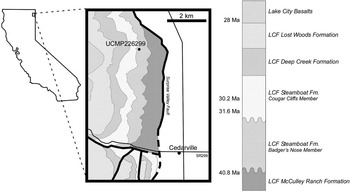
The new rhinocerotid specimen described here was recovered from talus on a slope approximately 6 km NNW of Cedarville, California (Fig. 1), just above the plant-bearing Badger’s Nose locality, near the contact of the Badger’s Nose and Cougar Cliffs members of the Steamboat Formation. The Steamboat Formation is part of a thick sequence of Eocene–Oligocene volcaniclastic and sedimentary strata in the eastern Warner Mountain Range of northeastern California (Egger et al., Reference Egger, Colgan and York2009), which was originally described as the Lower Cedarville Formation (LCF) by Russell (Reference Russell1928). Subsequent work (Martz, Reference Martz1970; Egger et al., Reference Egger, Colgan and York2009; Egger and Miller, Reference Egger and Miller2011) subdivided the Lower Cedarville into five distinct units (Fig.1).
Map and generalized stratigraphy, showing the locality of the fossil. Geological boundaries after Egger and Miller (Reference Egger and Miller2011), radiometric dates of Axelrod (Reference Axelrod1966), Myers (Reference Myers1998), and Colgan et al. (Reference Colgan, Eggar, John, Cousens, Fleck and Henry2011).

The oldest of these subdivisions of the LCF, the McCulley Ranch Formation, has yielded a 40K/40Ar date of 40.8±3.0 Ma from a lava flow near its top (Axelrod, Reference Axelrod1966), and paleomagnetic data place this formation within Chron C18r (39.4–40.2 Ma; Upton and Prothero, Reference Upton and Prothero2009). Unconformably above the McCulley Ranch Formation sits the Steamboat Formation, which is composed of a series of interbedded conglomerates, sandstones, and mudstones (Myers, Reference Myers1998). The basal unit of this sequence, the Badger’s Nose Member, contains thinly laminated lacustrine mudstones yielding abundant plant fossils, interbedded with well-sorted sandstone (Myers, Reference Myers2006), and correlated with Chron C13r (33.8–34.9 Ma; Upton and Prothero, Reference Upton and Prothero2009). In contrast, the overlying Cougar Cliffs Member is composed primarily of coarse- to medium-grained, cross-stratified sandstones derived from immature volcaniclastic grains; it is interpreted to represent a syneruptive alluvial facies (Myers, Reference Myers1998). The andesitic volcaniclastics of the region originated from a nearby stratovolcano to the SSW (Egger et al., Reference Egger, Colgan and York2009)
Fallout tuffs punctuating the Cougar Cliffs Member have yielded 40K/40Ar dates of 33.9±2.7 Ma and 31.1±1.3 Ma (Duffield and McKee, Reference Duffield and McKee1986). More recently, Myers (Reference Myers1998) sampled fallout tuffs in the Cougar Cliffs Member above an unconformity truncating the top of the Badger’s Nose Member. These provided Ar40/Ar39 dates of 31.56±0.46 Ma and 30.19±0.47 Ma, placing deposition of the Cougar Cliffs Member in the early to mid-Oligocene, following the chronology of Prothero and Swisher (Reference Prothero and Swisher1992). The upper part of the Cougar Cliffs Member, and the overlying laharic sediments of the Deep Creek and Lost Woods Formations, have not been radiometrically dated (Colgan et al., Reference Colgan, Eggar, John, Cousens, Fleck and Henry2011). However, Ar40/Ar39 dates from the overlying Lake City Basalts north of the region, and the Cedar Pass Volcanic Complex to the south, indicate that deposition of the Cougar Cliffs Member ceased by the late Oligocene, at ca. 28 Ma and 26.6 Ma, respectively (Colgan et al., Reference Colgan, Eggar, John, Cousens, Fleck and Henry2011).
Institutional Abbreviations
UCMP, University of California Museum of Paleontology.
UCMP226299 was recovered from loose talus, on a 20°–30° slope less than 100 m from the Badger's Nose/Cougar Cliffs contact. Although this precludes a precise placement within the Steamboat Formation, the attached host sediment of coarse-grained, grey to tan colored, volcaniclastic sandstone strongly suggests that the fossil is derived from the Cougar Cliffs Member, and had rolled downhill to where the Badger’s Nose Member outcrops. The collection site is above the Badger’s Nose floral locality where Myers (Reference Myers1998) obtained the ~30 Ma Ar40/Ar39 dates noted above, suggesting that UCMP226299 is slightly younger (mid-Oligocene) than would be indicated from the early Oligocene dates of Duffield and McKee (Reference Duffield and McKee1986) obtained some 30 km to the south. With the stratigraphic caveats mentioned above, the fossil may therefore be cautiously referred to the Whitneyan NALMA (ca. 32–29 Ma; Prothero and Swisher, Reference Prothero and Swisher1992). To our knowledge, UCMP 226299 represents only the second mammalian fossil recovered from the Warner Mountains. The other, UCMP 121793, an isolated rhinocerotid lower molar also described and illustrated below, is reported to derive from the “lower Cedarville Flora” at UCMP locality V78126.
Description of material
UCMP226299
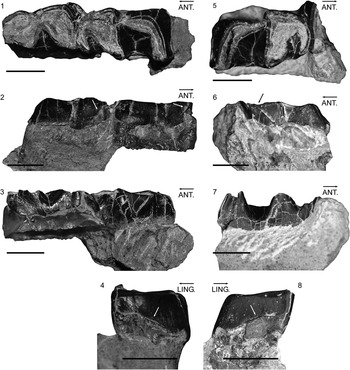
The new specimen (UCMP226299), a right mandibular fragment bearing two molars, is clearly rhinocerotid in affinity (Fig. 2.1–2.4, see Fig. 1S for a 3D photogrammetric reconstruction [PhotoScan, Agisoft]). The base of the anterior tooth was embedded in resin prior to preparation. The specimen exhibits little postmortem damage or distortion, except for some slight cracking of the enamel.
UCMP 226299 in (1), dorsal; (2), labial; (3), lingual; and (4), posterior view. UCMP121793 in (5), dorsal; (6), labial; (7), lingual; and (8), posterior view. Arrows in (2), (4), (6), and (8) indicate the position of the cingulum. Scale bars are 2 cm; anterior direction in (1–3), (5–7) (ANT.), and lingual direction in (4), (8) (LING.) is indicated by arrows.

Both teeth show considerable wear, suggesting a mature individual. The absence of any trace of enamel or roots posterior to the last tooth in the specimen, as a well as the lack of interdental wear on its posterior face, indicate that it is m3. Teeth were measured with digital calipers to the nearest millimeter (Table 1): length was measured along the labial base and width across the posterior wall. The crown of m2 is worn to within 15 mm of the base of the talonid (measured labially), leaving little of the original morphology, the trigonids and talonids having been worn down into a single enamel rimmed basin across the labial third of the crown. The majority of the posterior wall of m2 cannot be observed due to contact with m3; however, a small, rugose shelf occurs at the exposed base of the hypoconid.
UCMP 226299 and UCMP 121793 dimensions (mm) compared with published mean dimensions of Eocene and Oligocene rhinocerotids of a similar size

Dimensions, ranges, and distributions from Prothero (Reference Prothero2005); standard deviations in parentheses. For caveats discussing the locality information of UCMP 121793, see body text.
* UCMP 121793 was recorded as Trigonias osborni by Prothero (Reference Prothero2005), and is the only previously known specimen from California.
Although m3 is also heavily worn, sufficient crown morphology remains to allow the positions of the major lophs to be discerned. The trigonid is represented as an expanse of dentine rimmed by enamel. The paralophid curves around the anterior margin of the tooth, and the para- and metalophids both project posterolingually. A posterolingually opening sulcus occurs between the para- and metalophids; this structure is quite shallow, however, given the advanced state of wear. The protoconid represents the most labially projecting portion of the crown, and the entoconid the most lingual. The talonid is large and open lingually. The cristid obliqua joins the metalophid about one-fourth of the crown width from the labial edge. The protoconid lies slightly posterior to this connection, and thus appears to curve back over the tip of the cristid obliqua. The internal face of the cristid obliqua slopes lingually and that of the entolophid anteriorly. When viewed dorsally, the base of the talonid forms the widest region of the crown. A small cingulum crosses the base of the lingual third of its posterior wall (Fig. 2.4). Breakage of the enamel truncates this cingulum labially.
On the labial walls of both teeth, a steeply inclined cingulum runs from the anterior portion of the base of the protoconid, climbing to meet the occlusal surface at an approximate 45° angle (Fig. 2.2). Distinctive occlusal wear facets are evident on the labial surfaces of both teeth at the corner formed between the cristid obliqua and the metaconid. Another wear facet is present on the posterior wall of m3 at the entoconid.
UCMP121793
The morphology, size, wear, and preservation of the single molar preserved in UCMP121793 (Fig. 2.5–2.8, see Fig. 2S for a 3D photogrammetric reconstruction [PhotoScan, Agisoft]) are strikingly similar to the posterior tooth of UCMP226299. Some variation is observed in the crown morphology when compared to UCMP226299, namely that the para- and metalophids do not project posteriorly to the degree seen in UCMP226299. However, UCMP226299 shows greater wear than UCMP121793, and these differences in crown morphology are likely attributable to this. The occlusal wear facets on the cristid obliqua, metaconid, and entoconid observed in UCMP226299 are also clearly evident in UCMP121793. As in UCMP226299, UCMP121793 also shows an inclined cingulum across the labial base of the trigonid (Fig. 2.6) and a small truncated cingulum on the posterior wall (Fig. 2.8). Interestingly, both specimens show the same distinctive pattern of breakage in the posterior wall enamel: the cingulum runs parallel to the base of the tooth, before a ventral-labially running “crack” appears and removes the ventral enamel. This crack then runs into a smooth curve that turns dorsally before curving back into a tight semicircle at the labial base. The exact replication of this breakage pattern in both teeth suggests that some original structural feature may have guided crack progression.
Sediments adhering to both specimens are lithologically similar: grey-to-tan colored, well-sorted, sub-rounded coarse-grained sandstone composed of reworked ash, with mafic grains evenly distributed throughout and accounting for approximately 5% of the sediment. No cross-bedding or other depositional structures are evident on the small amounts of matrix remaining on the specimens.
Discussion
Rhinocerotid lower molars are morphologically conservative and are insufficient on their own to provide enough diagnostic characters to identify taxa, even to the level of subfamily. Despite an overall trend of increasing rhinocerotid diversity from the Chadronian into the Whitneyan NALMAs, the group is relatively underrepresented during this interval outside the High Plains and Rocky Mountains (Prothero, Reference Prothero2005). A stark illustration of the incomplete sampling of Oligocene rhinocerotids in North America is the fact that Penetrigonias and Amphicaenopus, both known from the Chadronian and Whitneyan, are absent from the intervening Orellan (Prothero, Reference Prothero2005).
The new specimen described here is so remarkably similar to UCMP121793 in its morphology, preservation, and associated sediments that it is reasonable to assume that they derive from the same lithostratigraphic unit, as well as the same species. The geographic coordinates for the locality from which UCMP 121793 is reported to derive (V78126) further confuse matters, because the most recent geological map of the area (Egger and Miller, Reference Egger and Miller2011) places this locality within the early-Eocene volcanic breccias of the McCulley Ranch Formation, which lies well below the Lower Cedarville Flora and clearly cannot be the host deposit as it is not a lithological match for the matrix adherent to the specimen. These coordinates are pre-GPS, and so are therefore somewhat tenuous. A personal account from the field trip when UCMP 121793 was recovered state that this specimen was also collected from loose talus, near the locality of UCMP 226299, stratigraphically above and less than 0.5 km south of the Lower Cedarville Flora locality (C. Bruce Hanson, personal communication, 2014). This description is more fitting with the lithological data, and would place the two specimens in geographical proximity as well, perhaps suggesting that they derive from the same individual.
Ambiguity about the assignable age of both Cedarville mammal fossils, plus their lack of distinctive morphological characters, suggest that it would be most appropriate to conservatively refer them to Rhinocerotidae incertae sedis. Although they cannot be ruled out entirely, other animals within the Rhinocerotoidea superfamily, namely hyracodonts and amynodonts, seem less likely candidates: hyracodontids known from North America are too small to have produced these teeth (Prothero, Reference Prothero1998), and although amynodonts achieved an appropriate size, these were nearly extinct in North America by the Whitneyan, and show posterolingual reorientation of the protolophids and hypolophids that is not observed in these specimens (Wall, Reference Wall1998).
Based on Prothero’s (Reference Prothero2005) review of North American rhinocerotids (Table 1), Trigonias osborni is the closest size match, but this would require the temporal extension of this taxon into the mid-Oligocene to encompass these fossils. Similarly, the Whitneyan species Diceratherium tridactylum is also the right size, but is currently only known from the High Plains and its presence in California would expand its geographic range substantially. We do, however, note the presence of Diceratherium species in Arikareen rocks of the John Day Formation, which must be kept in mind given both the temporal uncertainty of the two new specimens, and the fact that sections within the John Day Formation may also be subject to temporal revision (Albright et al., Reference Albright, Woodburne, Fremd, Swisher, MacFadden and Scott2008). For these reasons, we do not provide a formal identification.
Of greatest importance here is the recognition that sediments of the eastern Warner Mountains are a potential and largely unexplored locale for early to mid-Oligocene fossil vertebrates. The paucity of terrestrial vertebrate fossil localities not only for this region, but also for this period, suggest that these strata may yield important finds that would fill in a gap in the rhinocerotid record of North America, and possibly other taxa as well. Although they are intuitively not great sources for vertebrate material, it is noteworthy that terrestrial vertebrate fossils have been reported from volcaniclastic deposits elsewhere, including in the Jurassic of northern Mexico (Fastovsky et al., Reference Fastovsky, Clark, Strater, Montellano, Hernandez and Hopson1995), the Cenozoic of Oregon (Fisher and Rensberger, Reference Fisher and Rensberger1972), and the Andes of Chile (Wyss et al., Reference Wyss, Flynn, Norell, Swisher, Novacek, McKenna and Charrier1994). Further investigation of the eastern Warner Mountains by vertebrate paleontologists is warranted.
Acknowledgments
P. Holroyd (UCMP) is thanked for providing access to specimens. S. Lautenschlager (University of Bristol) assisted with production of 3D PDFs of the specimens. P. Holroyd and C.B. Hanson are thanked for their constructive reviews of the manuscript.
Accessibility of supplemental data
Supplemental materials deposited at Dryad: doi:10.5061/dryad.dt682