Introduction
The pesticide market is characterized by new active substances or commercial formulations constantly being introduced into it, while those with detected negative effects on human health or the environment are being withdrawn (EU 2009, Handford et al. Reference Handford, Elliott and Campbell2015). The introduction of legal regulations prohibiting the use of a pesticide does not usually lead to immediate cessation of its application in agriculture (Novotny et al. Reference Novotny, Misik, Honzlova, Ondráček, Kuča and Vávra2011); a substance can still be used, as farmers are allowed to use the stocks that have already been purchased (Kervegant et al. Reference Kervegant, Merigot, Glaizal, Schmitt, Tichadou and de Haro2013, Baker et al. Reference Baker, Ellwood, Johnson and Macdonald2016). More seriously, pesticide withdrawal is rarely global, and is most often confined to one country or a group of countries (EU 2009, Handford et al. Reference Handford, Elliott and Campbell2015). Hence, it is possible that pesticides withdrawn from a particular country’s market may still be widely used in other, even neighbouring countries and still be sold worldwide. Access to the market of legally purchased pesticides may generate illicit trafficking, which is an increasing problem (Ruiz-Suárez et al. Reference Ruiz-Suárez, Boada, Henríquez-Hernández, González-Moreo, Suárez-Pérez and Camacho2015, Helou et al. Reference Helou, Harmouche-Karaki, Karake and Narbonne2019, Cuenca et al. Reference Cuenca, Tirado, Vikström, Lindh, Stenius and Leander2020). Noteworthy is the fact that local communities may collect banned pesticides not only for agricultural purposes, but also to combat non-target species such as wild birds or mammalian predators that are considered to be conflict species, including rare species with high conservation priority (Tennakoon et al. Reference Tennakoon, Perera and Haturusinghe2009, Richards Reference Richards2012, Chiari et al. Reference Chiari, Cortinovis, Vitale, Zanoni, Faggionato, Biancardi and Caloni2017, Inderwildi et al. Reference Inderwildi, Müller, Ayé and Sinniger2018, Pacheco et al. Reference Pacheco, Jacome, Astore, Borghi and Piña2020).
The administrative withdrawal of harmful pesticides from use is appropriate and necessary for the protection of human health and the environment (Mineau Reference Mineau2004, Handford et al. Reference Handford, Elliott and Campbell2015); however, no study to date on such legal bans has shown the delay before the banned substance actually ceases to enter the environment.
The aim of the present study was to assess the effectiveness of the implementation of a legal ban on the use of a pesticide and the lag before its elimination from the environment. Carbofuran, a globally popular pesticide that was withdrawn in the European Union (EU) in 2008 (EU 2009), was analysed. Its presence in the tissues of the protected raptors the white-tailed eagle (Haliaeetus albicilla) and the common buzzard (Buteo buteo) was monitored in Poland over more than a decade since the ban was imposed. Additionally, the concentrations of carbofuran in samples from the examined species were determined.
Methods
Study area and origin of the dataset
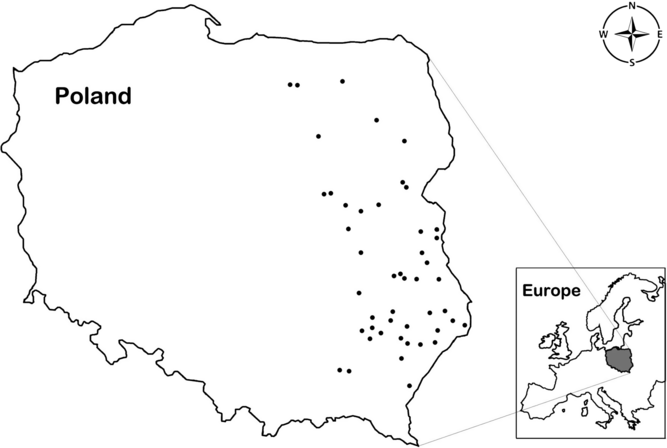
Sampling was conducted in Poland (Fig. 1), a region characterized by high biodiversity, including many rare bird species with high conservation status (Sidlo et al. Reference Sidlo, Błaszkowska and Chylarecki2004).
Locations of sites of collection of liver samples from white-tailed eagles and common buzzards.

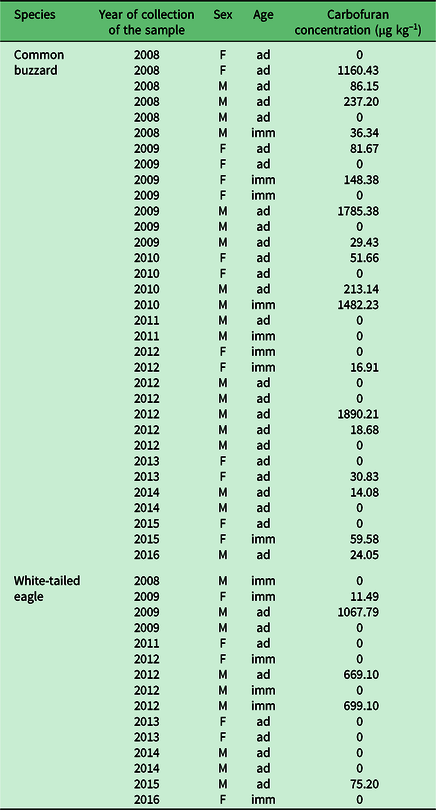
Two sources of data were used in order to detect and quantify the presence of carbofuran in the organs of the raptors. The first source of data was the liver carbofuran concentration determined by liquid chromatography with tandem mass spectrometry (LC-MS/MS) analysis. A detailed description of all analytical procedures used for the detection and quantification of carbofuran in liver samples is provided in Supplementary Appendix S1 (available online). The tissues were sampled from injured or weakened individuals that had died despite intensive veterinary treatment or from birds that had to be euthanized due to non-treatable injuries. Liver samples were collected during necropsy examination of the white-tailed eagles and buzzards. The samples were provided by veterinary clinics or rehabilitation centres. White-tailed eagle liver samples were collected from October to March, while buzzard liver samples were collected from March to June. For each sample, the approximate place of death of the individual as well as its sex and age were determined (Fig. 1 & Table 1). Birds were sexed by internal examination after dissection and classified as immature or adult (over 2 years old) on the basis of their plumage, gonad development and iris colour (Cramp & Simmons Reference Cramp and Simmons1980, Forsman Reference Forsman1999). In total, 48 samples of liver were collected: 15 from white–tailed eagles and 33 from common buzzards (details in Table 1). All liver samples were stored at –20°C until LC-MS/MS analysis. All samples originated from 2008 to 2016, which facilitated tracking of the presence of carbofuran 9 years after its official ban in the EU.
Characteristics of the study materials, including the species, sex and age of the birds and the year of collection of samples. The last column shows the concentrations of carbofuran determined by the liquid chromatography with tandem mass spectrometry analysis.

ad = adult; F = female; imm = immature; M = male.
The other source of data was survey information provided by the Regional Directorates for Environmental Protection (RDEP) – government institutions managing species protection at the regional level. A survey was sent to these institutions in order to determine the number of dead or injured white-tailed eagles and buzzards in their region from 2016 to 2019 and the causes of death of these raptors. An additional question concerned possible toxicological analyses of any of the birds performed during this period and pesticides that were detected in their organs. In total, information about 52 dead white-tailed eagles and 11 dead buzzards was obtained from the RDEP. Toxicological assays (LC-MS/MS analysis) were carried out on three white-tailed eagles and three buzzards. The data provided by the RDEP facilitated tracking of the use of carbofuran over the 3 years from 2017 to 2019.
Results
Carbofuran residues were detected in 18 of the 33 buzzard liver samples and in 5 of the 15 analysed liver samples from the white-tailed eagles; concentrations were in the ranges of 14.08–1890.21 and 11.49–699.10 μg kg–1 of dry matter, respectively (Table 1).
On the basis of the detected concentrations, we divided the results into three groups in terms of the probable degree of carbofuran toxicity to raptors (Table 1): (1) samples with no carbofuran (i.e., carbofuran was not detected by LC-MS/MS analysis) – 25 individuals; (2) samples with non-lethal doses of carbofuran (11.5–237.2 μg kg–1) – 16 individuals; and (3) samples with concentrations >669 μg kg–1 (i.e., high, lethal concentrations of carbofuran) – 7 individuals.
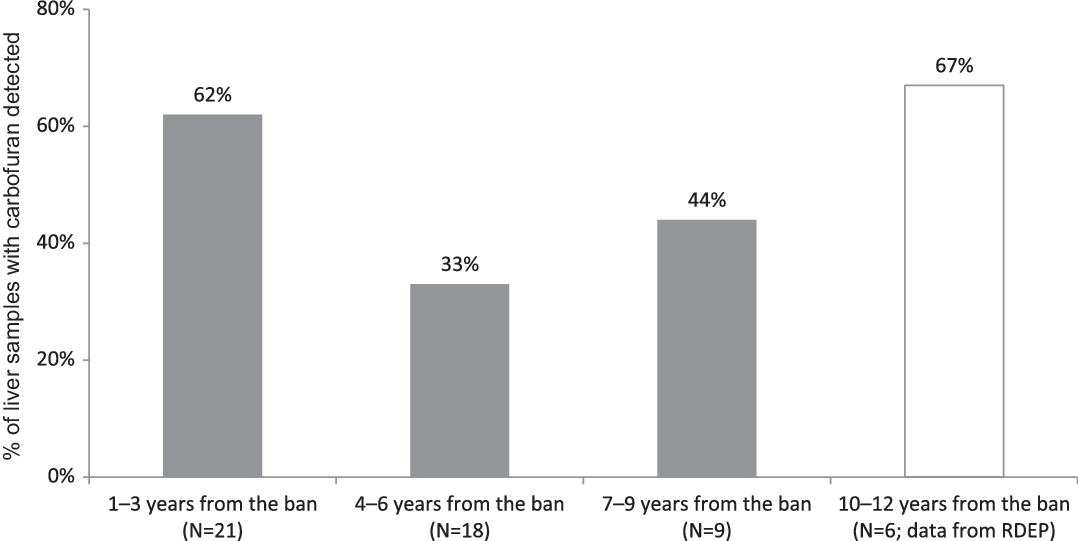
Carbofuran was detected in the liver samples of the analysed raptors throughout 2008–2019. Carbofuran was detected in 62% of the samples in the first 3 years after the introduction of the ban and in 33% and 44% of the samples in the subsequent years (Fig. 2). The RDEP information confirmed the continual use of carbofuran, as it was detected in four of the six samples from 2017 to 2019 (Fig. 2), although this should not be interpreted as an increase in the frequency of carbofuran application in that period. Rather, there were differences between the two methodologies for collection of samples for analysis; the LC-MS/MS samples were collected without taking into account the cause of death of the raptors, while the RDEP usually recommended toxicology assays when there was a suspicion that the bird’s death was caused by poisoning.
Percentage of liver samples with carbofuran detected from 2008 to 2019, divided into 3-year periods: grey columns – data from liquid chromatography with tandem mass spectrometry analysis (2008–2016); white column – data from government administration institutions (Regional Directorates for Environmental Protection (RDEP), 2017–2019). The information provided by the RDEP confirmed the continual use of carbofuran, although this should not be interpreted as an increase in the frequency of carbofuran application in that period (see explanation in the text).

Discussion
This study has shown that legal withdrawal of harmful pesticides from commercial trading may not be effective in practice or its effectiveness may be significantly delayed. Despite the ban on the use of carbofuran being imposed in EU countries over a decade ago, the pesticide is still present in the environment and contributes to the poisoning of protected raptors.
The frequencies of individuals whose liver tissues contained carbofuran shown in the present study (white-tailed eagles, 33%; buzzards, 54%) correspond to the high rates reported in other studies. For example, Hong et al. (Reference Hong, Lin, Walther, Shie and Sun2018) detected carbofuran in 57% of samples derived from the Taiwan black kite (Milvus migrans). Toxicological analyses of 17 poisoned endangered Eurasian griffons (Gyps fulvus) in Croatia showed the presence of carbofuran in the livers of 15 birds (88%; Muzinic Reference Muzinic2007). Inderwildi et al. (Reference Inderwildi, Müller, Ayé and Sinniger2018) reported the presence of carbofuran in 50% of poisoned peregrines in Switzerland. A lower frequency of birds with carbofuran (7% of 28 birds) was found by Molenaar et al. (Reference Molenaar, Jaffe, Carter, Barnett, Shore, Rowcliffe and Sainsbury2017) in red kites (Milvus milvus) in England.
Other important issues are the concentrations of prohibited pesticides detected in indicator species and the knowledge of the metabolism of the analysed substances. Liver sampling is sufficient for the reliable detection of pesticides (e.g., Martínez-Haro et al. Reference Martínez-Haro, Mateo, Guitart, Soler-Rodríguez, Pérez-López, María-Mojica and García-Fernández2008, Thomas et al. Reference Thomas, Mineau, Shore, Champoux, Martin and Wilson2011, Hong et al. Reference Hong, Lin, Walther, Shie and Sun2018). An unquestionable advantage of the liver data is their ability to reflect the current exposure in bird habitats (Becker Reference Becker, Markert, Breure and Zechmeister2003, Garcia-Fernandez et al. Reference Garcia-Fernandez, Calvo, Martinez-López, Maria-Mojica and Martinez2008, Hong et al. Reference Hong, Lin, Walther, Shie and Sun2018). However, the liver has the ability to metabolize carbofuran, and the absence of this pesticide in the liver might be related to its rapid biotransformation (De Lavaur et al. Reference De Lavaur, Carpentier-Le Sech and Prin1991, Lehel et al. Reference Lehel, Laczay, Déri, Dari and Budai2010). Hence, some researchers examining pesticide poisoning analyse the contents of crops (Elliott et al. Reference Elliott, Langelier, Mineau and Wilson1996, Molenaar et al. Reference Molenaar, Jaffe, Carter, Barnett, Shore, Rowcliffe and Sainsbury2017, Richards et al. Reference Richards, Zorrilla, Lalah, Otieno, Fernandez, Calvino and Garcia2017), alimentary tracts (Augspurger et al. Reference Augspurger, Smith, Meteyer and Converse1996, Wobeser et al. Reference Wobeser, Bollinger, Leighton, Blakley and Mineau2004) or stomachs (Tennakoon et al. Reference Tennakoon, Perera and Haturusinghe2009, Hong et al. Reference Hong, Lin, Walther, Shie and Sun2018).
In the present study, both low and high liver carbofuran concentrations were detected. It is relatively easy to interpret the cases of high concentrations: the bird ingested a large dose of carbofuran and intoxication with this pesticide was the direct cause of its death (Anderwald Reference Anderwald2009). In the case of lower concentrations, the bird might have ingested a large but not lethal amount of carbofuran, but the level of the pesticide may have decreased due to metabolism. It is also possible that the bird consumed a small amount of the pesticide with food and the time between the poisoning and liver sampling was short. This issue should be taken into account in the interpretation of low concentrations of carbofuran, as the same value of its current concentration may be associated with different metabolic loads on the raptor. However, even low concentrations of carbofuran in the liver indicate the presence of this substance in the environment.
Literature referring to low, sub-lethal doses of pesticides in birds is rare (e.g., Eason & Spurr Reference Eason and Spurr1995, Butler Reference Butler2014, Hamidipoor et al. Reference Hamidipoor, Pourkhabbaz, Banaee and Javanmardi2015), whereas the tendency to describe cases of fatal poisoning dominates (e.g., Muzinic Reference Muzinic2007, Hong et al. Reference Hong, Lin, Walther, Shie and Sun2018). Interpretation of low pesticide concentrations in some individuals in the present study may suggest a certain often-overlooked issue. Carbamate pesticides disrupt nerve conduction and neuromuscular transmission, as carbofuran is a highly toxic acetylcholinesterase inhibitor (Roberts & Reigart Reference Roberts and Reigart2013). Ingestion of even a small dose of such a substance can disrupt motor coordination and impair sensory organs in raptors (muscle twitching, sensory and behavioural disturbances, incoordination, seizures and depressed motor function), making these birds more susceptible to accidental collisions or injury by other predators. This implies that even low doses of pesticides exerting such carbofuran effects can indirectly increase the mortality of these birds. The present study shows that low pesticide concentrations can be detected in raptor populations more frequently than cases of acute poisoning. However, the metabolic and population consequences of such non-lethal but chronic poisoning (e.g., the impact on fertility or risk of collision-related injuries) are still unknown.
A further question here is the source of poisoning of the raptors. Carbamate pesticides have a short environmental half-life, and ingestion of poisoned food is the most common route of exposure to pesticides (Kwon et al. Reference Kwon, Wee and Kim2004, Hong et al. Reference Hong, Lin, Walther, Shie and Sun2018). Cases of poisoning of white-tailed eagles are most often reported in winter, when these birds change their feeding strategies and eat carrion more frequently due to the depletion of food resources (Nadjafzadeh et al. Reference Nadjafzadeh, Hofer and Krone2013). The birds feed on dead foxes (Vulpes vulpes), which are regarded in Poland as nuisance pests and are controlled illegally with the use of poisoned baits containing pesticides such as carbofuran (Anderwald Reference Anderwald2009). Such intoxication of conflict species and secondary poisoning in raptors has been repeatedly suggested (Wobeser et al. Reference Wobeser, Bollinger, Leighton, Blakley and Mineau2004, Muzinic Reference Muzinic2007, Tennakoon et al. Reference Tennakoon, Perera and Haturusinghe2009, Lehel et al Reference Lehel, Laczay, Déri, Dari and Budai2010, Novotny et al. Reference Novotny, Misik, Honzlova, Ondráček, Kuča and Vávra2011, Reljić et al. Reference Reljić, Srebočan, Huber, Kusak, Suran and Brzica2012, Krone et al. Reference Krone, Auls and Neurath2017). In the case of buzzards, poisoning may occur through a similar mechanism. However, the poisoning being detected throughout the year in this species and not only in winter suggests that small mammals that had previously absorbed carbofuran from areas where it was used to protect crops or from deliberately poisoned baits were a likely source of the intoxication in the buzzards. A less frequent carbofuran source for buzzards may also be small and medium-sized birds living in the agricultural landscape, which are frequent prey of this species (Goszczyński et al. Reference Goszczyński, Gryz and Krauze2005).
The indication is that there has been continual use of environmentally hazardous pesticides over a decade after the introduction of the official ban, and this suggests that it will be difficult to eliminate this practice without intensified international cooperation. After the prohibition of the use of a pesticide, more intensive steps should be undertaken to detect the banned substance at EU border-crossing points if trafficking is probable, and the content of the banned pesticide in crop plants should be intensively controlled in order to deter its use. It would also be advisable to introduce financial incentives to buy the stored prohibited substance back from farmers. Additionally, the public, especially target groups, should be educated about the health and environmental hazards related to the application of banned pesticides and the legal consequences. The presence of prohibited substances in wild indicator animals including predators, such as the present raptors, should be monitored. Only such intensified actions will prevent the non-compliance with introduced bans and the persistent tangible damage to the natural environment caused by pesticides.
Conclusions
In spite of its ban in the EU more than a decade ago, carbofuran still poses a threat to populations of raptors, such as the white-tailed eagle and common buzzard. The negative impact of carbofuran is noted both during the breeding season, when it is still used as a pesticide to protect plants, and during the raptor wintering period, when it is used to exterminate foxes in eastern Poland. Both high, probably lethal and low concentrations were noted in the birds. The low concentrations of the pesticide do not exclude its negative effect as an indirect cause of death and injuries to birds resulting from collisions of birds exhibiting impaired motor and sensory coordination with elements of the environment. Legal measures intended to prevent the presence of the most harmful pesticides following withdrawal from commercial trading may not be effective in practice, or their impact may be considerably delayed. After the introduction of the ban, steps involving control, education and financial incentives should be intensified in order to achieve real elimination of the pesticides from the market as soon as possible. The current absence of coordination of such activities results in the low effectiveness of introduced bans and exerts negative effects on wildlife.
Supplementary material
To view supplementary material for this article, please visit https://doi.org/10.1017/S037689292000034X
Acknowledgements
The authors thank the veterinarians involved in sharing material for the LC-MS/MS analyses. The study was performed with the permission (for the first author) of the Regional Directorate of Environmental Protection in Lublin (WPN.6401.224.2014.1).
Financial support
None.
Conflict of interest
None.
Ethical standards
None.