


Introduction
In the less developed world as a whole, infant and child health and survival is improving steadily, with under-five mortality dropping from 99 per 1000 live births in 1990 to 66 per 1000 live births in 2009. Regrettably, this progress has tended to bypass sub-Saharan Africa, which has continued to record highest levels of, and sluggish decline in, mortality rates, despite recent success stories in a number of countries (Norton, Reference Norton2005; UN, 2011). It is estimated that out of the more than 10 million children who die each year before reaching their fifth birthday, about 90% are in only 42 countries, 36 of which are in the sub-Saharan Africa region (Black et al., Reference Black, Morris and Bryce2003). Numerous studies on infant and under-five mortality in less developed countries indicate that most of the under-five deaths are from preventable causes such as diarrhoea, pneumonia, measles, malaria, HIV and underlying malnutrition. They suggest that substantial reduction in childhood mortality could be achieved by improved coverage of a small number of effective child survival interventions (Bryce et al., Reference Bryce, Black, Walker, Buttha, Lawn and Steketee2005; Fotso et al., Reference Fotso, Ezeh, Madise and Ciera2007; Jones et al., Reference Jones, Steketee, Black, Buttha and Morris2003; Mohan, Reference Mohan2005). While preventive interventions – such as immunization, safe water and sanitation, micronutrient supplement, nutrition counselling, and insecticide-treated bed nets – have been widely promoted in the public health sector (Jones et al., Reference Jones, Steketee, Black, Buttha and Morris2003; Bryce et al., Reference Bryce, Black, Walker, Buttha, Lawn and Steketee2005; World Bank, 2010), a growing body of research and scenario-building points to the critical role of family planning as one of the most cost-effective, high-yield interventions to improve mothers' and children's health and survival (UNDP, 2003; WHO, 2005; Moreland & Talbird, Reference Moreland and Talbird2006; Smith et al., Reference Smith, Ashford, Gribble and Clifton2009).
While the main benefit of contraception for maternal health is through reduction in unintended pregnancies, its main benefit for newborn, infant and child health and survival lies in its potential to lengthen the intervals between successive births, though there are other potential benefits for children of reducing unintended births and avoiding births at higher-risk ages (Cleland & Sathar, Reference Cleland and Sathar1984; Hobcraft et al., Reference Hobcraft, McDonald and Rutstein1983; Boerma & Bicego, Reference Boerma and Bicego1992). The link between preceding interval length and child survival has been known for decades. A systematic review identified 65 published studies that estimated the effect of preceding interval length after adjustment for at least maternal age or parity and socioeconomic status (Rutstein et al., Reference Rutstein, Johnson, Conde-Agudelo and Rosas-Bermudez2005). The most recent and comprehensive analysis used pooled data on over one million births from 52 Demographic and Health Surveys (DHSs) (Rutstein, Reference Rutstein2008). A large number of potential confounders were controlled in multivariate modelling, including intendedness of the child, mother's use of health services and contraception, socioeconomic factors, and maternal age and parity. The adjusted results implied that children born within 24 months of an elder sibling experienced a 60% increased risk of death in infancy while those born within two to three years faced a 10% increase compared with those born after intervals of four to five years. This result is broadly consistent with earlier cross-national studies using similar data sources (Hobcraft et al., Reference Hobcraft, McDonald and Rutstein1985; UN, 1994; Rutstein et al., Reference Rutstein, Johnson, Conde-Agudelo and Rosas-Bermudez2005). With regard to early child mortality (between ages one and five years), most studies show significant adverse effects of short preceding intervals, but they are less pronounced than in infancy.
The effect of short succeeding birth intervals on survival of the child of interest (the index child) has received less attention. Care is needed to circumvent the problem of reverse causality (the death of the index child may be the cause, not the consequence, of a short interval), which arises from the fact that when the index child dies, the succeeding interval is usually short partly because lactational amenorrhoea is shorter. Examination of effects in infancy is impractical because too few conceptions occur early enough in the first twelve postpartum months to affect infant death, but large effects on childhood mortality of short succeeding intervals have been found in cross-national studies, with a doubling of risk between age one and two years and smaller effects at older ages (Hobcraft et al., Reference Hobcraft, McDonald and Rutstein1985; UN, 1994).
These results are commonly ignored in recommendations for improving newborn and child survival, perhaps partly because most of the evidence has been published in non-medical journals (e.g. Friberg et al., Reference Friberg, Kinney, Lawn, Kerber and Odubanjo2010). A more justifiable reason for neglect is that the findings still attract a degree of scepticism, for three main reasons. First, the causal mechanisms are uncertain. In infancy, maternal nutritional depletion, particularly folate deficiency, resulting in impaired fetal growth, is the most plausible mechanism (Hobcraft et al., Reference Hobcraft, McDonald and Rutstein1983; Smits & Essed, Reference Smits and Essed2001). Strong empirical support comes from a systematic review and meta-analysis of 69 studies from both developed and less developed countries on the link between spacing and perinatal outcomes (Conde-Agudelo et al., Reference Conde-Agudelo, Rosas-Bermúdez and Kafury-Goeta2006). Short preceding intervals were associated with enhanced risk of prematurity and low birth weight for gestational age. It also seemed likely that short intervals raised the risk of fetal and early neonatal death, though the small number of relevant studies precluded confident conclusions. Supporting evidence for the maternal depletion hypothesis comes from a study in Matlab, Bangladesh, which showed that preceding intervals starting with a miscarriage or abortion had a less adverse effect on survival of the index child than those that started by a live birth, with the nutritional demands on the mother of full gestation and breast-feeding (Davanzo et al., Reference Davanzo, Hale, Razzaque and Rahman2008). In childhood, competition between closely spaced siblings for limited household resources and maternal attention, or cross-infection, are likely mechanisms but conclusive evidence for either is lacking (Boerma & Bicego, Reference Boerma and Bicego1992).
The second ground for scepticism concerns common causes that might give rise to both short intervals and increased risk of death in infancy or childhood. Breast-feeding is an obvious suspect. Early weaning is associated with short intervals and poses a threat to the survival of the index child, and may thus give rise to a spurious relationship between spacing and mortality. Length of breast-feeding is rarely controlled in multi-country studies. However, the link between short intervals and mortality persisted in several multivariate analyses of single data sets that included a control for breast-feeding (Retherford et al., Reference Retherford, Minja, Shyam and Gubhaju1989; Kuate-Defo, Reference Kuate-Defo1997; Manda, Reference Manda1999). Unmeasured family- or mother-specific factors are a related concern. Allowance for this possibility through random-effects models made little difference to the spacing–mortality association in two studies (Curtis et al., Reference Curtis, Diamond and McDonald1993; Whitworth & Stephenson, Reference Whitworth and Stephenson2002). Some studies have also controlled for gestational age of the index child, though prematurity is more appropriately classified as lying on the causal pathway between short intervals and infant health than as a confounder (Wolfers & Scrimshaw, Reference Wolfers and Scrimshaw1975; Pebley & Stupp, Reference Pebley and Stupp1987; Miller et al., Reference Miller, Trussell, Pebley and Vaughan1992). The spacing–mortality relationship has proved remarkably robust and it thus seems unlikely that it is spurious.
The third source of doubt relates to the almost exclusive reliance on retrospective surveys, in which mothers are asked for dates of birth (or ages) of all children, their survival and age at death. Of the 65 studies identified in the systematic review by Rutstein and colleagues (Reference Rutstein, Johnson, Conde-Agudelo and Rosas-Bermudez2005), 62 were based on retrospective maternity histories. Such histories suffer from two types of error that might bias estimates of the association between birth spacing and child survival: omission of dead children and misdating of births. Omission of dead children is considered rare in DHSs and similar surveys (Pullum, Reference Pullum2006), and even when it does occur it is more likely to dilute the association than inflate it, because dead children who are closely spaced are probably more prone to omission than others. Misdating of births is a more pervasive defect (Potter, Reference Potter1988). Moreover, the birth dates of children who have died are less likely to be recalled with precision by mothers and more likely to be displaced backwards in time than those of surviving children (IRD, 1990; Curtis, Reference Curtis1995; Pullum, Reference Pullum2006). This type of error moves the birth date of dead children closer to the birth date of any older sibling and thus biases estimates of birth interval effects.
Other data sources are unlikely to suffer from systematic backwards transfer of birth dates of children who have died and therefore have a special value as a check on the validity of findings based on retrospective data. By extending the systematic review by Rutstein and colleagues (Reference Rutstein, Johnson, Conde-Agudelo and Rosas-Bermudez2005) and relaxing the eligibility criteria, a total of eighteen studies were identified that used registration data, ecclesiastical data for historical populations, or prospective cohort or surveillance data to assess the effect of intervals on child survival. Of these eighteen, only four were conducted in sub-Saharan Africa. All four studied high-fertility rural populations. Two found the expected adverse effect of short intervals and two did not. In an early study in western Nigeria, no difference in the mean preceding interval length was found between index children who died in infancy or early childhood and those who survived (Doyle et al., Reference Doyle, Morley, Woodland and Cole1978). In Machakos, Kenya, no effect of a short preceding interval on the survival or growth of the index child was found. Because of the small number of deaths, effects of short succeeding intervals were difficult to establish but there were suggestions of enhanced risk of death (Boerma & Van Vianen, Reference Boerma and Van Vianen1984). Ronsmans (Reference Ronsmans1996) utilized longitudinal data on rural Senegalese children born between 1983 and 1989. Results from both logistic and Cox proportional hazards regression models found that a short preceding interval of less than one year increased the risk of neonatal, and to a lesser extent post-neonatal mortality, but intervals of one to two years had no effect. A short subsequent interval of less than two years was associated with a four-fold increase in the risk of mortality in childhood. The fourth sub-Saharan African study used surveillance data from Burkina Faso and found that a preceding interval of less than 18 months raised the risk of infant death by 36% but had no effect in childhood. The study found a slightly stronger effect of a succeeding interval of less than 18 months on mortality between ages one and five years (Becher et al., Reference Becher, Muller, Jahn, Gbangou, Kynast-Wolf and Kouyaté2004).
Two conclusions are clear from this sketch of the literature. First, while the overwhelming body of evidence from retrospective data sources points to a strong adverse effect of short intervals on child survival, supporting evidence from prospective data sources is weaker, at least for sub-Saharan Africa. Not only is the number of such studies small, but results are inconsistent, and even the Senegal and Burkina Faso investigations only examined the effect of very short preceding intervals of less than 12 and 18 months, respectively. As such short intervals are rare, the public health implications of their findings are minor. Second, no study has investigated the spacing–mortality relationship in urban Africa, using prospective data.
These considerations provide the motivation for this paper. The aim is to make a significant contribution to the body of evidence by assessing the effect of preceding and succeeding interval lengths in a poor urban population using demographic surveillance data from informal settlements in Nairobi. The specific objectives are to: investigate the relationships between the length of preceding birth interval and infant and early childhood mortality between 12 and 23 months; and examine the impact of succeeding birth interval length on early childhood mortality.
Why focus on the urban poor?
According to the United Nations, sub-Saharan Africa is soon to be predominantly urban. In a country like Nigeria – the most populous country in Africa – this milestone is estimated to have been reached in 2010. The proportion of Nigerians living in cities rose from about 16% in 1960 to more than 35% in 1990 and nearly 50% in 2010, and it is projected that by 2050, more than three Nigerians out of four will be living in an urban area (UN, 2010). This explosion of urban populations in a context of poor economic development and governance has resulted in unprecedented growth of slums and unplanned settlements on the periphery of most African cities (Brockerhoff, Reference Brockerhoff2000; Cohen, Reference Cohen2004; Mercado & Havemann, Reference Mercado and Havemann2007). Kenya's capital city typifies the current urban population boom and associated urban health and poverty problems. Its population increased from about 120,000 in 1980 to about 4 million in 2009 (KNBS, 2009), with over 60% of the population living in slums that cover only 5% of the city's residential land area (CBS, 2005). In this context of growing urban poverty, newly assembled evidence indicates that the urban advantage in health and well-being is being eroded and that in countries like Kenya, rates of child malnutrition and mortality are higher in slums and peri-urban areas than in more privileged urban neighbourhoods, and even than in rural areas (Gould, Reference Gould1998; APHRC, 2002; Fotso, Reference Fotso2006). Evidently, failing to target the rapidly growing population of the urban poor may result in lack of progress towards the health Millennium Development Goals (MDGs).
Data and Methods
Data from the Nairobi Urban Health and Demographic Surveillance Site (NUHDSS) were used. The NUHDSS collects data continuously in the surveillance site through the year, with all households visited every 4 months. Information collected includes births, deaths and in- and out-migration episodes. The surveillance site covers two informal settlements of Nairobi, Kenya – namely, Viwandani and Korogocho – and is run by the African Population and Health Research Centre (APHRC). It covers a total population of about 71,000 individuals from nearly 28,500 households (Emina et al., Reference Emina, Beguy, Zulu, Ezeh, Muindi, Elung'ata, Otsola and Yé2011). These two densely populated informal settlements are both characterized by high unemployment and poverty levels, crime, poor sanitation and general poor health indicators when compared with Nairobi as a whole (APHRC, 2002). The two communities, however, exhibit structural differences: Viwandani is bordered by an industrial area, and attracts migrants with relatively higher education levels, while the population in Korogocho is more stable and has a higher proportion of cohabiting couples. As a result, Viwandani has been shown to have better health outcomes than Korogocho (APHRC, 2002; Emina et al., Reference Emina, Beguy, Zulu, Ezeh, Muindi, Elung'ata, Otsola and Yé2011; Faye et al., Reference Faye, Falkingham, Baschieri and Muindi2011; Fotso et al., Reference Fotso, Madise, Baschieri, Cleland, Zulu, Mutua and Essendi2012).
As in other Nairobi slums, the public provision of maternal and child health services is very limited. As a consequence, residents mainly rely on traditional birth attendants and sub-standard, private-for-profit facilities that are often unlicensed (Essendi et al., Reference Essendi, Mills and Fotso2011). A large proportion of women living in the study area run the risk of early postpartum pregnancy because of low or delayed use of modern methods of contraception (Ndugwa et al., Reference Ndugwa, Cleland, Madise, Fotso and Zulu2011). As a result, total fertility is estimated at around 3.4 in the study area (Emina et al., Reference Emina, Beguy, Zulu, Ezeh, Muindi, Elung'ata, Otsola and Yé2011), slightly higher than in Nairobi as a whole or urban Kenya (about 2.9), as reported in the 2008/09 Kenya DHS. As expected, infant and children from the area exhibit poor health. For example, the prevalence of stunting reaches nearly 60% among children aged 15–17 months, and remains almost constant in the subsequent age groups (Fotso et al., Reference Fotso, Madise, Baschieri, Cleland, Zulu, Mutua and Essendi2012).
Data
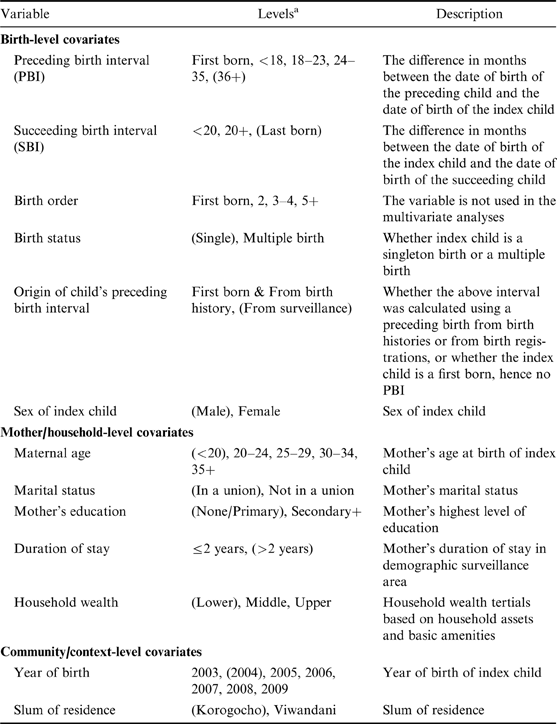
This study includes data from seven years of study (2003 to 2009). Despite the NUHDSS being operational since 2002, births in 2002 were excluded in order to reduce the reliance on preceding birth interval lengths that were computed from mothers' retrospective reports. Further, source of preceding child's birth date (retrospective or surveillance) was controlled for in the regression analysis so as to further minimize any possible bias. To avoid possible under-reporting of vital events, births occurring in the year 2010 were also excluded since on average it takes about a year for the NUHDSS to update births and deaths. For the purpose of this paper all births were considered, whether single or multiple births that were registered in the NUHDSS as being born to mothers who were current residents of the surveillance area. Table 1 presents a description of all the covariates used in the analysis and a brief description of how they were defined and computed.
Description and definition of variables used in the study

a Reference categories in parentheses.
As few children in the analysis had been exposed to the risk of mortality after the age of 2 years, the outcomes of interest in this paper are infant mortality and early childhood mortality between 12 and 23 months. The key predictor is the preceding birth interval (PBI), defined as the difference in months between the date of birth of the index child and the date of birth of the preceding child. It is coded as a five-category variable (first born, <18 months, 18–23 months, 24–35 months, 36+ months). In addition, the effect of succeeding interval length on mortality between age one and two years is examined. Succeeding interval length, defined as the difference in months between the date of birth of the succeeding child and the date of birth of the index child, was represented by three categories: <20 months, 20+ months and last born. The choice of 20 months ensured that the conception of the younger sibling occurred when the index child was still alive, thus circumventing the problem of reverse causality, namely that the death of the index child was responsible for early conception of a subsequent child. Results for the category 20+ months will be ambiguous because some younger siblings will have been conceived before the death of the index child and others after. Thus interpretative emphasis will be on the difference in mortality between the other two categories.
A number of control variables at the birth/child, mother/household and community/context levels have been included in the analyses, as listed in Table 1. At the birth/child level, sex and birth status (single or multiple) were controlled for, all shown by other studies to be associated with newborn, infant and child mortality. The birth order was excluded from the multivariate analysis for two reasons: it did not exhibit any association with mortality in the descriptive analysis, and more importantly, it tends to be highly correlated with mother's age. Mother/household specific confounders include marital status, mother's education and her duration of stay in the informal settlements – used as a proxy for duration of exposure to the adverse effects of environmental conditions in these settlements – and household wealth constructed using household asset ownership and housing characteristics. Finally, the analyses control for slum of residence (Viwandani or Korogocho – given the socioeconomic differences of the two sites), and the year of birth of the index child. About 15% of observations had missing household wealth data. These values were imputed using the STATA add-on for imputation by chained equations (ICE) procedures (Royston, Reference Royston2005). The following variables were used in the imputation equations: neighbourhood where the household is located; mother's marital status, age, education and parity at the time of the first interview; household size; slum of residence; and the values of poverty measures for the preceding and/or the following time point. The few missing values for mother's education and marital status (less than 5%) were also imputed using the same procedure.
The survival status of preceding children was also considered (whether they were alive at the estimated conception date of the index child) but the inclusion of this factor made no difference to the results, probably because of the small number of deaths, and it was therefore omitted. Possible interactions between sex of preceding and index children were explored but no significant effects were found. Other possible confounders were unavailable. These include wantedness of the index child, health care utilization by the mother before and at birth of the index child, and breast-feeding.
Methods of analysis
Mortality rates were calculated using the stptime command in STATA® 10 employing person-time data. The quality and precision of the dates of birth and dates of death, as well as dates of other key exposure indicators such as out-migrations, exits and re-entries, determined the type of analysis. Mortality rates were computed using person-years, and their bivariate association with the key predictor and the control variables produced. Kaplan–Meier (K–M) survival curves were also generated, with focus on the preceding birth intervals.
Non-parametric K–M survival curves were used to explore the data and assess the fitness of the choice of Cox proportional hazard model for the multivariate analysis. The Cox models were fitted using the index child's age as the timing variable and death of child as the censoring variable. The hazard of mortality at any point in time t is given as:
 $$h(t | X) = h(t) \exp \sum^p_{i=1} X_i \beta_i$$
where h(t) is the baseline hazard, which represents the probability of the child dying before any exposure to X.
All Cox models were tested for proportionality assumptions and only one covariate (succeeding birth interval) marginally failed to satisfy the assumptions of proportional hazards. This test was performed using the Schoenfeld test of proportionality, a re-estimation procedure using residuals of the Cox proportional hazard model. The multivariate analyses were carried out through three models. Model 1 includes the key predictor (preceding birth interval) coded as a categorical variable and three related covariates: origin of the PBI, succeeding birth interval and single/multiple births. Model 2 adds to Model 1 the remaining covariates at the child, mother, household and community levels. Model 3 is similar to Model 2, with PBIs defined as a continuous variable (in years), and its square included. Restricted to non-first births, this model is designed to allow the estimate of the effects of each additional year of PBI on infant and child mortality rate.
Results
Sample characteristics and descriptive results
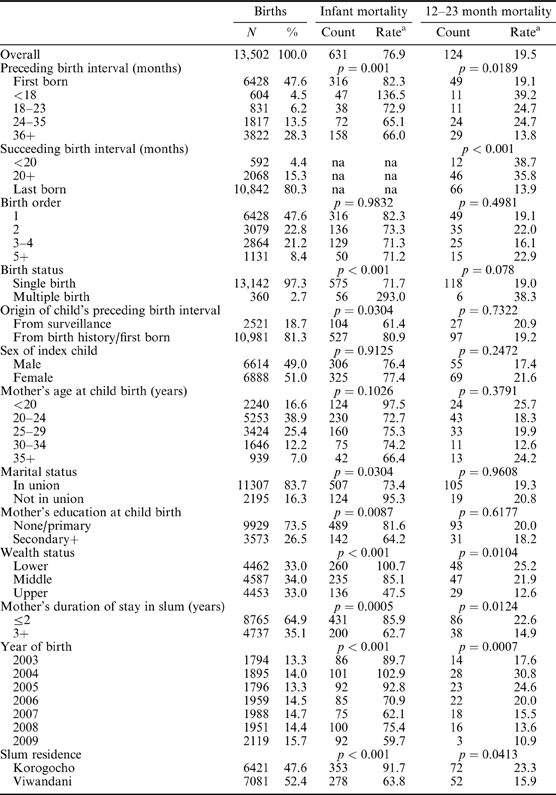
The characteristics of the 13,502 births that took place in the study area between 2003 and 2009 are presented in Table 2. As can be seen, nearly 48% were first births, a reflection of the low fertility and young age structure of the population. Of the remainder, about 9% (604 out of the 7074 non-first births) were born within 18 months of an older sibling, and 12% (831 out of 7074) within 18–23 months. Noticeable is the relatively high proportion of births with a PBI of 36 months or longer among second and higher order index births (54%: 3822 out of 7074). The preceding birth occurred outside the surveillance area in 64% of non-first births (2521 births out of 7074 were from the surveillance area) and thus the interval length was computed from retrospective reports. All index children were born in the slum and their dates of birth were derived from the surveillance system. Less than 5% of births had a succeeding birth interval (SBI) of 20 months or shorter, a small proportion that reflects the fact that, in this low-fertility population, many children will be last born. The proportions of birth order 2 and birth order 3–4 are almost similar (around 22%), and the prevalence of multiple births stands at less than 3%. Sex ratio at birth in the study area is 96 males for 100 females. A large proportion of births were from mothers aged less than 25 years (56%), in union (84%), with no or primary education (74%), and who had stayed less than three years in the study area (65%). Births are quite evenly distributed by year.
Births and mortality rates among the urban poor in Nairobi, Kenya, by selected covariates, 2003–2009
a Rates are computed using person-years.
na, not applicable.
Table 2 also shows the bivariate association of PBI and other covariates with infant and 12–23 month mortality rates. Births with PBIs shorter than 18 months have the highest infant mortality rate (136.5), followed by first births (82.3) and births with PBI of 18–23 months (72.9). Births with PBI of 24–35 months and 36 or more months have almost the same mortality rate of 65. Noticeably, birth orders 2, 3–4 and 5+ are associated with a similar infant mortality rate. The risk of death in early childhood, between 12 and 23 months, declines monotonically with length of the PBI. Likewise, a short SBI is associated with increased mortality risk in early childhood. Infant mortality and early childhood mortality trajectories by PBI are depicted in Fig. 1.
Kaplan–Meier survival functions for infant and 12–23 month mortality by preceding birth intervals (PBI).

Multivariate analysis of birth intervals and infant mortality
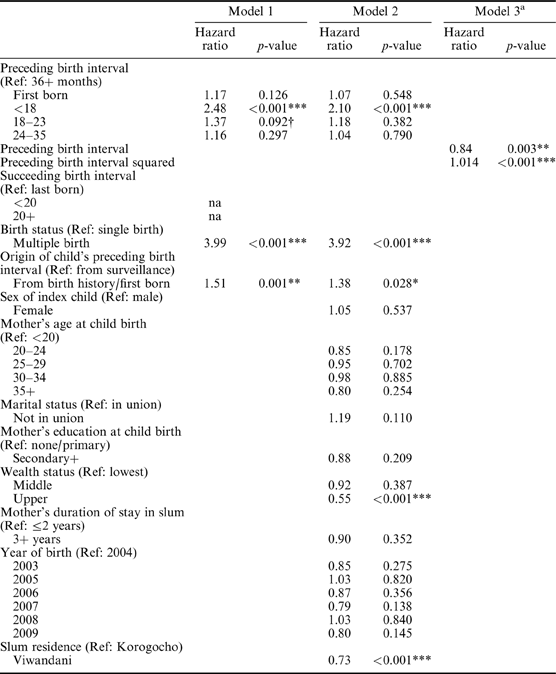
The results of the hazard models on the determinants of infant mortality are shown in Table 3. In Model 1, the (partial) effect of PBI is strong, with infants who have a very short PBI (less than 18 months) dying at a rate that is about 2.5 times higher than their counterparts with PBI of 36 months or longer (p<0.001). Compared with children whose PBI is 36 months or longer, those with a short PBI length (of 18–23 months) have an infant mortality rate that is approximately 37% higher (p<0.10). First births and infants with PBI of 24–35 have similar mortality hazard ratios and do not significantly differ from their counterparts with PBI of 36 months or longer. Infants whose preceding sibling was born outside the study area have increased mortality risk (p<0.01). Not surprisingly, multiple births (twins and triplets) have a mortality rate about 4.0 times higher than single births (p<0.001). In Model 2, which includes all covariates, the excess mortality associated with very short PBI remains large (p<0.001), while that associated with PBI of 18–23 months is statistically insignificant. The effect of origin of PBI is slightly reduced but remains significant (p<0.05). The hazards ratios associated with first birth and interval of 24–35 months are almost identical to the mortality risk associated with interval 36 months or longer.
Results of Cox proportional hazards models (hazard ratio and p-value) on the determinants of infant mortality among the urban poor in Nairobi, Kenya, 2003–2009
a Model 3 uses PBI as a continuous variable. It includes all covariates as in Model 2 (coefficients not shown).
†p<0.10; *p<0.05; **p<0.01; ***p<0.001.
As reported in Model 3, PBI modelled as a continuous variable (in years) is significantly associated with infant mortality, with hazard of infant mortality rate dropping by about 16.3% for every one year increase in the length of PBI (p<0.01).
Multivariate analysis of birth intervals and 12–23 month mortality
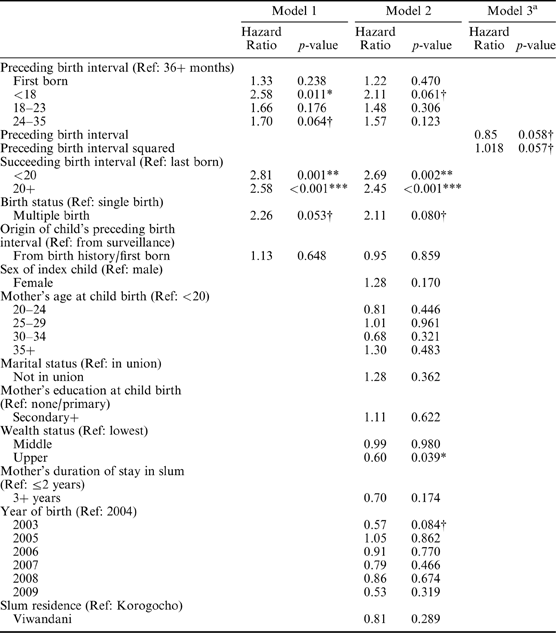
It is apparent in Table 4 that the effects of PBI on mortality in the second year and on infant mortality (as reported in Table 3) are similar in size, though the degree of statistical significance is lower for early childhood mortality. In Model 1, the risk of dying in early childhood is about 2.6 times higher among children with very short PBI (less than 18 months), compared with those with PBI of 36 months or longer (p<0.05). While there is almost no mortality difference between short PBI (18–23 months) and PBI of length 24–35 months, the latter is associated with statistically significant excess early childhood mortality, compared with children with PBI of 36 months or longer (p<0.10). Index children who experience the birth of a younger sibling within 20 months have a mortality rate that is nearly 2.8 times higher than last births (p<0.001). Even after surviving up to 12 months, multiple births continue to experience a mortality rate that is 2.3 times higher than single births (p<0.10). In contrast to infant mortality, the origin of PBI is not significantly associated with mortality in the second year. The results change only marginally in the full model (Model 2).
Results of Cox proportional hazards models (hazard ratio and p-value) on the determinants of early childhood mortality among the urban poor in Nairobi, Kenya, 2003–2009
a Model 3 uses PBI as a continuous variable. It includes all covariates as in Model 2 (coefficients not shown).
†p<0.10; *p<0.05; **p<0.01; ***p<0.001.
The results in Model 3 suggest that for children surviving up to 12 months, the hazard mortality rate is reduced by 14.5 (1–0.855)% for every one year increase in the length of PBI (p<0.10).
Other determinants of infant and 12–23 month mortality
As shown in numerous other studies in sub-Saharan Africa, these results confirm the absence of significant sex-differentials in mortality. While the sex difference is negligible for infant mortality, females tend to record higher early childhood mortality, but the difference is not statistically significant (see Model 2 in Tables 3 and 4). Infants born to mothers in union tend to have lower infant and early childhood mortality than those born to single mothers, but the difference is not statistically significant at the level of 10%. A similar pattern can be observed in the effect of mother's length of residence in the study area, with children born to mothers who have stayed three years or longer in the study site having infant and early childhood mortality rates that are lower than the rates for mothers who have been in the area for two years or less, but the difference does not reach statistical significance, despite a large difference of 30% for early childhood mortality. The data also show an overall declining trend in infant mortality over the years; the upsurge observed in 2008 may be explained by the civil strife that followed the December 2007 elections in Kenya. An overall decline in mortality between 12 and 23 months is also apparent, though the year 2005 recorded a higher rate compared with 2003.
Household wealth is a strong predictor of infant mortality, and to a lesser degree, of mortality between 12 and 23 months. Children from poorest households have an infant mortality rate that is about 83% higher than the rate of their counterparts from the upper economic class (p<0.001). After infancy, their mortality rate is 66% higher (p<0.05). Finally, while mother's education, and to some extent mother's age at birth, are not significantly related to the risk of death in the first or second year, the slum of residence emerges to be a strong predictor of infant mortality, with births from Korogocho recording an infant mortality rate about 37 (1/0.728)% higher than those from Viwandani (p<0.001 in Table 3). For child mortality, the difference is in the same direction but is not statistically significant at the level of 10%.
Discussion
The central aim of this paper was to re-assess the spacing–child mortality relationship using data that are largely prospective rather than totally retrospective. While prospectively collected information is not immune from errors of omission, the dating of vital events is almost certainly superior to that which relies on the mother's memory over the past 10 or 15 years. As outlined in the introduction, only four relevant studies using prospective data from sub-Saharan Africa have been published and their findings are conflicting. Moreover, all four studies related to high-fertility rural populations, whereas the analyses reported in this paper are based on a lower fertility population living in slum conditions.
Because of low fertility and the youthful age structure of those living in Nairobi's informal settlements, nearly half the births recorded in the two study areas were first born. Among the remainder, short preceding intervals are common: 20% of second and higher order births were delivered within 24 months of an elder sibling, including 9% with a very short preceding interval of less than 18 months. Even after adjusting for a range of possible confounding factors, this longitudinal analysis among the urban poor in Nairobi, Kenya, demonstrates that the length of the preceding birth interval is a major determinant of infant and early childhood mortality. In infancy, a preceding birth interval of less than 18 months is associated with a two-fold increase in mortality risks (compared with lengthened intervals of 36 months or longer), while an interval of 18–23 months is associated with an increase of 18%. However, little further advantage is conferred by intervals of 24–35 months. Among non-first births, infant mortality risks would decrease by 16.3% for each additional year of increase in PBI. During the early childhood period, children born within 18 months of an elder sibling are more than twice as likely to die as those born after an interval of 36 months or more. The mortality gap between short interval (18–23 months) and lengthened birth interval does not reach statistical significance, but is nevertheless apparent. Further, an increase of one year in preceding birth interval is estimated to result in a reduction of 14.5% in early childhood mortality among second and higher order births. Succeeding intervals of less than 20 months were uncommon but associated with a 245% increase in early childhood mortality, compared with last births. Davanzo et al. (Reference Davanzo, Hale, Razzaque and Rahman2008) find a significant deleterious effect on childhood mortality of the woman becoming pregnant again before the index child's first birthday. One major limitation of this analysis is that it was not possible, because of limited exposure, to assess the effects of child spacing beyond the age of two years, though this will become possible in the future.
The magnitude of the effects of the preceding interval length on infant mortality, and the effect of succeeding interval length on mortality in the second year, are consistent with the results of many studies derived from retrospective data and thus act to support their validity. The still large effect of preceding interval length on mortality between ages 12 and 23 months is perhaps more surprising because most studies have found smaller effects in childhood than in infancy, though it is consistent with the pooled analysis of 52 DHSs (Rutstein, Reference Rutstein2008). This result suggests that competition for scarce household resources, in this very poor population, may be a more important pathway of influence than maternal depletion. Other studies conducted in the same communities reported high levels of undernutrition among infants and children and pervasive food insecurity, with only one household in five categorized as food-secure (Faye et al., Reference Faye, Falkingham, Baschieri and Muindi2011; Fotso et al., Reference Fotso, Madise, Baschieri, Cleland, Zulu, Mutua and Essendi2012).
Non-last birth children who experience the birth of a younger sibling within 20 months are more than twice as likely to die in the second year compared with last borns, though their mortality experience does not differ significantly from that of their counterparts with SBI of 20 months or longer. The early advent of a succeeding child introduces competition for attention and care and it is likely that the older child loses parental attention and is left to the care of others. A study by Manda (Reference Manda1999) showed that breast-feeding status does not significantly modify the effect of PBI on infant and child mortality risks, but does partially reduce the effect of SBI. In the study area, exclusive breast-feeding for the first 6 months was rare (only about 2% of infants); more than a third (37%) were not breast-fed in the first hour following delivery; and 40% were given something to drink other than the mothers' breast milk within 3 days of delivery (Kimani-Murage et al., Reference Kimani-Murage, Madise, Fotso, Kyobutungi, Mutua, Gitau and Yatich2011). As found for infant and child undernutrition (Fotso et al., Reference Fotso, Madise, Baschieri, Cleland, Zulu, Mutua and Essendi2012), poverty appears to be a strong determinant of mortality, despite the fact that most of the children are exposed to similar environmental conditions such as poor sanitation and overcrowding. Prior research in these two slums has identified strong and statistically significant differences between the two sites, with Korogocho having poorer health and socioeconomic outcomes compared with Viwandani (Faye et al., Reference Faye, Falkingham, Baschieri and Muindi2011; Emina et al., Reference Emina, Beguy, Zulu, Ezeh, Muindi, Elung'ata, Otsola and Yé2012; Fotso et al., Reference Fotso, Madise, Baschieri, Cleland, Zulu, Mutua and Essendi2012). The present results also confirm that children born in Korogocho have higher hazards of mortality than those born in Viwandani. This difference, together with the strong effects of household wealth, testifies to the considerable diversity of health and survival among Nairobi's slum dwellers.
Mother's duration of slum residence does not significantly affect infant and early childhood survival, though children whose mothers have lived in the slum longer tend to have better survival chances compared with their counterparts born to recent in-migrants (the difference is not statistically significant). This result is in contrast with evidence of the shocking disadvantages that confront a new migrant to the slums (Bocquier et al., Reference Bocquier, Beguy, Zulu, Muindi, Konseiga and Ye2011; Zulu et al., Reference Zulu, Beguy, Ezeh, Bocquier, Nyovani, Cleland and Falkingham2011), with mothers adapting to the slum environment, establishing social networks of support and becoming more familiar with sources of effective health care over time.
Conclusions
The findings from this analysis lend support to the importance of revitalizing birth spacing as a child survival intervention – especially in sub-Saharan Africa where levels of unmet need for birth spacing and failure to avoid mistimed pregnancies remain unacceptably high – and concur with other studies that the prevalence of unintended pregnancy needs to be markedly reduced in order to achieve the child and maternal health MDG (Cleland et al., Reference Cleland, Bernstein, Ezeh, Anibal, Anna and Jolene2006; Gipson et al., Reference Gipson, Koenig and Hindin2008; Singh et al., Reference Singh, Sedgh and Hussain2010). Recently, both the US Agency for International Development and World Health Organization have changed the recommendation on birth spacing from a two-year to a three-year interval between births (USAID, 2002; WHO, 2005). The results of this study support this change. Birth spacing can make a particularly important contribution to child survival in sub-Saharan Africa because fertility remains high and thus the majority of children have both older and younger siblings, thereby exposing them in childhood to the double jeopardy of short preceding and succeeding intervals. Moreover, in contrast to most Asian and Latin American countries, deaths after infancy remain common, accounting for between 30 and 50% of all under-five deaths. The reproductive culture in this region is conducive to an emphasis on contraception for birth spacing because of the traditional importance attached to ensuring wide gaps between children and a much larger proportion of contraceptive users are motivated by spacing or postponement of pregnancies, rather than limitation, than in other less developed regions (Westoff, Reference Westoff2010).
Acknowledgments
The authors acknowledge the financial support from the Hewlett Foundation through the INDEPTH Network on the project Fertility, Family Planning, Child Health and Survival, and Household Economic Outcomes: What Can We Learn from the Nairobi Urban Health and Demographic Surveillance System? and from the Bill & Melinda Gates Foundation through the project Measurement, Learning and Evaluation (MLE) of the Urban Reproductive Health Initiative (URHI). Both grants funded the time of the authors from APHRC. The authors thank Dr Donatien Beguy for his contribution to data management and the identification of the appropriate analysis methods. They are also grateful to Dr Eliya Zulu and Dr Ivy Kodzi for their lead roles in the projects that identified the relevance of the topic investigated in this paper. They also thank Ms Rhoune Ochako and Ms Carol Mukiira (both from APHRC) for proofreading the last version of the manuscript.


 Open access

