Implications
Our method of identifying and understanding livestock farming management strategies enables inclusion of the meaning that farmers attribute to management. It appears that the strategies that farmers devise and develop result from a compromise between activities they should do, activities they would like to do and activities they do not accomplish. From an operational viewpoint, this approach should help advisors visualise livestock management strategies as envisaged by beef-cattle farmers, as this is key in assisting farmers with change. Thus, the ranking of livestock production dimensions according to the type of mastery sought, categorisation of underlying motivations and identification of management guidelines can be tools for advisors to identify farmers’ views, possible obstacles to change and potential difficulties encountered in livestock management.
Introduction
It is well established that under similar production conditions, technical and economic performance can differ considerably among farmers (Rougoor et al., Reference Rougoor, Trip, Huirne and Renkema1998; Hansson, Reference Hansson2007). The human component of farming systems plays an important role in management practices, and this fuller representation of farmer behaviour and motivation is crucial for understanding differences in management practices and performances across farms (Solano et al., Reference Solano, León, Pérez, Tole, Fawcett and Herrero2006). In particular, it plays an important role in determining whom farmers approach for information or help and the technology they adopt (Solano et al., Reference Solano, León, Pérez, Tole, Fawcett and Herrero2006). Thus, for advisors who want to understand failures of some of their services or technical messages among particular farmers, as well as to design advice that accommodates differences in farm management among farmers, it is essential to have tools that illuminate farmers’ management strategies.
Considerable research has focussed on predicting the influence of farmer and farm characteristics (usually biographical and structural, respectively) on technology adoption rates and use, farm management and performance (Solano et al., Reference Solano, León, Pérez, Tole, Fawcett and Herrero2006). Nevertheless, a more comprehensive approach towards the human component of the farming system is required, which includes farmers’ economic and technical orientations, decision-making approaches and information preferences (Solano et al., Reference Solano, León, Pérez, Tole, Fawcett and Herrero2006). Such research on livestock farming systems has been conducted by focussing on characterising and understanding the diversity of farmers’ management strategies (Gibon et al., Reference Gibon, Rubino, Sibbald, Sorensen, Flamant, Lhoste and Revilla1996; Girard et al., Reference Girard, Bellon, Hubert, Lardon, Moulin and Osty2001; Fiorelli et al., Reference Fiorelli, Dedieu and Pailleux2007) or farming styles (Van der Ploeg, Reference Van der Ploeg1993; Brodt et al., Reference Brodt, Klonsky and Tourte2006). Many of these studies have developed classification systems to describe this diversity, but such systems may not be practical for advisors who want to identify an individual livestock farmer's management strategies. Moreover, these studies usually deal with management strategies to address a problem predefined by the researcher in a particular dimension of livestock production (e.g. feeding, reproduction, animal health). Although classification systems provide better understanding of management strategies within a specific dimension, they do not encompass all management strategies and do not identify farmer priorities, which is all the more crucial in a production context marked by uncertainty and change. Indeed, farmers try less to reach a specific level of quantitative performance than to control, as best they can, the various dimensions of livestock farming to ensure their farms’ survival (Dedieu and Ingrand, Reference Dedieu and Ingrand2010).
The objective of this study was to present an approach that can be used to obtain a more comprehensive view of beef-cattle farmers’ management strategies and to identify and understand those of an individual farmer. We first present the research protocol we used. We then present how beef-cattle farmers ranked the different dimensions of livestock farming they have to manage, the underlying motivations and the management guidelines, which structure their ranking. We finally discuss these main results and how our approach can be used for advisory work.
Material and methods
Analysis framework
Our research is based on three related key concepts and incorporates farming system management (Keating and McCown, 2001). A livestock farming management strategy enables understanding of observed livestock farming operations (Hubert et al., Reference Hubert, Girard, Lasseur and Bellon1993). According to Rougoor et al. (Reference Rougoor, Trip, Huirne and Renkema1998), farm management is defined simply as ‘using what you have to get what you want’. This definition stresses that setting priorities and allocating resources accordingly is a basic condition for farmers to perform effective farm management. A farmer, as a manager, generates an overview of the dimensions he should address and then chooses which is most valuable for investing material (e.g. money, work) and immaterial (e.g. information, skills) resources. An agricultural advisor may not consider the management priorities, which a farmer establishes as efficient or sufficiently relevant, and such differences in opinion can explain the farmer's refusal to adopt advisory recommendations.
On the basis of this framework, we identified three main concepts to render operational the underlying definition of ‘the set of objectives and management guidelines’ characterising livestock management strategies according to Gibon et al. (Reference Gibon, Rubino, Sibbald, Sorensen, Flamant, Lhoste and Revilla1996). These concepts are:
• mastery farmers seek while managing their farms, which refers to activities farmers can and want to do for their farm to survive, rather than activities they plan to do to optimise performances;
• dimensions of livestock farming, the mastery of which farmers identify as crucial for farm survival. Management sciences suggest analysing the strategy of a business by segmenting it into strategic activities. These are defined as ‘sub-assemblies of an organisation to which it is possible to allocate or from which to withdraw resources autonomously and which correspond to specific combinations of the key factors for success’ (Johnson et al., Reference Johnson, Scholes, Whittington and Fréry2008). Drawing upon this work, we segmented the livestock farming system into dimensions (sub-assemblies) that farmers decide need to be mastered to ensure farm survival. To this extent, our approach is grounded in research on farm resilience rather than in farm competitiveness. Therefore, mastery refers to the use of physical (e.g. milking machinery) and information (e.g. sire registers) resources, which achieve the objectives that farmers have assigned to a specific dimension.
• ranking of dimensions according to the importance farmers assign to their mastery, which refers to the priorities established by farmers (Rougoor et al., Reference Rougoor, Trip, Huirne and Renkema1998). Identification of the dimensions, their ranking and the reasons for the ranking constitute what Gibon et al. (Reference Gibon, Rubino, Sibbald, Sorensen, Flamant, Lhoste and Revilla1996) call the farming management strategy, for example, a set of farming objectives (motivations) and management guidelines (which structure the dimensions on which decisions and actions are made).
Farming system sample and data collection
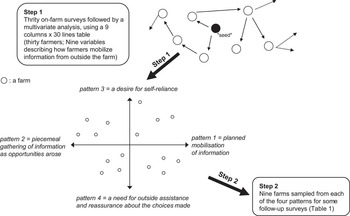
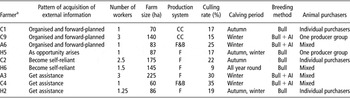
The study was carried out from 2005 to 2006 in the traditional beef-cattle farming area in the Centre region of France. Sampling was based on a two-step process (Figure 1). In the first step, farmers completed surveys about ways they obtain information from outside the farm. Surveys continued until we obtained a sufficiently wide range of diversity in practices (i.e. 30 surveys). A list of different management dimensions in the beef-cattle farming system was discussed with the farmers during this survey step, which enabled us to co-construct a set of 13 dimensions: feeding (distribution), calving (taking care of cows and calves), reproduction (batching cows and choosing periods), genetics (choosing bulls according to the genetic level target), replacement (choosing heifers), culling (choosing cows to sell), animal health, feed stocks (for the wintering period), grazing (management), fertilisation, administration/regulations, accounting and sales. Cluster analysis of the survey data revealed four distinct patterns of information-seeking behaviour (Cerf and Magne, Reference Cerf and Magne2007), which depended neither on farm structure (i.e. production orientation, size) nor on the location (departments). On the contrary, we postulated that different information-seeking patterns were linked to different farming strategies. Therefore, for the second step we sub-sampled nine of the 30 farmers, who served to represent these patterns (Table 1). Two semi-directive interviews were carried out with each to analyse the relations between information-seeking patterns and priorities for mastering the 13 previously defined dimensions. During the first interview, farmers ranked the 13 dimensions in decreasing order of the importance they attributed to their mastery (i.e. high rank = 1, low rank = 13) and provided reasons for their rankings. The interviews were recorded and lasted an average of 4 h. A second interview, 6 months later, provided the same information at a different point in time (because priorities could change with the season) and, if necessary, supplemented data from the first survey.
Diagram of the two-step methodology.

Main characteristics of 9 out of 30 beef-cattle farms sampled, according to functional and structural variables (the four patterns of acquisition of external information (from outside the farm) identified in the 30 farms are represented)

CC = cow-calf system; F = fattening system; F&B = fattening and breeding; AI = artificial insemination.
aA, C, H: Department of France (Allier, Cantal, Haute-Vienne).
Data analysis
The recorded interviews were transcribed into fact sheets, which identified reasons farmers gave to justify their rankings, along with the content, origin and medium of the information the farmer used to control each dimension. These fact sheets allowed preliminary structuring of the data and initial analysis of variability in dimension rankings. The structured data were then analysed to reveal relations between rankings, motivations explaining these rankings and guidelines structuring the management strategies as a whole, which clarified their coherence to farmers.
Statistical analysis to describe variability in ranks
Distributions of the ranks of the 13 dimensions were described with boxplots.
Data categorisation to identify motivations to control each dimension
A method of data abstraction based on knowledge engineering was used to delineate farmer motivations regarding the dimensions. This qualitative method is based on the characterisation of observed variability by determining key categories that structure and synthesise it (Girard et al., Reference Girard, Bellon, Hubert, Lardon, Moulin and Osty2001). We characterised variability in rankings by defining categories of motivations based on farmers’ justifications for the importance they assigned to mastery of the dimensions, which was related to two factors: reasons why farmers considered mastery important (e.g. to counter a threat to farm survival) and the magnitude of this importance (e.g. crucial v. minor). Motivations were grouped into four categories:
• risk to the farm's survival if the dimension was not controlled.
• pleasure experienced in the quest for mastery. For example, some farmers ranked certain dimensions lower because the quest for their mastery gives them little satisfaction (or indeed, dissatisfaction).
• efficiency, which represents farmers’ satisfaction about the results obtained in a specific dimension considering the resources devoted to it. For example, certain farmers felt that they had low efficiency in technical dimensions, although they ranked them higher.
• ability to control mastery, which represents the degree to which farmers perceive that they have the power to control dimensions (v. their being driven by outside forces). For example, some farmers ranked certain dimensions higher because they felt that they could control them.
For each dimension, the importance of each of these four categories to a farmer was described as high, medium or low, allowing a dimension's rank to be explained by one or more of the motivation categories.
Multivariate analysis to identify management guidelines at the system scale
Principal component analysis (PCA, using SPAD 5.0) was used to explore potential relations among the sets of 13 dimensions presented above. Each factorial axis obtained, therefore, represented a ‘farming management guideline’. Description and interpretation of the factorial axes were based on analysis of the contributions of every variable (i.e. the dimensions) to each axis. For each farmer, the coherence of the whole strategy according to the priorities (which result from the combination of motivations) given towards mastering the dimensions could then be described by combinations of different farming management guidelines.
The PCA was derived from a table containing 13 dimensions in columns and nine beef-cattle farmers in rows, with the 117 values the dimension ranks. Ranks were then translated to a [0; 100] range and inverted (e.g. rank 1 became rank 100) to make PCA results easier to read (i.e. dimensions with higher original ranks (more importance) lay further from the centre of the factorial plan).
Results
Variability in dimension rankings
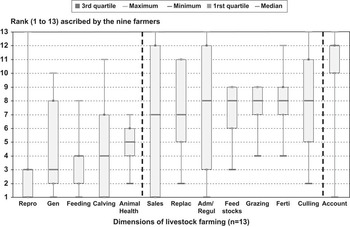
Although farmers ranked the desire to master certain dimensions similarly, ranks tended to vary greatly (Figure 2). Dimensions were organised into three groups based on their median ranks. The first group (median rank = 3 to 5) included the dimensions’ reproduction, genetics, feeding, calving and animal health, all of which are related to the technical management of the herd. Their mastery is fundamental for farmers as they influence the progress of the production process (producing and rearing animals and keeping them healthy). The second group (median rank = 7 to 8) included sales, replacement, administration/regulations, feed stocks, grazing, fertilisation and culling, which are mainly concerned with exploiting products and the forage system. Lastly, accounting was classed separately as the least important to control (median rank = 12). According to farmers, no ‘action levers’ existed to control this dimension, which is considered simply a requirement for farming activity.
Ranking of 13 dimensions of livestock farming by nine farmers according to the importance they attributed to their mastery and development. Rank 1 equals highest importance; rank 13 equals lowest importance. Vertical lines separate dimensions by median-rank group. Repro = reproduction; Gen = genetics; Replac = replacement; Adm/regul = administration/regulations; Ferti = fertilisation; Account = accounting.

The variability (interquartile range, IQR) in dimension ranks showed that farmers did not always agree on the importance of certain dimensions. However, some dimensions had relatively low variability (IQR = 2) around high (reproduction, feeding, animal health) or low (feed stocks, grazing, fertilisation, accounting) median ranks. Variability was greater (IQR = 6) for genetics and calving (with high median ranks) and replacement and culling (with lower median ranks). Finally, variability was the greatest (IQR = 9 to 11) for administration/regulations and sales.
Motivations to understand dimension rankings
The following two examples show how identifying and estimating the magnitude of farmers’ motivations for seeking to control the farming system improved understanding of why they ranked farming dimensions in the order that they did.
Administration/regulations rank influenced by ability to control
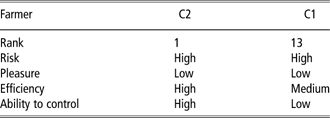
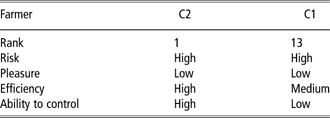
Farmers C2 and C1 ranked the mastery of administration/regulations as the most and the least important, respectively, but they reported the same levels of risk (high) and pleasure (low; Table 2). Conversely, they differed in regard to efficiency (high and medium for C2 and C1, respectively) and especially ability to control (high and low for C2 and C1, respectively). Analysis of the combination of motivation levels suggests that the two farmers weighed the two latter motivations differently. Hence, risks carried more weight for farmer C1 than pleasure because he considered the dimension as under his control, which explains the high rank he attributed. In contrast, lack of pleasure carried more weight for farmer C2 than the risks, partly because he considered it a dimension out of his control, which explains the low rank he ascribed. It is important to note that differences between the two farmers did not depend on their production orientations (fattening for C2 and cow–calf for C1), because (i) administration/regulation requirements did not differ a priori between them, and (ii) other farmers performing fattening (e.g. H5) also ranked this domain low (12) and reported the same motivation levels as farmer C1.
Comparison of two beef-cattle farmers regarding the importance attributed to motivations behind their ranking of the mastery of administration/regulations
Genetics rank influenced by pleasure and efficiency
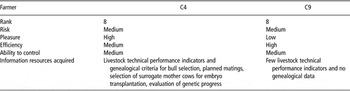
Farmers C4 and C9 ranked mastery of genetics identically (8), but the former used a greater variety of information sources (in terms of medium, origin and content) than the latter (Table 3). Analysis of the combination of motivation levels explains these differences (Table 3). They assigned the same levels to risks (medium) and ability to control (low, due to biological variability), but differed with regard to the pleasure and efficiency associated with its mastery. Farmer C4, who subscribed to performance testing and was registered in the French Herd Book, used livestock performance indicators and genealogical criteria to select bulls, plan matings, select surrogate mothers for embryo transplants and evaluate his herd's genetic progress (high pleasure). Farmer C4 also perceived that he had more progress to make (medium efficiency). Conversely, farmer C9 used few performance indicators to plan the genetics of his herd; matings depended more on purchases of complete herds, which he expanded, rather than on planned genetics (low pleasure). However, farmer C9 was satisfied with the results he obtained considering the few resources he allocated (high efficiency). The differences between the two farmers’ level of pleasure and efficiency explain their different levels of information seeking in genetics.
Comparison of two farmers regarding their ranking of the mastery of genetics, the importance attributed to their motivations and their information-seeking activity

Guidelines for understanding relations among dimensions
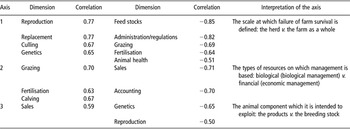
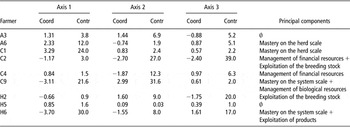
The first three factorial axes of the PCA explained 74% of the total variability of the data. Correlation analysis of the initial variables (i.e. dimensions) with each of the axes (Table 4) along with the coordinates and contributions of the nine farmers to the factorial axes (Table 5) identified three management guidelines (one per axis) to ensure the farm survival.
Interpretation of the three factorial axes of the principal component analysis from their correlations with dimensions of livestock farming

Analysis of the contributions of the nine farmers to the three factorial axes from the principal component analysis: identification of the principal components that characterize them

Coord = coordinates; Contr = contribution (%).
∅: no structuring principal component.
The first factorial axis (explaining 38% of the variability) represents the scale at which risk of failure and the farm's survival are perceived. Thus, it contrasts farmers (C9 and H6) who perceived risks at the herd scale (mastering reproduction, genetics and replacement) with those (C1 and A6) who perceived risks at the whole-farm scale (mastering feed stocks, administration/regulations, grazing, fertilisation and animal health). Farmers C9 and H6 mastered risk at the whole-farm scale by seizing outside opportunities (notably the optimisation of subsidies), which allowed them to optimise profitability and minimise forage and veterinary costs (Table 5). Conversely, farmers C1 and A6 attempted to control risks at the herd scale by managing herd composition and dynamics on the basis of their perceived ability to control dimensions and the importance they ascribe to dimensions of animal management and technical performance. Thus, farmer C1 perceived that he possesses greater mastery over biological (e.g. oestrus cycles, insemination) and biotechnical hazards (e.g. accidental loss of cows) within his farm than over problems of external origin (e.g. administrative and regulatory reforms, extreme weather). Likewise, farmer A6 focused on improving his herd's reproduction and genetics, claiming that his criteria for culling and replacements depended heavily on his policy of genetic improvement and the animals’ registration in the Herd Book.
The second axis (explaining 24% of the variability) represents the farm resources on which farmers focus attention and effort. Thus, it contrasts farmers (C9) who aimed to master biological resources (e.g. grazing, fertilisation, calving) with those (C2 and C4) who aimed to master financial resources (e.g. sales, accounting). Farmer C9 perceived himself as relatively inefficient in biological dimensions and preferred to concentrate on mastering them rather than financial dimensions. In contrast, farmers C2 and C4 structured their management strategy around a well-defined sales strategy and accounts-based management, which allowed them to evaluate production results in depth. Indeed, farmer C2 asserted that mastering accounting consists of thinking about investments and commercial strategy. These two farmers considered selling and sales strategies integral parts of farm management, but they also believed that this dimension demands extra attention and is difficult to control, as it depends on factors outside the farm. They believed that they efficiently mastered biological dimensions and were satisfied with the results they obtained.
The third axis (explaining 12% of the variability) represents the animal component, which farmers seek to exploit and improve to control the production process. Thus, it contrasts farmers (C2 and H2) who based their reasoning on exploitation of the cow herd (e.g. reproduction, genetics) with those (H6) who based it on exploitation of herd products (e.g. sales). According to farmers C2 and H2, the challenge at the herd scale was to control the dimensions associated with the reproductive herd, as they affect the continuity of the production process. Farmer C2 perceived that he was not efficient enough in the mastery of reproduction and genetic dimensions, especially because he considered their control a reflection of his competence, although these dimensions are subject to biological variability. Farmer H2 claimed that the control of the reproductive herd remained his greatest challenge because it constituted his sole capital, as he rented the land. He aimed to develop the herd's genetic potential over the long term to generate as much capital as possible for his retirement. Finally, planning the matings and considering genetic selection were activities he enjoyed, whereas farmer H6 attempted not only to exploit the growth potential of products but also to obtain the best price when he sold them. He stated, ‘What matters is to have calves; all the cows, whatever their genetic potential, can produce them’. Farmer H6 was mainly motivated by the commercial side of farm management.
Discussion
Technical herd dimensions are central to farmers’ management strategies
Our study showed that for all beef-cattle farmers sampled, three dimensions of technical herd management (i.e. feeding, reproduction and animal health) are priorities to control to ensure their farms’ survival. These dimensions refer to the three main functions of animals (as biological systems), which provide the capacity to adapt to the farm environment (Blanc et al., Reference Blanc, Bocquier, Agabriel, D'hour and Chilliard2006). All farmers ranked the dimensions concerning forage management (harvesting for stocks and grazing) as less important to control, perhaps because (i) farmers were located in a grassland region, which may have decreased their sensitivity towards the need to manage grassland resources, and (ii) the study occurred in 2005, before farmers had noticed effects of climate change (despite looking for them for years). In contrast, there was great variability in the importance that farmers attached to the mastery of the administration/regulations and sales dimensions, explained mainly by differences in the pleasure of and ability to control them. Therefore, it is interesting to discover that technical herd management remains the main dimension that farmers seek to control. This result confirms that in the face of transformation of the Common Agricultural Policy payments of entitlements into single payments per farm, mastering technical dimensions of livestock farming are ways that farmers adapt and ensure their farms’ survival and viability (Veysset et al., Reference Veysset, Lherm and Bebin2005). Thirty other surveys performed on beef-cattle farming systems and 25 surveys on suckler sheep systems have confirmed these technical leanings of beef-cattle and sheep farmers (Ingrand et al., Reference Ingrand, Pailleux and Poupart2009).
Implications for researchers and agricultural advisors
The study's findings indicate that greater consideration of the human dimension in livestock farming systems is a major challenge of future research on these systems (Gibon and Hermansen, Reference Gibon and Hermansen2006). The originality of our approach renders farmers’ management strategies visible by analysing their rankings of dimensions of livestock farming and underlying motivations, rather than practices linked to a preconceived problem or a specific situation. Doing so identifies concepts that make sense to farmers in their day-to-day management (i.e. what they do, but also what they think they should do, what they would like to do, what they do not attempt to manage or the difficulties they encounter, etc.). Identifying these elements enabled the understanding of ways in which farmers allocate information resources to each management dimension. In addition, comparing a representation of farmers’ strategies with an external diagnosis of the farms’ performances should identify discrepancies, which could be the keystone of the advisory process with farmers. This offers opportunities for advisors to customise their services to farmers better.
Our approach differs from studies that aim to characterise farmers’ management strategies, as it focuses less on defining at-risk types of strategies (or farming styles) than on establishing criteria useful and practical for identifying and understanding an individual farmer's strategy. In fact, simply showing that farmers’ strategies are not defined according to technical, economic or more subjective motivations (Fiorelli et al., Reference Fiorelli, Dedieu and Pailleux2007) is not original. In contrast, delineating several categories of farmers’ motivations and showing ways in which they can be combined and be influential enable a better understanding of farmers’ management strategies. Finally, contrary to methods whose results vary depending on the farmers sampled, our approach's results are assumed not to be contingent on the individuals sampled, meaning that they can be tested as guidelines for the whole population. The use of ranking dimensions to identify and understand livestock farming management strategies had already been tested on a larger sample of beef-cattle and sheep farmers (Ingrand et al., Reference Ingrand, Pailleux, Poupart, Magne and Mugnier2010), which validated the robustness of the analysis framework. The method can also be used in other farming systems, with a redefinition of the farming dimensions concerned. The dimensions of livestock farming we identified seem to be generic for livestock farming systems. On the contrary, they have to be adapted in crop farming systems.
The study's findings have not yet been put into practice by livestock farming advisors. However, the ways we intend to use them are based on numerous experiences and exchanges with agricultural advisors and farmers during interviews aimed at updating advisory approaches to beef-cattle farming (Magne and Ingrand, Reference Magne and Ingrand2004). A method in the form of a card game is being tested to obtain farmers’ ranking of dimensions. Each card corresponds to a dimension, and farmers are asked to sort the cards according to the four categories of motivations: the risks, pleasure, efficiency and ability to control, which they perceive. The game can be played with an individual or a group. This approach is currently being used with 30 beef-cattle farmers and 24 sheep farmers in 2009 (Ingrand et al., Reference Ingrand, Pailleux and Poupart2009 and Reference Ingrand, Pailleux, Poupart, Magne and Mugnier2010). Initial observations indicate that the greatest difference in ranking between cattle and sheep farmers concerns the pleasure motivation, with highly ranked dimensions focusing on animals for sheep farmers (e.g. flock, reproduction, feeding), and on resources for cattle farmers (e.g. feed stocks, grazing). Future research would explore the use of this method in agricultural advisory work; to do so, we have introduced other key elements (farmers’ objectives, farmers’ criteria to characterise the situations they have to manage, farmers’ criteria to choose the information resources to manage these situations) to better understand the link between management strategies and the information resources farmers use to succeed (Magne and Cerf, Reference Magne and Cerf2009; Magne et al., Reference Magne, Cerf and Ingrand2010). Ultimately, we believe that a quantitative, rather than qualitative, characterisation of the motivations underlying the rank farmers assign to mastering dimensions of livestock farming could facilitate interpretation for advisors.
Conclusion
A simple method of ranking by beef-cattle farmers of 13 livestock farming dimensions that they manage enabled a more comprehensive identification and understanding of their farming management strategies. Results demonstrated that strategies emerge from a compromise between activities they must do, activities they would like to do and activities they do not achieve. Three guidelines were identified, contrasting specific combinations of the dimensions on which beef-cattle farmers focus: the animal/herd v. whole-farm scale, biological v. financial dimensions and reproductive cows v. animals sold. The study's findings have implications for research by better integrating the meaning, which farmers attribute to livestock farming management. Understanding strategies of livestock farming as envisioned by farmers is a key step for agricultural advisors. The ranking of management dimensions, identification of management guidelines and combination of the categories of motivation necessary to master each dimension constitute elements, which could become operational tools for advisors who wish to support a variety of management strategies. Further research is necessary to validate our findings and to go further in the operationalisation of the methodological elements we propose here.
Acknowledgements
This work was carried out with the financial support of (i) ANR, the French National Research Agency, under the Programme Agriculture et Développement Durable, project Discotech (ANR-05-PADD-04-01); (ii) the French Livestock Institute; and (iii) the French Ministry of Research and Education.