INTRODUCTION
Fatal outbreaks of theileriosis among cattle and buffaloes caused by Theileria parva (east coast fever) and Theileria annulata (tropical theileriosis) are well documented (Coetzer and Tustin, Reference Coetzer and Tustin2004). Oriental theileriosis, being considered to be a benign form, has not yet drawn similar attention. This disease, caused by a group of organisms variously designated as Theileria orientalis/Theileria sergenti/Theileria bufeli (Altangerel et al. Reference Altangerel, Sivakumar, Inpankaew, Jittapalapong, Terkawi, Ueno, Xuan, Igarashi and Yokoyama2011) has come under closer scrutiny in recent years owing to reports of severe outbreaks among cattle from many parts of the world (McFadden et al. Reference McFadden, Rawdon, Meyer, Makin, Morley, Clough, Tham, Mullner and Geysen2011; Eamens et al. Reference Eamens, Gonsalvse, Jenkins, Collins and Bailey2013).
India is the largest producer of milk in the world and buffaloes contribute to more than 60% of the total milk production. The country is endemic for tropical theileriosis among cattle (Manuja et al. Reference Manuja, Malhotra, Sikka, Sangwan, Sharma, Mehta, Gulati and Nichani2006) while theileriosis among buffaloes remains unreported. There are reports of prevalence of oriental theileriosis among buffaloes in other Asian countries such as Sri Lanka, Vietnam, Thailand (Sarataphan et al. Reference Sarataphan, Kakuda, Chansiri and Onuma2003) and China (Lan et al. Reference Lan, Hui-Hui, Wen-Jie, Qing-Li, Rui, Li-Xia, Pan, Yan-Qin, Jun-Long and Marinda2010). These studies were conducted on blood samples collected from a number of apparently healthy animals from a wide geographic area. Detailed investigation of actual disease outbreaks among buffaloes has not been reported so far.
This paper describes the development of clinical signs and haematopathological alterations during a fatal outbreak of oriental theileriosis among dairy buffaloes for the first time. The extent and progression of clinical disease was unusually severe in these cases. Since T. orientalis is still regarded as a pathogen of low virulence, the pathogenic processes that could be linked to the severity of this outbreak warranted a detailed study. The identification of the pathogen at the structural and molecular level established the presence of a genotype hitherto unreported in India.
MATERIALS AND METHODS
Animals
Fifteen adult dairy buffaloes belonging to breeds Murrah (n = 8) and Nili Ravi (n = 7) respectively were procured from the State of Punjab in the northern part of India which is known for its high yielding buffaloes. They were immediately transported to a commercial dairy farm in Palakkad District of the State of Kerala in the southern tip of the country across a distance of 3500 km. This constituted the initial stock for the owners. The animals were housed in a single shed in the farm. Clinical signs started to manifest by the eighth week of their arrival. All 15 animals were in various stages of progression of the disease when examined by our team for the first time after 10 weeks of their arrival in the farm.
Clinical evaluation
Affected animals were subjected to detailed clinical examination every day. Peripheral blood smears and lymph node aspirate were prepared and examined by Leishman–Giemsa staining from each buffalo. Approximately 20 microscopic fields were checked per smear for estimating the parasitaemic status. An automatic haematology counter (Goodhealth Inc., New Delhi) was used for the complete haematological examination of heparinized blood samples. Serum biochemistry assessment was done with a semi-automatic biochemical analyser (Transasia, India). Post-mortem examinations followed by a detailed evaluation of histopathological changes were done for all the seven dead animals.
Concurrent T. annulata infection was ruled out by polymerase chain reaction (PCR) (d'Oliveira et al. Reference d'Oliveira, van der Weide, Habela, Jacquiet and Jongejan1995) for species-specific Tams 1 (MSA) gene in the 721 bp region. Alternative causes of haemolytic anaemia such as Anaplasma, Babesia and Trypanosoma were considered and eliminated by negative results of repeated microscopical examination of peripheral blood smears. Specific PCR targeting the merozoite surface glycoprotein 45 (gp45) for Babesia bigemina and rhoptry-associated protein 1 (rap-1) specific for Babesia bovis (Mtshali et al. Reference Mtshali, Tsotetsi, Thekisoe and Mtshali2014) were also employed to rule out babesiosis. Dung samples were screened to check for trematode parasite infestations. Fodder lots were scrutinized for the presence of toxic plants. Adult ticks collected from buffaloes were morphologically examined and identified using the guide to identification of species (Wall and Shaerer, Reference Wall and Shaerer2001).
Molecular investigations
Confirmation of identity of theileria organisms was done by amplification of 18SrRNA gene as described by Allsopp et al. (Reference Allsopp, Baylis, Allsopp, Cavalier-Smith, Bishop, Carrington, Sohanpal and Spooner1993). Further discrimination of T. orientalis was done by amplifying and comparing the major piroplasm surface protein (MPSP) gene (Tanaka et al. Reference Tanaka, Onoe, Matsuba, Katayama, Yamanaka, Yonemichi, Hiramatsu, Baek, Sugimoto and Onuma1993). Five samples were selected at random and duplicate PCR products from them were purified using a commercial kit (GeneJET*) employing spin column technology. Every PCR was done in duplicate and we used products from both PCR for sequencing to reduce amplification errors and increase accuracy. The products were subjected to nucleotide sequencing at SciGenome, Kochi. The sequences obtained were applied to Basic Local Alignment Search Tool in NCBI for homology analysis. A phylogenetic tree was constructed using the neighbour-joining algorithm with molecular distance estimation. Clustal V method with MegAlign programme (LaserGene/DNAStar) software was employed for this purpose. The evolutionary distances were computed using the Maximum Composite Likelihood method (Tamura et al. Reference Tamura, Nei and Kumar2004). All positions containing gaps and missing data were eliminated from the dataset. Translation of the sequences was done to detect significant amino acid changes in the structure of the genotype under study.
Therapeutic management
A treatment regime of Buparvaquone (2·5 mg kg−1 body wt. i/m twice 24 h apart) followed by oxytetracycline hydrochloride (10 mg kg−1 body wt. i/v daily for 5 days) was followed for all affected animals. Supportive therapy using fluids, parenteral supplements and haematinics was employed according to requirement.
RESULTS
Clinical evaluation
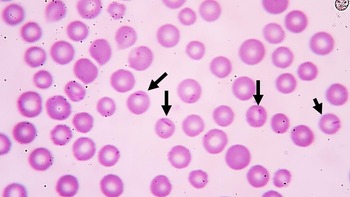
Typical piroplasms of T. orientalis, appearing as thin or thick rods with light staining trailing cytoplasm (Aparna et al. Reference Aparna, Ravindran, Vimalkumar, Lakshmanan, Rameshkumar, Kumar, Promod, Ajithkumar, Ravishankar, Devada, Subramanian, George and Ghosh2011) were detected in the erythrocytes of all animals during microscopical examination of blood smears on the first day itself.
Progression of clinical signs
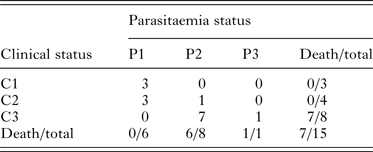
The animals could be categorized into three based on the progression of clinical signs (Table 1). The first category (C1) included three animals with early clinical signs such as lethargy, reduced feed intake, hypogalactia and generalized depigmentation of skin. Four animals in which the clinical signs had progressed to peripheral lymphadenopathy, haemorrhagic conjunctivitis, lacrimation, anaemia, anorexia, agalactia and sternal recumbency were included in the second category (C2). Oedema of the dependant parts, especially the metacarpal region of one or more limbs was observed in all animals of this category. Animals in the terminal stages of the disease with severe anaemia, ventral oedema, jugular pulse, purulent nasal discharge, pneumonia, ataxia, dyspnoea and lateral recumbancy belonged to the third category (C3). Seven out of eight animals in this group died within 2 weeks from the beginning of therapy.
Classification of 15 buffaloes based on parasitaemia, clinical signs and end result of infection

P1 – Stray organisms detected (<1% of erythrocytes affected).
P2 – 1–2 organisms detected in most of the fields (5–6% of erythrocytes affected).
P3 – Numerous organisms detected in most of the fields (>10% of erythrocytes affected).
C1 – Lethargy, reduced feed intake, hypogalactia and generalized depigmentation of skin.
C2 – Peripheral lymphadenopathy, haemorrhagic conjunctivitis, lacrimation, anaemia, anorexia, agalactia and sternal recumbency.
C3 – Ventral oedema, jugular pulse, anaemia, purulent nasal discharge, ataxia, dyspnoea and lateral recumbency.
Haematological changes
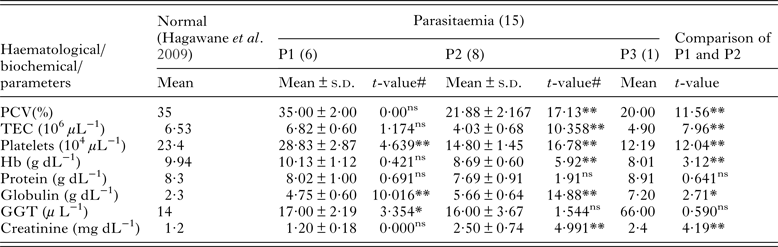
Animals were also divided into three categories based on the parasitaemic status as determined by the number of erythrocytes infected with piroplasms (Table 2). Haematobiochemical alterations observed for each category are shown in Table 2. Six animals in the first category (P1) were in the early stages of the disease with only mild (<1%) parasitaemia and no significant haematological abnormalities. Eight buffaloes in the second category (P2) had 1–2 erythrocytes (5–6%) infested with piroplasms in each field of vision under the microscope. They had haematological changes such as anaemia, low packed cell volume (PCV), low total erythrocyte count (TEC), degenerative shift to left and thrombocytopenia consistent with large-scale destruction of erythrocytes. Pleomorphism of erythrocytes into spherocytes and acanthocytes was also evident. Elevated serum creatinine levels in animals of this group indicated renal impairment. Seven out of eight animals in this group had advanced clinical signs. The group (P3) had only one animal with heavy (>10%) parasitaemia, which had haematological alterations similar to category P2. But the gamma glutamyl transferase (GGT) level was also severely elevated, indicating hepatic impairment and further progression of the disease.
Comparison of selected haematological and biochemical parameters in relation to parasitaemia among 15 buffaloes with Theileria orientalis infection

PCV, packed cell volume; TEC, total erythrocytic count; Hb, haemoglobin; GGT, Gamma glutamyl transpeptidase.
P1 – Stray organisms detected (<1% of erythrocytes affected).
P2 – 1–2 organisms detected in most of the fields (5–6% of erythrocytes affected).
P3 – Numerous organisms detected in most of the fields (10–15% of erythrocytes affected).
**Significant at 0·01 level; *significant at 0·05 level; ns, non-significant at 0·05 level.
# t-value for the comparison with normal value.
Differential diagnosis
Microscopic examination of blood smears did not reveal any other aetiologic agent for haemolytic anaemia like Anaplasma, Babesia or Trypanosoma. Amplification of species-specific Tams 1 (MSA) gene at the 721 bp region for T. annulata was not observed in PCR of any of the samples. PCR targeting merozoite surface gp45 for B. bigemina and rap-1 specific for B. bovis also did not yield any positive results. The possibility of plant toxins was ruled out as the animals were stall fed with commercial concentrates and hybrid Napier fodder cultivated in the farm premises.
Therapeutic management
All seven animals in the first two clinical categories recovered upon treatment. But the health status and production performance of the recovered animals remained sub-optimal despite continuing supportive intervention for the next 3 months. Seven out of eight animals in the third clinical category died within 14 days despite intensive management.
Post-mortem examination and histopathology
Petechiae and echymosis of the vital organs and subcutaneous musculature were the primary lesions noticed. Thoracic and peritoneal effusions, cardiac myopathy, hydro-pericardium, pulmonary emphysema, multi-lobular congestion and consolidation of lungs were observed in five animals. Multiple white nodular foci were evident predominantly in the kidneys. Diffuse lymphocytic infiltration of vital organs, lymphoid depletion and oedema in lymphnodes were observed in sections of tissues from all the seven animals. Moderate hepatocytolysis and haemosiderosis coupled with lymphangiectasis were evident in the liver. Extensive involvement of the kidneys was also manifested as tubular necrosis, hyalinization and glomerulitis in all these cases.
Molecular identification
Amplification of 18SrRNA gene was evident in the PCR of samples from 15 animals with typical bands in the 1098 bp region. Amplification of species specific MPSP gene (770 bp) for T. orientalis was observed in all the 15 samples. The nucleotide sequences of 1098 bp amplicons obtained in this study had close homology (99%) with other sequences of T. orientalis/buffeli with accession numbers HM538215, HM538206, HQ840965 (from China), AB520955 (Japan), AF236094 (The Netherlands), AB000272 (Australia) and DQ287959 (Spain). They were deposited with GenBank accession number KM609973. The MPSP gene sequences determined in this study aligned closely in the phylogenetic tree (Fig. 1) with Genotype N2 sequences reported by Sivakumar et al. Reference Sivakumar, Tattiyapong, Fukushi, Hayashida, Kothalawala, Silva, Vimalakumar, Kanagaratnam, Meewewa, Suthaharan, Puvirajan, de Silva, Igarashi and Yokoyama2014 (accession nos. AB560829–AB560832). These were deposited in the GenBank with accession number KM043772. Translation of the sequences revealed differences in only two amino acids from other N2 genotypes.
Phylogenetic tree constructed using MPSP gene sequences of Theileria orientalis. The evolutionary history was inferred using the Neighbour-Joining method. The tree is drawn to scale, with branch lengths in the same units as those of the evolutionary distances used to infer the phylogenetic tree.

Ticks
Only a few (<5/animal) ticks could be collected from each animal, which were identified as Rhipicephalus microplus.
DISCUSSION
Outbreak of fatal oriental theileriosis among buffaloes is described for the first time in this paper. Microcytic and normochromic anaemia, thrombocytopenia and degenerative shift to left observed in this study were consequent to disseminated haemorrhages and large-scale destruction of erythrocytes. Previous reports of pathogenesis of T. orientalis in cattle are also consistent with progressive anaemia (Eamens et al. Reference Eamens, Gonsalvse, Jenkins, Collins and Bailey2013). The piroplasms of T. orientalis trigger an autoimmune mechanism through increased Gamma Interferon and TNF (Alpha) production, leading to haemolysis and disseminated haemorrhages throughout the body (Stockham et al. Reference Stockham, Kjemtrup, Conrad, Schmidt, Scott, Robinson, Tyler, Johnson, Carson and Cuddihee2000). The Hb, PCV and TEC values were significantly lower in P2 group animals than in P1 group animals, indicating that the severity of the anaemia increased with the increase in parasitaemic levels. The clinical signs also were more pronounced in P2 group animals as compared with P1 (Fig. 2).
Erythrocytes from the peripheral blood of a buffalo containing large pleomorphic piroplasms of Theileria orientalis. Wright's staining.

The important variation observed in this study was the acute progression of clinical signs beyond anaemia, leading to mortality among animals in the highly parasitaemic P3 group and the less severely affected P2 group (Table 1). Functional impairment of vital organs subsequent to diffuse leucocytic infiltration had contributed to the aggravation of the clinical signs in these animals. Such changes were reported previously for tropical theileriosis only.
An existing underlying T. annulata infection was considered, but was ruled out by the absence of PCR amplification of Tams 1 (MSA) genes specific for T. annulata. Moreover, microscopical examination of blood smear and lymph node aspirates of animals at the peak of clinical signs also failed to detect any typical T. annulata piroplasms or schizonts. Though the sensitivity of microscopical examination for diagnosis of theileria parasites is limited in subclinical cases (Aktas et al. Reference Aktas, Kursat and Nazir2006), accuracy of PCR even in latent cases is well documented by many workers (Altangerel et al. Reference Altangerel, Sivakumar, Inpankaew, Jittapalapong, Terkawi, Ueno, Xuan, Igarashi and Yokoyama2011; Kamau et al. Reference Kamau, Je De Vos, Playford, Salim, Peter and Chihiro2011). Similar was the case for babesiosis, where specific primers failed to amplify merozoite surface gp45 and rap-1 gene in all animals.
The phylogenetic position of the organism under consideration was in close proximity to T. orientalis/buffeli sequences already reported. Gubbels et al. (Reference Gubbels, Hong, Weide, Nijman, Guangyuan and Jongejan2000) concluded that all known T. buffeli-like isolates originate in a disperse group of buffalo-derived parasites that have adapted to cattle. The MPSP gene exhibits significant sequence diversity among field isolates of T. orientalis and currently 11 genotypes of T. orientalis are known worldwide based on registered MPSP gene sequences (Altangerel et al. Reference Altangerel, Sivakumar, Inpankaew, Jittapalapong, Terkawi, Ueno, Xuan, Igarashi and Yokoyama2011). The phylogenetic position of the organism in our study aligns with that of the N2 genotype observed in a prevalence study of T. orientalis among buffaloes in Vietnam by Sivakumar et al. (Reference Sivakumar, Tattiyapong, Fukushi, Hayashida, Kothalawala, Silva, Vimalakumar, Kanagaratnam, Meewewa, Suthaharan, Puvirajan, de Silva, Igarashi and Yokoyama2014). The N2 genotype, which has been isolated only from buffaloes so far, is not yet reported in India.
Theileria orientalis is transmitted by Haemaphysalis ticks of which Haemaphysalis spinigera is restricted to South India (Mondal et al. Reference Mondal, Sarma and Saravanan2013). But we were able to detect only a few (>5/animal) R. microplus ticks among our study population. Altangerel et al. (Reference Altangerel, Sivakumar, Inpankaew, Jittapalapong, Terkawi, Ueno, Xuan, Igarashi and Yokoyama2011) were also unable to find any of the common vectors, namely, Haemaphysalis spp., Amblyomma spp. and Dermacentor spp. in some areas of high prevalence. Instead Rhipicephalus (Boophilus) was found, which is not reported as a vector for T. orientalis. In light of our findings, significance of Rhipicephalus as a vector for T. orientalis in Kerala warrants further investigation.
The development of clinical signs in this study resemble those reported by Kamau et al. (Reference Kamau, Je De Vos, Playford, Salim, Peter and Chihiro2011) for previously unexposed cattle being introduced into an area endemic for Theileriosis. The potential of T. orientalis to cause fatal disease in naïve healthy cattle upon introduction to areas with high prevalence was pointed out by Mcfadden et al. (Reference McFadden, Rawdon, Meyer, Makin, Morley, Clough, Tham, Mullner and Geysen2011). Since the animals were procured from scattered small holder units in their native place, it could not be verified whether any previous theileriosis outbreaks had occurred among them. Among Indian states, high prevalence of T. orientalis has been reported only from Kerala so far. It could be that T. orientalis Genotype N2 had established its presence here, and the new animals in the farm were exposed for the first time to the organism through vectors from neighbouring farms shortly after their arrival. The possibility of a previously acquired latent infection in the buffaloes was ruled out since the symptoms appeared 8 weeks after being subjected to transportation stress.
CONFLICT OF INTEREST STATEMENT
The authors declare that they have no conflict of interest. None of the authors of this paper have a financial or personal relationship with other people or organizations within 3 years of the submitted work that could inappropriately influence or bias the content of the paper.
FINANCIAL SUPPORT
This research received no specific grant from any funding agency, commercial or not-for-profit sectors.