A. MONUMENTAL
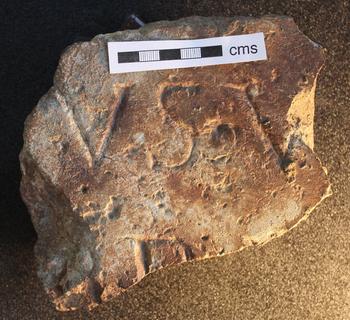
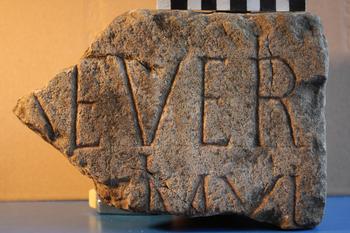
1. City of London (Londinium, TQ 3275 8148), 2–3 Cross Keys Court, EC2 (fig. 1). Fragment of a fine-grained reddish slab, apparently marble discoloured by fire, 150 by 120 mm, 40 mm thick, foundFootnote 2 in 1981. The surface was carefully smoothed before inscribing, and the letters are quite well drawn and executed: […]VSV[…] | […].. vacat […]Footnote 3
London, inscribed stone (No. 1).
(Photo: R.S.O. Tomlin)

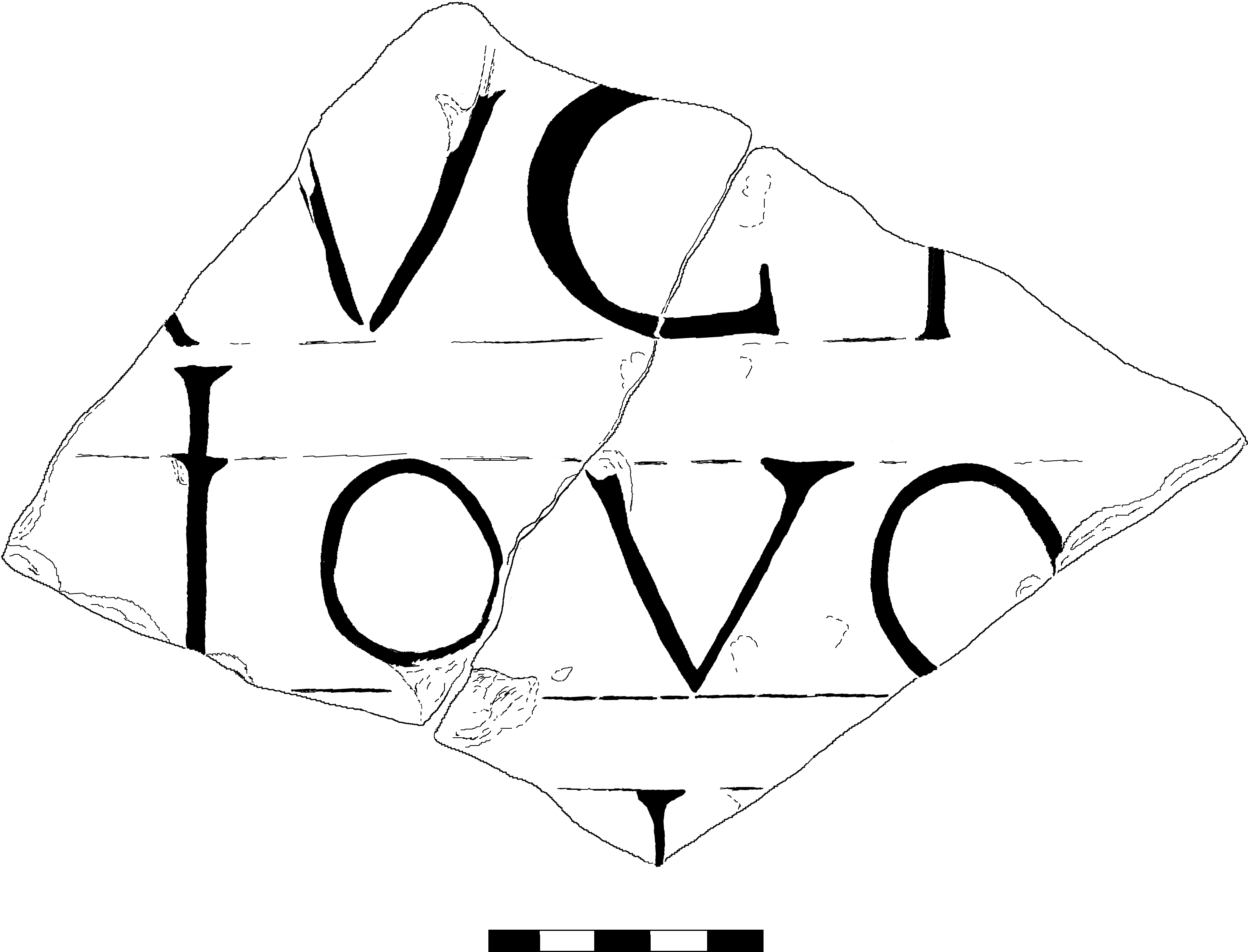
2. Caerleon (Isca, ST 37660 92277), Monmouthshire (fig. 2). Two conjoining fragments of a red sandstone slab, 0.25 by 0.15 m, 0.04 m thick, foundFootnote 4 in 2009 in the rubble of a Roman building set back from the Roman road c. 5 km north-east of the Roman fortress. Like the inscribed slabs found just to the west at Bulmore (RIB 359, etc.), it is apparently part of a tombstone re-used. Part survives of three lines of letters neatly inscribed between setting-out lines 46 mm apart: […].VC.[…] | […]
 VO[…] | […].[…], […].uc.[…] | [… i]niquo […] | […].[…], ‘… unfair …’Footnote 5
Caerleon, tombstone (No. 2).
(Drawn by R.S.O. Tomlin)

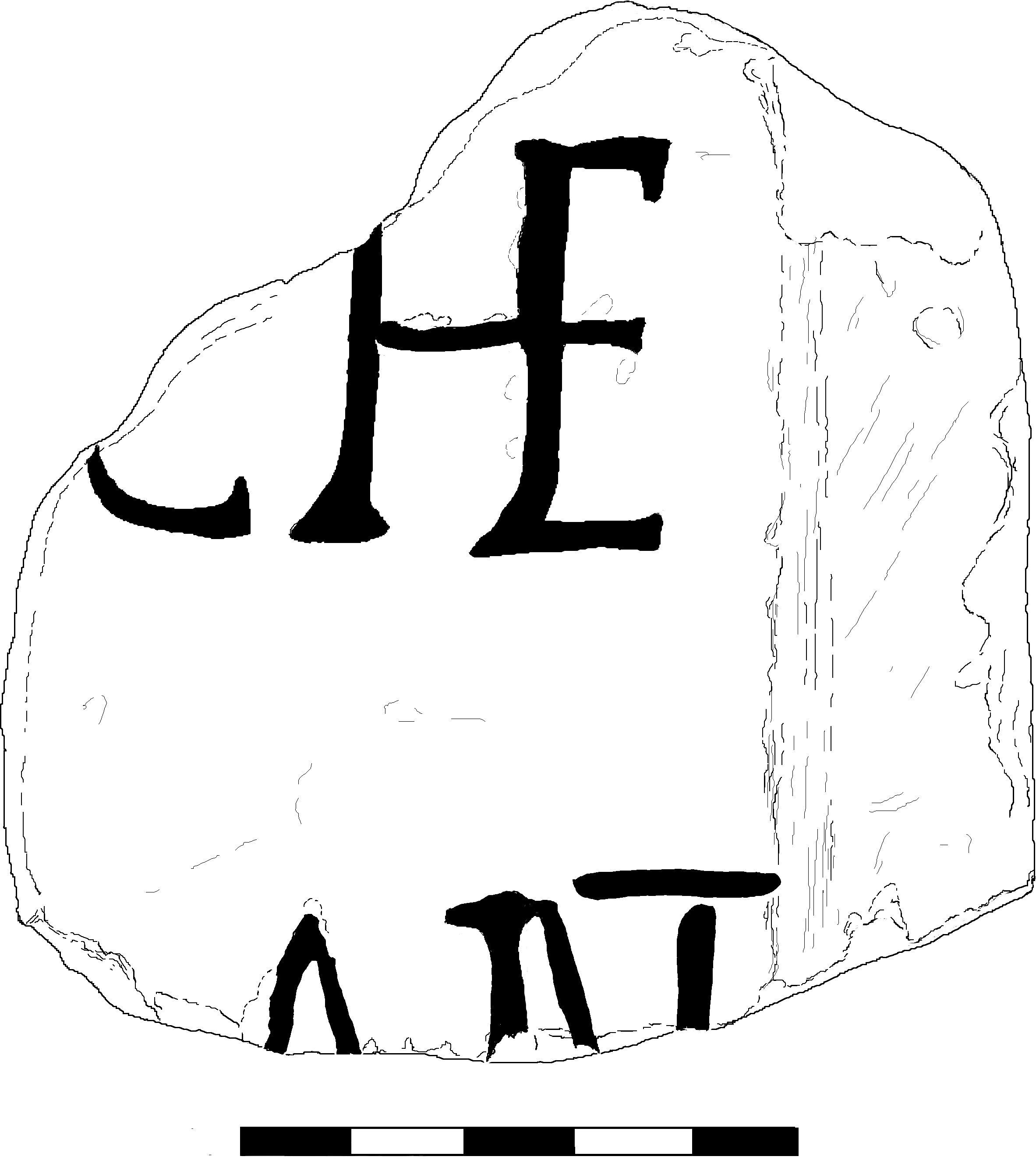
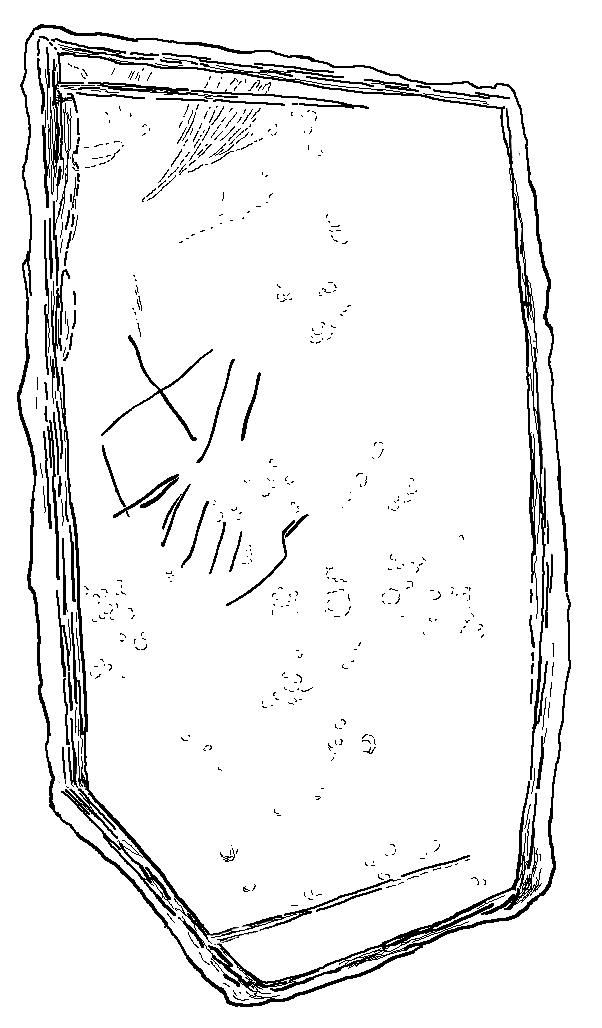
3. Brough-under-Stainmore (Verteris, NY 792 140), Cumbria (fig. 3). Small fragment of a buff sandstone slab, probably a tombstone, 95 by 98 mm, now 40 mm thick (but broken, and not original), foundFootnote 6 in c. 2008 south-east of the Roman fort. The right edge is original, which shows that the text was inscribed within a slightly recessed panel; in rather poor, shallow letters 36 mm high (line 1): […] | […]C | […]A
 | […]Footnote 7
Brough-under-Stainmore, tombstone (No. 3).
(Drawn by R.S.O. Tomlin)

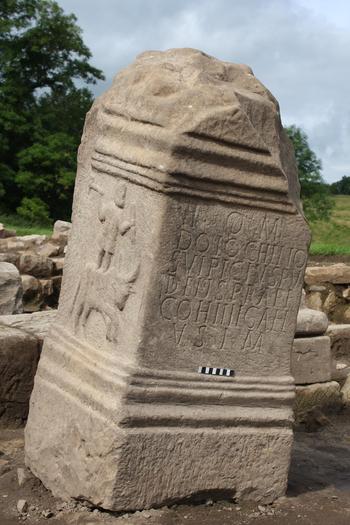
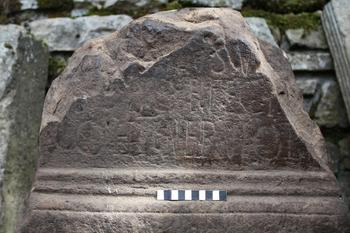
4. Vindolanda (NY 768 663), Northumberland (fig. 4). Buff sandstone altar (SF 13600), 0.49 by 1.05 m, 0.48 m deep, foundFootnote 8 in 2009 still in situ, but fallen forwards, in a third-century Roman building thought to be a Dolichenum between the intervallum road and the north rampart of the visible stone fort, which it overlies immediately west of the north gate. The base is complete, but most of the capital is lost, except for part of a band of chip-carved XXX decoration. The die is recessed, with plain mouldings above and below; on the left side is carved Jupiter Dolichenus in high relief, holding an axe and a thunderbolt, standing on a bull; on the right side, a jug and patera. The front of the die, 0.42 by 0.39 m, is inscribed with six lines of well-cut letters, 42 mm high (on average), in quite good unweathered condition: I O M | DOLOCHENO | SVLPICIVS PV|DENS PRAEF | COH IIII GALL | V S L M, I(ovi) O(ptimo)M(aximo) | Dolocheno | Sulpicius Pu|dens praef(ectus) | coh(ortis) IIII Gall(orum) | v(otum) s(olvit) l(ibens) m(erito). ‘To Jupiter Dolochenus Best and Greatest, Sulpicius Pudens Prefect of the Fourth Cohort of Gauls, paid his vow willingly, deservedly.’Footnote 9
Vindolanda, altar (No. 4). Height 1.05 m.
(Photo: R.S.O. Tomlin)

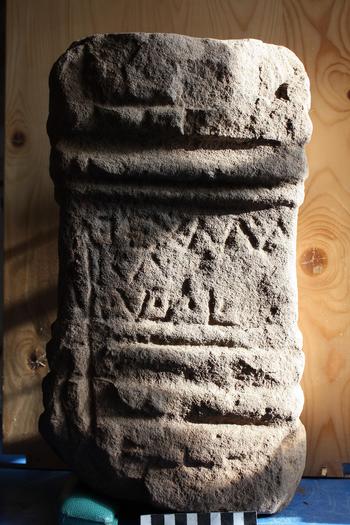
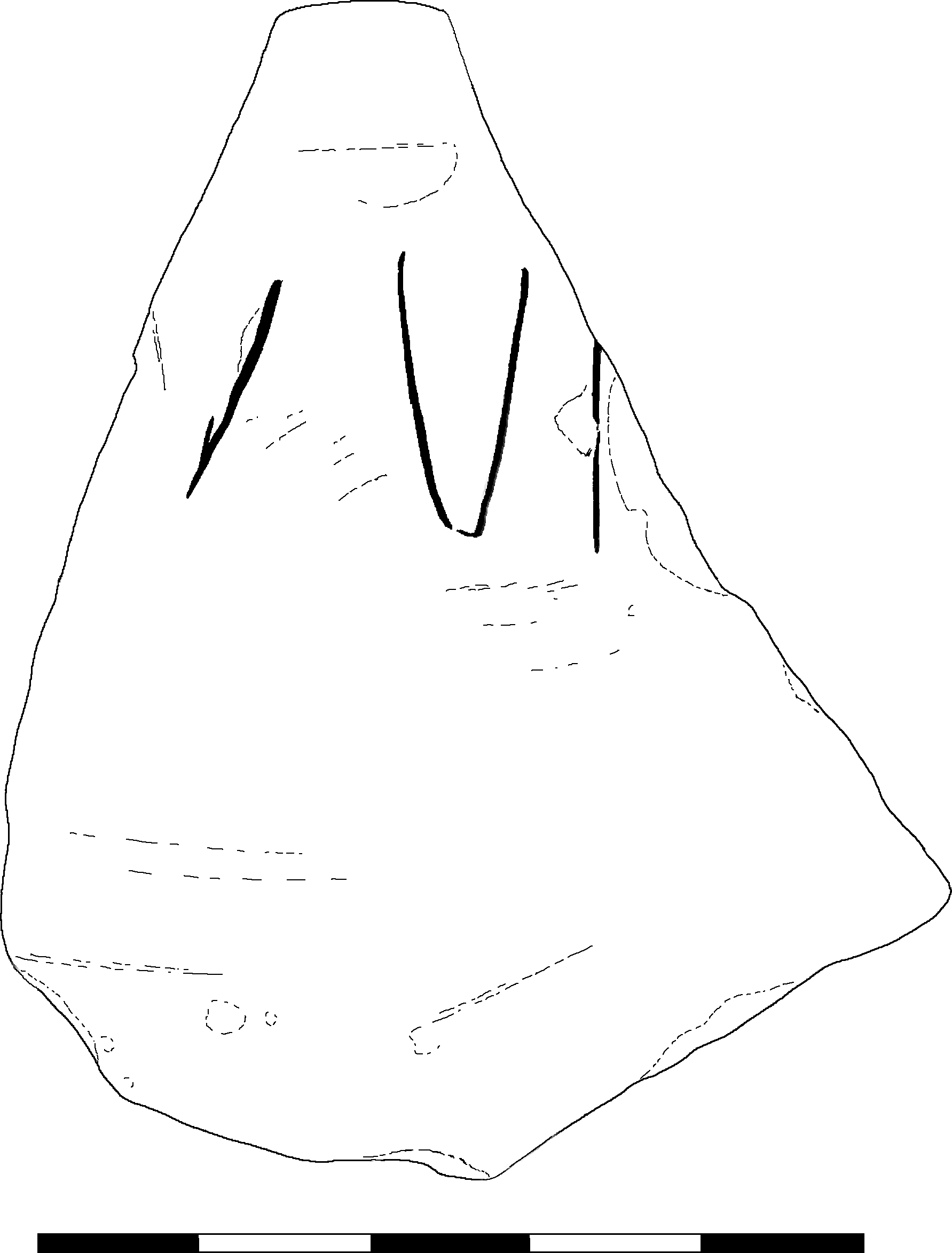
5. Ibid. (fig. 5). Lower part of a dark buff sandstone altar (SF 13601), 0.48 by 0.58 m, 0.43 m deep, found in situ beside the preceding item. It consists of a well-cut base, complete except for the lower front right corner, and a triangular portion of the die preserving part of the last three lines. On the left side of the die survives the lower part of three rounded figures carved in relief, apparently a round disc between a wreath and patera. On the front of the die, originally 0.43 m wide, the surviving text reads: […] | […]IVS V[2–3] | [3] PRAEFECT[..] | COH II NERVIOR, […] | […]ius V[…] praefect[us] | coh(ortis) II Nervior(um). ‘… […]ius V[…], prefect of the Second Cohort of Nervians.’Footnote 10
Vindolanda, altar (No. 5).
(Photo: R.S.O. Tomlin)

6. Ibid. (fig. 6). Crude altar of darkish buff sandstone (SF 13642), 0.23 by 0.42 m, 0.17 m deep, found near the two previous items. The capital and base are distinguished from the recessed die by crude mouldings extending round three sides; on its face, 0.21 by 0.10 m, is a three-line text crudely inscribed: ..EXṂ | .Rvacat | . ° V ° S ° L ° [.]°, perhaps ..EXMA | [a]ra(m) |. v(otum) s(olvit) l(ibens) m(erito). ‘… altar, paid his vow willingly, deservedly.’Footnote 11
Vindolanda, altar (No. 6).
(Photo: R.S.O. Tomlin)

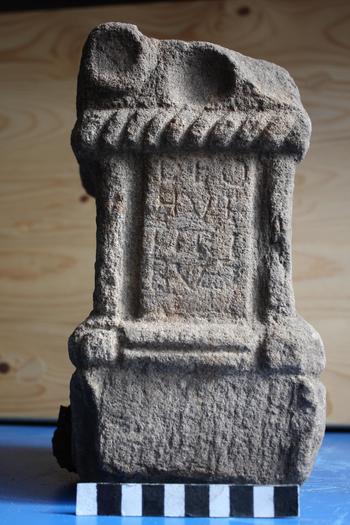
7. Ibid. (fig. 7). Miniature altar of buff sandstone (SF 12856), 125 by 238 mm, 130 mm deep, found in 2009 in the intervallum road. On top of the capital is a circular focus between bolsters, whose ends enclose a round recess rather than a pediment. Below them is a rope moulding which continues to the left as a plain moulding; the right bolster and moulding below have been lost. The face of the recessed die is marked by a vertical groove to left and right, as if to indicate a pilaster, but there is no corresponding groove either side. The face is incised with shallow letters c. 12 mm high: DEO | HVE | TERI | BVṢ, deo | Hue|teri|bus. ‘To the god Hueteres.’Footnote 12
Vindolanda, altar (No. 7).
(Photo: R.S.O. Tomlin)

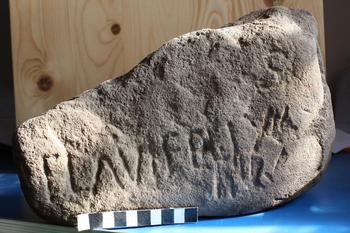
8. Ibid. (fig. 8). Buff sandstone building-stone, 0.30 by 0.10 m, 0.18 m deep. Crudely inscribed on the upper surface, not the face. (i) Pecked with a point: S. (ii) Chiselled with a point: […]FLΛVI FELIX, [centuria] Flavi Felix. ‘Felix, century of Flavus (or Flavius).’Footnote 13
Vindolanda, building-stone (No. 8).
(Photo: R.S.O. Tomlin)

9. Ibid. For two new fragments of RIB 1705, see below, Addenda et Corrigenda (b).
B. INSTRUMENTUM DOMESTICUM
BEDFORDSHIRE
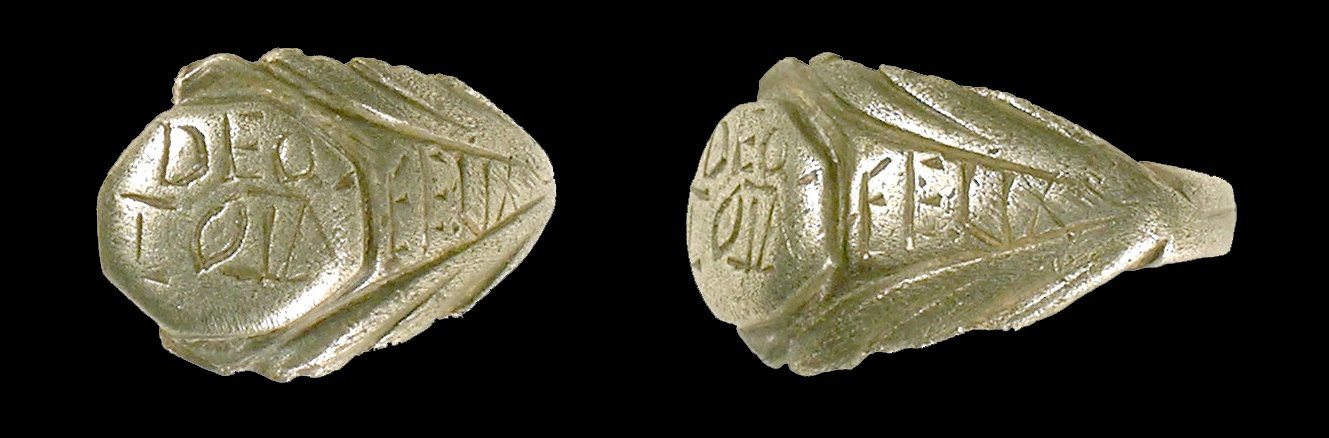
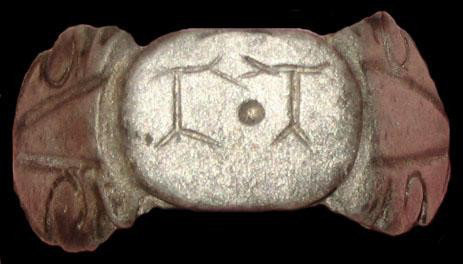
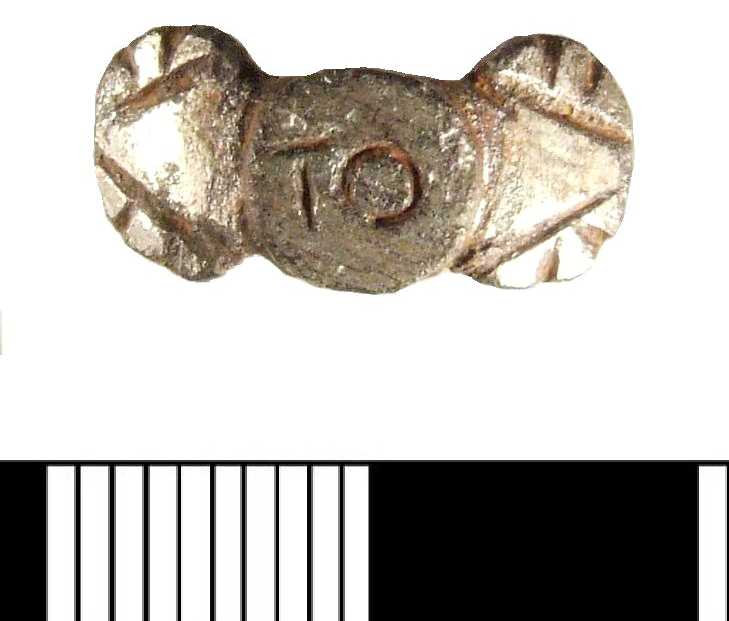
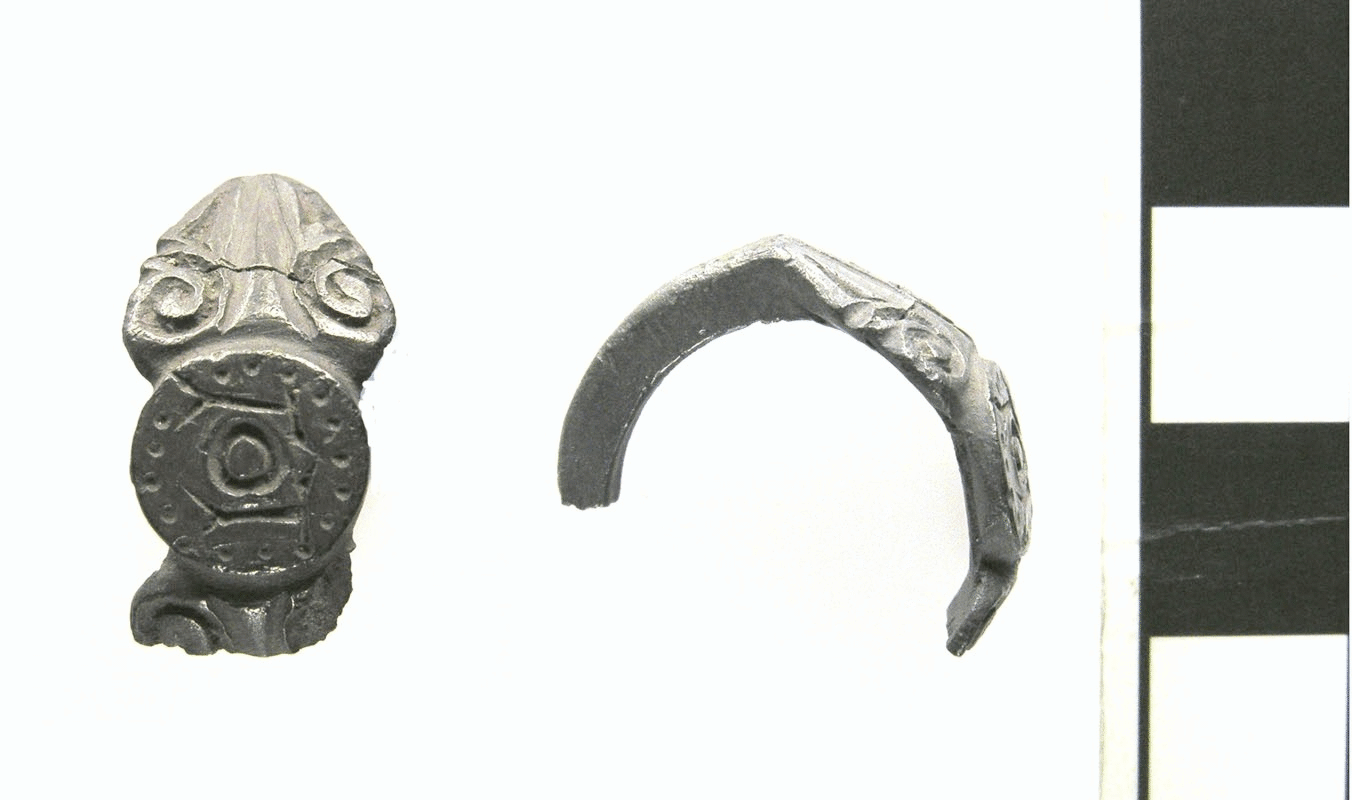
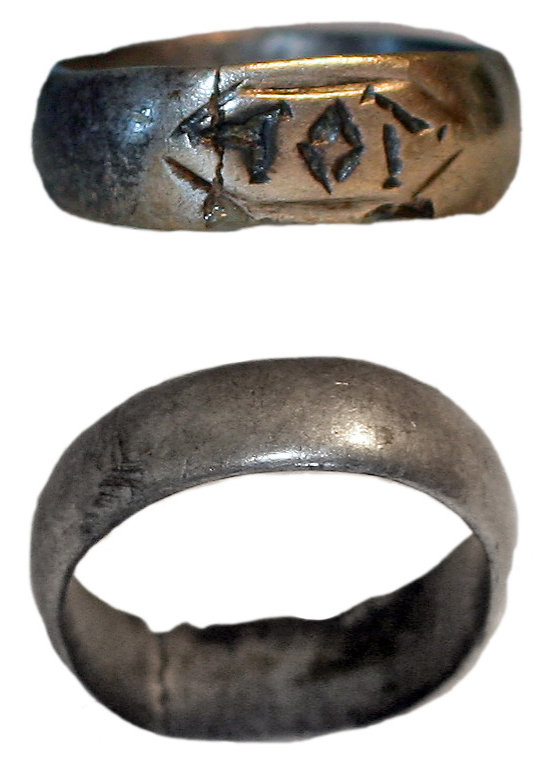
10. Hockcliffe (SP 95 28) (fig. 9). Fragment of a silver finger-ring comprising the bezel and one shoulder, foundFootnote 14 in 2005. Incised (i) on the bezel: DEO | TOTA, deo | To(u)ta(ti). ‘To the god Toutatis.’ Incised (ii) on the shoulders: […] | FELIX, [utere] | felix. ‘Use (and be) happy.’Footnote 15
Hockliffe, silver finger-ring (No. 10). Width of bezel: 10 mm.
(Photo: Portable Antiquities Scheme)

EAST SUSSEX
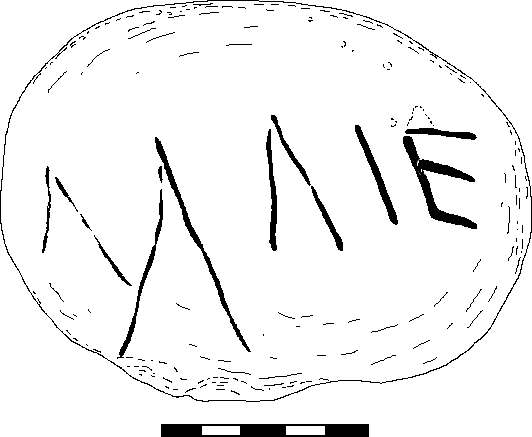
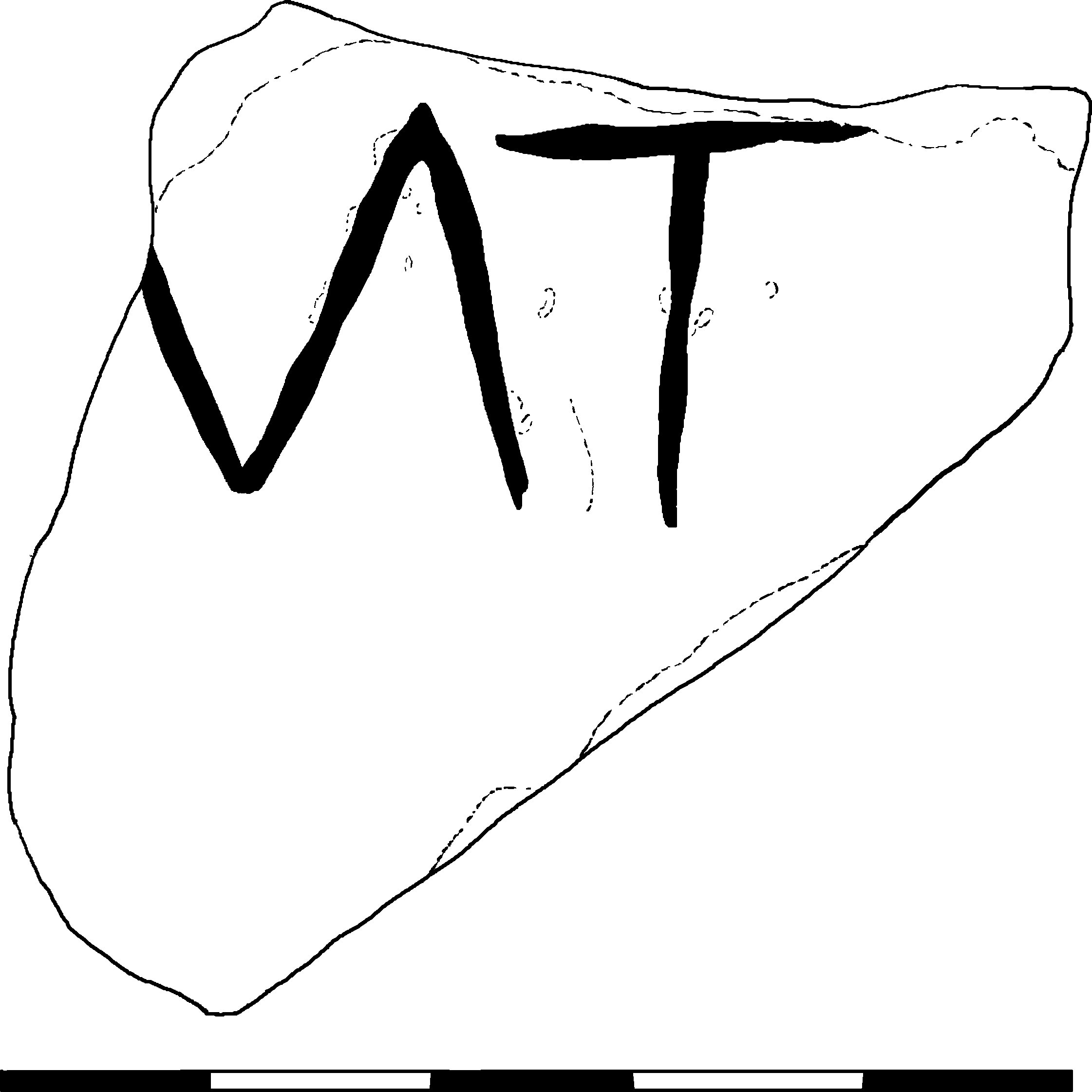
11. Lewes (TQ 41 10) (fig. 10). Oval lead disk, presumably Roman, 13 mm wide, foundFootnote 16 in 2009. There is no sign of attachment, but otherwise it might be the bezel of a finger-ring. Crudely inscribed: MΛIE, perhaps Mai(a)e. ‘Of (or to) Maia.’Footnote 17
Lewes, lead disc (No. 11).
(Drawn from a photograph by R.S.O. Tomlin)

EAST YORKSHIRE
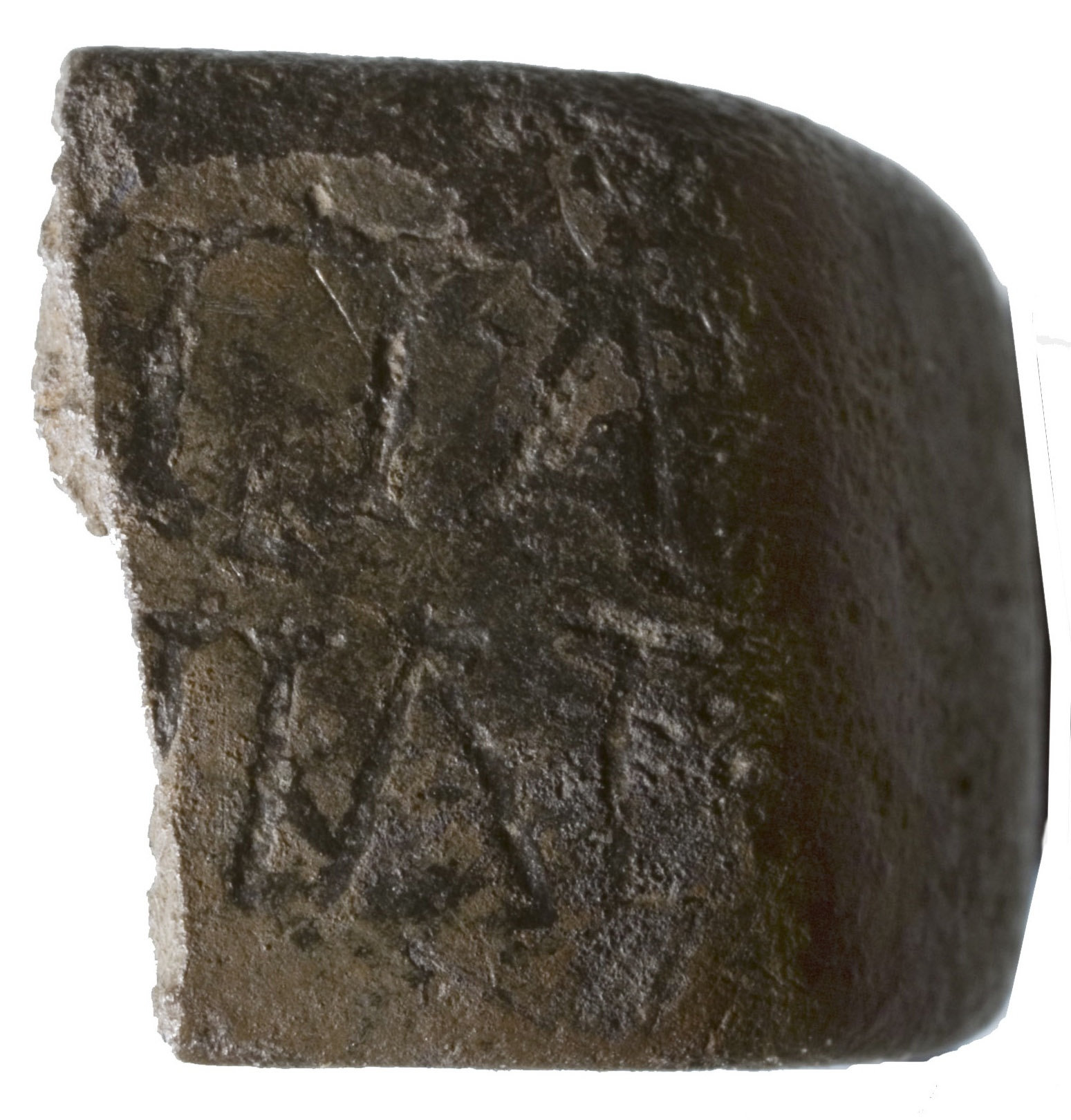
12. Hayton (SE 82 45) (fig. 11). Part of a plain silver (Ag 87%) finger-ring, foundFootnote 18 in 2009. In crudely incised letters, with apparent remains of niello filling: […]..IΛ | […].IΛT, perhaps [..]..ia [ven]iat. ‘Let […]ia come’.Footnote 19
Hayton, silver finger-ring (No. 12).
(Photo: Portable Antiquities Scheme)

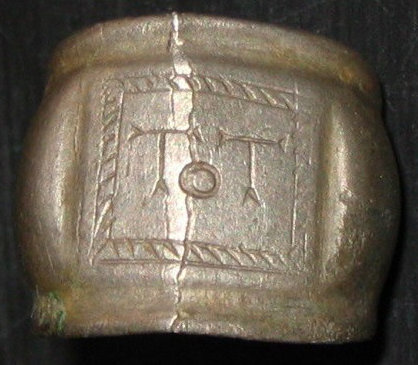
13. Ibid. Silver finger-ring, foundFootnote 20 in the 1980s or 1990s; inscribed on the bezel: TOT
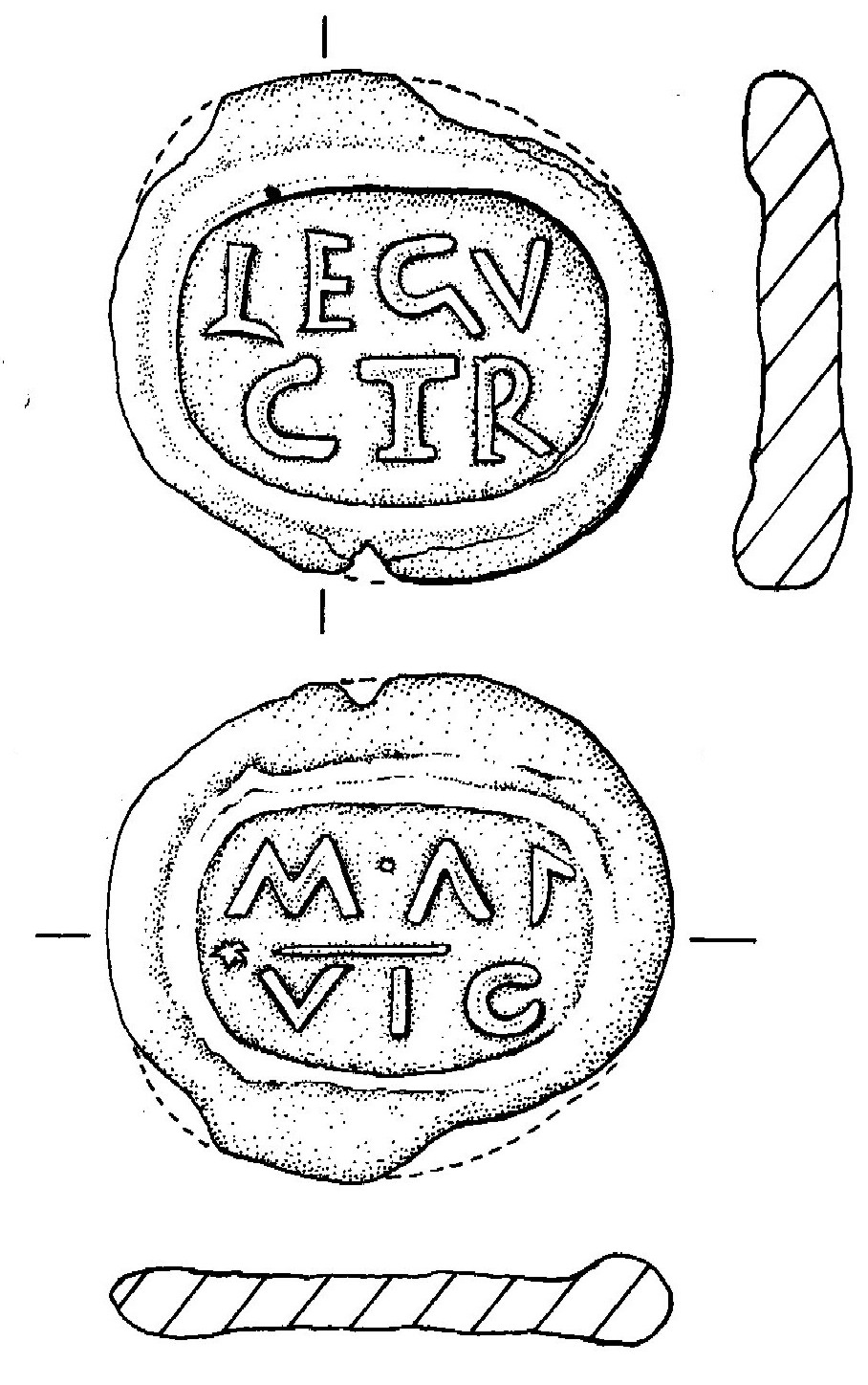
14. Ibid. (fig. 12). Oval lead sealing, foundFootnote 21 in 2009. Obverse: LEGV | CTR Reverse: M°A | VICFootnote 22
Hayton, lead sealing (No. 14).
(Drawing: Portable Antiquities Scheme)

GLOUCESTERSHIRE
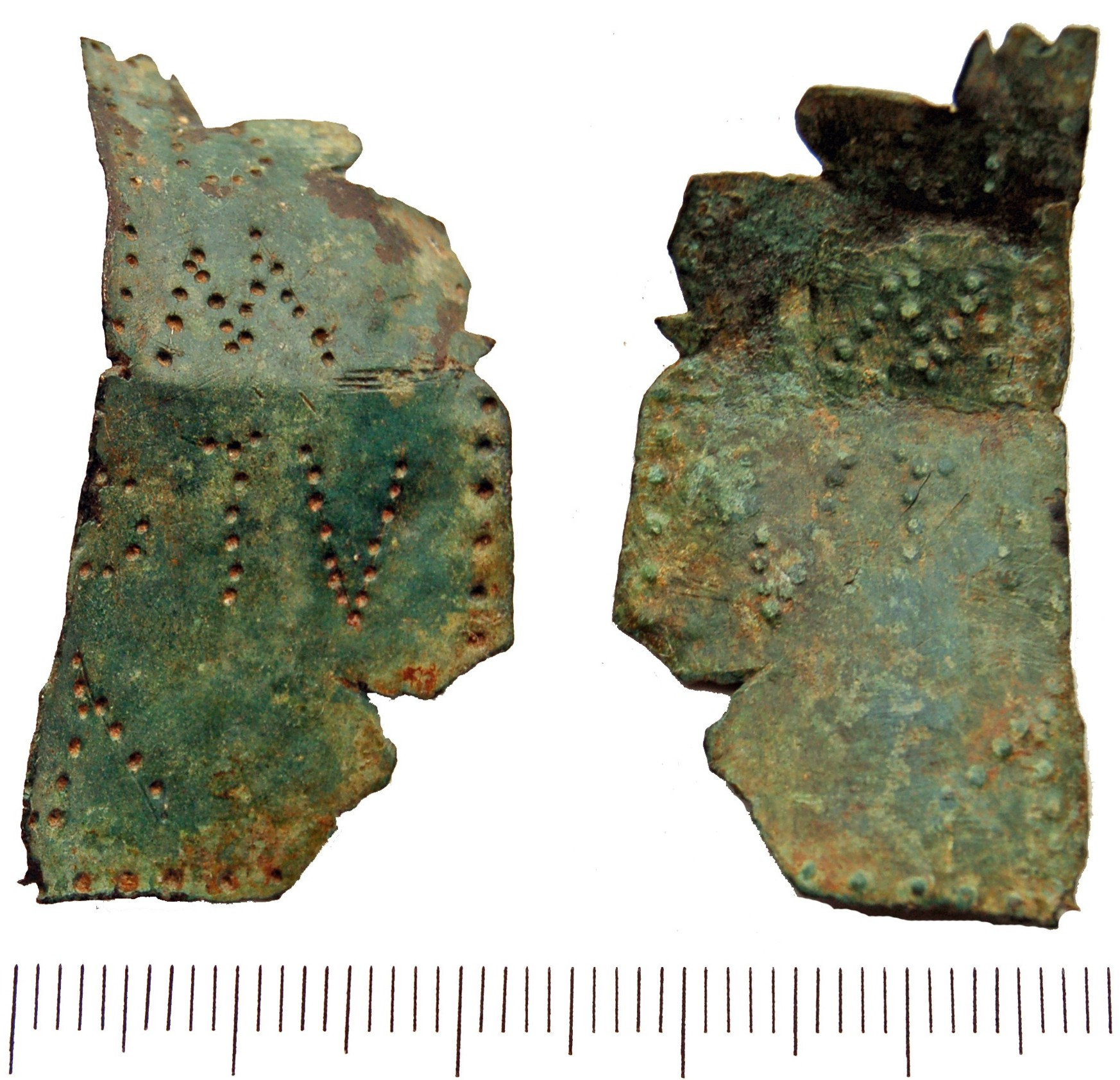
15. Uley (ST 788 998), Roman temple (fig. 13). Fragment of a copper-alloy votive plaque, 19 by 39 mm, foundFootnote 23 in 2009. Part survives of the right and bottom edges, which are defined by a line of punched dots. In letters formed by punched dots: […].O | […].M | […]OTV | […]Ṃ vacat, […].O | […].M |[v]otu|m. ‘… a vow.’Footnote 24
Uley, copper-alloy plaque (No. 15).
(Photo: Portable Antiquities Scheme)

HAMPSHIRE
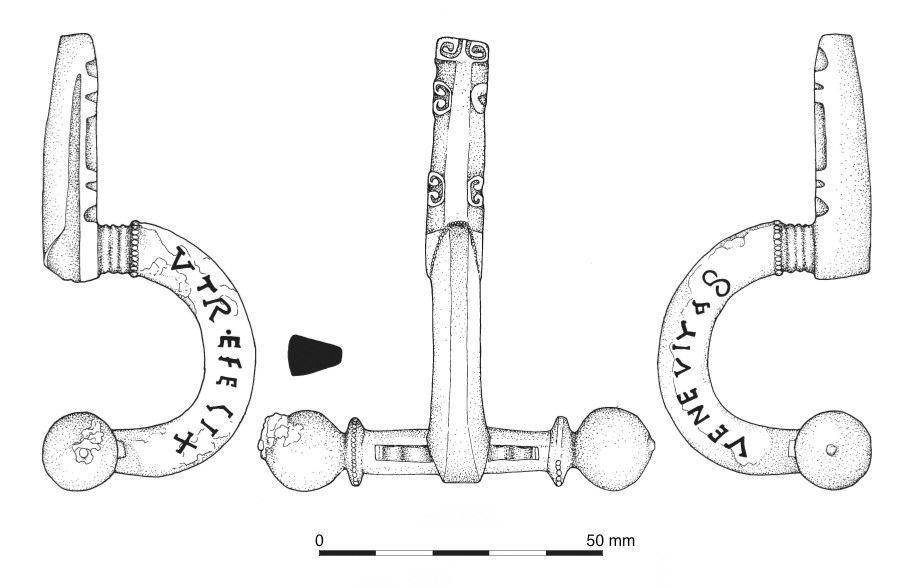
16. Lankhills fourth-century Roman cemetery, Winchester (Venta Belgarum, SU 479 304) (fig. 14). Gilded copper-alloy crossbow brooch (SF 4190), 77 mm long by 74 mm wide, foundFootnote 25 in 2003–4 in the burial of an adult, presumably male (Grave 1846), located approximately in the area of the right shoulder.Footnote 26 Inscribed in niello, either side of the bow: (i) VENE VIVAS, (b)ene vivas. ‘May you live well.’ (ii) VTRE FELIX, ut(e)re felix, ‘Use (and be) happy’.Footnote 27
Lankhills, crossbow brooch (No. 16).
(Drawing: Oxford Archaeology)

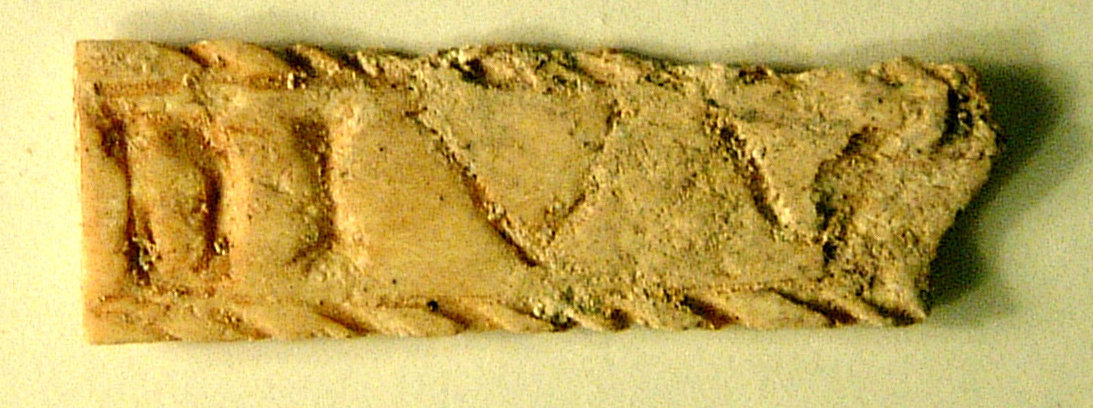
17. Ibid. (fig. 15). Incomplete bone plaque (SF 1536), now 9 by 28 mm, 2 mm thick, found in the grave of an adult female (Grave 620), placed near the right foot and adjacent to the associated burial of a neonate in the same coffin. It is rectangular, but broken and eroded at one end. A groove runs parallel to each long edge, with short diagonal grooves between it and the edge; on the underside, the original edges are slightly bevelled. Inscribed in capitals: DIVV[…], probably diu v[ivas], ‘May you live long’.Footnote 28
Lankhills, bone plaque (No. 17). Width 28 mm.
(Photo: Oxford Archaeology)

LEICESTERSHIRE
18. Goadby Marwood (SK 78 26). Silver finger-ring, foundFootnote 29 in c. 1982. Inscribed on the bezel: TOT
19. Wymeswold (SK 60 23). Silver finger-ring, found in c. 1992. Inscribed on the bezel: TOT
LINCOLNSHIREFootnote 30
20. Fillingham (SK94 85). Silver finger-ring found in 2003 (D 1), inscribed: TOT
21. Horncastle (TF 25 69) area. Silver finger-ring found in 2000 (D 3), inscribed: TOT
22. Lincoln (Lindum, SK 97 71) area (fig. 16). Silver finger-ring from an old collection (D 4), inscribed: TOT
Lincoln area, silver finger-ring (No. 22).
(Photo: Portable Antiquities Scheme)

23. Lincoln, Saltergate. Silver finger-ring found in 1973 (D 6), inscribed: TOT
24. Lincoln, 12 Steep Hill. Silver finger-ring found in 1974 (D 7), inscribed: TOT
25. Wickenby (TF 09 83). Silver finger-ring found in 2003 (D 8), inscribed: [T]OT
26. Edlington (TF23 71). Silver finger-ring (D 9), inscribed: [T]O[T]
27. Torksey (SK 83 77). Silver finger-ring found in c. 1980 (D 11), inscribed: TOT
28. Frampton (TF 32 39). Copper-alloy finger-ring found in c. 1994 (D 12), inscribed: TOT
29. Threekingham (TF 09 35). Silver finger-ring found in c. 1990 (D 13), inscribed: TOT
30. Stenigot (TF 25 81). Silver finger-ring found in c. 1990 (D 14), inscribed: TOT
31. Ibid. Another silver finger-ring found in c. 1990 (D 15), inscribed TOT
32. Kelstern (TF 25 90). Silver finger-ring found in c. 1990 (D 16), inscribed: TOT
33. Lincoln area (fig. 17). Another silver finger-ring from an old collection (D 17), inscribed: TOT
Lincoln area, silver finger-ring (No. 33).
(Photo: Portable Antiquities Scheme)

34. Rowston (TF 06 56). Silver finger-ring found in 2004 (D 18), inscribed: TOT
35. Horncastle (TF 25 69). Copper-alloy finger-ring found in 1998 (D 19), inscribed: TOT
36. Gate Burton (SK 83 82). Silver finger-ring found in the early 1990s (D 21), inscribed: TOT
37. Ibid. Another silver finger-ring found in the early 1990s (D 22), inscribed: TOT
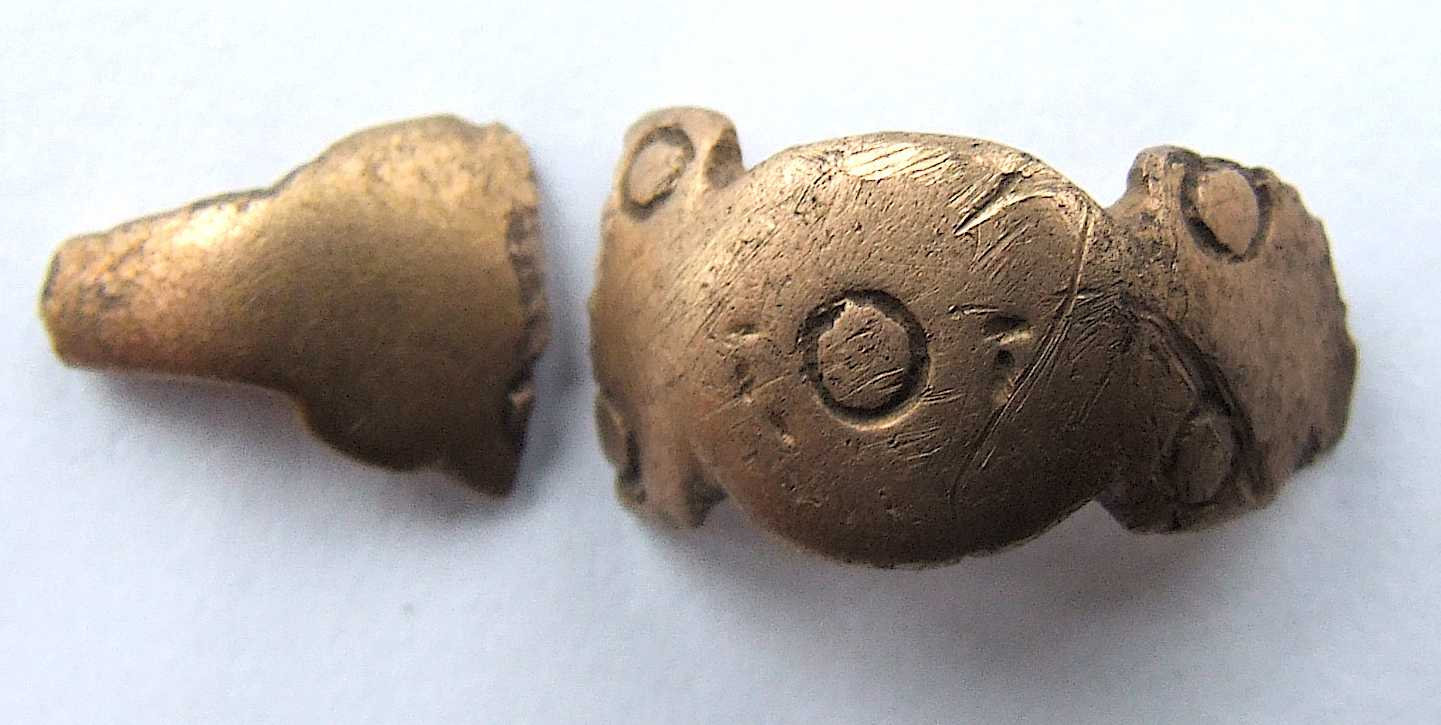
38. Ulceby Cross (TF 41 73) (fig. 18). Fragment of a gold finger-ring found in the early 1990s (D 23), comprising the bezel and shoulders, inscribed: TOT
Ulceby Cross, gold finger-ring (No. 38).
(Photo: Portable Antiquities Scheme)

39. Hibaldstow (SE 95 03). Silver finger-ring found in 1976 (D 24), inscribed: TOT
40. Swinhope (TF 21 96). Silver finger-ring found in 2003 (D 25), inscribed: TOT
41. Fulbeck (SK 95 50) area. Silver finger-ring (D 26), inscribed: DLO | TOT, d(e)o To(u)t(ati).Footnote 31
42. Ancaster (SK 98 44). Silver finger-ring found before 1996 (D 27), inscribed: TOT
43. Swallow (TA 17 03). Silver finger-ring found before 1996 (D 28), inscribed: TOT
44. Riby (TA 18 07). Copper-alloy finger-ring found before 1996 (D 29), inscribed: TOT
45. Lincolnshire (no further provenance). Silver finger-ring (D 31), inscribed: TOT
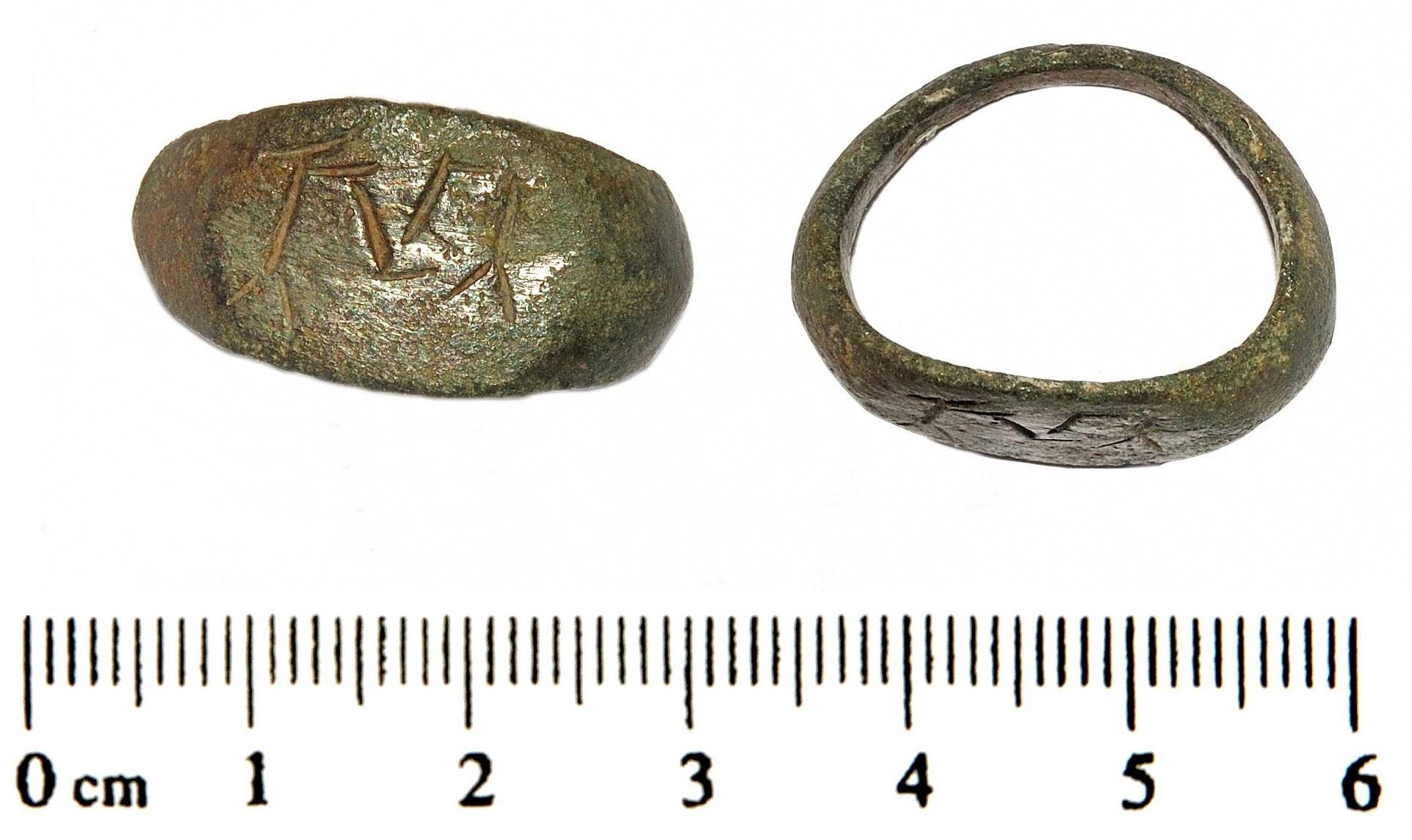
46. Ancaster (SK 98 44) (fig. 19). Copper-alloy ring found in the 1990s (D 32), inscribed: TVTFootnote 32
Ancaster, copper-alloy finger-ring (No. 46).
(Photo: Portable Antiquities Scheme)

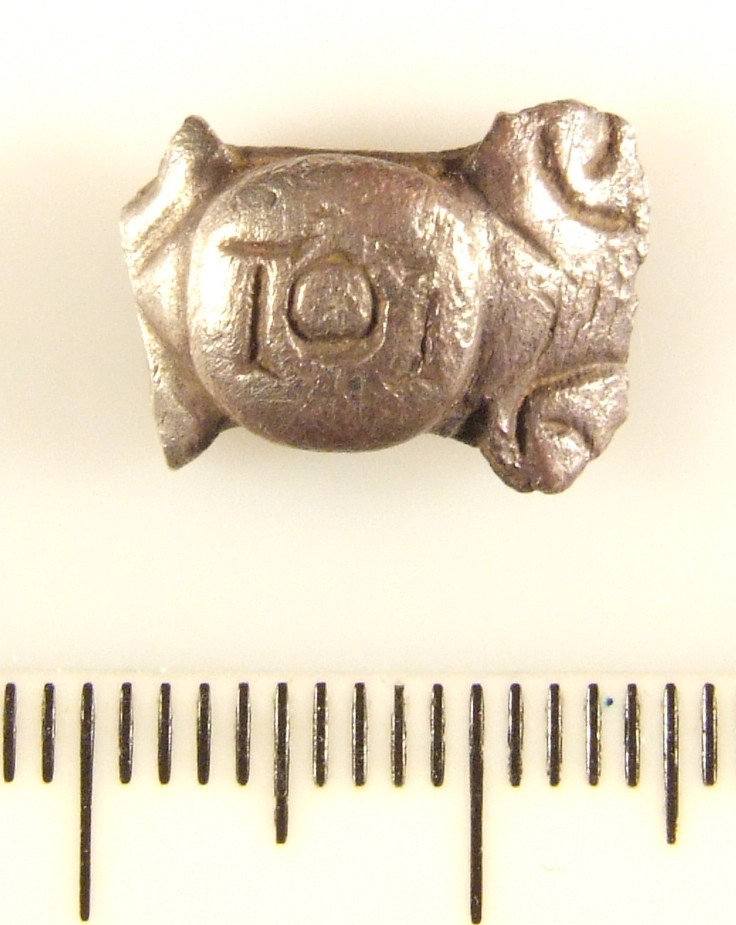
47. Thimbleby (TF 24 70) (fig. 20). Fragment of a silver finger-ring found in 2007 (D 33) comprising the bezel and shoulders, inscribed: TOT
Thimbleby, silver finger-ring (No. 47).
(Photo: Portable Antiquities Scheme)

48. Old Winteringham (SK 94 21). Silver finger-ring found in the 1980s (D 34), inscribed: TOT
49. Ancaster (SK 98 44). Another copper-alloy finger-ring found in the 1980s or 1990s (D 53), inscribed: TOT
50. Stixwould (TF 16 64). Silver finger-ring found in 2008 (D 54), inscribed: TOT
51. Lincolnshire (no further provenance). Another silver finger-ring from an old collection (D 56), inscribed: TOT
52. Thonock (SK 82 91). Silver finger-ring found in the 1990s (D 57), inscribed: TOT
53. Ibid. Another silver finger-ring found in the 1990s (D 58), inscribed: TOT
54. Osbournby (TF 06 38) (fig. 21). Silver finger-ring found in 2009 (D 60), inscribed: TO(T)Footnote 33
Osbournby, silver finger-ring (No. 54).
(Photo: Portable Antiquities Scheme)

55. Thonock (SK 82 91). A third silver finger-ring found in the 1990s (D 61), inscribed: [T]O[T]
56. Wickenby (TF 09 82). Silver finger-ring found in 2008 (D 62), inscribed: TOT
57. Caistor (TA 11 01). Silver finger-ring from an old collection (D 63), inscribed: TOT
58. Wellingore (SK 98 55). Fragment of a plain silver finger-ring found in 2009 (D 65), inscribed: [T]O[T]
LONDON
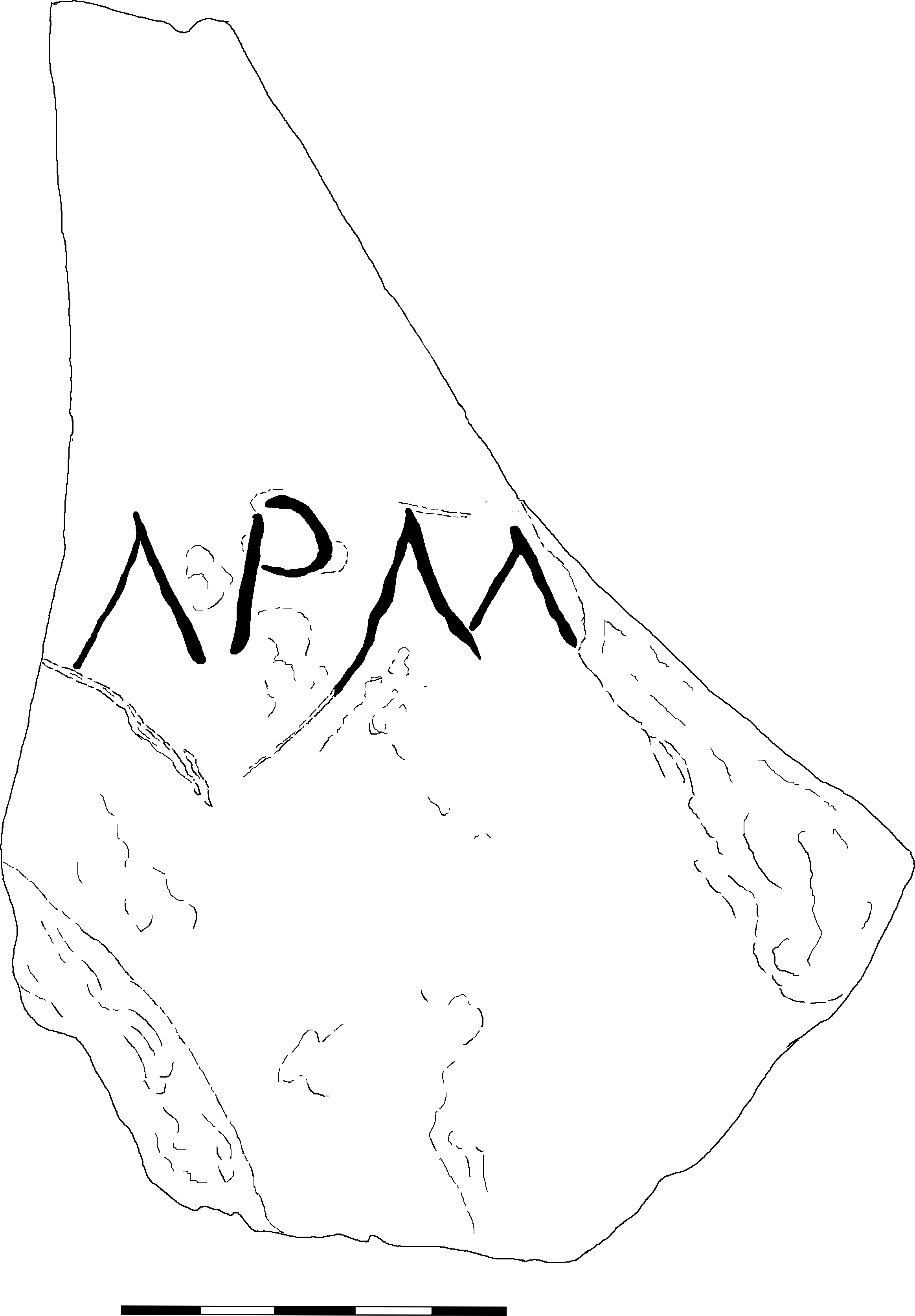
59. City of London (Londinium, TQ 32329 81240), 120 Cheapside (fig. 22). Wall sherd (SF 85) of a South Spanish oil amphora (Dressel 20), foundFootnote 34 in 2005. Scratched on the shoulder after firing, in crude capitals: […]ΛPM[…], probably A(ulus) P(…) M(…) Footnote 35
London, amphora graffito (No. 59).
(Drawn by R.S.O. Tomlin)

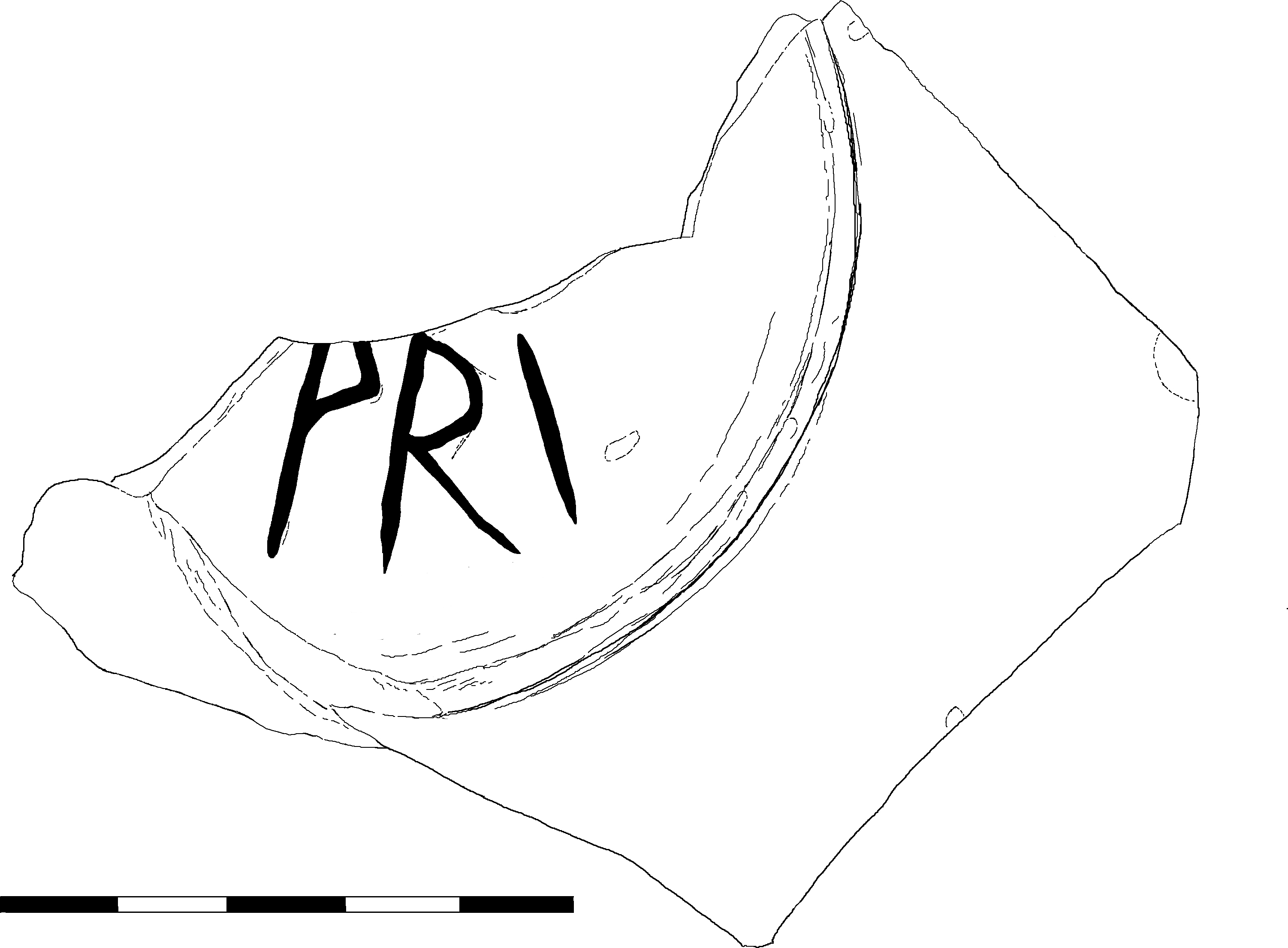
60. Ibid. (Londinium, TQ 32352 81325), 14–18 Gresham Street (fig. 23). Base sherd (SF 724) of a samian dish (Drag. 18 SG), foundFootnote 36 in 2006–7. Deeply incised underneath after firing, in crude capitals: PRI, probably Primus or a cognate name.Footnote 37
London, samian graffito (No. 60).
(Drawn by R.S.O. Tomlin)

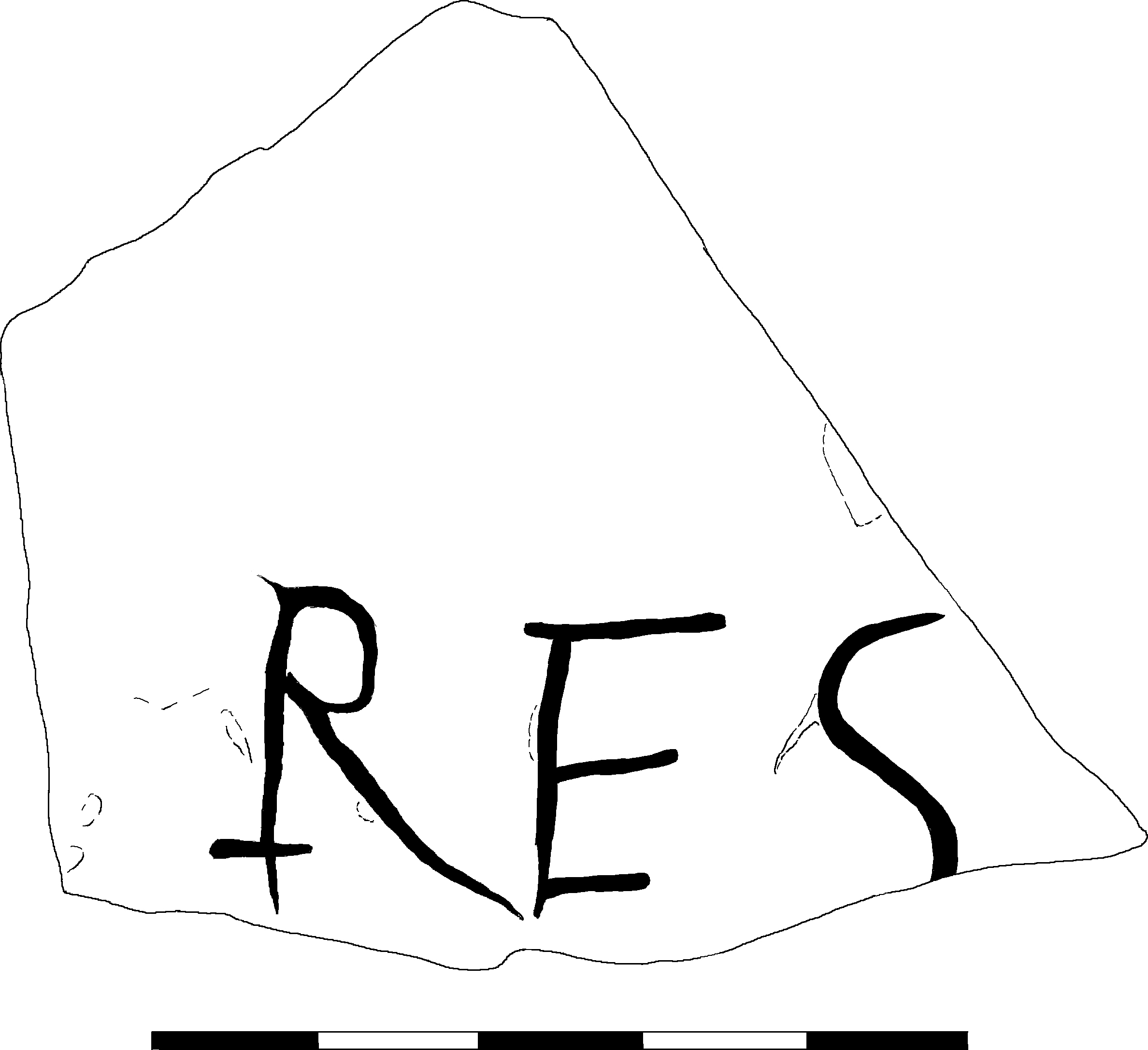
61. Ibid. (fig. 24). Wall sherd (SF 646) of an oxidised ware flagon or jar found in a Flavian context. Incised after firing, in quite stylish capital letters: RES[…], an incomplete personal name.Footnote 38
London, coarseware graffito (No. 61).
(Drawn by R.S.O. Tomlin)

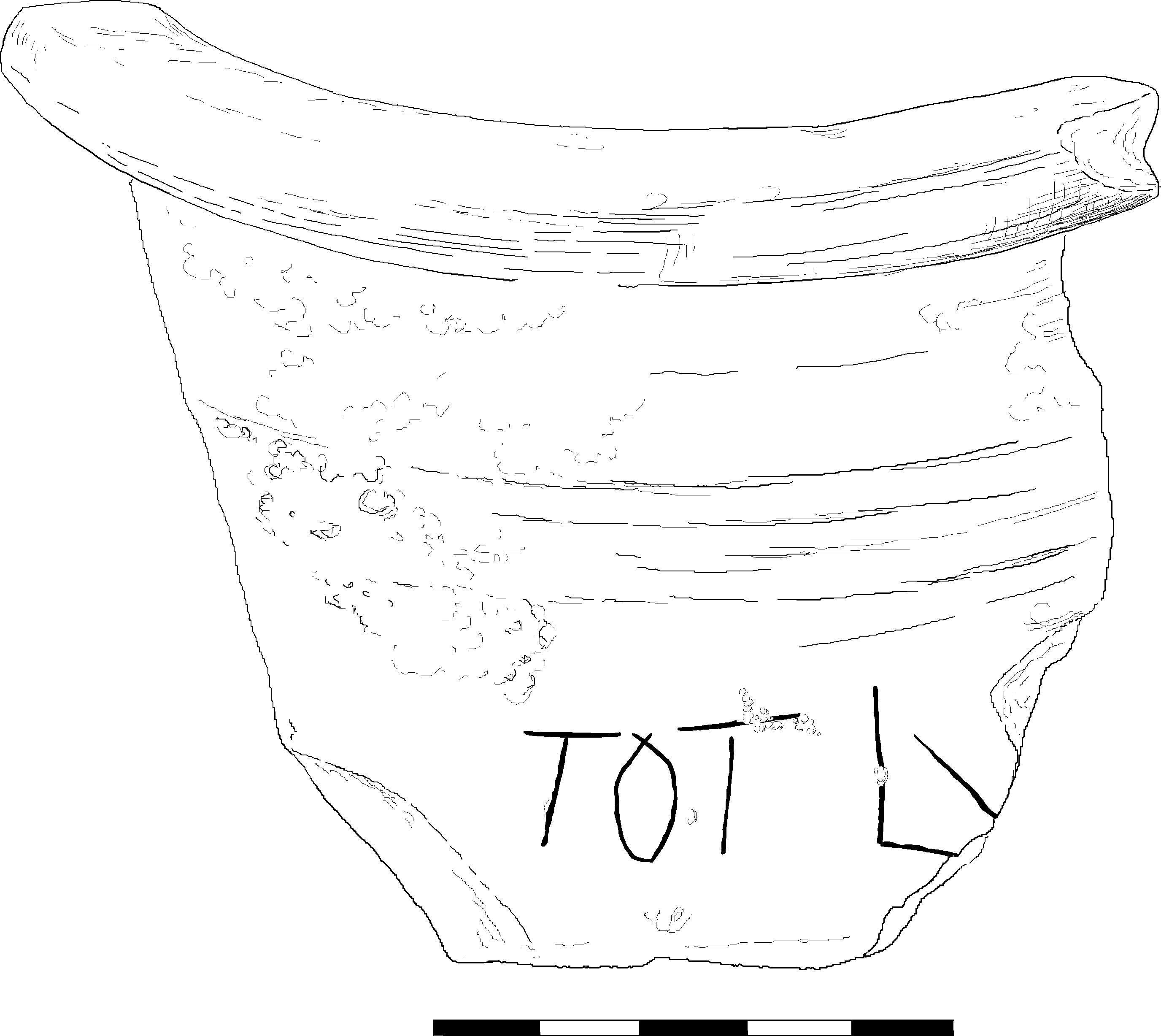
62. Ibid. (fig. 25). Rim sherd (SF 1178) of a pale buff coarseware pot, found with other uninscribed sherds of the same pot. Scratched on the shoulder after firing with a fine point: TOT LV[…], apparently the dedication formula TOT followed by a personal name such as Lucius or one of its cognates.Footnote 39
London, coarseware graffito (No. 62).
(Drawn by R.S.O. Tomlin)

63. Greater London (TQ 3680 8320), Gladstone Place, Tower Hamlets (fig. 26). Coarseware rim sherd foundFootnote 40 in 2008. Scratched after firing: […]ṚITI I[…], perhaps Ritici. ‘(Property) of Riticus or Riticius.’Footnote 41
London, coarseware graffito (No. 63).
(Photo: Pre-Construct Archaeology)

NORTH YORKSHIRE
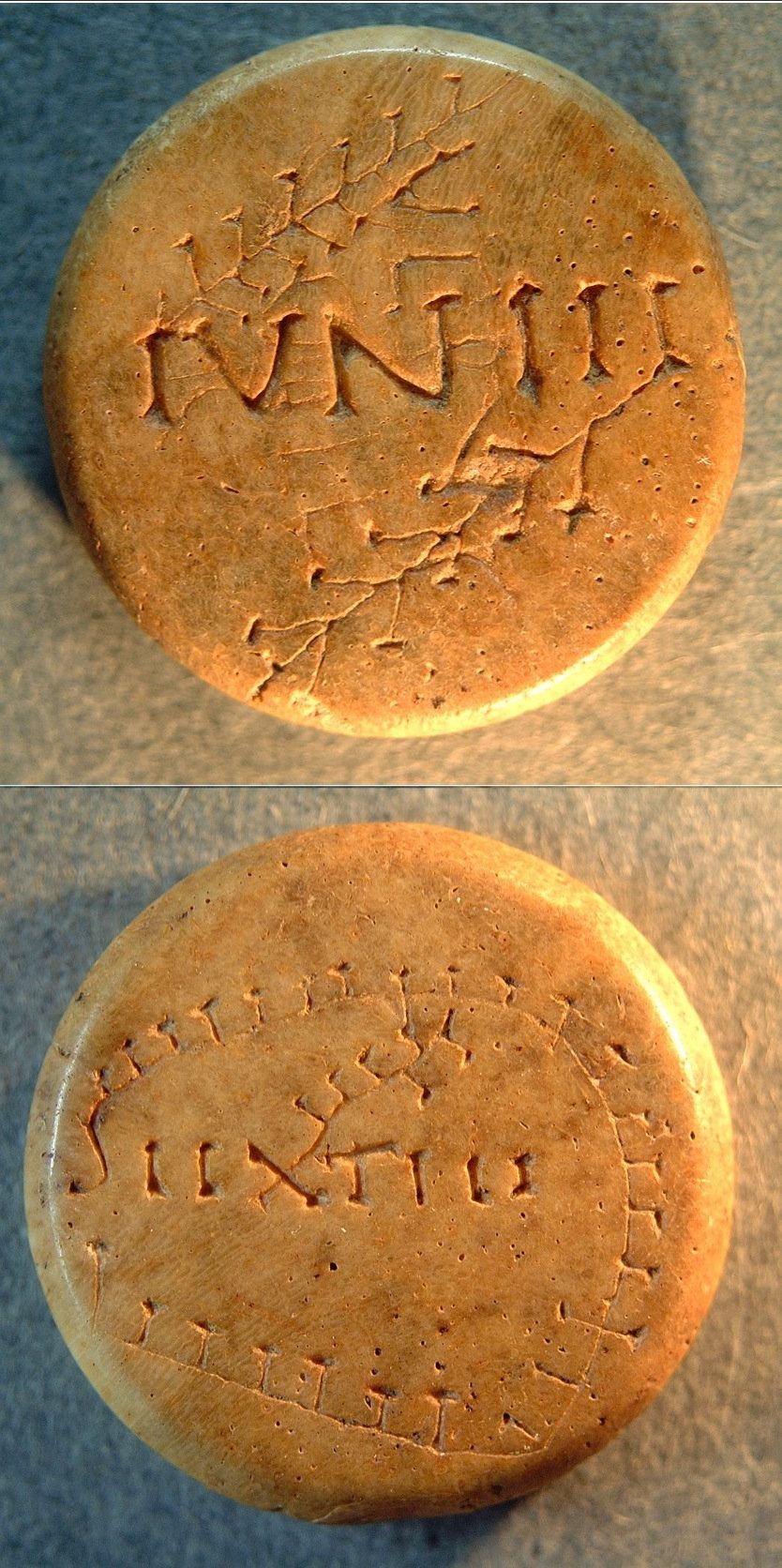
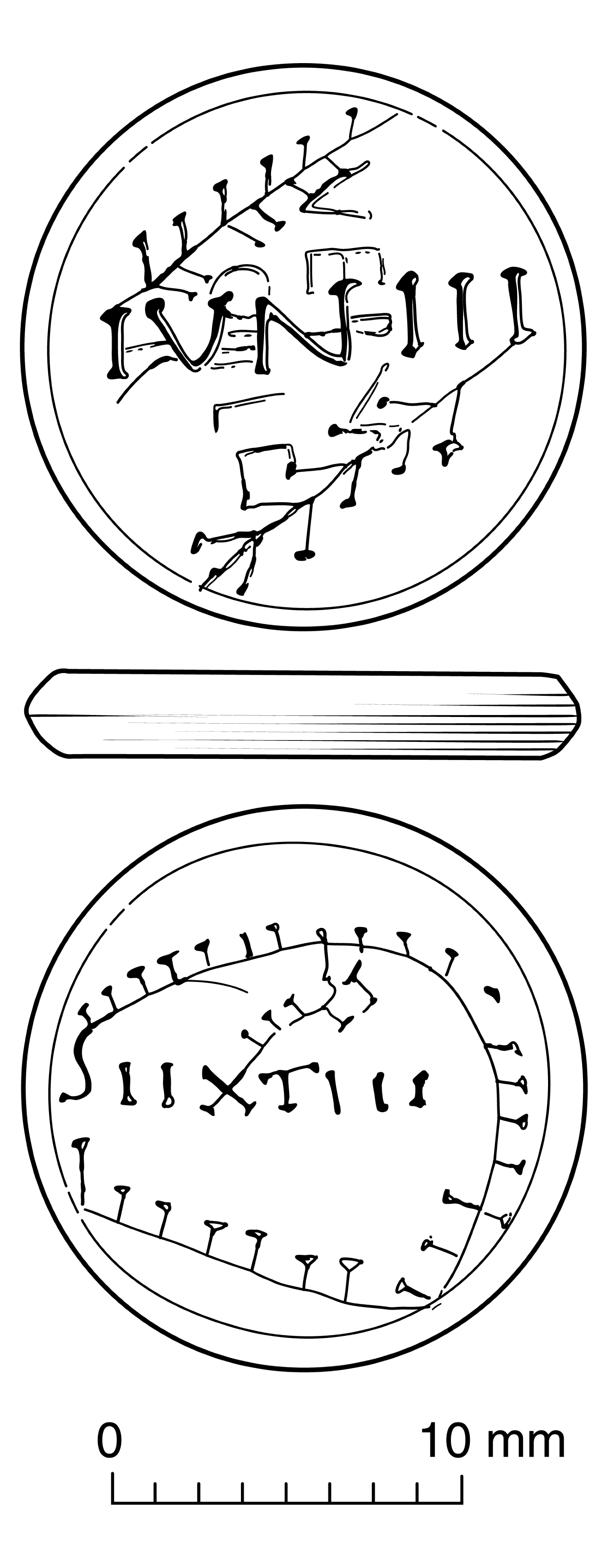
64. York (Eboracum, SE 605 521), St Leonard's Hospital (figs. 27 and 28. Bone roundel or gaming-counter with a dark patina, 15 mm in diameter, 3 mm thick, foundFootnote 42 in 2004 in late/post-Roman repairs to the west corner of the legionary fortress defences. Inscribed both sides. Obverse: (i) deeply incised across the diameter in neat serifed capitals, between two incised figures at a diagonal probably representing palm-leaves: IVNIII. (ii) Scratched over (i) at right-angles, in much shallower, informal, capitals: VERVS | C.LE | R, Verus | C[e]le|r. The personal names ‘Verus’ and ‘Celer’. Reverse: deeply incised across the diameter in serifed capitals similar to those of obverse (i) but smaller, within an oval outline probably representing a garland of olive or laurel: SEXTIII.Footnote 43
York, bone roundel (No. 64).
(Photo: York Archaeological Trust)

York, bone roundel (No. 64).
(Drawn by Lesley Collett)

NORTHUMBERLAND
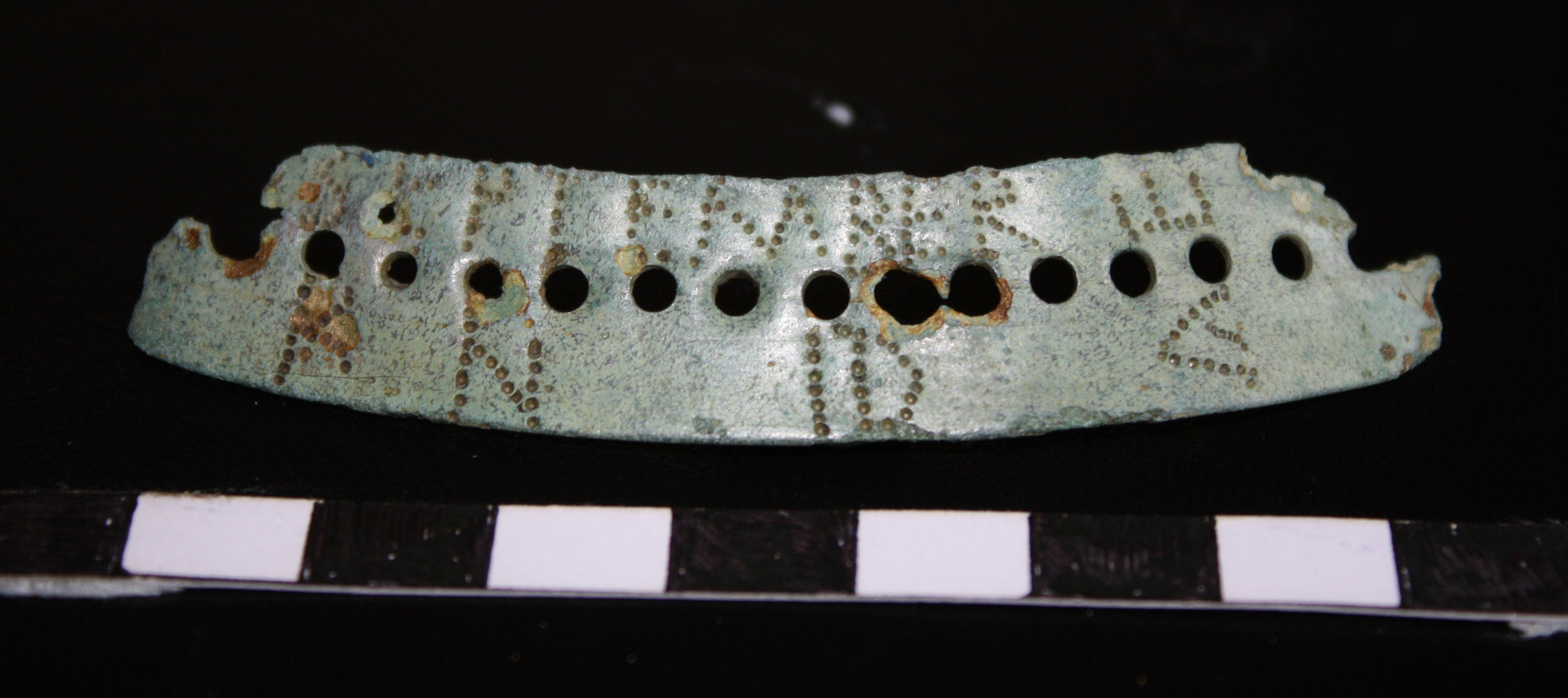
65. Vindolanda (NY 768 663), the visible stone fort (fig. 29). Fragment of a copper-alloy strip (SF 12223), 83 by 21 mm, c. 1 mm thick, foundFootnote 44 in 2008 in debris from the east granary. The strip curves gently as if part of a circumference c. 350 mm in diameter, and is pierced medially with a series of fifteen (including two incomplete) round holes, 3 mm in diameter, 2 mm apart. Inscribed in letters formed by punched dots: (i) above the holes, SEPTEMBER; (ii) below the holes, K N ID, K(alendae) N(onae) Id(us); (iii) at right-angles, just after ‘September’, AE, Ae(quinoctium).Footnote 45
Vindolanda, copper-alloy strip (No. 65).
(Photo: R.S.O. Tomlin)

66. Ibid. Ten fragments of brick or tile impressed with rectangular stamps of Legion VI Victrix now incomplete, foundFootnote 46 in 2009. Three at least can be identified as RIB II.4, 2460.50 (Wright, type 44).
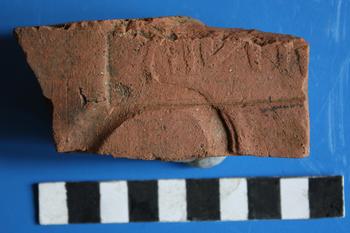
67. Ibid. (fig. 30). Fragment of tile 22 mm thick (SF 13252), impressed at one end with a rectangular stamp over the tilemaker's ‘signature’: CIINII[…], presumably c(ohors) II Ne[rv(iorum)].Footnote 47
Vindolanda, stamped tile (No. 67).
(Photo: R.S.O. Tomlin)

68. Ibid. Fragment of tile 25 mm thick (SF 12236), in a grey fabric unusual at Vindolanda, impressed with a well-made ansate stamp with letters in high relief: CO[…], co[h(ors) …].Footnote 48
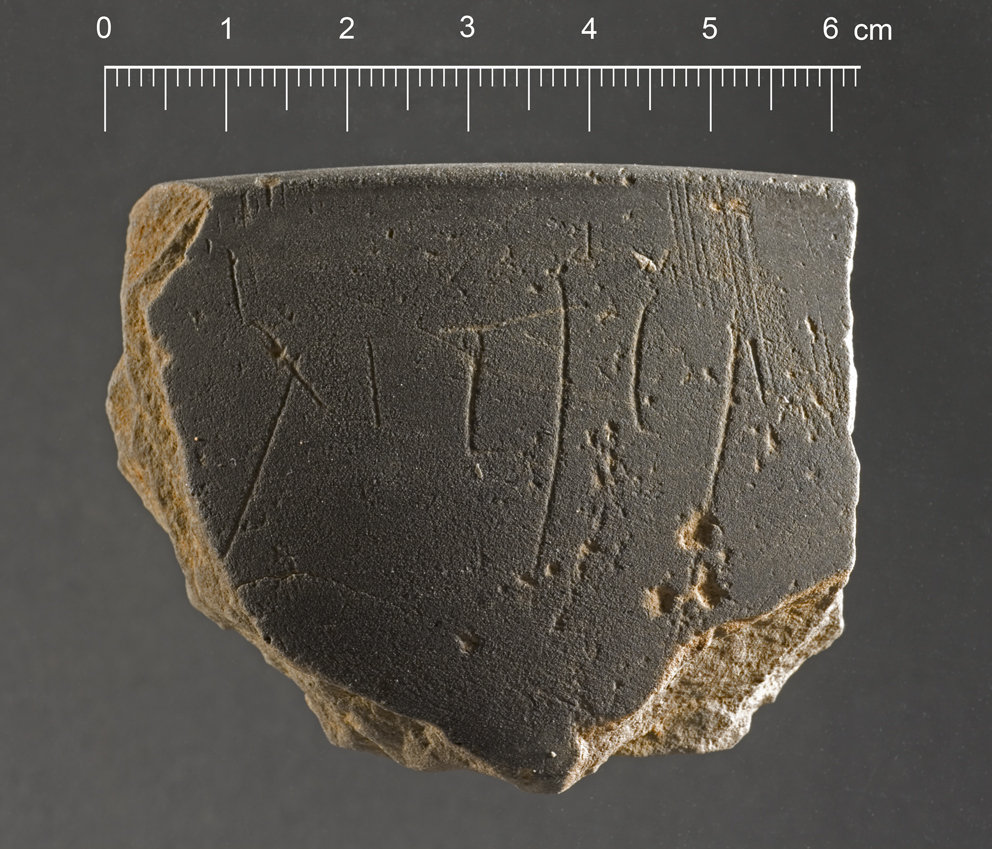
69. Ibid. Rim sherd of a pale buff mortarium (SF 12416), crudely incised with a knife before firing, on the rim below the lip: ṆINI.[…]Footnote 49
70. Ibid. Wall sherd of a South Spanish oil amphora (Dressel 20) (SF 13295), incised after firing with a series of straight strokes in the vertical axis; reading downwards: […]IIVVFootnote 50
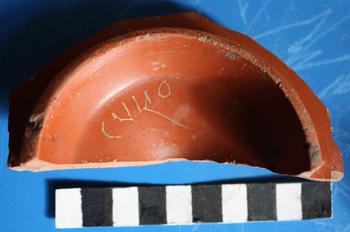
71. Ibid. (fig. 31). Base sherd of a samian platter (Drag. 18/31) (SF 13388), scratched underneath after firing within the foot-ring: ṢVLIO, perhaps Sulio.Footnote 51
Vindolanda, samian graffito (No. 71).
(Photo: R.S.O. Tomlin)

72. Ibid. Rim sherd of a grey jar (SF 13453), incised after firing: PR, Pr(…).Footnote 52
73. Ibid. Rim sherd of a grey jar (SF 13018), coarsely incised after firing: CANVS, Canus.Footnote 53
NOTTINGHAMSHIREFootnote 54
74. Stanford on Soar (SK 54 22). Silvered copper-alloy finger-ring found in the 1980s or 1990s (D 35), inscribed: TOT
75. East Stoke (SK 75 49). Silver finger-ring found in the 1980s or 1990s (D 37), inscribed: TOT
76. Mansfield (SK 54 61). Copper-alloy finger-ring found in the 1990s (D 38), inscribed: TOT
77. Linby (SK 53 53) (fig. 32). Fragment of a silver finger-ring found in 2007 (D 39) comprising the shoulders and bezel, inscribed: TOT
Linby, silver finger-ring (No. 77).
(Photo: Portable Antiquities Scheme)

78. Gringley on the Hill (SK 73 90). Silver finger-ring found in the 1980s or 1990s (D 40), inscribed: TOT
79. Redhill on Soar (SK 4928). Copper-alloy finger-ring (D 55), inscribed: TOT
80. Caunton (SK 74 59) (fig. 33). Copper-alloy finger-ring found in 2008 (D 59), inscribed: TVTFootnote 55
Caunton, copper-alloy finger-ring (No. 80).
(Photo: Portable Antiquities Scheme)

SOMERSET
81. West Bagborough (ST 16 32) (fig. 34). Sub-rectangular piece of hacksilber cut from scrap silver plate, 39.6 by 68.9 mm, 8 mm thick, weight 163.26 gm, foundFootnote 56 in 2001. Inscribed with a fine point: XII | VIIII S, XII | VIIII s(emis), ‘12; 9; one-half.’Footnote 57
West Bagborough, hacksilber (No. 81). Width 39.6 mm.
(Drawn from a photograph by R.S.O. Tomlin)

WILTSHIRE
82. Pewsey (SU 18 56). Silver finger-ring foundFootnote 58 in 2009, inscribed: TOT
CHANNEL ISLANDS
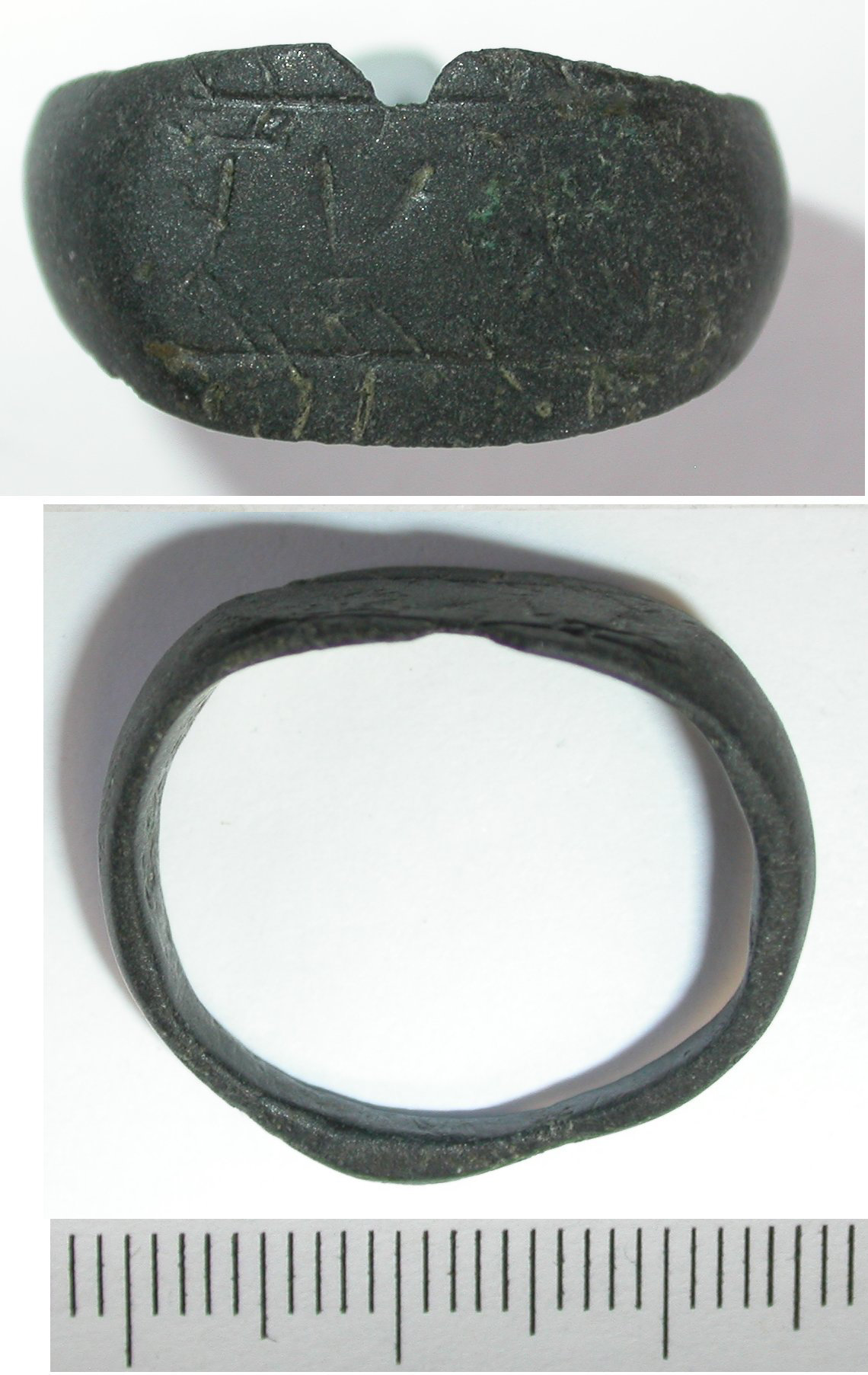
83. St Peter Port, Guernsey, La Plaiderie. Copper-alloy finger-ring, foundFootnote 59 in 1983/85. Incised on the bezel: […] | VALE, probably [bene] |vale. ‘Fare well.’Footnote 60
84. Ibid. Fragment of a cylindrical glass bottle with moulded inscription in the base: FRO, Fro(ntinus).Footnote 61
85. St Peter Port, Guernsey, Bonded Store (WV 3356 7809) (fig. 35). Wall sherd of a flagon foundFootnote 62 in 1996/2003, in the fill of a Roman ditch probably of the mid-second century. Scratched above the shoulder after firing: […] T, probably Vat(…), an abbreviated personal name.Footnote 63
Guernsey, coarseware graffito (No. 85).
(Drawn by R.S.O. Tomlin)

86. Ibid. (fig. 36). Wall sherd of another flagon, scratched after firing: […]I VI[…]Footnote 64
Guernsey, coarseware graffito (No. 86).
(Drawn by R.S.O. Tomlin)

SCOTLAND
CITY OF EDINBURGH
87. Cramond (NT 1900 7688). Base sherd of a samian dish (Drag. 18/31) stamped by Reditus of Lezoux (c. a.d. 135–65) (SF 107), foundFootnote 65 in 2008. Scratched underneath after firing in capital letters: VIIR, an abbreviated personal name Ver(…), perhaps Ver(ecundus).Footnote 66
ADDENDA ET CORRIGENDA
(a) RIB 1688 (Vindolanda). This altar is now so weathered as to be illegible, but with the help of No. 4 above (Vindolanda) the prefect's name can be read from Wright's (1950) drawing as [SV]LI|CIVS VDENS, [Su]lpi|cius Pudens.Footnote 67 It was preceded in line 3 by the cui praeest formula abbreviated; the drawing suggests [C] [R]AE.
(b) RIB 1705 (Vindolanda) (fig. 37). Two fragments of a buff sandstone dedication-slab were foundFootnote 68 in 2009 at Vindolanda, in the east granary of the visible stone fort. They almost certainly belong to the same inscription as a much larger fragment (RIB 1705) found at Vindolanda in 1933, re-used in the Headquarters Building immediately to the east. Fragment (i), 205 by 145 mm, 115 mm thick, with original top edge, right edge and back, is inscribed in letters 60 mm high which retain trace of red paint: […]ṢEVE | […
![]Ị͡](https://static.cambridge.org/binary/version/id/urn:cambridge.org:id:binary:20190822073520951-0731:S0068113X10000504:S0068113X10000504_char10.gif?pub-status=live)
 XI | […], […] Severi | [… Parth]ici m[a]xi(mi) | […]. It evidently identified Caracalla as the son of the deified Severus, Most Great Conqueror of Parthia (etc.).Footnote 69 Fragment (ii), 80 by 115 mm, maximum thickness 60 mm (but not original), is inscribed in similar letters 50 mm high without trace of colouring: […] | […]Ạ[…] | […]
 […] | […], part of Caracalla's fictive ancestry.Footnote 70
Vindolanda, RIB 1705 (Add. (b), (i)).
(Photo: R.S.O. Tomlin)

(c) After RIB II.3, 2422.40, note is made of an unprovenanced gold TOT finger-ring which is now in the Victoria and Albert Museum. In addition to RIB II.3, 2422.38 (British Museum), six silver TOT rings without provenance have also been recorded (fig. 38).Footnote 71
Unprovenanced silver finger-ring (Add. (c)).
(Photo: Portable Antiquities Scheme)

(d) Britannia 27 (1996), 453, No. 31 (South Shields). This fragment of a copper-alloy belt-plate, originally read as [IO]VIS after RIB II.3, 2429.11 (Brampton), is now better read and restored as [ser]ves.Footnote 72 ‘May you preserve.’
(e) RIB II.3, 2429.12 (Kirkby Thore). This fragment of a copper-alloy belt-plate, reading SERV.[…], is better restored as serv[es].Footnote 73 ‘May you preserve.’
(f) RIB II.4, 2472.2, tile-stamp reading C IIII G, c(ohors) IIII G(allorum). Examples noted are all from Templebrough, but the same stamp was used for two roof-tiles (tegulae) found at Castleford (Lagentium). Since they are in the same fabric as the majority of tile from this fort and its vicus, this fabric was probably local; it would follow that in the Flavian period the cohort was stationed at Castleford.Footnote 74
(g) RIB III has now been published, and brings the record of inscriptions on stone in RIB I to the end of 2006. They are numbered from 3001 (to 3550), to mark them as belonging to a third volume.Footnote 75
CHANGE OF LOCATION
(a) RIB 1020 (probably Cumberland). This fragment of a Twentieth Legion dedication-slab was rediscovered in c. 1995, in a garden in Barkway, Herts.Footnote 76