Introduction
In a broad sense the focus of this study is on life moving beyond its planet of origin, a question of evolutionary interest and because human exploration of space is the movement of life from Earth. Moving beyond the planet of origin requires a vehicle for transport, the ability to withstand transport, and the ability to colonize, thrive and ultimately evolve in the new environment. The core of this study is to identify organisms that are likely to withstand the rigors of space, using as a guiding principle the hypothesis that desiccation resistance and natural exposure to high levels of radiation are good predictors of radiation resistance. Critical to this is the ability of the organisms to withstand space radiation, space vacuum desiccation and time in transit. The result of this investigation will increase our understanding of several of these parameters.
Can life survive beyond its home planet? In attempts to answer this question microbes tested in the space environment include Bacillus subtilis spores, bacteria, bacteriophage T-1, tobacco mosaic virus, osmophilic microbes, cyanobacteria and lichens (Horneck & Brack Reference Horneck, Brack and Bonting1992; Horneck Reference Horneck1993; Mancinelli et al. Reference Mancinelli, White and Rothschild1998; Nicholson et al. Reference Nicholson, Munakata, Horneck, Melosh and Setlow2000, reviewed in Horneck et al. Reference Horneck, Klaus and Mancinelli2010). B. subtilis spores will survive for years in space if in a multilayer or mixed with glucose to protect them against high solar ultraviolet (UV)-radiation flux, but are killed in minutes if exposed in a monolayer (Horneck Reference Horneck1993; Horneck et al. Reference Horneck, Bücker and Reitz1994, Reference Horneck, Rettberg, Wehner, Eschweiler, Strauch, Panitz, Starke and Baumstark-Kahn2001). Viruses lose viability in weeks (reviewed in Horneck & Brack Reference Horneck, Brack and Bonting1992; Horneck et al. Reference Horneck, Klaus and Mancinelli2010). The halophile Halorubrum chaoviator (Mancinelli et al. Reference Mancinelli2009) (formerly Haloarcula-G) and the cyanobacterium Synechococcus (Nägeli) can survive for at least weeks in the space environment (Mancinelli et al. Reference Mancinelli, White and Rothschild1998) and probably much longer (Mancinelli et al. Reference Mancinelli, Fahlen, Landheim and Klovstad2004).
The interplanetary medium poses obstacles to the survival of Earth-based, and presumably, all carbon-based life. Space is extremely cold. It is subject to unfiltered solar radiation, solar wind and galactic cosmic radiation. It has exceedingly low pressures, and has a much lower gravity than Earth (Mileikowsky et al. Reference Mileikowsky, Cucinotta, Wilson, Gladman, Horneck, Lindegren, Melosh, Rickman, Valtonen and Zheng2000; Horneck Reference Horneck, Rothschild and Lister2003; Rothschild Reference Rothschild, Rothschild and Lister2003). Space is a nutritional wasteland with respect to water and organic carbon. The organisms most likely to survive these conditions are microbes, although some seeds, fungi, lichens or invertebrates might be able to make the journey. For the small prokaryotes, gravity is not an issue, and cold tolerance is widespread among spores.
During the short term, most damage to microbes exposed to the space environment is due to UV-radiation, but heavy ionizing radiation has a greater probability of being lethal (rev. in Horneck et al. Reference Horneck, Bücker and Reitz1994; Horneck et al. Reference Horneck, Klaus and Mancinelli2010). Reactive oxygen species are produced by ionizing radiation during flight and are an important component of radiation damage in space (Horneck et al. Reference Horneck, Klaus and Mancinelli2010). Types of DNA damage due to UV and ionizing radiation in space are, in order of increasing danger to the cell, damage to nucleo-bases, single strand breaks and double strand breaks.
Desiccation tolerance has been reported for a variety of organisms including bacteria, yeast, lichenized fungi, plants, insects and crustaceans (e.g. Clegg Reference Clegg and Leopold1986; Csonka &Hanson Reference Csonka and Hanson1991; Crowe et al. Reference Crowe, Hoekstra and Crowe1992 reviewed in Potts Reference Potts1994; Jönsson et al. Reference Jönsson, Rabbow, Schill, Harms-Ringdahl and Rettberg2008; de la Torre et al. Reference de la Torre2010; Tepfer et al. Reference Tepfer, Zalar and Leach2012). One of the mechanisms of death due to anhydrobiosis (extreme desiccation) in prokaryotes is the dehydration of DNA leading to its breakage (Dose et al. Reference Dose, Bieger-Dose, Kerz and Gill1991, Reference Dose, Bieger-Dose, Labusch and Gill1992, Reference Dose, Bieger-Dose, Dillman, Gill, Kerz, Klein, Meinert, Nawroth, Risi and Stridde1995).
The ability to cope with high concentrations of salt and/or desiccation seems to be a good predictor of protection from radiation damage as has been shown in microbes on Earth. This is due to the fact that DNA damage accumulates during desiccation because there is no DNA repair (Setlow Reference Setlow1992). We know that organisms living in evaporitic salt crusts are highly resistant to desiccation, space vacuum and UV-radiation through ground (Rothschild et al. Reference Rothschild, Giver, White and Mancinelli1994; Rothschild & Mancinelli Reference Rothschild and Mancinelli2001; Rothschild Reference Rothschild, Rothschild and Lister2003) and spaceflight experiments aboard ESA's Biopan facility (Mancinelli et al. Reference Mancinelli, White and Rothschild1998). Duricrusts thought to be indicative of salt crusts, were found at both Viking lander sites (Clark Reference Clark1978; Clark & van Hart Reference Clark and Van Hart1981). Deposits considered to be saltpans are seen on images of the martian surface (Forsythe & Zimbelman Reference Forsythe and Zimbelman1995). Magnesium sulphate salts have also been detected on Mars (Vaniman et al. Reference Vaniman, Bish, Chipra, Fialips, William and Feldman2004). On any world in which liquid water becomes limited, we would expect salt formations to become an important niche for life. This suggests that if life evolved on a planet or moon then there could be osmophiles and possibly halophiles on such a body (Mancinelli et al. Reference Mancinelli, Fahlen, Landheim and Klovstad2004; Mancinelli Reference Mancinelli and Tokano2005a, Reference Mancinelli, Gunde-Cimerman, Plemenitas, Oren and Josephb).
Of course organisms have evolved mechanisms to avoid or repair damage. Organisms other than archaeal halophiles use organic compounds as osmotica, whereas the archaeal halophiles use K+ as their internal osmoticum. Oxidative damage, which results from space radiation as well as occurring on earth during aerobic metabolism (Brawn & Fridovich Reference Brawn and Fridovich1981), may be avoided by detoxification mechanisms such as the enzyme superoxide dismutase. Nearly all these organisms also contain catalase that catalyses the decomposition of hydrogen peroxide to oxygen and water. Peroxidases are also used by some bacteria and protists to decompose hydrogen peroxide to water by oxidizing organic compounds. Moreover, water- and lipid soluble antioxidants, such as glutathione or ascorbate and tocopherol, respectively, scavenge free radicals. Many halophilic microbes are pigmented and contain carotenoids that act as quenchers of single-state oxygen (rev. in Siefermann-Harms Reference Siefermann-Harms1987), that can result from both radiation damage and desiccation.
The European Space Agency's multi-user exposure facility EXPOSE (Schulte et al. Reference Schulte, Baglioni, Demets, Ehrenfreund, Angerer and Battrick2001) was used for this study. Attached to the outside of the International Space Station (ISS), EXPOSE provides a platform for long-term studies of the space environment (Rabbow et al. Reference Rabbow2009, Reference Rabbow2012, Reference Rabbow2014). EXPOSE-R was placed outside of the Russian Zvezda module of the ISS for nearly 2 years, from March 2009 to January 2011 (Rabbow et al. Reference Rabbow2014). The results of exposure of the archaeal halophile H. chaoviator and the cyanobacterium Synechoco ccus (Nägeli) while in the EXPOSE-R platform are reported in this paper.
Materials and methods
Organisms
Synechococcus (Nägeli), a halophilic cyanobacterium isolated from the evaporitic gypsum–halite crusts that form along the marine intertidal, and H. chaoviator a member of the Halobacteriaceae isolated from an evaporitic NaCl crystal obtained from a salt evaporation pond were used in this study. The isolation protocol for each organism is described elsewhere (Mancinelli et al. Reference Mancinelli, White and Rothschild1998, Reference Mancinelli2009)
Sample preparation for flight
H. chaoviator was grown to just past mid-log phase in casein medium (ATCC #876) consisting of: NaCl 250.0 g, HYCase 5.0 g, yeast extract 5.0 g, MgCl2. 6H2O 20.0 g, KCl 2.0 g, CaCl2.2H2O 0.2 g, all dissolved in 900 ml distilled H2O. The pH was adjusted to 7.4 before adjusting to a final volume of 1 litre of distilled H2O. The medium was sterilized by autoclaving. Growth was monitored turbidometrically with a Klett-Summerson colorimeter equipped with a red #66 filter. The growth phase was determined by comparing the Klett readings with a growth curve for the organism. The cells were harvested by centrifugation (5000 g for 10 min) just past mid-log phase. The supernatant was discarded and the cell pellet washed five times by centrifugation in a 25% NaCl aqueous solution. After the final wash the pellet was suspended in a 25% NaCl solution. The procedures for preparing Synechococcus samples were similar to that for H. chaoviator, except that Synechococcus was grown in CHU 11 medium consisting of: NaNO3 1.5 g, MgSO4·7H2O 0.08 g, Na2SiO3·9H2O 0.06 g, CaCl2·2H2O 0.04 g, K2HPO4·3H2O 0.04 g, Na2CO3 0.02 g, citric acid 6.0 mg, ferric ammonium citrate 6.0 mg, EDTA 1.0 mg, trace metals 1.0 ml, all in one l of distilled H2O, and the wash solution was 0.5% CaSO4·2H2O and 6% NaCl, 1% MgCl2·6H2O and 0.1% MgSO4. After the final wash of each organism type the pellet was suspended in the appropriate wash salt to a dilution equalling 2.5 × 10⁸ cells of Halorubrum or Synechococcus per ml, determined microscopically using a haemocytometer. Twenty microliter aliquots of the diluted suspension (20 μl = ~107 cells, a number that produces a monolayer of cells when placed onto a disc 7 mm in diameter) were then placed onto 7 mm diameter quartz discs and dried in forced air incubator at 30 °C overnight.
Flight protocol
Flight samples and the mission ground reference (MGR) controls were transported to the DLR in Cologne, Germany. Half of the samples were loaded into the flight facility and the other half in the MGR simulation facility (Rabbow et al. Reference Rabbow2014). For a description of the MGR facility and tests see Rabbow et al. (Reference Rabbow2014). The flight samples were transported to the ISS and placed outside the Station on the EXPOSE-R external platform (Rabbow et al. Reference Rabbow2014). For the flight experiment, samples were placed in two types of sample trays. One tray was vented to space (vacuum 10−7–10−4 Pa) and one tray was filled with inert argon gas at a pressure of 105 Pa. A neutral density filter system on top of the trays with a cut-off at λ = 200 nm (quartz) or λ = 110 nm (MgF2) allowing 100, 1 or 0.01% transmission was used to vary the UV-radiation exposure to the samples. A second set of samples was located beneath the irradiated samples, and were the dark samples, thereby receiving – apart from insolation – the same environmental conditions as the irradiated samples. The total number of samples exposed to each condition was 16.
At the end of the flight experiment the samples were returned to the DLR in Cologne, Germany, where the flight samples and ground simulation samples were disassembled (Rabbow et al. Reference Rabbow2014) packaged and returned to the author's laboratory in the US.
Determination of survivability
Microbial survival was determined by comparing the number of viable cells in the laboratory controls (i.e. samples not exposed to vacuum desiccation or solar UV-radiation) with the number of viable cells recovered from the exposure chambers after completion of the test. Viable cell counts were determined using the most probable number (MPN) technique (Koch Reference Koch and Gerhardt1994) and Molecular Probes Inc., LIVE–DEAD BacLight stain. For growth and reproductive viability the H. chaoviator samples were incubated at 37 °C in casein medium for 2 weeks and the growth monitored. The Synechococcus samples were incubated at 30 °C for 4 weeks under light at 70 μmol m−2 s−1, and the growth was monitored.
The survivability of the flight samples and laboratory ground simulation chamber (MGR) time course experiment samples were calculated as a per cent of the number of survivors compared to the number of survivors from samples stored in the laboratory under ambient conditions.
Results
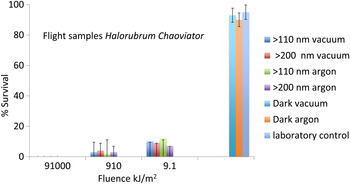
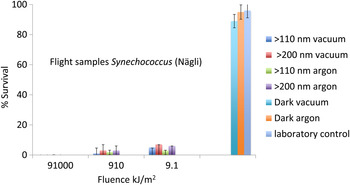
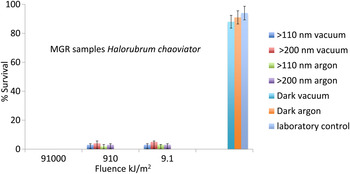
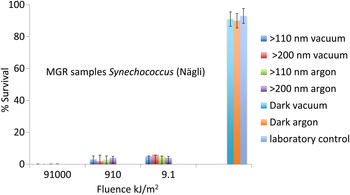
Samples kept in the dark, in both the flight experiment and the ground simulation experiment (MGR) but exposed to space vacuum showed 90 ± 5% survival compared to the unexposed lab ground controls (Figs. 1–4). Samples exposed to full UV-radiation for over a year were bleached and although results from Molecular Probes Live–Dead stain suggested ~10% survival no survival was detected from the cell growth and division tests using the MPN method (Figs. 1–4). Those samples exposed to attenuated UV-radiation in both the flight and ground simulation tests (MGR) exhibited limited survival using both the Bac-Lite Live–Dead stain and the MPN growth tests (Figs. 1–4). The temperature on EXPOSE-R during the mission ranged from −24.6 to +49.5 °C.
Discussion
This study's results are relevant to understanding the evolution of life on early Earth, adaptation and evolution of life on Earth today, the future of life beyond Earth, the potential for interplanetary transfer of viable microbes via meteorites and dust particles as well as spacecraft, and the physiology of halophiles. While the six-year long duration exposure facility (LDEF) mission holds the record for exposing samples for the longest time to the space environment (Horneck et al. Reference Horneck, Bücker and Reitz1994), the EXPOSE-R mission is second with an exposure time in low-Earth orbit for nearly 2 years. Consequently, results from the EXPOSE-R mission are important in assessing the potential survival of organisms off Earth and their potential for transport to other planets via meteorites or spacecraft. If buried beneath the surface of a meteorite they must withstand desiccation and hard radiation, if on the surface the immediate concern is UV-radiation and desiccation.
Solar UV-radiation can be divided into three spectral ranges: UVC (200–280 nm), contributing 0.5% to the whole solar electromagnetic spectrum; UVB (280–315 nm), contributing 1.5%; and UVA (315–400 nm), contributing 6.3%. Although the UVC and UVB regions make up only 2% of the entire solar extraterrestrial irradiance, they are mainly responsible for the high lethality of extraterrestrial solar radiation to microorganisms exposed to it (Edwards et al. Reference Edwards, Bond, Gihring and Banfield2000; reviewed in Friedberg et al. Reference Friedberg, Walker and Wolfram1995), due to the high absorption at those wavelengths by DNA it is the target for inactivation and mutation induction within that UV range.
Space vacuum is another harmful factor affecting microbial integrity. If cells are not protected by internal or external substances, dehydration will cause severe damage to the cell components: lipid membranes may change from planar bilayers to cylindrical bilayers and carbohydrates, proteins, nucleic acids may undergo amino-carbonyl reactions (Maillard reactions) that result in cross-linking and, finally, polymerization of the biomolecules including DNA (Dose & Gill Reference Dose and Gill1995; Wehner & Horneck Reference Wehner and Horneck1995; Beckman & Ames Reference Beckman and Ames1998). These structural changes can give rise to functional changes, such as inhibited or altered enzyme activity, changes in membrane permeability, and alteration of genetic information that may lead to cell death or mutagenesis.
H. chaoviator and Synechococcus (Nägeli) were flown on two Biopan missions (Mancinelli et al. Reference Mancinelli, White and Rothschild1998). During the first Biopan mission these halophiles received a total dose of 6000 kJm−2 of UVA and 4000 kJm−2 of UVB and C. During the second flight the organisms were exposed to the space environment for 12.5 days giving the organisms a dose of ~5000 kJm−2 of UVA and ~3333 kJm−2 of UVB and C combined. The total dose of UVB and UVC received by the organisms during the Biopan flights was approximately five times greater than the exposure attenuated dose received by the organism during the EXPOSE-R flight, yet the results were similar with regard to H. chaoviator with both flights showing a few per cent survival, while the results of the Synechococcus (Nägeli) showed significantly higher survival during the Biopan flights. These data suggest that the duration of the flight may have contributed to the lower survival rate of the Synechococcus for EXPOSE-R. The data from this study suggests that solar UV-radiation may be the primary factor in killing these halophilic organisms, most likely through DNA damage, and is in agreement with the data obtained by Mancinelli et al. (Reference Mancinelli, White and Rothschild1998), Horneck et al. (Reference Horneck, Bücker and Reitz1994) and Lindberg & Horneck (Reference Lindberg and Horneck1991).
The data from this experiment and the Biopan experiments demonstrate clearly that H. chaoviator and Synechococcus (Nägeli) are extremely desiccation resistant. Their desiccation resistance is most likely related to their salt tolerance. Many microorganisms respond to increases in osmolarity by accumulating osmotica in their cytosol, which protects them from cytoplasmic dehydration and desiccation (Yancey et al. Reference Yancey, Clark, Hand, Bowlus and Somero1982). With the exception of the Halobacteriaceae, which use K+ as their osmoticum (Larsen Reference Larsen1967), glycine betaine is the most effective osmoticum in most prokaryotes (Le Rudulier & Bouillard Reference Le Rudulier and Bouillard1983). Osmotic concentration increases during desiccation, so responses are similar to those of a cell in high-salt environments. Compatible solutes such as K+, glutamate, glutamine, proline, glycine betaine, sucrose and trehalose accumulate away from proteins, forcing water nearby and thus stabilizing them (Potts Reference Potts1994), and possibly stabilizing dry membranes (Aguilar et al. Reference Aguilar, Ingemansson and Magnien1998).
The Biopan experiments provided the initial data on the ability of osmophilic (halophilic) microbes to survive the space environment, and thus a glimpse into their potential for interplanetary transfer. The data from the EXPOSE-R experiment suggests that these types of organisms may survive interplanetary transfer aboard spacecraft on the order of months to years, especially if they are protected from solar UV-radiation.
Outlook
With international plans being formulated for solar system exploration, either using robotic probes or with human crews, we are confronted with exciting new opportunities and challenging demands. The search for signatures of life forms on another planet or moon in our solar system is one of the most prominent goals of astrobiology. Our neighbour planet Mars and Jupiter's moon Europa are targets for the search for life beyond Earth. By analogy, with terrestrial extremophilic microbial communities, e.g. those thriving in arid, cold, salty environments and/or those exposed to intense UV-radiation, additional potential extraterrestrial habitats may be identified.
Spacecraft, whether robotic orbiters, entry probes, or landers can unintentionally introduce terrestrial microorganisms to the planet or moon is a primary concern of planetary protection. In a recent study using a model of the Mars Phoenix lander Marshall & Mancinelli (Reference Marshall and Mancinelli2011) demonstrated mechanisms by which microbial spores could be carried on a spacecraft and dispersed into the surrounding environment resulting in contamination. Such contamination may destroy the opportunity to examine these bodies in their pristine condition. To prevent the undesirable introduction and possible proliferation of terrestrial microorganisms on the target body, the concept of planetary protection has been introduced and the COSPAR Planetary Protection Guidelines formulated (COSPAR 2011).
The presence of humans on the surface of the Moon or Mars will substantially increase the capabilities of space research and exploration; however, prior to any human exploratory mission, the critical microbial issues concerning human health and wellbeing need to be addressed, and effective planetary protection protocols must be established. Provision of metabolic consumables and removal of waste by-products from the closed, self contained environment, whether constituting a human habitat or a cell culture bioreactor, represent the final necessities for life support. The closed cabin or habitat conditions also present added long-term challenges to their design with regard to crew health, due to the potential build-up of contaminants in the atmosphere and water systems and of biofilms on the surfaces of internal structures. Finally, in some cases, the life support functions themselves can be met by use of living systems acting through a variety of ecological pathways. In this sense, the living systems become an increasingly integral part of the spacecraft or habitat itself; therefore, analysis of space microbiological experiments should be done with a broad systems- level point of view, taking into account the interaction between biological phenomena and physical influences associated with the overall environment both within and external to the space habitat.
This and other studies are providing data that will allow us to assess the possibility and probability of life living beyond its home planet. We have just taken the first few steps in understanding the depth and breadth of the perils of space travel and what it will take to overcome them.
Data from H. chaoviator after exposure to three levels of solar UV-radiation, or vacuum only during the EXPOSE-R mission. The bars indicate the standard deviation. Per cent survival was determined by N/No, where N = the number of survivors determined by the MPN method and No is the number of surviving cells in the laboratory controls. The total number of samples exposed to each condition was 16.

Data from Synechococcus (Nägeli) after exposure to three levels of solar UV-radiation, or vacuum only during the EXPOSE-R mission. The bars indicate the standard deviation. Per cent survival was determined by N/No, where N = the number of survivors determined by the MPN method and No is the number of surviving cells in the laboratory controls. The total number of samples exposed to each condition was 16.

Data from H. chaoviator after exposure to three levels of solar UV-radiation, or vacuum only during the MGR ground simulation study. The bars indicate the standard deviation. Per cent survival was determined by N/No, where N = the number of survivors determined by the MPN method and No is the number of surviving cells in the laboratory controls. The total number of samples exposed to each condition was 16.

Data from Synechococcus (Nägeli) after exposure to three levels of solar UV-radiation, or vacuum only during the MGR ground simulation study. The bars indicate the standard deviation. Per cent survival was determined by N/No, where N = the number of survivors determined by the MPN method and No is the number of surviving cells in the laboratory controls. The total number of samples exposed to each condition was 16.

Acknowledgements
Funding for this study was provided by the NASA Astrobiology Institute through Co-operative agreement NNA10DE25 G Technical support was provided by R. Landheim. We thank Gerda Horneck, Elke Rabbow and Corinna Panitz for their assistance and support throughout the mission.