In the mid-2000s, Reference Kutty, Woods and Sena1-3 cases of Clostridioides difficile infection occurring outside acute-care hospitals and long-term care facilities were increasingly recognized by public health officials, heralding the era of community-associated C. difficile infection (CA-CDI). Subsequently, nearly 50% of adults infected with C. difficile were categorized as CA-CDI. Reference Khanna, Pardi and Aronson4,Reference Kuntz, Chrischilles, Pendergast, Herwaldt and Polgreen5 The varied, sometimes prolonged incubation period of C. difficile infection has rendered it difficult to identify the reservoirs of the organism in the community. Although the sources of adult community-associated infection likely are multiple, studies have indicated that infants may serve as one nidus of transmission Reference Chitnis, Holzbauer and Belflower6 ; a large proportion of infants excrete toxigenic C. difficile asymptomatically during their first year of life. Reference Adlerberth, Huang and Lindberg7,Reference Jangi and Lamont8 To probe the possible role of colonized infants as a source of CA-CDI in adults, the current study enrolled a cohort of healthy, full-term infants at birth and cultured their stool during regular well-child visits over their first year of life. Isolates of C. difficile then were compared by ribotyping and by whole-genome sequencing (WGS) to those derived from a concomitant cohort of adults with CA-CDI from the same metropolitan area.
Methods
This study was reviewed and approved by the Institutional Review Board of University Hospitals Cleveland Medical Center.
Patient recruitment
Healthy infants attending a suburban, demographically diverse pediatric practice were enrolled at birth and prospectively followed at the 2-, 6-, and 12-month well-child visits. At birth and at each visit, a stool sample was collected and refrigerated for up to 3 days before being stored at −80°C for batch testing. These handling procedures resulted in <10% decrease in cultivatable C. difficile colony numbers compared with samples cultured on the day the stool was produced.
A contemporaneous set of sequential adult stool samples submitted to the clinical microbiology laboratory at University Hospitals Cleveland Medical Center, located ~9.65 km (~6 miles) from the pediatric practice, was used for comparison. Samples were identified as C. difficile–positive by commercial polymerase chain reaction assay (PCR) and stored at −80°C. A subset of these samples was categorized by the hospital infection prevention service as “community onset” according to National Healthcare Surveillance Network case definitions Reference McDonald, Gerding and Johnson9 ; these were deidentified and selected for further analysis.
Microbiology and ribotyping
Infant stool samples were tested for presence of free toxin using a commercially available enzyme immunoassays (EIAs) for toxins A and B (Abbot Laboratories, Abbot Park, IL). Infant and adult samples were cultivated for C. difficile using previously defined methods. Reference Riggs, Sethi, Zabarsky, Eckstein, Jump and Donskey10 In short, frozen stool was transferred to an anaerobic chamber and thawed for 10 minutes at 37°C. A 10-mg aliquot of thawed stool suspension was plated onto prereduced C. difficile brucella agar containing 0.1% taurocholic acid and 5 mg/L lysozyme. Reference Nerandzic and Donskey11 Putative C. difficile colonies were selected based on typical morphology and identity was confirmed by a latex agglutination assay (Microgen Bioproduct, Surrey, UK). We performed PCR amplification of the tcdC and cdtB genes to identify toxigenic C. difficile isolates and binary toxin-positive isolates, respectively. Reference Riggs, Sethi, Zabarsky, Eckstein, Jump and Donskey10
The ribotype of each isolate was determined by fluorescent PCR ribotyping according to previously published methods. Reference Martinson, Broadaway and Lohman12 In short, genomic DNA was extracted by heating an overnight culture to 95°C for 15 minutes and amplified by PCR using the primers, conditions, and program reported by Martinson et al. Reference Martinson, Broadaway and Lohman12 Fluorescent amplicons were then sequenced for fragment analysis by Capillary Electrophoresis at the University of Michigan Biomedical Research Core facility. Fluorescent ribotypes were designated using the Montana State University Fluorescent PCR Ribotyping Pipeline reference library. Reference Martinson, Broadaway and Lohman12
Whole-genome sequencing
Samples from the infant and adult CA-CDI sets that expressed the same ribotypes were further subjected to WGS. DNA was extracted using the QIAamp DNA Micro Kit (Hilden, Germany). The preparation of the libraries was performed using the Nextera DNA Flex Library Prep Kit (Illumina, San Diego, CA), and paired-end reads (2 × 150 bp) were generated using the Illumina MiniSeq reagent kit and MiniSeq instrument (Illumina, San Diego, CA). Whole-genome single-nucleotide polymorphism (WgSNP) analysis was performed using the cloud based BioNumerics version 7.6 software platform (Applied Maths NV, Sint-Martens-Latem, Belgium, available at http://www.applied-maths.com) after dynamic trimming and mapping of the raw reads to a reference genome isolate (National Center for Biotechnology Information [NCBI] Cdiff Refseq 630). The reference genome de novo assembly was completed using SPAdes assembler on the Bionumerics calculation engine using the Bowtie2 mapping algorithm.
We used the following settings for the Bowtie mapping algorithm: minimum total coverage of 3, minimum forward coverage of 1, minimum reverse coverage of 1, single-base threshold of 0.75, double-base threshold of 0.85, triple-base threshold of 0.95, and gap threshold of 0.5. An SNP analysis was performed using the patient isolates (adult and infant). Using SNP filtering, positions with at least 1 unreliable (N) or ambiguous (non-ACGT) base was removed. Each retained SNP position has minimum 5× coverage, at least covered once in both forward and reverse directions. Further, advanced cluster analysis (similarity matrix) was constructed using similarity coefficient for categorical (differences). A dendrogram was created using global closest pair method (UPGMA) with no resampling. All of the analyses were performed within the BioNumerics version 7.6 software platform.
Whole-genome multilocus sequence typing (wgMLST) with assembly-free and assembly-based calls was performed using the calculation engine on the Bionumerics version 7.6 platform, employing the sequences derived from the WGS analysis. Quality assurance was performed to ensure accuracy of the calls. Isolates so analyzed were assigned both to their MLST Pasteur sequence type (ST) and their public ST.
Results
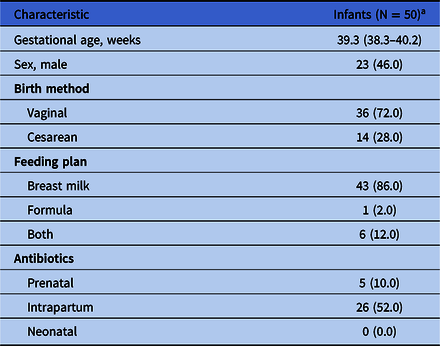
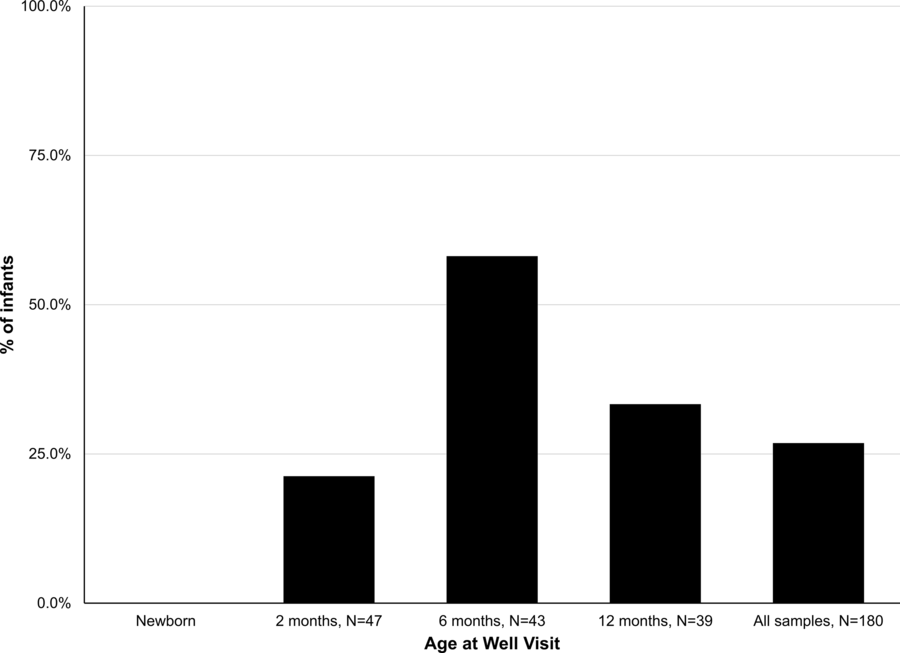
In total, 50 infants were recruited as newborns between June 2016 and March 2017; 11 infants (22.0%) were lost to follow-up by the 12-month well-child visit. All infants were full term, and 36 (72.0%) were born via vaginal delivery. Most of the infants were exposed to perinatal antibiotics (Table 1). Over the course of the study, 180 infant stool samples were collected. No infant had a C. difficile–positive stool at the newborn baseline, but 36 (72.0%) were positive for C. difficile at least once during subsequent study visits. Among these 36, 9 infants (25.0%) tested positive on multiple well visits, and 3 (8.3%) infants tested positive at all 3 postnatal visits. The incidence peaked at 6 months, with 25 of 43 (58.1%) infants testing positive for C. difficile (Fig. 1). No infant displayed gastrointestinal symptoms during any of their study visits.
Infant Characteristics at Birth a

a Continuous data are presented as median (interquartile range). Categorical data are presented as number (% of N).
Longitudinal prevalence of Clostridioides difficile positive stools in healthy infants.

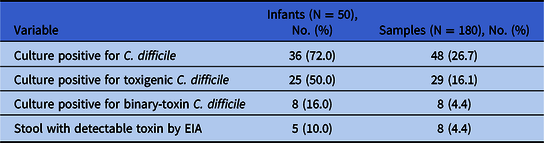
Of the 36 infants with positive cultures for C. difficile, 25 (69.4%, or 50% total infants) carried the enterotoxin gene tcdC (Table 2). Of the 36, 8 (22.2%, or 16% of all infants) carried binary toxin-positive strains, all from isolates that also were tcdC positive. Also, 5 (13.9%, or 10.0% of all infants) had 1 or more stools that tested positive for enterotoxin by EIA (Table 2). The proportions of the 180 total stool samples that exhibited these characteristics is presented in Table 2. The 48 infant stool samples with positive cultures for C. difficile had a density of organisms that ranged from log10 2.0 to log10 4.6 colony-forming units (CFU) per gram of stool. Of 48 infant samples, 20 (41.6%) harbored >log10 4.0 CFU per gram of stool, all with toxigenic organisms.
Results of Infant Stool Analyses

Note. EIA, enzyme immunoassay.
Of 37 stool specimens from adults with CA-CDI, 35 (94.6%) had toxigenic C. difficile recovered by culture. Of these 35 isolates, 4 (18.2%) were binary toxin positive. The density of C. difficile in these samples ranged from log10 2.0 to log10 6.0 CFU per gram of stool. Also, 11 adult samples (31.4%) contained > log10 4.0 CFU per gram of stool.
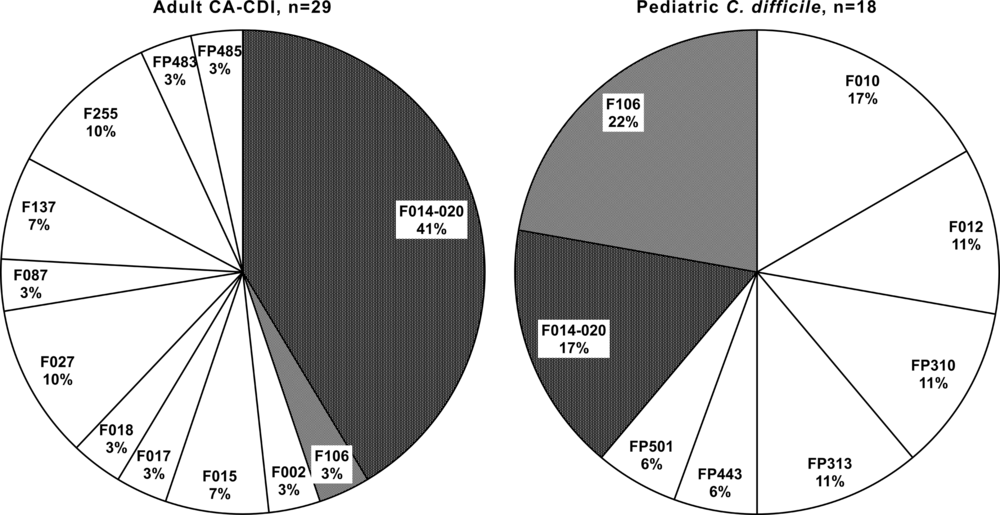
In total, 38 infant C. difficile isolates and 35 isolates from the contemporaneous set of adults with CA-CDI were submitted for fluorescent PCR ribotyping. We were unable to recover the 10 infant samples that were not submitted for ribotyping from the stored frozen isolates. Among the 38 infant isolates, 18 (47.3%) matched existing ribotypes in the reference database. Reference Martinson, Broadaway and Lohman12 For the infant isolates that matched existing ribotypes, 8 ribotypes were identified, with F014-020, F106, and F010 having the greatest representation (Fig. 2). Among the 35 adult isolates, 29 (82.9%) matched existing ribotypes in the reference database. Reference Martinson, Broadaway and Lohman12 For the adult CA-CDI isolates that matched existing ribotypes, 12 ribotypes were identified, and F014-020 was the most frequently represented strain (Fig. 2).
Ribotype concordance in a contemporaneous population of adults with CA-CDI and infants with Clostridioides difficile. Ribotypes present in both populations are denoted in the shaded pie slices.

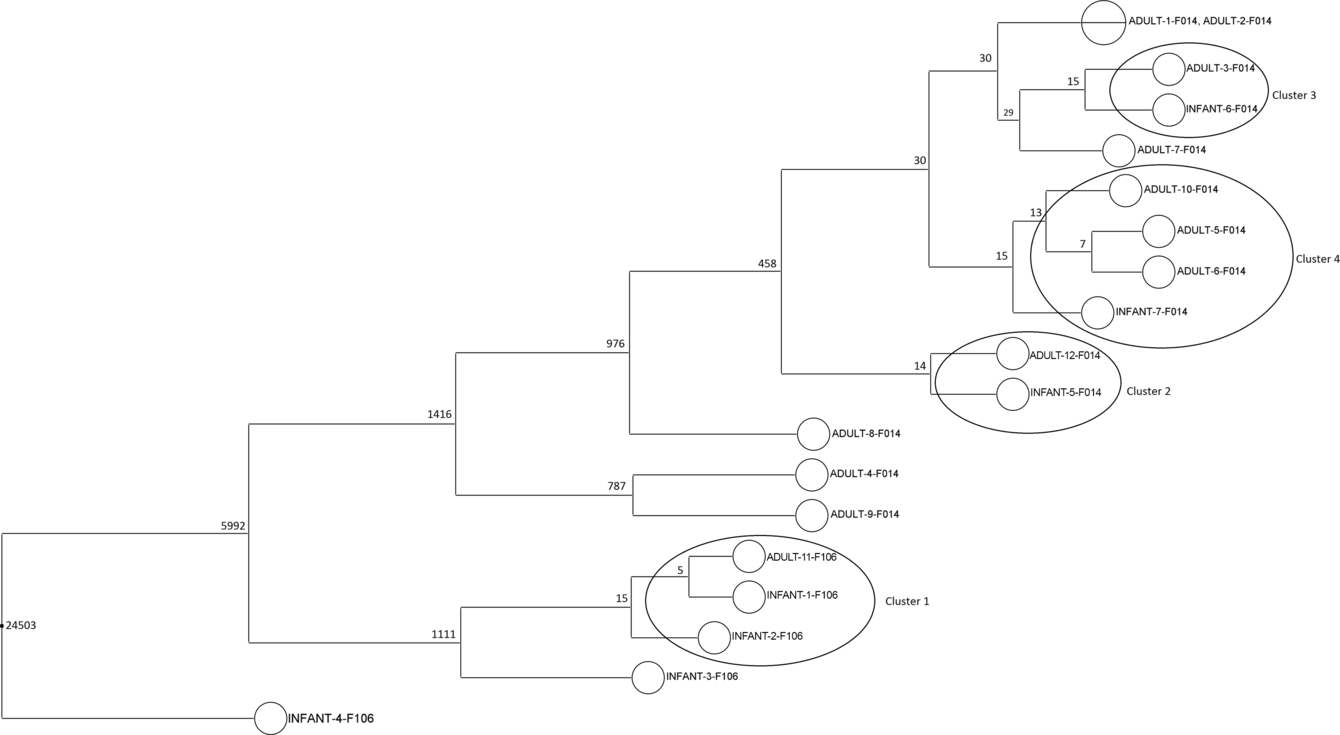
Furthermore, 2 ribotypes were present in both adults with CA-CDI and in infants: F106 was recovered from 4 infants and 1 adult and F014-020 was recovered from 3 infants and 12 adults (Fig. 2). All of these isolates were toxigenic. These organisms were submitted for wgMLST analysis to determine the degree of genetic similarity of C. difficile between the adult and infant samples. One adult–infant pair within cluster 1, both derived from ribotype F106 and from ST33 (Pasteur) or ST42 (Public), differed by 5 SNPs (adult-11-F106 and infant-1-F106) (Fig. 3 and Supplementary Figs. 1 and 2 online). Within this cluster 1, an additional infant (infant-2-F106), differed by 15 SNPs. A third adult–infant pair in cluster 2, adult-12-F014 and infant-5-F014, both derived from the same ribotype and belonging to the same ST group (ST1 [Pasteur] or ST110 [Public]), differed by 14 SNPs. A fourth adult–infant pair in cluster 3, adult-3-F014 and infant-6-F014, derived from the same ribotype and the same ST group (ST1 [Pasteur] or ST2 [Public]), differed by 15 SNPs (Fig. 3 and Supplementary Figs. 1 and 2 online). An apparent cluster (cluster 4) including several isolates (infant-7-F014, adult-6-F014, adult-5-F014, and adult-10-F014) all were derived from the same PCR ribotype and the same ST group (ST1 [Pasteur] or ST2 [Public]) and differed by ≤15 SNPs (Fig. 3 and Supplementary Figs. 1 and 2 online).
Dendrogram representing the genetic relatedness of isolates subjected to whole-genome sequencing. Isolates are designated as “adult” or “infant,” followed by their study number and polymerase chain reaction (PCR) ribotype assignment. Potentially related adult-infant pairs are grouped together in circles. The number designated at each branch point represents the single-nucleotide polymorphism (SNP) distance between the isolates.

Discussion
In this study, we explored the potential role of C. difficile–colonized infants in the epidemiology of CA-CDI in adults. We confined the study to adults with community-associated infection because we hypothesized that epidemiologic associations between babies and adults would be most apparent among those who had acquired C. difficile outside acute-care and long-term care wards. Our data indicated that at least some organisms involved in asymptomatic infant carriage and those simultaneously isolated in adult CA-CDI within the same geographical region exhibited genetic similarities. Using this protocol, we were unable to establish the directionality of putative transmission events; the results are as consistent with adult-to-infant transmission as transmission from the baby to the adult, or acquisition by both populations from a common reservoir. These results do indicate, however, that asymptomatic infant carriage and adult CA-CDI are not caused by mutually exclusive strains.
Two ribotypes in particular, comprising 39% of isolates from infants, were identifed in a subset (45%) of organisms cultured from the contemporaneous population of adults with CA-CDI. WGS comparisons revealed 1 infant–adult pair that differed by 5 SNPs and several others that differed by ≤16 SNPs. To add perspective to the degree of relatedness implied by these SNP differences, Eyre et al Reference Eyre, Cule and Wilson13 determined that the evolutionary mutation rate of C. difficile isolates cultured repeatedly from the same adult was slightly less than 1 SNP per year. Reference Eyre, Cule and Wilson13 Although it is likely that the mutation rates vary from strain to strain and are different in organisms derived from different ecological contexts, the results from the current study are consistent with a common bacterial ancestor encountered ~5 years prior to our study for the pair differing by 5 SNPs. Those differing by 16 or fewer SNPs may be unrelated (according to the definitions suggested by Eyre et al Reference Eyre, Cule and Wilson13 ) or from an event proportionately further in the past. The babies and adults included in the current report had no apparent epidemiological link, and notwithstanding these estimates of genetic relatedness, it is not possible to confidently time a past transmission event in the absence of data pertaining to social interactions. Nonetheless, the current data support the possibility that infant colonization and adult CA-CDI are not distinct epidemiological phenomena.
Prior European studies have implicated babies as reservoirs for CA-CDI in adults. Rousseau et al Reference Rousseau, Poilane, De Pontual, Maherault, Le Monnier and Collignon14 prospectively followed a small cohort of infants in Paris and found that ribotypes of asymptomatically excreted C. difficile that were similar to disease-producing ribotypes in French adults with CDI. Further strain characterization was not performed, however, and the adult isolates were not collected concomitantly to the infants’. Additional studies performed by investigators in Oxford, United Kingdom, employed high-throughput WGS to compare colonizing C. difficile strains in infants to those from adults with CDI in central England. Small proportions of isolates from both groups were genetically identical (ie, 0 SNPs), and 38% of infant isolates exhibited 10 or fewer SNPs compared with adult samples. Reference Stoesser, Eyre and Quan15 Our study, while smaller in scale, reflects similar characteristics in an American population.
Even though, to the best of our knowledge, no study to date has directly demonstrated infant-to-adult household transmission of C. difficile, such transmission is credible. Family-member contact with colonized infant stool is frequent and usually unprotected, providing abundant opportunity for transmission. Indeed, the density of organisms in at least some of the infants in our study, >log10 4 per gram of stool, exceeds that of most adult carriers Reference Riggs, Sethi, Zabarsky, Eckstein, Jump and Donskey10 and was similar to our adult samples from patients with CA-CDI. Moreover, apparent intrafamilial transmission of other enteric bacteria has been documented, Reference Alconcher, Rivas, Lucarelli, Galavotti and Rizzo16,Reference Johnson, Davis and Clabots17 and spread of C. difficile from a recently infected adult to other noninfant household contacts has been reported in prospectively studied families in Quebec. Reference Loo, Brassard and Miller18 Ultimately, however, the establishment of asymptomatic infant C. difficile excretion as a contributor to CA-CDI in adults will require longitudinal studies documenting the transmission of genetically related isolates from colonized infant to initially C. difficile–negative adult contacts. The current study provides the motivation to study the epidemiological role of infant C. difficile colonization in this more granular fashion.
Supplementary material
To view supplementary material for this article, please visit https://doi.org/10.1017/ice.2020.1290
Acknowledgments
Financial support
This work was supported in part by the Central Texas Veterans’ Health Care System, Temple, Texas, and the Louis Stokes Cleveland VA Medical Center, Cleveland, Ohio.
Conflicts of interest
All authors report no conflicts of interest relevant to this article.