1. Introduction
Williams–Beuren syndrome (hereafter, WS) is a developmental disorder caused by a microdeletion in one copy of the chromosome 7 affecting two dozen genes (Korenberg et al., Reference Korenberg, Dai, Bellugi, Jarvinen-Pasley, Mills, Galaburda, Reiss, Pober, Epstein, Erickson and Wynshaw-Boris2008). The hemizygosis of these genes contribute to the physical, cognitive, and socio-affective impairments characteristic of the disorder, although a one-to-one correlation between genes and deficits and dysfunctions has been difficult to prove (Bellugi, Korenberg, & Klima, Reference Bellugi, Korenberg and Klima2001; Tassabehji, Reference Tassabehji2003).
First studies of the disorder reported that language is spared in WS, whereas other abilities (visuospatial cognition and social skills) are impaired. Recent, fine-grained analyses have concluded that affected people have problems with structural components of language (i.e., morphology, syntax, etc.). Morphological abilities of people with WS are a controversial issue. A main concern has been whether the observed deficits support a distinction between a computationally based (regular) inflectional mechanism and a lexically based (irregular) inflectional device, as proposed by the word-and-rule theory of inflection (Pinker & Prince, Reference Pinker, Prince, Lima, Corrigan and Iverson1994). According to several authors (e.g., Bromberg, Ullman, Marcus, Kelly, & Levine, Reference Bromberg, Ullman, Marcus, Kelly and Levine1995; Clahsen & Almazan, Reference Clahsen and Almazan1998; Krause & Penke, Reference Krause and Penke2002; Clahsen, Ring, & Temple, Reference Clahsen, Ring, Temple, Bartke and Siegmüller2004) only the latter is impaired. Others (e.g., Thomas et al., Reference Thomas, Grant, Barham, Gsödl, Laing, Lakusta and Karmiloff-Smith2001) have argued that people with WS do not exhibit any unusual pattern of dissociation between regular and irregular forms of words, but only a developmental delay in the acquisition of this component of grammar.
This question remains inconclusive in spite of a growing corpus of cross-linguistic data. Children with WS acquiring Hebrew (a Semitic language that inflects the verb by adding vowels to consonantal roots) master a basic control of root structure, although they exhibit a poorer performance and/or a delay with regards to specific morpho(phono)logical processes (Levy & Bechar, Reference Levy and Bechar2003; Levy & Hermon, Reference Levy and Hermon2003). Children with WS acquiring French (an inflectional language) or Hungarian (an agglutinative language) are sometimes delayed compared to typically developing (TD) children matched for mental age, but qualitative differences are not observed between groups (Karmiloff-Smith, Grant, Berthoud, Davies, Howlin, & Udwin, Reference Karmiloff-Smith, Grant, Berthoud, Davies, Howlin and Udwin1997; Lukács, Racsmány, & Pléh, Reference Lukács, Racsmány and Pléh2001; Pléh, Lukács, & Racsmány, Reference Pléh, Lukács and Racsmány2003).
The objective of this study is twofold. First, we aim to contribute to the ongoing discussion on the nature of morphological (dis)abilities in people with WS. Additionally, we want to contribute to the ongoing discussion about cross-linguistic differences between people with WS. Most research on this topic has been conducted on English-speaking populations. Here, we analyze a Spanish-speaking group with WS. In contrast to English, Spanish is a highly inflected language. Nouns are inflected for number and gender. Singular is the unmarked number. Plurals are marked with -s or -es, or remain invariable, depending on complex morphophonological rules. All Spanish nouns are assigned a grammatical gender (masculine or feminine), even if it refers to a sexless entity. Gender is occasionally marked in the noun (adding -o for masculine and -a for feminine), but frequently gender is only overtly marked in the determiner. Also in contrast to English, Spanish verbs are highly inflected. Inflectional suffixes convey different kind of grammatical information (person, number, mood, tense, aspect). Moreover, there are regular and irregular verbal paradigms involving different allomorphs and different kinds of morphophonological alternations.
2. Method
2.1. participants
Three groups of participants took part in this study. The experimental group comprised thirteen children with WS (six boys and seven girls, mean chronological age 10;7, range 7;3–15;6). Diagnosis was confirmed by fluorescence in situ hybridization (FISH) to the elastin gene deletion in chromosome 7, a robust marker for WS. Thirteen TD children (six boys and seven girls, mean chronological age 6;4, range 5;4–7;4), matched to the WS group on verbal mental age, composed the first control group (hereafter, VA-TD). Eight TD children (four boys and four girls, mean chronological age 10;4, range 8;0–12;5) formed the second control group that was matched on chronological age (hereafter, CA-TD) to the WS group. All participants were monolingual native speakers of Castilian Spanish. The participants had no hearing deficits. For all groups, their parents provided written consent for their participation in the study.
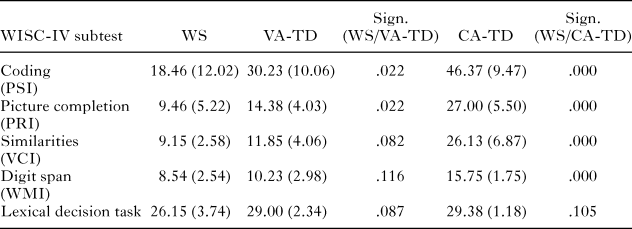
The WS and the VA-TD groups were matched according to the short form of the Wechsler Intelligence Scale for Children–Fourth Edition (WISC-IV) and also to a lexical decision task (Table 1). This version of the WISC-IV provides high levels of reliability and validity when applied to research (see Demsky, Gass, Edwards, & Golden, Reference Demsky, Gass, Edwards and Golden1988, for Spanish-speaking populations). The short version of the WISC-IV test comprises four subtests: Coding, Picture Completion, Similarities, and Digit Span, each of which represents a main index of the WISC-IV: the Processing Speed Index (PSI), the Perceptual Reasoning Index (PRI), the Verbal Comprehension Index (VCI), and the Working Memory Index (WMI), respectively. Significant differences between the WS group and the VA-TD group were observed only in the Coding and Picture Completion subtests (Table 1). With regards to the lexical decision task, a total of sixteen words and sixteen pseudo-words (primitive and morphologically derived) were randomly mixed and presented orally; the participants had to say whether they were real words or not. The frequency band employed was low, between three and nineteen occurrences per million (with a mean value of 9.8). No significant differences were found between groups, nor any ceiling effect (see Section 2.2.1 below).
The CA-TD scored significantly higher than the WS group in the four subtests of the WISC-IV. No statistical differences were found regarding the lexical decision task (Table 1).
Cognitive and verbal assessment: mean (and SD) in each subtest for the three experimental groups

2.2. tasks
We designed four tasks to assess how nouns and verbs are inflected by Spanish children with WS. In order to be able to establish confident cross-linguistic comparisons we built on tasks previously tested in English and French populations with WS.
2.2.1. Task 1: noun inflection
This task was based in the WUG test (Berko, Reference Berko1958). Thirty-two items accounting for all the pluralization patterns in Spanish evaluated the participant’s ability to pluralize nouns: (the number of items comprising each subgroup roughly equates to its frequency in the Spanish lexicon):
– fourteen nouns and pseudo-nouns ending in a tonic -á/-é/-ó, or in an unstressed vowel (these nouns add -s to the singular form). This is one of the two main pluralization patterns in Spanish (e.g., foca/focas ‘seal/seals’);
– eight nouns and pseudo-nouns ending in a consonant other than -s (these nouns add -es to the singular form). This is the second main pluralization pattern in Spanish (e.g., calamar/calamares ‘squid/squids’);
– three polysyllabic nouns and pseudo-nouns ending in -s and in a tonic syllable, and that are not compounds (these nouns add -es to the singular form) (e.g., compás/compases ‘compass/compasses’);
– three polysyllabic nouns ending in -s and in a tonic syllable, and that are compounds (these nouns remain invariable in the plural) (e.g., saltamontes/saltamontes ‘grasshopper/grasshoppers’);
– two nouns and pseudo-nouns ending in a tonic -í/-ú, (these nouns add either -s or -es to the singular form) (e.g., jabalí/jabalíes, jabalís ‘wild boar / wild boars’);
– two polysyllabic pseudo-nouns ending in -s and in a non-stressed syllable (these nouns remain invariable in the plural) (e.g., lunes/lunes ‘Monday/Mondays’).
The children were shown pictures displaying two or three exemplars of each item. Afterwards, they were verbally stimulated to generate the plural forms of the nouns: “Mira, un elefante. Y ahora, ¿cuántos hay?” ‘Look, an elephant. How many are there now?’; “Mira, un resijel [pseudo-noun]. Y ahora, ¿cuántos hay?” ‘Look, a resijel. How many are there now?’. Expected answer: “Hay tres elefantes” ‘There are three elephants’; “Hay tres resijeles” ‘There are three resijeles’.
2.2.2. Task 2: gender attribution, gender inflection, and gender agreement (I)
This is a production task. We relied on the tasks designed by Karmiloff-Smith et al. (Reference Karmiloff-Smith, Grant, Berthoud, Davies, Howlin and Udwin1997). In Spanish, masculine nouns sometimes add -o to the root (pat-o ‘duckmasc’), while feminine nouns add -a (pat-a ‘duckfem’). Nevertheless, in many cases grammatical gender is expressed in the determiner only (see examples below). For each noun we used a drawing displaying three exemplars painted in different colours and with specific gender attributes (a hat and a tie for males and a ribbon and a collar for females). Nouns were introduced with the cardinal numeral tres ‘three’: “Mira, tres patos” ‘Look, three ducks’ (yellow, red, and white). Afterwards, the child was shown only two of the specimens (for example, the yellow and the red ones) and then asked: “¿Cuál falta ahora?” ‘And here, which one is missing?’. In order to answer this question correctly, appropriate gender agreement between the article, the noun, and the adjective has to be computed: El MASC pato MASC blanco MASC ‘the white duck’. Our task included thirty-two items and six subgroups (the number of items comprising each subgroup roughly equates to its frequency in the Spanish lexicon):
– nine nouns and pseudo-nouns not ending in either -o or -a applied to masculine drawings (e.g., pez ‘fishmasc’);
– eight nouns and pseudo-nouns not ending in either -o or -a applied to feminine drawings (e.g., serpiente ‘snakeFEM’);
– six nouns and pseudo-nouns ending in -a applied to feminine drawings (e.g., tigresa ‘tigerfem’);
– five nouns and pseudo-nouns ending in -o applied to masculine drawings (e.g., oso ‘bearmasc’);
– two pseudo-nouns ending in -o applied to feminine drawings (e.g., coto ‘cotoFEM’);
– two pseudo-nouns ending in -a applied to masculine drawings (e.g., resija ‘resijamasc’).
2.2.3. Task 3: gender attribution, gender inflection, and gender agreement (II)
This is a comprehension task. It was aimed at assessing how gender is attributed to nouns, either relying on the noun ending or on the inflectional suffix in the determiner. Three different types of nouns and pseudo-nouns were included: ending in -a, ending in -o, and ending in an element other than -a/-o. They were introduced by either the masculine article el ‘themasc’ or the feminine article la ‘thefem’. In this task we made use of the same items that we employed for the Task 2 (Section 2.2.2). Two pictures were shown to the children: one depicting an exemplar with male attributes (a hat and a tie) and one showing the same creature with female attributes (a ribbon and a collar).
2.2.4. Task 4: verb inflection
This is a production task. We prepared a list of thirty-two verbs and pseudo-verbs, regular or irregular, with real or invented roots. We asked the children to generate simple past forms, according to the methodology described by Clahsen and Almazan (Reference Clahsen and Almazan1998) and Thomas et al. (Reference Thomas, Grant, Barham, Gsödl, Laing, Lakusta and Karmiloff-Smith2001). Our sample comprised the following ten subgroups of verbs (verbs and verbal roots (for pseudo-words) were selected according to their length and frequency, to achieve homogeneous samples):
– four irregular pseudo-verbs derived from real verbal roots by adding real prefixes (e.g., pretraer = pre ‘previous’+ traer ‘take’);
– four irregular pseudo-verbs derived from real verbal roots by adding non-real prefixes (e.g., pilpedir = pil + pedir ‘ask’);
– four simple (i.e., non-derived) irregular verbs (e.g., dormir ‘to sleep’);
– four derived irregular verbs (e.g., predecir ‘to foretell’);
– two regular pseudo-verbs derived from real nominal roots by suffixation (e.g., croquetear, from croqueta ‘croquette’);
– two regular pseudo-verbs derived from non-real nominal roots by suffixation (e.g., pilear);
– two regular pseudo-verbs derived from real verbal roots by adding real prefixes (e.g., presubir = pre + subir ‘go up’);
– two regular pseudo-verbs derived from real verbal roots by adding non-real prefixes (e.g., pilsaltar = pil + saltar ‘jump’);
– four simple (i.e., non-derived) regular verbs (e.g., hablar ‘to talk’);
– four derived regular verbs (e.g., preparar ‘to prepare’).
Verbs were presented in their infinitive form. A linguistic context was provided to trigger the simple past form: e.g., “Juan duerme con su abuela cada día. Ayer también … [durmió con su abuela]” ‘John sleeps with his grandma every day. Yesterday he also … [slept with his grandma]’.
2.3. procedure
All participants were individually tested over two days. During the first day, their cognitive profile was assessed according to the WISC-IV. We applied the linguistic tests in two separate sessions during the second day, because they were highly demanding for the WS participants. We also avoided distractions that might affect their performance because of their limited sustained attention. Target sentences were read aloud by the experimenter, who used a neutral prosody. This protocol was kept the same across tasks and across experimental groups. The tasks were always introduced by an example. To check that the child had correctly understood what she was expected to do, the experimenter first read the question in the example and asked the child to provide an answer. In case the child did not understand the procedure, the experimenter read the question for a second time and provided him with the correct answer. Next, the same question was read again to the child who was encouraged to provide an answer by himself. Next, the target sentences were read (only once) and the answers were written down. Depending on the task, participants were expected to point at the drawing that matched the input or to provide an oral answer. Correct answers were given a score of 1, while wrong answers were given a score of 0 (oral answers were also analyzed qualitatively).
3. Results
3.1. general overview
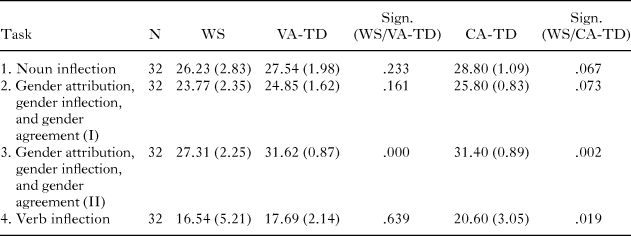
The performance of the WS and the control groups was compared using non-parametric statistics (Mann–Whitney U test). Table 2 shows the mean scores, the standard deviations, and the statistical significance of the differences between groups.
Mean (and SD) of correct responses in Tasks 1, 2, 3, 4

The WS group scored significantly lower than the CA-TD and the VA-groups in the task that evaluates the comprehension of gender attribution, gender inflection, and gender agreement (Task 3, Section 2.2.3). Close to significant results were observed in the task that assesses verbal inflection (Task 4, Section 2.2.4), but only compared to the CA-TD group (Table 2). The variability of the scores was slightly greater for the WS group compared to the VA-TD group. Because of the several types of items we have considered, we provide below a qualitative analysis of the results. Whenever items can be grouped in larger subcategories (e.g., problems with regular vs. irregular verbs in Task 4), we also give the significance of the differences according to the Mann–Whitney U test.
3.2. noun inflection (task 1)
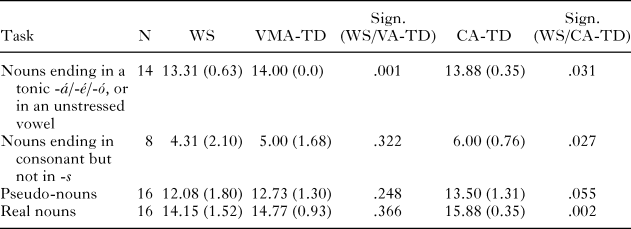
In this task, significant differences between the WS and the VA-TD groups were observed regarding nouns ending in a tonic -á,-é/-ó, or in an unstressed vowel (Table 3). These nouns add -s to the singular form. Pseudo-nouns or low-frequency nouns were problematic for children with WS. Usually they used the singular form (e.g., ictó/*ictó; orangután ‘orangutan’/*orangután; gibón ‘gibbon’/*gibón). Overall, although non-existing nouns were processed more poorly than the real ones, differences between groups were not significant (Table 3).
Mean (and SD) of correct responses in noun inflection (Task 1)

3.3. gender attribution, gender inflection, and gender agreement (i) (task 2)
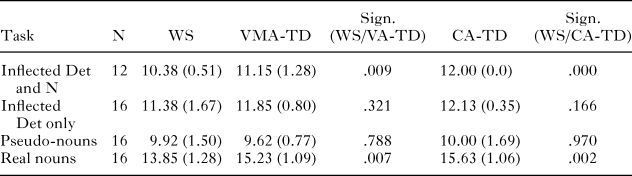
Differences between the WS and the VA-TD groups in this task were not significant (Table 2). Overall, the task seemed problematic for TD children too (particularly for younger children), who did not score at ceiling. Children with WS significantly underscored when they had to produce noun phrases with three inflectional markers (e.g., el MASC pato MASC blanco MASC) (Table 4). They also performed significantly worse than the VA-TD group when they had to inflect pseudo-nouns.
Mean (and SD) of correct responses in gender attribution, gender inflection, and gender agreement I (Task 2)

3.4. gender attribution, gender inflection, and gender agreement (ii) (task 3)
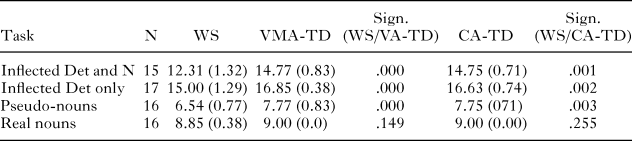
This task was a challenge for children with WS (Table 2). Differences with the VA-TD and the CA-groups were statistically significant for all conditions, except for real nouns (Table 5).
Mean (and SD) of correct responses in gender attribution, gender inflection, and gender agreement II (Task 3)

3.5. verb inflection (task 4)
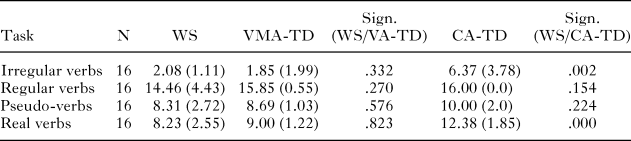
In this task children with WS scored similarly to their peers matched on VA, but significantly lower than their peers matched on CA on some kind of items, particularly on irregular verbs (Table 6). A qualitative analysis of their answers showed that the most difficult verbs for children with WS were derived irregular verbs, either non-real (e.g., condigerir = con ‘with’ + digerir ‘digest’, expected simple past form: condigirió, given answers: *condigerió, *condigeró, ?condigerir) or real (e.g., retener ‘retain’, expected past form: retuvo, given answers *retenió, *retenó, ?retener).
Mean (and SD) of correct responses in verb inflection (Task 4)

4. Discussion
Our results suggest that the competence achieved by Spanish children with WS parallels that of their peers matched on VA and even that of their peers matched on CA in some areas. They experience some problems with gender assignment, gender inflection, and gender agreement. Next, we discuss the results in some detail. At the end of this section, we suggest a possible explanation for what we have observed.
4.1. noun inflection
Children with WS and VA-TD children perform similarly regarding all pluralization patterns in Spanish, with the exception of nouns ending in a tonic -á,-é/-ó, or in an unstressed vowel. These results are in line with Pérez-Pereira (Reference Pérez-Pereira1989), who found that TD children (aged from three to six years) score significantly lower when the -es allomorph is required. The same pattern has been observed in Spanish children with Down Syndrome (Lázaro, Garayzábal, & Moraleda, Reference Lázaro, Garayzábal and Moraleda2013). Additionally, we found that children with WS perform better with real nouns. Again, this is also in line with Pérez-Pereira (Reference Pérez-Pereira1989), who found that TD children have more problems when they have to pluralize pseudo-words. On the whole, our children with WS behave very much like younger TD children. Our results are also in line with previous results with children with WS acquiring English, who have mastered the rule for pluralizing nouns, but who still show problems with irregular forms (Bromberg et al., Reference Bromberg, Ullman, Marcus, Kelly and Levine1995; Clahsen & Almazan, Reference Clahsen and Almazan1998, for spontaneous speech; Clahsen et al., Reference Clahsen, Ring, Temple, Bartke and Siegmüller2004).
4.2. gender attribution, gender morphology, and gender agreement
Several lessons can be drawn from our evaluation. First, children with WS drive more efficiently from gender/sex attributes to grammatical gender (as in Task 2) than from grammatical gender to the referent’s features (as in Task 3). Second, they perform better with real nouns. This real-world effect has been observed in other languages too (see Clahsen and Almazan, Reference Clahsen and Almazan1998, for English, and Boloh, Ibernon, Royer, Escudier, and Danillon, Reference Boloh, Ibernon, Royer, Escudier and Danillon2009, for French). Third, to infer the gender (or the sex), children with WS focus on the noun, contrary to TD children, who focus more on the determiner. Specifically, the low scores obtained with pseudo-nouns not ending in -o/-a which refer to female drawings are in line with Boloh et al. (Reference Boloh, Ibernon, Royer, Escudier and Danillon2009), who found that French children with WS prefer the masculine form. According to Karmiloff-Smith et al. (Reference Karmiloff-Smith, Grant, Berthoud, Davies, Howlin and Udwin1997), this behaviour suggests that children with WS have learned article–noun pairs by rote, as young TD children also do. Overall, our results support the view that the morphological skills involved are delayed, in line with Boloh’s et al. (Reference Boloh, Ibernon, Royer, Escudier and Danillon2009) study of gender attribution in French. Finally, we also observed that the more variables to be computed, the worse the scores obtained by the WS group. Accordingly, in Task 2, children with WS performed significantly worse than their peers matched on VA when gender was also marked in the determiner.
4.3. verb inflection
According to our results, the acquisition of irregular forms is delayed in Spanish children with WS, because they perform quite similarly to their peers matched on VA, but significantly worse than their peers matched on CA. This is plausibly due to the low frequency of irregular forms in the input. Moreover, children with WS consistently over-regularize irregular verbs (both existing and non-existing verbs), as younger TD children do. Finally, children with WS correctly compute tense. This suggests that the notion of past is learned early in this condition. Our results are in line with Pérez-Pereira (Reference Pérez-Pereira1989), who found that young Spanish TD children tend to regularize irregular verbs and that irregular pseudo-verbs are assigned to the first conjugation (i.e., drumir [third conjugation] is inflected as drumó [first conjugation], instead of as drumió). We have observed this behaviour too. In contrast, children with WS inflect regular verbs (real and unreal) correctly. This supports the view that they have already mastered the rule needed for generating simple past forms.
On the whole, our results are in line with previous studies in languages other than Spanish that claim that children with WS have mastered the production of regular past forms, although they still exhibit a poor command of irregular forms, which are mainly over-regularized (Bromberg et al., Reference Bromberg, Ullman, Marcus, Kelly and Levine1995; Clahsen & Almazan, Reference Clahsen and Almazan1998; Krause & Penke, Reference Krause and Penke2002; Clahsen et al., Reference Clahsen, Ring, Temple, Bartke and Siegmüller2004). Moreover, our results support the view that the grammatical knowledge of children with WS is similar to that of younger TD children, as also suggested by many other researchers (e.g., Karmiloff-Smith et al., Reference Karmiloff-Smith, Grant, Berthoud, Davies, Howlin and Udwin1997; Thomas et al., Reference Thomas, Grant, Barham, Gsödl, Laing, Lakusta and Karmiloff-Smith2001; Lukács et al., Reference Lukács, Racsmány and Pléh2001; Levy & Hermon, Reference Levy and Hermon2003; Lukács, Pléh, & Racsmány, Reference Lukács, Pléh, Racsmány, Bartke and Siegmüller2004; Lukács, Reference Lukács2005).
4.4. conclusions
To date, research about the linguistic abilities of children with WS acquiring Spanish is still scarce. In this study we have tested several issues regarding noun and verbal morphology, and also agreement within the noun phrase. Our results confirm that children with WS behave much as younger TD children. Accordingly, they have mastered the morphological rules involved, but they have problems with irregular forms or infrequent items. This may result from a delay in the normal process of restricting the scope of productive rules, although some processing constraint may account for their lower scores in tasks involving a high number of morphosyntactic cues.